Sample Category Title
Santa Rally on Standby with Markets Split on 2026 Fed Cuts
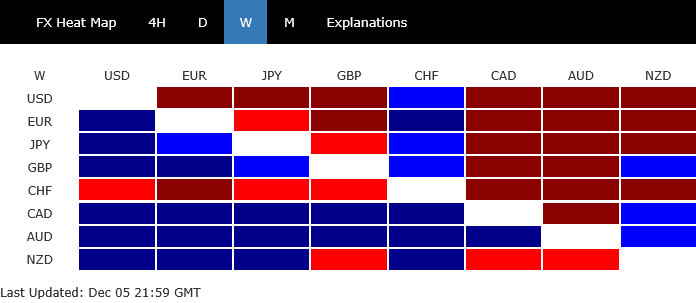
Dollar spent most of the week pinned to the bottom of the performance board, as a steady flow of data reinforced expectations for a Fed rate cut in December. Even though selling pressure eased slightly into Friday—thanks in part to a surprisingly firm rebound in longer-dated Treasury yields—the greenback still struggled to find a foothold.
Risk sentiment improved across major markets, and that shift alone did much of the heavy lifting. The notable underperformance of the Swiss Franc highlighted the change in tone, with safe-haven demand fading while yields elsewhere climbed. Euro was also heavy.
Against that backdrop, the outperformers told their own story. Aussie surged to the top of the weekly rankings as traders began to position for the possibility of an RBA hike in 2026. Governor Michele Bullock’s message to the parliament—signaling that policymakers may need to pivot back toward tightening if inflation re-accelerates—gave markets a narrative they were quick to embrace.
Canada’s Dollar was not far behind, propelled by another impressive labor-market beat that further cemented expectations for the BoC to hold rates unchanged through 2026. Sterling also benefited from persistent optimism following the well-received Autumn Budget, helping it round out the top three.
Yen and Kiwi held the middle ground but for very different reasons. In Japan, rising expectations for a December BoJ rate hike were tempered by stronger global risk appetite. For Kiwi, the tone was firm but restrained, with investors largely respecting the RBNZ’s hawkish hold last month, without chasing the move.
US Stocks Hold Their Nerve, but Santa Needs More Data
Whether US equities are entering a genuine Santa Claus rally remains an open question, but last week’s performance at least showed that dip buyers are still very much alive. The brief pullback in mid-November was swiftly absorbed, with major indexes defending near-term technical supports and re-establishing upward momentum. That resilience alone keeps the year-end rally narrative on the table.
Still, the conviction behind the move is less than overwhelming. Many investors are reluctant to chase the highs given the sheer volume of event risk ahead. Markets have already fully priced in a Fed rate cut this month, and incoming data last week largely validated that view. What remains uncertain is the path beyond December, and that lack of clarity is holding sentiment in check.
The next two weeks could change that. The December 10 FOMC meeting is clearly a consequential one—not because of the cut itself, which markets assume—but because of the updated economic projections and the new dot plot. These will effectively set the tone for how aggressively the Fed expects to—or is willing to—ease through early 2026.
In parallel, the following week’s heavy-weight data—NFP and CPI—will give markets a more concrete read on whether pricing pressures are merely stabilizing at a still-elevated level, and whether the deterioration of job market is already in the rear mirror. For equities, “bad news is good news” still applies, but only up to a point. Softer data would strengthen the case for earlier or deeper Fed cuts, thereby supporting valuations.
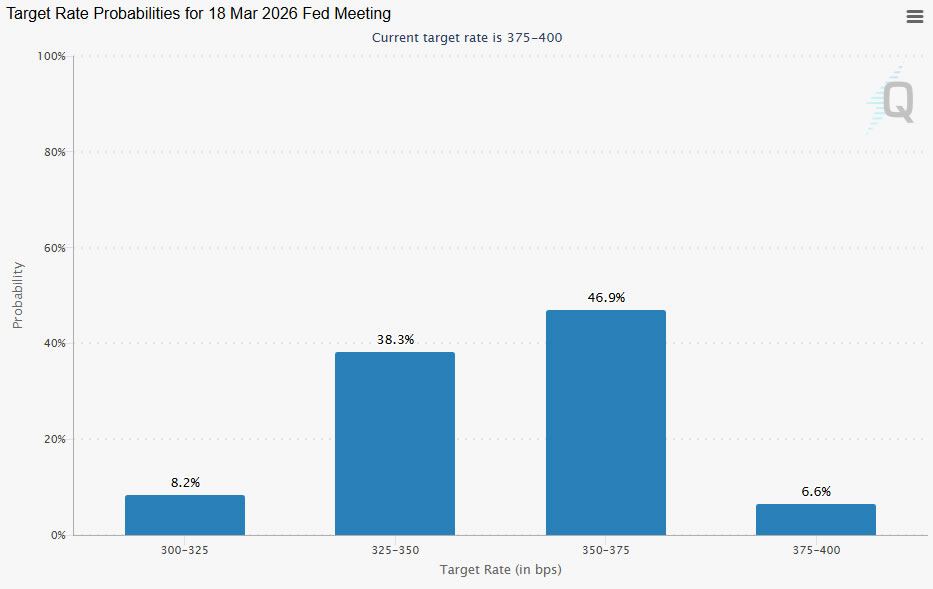
Fed fund futures, meanwhile, reflects a lot of uncertainty. The odds of another 25bps cut by March sit just under 50%, essentially a coin toss. That pricing highlights how divided the market is on whether the Fed pauses in Q1 or continues easing. Until that gap closes one way or the other, equities could remain reactive rather than directional.
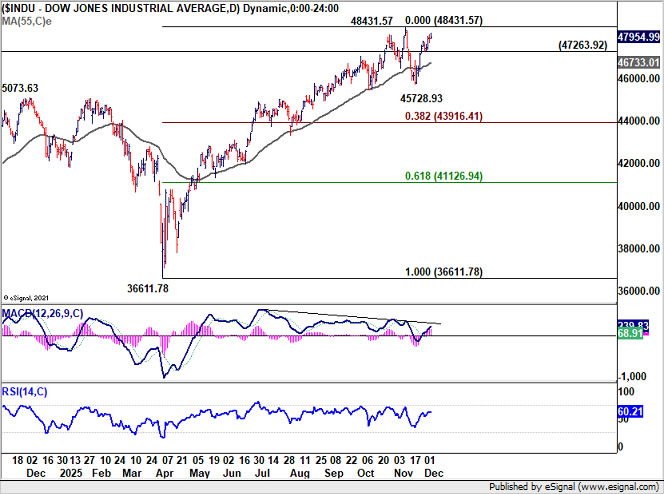
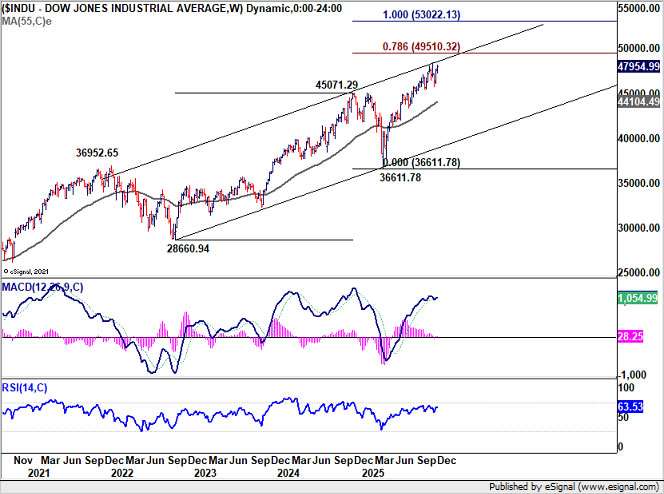
Technically, for DOW, break of 48,431.57 will resume the long term up trend to 78.6% projection of 28,660.94 to 45,701.29 from 36,611.78 at 49,510.32, or even further to 50k psychological level in the near term. However, on the downside, break of 47,263.92 support will suggest that corrective pattern from 48,431.57 has started a third leg, and would target 47,528.93 support again.
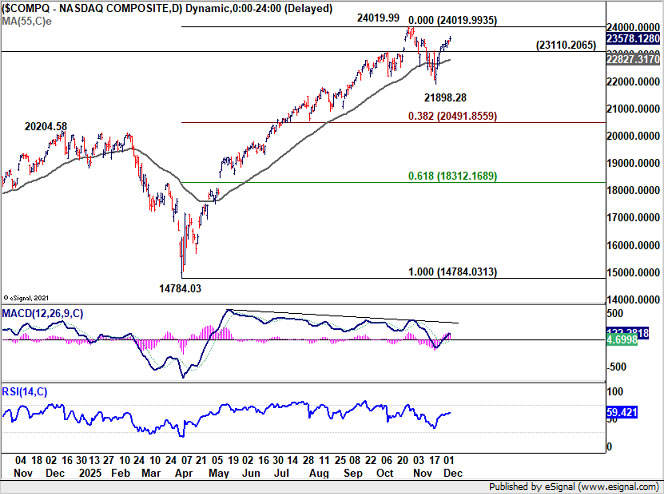
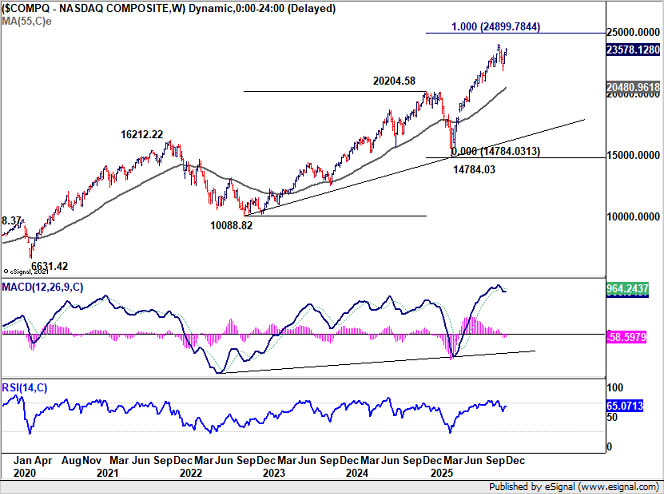
Similarly, break of 24,019.99 will resume NASDAQ's up trend to 100% projection of 10,088.82 to 20,204.58 from 14,784.03 at 24,899.78. However, on the downside, break of 23,110.20 support will extend the corrective pattern from 24,019.99 with another falling leg to 21,898.28 support again.
So the question remains: will Santa deliver? The answer hinges on whether next week’s Fed projections and the following week’s CPI/NFP releases provide markets with the confidence they currently lack. Until then, optimism is warranted—but caution still rules the edges of the rally.
Yields Surge on Fears of a Politicized Fed; Dollar Struggles to Keep Up
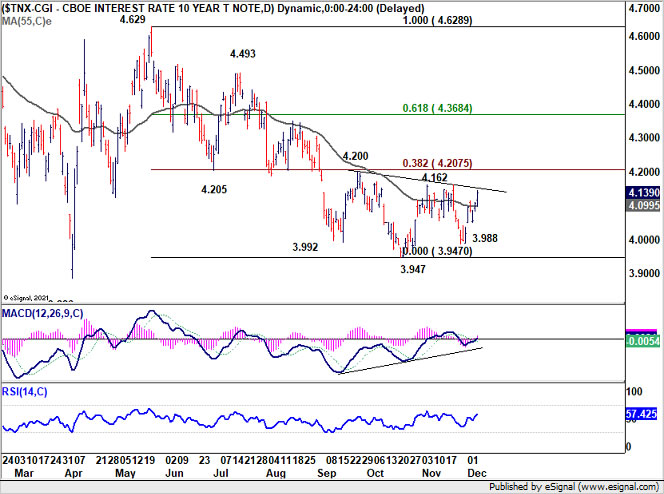
US Treasury yields displayed far more resilience last week than many had expected. Instead of extending the slide toward October low of 3.947, the 10-year yield reversed and closed firmly at 4.139. Part of that rebound reflects improved risk appetite globally, as investors rotated out of safety and back into equities. But that alone does not fully explain the recovery, given the market’s growing conviction that the Fed will cut rates next week.
A deeper driver may be emerging: the market is beginning to price in a wider range of political and policy outcomes for 2026. The looming transition at the Fed has injected some unmistakable uncertainty that extends beyond the typical macro data cycle. Chair Jerome Powell’s term ends next year, and reports increasingly suggest that President Donald Trump intends to appoint his top economic adviser Kevin Hassett as the next Fed chief.
Hassett is widely perceived as a strong monetary dove, and the prospect of a Fed leadership more aligned with the White House introduces non-trivial risks for bond markets. Investors fear that a politically influenced Fed could lean too heavily into easing—even in an environment where inflation remains above target—potentially setting the stage for a renewed inflation cycle.
That anxiety may explain why longer-dated yields are refusing to break lower despite softer labor market signals. The bond market is effectively hedging against the possibility that the Fed’s medium-term reaction function becomes less restrictive and less focused on price stability. In other words, yields are reacting not just to economic data, but to institutional risk.
A further wrinkle is the idea that Hassett could operate as a “shadow Fed chair” in the months before formally taking office. Markets fear that his comments—rather than Powell’s—may become the unofficial guide for rate-expectation pricing. That would add volatility to an already delicate policy transition.
Against this backdrop, Dollar remains soft but not outright collapsing. Most of the weakness last week stemmed from improving global risk sentiment rather than any direct Fed repricing. Dollar selloff against European majors has slowed towards the end of the week, while yield support offers a partial offset. Still, the greenback retains a heavy tone as long as political uncertainty lingers.
Technically, 10-year yield may be completing a head-and-shoulders bottoming formation (ls 3.992; h: 3.947; rs: 3.988). Break of 4.162 will complete the pattern and be the first important sign of bullish trend reversal.
Nevertheless, the much more important hurdle lies in 4.2 cluster resistance level, with 4.200 resistance as well as 38.2% retracement of 4.629 to 3.947 at 4.207. As long as this level holds, outlook for 10-year yield will stay neutral at best.
However, firm break of 4.2 could easily push 10-year yield to 61.8% retracement at 4.368 and above. And that could be a strong indication of some serious underlying repricing.
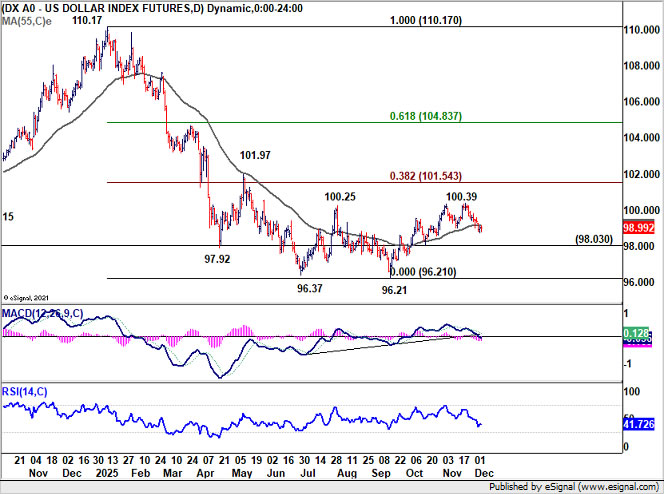
Dollar Index gyrated lower last week to close at 98.99. The break of 55 D EMA (now at 99.13) argues that rebound from 96.21 might have completed at 100.39 already.
Deeper fall is now in favor to 98.03 support. Decisive break there will confirm this bearish case, and bring retest of 96.21 low.
In case of another rise, strong resistance is still expected from 38.2% retracement of 110.17 to 96.21 at 101.54 to limit upside.
Markets Flip Toward RBA Tightening—Aussie Extends Gains, Loonie Strengthens Too
Commodity currencies finished last week as clear outperformers, buoyed by firmer risk sentiment and strong domestic catalysts. Aussie led the major currencies, reflecting a dramatic shift in how markets now view next year’s RBA policy path. What only recently looked like a debate between “cut or hold” has quickly evolved into early pricing of outright tightening.
The turnaround in expectations has been striking. Just two weeks ago, traders were split on whether the RBA might cut rates by May. But with inflation showing signs of re-accelerating, and national accounts revealing an economy gaining momentum into year-end despite the headline miss. Markets have swung decisively toward the view that the RBA will need to tighten, not ease, in 2026.
Household spending and private demand were firmer than anticipated, reinforcing concerns that underlying inflation pressure may not fade as quickly as policymakers hoped, or even re-emerge. That was enough for investors to conclude that rate cuts are effectively off the table, while the risk of multiple hikes is now starting to be priced in from February onward.
Loonie also impressed, albeit through a very different catalyst. The late-week surge stemmed from another strong jobs report, marking the third consecutive upside surprise. November’s employment gains and the sharp drop in unemployment signal that the economy is finally moving past the drag created by earlier US tariff distortions.
For the BoC, the message is now crystal clear: the easing cycle is over. After delivering 275bps of cuts—one of the largest cycles among major central banks—the BoC signaled in October that policy was already near the lower bound of neutral. The latest labor-market data cement expectations that rates will remain on hold until at least 2027 unless growth deteriorates sharply.
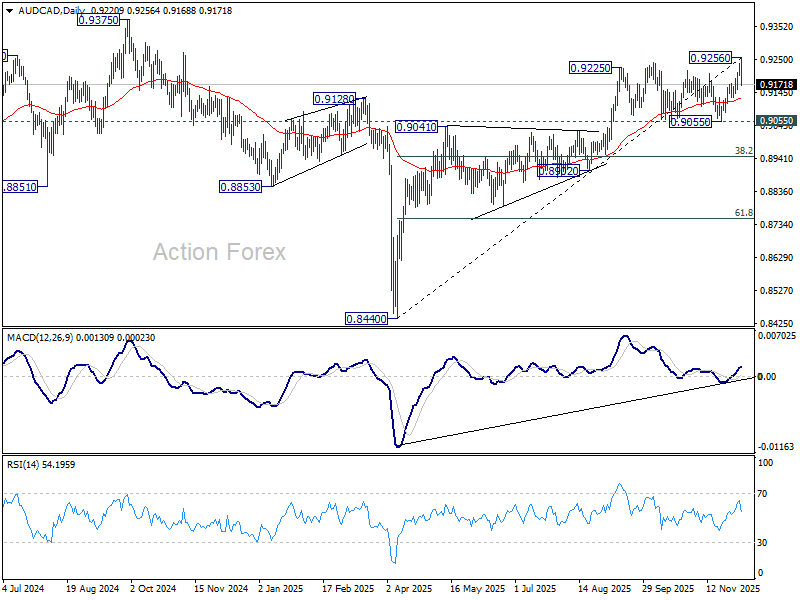
Despite the solid macro backdrop for both currencies, AUD/CAD price action reflects a market pausing for breath. The cross briefly edged to 0.9256 before reversing sharply, hinting that a short-term top is already in place. Profit-taking near major resistance added to the pullback.
In the near term, consolidation looks more likely than continuation. A deeper dip toward the 55-day EMA at 0.9127 is possible, particularly if risk appetite wobbles or if investors reassess the pace of RBA tightening. A break of the EMA would not alter the broader trend but would reinforce the view that the pair needs more time to establish a base.
Bigger-picture momentum, however, remains constructive. As long as 0.9055 support holds, the rise from the 2025 low at 0.8440 remains intact, and another leg higher is favoured at a later stage. The timing—and strength—of that move will depend on how aggressively markets lean into RBA hike expectations in early 2026.
Only a firm break of 0.9055 would suggest that AUD/CAD is no longer trending, opening a deeper pullback toward the 38.2% retracement of 0.8440 to 0.9256 at 0.8944. Until then, dips remain part of a broader bullish structure anchored by relative central-bank divergence.
USD/CAD Weekly Outlook
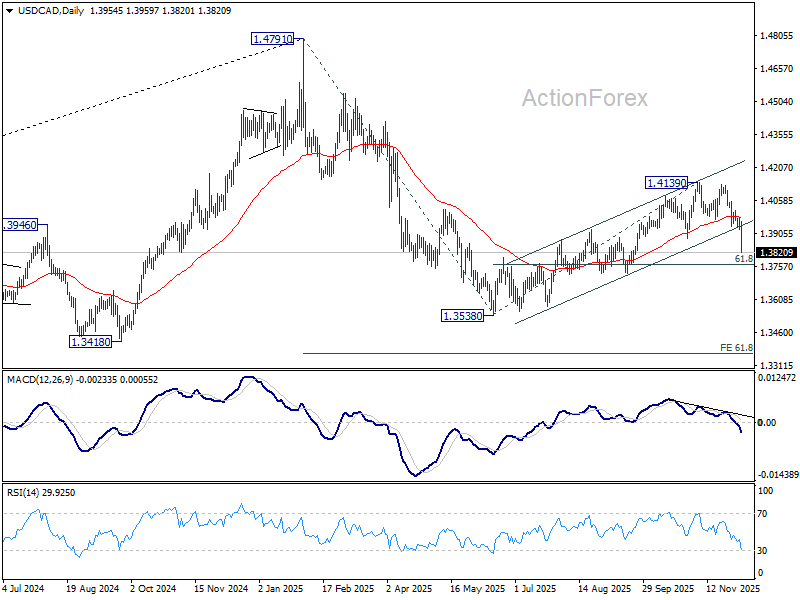
USD/CAD's steep decline last week suggests that rise from 1.3538 has already completed at 1.4139. Initial bias remains on the downside this week for 61.8% retracement of 1.3538 to 1.4139 at 1.3768. Firm break there will argue that whole decline form 1.4791 might be ready to resume through 1.3538 low. For now, risk will stay on the downside as long as 1.3970 support turned resistance holds, in case of recovery.
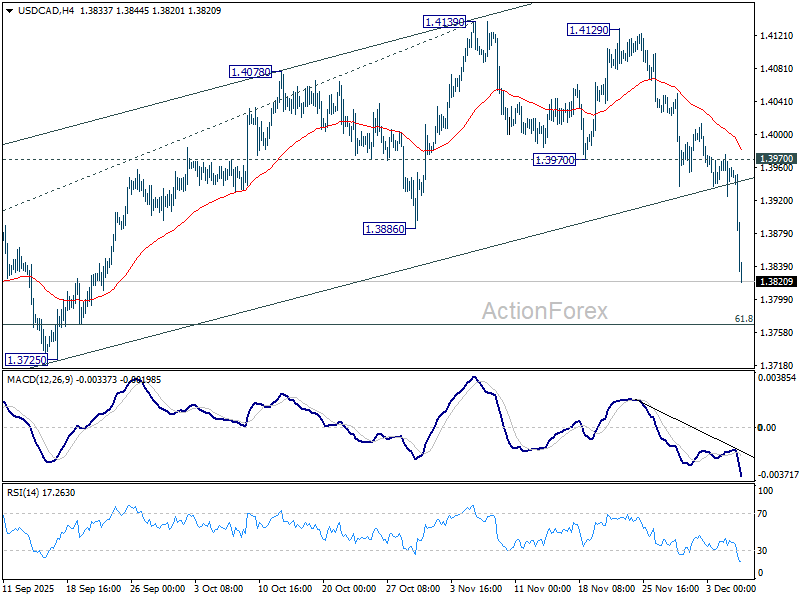
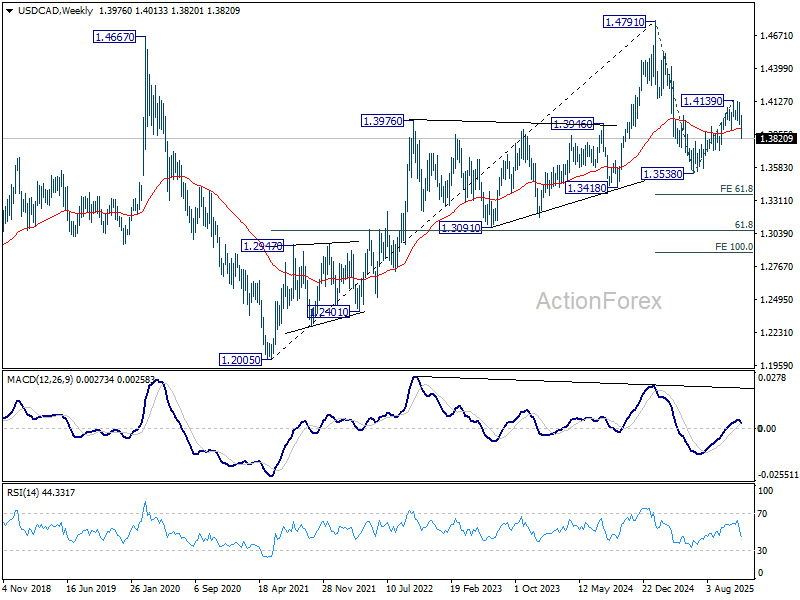
In the bigger picture, current development suggests that price actions from 1.4791 is developing into a deeper, larger scale correction. In the less bearish case, it's just correcting the rise from 1.2005 (2021 low). But even so, break of 1.3538 will pave the way to 61.8% projection of 1.4791 to 1.3538 from 1.4139 at 1.3365. This will remain the favored case as long as 1.4139 resistance holds, in case of rebound.
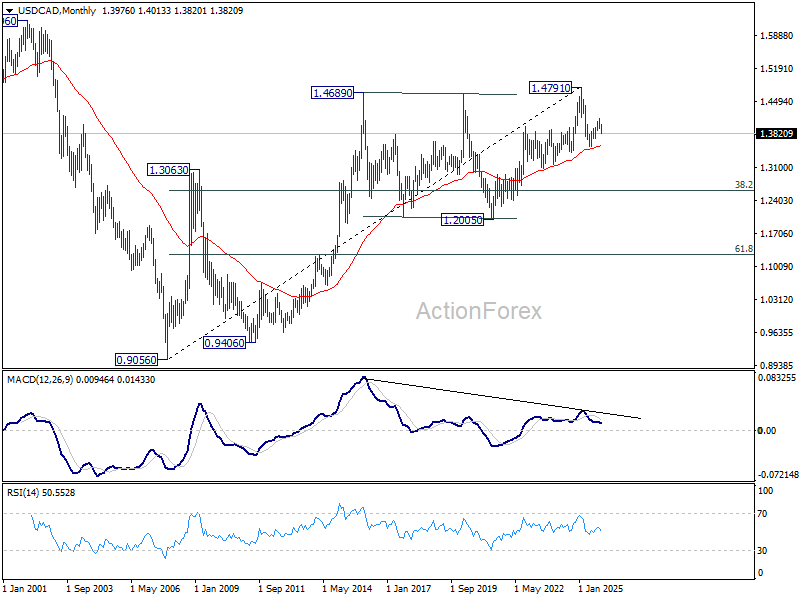
In the long term picture, rising 55 M EMA (now at 1.3567) remains intact. Thus, up trend from 0.9056 (2007 low) should still be in progress. However, considering bearish divergence condition M MACD, sustained trading below 55 M EMA will argue that the up trend has completed with five waves up to 1.4791, and turn medium term outlook bearish for correction. to 38.2% retracement of 0.9056 to 1.4791 at 1.2600.
EUR/USD Weekly Outlook
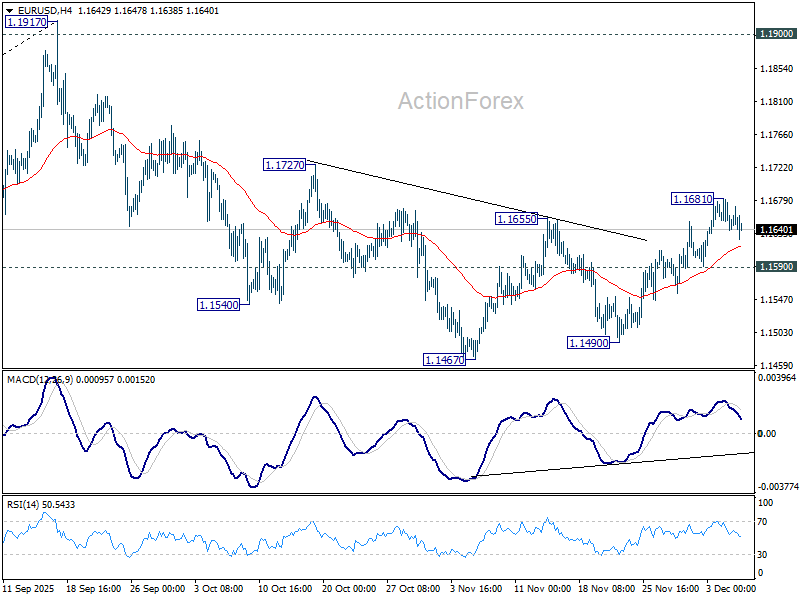
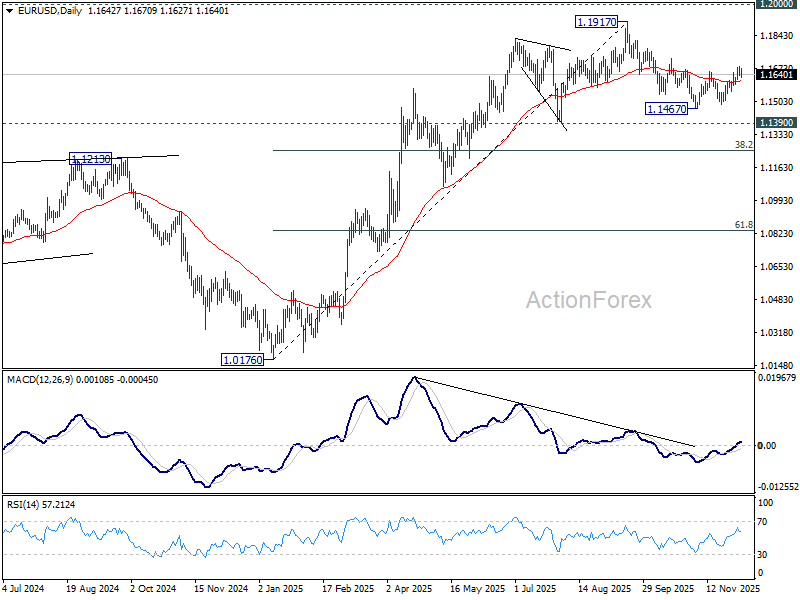
EUR/USD rebounded to as high as 1.1681 last week but retreated since then. Initial bias is turned neutral this week first. Corrective fall from 1.1917 could have completed at 1.1467. Above 1.1681 will target 1.1727 resistance first. Firm break there will solidify this case and bring retest of 1.1917 high. However, break of 1.1590 will revive near term bearishness, and bring retest of 1.1467 low.
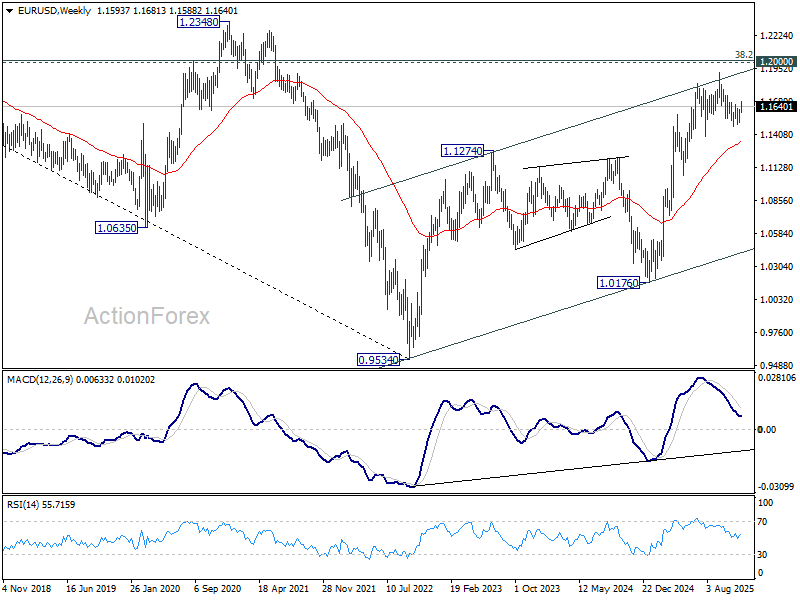
In the bigger picture, as long as 55 W EMA (now at 1.1346) holds, up trend from 0.9534 (2022 low) is still in favor to continue. Decisive break of 1.2 key psychological level will carry larger bullish implication. However, sustained trading below 55 W EMA will argue that rise from 0.9534 has completed as a three wave corrective bounce, and keep long term outlook bearish.
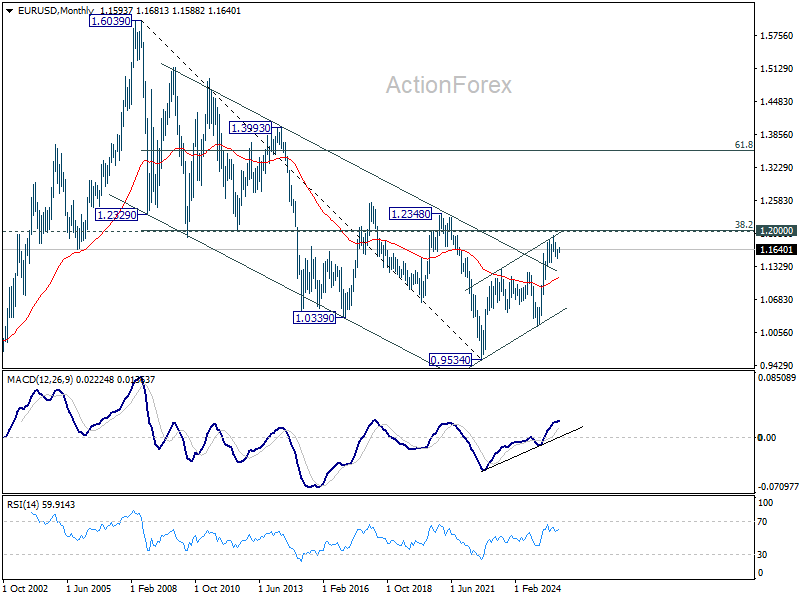
In the long term picture, 38.2% retracement of 1.6039 to 0.9534 at 1.2019, which is close to 1.2000 psychological level is the key for the outlook. Rejection by this level will keep the multi decade down trend from 1.6039 (2008 high) intact, and keep outlook neutral at best. However, decisive break of 1.2000/19, will suggest long term bullish trend reversal, and target 61.8% retracement at 1.3554.
USD/JPY Weekly Outlook
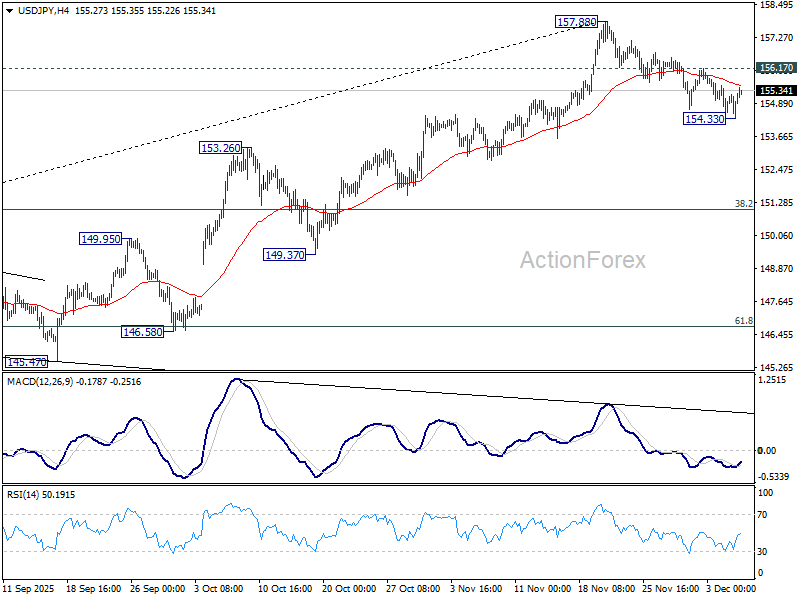
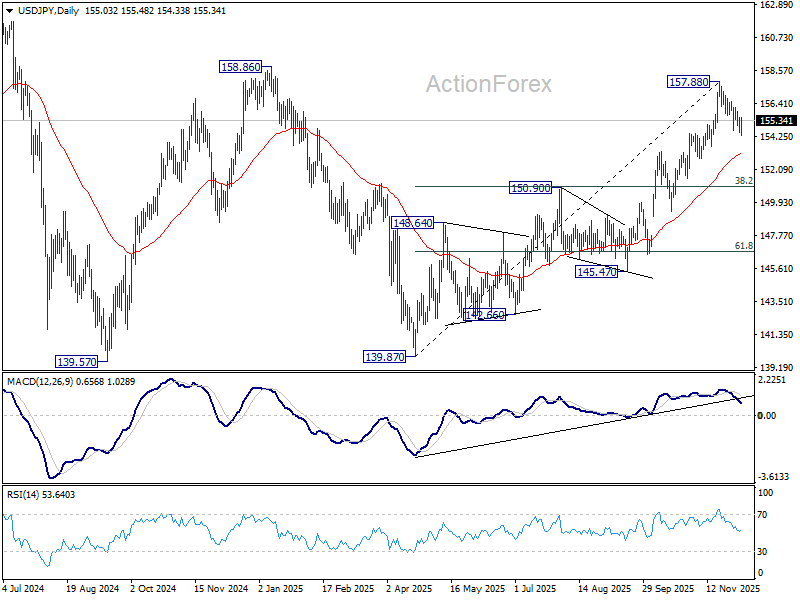
USD/JPY's fall from 157.88 short term top extended lower last week, but lost momentum after hitting 154.33. Initial bias is turned neutral this week first. On the downside, below 154.33 will target 55 D EMA (now at 153.11). Firm break there will bring deeper fall to 150.90 cluster (38.2% retracement of 139.87 to 157.88 at 151.00). On the upside, though, break of 156.17 resistance will indicate that the pullback has completed and bring retest of 157.88 high.
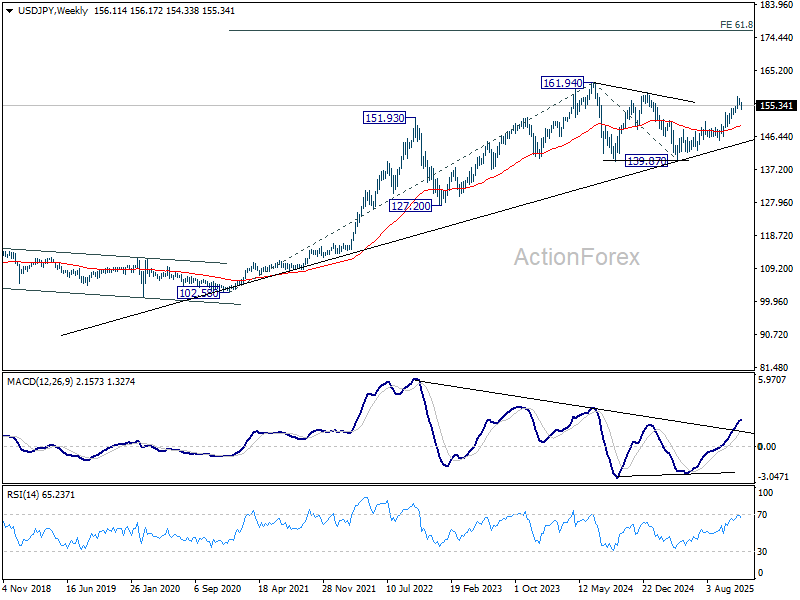
In the bigger picture, corrective pattern from 161.94 (2024 high) could have completed with three waves at 139.87. Larger up trend from 102.58 (2021 low) could be ready to resume through 161.94 high. Decisive break of 158.85 structural resistance will solidify this bullish case and target 161.94 for confirmation. On the downside, break of 150.90 resistance turned support will dampen this bullish view and extend the corrective range pattern with another falling leg.
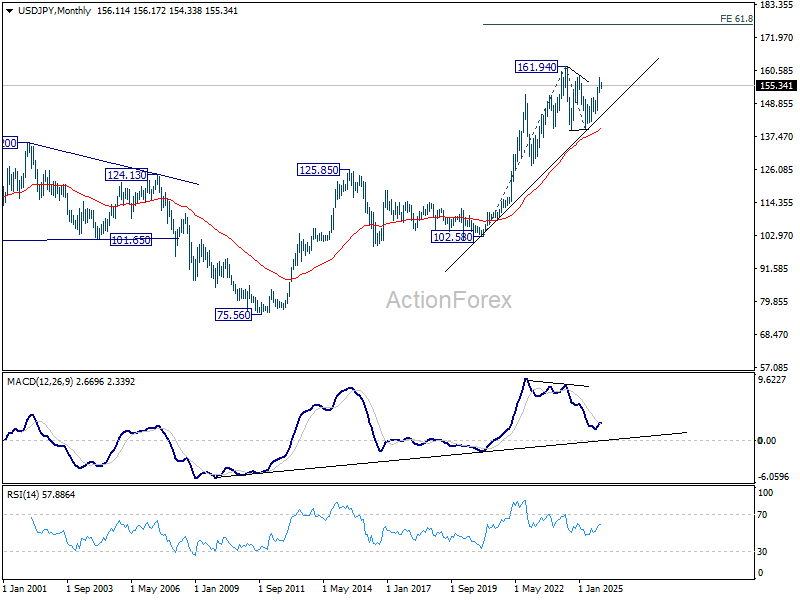
In the long term picture, up trend from 75.56 (2011 low) is still in progress and might be ready to resumption. Firm break of 161.94 will target 61.8% projection of 102.58 (2020 low) to 161.94 (2024 high) from 139.87 at 176.55 in the medium term.
GBP/USD Weekly Outlook
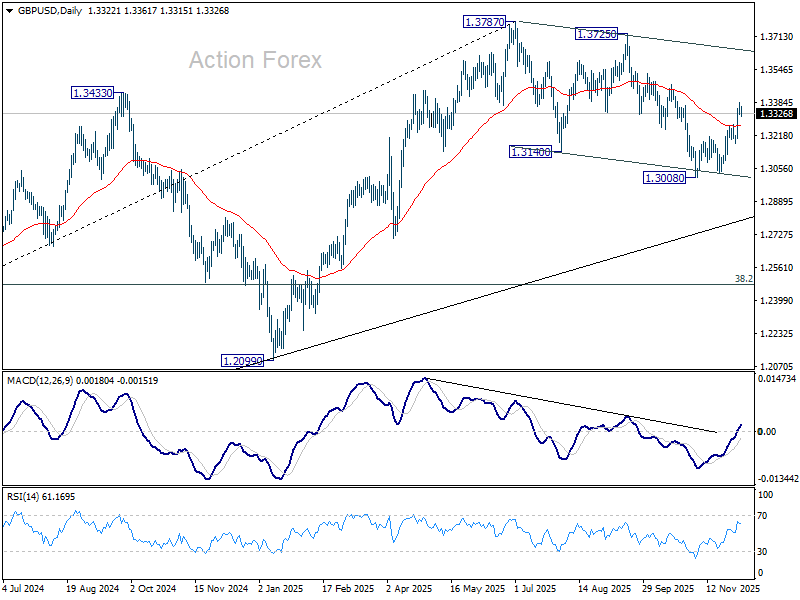
GBP/USD's rebound from 1.3008 resumed last week but retreated after hitting 1.3384. Initial bias remains neutral this week for some consolidations. But further rally is expected as 1.3178 support holds. Current development suggests that fall from 1.3787 has completed as a three-wave correction to 1..3008. Above 13384 will target 1.3470 resistance. Decisive break there will bring retest of 1.3787 high.
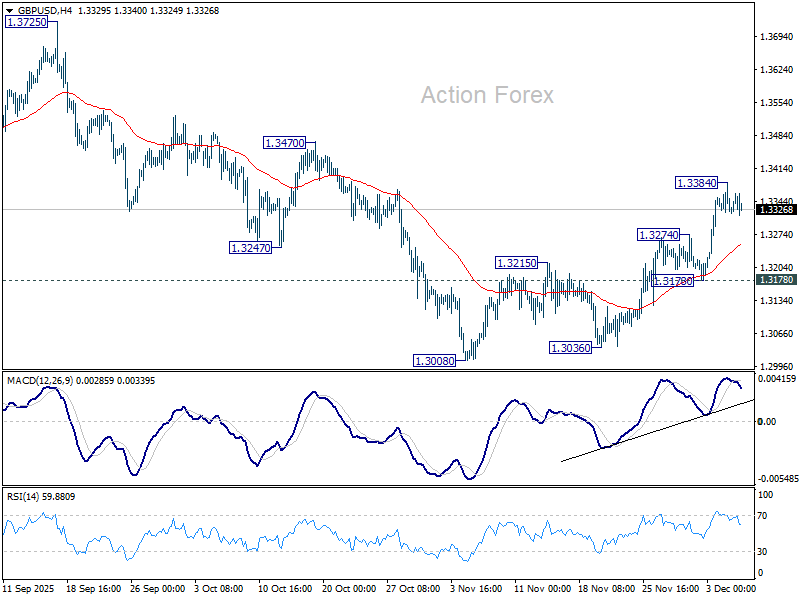
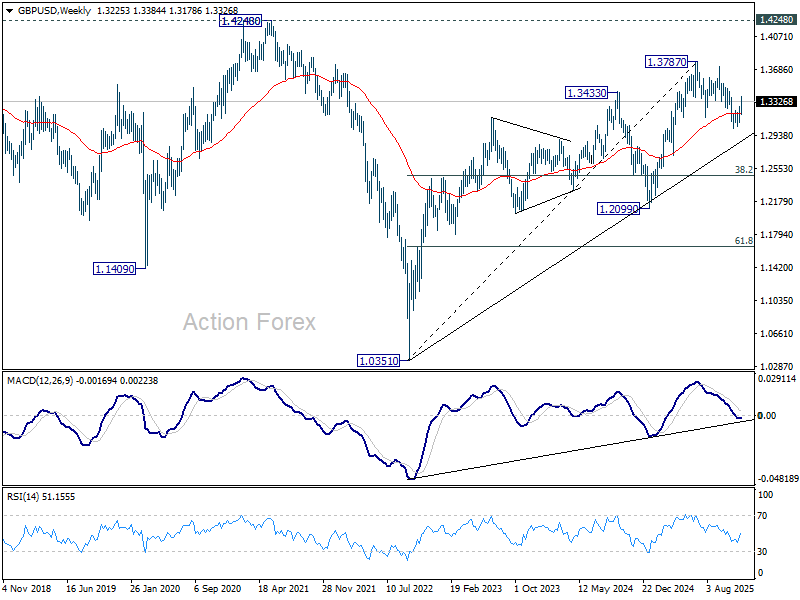
In the bigger picture, current development suggests that fall from 1.3787 is merely a corrective move, and larger rise from 1.0351 (2022 low) is still in progress. Firm break of 1.3787 will target 1.4248 (2021 high) key structural resistance. This will remain the favored case as long as target 38.2% retracement of 1.0351 to 1.3787 at 1.2474 holds, in case of another fall.
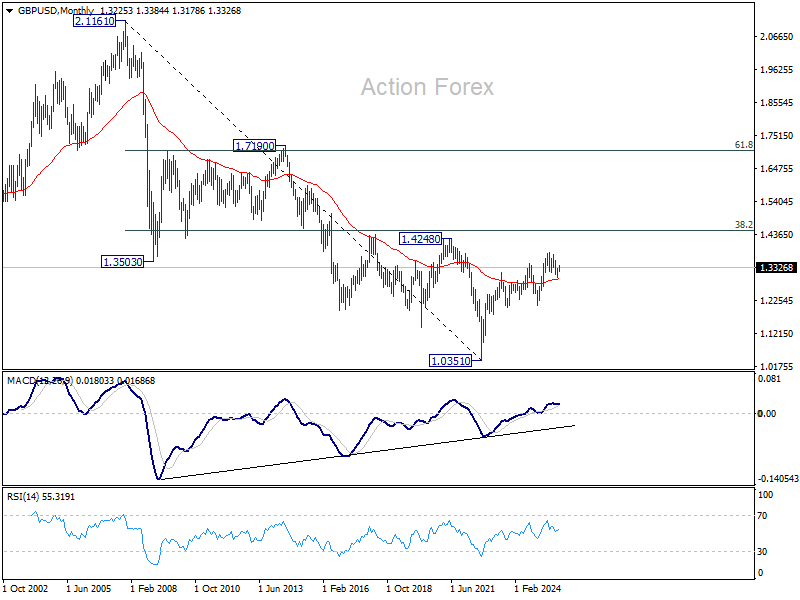
In the long term picture, as long as 1.4248/4480 resistance zone holds (38.2% retracement of 2.1161 to 1.0351 at 1.4480), the long term outlook will remain bearish. That is, price actions from 1.3051 are seen as a corrective pattern to down trend from 2.1161 (2007 high) only. Nevertheless, decisive break of 1.4248/4480 will be a strong sign of long term bullish reversal.
USD/CHF Weekly Outlook
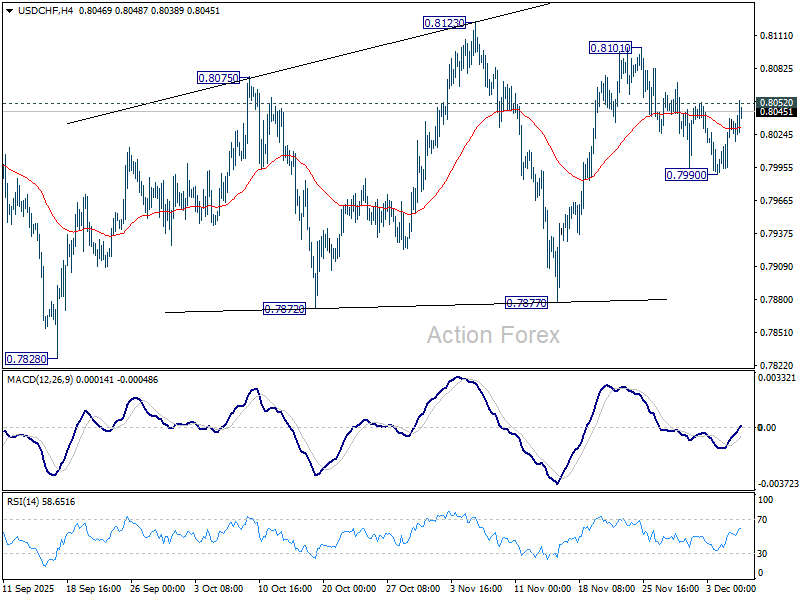
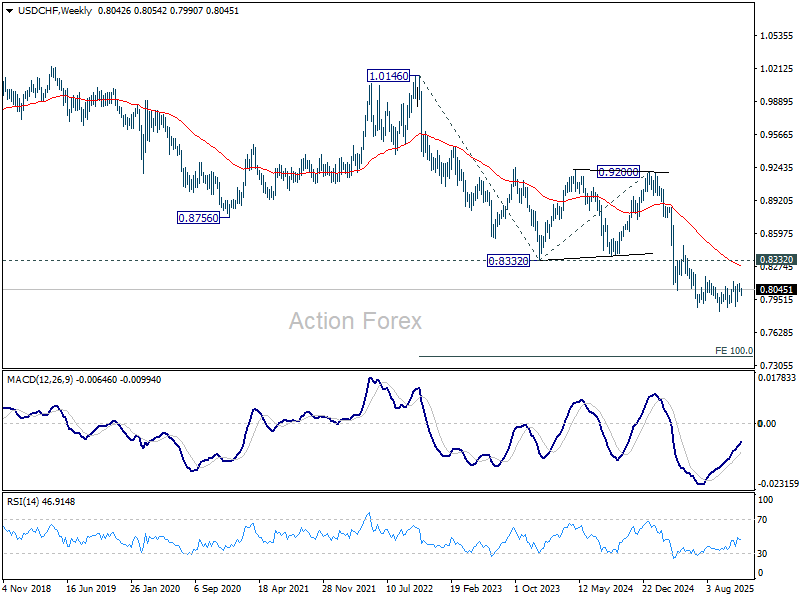
USD/CHF retreated to 0.7990 last week but recovered since then. Initial bias stays neutral this week first. Overall outlook is unchanged that price actions from 0.7828 are developing into a corrective pattern. On the upside, break of 0.8052 will bring stronger rise to 0.8101, and then 0.8123 resistance. On the downside, though, break of 0.7990 will extend the fall from 0.8101 towards 0.7877 support instead.
In the bigger picture, long term down trend from 1.0342 (2017 high) is still in progress. Next target is 100% projection of 1.0146 (2022 high) to 0.8332 from 0.9200 at 0.7382. In any case, outlook will stay bearish as long as 0.8332 support turned resistance holds (2023 low).
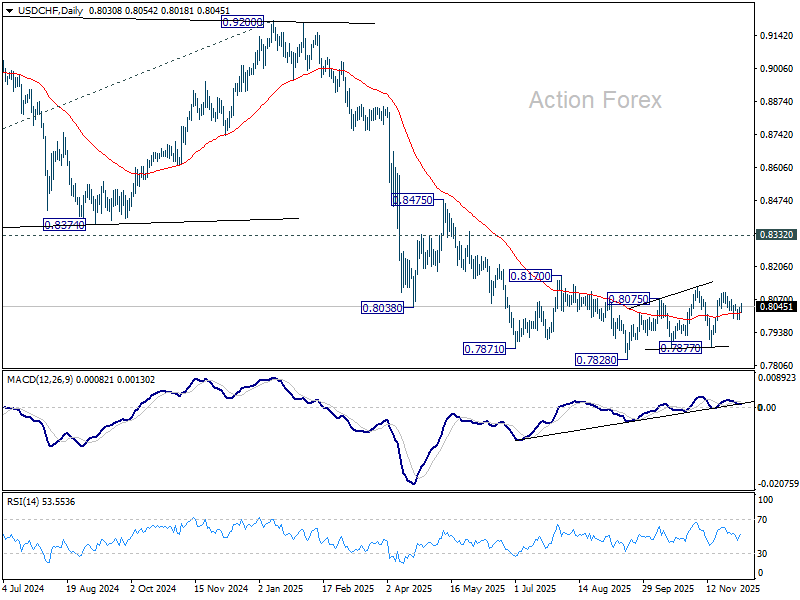
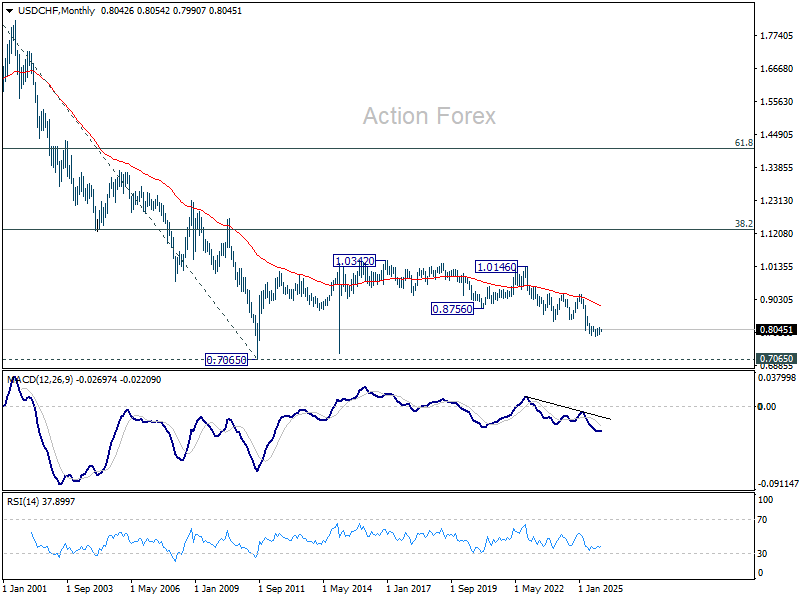
In the long term picture, price action from 0.7065 (2011 low) are seen as a corrective pattern to the multi-decade down trend from 1.8305 (2000 high). It's uncertain if the fall from 1.0342 is the second leg of the pattern, or resumption of the downtrend. But in either case, outlook will stay bearish as long as 0.8756 support turned resistance holds (2021 low). Retest of 0.7065 should be seen next.
AUD/USD Weekly Report
AUD/USD's strong rise last week suggests that corrective pattern from 0.6706 has already completed with three waves to 0.6420. Rise from 0.5913 might be ready to resume. Initial bias stays on the upside this week for retesting 0.6706 first. Firm break there will pave the way to 61.8% projection of 0.5913 to 0.6706 from 0.6420 at 0.6910. On the downside, below 0.6604 minor support will turn intraday bias neutral and bring consolidations, before staging another rise.
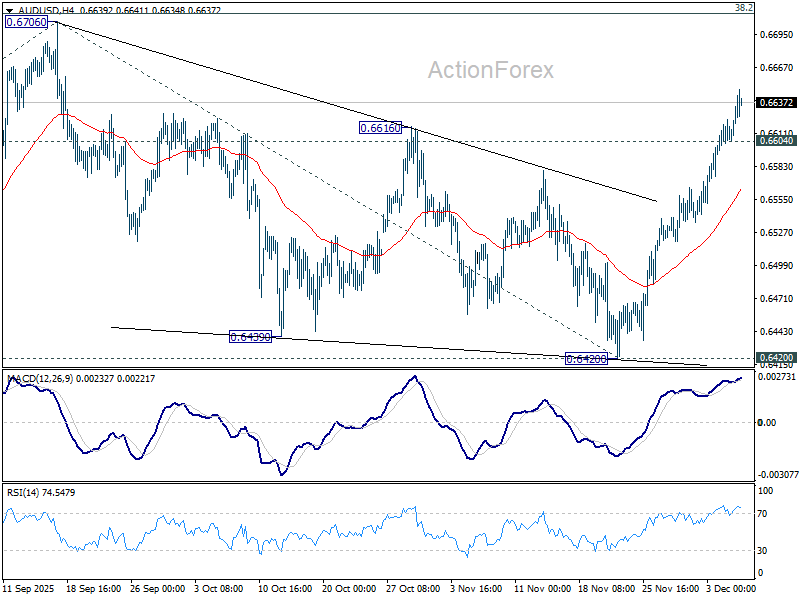
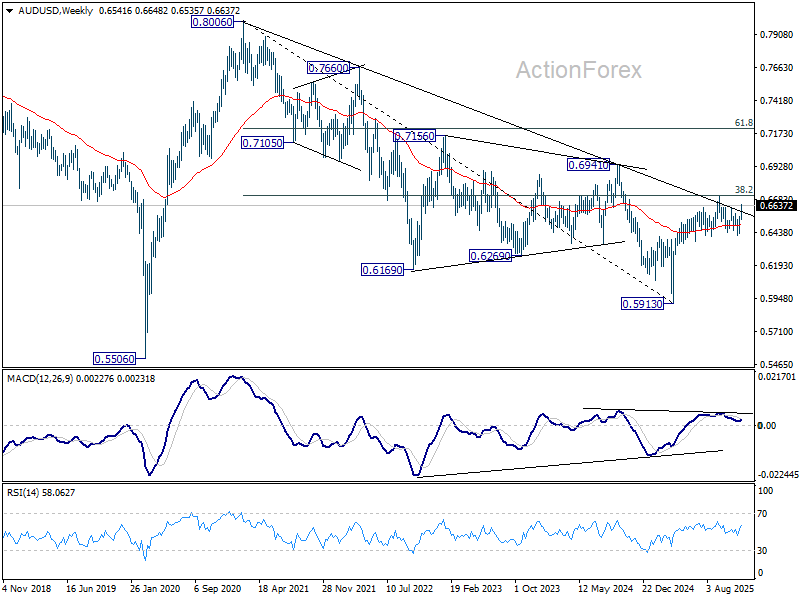
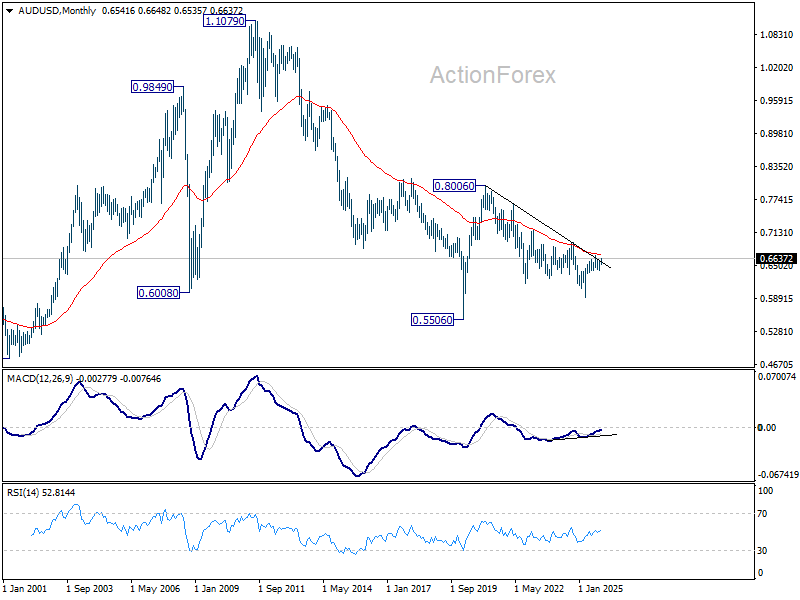
In the bigger picture, the break of multi-year falling trend line resistance suggests that rise from 0.5913 is possibly reversing whole down trend from 08006 (2021 high). Decisive break of 38.2% retracement of 0.8006 to 0.5913 at 0.6713 will solidify this case, and bring further rally to 61.8% retracement at 0.7206. On the downside, however, firm break of 0.6420 support will suggest rejection by 0.6713 and retain medium term bearishness.
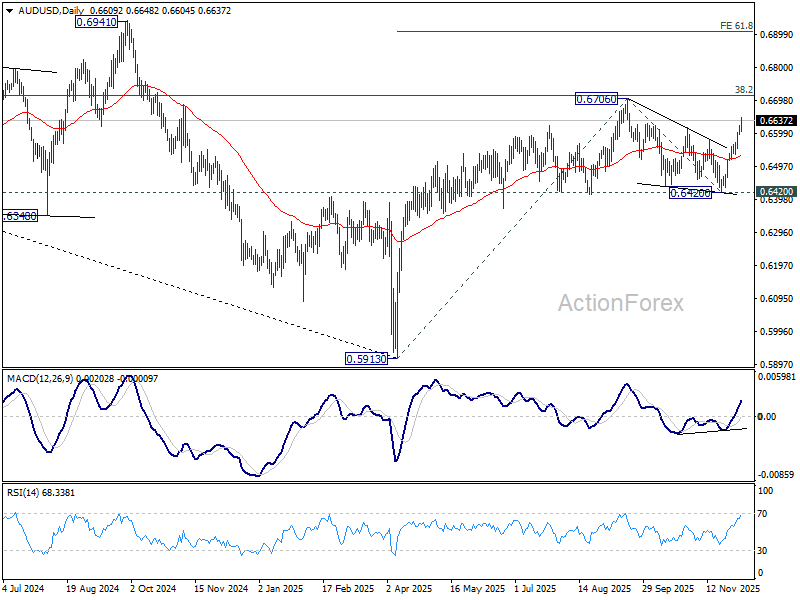
In the long term picture, fall from 0.8006 is seen as the second leg of the corrective pattern from 0.5506 long term bottom (2020 low). Hence, in case of deeper decline, strong support should emerge above 0.5506 to contain downside to bring reversal. On the upside, firm break of 0.6941 will argue that the third leg has already started back to 0.8006 and above.
USD/CAD Weekly Outlook
USD/CAD's steep decline last week suggests that rise from 1.3538 has already completed at 1.4139. Initial bias remains on the downside this week for 61.8% retracement of 1.3538 to 1.4139 at 1.3768. Firm break there will argue that whole decline form 1.4791 might be ready to resume through 1.3538 low. For now, risk will stay on the downside as long as 1.3970 support turned resistance holds, in case of recovery.
In the bigger picture, current development suggests that price actions from 1.4791 is developing into a deeper, larger scale correction. In the less bearish case, it's just correcting the rise from 1.2005 (2021 low). But even so, break of 1.3538 will pave the way to 61.8% projection of 1.4791 to 1.3538 from 1.4139 at 1.3365. This will remain the favored case as long as 1.4139 resistance holds, in case of rebound.
In the long term picture, rising 55 M EMA (now at 1.3567) remains intact. Thus, up trend from 0.9056 (2007 low) should still be in progress. However, considering bearish divergence condition M MACD, sustained trading below 55 M EMA will argue that the up trend has completed with five waves up to 1.4791, and turn medium term outlook bearish for correction. to 38.2% retracement of 0.9056 to 1.4791 at 1.2600.
GBP/JPY Weekly Outlook
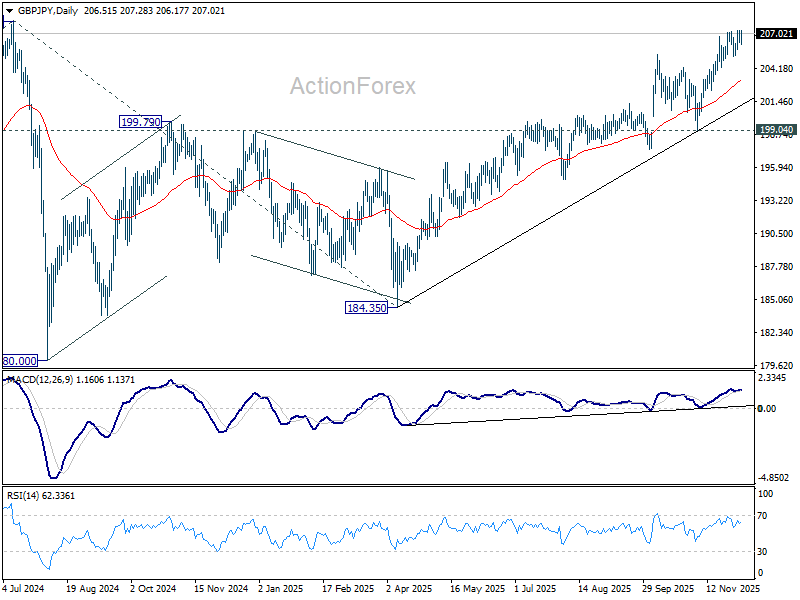
GBP/JPY edged higher to 207.34 but quickly retreated. Initial bias stays neutral this week first, but further rise is expected as long as 205.17 support holds. Break of 207.34 will resume the rally from 184.35 and target 208.09 high. However, break of 205.17 support will turn bias to the downside for deeper pullback, possibly to 55 D EMA (now at 203.25).
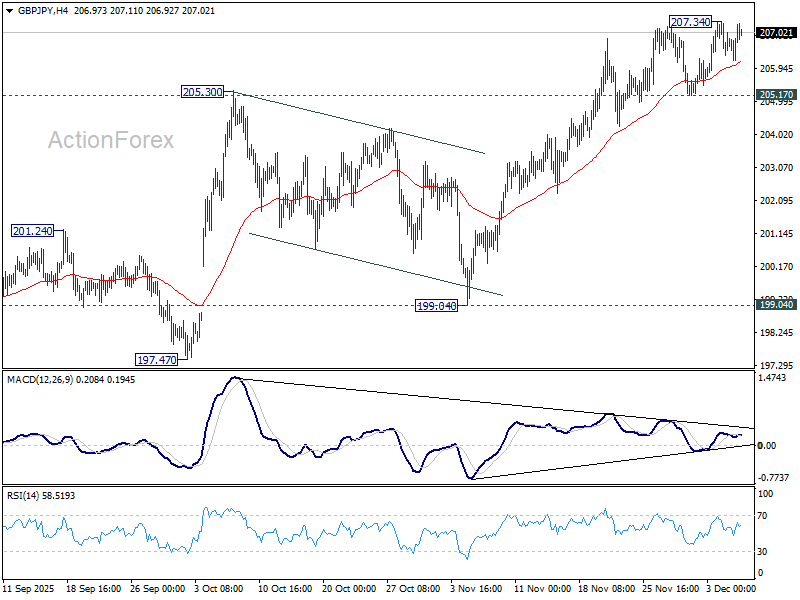
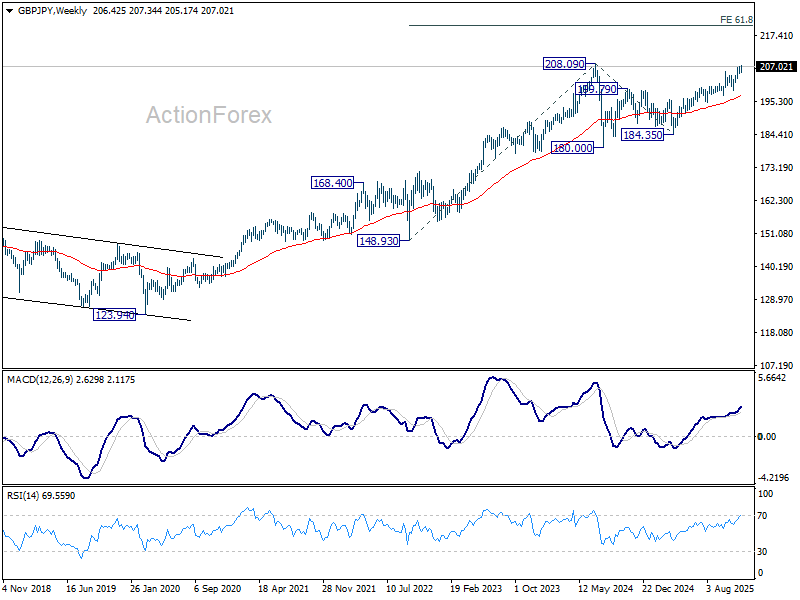
In the bigger picture, price actions from 208.09 (2024 high) are seen as a corrective pattern which might have completed at 184.35. Firm break of 208.09 high will resume the up trend from 123.94 (2020 low). Next target is 61.8% projection of 148.93 to 208.09 from 184.35 at 220.90. However, decisive break of 199.04 support will dampen this view and extend the corrective pattern with another fall.
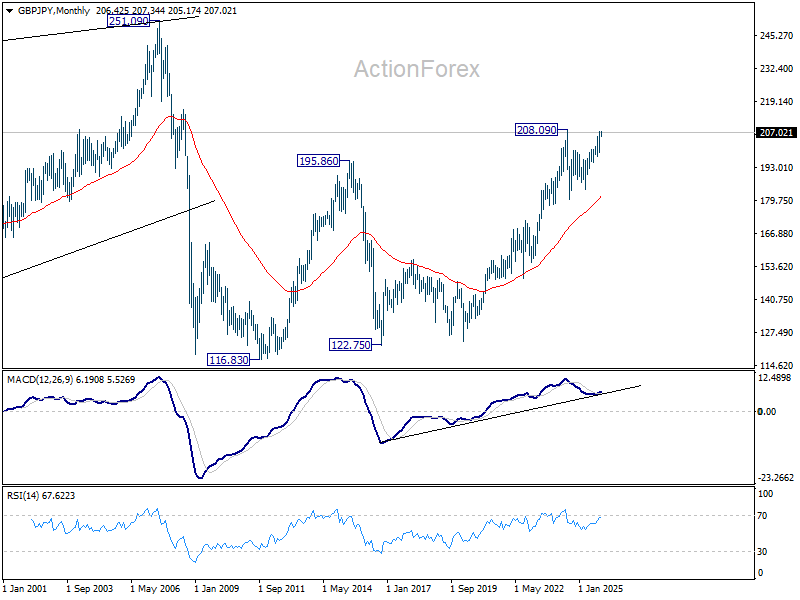
In the long term picture, there is no sign that the long term up trend from 122.75 (2016 low) has concluded. But firm break of 208.09 is needed to confirm resumption. Otherwise, more medium term range trading could still be seen.
EUR/JPY Weekly Outlook
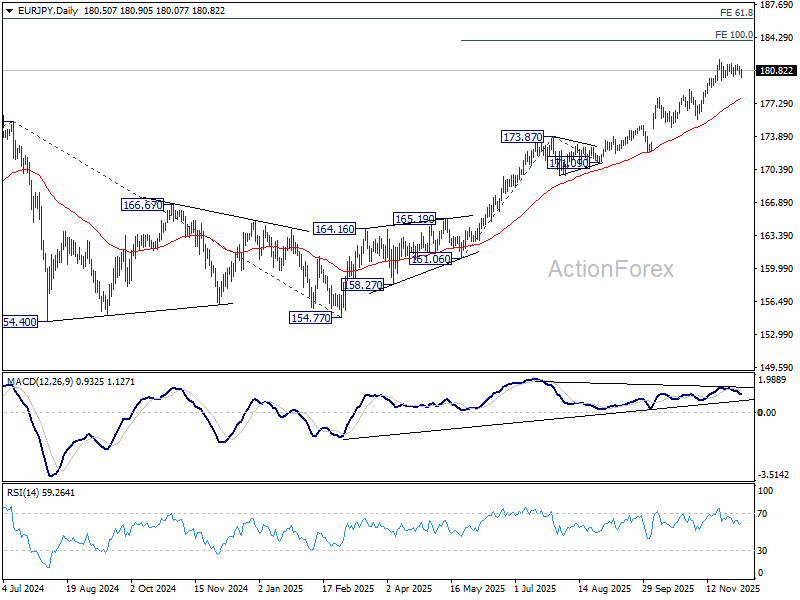
EUR/JPY stayed in established range below 181.98 last week and outlook is unchanged. Initial bias remains neutral this week first, and further rally is expected with 179.74 support intact. On the upside, break of 181.98 will resume larger up trend to 100% projection of 161.06 to 173.87 from 171.09 at 183.90 next. However, firm break of 178.80 will argue that deeper correction is already underway towards 55 D EMA (now at 177.84).
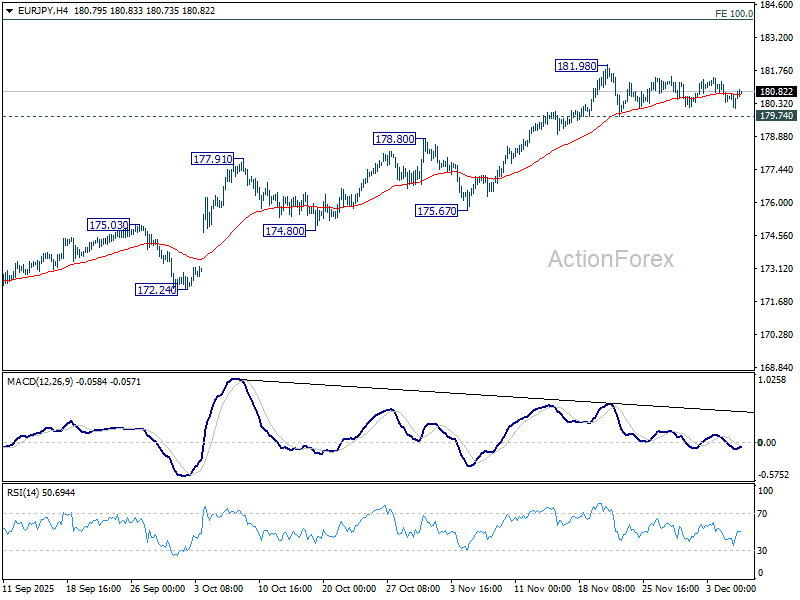
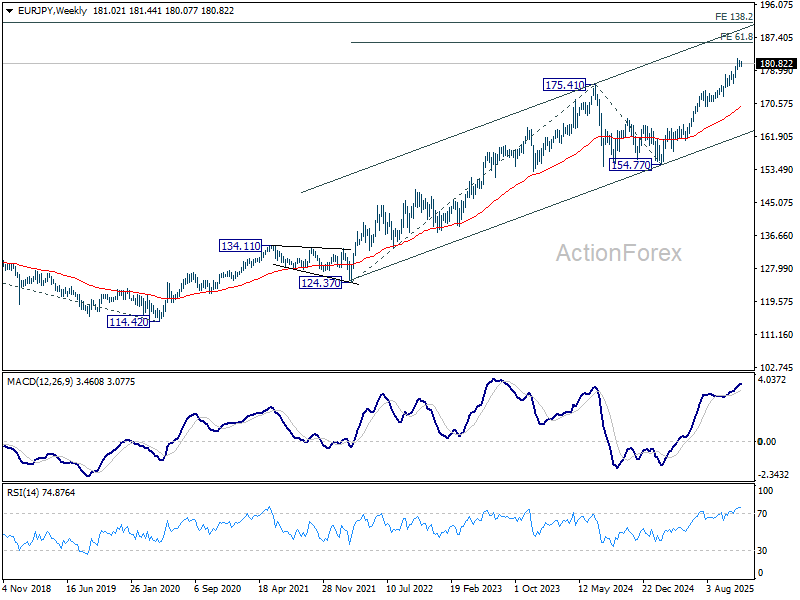
In the bigger picture, up trend from 114.42 (2020 low) is in progress and should target 61.8% projection of 124.37 to 175.41 from 154.77 at 186.31. However, considering bearish divergence condition in D MACD, upside should be capped by 186.31 on first attempt. Outlook will continue to stay bullish as long as 55 W EMA (now at 169.87) holds, even in case of deep pullback.
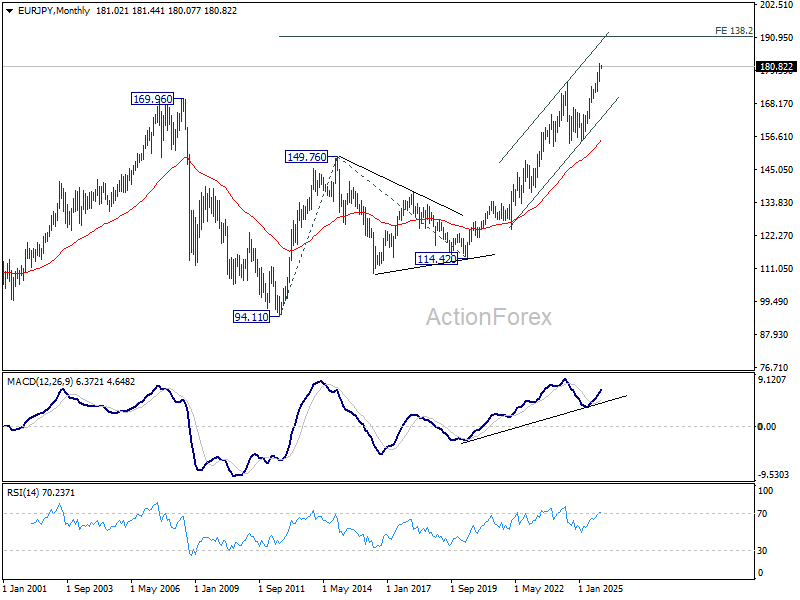
In the long term picture, up trend from 94.11 (2021 low) is in progress. Next target is 138.2% projection of 94.11 to 149.76 (2014 high) from 114.42 (2020 low) at 191.32. This will remain the favored case as long as 154.77 support holds.
EUR/GBP Weekly Outlook
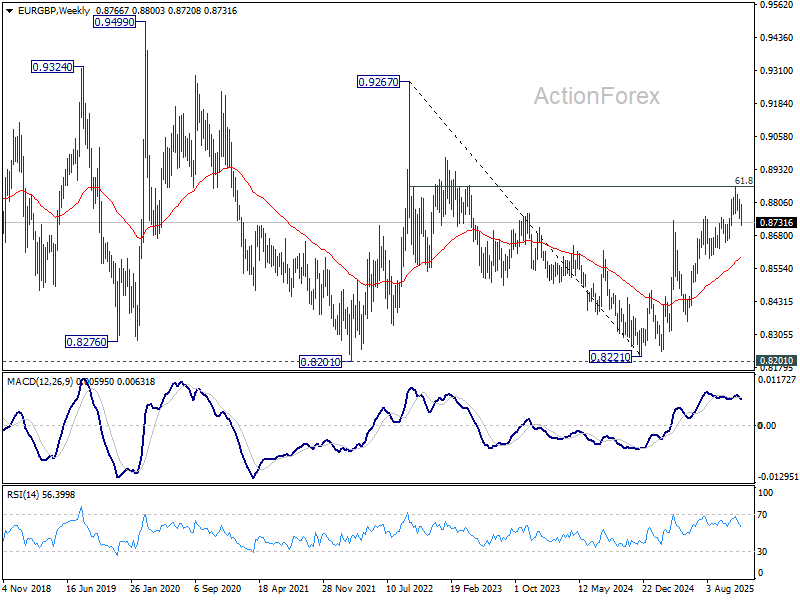
EUR/GBP's fall from 0.8863 extended last week and the break of 55 D EMA (now at 0.8745) should confirm rejection by 0.8867 key fibonacci level. Initial bias stays on the downside this week for 0.8631 cluster (38.2% retracement of 0.8221 to 0.8663 at 0.8618). For now, risk will stay on the downside as long as 0.8800 resistance holds, in case of recovery.
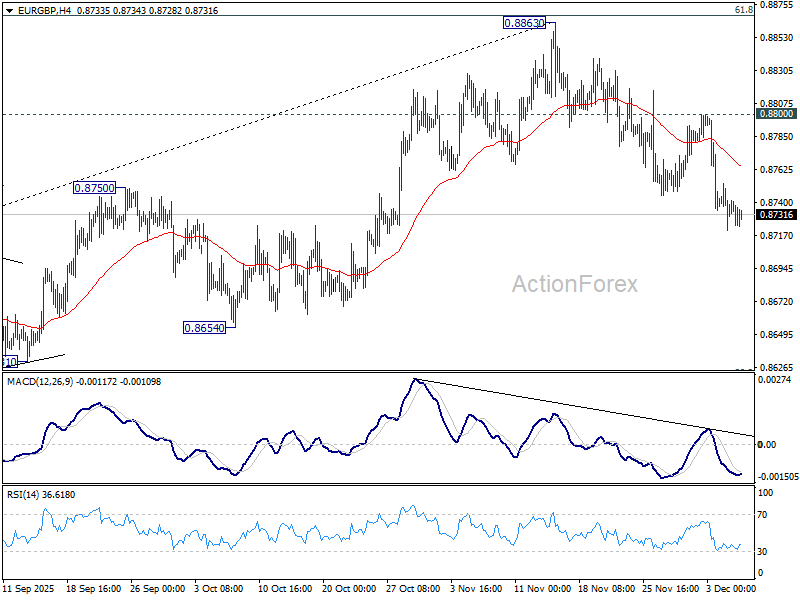
In the bigger picture, rise from 0.8221 medium term bottom is still seen as a corrective move. Upside should be limited by 61.8% retracement of 0.9267 to 0.8221 at 0.8867. Sustained trading below 55 W EMA (now at 0.8600) should confirm that this corrective bounce has completed. However, decisive break of 0.8867 will suggest that EUR/GBP is already reversing whole decline from 0.9267 (2022 high). That should pave the way back to 0.9267.
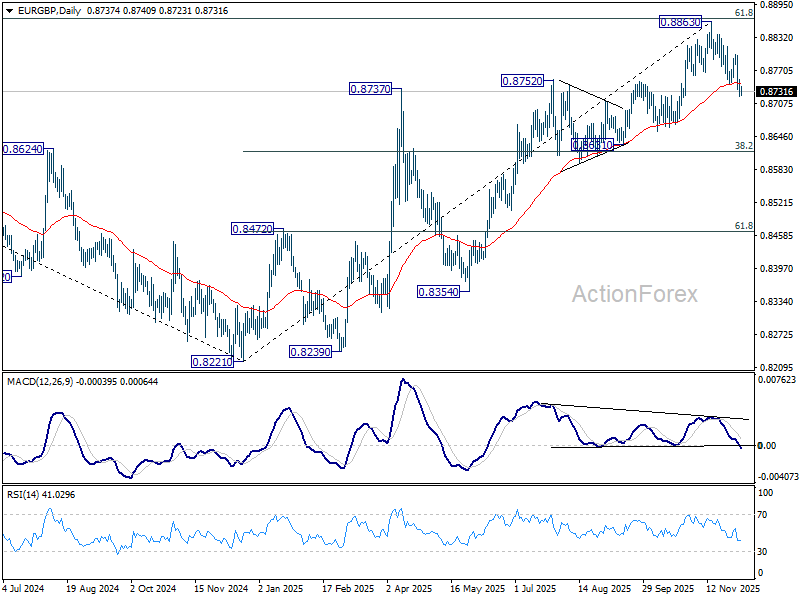
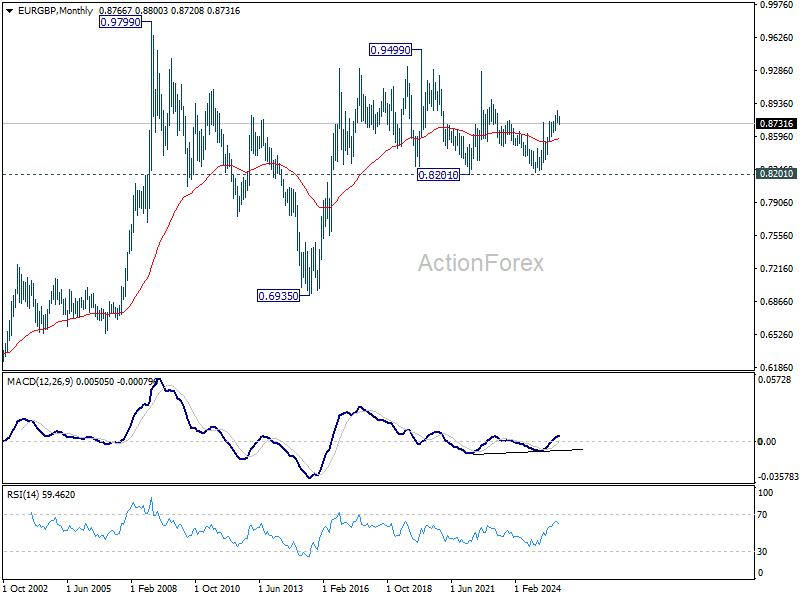
In the long term picture, price action from 0.9499 (2020 high) is seen as part of the long term range pattern from 0.9799 (2008 high). Range trading should continue between 0.8201 and 0.9499, until there is clear signal of imminent breakout.