Sample Category Title
Eco Numbers Put Extra Burden on Dollar
Markets
There was action on all fronts yesterday. Let’s start with geopolitics. Ukrainian President Zelensky said that negotiations on a truce remained ongoing after headlines that Ukraine agreed to the US-brokered peace deal. Markets nevertheless reacted positively (equity, EUR, CE FX up; gas/oil down), embracing the progress made since high-level Geneva talks over the weekend. The past two days, the US was also involved with Russian officials in Abu Dhabi, working to a meeting between US chief negotiator Witkoff and his team and Russian President Putin in Moscow likely next week. The Ukraine-Russia situation was one of the topics touched on during a phone call between US President Trump and his Chinese counterpart Xi Jinping who seem back on speaking terms after extending the trade truce by a year at the end of October. Next came (US) eco data with delayed September retail sales and producer prices and up-to-date November Richmond Fed manufacturing index (-15 from -4 vs -5 expected) and consumer confidence. Data disappointed apart from in line with consensus US PPI. Headline retail sales growth slowed from a strong 0.6% M/M in August to 0.2% (vs 0.4% consensus) with all core categories weaker than expected as well. Despite the lower September numbers, real consumer spending was robust over Q3, expected at 3.2% annualized (vs +2.5% Q/Qa in Q2). November consumer confidence crashed from 95.5 to 88.7, the lowest outcome since the Covid-pandemic with the exception of April of this year (Liberation Day). There was an obvious setback in the present situation gauge given the US government shutdown, but the expectations comments fell even further back. The eco numbers put an extra burden on the dollar intraday while pushing US yields lower a first time. A third topic added to those moves: headlines that Kevin Hassett was seen as frontrunner to replace Fed Chair Powell next year. From the remaining shortlist of 5 candidates (Waller, Bowman, Warsh and Rieder), Hassett has the most dovish profile. He advocates aggressive rate cuts, prioritizing growth of inflation control. The bar to reverting to QE under his watch is probably lowest as he closely aligns with Trump’s agenda. Hassett nevertheless stresses the importance of a fully independent central bank. US yields eventually closed around 3 bps lower across the curve with EUR/USD rising from 1.1521 to 1.1570. The short term faith of the US stock market was the final talking point. Key indices tested the October low/100d mavg recently. Dip buyers showed up last Friday and gained strength on Monday and also yesterday despite a negative open (-1% and more for Nasdaq). Main indices eventually ended +0.67% (Nasdaq) to 1.4% (Dow) higher. The S&P 500 tested last week’s high. Taking that out would put fears to bed of a sell-on-ticks pattern being established.
Today’s eco calendar is less exciting. Keep in mind that US markets are closed tomorrow for Thanksgiving and that traded volumes are traditionally lower on (Black) Friday. Attention will shift to the UK with the long-awaited 2026 Autumn Budget. UK assets are extremely sensitive to the topic. From a risk point of view, a lot can go wrong/be considered as insufficient to address the public finances situation.
News & Views
The Reserve Bank of New Zealand cut its policy rate by another 25 bps to 2.25% in a 5-1 vote. (one vote for unchanged). In explaining its current and future actions/intentions, the RBNZ admits that CPI inflation has increased to the top of the 1%-3% target range in Q3, but given spare capacity in the economy it is expected to return to 2% by mid-2026. Economic activity was weak in mid-2025, but the RBNZ sees it picking up. Lower interest rates are supporting household spending and the labour market is stabilizing. A weaker exchange rate is supporting exporters’ income. The RBNZ now sees risks to the inflation outlook as broadly balanced. In its updated forecast, the central bank now expects the policy rate at 2.2% in the first three quarters of next year. The bar for further easing looks very high. The 2-y NZ government bond yield rises by 7.5 bps this morning (2.66%). The kiwi dollar jumps sharply from the 0.5625 area to currently 0.5695.
Australian October CPI rose from 3.6% Y/Y to 3.8% Y/Y. The largest contributor to annual inflation was housing (5.9%), followed by food and non-alcohol beverages and recreation and culture, both rising 3.2%. Underlying inflation accelerated from 3.2% Y/Y to 3.3% Y/Y. Annual services inflation was 3.9%, up from 3.5%. Inflation rising further above the 2-3% RBA target range leaves the central bank no room to cut the policy rate any further. Markets now even ponder the chances of a rate hike end 2026. The 3-y Australia government bond yield jumps 14 bps (3.88%). The Aussie dollar jumps from the AUD/USD 0.647 area to currently trade near 0.6505.
EUR/CHF Daily Outlook
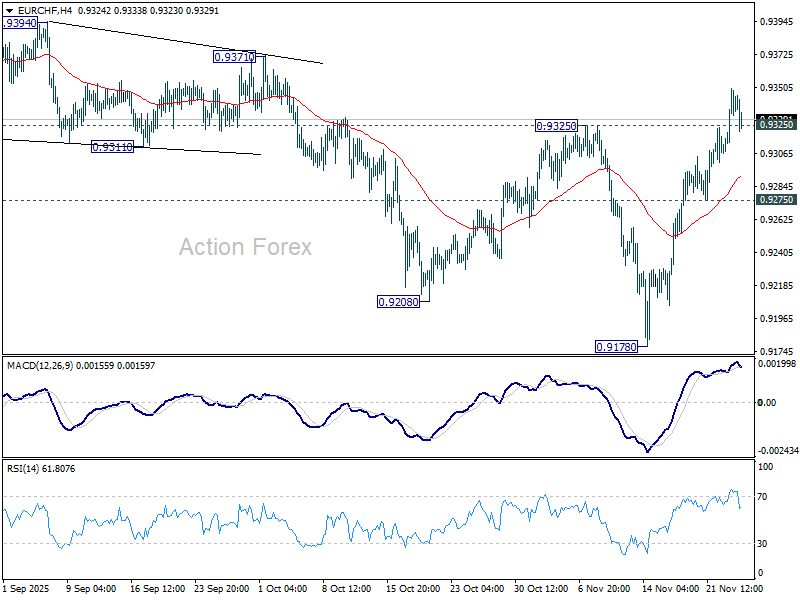
Daily Pivots: (S1) 0.9318; (P) 0.9335; (R1) 0.9361; More....
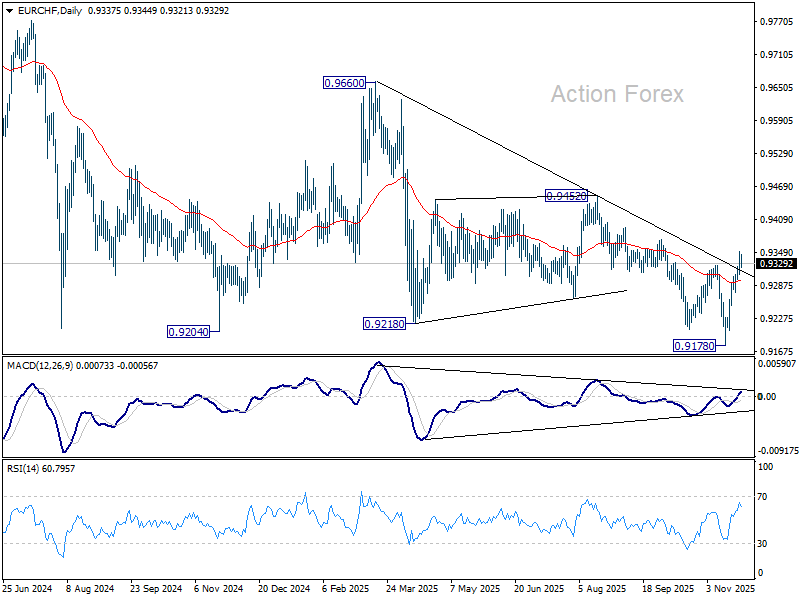
The break of 0.9325 resistance suggests that EUR/CHF's fall from 0.9660 has completed at 0.9178, on bullish convergence condition in D MACD. Intraday bias is back on the upside for 0.9452 resistance. For now, risk will stay on the upside as long as 0.9275 support holds, in case of retreat.
In the bigger picture, outlook remains bearish with EUR/CHF staying well inside long term falling channel after multiple rejection by 55 W EMA (now at 0.9377). Next target is 61.8% projection of 1.1149 to 0.9407 from 0.9928 at 0.8851. Break of 0.9452 resistance is needed to be the first sign of medium term bottoming. Otherwise, outlook will stay bearish in case of strong rebound.
EUR/GBP Daily Outlook
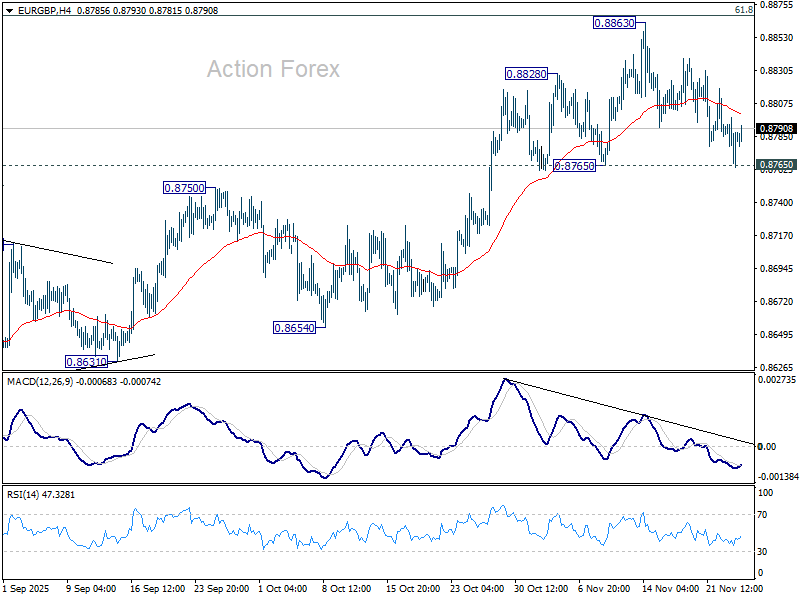
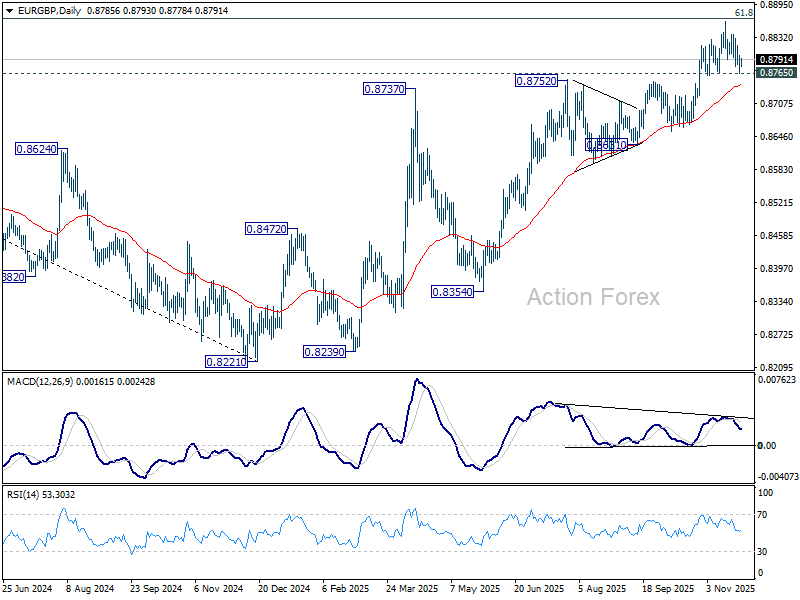
Daily Pivots: (S1) 0.8770; (P) 0.8784; (R1) 0.8803; More…
EUR/GBP is still bounded in range of 0.8765/8663 and intraday bias stays neutral. Considering bearish divergence condition in 4H MACD, firm break of 0.8765 support will confirm short term topping. Intraday bias will be back to the downside for 55 D EMA (now at 0.8742). Sustained break there will be an early sign of bearish trend reversal. Nevertheless, decisive break of 0.8867 fibonacci level will carry larger bullish implications.
In the bigger picture, rise from 0.8221 medium term bottom is still seen as a corrective move. Upside should be limited by 61.8% retracement of 0.9267 to 0.8221 at 0.8867. Sustained trading below 55 W EMA (now at 0.8588) should confirm that this corrective bounce has completed. However, decisive break of 0.8867 will suggest that EUR/GBP is already reversing whole decline from 0.9267 (2022 high). That should pave the way back to 0.9267.
EUR/AUD Daily Outlook
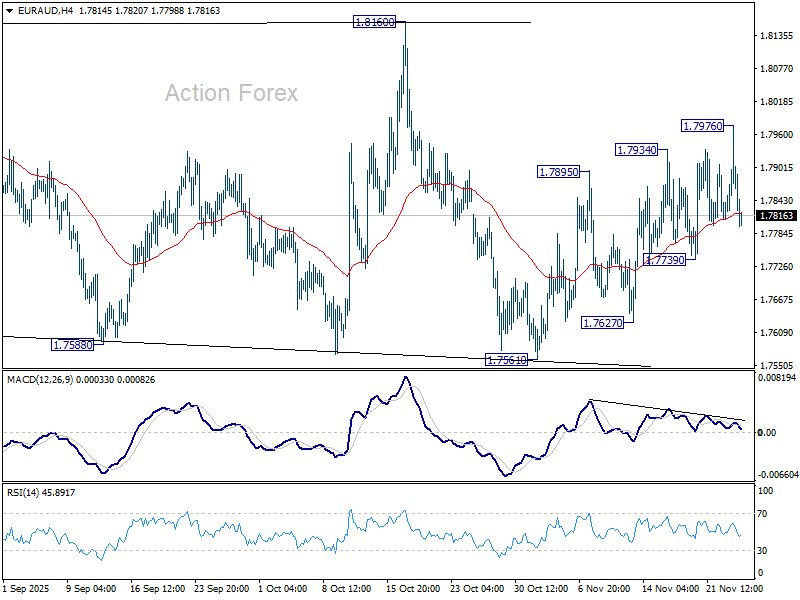
Daily Pivots: (S1) 1.7805; (P) 1.7891; (R1) 1.7971; More...
EUR/AUD edged higher to 1.7976 but retreated quickly again. Intraday bias remains neutral. On the upside, above 1.7976 will resume the rebound from 1.7561 towards 0.8160 resistance. On the downside, however, break of 1.7739 support will argue that the rebound has completed and turn bias back to the downside for 1.7561.
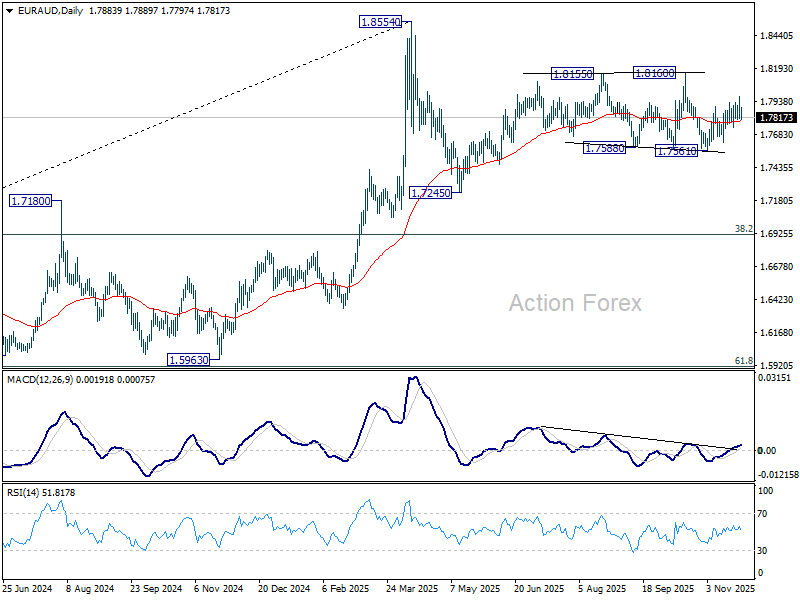
In the bigger picture, price actions from 1.8554 medium term top are seen as a corrective pattern. Sustained break of 55 W EMA (now at 1.7426) will suggest that it's correcting the whole rally from 1.4281 (2022 low). In this case, deeper decline would be seen to 38.2% retracement of 1.4281 to 1.8554 at 1.6922. Nevertheless, strong rebound from 55 W EMA will likely bring resumption of the up trend sooner.
EUR/JPY Daily Outlook
Daily Pivots: (S1) 180.17; (P) 180.52; (R1) 180.94; More...
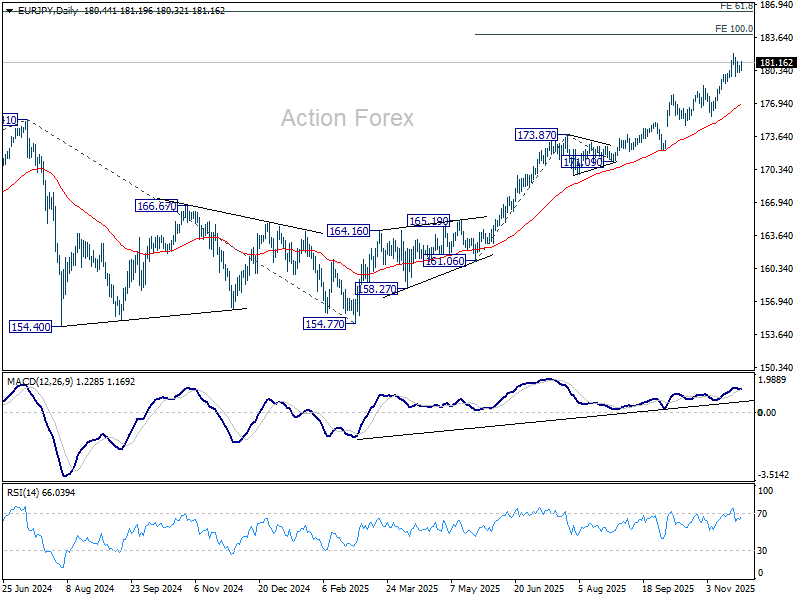
EUR/JPY is staying in consolidations below 181.98 and intraday bias remains neutral. Deeper retreat cannot be ruled out, but downside should be contained by 178.80 resistance turned support to bring another rally. On the upside, break of 181.98 will target 100% projection of 161.06 to 173.87 from 171.09 at 183.90 next. However, firm break of 178.80 will argue that deeper correction is already underway towards 55 D EMA (now at 176.64).
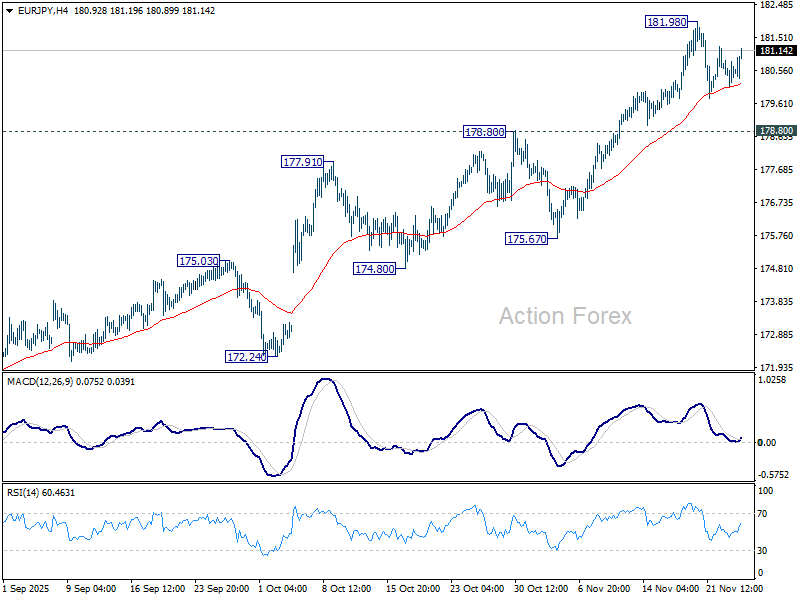
In the bigger picture, up trend from 114.42 (2020 low) is in progress and should target 61.8% projection of 124.37 to 175.41 from 154.77 at 186.31. Outlook will continue to stay bullish as long as 55 W EMA (now at 169.42) holds, even in case of deep pullback.
GBP/JPY Daily Outlook
Daily Pivots: (S1) 204.98; (P) 205.49; (R1) 205.98; More...
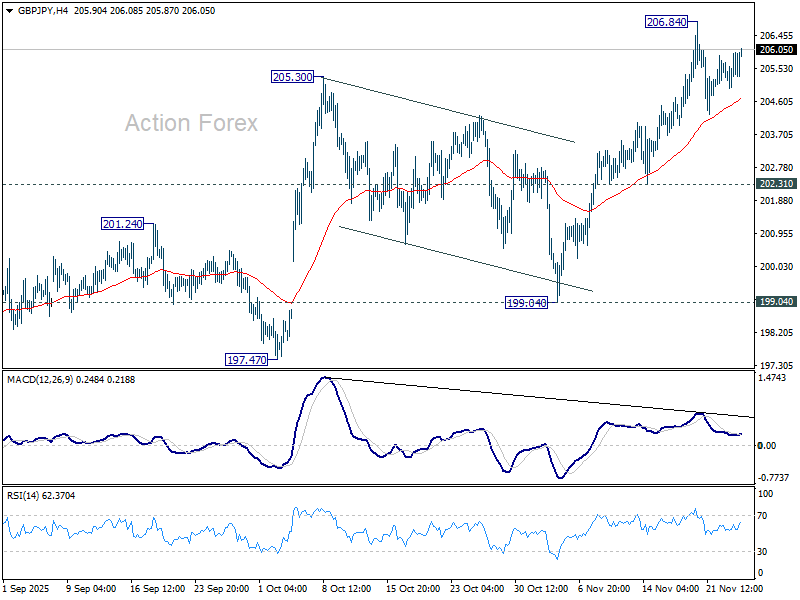
GBP/JPY is staying in consolidations below 206.84 and intraday bias remains neutral. Deeper retreat cannot be ruled out, but downside be contained by 202.31 support to bring another rise. Break of 206..84 will target 208.09 high. Decisive break there will confirm long term up trend resumption.
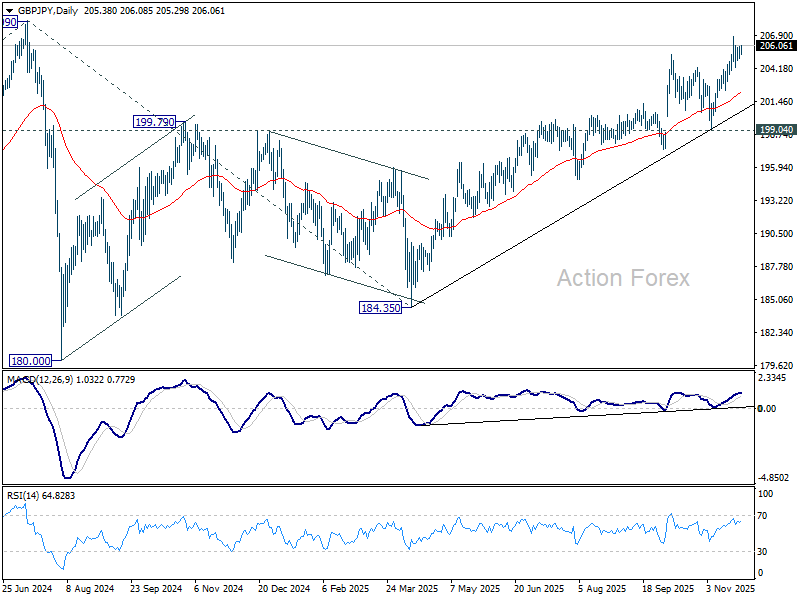
In the bigger picture, price actions from 208.09 (2024 high) are seen as a corrective pattern which might have completed at 184.35. Firm break of 208.09 high will resume the up trend from 123.94 (2020 low). Next target is 61.8% projection of 148.93 to 208.09 from 184.35 at 220.90. However, decisive break of 199.04 support will dampen this view and extend the corrective pattern with another fall.
AI Season Two: Clash of the Giants
There is some decent drama unfolding among the Big Tech bros this week — and Google and Nvidia are right in the middle of it. The former victim in the AI race, Google, which only months ago looked like it could be eaten alive by OpenAI’s next-gen AI chatbot, is suddenly storming back and, in a twist, pushing Nvidia dangerously close to the cliff as it takes the lead in a way few saw coming.
To put things rapidly into context: the past two years haven’t been rosy for Google. Gemini took time to lift off, hallucinated and became a punchline in its early days. The model quietly improved its way through end users until Gemini 3 hit hard last week. Google eventually got its AI model right and moved aggressively into 3D reasoning, agentic coding and “vibe coding” — the kinds of end-products that could mint billions in revenue.
But that’s not where the story ends.
It’s where it begins.
As AI chatbots seep into everyday life, demand for inference is exploding. Inference is when AI takes your request and figures out an answer. And with it, the cost of inference — the cost of running a trained model every time someone queries it — is exploding too. For OpenAI, that bill for 2024 is projected to hit around $2.3 billion, roughly 15× its training costs.
And here comes the plot twist: Meta and OpenAI are reportedly moving toward Google’s TPUs — Google’s homegrown chips — to run their own models because they are cheaper to operate while offering comparable performance. Both Meta and OpenAI are said to be seeking up to 4× better performance-per-dollar on inference workloads.
And inference is the next big thing because it never stops: every time you chat with a bot, the cost accumulates. Inference costs are projected to make up almost three-quarters of total AI computing costs by 2030.
So the world’s biggest AI players could be shifting toward Google’s TPUs — cheaper, more tailored to AI workloads — and potentially replacing Nvidia.
Read that again.
That’s a real risk for Nvidia, whose client base is nearly half made up of these same Big Tech giants. This is why — on top of the accounting drama that hit the company last week — the stock shed another 2.60% yesterday, while Google rallied to a fresh ATH.
In the meantime, Meta boosted its ad revenue thanks to AI, but its long-term business model is unclear. Meta is spending billions to transform its social media platforms into AI-content platform — a direction that risks disengaging users. Its Llama model is rarely mentioned in enterprise-grade discussions, and its oversized compute spending could backfire. Unlike Google, which can simply rent excess compute through its existing cloud offering, Meta must actually build that business from scratch.
Outside the US, Alibaba’s AI efforts may be paying off. The company announced a stronger-than-expected 34% growth in its cloud business, that helped counterweigh their spending on consumer subsidies and AI investments. But the numbers couldn’t bring investors on board. The share price is struggling to a reverse October – November softness.
In summary, Nvidia is being broadly questioned, Meta may be hitting its potential, while Amazon is the one Big Tech name that could benefit meaningfully from robotics when the time is right.
But right now, Google suddenly seems to have it all: the data, the data centres, the chips, the AI model and the interface. It might well be the next $5 trillion beast. And if you think about it, Alibaba also has many of these assets. It’s got the data, the data centres, its own chips, its AI model, its e-commerce empire, and incredible reach within China and beyond. So if you believe the future is “everything under one roof,” Alibaba is - has always been - a strong candidate.
What about Nvidia? Nvidia has been struggling since its latest earnings blew up in its hands as investors focused on swelling inventories and deferred payments. The company has been compared to Enron, booed because of the Google-TPU news, and are now defending themselves by saying “we’re not Enron” and “we are happy for Google.” Their main argument is that Google’s TPUs are designed for one specific function, whereas Nvidia’s GPUs are compatible with every AI model. But will that matter if companies simply want chips that do the job cheaply and efficiently?
So, the moment has come ladies and gentlemen: competition for Nvidia is arriving from an unexpected direction. That could eat into its revenue potential and market share. Everyone is waiting to see how Nvidia will respond — by expanding customers beyond Big Tech, rolling out more inference-friendly GPUs, or pushing deeper into cost-competitive partnerships. We’ll soon find out.
Meanwhile, US consumer sentiment is waning. More than half of the strong US GDP this year came from massive AI investment. Yesterday’s retail sales and PPI came in soft — softer than expected — although major retailers upgraded their annual forecasts and said the holiday season should look fine.
And if not, the Fed will be there to save the day. The probability of a 25bp cut rose to around 85% after the latest data. The US dollar slipped below its 200-DMA, helping the EURUSD break above the September–November bearish consolidation trend.
Cable also extended gains into today’s Budget announcement— an announcement that might bite. There have been plenty of leaks about where Rachel Reeves will squeeze out £30bn to get the numbers right and keep both markets and households happy. Ultimately, no one will be fully satisfied.
The good news is that stress in gilt markets has been contained over the past few days. The bad news is that yields are near the levels reached during the Liz Truss mini-budget crisis three years ago, and Reeves has the smallest fiscal headroom on record — giving her zero margin for error. After today’s Budget, we’ll have a clearer view on whether the measures will be enough to keep gilt markets tidy and whether they are deflationary enough to convince the Bank of England to cut rates in December — which I think they will be. If so, current levels look appetizing for GBP sellers.
Will UK Autumn Budget Calm Fiscal Concerns?
In focus today
The UK Autumn budget will be released in the afternoon. Expectations for an ambitious plan to cut costs and boost productivity have declined after the plans to raise income taxes were abandoned, although a less ambitious approach will also do for investors for now. Gilt and GBP investors will zoom in on the headroom, which will serve as a buffer against future debt issuance. Chancellor Reeves will likely have to increase it from the previous modest GBP 10bn closer to GBP 30bn.
In the morning, Norwegian mainland GDP growth is released, which we expect will have slowed to 0.2% in Q3, somewhat lower than Norges Bank's forecast from the September MPR (0.4%). However, monthly figures indicate that employment grew around 0.1% in Q3, which may suggest some upside risk to our estimate.
Overnight China releases its industrial profit growth for October. It recovered in late summer to reach 21.6% in September but likely did not sustain that level in October, when US tariff threats hit exports. We look for a decline to around 10% y/y, but it could go lower.
Economic and market news
What happened overnight
In the Ukraine war, Moskov signalled it could reject the 19-point peace plan developed by Ukraine and the US earlier this week, citing the significant changes from the plan developed in Alaska. US President Trump announced that there was no deadline on reaching an agreement and that he would meet with the two other Presidents only when the "deal to end this War is FINAL or, in its final stages". US envoy Steve Witkoff is set to meet President Putin next week to further the peace plan.
What happened yesterday
In the US, the delayed September producer price index (PPI) for final demand came in at 0.3% m/m and 2.7% y/y SA, matching low consensus expectations. The core measure (excluding food and energy) was lower at 0.1% SA y/y. US retail sales growth slowed in September, with sales increasing by a modest 0.2% m/m and the Conference Board's consumer confidence index saw a decline in November to 88.7 from 95.5 in October. It was the second lowest reading in five years. Overall, the data prints from the US added fuel to the fire of worries surrounding the US economy and markets are currently pricing about an 80% chance of an interest rate cut at the FOMC December meeting.
According to Bloomberg News, White House economic advisor Kevin Hassett is the frontrunner to be the next Fed chair. Prediction markets are telling the same story, with his nomination sitting just above 50%.
In Sweden, the October PPI came in at 0.4% y/y and 0.4% m/m. The numbers were nothing dramatic and were primarily driven by a rise in electricity prices.
Equities: Equities were sharply higher again on Tuesday, for a third straight day, with S&P 500 and Stoxx 600 eventually closing up 0.9%. This means that equities are only some 1-2% off previous highs. This session was much more like Friday's markets; investors were selectively buying the company outside the obvious AI plays. Russell 2000 gained 3% and sectors like healthcare, consumer discretionary and materials sector led the gains, ~2% higher. All in all, risk appetite was solid evident in a wide breadth (426 of the S&P 500 closed higher) and VIX falling below 20. Tech did okay, but with a lot of company specific news driving the sector in opposite directions (Nvidia down sharply on competition concerns, Alphabet and Meta higher on rumours that Meta will buy Google's chips). Similarly, heavy tech-indices in Asia are rebounding 1-2% higher this morning.
FI and FX: The money market is increasingly convinced that there will be a December cut from the Fed with futures now indicating 21bp. The longer end is lower as well with US10y at 4,00%. The UST 5y auction met strong demand. Equities like what they see. Broad US equity indexes closed higher for the third consecutive day, and futures are in green. The USD took a hit yesterday on the news that Russia's war in Ukraine might come to an end. EUR/USD moved from 1.1520 to 1.1590 and USD/SEK fell 10 figures. EUR/SEK and EUR/NOK trade just above 11.00 and 11.80.
EUR/USD Daily Outlook
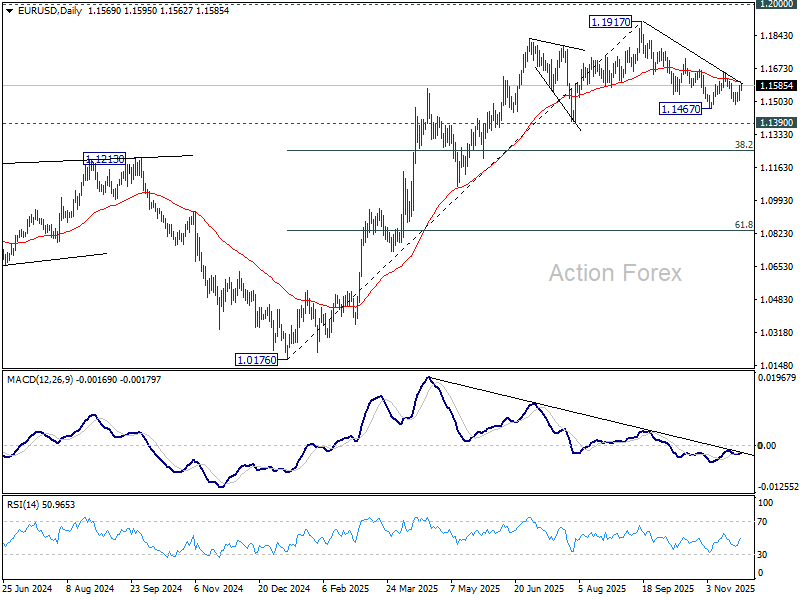
Daily Pivots: (S1) 1.1526; (P) 1.1556; (R1) 1.1600; More…
Intraday bias in EUR/USD remains neutral and more consolidations could be seen. Further decline is expected with 1.1655 resistance intact. On the downside, below 1.1490 and 1.1467 will resume the whole decline from 1.1917 high. Next targets are 1.1390, and then 38.2% retracement of 1.0176 to 1.1917 at 1.1252.
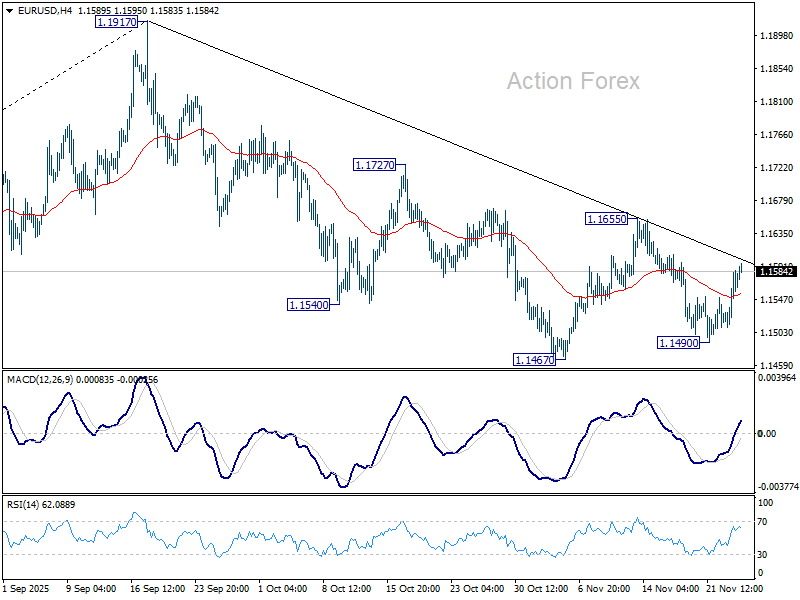
In the bigger picture, considering bearish divergence condition in D MACD, a medium term top is likely in place at 1.1917, just ahead of 1.2 key psychological level. As long as 55 W EMA (now at 1.1328) holds, the up trend from 0.9534 (2022 low) is still in favor to continue. Decisive break of 1.2000 will carry larger bullish implications. However, sustained trading below 55 W EMA will argue that rise from 0.9534 has completed as a three wave corrective bounce, and keep long term outlook bearish.
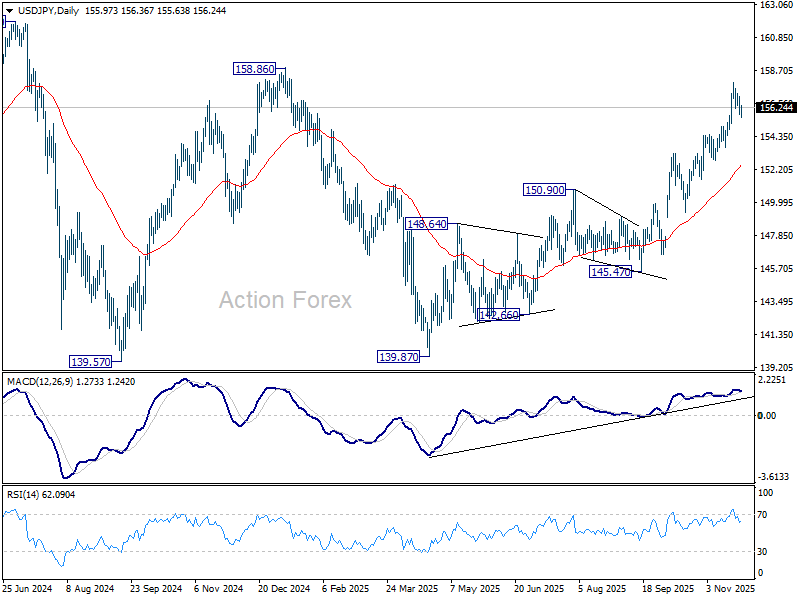
USD/JPY Daily Outlook
Daily Pivots: (S1) 155.59; (P) 156.29; (R1) 156.77; More...
Intraday bias in USD/JPY stays neutral and more consolidations could be seen below 157.88. Downside should be contained by 154.47 resistance turned support. On the upside, break of 157.88 will resume the whole rally from 139.87. Next target is 158.86 structural resistance, and then 161.94 high.
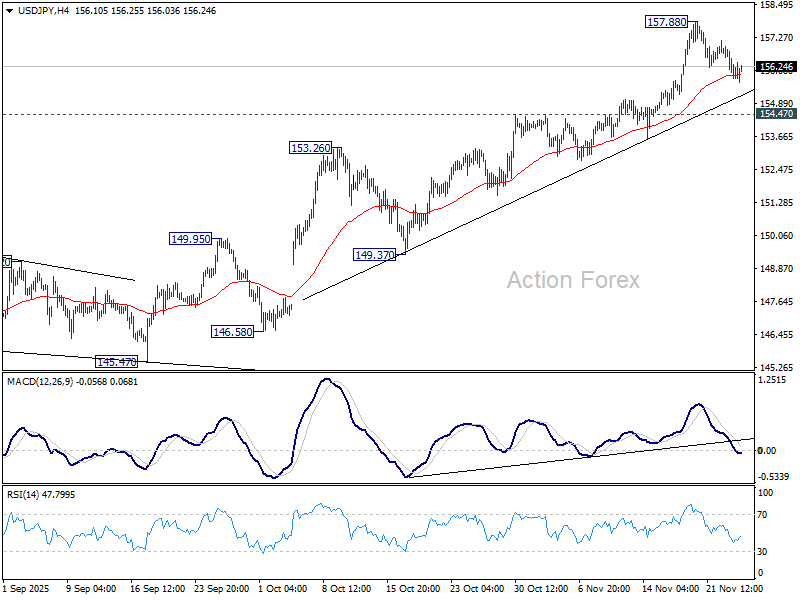
In the bigger picture, current development suggests that corrective pattern from 161.94 (2024 high) has completed with three waves at 139.87. Larger up trend from 102.58 (2021 low) could be ready to resume through 161.94 high. Decisive break of 158.85 structural resistance will solidify this bullish case and target 161.94 for confirmation. On the downside, break of 150.90 resistance turned support will dampen this bullish view and extend the corrective range pattern with another falling leg.