Sample Category Title
AUDUSD Wave Analysis
AUDUSD: ⬆️ Buy
- AUDUSD broke resistance area
- Likely to rise to resistance level 0.6700
AUDUSD currency pair recently broke the resistance area located at the intersection of the pivotal resistance level 0.6620 (former monthly high from July) and the resistance trendline of the daily up channel from May.
The breakout of this resistance area continues the active impulse wave c, which belongs to the ABC correction 2 from April.
Given the strong daily uptrend and bearish US dollar sentiment, AUDUSD currency pair can be expected to rise to the next resistance level 0.6700 (target for the completion of wave 2).

Bitcoin Wave Analysis
Bitcoin: ⬆️ Buy
- Bitcoin broke daily down channel
- Likely to rise to resistance level 116755.00
Bitcoin cryptocurrency recently broke the daily down channel from the start of August (which enclosed the c-wave of the previous ABC correction ii).
The breakout of this down channel continues the active impulse wave iii, which started earlier from the key support level 107940.00.
Given the clear daily uptrend, Bitcoin cryptocurrency can be expected to rise to the next resistance level 116755.00.

Flashlight for the September FOMC Blackout: Cuts to Begin Again
Summary
- We expect the FOMC to resume lowering the fed funds rate at its September meeting with a 25 bps rate cut that would bring the policy rate to a range of 4.00%-4.25%.
- A more precarious picture of the labor market has become apparent since the FOMC last met in July. The three-month average pace of payroll gains is now reported at just 29K compared to 150K when the FOMC gathered in July. Furthermore, the unemployment rate has moved up to a cycle-high of 4.3%, putting it at the top end of the FOMC’s range consistent with “full employment.”
- Additional policy easing this year has been delayed due to inflation. Reflation in the goods sector alongside slower services disinflation has kept core PCE running about one percentage point above the 2% target. That said, the outlook for inflation has been little changed over the past six weeks. Our own forecast looks for core PCE to rise 3.1% on a Q4/Q4 basis this year, the same as before the July FOMC meeting.
- We think the meeting statement will mark down the FOMC's current view of the labor market but refrain from signaling that additional rate cuts will immediately follow September’s cut. This would give the FOMC the flexibility to reduce the policy rate again at its next meeting on October 29 or proceed with additional easing more slowly.
- We expect the updated dot plot to signal more easing through the remainder of this year and next (Table). The composition of the Committee looks set to tilt in a more dovish direction with Stephan Miran on track to be confirmed prior to the meeting. However, the more significant driver of the revision, in our view, is the combination of increased risk to full employment and the generally stable inflation outlook. We think the median dot for 2025 will move down to project 75 bps of cuts compared to 50 bps of cuts in June. For 2026, we anticipate the median dot will fall 50 bps from the June SEP projection of 3.625% to 3.125%, implying an additional 25 bps cut next year. We do not expect any changes to the median longer-run estimate.
- Our base case forecast for the federal funds rate is three 25 bps rate cuts at the three remaining FOMC meetings of the year, followed by two 25 bps rate cuts at the March and June FOMC meetings before a prolonged hold at 3.00%-3.25%. For further reading on our fed funds projections and broader economic outlook, see our recently released monthly economic outlook.

Phase II of the FOMC's Rate Cutting Cycle Begins
The FOMC held the fed funds rate steady at the conclusion of its July 30th meeting, the Committee's fifth straight hold. The decision reflected still-elevated inflation and a constructive view of the jobs market based on the data in hand at that time. That said, the decision was not unanimous; Governors Waller and Bowman dissented in favor of a 25 bps cut.
We expect the FOMC to resume lowering the fed funds rate at its September meeting with a 25 bps cut that would bring the policy rate to a range of 4.00%-4.25% (Figure 1). Although the FOMC has been on hold for the past eight months, a bias toward further easing has persisted. Both the March and June dot plots showed that most officials expected rates to be lower later this year, as the current policy rate is set above even the highest estimates of the longer-run, “neutral” rate.
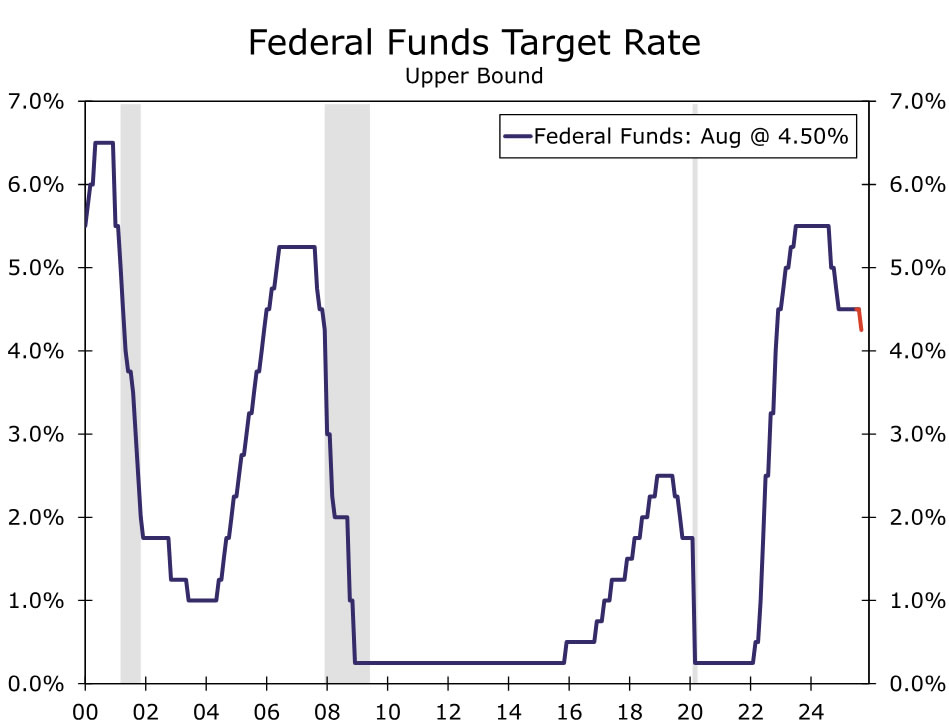
Additional policy easing this year has been delayed due to inflation. Consumer price growth has been above the FOMC’s 2% target for more than four years, leaving policymakers concerned that the prolonged overshoot could still de-anchor inflation expectations. The implementation of widescale tariffs has stoked these concerns further and has contributed to inflation turning higher again. Goods prices have been the driving force behind the upturn, but services inflation has also been sticky (Figure 2). Reflation in the goods sector alongside slower services disinflation has kept core PCE inflation running about one percentage point above the 2% target. That said, the outlook for inflation has been little changed over the past six weeks. Our own forecast looks for the core PCE delator to rise 3.1% on a Q4/Q4 basis this year, unchanged from our estimate prior to the July FOMC meeting.

The labor market through much of this year has looked to be in line with the FOMC’s mandate of maximum employment, with the unemployment rate hovering at, or slightly below, the Committee’s median longer run estimate of unemployment (4.2%). But, a more precarious picture of the labor market became apparent with the July jobs report released just two days after the FOMC’s last meeting. The marked slowdown in hiring in that report was reaffirmed with the August employment report released on September 5. The three-month average pace of payroll gains is now reported at just 29K compared to 150K when the FOMC gathered in July (Figure 3). Preliminary benchmark revisions from the BLS released on September 9 suggest that job growth in the 12 months ending March 2025 averaged only 73K, half its currently published pace. Furthermore, the unemployment rate has moved up to a cycle-high of 4.3%, putting it at the top end of the FOMC’s range consistent with “full employment.” (Figure 4)


With the labor market on shakier ground, more members appear ready to join Governors Waller and Bowman in support of reducing the fed funds rate even as inflation remains above target. Notably, in his address at Jackson Hole, Chair Powell opened the door for a rate cut in September by stating that the downside risks to employment are rising and that this shift in the balance of risks to the FOMC’s mandates “may warrant adjusting our policy stance.” Other voting members also appear to have grown more concerned. Even before the poor August jobs report, St. Louis Fed President Musalem, who is generally considered a hawk, said that “putting most of the weight on the inflation goal runs the risk of not providing enough support to maintain a full employment labor market at a time when downside risks have risen.”
Not everyone on the Committee seems fully convinced that it is appropriate to begin lowering rates at the September meeting. Chicago Fed President Goolsbee, speaking after the August jobs report, said that he is still undecided about his support for a rate cut and noted the need to look at the inflation side of the mandate too. We think it is possible that he or Kansas City President Schmid dissents in favor of keeping the fed funds rate unchanged. If current Chair of the Council of Economic Advisers Stephen Miran is confirmed in time to participate in the meeting, which seems probable at this point in time, we think it is possible he could dissent in the opposite direction, perhaps preferring a 50 bps rate cut to make up for the hold at the July meeting. Governors Bowman or Waller also could dissent in favor of a 50 bps move, although we consider this a less likely outcome.
In terms of changes to the post-meeting statement, we think the new meeting statement will mark down the Committee’s current assessment of the labor market. We expect the characterization of “solid” to be abandoned and for the statement to note that the unemployment rate has moved up while hiring has slowed. With inflation still “somewhat elevated,” we believe the statement will be cautious in signaling that additional rate cuts will follow September’s anticipated move. We doubt it will reference the pace of additional cuts ahead, e.g., as “gradual” or “measured.” Rather, we suspect the statement will continue to indicate that future adjustments will depend on additional data and changes in the outlook. This would give the Committee the flexibility to reduce the policy rate again at its next meeting on October 29 or proceed with additional easing more slowly.
Summary of Economic Projections to Show More Easing Ahead
More insight into how FOMC participants see the path of the policy rate unfolding will be available in the Summary of Economic Projections (SEP). We expect the updated dot plot to signal more easing through the remainder of this year and next. In the prior SEP released in June, the median projection for the fed funds rate at year-end implied a total of 50 bps of rate cuts. We think the median will shift down to 75 bps of cuts this year (Figure 5). For 2026, we anticipate the median dot will fall 50 bps from the June SEP projection of 3.625% to 3.125%, implying an additional 25 bps cut during the next calendar year. The projections for 2027 and the first look at 2028 likely will be widely dispersed given the longer time horizon, yet we anticipate the median each year also will register 3.125%, consistent with the policy rate returning to a more neutral stance by the end of the forecast horizon. We do not expect any changes to the median longer-run estimate.

The lower median projections for the fed funds rate in 2025 and 2026 could be fostered by a more dovish composition of the Committee if Stephan Miran is confirmed in time to participate in the September meeting. However, the more significant driver, in our view, is the combination of greater risk to employment amid a generally stable outlook for inflation the past few months despite ongoing uncertainty around the inflationary impact of changes to tariff policy (Figure 6). We anticipate the median Q4/Q4 estimates for headline and core PCE inflation in 2025 will remain unchanged in the September SEP at 3.0% and 3.1%, respectively. The inflation estimates for 2026 may tick up a tenth or so as the slow adjustment to tariffs keeps inflation elevated slightly longer, although at around 2.5%, that would still leave inflation making strides back toward the Committee's target next year.

We expect the median estimate for the unemployment rate to remain at 4.5% at the end of this year and next, as the sharp slowdown in payroll growth recently has coincided with weaker labor force growth. While this would not mark a change from the last SEP, we suspect the Committee's risk assessments to their unemployment projections will be further tilted toward the upside. The 2025 median projection for GDP is also likely be left unchanged after growth appears to have rebounded strongly in Q2 from its dip at the start the year. That said, 1.4% growth on a Q4/Q4 basis would still be below the Committee's estimate of potential growth (1.8%) and consistent with underlying inflation easing after the initial price pressures from tariffs have passed.
European Central Bank Pauses Again, Further Easing Still Possible
Summary
- The European Central Bank (ECB) held its Deposit Rate steady at 2.00% at today's monetary policy announcement, keeping its monetary policy stance on hold for the second meeting in a row. The accompanying statement was neutral in tone and offered little in the way of forward guidance on future policy moves.
- The ECB made only modest revisions to its economic projections, raising its economic growth outlook modestly, while lowering its forecast for underlying inflation very slightly. The ECB projects underlying inflation at 2.4% for 2025, 1.9% for 2026, and 1.8% for 2027. The fact that the central bank's medium-term inflation forecasts are below the 2% inflation target, and the 2027 forecast was revised lower, are modestly dovish signals in our view. The dovish signal from the economic projections was largely offset however by comments from ECB President Lagarde. She said that growth risks were balanced, and suggested the disinflationary process for the Eurozone is now over.
- Despite the overall neutral tone of today's announcement, we expect the evolving growth, wage and inflation trends will still see the ECB deliver one final 25 bps rate cut, to 1.75%, at its December meeting. We expect growth to soften in the coming quarters, reflecting slower employment and income growth, and still subdued sentiment and confidence. Meanwhile, wage and labor cost pressures continue to show a gradual deceleration, which we view as consistent with core inflation converging to target and leading to modest further monetary easing.
European Central Bank Pauses For a Second Meeting
The European Central Bank (ECB) held its Deposit Rate steady at 2.00% at today's monetary policy announcement, keeping its monetary policy on hold for the second meeting in a row. The ECB offered little in the way of new guidance, while making only marginal changes to its economic projections. Overall, our outlook for ECB monetary policy remains unchanged, and we still see potential for modest further monetary easing.

Today's announcement was perhaps even more concise than usual, with the ECB simply saying its "assessment of the inflation outlook is broadly unchanged." That is reflected in the ECB's updated economic projections, which saw a modest upgrade to the growth outlook, and a very mild downgrade to the underlying inflation outlook. The central bank forecasts GDP growth of 1.2% for 2025 (previously 0.9%), 1.0% for 2026 (previously 1.1%) and 1.3% for 2027 (unchanged). With regard to underlying inflation (CPI excluding food and energy), the ECB forecasts underlying inflation of 2.4% in 2025 and 1.9% in 2026 (both unchanged) and 1.8% in 2027 (previously 1.9%). Despite only minor changes, we view the updated inflation forecasts in particular as noteworthy. The minor downward revision to the 2027 inflation forecast is, in our view, a modestly dovish signal. Moreover, with both the 2026 and 2027 underlying inflation forecasts below the ECB's 2% inflation target, it leaves open the possibility of further easing, without guaranteeing it. The dovish signal from the economic projections was largely offset however by comments from ECB President Lagarde. She said that growth risks were balanced, and suggested the disinflationary process for the Eurozone is now over.

The ECB also said it is determined to ensure that inflation stabilizes at its 2% target and, in a familiar refrain, said it "will follow a data-dependent and meeting-by-meeting approach" and that it is “not pre-committing to a particular rate path.” The importance of the underlying inflation outlook was also reinforced by the ECB's comment that its decision will be based, among other things, by "the dynamics of underlying inflation and the strength of monetary policy transmission."
We Still Expect a Final ECB Rate Cut Later This Year
While the ECB held rates steady at today's meeting, we believe the evolving growth, wage and inflation trends could still see the central bank deliver one final 25 bps rate cut, to 1.75%, at its December meeting. That would take the ECB's policy rate towards the "accommodative end" of what view as the neutral range, of between 1.75% to 2.25%. We expect a slower pace of economic growth over the second half of 2025 and still see some downside risks to the growth outlook, while we also think wage and price fundamentals remain consistent with a gradual disinflationary trend toward the 2% inflation target.

Eurozone Q2 GDP grew by just 0.1% quarter-over-quarter, after a 0.6% gain in Q1. While that headline result might overstate the degree of weakness (our estimate of underlying final domestic demand rose 0.3% in Q2), there are still reasons to expect a slower pace of growth over the next few quarters. Income trends have begun to soften, as Q2 real employee compensation slowed to 2.5% year-over-year, while Q1 real household disposable income rose by even less, with a 0.8% gain. Slow income growth, combined with an overall cautious consumer (as reflected in unusually elevated savings rates in recent quarters) will likely be consistent with only a modest pace of Eurozone consumer spending, at best, in the coming quarters. Reinforcing the slowing income trend is a deceleration in job growth. Eurozone Q2 employment rose by just 0.6% year-over-year, and forward-looking employment indicators suggest a slight further slowing in job growth remains possible.

While increased defense spending could support investment spending over the medium-term, the immediate prospects for investment spending are also mixed. Our measure of core ex-housing investment dipped by 0.1% year-over-year in Q2, and low levels of capacity utilization suggest sluggish investment spending for the time being. While acknowledging that uncertainty, especially surrounding trade and tariff policy, has receded to some extent, a still somewhat unsettled environment is also a limiting factor for the near-term investment outlook. The Eurozone August manufacturing PMI rose to 50.7 while the services PMI slipped to 50.5. Neither index is at a level, however, that suggests upbeat sentiment which would be consistent with stronger investment spending. Moreover, the PMI surveys are also at levels that are historically consistent with only a modest pace of overall economic growth more broadly.

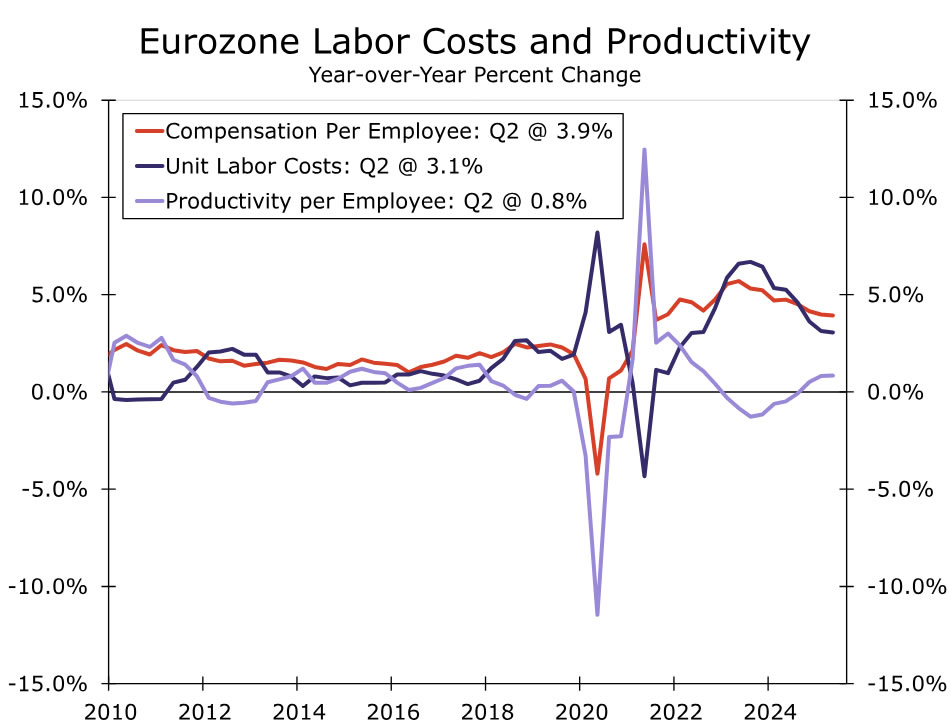
Finally, we still view wage and cost pressures as consistent with some further gradual disinflation in the quarters ahead. To be sure, wage indicators were somewhat mixed in the second quarter, as the ECB Indicator of Negotiated Wages quickened to 4.0% year-over-year, while the Q2 labor cost index also firmed to 3.7%. However, Q2 compensation per employee—the broadest wage measure—eased slightly further to 3.9%. Combined with a moderate improvement in labor productivity to 0.8% year-over-year in Q2, that has also contributed to a deceleration in unit labor cost growth to 3.1%. While the current level of unit labor cost growth remains mildly elevated, a further slowing in wages provides a clear path for unit labor cost growth and underlying inflation to both converge towards 2%, and possibly slightly below.

Overall, with the likelihood of slower economic growth ahead and in our view some potential for further disinflation to come, we lean toward the European Central Bank delivering a final 25 bps rate cut at its December meeting, to 1.75%. We think that benign CPI readings, especially core and services inflation, as well as a further slowing in wage growth, would be the most important contributors to further monetary policy easing. At the same time, wage and price indicators represent the main risk to our call for another ECB rate cut. Should wage growth, and/or core and services inflation fail to slow perceptibly in the months ahead, ECB policymakers may be more comfortable holding the Deposit Rate at the current 2.00% level for an extended period.

ECB Review – Confident Despite Inflation Below Target in 2027
- ECB decided to leave the policy rate unchanged at 2.00% at today's meeting as fully expected by both markets and analyst.
- The staff projections featured a dovish twist as the inflation forecast for 2027 was lowered to 1.9% y/y (from 2.0% y/y) and core inflation to 1.8% (from 1.9%).
- Lagarde downplayed the revisions to inflation and said the growth outlook was balanced for the first time since September 2023 leading to an overall hawkish market reaction.
- We do not expect any policy rate changes from the ECB in 2025 or 2026.
As widely expected, the ECB decided to keep the policy rates unchanged at today's meeting, leaving the deposit rate at 2.00%. The most significant information from the meeting was the new staff projections that lowered the core inflation forecast for 2027 to 1.8% y/y (from 1.9%) and headline to 1.9% y/y (from 2.0%). The forecast for 2027 should be seen as "medium-term inflation" since it is mainly affected by monetary policy and not temporary factors such as swings in global commodity prices. Following an initial dovish market reaction to the new projections, Lagarde struck a hawkish tone at the press conference, fully erasing the previous move. She downplayed the downward revision to the inflation forecast noting that this was primarily due to a stronger euro and that the deviation from 2% was minor. Moreover, the GC now sees the risks to the growth outlook as being balanced after having highlighted downside risks to growth since September 2023. In our view, this adds to the hawkish arguments for the ECB being on hold as they are more confident in the outlook. The risk of a final cut remains as the ECB could be surprised on the downside by data, particularly if domestic demand does not evolve as expected, although this is not our base case.
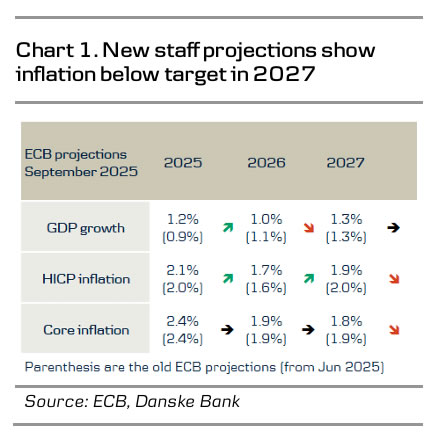
Otherwise, the staff projections showed a growth forecast that was revised up for 2025 to 1.2% y/y (from 0.9%) due to better-than-expected growth in the first half of the year while the expectation was unchanged for 2027. Core inflation was unchanged in 2025 and 2026 and headline slightly higher in 2025 at 2.1% (from 2.0%) due to previous inflation being higher than expected. Hence, the upward revision in 2025 was expected due to previous data while the downward inflation revision in 2027 came as a surprise. Lastly, the ECB repeated the previous guidance that the GC will "follow a data-dependent and meeting-by-meeting approach to determining the appropriate monetary policy stance".
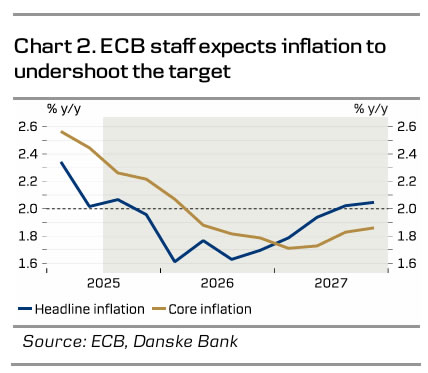
We keep our call that the ECB will not make any policy rate changes in 2025 or 2026. With growth holding up better than expected core inflation above the 2% target due to sticky wage growth, and the outlook for fiscal easing in 2026 we do not expect the ECB to deliver a final cut in the coming six months, contrary to market expectations. At the same time, we believe hikes in 2026 are premature due to inflation most likely being below target by then and the German economy having sufficiently room to increase production without fuelling inflation.
A Hesistant FX Market After As-Expected September CPI Release
Forex currencies have been dormant since the beginning of August as Markets haven't found what they want in the latest key data reports.
As previously thought, the latest NFP, PPI, and CPI combo reports would have expected to relieve volatility in FX. But volatility there wasn't.
After receiving all the most influential market data, the next step will be next Wednesday's FOMC rate decision (September 17).
Prior to the CPI release, expectations for a 50 bps cut were priced at 10% and are now closer to 5%. The 25 bps cut, however, is still priced to be a sure thing.
Indeed, when looking at Market reactions in other assets, it seems that the theme that is developing is one of a less prolonged impact of tariffs.
Despite an as expected 0.3% report, participants bidding on Bonds and Gold point toward a repricing of lower long-run inflationary impact of tariffs (while they are just starting to bite now), which is flattening the US Yield curve.
Until now, pricing has been one of lower short-term inflation expectations versus higher ones in the long run.
Despite the immediate US Dollar selloff, FX currencies are hesitant and hang close to unchanged on the session.
Discover major currency pairs charts and levels, after first peaking at reactions to other asset classes.
An overlook at cross-assets market reactions: Bonds and Gold are loving it, USD corrects.
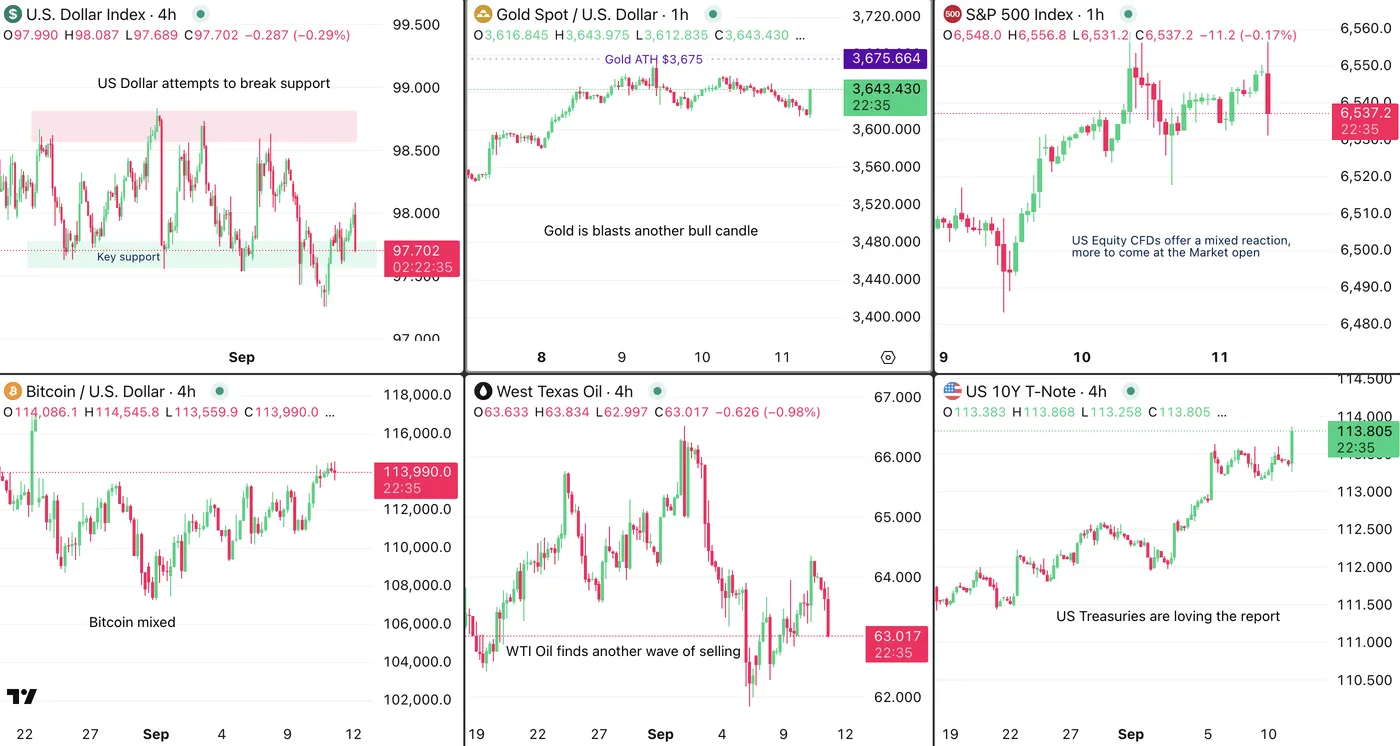
Cross-Asset charts post-CPI – September 11, 2025 – Source: TradingView
All FX Majors Charts with the immediate key levels in play
Yen likes the report but still needs more – USDJPY
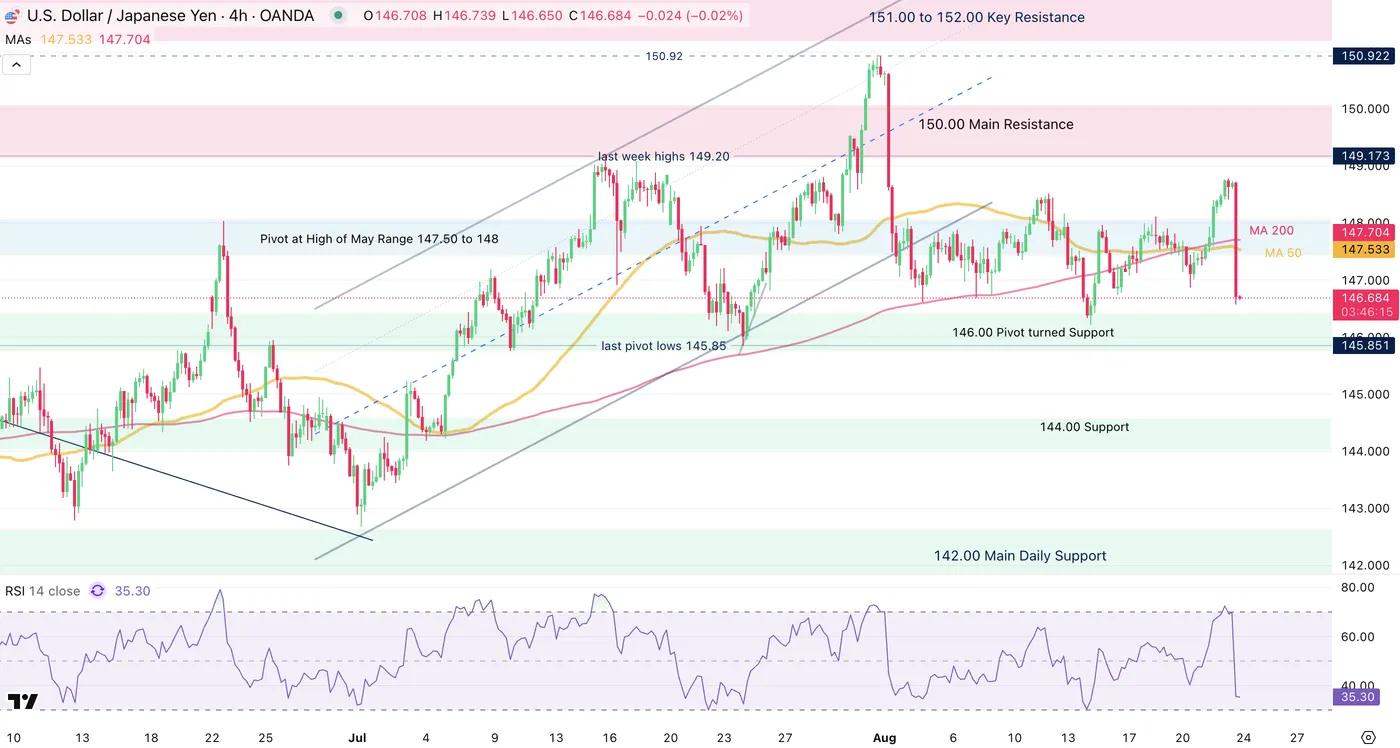
USDJPY 1H Chart, September 11, 2025, Source: TradingView
The most volatile FX pair is enjoying the ongoing selloff in the US Dollar but has yet to break out of its mid-range pivot zone.
Some ongoing selling might be pushing prices out of this region however this move still has to develop.
Wicky action at the extremes prove that participants are still hesitant on the upcoming direction for currencies.
A 25 bps confirming could still provide some strength to the USD which helps to explain why participants are still looking at each other to see who moves first
Levels to watch for USDJPY:
- Mid-range pivot 147.50 to 148.00 (currently trading – Look for breakouts of this zone)
- May Range Extremes 148.70 to 149.50 (Daily MA 200)
- 146.50 Main range Support
AUDUSD – pushing to retest yearly highs
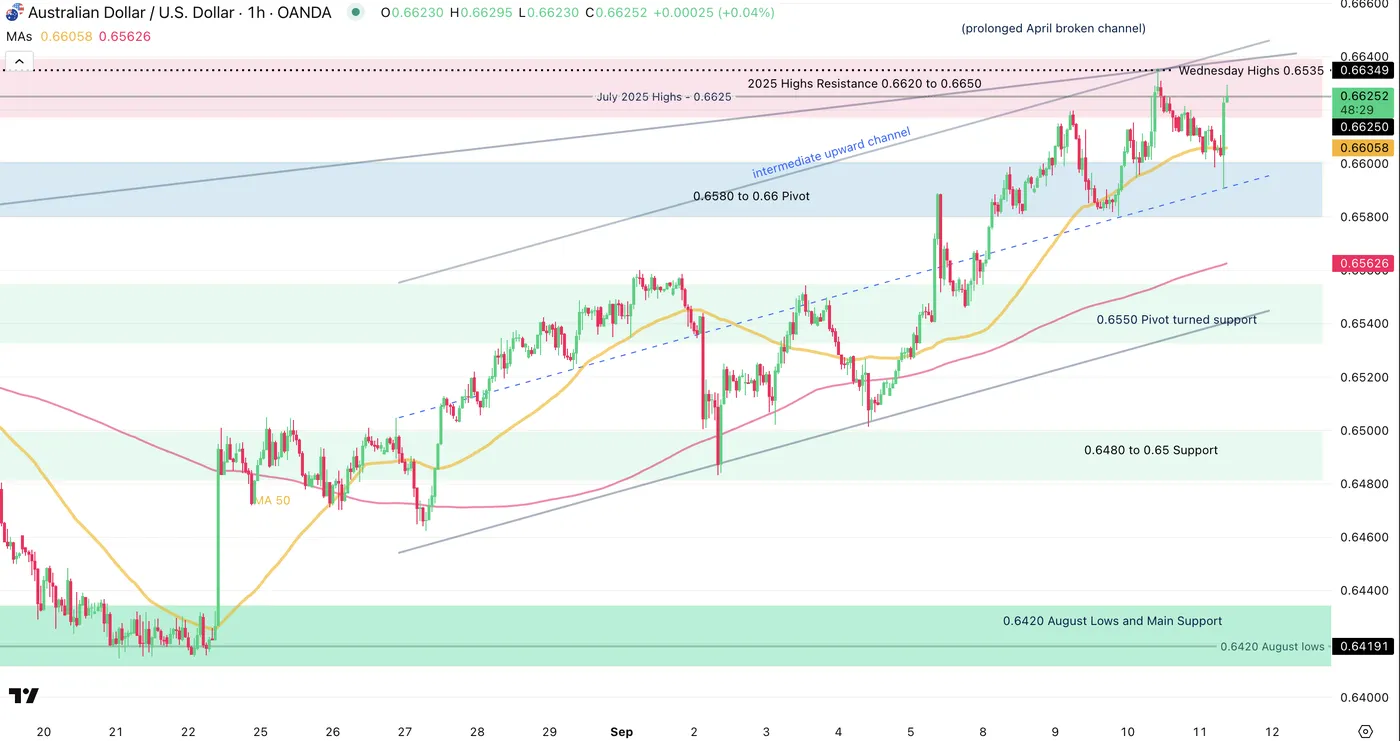
AUDUSD 1H Chart, September 11, 2025, Source: TradingView
AUDUSD has rebounded significantly since its August 1st lows and by evolving in an intermediate upward channel, heads to retest its yesterday and 2025 highs (0.6535).
Some hesitation at the current levels is forming and will be essential to monitor.
Levels to watch for AUDUSD:
- 2025 Highs Resistance 0.6620 to 0.6650
- 0.6580 to 0.66 Pivot acting as mid-term support
- 0.6550 Pivot turned support and low of intermediate channel.
EURUSD – a wicky retest of its range resistance
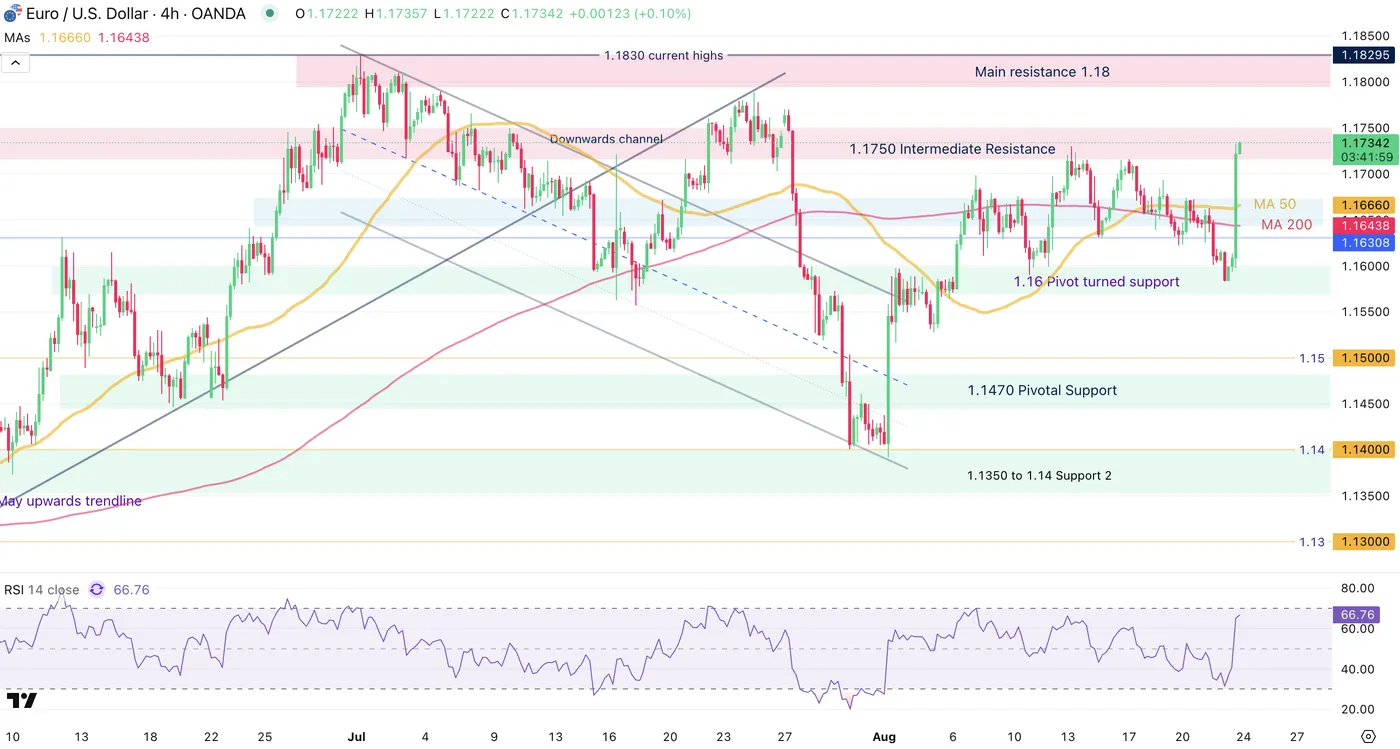
EURUSD 2H Chart, September 11, 2025, Source: TradingView
EURUSD still evolves within its August range after a failed upside breakout in yesterday's session.
Buyers have pushed towards a retest of the resistance but seem to be running out of steam.
Levels to watch for EURUSD:
- PPI highs 1.17801
- 1.1750 Immediate Resistance
- Session lows and key range pivot 1.1660
- 1.16 Current main Support
USDCHF – Downfall stalling
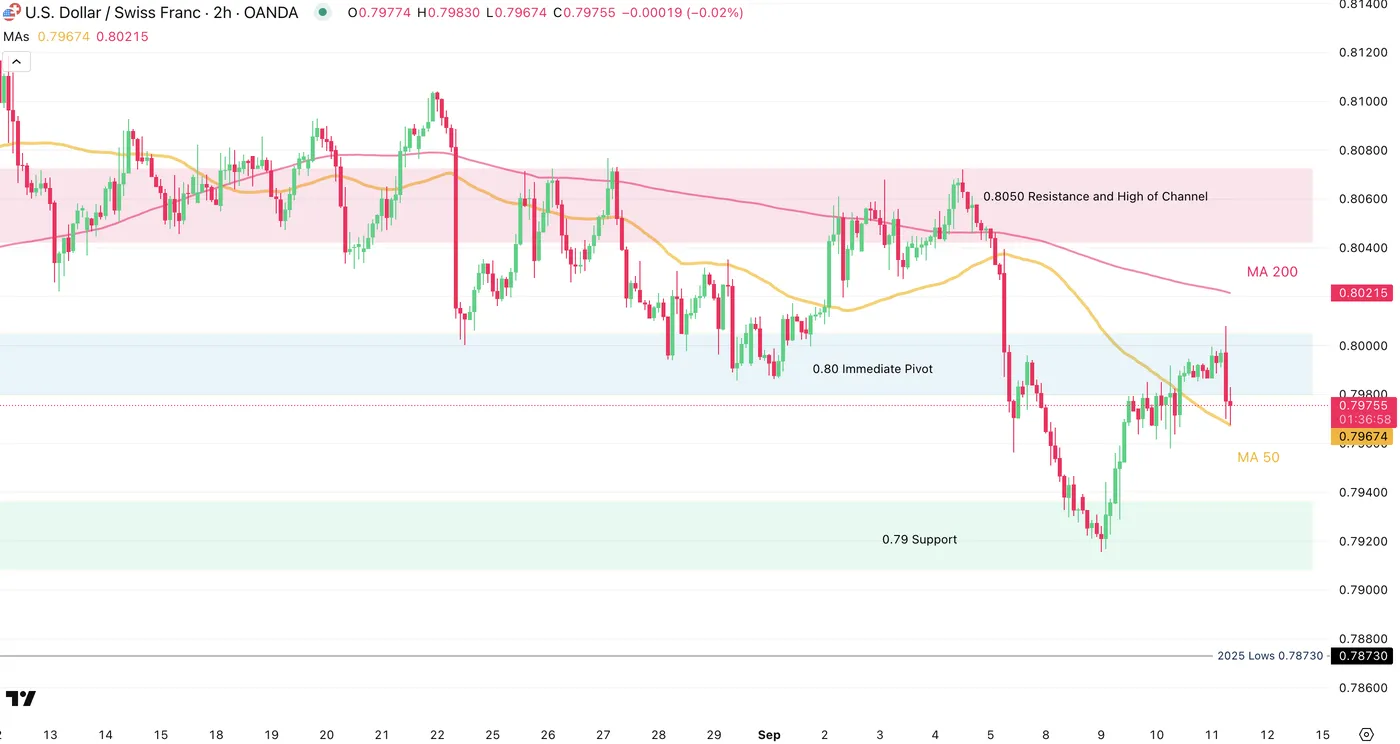
USDCHF 2H Chart, September 11, 2025, Source: TradingView
The Swiss franc had strengthened immensely in the beginning of the month which pushed USDCHF towards a retest of its 2025 Main support (0.7916 week lows).
However, despite a selling candle from the data, hesitation comes at the 50-period MA which will also be key to upcoming action: A rejection of the MA could provide a boost to the pair, while a breakdown could also lead to further downside.
Levels to watch for USDCHF:
- 0.8050 Resistance
- 0.80 Immediate Pivot and 50-period MA (action stalling here)
- 0.79 Main Support (latest rebound)
- 2025 Lows 0.78730
GBPUSD – Liked the report, but hesitant at the highs
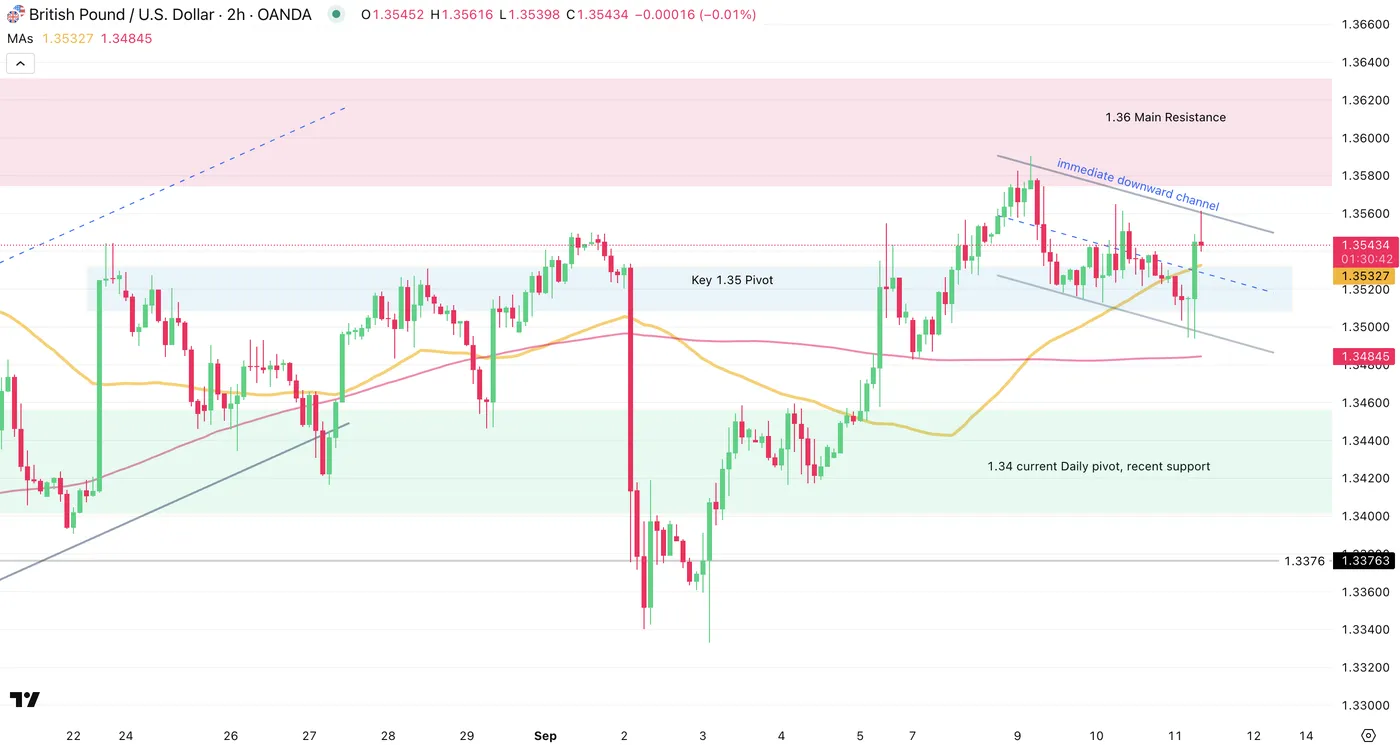
GBPUSD 2H Chart, September 11, 2025, Source: TradingView
GBPUSD has, like its European neighbor, been stuck in a 2,000 pip range since the middle of August (1.34 to 1.36).
The buying reaction to the CPI report is once again met with some hesitation as prices are meeting the range resistance.
Watch the immediate low-slope downward channel that may shape today's price action.
Levels to watch for GBPUSD:
- 1.36 Main channel Resistance
- Key 1.35 Pivot (daily lows, key for buy/sell momentum)
- 1.34 current Daily pivot (acted as Support)
USDCAD reject its mid-term upward channel
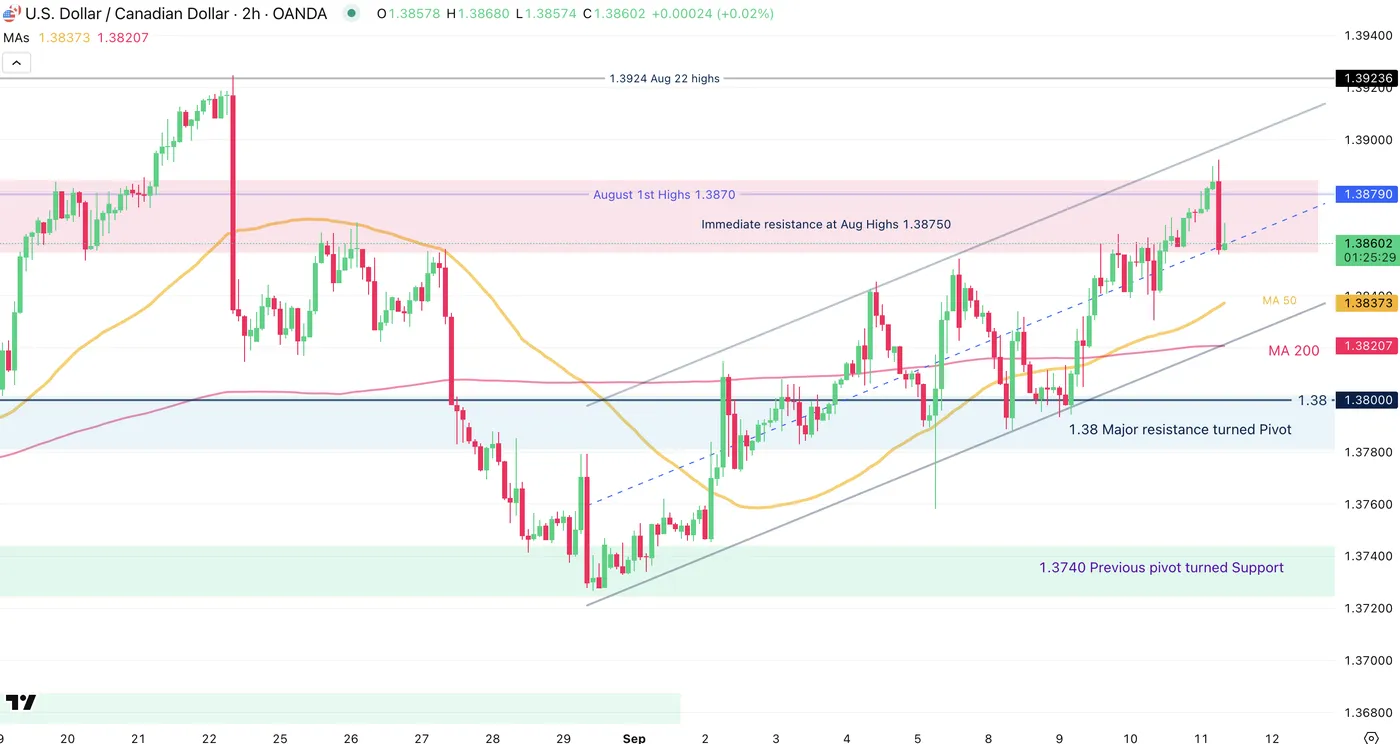
USDCAD 2H Chart, September 11, 2025, Source: TradingView
USDCAD is virtually unchanged after the report – By attaining the upper bound of its upward channel, mean-reversion selling seems to occur but real momentum has yet to materialize.
Levels to watch for USDCAD:
- Immediate resistance at Aug Highs 1.38750
- 1.38 Major resistance turned Pivot
- 1.3740 Support
Safe Trades!
Sunset Market Commentary
Markets
The European Central Bank in a move widely expected kept the policy rate unchanged at 2%. The second no-change outcome straight was unanimous and results from the ECB observing that inflation is currently around the 2% medium target. With the updated forecasts showing inflation to stay there over the policy horizon, there was no need to adjust rates. The ECB penciled in 2.1%-1.7%-1.9% over the 2025-2027 period, to be compared with 2%-1.6%-2% in June. Core inflation expectations stayed pretty much the same as well. Growth for this year was bumped to 1.2% from 0.9%. The first quarter enjoyed a boost from (export) frontloading while domestic consumption remained resilient so far. Current headwinds from a stronger euro, import tariffs and increased competition should fade in 2026. Growth for that year was revised slightly downward to 1% while that for 2027 was kept unchanged at 1.3%. Lagarde noted that risks to growth have become more balanced, an important shift from July when “risks remained tilted to the downside”. Lagarde’s response to the first question in the press conference, whether the easing cycle is over, immediately struck a nerve: “Let me tell you this … the disinflation process is over.” Everything she said afterwards (we’re data dependent, go meeting by meeting …) in the rest of her answer and by extension of the presser can and was easily ignored. Lagarde de facto buried any remaining doubts whether the central bank will lower rates again, barring major shocks. Combined with the upgraded growth risk balance it hurled short-term European rates to intraday highs, leading to net daily changes varying between +1.6 (30-yr) to +4.8 bps (5-yr). The 2-yr swap yield rises to a 5-month high, the German equivalent is on the verge of topping 2%.
In between the statement release and the presser, the US published in-line with consensus August CPI numbers but well-above-consensus jobless claims. The former printed 0.4% on a headline basis, slightly more than the 0.3% expected. The yearly figure matched the anticipated rise to 2.9%. Core CPI came in at 0.3% and 3.1% (same as in July). The core goods excluding new and used vehicles, considered sensitive to tariff-related inflationary pressures, was only up 0.13% m/m, the weakest reading since March and a further deceleration from July’s 0.22%. Other closely watched import-exposed categories such as video & audio products, apparel and household furnishings all showed either a contained price increase, a smaller one than the month before or both. Services inflation added a July-matching 0.3% m/m whereas some feared this category would come in hot. The numbers came together with a significant uptick in jobless claims to 263k, the highest since late 2021 when the numbers were still normalizing from the Covid spike. It’s seen as evidence of a weakening labour market and boosted Fed rate cut expectations. Three 25 bps cuts are now fully priced in for this year with some adding to bets for a 50 bps move next week. The ECB and US data help give the euro the upper hand over the dollar, though given the yield differentials gains could have been larger. EUR/USD bounces of an upward sloping trend line towards 1.172. The 1.1829 July multiyear remains out of reach so far.
News & Views
The Norges Bank today published its Q3 Regional Network report, important input for its policy meeting Thursday next week. According to the report, full capacity utilization (at 35%) was little changed from the previous surveys. Overall, contacts expect output growth to remain fairly stable in the period between Q3 2025 (0.4%) and Q4 2025 (0.4%) Many expect higher household purchasing power to strengthen demand. Some contacts expect growth in residential construction to boost activity. A number of contacts point out that there is still uncertainty related to international trade barriers and some cite greater customer caution. Contacts expect somewhat higher investment in 2025 (1.1% from -0.9% previously) than in 2024 and growth to remain firm in 2026 (1.6%). At 25%, contacts reporting recruitment difficulties rose slightly. They also see further employment growth both in Q3 and Q4 (0.2%). Wage growth is estimated at 4.5% this year and 4% next year. Combined with higher than expected August (core) CPI data published yesterday, the survey outcome poses questions whether the NB will already reduce the policy rate further next week. The Norwegian krone strengths modestly further today (EUR/NOK 11.615).
USD/JPY Mid-Day Outlook
Daily Pivots: (S1) 147.20; (P) 147.42; (R1) 147.69; More...
Intraday bias in USD/JPY remains neutral for the moment. Risk will stay on the upside as long as 149.12 resistance holds. Firm break of 146.20 will target 100% projection of 150.90 to 146.20 from 149.12 at 144.42. Also, sustained trading below 55 D EMA (now at 147.16) will argue that whole rebound from 139.87 has completed with three waves up to 150.90.

In the bigger picture, price actions from 161.94 (2024 high) are seen as a corrective pattern to rise from 102.58 (2021 low). Decisive break of 61.8% retracement of 158.86 to 139.87 at 151.22 will argue that it has already completed with three waves at 139.87. Larger up trend might then be ready to resume through 161.94 high. In case the corrective pattern extends with another fall, strong support is expected from 38.2% retracement of 102.58 to 161.94 at 139.26 to bring rebound.

USD/CHF Mid-Day Outlook
Daily Pivots: (S1) 0.7970; (P) 0.7982; (R1) 0.8006; More….
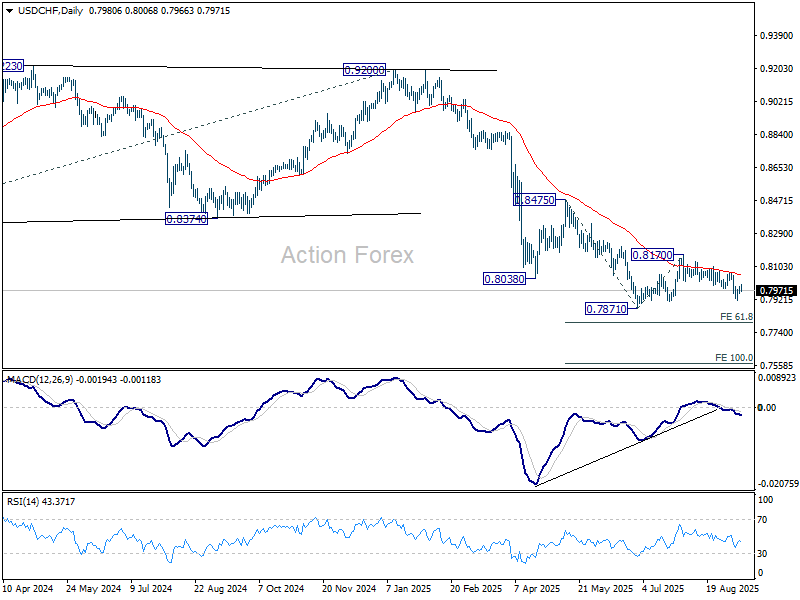
USD/CHF is staying in consolidations above 0.7914 temporary low and intraday bias remains neutral. Risk will stay on the downside as long as 0.8071 resistance holds. Below 0.7914 will bring retest of 0.7871 low. Firm break there will resume larger down trend. Next target is 61.8% projection of 0.8475 to 0.7871 from 0.8170 at 0.7797.
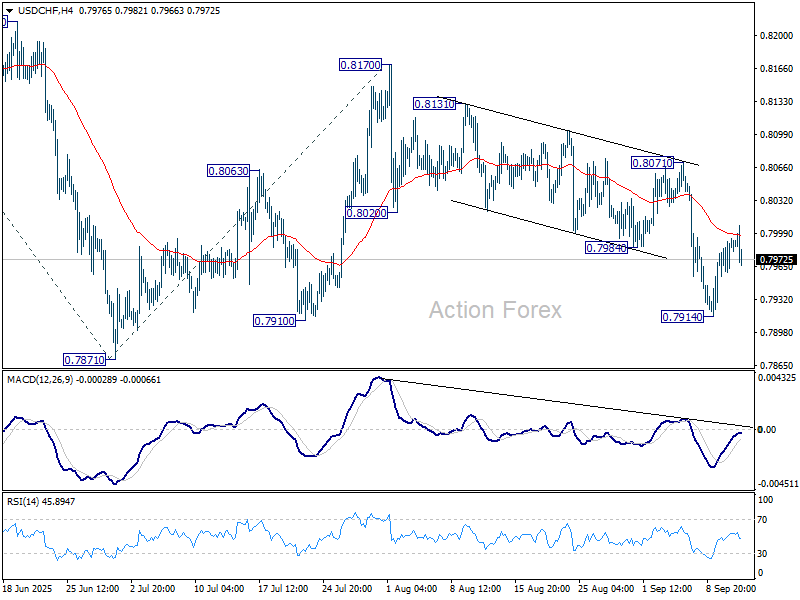
In the bigger picture, long term down trend from 1.0342 (2017 high) is still in progress. Next target is 100% projection of 1.0146 (2022 high) to 0.8332 from 0.9200 at 0.7382. In any case, outlook will stay bearish as long as 0.8475 resistance holds.