Sample Category Title
Franc hit by tariff shock, CHF/JPY drops towards 180, but 178 should hold
Swiss Franc has come under heavy pressure since early August, with trade tensions driving much of the weakness. The US stunned markets last week by imposing a 39% tariff on Swiss imports, accusing Bern of failing to make “meaningful concessions” on trade. The duties, effective Thursday, will impact a broad swath of Swiss exports — including high-value goods like pharmaceuticals and luxury watches — which are heavily reliant on access to the US market.
Swiss officials have scrambled to Washington in a final attempt to prevent the tariffs from being implemented. President Keller-Sutter and Business Minister Parmelin arrived Tuesday, and a meeting with US Secretary of State Marco Rubio is scheduled for Wednesday. With no confirmed talks yet with US trade or commerce officials, hopes for a breakthrough might be fading, further weighing on the Franc.
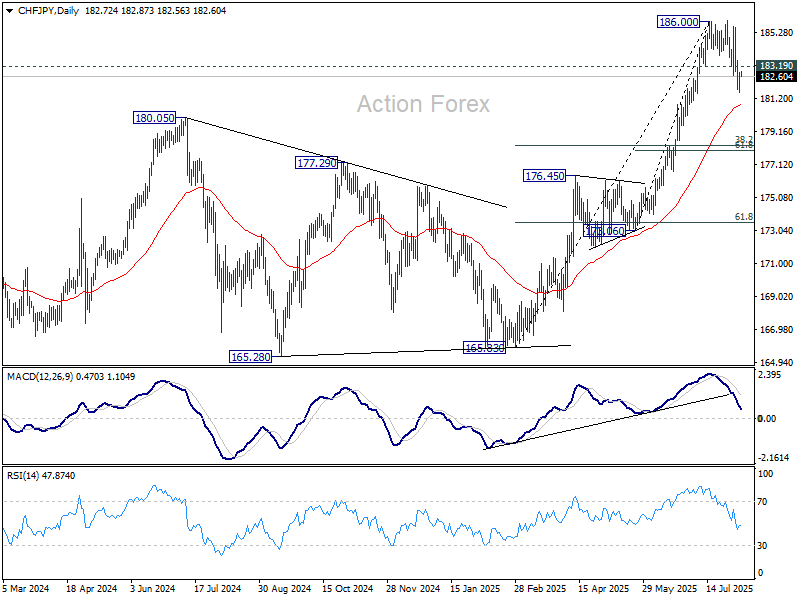
CHF/JPY is reflecting this pressure technically, with the pair confirming a short-term top at 186.60 after breaking support at 183.19. Near-term outlook favors a deeper correction to (now at 180.79) and possibly below.
But strong support should emerge around 178 support zone, (61.8% retracement of 173.06 to 186.00 at 178.00 and 38.2% retracement of 163.83 to 186.00 at 178.29) to contain downside. Large up trend is expected to resume through 186.00 at a later stage, if tensions with Washington ease in the coming weeks.
GBP/JPY Daily Outlook
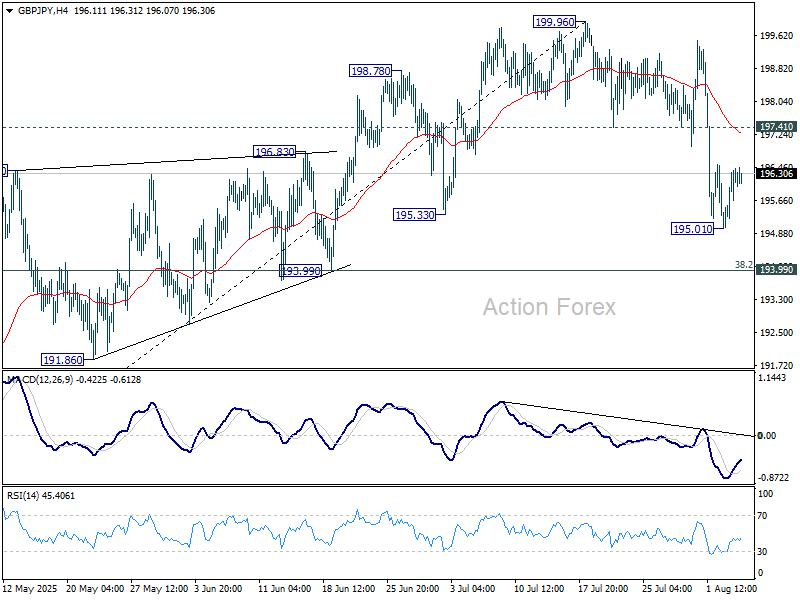
Daily Pivots: (S1) 195.39; (P) 195.92; (R1) 196.81; More...
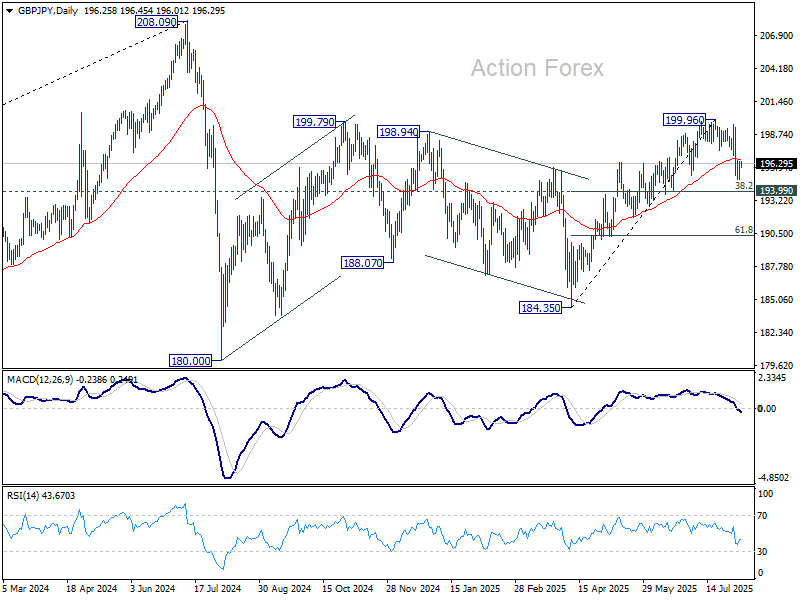
Intraday bias in GBP/JPY is turned neutral with current recovery. Corrective fall from 199.96 short term top could extend lower. But strong support is expected from 193.99 cluster support (38.2% retracement of 184.35 to 199.96 at 193.99). to bring rebound. On the upside, break of 197.41 support turned resistance will bring retest of 199.96. However, sustained break of 193.99 will raise the chance of near term bearish reversal.
In the bigger picture, price actions from 208.09 (2024 high) are seen as a correction to rally from 123.94 (2020 low). The pattern might still extend with another falling leg. But in that case, strong support should be seen from 38.2% retracement of 123.94 to 208.09 at 175.94 to contain downside. Meanwhile, decisive break of 208.09 will confirm long term up trend resumption.
EUR/JPY Daily Outlook
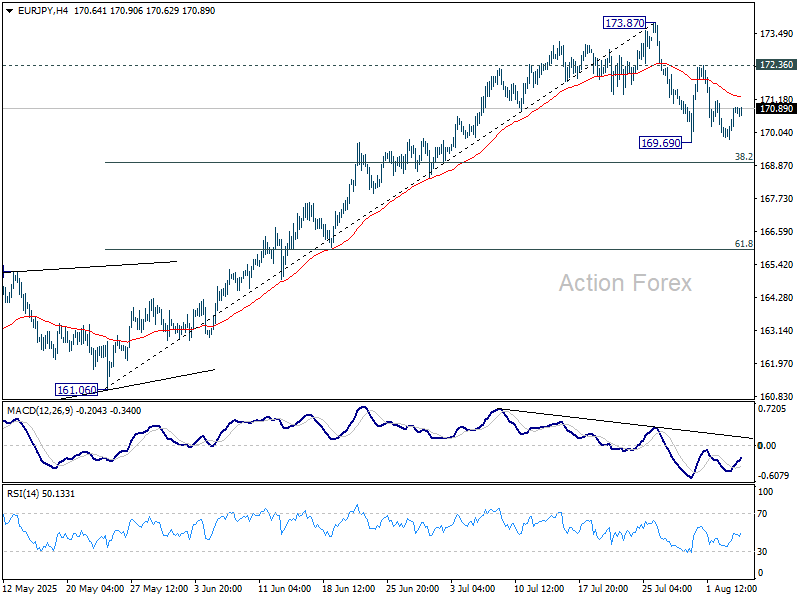
Daily Pivots: (S1) 170.10; (P) 170.52; (R1) 171.23; More...
Outlook in EUR/JPY remains unchanged and intraday bias stays neutral. While fall from 173.87 short term top could extend lower, downside should be contained by 38.2% retracement of 161.06 to 173.87 at 168.97 to bring rebound, at least on first attempt. On the upside, above 172.36 resistance will bring retest of 173.87 first. However, sustained break of 168.97 will raise the chance of near term bearish reversal.
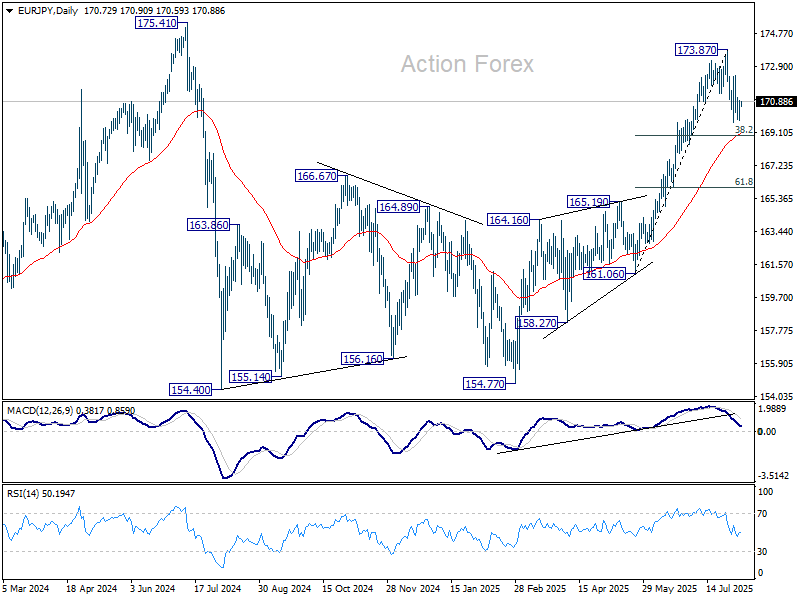
In the bigger picture, considering current strong momentum as seen in the rally from 154.77, corrective pattern from 175.41 could have already completed. Decisive break there will confirm long term up trend resumption. Next target is 61.8% projection of 124.37 to 175.41 from 154.77 at 186.31. However, rejection by 175.41, followed by firm break of 55 D EMA (now at 168.80) will delay this bullish case.
EUR/GBP Daily Outlook
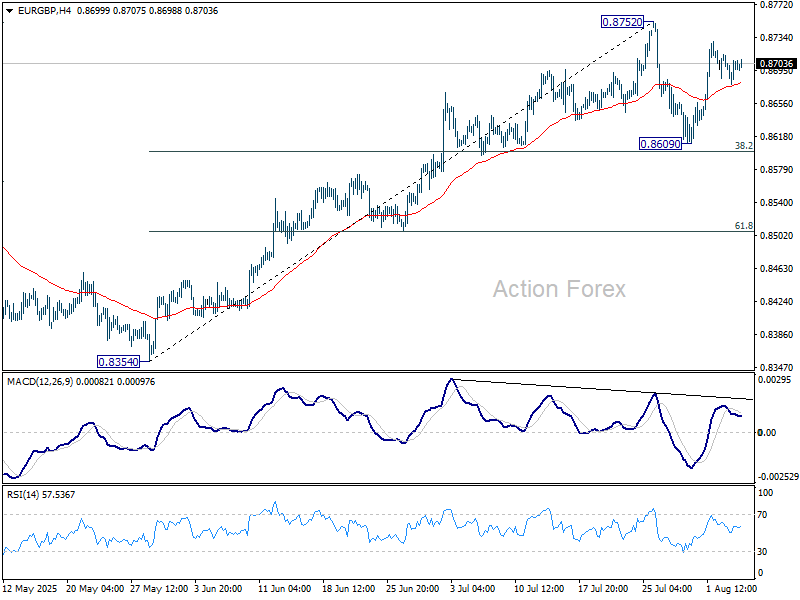
Daily Pivots: (S1) 0.8674; (P) 0.8707; (R1) 0.8736; More...
Intraday bias in EUR/GBP remains neutral, and consolidations from 0.8572 short term top could extend. But in case of another fall, downside should be contained by 38.2% retracement of 0.8354 to 0.8752 at 0.8600. On the upside, firm break of 0.8752 will resume the rise from 0.8354 towards 0.8867 fibonacci level.
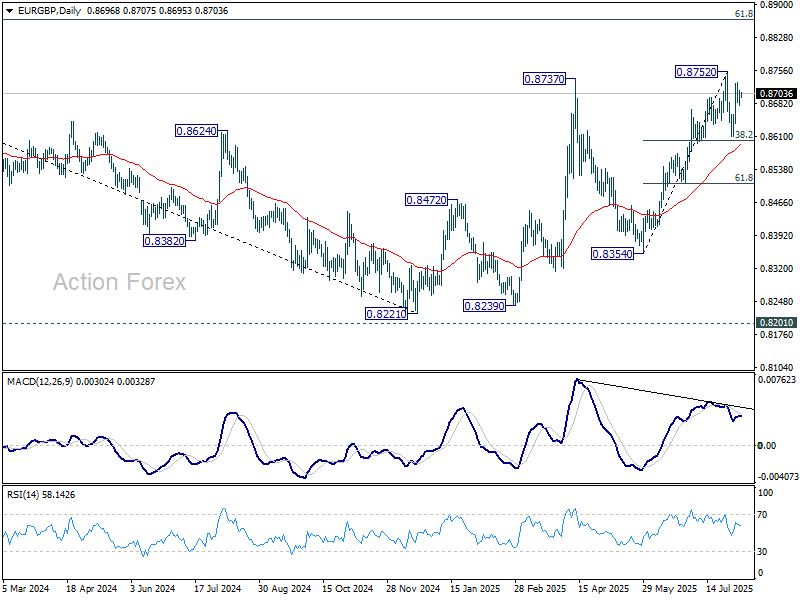
In the bigger picture, the structure from 0.8221 medium term bottom are not impulsive enough to suggest that it's reversing the down trend from 0.9267 (2022 high). But even if it's a correction, further rise is expected to 61.8% retracement of 0.9267 to 0.8221 at 0.8867. This will remain the favored case as long as 55 W EMA (now at 0.8493) holds.
EUR/AUD Daily Outlook
Daily Pivots: (S1) 1.7839; (P) 1.7877; (R1) 1.7918; More...
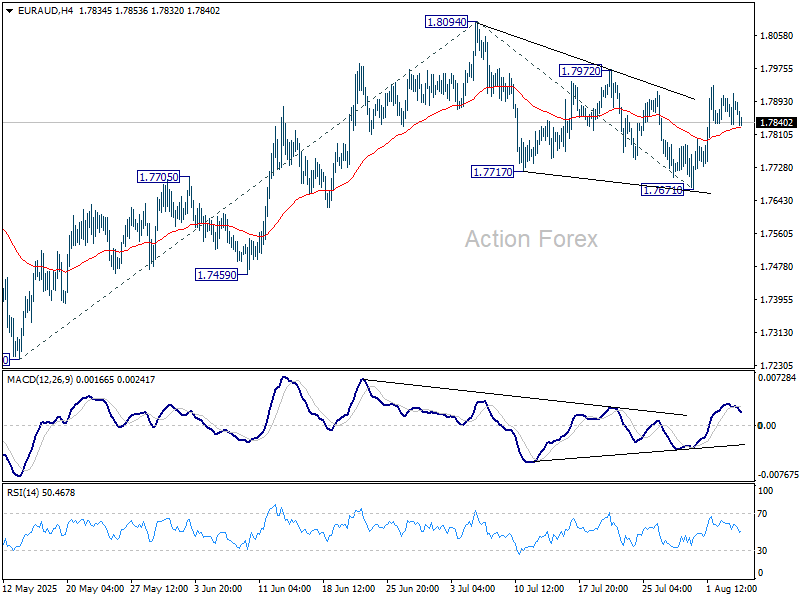
Intraday bias in EUR/AUD stays neutral at this point. On the upside, break of 1.7972 resistance should resume the whole rally from 1.7245 through 1.8094 to 61.8% projection of 1.7245 to 1.8094 from 1.7671 at 1.8196. On the downside, below 1.7671 will bring deeper fall back to 1.7459 support instead.
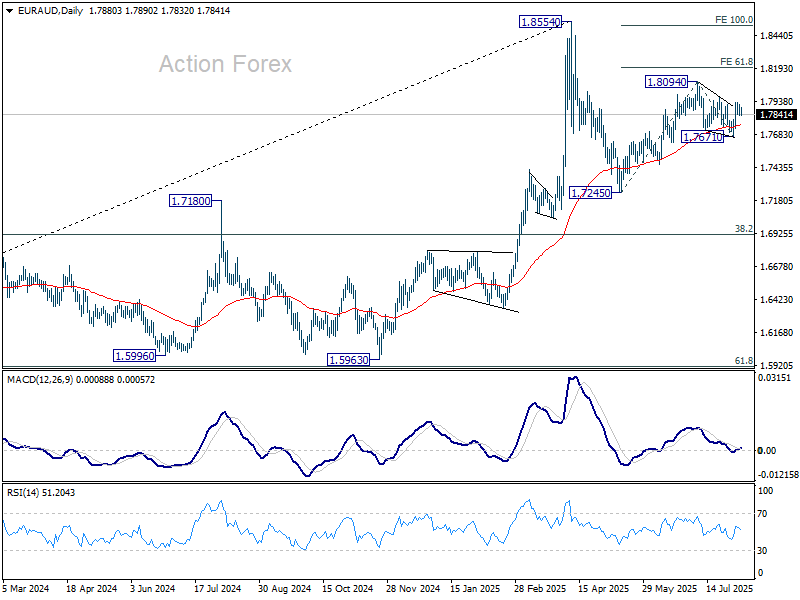
In the bigger picture, price actions from 1.8554 medium term top are seen as a corrective pattern. Such pattern could extend further with another falling leg. But even in that case, downside should be contained by 38.2% retracement of 1.4281 (2022 low) to 1.8554 at 1.6922 to bring rebound. Up trend from 1.4281 is expected to resume at a later stage.
EUR/CHF Daily Outlook
Daily Pivots: (S1) 0.9330; (P) 0.9345; (R1) 0.9361; More....
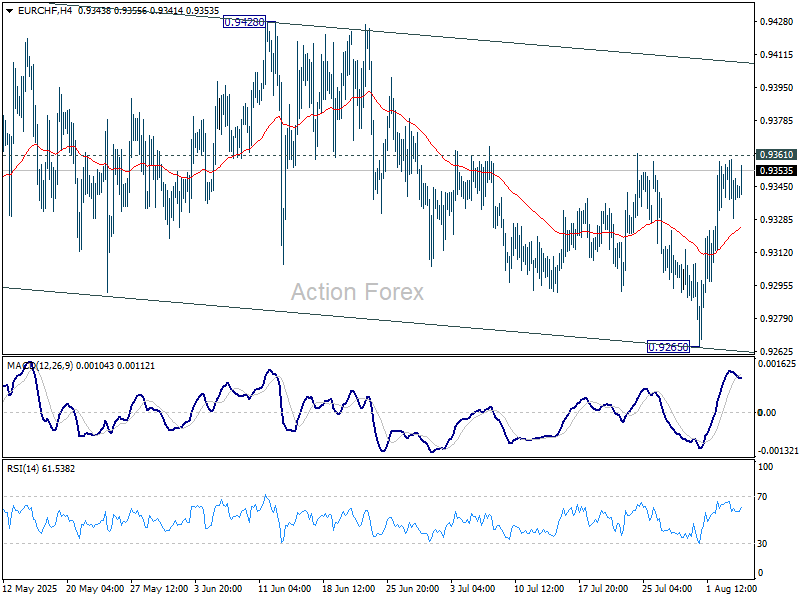
Intraday bias in EUR/CHF stays neutral and focus remains on 0.9361 resistance. Firm break there will suggest that corrective pattern from 0.9445 has already completed at 0.9265. Further rise should then be seen to 0.9428 resistance for confirmation. However, below 0.9265 will bring another fall back to retest 0.9218 low.
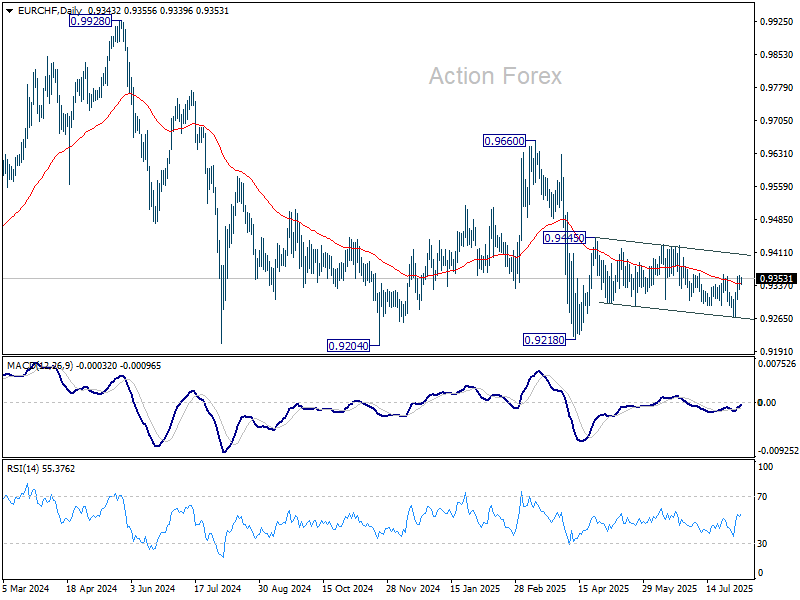
In the bigger picture, the down trend from 0.9204 (2018 high) might still be in progress considering that EUR/CHF is staying well inside the long term falling channel. However, with bullish convergence condition in W MACD, downside position should be limited in case of another fall. Instead, firm break of 0.9660 resistance will be an important sign of medium term bullish trend reversal.
EUR/USD Daily Outlook
Daily Pivots: (S1) 1.1539; (P) 1.1564; (R1) 1.1599; More...
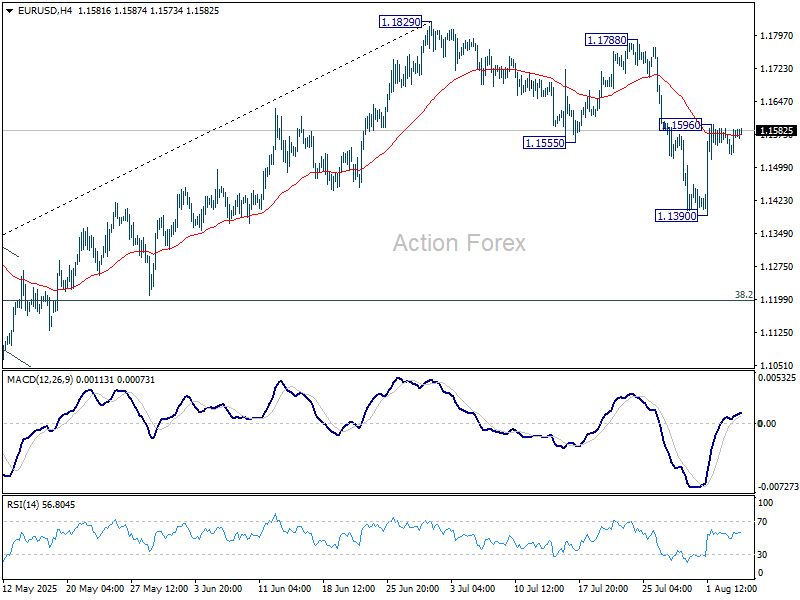
Intraday bias in EUR/USD remains neutral and outlook is unchanged. On the upside, above 1.1596 will affirm the case that correction from 1.1829 has completed with three waves at 1.1390. Further rally should then be seen to retest 1.1788/1820 resistance zone. On the downside, break of 1.1390 will resume the correction to 38.2% retracement of 1.0176 to 1.1829 at 1.1198 instead.
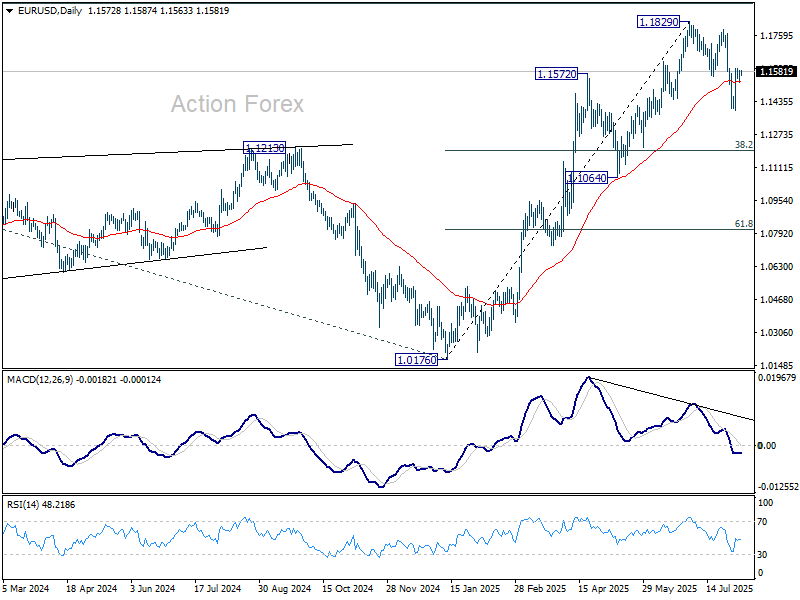
In the bigger picture, rise from 0.9534 long term bottom could be correcting the multi-decade downtrend or the start of a long term up trend. In either case, further rise should be seen to 100% projection of 0.9534 to 1.1274 from 1.0176 at 1.1916. This will remain the favored case as long as 1.1604 support holds.
USD/JPY Daily Outlook
Daily Pivots: (S1) 146.84; (P) 147.34; (R1) 148.06; More...
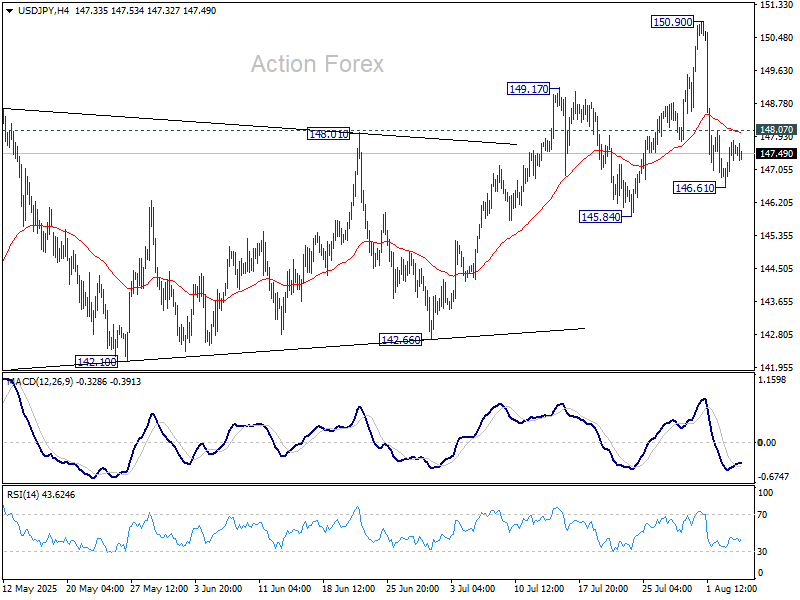
Intraday bias in USD/JPY stays neutral for the moment. As long as 145.84 support holds, larger rebound from 139.87 is still in favor to continue. On the upside, above 148.07 minor resistance will bring stronger rebound back to retest 150.90. However, on the downside, firm break of 145.84 support will argue that whole rise from 139.87 might have already completed. Deeper fall should then be seen to 142.66 support for confirmation.
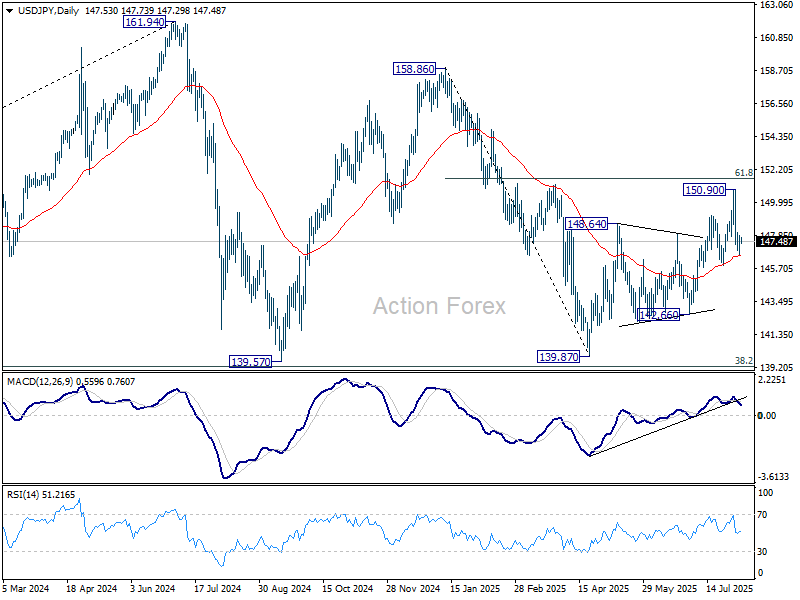
In the bigger picture, price actions from 161.94 (2024 high) are seen as a corrective pattern to rise from 102.58 (2021 low). Decisive break of 61.8% retracement of 158.86 to 139.87 at 151.22 will argue that it has already completed with three waves at 139.87. Larger up trend might then be ready to resume through 161.94 high. In case the corrective pattern extends with another fall, strong support is expected from 38.2% retracement of 102.58 to 161.94 at 139.26 to bring rebound.
GBP/USD Daily Outlook
Daily Pivots: (S1) 1.3267; (P) 1.3292; (R1) 1.3324; More...
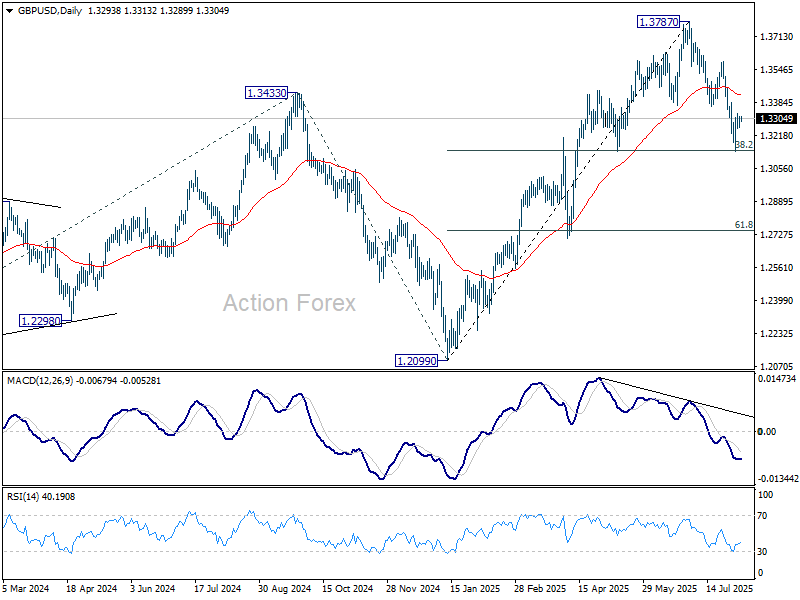
Range trading continues in GBP/USD and intraday bias stays neutral. On the upside, sustained break of 1.3363 support turned resistance will indicate that the fall has completed as a three-wave correction. Further rally should then be seen back to 1.3587 resistance next. Nevertheless, sustained trading below 38.2% retracement of 1.2099 to 1.3787 at 1.3142 will target 61.8% retracement at 1.2744.
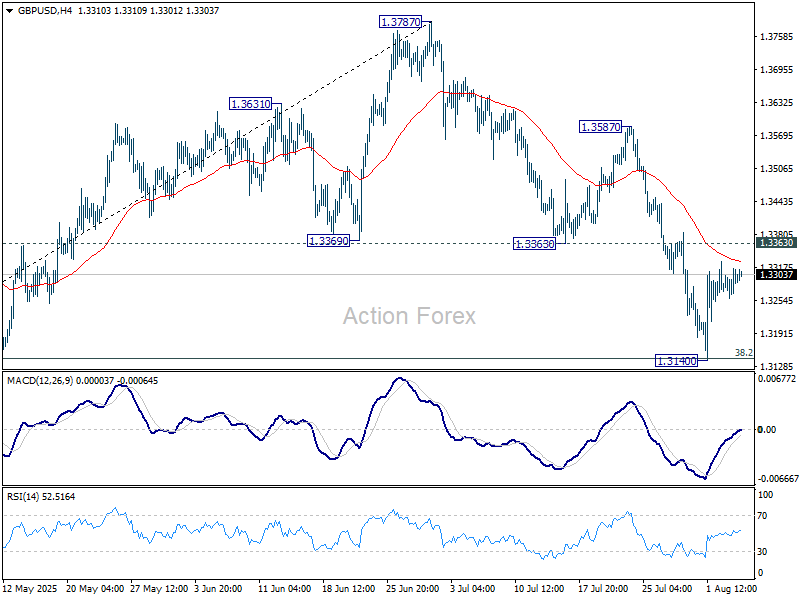
In the bigger picture, up trend from 1.3051 (2022 low) is in progress. Next medium term target is 61.8% projection of 1.0351 to 1.3433 from 1.2099 at 1.4004. Outlook will now stay bullish as long as 55 W EMA (now at 1.3049) holds, even in case of deep pullback.
USD/CHF Daily Outlook
Daily Pivots: (S1) 0.8053; (P) 0.8086; (R1) 0.8106; More….
Range trading continues in USD/CHF and intraday bias remains neutral at this point. On the downside, below 0.8020 will affirm that case that corrective bounce from 0.7871 has completed at 0.8170. Bias will be back on the downside for 07871/7910 support zone. On the upside, though, break of 0.8170 will resume the rise from 0.7871 to 38.2% retracement of 0.9200 to 0.7871 at 0.8379 instead.
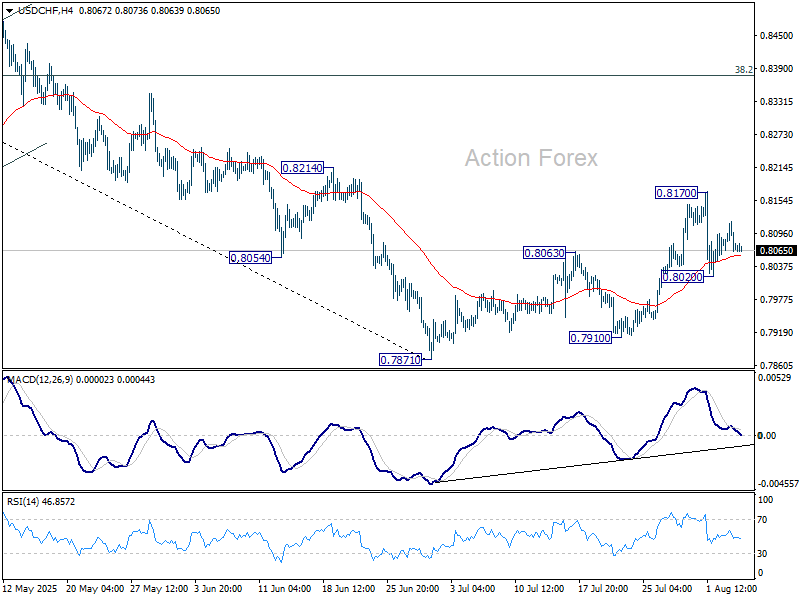
In the bigger picture, long term down trend from 1.0342 (2017 high) is still in progress. Next target is 100% projection of 1.0146 (2022 high) to 0.8332 from 0.9200 at 0.7382. In any case, outlook will stay bearish as long as 0.8475 resistance holds.