Sample Category Title
Summary 7/15 – 7/19
Monday, Jul 15, 2019
[php_everywhere instance="1"]
Tuesday, Jul 16, 2019
[php_everywhere instance="2"]
Wednesday, Jul 17, 2019
[php_everywhere instance="3"]
Thursday, Jul 18, 2019
[php_everywhere instance="4"]
Friday, Jul 19, 2019
[php_everywhere instance="5"]
CFTC Commitments of Traders – Bets for Higher Oil and Gold Prices Dropped
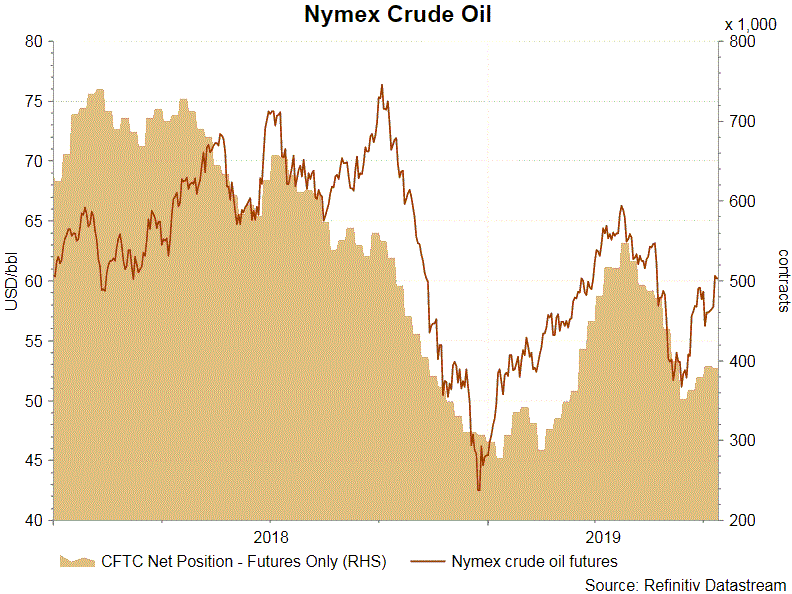
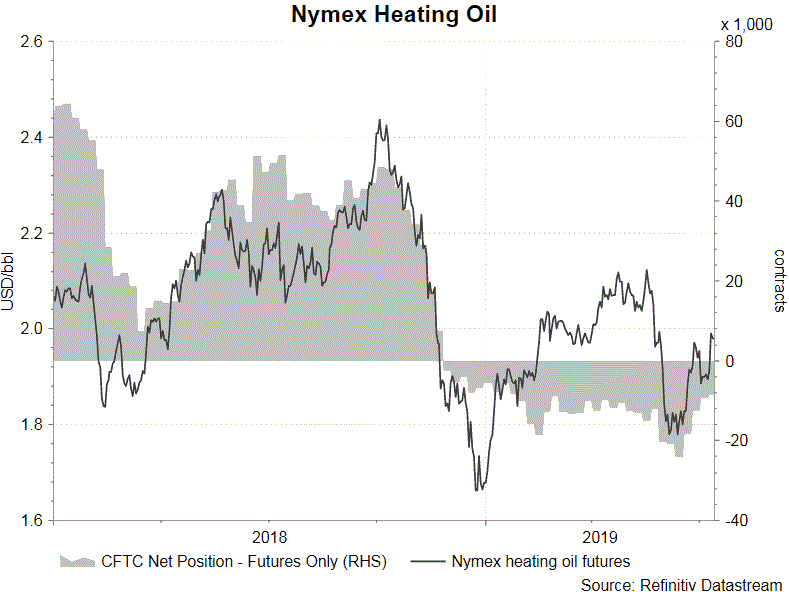
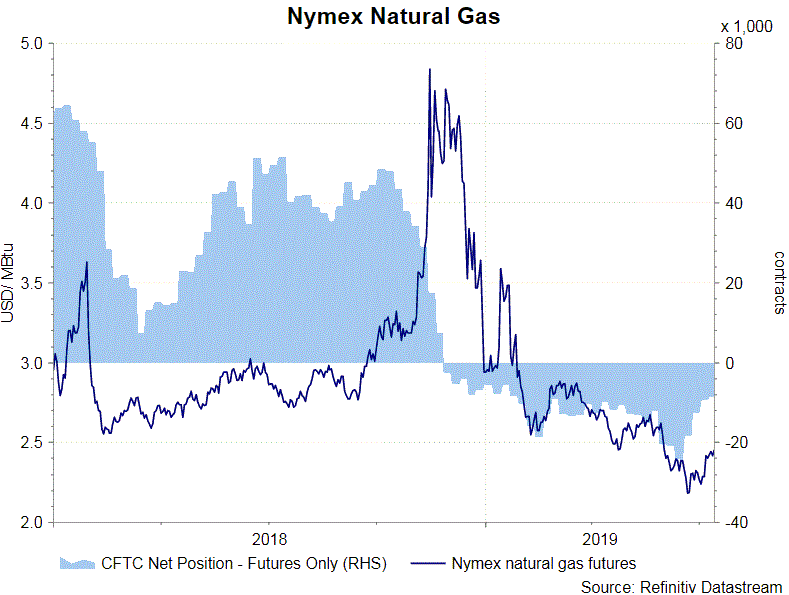
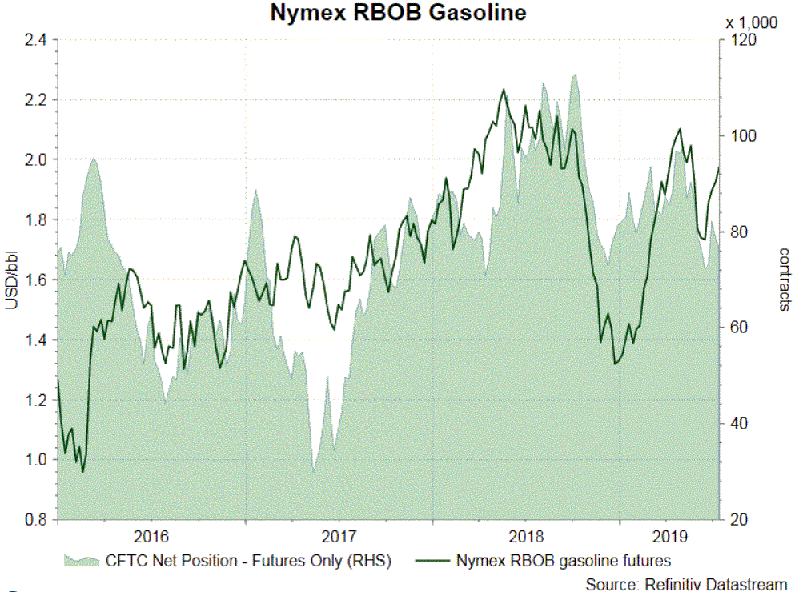
According to the CFTC Commitments of Traders report for the week ended July 9, NET LENGTH for crude oil futures fell -2 661 contracts to 390 149 for the week. Speculative long positions dropped -7 484 contracts and shorts were down -4 823 contracts. For refined oil products, NET LENGTH for gasoline fell -2 210 contracts to 76 342, while NET SHORT for heating oil slipped -950 contracts to 8 334 for the week. NET SHORT for natural gas futures dropped -1 638 contracts to 157 507 contracts for the week.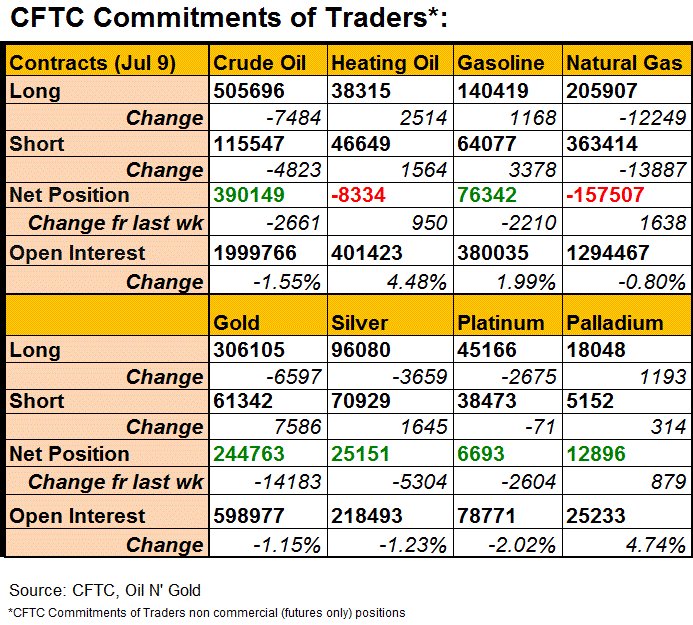
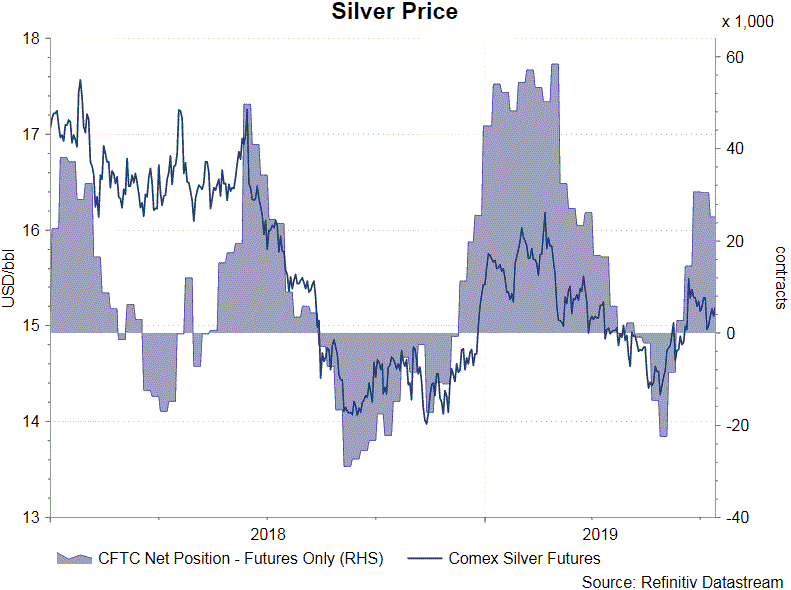
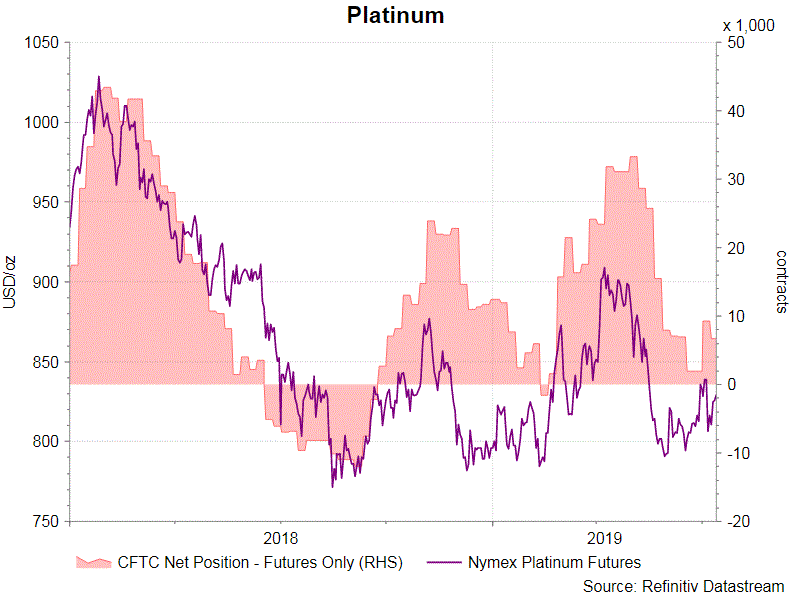
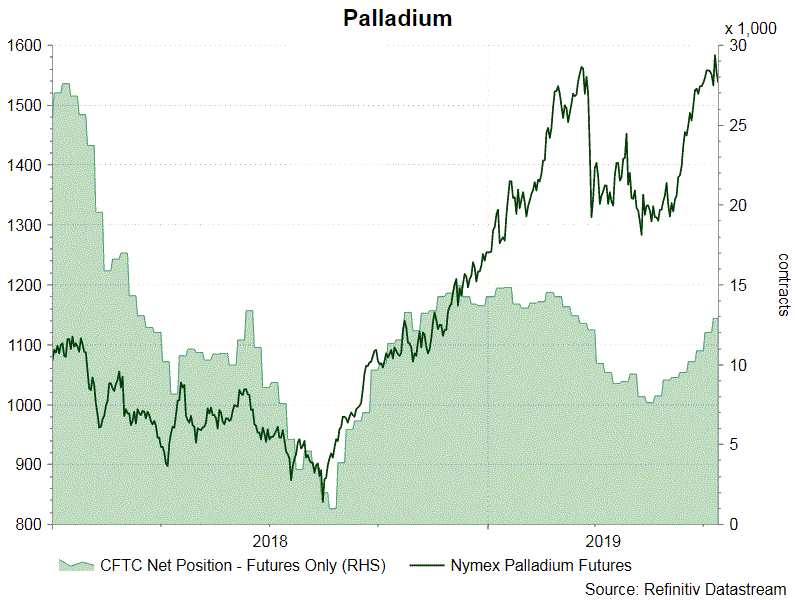
 NET LENGTH of gold and silver futures shrank last week. NET LENGTH for gold futures declined -14 183 contracts to 244 763. This is the first decline in 6 weeks as traders took profit from recent gold price rally. Speculative long positions fell -6 597 contracts, while shorts rose +7 586. For silver futures, speculative long positions dropped -3 659 contracts while shorts added +1 645. NET LENGTH for silver futures was down -5 304 contracts to 25 151. For PGMs, NET LENGTH of Nymex platinum futures declined -2 604 contracts to 6 693 while that for palladium gained +879 contracts to 12 896.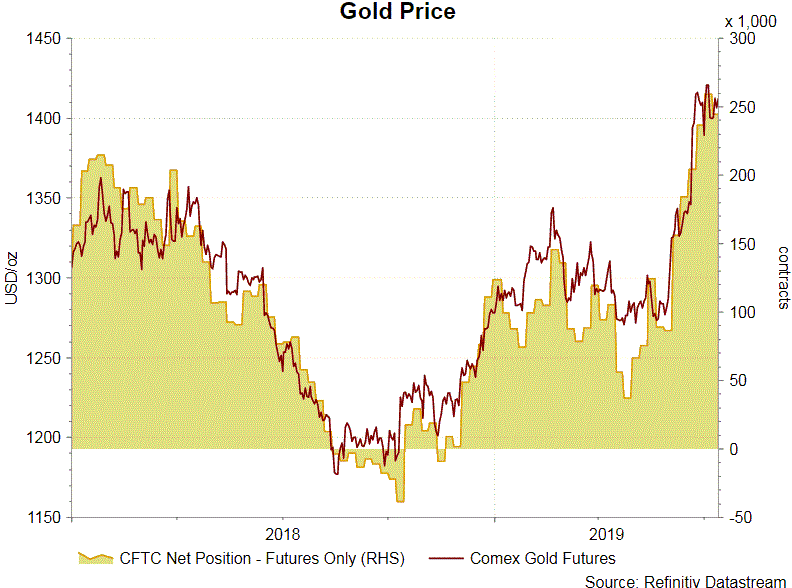
Weekly Economic and Financial Commentary: “To Call Something Hot, You Need to See Some Heat”
U.S. Review
Fed Rate Cut Approaching in July
- Fed Chair Powell did nothing during his Semiannual Monetary Policy testimony to Congress this week to push back against the market's view that the Fed will cut rates at its July 30-31 meeting.
- We expect that ongoing "crosscurrents" facing the U.S. economy will compel the Fed to cut rates both in July and again later this year, likely in October.
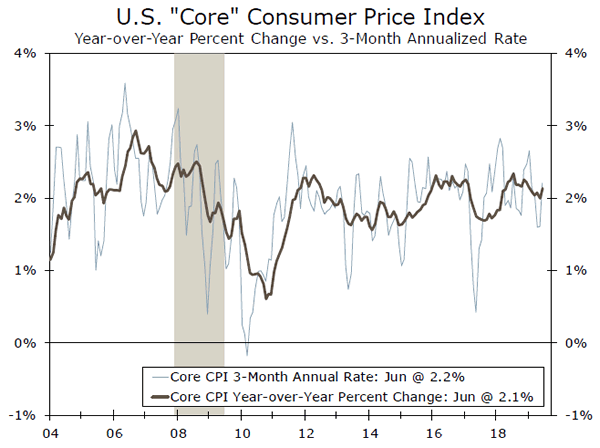
- The core CPI rose 0.3% in June, the largest monthly increase since January 2018, yet the generalized weakness in inflation this expansion further supports the Fed's rate cut case.
"To Call Something Hot, You Need to See Some Heat"
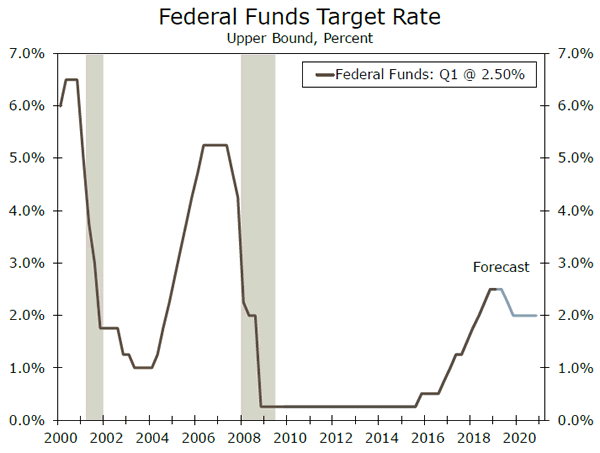
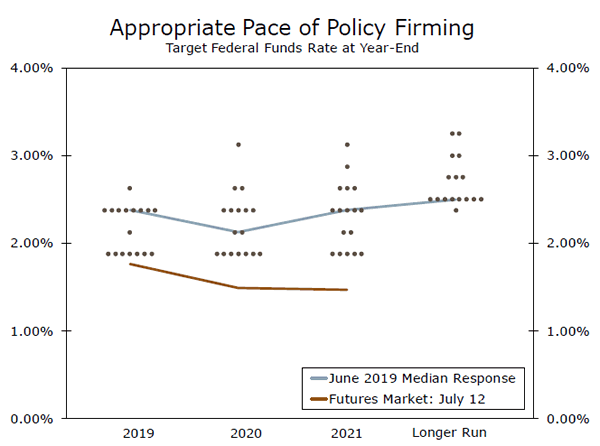
Fed Chair Powell confirmed the market's view that the Fed will cut rates at its July 30-31 meeting during his Semiannual Monetary Policy testimony to Congress this week. Some had speculated that Powell would push back against market expectations, if not regarding the expected timing of cuts then at least the magnitude. Yet with markets expecting a total of more than 100 bps of cuts, Powell opted to instead merely reiterate the messaging from the June FOMC meeting—that the uncertainties surrounding the trade environment and deteriorating global fundamentals are sufficient to compel an insurance cut. The minutes from that meeting were also released this week, and pointed to the strong consensus behind a rate cut in July. As we expected, the strong 224K June jobs number did not significantly affect the Fed's view; Powell did not mention it or the latest trade truce. We expect that ongoing "crosscurrents" facing the U.S. economy will compel the Fed to cut rates both in July and again later this year, likely in October. Perhaps more interestingly, Powell spoke surprisingly candidly about the Fed's success meeting the full employment portion of its dual mandate, and added to the growing chorus of questions regarding the viability of traditional macroeconomic models of the relationship between unemployment and inflation. Powell stated that "we don't have any evidence for calling this a hot labor market", and argued that the economy has further room to run, particularly by drawing people back into the labor force and boosting wages for those who were late to join the expansion, which is now the longest on record. Powell reiterated that "inflation pressures remain muted" and wryly stated that "To call something hot, you need to see some heat".
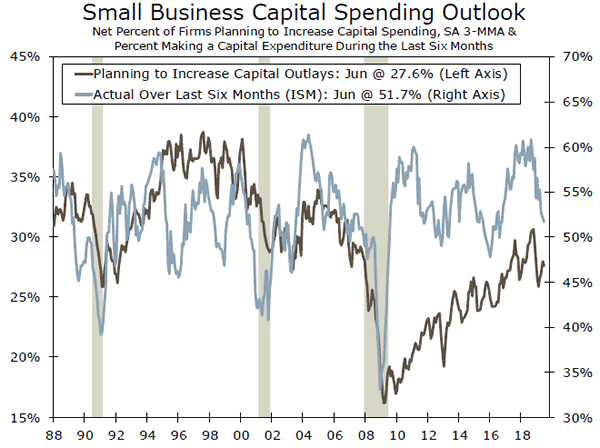
We did in fact get a few blips of heat this week— the core CPI rose 0.3%, the largest monthly increase since January 2018. Yet this follows four consecutive 0.1% readings. Meanwhile, the NFIB survey of small businesses reported that the proportion of firms raising prices jumped an eye-catching seven points. The selling prices measure is often viewed as a leading indicator for broad CPI inflation, perhaps suggesting some upside potential in coming months. Yet this number comes off of a low base, as the prior month's reading was the lowest since December 2017. The core Producer Price Index also rose an above-consensus 0.3%, but the trend is still moderate. The inflation story remains the same— gradually rising towards the Fed's 2% target, but unlikely to break meaningfully higher. What is more recent is the Fed's impatience with this painfully slow convergence to its target. Worried about the downward drift in inflation expectations, policymakers see a cut as the best way to bring inflation decisively up, notwithstanding the added justification to ease stemming from trade uncertainty.
Thus while the S&P 500 opened at an all-time high this morning and the unemployment rate sits at 3.7%, the Fed has all but locked in a July rate cut. While this may contradict conventional wisdom, the current Fed Chair testified to Congress this week that the Phillips Curve, or the relationship between unemployment and inflation that has underlain monetary policymaking for decades, is now just a "faint heartbeat". These are unconventional times.
U.S. Outlook
Retail Sales • Tuesday
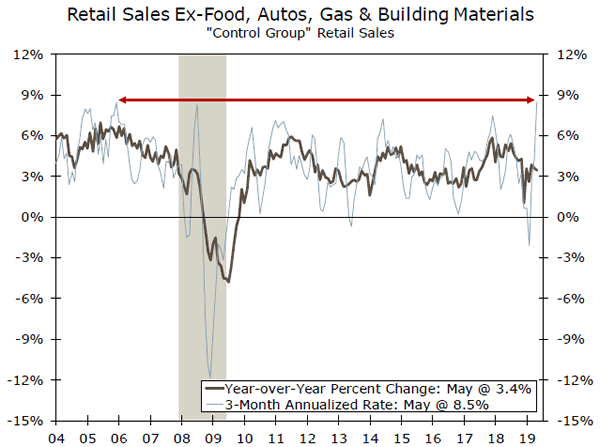
On Tuesday we receive retail sales estimates for June, which will provide us with a complete look at how sales fared over the second quarter. We have recently nudged our Q2 personal consumption expenditures (PCE) forecast higher to 3.4% from 2.9% previously, as spending is already on solid footing for the period. Indeed, following two solid monthly gains, retail sales rose 0.5% in May. This pushed control group sales—which exclude volatile components and are a good proxy for consumer spending—up 8.5% on a three-month annualized rate. This is the fastest pace since 2006 and suggests PCE growth is tracking well north of 3% in the second quarter. Higher frequency data, such as the Redbook Index for same store sales— which covers a sample of U.S. retailers—suggest sales remained solid in June. But given a more recent wilting of confidence, we expect retail sales rose a more modest 0.2% last month.
Previous: 0.5% Wells Fargo: 0.2% Consensus: 0.2% (Month-over-Month)
Industrial Production • Tuesday
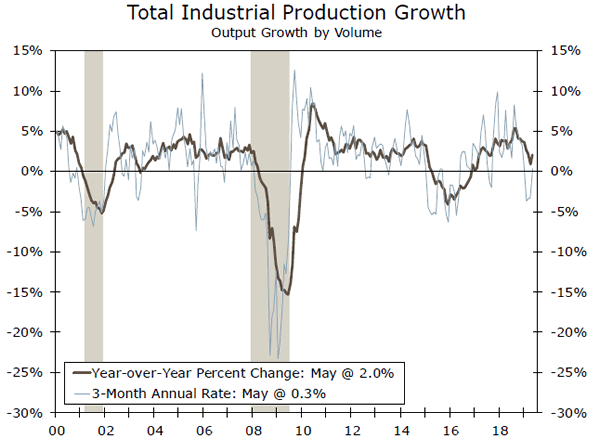
Later on Tuesday we will get a look at the production side of the economy. Reflecting slower global growth and ongoing trade uncertainty, manufacturing production has floundered this year and weighed on total industrial production (IP). The latest IP print for May, however, did show a rebound of 0.4%, with manufacturing production posting its first monthly increase this year. The ISM manufacturing index eased slightly in June, but suggested a continued expansion in manufacturing activity. Weakness in the new orders component of the index suggests production growth should remain modest. Uncertainty about the structure of future trading relations continues to linger, even despite Presidents Trump and Xi agreeing to further trade negotiations, which also suggests manufacturing will remain under pressure in coming months. We forecast that total industrial production rose 0.1% in June as challenges remain for the factory sector.
Previous: 0.4% Wells Fargo: 0.1% Consensus: 0.1% (Month-over-Month)
Housing Starts • Wednesday
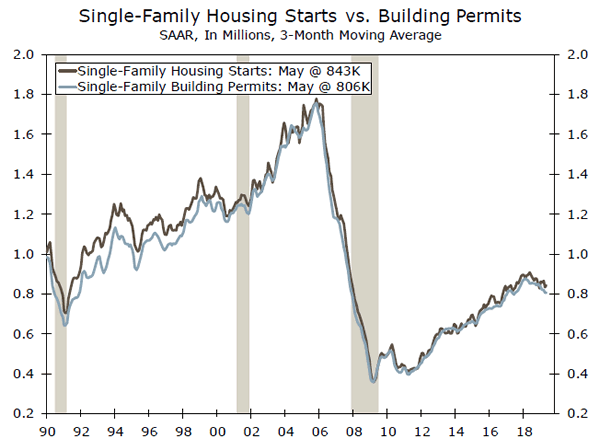
On Wednesday, attention will turn to the housing market. New residential construction has struggled to gain momentum despite lower building costs and improved buying conditions. On a year-todate basis through May, housing starts are 5.3% below their prioryear pace. That said, the 1.269 million-unit pace hit in May is slightly above the pace averaged over the past six months. The increase in May permits was encouraging: single-family permits rose 3.7%, ending a five-month streak of declines. The gain in permits alongside more favorable buying conditions point to gradually improving activity over the summer. But, despite lower mortgage rates, a surge in activity remains unlikely. The NAHB Housing Market Index fell last month after hitting a seven-month high in May. Builders were likely discouraged by the prospects of an escalating trade war. We expect starts to notch a 1.246 million-unit pace in June.
Previous: 1,269K Wells Fargo: 1,246K Consensus: 1,260K
Global Review
Temporary Reprieve on the Global Front
- There were some mildly encouraging elements in this week's international economic figures, although we believe this represents a temporary reprieve rather than the start of a sustained improvement.
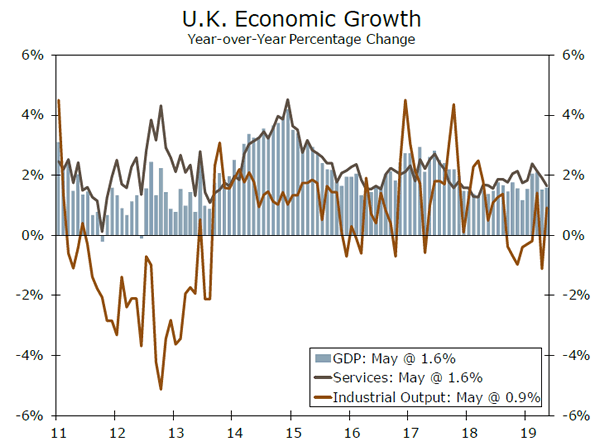
- U.K. GDP rose 0.3% month-over-month in May, reversing most of its April decline. However the gain was led by the manufacturing sector, with activity in the important services sector flat on the month.
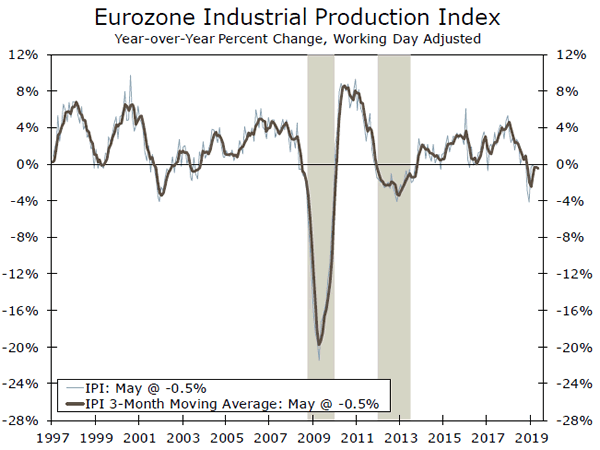
- Eurozone industrial production rose in May, but soft orders data and PMI surveys suggest further declines can be expected.
European Economies Still Sluggish Overall
The news this week from some of Europe's key economies portrayed a picture of growth that is still sluggish overall across the region. May industrial activity data were released across the Eurozone, and showed a slight improvement from April. Eurozone May output rose 0.9% month-over-month, while by country German output rose 0.3%, French output jumped 2.1%, and Italian output rose 0.9%. That said, the May increase does not represent a decisive turnaround for the European industrial sector. Eurozone industrial output was still down 0.5% year-over-year and the Eurozone manufacturing PMI remains entrenched in contraction territory, while Germany's factory orders suggest further declines for European manufacturing can still be expected.
There was a brief reprieve on the U.K. economic front as GDP rose 0.3% month-over-month in May, although that comes after a large April decline. Moreover, the increase was largely led by a jump in manufacturing output, with service sector activity flat on the month. With services accounting for the bulk of the economy and growth in that sector subdued, the consensus currently forecasts a small 0.1% quarter-over-quarter fall in Q2.
Latin American Central Banks Looking to Ease?
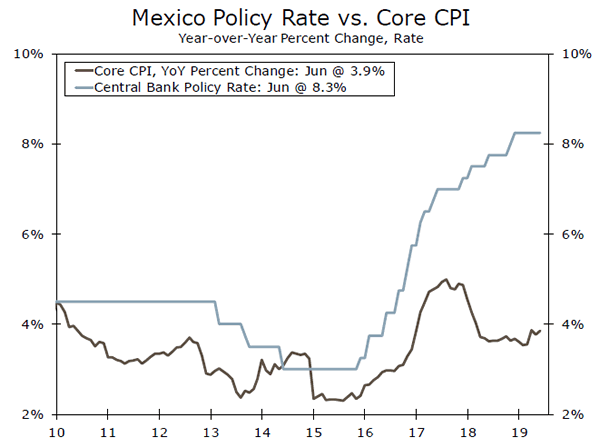
This week's figures from Latin America have arguably moved two of the region's central banks closer to cutting interest rates. The case is likely strongest for Mexico, where the policy interest rate is still high at 8.25%. The latest batch of data shows Mexico's June CPI slowing to 3.9% year-over-over, while May industrial output declined 2.1% month-over-month and 3.3% year-over-over. Following a more dovish tone at the Bank of Mexico's late-June monetary policy announcement, we think there is a decent chance the central bank will lower rates at its next monetary policy meeting in mid-August.
The case for lower interest rates in Brazil is not quite as compelling, with the central bank's policy rate—the Selic rate—already at a record low of 6.50%. That said, this past week saw June CPI inflation slow noticeably to 3.4% year-over-year, while activity growth remains relatively subdued as evidenced by a slowing in May retail sales to 1% year-over-year. While Brazilian central bank easing is not part of our base case forecast, we think a rate cut cannot be ruled out.
News From the Trade War Frontlines
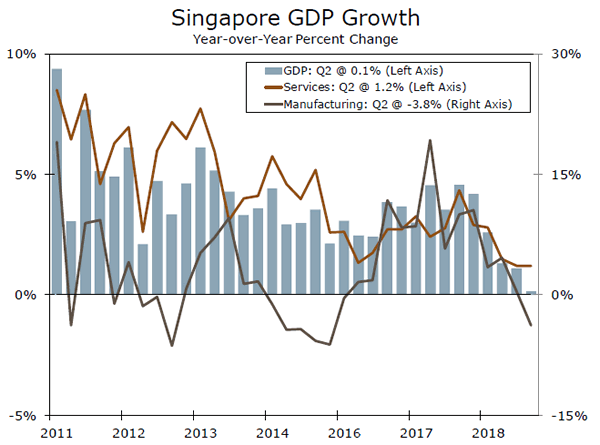
China's June trade balance improved to a surplus of US$50.98B, although the underlying details were less encouraging. Exports fell 1.3% year-over-year, compared to the small gain seen in May, while imports fell a larger 7.3%. The external sector has of course been a key area of concern for China given its trade dispute with the United States, although the "truce" achieved on the sidelines of the June G20 meeting may help improve sentiment in the months ahead. Singapore's economy has arguably been a casualty of the "trade war", with Q2 GDP unexpectedly slumping 3.5% quarter-on-quarter annualized and slowing to 0.1% year-over-year, with most of the softness concentrated in the manufacturing sector.
Global Outlook
China GDP • Monday
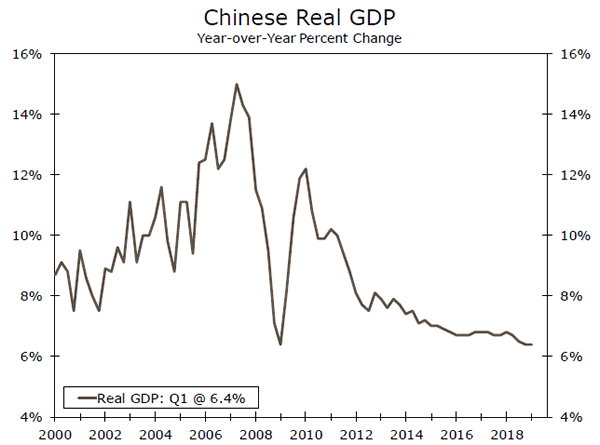
Next week sees the release of some Chinese economic figures for the second quarter, which will give the latest reading on the health of the economy following the solid start in Q1. Most notable will be Q2 GDP data, which the consensus expects to rise 1.5% quarter-over-quarter, but slow to 6.2% year-over-year. We forecast growth will slow a bit more quickly, to 6.1%, while within that overall growth figure we expect that activity in the service sector held up better than in the manufacturing sector. Mixed confidence surveys and activity data during Q2, and uncertainty stemming from trade tensions with the United States, likely contributed to slower growth Q2.
Activity data for June are also on the schedule. Growth in retail sales is expected to ease to 8.5% year-over-year, while growth in industrial output should rebound modestly to 5.2% after a soft May reading. Overall economic trends remain subdued however, and a further growth slowdown seems likely.
Previous: 6.4% Consensus: 6.2% (Year-over-Year)
Canada CPI • Wednesday
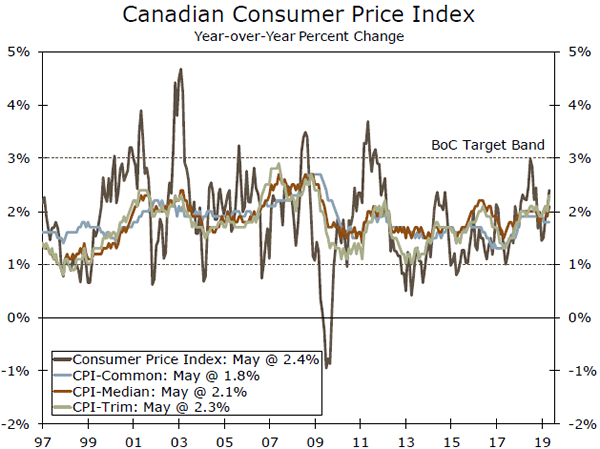
Canadian consumer prices jumped more than expected in May, led by increases in several transportation-related costs, and the main focus next week will be to what extent that jump is reversed with the release of the June CPI. Lower gasoline prices will probably partly weigh on the CPI and overall we expect most if not all of the May jump to be reversed. With our forecast for the headline CPI to slow to 1.9% year-over-year. We expect the central bank's core CPI inflation measure's to print close to (or above) the 2% inflation target midpoint. Given a quickening in wage inflation, we would not be surprised to see Canadian inflation trends remain modestly elevated in the near-term.
The Bank of Canada held its policy rate steady this week, and while we don't expect CPI trends will prompt the central bank to tighten, the Bank of Canada appears unlikely to join other G10 central banks in easing monetary policy,
Previous: 2.4% Wells Fargo: 1.9% Consensus: 1.9% (Year-over-Year)
U.K. Retail Sales • Thursday
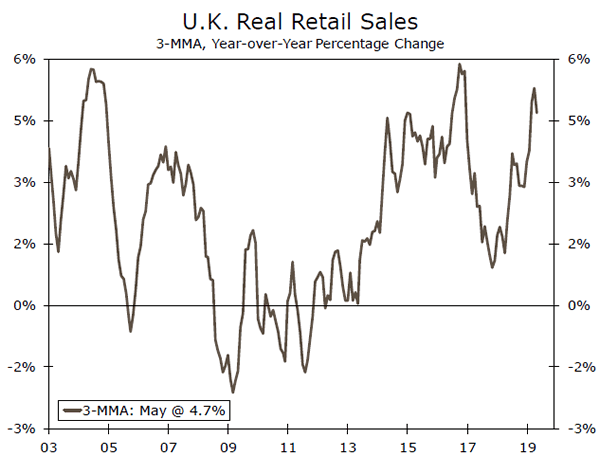
After a (surprisingly) resilient start for the U.K. economy in 2019, the focus during the second quarter has shifted to the extent to which growth has subsequently slowed. A reversal of ahead of the initial end-March Brexit deadline has likely contributed to the downshift in growth, although consumer spending also appears to have weakened perceptibly during the second quarter. Retail sales fell on a sequential basis in April and May, after three straight monthly increases during Q1. Recent confidence surveys suggest the underlying trend in the retail sector remains soft, and the consensus expects another decline, of 0.3% month-over-month in June.
The June CPI is also on next week's schedule, but should have little market impact. The headline CPI should rise 2.0% year-over-year and the core CPI 1.8%, both close to the inflation target.
Previous: -0.5% Consensus: -0.3% (Month-over-Month)
Point of View
Interest Rate Watch
Policy is on the Right Track
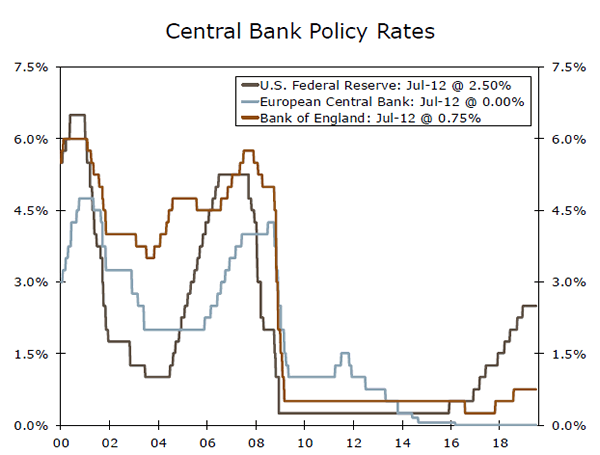
Powell's congressional testimony this week came in very close to expectations. The Fed Chair highlighted the Fed's primary areas of concern, most of which centered on deteriorating economic conditions overseas and the continued uncertainty surrounding trade negotiations and Brexit. Powell added in his concerns about how Congress and the President will come to terms with the debt ceiling for good measure, and also stated that they were not dissuaded at all by June's strong employment report. We see little in the way of economic news that is likely to get in the way of a quarter percentage point cut in the federal funds rate at the July 31 FOMC meeting.
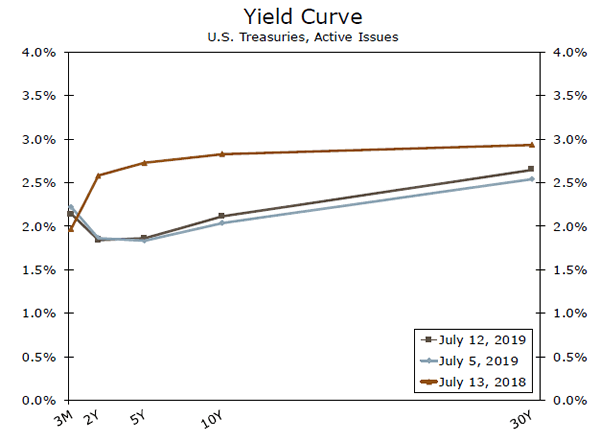
While a quarter point rate cut now appears certain, the stronger economic news and slightly higher-than-expected core inflation data have likely killed the idea of a half percentage point cut at the July meeting. Such talk always seemed simplistic to us. At face value, a half percentage point cut in the federal funds rate would steepen the yield curve because the funds rate would fall back below the 10-Year Treasury note. But a half point move might also spook markets and cause Treasury yields to decline, leaving the yield curve flat or even inverted. The Fed would then have fewer viable options.
The stock market appears to like the idea of a more dovish Fed. The major stock indices have also risen solidly since Powell's testimony, as the recent inversion of the yield curve looks less menacing. Powell and Congress also earned some style points this week. Powell made his major points about the need to cut interest rates succinctly and convincingly and made a strong case that the risks from slower global growth and major unresolved issues like Brexit, trade talks and the impending U.S. debt ceiling more than outweigh concerns about easing at a time that the economy appears to be at or beyond full employment.
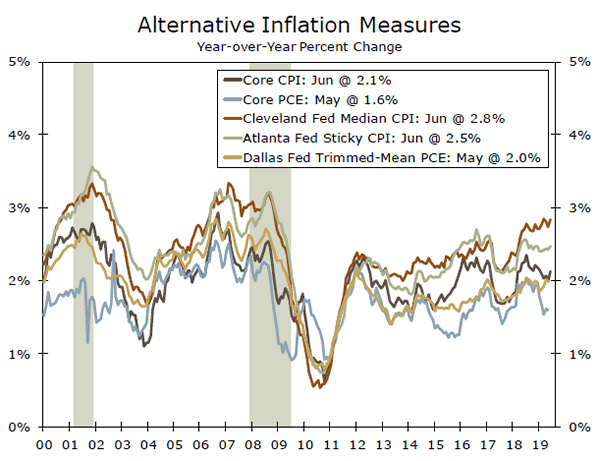
Powell also expressed little concern on inflation, despite the bounce-back in some core inflation measures. The bottom line on inflation is that it is lower than it should be for this point of the business cycle, which gives the Fed the leeway to cut 25 bps in both July and again later this year.
Credit Market Insights
Developments in Consumer Credit
U.S. consumer debt increased in May to $17.1B, expanding at a solid pace for the second straight month. Revolving credit including credit card borrowing reached a new high, climbing $7.2B from the previous month, the largest increase since October. However, the non-revolving sector, which includes educational and automobile loans, increased only $9.9B, the smallest increase since June 2018, after rising $10.5B in April,
The data suggest that consumer borrowing has remained strong, mainly due to higher wages and job growth. Household debt ticked up in the first quarter of 2019, increasing for the 19th consecutive quarter. Mortgage balances and auto loans also increased in Q1-2019, expanding 1.3% and 0.5%, respectively, while total credit card balances fell 2.5%. Meanwhile, the total amount of outstanding student loans increased to $1.49T in the first quarter, up $29B from the previous quarter. The growth in student loan debt continues to be a concern among some analysts as one of the country's 2most widespread financial burdens.
Personal income and spending was also firmer in May, and PCE growth is now on track to come in above 3% in Q2. Consumer fundamentals remain strong, supported by stronger job growth, which helps to increase spending. Despite the strong consumer data, it will likely not be enough to dissuade the Fed from cutting interest rates at its July meeting.
Topic of the Week
Recent Volatility in the ASI
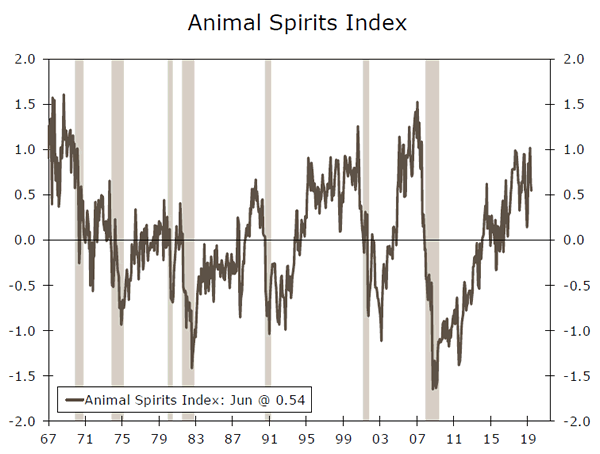
Previously, we have introduced an index to quantify Keynes' "animal spirits". Our Animal Spirits Index (ASI) is constructed using five variables to capture sentiment of major economic agents, in major sectors of the economy, to shed light on economic agents' expectations about the near-term economic outlook. We utilize a dynamic factor modeling approach in constructing our index.
An ASI value above zero (positive animal spirits), suggests optimism, while a value below zero (negative animal spirits) indicates pessimism. The lowest value of the ASI was during the Great Recession in October 2008 when the index fell to -1.65 (top chart). The index proceeded to stay in negative territory until January 2014, consistent with the slow recovery from the Great Recession. The index has since remained in positive territory for the majority of the time since February 2014, as the economic expansion has gained steam and optimism has returned.
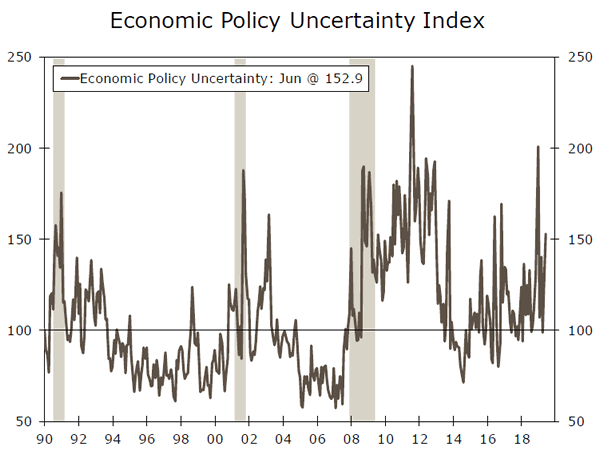
This week we updated our model, finding that the ASI has been volatile in the first half of 2019. Starting the year at 0.25, the index climbed to its highest level in the post- Great Recession era, 1.02, in April before falling back to 0.54 in June. The volatility in the ASI was a result of fluctuations in the equity market and policy tension. The policy uncertainty index fell to 98.7 in April after jumping to 201 in January (bottom chart). Meanwhile, the VIX has remained relatively calm in 2019. The two components of the ASI that are still under stress are the yield spread and the consumer confidence index. The yield spread has remained negative while the consumer confidence index dropped in June to 121.5 from 131.3 the previous month.
Although the yield curve has inverted in recent months, the ASI shows that economic agents are comfortable with the recent developments in the economic and financial worlds. It seems the economic policy environment along with the equity market recovery have driven the ASI higher for now. We will continue to update our ASI and report any significant changes in the index.
The Weekly Bottom Line: Bank of Canada Signals High Bar to Cuts
U.S. Highlights
- In a busy week for Fed communication, Chair Powell gave his semiannual testimony to Congress where he confirmed that crosscurrents hitting the outlook would likely require some additional accommodation.
- The Fed Chair also noted that he doesn't see the labor market as particularly hot and, with wage growth subdued, has more room to run.
- Powell also noted the risk that weak inflation could prove more persistent than anticipated. That risk diminished somewhat with the June CPI report, which showed core inflation firming across both goods and services.
Canadian Highlights
- The Bank of Canada met expectations this week, holding its policy interest rate at 1.75%. Communication struck a neutral tone, which, with a downgraded outlook, suggests the bar to monetary easing remains high absent a realization of negative risks.
- There is potential upside to the Bank's near-term view of economic growth. Housing activity appears to have come back to life in the second quarter. An economic outperformance would likely further reduce Canadian easing expectations.
U.S. - Chair Powell Asks, "Where's the Heat?"
It was a big week for Fed communication. Fed Chair Powell took center stage with his semiannual testimony to Congress, while minutes from the Federal Open Market Committee's (FOMC) June meeting shed light on participants' views of the risks to the economy.
The key takeaway from Powell's prepared remarks was that the Fed Chair still sees crosscurrents and uncertainty as weighing on the outlook. Given that this was the key factor behind the FOMC's increased willingness to provide additional accommodation, this was as clear a signal as any that a July rate cut is happening. Nailing the coffin closed, when the Chair was asked if the strong June jobs report had done anything to change his mind, he replied, "a straight answer...is no."
Between now and the July 31st meeting there are data on retail sales, housing starts, home sales, durable goods orders, and a few others. Even relatively positive outcomes on all these reports are unlikely to move the Fed off that 25-basis point cut. They could, however, go a long way to moving market pricing for additional cuts (almost three by the end of this year). In the meantime, Fed speakers have one more week to communicate their take on economic data before the quiet period preceding the July meeting.
The other message in the Fed's accompanying Monetary Policy Report as well as Powell's Q&A sessions was the recognition that inflation is weak, and the labor market may still have some room to grow - even with an unemployment rate at 3.7%. Perhaps the most interesting response Powell gave over the two days of testimony was to a question about the possibility that lower interest rates would cause the labor market to run hot. His response was: "you know, I guess I would start by saying we don't have any basis for calling this a hot labor market."
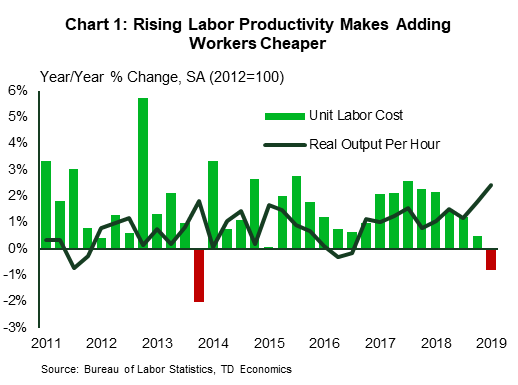
Powell went on to say that wage growth of 3%, while better than the 2% it was five years ago, is "barely keeping up with productivity." In fact, productivity growth has accelerated over the past year, and, as a result, the cost of adding workers relative to the output they produce has declined (Chart 1). Absent evidence of wage inflation, the Fed is unlikely to get too heated by a low unemployment rate, even if it continues to push further below its long-run estimates.
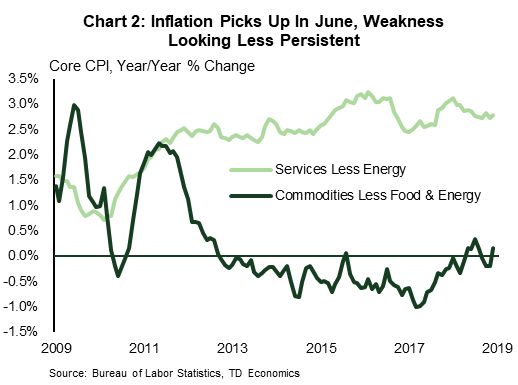
Nonetheless, sometimes the data zigs just when everyone expects it to zag. While the Fed Chair cited the risk that weak inflation would prove more persistent than anticipated, the CPI out this week showed prices rising firmly in June. Core CPI (excluding food and energy) rose 0.3% on the month - the strongest gain since January 2018. Price growth firmed for both core goods and services (Chart 2). Still, with the year-on-year headline rate at just 1.7% and core at 2.2%, the firetrucks can stay parked for now.
Canada - Bank of Canada Signals High Bar to Cuts
It was a relatively quiet week in Canadian markets. Despite a modest climb in oil prices, the S&P/TSX composite index was set to end the week relatively flat. So too the loonie, which despite some mid-week volatility, sat pretty close to where it started the week as of mid-morning Friday.
The main economic events, both here and elsewhere this week were central bank driven, and Wednesday was the main event. South of the border, Federal Reserve Chair Jerome Powell's testimony to Congress all but confirmed that a policy interest rate cut would be coming at the end of this month (see commentary). With most major economy central banks leaning towards additional stimulus in the wake of softening momentum, the Bank of Canada had a fine line to walk given relatively healthy domestic data and the external negative risks.
And walk the line they did. The statement that came with Wednesday's decision to leave the key overnight interest rate at 1.75% went right down the middle: the external risks were front and centre, and the economic outlook was downgraded a touch, but there were few signals that Canadian monetary easing is on the table (See our thoughts). Instead, the message was again one of risk management. The Bank stands ready to act in the event of a deterioration in economic activity, but this is not their base case, and they feel no urgency to replicate the expected 'insurance' cuts of the Federal Reserve.
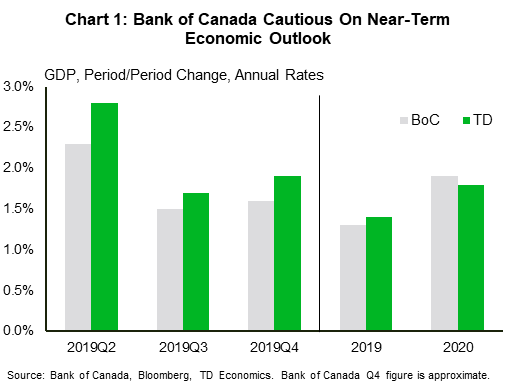
There is also an argument to be made that the Bank of Canada is trying to avoid a situation where markets become convinced of easing to the point where a failure to act may create undue volatility. The evidence for this may be the Bank's relatively conservative economic growth forecast. Compared to our view, the Bank of Canada envisions a slightly more modest pace of activity this year (Chart 1).
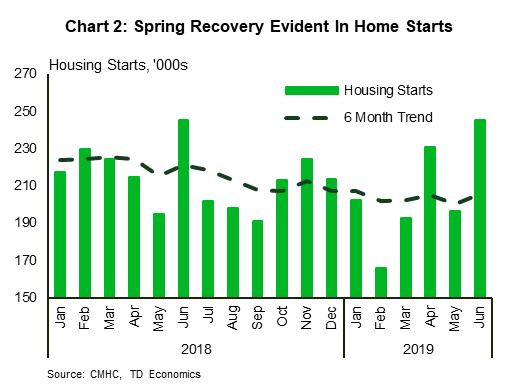
A significant part of the Bank of Canada's cautious near-term view is related to housing. This appears to be a note of caution given the available data. Even allowing for a modest pull-back of activity in June (figures are due Monday), resales popped nicely in the second quarter. So too has homebuilding activity. Housing starts shook off their winter blues (Chart 2; see our commentary), and the more lagged investment data also points to healthy activity early in the quarter.
So, given the Bank of Canada took a neutral tone to go with this downgraded outlook, it stands to follow that the market would dial back cut expectations as the Bank of Canada's forecast is modestly exceeded. This suggests a reluctance to ease monetary policy unless necessary - data dependence, not outlook dependence, in effect, and a different approach from their U.S. counterparts. In effect, the Bank of Canada appears to be comfortable taking a reactive approach, rather than a proactive one. Clearly, should negative risks materialize, we'd be in a different world, but for now, if you're enjoying the drop in mortgage rates, thank Chair Powell, not Governor Poloz.
U.S.: Upcoming Key Economic Releases
U.S. Retail Sales - June
Release Date: July 16, 2019
Previous: 0.5%, ex auto: 0.5%, control group: 0.5%
TD Forecast: 0.1%, ex auto: 0.1%, control group: 0.3%
Consensus: 0.2%, ex auto: 0.2%, control group: 0.3%
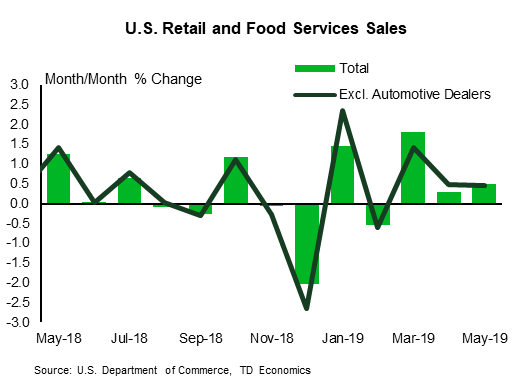
We expect another firm increase in sales in the key control group (+0.3% m/m) to be the main driver behind a 0.1% gain in headline retail sales, as consumer fundamentals remain sound (healthy labor market, steady real wages and high confidence levels). A firm gain in core sales should more than offset both a decline in sales at gasoline stations, which reflect a drop in gasoline prices in June, and a minor retreat in auto sales following a 0.6% increase in May. On net, retail sales should end the quarter with average annual growth at 3.2%, up from 2.8% in Q1.
Canada: Upcoming Key Economic Releases
Canadian Consumer Price Index - June
Release Date: July 17 , 2019
Previous: 0.4% m/m, 2.4% y/y
TD Forecast: -0.2% m/m, 2.1% y/y
Consensus: -0.3% m/m, 1.9% y/y
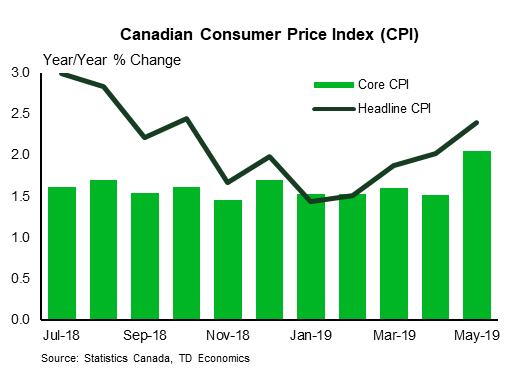
TD looks for headline inflation to decelerate to 2.1% y/y in June, with prices down 0.2% from May. Lower gasoline prices will provide the main driver for the monthly print; gasoline prices fell by 8% for the month as a whole, which should shave 0.3pp off the headline print in June. Elsewhere, food prices should see modest gains following the recent strength in producer prices. Still, 3.5% is likely to mark the peak for food price inflation since FX passthrough from a stronger Canadian dollar should start to provide some relief in the coming months. We also see scope for a pullback in telecom prices after new "unlimited" data plans were introduced by major service providers in early June. Looking past the headline, exclusion-based core measures (ie. ex food and energy) should hold stable given the large drag from energy prices, while the Bank of Canada's preferred core measures are likely to edge lower to 2.0% y/y on average.
Canadian Manufacturing Sales - May
Release Date: July 17, 2019
Previous: -0.6%
TD Forecast: 1.6%
Consensus: 1.5%
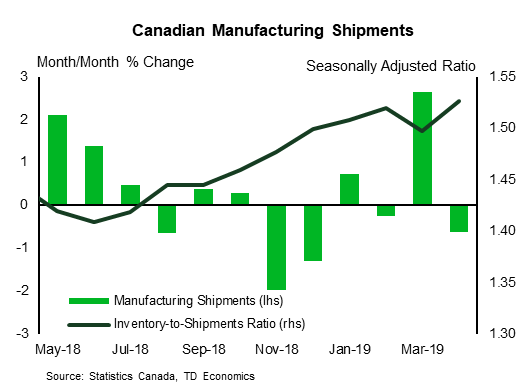
TD looks for manufacturing sales to rebound by 1.6% in May, driven by a sharp pickup in transportation products. Motor vehicles are only part of the story after temporary production shutdowns drove an 8.9% decline in manufacturing shipments last month. international trade for May showed a large rebound in motor vehicle exports, but also revealed a record $2.92bn in monthly aerospace exports. Outside of the transportation sector, forestry products will weigh on the headline print after a major logging company announced it will temporarily shutter production at 13 lumber mills starting April 29th. Manufacturing volumes should rise in line with the nominal series owing to flat producer prices in May, which will provide a tailwind to monthly GDP.
Canadian Retail Sales - May
Release Date: July 19, 2019
Previous: 0.1%, ex-auto: 0.1%
TD Forecast: 0.3%, ex-auto: 0.6%
Consensus: 0.3%, ex-auto: 0.3%
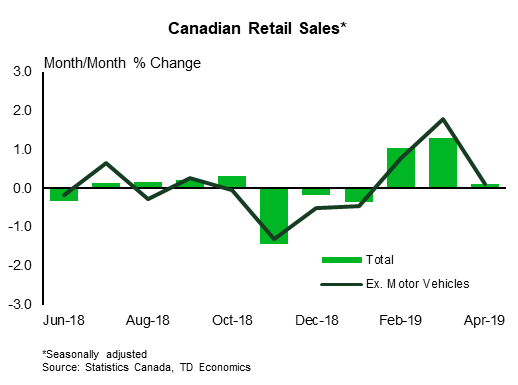
Retail sales are forecast to rise by 0.3% in May as lower auto sales provide an offset to a pickup in core retail measures. New vehicle sales are projected to edge lower on softer passenger car sales, and we expect a muted contribution from gasoline stations as the tailwind from higher prices dissipates. On the other end of the spectrum, the recreation component should provide a source of strength as NBA playoff spending makes its impact felt; restaurant sales are not included in the retail report, but the supplementary food and beverage survey should show similar gains. Building materials and home furnishings will provide another source of strength on the recent recovery in existing home sales. Retail volumes should see little change on account of the 0.3% (sa) increase in consumer prices, consistent with some moderation in household consumption from the 3.5% gain in Q1.
Forward Guidance: Inflation Data to Keep BoC on the Sidelines, For Now
Comments from US Fed Chair Powell this week reinforced expectations for a rate cut at the end of July, and we think a follow-up move is likely in September. “Muted” inflation trends give the Fed flexibility to provide a bit more accommodation to offset global growth concerns and a softening US industrial sector (both linked to rising trade tensions). The Bank of England and European Central Bank also look poised to cut rates before the end of 2019. The Bank of Canada remained something of an outlier this week, maintaining a neutral bias in its policy statement on Wednesday. But the central bank put greater emphasis on trade tensions and slowing global growth, raising the odds that its next move will be to lower rates.
How long can the Bank of Canada hold steady while other central banks ease? Much will depend on how the domestic economy holds up to rising external risks. Next week’s economic data should reinforce that Canada’s economy is picking up after a winter slowdown. A big jump in non-energy exports—including a rebound in auto exports—means manufacturing sales probably increased at a solid pace in May. Household spending growth remains modest compared with recent years, but labour markets are solid and recent declines in global interest rates have lowered borrowing costs for Canadian households. We look for retail sales to post a fourth consecutive monthly increase in May. The US consumer looks even healthier, with an expected tick higher in June retail sales likely capping off a nice rebound in household spending in Q2.
The BoC has a bit of leeway to hold rates steady while the Fed eases—Canada’s policy rate is already more accommodative than in the US. And inflation has been running much closer to 2% in Canada. We think that remained the case in June, though headline CPI inflation likely fell back to 2% (due to lower energy prices) and the BoC’s core measures might tick back down to 2.0% from 2.1% on average in May. All told, we don’t think next week’s data will build a case for the BoC to follow its global counterparts in the near-term. However, given Governing Council’s more concerned tone this week, we have penciled in a 25 basis point rate cut early next year. But it will take softer data at home and abroad to justify that move.
As Central Banks Move to Cut Rates Again, How Much Lower Can They Go?
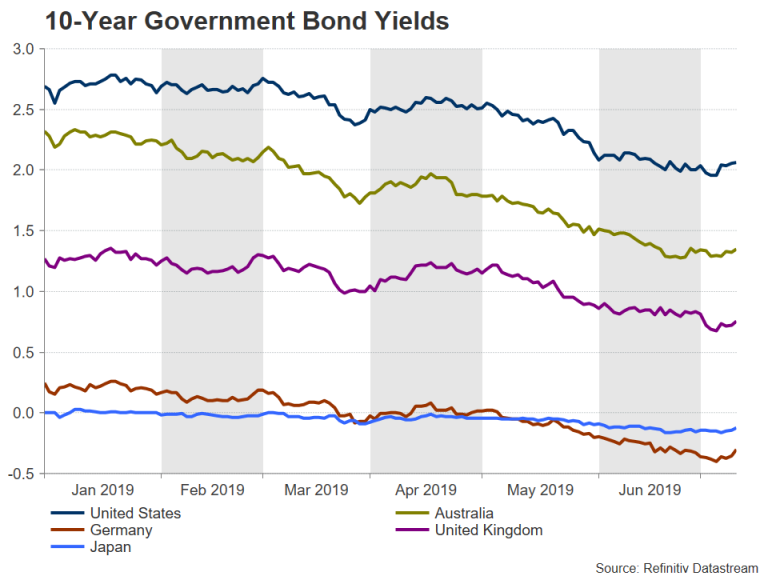
As sovereign bond yields around the world take a nosedive in anticipation of rate cuts by major central banks, the question once again being asked is how low can interest rates go. With rates in many regions such as Europe and Japan already in negative territory, have central banks run out of adequate scope to conduct effective policy easing?
Bond yields tumble on recession fears
Slowing growth and worries of a possible recession in the United States and elsewhere have driven traders to aggressively price in substantial rate cuts by the major players in the world of monetary policy. But while there are notable signs of market stress, as indicated by the partial inversion of the US yield curve and German bunds falling to record lows below zero, the growth picture so far hasn’t been quite as bad as many have predicted.
The latest data out of the US show the economy is still expanding at a comfortable pace, albeit at a slower one. Growth in the euro area and Japan has also held up relatively well. Even the UK, where Brexit remains a major source of uncertainty, has so far avoided a negative quarter in GDP growth. But there are concerns that the second half of 2019 will be much more challenging.
Global growth outlook deteriorating
Those investors hitting the panic button would point to the continued downtrend in the PMI indicators, particularly in the manufacturing PMIs, which have fallen to contractionary territory in most European and Asian countries. The ongoing trade tensions and the fading chances of a quick resolution to the Sino-US dispute are likely to weigh on world trade for the rest of the year. This means export-reliant economies such as Germany and Japan could easily slip into recession in the coming quarters if there’s no positive developments that could help revive falling business confidence.
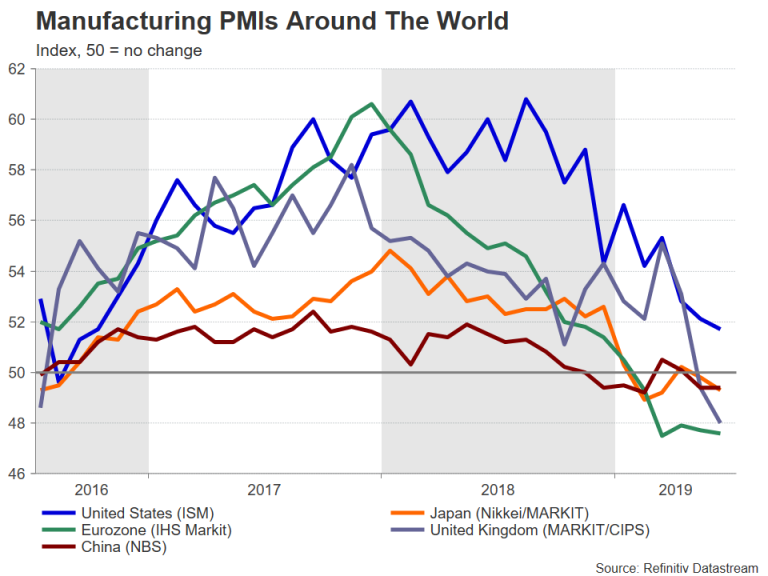
But it’s not just the manufacturing sector that’s experiencing a slowdown (if not an outright recession). There are signs the broader economy is also faltering in many countries. The US’s ISM non-manufacturing PMI hit a near two-year low in June and the services PMI in the UK is dangerously close to the 50-neutral level. In Japan, falling wages pose a risk to already weak conditions for domestic consumption.
Yield curve inversion worries markets and policymakers
But the most talked about indicator, which is considered by policymakers and market participants alike as a reliable foreteller of a recession, is the yield curve inversion. The yield spread between 10-year and 3-month Treasuries, which has turned negative before every recession since the Second World War, has been inverted since May. The longer the spread between the two remains negative, the higher the risk of a recession.
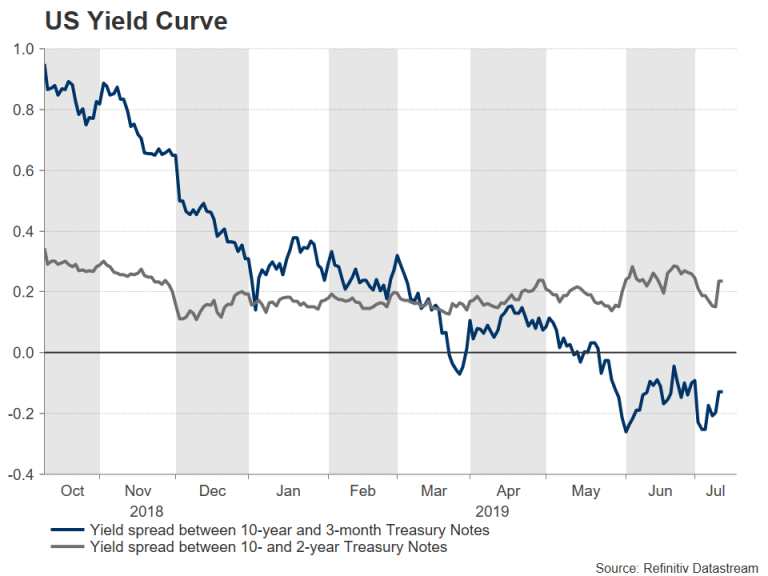
This particular part of the yield curve is watched closely by the New York Fed in its own gauge of calculating the odds of a recession. But this may still not be sufficient to convince all the hawks at the Federal Reserve that things are bad enough to warrant aggressive policy action. Some policymakers may wait to see an inversion of the 10- and two-year yield curve for a more conclusive warning that things are not right in the US economy.
Fed easing a foregone conclusion
Although it’s unclear whether everyone in the Federal Open Market Committee is on board for a rate cut, the consensus among market participants is that there will be at least a 25-basis points reduction at the July meeting, with Fed Chairman Jerome Powell cementing those views in his semi-annual testimony to Congress this week. The bigger question, however, is whether two or three pre-emptive rate cuts by the Fed will succeed in abating fears about a US and global recession.
The Fed has less bandwidth to cut rates this time round than in previous occasions when the economy was past the peak of the business cycle. It would be perfectly natural, therefore, for the Fed to not want to make dramatic reductions in interest rates when the economy is still expanding. However, if there was a coordinated effort by central banks globally to increase monetary policy accommodation, policymakers may just succeed in warding off a steep downturn without having to resort to unconventional and untested policies.
Can rates in Eurozone and Japan go any lower?
But this is more of a problem for the likes of the European Central Bank and the Bank of Japan where rates are already sub-zero. The ECB is expected to embark on a fresh round of policy easing in the coming months. But with the deposit rate currently at -0.40%, the ECB perhaps can only afford to cut rates by another 30 bps or so before it risks damaging the profitability of commercial banks operating in the Eurozone. The BoJ has a similar dilemma, which possibly leaves quantitative easing as a more attractive option for the two central banks.
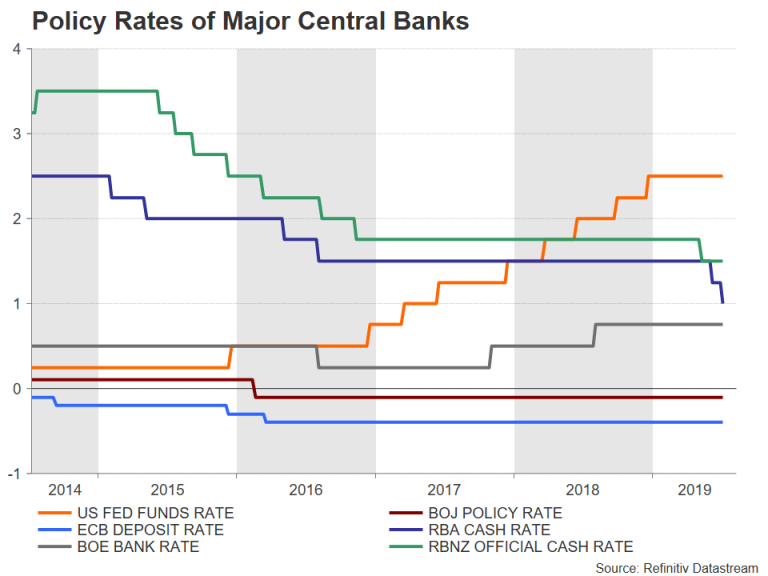
However, there’s a real danger that more QE would not be as effective as it was the first time round during the financial crisis back in 2008-09. There’s also doubts as to how effective negative interest rates are with the evidence so far from Japan and the euro area pointing to only limited success in lifting inflation.
Race to the bottom
This raises the question of how central banks would respond to an actual recession or even a new global economic crisis. The Fed at the moment has the most room to cut before rates fall to zero again, hence the US dollar’s recent depreciation.
The Reserve Banks of Australia and New Zealand were the first to make insurance cuts and it would only take a few more moves before they reach zero. However, both the RBA and RBNZ got through the financial crisis without the need for QE and so are not facing the same risk of diminishing returns like the ECB and BoJ if they decided to begin asset purchases. The Bank of England has a bit more leverage than its European counterparts, but a potential chaotic UK exit from the European Union could force it to restart QE. As for the ECB and the BoJ, the only way out for these economies from a severe downturn may be more fiscal rather than monetary stimulus.
Dollar’s decline may not be sustainable in long run
But for the currency markets, whether policy easing involves deeper negative rates or more QE is perhaps not as relevant as the big picture, which is that all the major central banks, reluctantly or proactively, are moving towards a more accommodative policy stance. While this may produce wild short-term swings, there is not a great deal to support the view that the longer-term trend will change as well. The US economy remains and is expected to stay in much better shape than its peers. Even with substantial Fed rate cuts, US yields are likely to remain above those of other nations’, potentially putting a floor under the greenback.
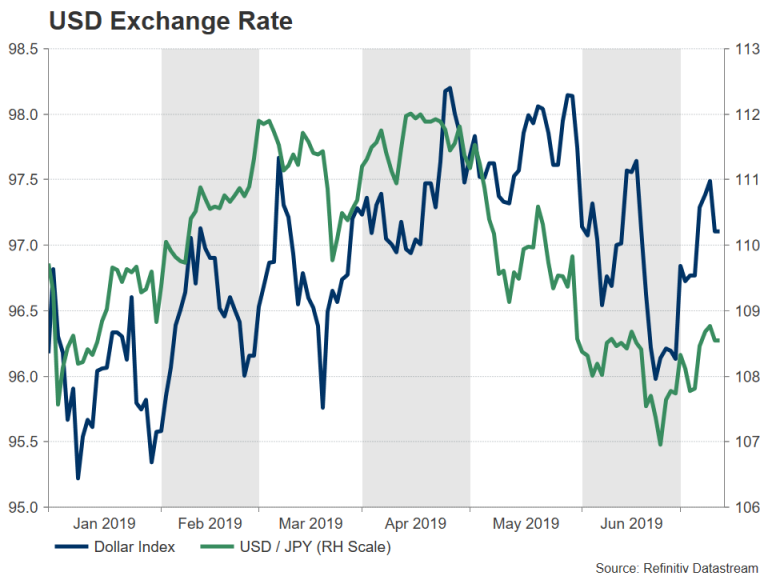
For now, though, the dollar is likely to face more downside pressure than the other majors, while the yen has the most to gain. The BoJ has not only failed to give clear signals that it will loosen policy in the near future, but any move could merely consist of minor tweaks or not very powerful changes to its existing stimulus programme. This probably leaves the yen vulnerable to more upside risks than its peers in the short- to medium-term.
Week ahead – Flurry of Key Data Eyed as Markets Digest Powell’s Cautiousness
After Fed chief Powell all but guaranteed a July cut, things could quiet down a little next week, as the agenda is dominated by economic data. Growth figures from China may shed light on how much damage the trade war has inflicted, while in the US, retail sales numbers will be among the final pieces of the puzzle before the next Fed meeting. Inflation stats from New Zealand and Canada are also on tap, with some UK data perhaps attracting attention as well given a scarcity of Brexit news.
China’s growth to touch three-decade low, despite the stimulus
The world’s second-largest economy will release a raft of data on Monday, with the highlight being the GDP print for Q2. Economic growth is forecast to have slowed to 6.2% in yearly terms, from 6.4% earlier, which if confirmed would be the clearest sign yet that the trade war has really started to bite. The nation’s retail sales, fixed asset investment, and industrial production for June are all coming out as well.
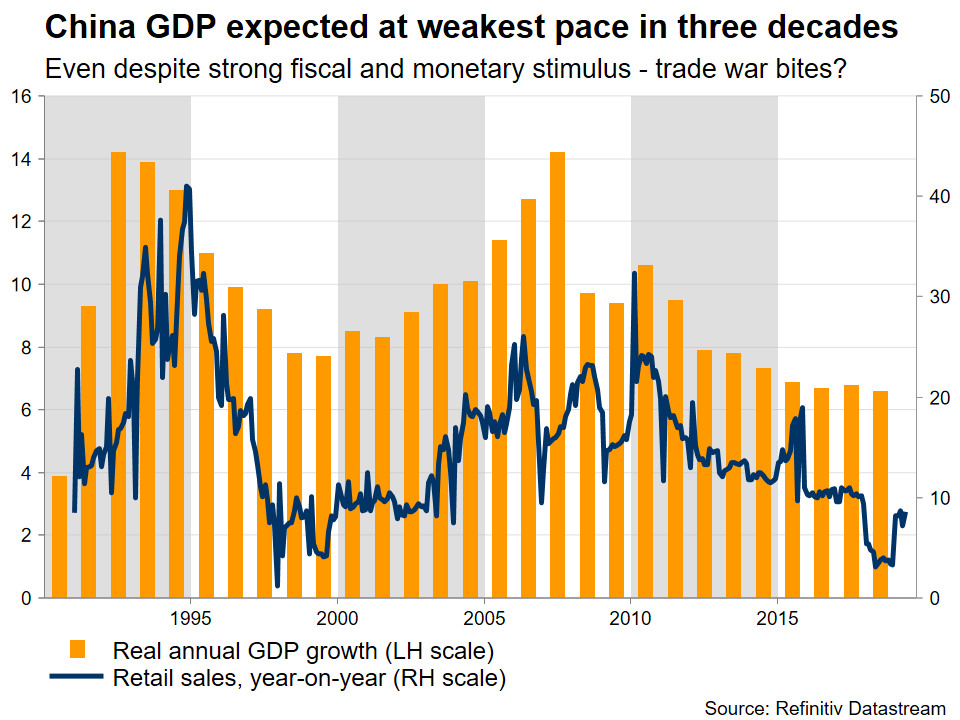
While such a growth slowdown doesn’t seem extreme at first glance, one must consider that economic momentum is losing steam even despite strong stimulus – both fiscal and monetary – from the Chinese authorities. In fact, a 6.2% GDP reading would constitute the weakest print in three decades, implying that it could increase the pressure on policymakers to open the ‘stimulus floodgates’ even wider.
Besides the yuan, these figures could also impact the Australian dollar, as well as risky assets like stocks.
US retail sales among the final pieces of the Fed’s easing puzzle
In America, retail sales on Tuesday will provide the last piece of evidence on the consumer, before the Fed’s two-week ‘quiet period’ begins ahead of the July 31 rate decision. Forecasts suggest that retail sales slowed on a monthly basis in June, but remained in positive territory for a fourth straight month, which would be encouraging in itself.
Admittedly though, there’s not much that can stop the Fed from cutting rates in July, even if these numbers are stronger than expected. Chairman Powell made it painfully clear that the Fed will deliver an ‘insurance cut’, even though the domestic economy doesn’t seem to be in dire need of monetary stimulus yet. His proactive stance is likely a signal of how aggressively the Fed will react moving forward – policymakers don’t want to be caught ‘behind the curve’ in a recession.
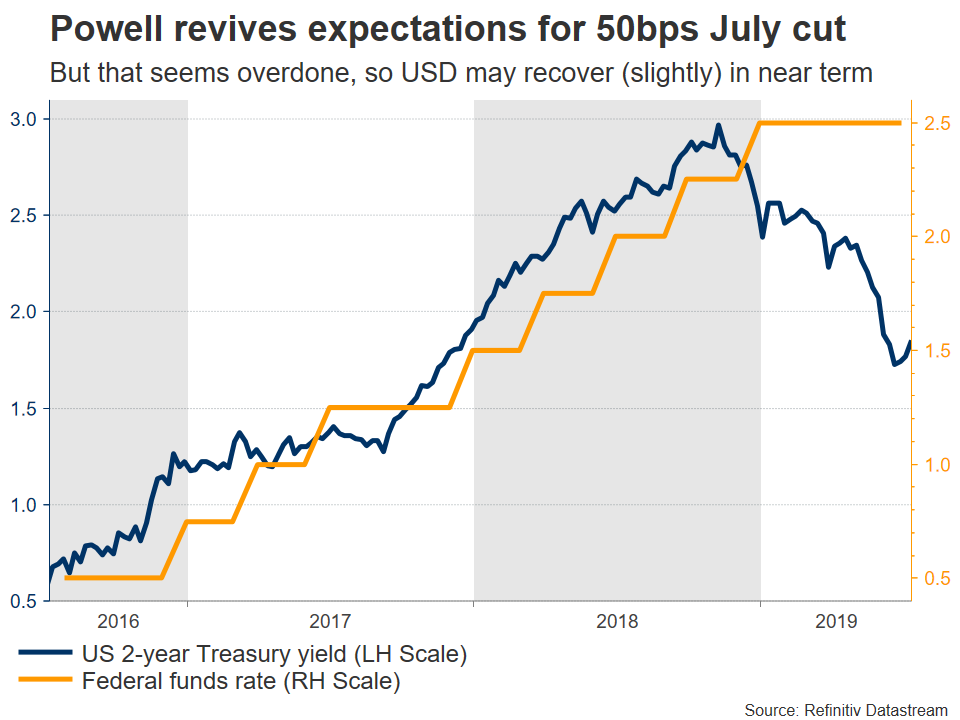
As for the dollar, while it may rebound slightly ahead of July 31 as expectations for a ‘double’ rate cut are priced out again, the big picture remains grim. Global central banks are entering an easing cycle, and the Fed has the most firepower with which to ease. That means the potential downside in the dollar is likely much greater than the euro’s or the yen’s, as both the ECB and BoJ have much less scope to cut, given their already-negative rates.
British data back in the spotlight amid Brexit hiatus
With the Conservative leadership contest not expected to conclude until July 22, Brexit news are likely to remain scarce for now, so UK data may come back in the limelight. Employment figures for May will hit the markets on Tuesday, before the inflation prints for June on Wednesday, culminating with retail sales stats on Thursday.
Mark Carney, the Bank of England Governor, changed his tune lately by highlighting that trade tensions have amplified downside risks for Britain. His comments imply the Bank may officially abandon its rate-hike plans soon, though that would hardly be surprising for markets, which currently price in a ~40% probability for a rate cut by December.
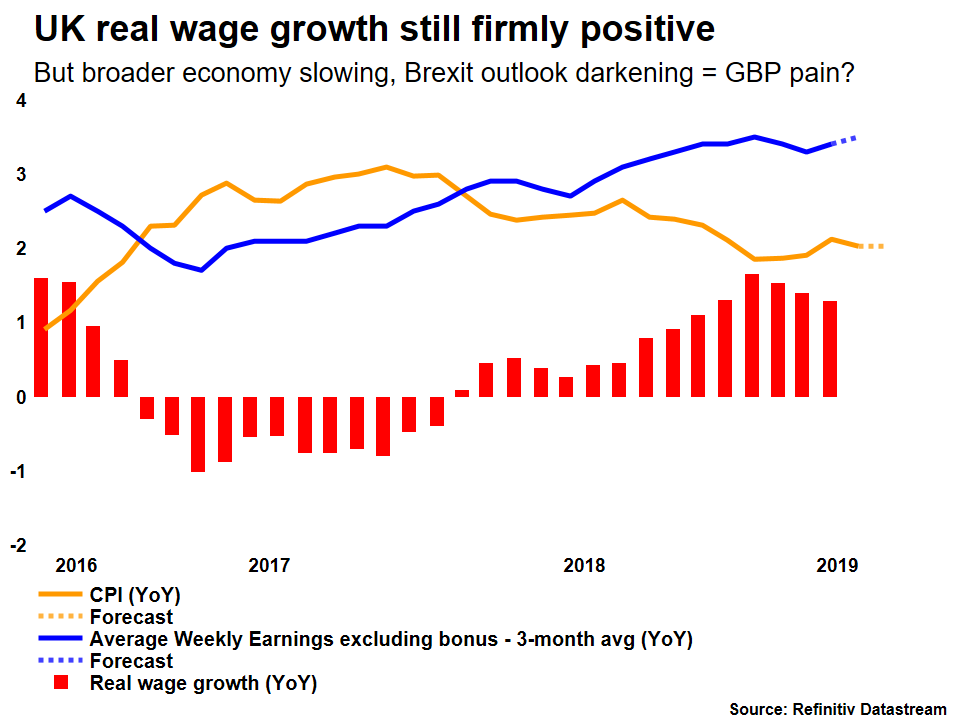
The pound, meanwhile, resumed its downtrend as both candidates hoping to become Prime Minister indicated they’d be willing to leave the EU in October without a deal. Granted, part of that may be ‘political theatre’, echoing Theresa May’s famous line: “no-deal is better than a bad deal”. What makes this threat more credible though, and hence scary for sterling, is that the Tories are sinking so severely in opinion polls that their next leader may truly consider a no-deal, for fear of losing more support as a party if Brexit is delayed again.
In this sense, the worst may not be over for the pound. Perhaps the only ‘saving grace’ for the currency may be further weakness in the US dollar, that offsets losses in sterling.
New Zealand inflation and Australian jobs data to guide antipodeans
The main event in New Zealand will be the release of inflation data for Q2 on Tuesday. The RBNZ already cut rates back at its May meeting and markets are pricing in a ~73% chance for another move at the August gathering, so these figures will be crucial in shaping expectations.
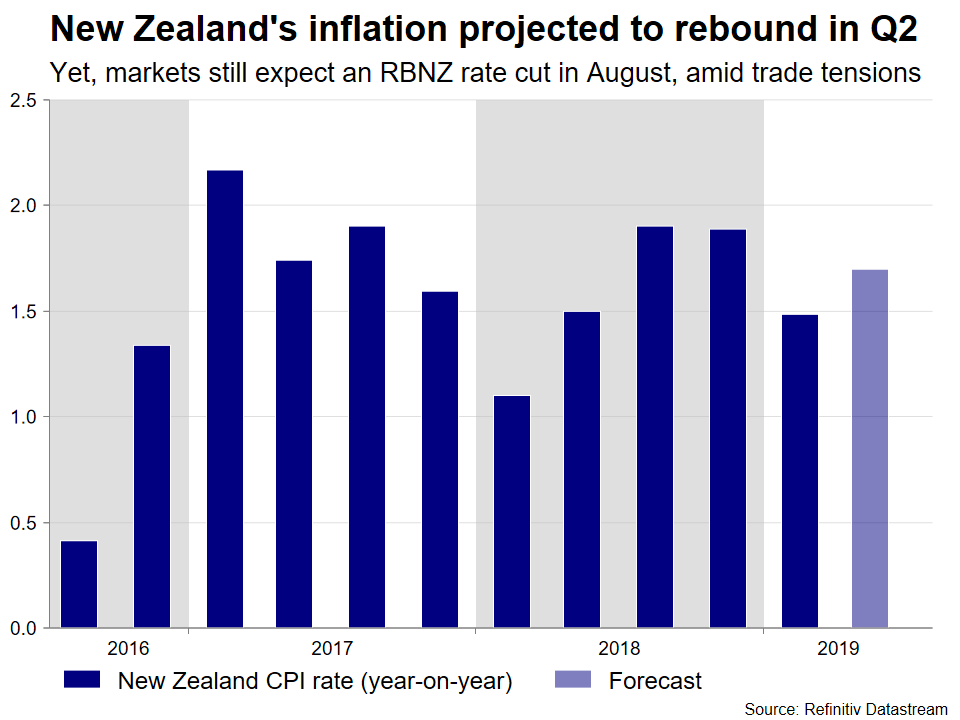
In Australia, jobs numbers for June are due on Thursday. The RBA also reduced rates, at both of its last two meetings, but appeared reluctant to signal more cuts. Instead, officials noted that labor market developments will guide their next move, which elevates the importance of the upcoming data.
The minutes from the latest RBA meeting are also due on Tuesday.
Canadian CPIs and retail sales coming up for loonie
The Bank of Canada (BoC) adopted a slightly more cautious tone this week, noting that trade tensions are becoming a bigger threat. Although policymakers still maintained a neutral stance overall, that could change quickly if the US-China negotiations turn sour. The loonie dropped but recovered quickly to touch a fresh high for 2019.
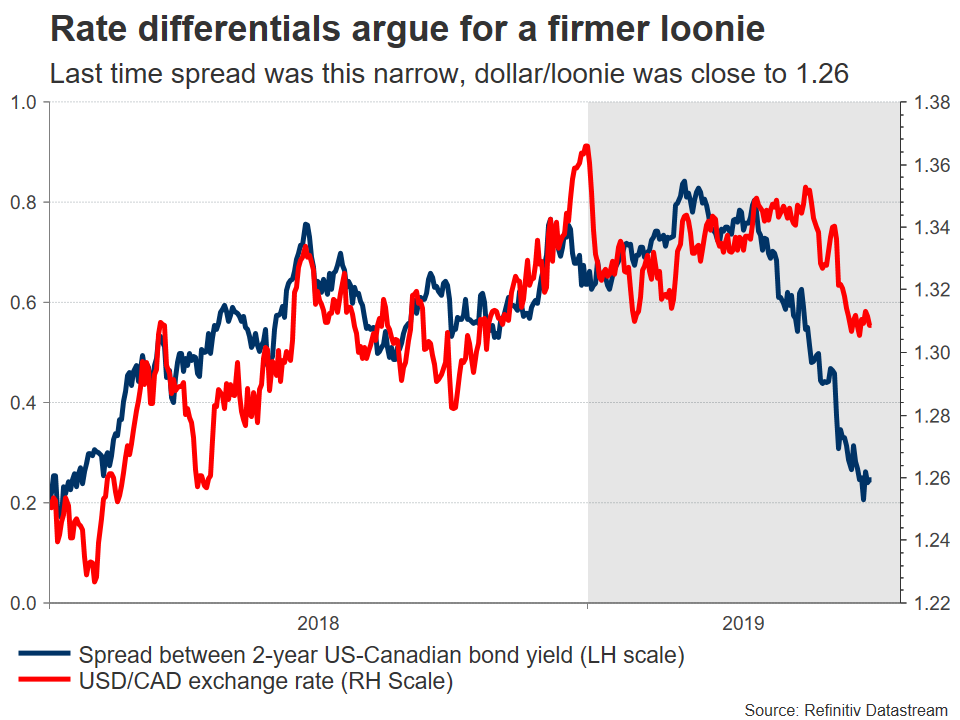
The next highlight for the currency will be the inflation data for June, due on Wednesday. Retail sales for May will follow on Friday.
While a lot will depend on trade, as long as the BoC-Fed policy divergence narrative holds, the outlook for the loonie remains positive overall.
Japanese inflation prints unlikely a game-changer for yen
In Japan, inflation numbers for June will hit the wires on Friday, but as usual the yen is unlikely to react much to economic data. Rather, the haven currency may take its cue mainly from any signals in the trade talks.
Cliff Notes: Consumer Sentiment Questions Effectiveness of Rate Cuts
Key insights from the week that was.
This week provided a big surprise for consumer sentiment in Australia. Meanwhile, FOMC Chair Powell made it crystal clear that the US central bank will cut rates at its next meeting in July.
The pre-eminent release of the week was our Westpac–MI consumer sentiment survey for July. Coming on the back of two rate cuts, the passing of the Federal Government’s three-stage tax cut plan, a stabilisation in house prices in Sydney and Melbourne, and broad-based gains for equities, there was every reason to believe that consumer sentiment would firm in the month.
However, what we instead saw was a concerning 4.1% fall in the headline index to 96.5 – an outright pessimistic level. While views on family finances versus a year ago did improve in the month, expectations for the year ahead fell away, to be circa 9% below average. Economic expectations for 1 and 5 years ahead also dropped back to near their long-run average, having consistently printed above that level since late-2017. Of concern for consumers looking forward is the labour market, with unemployment expectations now clearly above average for the first time since mid-2017 (note a higher reading for this series points to a higher expectation of unemployment, i.e. a weaker labour market).
The one area of the survey that was ‘as expected’ was the housing detail. On the back of the rate cuts and APRA’s lending standards adjustment, ‘time to buy a dwelling’ recorded its first above-average reading in four and a half years. House price expectations also strengthened further in the month. Responses from each of the states point to positive price growth, though the overall index is still below average – implying future gains are likely to be modest.
Turning to the business sector, the NAB business survey for June was another sombre read, with confidence retracing its post-election bounce to be back below average, while conditions remained sub-par. On the latter, for Q2 overall, conditions are the weakest they have been since 2014.
In contrast to households expectations of the labour market however, at June employers remained happy to hire, the NAB business survey’s employment index printing above average at a level consistent with job gains of 20k per month – high enough to keep the unemployment rate broadly unchanged. That said, if forward orders remain weak in the period ahead and profitability continues to be squeezed, it is difficult to see this positive view on employment enduring. Westpac continues to expect the unemployment rate to rise towards 5.5% over the coming 6-12 months. Along with persistently weak consumer demand, this is why we see the RBA cutting the cash rate once more in November to 0.75%. To this view, risks are to the downside.
Moving offshore, in the US this week we received a comprehensive update on the views of the FOMC as Chair Powell appeared before Congress and the June meeting minutes were released. In short, it was very clear from these communications that, not only will a cut be delivered at the July meeting, but that another will follow before year end. These cuts are best considered insurance and are justified by the expectation that current global uncertainties will persist for the foreseeable future – principally affecting business investment in the US.
To our and the FOMC’s expectation of two cuts by year end, the risk is that current uncertainties grow and/or their economic impact in the US spreads to the consumer via employment and wages. If that were to occur, then the FOMC would likely see a need to continue cutting into 2020, in line with the market’s four-cut expectation. The risk of such an outcome is less than 50%, but not immaterial. With regards to inflation, the latest CPI print surprised to the high side. The 0.3% core inflation result for June was driven by a rebound in apparel and used vehicle prices, supporting the FOMC’s view that recent weakness will prove transitory. The all-important shelter component also continued to rise at a robust pace. With annual core inflation at 2.1%yr and headline at 1.6%yr, there is no reason to fear inflation to the upside, but equally no real justification to believe disinflation will prove a lasting concern either.
Nikke100 and USD/JPY – Are The Stock Market and xxx/JPY Ready To Rumble?
Hello traders and welcome back to the US session!
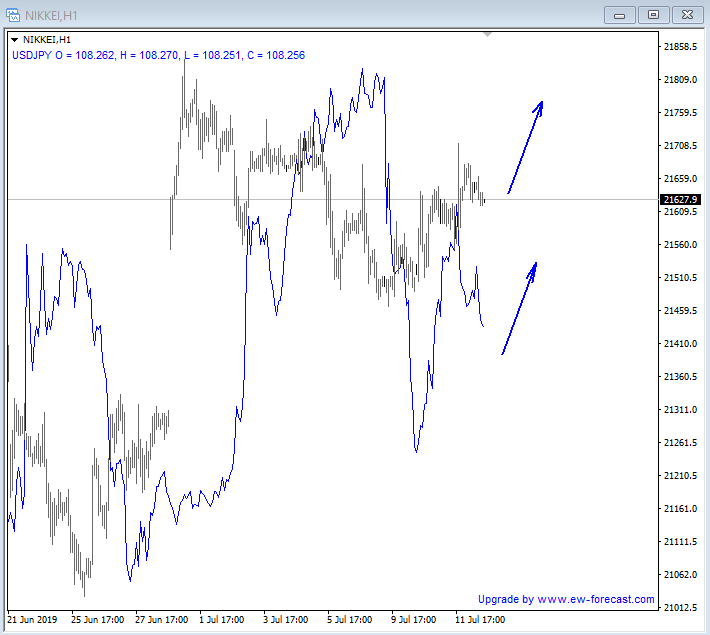
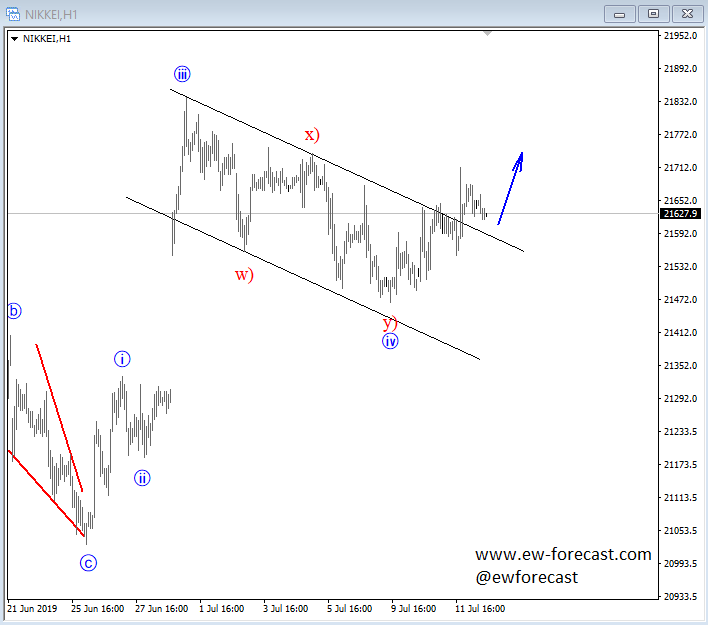
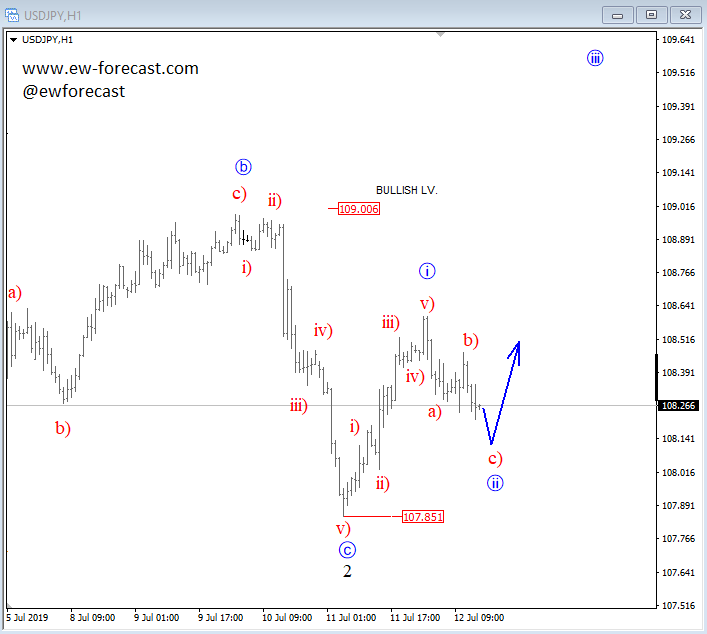
USDJPY made a nice bullish daily candlestick and looking on the intraday, we can see a nice five-wave rally, so seems like more upside can be seen after that small three-wave setback, especially if we consider a bullish looking Nikkei since we know they are positively correlated.
Don't forget, even 10Y US Yield and 10Y JPY Yield are recovering which also suggest higher prices for Nikkei and USDJPY.
NIKKEI vs. USDJPY, 1h
NIKKEI, 1h
USDJPY, 1h
EUR/USD Outlook: Euro Eases from Key Barriers on Better than Expected US Data
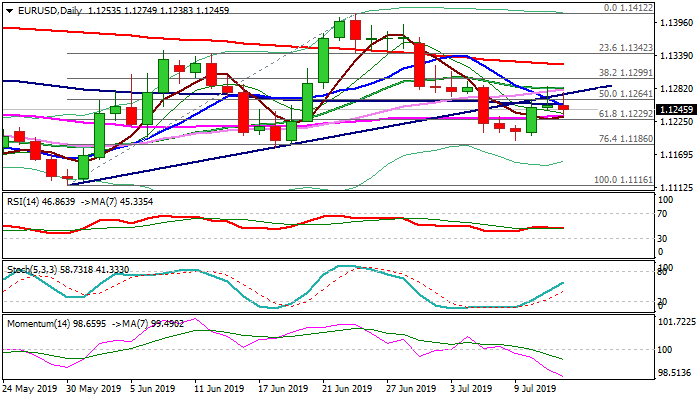
The Euro moves lower in early US trading on Friday as stronger than expected US PPI data inflated dollar. The pair repeatedly failed to close above strong 1.1254/85 resistance zone (100DMA/broken bull-trendline/converged 20/30DMA's) that was cracked on Thu/Fri, but subsequent pullbacks marked strong rejections, confirming the strength of resistances. Thursday's Doji with long upper shadow and today's easing, suggest that short recovery off week's low at 1.1193, might be over. Fresh weakness pressures supports at 1.1236 (55DMA) and thin daily cloud (1.1227/29) break of which is needed to confirm reversal scenario and re-focus lows at 1.1193/81. Very strong bearish momentum on daily chart supports the notion, however, overextended 14-d momentum and north-heading stochastic may slow bears.
Res: 1.1254; 1.1274; 1.1285; 1.1300
Sup: 1.1236; 1.1227; 1.1193; 1.1181