Sample Category Title
Equity Markets Embrace Tariff Delay
Equity markets embrace tariff delay
Equity markets’ refusal to roll over has been impressive this last month as they use a selective narrative to rally after each trade-war-induced sell-off. The overnight session was a classic case, as markets across Asia, Europe and North America rallied as the White House announced a six-month delay on whether to impose auto tariffs on vehicles from Europe and Japan. Unnoticed or ignored in the supposedly improved trade narrative were German 10-year bunds plumbing new lows in yield terms and lower-than-expected US retail sales.
That reality is unlikely to last now the White House has turned its artillery on Chinese telecom giant Huawei. President Trump signed an executive order allowing the government to ban US companies from making purchases from companies deemed a “national security threat.” Earlier, the US Commerce Department had added Huawei to a list of entities that prohibits them from acquiring US-made technology and components without a government licence. If that’s not an escalation in trade tensions, then I don’t know what is, and it’s likely to take the gloss of any potential rallies in Asia today.
Let us also note the previously-mentioned auto tariffs were aimed at Europe and Japan, not China. A trade deal with China will not take trade tensions off the table for Washington DC by any means.
Asia has a busy day ahead, starting with Australian employment data at 0930 Singapore time (SGT). Notoriously volatile, Australia is expected to add 18,000 jobs. With the Australian dollar (AUD) already wobbling from a reluctantly dovish central bank, a high correlation to China, a falling housing market and a Federal election on Saturday, an undershoot could have an outsized bearish reaction on the AUD.
Malaysia announces its GDP growth at midday (SGT) with 4.5% growth YoY forecast. Indonesia’s central bank follows at 1530 (SGT) with its latest rate decision, widely expected to be unchanged at 6%. Like Australia, both Malaysia and Indonesia have an outsized amount of skin in the game vis-a-vis China with lower growth or a dovish central bank likely to provoke nervous investors to head for the exit.
FX
The US dollar index was mostly unchanged overnight as a lull in trade rhetoric saw currencies mostly steady. Regional markets could see some pressure today following the Huawei news and if the data releases prove underwhelming. Sentiment remains fragile, to say the least, and this will limit any gains by regional currencies against the mighty greenback.
Equities
The late session news on Huawei from Washington DC should bring equity markets in the region back down to earth this morning. The realisation that all things trade are not suddenly rosy will limit gains on Asian markets as the street awaits China’s response to this latest shot across its bows.
Oil
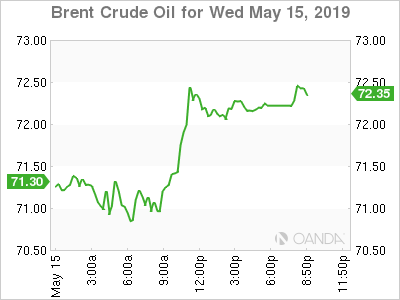
Middle East tensions are carrying the day at the moment on oil markets with Brent Crude and WTI both rising around 1% in overnight trading. Asia can expect a consolidative session as Middle East tensions support the downside while trade tensions cap gains.
Gold
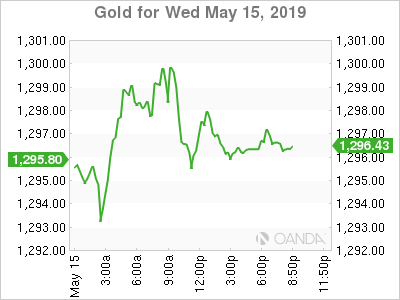
Gold was almost unchanged overnight at USD1,296.00 an ounce, slumbering like the greenback in overnight trading. Gold seems to have reached a temporary detente at these levels with momentum weak to push it either way. The geopolitical premium appears to be baked into the price for now.
USD/CAD Canadian Dollar Rises On Steel And Aluminum Tariffs News
The Canadian Dollar rose 0.18 percent against the greenback on Wednesday. Canadian inflation data met the forecast at a 2 percent rise on a year over year basis. Gasoline prices increased 10.2 percent in the last 12 months as crude has appreciated with the OPEC+ deal limiting output and several geopolitical disruptions to supply offsetting the rise of US and Canadian production.
The biggest factor for the loonie did not come from an economic indicator. The news that the US is close to reaching a resolution on steel and aluminium tariffs boosted the currency. US Treasury Secretary Mnuchin said high level talks met to discuss trade. Given the uncertainty surrounding trade with the US, the news carries a positive connotation and eases concerns for the USMCA deal that could come under fire if the US decided to pursue a global trade war.
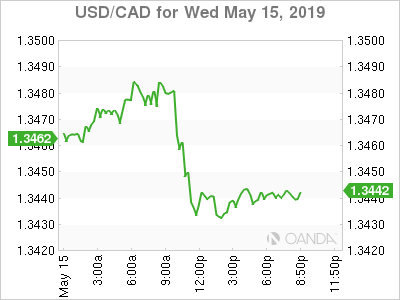
The US is also signalling a willingness to reassume talks with China as Mnuchin is looking forward to connecting again with Beijing.
Oil prices rose despite higher US weekly inventories as tension in the Middle East forced the US to pull out its diplomats out of Iraq. The OPEC+ deal brought about stability to crude prices, but as geopolitics have caused supply disruptions prices have risen as sanctions, sabotage and military action threaten the steady flow of crude in the region.
The US dollar is higher against most majors on Wednesday after a flurry of trade comments injected optimism into the market. A delay of US auto tariffs boosted global stock markets and offset some of the softer US data released on Wednesday. Retail sales and industrial production remain weak in an economic calendar that wrapped up early this week. The next major release in the US will be next week on Wednesday when the U.S. Federal Reserve published its notes from its April/May FOMC meeting.
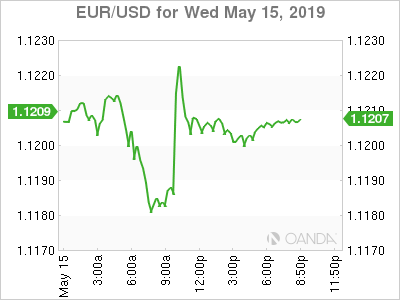
Global trade has been the biggest story in 2019 as much as the Fed was in 2018. The central bank hiked rates 4 times in 2019, but as the US economy loses momentum even the President has asked for a rate cut. The market is now pricing in that scenario as a real possibility this year and it could become a reality if fundamentals don’t improve.
The US decided it was better to delay the auto tariffs to avoid opening more fronts in order to concentrate on the China deal. US Treasury Secretary Mnuchin said that a deal with Canada and Mexico is close on steel and aluminium which would give more bandwidth on trade to focus on dealing with the second largest economy.
OIL – Crude Higher as Middle East Tension Offset Higher US Inventories
The Energy Information Administration (EIA) reported a gain of 5.4 million barrels but rising tensions in the Middle East forced US diplomats to withdraw from Iraq putting more emphasis on a showdown between America and Iran.
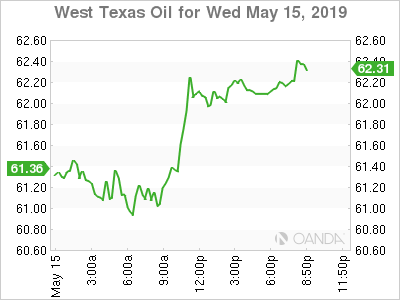
The attacks on Saudi tankers and Iran ending its nuclear commitments have escalated turmoil in the region with the US ready to apply pressure in Tehran and evacuating its embassy in Iraq due to security concerns.
Supply disruptions have kept crude higher, even as the US has ramped up production. The OPEC+ agreement to limit output is the biggest factor, but geopolitical disruptions like the US sanctions against Iran and Venezuela and the armed conflict in Libya are added to the situation in Saudi Arabia.
Iran has said that its goal it’s not military confrontation, but just a response to US escalating its efforts. Supply disruptions have been the major factor boosting oil prices. Geopolitical
Saudi Arabia is seen as the main producer that could cover the gap in supply left by Iranian crude. US President Donald Trump has tweeted about the OPEC’s role in keeping prices lower if they increase their output.
The deal between OPEC and other major producers will reach its end in June, but it could be extended if participants deem the market has not reach price stability which was their main goal. Russia remains a big question mark as it has sacrificed its revenue to be part of the deal and could be ready to take advantage of higher prices ahead of even higher levels of US production causing another drop.
US production has increased dramatically to the point that the one-time net importer is now an exporter of energy products. Shale technology has tipped the scales of global production and threatens to reduce the influence that the OPEC has on the market. The decision from OPEC members to fight fire with fire and flood the market to drive shale operations into bankruptcy backfired and forced the group to reach out to non-OPEC members in order to have a significant impact on the market by collectively reducing their output.
GOLD – Gold Stable as Trade Concerns Ease but Middle East Tensions Rise
Gold was flat on Wednesday as positive US comments on trade brought back risk appetite. The Trump administration delayed auto tariffs by six months and is said to be close to resolving its steel and aluminum tariffs with Canada and Mexico. Stock markets rose on the news, despite softer economic indicators out of the US. The yellow metal’s fall was broken by the higher tensions in the Middle East making gold a good alternative for investors looking for a safe haven.
Trade concerns are easing as the White House is looking forward to more talks with China and tariff delays for global auto lifted pressure on European stocks. Volatility will remain high as uncertainty is plentiful with so many geopolitical risks up in the air making gold a viable asset for diversification.
STOCKS – Equities Rebound After Positive Trade News
Global equities were higher after US President Donald Trump announced a delay to the planned auto tariffs. The six-month term was a positive for auto stocks that gained after the news. The US entered a combative stance on trade when Trump entered the White House, but as a trade deal with China broke off in the last mile American rhetoric had become more aggressive and markets feared a full-on trade war.
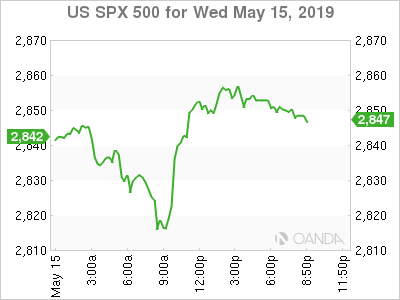
US data came in below expectations with retail sales and industrial production disappointing and building the case for a Fed rate cut this year. Economic indicators continue to be mixed and the market is pricing in lower growth, but trade war concerns are driving prices. Until a US-China trade deal is signed, which could come before or at the G20 meeting in Japan, fundamentals will still be in the backseat to geopolitics.
Eco Data 5/16/19
[php_everywhere instance="1"]
Japanese Yen Yawns as US Retail Sales Disappoint
USD/JPY is almost unchanged on Wednesday. In the North American session, the pair is trading at 109.57, down 0.03% on the day. There are no major Japanese events. In the U.S., retail sales and core retail sales both missed expectations. On Thursday, the U.S. releases three key indicators – building permits, unemployment claims and the Philly Fed Manufacturing Index.
U.S. retail sales in April were weaker than forecast, but this didn’t help the struggling pound. The currency has lost 1.2% this week and is trading at its lowest level since mid-February. Retail sales declined 0.2%, after a strong gain of 1.6% in March. Core retail sales posted a small gain of 0.1%, much lower than the estimate of 0.7%.
Another round of tariffs between the U.S. and China has triggered sharp swings in the equity markets. This has also led to significant volatility from USD/JPY, as the safe-haven yen has climbed when risk appetite has sagged, and conversely, the yen has fallen when trade tensions have eased and risk apprehension has declined. The yen has posted four straight winning weeks, corresponding to sharp declines on global equity markets. The new tariffs are set to take effect in several weeks and could continue to cause volatility in the stock markets. If this happens, traders can also expect swings in the movement of USD/JPY.
Stocks rebound as Trump ducks auto tariffs decision, but US and German yields stay down
A couple of US trade policy news are giving market sentiment a mild lift in early part of US session. It's clear that the trade talks with China collapsed even though Trump denied it. Trump now appears to be backing down from his hard-line trade stance against the country's closest allies in Canada and EU.
Firstly, US Treasury Secretary Steven Mnuchin confirmed himself that he's going to China soon to continue trade negotiations. He said, "my expectation is that we will go to Beijing at some point in the near future to continue those discussions.... We're continuing discussions. There's still a lot of work to do."
Secondly, Mnuchin also indicated that US is very close to resolving steel and aluminum tariffs on Canada and Mexico. Separately, it's reported that Trade Representative Lighthizer is scheduled to meet Canadian Foreign Minister Chrystia Freeland again. Lighthizer will bring forward a proposal to remove such national security steel and aluminum tariffs.
Thirdly and most importantly, an unnamed source was quoted saying that Trump will delay the decision on auto tariffs by up to six months. The original decision is due this Saturday, May 18. It reported that the White House has held a series of high-level meetings on the issue in recent days. And automaker official were repeatedly told that the decision will be delayed. But White House declined to comment.
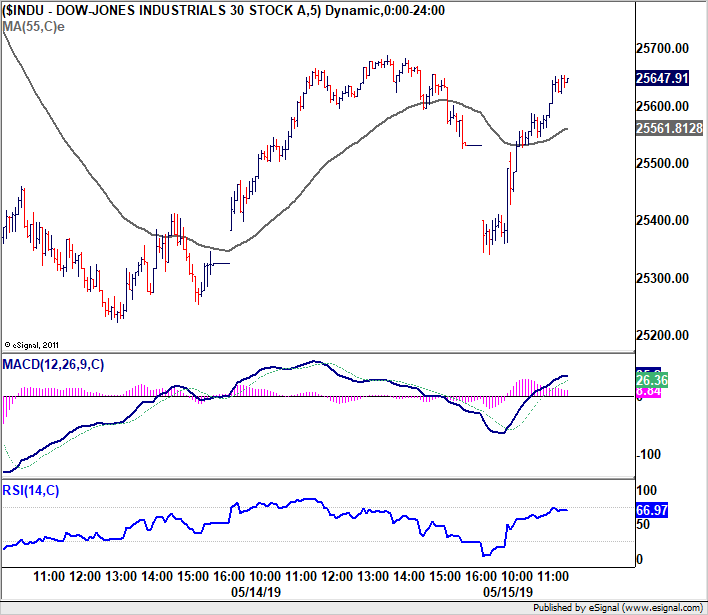
DOW dived to as low as 25341.91 in early trading but it's now back up 0.4%, above 25600. 10-year yield also hit as low as 2.361 but it's back at 2.389 now. Still, 10-year yield below 2.4 is a serious sign of risk aversion.
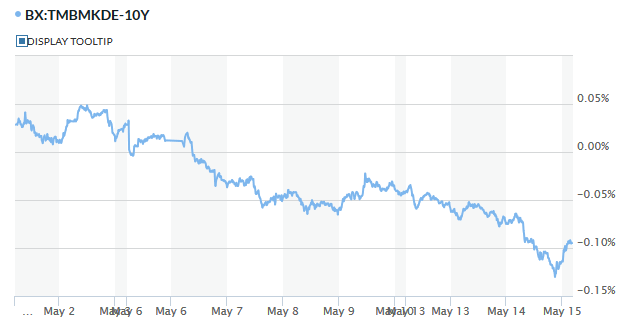
In Germany, DAX dropped to as low as 11862.21 earlier today but closed up 0.86% at 12904.74. German 10-year yield reached as low as -0.131 earlier today and it's back at -0.095 at the time of writing. German yield is pressured by concerns over Italy's budget. Postponing auto tariffs just delay the problem, not solve it. And, it certainly couldn't solve the unrelated problem of Italy.
Pound Slips to 3-Month Low Despite Soft U.S. Retail Sales
GBP/USD has posted considerable losses on Wednesday, as the pound continues to slide. In the North American session, the pair is trading at 1.2845, down 0.47% on the day. On the release front, there are no British events. In the U.S., consumer spending numbers disappointed, as retail sales and core retail sales both missed expectations. On Thursday, the U.S. releases three key indicators – building permits, unemployment claims and the Philly Fed Manufacturing Index.
U.S. retail sales in April were weaker than forecast, but this didn’t help the struggling pound. The currency has lost 1.2% this week and is trading at its lowest level since mid-February. Retail sales declined 0.2%, after a strong gain of 1.6% in March. Core retail sales posted a small gain of 0.1%, much lower than the estimate of 0.7%.
Brexit has been on the backburner for several weeks, but will be back on center stage in early June. Parliament is expected to vote yet again on a Brexit withdrawal agreement, after three previous attempts by the May government ended in failure. It’s difficult to see why the result will be any different this time around, as Conservative lawmakers remain deeply divided on Brexit. May tried to enlist the help of Labor leader Jeremy Corbyn, but these talks have been unproductive. The next Brexit vote in parliament will be May’s last chance before the summer recess, and her days as prime minister may be numbered.
The pound remains under pressure, and the uncertainty surrounding Brexit and global trade tensions are making fund managers increasingly pessimistic over the pound. Major financial services companies are reducing their exposure to the pound, with some going further and shorting the currency. The May government has been unable to present the public with a clear roadmap for departing the EU, and a no-deal remains a possibility, although both the EU and Britain are in agreement that a no-deal exit would be disastrous. Given the turmoil over Brexit, the pound is likely to face further headwinds in the coming weeks.
GBP/JPY Mid-Day Outlook
Daily Pivots: (S1) 141.15; (P) 141.67; (R1) 141.96; More...
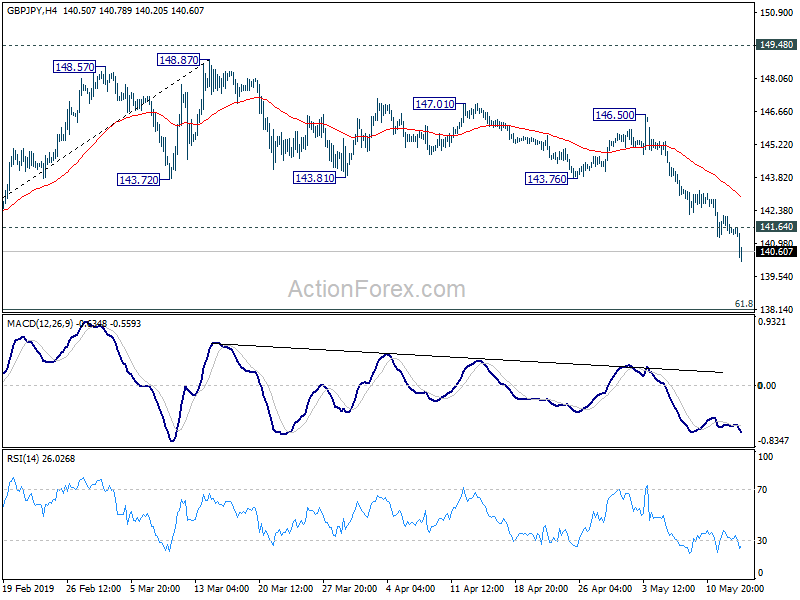
GBP/JPY's fall resumed after brief consolidations. Intraday bias is back on the downside for 1.8% retracement of 131.51 to 148.87 at 138.14 next. Sustained break there will pave the way to retest 131.51 low. On the upside, above 141.64 minor resistance will turn intraday bias again and bring consolidations, before staging another decline.
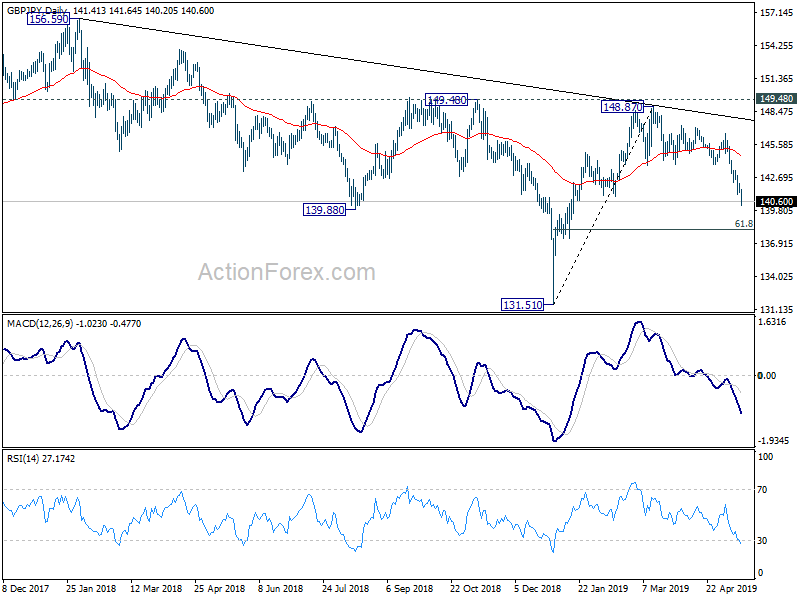
In the bigger picture, current development suggests that GBP/JPY was rejected by 149.98 key resistance. And medium term fall from 156.59 is still in progress. Break of 131.51 will target 122.36 (2016 low). On the other hand, decisive break of 149.98 should confirm that medium term fall from 156.59 (2018 high) has completed at 131.51 already. Further rally would be seen back to 156.59 resistance and above.
Sunset Market Commentary
Markets
German Bunds and US Treasuries edge higher in sympathy today. Chinese data overnight lead investors to believe more Chinese stimulus was around the corner, pushing Chinese equities more than 2% higher. European equities opened higher as well, supported by a solid, but as expected, German first quarter GDP result. However, immediately after the EU opening, the tide turned and risk-off prevailed again. German Bunds jumped higher and held an upward bias throughout the day. The German yield curve is bull flattening with losses up to -5.8 bps (30-yr). The German 10-yr yield fell intraday to -0.13%, the lowest level since 2016, but partly recovered ahead of the US opening. US Treasuries climbed higher as well and set an intraday peak after retail sales printed well below expectations in April. A stronger-than-expected Empire Manufacturing gauge offered little resistance, especially when a little after the industrial production data disappointed as well. The US yield curve is edging lower with the US 2-yr yield (-4.8 bps) falling below 2.16%, the lowest level since February 2018. Italian BTP’s continued declining as fears of a standoff between the Italian government and the EU over the fiscal deficit surfaced again. President Mattarella even discussed a possible government break-up and hinted at a new election date. Peripheral spreads over the German 10-yr yield are widening with Italy (+8 bps) and Spain (+4 bps) underperforming.
Global markets entered a diffuse trading pattern today. However, this time the euro suffered more than the dollar on the global uncertainty. This morning, Asian/Chinese markets reacted remarkably positive to poor Chinese data as investors hoped for more policy stimulation. European equities tried to copy this optimism at the start of trading. However, initial gains were almost immediately reversed, starting an elongated intraday risk-off trade. Both German and US yields declined substantially. EUR/USD gradually drifted back below 1.12. EMU data were not to blame. EMU and German Q1 growth both printed as expected (0.4% Q/Q). Maybe European investors were more worried on the potential fall-out from decelerating growth in China. Negative headlines on Italy (including widening EMU spreads) remained a euro negative, too. In the US, April retail sales and production printed weaker than expected, suggesting ongoing soft consumer spending at the start of Q2. The report supported calls for a Fed rate cut, but had little impact on EUR/USD. The pair is trading in the 1.1185 area. USD/JPY (109.30 area) dropped on yen strength as global uncertainty persists. Today’s ‘classic’ risk-off trade was completed by a further slide in EUR/JPY (122.30 area).
Sentiment on sterling remained fragile today. There were no important UK eco data. Talks between labour and the government continue, but markets have little faith on a constructive outcome. EUR/GBP is touching a new short-term top near 0.8700. The 0.8723 resistance is coming on the radar. The combination of sterling weakness and relative USD strength is pushing cable back to the mid 1.28 area.
News Headlines
Headline inflation in Canada rose 0.4% M/M in April. The Y/Y-measure returned to 2.0% (from 1.9%). Part of the rise was due to a levy on carbon taxes, raising gasoline prices. Some underlying inflation measures were marginally softer than expected. In this respect, the report doesn’t rally support the case for further BoC rate hikes. The loonie lost marginal ground after the publication of the report.
The International Energy Agency warned that the oil market could face a shortage. The IEA said “considerable uncertainty” about global supply emerges (US sanctions on Iran/Venezuela and ongoing conflicts in Libya), while global oil demand will grow more slowly than previously thought.
EUR/USD Mid-Day Outlook
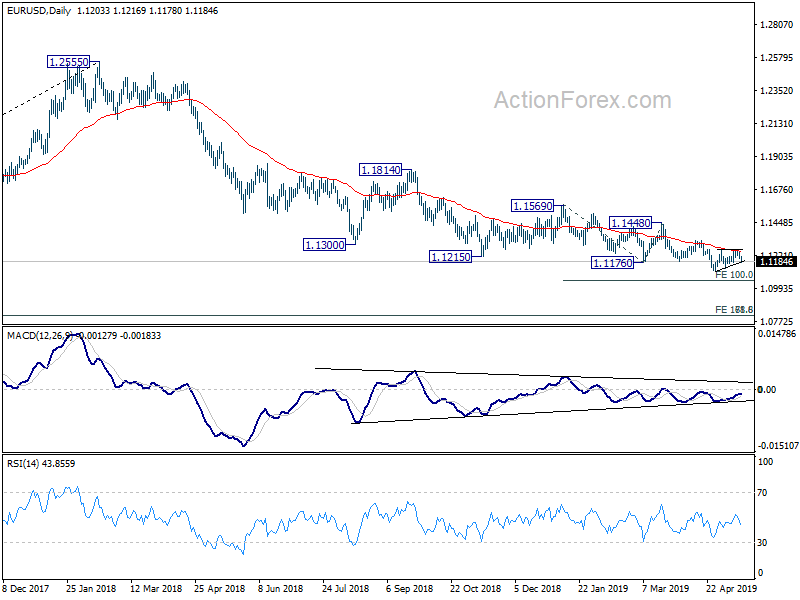
Daily Pivots: (S1) 1.1211; (P) 1.1237; (R1) 1.1251; More.....
Intraday bias in EUR/USD remains neutral with focus on 1.1173 minor support. Break will turn bias to the downside for 1.1111 low. Break will extend down trend to 100% projection of 1.1448 to 1.1183 from 1.1324 at 1.1059. Break will target 161.8% projection at 1.0895. On the upside, in case of another rise as consolidation from 1.1111 extends, upside should be limited well below 1.1324 resistance.
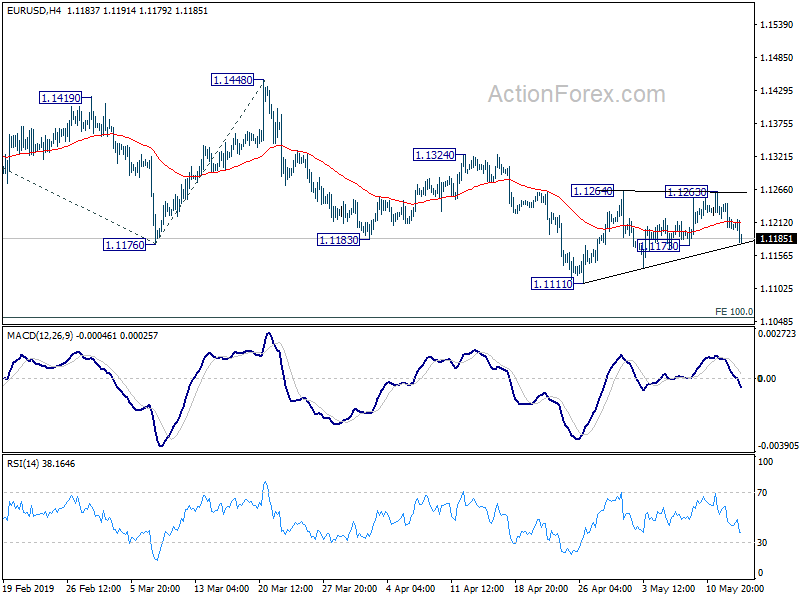
In the bigger picture, down trend from 1.2555 (2018 high) has just resumed. 61.8% retracement of 1.0339 (2016 low) to 1.2555 (2018 high) at 1.1186 was also taken out. Current fall should now target 78.6% retracement at 1.0813. Sustained break there will pave the way to retest 1.0339. On the downside, break of 1.1448 resistance is needed to be the first sign of medium term bottoming. Otherwise, outlook will stay bearish in case of rebound.
GBP/USD Mid-Day Outlook
Daily Pivots: (S1) 1.2881; (P) 1.2926; (R1) 1.2949; More....
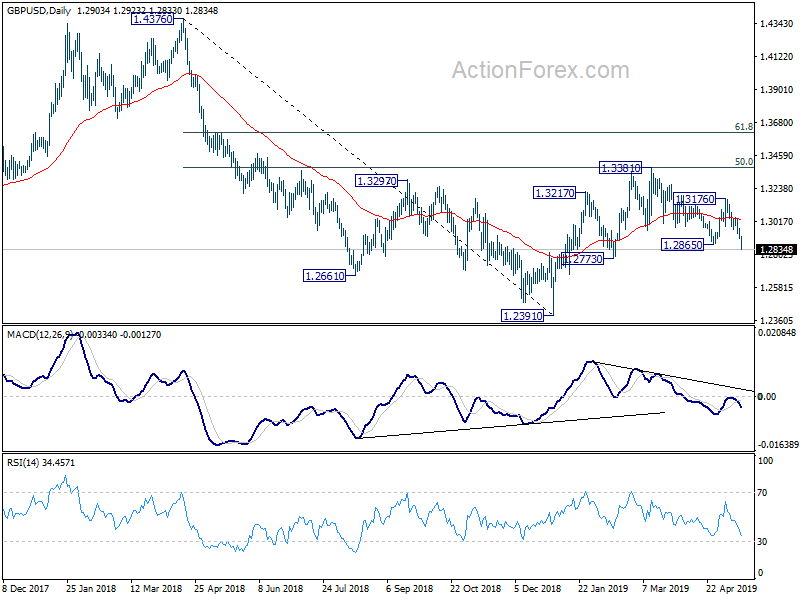
GBP/USD's decline extends to as low as 1.2833 so far. Break of 1.2865 should confirm completion of rebound from 1.2391, at 1.3381. Intraday bias stays on the downside and deeper decline would be seen back to retest 1.2391 low. On the upside, above 1.2923 minor resistance will turn intraday bias neutral for consolidation first. But recovery should be limited well below 1.3176 resistance to bring fall resumption.
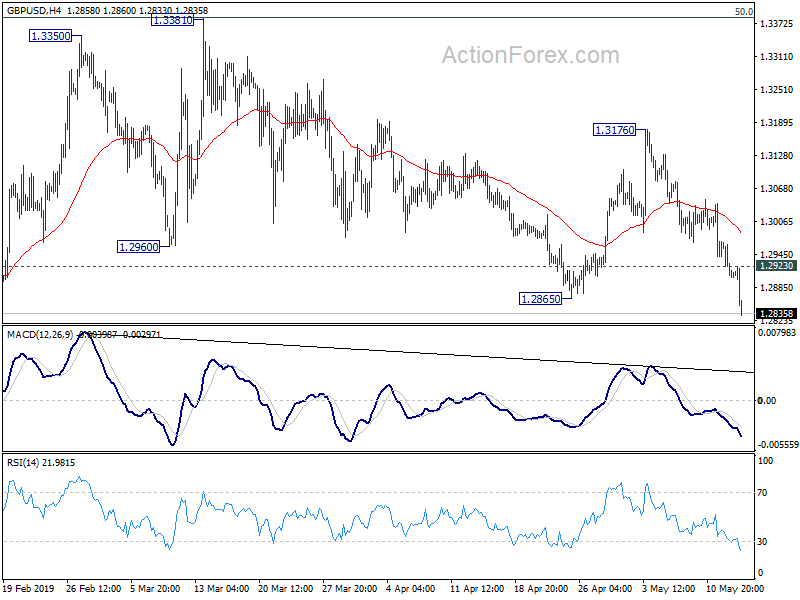
In the bigger picture, medium term decline from 1.4376 (2018 high) halted and made a medium term bottom after hitting 1.2391. Rebound from 1.2391 is seen as a corrective move for now. In case of another rise, strong resistance could be seen around 61.8% retracement of 1.4376 to 1.2391 at 1.3618 to limit upside. On the downside, break of 1.2773 support will suggests that such corrective rise is completed and bring retest of 1.2391 low first.