

Sample Category Title
USD/CHF Mid-Day Outlook
Daily Pivots: (S1) 1.0059; (P) 1.0078; (R1) 1.0106; More...
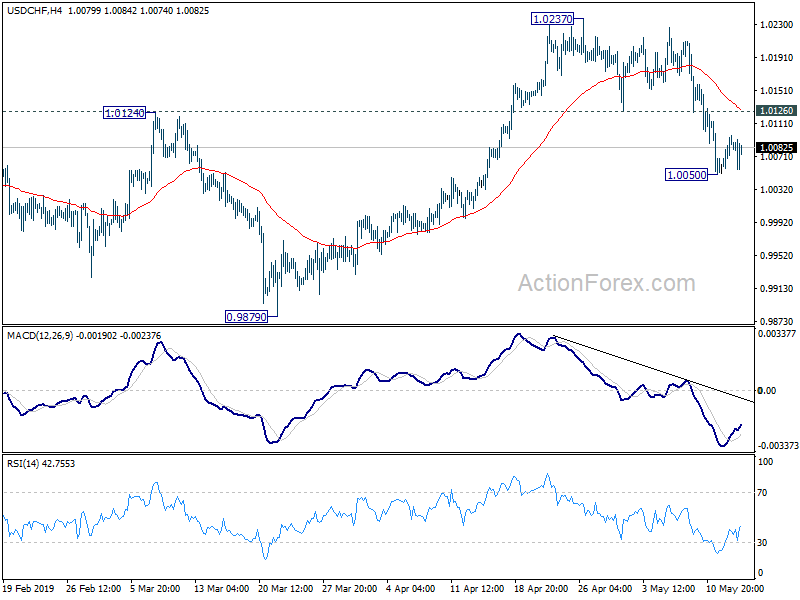
USD/CHF is staying in consolidation above 1.0050 temporary low and intraday bias remains neutral first. More consolidation could be seen but upside should be limited by 1.0126 support turned resistance to bring another decline. On the downside, break of 1.0050 will resume the fall from 1.0237 to retest 0.9879 key support. Though, firm break of 1.0126 will turn bias back to the upside for 1.0237 resistance.
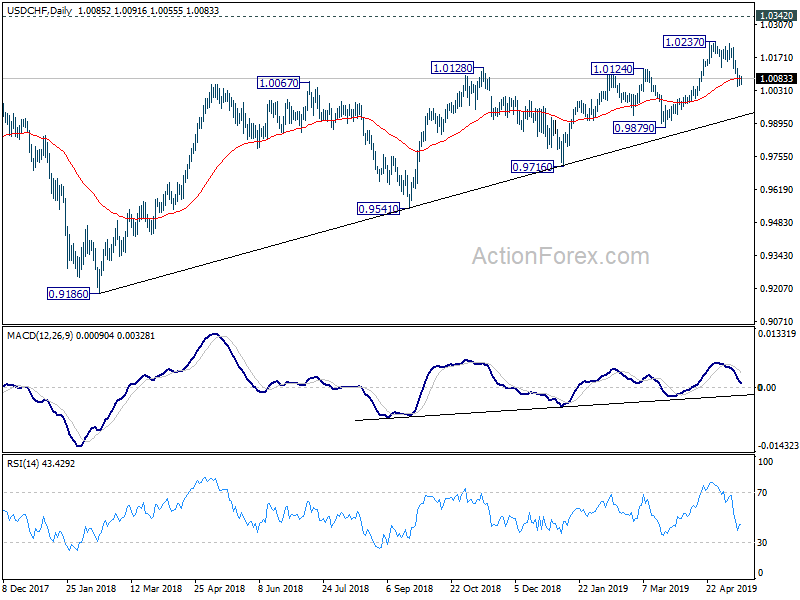
In the bigger picture, as long as 0.9879 support holds, medium term up trend form 0.9186 is still in progress. Break of 1.0237 will target 1.0342 resistance next. For now, we'd be cautious on strong resistance from there to limit upside, until we see medium term upside acceleration. However, decisive break of 0.9879 will be a strong sign of medium term reversal. Focus will be turned back to 0.9716 support for confirmation.
USD/JPY Mid-Day Outlook
Daily Pivots: (S1) 109.24; (P) 109.51; (R1) 109.87; More...
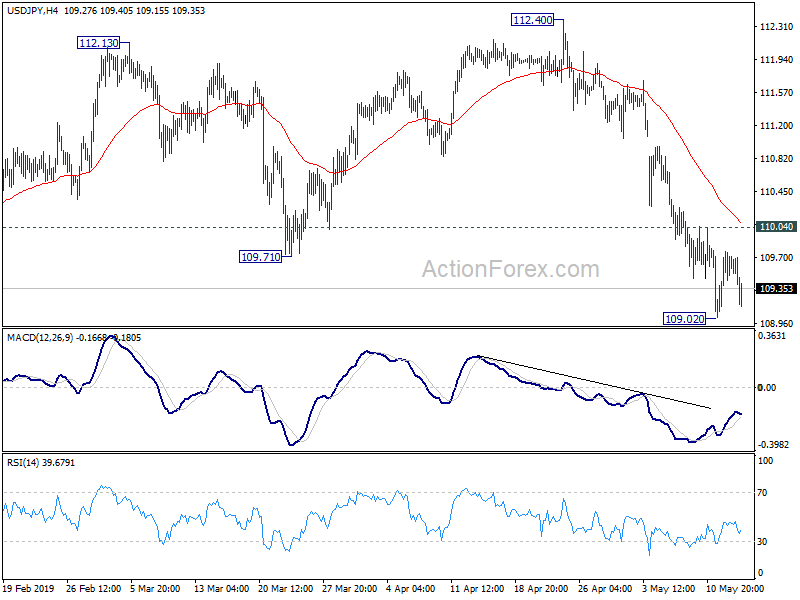
Intraday bias in USD/JPY remains neutral for consolidation above 109.02 temporary low. Further decline is expected as long as 110.04 resistance holds. On the downside, break of 109.02 will resume the fall from 112.40 to retest 104.69 low. Nevertheless, break of 110.04 minor resistance will indicate short term bottom. Lengthier consolidation could be seen before another decline.
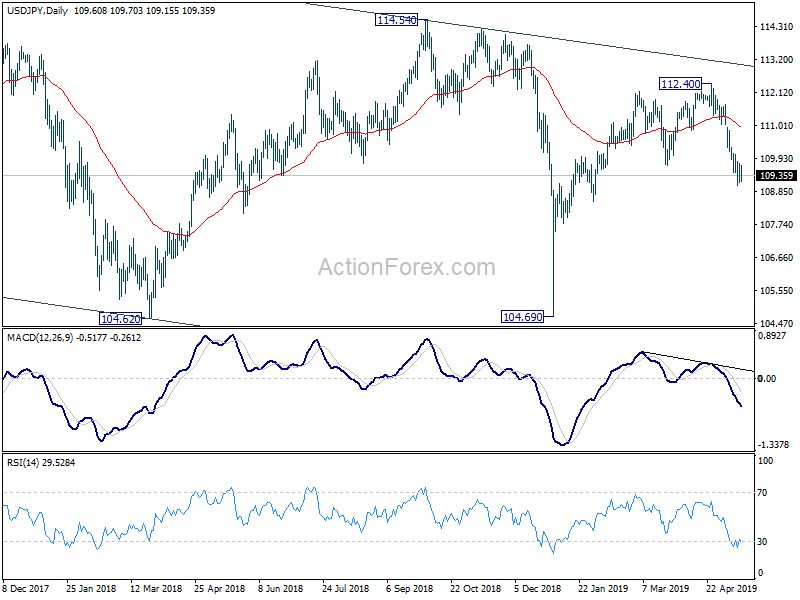
In the bigger picture, USD/JPY is staying inside falling channel from 118.65. Currently development suggests that rebound from 104.69 is only a corrective move. And fall from 118.65 is not completed yet. Decisive break of 104.69 will extend the down trend towards 98.97 support (2016 low). For now, we'd expect strong support above there to bring rebound.
US: Retail Sales Pull Back in April
- After surging in March, retail sales came back to earth in April, edging lower by 0.2% (month-on-month). The outturn was below consensus expectations which called for a 0.2% gain. The already-hefty increase in March was revised slightly higher to 1.7% (from 1.6%).
- Sales at gas stations had another strong month (+1.8%) as gas prices continued to rise in April. Meanwhile, following an outsized gain in March, auto sales took a step back in April, falling by 1.1%. Vehicle sales dropped to 16.4 million (SAAR) in April, down from an elevated 17.5 million units sold in March.
- Excluding the most volatile components (gas, autos, building materials, and food services), the retail sales 'control group' was flat on the month (+1.1 prior) – also undershooting expectations for a 0.3% gain.
- Delving further into the details, sales were weaker across most categories. After increasing for three consecutive months, sales of furniture were flat in April (and down 3.1% from the year ago). Sales of electronics & appliances also pulled back by 1.3% (+1.2% prior), and sales of building materials declined by 1.8% (+0.8% prior). Clothing was down -0.2% (+2.1% prior), personal care and health sales edged lower 0.2% after three months of gains. Ditto for non-store retailers, where sales also ebbed by 0.2% after sizeable gains in the three months prior.
Department stores were the only category to see stronger growth in April (+0.7%), with sales rising for the first time since last November. Sales of food, general merchandise and at eating & eating places all edged up by a modest 0.2% on the month.
Key Implications
- After a surge in March, retail sales were expected to moderate in April, and moderate they did. The flat reading in the control group is somewhat disappointing, but several of the categories that pulled back did so after solid gains in prior months. Importantly, today's data doesn't change the calculus for consumer spending in the second quarter significantly. We continue to expect a solid rebound in real personal consumption of roughly 3% (annualized), enough to drive real GDP growth of around 2.0%.
- Some of the pull back in April was in housing-related categories, such as furnishings, electronics and building materials. This is contrary to other housing indicators that have shown progress in recent months. With lower mortgage rates and solid income growth, we expect housing activity to pick up in the months ahead, which augurs for a rebound in these spending categories as well.
Canada: Inflation Ticks Higher in April, But Core Measures Edge Lower
- Consumer price inflation edged up to 2.0% year-on-year (from 1.9% in March), meeting the consensus forecast. Month-on-month, seasonally adjusted prices were up 0.3% in April. Gains were broad-based with all sub-categories either rising or flat on the month.
- Strong month-on-month gains in gasoline prices contributed to the higher headline print, in part due to the introduction of carbon levies in several provinces. Energy prices were up 0.7% year-on-year (up from -1.2% in March).
- Food price inflation slowed in April to 2.9% (from 3.6% in March). Declining beef prices were the main contributor according to Statistics Canada. Fresh vegetable price inflation also slowed, but still stood at 14.5% (from 15.7% in March).
- Two of three core inflation measures edged lower in the month. CPI-median moved to 1.9% (from 2.1%) and CPI-trim to 2.0% (from 2.1%). The CPI-common measure was unchanged at 1.8%. On average, the three core measures are at 1.9% (down from 2.0% in March).
Key Implications
- Higher energy prices, but slowing food price inflation left overall prices up 2.0% in April. Overall, as evidenced the relative stability of core measures, inflation remains well contained and is likely to remain there over the foreseeable future.
- The strange combination of weak economic growth and a strong labour market will keep policy makers on their toes. At best it suggests that firms are still looking to expand, but are maintaining flexibility by adding employees rather than increasing investment. At worst it suggests a burgeoning productivity problem that means lower potential growth and less running room for policy. Ultimately policy makers will have to watch how this plays out. In the meantime, with global economic uncertainty increasing, monetary policy is likely to remain on standby.
Risk Aversion on Weak US and Chinese Data
Both China and US are seeing softer data points ahead of an escalation in tariffs. US stocks opened sharply lower and the risk-off environment could get ugly if we see a strong break of yesterday’s lows. Safe-haven currencies are stronger with the yen and franc posting the biggest gains. Gold prices have modest gains after recapturing the $1,300 an ounce level.
- Retail Sales – Rate cut bets grow on soft reading
- China – More stimulus please
- RBA – OIS now pricing in 2 cuts in 2019
- Germany – GDP improves on temporary factors
- Oil – EIA report highlights US production to accelerate
Retail Sales
Retail sales volatility continues as the April readings come in softer than expected. The decline in vehicle sales was confirmed after a -0.2 percent reading showed the strong rebound in March may have been temporary and keeps the horrendous December number on the back of trader’s minds. The US consumer outlook remains mixed as the labor market and wages appear robust, but vulnerable to the outcome of the trade war.
Empire State Factory survey had its best reading in six months, but markets may not care as much until we see a resolution with trade uncertainty. Inventories declined which bolds well for demand being strong. The Empire report was pretty positive across the board, but will likely take a back seat to the retail sales readings.
The April readings for US industrial production and factory output disappointed before the NY open. Overall, the US data this morning has been soft and should provide added motivation to push forward in working a deal out with China.
Expectations for a Fed rate cut grew following the softer than expected retail sales reading.
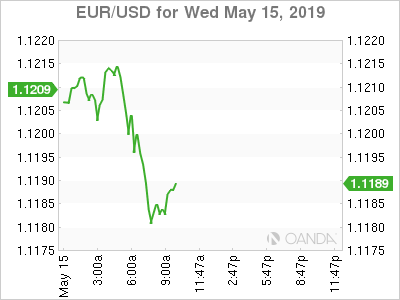
China
A slew of Chinese economic data showed a deceleration ahead of higher tariffs from the US. Asian stocks however little harmed as expectations remain high more stimulus is on its way. The dismal data also adds to the argument that China needs a trade deal more than ever and that fresh rate cuts will not be enough for sustained growth.
The industrial output reading for April climbed 5.4%, a miss of the 6.5% consensus and much lower than the strong 8.5% print in March. Retail sales fell to the lowest level since 2003 and the closely watched manufacturing investment growth was the weakest reading since 2004.
Trumps tariff increase and threat for fresh ones should keep the highly motivated Chinese to keep trade talks progressing to an eventual deal.
RBA
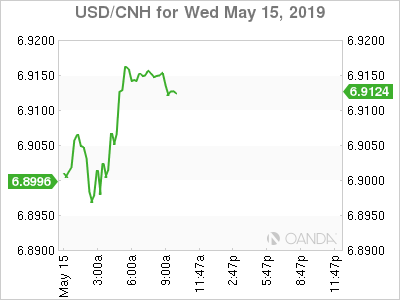
Following softer than expected wage data and horrendous Chinese data, the OIS is now pricing in two rate cuts for 2019 and sees possibly 3 cuts within the next 12 months. The RBA opted not to adopt an easing bias at the last meeting, but the data since the May 7th meeting has disappointed.
The Australian dollar has found some support after making 4-month lows, but it appears the expected stimulus from the PBOC is unlikely to deliver a big boost for the Australian economy.
Oil
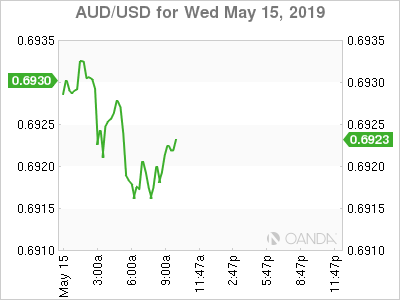
Crude prices continue to wildly fluctuate from global growth concerns from trade war fears, geopolitical risks and higher future production from the US. Trade war angst is putting a dent with demand concerns and increasing production appears to be driving the move lower today. Geopolitical risks remain plentiful and that could provide some short-term support, initial support seen at the $60 a barrel level.
EUR/USD Outlook: Euro Remains in Red Despite Solid EU/German Data and US Retail Sales Miss
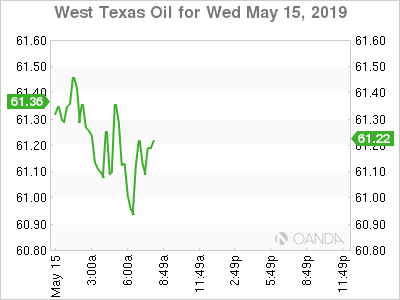
The Euro stands at the back foot at the beginning of the US session on Wednesday, despite solid EU/German GDP data and disappointing US retail sales.
German GDP rose 0.4% in Apr while EU figures came in line with expectations, but US retail sales disappointed (Apr -0.2% vs 0.2% f/c and 1.7% prev).
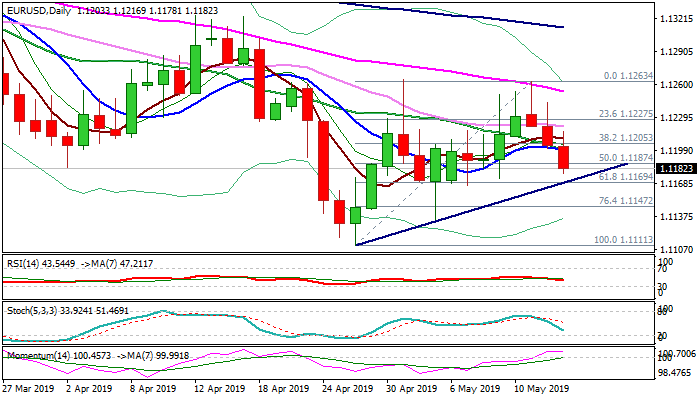
Bearish daily MA's and Ichimoku studies maintain pressure, as the pair holds in red for the third day, with sentiment additionally weighed by political turmoil in Italy ahead of EU elections.
The pair dipped to new one-week low at 1.1178 after marking over 50% retracement of 1.1111/1.1263 upleg.
Bears eye key support at 1.1170 zone (Fibo 61.8%/bull-trendline drawn off 2019 low at 1.1111) violation of which would generate bearish signal on confirmation of 1.1263 double-top, for further weakness.
Converged 10/20SMA's and broken Fibo 38.2% support mark solid barriers at 1.1200/05 which should ideally limit upticks.
Res: 1.1200; 1.1221; 1.1244; 1.1263
Sup: 1.1170; 1.1147; 1.1134; 1.1111
EUR/JPY Mid-Day Outlook
Daily Pivots: (S1) 122.48; (P) 122.95; (R1) 123.32; More....
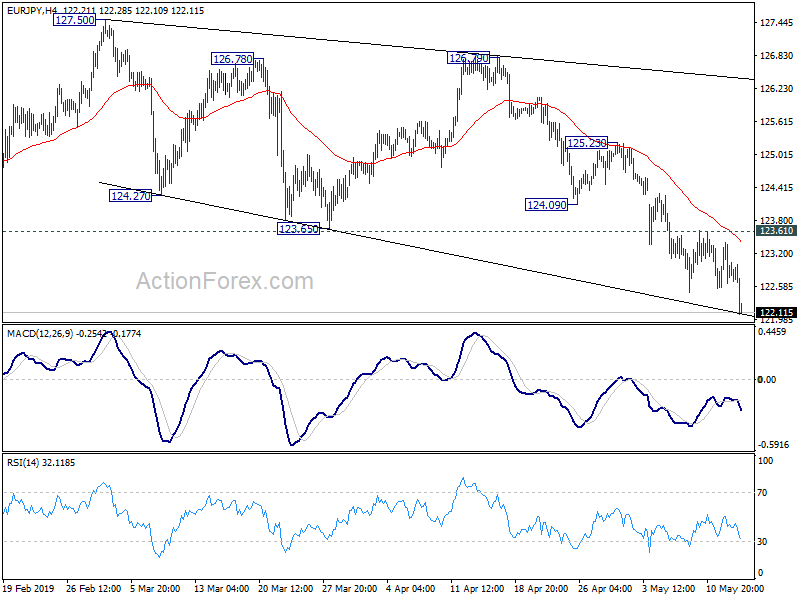
EUR/JPY's decline resumed after brief consolidation and reaches as low as 122.08 so far. Intraday bias is back on the downside. Current fall from 127.50 should extend to retest 118.62 low. On the upside, break of 123.61 resistance is needed to indicate short term bottoming. Otherwise, outlook will remain bearish in case of recovery.
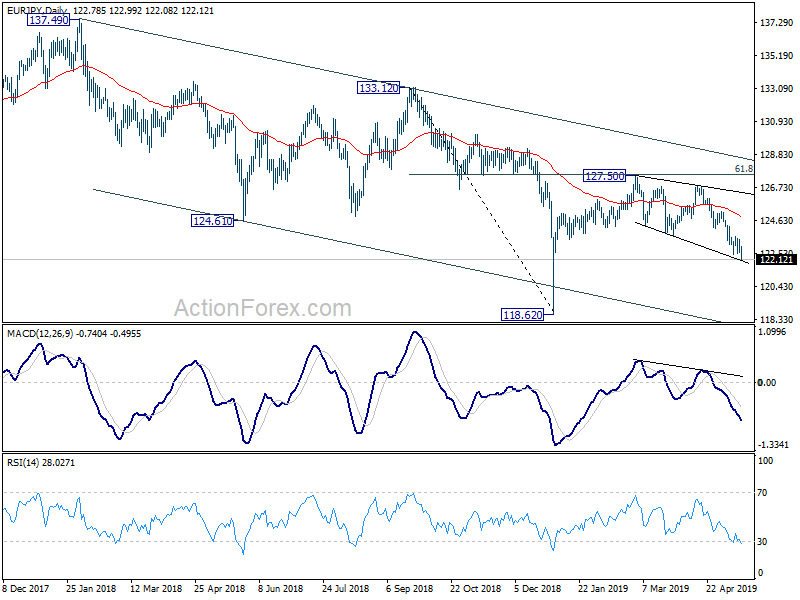
In the bigger picture, current development argues that rebound from 118.62 is merely a correction and has completed at 127.50. EUR/JPY is staying in long term falling channel from 137.49 (2018 high). Decisive break of 118.62 will confirm resumption of this medium term fall and target 109.20 low. For now, this will be the favored case as long as 125.23 resistance holds.
Yen and Franc Surge as German Yield in Free Fall on Italy Budget
Worries over Italy's budget takes center stage today. Italy 10-year yield hit as high as 2.812. On the other hand, German 10-year yield dived to as low as -0.131. US 10-year yield is also dragged down to as low as 2.364 so far. These are clearly signs of risk aversion even though stock market losses are limited for the moment. In the back, poor Chinese data also indicates that slowdown is resuming after a brief seasonal rebound in March. Weaker than expected US retail sales add to the concerns of investors in general.
In the currency markets, Yen and Swiss Franc are back as the strongest ones for today, thanks to falling treasury yields in Germany and US. Dollar is following as third strongly, mainly thanks to weakness elsewhere. Sterling suffers renewed selling in early US session and is now the weakest one. Australian and New Zealand Dollar follow as next weakest.
Technically, EUR/JPY and GBP/JPY resumed recent decline today by taking out 122.48 and 141.20 temporary lows. More decline is expected head. USD/JPY is holding above 109.02 temporary low for now, but could easily be dragged down by other Yen crosses. AUD/USD is extending recent fall with focus on 0.6913 fibonacci projection level. Decisive break there, with downside acceleration, will solidify the case for larger down trend resumption. GBP/USD's break of 1.2865 support should confirm near term reversal for 1.2391 low again. USD/CAD is staying in range as Canadian CPI was largely stable.
In Europe, currently, FTSE is up 0.04%. DAX is down -0.93%. CAC is down -0.66%. German 10-year yield is down -0.051 at -0.0118. Italian 10-year yield is up 0.024 at 2.758. Earlier in Asia, Nikkei rose 0.58%. Hong Kong HSI rose 0.52%. China Shanghai SSE rose 1.91%. Singapore Strait Times dropped -0.15%. Japan 10-year JGB yield rose 0.001 to -0.05.
German-Italian yield spread widens on renewed Italy concerns
German-Italian yield spread widens sharply again today on fear of expansionary budget again in Italy and renewed risk of showdown with EU. The trigger was Italian Deputy Prime Minister Matteo Salvini's pledge yesterday, to be prepared to let budget deficit rise above EU limits if it were to boost employment.
Salvini doubled down today and said that "If there are European rules that are starving a continent, these rules must be changed". On current market reactions to his comments, he said he's "absolutely not worried", because "Italians' right to a job, life and health comes first."
German GDP grew 0.4% in Q1 on domestic resilience, first ray of hope but uncertainty remains
Germany GDP grew 0.4% qoq in Q1, matched market expectation. That was also a significant improve over Q4's 0.0% growth. The quarter-on-quarter comparison (price-, seasonally and calendar-adjusted) shows that positive contributions mainly came from domestic demand.
Fixed capital formation in construction and in machinery and equipment increased considerably. Household final consumption expenditure, too, increased substantially. However, government final consumption expenditure recorded a decline. And there were mixed signals regarding foreign trade; as both exports and imports increased.
Economy Minister Peter Altmaier said the growth figures were a "first ray of hope" following two quarters without expansion. However, he warned that " international trade disputes are still unresolved". He urged , "we must do everything possible to find acceptable solutions that enable free trade".
Eurozone GDP grew 0.4% in Q1, employment grew 0.3%
Eurozone GDP grew 0.4% qoq in Q1, matched expectations. EU 28 GDP grew 0.5% qoq. Over the year, Eurozone GDP rose 1.2% yoy while EU28 GDP grew 1.5% yoy. Employment grew 0.3% qoq in Q1, above expectation of 0.2% qoq. EU 28 employment all grew 0.3% qoq.
US retail sales dropped -0.2%, ex-auto sales rose 0.1%, both missed expectations
In April, US headline retail sales dropped -0.2%, missed expectation of 0.2% mom rise. Ex-auto sales rose merely 0.1% mom, much lower than expectation of 0.7% mom. Industrial production dropped -0.4% versus expectation of 0.0%. Empires State manufacturing index rose to 17.8 in May, up from 10.1 and beat expectation 8.0.
Canada CPI climbed to 2.0%, matched market expectations
In April, Canada CPI accelerated to 2.0% yoy, up from 1.9%, matched expectations. CPI core commons was unchanged at 1.8%, matched expectations. CPI core median slowed to 1.9% yoy, missed expectation of 2.0% yoy. CPI core trim slowed to 2.0% yoy, missed expectation of 2.1% yoy.
China retail sales growth slowed to lowest since 2003, industrial production and fixed asset investment missed too
China industrial production growth slowed to 5.4% yoy in April, missed expectation of 6.5% yoy. That's also sharp deterioration from 4-year high of 8.5% yoy in March. Fixed-asset investment growth slowed to 6.1% ytd yoy, down from 6.3% and missed expectation of 6.4%.
More seriously, retail sales growth slowed to 7.2% yoy, down from 8.7% yoy and missed expectation of 7.2% yoy. That's also the lowest growth since May 2003. That dents hope of shifting the burden of the economy from exports to domestic demand growth. Unemployment rate, though, dropped to 5.2%.
More on China: China's Slowdown Resumes as Seasonal Effects Faded
Aussie drops after wage price miss, consumer sentiment barely rose
Australia, Wage Price Index rose only 0.5% qoq in Q1, below expectation of 0.6% qoq. Westpac Consumer Sentiment rose 0.3% to 101.3 in May, up from 100.7.
Westpac also noted that easing bias was delivered by RBA at last week's meeting, with growth and inflation forecasts lowered to "barely acceptable" levels. More importantly, such forecasts are based on market pricing for a full rate cut for. Westpac maintained that the tensions between strong labor market and weak GDP will be resolved over the next few months. And the case of August RBA cut would become clear.
EUR/JPY Mid-Day Outlook
Daily Pivots: (S1) 122.48; (P) 122.95; (R1) 123.32; More....
EUR/JPY's decline resumed after brief consolidation and reaches as low as 122.08 so far. Intraday bias is back on the downside. Current fall from 127.50 should extend to retest 118.62 low. On the upside, break of 123.61 resistance is needed to indicate short term bottoming. Otherwise, outlook will remain bearish in case of recovery.
In the bigger picture, current development argues that rebound from 118.62 is merely a correction and has completed at 127.50. EUR/JPY is staying in long term falling channel from 137.49 (2018 high). Decisive break of 118.62 will confirm resumption of this medium term fall and target 109.20 low. For now, this will be the favored case as long as 125.23 resistance holds.
Economic Indicators Update
| GMT | Ccy | Events | Actual | Forecast | Previous | Revised |
|---|---|---|---|---|---|---|
| 23:50 | JPY | Japan Money Stock M2+CD Y/Y Apr | 2.60% | 2.30% | 2.40% | |
| 00:30 | AUD | Westpac Consumer Confidence May | 0.60% | 1.90% | ||
| 01:30 | AUD | Wage Price Index Q/Q Q1 | 0.50% | 0.60% | 0.50% | |
| 02:00 | CNY | Fixed Assets Ex Rural YTD Y/Y Apr | 6.10% | 6.40% | 6.30% | |
| 02:00 | CNY | Industrial Production Y/Y Apr | 5.40% | 6.50% | 8.50% | |
| 02:00 | CNY | Retail Sales Y/Y Apr | 7.20% | 8.60% | 8.70% | |
| 02:00 | CNY | Surveyed Jobless Rate Apr | 5.00% | 5.20% | ||
| 06:00 | JPY | Machine Tool Orders Y/Y Q1 Apr P | -33.40% | -28.50% | ||
| 06:00 | EUR | German GDP Q/Q Q1 P | 0.40% | 0.40% | 0.00% | |
| 09:00 | EUR | Eurozone Employment Q/Q Q1 P | 0.30% | 0.20% | 0.30% | |
| 09:00 | EUR | Eurozone GDP Q/Q Q1 P | 0.40% | 0.40% | 0.40% | |
| 12:30 | CAD | CPI M/M Apr | 0.40% | 0.40% | 0.70% | |
| 12:30 | CAD | CPI Y/Y Apr | 2.00% | 2.00% | 1.90% | |
| 12:30 | CAD | CPI Core - Common Y/Y Apr | 1.80% | 1.80% | 1.80% | |
| 12:30 | CAD | CPI Core - Median Y/Y Apr | 1.90% | 2.00% | 2.00% | |
| 12:30 | CAD | CPI Core - Trim Y/Y Apr | 2.00% | 2.10% | 2.10% | |
| 12:30 | USD | Empire State Manufacturing May | 17.8 | 8 | 10.1 | |
| 12:30 | USD | Retail Sales Advance M/M Apr | -0.20% | 0.20% | 1.60% | 1.70% |
| 12:30 | USD | Retail Sales Ex Auto M/M Apr | 0.10% | 0.70% | 1.20% | 1.30% |
| 13:15 | USD | Industrial Production M/M Apr | -0.50% | 0.00% | -0.10% | 0.20% |
| 13:15 | USD | Capacity Utilization Apr | 77.90% | 78.70% | 78.80% | 78.50% |
| 14:00 | USD | NAHB Housing Market Index May | 64 | 63 | ||
| 14:00 | USD | Business Inventories Mar | 0.00% | 0.30% | ||
| 14:30 | USD | Crude Oil Inventories | 0.0M | -4.0M |
Stable Inflation is Good News for Canadian Consumers
- As expected, headline inflation ticked up to 2.0% year-over-year in April from 1.9% in March
- The modest increase was due to rising energy prices, which are back into positive territory (year-over-year) for the first time since last October
- Implementation of the federal carbon pricing backstop added to the rise in energy prices—separate data shows average gasoline prices rose 11.7 cents per litre in April, with 3.6 cents of that coming from higher taxes
- The Bank of Canada’s core measures averaged 1.9% in April—they’ve been remarkably steady at 1.9-2.0% for the last 15 months
While low pump prices around the turn of the year are now a distant memory, there was some good news for consumers in today’s CPI report. Core inflation remained steady at 2%, giving the Bank of Canada plenty of leeway to hold interest rates steady (and watch other developments, like rising global trade tensions). For households, that means less of an increase in debt service costs than was seen last year. And while wage growth has been disappointingly slow, hourly pay is still outpacing overall inflation, giving consumers at least some increase in purchasing power. Finally, while imposition of the federal carbon pricing backstop in some provinces added to rising energy costs in April, the average household gets that money back when they file their taxes.
CAD Trades Weaker on BoC Preferred Inflation Measure Miss
The annual inflation rate in Canada accelerated slightly in April on broad-based price increases for items such as mortgage payments, vehicles and fresh vegetables.
According to Stats Canada, Canada’s CPI rose +2.0% y/y, after a +1.9% advance in March.
On a month-over-month basis, inflation climbed +0.4%, led by higher prices for gasoline and women’s clothing.
However, the Bank of Canada (BoC) preferred measures for underlying inflation moved down. The average annual gain for the three core-inflation measures came in at +1.9% m/m vs. March’s +2%.
CAD is trading at the low of the day so far, the USD is up +0.2% at C$1.3490.
U.S retail sales miss
South of the Canadian border, an important measure of consumer spending fell in April, signalling spending was sluggish stateside as Q2 begins.
Retail sales declined a seasonally adjusted -0.2% in April m/m according to the Commerce Department.
The drop fell short of the +0.2% increase the market was expecting. The disappointing print has dealers increasing the odds for a Fed rate cut sooner than later.