

Sample Category Title
Three important risks to know about crude oil
The last quarter of 2018 was a tough one for oil producers as fears over a global growth slowdown and concerns on plentiful production sent prices to 1 ½-year lows. To reverse the slump, OPEC and non-OPEC members clinched a deal to cut output as of January 1 despite previously increasing levels, with the market responding immediately, sending prices higher by 18% since the start of the new year. But moving ahead, the outlook remains fragile as some issues still need to be sorted out.
Supply troubles
Last Tuesday, Saudi Arabia, the world’s top oil exporter, said that it would voluntarily cut March production to around 9.8 million bpd, 500,00 bpd more than it had initially pledged under the latest 1.2mln bpd output cut deal signed with its OPEC plus counterparts in December. On the same day, the IEA’s monthly report revealed that compliance among OPEC members was estimated around 86% with Kuwait and UAE reducing production more than promised as well. On the negative side the non-OPEC group scored on average at a minimal 25%, with Russia, the second biggest oil producer after the US, making only 18% of its pledged output cut.
While the low compliance rates by non-OPEC members is not a new tendency, the miss in targets could lead to a dull and unsatisfactory rally in oil prices, potentially putting the Saudi Arabian government at risk of falling short of its 2019 budget targets if prices fail to rise towards its $80-$85 breakeven point according to the IMF estimates – especially when a more evidently slowing global economy threatens demand growth and steeper output cuts could be less desirable at a time when political tensions in other key oil areas are already restricting deliveries.
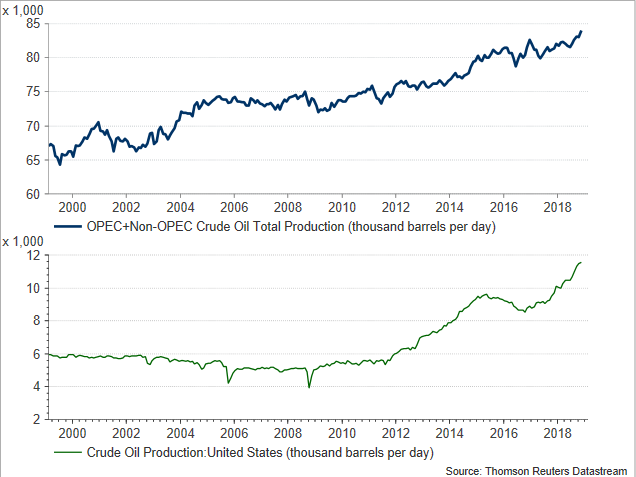
Oversupply in the US has been long disturbing OPEC’s plans for higher prices and it will probably continue doing so in the next two years as domestic production is expected to hit new highs in 2019 and 2020. It is also worth noting that new pipelines at the vital Permian Basin in Western Texas are anticipated to start operating in the second half of 2019, adding more bearish supply pressure to oil markets.
OPEC and its allies will gather next in Vienna on April 17-18 to review the pact. Taking the above into account and aiming to keep supply and demand in balance, the group could renew the output cut agreement if prices are not on desired levels by that day.
Meanwhile, the Paris-based IEA raised its supply growth forecasts for 2019 to 1.8 mln bpd from 1.5 mln bpd previously, while keeping demand growth predictions steady at 1.4 mln bpd.
Sanctions waivers expire
In geopolitics, Iran is keeping a hard line on its nuclear program despite US sanctions hurting the economy badly. Crude oil exports in January dropped to the lowest since 2014 and analysts predict real GDP to decline by 3.6% in 2019 after contracting by 1.4% in 2018. Yet conditions could have been worse in the absence of US waivers to eight importers of Iranian oil such as China, Japan and India. But at the beginning of May, the six-month exemption expires, and the Trump administration will likely take a glance at oil prices before making any decision. Since the US favours lower prices, only a significant drop from current levels (below $50/barrel) could see the US reducing the number of waivers. Alternatively, a spike above $80 could allow for more Iranian oil in the markets, with the US extending the waivers.
Oil-rich Venezuela has been also sanctioned by the US last month as the administration tries to limit financial support for the president Nicolas Maduro. However, diminished supply from the country, which has been weighing well before the recent political turmoil began, seems to have caused little reaction to the oil market so far. Nevertheless, developments in the area will continue to attract interest.
US-China trade war to weigh on demand
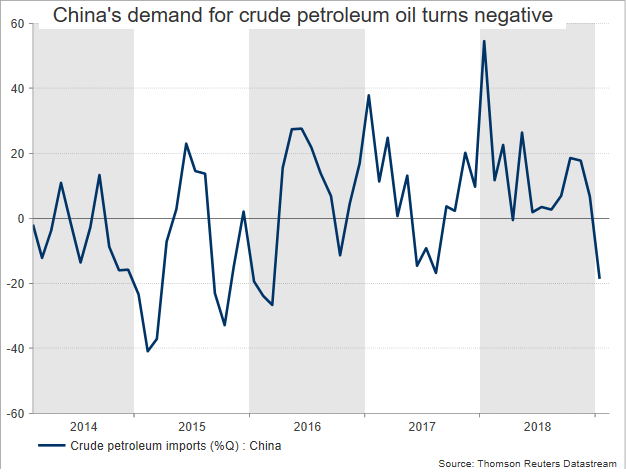
The months-long US-Sino trade war is the hottest topic in oil markets. China has already started to feel the pinch from US tariffs and undoubtedly further escalation in tensions would only bring more harm to the world’s second largest oil consumer and therefore to oil demand.
Although headlines early on Friday created impression that last week’s trade negotiations in Beijing made a hole in the water, both sides appeared satisfied during the weekend, with the US President twitting that big progress has been made “on many fronts”. China reported improvement as well, saying that a consensus in principle on some key areas has been reached. Still, with neither side giving specific details on what has been agreed, some caution remains on storage as discussions move to Washington. The US administration is expected to keep pressure on China until it forces Beijing to reform its regulatory practises – especially those that force technology transfers to China. Should talks complicate before the March 1 deadline, blocking the path for a constructive summit between Trump and Xi Jinping as soon as next month, US import tariffs on $200 billion Chinese products are set to rise from 10% to 25% unless President Trump decides to move the deadline forward, which is not unlikely given the recent headlines over a 60-day extension and the data volatility in the US and elsewhere. But even if Washington shows sympathy, allowing more time for negotiations to progress, the business sentiment is not expected to get any better as companies will wisely avoid moving on with their investment plans until the dark clouds clear.
Meanwhile in the markets
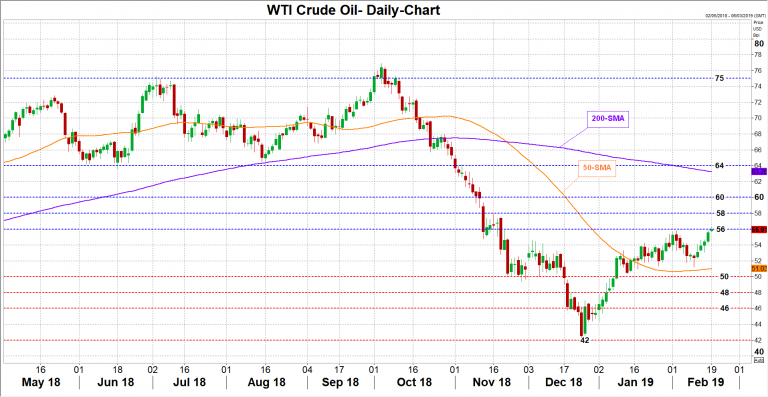
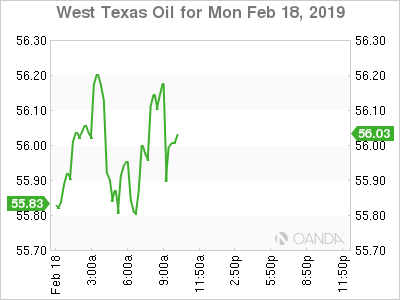
WTI crude oil has turned higher after hitting a 1 ½ -year low of 42.36, with the price currently pushing hard to overcome resistance at 56 that could allow for more buyers to enter the market. Should tensions in the Middle East intensify restricting the flow of deliveries, WTI crude could see resistance coming at 58 and then at 60. Crawling higher, significant interest is expected to gather around the previous 64 support level, though only a close above 75 would shift the outlook to a bullish one.
In the negative scenario, extensive pumping in the US and a steeper global economic slowdown triggered by an even more aggressive trade war could send the price down to the 50 support mark. Piercing that floor, bearish action could pause within the 48-46 area, while steeper declines could also challenge the 42 bottom.
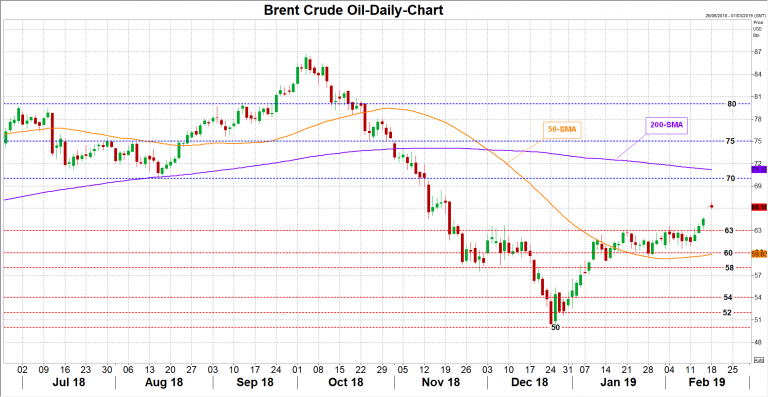
The London-based Brent is printing three-month highs above the 66 level but investors are waiting to confirm the rally’s sustainability above the 70 mark where the price rebounded in late-August. Should the price shoot even higher surpassing the 200-day moving average currently at 71 and the 75 barrier, resistance could run up to 80.
On the downside, the market could face a wall in the 60-63 congested area before testing support near 58. An extension lower would likely see negative momentum slowing somewhere between 54-52, while beneath that, the bears would need to break the bottom at 50 to keep the market under their control.
With Brexit in Limbo, Pound Looks to UK Jobs Data
The latest British employment data are due for release on Tuesday, at 09:30 GMT. Forecasts point to some further acceleration in wage growth during December, which is encouraging and could support the pound on the news. That said, with less than six weeks left until the UK exits the EU, and still no agreement in place, any data-induced rallies in sterling may remain limited until the political fog clears a little.
The UK labor market remains the economy’s bright spot, with the unemployment rate hovering near decade-lows and wage growth having picked up steam in recent months. The latter is particularly encouraging, as combined with slowing inflation, it pushes workers’ real incomes higher, theoretically boosting future consumption.
In December, the unemployment rate is forecast to have held steady at 4.0%, while average weekly earnings excluding bonuses are expected to have accelerated to 3.4% on a yearly basis, from 3.3% previously. Indeed, the wages forecast is supported by surveys like the Markit/REC Report on Jobs, which noted that starting salaries rose at one of the fastest rates in over three years during the month. An overall strong set of prints could support the pound a little on the news.
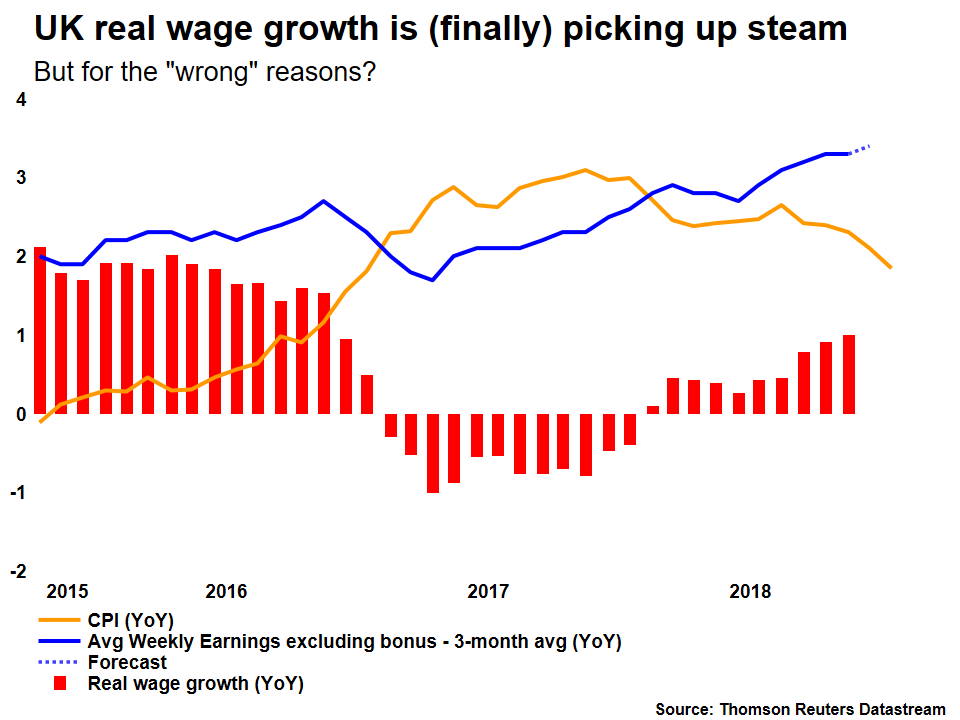
However, it’s not all good news, as the same survey found that most of the pay gains are a result of Brexit uncertainties, with UK citizens being unwilling to move jobs due to uncertainty, and fewer EU citizens are entering the UK for work. In other words, wages aren’t necessarily accelerating because the labor market is exceptionally tight, but rather because British workers are afraid to change jobs and EU workers are avoiding the island altogether.
Economics aside, what matters most for the pound right now are politics. On that front, PM May is trying to squeeze out some last-minute concessions from the EU, to push her deal through Parliament. For that to happen, lawmakers want legally-binding assurances that the Irish backstop will either be time limited, or the UK will have a mechanism to exit from it unilaterally, without consent from Brussels. The concern is that the UK may be trapped in a customs arrangement with the EU, that prevents it from striking trade deals with foreign nations, indefinitely.
Yet, the EU is extremely unlikely to grant legally binding changes. Reports suggest Brussels could meet half way, for instance including a clause that the “need” for the backstop will be “reexamined” every six months, but again, such changes probably won’t be enough to appease Parliament. Therefore, uncertainty is set to remain elevated at least until February 27, when lawmakers will vote on some amendments that could force the government to take certain actions, like extending Article 50. This implies that any rallies in sterling may remain relatively limited until that date.
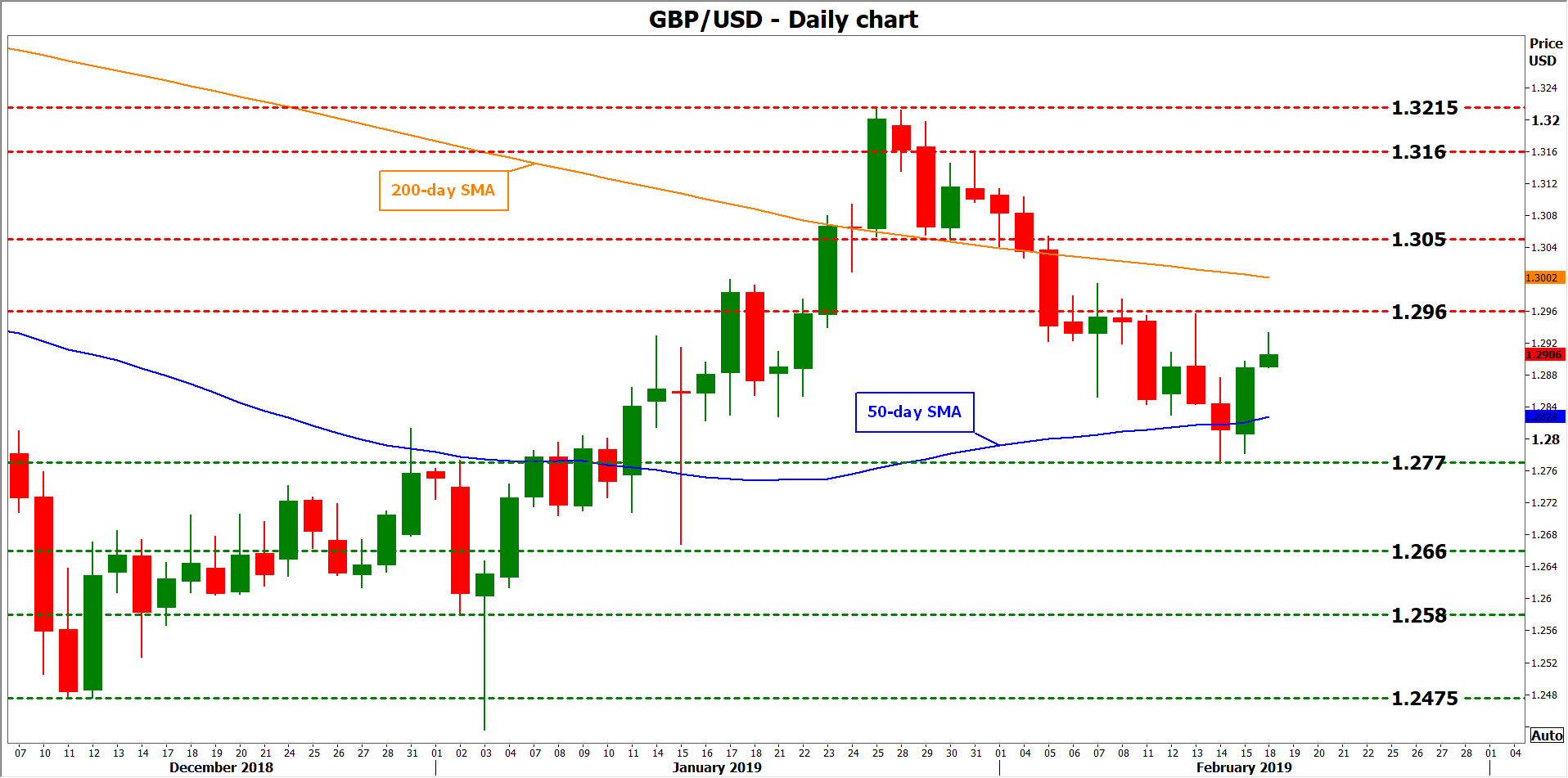
Looking at sterling/dollar technically, initial resistance to advances may be found near 1.2960, the February 13 high. An upside break could open the way for the 200-day simple moving average (SMA), which currently lies near the psychological 1.3000 handle.
On the other hand, another wave of declines may meet support near the 50-day SMA at 1.2828, with a downside violation aiming for the February 14 lows at 1.2770. Even lower, the bears may stall around 1.2660, which was a previous low back in August and roughly coincides with the January 15 trough.
Slow Start to Trading Week
A slow start to the trading week saw the European bourses trade mixed as the rally sparked by optimism on the trade front starts to run out of steam and as US equities and bond markets are closed today. Over the weekend, President Trump received the Commerce Department’s 9-month probe on whether imported vehicles pose a national security threat. President Trump now has 90 days to decide if he wants to go after European automakers with tariffs. The next trade war is just around the corner and the general consensus is that Trump will wait until he is further along with the China trade war before ramping things up against Europe.
- USD- Quiet amid President’s Day
- Walmart – Strong earnings could ease concerns of that terrible December retails sales number
- GOLD – Weaker dollar the key for the next move higher
- OIL – Supply disruptions and soft dollar keep rally going
USD
The dollar was mixed against its major trading partners as US equities and bond markets were closed in observance of President’s Day. The bar has been set pretty high for China and the US to reach a framework agreement before the March 1st deadline. This week talks come back to DC and need to deliver further progress on intellectual property rights, forced technology transfer, Made in China 2025 plan, and how they will verify and enforce any agreement. The potential letdown on lack of detail could slow down the global equity and rally and stall the recent fall in the dollar.
Walmart
The retail giant’s earnings results will be closely watched to tomorrow. Walmart could show that the retail market was not as terrible as last week’s retail sales number suggested. Walmart shares have been fairly bid and is nearing the formation of an inverted head and shoulders pattern. Gross margins are expected to be pressured as increasing costs, and labor cost are to grow as they continue to fight attracting customers with Amazon.
Gold
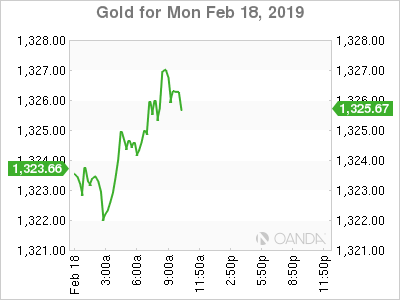
The precious yellow metal’s gains are mainly from weaker dollar movement, which has stemmed from both the Fed’s pivot to keep rates on hold for the formidable future and global growth slowdown concerns. Optimism on the trade front may continue to help risk appetite across the board and could help bring the dollar down.
Oil
Crude prices opened higher to start of trading week as a supply disruption from Saudi Arabia’s biggest offshore oilfield is tightening supplies for heavy crude. Oil’s recent rally has been driven by the weaker dollar and the significant optimism the trade war may be ending soon. While a trade deal is expected, oil’s gains may be capped as growing production from the US will keep the supply side argument in place.
Sunset Market Commentary
Markets
Global core bonds lost ground today as risk sentiment remains slightly upbeat in a low-volume trading session. Asian equities rallied this morning to their highest level since October on positive signals from the US-Sino trade talks and optimism on China’s economy. With a completely empty economic calendar in the EMU and US markets closed (Presidents Day), market action was set to remain limited. ECB governor Villeroy hinted that the ECB could change its interest-rates guidance if it becomes clear that the economic slowdown isn’t temporary. He thereby confirms the ECB’s dovish comments of late after ECB’s Coeuré hinted on Friday on a new round of TLTRO’s. European equities drifted sideways, while core bonds opened with a downward tendency. Investors remain cautious too on US President Trump receiving the results of the Dept. of Commerce’s investigation as to whether automobile imports represent a security risk to the US. This could lead to the US imposing tariffs. Meanwhile, France announced a new 30-year bond syndication, causing a downtick in the Bund. The German yield curve steepened with changes in the range of -0.8 bps (2-yr) to +2.1 bps (30-yr). Peripheral spreads are tightening with Greece (-6 bps), Portugal (-6 bps) and Italy (-3 bps) outperforming.
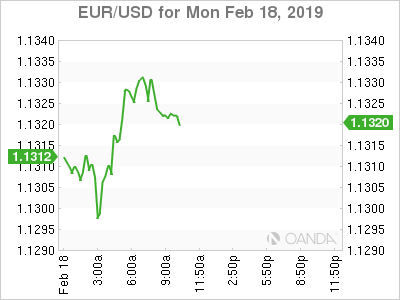
EUR/USD rebounded on Friday off a short-term correction low in the 1.1235 area as US production data created doubts on the resilience of the US economy. The ECB signaling a potential prolongation of TLTRO’s supported buying of EMU assets and was a short-term euro positive. Today, EUR/USD extended Friday’s rebound. There were no EMU eco data and US markets were closed in observance of Presidents Day. In technical trading, EUR/USD settled in the low 1.13 area (currently around 1.1325). Last week’s mixed/soft US eco data are currently still preventing USD/JPY to profit from a constructive risk sentiment. The pair trades in the mid 110 area.
EUR/GBP trading was confined to a tight range in the mid 0.87 area. There was a lot of debate n the UK political scene as seven labour MP’s leaving the labour party to form an independent group, challenging Labour leader Jeremy Corbyn’s strategy on Brexit and on other issues. The reaction of sterling was close to non-existent as the move is not seen as potentially leading to an alternative Brexit scenario. EUR/GBP is trading in the 0.87658 area . Cable is changing hands north of the 1.29 handle, mirroring modest USD softness.
News Headlines
Seven UK politicians left the Labour opposition party to form their own “Independent Group” party. The split has long been rumored and is said by some of its members to be the result of Labour leader Corbyn’s failure to make a fist against May’s brexit policy. Others have left, accusing the party of anti-Semitism. Britain’s new movement calls on politicians across party borders to join their ranks, with some Conservatives rumoured to do so.
Bulgaria’s ruling party GERB has dropped plans to alter the election code on Monday after the main opposition (Socialist Party, BSP) left Parliament. BSP, which hold about 33% of the Parliamentary seats, said fair elections could not be guaranteed if the revisions were passed. Bulgaria is holding local elections in October 2019.
Ukraine’s foreign minister Klimkin asked the EU for more funds to finance infrastructure and local businesses in the east and south of the country. The regions need a reshuffle of the economic model, Klimkin says, adding Russian attempts to destabilize the area would be “very detrimental for European security”.
USD/JPY Mid-Day Outlook
Daily Pivots: (S1) 110.26; (P) 110.46; (R1) 110.66; More...
USD/JPY is staying in range of 110.00/111.13 and intraday bias remains neutral. On the downside, break of 110.00 resistance turned support will suggest rejection by 110.77 and the rebound from 104.69 has likely completed. Intraday bias will be turned back to the downside for 108.49 support for confirmation. Nevertheless, break of 111.13 should confirm resumption of rise from 104.69 for 114.54 resistance.
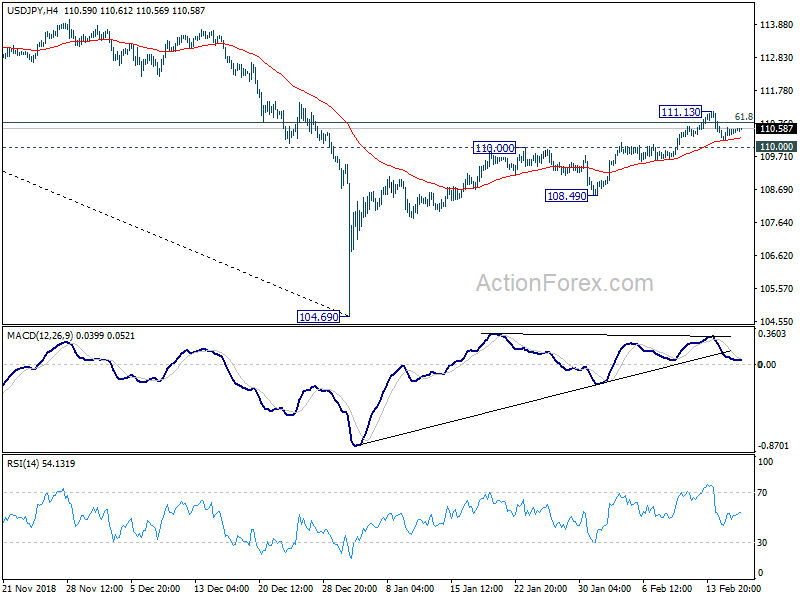
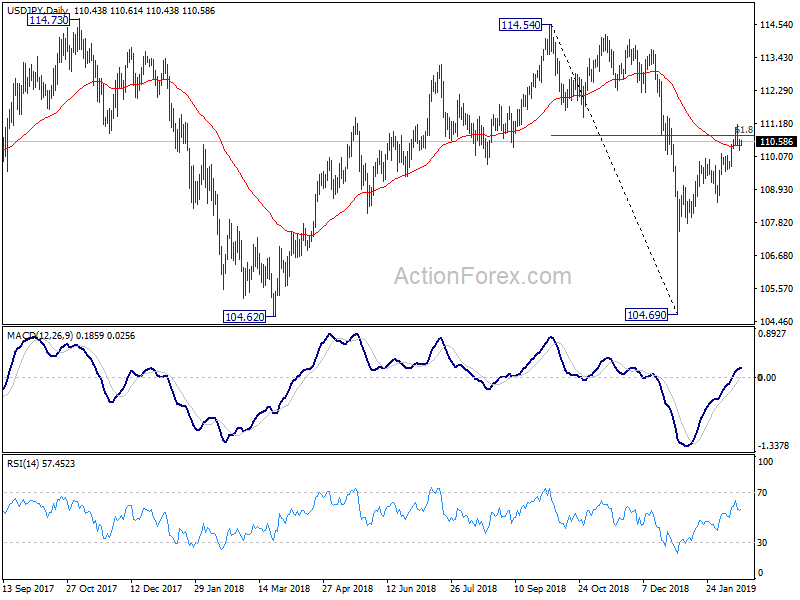
In the bigger picture, while the rebound from 104.69 was stronger than expected, it couldn't sustain above 55 day EMA yet. Outlook is turned mixed first. On the downside, break of 108.49 support will revive that case that such rebound was a correction. And, larger down trend is still in progress for another low below 104.62. But sustained trading above 55 day EMA will turn focus to 114.54. Decisive break there will confirmation completion of the decline from 118.65 (2016 high).
USD/CHF Mid-Day Outlook
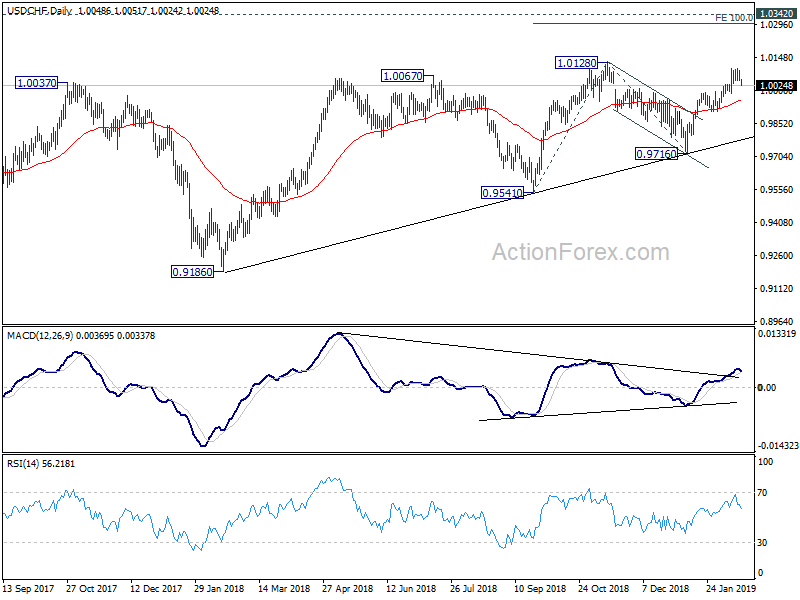
Daily Pivots: (S1) 1.0033; (P) 1.0061; (R1) 1.0079; More....
USD/CHF's pull back from 1.0098 extends lower today but stays above 0.9988 support. Intraday bias remains neutral and another rise is still in favor. On the upside, above 1.0098 will target 1.0128 first. Break will confirm resumption of up trend from 0.9186. Next target will be 100% projection of 0.9541 to 1.0128 from 0.9716 at 1.0303. However, break of 0.9988 will indicate rejection by 1.0128 and turn intraday bias to the downside for 0.9716 support again.
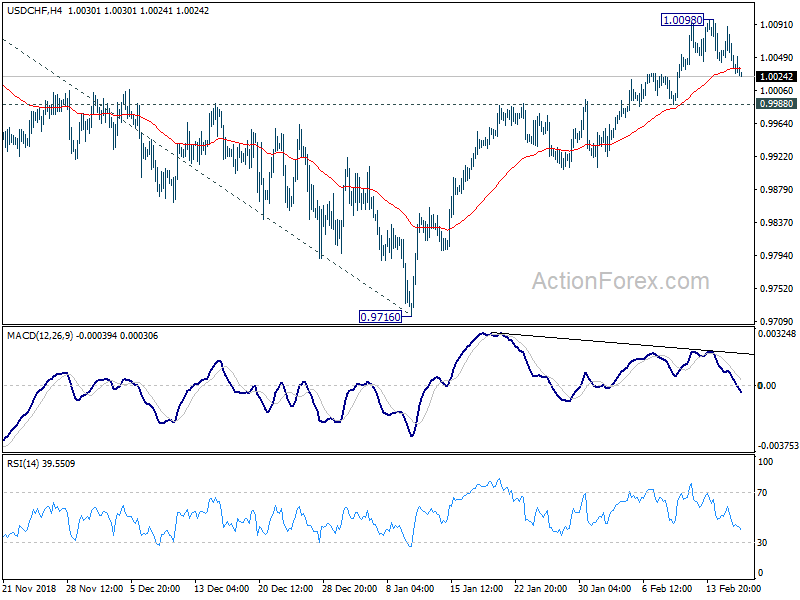
In the bigger picture, USD/CHF drew strong support from medium term trend line and rebounded. That suggests rise from 0.9186 is still in progress. Further break of 1.0128 will confirm up trend resumption and target 1.0342 key resistance. Nevertheless, break of 0.9716 will dampen this bullish view and at least bring deeper fall to 0.9541 key support.
EUR/USD Mid-Day Outlook
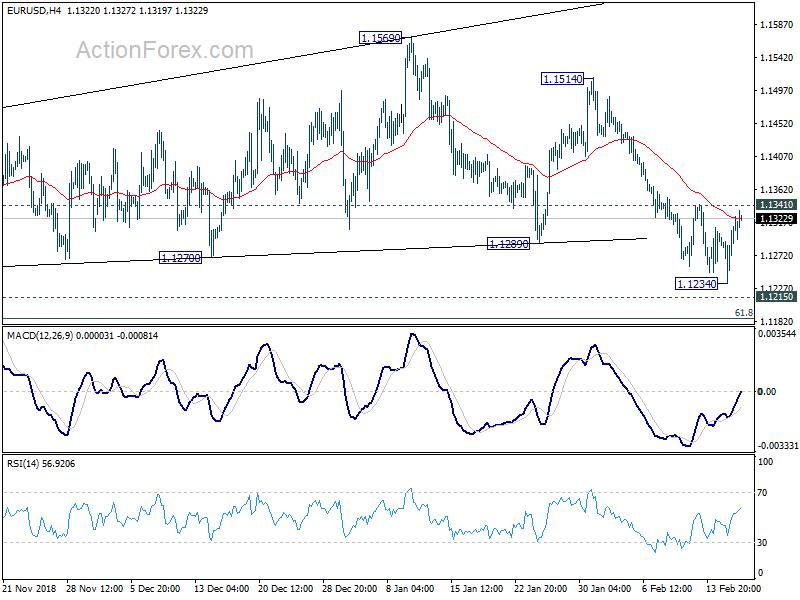
Daily Pivots: (S1) 1.1248; (P) 1.1277; (R1) 1.1321; More.....
EUR/USD's recovery from 1.1234 extends today but upside is held below 1.1341 minor resistance. Intraday bias remains neutral and further decline is still in favor. On the downside, decisive break of 1.1215 low will resume the larger down trend from 1.2555 to 1.1186 fibonacci level next. Nevertheless, break of 1.1341 will suggests that consolidation from 1.1215 is extending with another rising leg back towards 1.1514 resistance.
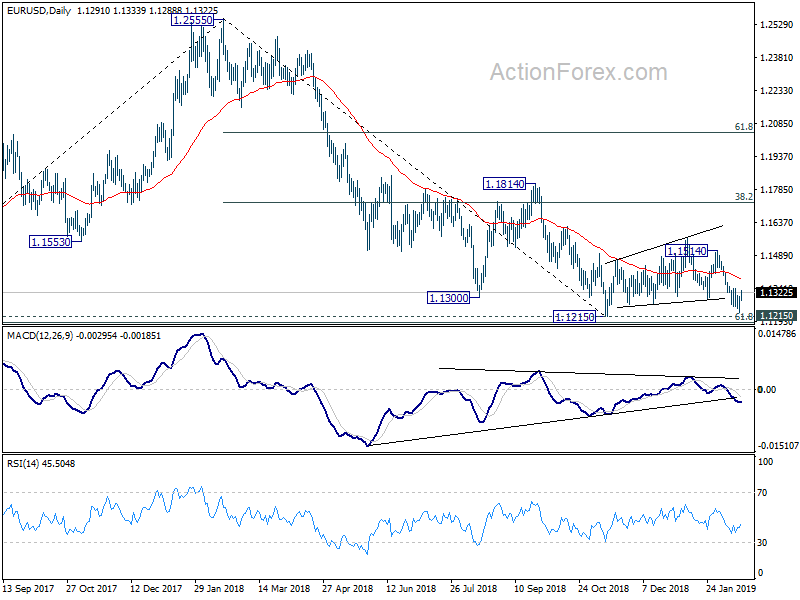
In the bigger picture, as long as 1.1814 resistance holds, down trend down trend from 1.2555 medium term top is still in progress and should target 61.8% retracement of 1.0339 (2017 low) to 1.2555 at 1.1186 next. Sustained break there will pave the way to retest 1.0339. However, break of 1.1814 will confirm completion of such down trend and turn medium term outlook bullish.
EUR/USD Outlook: Recovery Extends Near Pivotal Fibo Barrier But Risk of Stall Exists
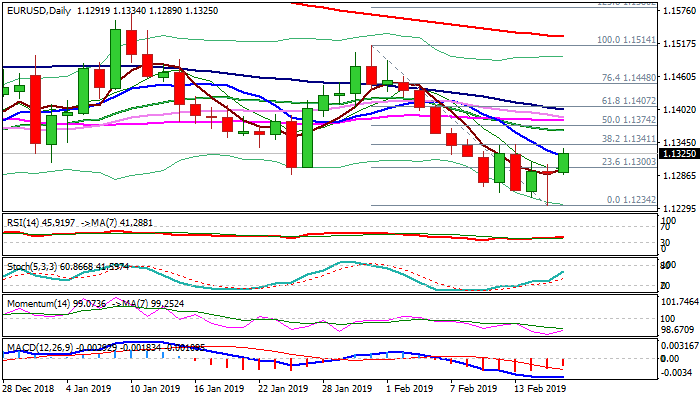
The Euro enters the US session at the front foot as recovery extended in European session and reached high just ticks ahead of key barrier at 1.1341 (Fibo 38.2% of 1.1514/1.1234/last week's highs.
Fresh risk appetite on trade optimism keeps the Euro supported, along with reversed momentum and north-heading stochastic.
However, bulls need to register close above 1.1341 pivot, to generate reversal signal and open way for further retracement of 1.1514/1.1234 bear-leg.
Caution on negative signals from the EU, which could have negative impact on recovery attempts. Return below 1.13 zone (Fibo 23.6%/rising 5SMA/4-hr cloud base) would neutralize bulls.
Res: 1.1334; 1.1341; 1.1365; 1.1382
Sup: 1.1311; 1.1299; 1.1260; 1.1234
GBP/USD Mid-Day Outlook
Daily Pivots: (S1) 1.2817; (P) 1.2857; (R1) 1.2930; More....
GBP/USD's recovery from 1.2773 extends today but upside is kept below 1.2958 resistance so far. Intraday bias remains neutral and more consolidation might be seen. Further decline is in favor with 1.2958 intact. On the downside, break of 1.2773 will resume the fall from 1.3217 to retest 1.2391 low. On the upside, however, break of 1.2958 resistance will turn bias to the upside for retesting 1.3217 instead.
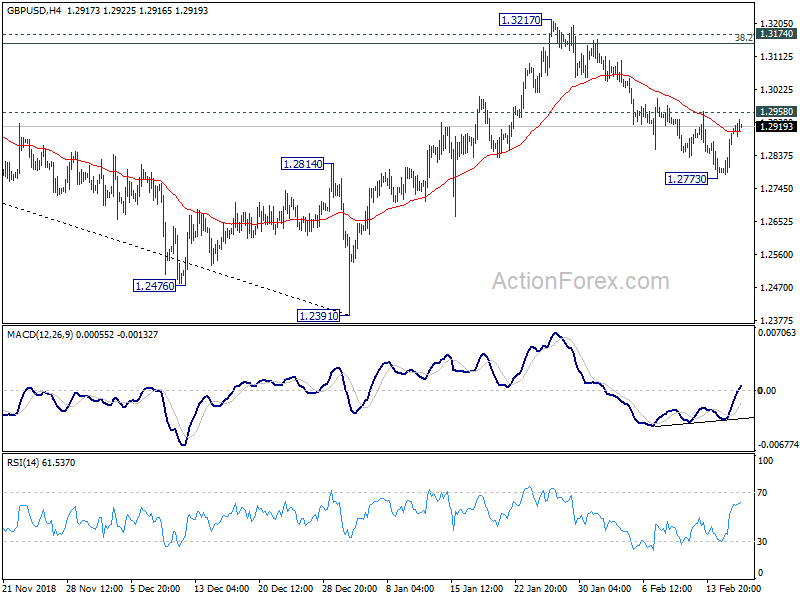
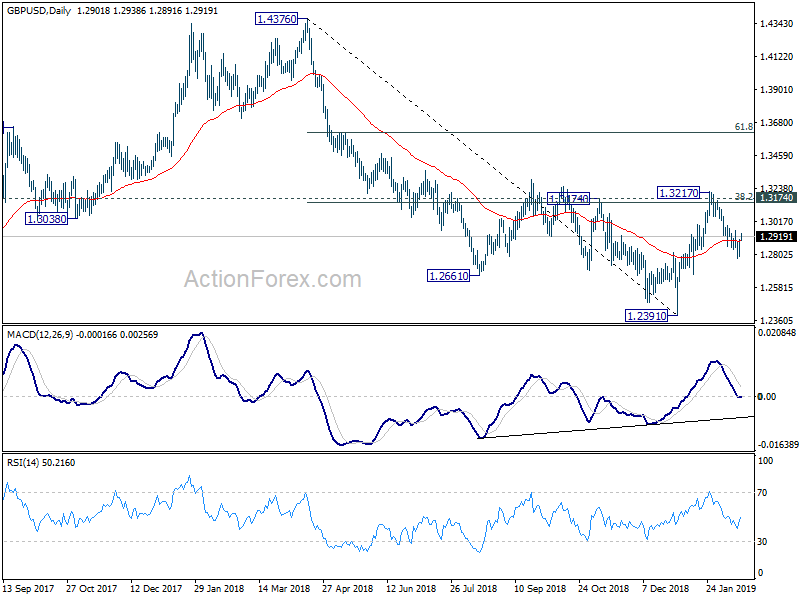
In the bigger picture, the rejection by 1.3174 key resistance revived the original view on GBP/USD. That is, decline from 1.4376 is possibly resuming long term down trend from 2.1161 (2007 high). Firm break of 1.2391 will solidify this bearish case and target 1.1946 (2016 low). However, decisive break of 1.3174 will invalidate this bearish case again and turn outlook bullish.
Euro and Sterling Strong for Today, But No Key Resistance Broken
Yen and Dollar are pressured for the whole day, and remain so in early US session. Risk appetite in Asian markets was boosted by optimism over US-China trade talks. There is hope that the meetings in Washington this week will eventually yield a memorandum of understanding of some sort, as the foundation to the trade agreement. Nevertheless, we point out that such optimism is not shared among European investors, as major European indices are just mixed.
Staying in the currency markets, Euro and Sterling are the strongest ones for no apparent reason. Both will face some tests later this week, including UK job data, German ZEW and Ifo, ECB accounts and Eurozone PMIs. Outlook for German economy is not too upbeat and Bundesbank expect subdued growth at least in first half. The risks of US auto tariffs remain. Meanwhile, there is no way out for Brexit impasse yet.
Technically, both gold resumed recent rally by taking out 1326.25 resistance. WTI crude oil also rises further to as high as 56.68 so far. China Shanghai SSE completed a double bottom reversal pattern. In the currency markets, EUR/USD and GBP/USD are still limited below 1.1341 and 1.2958 resistance levels. USD/CHF is held well above 0.9988 support. USD/JPY is kept well above 110.00 support. USD/CAD is holding above 1.3196 support. There is no clear bearishness in Dollar. EUR/JPY and GBP/JPY are held in rage below 125.95 and 144.84 respectively, as consolidation extends. EUR/GBP is also kept above 0.8728 minor support. Overall markets are rather consolidative.
In other markets, FTSE is currently up 0.05%, DAX is down -0.06%, CAC Is up 0.32%. German 10-year yield is up 0.0083 at 0.114. Earlier in Asia, Nikkei rose 1.82%. Hong Kong HSI rose 1.60%.China Shanghai SSE rose 2.68%. Singapore Strait Times rose 0.81%. Japan 10-year JGB yield rose 0.002 to -0.019. US market is on President's day holiday today.
UK Lidington: Useful discussions with Brussels, but very difficult to reopen negotiations
UK Minister for the Cabinet Office David Lidington said today that the government is having useful discussion with Brussels. However, it's still very difficult to reopen withdrawal agreement negotiation.
He told BBC radio that "My experience last week… was that they were a lot more than courtesy calls. It was a very useful discussion about the politics, both within the United Kingdom and within the EU27, and a scoping out of what was possible." However, Lidington also noted that "Reopening the withdrawal agreement… will be very difficult."
Brexit Minister Steve Barclay will meet EU's chief Brexit negotiator today. Prime Minister Theresa May's spokesman said "the PM has been seeking to reopen the withdrawal agreement and that remains our position". On the other hand, EU reiterated that they won't reopen negotiation.
EU launched outreach campaign on no-deal Brexit customs preparedness
European Commission launched an outreach campaign today on "no-deal" Brexit customs preparedness. The campaign aims to " raise awareness amongst the EU's business community, especially SME" to prepare for a "no-deal" scenario while continuing to trade with the UK after March 30. EU urged that businesses should "assess whether they have the necessary technical and human capacity to deal with customs procedures and rules", "consider obtaining various customs authorisations and registrations in order to facilitate their trading activity" and, "Get in touch with their national customs authority to see what other steps can be taken to prepare."
Pierre Moscovici, Commissioner for Economic and Financial Affairs, Taxation and Customs, said: "With the risk of a no-deal Brexit increasing as we get closer to March 29, the European Commission and national customs authorities are working hard to be ready to introduce checks and controls on goods flowing between the EU and the UK. This is key to protecting our consumers and our internal market. A lot depends on the ability of businesses trading with the UK to get up to speed with the customs rules that will apply on day one in case of no deal. There is no time to lose and we are here to help with the information campaign."
Bundesbank: German economy to remain subdued at least in H1
In its monthly report, Bundesbank warned that German economy will continue to struggle in the first half of 2019. The economy is unlikely to regain momentum with Weak orders in manufacturing, gloomy sentiment indicators and sluggish investments. It said that "all these suggest that the underlying pace of the economy should remain subdued at least in the first half of the year."
Though, it also noted that "there are no signs that the slowdown is becoming an outright downturn." In particular, the drag from auto exports is starting to normalize. Meanwhile, labor market remains healthy with private consumption picking up.
Auto tariff report submitted, 90 days for Trump to act
The US Commerce Department met the Sunday deadline and submitted its investigation report on imported cars and auto parts to the White House. The Section 232 is about national security threats from those auto imports. A Commerce Department spokesperson said it would not disclose any details of the report. Trump has 90 days to make a decision on whether to act up the recommendations, which could include some tariffs on fully assembled vehicles or on technologies and components related to electric, automated, connected and shared vehicles.
German Chancellor Angela Merkel said in the Munich Security Conference that "we are proud of our cars and so we should be." She added that "if that is viewed as a security threat to the United States, then we are shocked". German car lobby VDA said the countries car industry has created more than 113k jobs in the US in recent years, with around 300 factories. German car companies were the largest car exporters from the US. And VDA said "all this strengthens the USA and is not a security problem."
Canada Freeland: Time to remove Section 232 tariffs with USMCA concluded
Canadian Foreign Minister Chrystia Freeland attended the Munich Security Conference over the weekend. There she also met US House Speaker Navy Pelosi and urged to remove the steel and aluminum tariffs. Freeland noted that Canada is now in the process of domestic ratification of the so called USMAC, US-Mexico-Canada agreement on trade. And Canada's position remains strongly opposed to the section 232 steel tariffs. She also told reporters that "the Canada position is now that we have concluded (USMCA) that is all the more reason why the tariffs must be lifted."
Separately at the conference, Freeland also urged to reinforce "rules-based international order". And she proposed to bring together specific coalitions around specific issues."
GBP/USD Mid-Day Outlook
Daily Pivots: (S1) 1.2817; (P) 1.2857; (R1) 1.2930; More....
GBP/USD's recovery from 1.2773 extends today but upside is kept below 1.2958 resistance so far. Intraday bias remains neutral and more consolidation might be seen. Further decline is in favor with 1.2958 intact. On the downside, break of 1.2773 will resume the fall from 1.3217 to retest 1.2391 low. On the upside, however, break of 1.2958 resistance will turn bias to the upside for retesting 1.3217 instead.
In the bigger picture, the rejection by 1.3174 key resistance revived the original view on GBP/USD. That is, decline from 1.4376 is possibly resuming long term down trend from 2.1161 (2007 high). Firm break of 1.2391 will solidify this bearish case and target 1.1946 (2016 low). However, decisive break of 1.3174 will invalidate this bearish case again and turn outlook bullish.
Economic Indicators Update
| GMT | Ccy | Events | Actual | Forecast | Previous | Revised |
|---|---|---|---|---|---|---|
| 23:50 | JPY | Machine Orders M/M Dec | -0.10% | -1.10% | 0.00% | |
| 00:01 | GBP | Rightmove House Prices M/M Feb | 0.70% | 0.40% |