Sample Category Title
EURNZD Recovers from 2-Month Low after Hitting Lower Bollinger Band
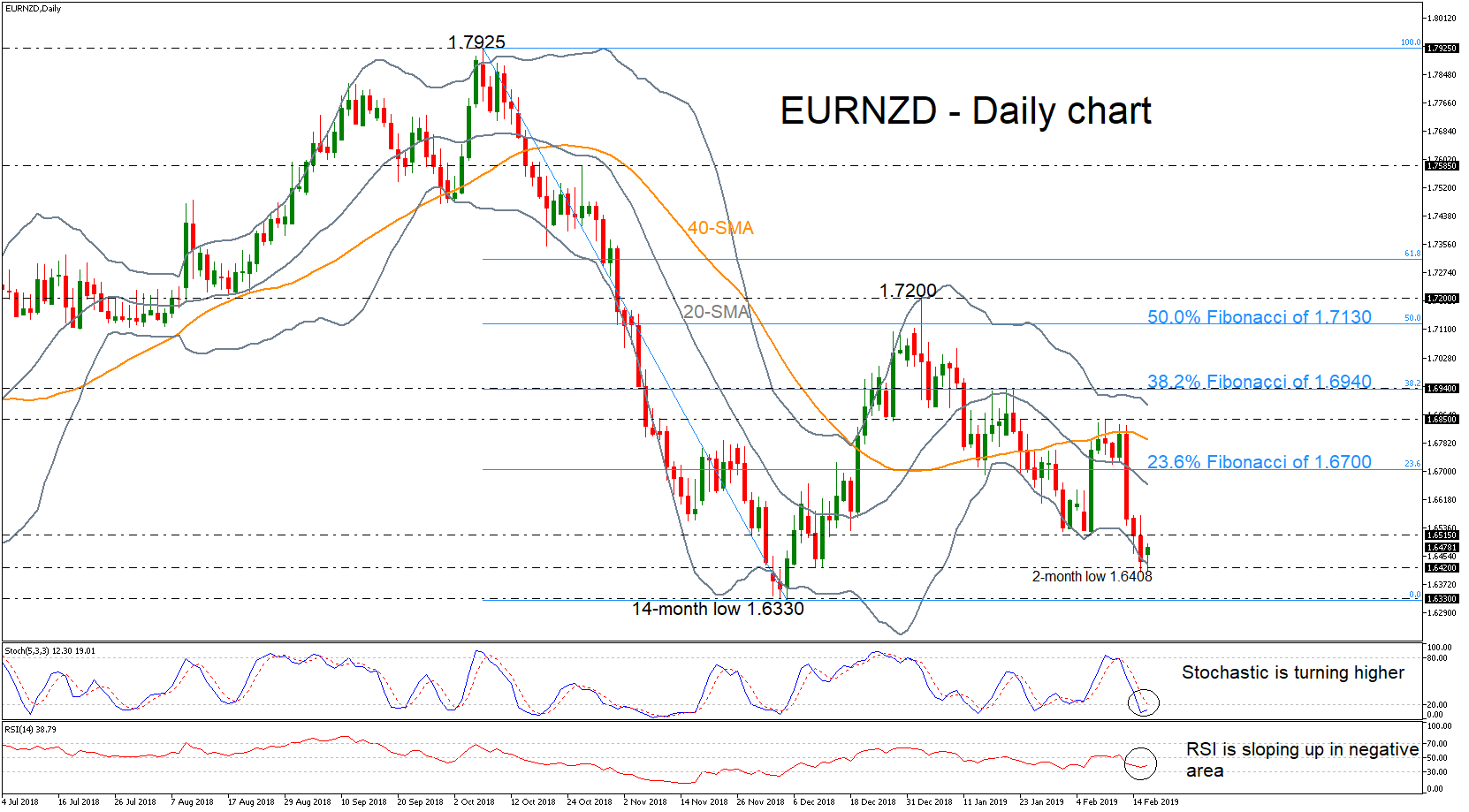
EURNZD has declined considerably over the previous three days, recording a new two-month low around 1.6408 and touching the lower Bollinger Band. Currently, the price is paring some of the losses, approaching the 1.6500 handle. Technical indicators in the daily timeframe are reversing back to the upside. The stochastic oscillator is turning higher in the oversold zone, signaling bullish pressure, while the RSI indicator is pointing up in the bearish area.
In the event of an upside reversal, the 23.6% Fibonacci retracement level of the downleg from 1.7925 to 1.6330, near 1.6700 could act as a barrier in case the price jumps above 1.6515. A break above this level would take the pair above the 40-day simple moving average towards the 1.6850 resistance.
Further losses should see the December 14-month low of 1.6330 acting as a major support. A drop below this region would reinforce the bearish structure in the medium term and open the way towards the next key support level of 1.6140, identified by the bottom on September 2017.
In the medium-term picture, euro/kiwi is trying to extend its bearish view, posting a negative tendency. A new lower low below 1.6330 would confirm this structure.
Canadian Dollar Calm on Lack of Data
USD/CAD is showing little movement in the Monday session. Currently, the pair is trading at 1.3235, down 0.15% on the day. In the U.S., banks are closed for a holiday. There are no U.S. or Canadian events on the calendar, so traders can expect limited movement from USD/CAD.
Recent Canadian numbers have been mixed. The economy created 66.8 thousand jobs in January, crushing the forecast of 6.5 thousand. However, manufacturing sales has recorded declines of 1.3% in December and 1.4% in November. The manufacturing sector has sputtered, as the global trade war has lessened the demand for Canadian exports. As well, low oil prices are weighing on the economy and on the Canadian dollar. The currency has slipped 1.2% in February. The Bank of Canada is unlikely to raise rates at the March 6 meeting, but there is room for rate hikes later in the year if economic growth improves.
Is the U.S. economy slowing down? There are concerns about the strength of the economy, after soft consumer data in January. Retail sales and core retail sales showed sharp contraction, and these numbers came on the heels of soft inflation indicators. Inflation remains low, despite a strong labor market. CPI showed no change in January and has failed to post a gain since November. Core CPI has recorded weak gains of 0.2% for four successive months. On an annualized basis, CPI gained 1.6% in January, the weakest year-over-year gain since mid-2017. The soft inflation numbers were a result of low energy prices, which fell 3.1% in January as oil prices remain under pressure.
China Shanghai SSE composite completed double bottom reversal pattern
Optimism over US-China trade negotiation gave Chinese stocks a strong boost today. The Shanghai SSE composite gained 2.68% or 71.97 pts to close at 2754.35. Technically, SSE is now considered takeout 2703.51 resistance decisively. That also completes a double bottom reversal pattern (2449.19, 2440.90).
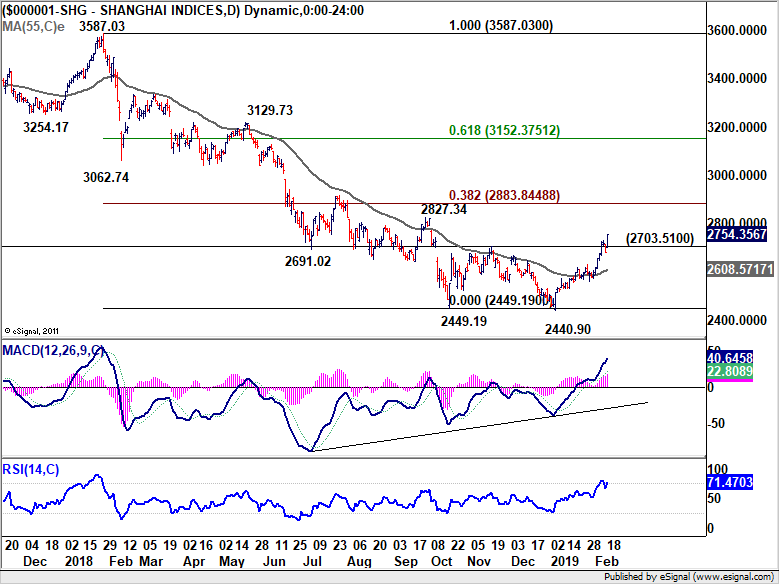
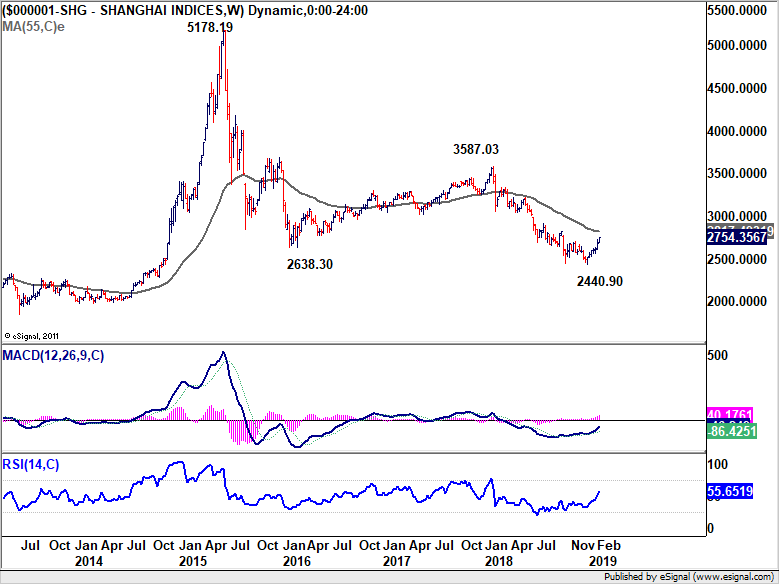
There are various ways to view the rise from 2440.90. For now, we'd treat it as a corrective rebound, correcting the down trend from 3587.03. Thus, strong resistance could be seen at 38.2% retracement of 3587.03 to 2440.90 at 2883.84 to limit upside. That's also quite close to 55 week EMA (now at 2817.49).
The Week ahead: Trade Talks, FOMC Minutes and Brexit in Focus
It has been a relatively quiet start to another busy trading week, with stocks in Asia concluding higher and European shares remaining steady amid gradual improved optimism over potential progress in US-China trade negotiations. Although Wall Street is closed today due to Washington’s birthday, global stock markets will be hoping for more inspiration to push higher after President Trump tweeted that US-China talks have been “very productive”.
I do think that while reports of China and the US achieving a consensus in principle on major topics is a welcome development for financial markets, it remains too early for any celebrations. The clock is ticking fast on the end of the 90-day truce set late last year, and it remains wishful thinking to carry optimism that there will be a major breakthrough with a trade deal. The more likely scenario at this point is that both sides could agree to another extension on the previous truce, or that there is an extension to the March deadline for new China tariffs. A market-friendly outcome to these long-standing tensions is still very much needed to boost appetite for riskier assets.
Across the Atlantic, all eyes will be on the FOMC minutes released mid-week that should offer further insight into how ‘patient’ and ‘flexible’ the Fed is on future rate hikes. If the minutes signal that US interest rates will be not increased at all in 2019, the Dollar is at risk of being dethroned as the king of the currency markets. The impact of last week’s disappointing retail sales report continues to be reflected in the Greenback’s bearish price action today, with the Dollar Index trading marginally below 96.70 as of writing. We see the Dollar weakness becoming a major theme in the near term, as political risk in the United States, disappointing domestic data and speculation of a pause in US monetary tightening decrease the Dollar’s competitive advantage against its major peers.
Investors should fasten their seat belts and prepare for a rocky ride on the British Pound, as Theresa May heads back to Brussels this week for more Brexit talks. With the European Union repeatedly stating that the Withdrawal Agreement is not open for renegotiations, May risks flying back home empty-handed. It is interesting how the Pound offered a muted reaction today despite several Labour MP’s resigning over the Brexit drama. Traders are becoming increasingly unconcerned with the endless political drama in the Commons, with some complacency over Brexit possibly seeping in. The Pound seems to be supported by expectations over the government extending Article 50 in an effort to prevent a no-deal Brexit.
Looking at the technical picture, the GBPUSD is pushing higher on the daily charts with prices finding comfort above the 1.2900 level. A solid daily close above this point should provide bulls with enough fuel to journey towards 1.3000.
Into US session: Yen & Dollar weakest on trade optimism
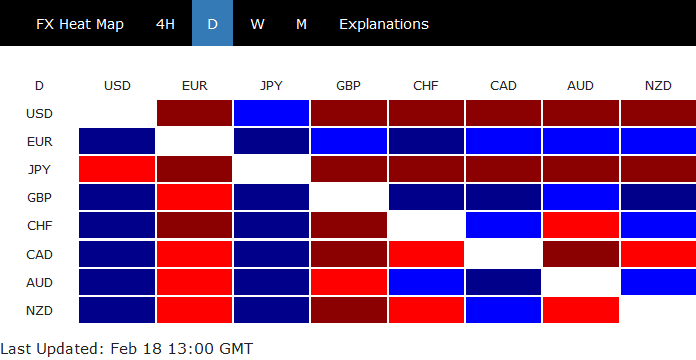
Entering into US session, Yen and Dollar remain the weakest major currencies today, on optimism that US and China could deliver a draft trade memorandum of understanding this week. But it should be noted that while Asian stocks closed sharply higher, European stocks are just mixed. Investors are not overwhelmingly convinced. With US on President's Day holiday, the markets could turn quiet for the result of the day.
Staying in the currency markets, Euro and Sterling are the strongest one so far. With a lack of economic data, Euro's strength is merely seen a technical rebound, paring recent losses. Bundesbank suggested that German economy will remain subdued in H1. With the assumption of normalization in the car industry, there is prospect of a rebound. But then, there is risk of US auto tariffs. Any, Euro will first look into ECB meetings and PMIs this week first. Sterling also look into employment data tomorrow.
In Europe, currently:
- FTSE is down -0.11%.
- DAX is down -0.22%.
- CAC is up 0.14%.
- German 10-year yield is up 0.0111 at 0.117.
Earlier in Asia:
- Nikkei rose 1.82%.
- Hong Kong HSI rose 1.60%.
- China Shanghai SSE rose 2.68%.
- Singapore Strait Times rose 0.81%.
- Japan 10-year JGB yield rose 0.002 to -0.019.
Bundesbank: German economy to remain subdued at least in H1
In its monthly report, Bundesbank warned that German economy will continue to struggle in the first half of 2019. The economy is unlikely to regain momentum with Weak orders in manufacturing, gloomy sentiment indicators and sluggish investments. It said that "all these suggest that the underlying pace of the economy should remain subdued at least in the first half of the year."
Though, it also noted that "there are no signs that the slowdown is becoming an outright downturn." In particular, the drag from auto exports is starting to normalize. Meanwhile, labor market remains healthy with private consumption picking up.
INDICES: German DAX Retraces From Its Resistance
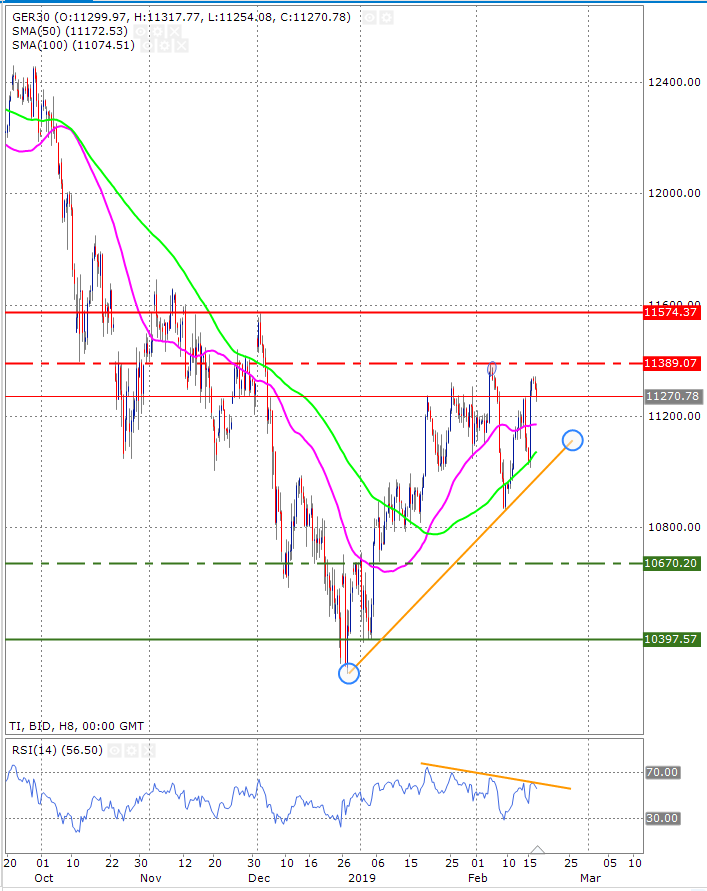
Bulls can step in if the price kisses the 50-day moving average. However, a break of this moving average could increase more selling pressure.
The German Dax index is trading above the upward trend line on an 8-hour time frame and this confirms that the uptrend is still intact. The further strength for this argument comes from the fact that the price is trading above the 50-day moving average and 100-day moving average shown in pink and green colors respectively. The price is tracing after reaching near its minor resistance zone shown by horizontal dotted red line. It is likely that the buyers may stip in when the price tests the 50-day moving average.
The RSI is trading near the overbought zone but below the downward trend line. Only a break of this would confirm more upward momentum
The minor resistance zone is shown by red dotted line and major by the solid line.
The minor support zone is shown by the green dotted line and major by the solid line.
EU launched outreach campaign on no-deal Brexit customs preparedness
European Commission launched an outreach campaign today on "no-deal" Brexit customs preparedness. The campaign aims to " raise awareness amongst the EU's business community, especially SME" to prepare for a "no-deal" scenario while continuing to trade with the UK after March 30. EU urged that businesses should "assess whether they have the necessary technical and human capacity to deal with customs procedures and rules", "consider obtaining various customs authorisations and registrations in order to facilitate their trading activity" and, "Get in touch with their national customs authority to see what other steps can be taken to prepare."
Pierre Moscovici, Commissioner for Economic and Financial Affairs, Taxation and Customs, said: "With the risk of a no-deal Brexit increasing as we get closer to March 29, the European Commission and national customs authorities are working hard to be ready to introduce checks and controls on goods flowing between the EU and the UK. This is key to protecting our consumers and our internal market. A lot depends on the ability of businesses trading with the UK to get up to speed with the customs rules that will apply on day one in case of no deal. There is no time to lose and we are here to help with the information campaign."
Quiet Session To Begin The Week
Notes/Observations
- Continued optimism over US-China trade talks as meeting continue this week in Washington
- US markets closed for Presidents day holiday
Asia:
- China Jan Vehicle Sales Y/Y: -15.8% v -13.0% prior (7th straight decline)
- Former BoJ Deputy Gov Iwata: Further rate cuts could bring some financial institutions 'under'; Japan must ramp up fiscal spending with debt bank rolled by BoJ
Europe:
- ECB's Villeroy (France): Reiterated the timing of rate hike depends on length of current slowdown. Stated that ECB would scrutinize the flow of economic data [when asked about whether recent data lowered the chances for a rate hike after the summer
- ECB's Rehn (Finland): recent data pointed to a weakening economy in the euro zone, cited greater uncertainties outside the euro zone. Reiterated interest rates would remain at the current level until monetary policy goals had been met. Had no comment on market developments [when asked about shift in market rate hike expectations]. To discuss in coming meetings what to do about TLTROs
- France and other European countries said to be ready to give Britain legally binding assurances that the Irish backstop is temporary (follow up: President Macron's Office denied reports that President Macron had offered concessions on the Irish backstop to end Brexit stalemate)
- Spain GESOP Poll: Socialists Party lead in polls but well short of a majority; Socialist Party would win between 115-117 seats; Conservative Popular Party would win 75-77 seats; Right Vox would win 43-46 seats; Centre right Ciudadanos would win 44-47 seats (Note: 1st poll since elections were called). Reminder: on Feb 15th Spain PM Sanchez called for for general (snap) elections for April 28th (in-line with press speculation)
- Nigeria Independent National Electoral Commission (Inec) delayed its presidential and parliamentary elections for a week (from Sat Feb 16th until Feb 23rd)
Americas:
- Over the weekend, US President Trump was briefed by advisers on trade talks with China; Trump called the talks ‘very productive' following the meeting
- Commerce Dept sent report to White House on 25% automobile tariff, contents were not disclosed. (Note: The presentation of the US Dep of Commerce investigative report regarding chapter 232 now gave President Trump 90 days to make final decision
Macro
- (UK) United Kingdom: PM May will be returning to Brussels this week to meet European Commission President Juncker and all of the 27 other EU heads of state. She is still hoping to win concessions on the Irish backstop. The next key date is February 27, when parliament will vote on the government's withdrawal plan, or alternatives if May has failed to win any concessions. It is also possible, although not certain, that parliament could vote to rule out a no-deal Brexit scenario.
- (DE) Germany: The US remains Germany's main export destination, with exports amounting to €113B last year, while Germany imported just €65B from the US over the same period. The UK was Germany's fourth largest export destination, after the US, France & China with exports amounting to €82B. It is all evidence to suggest that an escalation of trade tensions with the US, but also Brexit could hit Germany's export oriented economy.
SPEAKERS/FIXED INCOME/FX/COMMODITIES/ERRATUM
Equities
- Indices [Stoxx600 -0.03% at 368.84, FTSE -0.29% at 7,215.40, DAX -0.30% at 11,265.72, CAC-40 -0.02% at 5,151.91, IBEX-35 +0.32% at 9,152.35, FTSE MIB +0.25% at 20,262.50, SMI +0.36% 9,265.40, S&P 500 Futures -0.09%]
- Market Focal Points/Key Themes: Equities European Indices trade mixed this morning with the U.K. FTSE trading slightly lower on potential Brexit plan amendments and slightly lower U.S. futures this morning. The New York Stock Exchange and the Nasdaq will be closed this Monday in observance of the federal holiday. On the corporate front shares of Wirecard trade 13% higher on Bafin bans short-selling positions in company's stock; Reckitt Benckiser, Petra Diamonds both rise as an a strong earnings and new CEO appointment. Meanwhile auto giant Daimler declines after China car sales data, with Faureci, Victoria PLC and Casino Guichard-Perrachon among other notable names declining on earnings, trading updates and analyst downgrades. Elsewhere Vinci shares rebound slightly after large contract award.
- Consumer discretionary: Casino Guichard-Perrachon SA [CO.FR] -2.5% (analyst action), McColl's Retail Group [MCLS.UK] +7.5% (earnings), Pendragon [PDG.UK] +0.5% (new CEO)
- Healthcare: Reckitt Benckiser [RB.UK] +4.5% (earnings)
- Industrials: Vinci [DG.FR] -1% (awarded significant contract), Faurecia [EO.FR] -0.5% (earnings), Daimler [DAI.DE] -1% (China car sales), Victoria PLC [VCP.UK] -14% (trading update)
- Technology: Wirecard [WDI.DE] +12% (Bafin bans short-selling positions)
- Materials: Petra Diamonds [PDL.UK] +8% (earnings; new CEO)
Speakers
- Ireland Foreign Min Coveney reiterated stance that EU would not renegotiate the Withdrawal Agreement; everyone was working hard to avoid a no-deal Brexit
- UK said not able to resign trade agreement with Japan by March
- Small group of UK Labour party officials said to be leaving the party
- Swiss Govt stated that a referendum on Federal Tax Act Reform and AHV financing to be held on May 19th
- Iran Supreme Leader Khamenei stated that European signatories of nuclear deal were deceiving the country
- Singapore Fin Min Heng Swee Keat unveiled the 2019/20 budget proposal; budget deficit seen at S$3.5B or 0.7% to GDP. To spend S$4.6B over three year in the economy. To set aside S$6.1B for Merdeka Generation Package to cover costs of package to support the elderly
Currencies/Fixed Income
Economic Data
- (CZ) Czech Dec Export Price Index Y/Y: 3.1% v 4.0% prior; Import Price Index Y/Y: 2.4% v 4.2% prior
- (CH) Swiss Total Sight Deposits w/e Feb 15th (CHF): 576.3B v 576.2B prior; Domestic Sight Deposits: 492.7B v 486.8B prior
- (NG) Nigeria Jan oil production at 1.66M bpd vs. 1.78M bpd m/m
Looking Ahead
- (UK) EU Brexit Negotiator Barnier to meet UK Brexit Sec Barclay in Brussels
- Saudi Arabia Oil Output & Exports for Dec.: JODI
- 05:30 (NL) Netherlands Debt Agency (DSTA) to sell €2.0-4.0B in 3-month and 6-month Bills
- 05:30 (ZA) South Africa announces details of upcoming I/L bond sale (held on Fridays)
- 06:00 (TR) Turkey to sell Floating Bonds
- 06:00 (IL) Israel to sell bonds
- 06:45 (US) Daily Libor Fixing
- 07:00 (IN) India announces details of upcoming bond sale (held on Fridays)
- 08:00 (ES) Spain Debt Agency (Tesoro) announces size of upcoming issuance
- 08:00 (UK) Baltic Dry Bulk Index
- 09:00 (FR) France Debt Agency (AFT) to sell combined €3.5-4.7B in 3-month. 6-month and 12-month Bills
- 11:15 (EU) ECB's Enria (SSM chief)
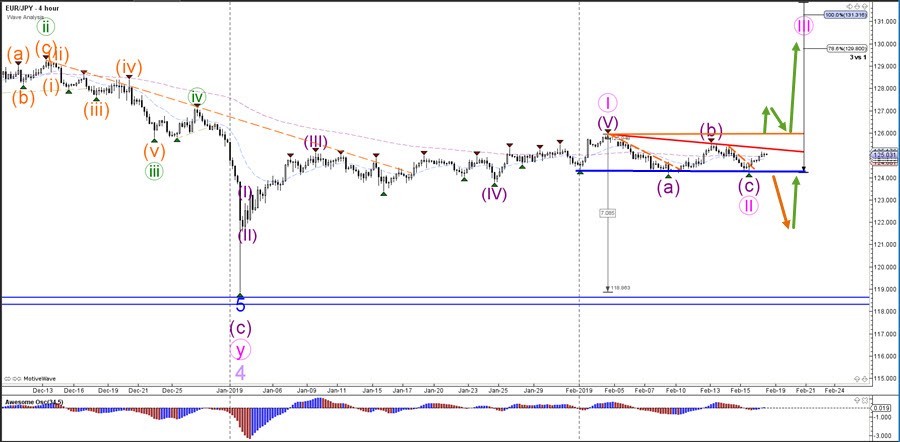
EUR/JPY Awaits Breakout For Wave 3 Impulse
The EUR/JPY has been moving sideways for a lengthy period of time. The correction could either be in wave 2 (pink) as indicated in the image, or price is still building a correction within an extended wave 1 (pink). The trend lines remain critical for the next direction: a bearish break below the support trend line (blue) could indicate a deeper wave 2 whereas a bullish break above the resistance trend lines (red) could indicate a wave 1 or 3 (pink).
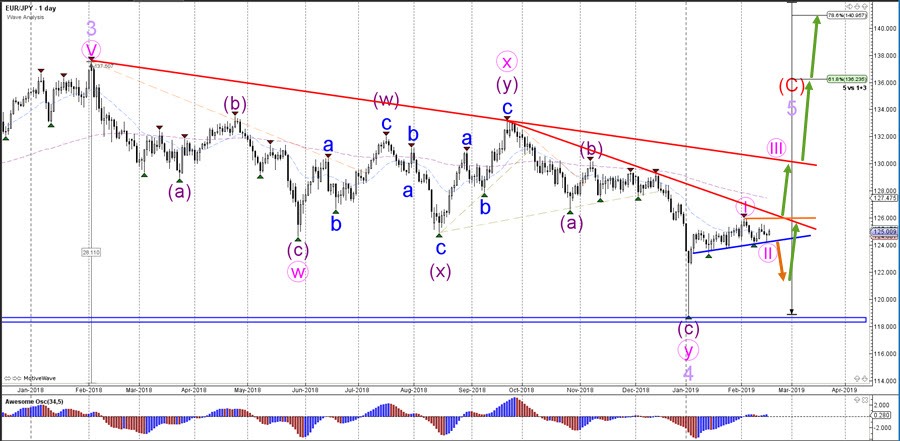
EUR/JPY seems to have completed a bearish ABC (purple) correction. The wave C (purple) could be finished as long as price stays above the support trend line (blue) and eventually manages to break above the resistance zone. A bearish break, however, could indicate the start of a deeper wave 2 (pink). A bullish breakout could indicate a move up the Fibonacci targets of wave 3 vs 1 but keep an eye on the resistance level at 127.50, because that is where price could complete a wave 1 (pink) as well.