

Sample Category Title
Sterling Might Wake Up as Brexti Vote Approaches, Busy Week Ahead
Asian stocks open the week lower, following Friday's selloff in the US. But the forex markets are pretty steady. Dollar is the weakest one for now, followed by Sterling and then Canadian. On the other hand, New Zealand Dollar leads the way higher, followed by Euro and then Japanese Yen. As usual on a Monday, the picture could drastically change throughout the day. In particular, Sterling is still hibernating in tight range except versus Euro. It might finally wake up as Tuesday's Brexit deal vote approaches.
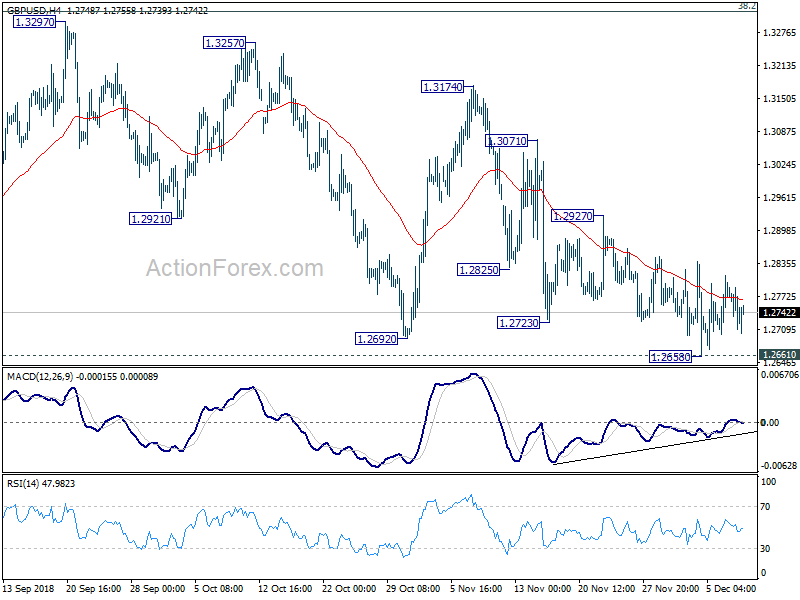
Technically, while EUR/USD strengthens today, it's capped below 1.1472 resistance and thus, there is not indication of bullish reversal yet. This is a key level to watch should Dollar's weakness extends. On the other hand, 1.2661 is key support in GBP/USD is another level to pay attention to. Break of which will be a sign that Sterling bears are finally coming out.
In other markets, at the time of writing. Nikkei is down -2.19%. Hong Kong HSI is down -1.41%. China Shanghai SSE is down -0.84% and Singapore Strait Times is down -1.36%. Japan 10 year JGB yield is down -0.0166 at 0.046.
UK PM May: Voting down the Brexit deal would take UK into uncharted waters
Ahead of the parliamentary vote on the Brexit deal on Tuesday, Prime Minister Theresa May warned on Sunday that voting down the deal could take the UK into "uncharted waters". And, that would mean "grave uncertainty for the nation with a very real risk of no Brexit or leaving the European Union with no deal." She added "when I say if this deal does not pass we would truly be in uncharted waters, I hope people understand this is what I genuinely believe and fear could happen."
At this, chance remains very slim for the bill to be passed. And there are rumor that May could pull the plug and postpone the vote. And she could go back to Brussels for some tweaks first. but Brexit Minister Stephen Barclay warned that "the risk for those who say simply go back and ask again, the risk is that isn't necessarily a one way street, the French the Spanish and others will turn round, if we seek to reopen the negotiation, and ask for more."
USTR Lighthizer: Trade talks with China not going beyond March
US Trade Representative Robert Lighthizer commented on trade negotiation with China for the first time since taking the leading role. He noted that 90 days talk has a "hard deadline" and Trump is "not talking about going beyond March. And, "the way this is set up is that at the end of 90 days, these tariffs will be raised". US has postponed raising of tariffs on USD 200B in Chinese imports from 10% to 25% after Trump-Xi meeting.
Lighthizer also said the US need "agricultural sales" and "manufacturing sales". But at the same time "we need structural changes on this fundamental issue of non-economic technology transfer." And, Americans "can be reassured that if there is a deal that can be made that will assure the protection of U.S. technology...and get additional market access...the president wants us to do it." But he also echoed Trump's rhetorics that "if not we will have tariffs."
OECD: RBA policy rates should start to rise soon
In a report released over the weekend, OECD said Australia's "long span of positive output growth continues". And, "continued robust output growth of around 3% is projected in the near future". On RBA, OECD said that "in the absence of negative shocks, policy rates should start to rise soon". It warned that "monetary conditions remain very accommodative, with the risk of imbalances accumulating further if the low-interest rate environment persists." And, "in the absence of a downturn, a gradual tightening should start as inflation edges up and wage growth gains momentum."
However, OECD also warned that the housing market is "a source of vulnerability". So far, "data point to a soft landing without substantial consequence for the overall economy." But "risk of a hard landing remains." And it urged authorities to "prepare contingency plans for a severe collapse in the housing market. These should include the possibility of a crisis situation in one or more financial institutions.
On the data front
New Zealand manufacturing activity rose 2.0% qoq in Q3. Japan GDP was finalized at -0.6% qoq in Q3, revised down from -0.5% qoq. Current account surplus narrowed to JPY 1.33T. Australia home loans rose 2.2% mom in October, versus expectation of -0.5% mom.
For the day ahead, Swiss will release unemployment rate. German will release trade balance. UK will release trade balance, GDP and productions. Eurozone will release Sentix Investor Confidence. Later in the day, Canada will release housing starts and building permits.
Looking ahead
The week is very busy ahead. Brexit vote in the UK on Tuesday (supposedly) would be a key event risk. Also, Italy may finally resubmit its revised budget plan to EU. Besides Two central banks will meet. SNB should keep monetary policy unchanged without a doubt. And based on recent global market volatility, SNB should also reiterate the need to maintain negative interest rate, and stand ready for intervention if needed.
No change in ECB's immediate plan is expected. That is, interest rates will be kept unchanged and ECB will stop asset purchase program after December. The main question is how ECB is viewing the current slow down in Eurozone growth. Would they maintain that Q3's slow down was just temporary? Or would they change the tune. A dovish shift doesn't necessarily change the forward guidance of keep interest rates at present levels at least "through the summer of 2019". ECB has enough flexibility in the guidance. But more cautiousness would likely mean more pressure on Euro.
There are also enough economic data to keep trades and investors busy. Here are some highlights for the week:
- Monday: Japan GDP; Swiss unemployment; Eurozone Sentix investor confidence; Germany trade balance; UK GDP, productions, trade balance; Canada housing starts, building permits
- Tuesday: Japan BSI manufacturing; Australian house price, NAB business confidence; UK employment; German ZEW economic sentiment; US PPI
- Wednesday: Australia Westpac consumer sentiment; Japan PPI, machine orders, tertiary industry index; Eurozone industrial production; US CPI
- Thursday: US RICS house price balance; Australia inflation expectation; German CPI final; Swiss CPI, SNB rate decision; ECB rate decision; Canada new housing price index; US import prices, jobless claims
- Friday: New Zealand BusinessNZ manufacturing; Japan Tankan survey, PMI manufacturing; China fixed asset investment, industrial production, retail sales, unemployment rate; Eurozone PMIs; US retail sales, industrial production, PMIs, business inventories.
GBP/USD Daily Outlook
Daily Pivots: (S1) 1.2693; (P) 1.2749; (R1) 1.2787; More...
GBP/USD continues to stay in tight range above 1.2658 temporary low and intraday bias remains neutral first. On the downside, sustained break of 1.2661 key support will resume larger down trend from 1.4376. Next target will be 1.1946. On the upside, break of 1.2927 will extend the consolidation from 1.26661 with another rise. But even in case of strong rebound, upside should be limited by 1.3316 fibonacci level to bring down trend resumption eventually.
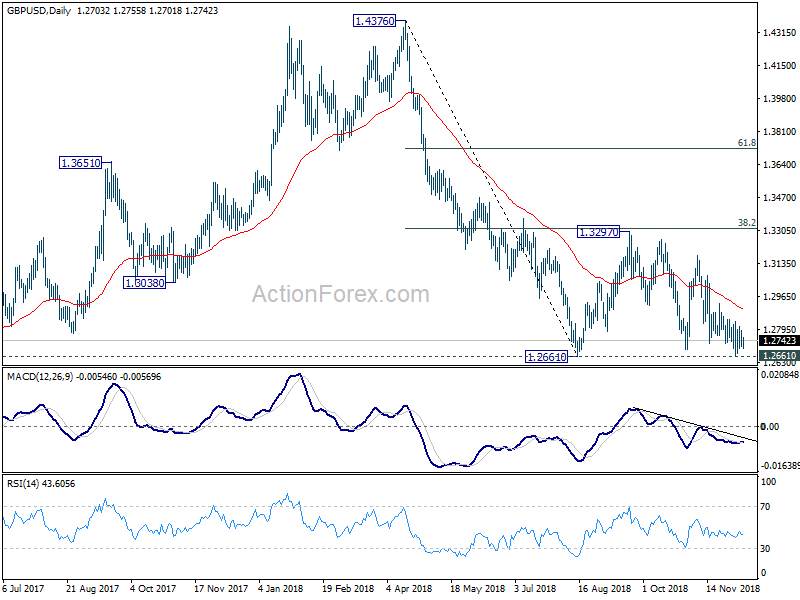
In the bigger picture, whole medium term rebound from 1.1946 (2016 low) should have completed at 1.4376 already, after rejection from 55 month EMA. The structure and momentum of the fall from 1.4376 argues that it's resuming long term down trend. And this will be the preferred case as long as 38.2% retracement of 1.4376 to 1.2661 at 1.3316 holds. However, firm break of 1.3316 would bring stronger rebound to 61.8% retracement at 1.3721. And, the eventual depth of the fall from 1.4376, and the chance of hitting 1.1946 low, will depend on the strength of the interim corrective rebound from 1.2661.
Economic Indicators Update
| GMT | Ccy | Events | Actual | Forecast | Previous | Revised |
|---|---|---|---|---|---|---|
| 21:45 | NZD | Manufacturing Activity SA Q/Q Q3 | 2.00% | 1.80% | ||
| 23:50 | JPY | GDP Q/Q Q3 F | -0.60% | -0.50% | -0.30% | |
| 23:50 | JPY | GDP Deflator Y/Y Q3 F | -0.30% | -0.30% | -0.30% | |
| 23:50 | JPY | Current Account (JPY) Oct | 1.21T | 1.29T | 1.33T | |
| 0:30 | AUD | Home Loans M/M Oct | 2.20% | -0.50% | -1.00% | |
| 5:00 | JPY | Eco Watchers Survey Current Nov | 49.5 | 49.5 | ||
| 6:45 | CHF | Unemployment Rate Nov | 2.50% | 2.50% | ||
| 7:00 | EUR | German Trade Balance Oct | 17.2B | 17.6B | ||
| 9:30 | GBP | Visible Trade Balance (GBP) Oct | -10.5B | -9.7B | ||
| 9:30 | GBP | Industrial Production M/M Oct | 0.10% | 0.00% | ||
| 9:30 | GBP | Industrial Production Y/Y Oct | -0.20% | 0.00% | ||
| 9:30 | GBP | Manufacturing Production M/M Oct | 0.00% | 0.20% | ||
| 9:30 | GBP | Manufacturing Production Y/Y Oct | 0.00% | 0.50% | ||
| 9:30 | GBP | Construction Output M/M Oct | -0.40% | 1.70% | ||
| 9:30 | GBP | GDP M/M Oct | 0.10% | 0.00% | ||
| 9:30 | GBP | Index of Services 3M/3M Oct | 0.30% | 0.40% | ||
| 9:30 | EUR | Eurozone Sentix Investor Confidence Dec | 8.4 | 8.8 | ||
| 13:15 | CAD | Housing Starts Nov | 198K | 206K | ||
| 13:30 | CAD | Building Permits M/M Oct | -0.20% | 0.40% |
Market Morning Briefing: Aussie Could Get Some Decent Support At 0.7215
STOCKS
Moment of truth for Equities? Looks like our bullish preference is under severe threat of being proven wrong.
Dow (24388.95) plunged again on Friday to a low of 24285, below the low of our range of 24500-25500, but above Support at 24250. We would prefer a bounce today,leading to fresh bullishness, else, a break below 24250 could intensify the current bearish sentiment.
The DAX (10788.09) has a "last" Support at 10700. Should that break (danger is there), a further decline towards 10000 would come up, as warned on Friday.
Asia looks pretty bearish with the Nikkei (21192) continuing Friday's fall and possibly breaking below crucial 21200. Sustenance below 21200 would prove our expectation of an eventual rise past 22000 to be wrong.
The Shanghai (2585) seems to be giving up on its attempt to rise past 2600 and there can be vulnerable to a fall towards 2500-2400.
In India, the Nifty (10693) could well fall towards 10400 on global sentiment as well as anxiety over the state election results. The Sensex (35673.25, +1.02%) would test 35000 on the downside.
COMMODITIES
Brent (62.11) is trading higher and could test 64 on the upside in the near term. Above 64, there is scope of testing 66+ levels in the medium term. View looks bullish just now.
WTI( 52.57) too has room to rise towards 56-58 levels in the near term. The small sideways range seems to be over just now and a rise in the medium term looks likely.
Gold (1255.20) has seen a sharp rise too but could face resistance at 1260 as seen on the daily candles. A small corrective dip from 1260 is possible before a sharp rise is seen again breaking above 1260 in the longer run.
Silver (14.69) has risen too and while above 14.50, the price could move up targeting 14.75-15.00 in the near term.
Copper (2.7405) could test support at 2.70 before bouncing back towards 2.80/85 again. Stuck within the 2.85-2.70 region, it is difficult to predict which side the price would eventually tilt towards. For now, the consolidation is likely to continue for some more time.
FOREX
Crucial levels to keep an eye on for Euro, Pound and Dollar Yen at 1.15 (resistance), 1.27 (support) and 112 (support) respectively. UK Parliament’s Brexit vote is due on Tuesday and could bring in volatility in the currency market depending upon the vote’s outcome.
Dollar Index (96.43) had broken below the immediate support at 96.75 last week and continues to trade lower just now. A dip to 96 is possible in the near term from where a bounce could be seen back towards 96.50-96.75 again in the medium term.
Euro (1.1440) has moved up and while above 1.14, there is scope of testing resistance near 1.15 as seen on the 3-day candles before coming off from there again towards 1.14-1.13 levels. Near term looks bullish towards 1.15.
Dollar Yen (112.75) is headed towards support at 112 from where a decent bounce is possible. Failure to bounce back from 112 would open up chances of falling towards 110 in the medium term. Watch price action near 112.
Pound (1.2750) is trading near the 1.27 support levels and only a bounce from here seen immediately could take it higher towards 1.29-1.30 levels. While a bounce from here is preferred just now, failure to bounce could make it vulnerable to a fall towards 1.26-1.24 in the medium term.
Aussie (0.7217) could get some decent support at 0.7215. There is 55-Day MA support just below current levels and if that holds, a bounce to 0.7250 and higher is possible.
Dollar Rupee (70.81) could open with a gap up near 71.20/30 region and is likely to test 71.50 before coming off from there towards 71.20-71.00.
INTEREST RATES
Mixed news on the US Yield Curve. The 2Yr (2.69%) has dipped some more and the 10-2 Spread (14bp) has moved up further from 13bp earlier. We need it to sustain above 11bp and move up to 20bp. At the same time, however, the 5-2 Spread is quoting at -2p, still negative. At the Far end, though, the 30-10 (29bp) and 30-5(45bp) have been rising and can test 35bp and 60bp respectively.
Importantly, the US 10Yr (2.83%) has crucial Support coming up nearby between current levels and 2.80%. A bounce from here is a decent possibility and could lead to the Curve steepening we have been hoping to see.
At the same time, the fall in US Yields is leading the German-US 2Yr Spread (-3.32%) higher and the US-Japan 10Yr Spread (2.79%) lower, which is being reflected in a stronger Euro (1.1435) and Dollar-Yen (112.35) lower.
In India, the 10Yr GOI (7.4636%) saw a small bounce on Friday, contrary to our expectation of a further fall towards 7.30%. Maybe we are in for a period of sideways consolidation between 7.50% on the upside and 7.30% on the downside.
Daily Markets Broadcast
Wall Street tumbles to six-week low
Weak jobs data and an escalation in US-China tensions over the arrest of Huawei’s CFO combined to pressure US futures markets in early trading today.
US30USD Daily Chart
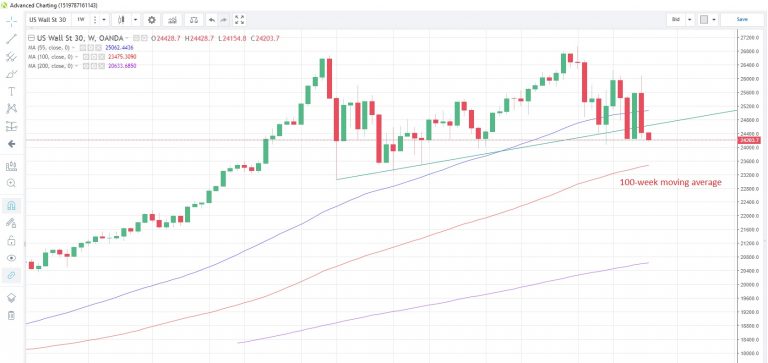
The US30 index has fallen to the lowest since October 26 this morning, following on from Friday’s losses
The 100-week moving average is at 23,475
The US economy added just 155,000 jobs in November, well below forecasts of +200,000 and a marked slowdown from October’s revised +237,000.
DE30EUR Monthly Chart
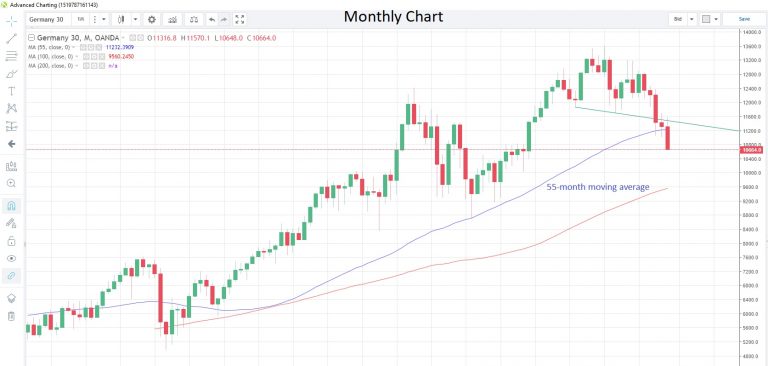
The Germany30 index is under pressure again today after suffering the worst weekly loss since March
The index looks set to close below the 55-month moving average at 11,233 for the first time since December 2011
Germany’s October trade surplus is expected to widen to EUR17.7b from 17.6b in September. Trade tariffs do not appear to be affecting the trade balance so far.
WTICOUSD Weekly Chart
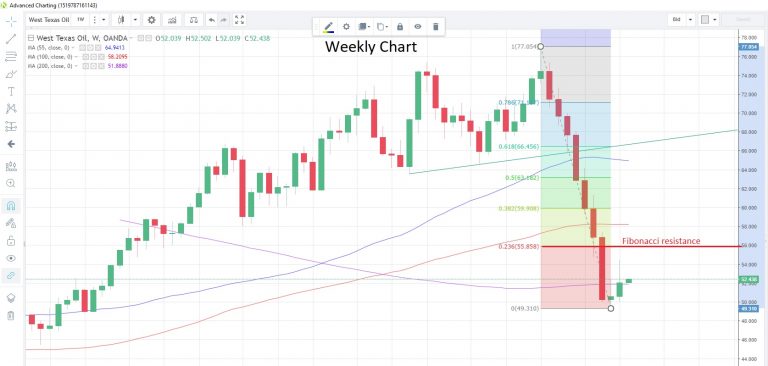
West Texas Intermediate looks poised for its second daily advance in a row after posting the biggest weekly gain in 10 weeks last week
Fibonacci retracement resistance may be found at $55.858, 23.6% retracement of the October-November drop
OPEC and non-OPEC producers pushed forward with an agreement to cut production by 1.2m bpd, without any assurances Iran would cap its production.
OECD: RBA policy rates should start to rise soon
In a report released over the weekend, OECD said Australia's "long span of positive output growth continues". And, "continued robust output growth of around 3% is projected in the near future". On RBA, OECD said that "in the absence of negative shocks, policy rates should start to rise soon". It warned that "monetary conditions remain very accommodative, with the risk of imbalances accumulating further if the low-interest rate environment persists." And, "in the absence of a downturn, a gradual tightening should start as inflation edges up and wage growth gains momentum."
However, OECD also warned that the housing market is "a source of vulnerability". So far, "data point to a soft landing without substantial consequence for the overall economy." But "risk of a hard landing remains." And it urged authorities to
"prepare contingency plans for a severe collapse in the housing market. These should include the possibility of a crisis situation in one or more financial institutions.
UK PM May: Voting down the Brexit deal would take UK into uncharted waters
Ahead of the parliamentary vote on the Brexit deal on Tuesday, Prime Minister Theresa May warned on Sunday that voting down the deal could take the UK into "uncharted waters". And, that would mean "grave uncertainty for the nation with a very real risk of no Brexit or leaving the European Union with no deal." She added "when I say if this deal does not pass we would truly be in uncharted waters, I hope people understand this is what I genuinely believe and fear could happen."
At this, chance remains very slim for the bill to be passed. And there are rumor that May could pull the plug and postpone the vote. And she could go back to Brussels for some tweaks first. but Brexit Minister Stephen Barclay warned that "the risk for those who say simply go back and ask again, the risk is that isn't necessarily a one way street, the French the Spanish and others will turn round, if we seek to reopen the negotiation, and ask for more."
Asia Market Update: Oil, Cnh, Aud Trade
Oil market update
Commodity market, in general, remains a binary trade very much but China’s unquenchable demand for Oil and Gas is back in focus this morning after Reuters reports China’s November oil, gas imports set fresh monthly record Reuters
Given the fact we are entering a 90-day trade war moratorium where its expected that China will increase imports of LNG and refined oil products, Prompt Oil prices are reacting positively to this pretty staggering headline which supports the demand side of the equation as this news bring something bullish to the table. In addition, a reported Lybian supply outage is also providing a fillip for prices this morning. Indeed looking much better than it did this morning when the market focus was singularly focused on the synchronized global growth slowdown.
USDCNH
While the magnetic 7 UDSCNH level is safe ahead of year-end, Sundays weaker than expected Chinese economic data November exports and imports posted 5.4 % YoY (versus Market 9.4%) and 3% YoY (versus market 14%); worse than the consensus. CPI was a touch worse than expected at 2.2% YoY (versus market 2.4%) while PPI was right inline at 2.7% YoY.is a stark reminder that the synchronised global slow down remains alive and well.
But it’s also a reminder that the Pboc will need to adjust monetary policy hard and fast to the right the economic ship.
USDCNH has tested 6.90 out of the gates this morning
AUDUSD
We’ve seen a modest retracement higher in the Australian dollar this morning, arguably short Aussie is the markets most crowded trade, after a significant and highly unexpected rebound) in Australia October home loans which handily beat market consensus while investment lending rebound well. While the intraday squeeze is on as traders sold AUD early this morning after the weaker China data, the markets are looking could be looking to stay short AUD given heightened risk around China which will likely tame any AUD upside ambitions.
Trade Tensions
US tension as the FT is reporting China summoned the US ambassador in Beijing to demand that Huawei CFO be release. Indeed, this news does not play well for the China Vice Premier Liu He’s visit to Washington DC from 12-14 Dec’18. Then again when it comes to US negotiations the best-laid plans of mice and men often go awry.
Risk sentiment is still in the tank but appears to be stabilizing after this morning wobble, still, the bar remains very high for a bullish flip
EUR/USD Likely Approaching Bullish Break
Key Highlights
- The Euro recovered recently and traded above the 1.1350 resistance against the US Dollar.
- There is a major bullish trend line formed with support at 1.1350 on the 4-hours chart of EUR/USD.
- The Chinese CPI in Nov 2018 increased 2.2% (YoY), less than the forecast of 2.4%.
- Today, the German Trade Balance for Oct 2018 will be released, which is forecasted to post a surplus of €17.7B.
EURUSD Technical Analysis
After a sharp downside move, the Euro found support near 1.1250-60 against the US Dollar. The EUR/USD pair recovered and traded above the 1.1300 and 1.1350 resistances.
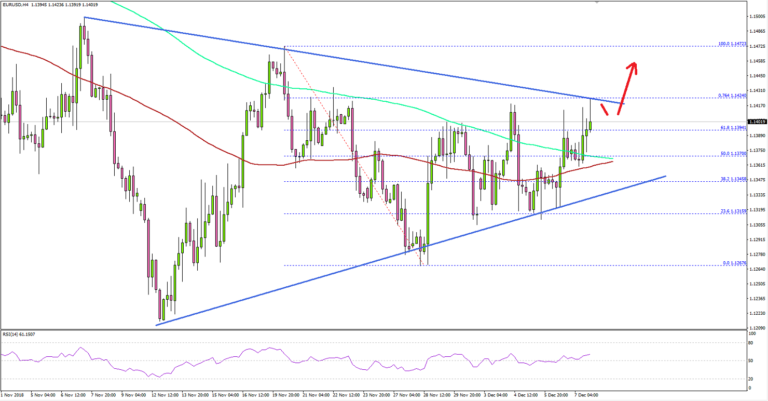
Looking at the 4-hours chart, the pair corrected above the key 1.1370 resistance as well, opening the doors for a decent rebound. Buyers even pushed the pair above the 50% Fib retracement level of the last decline from the 1.1472 high to 1.1267 low.
Besides, there was a close above the 1.1350 level, the 200 simple moving average (green, 4-hours), and the 100 simple moving average (red, 4-hours).
On the upside, the pair is facing resistance near the 1.1420-30 zone. A close above 1.1430 could clear the path for more gains towards the 1.1470 and 1.1500 resistance levels.
On the downside, an initial support is near 1.1370 and the 100 SMA. Besides, there is a major bullish trend line formed with support at 1.1350 on the same chart. If there is a close below the trend line and 1.1330, the pair may decline once again towards the 1.1260 level.
Fundamentally, the Chinese CPI for Nov 2018 was released by the National Bureau of Statistics of China. The market was looking for a 2.4% rise in the Chinese CPI compared with the same month a year ago.
However, the result was disappointing as the CPI increased 2.2%. The monthly change was also disappointing as there was a decline of 0.3% in the CPI.
The outcome may impact the risk sentiment in the short term, but it seems like pairs such as EUR/USD and GBP/USD are likely to rebound further in the near term.
Economic Releases to Watch Today
- Germany's Trade Balance for Oct 2018 – Forecast €17.7B, versus €17.6B previous.
- Germany's Imports of goods and services Oct 2018 – Forecast +0.4%, versus -0.4% previous.
- Germany's Exports of goods and services Oct 2018 – Forecast +0.5%, versus -0.8% previous.
- UK Industrial Production for Oct 2018 (MoM) – Forecast +0.1%, versus 0% previous.
- UK Manufacturing Production for Oct 2018 (MoM) – Forecast 0%, versus +0.2% previous.
- UK GDP for Oct 2018 (MoM) – Forecast +0.1% versus 0% previous.
USTR Lighthizer: Trade talks with China not going beyond March
US Trade Representative Robert Lighthizer commented on trade negotiation with China for the first time since taking the leading role. He noted that 90 days talk has a "hard deadline" and Trump is "not talking about going beyond March. And, "the way this is set up is that at the end of 90 days, these tariffs will be raised". US has postponed raising of tariffs on USD 200B in Chinese imports from 10% to 25% after Trump-Xi meeting.
Lighthizer also said the US need "agricultural sales" and "manufacturing sales". But at the same time "we need structural changes on this fundamental issue of non-economic technology transfer." And, Americans "can be reassured that if there is a deal that can be made that will assure the protection of U.S. technology...and get additional market access...the president wants us to do it." But he also echoed Trump's rhetorics that "if not we will have tariffs."
Brexit Monitor: Vote On Tuesday Is Not The Final Word In The Brexit Saga
Key dates
- 10 December: ECJ ruling on Brexit reversal and 4th day of Brexit debate. 11 December: Vote in House of Commons on Theresa May’s Brexit deal.
- 13-14 December: EU summit. 20 December to 7 January: House of Commons recess due to Christmas
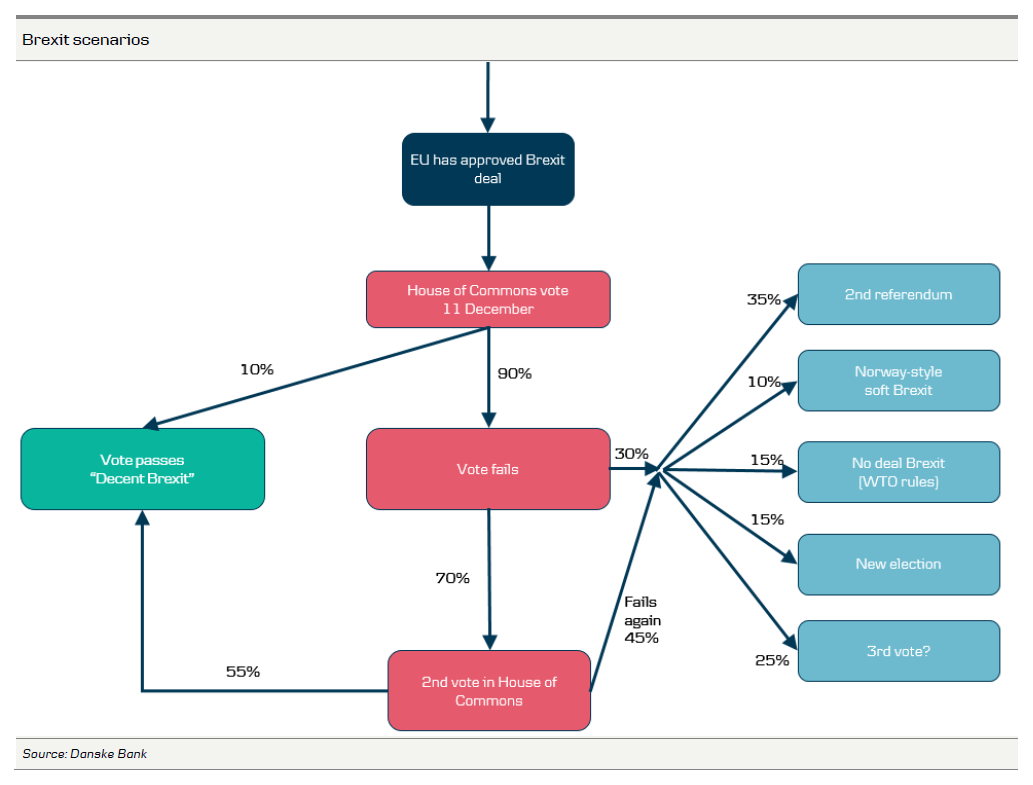
The vote on PM Theresa May’s Brexit deal takes place on Tuesday, 11 December at 20:00 CET (including votes on amendments). Despite May’s attempt to secure public and political backing, it seems unlikely the deal will be passed. According to The Guardian’s count, more than 400 MPs have said they will vote against the deal (320 votes are needed for it to fail). Slightly more than 100 Conservative MPs (a mix of hardliners, soft Brexiteers and pro-EU), May’s supporting party DUP from Northern Ireland, Labour, LibDems and the Scottish National Party appear to be voting against the deal. Only Conservative loyalists and those on the government payroll have indicated they will vote in favour.
What happens if/when the deal is voted down? As a defeat is widely expected, markets would react to the size of the defeat, although we doubt the market reaction will be significant, as political uncertainty is likely to remain elevated. We will monitor the following days to see how the different politicians and groups react. PM May is set to participate in the EU summit beginning on Thursday, 13 December, which will be her first chance to talk face-to-face with the other EU leaders about how to proceed.
Many political analysts say it is likely that PM May will try to hold a second vote in the House of Commons at a later stage. Some have said this could come as early as just before Christmas, but we think January seems more realistic, as she would probably need to secure some concessions from the EU in renegotiations (although they would likely be small, as it is difficult to see what changes the EU would accept at this point). This would require more talks with the EU’s chief negotiator, Michel Barnier, and not only talks with the EU leaders. Given that many appear to expect a second vote, this also makes it easier to vote against the deal the first time, to show opposition without any major consequences. Some Conservative policymakers have urged May to postpone the vote.
What happens if the deal is voted down a second time? Well, then we are in uncharted territory. We think it is difficult to see how PM May could survive two defeats, and would expect her to either resign or be forced out. That opens up a range of possible outcomes. Although we still cannot rule out a ‘no deal Brexit’, we think the likelihood of this scenario has declined after Conservative MP Dominic Grieve’s amendment passed this week, which gives Parliament the possibility to tie the government’s hands in the negotiations. One of the main issues with Brexit is that none of the politicians agree on how the ideal Brexit should look, but the majority definitely wants to avoid a no deal Brexit and the amendment makes it easier for Parliament to avoid that scenario. While the amendment was a short-term defeat for May, as it underlines her lack of power despite being the Prime Minister, it may be positive for her in the long run. At least, it seems to make her threat that it is “her deal or a soft Brexit (or no Brexit at all)” more credible. May’s deal is probably the hardest version of Brexit on the table right now, which is positive, as it is what we call a “decent Brexit”. It also increases the chance that the hardliners will vote for the deal the second time, as they risk a softer Brexit or a reversal of Brexit by voting it down. The deal is clearly not perfect for them but after all the UK would still be able to end free movement of labour and would get an independent trade policy over time. The problem is that the DUP has said it will vote for no confidence in the government if the deal passes, see Tim Shipman (Political Editor on Sunday Times) on Twitter
The probability of a second referendum has increased over the past couple of months. It has probably been made easier by the European Court of Justice, which has said that the UK may be able to withdraw its Article 50 notification (which started the two years of negotiations with the EU) unilaterally as long as the UK is not abusing the rule just to buy more time (however, look out for the final ruling on Monday morning at 09:00 CET). It would still require a majority of Parliament to call a referendum, which will be difficult. Opinion polls suggest the result would be a slim victory for the remain camp.
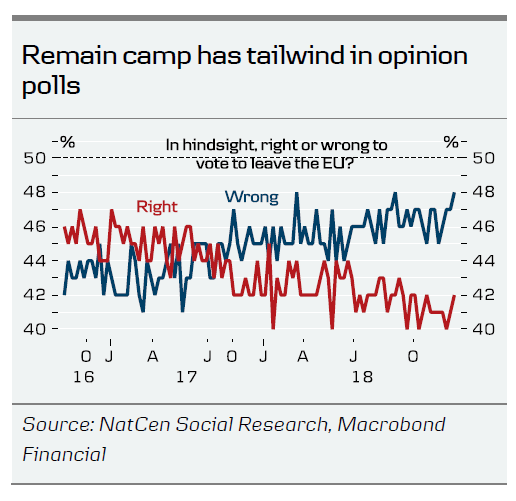
Recently, a Norway-style option has gathered more attention. This would be a soft Brexit, something that we ruled out as unlikely some time ago. In a Norway-style Brexit, the UK would leave the EU but join both EFTA and EEA (EFTA membership is necessary for EEA membership). While there would not be any economic consequences, the political damages would be significant, as the UK would be subject to all EU laws (including paying to the EU budget and accepting free movement of people) without representation in institutions, agencies, etc. In that case, it would make more sense to just stay in the EU and have power over legislation. For that reason, we believe the likelihood of this scenario playing out is low.
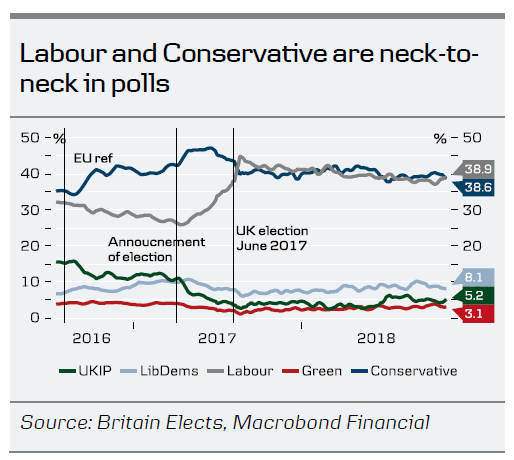
We still believe the likelihood of a new election is low. The Prime Minister cannot call for a snap election anymore and this could only occur if (1) the House of Commons voted for no confidence in the government and no new government were formed within two weeks or (2) the House of Commons dissolved itself by a two-thirds majority. It is difficult to see the Conservative MPs having the incentive to support a snap election, as they risk losing their seats (Labour and the Conservative Party are neck-to-neck in the opinion polls). At some point, some Labour MPs could rebel against the party line and vote in favour of May’s deal in order to move on from Brexit, if/when it became clear that a snap election was unlikely.
FX outlook: EUR/GBP volatile for longer, but lower eventually
In our main scenario, we still expect a ‘decent’ Brexit and we maintain the long-held view that EUR/GBP will break lower towards our ‘Brexit-corrected’ MEVA estimate of 0.82, if/when the deal eventually passes in the UK Parliament.
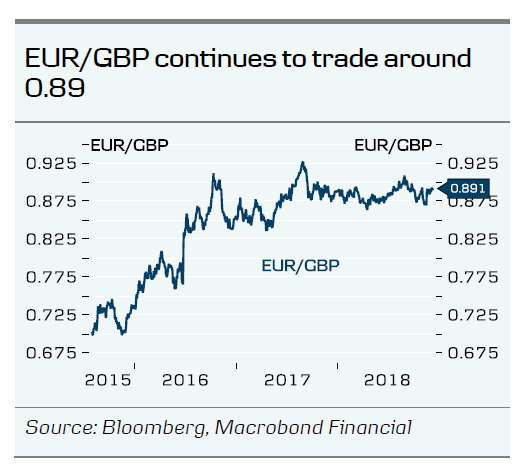
However, given that the Brexit deal will not likely pass in the House of Commons, the vote on 11 December no longer represents a significant ‘digital risk’ for the FX market and GBP. Hence, we see a high risk that Brexit will remain unresolved when we enter 2019, which should keep EUR/GBP in check albeit volatile around the 0.87-0.90 range for a prolonged period. Indeed, we could still see large fluctuations in EUR/GBP after the vote on 11 December, where the initial knee-jerk reaction will depend on the actual vote. However, the biggest move would, in our view, be downward if the Brexit deal, contrary to expectations, is accepted on 11 December.
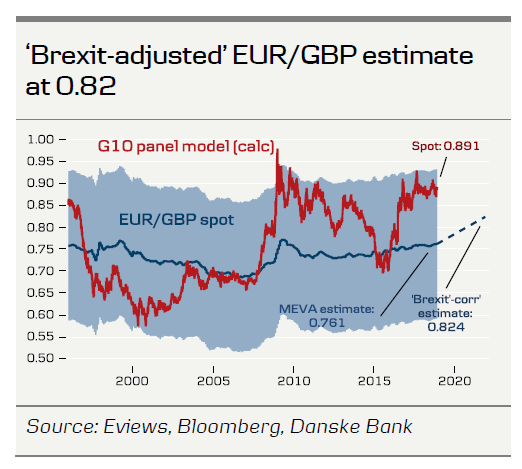
Due to May’s weak political position and the Parliament increasingly taking control over Brexit, the risk of a ‘no deal Brexit’ has, in our view, declined, while the likelihood of a softer Brexit and no Brexit at all has increased substantially. This implies that the outcome distribution for EUR/GBP is now tilted towards the downside, and while spikes higher cannot be ruled out near term, we see a higher risk of EUR/GBP remaining range-bound and volatile for longer, rather than the cross testing 1.00 in the coming three months. This should eventually weigh on EUR/GBP.
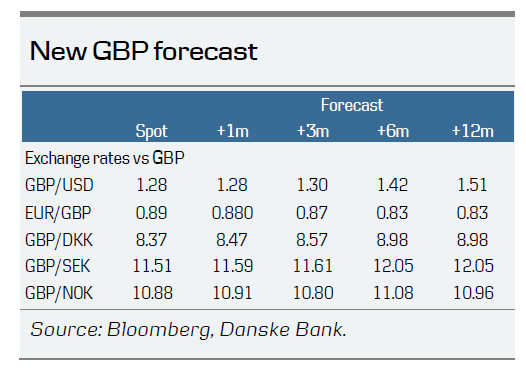
We raise our 1M EUR/GBP forecast to 0.88 (from 0.84 previously) and lift our 3M target to 0.87 (previously 0.83), as the big break lower may not materialise in the coming months. We stress, however, that we see risk skewed to the downside relative to our 3M target in case Brexit is finalised within the next three months. We keep our 6-12M forecast unchanged at 0.83.
FX strategy: Short EUR/GBP via options
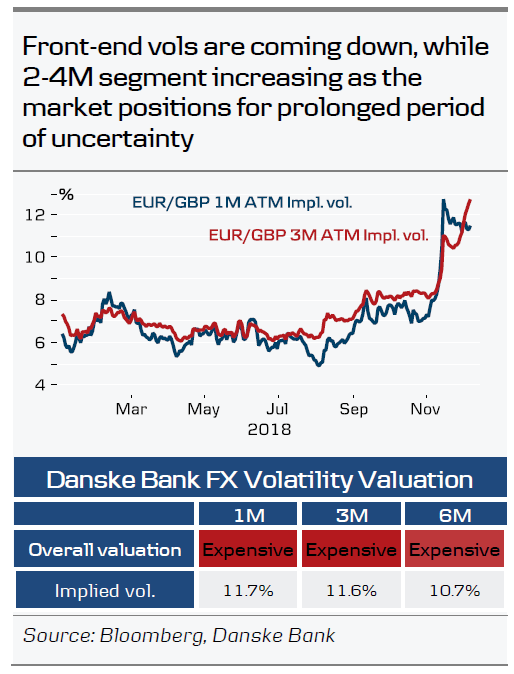
Timing a possible break lower in EUR/GBP is very difficult and given the high degree of ‘digital risk’ in the GBP related to Brexit, we prefer to position for GBP appreciation via FX options. We are short EUR/GBP via 1M-4M put calendar spread as one of our FX Top Trades for 2019. The main risk to this trade is that the big break lower in EUR/GBP materialises within the next month, e.g. if the Brexit deal is accepted by the House of Commons on 11 December or if the probability of a second referendum increases significantly.
Hedging GBP income/asset
We recommend hedging GBP income/assets by buying 25-30 delta EUR/GBP call options. Implied volatility (option price) is very expensive, but we judge that the price is fair given the risk of a bounce in EUR/GBP and not least given the downside potential in our main scenario and other GBP positive scenarios such as a new referendum or ‘no Brexit’. Corporate clients could consider hedging the entire 2019 flow via 3-4M call options. Hedges can then subsequently be swapped out to the actual pay dates when Brexit is clarified. The risk to this strategy is that Brexit remains unresolved when the bought options expire, which would then require buying another period of protection.
Hedging GBP expenses
We are approaching the end of the Brexit path, and we recommend clients hedging GBP payables to increase hedge ratios and hedge horizon via FX forwards. Given the risk of a prolonged period of uncertainty and not least the risk of a near-term bounce in the spot, clients could consider hedging via risk reversals (1-3M). 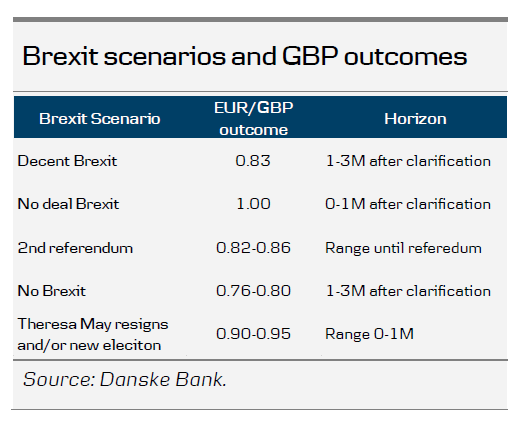
Equity Markets: The Bar Is High For A Sustained Bullish Pivot
Brexit comes front and centre in the week ahead between the UK Parliament’s Meaningful Vote, Tuesday, December 11 and the following EU Summit, December 13-14. Remember that 320 is the crucial threshold to get a deal over the line in Parliament, with the single biggest issue now continuing to be the backstop arrangement.
Foreshadowing a gloomy start to the Asia session, data released on Sunday indicated China’s factory inflation cooled on subdued demand, while consumer price index moderated. The China slowdown has been dominating news outlets for months, and this weaker than expected print will add more ink to the mix. And will provide a stark reminder to Asian consumers getting ready for their holiday season shopping bonanza that local economies are slowing, and consumers will feel the pinch. If you’re living in my neck of the woods ( Singapore) even if you’ve been ” good for goodness sakes”, I would expect that holiday stocking to be a little less full this year.
US Markets(the bar is high for a sustained bullish pivot )
Major US stock indices slumped more than 2% on closing Friday in what was a fitting conclusion to an argy-bargy week that left investors battered, bruised and running for cover after an injury -prone week in the markets.
In the wake of the Huawei, which will likely remain in the headlines for some time as China continues to pressure both Canada and US to withdraw charges, it’s more than apparent that US-China tensions are well beyond trade. And when combined with the fact ‘Tariffs-Limbo’ is likely to extend well into 2019, uncertainty is expected to remain high, and could still explode into a full-blown trade war. And as if we needed a reminder Trader Rep Lighhizer was back stirring the pot again this morning suggesting the US/China trade needs to be resolved by March 1 or new tariffs will be imposed. This announcement comes after China’s trade surplus with the US reaches record levels. But China’s overall trade last month was worse than expected, with export growth slowing to 5.4 per cent and import growth slowing to 3 per cent.
What was once a wall of worry built out of mud brick and bamboo which quickly eroded on the first glimmer of a US equity market rebound, has now morphed into an impenetrable edifice made of concrete block and rebar which towers menacingly over the global capital market Even more so as those US equity market rebounds are few and far between these days.
Uncertainty about US-China relations couple with concerns about the health of the US economy is hurting risk assets across the board. Indeed, market sentiment remains fragile, and the US November employment report didn’t precisely provide a rosy outlook for the health of the US economy.
Of course, the markets are always prone to short covering rallies; even still I expect traders to be better sellers for risk knowing the hurdle for flipping to bullish positions seems high.
But do buckle in for yet another President Trump twitter offensive as the focus shall next be on China Vice Premier Liu He’s visit to Washington DC from 12-14 Dec’18.
There is so much hinging on the policy decision by the leader of the two largest economies
Oil markets( desperately seeking stability)
Oil is up marginally this morning after Friday OPEC cut
WTI initially surged towards the mid-50s on a 1.2mn production cut from OPEC. While the analysts were out in hoards with canned commentaries post-OPEC, but frankly, the only sigh of relief for oil bulls was the opportunity to cut intraday long positions, as industry veterans know oil markets are not even close to being out of the woods yet. As of yet, we have no idea what will happen on the US Iran sanctions waivers, and we still do not know what President Trump’s response will be, which is not going to be market stabilising that’s for sure. A cooling global economic climate which is being reflected in struggling US shares markets, I would be amiss not to suggest that Oil prices were weighted down by Friday US equity markets sell-off.
I didn’t lose any sleep over the OPEC announcement although it came in higher than the mean estimates. I’m not convinced about Friday’s bounce as the bar for a positive surprise was shallow, particularly after Saudi oil minister Al-Falih indicated on Thursday that no agreement was guaranteed. So, the price action was an unwinding of negatives triggering an interday short squeeze, with few if any new positives are coming to the table. And while this cut should help actuate OPEC self-inflicted production damages, it’s probably not thick enough to eliminate global supply inventory overhang and trigger a bullish market follow through.
However technical analysts are reminding us the Oil WTI could head back to $ 60 per barrel as recent price action is eerily similar to 2011 when Oil prices plummeted 35 % followed by a 26 % rally over 4 weeks. The only bit of caution I suggest in this view is that ” times are a changin” in the oil markets. But no doubt Oil charts will be included in virtually every technical analysts ” 12 Charts of Xmas” packages.
Now we make the all-important pivot to April OPEC meeting; investors will be looking for evidence of how much of these cuts will be delivered, while OPEC monitors market conditions to determine if further adjustments are needed to maintain price stability. Interesting this breaks with OPEC convention of scheduling meeting every six months so apparently OPEC is serious about fine-tuning the supply side of the equation which could keep a base intact on oil prices.
While OPEC matters, it’s becoming more apparent the colossal super producers Russia -Saudi Arabia and the US appear to be the main oil market rudders. Russia wants to pump; the US wants lower prices while Saudi needs higher pricing as ageing oil field are more expensive to produce. But let’s face it, Russia is as compelling to OPEC as Riyadh, and the U.S. are now net exporters of oil all of which suggest the balance of power is shifting. But at the end of the day, US political pressure over Saudi Arabia is likely handcuffing the Kingdom from making the necessary cuts required to rebalance oil markets for their domestic concerns favourably.
Baker Huges reported that US driller cut the most rigs since May 2016 despite record production
Gold Markets
A weaker USD, softer US NFP data and sagging US equity futures this morning has gold back to testing the $1,250 levels. With risk in the tank coupled with the Fed dovish pivot, gold continues to shine.
Currency Markets( looking for the next big trade)
The US dollar traded slightly weaker after a miss on Friday’s NFP headline and wages data, but the participation didn’t change. G-10 majors were confined to a relatively muted range, however, knowing that this miss does not alter the broader macro landscape of robust growth and subdued inflation, and will not change the Fed plans to raise rates in December and into 2019. But in the US market focus will turn to this weeks inflation prints
AUD: The Aud is trading lower out of the gates this morning on follow through effects from the weaker China inflation prints. The outlook remains negative for the Austraila dollar over concerns about China trade, while on the domestic front credit and housing market conditions are weighing dovish on RBA policy.
EUR: Its the moment of truth for the ECB this week where it is widely expected the ECB will end the APP but the master of illusion Mario Draghi will likely temper the Euro ambitions by revising inflation forecast lower, given the recent string of poor EU economic data.
At his latest press conference, Draghi said that a few board members discussed TLTRO’s, but since then nary a peep suggesting the ECB may keep those powders try for perhaps for more desperate times.
However, the EUR is still trading in a range as seller emerge above 1.1400 as weak EU data weighs will support remains firm below 1.1300 as with only seven bps of rate hike priced into the 2019 rate curve; it does look far too cheap. But traders are increasingly warming up to the later suggesting we could see a push higher ahead of this week ECB.
GBP: Tuesday will also see one of the most significant events lined up for the week – Westminster’s verdict on Theresa May’s Brexit plan. Remember, 320 is the crucial threshold to get a deal over the line in Parliament, with the single biggest issue at the moment continuing to be the backstop arrangement. GBP is very much a binary reactive trade and very much subject to the headline roulette wheel. This morning , The Times is reporting PM May is expected to face 48 MP letters this week calling of her to step down.
JPY: USDJPY trading continues to spin a broken record as even in the face of US equity market routs the pair continues to hold firm at 112.50 and surprising many. But with the shift to a more dovish Fed view, traders are moving away from an early BoJ interest rate hike . However, the S&P futures are opening up poorly this morning and we are back to testing 112.50 once again as risk off greets Asia this morning.
Asia Currency Markets
Local markets are still beating to the pulse of the Huawei headlines
IDR: Sentiment remains favourable as the reducing of long USDIDR positions continues as Foreign investment inflow into Fixed Income market ( carry trade) remains buoyant.
MYR: After last weeks surprising test of 4.15 on USDMYR long unwind, and strong bond flows. Traders will focus on oil prices in the wake of OPEC production cut.
CryptoMarkets ( I’m ducking already from the soothsayers’ retort )
When Bitcoin fell through $6000, I expected BTC to trade $3500 in December and then possibly follow through down to $2500 in the New Year. And Gold would shine into year end due to escalating political risk. And let me tell you did I hear it on social media from soothsayers and HODL (those holding on for dear life) getting accused of shattering their “LAMBO” dreams. Nothing personal here just calling things as I see them, that’s what people with 20 + years in the market do for a living.
Well, in three weeks, coins have shed another 30 % and to think only a year ago we were at $ 20,000. Of course, at that time I would be lying if thoughts of joining a secret nerdy libertarian crypto club didn’t cross my mind. Fortunately, someone reminded by about “Tulip Mania” in the 17 the century.
But, Bitcoins have gone well beyond the ridiculousness of tulip bulb mania. It’s has been a disastrous year for Cryptos, and by all indication, the current bear market could go from bad to worse with no fundamental or underlying reasons to buy BTC even more so when the only support offered up is a squiggly line on an analyst chart. Not to mention, it’s Xmas time, people need dollars, not Crypto coins to buy a gift.
But when factoring in a more regulatory oversight and the world of tighter credit conditions, there is probably a bit more downside on this trade with $2500 looking much likelier than $6000 is today