

Sample Category Title
Pound Drops Momentarily Below 1.30 on Brexit Woes; Oil Set for Fifth Weekly Loss
Here are the latest developments in global markets:
- FOREX: The British economy expanded by 1.5% y/y in the third quarter as expected, preliminary data showed. The UK’s trade deficit narrowed, and the manufacturing output was slightly better than forecast in September. However, the evidence on business investment was disappointing and today’s discouraging Brexit headlines were enough to push pound/dollar straight down to 1.2988 before a reversal to 1.3035 (-0.15%). Particularly, capital expenditures decreased by 1.2% q/q in Q3 compared to a 0.2% expected rise, printing the biggest loss since Q1 2016. On the Brexit front, the DUP’s Brexit Spokesman, Sammy Wilson, reacted harshly to the British PM’s detailed Brexit letter after May seemed to back a different regulation for Northern Ireland than for the rest of the UK under the backstop clause. Wilson threatened to vote down the exit plans in the House of Commons if the proposals remain on the table. Pound/yen retreated by 0.53%, while euro/pound was in positive territory, gaining 0.20%. Meanwhile in the eurozone, concerns over the EU-Italian budget dispute scaled up following the European Commission’s forecasts on the Italian economy, which appeared more pessimistic than Rome’s predictions yesterday, particularly on the size of the public deficit. US tariff threats on EU cars seem to remain alive according to the EU Trade Commissioner, who argued that the US shows little willingness to strike a deal with the EU on the matter. Euro/dollar extended Thursday’s downside to 1.1325 before inched up to 1.1347(-0.11%), to the lowest since November 1. The dollar index was trading flat at 96.78 and dollar/yen slipped to 113.84 (-0.18%) after the Fed kept interest rates steady as expected and remained on course for further monetary tightening. Yet policymakers acknowledged the weakness in business investment, with markets seeing the US-Sino trade war responsible for the shortfall, especially after Moody’s reported on Thursday that the tensions between the sides could fire up in 2019 and global growth may slow in the next two years. Dollar/loonie rallied as high as 1.3197, a level never seen since early September, on the back of tumbling oil prices.
- STOCKS: European stocks followed US and Asian stocks lower on Friday, perhaps weighed by the Fed’s cautious statement on US business investment. The pan-European STOXX 600 and the Euro STOXX 50 were down by 0.55% at 1040 GMT. The German DAX 30 fell by 0.47%, the French CAC 40 declined by 0.80% and the UK’s FTSE 100 retreated by 0.57%. The Italian FTSE MIB was the worst performer, losing 1.20%. Futures tracking the S&P 500, Dow Jones and Nasdaq 100 were flashing red, pointing to a negative open.
- COMMODITIES: Crude prices turned increasingly bearish on Friday as concerns about supply build-ups and a slowing global economy weighed on market sentiment. WTI crude and Brent were heading for the fifth negative weekly close, with the former bridging below $60/barrel to touch a nine-month low at $59.28 (-1.94%) and the latter breaking support at $70 to register 7-month lows at $69.13 (-1.66%). In precious metals, gold remained on the downside, extending losses towards $1219 (-0.32%).
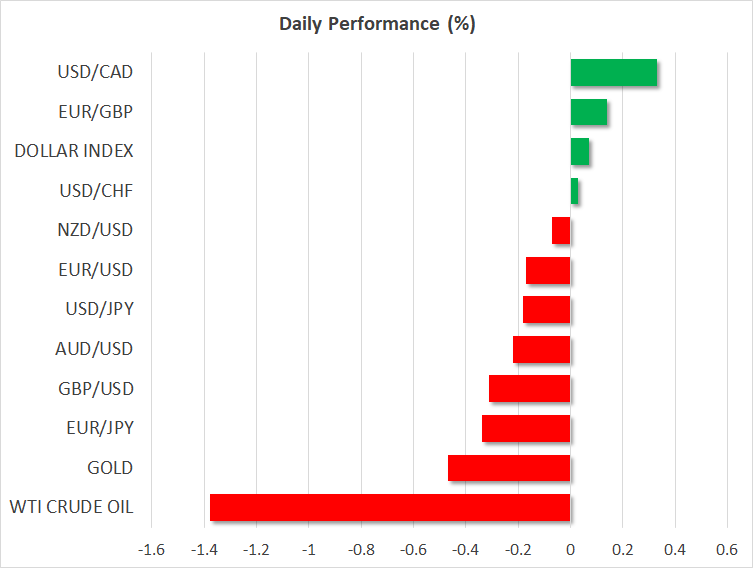
Day ahead: US PPI figures eyed; flash University of Michigan Consumer Confidence Index in focus
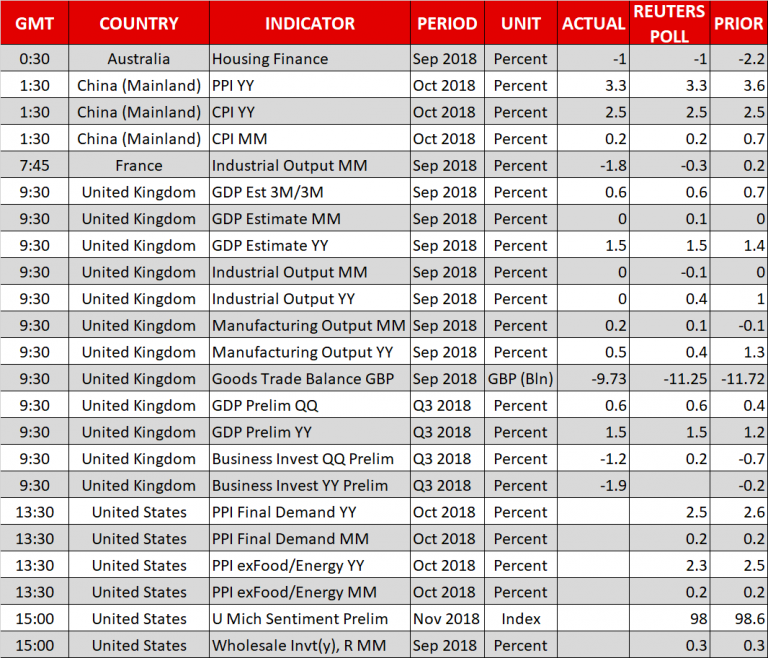
In the remainder of the day, the calendar will feature producer prices and wholesale inventories out of the US, while the University of Michigan will deliver initial estimates on the US consumer sentiment.
At 1330 GMT, the US Producer Price Index, another gauge for inflation, is expected to show that the price of overall goods sold by manufacturers has risen by 2.5% y/y in October, slightly less than in September when the gauge showed a growth of 2.6%. In the absence of food and energy, the core PPI is anticipated to ease to 2.3% y/y from 2.5% giving an early sign that inflation pressures might have stalled for the third month before the CPI figures, a more popular inflation measure, come into view next week.
At 1500 GMT, growth in wholesale inventories is said to have expanded by 0.3% on a monthly basis in September, the same as in August, while separately, the preliminary University of Michigan Consumer Sentiment Index is projected to have declined for the third month in November. Particularly, the index is seen lower by 0.6 points at 98 and still below the 8-year high of 102 reached in March. The survey’s sub-indexes measuring inflation expectations have proved market-moving in the past and will thus also be attracting attention. Should the numbers prove that confidence among consumers has lessened by more than analysts think, then the dollar could see selling interest today. Yet with the Fed pledging additional rate hikes in the near future, bearish movements could be curbed.
In energy markets, oil prices might move in the wake of the Baker Hughes oil rigcount at 1800 GMT.
As for scheduled public appearances today, Bank of England chief economist Andy Haldane will be speaking at 1830 GMT. Earlier in the US, New York Fed President, John Williams (permanent voting FOMC member) and the Philadelphia Fed President, Patrick Harker (non-voter) will be commenting at the America’s Workforce Book launch at 1330 GMT and 1345 GMT respectively. Meanwhile, at 1405 GMT, the Fed Vice Chair for Supervision, Randal Quarles (permanent voter) will be speaking on Stress Testing in Washington.
Brexit, trade and the Italian budget story may continue to feed risk-off sentiment during the day.
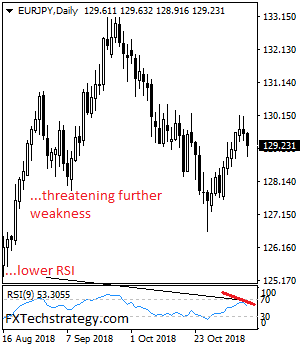
EURJPY Immediate Risk Remains Lower Towards 128.60 Region
EURJPY: immediate risk remains lower towards its key support located at 128.60 zone. Further down, support comes in at the 128.00 level where a break if seen will aim at the 127.50 level. A cut through here will turn focus to the 127.00 level and possibly lower towards the 126.50 level. On the upside, resistance resides at the 129.50 level. Further out, we envisage a possible move towards the 130.00 level. Further out, resistance resides at the 130.50 level with a turn above here aiming at the 131.00 level. On the whole, EURJPY continues to face further downside threats nearer term.
European update: Dollar struggles to extend gain, Sterling weakest after GDP
Dollar tries to extend post FOMC rally today but there is little success so far. Firstly, the greenback is overshadowed by Yen and Swiss Franc. Yen is clearly lifted by risk aversion. Meanwhile, Swiss Franc trades higher on some mild weakness in emerging market currencies like Rand and Lira. Secondly, there is no technical breakthrough in Dollar pairs today. USD/HF is limited below 1.0094 resistance. EUR/USD is held well above 1.1300 key support. And even GBP/USD and AUD/USD are held well above 1.2951 and 0.7182 minor support levels respectively.
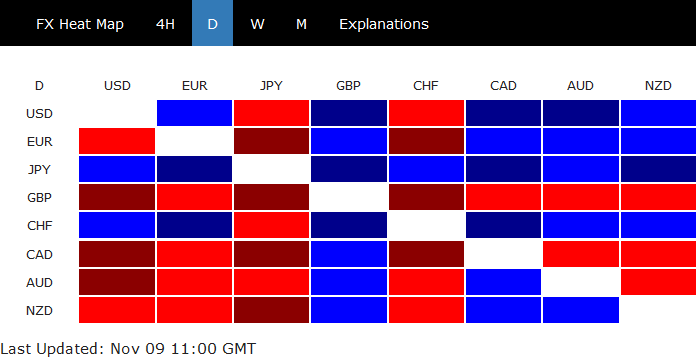
Sterling is trading as the weakest one even though Q3 GDP grew 0.6% as expected. But September's monthly GDP miss raises some doubt over the outlook ahead. And there is never-ending Brexit negotiation, without any progress on Irish border backstop. Canadian Dollar follows as the second weakest, and the Australian Dollar.
In European markets, all major indices are down at the time of writing.
- FTSE is down -0.86%
- DAX is down -0.73%
- CAC is down -1.01%
- German 10 year yield is down -0.0271 at 0.433
- Italian 10 year yield is up 0.030 at 3.432... spread is pressing 300 again
Asian indices also closed broadly down
- Nikkei dropped -1.05% to 22250.25
- Hong Kong HSI dropped -2.39% to 25601.92
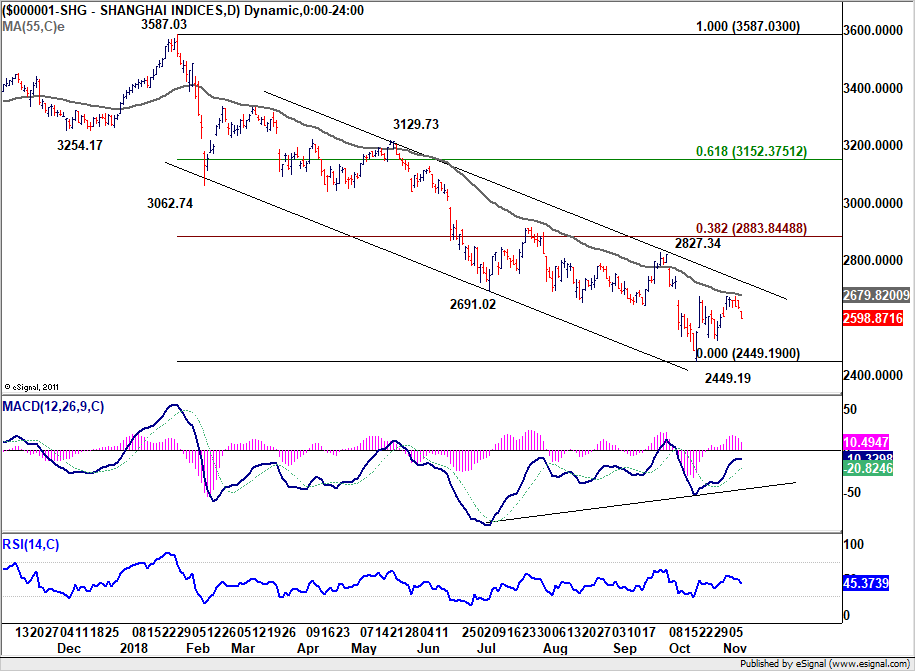
- Shanghai SSE dropped -1.39% to 2598.87
- Singapore Strait Times dropped -0.49% to 3077.97
Is SSE's corrective rebound from 2449.19 completed ahead of 55 day EMA? Probably.
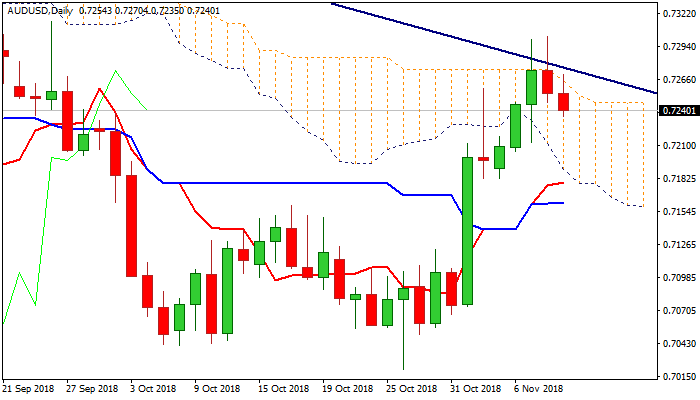
AUDUSD Outlook: Pullback Expected To Offer Better Buying Opportunities While Supports At 0.7190/80 Hold
The Australian dollar stands at the back foot on Friday and extends pullback after double upside rejection at 0.7300 zone and repeated failure to close above cracked top of falling daily cloud.
Lower Asian stocks and weaker than expected Australian housing data added to negative near-term sentiment, offsetting overall positive tone from RBA's monetary policy statement, with bearish signal coming from reversal of daily slow stochastic from overbought zone.
Overall structure remains bullish with pullback seen as positioning for renewed attempt at strong resistances at 0.7260/75 zone (20WMA/100SMA/daily cloud top/Fibo 38.2% of 0.7676/0.7017/trendline resistance).
Strong supports at 0.7190/80 zone (Fibo 38.2% 0.7020/0.7302/rising 10SMA/daily cloud base) need to contain extended downticks to keep bulls in play for fresh advance. Conversely, close below 0.7180 pivot would sideline bulls and signal further weakness.
Res: 0.7299, 0.7314, 0.7381, 0.7446
Sup: 0.7235, 0.7194, 0.7180, 0.7161
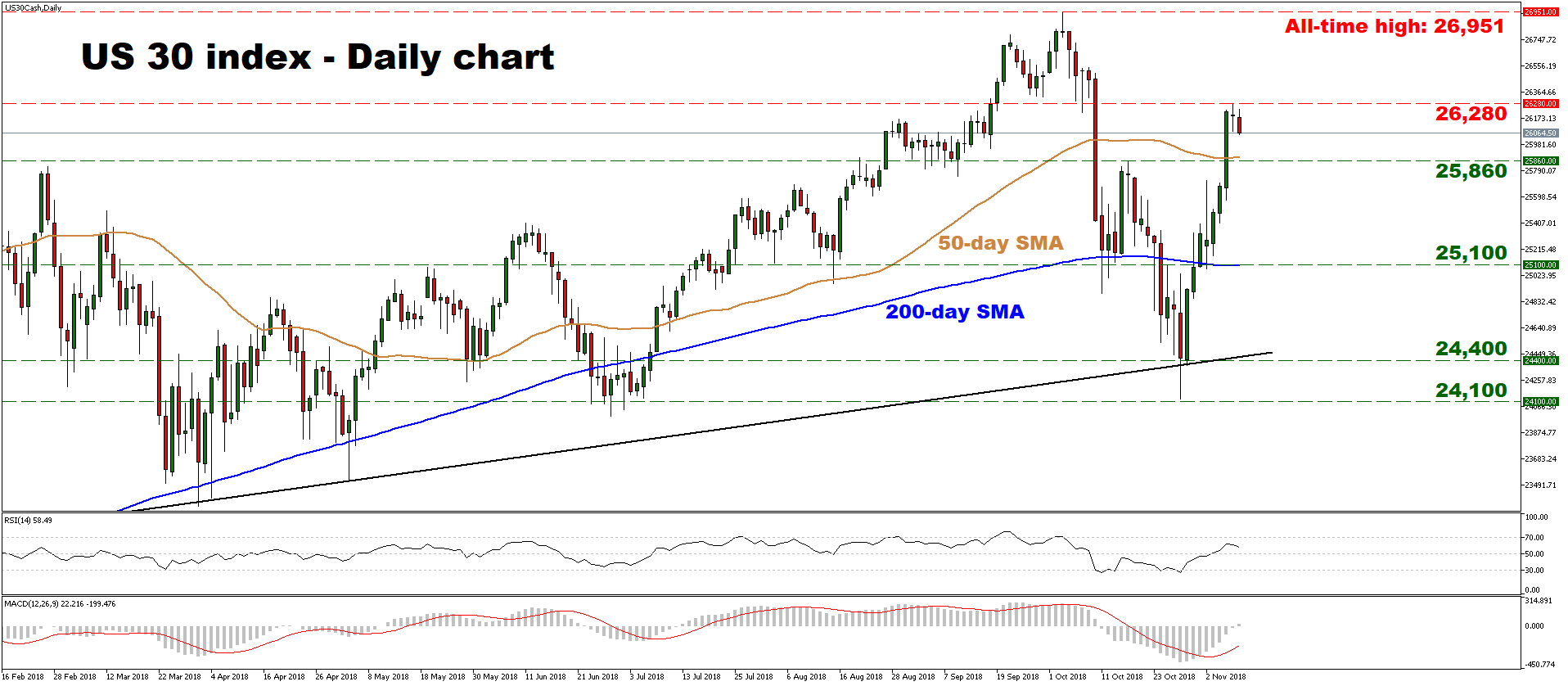
US 30 Index Bounces Sharply, Re-Approaches Rrecord Highs
The US 30 index rebounded sharply in recent sessions, after finding support near a medium-term uptrend line drawn from the lows of February 6. The index has now crossed back above both the 50- and 200-day simple moving averages (SMA), which implies the short-term outlook is now back to positive.
Taking a look at short-term oscillators, the RSI looks to be headed lower for a test of its neutral-50 line, signaling that positive momentum is losing some steam. The MACD, on the other hand, rests safely above its red trigger line and has just crossed above zero, painting a predominantly bullish picture.
Further advances in the index could encounter immediate resistance near the November 8 high of 26,280. If the bulls pierce it, that may open the way for a test of 26,951, the all-time high recorded on October 3. Another upside break would bring the index into unchartered waters, with advances likely to stall near round figures that may hold psychological importance, such as 27,500 and 28,000.
On the other hand, another pullback could meet preliminary support around the crossroads of the 25,860 zone and the 50-day SMA, currently at 25,886. A bearish break would turn the picture to neutral and shift the focus to 25,100, where the 200-day SMA is also located at present. Even further downside extensions would turn the short-term outlook negative, setting the stage for a test of the October 30 trough at 24,400, and the aforementioned uptrend line.
To sum up, the short-term picture has realigned with the medium-term one and is back to positive, though a break back below the 50-day SMA would bring that into doubt.
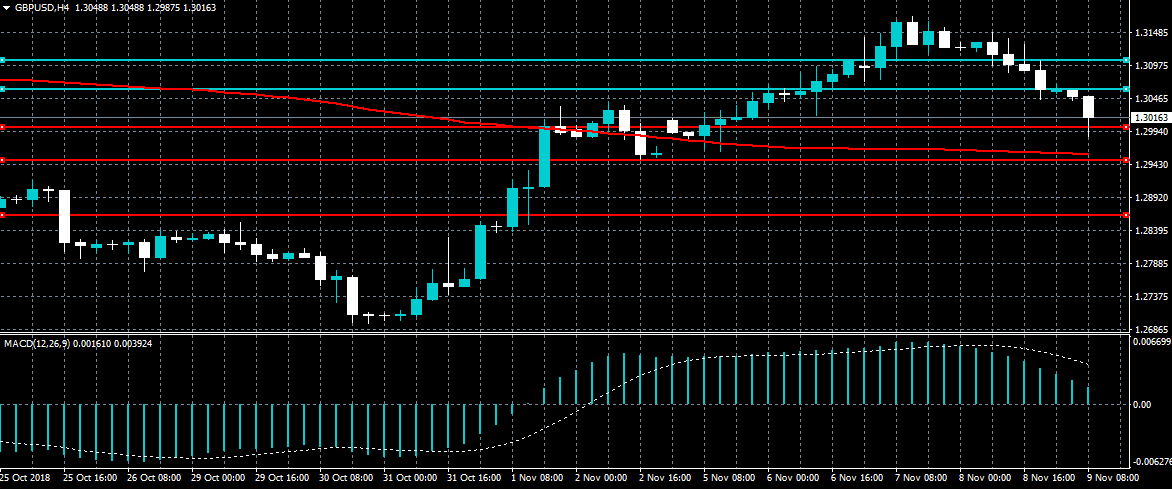
GBPUSD Testing Psychological 1.3000 Level
The British pound has continued to move lower against the US dollar during the European trading session, following weaker than expected UK GDP data and bearish Brexit headlines. The GBPUSD pair is likely to experience further technical selling if the psychological 1.3000 support level is broken. Sterling traders now await key inflation and consumer confidence data from the US economy.
The GBPUSD pair is strongly bearish while trading below the 1.3000 level, key support is found at the 1.2955 and 1.2866 levels.
If the GBPUSD pair holds above the 1.3000 level, price could correct back towards the 1.3055 and 1.3100 resistance levels.
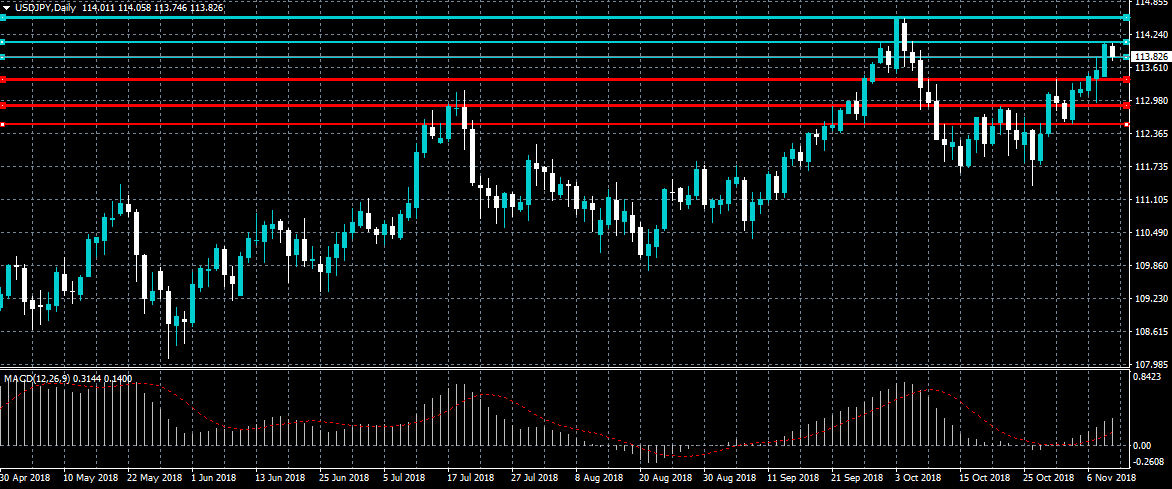
USDJPY Rejected At 114.00 Resistance
The US dollar is testing former breakout resistance now turned support against the Japanese yen currency after a second technical rejection from the 114.00 level. The intraday bias surrounding the USDJPY pair is bullish while trading above the 113.81 level. Buyers will likely aim for the 114.54 level, while technical sellers need to close the week below the 112.90 support level.
The USDJPY pair is only intraday bullish while trading above the 113.81 level, key resistance is found at the 114.10 and 114.54 levels.
If the USDJPY pair moves below the 113.81 level, key support is found at the 113.37 and 112.90 levels.
USD/CAD – Bullish Fed Sends Canadian Dollar To 8-Week Low
The Canadian dollar has posted losses in the Friday session, following the trend seen on Thursday. Currently, USD/CAD is trading at 1.3195, up 0.31% on the day. The pair is trading at its highest level since early September. There are no Canadian events on the schedule. In the U.S., PPI and Core PPI are both expected to post gains of 0.2% for October, unchanged from the September readings. As well, UoM Consumer Sentiment is forecast to slow to 98.0 points.
After the intense excitement surrounding the U.S. mid-term elections, the Federal Reserve meeting paled in comparison. The markets were not expecting much drama, as it was not really a “live meeting” – there was virtually no chance of a rate hike and no press conference from Fed chair Jerome Powell. Fed policymakers continued to sound hawkish in the rate statement, in a similar vein to the previous statement in September. Fed policymakers noted that job creation is solid, unemployment is down and consumer spending has been growing. The one caveat to this rosy picture was that business investment has slowed. The statement added that further “gradual increases” are expected, given that headline and core inflation are close to the Fed target of 2 percent. The Fed next convenes in mid-December, with the CME Group pegging the odds of a December rate hike at a strong 76 percent.
A red-hot U.S economy has helped boost the Canadian economy, which continues to perform well. This was underscored on Thursday by a superb reading from Ivey PMI, a key gauge of economic activity. The indicator surged to 61.8 in November, up sharply from 50.4 in October. This reading easily beat the estimate of 50.9 points. Earlier this week, Bank of Canada Governor Stephen Poloz said that the Bank would continue gradually raising rates from the current 1.75% to a “neutral stance” of between 2.5% and 3.5%. The magic question for investors is how quickly the BoC will move in this direction. The BoC has raised rates some five times in the past 15 months, and upcoming rate hikes will help make the Canadian dollar an attractive option for investors.
Stocks Fall Amid China Worries, Dollar Holds Gains
European stocks slid, following a retreat in Asia, amid growing concerns about a slowdown in China and policy makers’ steps to address it. The dollar advanced as the Federal Reserve stayed on track for a December rate hike. Mining and energy shares led a drop in Europe’s main equity gauge after crude oil entered a bear market. Futures contracts pointed to second day of declines for U.S. stocks. Equities in Hong Kong and China led losses in Asia, with financial shares doing particularly poorly following news that Beijing plans to set quotas for banks to pump credit into private companies. Treasury yields edged lower.
Softer Chinese producer-price gains, weak car sales and a disappointing outlook from a top online travel company combined to reignite lingering concerns about the health of the world’s second-biggest economy. That’s capturing investor attention after a Fed rate meeting on Thursday that offered few surprises, with policymakers repeating their outlook for “further gradual” increases. Meanwhile, the offshore yuan held this week’s drop, amid little sign of an end to the U.S.-China trade war in the wake of the midterm elections. The pound weakened and gilts gained amid ongoing speculation over a potential Brexit deal. Emerging-market stocks and currencies slid.
The Stoxx Europe 600 Index dipped 0.5 percent as of 9:22 a.m. London time, the largest decrease in two weeks. Futures on the S&P 500 Index fell 0.4 percent, the biggest fall in a week. The MSCI Asia Pacific Index declined 1.1 percent. The MSCI Emerging Market Index sank 1.5 percent to the lowest in more than a week on the biggest tumble in more than two weeks. The Bloomberg Dollar Spot Index climbed 0.2 percent to 1,206.62, the highest in more than a week. The euro declined 0.2 percent to $1.1337, the weakest in more than a week.
DAX Dips As Fed Reserve Remains Hawkish
The DAX index has dropped lower in the Friday session, after sharp losses on Thursday. Currently, the DAX is trading at 11,470, down 0.50% since the Thursday close. In economic news, there are no German or eurozone indicators, so movement in the Friday session will be mostly driven by U.S inflation and consumer confidence numbers later in the day.
The intense mid-term elections in the U.S. earlier this week boosted global stock markets and gave the DAX a slight boost, but the upward momentum quickly dissipated after the Federal Reserve rate statement on Thursday. Investors were not expecting anything significant from the Fed meeting and policymakers did not disappoint. The Fed had trouble locating trouble spots in the U.S economy, which continues to fire on all cylinders. The rate statement noted that job creation remains strong, unemployment is down and consumer spending has been growing. The one caveat to this rosy picture was that business investment has slowed. The statement added that further “gradual increases” are expected, given that headline and core inflation are close to the Fed target of 2 percent. The Fed next convenes in mid-December, with the CME Group pegging the odds of December rate hike at a strong 76 percent.
Are Rome and Brussels headed for a nasty collision? The crisis over the Italian budget shows no signs of easing anytime soon, and the fallout could weigh on the financial markets and on the euro, which has broken below the 1.14 level. The EU’s Economic Commissioner, Pierre Moscovici, has demanded that Rome revise its budget, which it says increases Italy’s debt and is in breach of EU rules. Moscovici has demanded a response from Rome by November 13 and has even threatened sanctions if the Italian government does not comply. On Wednesday, Italian Prime Minister Giuseppe Conte said that he had no intention of backing down over the budget. Italy is the third largest economy in the eurozone, and the financial markets and the euro could react negatively if Rome and Brussels cannot resolve the crisis.