Sample Category Title
Dow Eases after Hawkish Fed; Initial Reversal Signal is Generating on Daily Chart
Dow stands at the back foot on Friday, as Asian and European stocks were lower and hawkish Fed surprised investors, dampening demand.
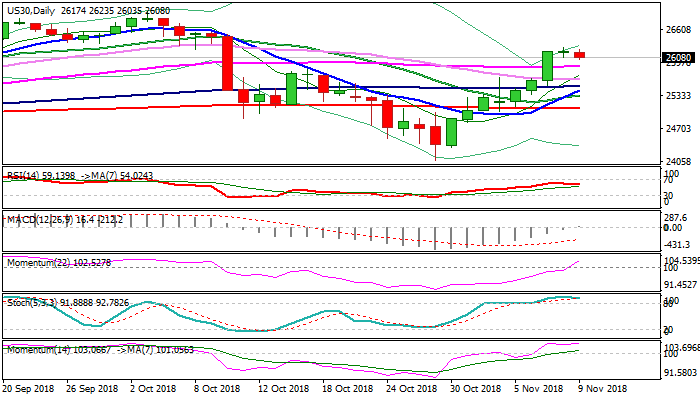
Thursday's trading ended in Doji, which signaled that steep ascend in past two weeks is running out of steam, with fresh easing on Friday, forming reversal pattern on daily chart. Close in red on Friday would generate initial reversal signal which requires confirmation on close below pivotal supports at 25958/00 (daily cloud base/55SMA).
The notion is supported by reversing slow stochastic in deep overbought territory and sideways-moving momentum.
Strong rally in past two weeks requires correction, but overall structure remains bullish and extended pullback should find support at 25430 zone (rising 10SMA/Fibo 38.2% of 24085/26267 rally) to keep bulls in play.
Res: 26267; 26283; 26509; 26550
Sup: 26035; 25958; 25900; 25639
Week Ahead – After Central Banks and Midterms, Focus to Move Back to Economic Data
With central bank meetings and the US midterm elections out of the way, economic data will return to the forefront next week. Monthly stats on inflation, industrial output, employment and retail sales will dominate the calendar, while GDP numbers out of Japan will be watched for a possible contraction in Q3. Italian politics will also be on investors’ radar over the coming week as the country has until November 13 to submit a redraft of its budget or risk EU fines. OPEC could be making the headlines too as major producers meet on November 11 to discuss possible cuts to crude oil output.
Aussie eyes Australian and Chinese data to maintain upside momentum
The Australian dollar rallied to 6-week highs this week as easing trade tensions, relief from the US midterms and an upbeat RBA lifted the currency. But the aussie could be at risk of a downside correction should next week’s figures disappoint. First up on the watchlist is the NAB business confidence gauge on Tuesday, which will be followed by the Westpac’s consumer sentiment index on Wednesday. However, the more important release on Wednesday will be the quarterly wage price index, plus some Chinese indicators.
Australian wage growth is forecast to have accelerated slightly in the third quarter, from 2.1% to 2.3% year-on-year. If confirmed, it would support the RBA’s view that wage pressures should start to gather pace as unemployment declines. The latest look on the jobs market will arrive on Friday but before then, investors will be able to sift through China’s monthly reads on industrial output, fixed-asset investment and retail sales.
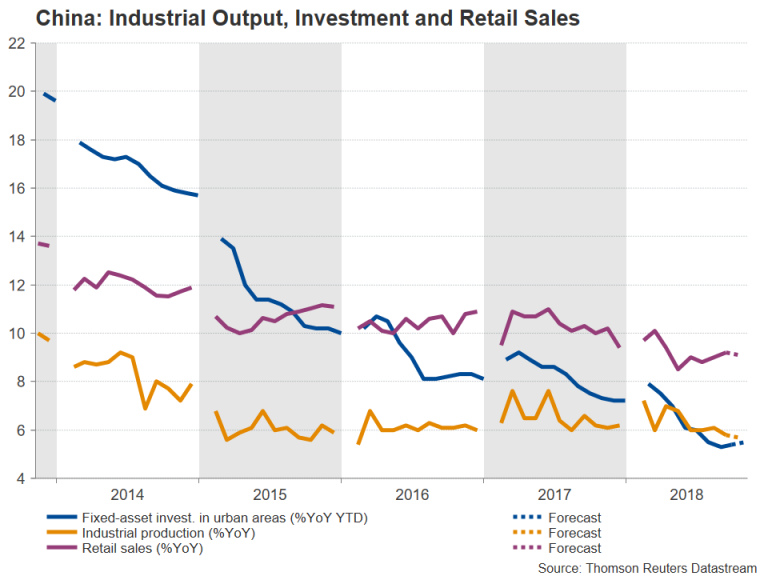
Industrial output growth is expected to slow further in October to 5.7% y/y, after hitting a 2½-year low of 5.8% in the prior month. Investment in urban areas is forecast to quicken marginally from 5.4% to 5.5% y/y in the year-to-date in October. Meanwhile, retail sales growth, which has been on an uptrend after hitting a 15-year low in May, is predicted to ease slightly to 9.1% y/y in October. A worse-than-expected slowdown in these key barometers would be negative for risk sentiment and the aussie, which often acts as a liquid proxy for the Chinese economy due to Australia’s dependence on exports to China.
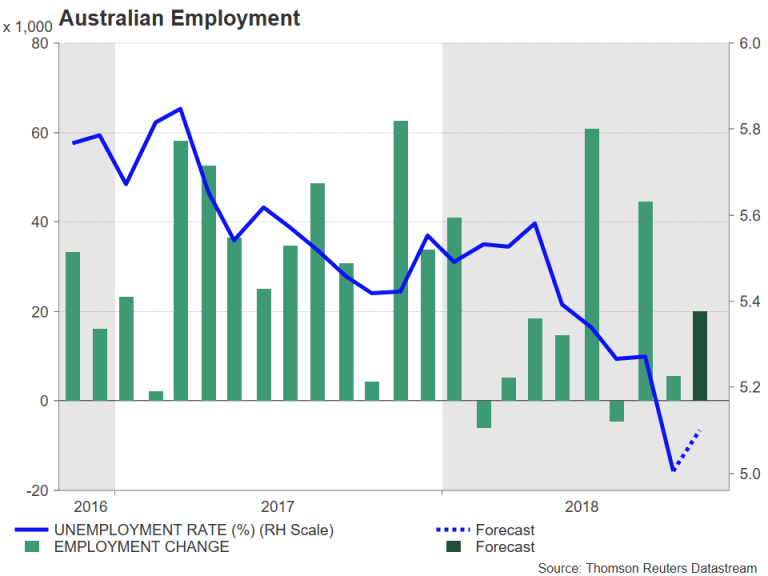
Lastly for the aussie, employment numbers will be the highlight on Thursday. The Australian economy is forecast to have added 20k jobs in October, picking up from a gain of 5.6k in September. The unemployment rate is expected tick higher, though, to 5.1%, due to an anticipated rise in the participation rate.
Japan’s economy to contract again in Q3
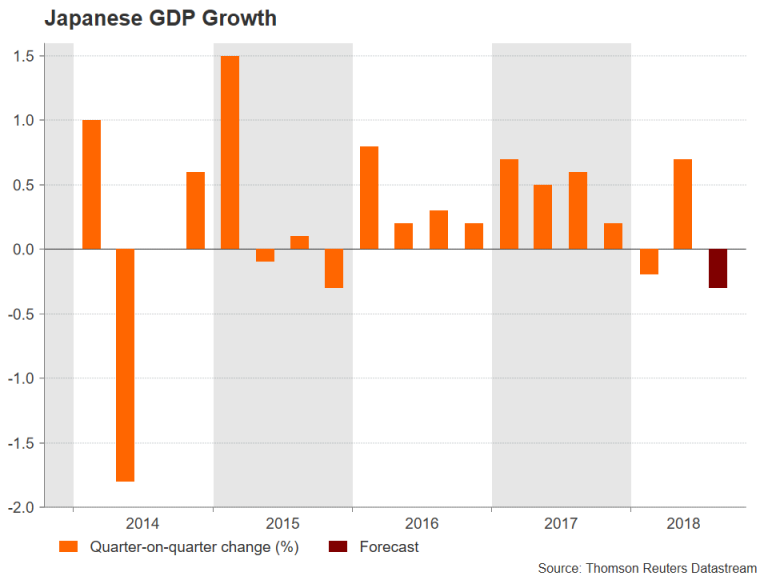
November hasn’t been a very good month for the yen so far (to the likely relief of policymakers). The recent efforts by the US and China to restart a trade dialogue, a dovish Bank of Japan, and drama-less midterm elections have taken the shine off the safe-haven Japanese currency. The yen could face additional selling pressure next week if the GDP figures, due Wednesday, show a negative print. After bouncing back from the first quarter dip by a descent 0.7% quarter-on-quarter rate in the second quarter, Japan’s economy is projected to have shrunk again in the latest quarter. GDP is seen to have declined by 0.3% q/q in the three months to September. A worse reading would further push back the foreseen timing of the BoJ’s exit from its massive stimulus program, as well as add to the deteriorating outlook for world growth in 2019.
Euro unlikely to find much direction from Eurozone indicators
The euro got a helping hand from a softer US dollar earlier this week to briefly recover back above the $1.14 handle. An upward revision to the Eurozone’s final composite PMI for October and some better-than-expected industry data out of Germany also bolstered the single currency. However, next week’s releases could struggle to inject more positive sentiment as it may be too early to anticipate convincing signs of a turnaround in Eurozone growth momentum, not too mention the ongoing standoff between Italy and the EU that’s still weighing on the currency. The European Commission has given Italy until November 13 to submit revised budget proposals, but the coalition government appears unwilling to budge, risking a much more contentious confrontation with the EU.
Tuesday’s German ZEW business survey will probably provide further evidence of the subdued picture. The ZEW economic sentiment index is forecast to fall further in November from -24.7 to -25.0, which would make it a 6-year low. On Wednesday, Eurostat will publish its second estimate of GDP growth for the euro area in the third quarter. Eurozone growth is expected to remain unrevised at 0.2% q/q in Q3, confirming the slowdown from the prior 0.4% rate. Industrial production figures for September are also out on Wednesday, while on Friday, the final estimates of Eurozone inflation for October are due.
Plenty of UK data but pound to remain hostage to Brexit headlines
It will be a busy calendar for the UK next week as employment, inflation and retail sales figures are out on Tuesday, Wednesday and Thursday, respectively. The UK labour market is expected to stay near full employment, with the unemployment rate holding at 4% in the three months to September. Total average weekly earnings are forecast to pick up to a three-year high of 3.0% y/y during the period, potentially boosting real incomes.
On Wednesday, the focus will turn to the latest CPI figures. The annual rate of inflation unexpectedly eased to 2.4% in September. It is projected to edge up to 2.5% in October. Core inflation is also expected to head higher, rising to 2.0% y/y.
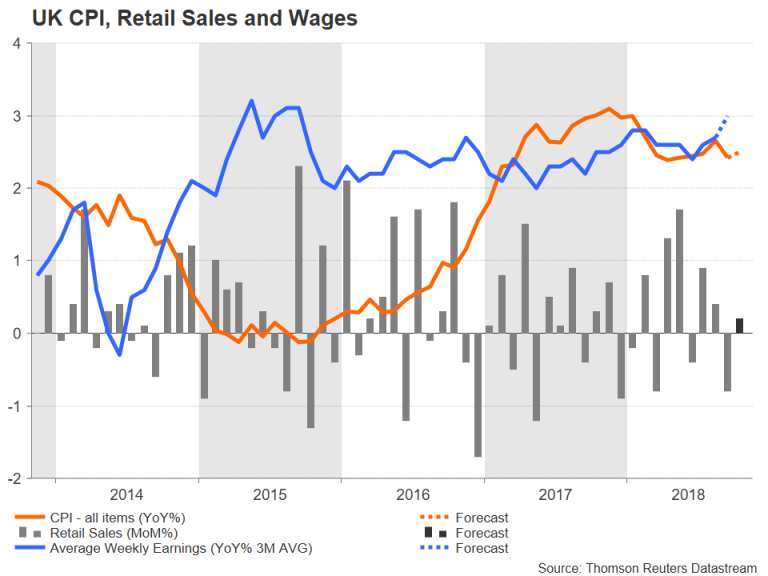
Finally, retail sales will be monitored closely to assess the strength of consumer spending during October, given that consumption accounts for around two thirds of UK GDP. Retail sales are forecast to have increased by 0.2% month-on-month in October, rebounding only partially from September’s 0.8% drop, and by 2.7% annually.
As British and EU negotiators close in on a Brexit deal, sterling will likely remain ultra-sensitive to any news reports pointing to an agreement or to talks breaking down, with the data probably proving to be of secondary importance once again. The pound rallied to a 3-week high of $1.3174 this week but could struggle to stretch those gains in the absence of fresh positive developments on the Brexit front, even if the data surprise to the upside.
US to also publish inflation and retail sales numbers
It’s looking like a somewhat less exciting time for dollar traders over the next seven days, as markets move past the US midterm elections and the FOMC meeting with not much changed regarding the near-term outlook. There should be enough US economic releases, however, to fill the void, starting with inflation figures on Wednesday.
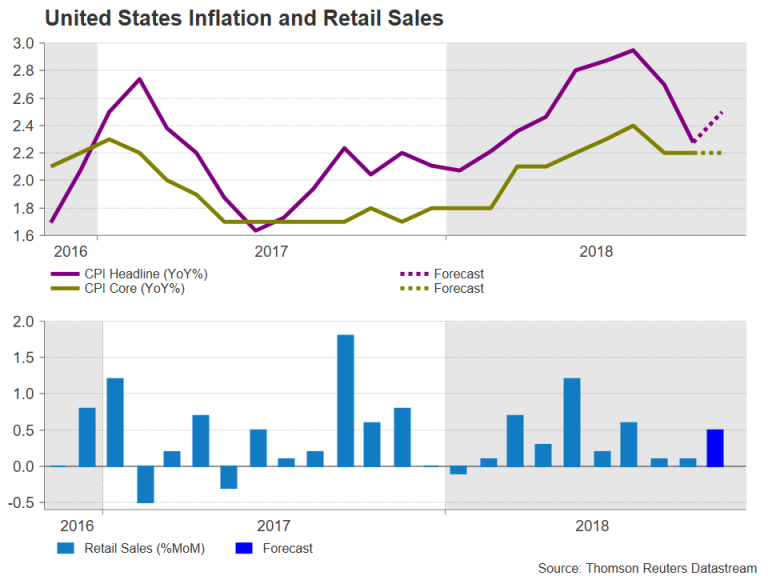
The 12-month rate of CPI is forecast to inch up by 0.2 percentage points to 2.5% in October, but the core rate is expected to stay unchanged at 2.2%. Import prices for October on Thursday will provide another price gauge for investors, while November manufacturing surveys – the New York Fed’s Empire State manufacturing index and the Philly Fed manufacturing index – will also be eyed. A bigger attraction on Thursday, though, will be retail sales numbers, which are likely to have the biggest impact on the dollar. October retail sales are forecast to point to a solid start to the fourth quarter, increasing by 0.5% m/m, which would be an improvement on the previous 0.1% rate. On Friday, the main release to watch will be industrial production figures for October.
Aside from the data, central bankers will also be hitting the headlines next week as Fed officials return to the public arena after this week’s policy meeting. The highlight will be Fed Chairman Jerome Powell’s appearance on Wednesday, who will participate in a panel discussion at a Dallas Fed event.
Weekly Focus: One Step Closer to a Brexit Deal?
Market Movers ahead
- In the US , we believe it is likely core inflation stayed unchanged at 2.2% in October. We expect retail sales to continue painting a robust picture of US consumers.
- Growth data will be in focus in the euro area , where German ZEW and preliminary GDP for Q3 are due to be released.
- Italy will return to the limelight, as Tuesday is the deadline for it to send a revised budget to the EU Commission.
- Deal or no deal is still the question relating to Brexit negotiations. We believe we will have to wait for December for an agreement. Unemployment and wages will also draw attention in the UK.
- In China , we are due to get key figures on money and credit as well as industrial production, retail sales and investment. We expect growth to weaken before it gets better from Q2 019. Japan is scheduled to release Q3 GDP data.
- In Scandinavia , it is time for Norwegian GDP for Q3 and inflation in Sweden and Denmark.
Weekly wrap-up
- The US midterm elections turned out as expected, with the Democrats winning the House while the Republicans strengthened their majority in the Senate. We expect this to have a limited effect on the economy and markets.
- New forecasts from the EU Commission revealed a downward revision to Italian growth and upward revision to the budget deficit, adding to the current EU-Italy standoff.
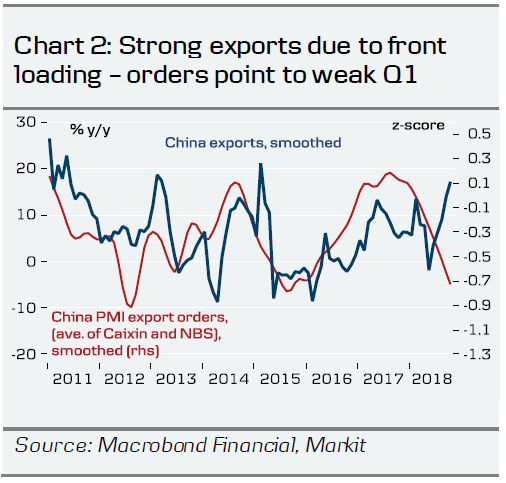
- Chinese exports were stronger than expected but it is likely this is due to front-loading of sales to the US ahead of a possible tariff increase on 1 January.
- Risk appetite recovered, sending both equities and bond yields higher.
China Weekly Letter: Next Stop Xi-Trump Meeting
This is the first edition of China Weekly Letter, which we will publish at the end of the week going forward. It aims to give a brief wrap-up on Chinese news, with focus on the three main stories of the week and a short summary of other news with links to articles for those who wish to delve deeper. It will be a maximum of two pages. Feedback is very welcome, as we want to find the best format to keep you updated on China.
Xi-Trump meeting the next big thing to watch
It seems clear that Xi and Trump will talk trade at a 'meeting plus dinner' in Buenos Aires on 1 December. There have been few new signals on the US side this week. However, Chinese Vice-President Wang Qishan (dubbed China's fire fighter) stated at the New Economic Forum in Singapore that China is ready to discuss trade with Trump, but also underlined that it would not be 'bullied and oppressed by imperialist powers' again (referring to the period China dubs the 'century of humiliation'). See SCMP.
Comment. We see a 60% likelihood of a ceasefire at the meeting (see US-China Trade - 60% chance of ceasefire at Xi-Trump meeting, 2 November 2018). Trump's hand has weakened a bit recently as US stocks have been more volatile and economic data has been a bit softer.There is also a risk, however, that Trump's loss of the majority in the House at the mid-term elections could turn his focus to an even more hawkish stance on China, as foreign policy is one of the areas where he currently holds the most power.
More signs of Chinese slowdown
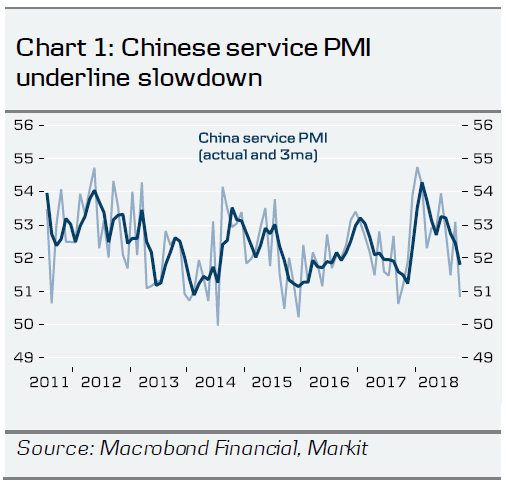
The CaixinPMI service for October dropped to 50.8 in October from 53.1 in September, the lowest level in a year (Chart 1). Car sales also declined further in October, down 11.7% from October 2017. Exports for October were stronger than expected (Chart 2), but this most likely reflects a front loading of sales ahead of a possible US tariff increase on Chinese goods on 1 January. Chinese leaders signalled further stimulus at the recent Politburo meeting recently. See China Daily.
Comment. We expect Chinese growth to get worse before it gets better but for it to avoid a hard landing. See China Notes - Weak Chinese PMI points to further slowdown in Q4, 31 October 2018. There is speculation that a household tax cut of up to 1% of GDP could be brewing in 2019 as part of further stimulus.
China International Import Expo (CIIE) signals further opening
In Xi Jinping's speech at the first CIIE in Shanghai, he promised further opening and that China would import goods and services worth USD40trn over the next 15 years. See SCMP. He also lashed out at Trump saying, 'please don't always beautify your own and point fingers at others' and 'we need cooperation, not confrontation - we need win-win, not a one-sided win'.
Comment. China is eager to signal further opening, but that it will not be intimidated by what it regards as bullying by the US.
Other China news
- People's Bank of China puts targets on bank lending for private companies. See SCMP. China aims to boost lending to the private sector as many companies have been squeezed by the crackdown on shadow banking and tighter lending standards due to the trade war. Premier Li Keqiang sent a clear signal on Thursday that more measures are coming to lift lending to the private sector. See China Daily.
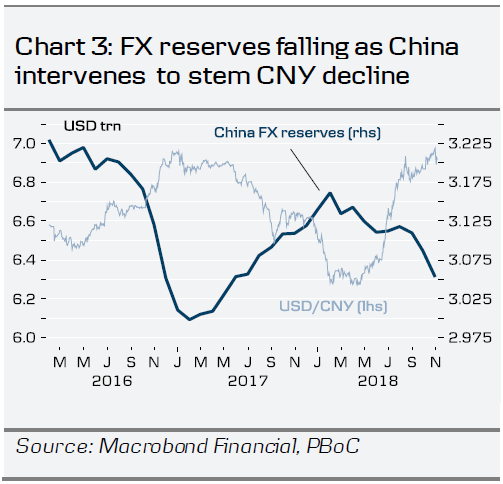
- Chinese FX reserves drop further in October as PBoC supports CNY. See Chart 3 and CNBC. We expect more of the same: a continued gradual weakening of CNY as the economy weakens and moderate intervention to stem the decline. We look for USD/CNY to reach 7.20 in 12 months.
- Chinese inflation unchanged at 2.5% – PBoC free to ease (see Bloomberg).
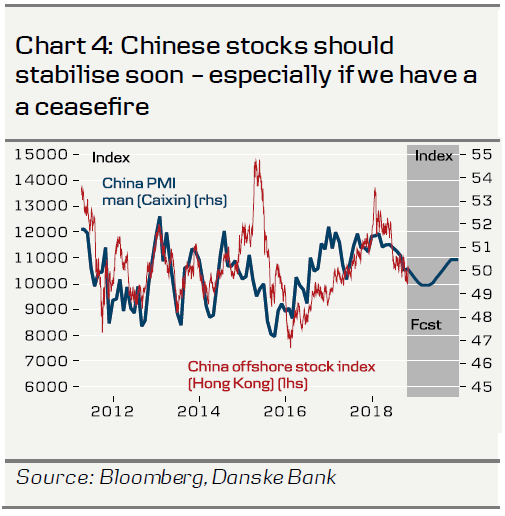
- Chinese stock markets still volatile as stocks fall back again on Friday. Are we bottoming out soon? If we are right that the Chinese economy is starting to recover gradually from Q2, we may be close to a bottom in Chinese stocks (Chart 4).
- Former US Treasury Secretary Hank Paulson warns of new economic 'iron curtain' at the New Economy Forum. See Bloomberg. We believe the US and China are clearly in for a long-term rivalry. However, it will not be a new 'cold war' in the old sense, as the US and China are much more integrated than the US and Soviet Block. The rest of the world depends on both countries and are likely to play on both horses.
- China's tech giant Tencent builds self-driving car team in Silicon Valley. See Reuters.
- Bloomberg's report 'The Big Hack' on China meets renewed scepticism. See SCMP. The story has added further fuel to US accusations of China spying, but several companies involved (Apple and Amazon) have publicly denied the story and called for Bloomberg to withdraw it.
- The US and China hold security talks. See NYT. Top security officials from the US and China are due to meet in Washington on Friday 16 November in an effort to ease tensions after a period of clashes regarding Taiwan and the South China Sea. According to the New York Times, China clearly views the talks as a scene-setter for the upcoming Xi-Trump meeting.
USD/JPY Mid-Day Outlook
Daily Pivots: (S1) 113.64; (P) 113.88; (R1) 114.28; More..
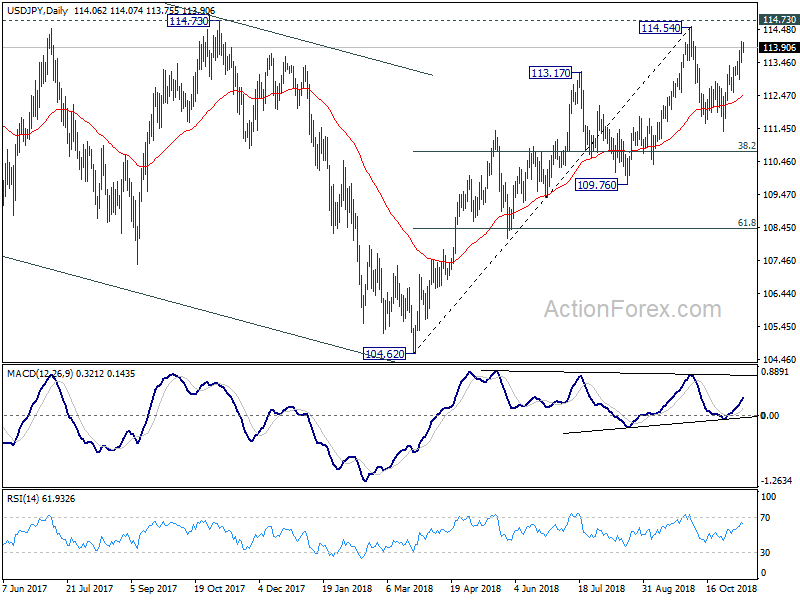
Intraday bias in USD/JPY remains on the upside as rise from 111.37 is in progress for 114.54 resistance. At this point, we'd be cautious on strong resistance from there to limit upside to bring another fall to extend the consolidation pattern from 114.54. On the downside, break of 112.94 minor support will argue that the rebound has completed. And, in that case, the corrective pattern from 114.54 could have started the third leg for 111.37 support and possibly below.
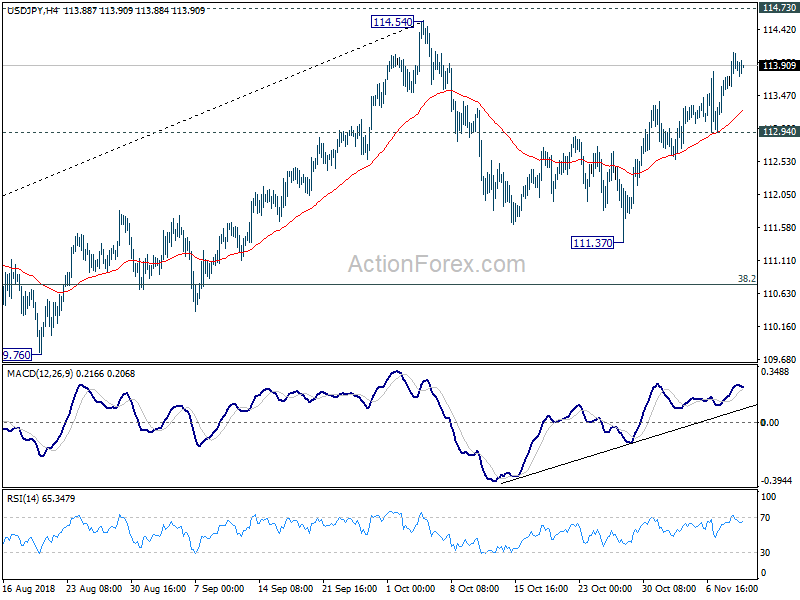
In the bigger picture, corrective fall from 118.65 (2016 high) should have completed with three waves down to 104.62. Decisive break of 114.73 resistance will likely resume whole rally from 98.97 (2016 low) to 100% projection of 98.97 to 118.65 from 104.62 at 124.30, which is reasonably close to 125.85 (2015 high). This will stay as the preferred case as long as 109.76 support holds. However, decisive break of 109.76 will dampen this bullish view and turns outlook mixed again.
USD/CHF Mid-Day Outlook
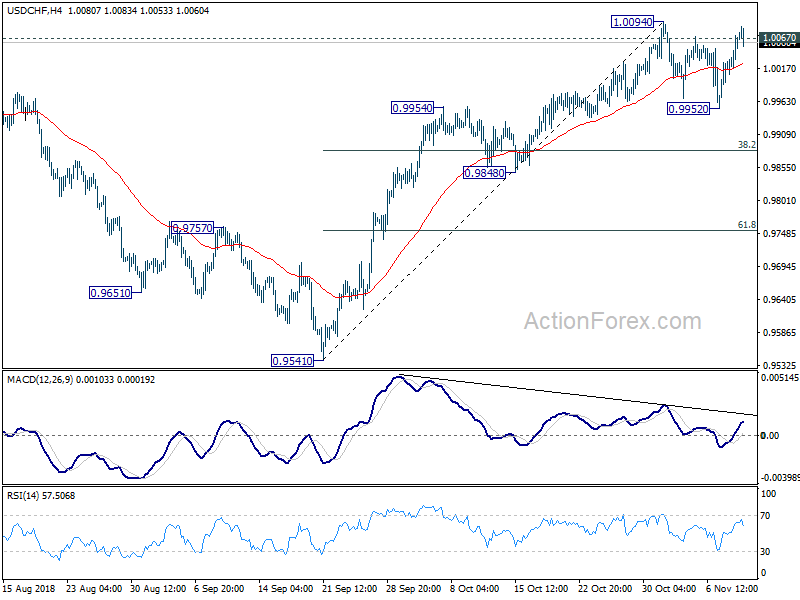
Daily Pivots: (S1) 1.0022; (P) 1.0047; (R1) 1.0086; More...
At this point, USD/CHF is still limited below 1.0094 resistance. Intraday bias remains neutral first. On the upside, break of 1.0094 and sustained trading above 1.0067 will confirm resumption of whole rise from 0.9541. USD/CHF should then target 1.0342 key resistance next. On the downside, below 0.9952 will extend the consolidation from 1.0094 with another decline. But we'd expect strong support from 38.2% retracement of 0.9541 to 1.0094 at 0.9883 to contain downside to bring rebound.
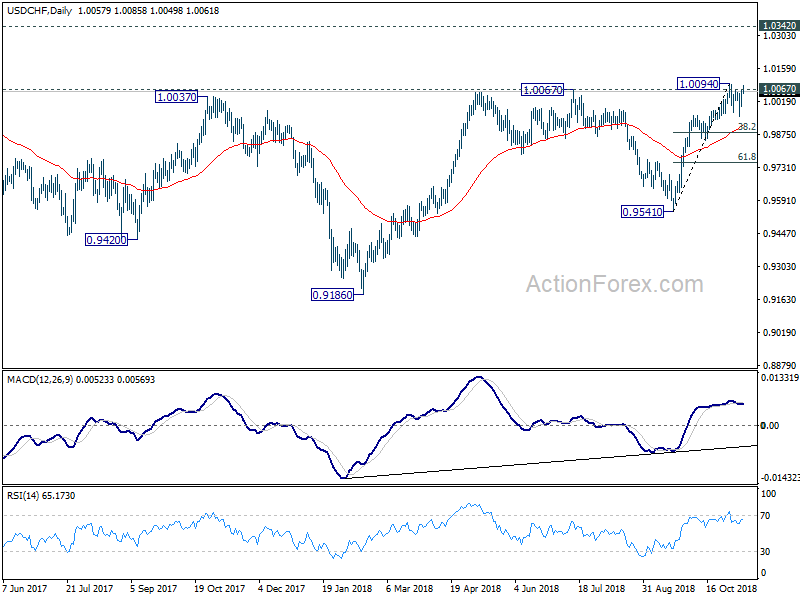
In the bigger picture, the pullback from 1.0067 has completed at 0.9541 already. And rise from 0.9186 is likely resuming. Firm break of 1.0067 will pave the way to retest 1.0342 key resistance. We'd be cautious on strong resistance from there to limit upside to bring another medium term fall to extend long term range trading. However, firm break of 0.9848 near term support will dampen this view and bring deeper decline back to 0.9541 support and possibly below.
GBP/USD Mid-Day Outlook
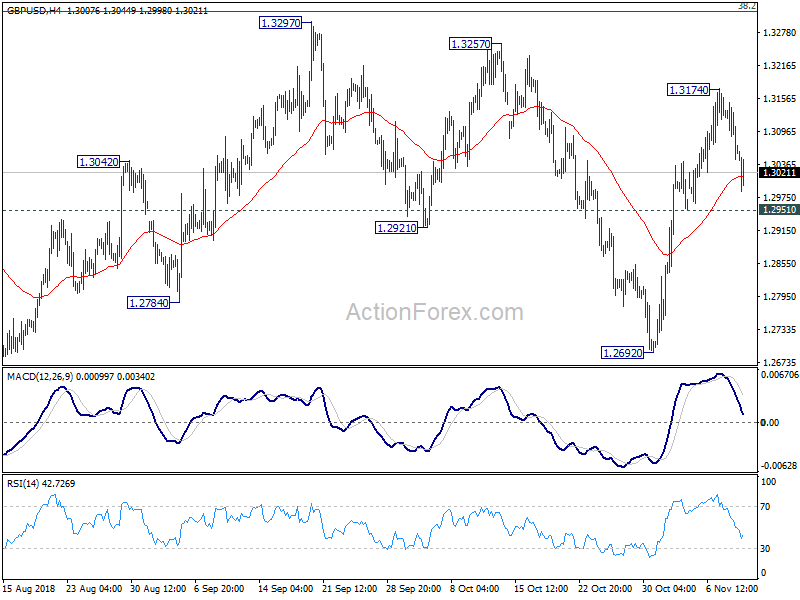
Daily Pivots: (S1) 1.3020; (P) 1.3086; (R1) 1.3126; More...
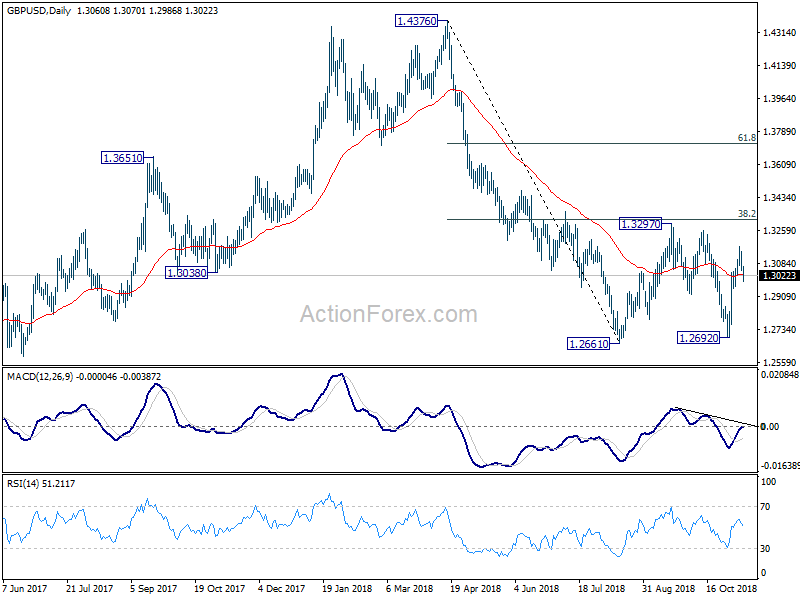
While the decline from 1.3174 extends lower today, GBP/USD is held above 1.2951 support. Intraday bias remains neutral and another rise cannot be ruled out. On the upside, above 1.3174 will target 1.3257/3297 resistance zone. However, as rise from 1.2692 is viewed as the third leg of consolidation pattern from 1.2661, we'd expect strong resistance from 1.3316 fibonacci level to limit upside to bring down trend resumption eventually. On the downside, below 1.2951 minor support will turn bias back to the downside for 1.2692 and then 1.2661 key support.
In the bigger picture, whole medium term rebound from 1.1946 (2016 low) should have completed at 1.4376 already, after rejection from 55 month EMA. The structure and momentum of the fall from 1.4376 argues that it's resuming long term down trend. And this will be the preferred case as long as 38.2% retracement of 1.4376 to 1.2661 at 1.3316 holds. However, firm break of 1.3316 would bring stronger rebound to 61.8% retracement at 1.3721. And, the eventual depth of the fall from 1.4376, and the chance of hitting 1.1946 low, will depend on the strength of the interim corrective rebound from 1.2661.
EUR/USD Mid-Day Outlook
Daily Pivots: (S1) 1.1329; (P) 1.1388; (R1) 1.1423; More....
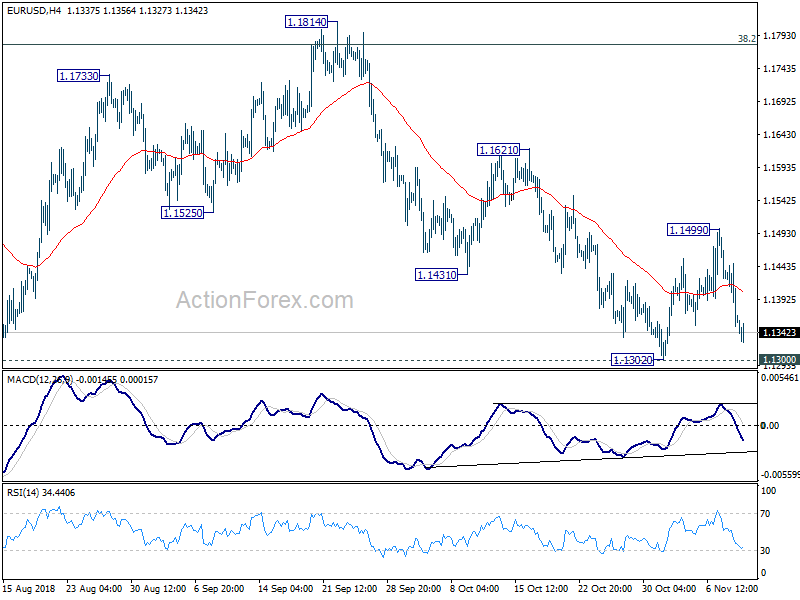
Intraday bias in EUR/USD remains on the downside for 1.1300 low. Decisive break there will resume down trend from 1.2555 to 1.1186 fibonacci level next. On the upside, break of 1.1499 will resume the rebound from 1.1302 to 1.1621 resistance instead.
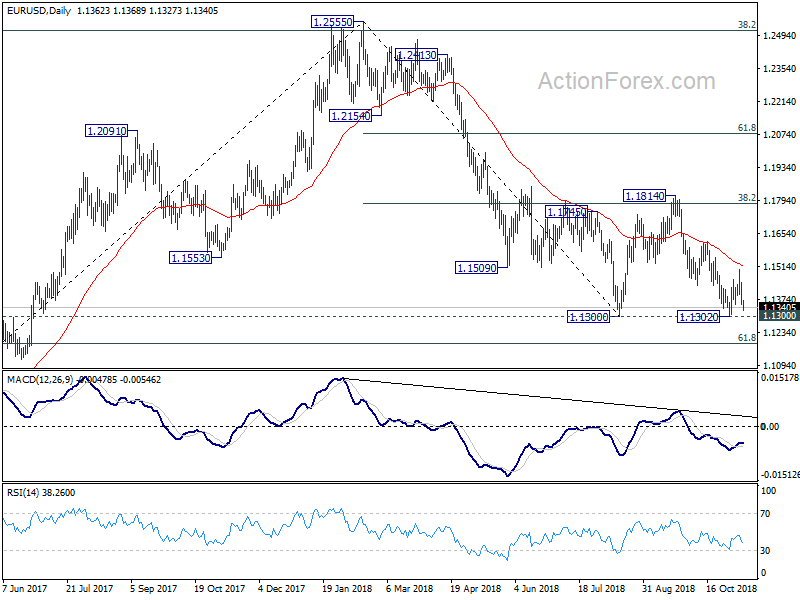
In the bigger picture, price actions from 1.1300 is seen as a corrective pattern. Decisive break of 1.1300 will resume the down trend from 1.2555 to 61.8% retracement of 1.0339 (2017 low) to 1.2555 at 1.1186 next. Sustained break there will pave the way to retest 1.0339. In case the consolidation from 1.1300 extends, upside should be limited by 1.1814 and 38.2% retracement of 1.2555 to 1.1300 at 1.1779. to bring down trend resumption eventually.
Dollar Firmer Up Again after Strong PPI, But More is Need to Prove Underlying Strength
Dollar turns a bit firmer again in early US session after stronger than expected PPI readings. For now it's on of the strongest one today, along with Yen and Swiss Franc. But still, more technical breakthrough is needed in the greenback to prove its underlying bullishness. USD/JPY and USD/CAD took the lead yesterday, and surged through 113.81 and 1.3170 resistance respectively. On the other hand, at this point, USD/CHF is still held below 1.0094 resistance and EUR/USD is kept well above 1.1300 low. Sterling is the weakest one on disappointing September GDP and Brexit impasse.
In other markets, major European indices are trading in red at the time of writing. FTSE is down -0.66%, DAX is down -0.23% and CAC is down -0.53%. German 10 year yield is down -0.0307 at 0.429. Italian 10 year yield is up 0.034 at 3.435. That is, spread is back above 300. Earlier today, Hong Kong HSI led Asian indices lower, closed down -2.39%. Nikkei dropped -1.05%, China Shanghai SSE down -1.39% and Singapore Strait Times dropped -0.49%.
Released from the US, headline PPI rose 0.6% mom, 2.9% yoy in October, above expectation of 0.2% mom, 2.7% yoy. PPI core rose 0.5% mom, 2.6% yoy, above expectation of 0.2% mom, 2.5% yoy.
UK Q3 GDP growth fastest since 2016, but September weakness clouds
UK Q3 GDP growth accelerated to 0.6% qoq, matched market expectations. That's also the fastest rate since Q4 2016. Head of National Accounts Rob Kent-Smith noted that "The economy saw a strong summer, although longer-term economic growth remained subdued. There are some signs of weakness in September with slowing retail sales and a fall-back in domestic car purchases. However, car manufacture for export grew across the quarter, boosting factory output. Meanwhile, imports of cars dropped substantially helping to improve Britain's trade balance."
However, it should be noted that the rolling three month growth rate slowed from 0.7% in both May-Jul and Jun-Aug periods. This is in line with the above comment that there were some weakness in September. Indeed, monthly GDP growth in September was at 0.0% mom, missed expectation of 0.1% mom.
UK Chancellor of Exchequer Philip Hammond hails today's GDP release with his tweet. He tweeted "Our economy grew 0.6% between July and September – proof of its underlying strength. That's 8 straight years of economic growth, 3.3 million more people in jobs and wages growing at their fastest pace in almost a decade."
Also released from UK, trade deficit narrowed to GBP -9.7B in September versus expectation of GBP -11.4B. Industrial production rose 0.0% mom, 0.0% yoy in September versus expectation of 0.1% mom, 0.5% yoy. Manufacturing production rose 0.2% mom, 0.5% yoy versus expectation of 0.1% mom 0.4% yoy. Construction output rose 1.7% mom in September versus expectation of 0.2% mom.
Italy Tria to keep the main pillars of budget, EU Dombrovskis said assumptions overly optimistic
Italy Economy Minister Giovanni Tria said today that the coalition government is "busy drafting the answer to the European Commission with regards to the most contentious points of the budget." Italy is requested to present a new or revised draft budget plan to the Commission by November 13. Despite the the requests, Tria told the parliament today that they will confirm the budget plan's "Main pillar". Tria reiterated the commitment to cap 2019 budget deficit at 2.4% of GDP. But based on the Commission's projection released yesterday, Italy's budget deficit would hit 2.9%.
European Commission Vice President Valdis Dombrovskis blasted Italy's projections were based on "overly optimistic assumptions." He added, "Basically the assumption is that if they … increase public spending, it will stimulate the economy and thus will help to reduce budget deficit. We see that this is actually not materializing."
RBA paints better outlook, but still nowhere near rate hike
Despite painting a slightly more upbeat picture on economic outlook in the quarterly monetary statement, RBA maintained the stance that it's no where near a move interest rate. 2018 year-average GDP growth projection was raised slightly from 3.25% to 3.50%. 2019 GDP growth projection was kept unchanged at 3.25%. Meanwhile, 2020 year-average GDP growth projection was raised slightly from 3.00% to 3.25% too. Unemployment rate is forecast to drop to 5.00% by end of 2018, stay there through 2019 and then drop further to 4.75% in by June 2020.
Headline inflation by December 2018 was raised from 1.75% to 2.00%, indicating that the temporary drag was less severe than expected. CPI would then climb further to 2.25% by December 2019 and stay there still December 2020, unrevised. Core inflation is projected to be at 1.75% by the end of 2018. Core CPI would then rise to 2.25% by December 2019, revised up from 2.00%. For December 2020, core CPI is projected to stay at 2.25%, unrevised.
RBA pointed out that "household income remains a key uncertainty around this forecast, especially in the context of high household debt and a slowing housing market." It added further that the uncertainty is on "outlook for household income growth" and "how households may respond to significant housing price declines".
But after all, RBA maintained that "given the expected gradual nature of that progress," if reducing unemployment and improving inflation, "the Board does not see a strong case to adjust the cash rate in the near term."
EUR/USD Mid-Day Outlook
Daily Pivots: (S1) 1.1329; (P) 1.1388; (R1) 1.1423; More....
Intraday bias in EUR/USD remains on the downside for 1.1300 low. Decisive break there will resume down trend from 1.2555 to 1.1186 fibonacci level next. On the upside, break of 1.1499 will resume the rebound from 1.1302 to 1.1621 resistance instead.
In the bigger picture, price actions from 1.1300 is seen as a corrective pattern. Decisive break of 1.1300 will resume the down trend from 1.2555 to 61.8% retracement of 1.0339 (2017 low) to 1.2555 at 1.1186 next. Sustained break there will pave the way to retest 1.0339. In case the consolidation from 1.1300 extends, upside should be limited by 1.1814 and 38.2% retracement of 1.2555 to 1.1300 at 1.1779. to bring down trend resumption eventually.
Economic Indicators Update
| GMT | Ccy | Events | Actual | Forecast | Previous | Revised |
|---|---|---|---|---|---|---|
| 23:50 | JPY | Japan Money Stock M2+CD Y/Y Oct | 2.70% | 2.80% | 2.80% | |
| 00:30 | AUD | RBA Monetary Policy Statement | ||||
| 00:30 | AUD | Home Loans M/M Sep | -1.00% | -1.10% | -2.10% | -2.20% |
| 01:30 | CNY | CPI Y/Y Oct | 2.50% | 2.50% | 2.50% | |
| 01:30 | CNY | PPI Y/Y Oct | 3.30% | 3.40% | 3.60% | |
| 09:30 | GBP | Visible Trade Balance (GBP) Sep | -9.7B | -11.4B | -11.2B | |
| 09:30 | GBP | Industrial Production M/M Sep | 0.00% | 0.10% | 0.20% | |
| 09:30 | GBP | Industrial Production Y/Y Sep | 0.00% | 0.50% | 1.30% | 1.00% |
| 09:30 | GBP | Manufacturing Production M/M Sep | 0.20% | 0.10% | -0.20% | |
| 09:30 | GBP | Manufacturing Production Y/Y Sep | 0.50% | 0.40% | 1.30% | |
| 09:30 | GBP | Construction Output M/M Sep | 1.70% | 0.20% | -0.70% | -0.30% |
| 09:30 | GBP | GDP M/M Sep | 0.00% | 0.10% | 0.00% | |
| 09:30 | GBP | GDP Q/Q Q3 P | 0.60% | 0.60% | 0.40% | |
| 09:30 | GBP | Index of Services 3M/3M Sep | 0.40% | 0.50% | 0.50% | |
| 13:30 | USD | PPI M/M Oct | 0.60% | 0.20% | 0.20% | |
| 13:30 | USD | PPI Y/Y Oct | 2.90% | 2.70% | 2.60% | |
| 13:30 | USD | PPI Core M/M Oct | 0.50% | 0.20% | 0.20% | |
| 13:30 | USD | PPI Core Y/Y Oct | 2.60% | 2.50% | 2.50% | |
| 15:00 | USD | Wholesale Inventories M/M (SEP F) | 0.30% | 0.30% | ||
| 15:00 | USD | U. of Mich. Sentiment Nov P | 98 | 98.6 |
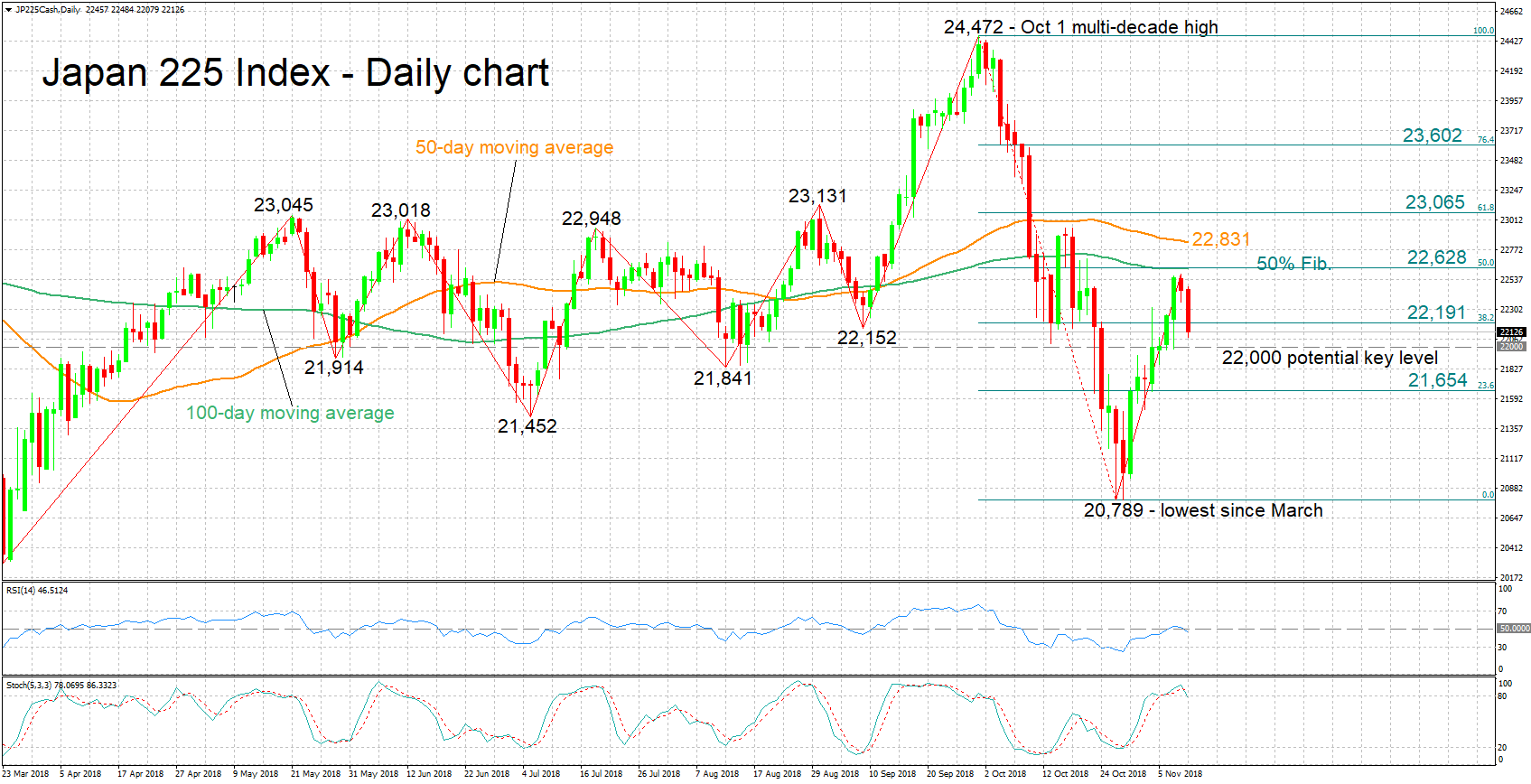
Japan 225 Index Retreats from 2½-Week High; Bearish Signal by Stochastics in Very Short Term
The Japan 225 index shifted gears, losing around 450 points relative to Thursday’s two-and-a-half-week high of 22,579.
The RSI halted its previous advance and reversed lower into bearish territory below 50. This suggests a tilt in short-term momentum towards a bearish direction. The stochastics are also giving a negative signal in the very short-term, as the %K and %D lines recorded a bearish cross.
Steeper losses may meet support around the 22,000 mark that may hold psychological importance; the area around this captures a couple of bottoms from the recent past as well. Lower, 21,654, this being the 23.6% Fibonacci retracement level of the downleg from 24,472 to 20,789, would be eyed for additional support.
On the upside, resistance could occur around 22,191, the 38.2% Fibonacci point. Higher still, the attention would turn to the zone around the 50% Fibonacci level at 22,628, which also encapsulates the 100-day moving average line, as well as yesterday’s top of 22,579.
The medium-term picture looks predominantly bearish, with trading activity taking below both the 50- and 100-day MAs. Notice though that the two MAs do not maintain a steep negative slope; the outlook is not strongly bearish.
Overall, the short-term bias has tilted to the downside, with the medium-term one looking mostly bearish at the moment.