Sample Category Title
EUR/JPY Remains In Downtrend Below 129.00
Key Highlights
- The Euro declined recently and tested the 126.50 area against the Japanese Yen.
- There are two important bearish trend lines in place with resistance at 128.70 on the 4-hours chart of EUR/JPY.
- The Euro Zone GDP in Q3 2018 (Preliminary) increased 0.2% (QoQ), less than the +0.4% forecast.
- Today, the Euro Zone CPI for Oct 2018 (Preliminary) will be released, which is forecasted to increase 2.2% (YoY).
EURJPY Technical Analysis
The Euro started a major downside move from well above the 131.00 level against the Japanese Yen. The EUR/JPY pair declined below the 130.00 and 129.00 support levels to enter a bearish zone.
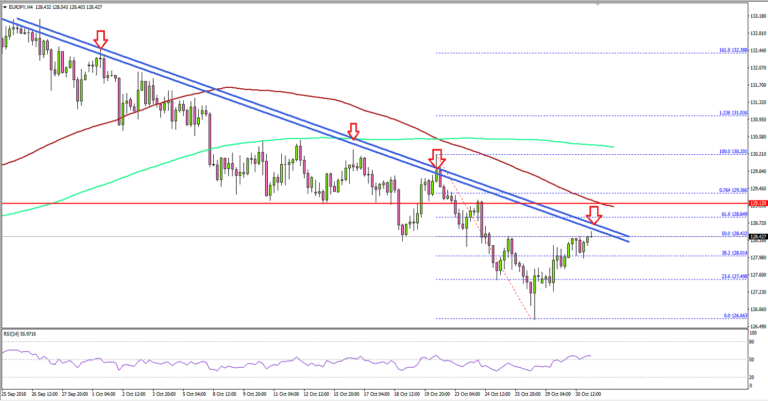
Looking at the 4-hours chart, the pair even broke the 128.50 support level and traded close to the 126.50 region. It traded as low as 126.66 and later started an upside correction.
Buyers pushed the pair above the 38.2% Fib retracement level of the last decline from the 130.20 high to 126.66 low. However, there is a strong resistance formed near the 128.50 and 129.00 levels.
More importantly, there are two important bearish trend lines in place with resistance at 128.70 on the same chart. Besides, the 61.8% Fib retracement level of the last decline from the 130.20 high to 126.66 low is near 128.84 to act as a resistance.
If there is a break and close above 129.00, the pair could move back in a positive zone. If not, there may be a fresh decline back towards the 127.00 and 126.50 levels in the near term.
Fundamentally, the Euro Zone GDP report for Q3 2018 (Preliminary) was released by the Eurostat. The market was looking for a growth of around 0.4% compared with the previous quarter.
However, the actual result was lower than the forecast as the GDP grew 0.2% in Q3 2018. Looking at the yearly change, there was an increase of 1.7%, which was less than the 1.8% forecast and also less than the last revised reading of 2.2%.
Overall, the Euro remains under pressure and pairs like EUR/USD and EUR/JPY are likely to struggle in the near term.
Economic Releases to Watch Today
- Euro Zone CPI for Oct 2018 (YoY, Preliminary) – Forecast +2.2%, versus +2.1% previous.
- Euro Zone Core CPI for Oct 2018 (YoY, Preliminary) – Forecast +1.0%, versus +0.9% previous.
- US ADP Employment Change April 2018 – Forecast 189K, versus 230K previous.
- Canadian Gross Domestic Product for August 2018 (MoM) – Forecast +0.2%, versus 0.2% previous.
EURGBP Bullish Price Rally Eyes 0.8945/55 Zone
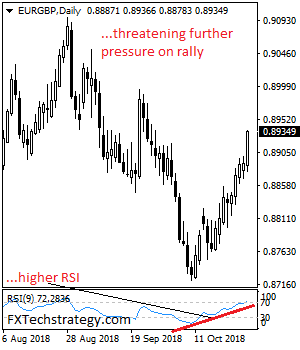
EURGBP bullish price rally eyes the 0.8945/55 resistance zone. Support stands at the 0.8900 level where a violation will turn focus to the 0.8850 level. A break below here will aim at the 0.8800 level. On the upside, resistance resides at the 0.8950 level. A violation if seen will turn risk towards the 0.9000 level. Further up, resistance comes in at 0.9050 level followed by the 0.9100 level. Its daily RSI is bullish and pointing higher suggesting further strength. All in all, EURGBP remains biased to the upside on further bullishness,
Dollar At 16 Month High After Stock Market Rebound
The US dollar is higher against most major pairs, with only the Australian and New Zealand dollars gaining against the greenback. European growth disappointed and Brexit continues to put pressure on the pound. Safe haven currencies failed to attract investors as US fundamentals remain strong ahead of the release of the biggest economic indicator in the market on Friday. US jobs are expected to have jumped 200,000 in October. The NFP report won’t bring anything new to the table on dollar strength, but the softness in global growth measures has benefited the US currency.
The Bank of Japan (BOJ) is not expected to make a substantive move when the policy rate announcement is published. Inflation is near 1 percent, which is not even close to the 2 percent lofty target, specially accounting for the rise in energy prices. BOJ Governor Haruhiko Kuroda’s press conference will be closely watched for more hawkish signals as a more stealthy approach to monetary policy tweaks is preferred.
No Halloween Surprise from the BoJ
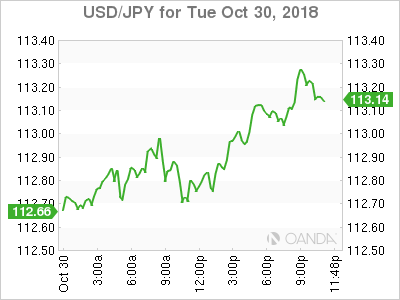
The USD/JPY fell 0.51 percent on Tuesday. The currency pair is trading at 112.94 ahead of the Bank of Japan (BOJ) monetary policy announcement. There is little chance of a repeat of the 2014 Halloween surprise by the central bank. Back in October 31, 2014 the BoJ increased the size of its QE program, when expectations where for move near the end of the year.
The JPY might be down, but not out as its position as a safe haven could come into effect sooner rather than later. Multiple headwinds could rise up as the global stock market has found its legs for the time being.
Investors are seeking higher yields, to the benefit of emerging markets, but given the volatility present in the markets the yen’s drop will be limited awaiting a risk-off triggering event.
US fundamentals keep driving the US dollar as other major economies struggle to keep up. A strong US PCE and consumer confidence ahead of the release of US employment data keep validating the Fed’s decision to keep hiking rates despite the negative comments from the Trump administration.
Pound Falls as No Deal Brexit Fears Rise
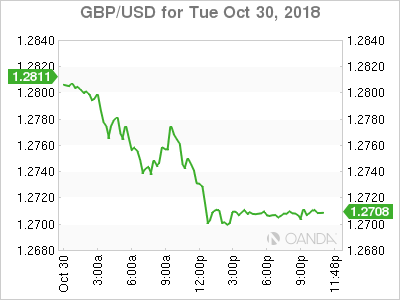
The GBP/USD lost 0.65 percent on Tuesday. The currency pair is trading at 1.2710 a day after the UK budget failed to inspire a recovery in the currency, specially since the document is conditioned by a favorable trade deal being agreed on.
The deadline for an orderly divorce between the UK and the EU is fast approaching and neither side seems ready to compromise increasing the probabilities of a no-deal exit.
The Bank of England (BoE) will hold court hosting another super Thursday, but economic releases have been soft. The Confederation of British Industry published a disappointing realized sales index with a reading of 5 when the expectation was 27. The lowest datapoint since April hinting at the end of the World Cup boost.
The consumer confidence barometer published by Gfk is expected to come in lower than previous months highlighting the effect of cold weather on purchases.
Oil Under Pressure from Iran Sanctions and US-China Trade War
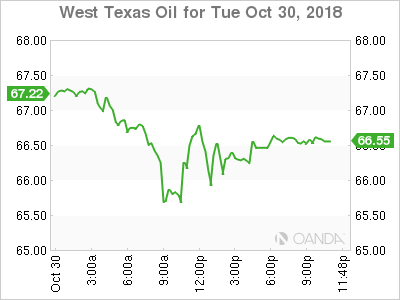
West Texas Intermediate fell 1.03 percent on Tuesday and is trading at 66.46 staying above the 66 price level after the release of the weekly API oil inventory report. Crude stocks rose 5.7 million barrels with gasoline and distillates showing a drawdown of more than 3 million barrels last week.
US sanctions against Iranian exports kick off next week providing some support for energy prices, although the major factors of late has been the lower global growth forecasts and a possible oversupply if Russia and Saudi Arabia, the de facto leaders of the production limit, increase their supply more than closing the gap left by lower exports from Iran.
Iran’s biggest customers could still find a way to purchase crude form its usual supplier despite the US sanctions. The Trump administration made it clear there would be no tolerance, but India, China and Turkey could test the resolve of the US.
If the supply disruption caused by US sanctions turns out to be smaller than forecasted, then Russia and Saudi Arabia could push market prices lower.
Investors will be looking for clues and the weekly release of US crude inventories by the Energy Information Administration (EIA) is the first stop on Wednesday at 10:30 am EDT.
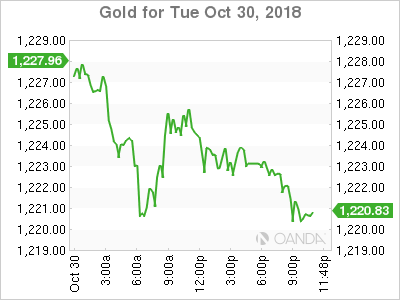
Gold fell 0.24 percent on Tuesday as the US dollar continued gaining across the broad. Strong US fundamentals so far this week, and the upcoming U.S. non farm payrolls (NFP) report are lifting the greenback. Risk appetite made a comeback and the stock market found itself back in the black.
The US economy continues to outperform other major economies and the dollar is reflecting that difference.
Gold Lower but Risk Appetite Could be Short Lived
Demand for gold as a safe haven was lower this week with the metal close to a 1 percent loss so far this week. Then again geopolitics will continue to be a major factor and given that gold is now firmly back on the mind of investors when seeking refuge in times of high risk a comeback this week cannot be ruled out.
The stock market sell-off reminded investors of the value of gold as a safe haven. With upcoming mid-term elections in the US and a big meeting between the US and China in Buenos Aires at the end of the month, there will be no shortage of investment opportunities.
Market events to watch this week:
Tuesday, October 30
8:30pm AUD CPI q/q
Tentative JPY BOJ Policy Rate
Tentative JPY Monetary Policy Statement
Tentative JPY BOJ Outlook Report
Wednesday, October 31
Tentative JPY BOJ Press Conference
6:00am EUR Flash EU CPI
8:15am USD ADP Non-Farm Employment Change
8:30am CAD GDP m/m
Thursday, November 1
5:30am GBP Manufacturing PMI
8:00am GBP BOE Inflation Report
8:00am GBP MPC Official Bank Rate Votes
8:00am GBP Monetary Policy Summary
8:00am GBP Official Bank Rate
8:30am GBP BOE Gov Carney Speaks
10:00am USD ISM Manufacturing PMI
8:00pm NZD ANZ Business Confidence
8:30pm AUD Retail Sales m/m
Friday, November 2
8:30am CAD Employment Change
8:30am CAD Trade Balance
8:30am CAD Unemployment Rate
8:30am USD Average Hourly Earnings m/m
8:30am USD Non-Farm Employment Change
8:30am USD Unemployment Rate
Eco Data 10/31/18
[php_everywhere instance="1"]
Today’s top mover: GBP/AUD again, building up medium term bearish reversal
GBP/AUD is once again a top mover today.
Sterling's weakness is not too much of a surprise based on the lack of progress of any form in Brexit negotiation. But Australian Dollar's resilience is rather impressive, considering that US-China trade war is ready to enter a full-blown stage any time. Nonetheless, Aussie's strengthen is also somewhat in correlation to resilience in Chinese stocks as well as iron ore prices. So, at least, it's explainable.
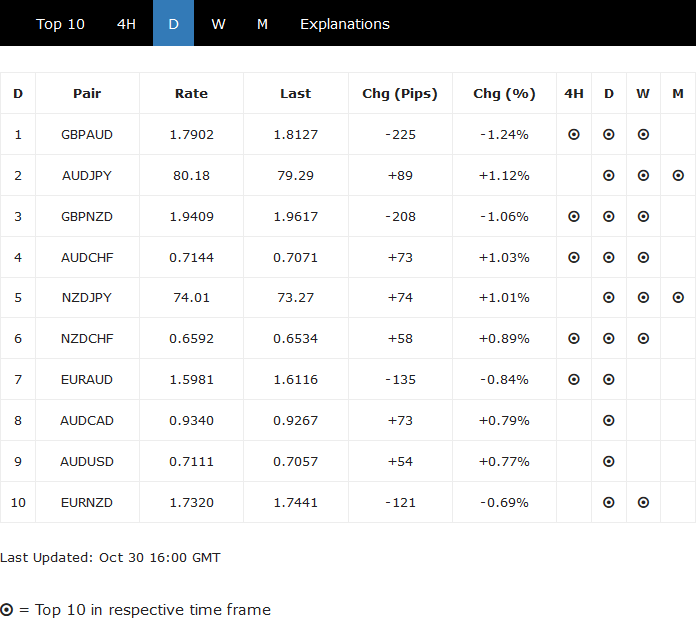
With today's downside acceleration, focus is now, immediately, on 61.8% retracement of 1.7282 to 1.8726 at 1.7863. Based on current downside momentum, this level could be easily taken out. And that will in turn be a stronger sign of medium term trend reversal.
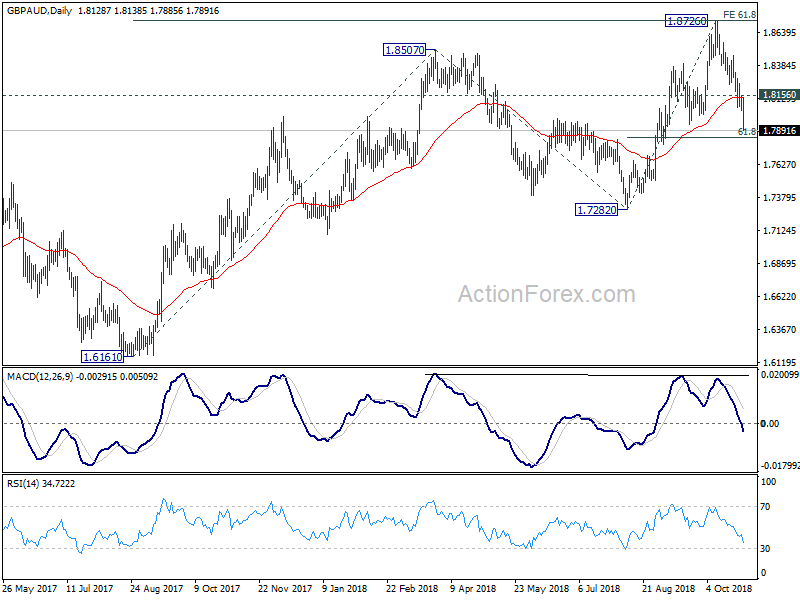
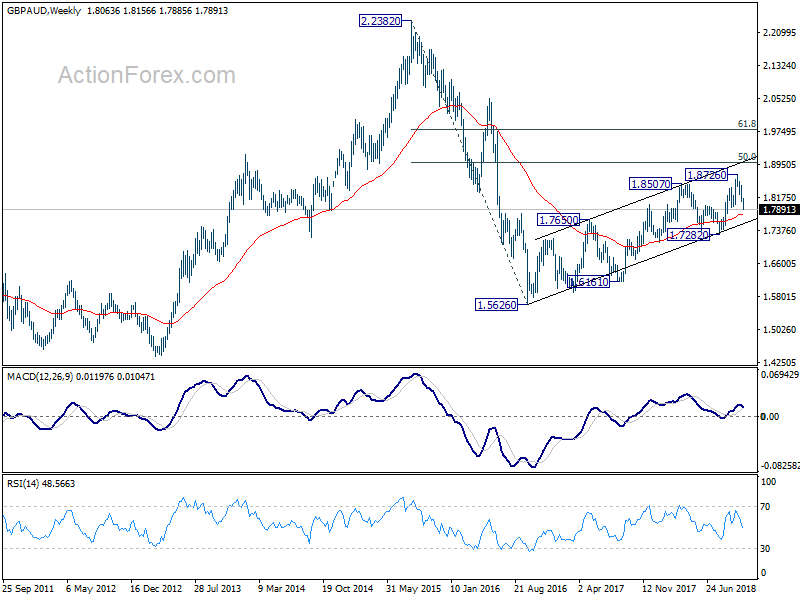
That is, whole "corrective" up trend from 1.5626 (2016 low) has completed at 1.8726 on after missing 50% retracement of 2.2382 to 1.5626 at 1.9004. For now, near term outlook will stay bearish as long as 1.8156 resistance holds. Sustained break of 1.7863 will turn focus to 1.7282 key support for confirming this medium term bearish case. GBP/AUD could be a very good candidate for medium term position trading.
Japanese Yen Drops to 1-Week Low, BoJ Rate Statement Looms
The Japanese yen has posted considerable losses in the Monday session, erasing Friday’s gains. In North American trade, USD/JPY is trading at 112.80, up 0.38% on the day. On the release front, the BoJ winds up its policy meeting and will release a policy statement. As well, Japan will release Preliminary Industrial Production, with an estimate of -0.2%. In the U.S, CB consumer confidence dipped to 137.9, but still beat the forecast of 136.3 points.
All eyes are on the Bank of Japan, but investors and analysts have learned to watch out for tweaks to monetary policy rather than any substantive moves. This could include minor changes to the way that the BoJ times its bond purchases, or other tweaks which will not cause significant volatility in exchange rates. The bank is expected to maintain interest rates at -0.10% and continue its massive stimulus program, which has had limited success in boosting inflation. The BoJ’s inflation target of around 2% could take years to be met, but policymakers have no plans to lower the target.
Japanese retail sales in September posted a solid gain of 2.1%, matching the estimate. This was the 11th straight gain in retail sales, pointing to strong consumer spending, a key driver of economic growth. The Japanese Ministry of Economy, Trade and Industry (METI) noted that high costs for food and energy boosted retail sales. METI upgraded its assessment, saying that retail sales were improving “gradually”. At the same time, the export-reliant Japanese economy is very vulnerable to the fall-out from the global trade war, and the threat by President Trump to impose tariffs on all Chinese goods could spell more headwinds for the Japanese yen.
Sunset Market Commentary
Markets
Global core bond are mixed today. US Treasuries and German Bunds edged lower at today’s opening, on the back of positive Asian risk sentiment. European equities opened higher as well but paired those gains almost immediately to continue to move south throughout the day. The Bund made an intraday U-turn as Italian Q3 GDP data showed a stagnation, sending BTP’s back in sell-off mode. Lega’s Salvini blamed previous government for weak results. The euro-area economy unexpectedly grew at its weakest pace in more than four years. GDP increased by 0.2% in Q3, while a stabilization of the 0.4% in Q2 was expected. Half what was forecasted and half of GDP growth in Q2. On a yearly basis, GDP slowed down from 2.1% to 1.7% (1.8% expected). The fall in economic confidence from 110.9 to 109.8 suggests a more enduring slowdown. US housing data continued their slowing trend which caused US Treasuries to recover some ground. The US yield curve edged still higher though today with the wings underperforming the belly of the curve. Changes range from +1.2 bps (5-yr) to +1.9 bps (30-yr). The German yield curve bull flattened with changes from -0.4 bps (2-yr) tot -1.2 bps (30-yr). Peripheral bond spreads over Germany widen with Italy (+16 bps), Greece (+5 bps) and Spain (+4 bps) underperforming.
FX markets were poised for some intraday volatility as today’s economic calendar contained several potential market movers. Following lower than expected Q3 growth in Italy and France, growth in EMU fell well below expectations (0.2% QoQ vs 0.4% expected) as well. German inflation (0.1% m/m) increased a notch more than anticipated even after last month’s jump. In the US the Conference Board consumer confidence was slightly softer than expected taking in account last month’s downward revision, but remains at a very lofty level. Eurobears initially pulled EUR/USD closer to the 1.1301-support after having digested the GDP data. The pair rebounded when the first American traders joined the currency arena ahead of a prudent US stock rally and was, perhaps, supported slightly by German inflation data. Both EUR/USD and stock markets topped off intraday highs however as the current risk environment proves too fragile to sustain the gains. EUR/USD is changing hands at 1.136. USD/JPY also retreated from its intraday top and is currently trading at 112.7.
EUR/GBP’s upwardly oriented trend was probably more related to sterling weakness than it was to euro strength. The pound suffered more from today’s fragile risk environment, overshadowing a soft EMU data batch. UK’s CBI data came in below expectations and were no help for sterling either. There were no relevant brexit updates to base trading upon. Investors don’t want to be positioned sterling long ahead of Thursday’s central bank gathering even if no important decisions are expected. EUR/GBP is currently filling bids at 0.892, up from 0.888 this morning. Cable followed EUR/USD in lockstep, losing ground before reversing losses partially around noon. The pair trades in the 1.274-area.
News Headlines
Eurozone eco data printed mixed to disappointing. Euro zone growth slowed to 0.2% Q/Q (vs 0.4% Q/Q expected), which is the slowest growth rate since 2014. National data showed a stagnation (!) in Italy while French GDP only increased by 0.2% Q/Q. German data aren’t available yet but new emissions tests probably hit the German car production and GDP growth as well. EMU EC economic confidence dropped for a 10th month straight, from 110.9 to 109.8. German October labour market data were a bright spot. Unemployment declined by 11k with the unemployment rate stabilizing at a multi-decade low of 5.1%. German inflation accelerated further from 2.2% Y/Y to 2.4% Y/Y, but this is probably due to a base effect in prices of recreation and culture.
Eurozone Inflation to Inch Higher in October but Doubts Persist about Outlook
Hot on the heels of the preliminary GDP readings, Eurostat will publish the flash estimates of Eurozone inflation for October on Wednesday at 10:00 GMT. With growth in the euro area unexpectedly slowing in the third quarter, the inflation numbers will likely bring better news for policymakers as both headline and underlying measures are anticipated to move higher. An upward trend could offer some support for the euro, which continues to be weighed by a weakening growth outlook and renewed political uncertainty in Europe.
The 12-month rate of the consumer price index (CPI) has stood at or above 2% since June, as higher energy prices push up the headline measure. A further pickup is expected in October with CPI forecast to rise by 2.2% year-on-year, up from 2.1% in September. However, looking at the two core gauges monitored by the European Central Bank, there’s been little progress in lifting underlying prices. When excluding energy and food items, CPI stood at 1.1% y/y in September, while the narrower measure that strips out alcohol and tobacco as well was 0.9%. Both are forecast to nudge upwards in October, with the former rising to 1.2% and the latter to 1.0%.
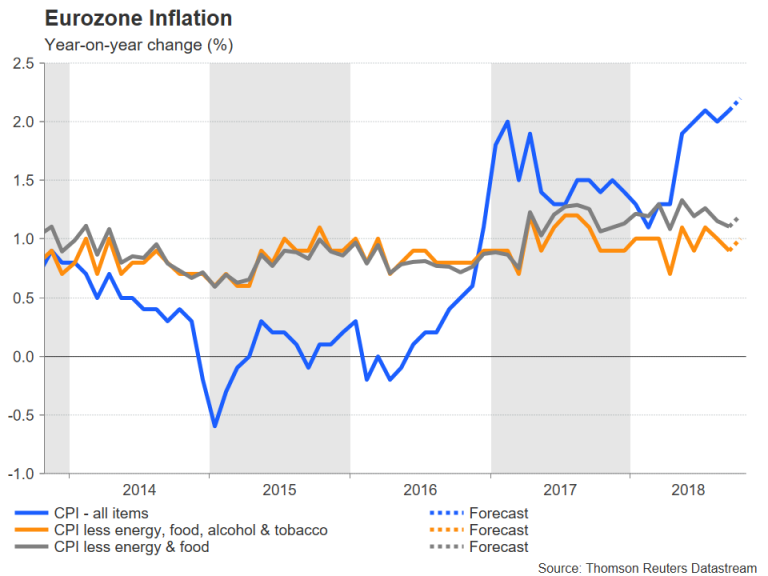
The absence of underlying price pressures is putting into question the ECB’s normalization plans, though the central bank’s chief, Mario Draghi, remains confident core inflation will recover. Draghi told reporters at the October policy meeting that while underlying inflation currently remains muted, he expects it to increase towards the end of the year. Should a pickup remain elusive, however, the ECB could be forced to contemplate extending its asset purchase program beyond December 2018, when the program is expected to end.
In the meantime, the odds that Eurozone growth and inflation would not evolve within the ECB’s projections were given a boost on Tuesday when GDP data showed the bloc’s economy expanded by just 0.2% during the third quarter – half the prior and expected rate of 0.4%. This only adds to the darkening outlook for the Eurozone economy, which has been clouded by the US-China trade war, a slowing Chinese economy, and closer to home, by fears that the budget stand-off between Italy and the EU could lead to a full-blown crisis.
These factors have strongly contributed to the euro’s downtrend during 2018. Any positive developments therefore on the inflation front could provide the single currency with a much-needed lift, at least in the short term, as it would back the ECB’s plans to gradually withdraw monetary stimulus.
An upside surprise to the CPI data could help euro/dollar overcome immediate resistance at around 1.1408, which is the 78.6% Fibonacci retracement level of the August-September upleg from 1.1297 to 1.1815. Clearing this hurdle would strengthen any positive momentum and drive the pair towards the 61.8% and 50% Fibonacci levels at 1.1495 and 1.1556, respectively.
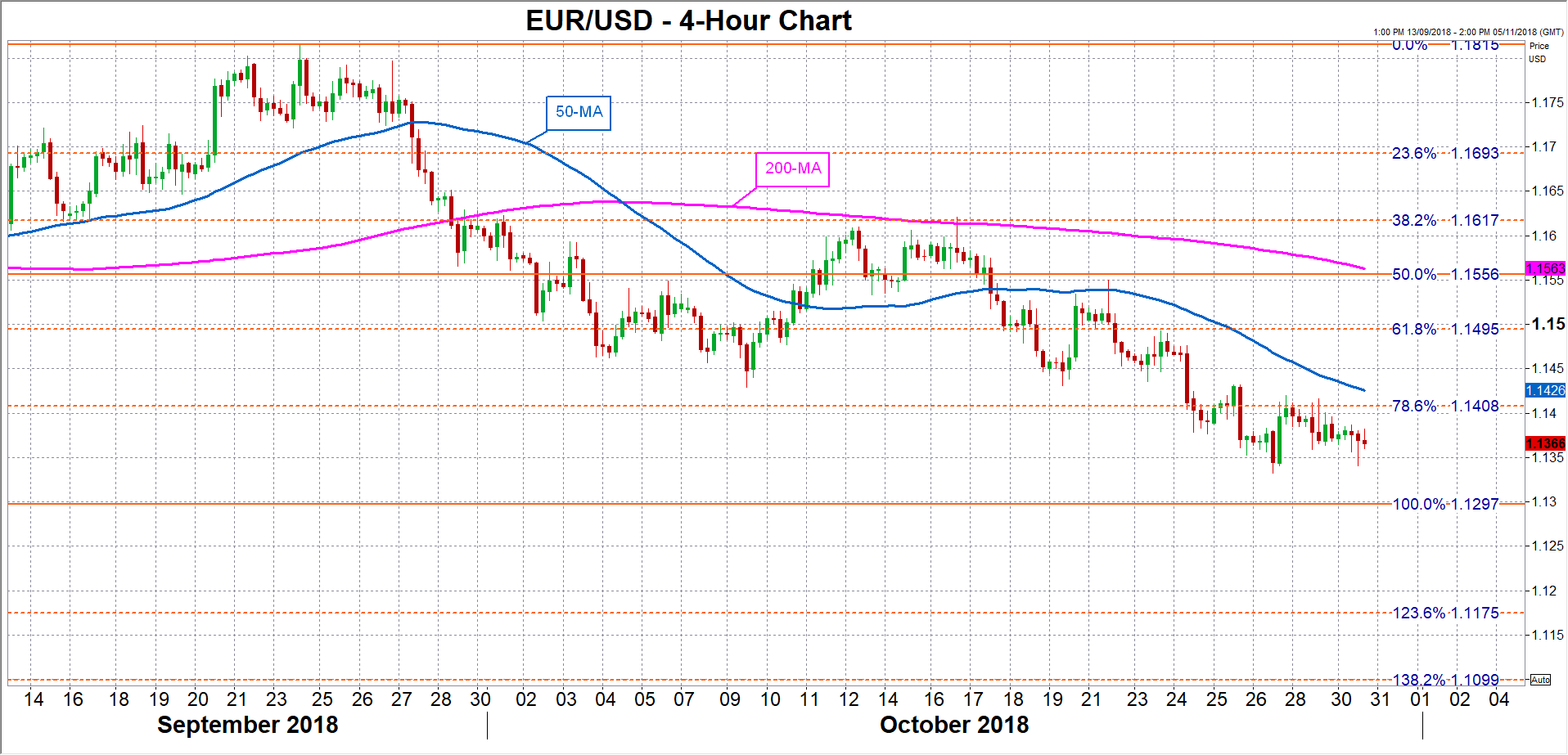
But if the inflation numbers fall short of expectations, euro/dollar could come under fresh selling pressure, with the August low of 1.1297 being the immediate barrier to the downside. A break below this level would open the way for the 123.6% Fibonacci extension at 1.1175, followed by the 138.2% Fibonacci at the 1.11 handle.
BoJ Unlikely to Alter Policy, But May Appear a Tad More Upbeat
The Bank of Japan (BoJ) will announce its policy decision during the Asian session on Wednesday. As per usual, no action is anticipated, with the yen instead likely to take its cue from any updates in the Bank’s economic assessment and forecasts – if any. Although the inflation picture remains tepid, growth-related indicators have picked up steam lately, which may lead the BoJ to appear a tad more optimistic. Beyond monetary policy, how risk appetite evolves will be crucial for the yen.
Investors do not seem to expect any further action by the BoJ in the foreseeable future, after the Bank tweaked its policy framework in a slightly more hawkish direction in July. For perspective, under its current framework the central bank has pledged to keep the yields on longer-dated Japanese government bonds fixed “around 0%” in an effort to stimulate borrowing and investment, but in July it took steps to allow yields to move a little more flexibly around this 0% target. While this was initially interpreted as a first step towards a normalization of policy, that theme gradually faded as Japanese economic data – and particularly underlying inflation – continued to tread water, dampening the prospect of further near-term moves.
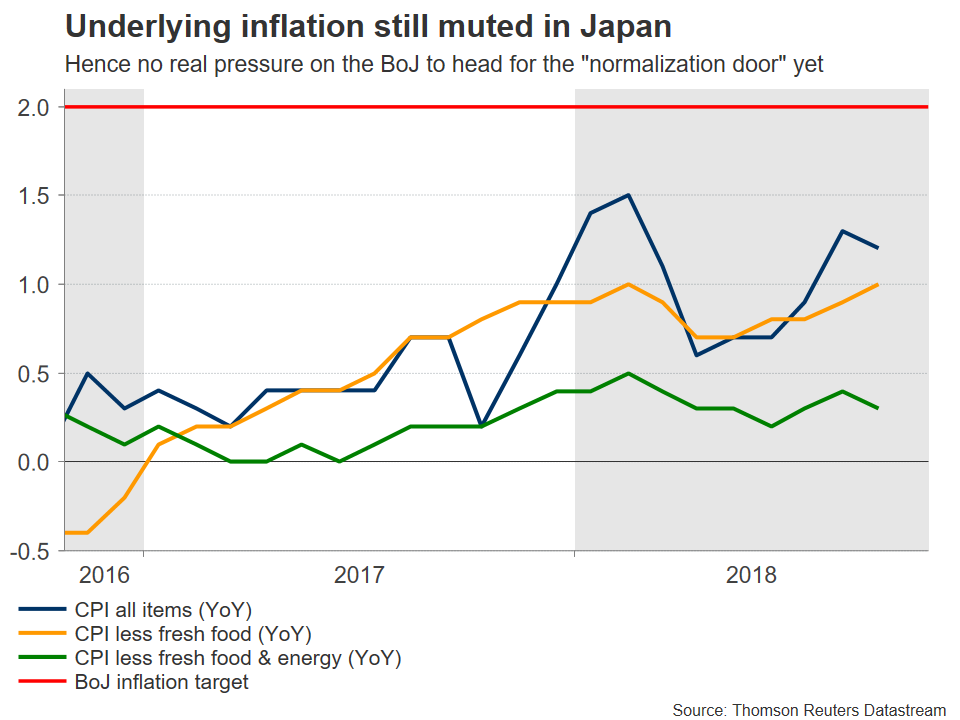
Indeed, even though headline inflation has risen to 1.2% lately on the back of higher oil prices, core inflation (excluding fresh food) remains at 1.0% in yearly terms, while the BoJ’s own measure which excludes both food and energy items is even more subdued, resting at a mere 0.3%. Perhaps even more troubling, wage growth has decelerated markedly in recent months, and in August it fell short of inflation – bringing real wage growth back to negative territory. Slower wage growth spells downside risks for future inflation, as consumers may find it more difficult to make ends meet, leading them to cut back some of their spending.
While the above suggest there’s little immediate pressure on policymakers to realistically consider normalization, there may be some cause for optimism yet, if one focuses on the growth outlook. Household spending has picked up steam, accelerating to its quickest pace in three years in August, while machinery orders that are seen as a leading gauge of capital spending have also gathered speed in recent months. Hence, both consumers and businesses appear to have been a little more cheerful lately, perhaps to an extent compensating for the unimpressive inflation picture.
Put together, the above suggest that although the BoJ is unlikely to make any changes to its ultra-loose policy framework, it could appear a tad more optimistic on the economy overall given the recent strong patch in growth-related indicators. That said, trade risks continue to lurk in the background, particularly as Japan may be caught in the crossfire of a continued Sino-US trade skirmish, so the central bank will likely avoid appearing too upbeat.
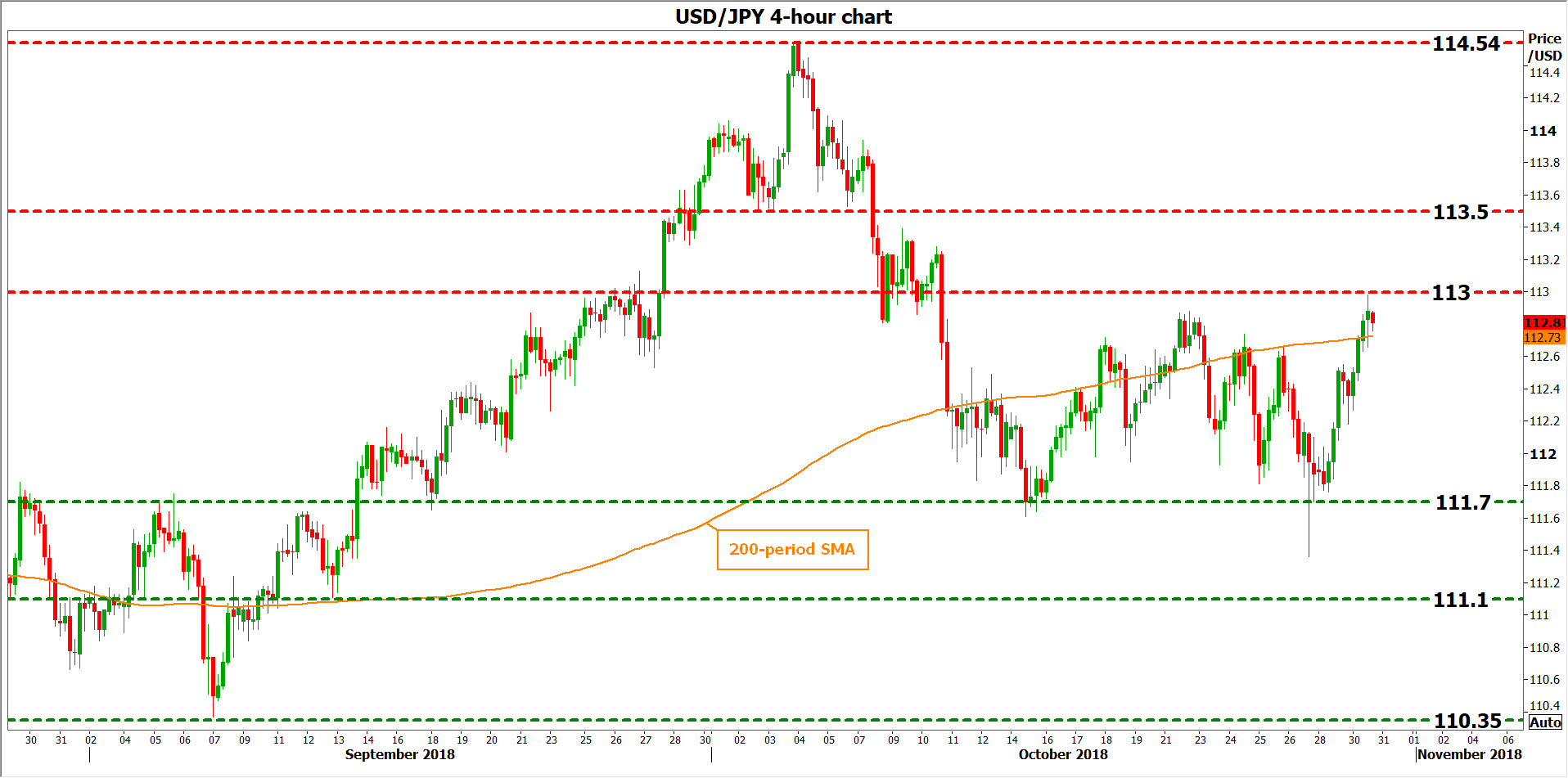
In case of a more optimistic assessment by the Bank, the yen could come under renewed buying pressure. Looking at dollar/yen technically, support to declines may be found near the 111.70 zone, defined by the lows of October 26. Even lower, the bears could stall first near the September 12 trough of 111.10, before the September 7 low of 110.35 comes into view.
On the flipside, a cautious assessment by policymakers, that places more emphasis on the recent slowdown in wages for instance, could be met with selling interest in the yen. Preliminary resistance to advances could come around the 113.00 handle, defined by the peak on October 30. An upside break may pave the way for a test of the 113.50 territory, defined by the inside swing low on October 2, with even steeper bullish extensions eyeing the one-year high of 114.54.
Beyond monetary policy, the other – and perhaps more important – determinant for the yen will be how investors’ risk appetite develops. The Japanese currency is widely considered to be a safe-haven asset, and has accordingly regained ground since early October on the back of the broader risk aversion seen in financial markets. Continued fragility in risk sentiment coupled with a slightly more optimistic tone by the BoJ, could be a recipe for some further near-term gains in the yen, at least against the battered euro and sterling.
US consumer confidence rose to 137.9, consumers expect strong growth to carry over into early 2019
US Consumer Confidence rose to 137.9 in October, up from revised 135.3, beat expectation of 135.0. That's also the higest level in 18 years since September 2000. Present Situation Index improved from 169.4 to 172.8. Expectations Index rose from 112.5 to 114.6.
Conference Board noted in the release that "Consumers' assessment of present-day conditions remains quite positive, primarily due to strong employment growth. The Expectations Index posted another gain in October, suggesting that consumers do not foresee the economy losing steam anytime soon. Rather, they expect the strong pace of growth to carry over into early 2019."
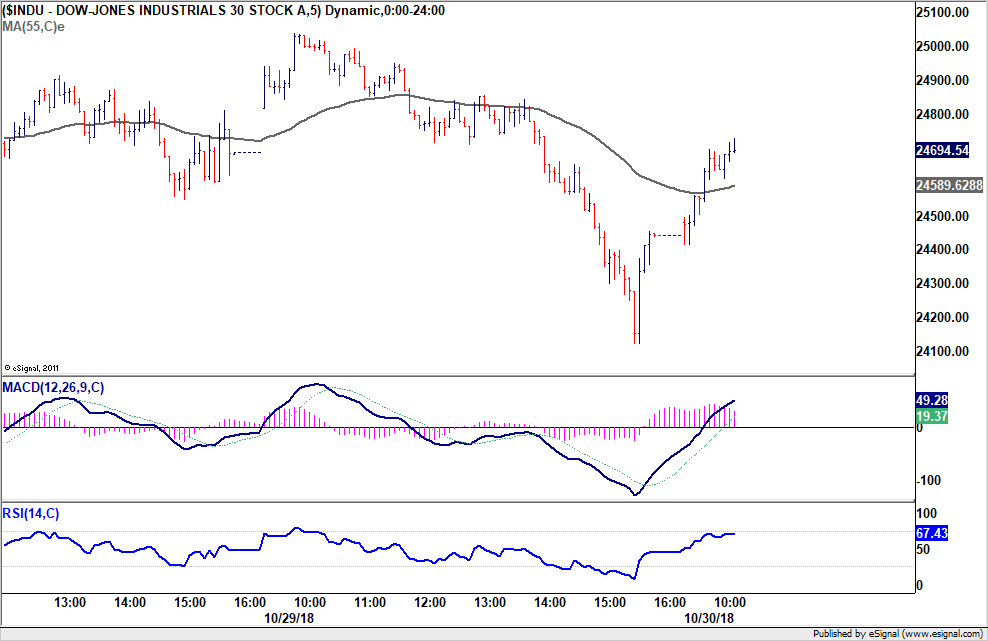
US stocks appear to be lifted by the stronger than expected release. DOW initially hesitated today but it's now up 1%.