Sample Category Title
EUR/CHF Daily Outlook
Daily Pivots: (S1) 1.1376; (P) 1.1398; (R1) 1.1426; More...
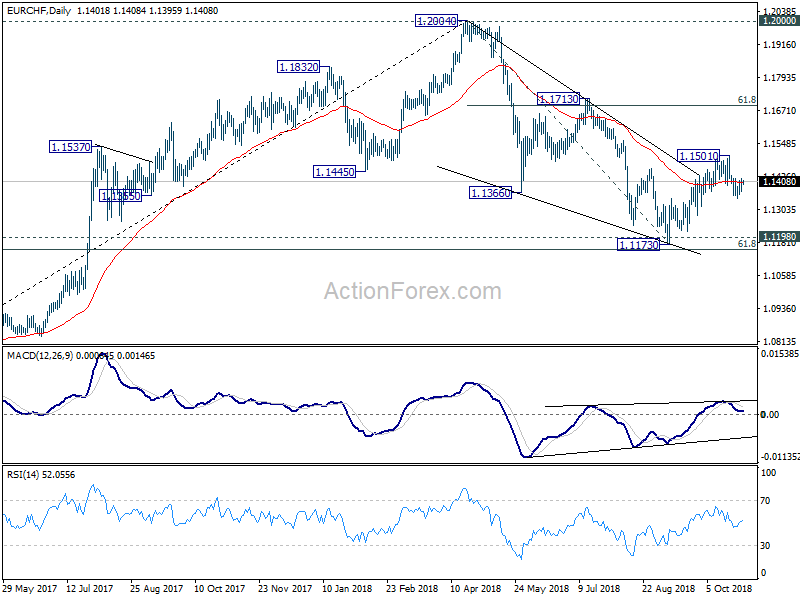
Intraday bias in EUR/CHF remains neutral as consolidation from 1.1343 is extending. As long as 1.1429 resistance holds, another fall is expected. As noted before, corrective rise from 1.1173 could have completed at 1.1501 already. Below 1.1343 will target 1.1154/98 key support zone again. At this point, we'd still expect this key support zone to hold. On the upside, above 1.1429 minor resistance will turn focus back to 1.1501 first. But still, break there is needed to confirm rally resumption. Otherwise, risk will stay on the downside even in case of strong recovery.
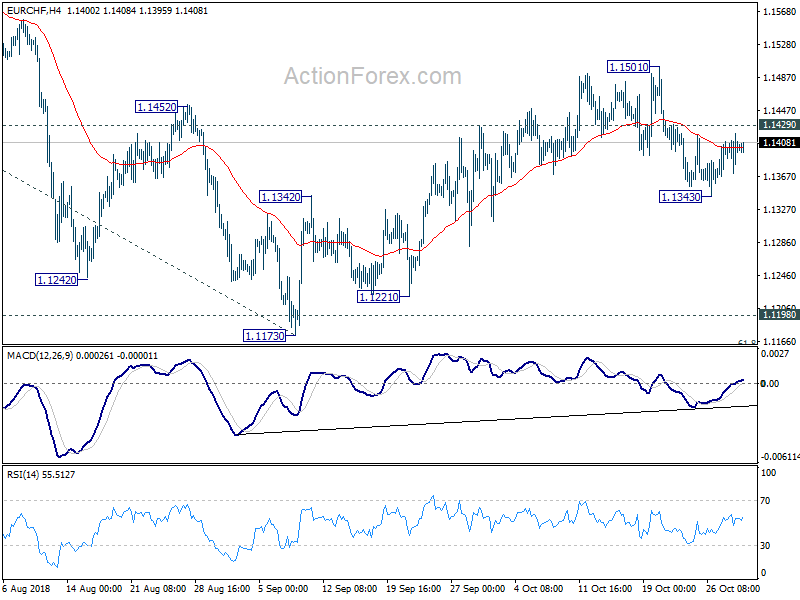
In the bigger picture, price actions from 1.2004 medium term top is seen as a correction only. Downside should be contained by support zone of 1.1198 (2016 high) and 61.8% retracement of 1.0629 to 1.2004 at 1.1154 to complete it and bring rebound. This cluster level is in proximity to long term channel support (now at 1.1243) too. A break of 1.2 key resistance is still expected in the medium term long term. However, sustained break of the mentioned support zone will mark reversal of the long term trend. In that case, 1.0629 key support will be back into focus.
Yen Under Pressure After BoJ Leaves Internest Rates Unchanged
China's manufacturing industry suffered another month of decline in September. Figures from the Chinese National Bureau of Statistics showed that the manufacturing PMI declined to 50.2, which was lower than August's 50.8. The 50.2 figure was an indication that the industry was nearing contraction. A figure below 50 in PMI is an indication that the industry is contracting. The services PMI was at 53.9, which was lower than the 54.9 from the previous month. These numbers raised concerns about the slowing global economy because China is the world's biggest manufacturer. They also raised the issue of the ongoing trade war with the USA. On Monday, it was revealed that the Trump administration was prepared to impose tariffs on all Chinese goods if his meeting with Xi does not yield results.
The Japanese yen continued weakening against the USD after the Bank of Japan made its monetary policy decision. As expected, the bank left rates unchanged at minus 0.10% and indicated that it will tweak the bond buying process but it won't rush changes. The new decision was made to ensure that the government debt market reflected the fundamentals. The reason for the yen weakness was that the bank did not give any forward guidance on the future of interest rates. In addition, the bank trimmed the inflation target for 2019 to 0.9% from the July forecast of 1.1%.
Yesterday, Wall Street had a mixed day as October comes to an end. Wall Street opened higher after the previous day's losses. Intraday, the stocks declined sharply with the S&P moving to the bear territory. The market then recovered and the Dow ended the day up by 431 points. After hours, the focus turned to Facebook, which missed analysts' forecasts on revenues which was a sign of the challenges it is facing.
The Australian dollar declined against the USD after the country's statistics office released the CPI data for the third quarter. The CPI remained unchanged at 0.4%, which was lower than the consensus estimates of 0.5%. On a YoY basis, the CPI declined from 2.1% to 1.9% in the quarter. However, the YoY numbers remain close to the RBA's target of 2.0%.
EUR/USD
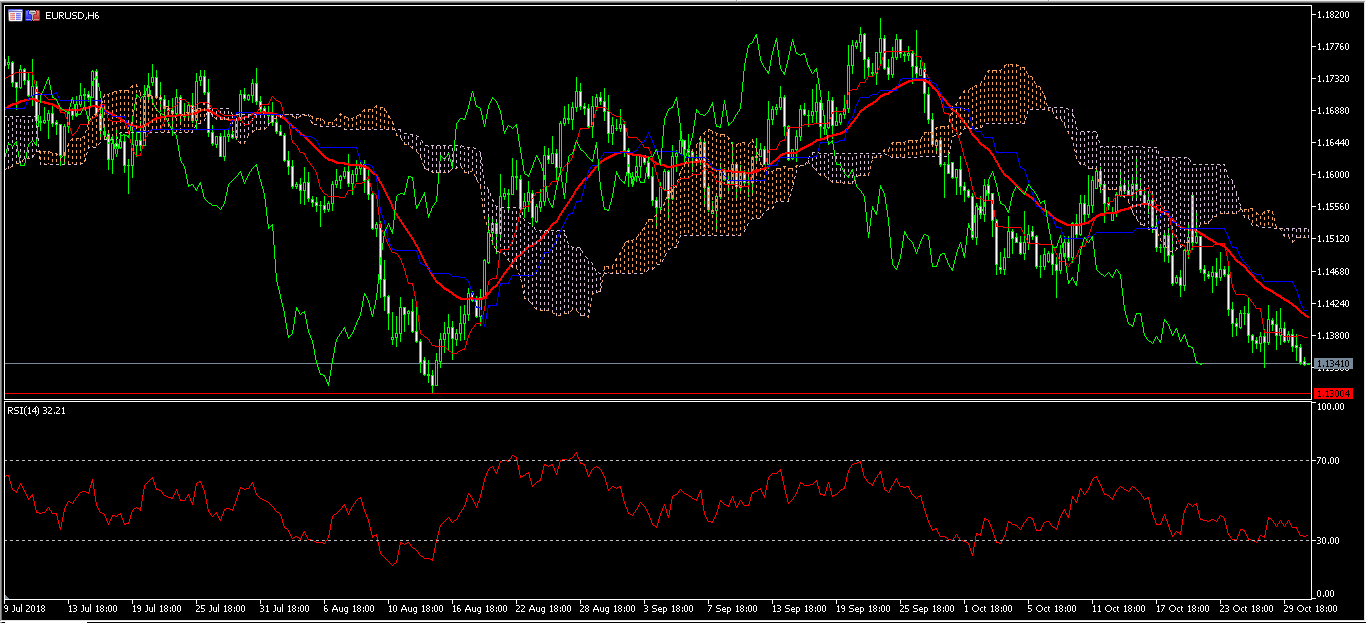
The EUR/USD pair declined to an intraday low of 1.1340. This was as the previous gains looked like a failed reversal. Today's low in the Asian session is the lowest it has been since Monday this week. The trend indicators like the moving averages, Ichimoku Kinko Hyo show that the pair could continue moving lower. This is confirmed by the oscillators like the RSI and the volumes indicators like the MFI as shown below. While this is the path of the least resistance, traders should be cautious about opening bearish trades past the 1.1300 level.
GBP/USD
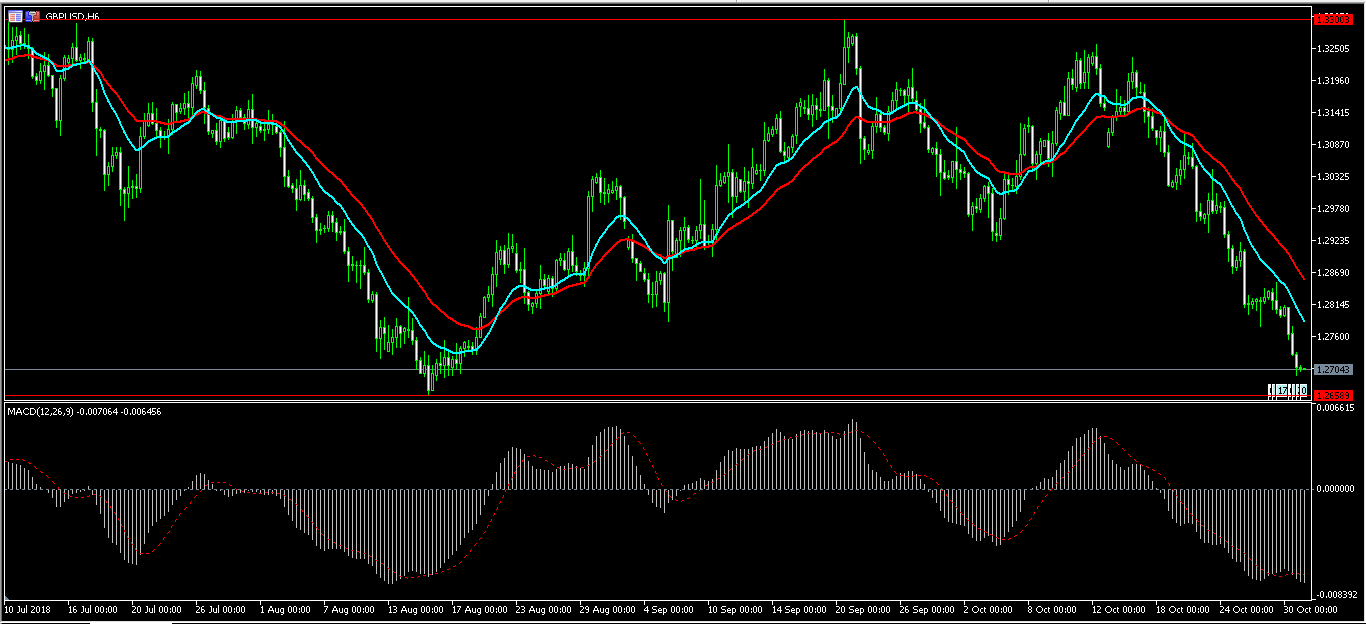
The GBP/USD pair moved lower in the Asian session and reached an intraday low of 1.2700. This was the lowest it has been since August 23. The double EMA indicator show that the pair's path of least resistance is downwards. This is confirmed by the MACD, which is at a multi-monthly low. However, as the new month starts, and as the pair edges closer to the important support of 1.2665, traders should be cautious about further bearish bets.
USD/JPY
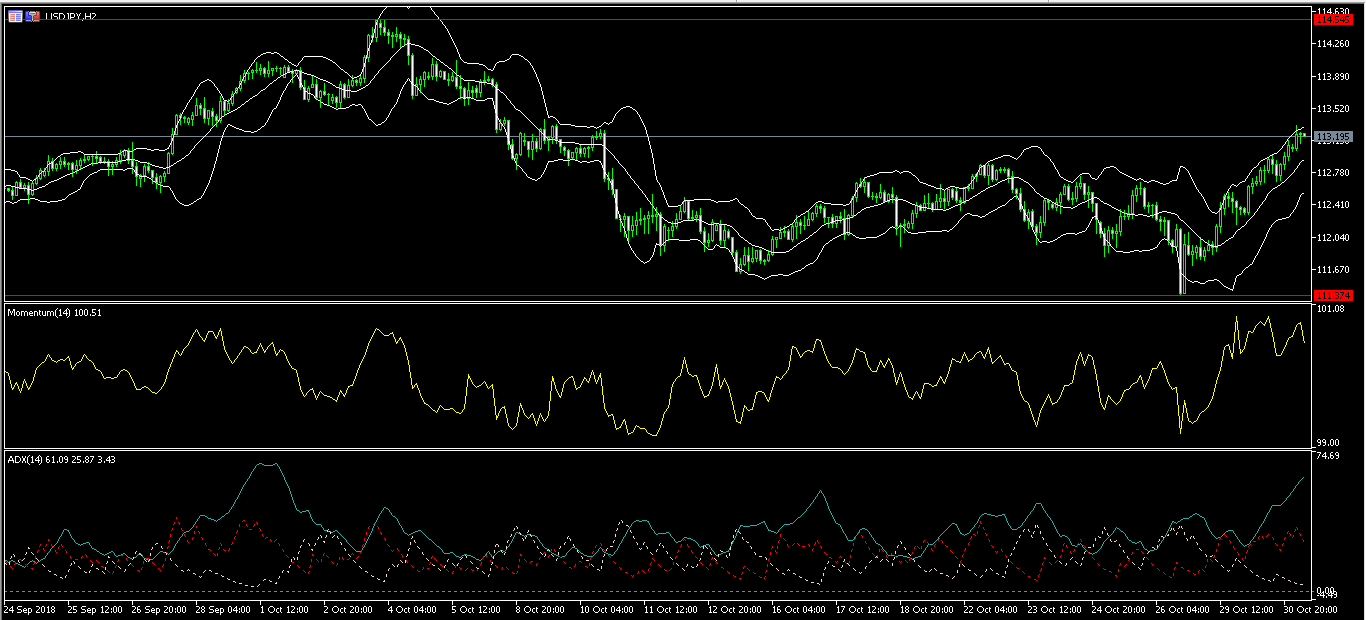
The USD/JPY pair moved higher, continuing a strong trend started on Wednesday last week. The pair reached an intraday high of 113.32. This was the highest it has been since October 11. The upward trend is gaining momentum as shown by the momentum indicator below. The Average Directional Index (ADX) which measures the strength of the trend is currently at 61 while the price is along the upper band of the Bollinger Bands. This is an indication that the pair could continue moving up in the new month.
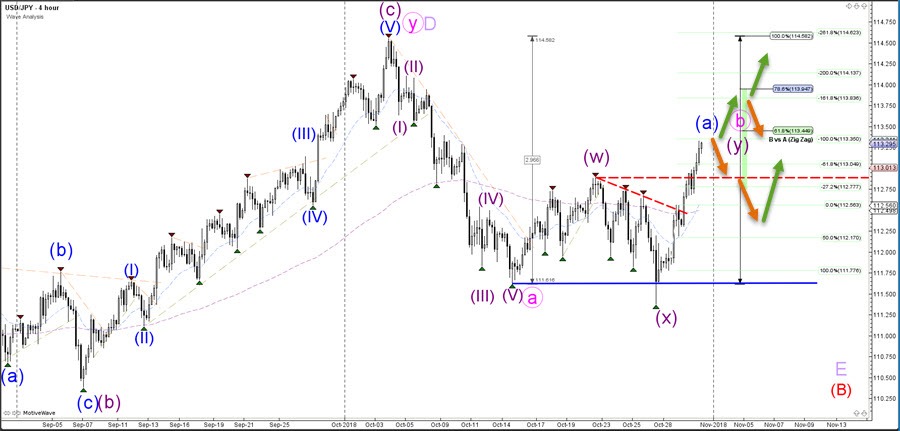
USD/JPY Bullish Momentum Reaching 61.8% Fibonacci Level
The USD/JPY bullish momentum could be part of a larger wave A (blue) of a wave B (pink) unless price manages to break above the 78.6% and 100% Fibonacci levels. In that case a different wave pattern is taking place than the expected ABC bearish zigzag (pink).
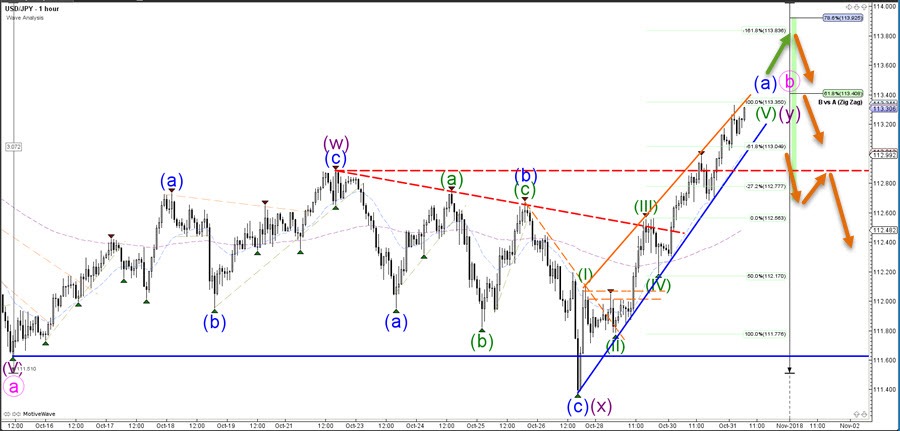
The USD/JPY is building a neat bullish trend channel that is now reaching key Fib levels.
EURNZD: Elliott Wave Showing Incomplete Sequence
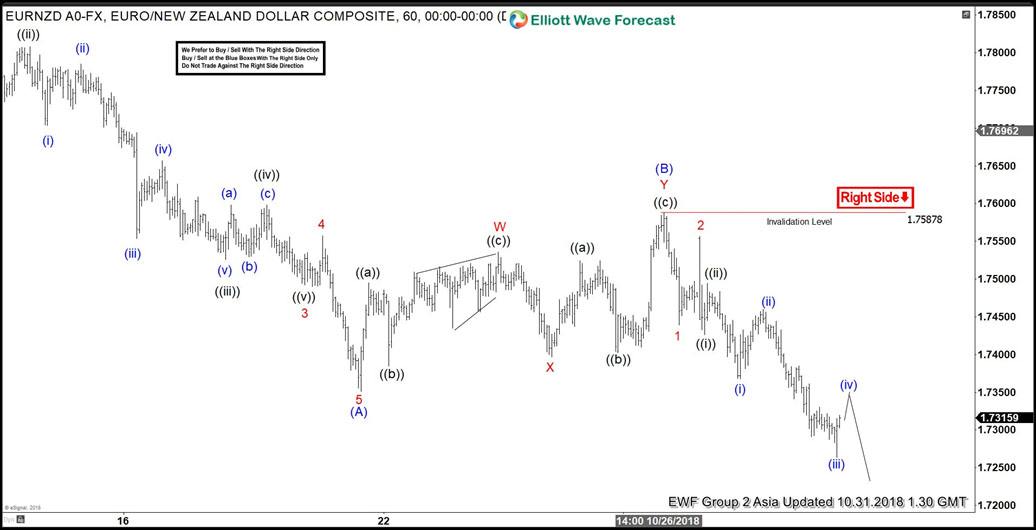
EURNZD short-term Elliott wave analysis suggests that the decline from 10/08/2018 peak is unfolding as Zigzag structure. Where a bounce to 1.7881 high ended Minute wave ((ii)), Minute wave ((iii)) ended in lesser degree 5 waves at 1.7528 low. Minute wave ((iv)) ended at 1.7596 high. And Minute wave ((v)) ended at 1.7493 low which also completed the Minor wave 3. Up from there, a bounce to 1.7556 high ended Minor wave 4 bounce. Down from there, a decline to 1.7354 low ended Minor wave 5 & finally completed intermediate wave (A) in 5 waves impulse.
Above from there, a bounce to 1.7587 high ended intermediate wave (B) bounce. The internals of that bounce unfolded as double three structure where Minor wave W ended in 3 swings at 1.7534 high. Minor wave X pullback ended at 1.7399 low and more Minor wave Y ended in another lesser degree 3 waves at 1.7587 high. Down from there, intermediate wave (C) remains in progress in another 5 waves. Near-term, while below 1.7587 high expect bounces to fail in 3, 7 or 11 swings for more downside towards 1.7004-1.6642 100%-161.8% Fibonacci extension area of intermediate wave (A)-(B) to end the cycle from 10/08/2018 peak & finding buyers again. We prefer more downside against 1.7587 high.
EURNZD 1 Hour Elliott Wave Chart
Gold Lower On Improved Risk Appetite, Oil Traders Shrug Off Inventory Build
Investors happy to see the back of October
It may have been a horrifying month for investors but a strong session in the US and Asia overnight could see it end on a less frightening note and even send us into November feeling a little less gloomy.
October has well and truly lived up to its chilling reputation, with stock markets around the globe suffering one of their worst months in recent memory. It’s been a wild ride for investors and there is no guarantee it’s over yet. Markets may have recovered their early losses and some indices may even be in the green for the week but volatility has not eased and that’s a concern.
Anxiety in still extremely evident in the markets and the next week is unlikely to calm that, with the jobs report, Fed meeting and midterms in the US only adding to the uncertainty. European stocks are expected to open well in the green on Wednesday but as we’ve seen recently, investor sentiment can quickly turn and those gains wiped out. I think there’s a few more scares to come before things settle down.
China sees gains despite weak PMIs
Chinese markets performed well overnight while the yuan continued to flirt with the seven handle against the dollar. This is seen by many as being a psychologically important level for the currencies, a break of which could propel it much further, potentially causing further tensions between the two countries. The central bank has been actively supporting the currency as it comes under pressure from tariffs in the hope of avoiding a scenario whereby rapid depreciation triggers outflows of capital from the country.
The gains in the markets came despite some weaker survey data from the country, with both the official manufacturing and non-manufacturing PMIs falling short of expectations. The former barely stayed in growth territory in a further sign of the impact tariffs are having on firms outlook for the economy.
Gold lower on improved risk appetite, Oil traders shrug off inventory build
Gold continues to edge lower as risk appetite improves, with the yellow metal being hit by the double whammy of lost safe haven appeal and a stronger US dollar. The dollar index has risen to its highest level in more than an year on the expectations of further rate hikes in the US as the economy continues to perform at a level most Western allies could only dream of.
Oil is also reaping the benefits of returning risk appetite, etching out modest gains on the day so far. This comes despite API reporting another significant increase in stocks on Tuesday, something that was largely shrugged off by investors at the time. I wonder whether they’ll be quite so relaxed if EIA report a similar number later on today.
Eurozone Stagflation?
Market movers today
Today's main event is the euro area flash HICP. The inflation number is particularly interesting given that euro area growth slowed to a four-year low yesterday and Draghi's insistence on inflationary pressure last week. Ergo stagflation. Since April, headline inflation has been close to the ECB's target (below but close to 2%). We expect the October numbers to increase slightly to 2.2% y/y driven by higher energy prices and much more importantly, higher core inflation. We expect a pickup in core inflation to from 0.91% to 1.09% on the back of higher service price inflation.
Overnight, Chinese Caixin PMI manufacturing is due. The number will be followed closely as it dropped to 50.0 in September and a further decline would take it below the 50 level.
Selected market news
The US equity market rebounded yesterday amid yet another volatile session. As of this morning, S&P 500 futures and Asian equity markets are in the black. Treasury yields and the dollar gained.
This morning, the Bank of Japan (BoJ) kept its monetary policy unchanged. The policy rate and the yield target on 10-year Japanese government bonds was maintained at -0.1% and 0% (+/-20bp), respectively. The decision was made by a 7-2 vote. The BoJ also maintained its forward guidance and left its asset purchases unchanged.
We expect the BoJ to keep its current policy intact until the end of 2019 at least. As we had expected, the BoJ revised down its inflation forecast from 1.1% back in July to 0.9% for FY 18 - so business as usual here. The growth forecast for FY 18 was also cut slightly from 1.5% to 1.4% and risks on the outlook for economic activity and price development are skewed towards the downside. In the current situation, the BoJ is likely to continue to maintain a very accommodative monetary policy for a long period of time.
Yesterday, euro area Q3 GDP growth came in at a four-year low of 0.2 % below consensus and our expectations (0.4%). In the absence of a component breakdown, we expect that growth was primarily driven by domestic demand in light of lingering external headwinds on the trade front. In terms of country composition, weaker activity was likely to have been driven primarily by Italy and Germany, and could not be fully compensated for by an acceleration in the French Q3 growth rate.
We lower our 2018 euro area GDP growth forecast to 1.9% based on weak data, but we still look for a small rebound in Q4 to 0.4%, primarily on the back of a recovery in German activity as production bottlenecks in the car industry subside. We do not think the data will ring alarm bells at the ECB as growth remains above potential (1.5%), but it strengthens the case for a downward revision of the GDP growth forecasts at the December meeting.
China Official PMIs Miss Ests
General Trend:
- Facebook rises in the afterhours post earnings
- Samsung reports final Q3 results, expects Q4 earnings to decline amid seasonality
- Sony rises over 3%, raised FY forecast
- Honda gains over 5%, raised outlook
- Australia’s ANZ rises after FY results
- Standard Chartered Q3 profits above ests, ROE rises
- South Korea and Japan industrial production data decline in Sept
- Aussie drops as core CPI misses ests
- BoJ cuts CPI forecasts
- BoJ may release new monthly bond purchase schedule later today
- Japanese companies expected to report earnings include Renesas, Panasonic, JVC, Docomo, Yamato Holdings, Yahoo Japan, Yamaha Motor, Mazda, Start Today, Takeda, Japan Tobacco and Japan Airlines
- Indian Rupee declines amid reports of possible rift between RBI Gov and government
Headlines/Economic Data
Japan
- Nikkei 225 opened +0.5%
- (JP) BOJ LEAVES INTEREST RATE ON EXCESS RESERVES (IOER) UNCHANGED AT -0.10%; AS EXPECTED; Vote 7:2 on yield curve control (YCC) setting (Harada and Kataoka again dissent)
- (JP) BOJ updates its Quarterly Outlook for Economic Activity and Prices cuts current year GDP, affirms others, Cuts core CPI view for FY18-FY20
- (JP) Japan is not expected to raise the financial income tax in the FY2019 reform - Japanese press
- (JP) JAPAN SEPT PRELIM INDUSTRIAL PRODUCTION M/M: -1.1% V -0.3%E; Y/Y: -2.9% V -2.1%E
- (JP) Japan PM Abe: ETF buying is not done with stock price level in mind, closely watching next steps by US against China on trade
- (JP) JAPAN SEPT ANNUALIZED HOUSING STARTS: 943K V 950KE; Y/Y: -1.5% V -0.8%E
- Honda, 7267.JP Reports Q2 Net ¥455.1B v ¥381.3B y/y, Op ¥513.9B v ¥422.2B y/y, Rev ¥7.87T v ¥7.49T y/y (after the close)
- Sony, 6758.JP Reports H1 Net ¥399.5B v ¥211.7B y/y, Op ¥434.5B v ¥361.8B y/y, Rev ¥4.14T v ¥3.92T y/y; Raises outlook (after the close)
Korea
- Kospi opened +0.4%
- (KR) SOUTH KOREA SEPT INDUSTRIAL PRODUCTION M/M: -2.5% V -0.5%E; Y/Y: -8.4% V -5.1%E
- (KR) South Korea to hold annual consultation meeting with Fitch this week on credit valuation - Korean press
China/Hong Kong
- Hang Seng opened +0.7%, Shanghai Composite +0.2%
- (CN) CHINA OCT OFFICIAL MANUFACTURING PMI: 50.2 V 50.6E; NON-MANUFACTURING PMI: 53.9 V 54.6E
- (CN) China PBoC Open Market Operation (OMO): skips v skips prior in 7-day reverse repos prior: Net: CNY150B drain v CNY120B injection prior
- (CN) China PBOC to sell yuan bills in Hong Kong Nov 7th: Offering CNY10B in 3-month and CNY10B in 1-yr bills; Auction aimed at improving yuan yield curve
- (CN) China PBOC sets Yuan midpoint rate at 6.9646 v 6.9574 prior (weakest level since May 20th, 2008)
- (CN) China Commerce Ministry:Opposed to US implementing unilateral sanctions against a Chinese firm, should immediately stop its wrong practice - Xinhua
- (CN) Follow Up: Hong Kong said to consider extending tax exemption to cover the bills that the China PBoC is planning to sell in HK
Australia/New Zealand
- ASX 200 opened +0.1%
- ANZ.AU Reports FY18 (A$) Cash net profit 6.48B v 6.81B y/y; Will not go ahead with IPO or sale UDC Finance
- (AU) AUSTRALIA Q3 CPI Q/Q: 0.4% V 0.5%E; Y/Y: 1.9% V 1.9%E; CPI Trimmed Mean Q/Q: 0.4% v 0.4%e; Y/Y: 1.8% v 1.9%e
- (NZ) New Zealand Sept Building Permits M/M: -1.5% v +7.8% prior
- CBA.AU Confirms to sell Colonial First State to Mitsubishi UFJ Trust and Banking Corporation for A$4.13B; to have post tax gain of A$1.5B
- ORG.AU Reports Q1 production 64.3 pje v 89.1 y/y; Sales 63.7 pje v 62.8 q/q; Rev A$640.5M v A$678.6M y/y
- (AU) Australia ratifies the TPP Pacific trade agreement (as expected)
- FCG.NZ Global Dairy Update: Reports Sept Total New Zealand milk production +6% y/y
Other Asia
- (IN) Said to be an irreversible breakdown between RBI Gov and Govt, RBI Gov may resign - local media
North America
- US equity markets ended higher: Dow +1.8%, S&P500 +1.6%, Nasdaq +1.6%, Russell 2000 +2%
- (US) Former Fed Chair Yellen: at least a couple more rate hikes are necessary as the Fed tries to take its foot off the accelerator
Europe
- (UK) Oct GfK Consumer Confidence: -10 v -10e
- (UK) Oct BRC Shop Price Index y/y: -0.2% v +0.2% prior
- (UK) Oct Lloyds Business Barometer: 19 v 29 prior
- (UK) S&P analysis: risk of no-deal Brexit has increased enough to become a relevant sovereign rating consideration (overnight)
- (IT) Italy Treasury: EU Commission has requested clarification on debt reduction plans; will respond by Nov 13th (overnight)
- STAN.UK Reports Q3 adj pretax $1.07B v $976Me, Op income $3.72B v $3.59B y/y
Levels as of 01:30ET
- Hang Seng +1.0%; Shanghai Composite +1.1%; Kospi +0.4%; Nikkei225 +2.0%; ASX 200 +0.4%
- Equity Futures: S&P500 +0.3%; Nasdaq100 +0.5%, Dax +0.9%; FTSE100 +0.8%
- EUR 1.1336-1.1416; JPY 113.03-113.33 ; AUD 0.7073-0.7107;NZD 0.6542-0.6571
- Dec Gold -0.5% at $1,218/oz; Dec Crude Oil +0.4% at $66.44/brl; Dec Copper -2.6% at $2.67/lb
Euro-Zone’s Economy Expanded At Its Weakest Pace In 4-Years In 3Q 2018
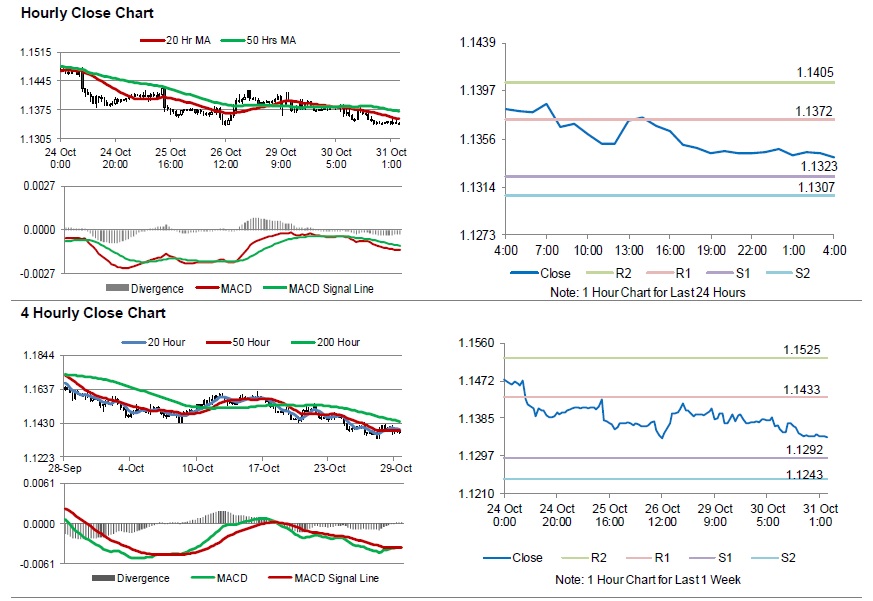
For the 24 hours to 23:00 GMT, the EUR declined 0.27% against the USD and closed at 1.1344, as Euro-zone's third quarter GDP growth slowed and economic confidence deteriorated, triggering fears over the region's economic growth prospects.
In the economic news, the Euro-zone's seasonally adjusted preliminary gross domestic product (GDP) expanded at its weakest pace in 4-years by 0.2% on a quarterly basis in 3Q18, undershooting market consensus for a gain of 0.3%. In the prior quarter, GDP had climbed 0.4%. Moreover, the region's economic sentiment indicator fell more than expected to 109.8 in October, compared to a level of 110.9 in the previous month. Market participants had expected the economic sentiment indicator to drop to a level of 110.0. Additionally, the business climate indicator eased to a level of 1.01 in October, more than market forecast for a fall to a level of 1.16 and compared to a level of 1.21 in the prior month. Also, the region's industrial confidence index fell to a level of 3.0 in October, compared to market expectations for a drop to a level of 3.9. The index had recorded a level of 4.7 in the previous month. However, the final consumer confidence index climbed to a level of -2.7 in October, confirming the preliminary print and in line with market anticipations. In the prior month, the index had recorded a reading of -2.9.
Separately, in Germany, the flash consumer price index (CPI) jumped 2.5% on an annual basis in October, notching its highest level in six years and rising at its fastest pace since February 2012. The CPI had increased 2.3% in the preceding month, while market participants had envisaged for a rise of 2.4%. Meanwhile, the nation's seasonally adjusted unemployment rate remained steady at 5.1% in October, at par with market expectations.
In the US, data showed that the US CB consumer confidence index rose to an 18-year high level of 137.9 in October, driven by strong labour market and compared to a revised level of 135.3 in the prior month.
In the Asian session, at GMT0400, the pair is trading at 1.1340, with the EUR trading a tad lower against the USD from yesterday's close.
The pair is expected to find support at 1.1323, and a fall through could take it to the next support level of 1.1307. The pair is expected to find its first resistance at 1.1372, and a rise through could take it to the next resistance level of 1.1405.
Going ahead, investors would await the Euro-zone's unemployment rate for September and consumer price index for October, set to release in a few hours. Moreover, Germany's retail sales for September due to be released in a few hours, will pique significant amount of investors attention. Later in the day, the US MBA mortgage applications followed by ADP employment change and the Chicago purchasing managers index, both for October, will keep traders on their toes.
The currency pair is trading below its 20 Hr and 50 Hr moving averages.
Britain’s Gfk Consumer Confidence Dipped In October, While Lloyds Bank Business Barometer Declined In The Same Month
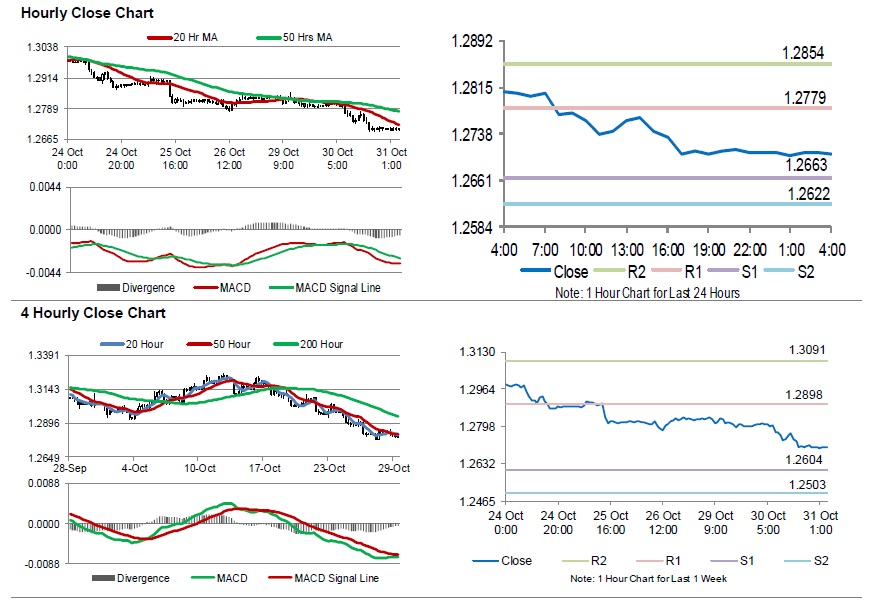
For the 24 hours to 23:00 GMT, the GBP declined 0.73% against the USD and closed at 1.2706, amid mounting worries over “no-deal” Brexit.
Macroeconomic data revealed that UK's Gfk consumer confidence slid to a level of -10.0 in October, at par with market expectations. The consumer confidence had recorded a level of -9.0 in the previous month. Additionally, the nation's Lloyds Bank business barometer eased 19.0% in October, compared to a reading of 29.0% in the prior month.
In the Asian session, at GMT0400, the pair is trading at 1.2705, with the GBP trading marginally lower against the USD from yesterday's close.
The pair is expected to find support at 1.2663, and a fall through could take it to the next support level of 1.2622. The pair is expected to find its first resistance at 1.2779, and a rise through could take it to the next resistance level of 1.2854.
The currency pair is trading below its 20 Hr and 50 Hr moving averages.
BoJ Kept Its Benchmark Interest Rate Unchanged
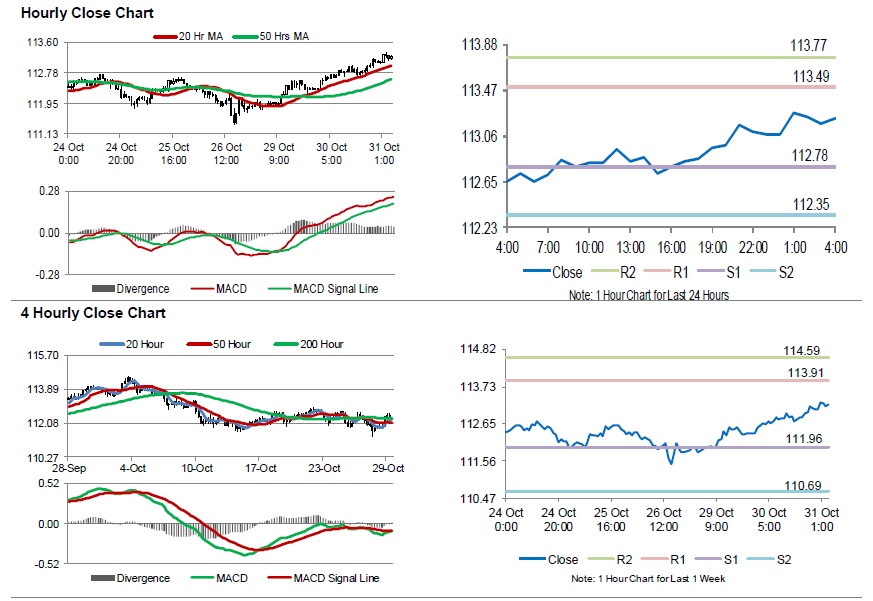
For the 24 hours to 23:00 GMT, the USD rose 0.63% against the JPY and closed at 113.07.
On the macro front, Japan’s preliminary industrial production retreated 2.9% on a yearly basis in September, compared to a rise of 0.2% in the previous month. Market participants had anticipated the industrial production to record a drop of 2.1%.
In the Asian session, at GMT0400, the pair is trading at 113.22, with the USD trading 0.13% higher against the JPY from yesterday’s close.
The Bank of Japan, in its October monetary policy meeting, opted to leave its benchmark interest rates unchanged at -0.10%, as widely expected and pledged to guide 10-year government bond yields at around 0%. Moreover, the central bank downgraded inflation forecast for 2019 to 1.9% from 2.0% and for 2020 to 2.0% from 2.1%. Meanwhile, real GDP growth outlook for both 2019 and 2020 was retained at 0.8%.
Earlier in the session, Japan’s consumer confidence index unexpectedly declined to a level of 43.0 in October, defying market expectations for an advance to a level of 43.5. The index had registered a level of 43.4 in the previous month. Also, housing starts slid 1.5% on an annual basis in September, compared to an advance of 1.6% in the prior month. On the contrary, Japan’s construction orders advanced 1.0% on a yearly basis in September, following a rise of 0.5% in the preceding month.
The pair is expected to find support at 112.78, and a fall through could take it to the next support level of 112.35. The pair is expected to find its first resistance at 113.49, and a rise through could take it to the next resistance level of 113.77.
The currency pair is trading above its 20 Hr and 50 Hr moving averages.