

Sample Category Title
EUR/USD Daily Outlook
Daily Pivots: (S1) 1.1328; (P) 1.1358; (R1) 1.1375; More....
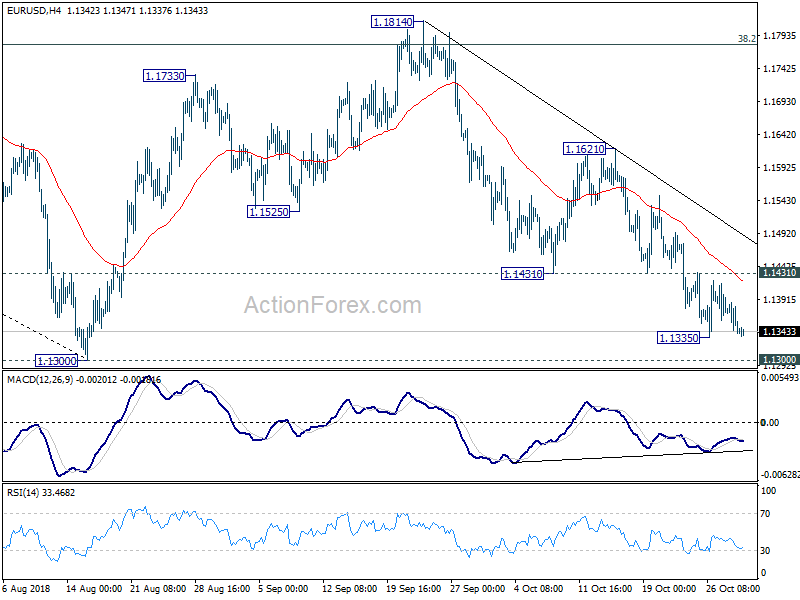
EUR/USD is holding above 1.1335 temporary low and intraday bias stays neutral first. Further decline is expected as long as 1.1431 support turned resistance holds. On the downside, below 1.1335 will target 1.1300 low first. Decisive break will resume whole down trend from 1.2555 and target 1.1186 fibonacci level next. On the upside, however, break of 1.1431 resistance will indicate short term bottoming, with bullish convergence condition in 4 hour MACD. Intraday bias will be turned back to the upside for 1.1621 resistance and above.
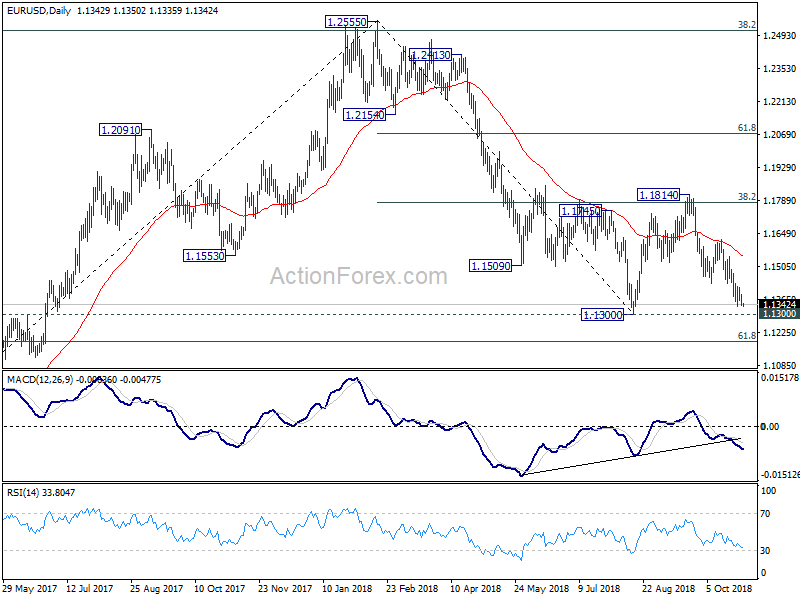
In the bigger picture, corrective pattern from 1.1300 could have completed at 1.1814 after hitting 38.2% retracement of 1.2555 to 1.1300 at 1.1779. Decisive break of 1.1300 will resume the down trend from 1.2555 to 61.8% retracement of 1.0339 (2017 low) to 1.2555 at 1.1186 next. Sustained break there will pave the way to retest 1.0339. On the upside, break of 1.1814 will delay the bearish case and extend the correction from 1.1300 with another rise before completion.
GBP/USD Daily Outlook
Daily Pivots: (S1) 1.2666; (P) 1.2739; (R1) 1.2783; More...
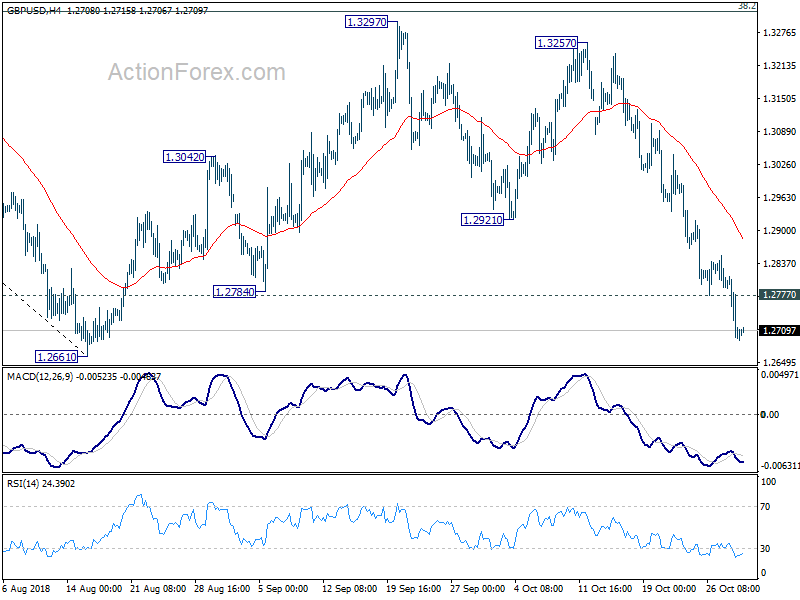
GBP/USD's decline is still in progress and intraday bias remains on the downside for 1.2661 low. Decisive break there will l resume larger down trend from 1.4376. Next target is 61.8% projection of 1.4376 to 1.2661 from 1.3297 at 1.2237. On the upside, above 1.2777 minor resistance will turn intraday bias neutral first. But for now, near term outlook will remain cautiously bearish as long as 1.2921 support turned resistance holds.
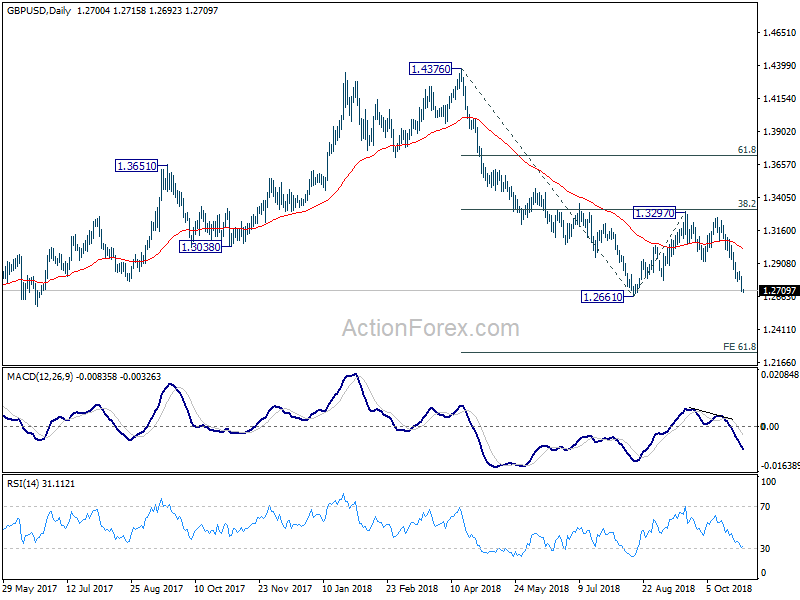
In the bigger picture, whole medium term rebound from 1.1946 (2016 low) should have completed at 1.4376 already, after rejection from 55 month EMA. The structure and momentum of the fall from 1.4376 argues that it's resuming long term down trend. And this will be the preferred case as long as 38.2% retracement of 1.4376 to 1.2661 at 1.3316 holds. However, firm break of 1.3316 would bring stronger rebound to 61.8% retracement at 1.3721. And, the eventual depth of the fall from 1.4376, and the chance of hitting 1.1946 low, will depend on the strength of the interim corrective rebound from 1.2661.
Dollar Regains Control as Stocks and Yield Rebound, Facing Key Levels Against Euro, Sterling and Franc
Dollar index jumped overnight and breached 96.98 key resistance, with the help from rebound in stocks and treasury yields. But strength of the greenback mainly centered against Sterling, Swiss Franc and Yen. It's holding in range against Euro, Canadian and Australian for the moment. As for today, Sterling is recovering broadly, mainly because it's digesting this week's sharp losses. Australian Dollar and Yen are the weakest for now instead.
DOW staged a strong 431.72 pts, or 1.77% rebound overnight. S&P 500 and NASDAQ also closed up 1.57% and 1.58% respectively. All three indices are staying in lower-low, lower-high pattern for the near term. But oversold condition could limit downside for a while. 10 year yield closed up 0.23 at 3.110. 30-year yield closed up 0.027 at 3.356. Both are held in near term consolidation. But 30-year yield displayed more resilience. In Asia, at the time of writing, Nikkei is up 2%, Singapore Strait Times up 0.66%, China Shanghai SSE is up 1.07%, Hong Kong HSI is up 0.91%. Japan 10 year JGB yield is up 0.0024 at 0.124. Markets sentiments seem to be back to normal.
Technically, with Dollar's rebound, focus will now be on 1.1335 temporary low in EUR?USD and break will put focus on 1.1300 key support level. At the same time, GBP/USD might also challenge 1.2661 key support. USD/CHF could challenge 1.0067 key resistance. We'll see if Dollar could power through these key levels, or be rejected from there.
BoJ stands pat, lowers inflation forecasts once again
BoJ left monetary policy unchanged today as widely expected, by 7-2 vote again. Short term policy interest rate is held at -0.1%. On long term interest rate, BoJ will continue with asset purchases to keep 10 year JGB yield at around 0%. G. Kataoka dissented again, pushing for more monetary easing due to "heightening uncertainties regarding development in economic activity and prices". Y. Harada dissented because "allowing the long-term yields to move upward and downward to some extent was too ambiguous".
In the Outlook for Economic Activity and Prices report, BoJ noted that the economy is likely to continue to grow above potential in fiscal 2018. For fiscal 2019 and 2020, the economy is expected to continue on an "expanding trend", partly supported by "external demand". But growth is projected to decelerate due to a "cyclical slowdown" in business fixed investments and the scheduled sales tax hike.
CPI continued to show "relatively weak developments" comparing to growth and labor market. Though, BoJ maintained that "further price rises are likely to be observed widely and then medium- to long-term inflation expectations are projected to rise gradually". Thus, CPI will gradually increase towards 2% target. On risks, BoJ said both economic and prices risks are "skewed to the downside".
In the updated economic projects, fiscal 2018 growth forecast was downgraded from 1.5% to 1.4%. Growth forecasts for 2018 and 2019 were kept unchanged at 0.8%. Fiscal 2018 core CPI projection was lowered notably to 0.9%, down from 1.1%. For fiscal 2019 and 2020, ex-sales-tax-hike core CPI projections were also lowered, to 1.4% and 1.5%, down from 1.5% and 1.6% respectively.
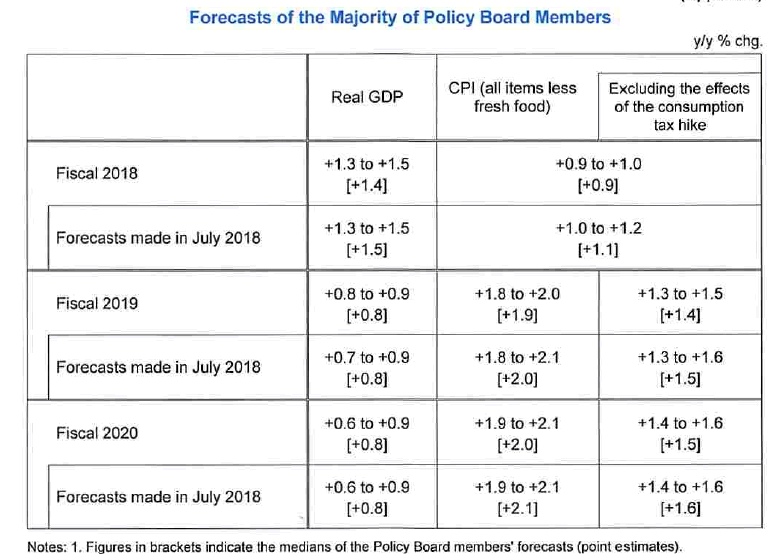
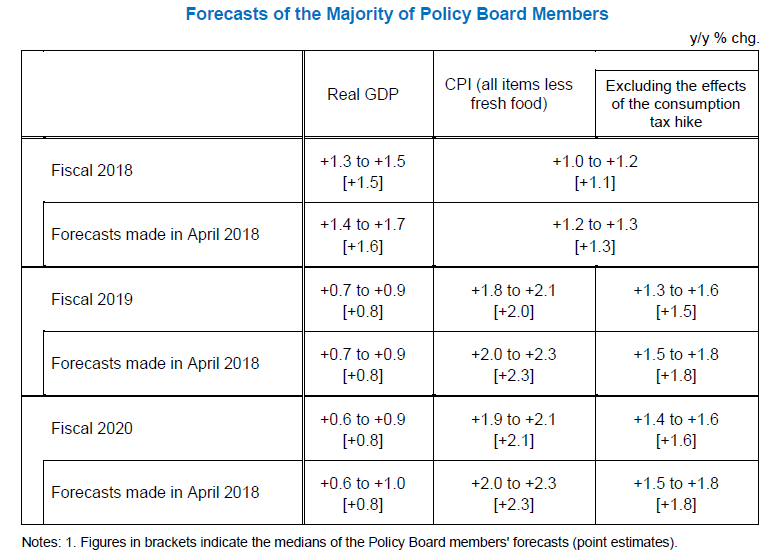
Also, note that the ex-sales-tax-hike core CPI projections are notably lower than April's forecasts, at 1.8% in fiscal 2019 and fiscal 2020 respectively.
Also from Japan, consumer confidence dropped to 43 in October. Housing starts dropped -1.5% yoy in September. Industrial production dropped -1.1% mom.
BoC Poloz: Interest rate hike to continue to neutral at 2.5-3.5%
Bank of Canada Governor Stephen Poloz reiterated the central bank's stance to continue with rate hike to the House of Commons Standing Committee on Finance yesterday. In his prepared remarks, Poloz noted that there were "some very positive developments" in the Canadian economy, with "solid momentum" and it "continues to operate near its capacity". Also, growth is "relatively broad-based across sectors and regions". He expected the economy to "growth at a rate slightly above its potential over the projection horizon". And "while there could be further volatility in inflation in coming months, our core measures remain firmly around 2 per cent". He also highlighted "trade and household indebtedness" as two main risks.
Overall, Poloz said even with last week's rate hike to 1.75% "monetary remains stimulative". BoC's policy rate is "still negative in real terms". The current estimated neutral is in range of 2.5-3.5%. Poloz said "policy rate will need to rise to neutral to achieve our inflation target." Though, the " appropriate pace of increases will depend on our assessment at each fixed announcement date of how the outlook for inflation and related risks are evolving". BoC will take into account how the economy adjusts to higher rates, as well as global trade policy developments and their implications on inflation outlook.
Australia CPI slowed to 1.9% yoy in Q3, AUD/USD dips briefly
Australia CPI rose 0.4% qoq, 1.9% yoy in Q3, versus expectation of 0.5% qoq, 1.9% yoy. The annual rate slowed quite notably from 2.1% yoy. Trimmed mean CPI was unchanged at 1.8% yoy. Weighted median CPI was also unchanged at 1.7% yoy.
Chief Economist for the ABS, Bruce Hockman said: "Annual growth in the CPI fell back below 2 per cent in the September quarter 2018. Modest rises in housing costs, including rents, utilities and property rates, and a fall in child care out-of-pocket expenses, saw a subdued rise in the CPI this quarter."
AUD/USD dips after the release but quickly recovered.
New Zealand ANZ business confidence rose to -37.1, next RBNZ move more likely a cut
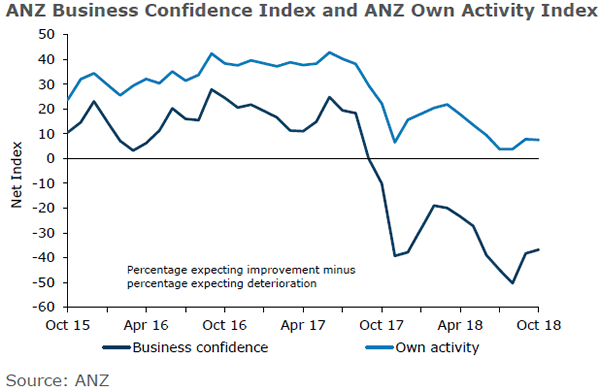
New Zealand ANZ Business Confidence improved to -37.1 in October, up from -38.3. Confidence is weakest in agriculture (-62.8) and best in construction (-14.8). Activity Outlook index dropped -0.4 to 7.4. Manufacturing (16.2) is the strongest, possibly due to lower New Zealand Dollar exchange rate. Services ranks second (12.6). Retail (-7.8) and agriculture (-2.3) are weakest.
On monetary policy, ANZ noted that "The Reserve Bank argued in the August Monetary Policy Statement that ticking along wasn't going to do the job, in terms of getting CPI inflation sustainably back to target. We therefore continue to believe that while the impacts of higher wage growth, higher oil prices, and the weaker currency certainly mean there's no hurry, it remains the case that an eventual OCR cut is more likely than a hike.
Also from New Zealand, building permits dropped -1.5% mom in September.
Elsewhere
The official China PMI manufacturing dropped to 50.2 in October, down from 50.8 and missed expectation of 50.6. Official PMI non-manufacturing dropped to 53.9, down from 54.9 and missed expectation of 54.9. UK Gfk consumer confidence dropped to -10 in October, BRC shop price index dropped -0.2%. Eurozone unemployment rate and flash CPI will be the main feature in European session. Later in the day, Canada GDP, IPPI and RMPI will be released. US will also release ADP employment, employment cost index and Chicago PMI.
GBP/USD Daily Outlook
Daily Pivots: (S1) 1.2666; (P) 1.2739; (R1) 1.2783; More...
GBP/USD's decline is still in progress and intraday bias remains on the downside for 1.2661 low. Decisive break there will l resume larger down trend from 1.4376. Next target is 61.8% projection of 1.4376 to 1.2661 from 1.3297 at 1.2237. On the upside, above 1.2777 minor resistance will turn intraday bias neutral first. But for now, near term outlook will remain cautiously bearish as long as 1.2921 support turned resistance holds.
In the bigger picture, whole medium term rebound from 1.1946 (2016 low) should have completed at 1.4376 already, after rejection from 55 month EMA. The structure and momentum of the fall from 1.4376 argues that it's resuming long term down trend. And this will be the preferred case as long as 38.2% retracement of 1.4376 to 1.2661 at 1.3316 holds. However, firm break of 1.3316 would bring stronger rebound to 61.8% retracement at 1.3721. And, the eventual depth of the fall from 1.4376, and the chance of hitting 1.1946 low, will depend on the strength of the interim corrective rebound from 1.2661.
Economic Indicators Update
| GMT | Ccy | Events | Actual | Forecast | Previous | Revised |
|---|---|---|---|---|---|---|
| 21:45 | NZD | Building Permits M/M Sep | -1.50% | 7.80% | 6.80% | |
| 23:50 | JPY | Industrial Production M/M Sep P | -1.10% | -0.20% | 0.20% | |
| 0:00 | NZD | ANZ Business Confidence Oct | -37.1 | -38.3 | ||
| 0:01 | GBP | GfK Consumer Confidence Oct | -10 | -10 | -9 | |
| 0:01 | GBP | BRC Shop Price Index Y/Y Oct | -0.20% | 0.20% | ||
| 0:30 | AUD | CPI Q/Q Q3 | 0.40% | 0.50% | 0.40% | |
| 0:30 | AUD | CPI Y/Y Q3 | 1.90% | 1.90% | 2.10% | |
| 0:30 | AUD | CPI RBA Trimmed Mean Q/Q Q3 | 0.40% | 0.40% | 0.50% | 0.40% |
| 0:30 | AUD | CPI RBA Trimmed Mean Y/Y Q3 | 1.80% | 1.90% | 1.90% | 1.80% |
| 0:30 | AUD | CPI RBA Weighted Median Q/Q Q3 | 0.30% | 0.40% | 0.50% | 0.40% |
| 0:30 | AUD | CPI RBA Weighted Median Y/Y Q3 | 1.70% | 1.90% | 1.90% | 1.70% |
| 1:00 | CNY | Manufacturing PMI Oct | 50.2 | 50.6 | 50.8 | |
| 1:00 | CNY | Non-manufacturing PMI Oct | 53.9 | 54.9 | 54.9 | |
| 3:08 | JPY | BOJ Rate Decision | -0.10% | -0.10% | -0.10% | |
| 5:00 | JPY | Consumer Confidence Index Oct | 43 | 43.5 | 43.4 | |
| 5:00 | JPY | Housing Starts Y/Y Sep | -1.50% | -0.50% | 1.60% | |
| 10:00 | EUR | Eurozone Unemployment Rate Sep | 8.10% | 8.10% | ||
| 10:00 | EUR | Eurozone CPI Core Y/Y Oct A | 1.00% | 0.90% | ||
| 10:00 | EUR | Eurozone CPI Estimate Y/Y Oct | 2.20% | 2.10% | ||
| 12:15 | USD | ADP Employment Change Oct | 190K | 230K | ||
| 12:30 | CAD | Industrial Product Price M/M Sep | -0.50% | |||
| 12:30 | CAD | Raw Materials Price Index M/M Sep | -1.50% | -4.60% | ||
| 12:30 | CAD | GDP M/M Aug | 0.20% | |||
| 12:30 | CAD | GDP Y/Y Aug | 2.40% | |||
| 12:30 | USD | Employment Cost Index Q3 | 0.80% | 0.60% | ||
| 13:45 | USD | Chicago PMI Oct | 60.5 | 60.4 | ||
| 14:30 | USD | Crude Oil Inventories | 6.3M |
Gold selloff accelerates, corrective rise from 1160.36 likely completed
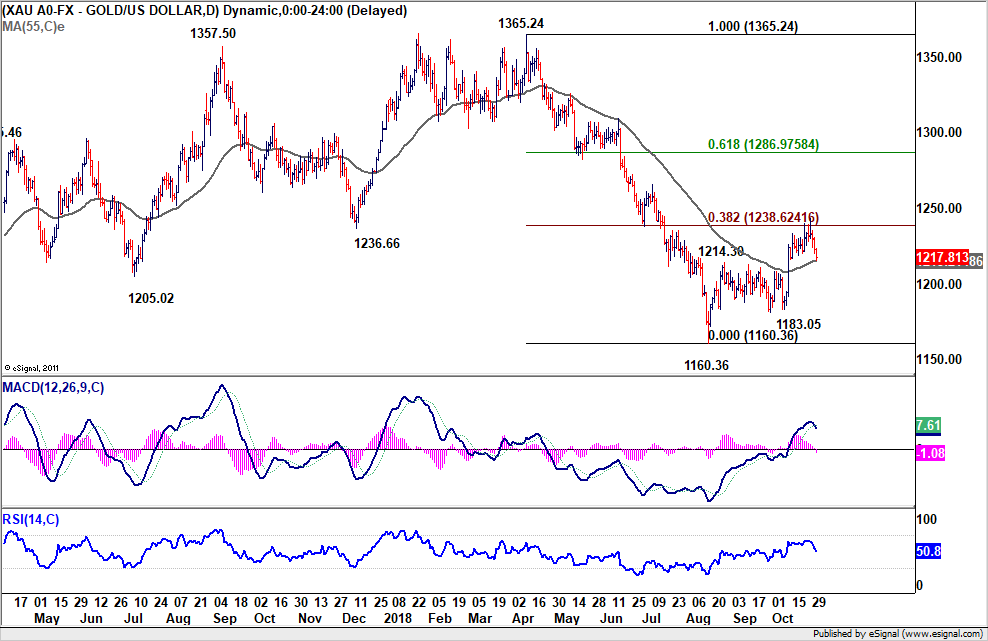
Gold drops to as low as 1215.57 so far today, breaking 1219.90 support firmly. The development suggests rejection by 38.2% retracement of 1365.24 to 1160.36 at 1238.62, despite brief breach. And it's in line with our view that rebound from 1160.36 is a correction only.
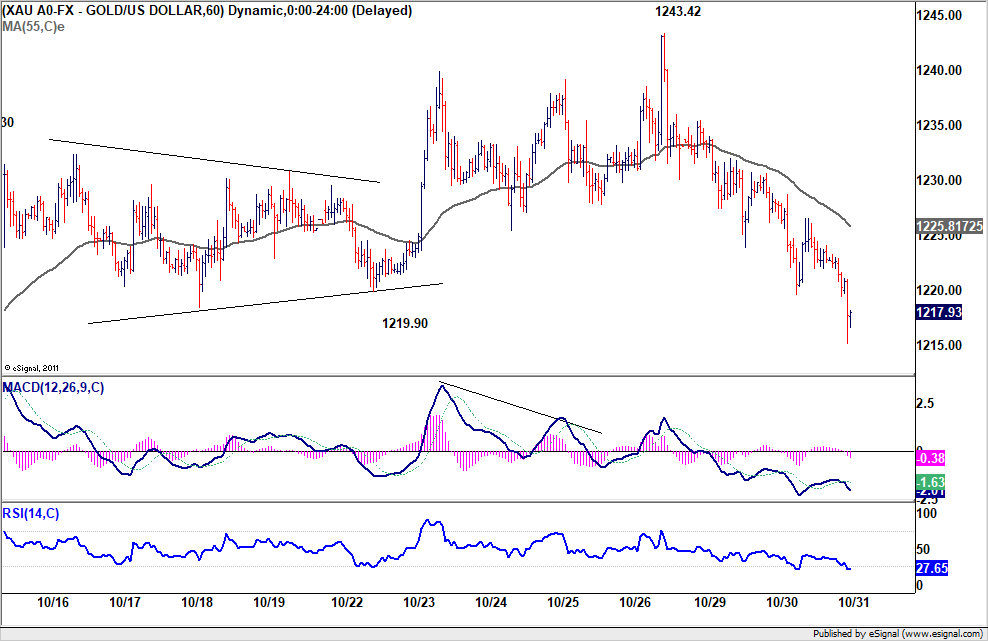
Immediate focus is on 55 day EMA (now at 1215.20). Sustained break will pave the way to retest 1160.36 low. In case of another recovery, we'd expect strong resistance from 1238.62 fibonacci level to limit upside again. Eventually, the down trend from 1365.24 is expected to extend through 1160.36 after the corrective pattern from 1160.36 completes.
BoJ stands pat, lowers inflation forecasts once again
BoJ left monetary policy unchanged today as widely expected, by 7-2 vote again. Short term policy interest rate is held at -0.1%. On long term interest rate, BoJ will continue with asset purchases to keep 10 year JGB yield at around 0%. G. Kataoka dissented again, pushing for more monetary easing due to "heightening uncertainties regarding development in economic activity and prices". Y. Harada dissented because "allowing the long-term yields to move upward and downward to some extent was too ambiguous".
In the Outlook for Economic Activity and Prices report, BoJ noted that the economy is likely to continue to grow above potential in fiscal 2018. For fiscal 2019 and 2020, the economy is expected to continue on an "expanding trend", partly supported by "external demand". But growth is projected to decelerate due to a "cyclical slowdown" in business fixed investments and the scheduled sales tax hike.
CPI continued to show "relatively weak developments" comparing to growth and labor market. Though, BoJ maintained that "further price rises are likely to be observed widely and then medium- to long-term inflation expectations are projected to rise gradually". Thus, CPI will gradually increase towards 2% target. On risks, BoJ said both economic and prices risks are "skewed to the downside".
In the updated economic projects, fiscal 2018 growth forecast was downgraded from 1.5% to 1.4%. Growth forecasts for 2018 and 2019 were kept unchanged at 0.8%. Fiscal 2018 core CPI projection was lowered notably to 0.9%, down from 1.1%. For fiscal 2019 and 2020, ex-sales-tax-hike core CPI projections were also lowered, to 1.4% and 1.5%, down from 1.5% and 1.6% respectively.
Also, note that the ex-sales-tax-hike core CPI projections are notably lower than April's forecasts, at 1.8% in fiscal 2019 and fiscal 2020 respectively.
Australia CPI slowed to 1.9% yoy in Q3, AUD/USD dips briefly
Australia CPI rose 0.4% qoq, 1.9% yoy in Q3, versus expectation of 0.5% qoq, 1.9% yoy. The annual rate slowed quite notably from 2.1% yoy. Trimmed mean CPI was unchanged at 1.8% yoy. Weighted median CPI was also unchanged at 1.7% yoy.
Chief Economist for the ABS, Bruce Hockman said: "Annual growth in the CPI fell back below 2 per cent in the September quarter 2018. Modest rises in housing costs, including rents, utilities and property rates, and a fall in child care out-of-pocket expenses, saw a subdued rise in the CPI this quarter."
AUD/USD dips after the release but quickly recovered.
Market Morning Briefing: The Support At 0.705-0.706 Continues To Stay Strong For The Aussie
STOCKS
Dow (24874.64, +1.77%) recovered sharply from levels near 24500 but closed just below immediate resistance near 25000. While below 25250-25000, the index could be tilted towards bearishness for the near term keeping chances of another decline to 24250 alive.
Dax (11287.39, -0.42%) was unable to sustain the bounce seen in the last couple of sessions. Some range trade in the 11400-11000 is possible before eventually moving up in the medium term towards 11600-11800.
Nikkei (21790, +1.55%) has risen sharply and if it manages to break above 21800-22000 could remain bullish for the coming sessions. At the same time we need to be cautious at weekly resistance near 22000.
Shanghai (2586.24, +0.71%) is likely to re-test 2650-2700 in the near term before facing rejection back towards current levels. Overall broad trade zone of 2700-2500 is likely to hold for the next 1-2 weeks.
Nifty (10198.40, -0.51%) dipped yesterday in line with the near term resistance near 10400-10300 region. While above 10000, we could see some range trade between 10400 and 10000. A break below 10000, if seen would turn bearish for the near term targeting 9700.
COMMODITIES
A rise in Dollar Index and recovery in the stock markets are negative for metals like Gold, Silver and Copper in the near term and have pushed prices lower. Also worry looms on a possible decrease in demand of metals from China due to the US imposed tariffs.
Resistance at 1240 is holding well on Gold (1222.20) pushing it back to our expected levels of 1220. Now if the fall continues, we could see a test of 1210-1200 again in the near term before the price re-attempts a rise back towards 1230-1240.
Silver (14.44) has broken below immediate support at 14.50 and could now come off towards 14 while the current fall continues. From 14, we could see a bounce back towards 14.50 or higher again.
Copper (2.6735) has also declined to test crucial support near 2.60-2.65 as mentioned yesterday. If 2.60 holds, we could see a bounce in another 2-3 sessions else a sharp decline towards 2.50 or even lower would come into the picture. For now preference is for a bounce from 2.60/65.
Both Brent and WTI are trading above long term support levels which if holds could soon produce a bounce by the coming week.
Brent (76.40) has immediate resistance at 77 on the daily candles and crucial long term support at 74-76 region. We could see trade within 74-77 levels in the next few sessions before a break on either side is seen.
WTI (66.44) also has important support in the 64-66 region and while that holds, a bounce in the near term looks possible.
FOREX
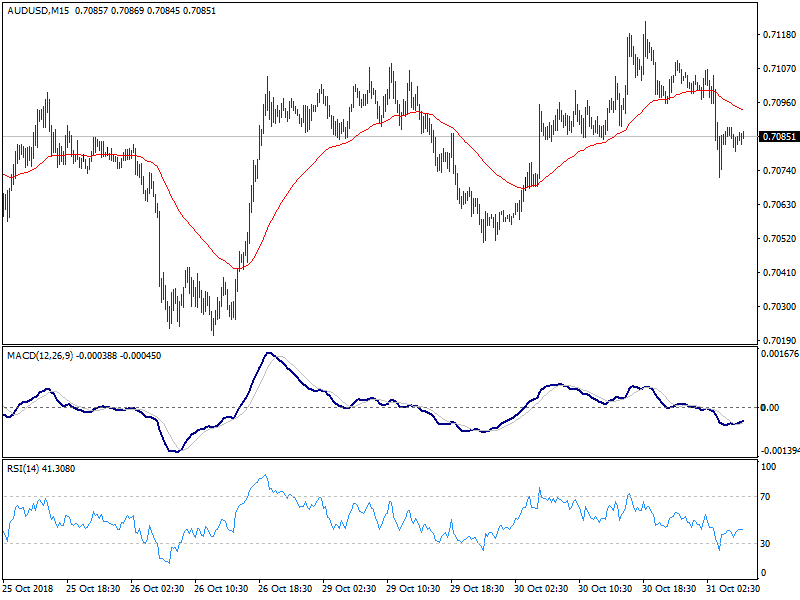
Watch 1.2662 on Pound and 0.705-0.706 on the Aussie. Both are crucial supports, which if broken, could lead to sustained Rupee weakness.
Euro (1.1344) could rise towards 1.1375-1.1400 from immediate support near 1.1325 in the next couple of sessions. After that, it could again come off towards 1.13.
Dollar Index (97.00) could face resistance anywhere between current levels and 97.25 in the next couple of sessions and could thereby come off towards 96.5-96.3, from where it could again rise.
Dollar Yen (113.15) has broken above 112.9 prior to the BoJ meet. We can now expect it to move higher towards resistance near 114.0-114.2 over the next 1-2 weeks.
Euro-Yen (128.36) could move up further towards 128.8-129.0 in the next couple of sessions before possibly coming off from there again.
Pound (1.2705) is testing crucial support at 1.27 on daily line chart. If it breaks below its Aug ’18 low of 1.2662 in this week, we could see it get very bearish in the weeks ahead.
Aussie (0.7080) : The support at 0.705-0.706 continues to stay strong for the Aussie. However while below 0.715, the possibility of the support breaking cannot be ignored. On weekly line chart, this level is seen as a crucial long term support, whose break could lead to sustained bearishness. Next few sessions could see a rise back towards 0.715.
Dollar Rupee (73.68) – Stay cautious on Dollar Rupee on a break above crucial resistance near 73.80. A decline could take it back towards 73.50.
INTEREST RATES
The US 10 Year (3.13%), as forecasted yesterday, has indeed moved up towards 3.13%. Infact, channel resistance might be slightly higher near 3.15%-3.16%, which could be tested over the next couple of sessions, before it comes off again below 3.10%.
The US 10-5 yr yield spread (0.17%) is trading at immediate resistance near current levels and if that holds the spread could come off towards 0.15% or lower in the coming sessions. This also suggests a possible downmove for the 10 year yield after 1-2 sessions.
Watch out for how the Japanese 10 year yield (0.12%) reacts after the BoJ meet today - where the Central Bank is expected to continue with its easy policy - it could lead to a further dip in the yield back towards 0.10%, which could then act as an important support level.
New Zealand ANZ business confidence rose to -37.1, next RBNZ move more likely a cut
New Zealand ANZ Business Confidence improved to -37.1 in October, up from -38.3. Confidence is weakest in agriculture (-62.8) and best in construction (-14.8). Activity Outlook index dropped -0.4 to 7.4. Manufacturing (16.2) is the strongest, possibly due to lower New Zealand Dollar exchange rate. Services ranks second (12.6). Retail (-7.8) and agriculture (-2.3) are weakest.
On monetary policy, ANZ noted that "The Reserve Bank argued in the August Monetary Policy Statement that ticking along wasn't going to do the job, in terms of getting CPI inflation sustainably back to target. We therefore continue to believe that while the impacts of higher wage growth, higher oil prices, and the weaker currency certainly mean there's no hurry, it remains the case that an eventual OCR cut is more likely than a hike.
Also from New Zealand, building permits dropped -1.5% mom in September.
BoC Poloz: Interest rate hike to continue to neutral at 2.5-3.5%
Bank of Canada Governor Stephen Poloz reiterated the central bank's stance to continue with rate hike to the House of Commons Standing Committee on Finance yesterday. In his prepared remarks, Poloz noted that there were "some very positive developments" in the Canadian economy, with "solid momentum" and it "continues to operate near its capacity". Also, growth is "relatively broad-based across sectors and regions". He expected the economy to "growth at a rate slightly above its potential over the projection horizon". And "while there could be further volatility in inflation in coming months, our core measures remain firmly around 2 per cent". He also highlighted "trade and household indebtedness" as two main risks.
Overall, Poloz said even with last week's rate hike to 1.75% "monetary remains stimulative". BoC's policy rate is "still negative in real terms". The current estimated neutral is in range of 2.5-3.5%. Poloz said "policy rate will need to rise to neutral to achieve our inflation target." Though, the " appropriate pace of increases will depend on our assessment at each fixed announcement date of how the outlook for inflation and related risks are evolving". BoC will take into account how the economy adjusts to higher rates, as well as global trade policy developments and their implications on inflation outlook.