

Sample Category Title
USD/CHF Mid-Day Outlook
Daily Pivots: (S1) 0.9963; (P) 0.9990; (R1) 1.0026; More...
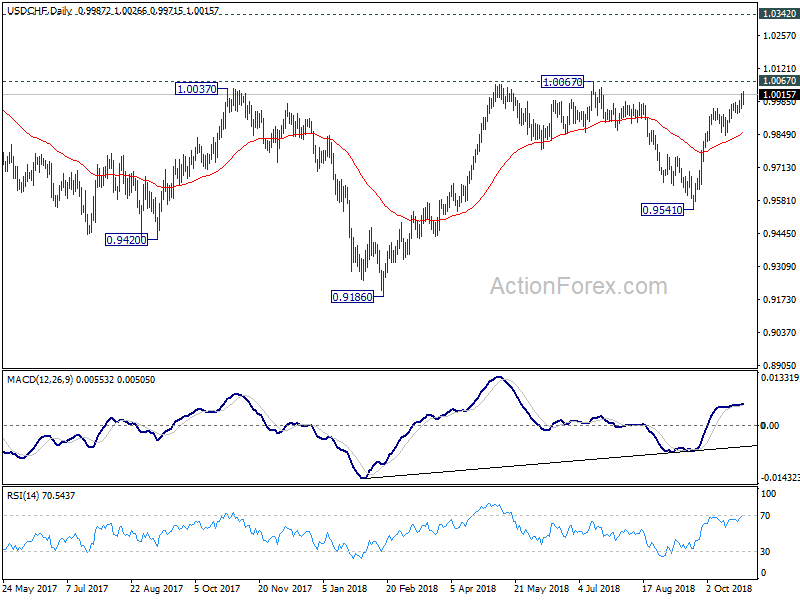
USD/CHF's rally is still in progress and intraday bias remains on the upside for 1.0067 resistance. Decisive break there will confirm resumption of larger rise from 0.9186 and should target 1.0342 key resistance next. On the downside, below 0.9955 minor support will turn intraday bias neutral first. But near term outlook will remain bullish as long as 0.9848 support holds.
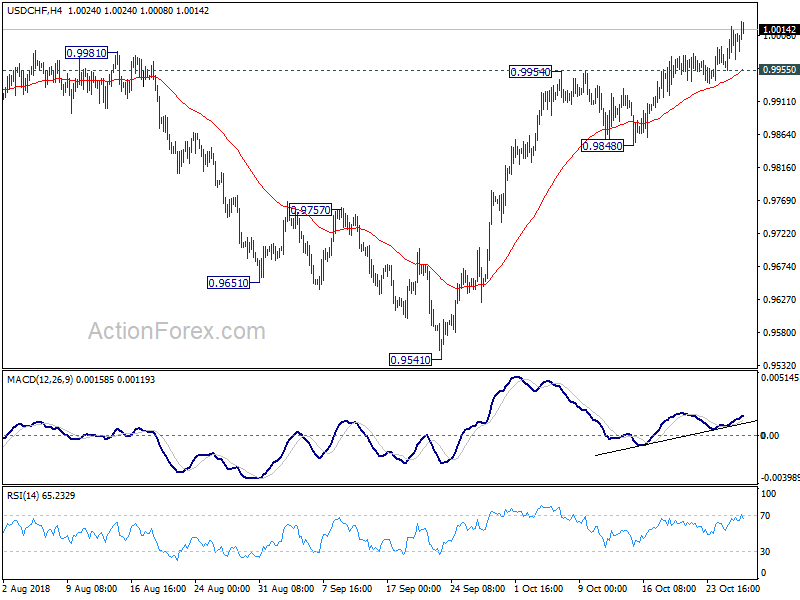
In the bigger picture, the pullback from 1.0067 has completed at 0.9541 already. And rise from 0.9186 is likely resuming. Firm break of 1.0067 will pave the way to retest 1.0342 key resistance. We'd be cautious on strong resistance from there to limit upside to bring another medium term fall to extend long term range trading.
EUR/USD Mid-Day Outlook
Daily Pivots: (S1) 1.1343; (P) 1.1388; (R1) 1.1420; More....
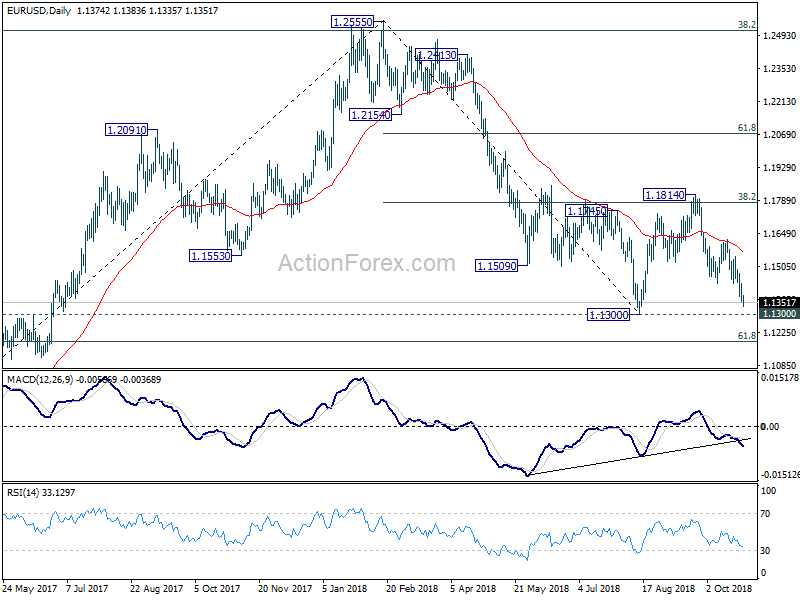
EUR/USD's decline is in progress and intraday bias stays on the downside for 1.1300 low. Break will resume whole down trend from 1.2555 and target 1.1186 fibonacci level next. On the upside, above 1.1432 minor resistance will turn intraday bias neutral first. But outlook will remain cautiously bearish as long as 1.1621 resistance holds.
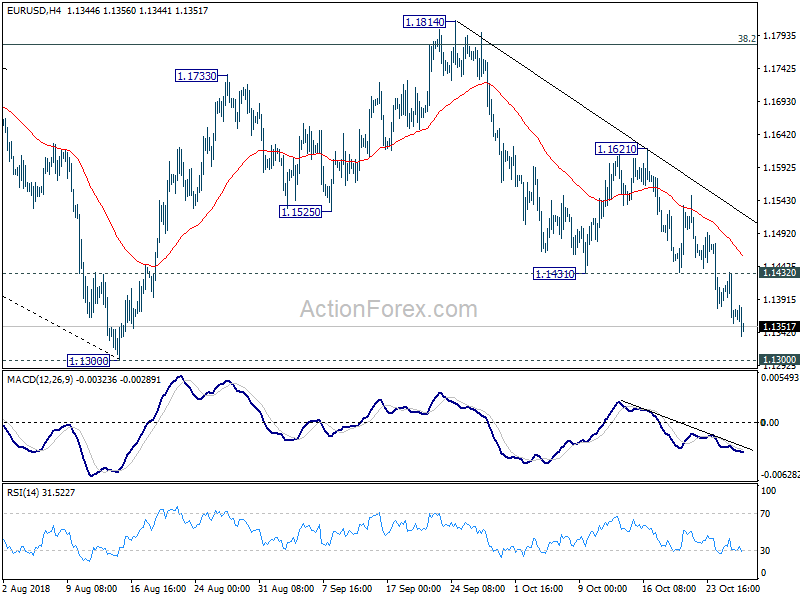
In the bigger picture, corrective pattern from 1.1300 could have completed at 1.1814 after hitting 38.2% retracement of 1.2555 to 1.1300 at 1.1779. Decisive break of 1.1300 will resume the down trend from 1.2555 to 61.8% retracement of 1.0339 (2017 low) to 1.2555 at 1.1186 next. Sustained break there will pave the way to retest 1.0339. On the upside, break of 1.1814 will delay the bearish case and extend the correction from 1.1300 with another rise before completion.
GBP/USD Mid-Day Outlook
Daily Pivots: (S1) 1.2770; (P) 1.2845; (R1) 1.2893; More...
GBP/USD falls to as low as 1.2776 so far today and breached 1.2784 support. Intraday bias stays on the downside for retesting 1.2661 low first. Decisive break there will resume larger down trend from 1.4376. On the upside, break of 1.2919 minor resistance is needed to indicate short term bottoming. Otherwise, outlook will remain mildly bearish even in case of recovery.
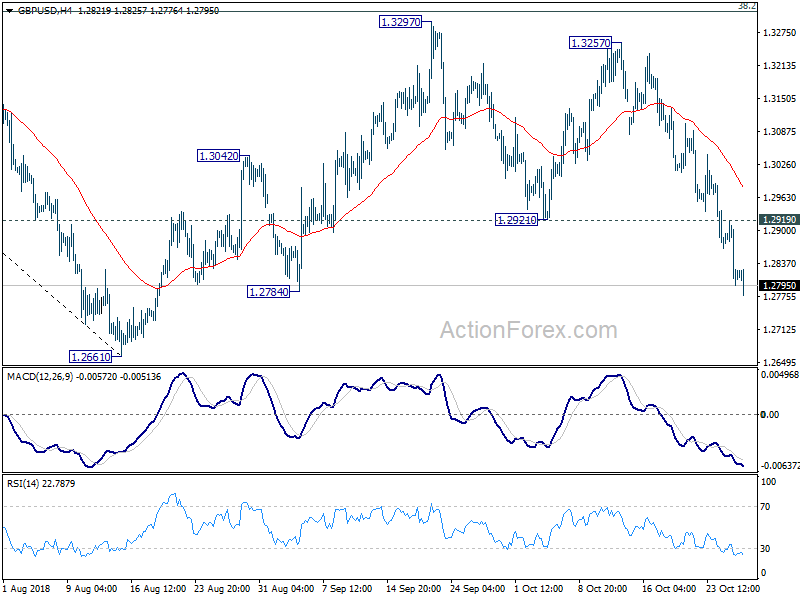
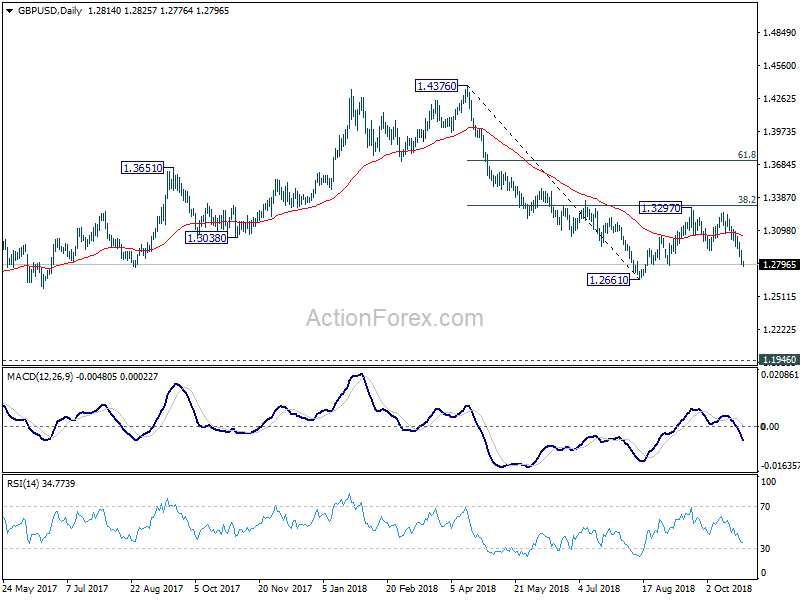
In the bigger picture, whole medium term rebound from 1.1946 (2016 low) should have completed at 1.4376 already, after rejection from 55 month EMA. The structure and momentum of the fall from 1.4376 argues that it's resuming long term down trend. And this will be the preferred case as long as 38.2% retracement of 1.4376 to 1.2661 at 1.3316 holds. However, firm break of 1.3316 would bring stronger rebound to 61.8% retracement at 1.3721. And, the eventual depth of the fall from 1.4376, and the chance of hitting 1.1946 low, will depend on the strength of the interim corrective rebound from 1.2661.
Dollar Firm as Q3 GDP Beat Expectations, Yen Even Stronger as Risk Aversion Intensifies Again
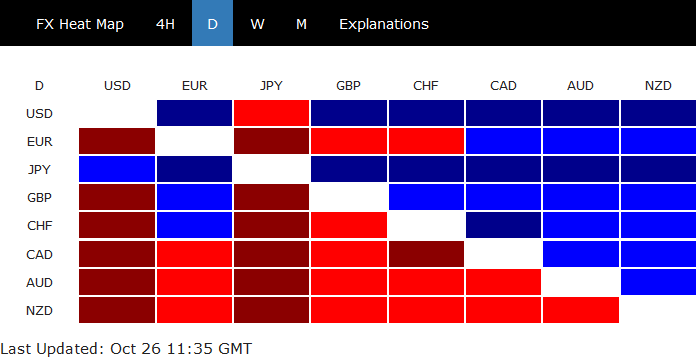
Yen and Dollar are trading as the strongest ones today as risk aversion intensifies again in European session. Stronger than expected Q3 GDP growth in the US is giving Dollar some support. But it's so far not enough to turn the tide with Yen. Commodity currencies are the weakest ones, led by New Zealand and then Australian Dollar. Euro and Sterling are actually not to far away. The markets are rather one-sided on Yen and Dollar.
Technically, AUD/JPY's breach of 78.67 low suggests that medium term down trend from 90.29 is ready to resume. USD/CAD's break of 1.3132 resistance also turns near term outlook bullish. A focus before weekly close is whether US stocks will reverse all of yesterday's rebound to close at a new low. Also, if more selloff is seen in stocks, whether Dollar and Yen have enough momentum to close further higher.
In other markets, major European stock indices are all in red. FTSE is down -1.10%, DAX down -1.17%, CAC is down -1.64%. German 10 year yield id down -0.0369 at 0.364. It was above 0.5 handle just 10 days ago. Italian 10 year yield is down -0.037 at 3.453, it pared back some earlier gains. Earlier in Asia, Nikkei closed down -0.40%, Singapore Strait Times dropped -1.35%, Hong Kong Kong HSI fell -1.11%, China Shanghai SSE lost -0.19.
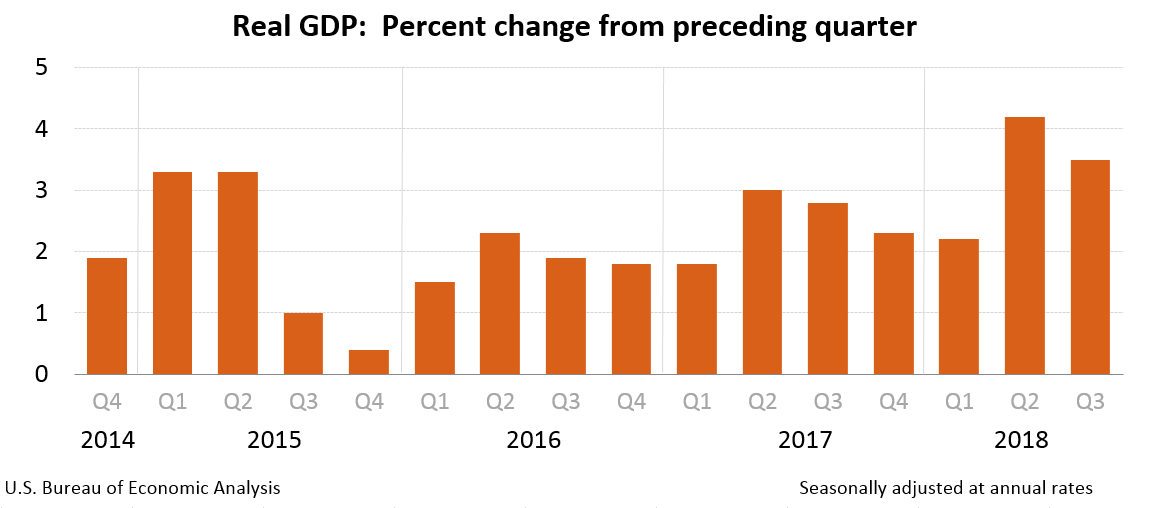
US Q3 GDP grew 3.5% annualized, deceleration reflected downturn in export and non-residential fixed investment
US GDP grew 3.5% annualized in Q3, slowed from Q2's 4.2% but beat expectation of 3.2%. BEA noted in the release that "The increase in real GDP in the third quarter reflected positive contributions from personal consumption expenditures (PCE), private inventory investment, state and local government spending, federal government spending, and nonresidential fixed investment that were partly offset by negative contributions from exports and residential fixed investment. Imports, which are a subtraction in the calculation of GDP, increased".
Also, "The deceleration in real GDP growth in the third quarter reflected a downturn in exports and a deceleration in nonresidential fixed investment. Imports increased in the third quarter after decreasing in the second. These movements were partly offset by an upturn in private inventory investment."
ECB: Professional forecasters lowered core inflation and GDP growth forecasts
The latest ECB Survey of Professional Forecasters (SPF) showed unchanged projections for headline inflation for 2018, 2019 and 2020. But Core inflation, excluding food and energy forecasts were revised slightly lower. Also, expectations for real GDP growth were also revised lower.
Headline inflation is projected to be at 1.7% in 2018, 1.7% in 2019 and 1.7% in 2020, unrevised. Core inflation is projected to be at 1.1% in 2018, 1.4% in 2019 and 1.7% in 2020, revised slightly down. ECB noted "he expected pick-up in underlying inflation remained underpinned by a pick-up in annual growth in compensation per employee, which was expected to increase to 2.3% by 2020." The convergence with between headline and core inflation is still a development that's welcomed by the ECB.
GDP growth is projected to be at 2.0% in 2018, 1.8% in 2019 and 1.6% in 2020. There were downward revision of -0.2% for 2018 and -0.1% for 2019. ECB noted "respondents typically attributed their revisions to external factors such as higher energy prices weighing on disposable income, with many also noting that they had now incorporated into their baseline forecasts at least some dampening impact on exports and investment due to increased uncertainty surrounding the outlook for world trade. "
NIESR on no-deal Brexit: BoE to hike to above 2.5% on surge in inflation, but sharp slowdown in growth
The UK National Institute of Economic and Social Research (NIESR) said the UK economy has "recently gained momentum" with Q3 GDP growth at 0.7%. Under the main forecasts scenario, based on "soft" Brexit, 2019 growth forecasts were revised up to 1.9%, reflecting the stronger momentum. However, NIESR also warned that here is "an enormous amount of uncertainty" around the forecasts.
Under a no-deal Brexit scenario which UK has to revert to trade under WTO rule, growth is projected to slow sharply down to just 0.3% in 2019. Unemployment rate will jump to 5.8% in 2020. Inflation will surge above BoE's target range in 2019, forcing BoE to raise interest rate to above 2.5% in 2019, next year.
The summary of new forecasts show, under a soft Brexit scenario, GDP to grow 1.4% in 2018, 1.9% in 2019 and than slow to 1.6% in 2020. CPI is expected to slow from 2.3% in 2018 to 1.9% in 2019 and then climb back to 2.1% in 2020. Unemployment is projected to drop from 4.1% to 4.0% in 2019 then rise back to 4.5% in 2020. BoE interest rate will rise from 0.8% to 1.3% in 2019 and then 1.8% in 2020.
However, under a no-deal Brexit, GDP growth will slow sharply from 1.4% to 0.3% in 2019, and 0.3% in 2020. Inflation will surge to 3.2% in 2019 before falling back to 2.6% in 2020. Unemployment rate will jump to 5.3% in 2019 and rise further to 5.8% in 2020. BoE will have to raise interest rate much faster to 2.6% in 2019 before dropping to 2.5% in 2020.
Full forecast will be published later on October 31.
GBP/USD Mid-Day Outlook
Daily Pivots: (S1) 1.2770; (P) 1.2845; (R1) 1.2893; More...
GBP/USD falls to as low as 1.2776 so far today and breached 1.2784 support. Intraday bias stays on the downside for retesting 1.2661 low first. Decisive break there will resume larger down trend from 1.4376. On the upside, break of 1.2919 minor resistance is needed to indicate short term bottoming. Otherwise, outlook will remain mildly bearish even in case of recovery.
In the bigger picture, whole medium term rebound from 1.1946 (2016 low) should have completed at 1.4376 already, after rejection from 55 month EMA. The structure and momentum of the fall from 1.4376 argues that it's resuming long term down trend. And this will be the preferred case as long as 38.2% retracement of 1.4376 to 1.2661 at 1.3316 holds. However, firm break of 1.3316 would bring stronger rebound to 61.8% retracement at 1.3721. And, the eventual depth of the fall from 1.4376, and the chance of hitting 1.1946 low, will depend on the strength of the interim corrective rebound from 1.2661.
Economic Indicators Update
| GMT | Ccy | Events | Actual | Forecast | Previous | Revised |
|---|---|---|---|---|---|---|
| 23:30 | JPY | Tokyo CPI Core Y/Y Oct | 1.00% | 1.00% | 1.00% | |
| 12:30 | USD | GDP Annualized Q3 A | 3.50% | 3.20% | 4.20% | |
| 12:30 | USD | GDP Price Index Q3 A | 1.7% | 2.1% | 3.00% | |
| 14:00 | USD | U. of Mich. Sentiment Oct F | 99.2 | 99 |
US Q3 GDP grew 3.5% annualized, deceleration reflected downturn in export and non-residential fixed investment
US GDP grew 3.5% annualized in Q3, slowed from Q2's 4.2% but beat expectation of 3.2%. BEA noted in the release that "The increase in real GDP in the third quarter reflected positive contributions from personal consumption expenditures (PCE), private inventory investment, state and local government spending, federal government spending, and nonresidential fixed investment that were partly offset by negative contributions from exports and residential fixed investment. Imports, which are a subtraction in the calculation of GDP, increased".
Also, "The deceleration in real GDP growth in the third quarter reflected a downturn in exports and a deceleration in nonresidential fixed investment. Imports increased in the third quarter after decreasing in the second. These movements were partly offset by an upturn in private inventory investment."
Into US session: One-sided markets on Yen and Dollar as risk aversion intensifies
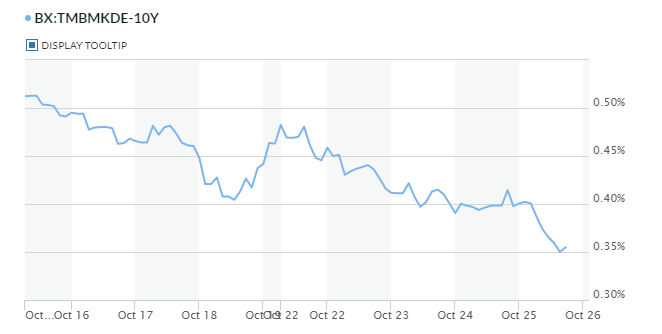
Entering into US session, Yen stays in the driving seat as risk aversion intensifies in European session. While all major European indices are in deep red, we'd like to point out the free fall in German 10 year yield too. German 10 year bund yield is down -0.044 at 0.357, which is a rather serious sign of investor nervousness. It was over 0.5 just 10 days ago. Italian 10 year yield is up 0.039 at 3.529. That is, German-Italian spread is closing in 320 again.
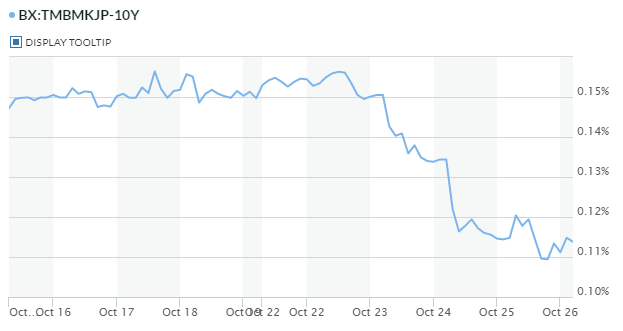
Also, note that Japanese 10 year JGB yield also suffered steep fall this week.
Back to the currency markets, Dollar is trading as the second strongest for today. It's partly supported by hawkish comments by new Fed Vice chair Richard Clarida, Trump's new addition to Fed. Dollar will look into US Q3 GDP for strength for further rally. Commodity currencies are the weakest ones. But Euro and Sterling are actually not far away. Today's market is rather one-sided on Yen and Dollar.
A quick snapshot at the European markets:
- FTSE is down -1.0%
- DAX down -1.51%
- CAC down -1.96%
- German 10 year yield down -0.044 at 0.357
- Italian 10 year yield up 0.39 at 3.529
In Asia:
- Nikkei dropped -0.40% to 21184.60
- Singapore Strait Times dropped -1.35% to 2972.02
- Hong Kong HSI dropped -1.11% to 24717.63
- China Shanghai SSE dropped -0.19% to 2598.85
USDCHF Recovers After Rebound On 0.9540, Trades Near 2-Month Peak
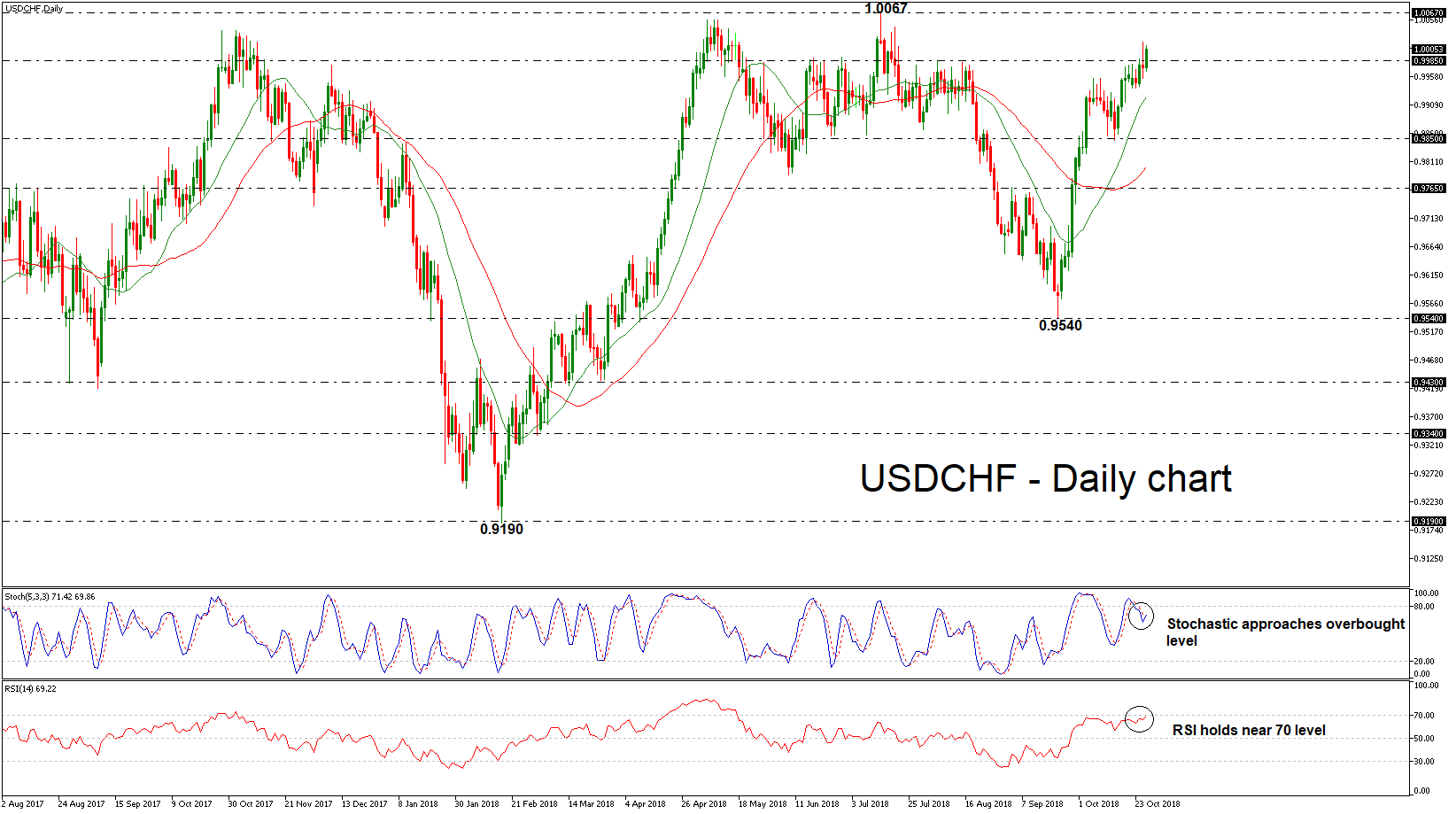
USDCHF started a strong recovery after the bounce off the September 21 low of 0.9540, driving the pair towards a new three-month high of 1.0017 on Thursday. The pair has eased a bit from that peak but remains in a positive mode above the 0.9985 hurdle.
Momentum indicators are pointing to a bullish bias in the short term with the RSI just below 70 and the stochastic oscillator approaching overbought territory. The %K line is attempting a bullish cross with the %D line of the stochastic, suggesting a sharp positive movement is nearing.
If given a move above yesterday’s peak of 1.0017, resistance may occur around the 1.0067 resistance barrier, achieved on July 13. A jump above this strong level, would help price to post a new high near the 1.0165 barrier.
On the downside, immediate support could be taking place around 0.9850, but the price first needs to slip below the 20-day simple moving average (SMA). Not far below lies the 40-day SMA around 0.9800 at the time of writing. A downside violation is turning the focus to 0.9765, taken from the highs on September 4. Steeper losses would turn the attention to the zone around the 0.9540 hurdle.
To conclude, the short- and medium-term timeframes seem to be mostly bullish, though they both currently appear relatively fragile.
Stocks Remain In The Eye Of Risk-Off Storm, US GDP On Tap
Here are the latest developments in global markets:
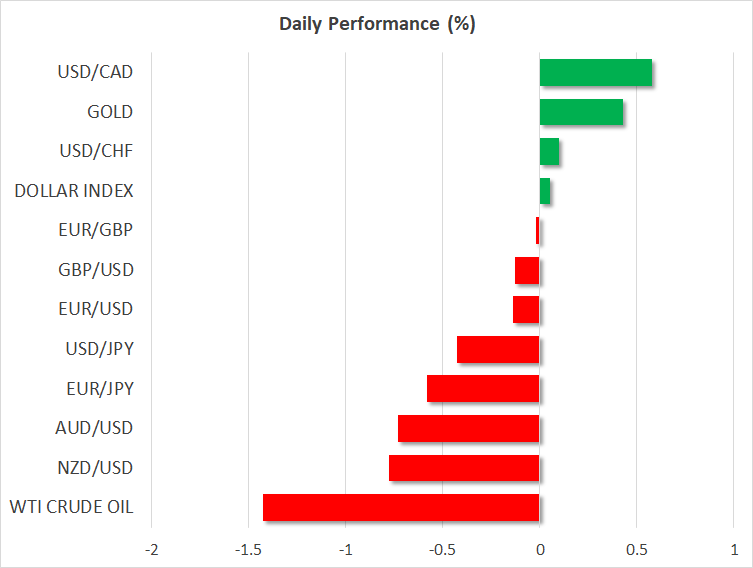
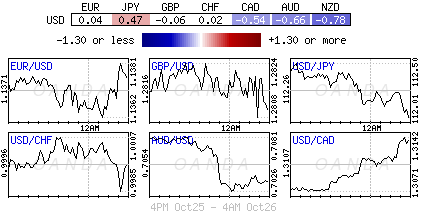
FOREX: The Japanese yen is by far the best performer among the major currencies on Friday, with the session being characterized by broad-based risk aversion thus far. Dollar/yen (-0.40%) is trading just a few pips below the 112.00 handle, while euro/yen (-0.61%) touched a fresh two-month low, as investors sought the safety of the Japanese currency. The dollar is also on the front foot ahead of the release of US GDP data, albeit only modestly. Euro/dollar is down by 0.12%, with the euro still licking its wounds following the ECB meeting yesterday. Sterling/dollar is lower by 0.12% as well, extending losses from Thursday that came on the back of reports Theresa May’s Cabinet cannot agree on a way forward for the Brexit talks to resume. Elsewhere, the commodity-currencies space was feeling the heat of the broader “risk-off” environment. Aussie/dollar (-0.69%) posted a new 2½ year low of 0.7020, while kiwi/dollar (-0.74%) is hovering just above its own multi-year trough. Meanwhile, dollar/loonie climbed by 0.60%, with the Canadian currency surrendering all the gains it recorded after the BoC struck a hawkish tone earlier in the week, to trade much lower.
STOCKS: European stocks were a sea of red at 1100 GMT on Friday, with the pan-European STOXX 600 trading lower by 1.44%, and the blue-chip STOXX 50 down by 1.40%. Accordingly, the German DAX 30 (-1.81%), French CAC 40 (-2.27%), British FTSE 100 (-1.56%) and Italian FTSE MIB (-1.67%) were all on the back foot. In the US, futures tracking the S&P 500, Dow Jones, and Nasdaq 100 were pointing to a significantly lower open today for these indices, greater than -1.0%.
COMMODITIES: Oil prices followed risk sentiment and energy stocks lower, with WTI (-1.46%) trading at $66.35 per barrel, and Brent (-1.25%) changing hands at $75.93 a barrel. Besides poor risk appetite, a warning by Saudi Arabia yesterday that oil markets could be oversupplied by the end of the year may have also contributed to the tumble. In precious metals, gold was higher by 0.46% at $1236 per ounce, enjoying some haven-demand as investors were increasingly turning defensive.
Day ahead: US GDP data in the limelight as risk sentiment remains fragile
Preliminary US GDP figures for Q3 will be the highlight during the remainder of Friday’s session in terms of data releases. Beyond those, currencies will remain sensitive to stock market movements and how risk sentiment develops, in light of the recent volatility.
Kicking off with the data, the first estimate of US GDP for Q3 is due out at 1230 GMT, and expectations are for economic growth to clock in at an annualized pace of 3.3%. While this would mark a slowdown from the robust 4.2% recorded in Q2, it’s still a very healthy print overall, with the Trump administration’s tax cuts seemingly keeping growth above potential. For context, the Atlanta Fed GDPNow model estimates the GDP print at 3.9%, while the New York Fed’s own gauge places it at a mere 2.1%.
Alongside the GDP number, the US will also release the preliminary core PCE price index for Q3. Forecasts point to inflationary pressures having lost some steam, with the core PCE rate expected to cool to 1.8% in annualized terms, from 2.1% in the previous quarter. The dollar will likely take its cue from these prints, coming under renewed buying interest in case of an overall beat, or giving back some of its latest gains on a disappointment. The final University of Michigan consumer sentiment index for October is also due out, at 1400 GMT.
More broadly, the mood in equity markets will likely prove critical in setting the tempo for currencies as well. Following disappointing earnings reports from the likes of Amazon and Google parent Alphabet after Wall Street’s closing bell yesterday, futures tracking the major US indices are flashing red, pointing to a notably lower open today. This has spilled over into broader risk aversion, evident by the defensive yen advancing across the board today, and commodity-linked currencies such as the aussie, kiwi, and loonie all recording sizeable losses.
In euro-related news, Standards and Poor’s is anticipated to announce its decision on Italy’s sovereign credit rating today. A potential downgrade of the nation’s debt, against the backdrop of Italian politicians remaining adamant about their elevated budget deficits, could spell more bad news for Italian assets and by extent, for the single currency.
As for the speakers, ECB President Mario Draghi will deliver remarks at 1400 GMT, but bearing in mind investors already heard from him at yesterday’s ECB meeting, any fresh signals that trigger a reaction in the euro appear unlikely.
Equities Sea Of Red
Friday October 26: Five things the markets are talking about
Asian equities hit 20-month lows overnight, while Euro stocks see red along with U.S futures as nervousness over corporate profits added to investors persistent fears about global trade and economic growth.
Treasuries are steady as the ‘big’ dollar edges higher ahead of today’s U.S Q3 GDP report (08:30 am EDT) – its expected to have slowed, yet remained near its best pace for the past three-years.
Central banks dominated proceedings this week, and they all followed the script, no change for ECB, CBRT, Riksbank and Norges, while the Bank of Canada (BoC) hiked +25 bps and removed ‘gradual’ from their statement – so we are back to data dependency.
Aside from ‘risk-on’ and ‘risk-off’ trading, rate differentials are the name of the game, and with USD/CHF trading atop of its three-month highs, and through parity, would suggest that rate differentials are currently winning out.
The EUR is under renewed pressure after the ECB acknowledged recent weakness being observed in the E.U data, but stressed it was too early to know if it was not largely being driven by “transitory” factors, whether they are “country-specific” or relate to the eurozone as a whole, and what is impacting consumer spending and what is not. So far, any spill over from Italy to the rest of the eurozone has been “limited.”
1. Stocks plummet again
In Japan, stocks posted their biggest weekly loss in nearly nine-months on growing worries over earnings of domestic firms. The Nikkei share average fell -0.40% overnight, taking the weekly loss to -5.7%. The broader Topix shed -0.31% to also end the week -5.7%.
Down-under, Aussie shares closed flat overnight, but ended the week in the ‘red.’ The S&P/ASX 200 index ended +0.02% up, but, for the week, the benchmark slumped -4.6%. In S. Korea, shares fell for a fourth consecutive session on domestic earnings worries, the Kospi index tumbled -1.75%, leading to a weekly decline of -5.99%.
In China, stocks slipped overnight but posted a weekly gain, supported by Government policies and measures to bolster the stock market and the real economy. The blue-chip CSI300 index fell -0.7%, while the Shanghai Composite Index ended down -0.2%. For the week, the CSI300 index gained +1.2%, while SSEC was up +1.9%.
In Hong Kong, stocks fell on regional cues. The Hang Seng index fell -1.4% overnight, while the Hang Seng China Enterprise index fell -1.7%.
In Europe, regional bourses trade lower across the board led by a weaker tech sector after disappointing results after the N.Y close from Amazon and Google.
U.S stocks are set to open deep in the ‘red’ (-1%).
Indices: Stoxx600 -1.5% at 349.9, FTSE -1.6% at 6897, DAX -1.8% at 11101, CAC-40 -2.0% at 4930, IBEX-35 -1.3% at 8668, FTSE MIB -1.7% at 18505, SMI -1.0% at 8620, S&P 500 Futures -1.0%
2. Oil falls on oversupply worries, gold lower
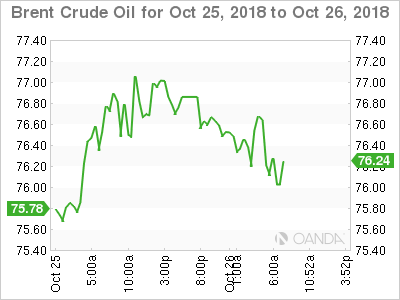
Oil prices are heading for a third consecutive weekly loss after Saudi Arabia warned of oversupply, while a global equity slump and concerns about trade clouded the outlook for fuel demand.
Brent crude oil is down -70c at +$76.19 per barrel, on course for a weekly loss of more than -4% – it has fallen close to -$10 this month, while U.S crude (WTI) is also down -70c at $66.63, set for a -3.5% loss on the week.
After months of concern about shortage of supply ahead of U.S sanctions on Iran, Saudi Arabia’s OPEC governor said yesterday that oil markets could face oversupply by the end of the year.
However, the markets immediate focus remains on U.S sanctions and the impact they are having on Iran’s oil exports.
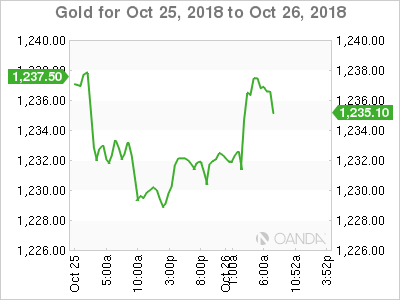
Ahead of the U.S open, gold prices are holding steady on the back of another equity loss overnight, with the metal on track to rise for the fourth consecutive week – its longest string of weekly gains since January. Spot gold is flat at +$1,231.58 an ounce, while U.S gold futures are up +0.1% at +$1,234.10 an ounce.
Note: Earlier this week, it touched a high of +$1,239.68, a peak since July 17. It’s up about +0.4% for the week.
3. Sovereign yields fall again
German Bund yields have hit a six-week low overnight as investor negativity over Italian budget talks and disappointing U.S earnings – Amazon and Google – is supporting investor appetite to own sovereign debt.
Note: Euro yields were already trading atop of the lows after the ECB stuck to its plans to claw back stimulus this week and Draghi acknowledging a loss of growth momentum and a “bunch of uncertainties” ahead.
German Bunds saw their yields drop -2 bps to -0.378% – that’s -20 bps lower than where it was a fortnight ago.
Italian BTP bonds have also weakened ahead of a today’s ratings review from S&P Global – the agency currently has Italy at a BBB rating with a stable outlook.
Italy’s two-year yields are +4 bps higher at +1.52%, and 5’s are up +2 bps at +2.84%.
Elsewhere, the yield on 10-year Treasuries has dipped -1 bps to +3.10%, while the U.K’s 10-year Gilt yield has fallen -2 bps to +1.42%. In Japan, the 10-year JGB yield has decreased -1 bps to +0.111%.
4. U.S dollar trades at three-month highs
The ‘mighty’ U.S dollar is trading atop of its three months highs against G7 pairs ahead of today’s U.S Q3 GDP data.
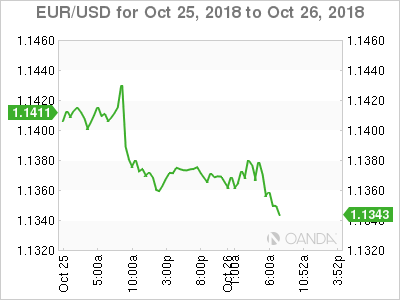
EUR/USD (€1.1369) is currently trading below the psychological €1.14 area as the Italian budget drama remains the markets focus. The S&P rating decision on Italian debt is seen as a non-event – talks between Rome and Brussels is more important.
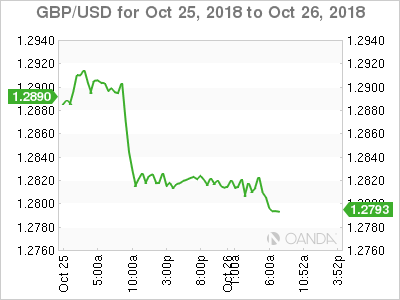
GBP/USD (£1.2808) is little changed as the Brexit impasse continues. Nothing is expected from U.K’s side before Monday’s budget as members within PM Theresa May’s cabinet argue on the approach to negotiations.
Weaknesses in Chinese yuan fix overnight certainly weighed upon other currencies in the region (AUD, NZD, SGD). China fixed the USD/CNY rate above ¥6.95 for first time in nearly two-years.
Note: Chinese officials also declared that they would not engage in competitive devaluation.
5. Consumer climate in Germany remains stable
According to market research GfK this morning, German consumer sentiment is set to stabilize in November “as a result of inconsistent development in mood.”
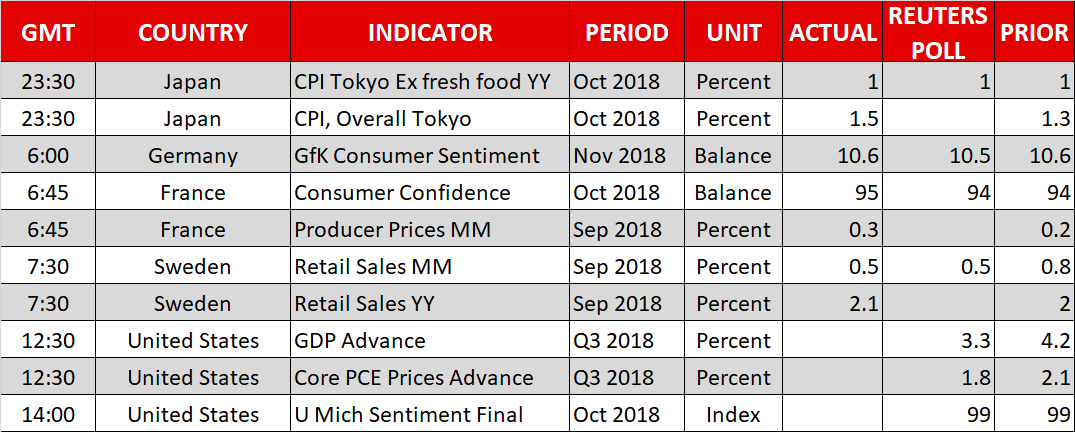
GfK’s forward-looking confidence index is expected to stay at 10.6 points in November, unchanged from October.
Note: GfK uses three sub-indexes – economic expectations, income expectations and propensity to buy – for the current month to derive a sentiment figure for the next month.
The economic expectations sub-index fell to 19.0 points in October from 27.1 points in September, while the income-expectations sub-index retreated to 54.4 points from 57.9 points, GfK said.
The propensity to buy, a gauge of consumers’ intention to spend on big-ticket items, rose to 55.9 points in October from 52.9 points in September.
DAX Plunges As Asian Markets Crumble
The DAX index has posted sharp losses after a positive session on Thursday. Currently, the DAX is trading at 11,094, down 1.88% on the day. In economic news, the sole eurozone indicator is German GfK Consumer Climate, which remained steady at 10.6 points. This edged above the forecast of 10.5 points. In the U.S, all eyes will be Advance GDP for the third quarter, which is expected to post a strong gain of 3.3%.
Asian equity markets are down on Friday, and European markets have followed suit. Almost all listings on the DAX are in negative territory, and Deutsche Bank has plunged 4.15%. It’s been a miserable October for the DAX, which has plunged some 9.4 percent. The DAX is hovering close to the 11,000 mark, which has held since December 2017. Investors remained unnerved over a host of crises, both in and out of Europe. These include the Italian budget crisis, the Brexit standoff, US-China relations and the death of a Saudi journalist in Turkey. Soft risk appetite and some disappointing earning reports in Europe and the U.S have sent global stock markets sharply lower.
There were no surprises from the ECB policy meeting on Thursday.The ECB maintained its main refinancing rate at a flat 0.00%, where it has been pegged since January 2016. With the euro and European stock markets heading lower this week, ECB President Mario Draghi tried to put a positive face on recent developments. Draghi acknowledged that the turmoil in global markets has raised the risks to the eurozone economy, but reiterated that the ECB remained on track to wind up its asset-purchase program in December. He discussed the eurozone’s “broad-based” economic growth and said he was confident that the Italian government would reach an agreement with the European Commission, which has rejected Italy’s budget since it raises the country’s deficit. However, Drahgi acknowledged that the eurozone economy has softened, and also noted the risks from the global trade war and the volatile political climate in Italy.