Sample Category Title
ECB Meeting Minutes Awaited to Prove How Hawkish Draghi is
On Thursday at 1130 GMT the European Central Bank is scheduled to publish accounts of its latest policy meeting and in the absence of any major data releases the minutes could lend a helpful hand to the euro if policymakers appear overall more hawkish than Mario Draghi did in his press conference. However, risks surrounding Italy and its fiscal policy remain pinned in the background and with trade uncertainties stressing investors, bulls may have to push harder to drive the common currency higher.
It was on September 13 when the European Central Bank chief Mario Draghi – usually a dove – took the markets by surprise, presenting the glass half full instead of half empty. During the press conference that took place after the conclusion of the central bank’s policy meeting, Draghi emphasized that a tighter labour market will push wage growth higher in the eurozone and therefore lift the underlying inflation. Indeed, according to Eurostat, wages and salaries per hour worked in the euro area increased by 1.9% year-on-year in the second quarter from 1.8% in the previous quarter, while labor costs which include non-wage costs such as social contribution picked up by 2.2%, faster than 2.1% recorded in Q1. Romania and Latvia experienced the biggest earnings gains, while Luxemburg and Spain registered the weakest wage expansion.
Yet, while rising oil prices keep the headline inflation around the central bank’s 2.0% target (2.1% y/y in September) flash estimates showed in September that the core equivalent, which excludes volatile items such as energy and food and therefore displays a more stable picture of the inflation trend, remained subdued at 0.9%, unable to break above 1.2% for more than a year now. In the same month, final readings on consumer confidence indicated that eurozone consumers turned more pessimistic, sending a message that household spending will probably do little to boost inflationary pressures in coming months. On the supply side, optimism among investors deteriorated for the third straight month in October as stated by the Sentix Investor confidence index. A survey conducted in the third quarter by UBS however identified that corporate leaders in the bloc intended to increase hiring, while a growing number of businesses were expecting to deliver higher wages too despite global trade risks – a piece of evidence justifying Draghi’s hawkish mood.
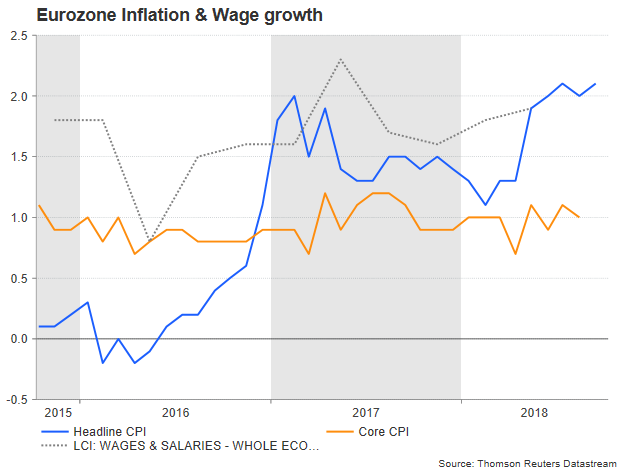
In FX markets, the euro has been on the back foot from February onwards adding tailwinds to inflationary forces as currency depreciation makes imported goods more expensive in the domestic market. Note that imports in the Euro area jumped significantly in the same period, hitting the second-highest value on record. Increasing monetary tightening by the Fed in combination with escalating global trade uncertainties, economic shocks in emerging markets and political tensions between Italy and the EU were highly linked to the euro weakness during the aforementioned period. And it seems that these factors will continue to pressure the common currency as the ECB has already guided traders in advance about its future monetary plans, confirming at the latest policy meeting that the asset purchase program will stop at the end of the year, while interest rates will hold steady until the end of summer 2019. The latter could be a sign that wage growth is the only hope for inflation to pick up steam, especially before Brexit happens.
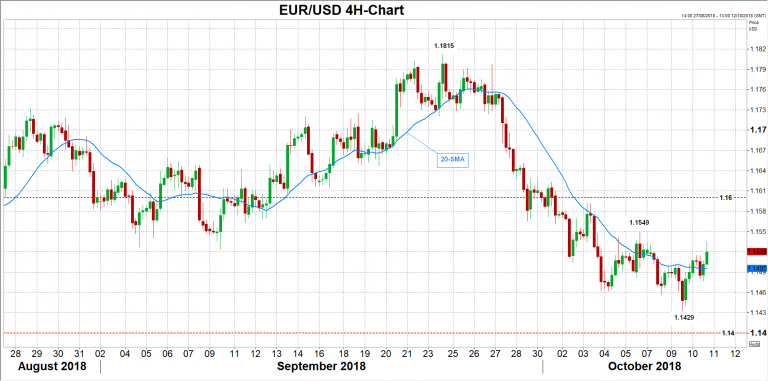
Should ECB minutes echo Draghi’s positive mood as the ECB member Yves Merch did on Wednesday, nothing interesting is expected to come up in the euro. However, if the accounts put a bigger weight on risks stemming from Italy, warning somehow that Italian fiscal demands combined with the country’s debt burden may turn the economic environment more fragile to financial shocks at a time when the ECB prepares to terminate QE, euro/dollar could slip back to Tuesday’s low of 1.1429. Steeper declines may touch the 1.1400 round level, though major support is expected around the 1.1300 bottom.
Alternatively, in case policymakers express their bullish views about wage growth and its positive impact on inflation in a more colourful way, the pair could reach 1.1549, the October 5 peak. A break above that level, would open the door for the 1.1600 psychological level.
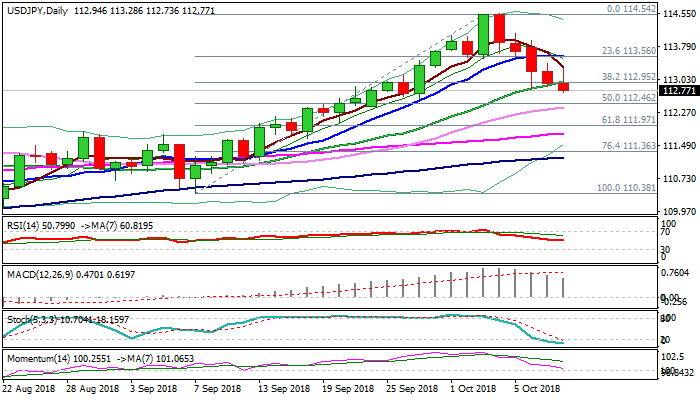
USDJPY Outlook: Bearish Signal on Eventual Break Below 112.95 Fibo Support
The dollar accelerated lower to new two-week low at 112.73 against yen as US stocks fell in early trading on Thursday.
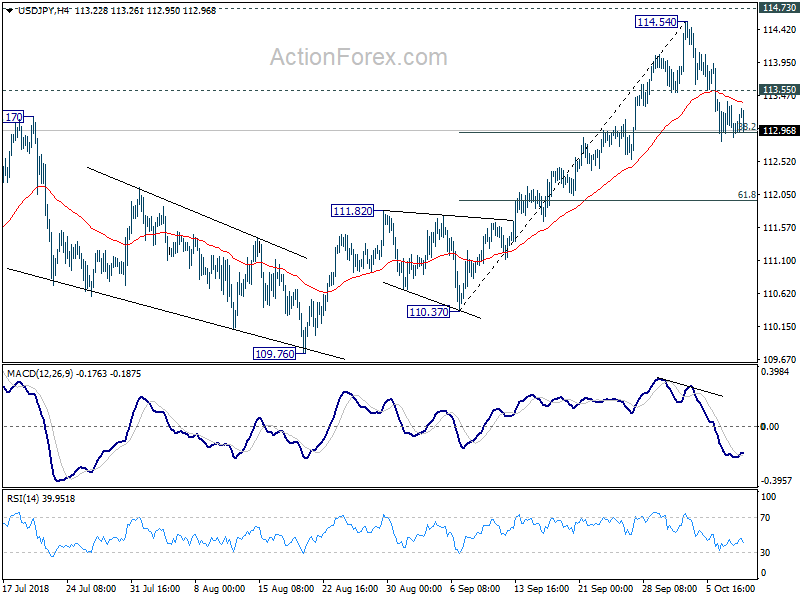
Fresh weakness emerged from session high at 113.28, where recovery attempts stalled and generating negative signal on eventual break below cracked Fibo support at 112.95 (38.2% of 110.38/114.54 rally, reinforced by 20SMA), which requires confirmation on daily close below.
Weakening momentum is approaching the border of negative territory and maintains pressure, while slow stochastic is continuing to head south, deeply in oversold zone.
Bears eye next pivotal support at 112.46 (50% of 110.28/114.54/daily Kijun-sen) to signal deeper correction on break.
US CPI data on Thursday are in focus for fresh signals.
Res: 112.95; 113.28; 113.56; 113.94
Sup: 112.73; 112.46; 112.37; 111.97
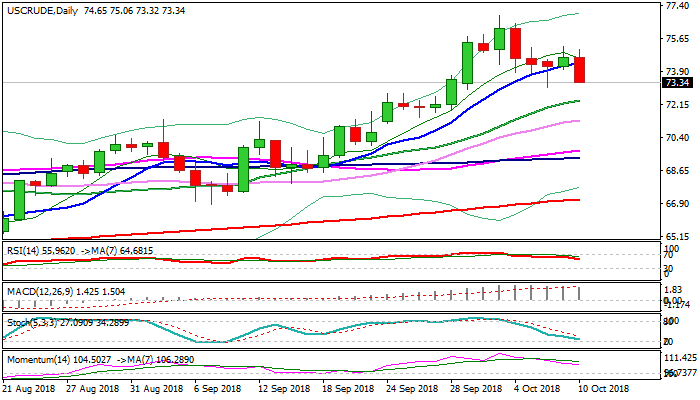
WTI OIL Outlook: Fresh Weakness Pressures Important Fibo Support at $73.05
WTI oil accelerated lower in early US trading on Wednesday and hit session low at $73.40. Fresh weakness in the Wall Street pushed oil prices lower, with traders looking for the impact of Hurricane which hit the Gulf of Mexico.
With sanctions on Iran looming and pressure of US government to governments to cut imports from Iran to zero, Saudi Arabia will provide supply to Indian buyers which ordered oil shipments from Iran in November.
South-heading momentum indicators on daily chart support further weakness, as fresh bears approach key near-term support at $73.05 (Fibo 38.2% of $66.85/$76.88 / 08 Oct low), break of which would provide fresh bearish signal for further extension lower.
API crude stocks data are due later today, with benchmark EIA weekly crude inventories due on Thursday and expected to provide further direction signals.
Sustained break below $73.05 would open $72.30 (rising 20SMA) and $71.86 (Fibo 50%), while past four-day congestion top at $75.25 marks solid resistance.
Res: 74.35; 74.51; 75.25; 75.89
Sup: 73.05; 72.30; 71.86; 71.30
Will the US Label China a Currency Manipulator? Not Likely
This has become one of the key questions lately as the US Treasury Secretary is set to release the semi-annual report on the FX policies of trade partners next week. However, although President Trump repeatedly states that China is a currency manipulator, the current law does not justify such a label.
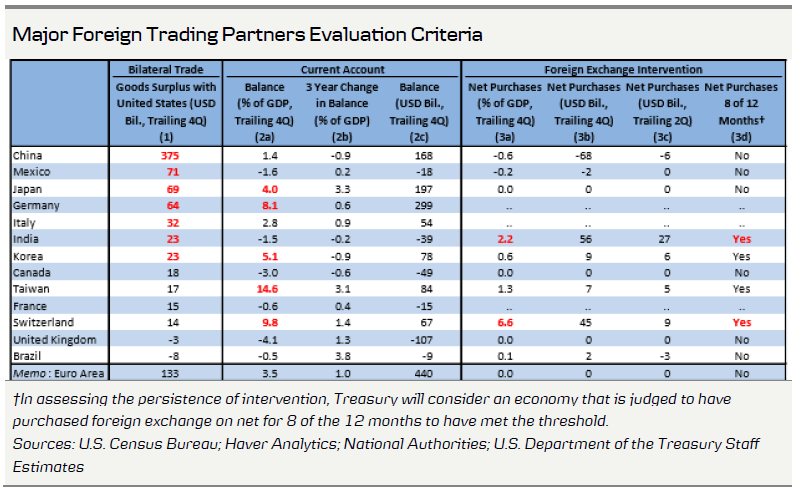
As the US law stands right now, China lives up to only one of the three criteria needed to designate the country a currency manipulator. The Treasury has established thresholds for these criteria that is specified in the Trade Facilitation and Trade Enforcement Act of 2015.
The criteria and thresholds are
- A significant bilateral trade surplus with the US of at least USD20bn.
- A material current account surplus of at least 3% of GDP.
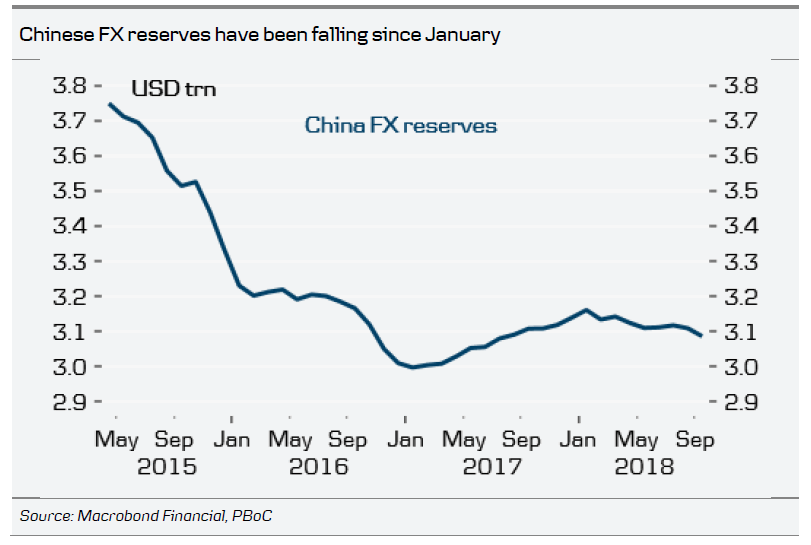
- Persistent, one-sided intervention, which occurs when net purchases of foreign currency are conducted repeatedly and total at least 2% of an economy's GDP over a 12-month period. The FX reserve has thus been declining in recent months.
China only lives up to the first of these criteria as the current account surplus has narrowed considerably and is actually close to zero. China is also not intervening to weaken the CNY. On the contrary, it is currently intervening to slow the depreciation.
We therefore still doubt that the Treasury would be able to label China a currency manipulator officially. However, the US will probably send a clear warning to China not to start using the currency as a tool in the trade war and highlight that it is watching things closely. China has repeatedly stated that it would not use the CNY as a tool.
The table below shows the April report evaluating the different countries:
There has been some talk that Trump wanted a change to the criteria so that China could be officially labelled a currency manipulator. However, it would likely require a change to the 2015 Act and hence does not seem probable ahead of the upcoming report next week.
Here's a link to the latest report from April. We do not know the exact day of the release other than it is scheduled for next week.
GBPUSD Outlook: Little Impact from Mixed UK Data as Brexit Optimism Continues to Boost Sterling
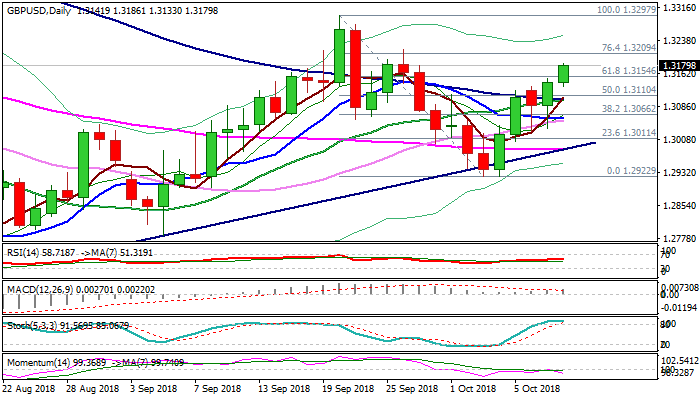
Cable returns to strength and retests European high at 1.3185, after shallow correction on mixed UK data found ground at 1.3136. UK GDP was flat in Aug vs 0.1% forecast while quarterly figure was 0.7% vs 0.6% f/c. Manufacturing production disappointed while IP ticked above consensus and trade gap widened in August. The pair showed minor reaction on data, with prevailing bulls on Brexit optimism remaining firmly in play. Close above broken Fibo barrier at 1.3154 (61.8% of 1.3297/1.2921) is likely and is going to generate bullish signal for 1.32+ gains. Focus turns on tomorrow's US CPI releases which could generate fresh direction signals. Session low marks initial support at 1.3133, followed by a cluster of converged MA's at 1.3102 (5/20/100SMA), which needs to keep the downside protected and maintain bullish bias.
Res: 1.3186; 1.3217; 1.3276; 1.3297
Sup: 1.3154; 1.3133; 1.3102; 1.3066
Sunset Market Commentary
Markets
Both US Treasuries and German Bunds lost ground today. US Treasury move can partly be traced back to investors anticipating the US auction. As yesterday, Bunds weren’t able to profit from deteriorating equity markets and ongoing Italian budget concerns. Spill-over effects from the US seem to outweigh the prevailing risk-off in Europe. Italian BTP futures recovered strongly today after opening with a dive after the coalition repeated its budget plans. The BTP was able to pair losses after FM Tria pointed out the budget watchdog approved the government economic forecasts and only had a different view on growth. US PPI’s remain strong with core PPI printing 0.4% (MoM) while only 0.2% was expected. Strong CPI’s tomorrow, well above the Fed’s 2% inflation target, can warrant a continuation of the rate hike cycle. German Bunds ended their rally down and were edging back higher at time of writing. Similar behaviour from US treasuries, but stronger. German yields rose with changes ranging between +0.4 bps (2-yr) and +1.6 bps (10-yr).The US yield curve bear steepens with changes ranging from +0.1 bps (2-yr) to +1.8 bps (30-yr). Spreads over German 10-yr yield remain relatively unchanged, with only Greece making a significant move (-14 bps).
Despite the budget watchdog’s rejection and Tria pressing on with the current budget proposal, Italians tensions receded somewhat. This offered EUR/USD a (temporary) window of opportunity but the pair struggles to retain the 1.15-mark. US headline PPI (2.6% YoY) was close to expectations (2.7% YoY), while the core measure surprised markets. If anything, the data should be dollar supportive. EUR/USD defied market logics though, and trended higher after the release. The couple is currently trading near 1.152. While we saw no apparent reason for this seemingly illogic move, it should be noted EUR/USD’s trajectory was captured within a narrow intraday range. Markets await further Italian intel and tonight’s US auctions which could propel US rates in case of mediocre results.
Sterling’s initial attempt to extend gains in the aftermath of yesterday’s rebound failed. After touching an intraday high at around 0.8723 EUR/GBP, the pound witnessed some volatility, following soft UK data (industrial production and GDP) and Haldane’s speech. The BoE’s chief economist judges inflationary risks as broadly balanced as he sees wage growth picking up, yet in a limited, gradual manner. Sterling’s mood swings were confined to very tight ranges though. Markets are trying to assess whether yesterday’s (and by extension of the past two weeks) brexit euphoria was justified. Tonight’s speech by Michel Barnier to the European Parliament will thus be the focal point. The EU chief negotiator is to present the European proposal for the future UK/EU ties, another theme of discussion in the brexit sage. Markets stay sidelined going into today’s main sterling event. EUR/GBP and cable are changing hands at 0.874 and 1.316 respectively, close to unchanged from yesterday.
News Headlines
ECB Executive Board Member Mersch joined ECB President Draghi in stressing that underlying inflation is about to pick-up in the euro zone because of underlying strength of the economy, the tightening labour market and the ECB’s ample degree of monetary policy accommodation.
Core US PPI rose by 0.4% M/M and 2.9% Y/Y in September, outpacing 0.2% M/M consensus and confirming building inflationary pressures. The headline reading printed at 0.2% M/M and 2.6% Y/Y. Industrial production data from the UK (0.2% M/M) and several EMU countries (France 0.3% M/M, Italy 1.7% M/M) beat consensus in August.
EUR/NOK dropped from 9.50 to 9.45 as headline and core inflation rose faster than forecast in September, respectively by 3.4% Y/Y and 1.9% Y/Y. Inflation readings warrant a continuation of the Norges bank’s tightening cycle which started in September.
USD/JPY Mid-Day Outlook
Daily Pivots: (S1) 112.76; (P) 113.07; (R1) 113.28; More...
At this point, intraday bias in USD/JPY stays neutral with focus on 38.2% retracement of 110.37 to 114.54 at 112.94. On the upside, above 113.55 will suggest that the pull back from 114.54 has completed. Intraday bias will be turned back to the upside for retesting 114.54 and 114.73 key resistance. Nonetheless, sustained trading below 38.2% retracement of 110.37 to 114.54 at 112.94 will target 61.8% retracement at 111.96.
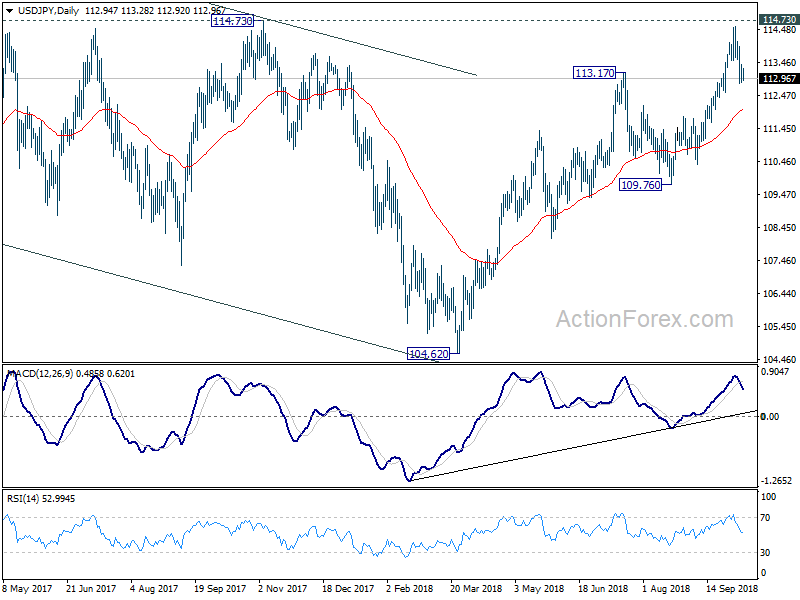
In the bigger picture, corrective fall from 118.65 (2016 high) should have completed with three waves down to 104.62. Decisive break of 114.73 resistance will likely resume whole rally from 98.97 (2016 low) to 100% projection of 98.97 to 118.65 from 104.62 at 124.30, which is reasonably close to 125.85 (2015 high). This will stay as the preferred case as long as 109.76 support holds.
USD/CHF Mid-Day Outlook
Daily Pivots: (S1) 0.9900; (P) 0.9929; (R1) 0.9946; More...
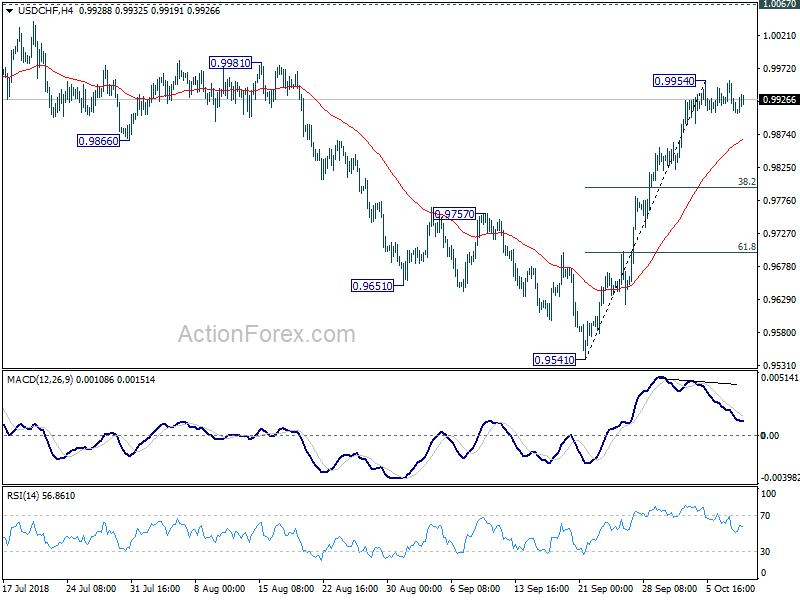
USD/CHF's consolidation from 0.9954 is still in progress and intraday bias remains neutral. Deeper pull back could be seen to 4 hour 55 EMA (now at 0.9866). But downside should be contained by 38.2% retracement of 0.9541 to 0.9954 at 0.9796 to bring rise resumption. On the upside, break of 0.9954 will target 1.0067 resistance next.
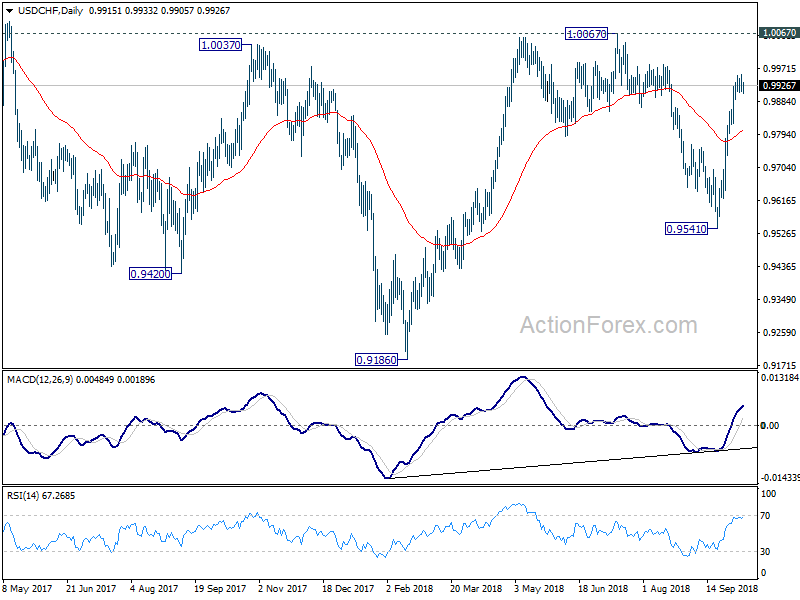
In the bigger picture, the pullback from 1.0067 has completed at 0.9541 already. And rise from 0.9186 is likely resuming. Firm break of 1.0067 will pave the way to retest 1.0342 key resistance. We'd be cautious on strong resistance from there to limit upside to bring another medium term fall to extend long term range trading.
GBP/USD Daily Outlook
Daily Pivots: (S1) 1.3068; (P) 1.3110; (R1) 1.3186; More...
Intraday bias in GBP/USD remains on the upside for 1.3297 as rebound from 1.2921 is in progress. But still, we'd expect strong resistance from 1.3316 key fibonacci level to limit upside to bring down trend resumption eventually. On the downside, below 1.3032 minor support will turn bias back to the downside for 1.2921 first.
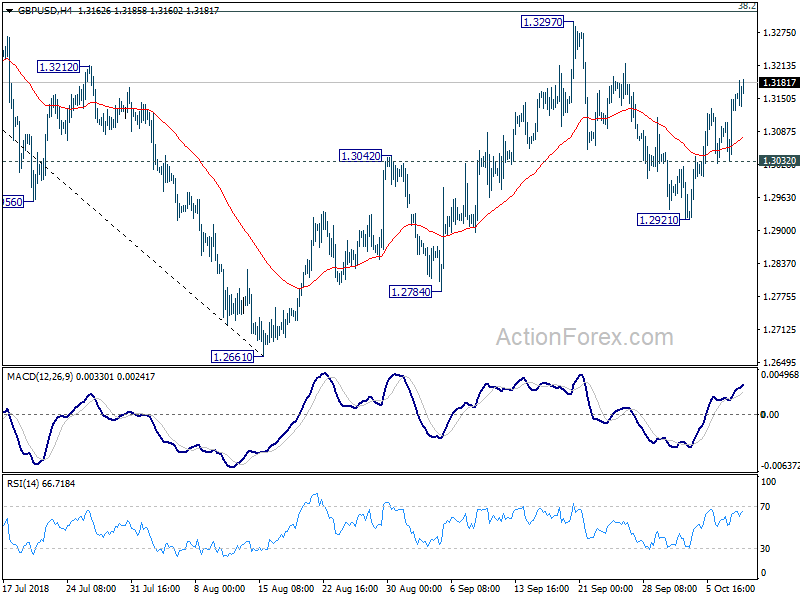
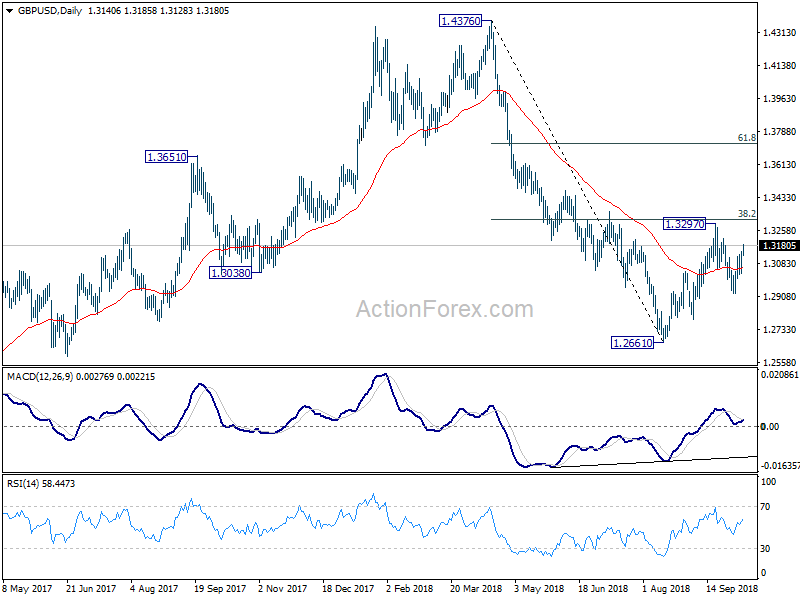
In the bigger picture, whole medium term rebound from 1.1946 (2016 low) should have completed at 1.4376 already, after rejection from 55 month EMA (now at 1.4062). The structure and momentum of the fall from 1.4376 argues that it's resuming long term down trend. And this will be the preferred case as long as 38.2% retracement of 1.4376 to 1.2661 at 1.3316 holds. However, firm break of 1.3316 would bring stronger rebound to 61.8% retracement at 1.3721. And, the eventual depth of the fall from 1.4376, and the chance of hitting 1.1946 low, will depend on the strength of the interim corrective rebound from 1.2661.
AUDUSD Is Eyeing 0.702, While USDCHF Aims For 1.005 – Elliott Wave Analysis
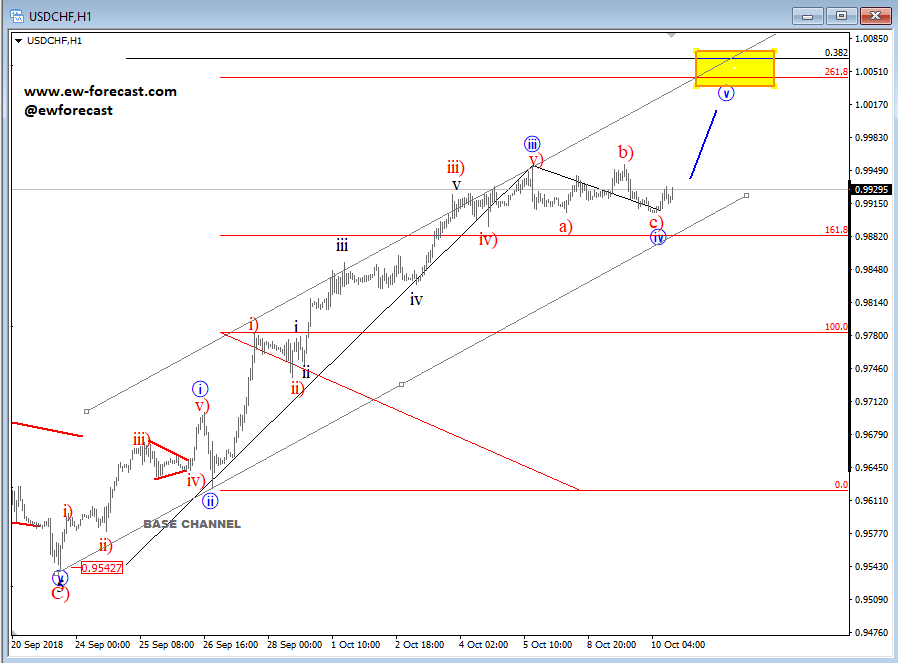
USDCHF is unraveling a five-wave rally from the 0.9543 lows with price currently ending wave iv of an uptrend. Wave iv can look for support at the lower Elliott wave channel line from where wave v can follow, towards 1.005 region.
USDCHF, 1h
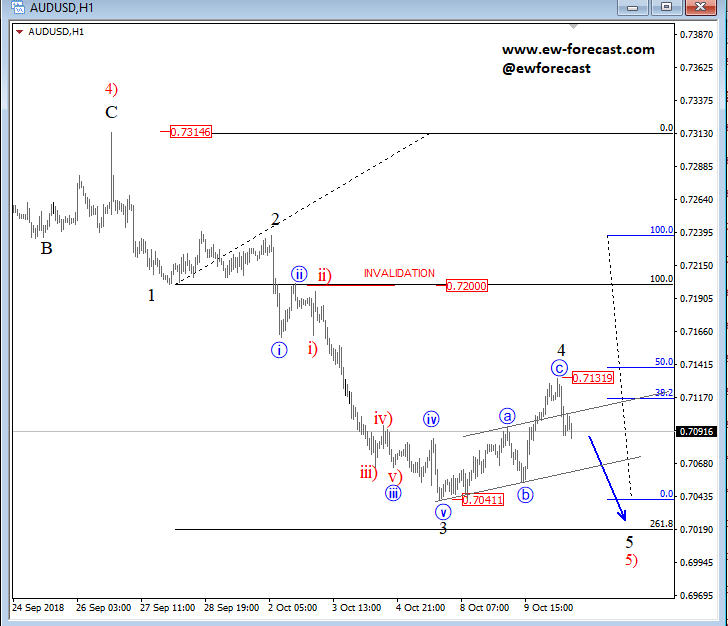
AUDUSD is slowly dropping, down from 0.714 level, which is a sign of a completed wave 4 correction, and that more weakness may follow into wave 5. A break below the upper channel line is an early evidence of a completed pullback, so ideally 0.702 area is in view.
AUDUSD, 1h