Sample Category Title
EURJPY Near-Term Momentum Turns North But Remains Below Downtrend Line
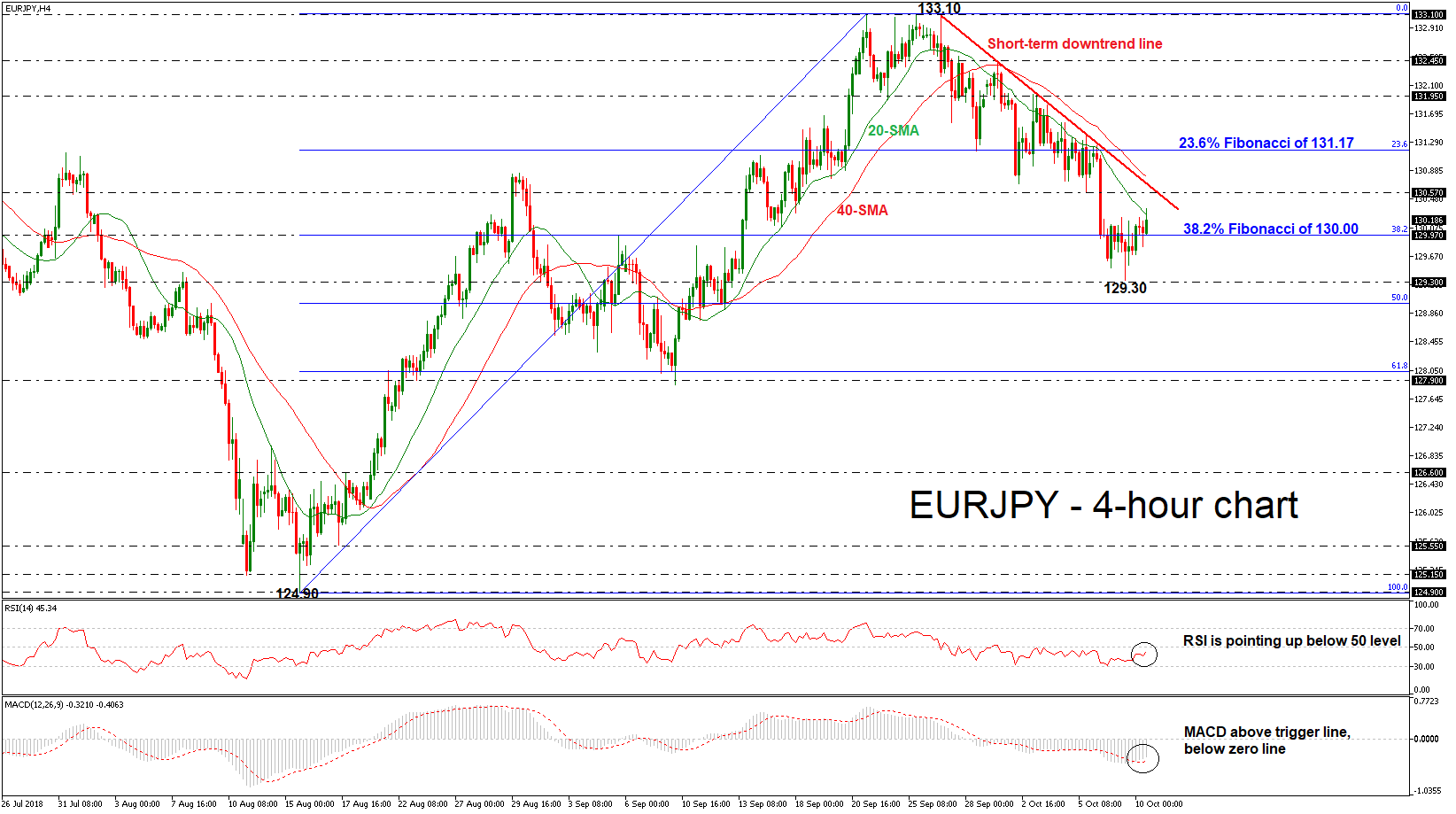
EURJPY has struggled near the 38.2% Fibonacci retracement level of the upleg from 124.90 to 133.10, around the 130.00 handle and over the last couple of hours edged higher, touching the 20-simple moving average (SMA) in the 4-hour chart. The positive movement is further supported by the RSI, which is moving north in the negative zone, while the MACD oscillator jumped above the trigger line, suggesting some gains.
If prices are able to continue to head higher the next immediate resistance for traders to watch is the 130.57 barrier, identified by the low on October 5. Even higher, the pair could meet the 40-SMA near 130.80 at the time of writing, while the next obstacle is coming from the 23.6% Fibonacci region of 131.17.
However, if the market manages to lose upside speed and turns lower again below the 38.2% Fibonacci, the price could move towards the 129.30 support, taken from the latest bottom on Tuesday. A break below this region could open the way towards the next immediate support – the 50.0% Fibonacci of 129.00.
Looking at the near-term picture, EURJPY has been trading within a short-term downtrend over the last two-weeks after the price bounced off the 133.10 resistance level.
Brexit Hopes Hold Pound Up; US PPI in Focus
Here are the latest developments in global markets:
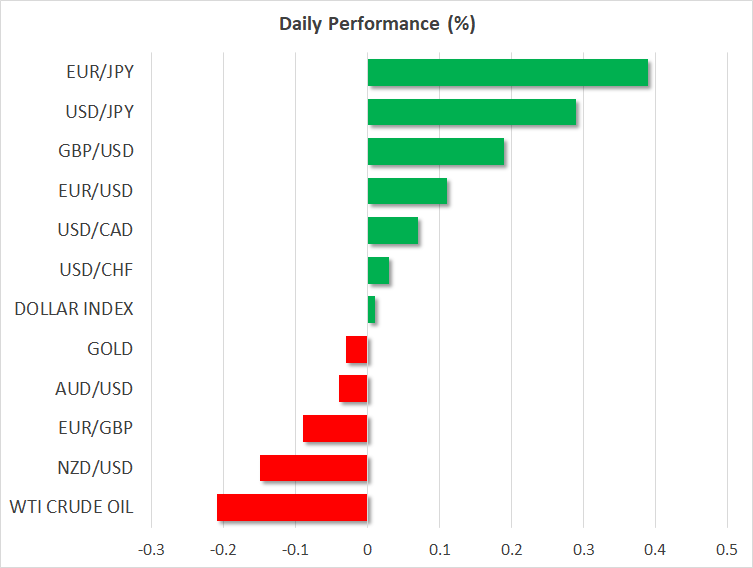
- FOREX: The British pound unlocked fresh two-week highs against the US dollar at 1.3184 but it soon fell to 1.3136 after GDP growth readings out of the UK missed a forecast of 1.6% y/y, showing instead an expansion of 1.5%. July’s mark, though, was revised upwards, from 1.6% to 1.7%. Separately, manufacturing and construction outputs in August disappointed as well, driving industrial production back to the negative territory. The British trade balance in the same month was unexpectedly discouraging too, displaying a wider deficit than projected. News that the EU and the UK are making progress on the UK-Irish border, a sticking point in Brexit negotiations, refreshed hopes that a deal could be near, helping pound/dollar to recover to 1.3156 (+0.10%). Euro/dollar was moving sideways around 1.1500 as the EU-Italian budget conflict maintained some caution in the market. Meanwhile, Reuters stated that the German government is considering cutting growth forecasts for 2019 from 2.3% to 1.8%. In monetary-related news, ECB member Yves Merch expressed confidence that wage growth should help core inflation to pick up steam ahead of ECB meeting minutes due on Thursday. Euro/pound was a little lower at 0.8736 despite the US President criticizing the Fed’s rate hike plans and trade uncertainties still hanging in the background. As of note, US 10-year Treasury yields were recovering after Tuesday’s pullback from 7-year highs. Dollar/loonie was marginally up at 1.2958 (+0.11%). In antipodean currencies, aussie/dollar and kiwi/dollar reversed earlier gains to slide to 0.7097 (-0.06%) and 0.6460 (-0.19%).
- STOCKS: The majority of European shares reversed lower on Wednesday after posting soft gains on Tuesday, as investors traded cautiously on fears that US tariffs may have serious consequences on global trade and world economic welfare. The pan-European STOXX 600 retreated by 0.21%, whereas the blue-chip Euro STOXX 50 was up by an equivalent percentage led by gains in telecommunications and utilities. The German DAX 30 declined by 0.46%, UK’s FTSE 100 was steady, while Italy’s FTSE MIB improved by 0.14%. The French CAC 40 dropped by 0.55% as shares in fashion companies such as the Gucci-owner Kering and the Paris-based Louis Vuitton tumbled amid concerns the US-Sino trade war could push away luxury-buyers in China. In Asia, equities closed mixed. In the US, futures tracking the S&P 500, Nasdaq 100 and Dow Jones held moderate losses, pointing to a soft negative open.
- COMMODITIES: WTI crude oil and Brent were weaker by 0.10% at $74.91/barrel and $84.93/barrel correspondingly after the IMF downgraded its global growth forecasts for 2018 and 2019 on Tuesday, mirroring a slowdown in demand for energy. Yet, platform evacuations and shut-ins in the Gulf of Mexico on the face of Hurricane Michael which was moving towards Florida, limited steeper declines in the market. In precious metals, gold went down to $1186.5/ounce (-0.21%).
Day Ahead: US delivers PPI ahead of CPI figures tomorrow; Canadian building permits on today’s calendar
President Donald Trump noted overnight that he is not happy with the Fed’s policy, saying that rates don’t have to rise this fast as inflation is under control. The disagreement between Trump and the Fed is not something new and the dollar’s positive performance today is a testament to that.
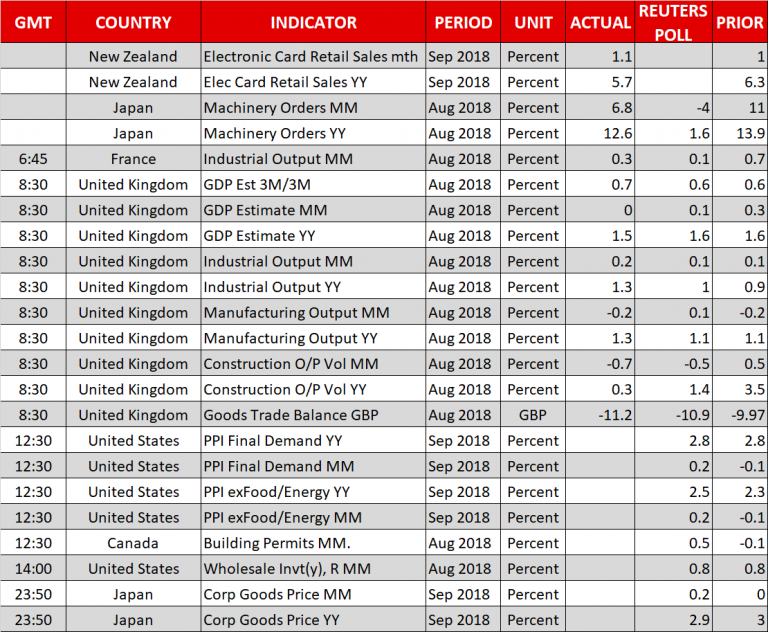
Looking at the calendar, at 1230 GMT, US producer prices for September are scheduled to be released. Predictions are for the headline PPI to remain steady at 2.8% y/y, while on monthly basis it is expected to accelerate to 0.2% from -0.1% in the previous month. Excluding food and energy items, core producer prices are anticipated to rise to 2.5% y/y from 2.3% y/y before. These prints may raise some speculation that US CPIs – due out tomorrow – could move in a similar direction, driving the US dollar higher in case the numbers pop up better than expected.
Readings on US wholesale inventories will be available at 1400 GMT.
In Canada, building permits for the month of August will be delivered at 1230 GMT, with analysts predicting the gauge to inch up to 0.5% m/m versus a decline of 0.1% in the prior month.
Later in the day, at 2350 GMT, Japan will publish PPI stats, though as usual the yen is not expected to react much on the data.
In energy markets, investors will be waiting for the API weekly report to indicate the change in US crude oil stocks for the week ending October 1, at 2030 GMT.
Six months before Britain leaves the EU, markets are positive that a deal related to divorce terms could be secured before the EU summit kicks off on October 17-18. Today people familiar with Brexit negotiations in Brussels reported that the EU is not expecting any new proposals on the Irish border from Britain and that both sides are working to narrow existing differences. Still, they remained optimistic that intense talks between the sides in the next five days could find a solution to the Irish backstop by Monday.
Elsewhere, numerous speeches are on the agenda. At 1400 GMT, the EU’s Brexit negotiator Michel Barnier will be speaking at the European Parliament, while regional Fed Presidents Charles Evans (non-voting member in FOMC in 2018) and Raphael Bostic (voting member) will be making remarks at 1615 GMT and 2100 GMT respectively. The day ends with a speech by Luci Ellis, RBA Assistant Governor at 2230 GMT.
EURGBP Outlook: Italy/Brexit News Keep the Cross Under Pressure; Oversold Techs Warn
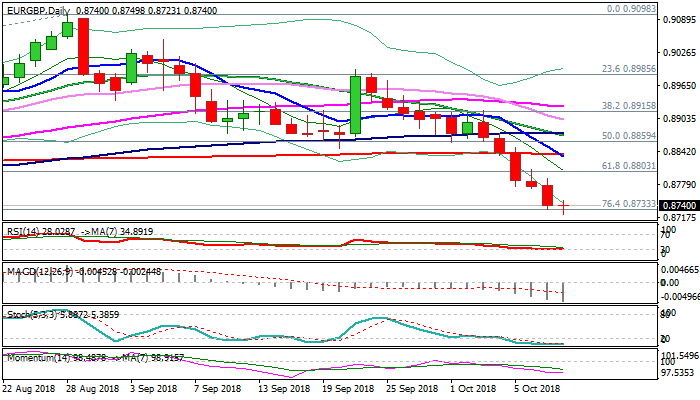
The cross is consolidating within narrow range, above new low at 0.8723 (the lowest since 15 June) posted today.
Extension of bear-leg from 0.8988 (24 Sep high) cracked target at 0.8733 (Fibo 76.4% of 0.8620/0.9098 ascend) but without clear break lower so far.
Negative sentiment was boosted by increased Brexit deal hopes and persisting concerns over Italy's budget which maintains pressure on Euro. Strong bearish momentum on daily chart and formation of 10/200SMA death-cross reinforce bearish structure, however, oversold daily RSI/slow stochastic suggest that larger bears may take a breather in coming sessions.
Indicators so far move in sideways mode, lacking firmer bullish signal and keeping upside attempts limited for now. Extended consolidation could be likely near-term scenario before fresh direction signal is generated. At the upside, base of weekly cloud which twisted on Monday and is thickening/broken Fibo 61.8% of 0.8620/0.9098, mark solid resistance at 0.8805, which is expected to ideally cap, guarding next strong barrier at 0.8835 (converged 10/200SMA's). Clear break of Fibo support at 0.8733 would signal bearish continuation towards 0.8697 (29 May trough) and unmask key support at 0.8620 (17 Apr low).
Res: 0.8750; 0.8805; 0.8835; 0.8870
Sup: 0.8723; 0.8697; 0.8680; 0.8620
EUR/USD Mid-Day Outlook
Daily Pivots: (S1) 1.1449; (P) 1.1476; (R1) 1.1520; More.....
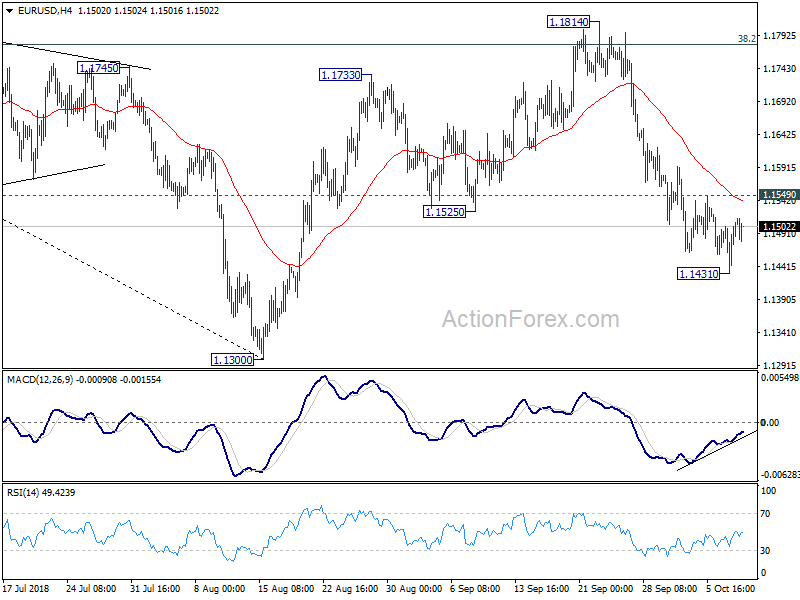
Intraday bias in EUR/USD remains neutral for consolidation above 1.1431. But with 1.1549 minor resistance intact, another decline is still expected. On the downside, below 1.1431 will resume the fall from 1.1814 and target 1.1300 low. Nonetheless, break of 1.1549 will indicate short term bottoming and bring stronger rebound, back to 55 day EMA (now at 1.1621).
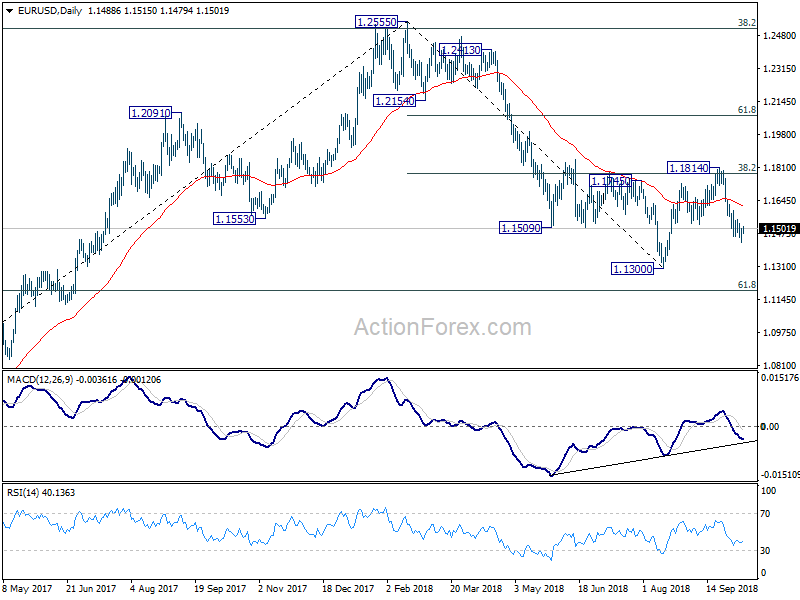
In the bigger picture, corrective pattern from 1.1300 could have completed at 1.1814 after hitting 38.2% retracement of 1.2555 to 1.1300at 1.1779. Decisive break of 1.1300 will resume the down trend from 1.2555 to 61.8% retracement of 1.0339 (2017 low) to 1.2555 at 1.1186 next. Sustained break there will pave the way to retest 1.0339. On the upside, break of 1.1814 will delay the bearish case and extend the correction from 1.1300 with another rise before completion.
Sterling Resilient Despite UK GDP Miss, Euro Firm as German-Italian Spread Back Below 300
Sterling continues show a lot of resilience today. In despite of weaker than expected August GDP report, as well as mixed productions data. the Pound manages to trade as the strongest one for today. Optimism on Brexit negotiation is a factor as there are rumors flying around, hailing progress made. But it should be noted that no details whatsoever on the so call progress are reported. Instead, Brexit Minister Dominic Raab sounded rather clear he's not shooting for a deal within this month, but next. And after all the nice words, EU would have to do what Raab said, that is, meet them "half way", or there won't be any deal.
For now, Euro is taking turn to be the strongest one for today with Sterling. As noted before, we believed that selling climax in Italian bonds is passed temporarily. German-Italian spread is back below 300 today. But Italy and Euro are both still vulnerable as credit agencies are lining up to publish their review on Italy towards the end of the month. Dollar is trading slightly firmer today. But it's for now seen as a leg in consolidative pattern, which doesn't warrant a breakout from range yet. Mixed PPI data from US also provides no help to the greenback. Yen, New Zealand and Australian Dollar are the weaker ones.
In Europe, stocks selling seem to have picked up some steam as the day goes. At the time of writing, CAC is down -0.99%, DAX down -0.88%, FTSE down -0.27%. Italian 10 year yield is down -0.017 at 3.494. German 10 year yield is up 0.0265 at 0.578. Earlier in Asia, Nikkei rose 0.16%, Hong Kong HSI rose 0.08%, China Shanghai SSE rose 0.18%. But Singapore Strait Times dropped -1.11%. 10 year JGB yield dropped -0.0065 to 0.156, still way above BoJ's allowed band of -0.1 to 0.1%.
US Treasurer Mnuchin warns China on competitive Yuan devaluation
US Treasury Secretary Steven Mnuchin warned China in a Financial Times interview on currency manipulation. He said that "as we look at trade issues, there is no question that we want to make sure China is not doing competitive devaluations." Nonetheless, Mnuchin also acknowledged that Chinese Yuan "depreciated significantly" due to "various factors". He added "one of those factors has to do with their own economic issues and what has gone on in the Chinese economy."
Earlier this week, Bloomberg reported that Mnuchin faced pressure from within the White House to formally designate China as currency manipulator. The Treasury Department is expected to release its semiannual currency report later this month. And we'll see Mnuchin's eventual stance then.
In our view, the 2015 Trade Act of the US has laid down three numerical criteria for currency manipulations. And China only satisfies one of the criteria, with huge bilateral trade surplus with US. We despise China for many of its economic and trade policies. While participation virtually in all international organizations since economic reform n 70s, China's compliance to the rules of games has been declining as its economic status in the world grows. It is also notorious for tweaking the rules in its favor, despite detrimental to others. However, to us, it is equally a disgrace that the Trump administration accuses China of what it is not, for political gains. More in Who is a Currency Manipulator?
Fed Williams: Fed is nearing end of monetary policy normalization
New York Fed President John Williams said in speech that recent FOMC statement well summarized the current US economy, with the word "strong" appeared five times. And Fed "has attained its dual mandate objectives of maximum employment and price stability about as well as it ever has." He added that "most indicators point to a very strong labor market" while "inflation is right on target:"
He expected fiscal stimulus and favorable financial conditions to provide "tailwinds" to the economy for more strong growth. He expected real GDP to grow by 3.0% in 2018 and 2.5% in 2019. Unemployment rate is expected to edge down to slightly below 3.% next year. Price inflation is expected to move up a bit above 2%. But he added that "I don't see any signs of greater inflationary pressures on the horizon."
Regarding removal of "accommodative" language in latest FOMC statement, Williams said "these more concise statements do not signify a shift in our monetary policy approach." And, they just "represent the natural evolution of the language describing the factors influencing our policy decisions ". And the changes in communications are signs that Fed is "nearing the end of the process of normalizing monetary policy".
Released from the US, PPI rose 0.2% mom, 2.6% yoy in September. Core PPI rose 0.2% mom, 2.5% yoy. From Canada, building permits rose 0.4% mom in August.
UK GDP growth stalled in August, Sterling mildly lower
Sterling trades mildly lower after UK GDP miss. UK GDP was flat in August, grew 0.0% mom, below expectation of 0.1% mom. Though July's figure was revised up from 0.3% mom to 0.4% mom. For the three months from June to August, GDP grew 0.7% from the March to May quarter. All three main sectors contributed to GDP growth in the three months to August. Services grew 0.42%, production grew 0.10%, construction grew 0.17%.
Commenting on today's GDP figures, Head of GDP Rob Kent-Smith said: "The economy continued to rebound strongly after a weak spring, with retail, food and drink production and housebuilding all performing particularly well during the hot summer months. However, long-term growth continues to lag behind its historical trend."
Also from UK, industrial production rose 0.2% mom, 1.3% in August, above expectation of 0.1% mom, 1.1% yoy. Manufacturing production dropped -0.2% mom, rose 1.3% yoy, below expectation of 0.2% mom, 1.5% yoy. Visible trade deficit widened to GBP -11.2B in August, above expectation of GBP -10.9B.
UK Raab hinted at no Brexit deal in October, targeting November
UK Brexit Minister Dominic Raab told the parliament yesterday that the European Council meeting next week will be an " important milestone" for Brexit negotiation. And he expected it to be "a moment where we will make some progress". He added that " negotiations were always bound to be tough in the final stretch". But he remained "confident we will reach a deal this autumn." His refrained comments suggested that he is targeting to complete the deal in November rather than October, as not enough progress was made. Raab also reiterated the Chequers proposal will deliver "frictionless trade with the EU that we have now". But he urged the EU to "meet us half way".
Separately, ITV reported that Prime Minister Theresa May's chief negotiation Olly Robbins has made "meaningful progress" with EU Brexit negotiator Michel Barnier on Irish border issue. But no detail on the so called progress was revealed, nor the source. The Times reported that May is planning to have an extended discussion on Brexit at next Tuesday's cabinet meeting to warp things up before the EU summit.
ECB Mersch: Global risks are gaining prominence
ECB Executive Board member Yves Mersch said in Singapore that the Eurozone economy is experience broad based expansion. And risks to growth remain "broadly balanced". Overall, Mersch expect the expansion to continue as a "pace slightly above potential in the period ahead." Inflation is expected to continue its rise thanks to "quite some" degree of monetary stimulus.
However, Mersch also warned that risks related to global factors, including "the threat of increased protectionism, the finalization of the Brexit negotiations and vulnerabilities in emerging markets are gaining prominence."
German government to revise down growth forecasts to 1.8% in both 2018 and 2019
Reuters reported, according to a document they obtained, German government slashed growth forecast for both 2018 and 2019 in the update to be released tomorrow. Growth is now projected to be at 1.8% in both 2018 and 2019, down from prior projections of 2.3% and 2.1% respectively. For 2020, growth is expected to be unchanged at 1.8%. Weak global trade, lowered state consumption and softer auto sector are the causes for slower than expected growth.
Inflation is projected to be at 1.9% in 2018 and rise further to 2.0% in 2019. The document also noted that "in view of the strong expansion of disposable income and moderate inflation, private consumption is likely to pick up noticeably." House hold spending is expected to grow 1.6% in 2018 and 2.0% in 2019. State consumption is projected to grow 1.4% in 2018 and 2.5% in 2019. State investment is project to rise 5.9% in 2018 and 5.2% in 2019.
According to IMF's latest forecasts released earlier this week, German growth is projected at 1.9% in 2018 and 1.9% in 2019, revised down from April forecasts of 2.5% and 2.0% respectively.
EUR/USD Mid-Day Outlook
Daily Pivots: (S1) 1.1449; (P) 1.1476; (R1) 1.1520; More.....
Intraday bias in EUR/USD remains neutral for consolidation above 1.1431. But with 1.1549 minor resistance intact, another decline is still expected. On the downside, below 1.1431 will resume the fall from 1.1814 and target 1.1300 low. Nonetheless, break of 1.1549 will indicate short term bottoming and bring stronger rebound, back to 55 day EMA (now at 1.1621).
In the bigger picture, corrective pattern from 1.1300 could have completed at 1.1814 after hitting 38.2% retracement of 1.2555 to 1.1300at 1.1779. Decisive break of 1.1300 will resume the down trend from 1.2555 to 61.8% retracement of 1.0339 (2017 low) to 1.2555 at 1.1186 next. Sustained break there will pave the way to retest 1.0339. On the upside, break of 1.1814 will delay the bearish case and extend the correction from 1.1300 with another rise before completion.
Economic Indicators Update
| GMT | Ccy | Events | Actual | Forecast | Previous | Revised |
|---|---|---|---|---|---|---|
| 23:30 | AUD | Westpac Consumer Confidence Oct | 1.00% | -3.00% | ||
| 23:50 | JPY | Machine Orders M/M Aug | 6.80% | -3.60% | 11.00% | |
| 06:00 | JPY | Machine Tool Orders Y/Y (Sep P) | 2.80% | 5.10% | ||
| 08:30 | GBP | Visible Trade Balance (GBP) Aug | -11.2B | -10.9B | -10.0B | -10.4B |
| 08:30 | GBP | Industrial Production M/M Aug | 0.20% | 0.10% | 0.10% | 0.40% |
| 08:30 | GBP | Industrial Production Y/Y Aug | 1.30% | 1.10% | 0.90% | 1.00% |
| 08:30 | GBP | Manufacturing Production M/M Aug | -0.20% | 0.20% | -0.20% | 0.00% |
| 08:30 | GBP | Manufacturing Production Y/Y Aug | 1.30% | 1.50% | 1.10% | 1.40% |
| 08:30 | GBP | Construction Output SA M/M Aug | -0.70% | -0.40% | 0.50% | |
| 08:30 | GBP | GDP M/M Aug | 0.00% | 0.10% | 0.30% | 0.40% |
| 08:30 | GBP | Index of Services 3M/3M Aug | 0.50% | 0.60% | 0.60% | 0.70% |
| 12:30 | CAD | Building Permits M/M Aug | 0.40% | 1.30% | -0.10% | -1.50% |
| 12:30 | USD | PPI M/M Sep | 0.20% | 0.20% | -0.10% | |
| 12:30 | USD | PPI Y/Y Sep | 2.60% | 2.80% | 2.80% | |
| 12:30 | USD | PPI Core M/M Sep | 0.20% | 0.20% | -0.10% | |
| 12:30 | USD | PPI Core Y/Y Sep | 2.50% | 2.40% | 2.30% | |
| 14:00 | USD | Wholesale Inventories M/M Aug F | 0.80% | 0.80% |
Canadian Dollar Edges Higher ahead of Building Permits
The Canadian dollar has edged higher in Wednesday session. Currently, USD/CAD is trading at 1.2966, up 0.13% on the day. On the release front, Canada releases Building Permits, which is expected to rebound with a gain of 0.5%, following to straight declines. The U.S releases key inflation indicators this week, starting with Producer Price Index reports. PPI and Core PPI are both expected to post gains of 0.2%, after a decline of 0.1% in the previous release. The U.S. will also publish the Treasury Currency report, a semi-annual publication. On Thursday, the U.S will release CPI reports and unemployment claims.
Will there be any surprises in the U.S Treasury currency report?. The report provides details of global exchange rate policies, as well as a list of countries which are deemed currency manipulators. In the April report, the U.S did not name any of its major partners as currency manipulators. Since then, the Trump administration has imposed some $200 billion in tariffs on Chinese goods. China has retaliated with its own tariffs on U.S goods, and there has been speculation that China could respond to the U.S tariffs by devaluating the Chinese yuan in order to bolster Chinese exports. In 2015 and 2016, the markets dropped sharply on fears that China would implement a major devaluation of its currency. Traders should treat the report as a market-mover.
Into US session: Sterling recovers from GDP blip, Euro and Dollar firm too
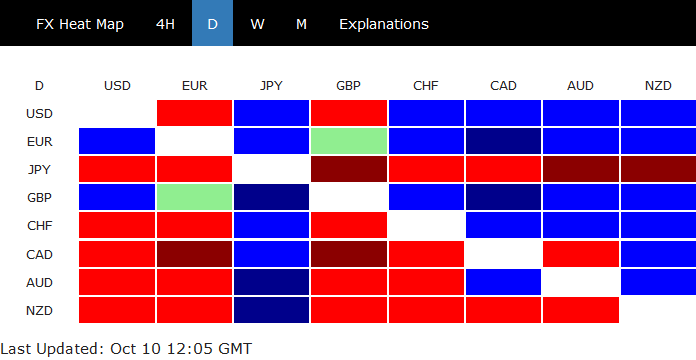
Entering into US session, Sterling is trading as the strongest one for today so far. Weaker than expected UK GDP triggered very brief retreat in the Pound. And Sterling quickly find its footing on Brexit optimism again. At the time of writing, Euro is the second strongest as Italian yield drops for another day. The selling climax in Italian bonds could have passed the climax for the near, possibly until credit agency rating actions. Dollar trades mildly high as consolidative price actions extend. Yen is the weakest one as sentiments stabilized and turned mixed. Kiwi is the second weakest, followed by Loonie.
In Europe, CAC leads the way down by -0.71%, DAX is down -0.64% and FTSE is down -0.05%. Italian 10 year yield is dropping -0.0361 at 3.475. German 10 year bund yield is up 0.0049 at 0.556. German-Italian spread is no back below 300. Earlier in Asia, Nikkei rose 0.16%, Hong Kong HSI rose 0.08%, China Shanghai SSE rose 0.18%. But Singapore Strait Times dropped -1.11%. 10 year JGB yield dropped -0.0065 to 0.156, still way above BoJ's allowed band of -0.1 to 0.1%.
German government to revise down growth forecasts to 1.8% in both 2018 and 2019
Reuters reported, according to a document they obtained, German government slashed growth forecast for both 2018 and 2019 in the update to be released tomorrow. Growth is now projected to be at 1.8% in both 2018 and 2019, down from prior projections of 2.3% and 2.1% respectively. For 2020, growth is expected to be unchanged at 1.8%. Weak global trade, lowered state consumption and softer auto sector are the causes for slower than expected growth.
Inflation is projected to be at 1.9% in 2018 and rise further to 2.0% in 2019. The document also noted that "in view of the strong expansion of disposable income and moderate inflation, private consumption is likely to pick up noticeably." House hold spending is expected to grow 1.6% in 2018 and 2.0% in 2019. State consumption is projected to grow 1.4% in 2018 and 2.5% in 2019. State investment is project to rise 5.9% in 2018 and 5.2% in 2019.
According to IMF's latest forecasts released earlier this week, German growth is projected at 1.9% in 2018 and 1.9% in 2019, revised down from April forecasts of 2.5% and 2.0% respectively.
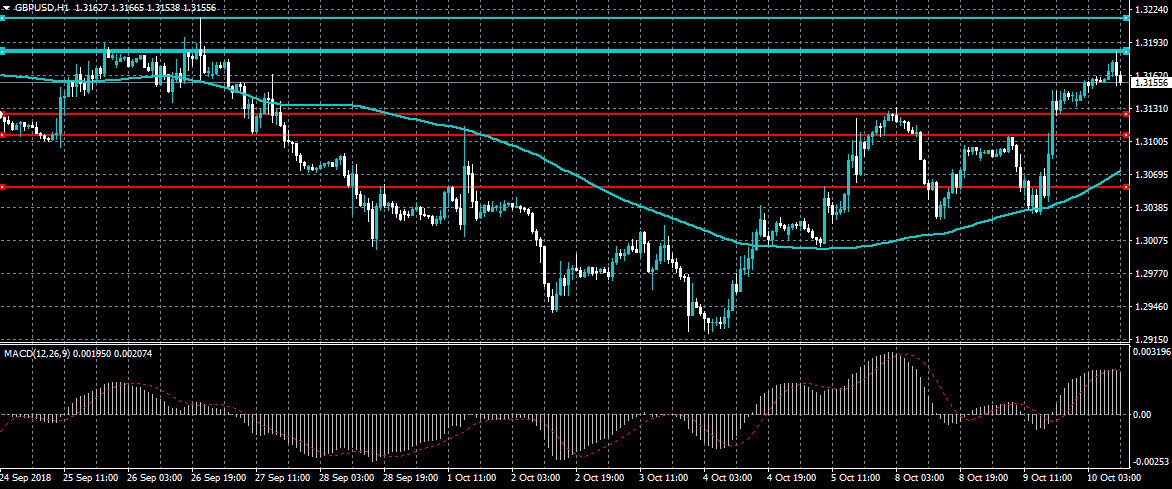
GBPUSD Still Bullish Despite SOft UK Data
The British pound still remains at elevated levels against the US dollar, despite another raft of soft economic data from the United Kingdom economy today. If GBPUSD buyers can move price towards the 1.3220 resistance level, a bullish inverted head and shoulders pattern will then be formed. Intraday sellers will need to force price back under the 1.3122 level to negate the current bullish pressures.
The GBPUSD pair is strongly bullish while trading above the 1.3122 level, key resistance is now found at the 1.3184 and 1.3220 levels.
If the GBPUSD pair moves below the 1.3155 level, key support is found at the 1.3122 and 1.3100 levels.
USDJPY Watching Large Head And Shoulders Pattern
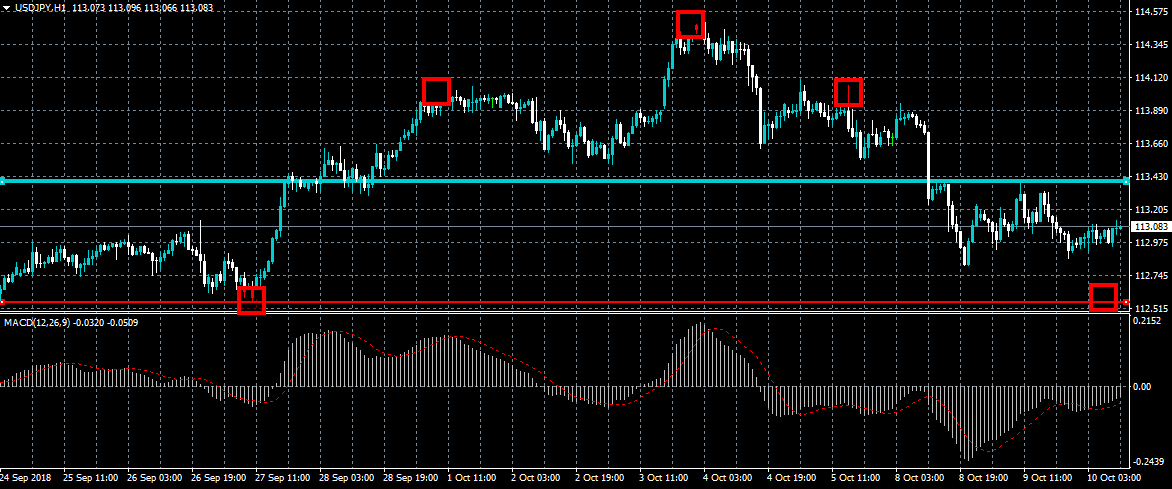
The US dollar continues to correct lower against the Japanese yen currency, as buyers fail to regain short-term control of the USDJPY pair. A bearish head and shoulders pattern is emerging across the lower time frames, with a two-hundred pip downside projection. Sellers will attempt to break the 112.55 support level, while intraday buyers need to move price above the 113.40 resistance level.
The USDJPY pair is intraday bearish while trading below the 113.40 level, key support found at the 112.78 and 112.55 levels.
If the USDJPY pair moves above the 113.40 level, buyers will likely test towards 113.80 and 114.06 resistance levels.