Sample Category Title
Crude Oil: Oil Trading Higher, Ahead Of Baker Hughes Weekly Rig Count Data
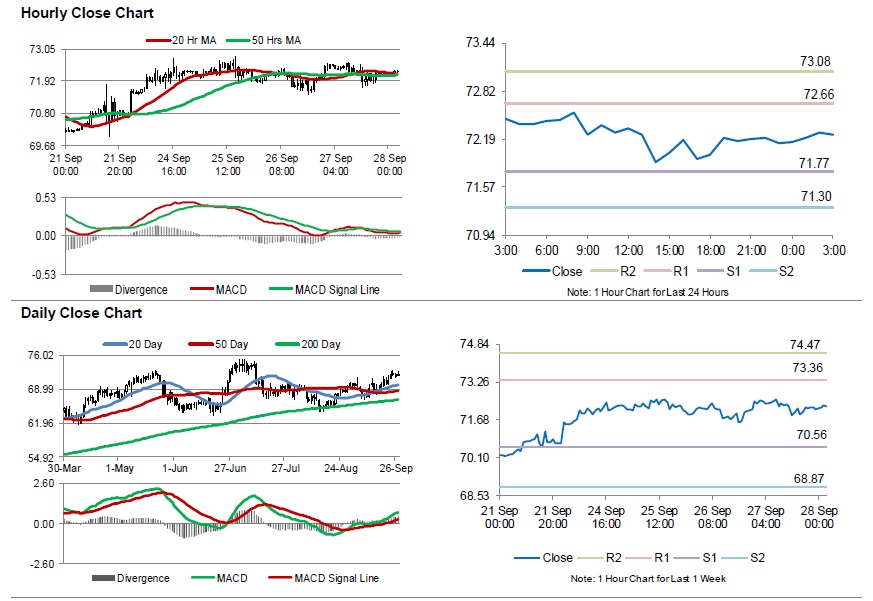
For the 24 hours to 23:00 GMT, Crude Oil marginally rose against the USD and closed at USD72.14 per barrel, after the US officials denied utilising domestic reserves to reduce the surge in oil prices.
In the Asian session, at GMT0300, the pair is trading at 72.25, with oil trading 0.15% higher against the USD from yesterday’s close.
The pair is expected to find support at 71.77, and a fall through could take it to the next support level of 71.29. The pair is expected to find its first resistance at 72.66, and a rise through could take it to the next resistance level of 73.08.
Crude oil is showing convergence with its 20 Hr and 50 Hr moving averages.
USD/JPY Daily Outlook
Daily Pivots: (S1) 112.82; (P) 113.15; (R1) 113.73; More...
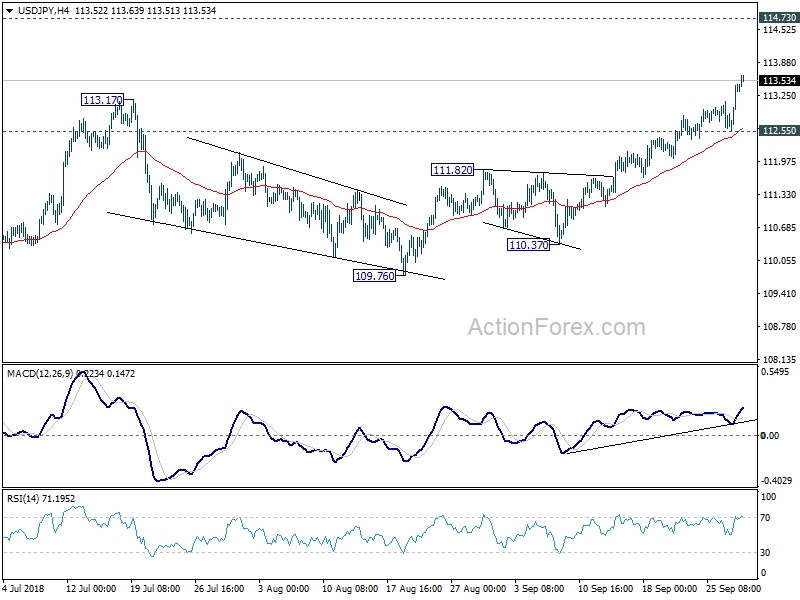
USD/JPY rises to as high as 113.63 so far today. The break of 113.17 resistance confirms resumption of whole rally from 104.62. Intraday bias is back on the upside for 114.73 key resistance next. Decisive break there will should confirm larger bullish case. On the downside, break of 112.55 support is needed to indicate short term topping. Otherwise, near term outlook will remain bullish in case of retreat.
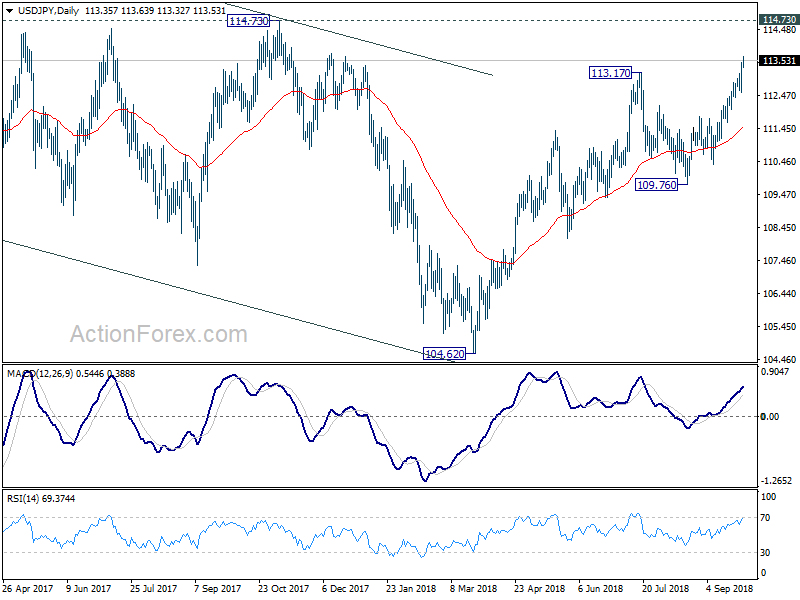
In the bigger picture, corrective fall from 118.65 (2016 high) should have completed with three waves down to 104.62. Decisive break of 114.73 resistance will likely resume whole rally from 98.97 (2016 low) to 100% projection of 98.97 to 118.65 from 104.62 at 124.30, which is reasonably close to 125.85 (2015 high). This will stay as the preferred case as long as 109.76 support holds.
Dollar Rally Continues as Focus Turns to PCE Inflation
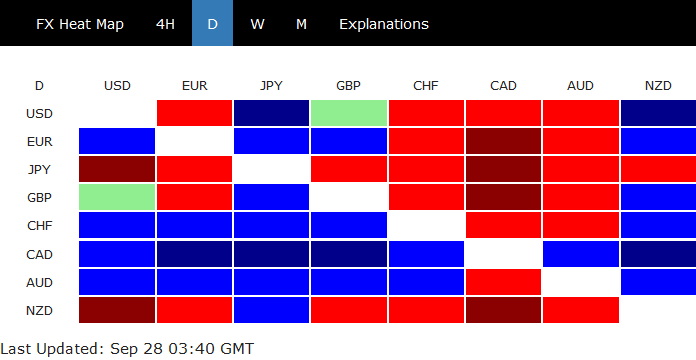
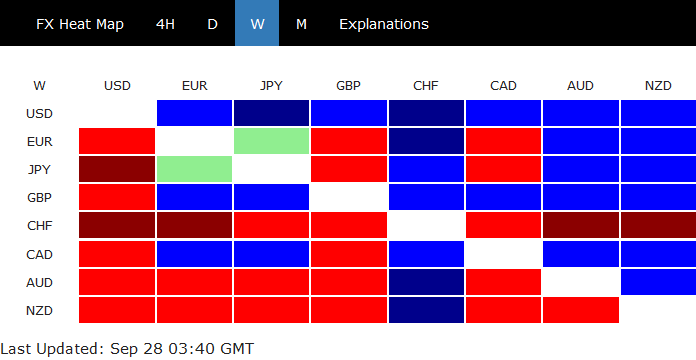
The case for bullishness in Dollar continued to build up with yesterday's rally. The greenback is now the strongest one for the week followed by Sterling. In particular, USD/JPY's firm break of 113.17 resistance confirmed larger up trend resumption. Now, GBP/USD is the only one who's yet to break 1.3042 minor support. Swiss Franc remains the weakest one for the week and there is no sign of a turnaround. Even though Australian and New Zealand Dollar recover in Asia, they are the favorite the end the week as the second weakest.
In other markets, US stocks ended higher overnight. DOW gained 0.21%, S&P 500 rose 0.28% and NASDAQ added 0.65%. Long term treasury yields were soft with 10 year yield closed down -0.005, 30-year yield down -0.008. In Asian, Nikkei is currently up 1.25%, Hong Hong HSI up 1.73%, China Shanghai SSE Up 0.93 and back above 2800, Singapore Strait Times up 1.17%. 10 year JGB yield is up slightly at 0.124. Gold stays weak at 1183 after breaking 1187.58 near term support yesterday. It should be heading back towards 1160.36 low in near term.
Technically, 1.3042 minor support in GBP/USD is a level to watch today, to see when the pair catches up with other Dollar pairs. Or instead, GBP/USD will recover ahead of this level again as the greenback pares gains before weekly close. PCE inflation data from US might be the trigger for the moves.
Italy to target budget deficit at 2.4% of GDP for the next three years
Italian government confirmed raising budget deficit, which would put them at odds with the EU. After the highly anticipated cabinet meeting, they decided to target budget deficit at 2.4% of GDP for the next three years. That is, Economy Minister Giovanni Tria, an unaffiliated technocrat, conceded his push for lowering deficit to just 1.6% of GDP, and then 2.0% in 2019.
"There is an accord within the whole government for 2.4 percent, we are satisfied, this is a budget for change," 5-Star Movement leader Luigi Di Maio and League leader Matteo Salvini, both Deputy Prime Ministers, said in a joint statement after meetings with Tria.
Prime Minister Giuseppe Conte said the budget goals were "considered, reasonable and courageous" and would "ensure more robust economic growth and significant social progress for our country." He added the budget plan included "the biggest program of public investments ever carried out in Italy."
While the 2.4% deficit target remains below EU rule of 3.0%, EU might find a lack of commitment on Italy's side to cut its massive debt.
BCC: 20% UK business will move to EU in case of no-deal Brexit
According to a survey by the British Chambers of Commerce, investment and recruitment would be cut in the event of 'no deal' Brexit. The survey found that:, 21% of businesses will cut investment, 20% will move part of all of their business to EU, 18% will cut recruitment. Also, 62% of businesses still haven't completed a Brexit risk assessment.
Adam Marshall, Director General of BCC, warned that "our evidence is clear - failure to reach a political agreement would have real-world consequences, with significant decreases in both investment and recruitment. Larger firms and those active in international trade would suffer the most from a disorderly and sudden exit from the EU, but there will be impacts across the board." And, he added "most concerning of all, a materially significant number of businesses are considering moving part or all of their operations to the EU in the event of 'no deal'".
Separately, UK Gfk consumer confidence dropped -2 to -9 in September. Joe Staton, Client Strategy Director at GfK, noted "when respondents talk about their personal finances, the scores are still positive. But for the general economy, they can only reflect on the obvious uncertainty surrounding Brexit."
BoC Poloz: Gradual rate hike to continue
Bank of Canada Governor Stephen Poloz said in a speech that the economic models suggested the economy is "operating essentially right around capacity". Still, "there is a great deal of uncertainty about the state of the economy and the prospects for growth and inflation."
But at the same time, he emphasized that the central bank cannot operate monetary policy "mechanically", but policy "becomes a matter of risk management". And, "being uncertain about the future does not justify inaction."
Poloz said "today, we continue to judge that higher interest rates will be warranted to achieve our inflation target." And, "the Bank will continue to follow a gradual approach to raising interest rates, and remain dependent on incoming data and other sources of information to guide our decisions."
BoJ: Growing downside risks stemming from trade frictions
In the summary of opinions of September 18-19 BoJ meeting, it's noted that the "he underlying trend in Japan's economic activity has not changed significantly". But there were growing downside risks "stemming from trade friction between such economies as the United States and China as well as from fluctuations in financial markets."
On inflation, the summary noted "it is gradually becoming clear that the delay in a rise in inflation is affected by not only a mere demand shortage, but also various factors such as the persistent deflationary mindset and improvement in productivity stemming from expansion in supply capacity."
On monetary policy, the summary noted both then need to "persistently maintain highly accommodative financial conditions" and "carefully examining the positive effects and side effects" of easing. Also, there is "room" to make policy "more flexible" for "market functioning".
A batch of economic data is also released from Japan. Tokyo CPI core accelerated to 1.0% yoy in September versus expectation of 0.9% yoy Unemployment rate dropped to 2.4% in August versus expectation of 2.5%. Retail sales rose more than expected by 2.7% yoy. However, industrial production missed and rose only 0.7% mom.
Looking ahead
Inflation data will be the main focuses of today. Eurozone will release September CPI flash. Germany unemployment, Swiss CPI, UK GDP final and current account will also be featured in European session.
Later in the day. US will release personal income and spending with PCE inflation. Chicago PMI will also be released. Canada will release July GDP, IPPI and RMPI.
USD/JPY Daily Outlook
Daily Pivots: (S1) 112.82; (P) 113.15; (R1) 113.73; More...
USD/JPY rises to as high as 113.63 so far today. The break of 113.17 resistance confirms resumption of whole rally from 104.62. Intraday bias is back on the upside for 114.73 key resistance next. Decisive break there will should confirm larger bullish case. On the downside, break of 112.55 support is needed to indicate short term topping. Otherwise, near term outlook will remain bullish in case of retreat.
In the bigger picture, corrective fall from 118.65 (2016 high) should have completed with three waves down to 104.62. Decisive break of 114.73 resistance will likely resume whole rally from 98.97 (2016 low) to 100% projection of 98.97 to 118.65 from 104.62 at 124.30, which is reasonably close to 125.85 (2015 high). This will stay as the preferred case as long as 109.76 support holds.
Economic Indicators Update
| GMT | Ccy | Events | Actual | Forecast | Previous | Revised |
|---|---|---|---|---|---|---|
| 22:45 | NZD | Building Permits M/M Aug | 7.80% | -10.30% | -10.80% | |
| 23:01 | GBP | GfK Consumer Confidence Sep | -9 | -8 | -7 | |
| 23:30 | JPY | Unemployment Rate Aug | 2.40% | 2.50% | 2.50% | |
| 23:30 | JPY | Tokyo CPI Core Y/Y Sep | 1.00% | 0.90% | 0.90% | |
| 23:50 | JPY | BOJ Summary of Opinions | ||||
| 23:50 | JPY | Industrial Production M/M Aug P | 0.70% | 1.50% | -0.10% | -0.20% |
| 23:50 | JPY | Retail Trade Y/Y Aug | 2.70% | 2.20% | 1.50% | |
| 5:00 | JPY | Housing Starts Y/Y Aug | 0.40% | -0.70% | ||
| 7:00 | CHF | KOF Leading Indicator Sep | 100.1 | 100.3 | ||
| 7:55 | EUR | German Unemployment Change Sep | -9K | -8K | ||
| 7:55 | EUR | German Unemployment Claims Rate Sep | 5.20% | |||
| 8:30 | GBP | Current Account Balance (GBP) Q2 | -19.4B | -17.7B | ||
| 8:30 | GBP | GDP Q/Q Q2 F | 0.40% | 0.40% | ||
| 9:00 | EUR | Eurozone CPI Estimate Y/Y Sep | 2.10% | 2.00% | ||
| 9:00 | EUR | Eurozone CPI Core Y/Y Sep A | 1.10% | 1.00% | ||
| 12:30 | CAD | Industrial Product Price M/M Aug | 0.60% | -0.20% | ||
| 12:30 | CAD | Raw Materials Price Index M/M Aug | 0.80% | 0.70% | ||
| 12:30 | CAD | GDP M/M Jul | 0.10% | 0.00% | ||
| 12:30 | USD | Personal Income Aug | 0.40% | 0.30% | ||
| 12:30 | USD | Personal Spending Aug | 0.40% | 0.40% | ||
| 12:30 | USD | PCE Deflator M/M Aug | 0.20% | 0.10% | ||
| 12:30 | USD | PCE Deflator Y/Y Aug | 2.30% | 2.30% | ||
| 12:30 | USD | PCE Core M/M Aug | 0.20% | 0.20% | ||
| 12:30 | USD | PCE Core Y/Y Aug | 2.00% | 2.00% | ||
| 13:45 | USD | Chicago PMI Sep | 63.8 | 63.6 | ||
| 14:00 | USD | U. of Mich. Sentiment Sep F | 96 | 100.8 |
BoJ: Growing downside risks stemming from trade frictions
In the summary of opinions of September 18-19 BoJ meeting, it's noted that the "he underlying trend in Japan's economic activity has not changed significantly". But there were growing downside risks "stemming from trade friction between such economies as the United States and China as well as from fluctuations in financial markets."
On inflation, the summary noted "it is gradually becoming clear that the delay in a rise in inflation is affected by not only a mere demand shortage, but also various factors such as the persistent deflationary mindset and improvement in productivity stemming from expansion in supply capacity."
On monetary policy, the summary noted both then need to "persistently maintain highly accommodative financial conditions" and "carefully examining the positive effects and side effects" of easing. Also, there is "room" to make policy "more flexible" for "market functioning".
A batch of economic data is also released from Japan. Tokyo CPI core accelerated to 1.0% yoy in September versus expectation of 0.9% yoy Unemployment rate dropped to 2.4% in August versus expectation of 2.5%. Retail sales rose more than expected by 2.7% yoy. However, industrial production missed and rose only 0.7% mom.
BoC Poloz: Gradual rate hike to continue
Bank of Canada Governor Stephen Poloz said in a speech that the economic models suggested the economy is "operating essentially right around capacity". Still, "there is a great deal of uncertainty about the state of the economy and the prospects for growth and inflation."
But at the same time, he emphasized that the central bank cannot operate monetary policy "mechanically", but policy "becomes a matter of risk management". And, "being uncertain about the future does not justify inaction."
Poloz said "today, we continue to judge that higher interest rates will be warranted to achieve our inflation target." And, "the Bank will continue to follow a gradual approach to raising interest rates, and remain dependent on incoming data and other sources of information to guide our decisions."
His full speech on "Technological Disruption and Opportunity". And video below.
https://www.youtube.com/watch?v=Fk8dngTOn3Y
BCC: 20% UK business will move to EU in case of no-deal Brexit
According to a survey by the British Chambers of Commerce, investment and recruitment would be cut in the event of 'no deal' Brexit. The survey found that:, 21% of businesses will cut investment, 20% will move part of all of their business to EU, 18% will cut recruitment. Also, 62% of businesses still haven't completed a Brexit risk assessment.
Adam Marshall, Director General of BCC, warned that "our evidence is clear - failure to reach a political agreement would have real-world consequences, with significant decreases in both investment and recruitment. Larger firms and those active in international trade would suffer the most from a disorderly and sudden exit from the EU, but there will be impacts across the board." And, he added "most concerning of all, a materially significant number of businesses are considering moving part or all of their operations to the EU in the event of 'no deal'".
Separately, UK Gfk consumer confidence dropped -2 to -9 in September. Joe Staton, Client Strategy Director at GfK, noted "when respondents talk about their personal finances, the scores are still positive. But for the general economy, they can only reflect on the obvious uncertainty surrounding Brexit."
Italy to target budget deficit at 2.4% of GDP for the next three years
Euro wasn't too bothered after Italian government confirmed raising budget deficit, which would put them at odds with the EU. After the highly anticipated cabinet meeting, they decided to target budget deficit at 2.4% of GDP for the next three years. That is, Economy Minister Giovanni Tria, an unaffiliated technocrat, conceded his push for lowering deficit to just 1.6% of GDP, and then 2.0% in 2019.
"There is an accord within the whole government for 2.4 percent, we are satisfied, this is a budget for change," 5-Star Movement leader Luigi Di Maio and League leader Matteo Salvini, both Deputy Prime Ministers, said in a joint statement after meetings with Tria.
Prime Minister Giuseppe Conte said the budget goals were "considered, reasonable and courageous" and would "ensure more robust economic growth and significant social progress for our country." He added the budget plan included "the biggest program of public investments ever carried out in Italy."
While the 2.4% deficit target remains below EU rule of 3.0%, EU might find a lack of commitment on Italy's side to cut its massive debt.
Euro is trading mixed for the day and the week.
Market Morning Briefing: Aussie Has Broken Below Support Near 0.724
STOCKS
Overall the stock indices are stable. While Nikkei looks strongly bullish, Dow and Shanghai could nmove up gradually. Nifty could spend some time ranged before moving up.
Dow (26439.93, +0.21%) bounced back from 26350 and tested 26557 yesterday before coming off to close at lower levels. While support near 26250 holds, fall in the index is likely to be limited. A gradual rise towards 27000 is possible in the coming sessions.
Near term resistance on Dax (12435.59, +0.40%) seems to be holding well just now producing an eventual dip towards 12200. A bounce back is possible next week from 12200 levels to re-test 12500 and higher.
Nikkei (24177.71, +1.60%) has risen sharply breaking the immediate resistance on the daily candles. While the rise above 24200-24250 sustains, the index could rally towards 25000 on the upside in the medium term. A rise in Dollar Yen is also possible while Nikkei looks strongly bullish.
Shanghai (2801.57, +0.35%) is likely to rise towards 2850 in the next 2-3 sessions. Thereafter, if the resistance holds, the index could spend some time in the 2750-2850 region; else a break above 2850 if seen would indicate medium term bullishness for Shanghai.
Nifty (10977.55, -0.69%) seems to be in a sideways mode just now in the 10900-11200 region. Note that 10800-10850 is an important support which may hold in the near term producing a bounce back towards 11200+ eventually.
COMMODITIES
Mild dip in the crude prices seen today. Brent (81.78) and WTI (72.24) are trading slightly lower. While the upside possibilities towards 85 and 74 remains for Brent and WI respectively, there could be some consolidation in the near term in the 83-81 region for Brent and below 72.50 for WTI in the near term.
Gold (1188.50) surprisingly broke below 1190 instead of our expectation to move up. This indicates fresh weakness in the prices and that the bears are still around. While the fall below 1190 sustains, Gold could come off further towards the crucial long term support at 1175-1160. For now we would expect 1160 to hold in the medium term.
Copper (2.79) is likely to test support near 2.75 in the next couple of sessions. While that holds, copper could again see a rise towards 2.85-2.90; else a fall to levels below 2.75 would come into picture.
FOREX
Although Euro and Aussie broke below 1.17 and 0.724, they have crucial supports near 1.164-1.160 and 0.7175-0.708. Dollar Rupee could again test 72.80 in today’s session.
Dollar Index (94.96) broke above resistance near 94.5. It now has resistance near the 34 days MA (95.04) and higher up near 95.5 (as seen on weekly line chart). Only on a breach of 95.5 would we start looking at higher levels.
Euro (1.1647) has broken below support near 1.17 on daily candles. However, on weekly candles, there could still be some support near 1.164. Lower down, support could also be provided by the 13 weeks MA (1.1618). Further down, on 3 day line chart, we see 1.16 as an important support. Hence, only on a break below 1.16 will we start looking at 1.14-1.15 on Euro.
Dollar Yen (113.56) breached its previous high of 113.18 and is now looking bullish towards 115 in the next 1-2 weeks. Note that there could still be some resistance near 113.75 as seen on 3 day candles, which could pause the upmove for a bit.
Euro Yen (132.26) looks like it could dip some more to test support near 131 on daily line chart next week. However, from the weekly line chart, the upward bias towards 134 in the next 1-2 weeks still remains.
Pound (1.3081) is likely to dip more towards support near 1.300-1.295 next week. A break below this support would make it bearish towards lower support near 1.28-1.27 on weekly candles (could be tested in the next 2-3 weeks).
Aussie (0.7214) has broken below support near 0.724 on daily candles and could now again drop towards support near 0.7175 on daily line chart. Note that the 0.7175-0.708 zone is a crucial long term support zone on weekly line chart.
Dollar Rupee (72.595) Another test of 72.80 is possible today. Euro's break below 1.17 increases possibility of an upward bias in USDINR in today's session.
INTEREST RATES
On Wednesday, the US Fed raised the federal funds rate by 25 bps to 2.25% as expected. Dropping of the term 'accomodative' was regarded as dovish. However, the Fed dot-plot has raised the chances of a December rate hike (it is now favoured by 12 out of 16 Fed members). Moreover, a majority of the members are expecting 3 rate hikes in 2019.
In response to dropping of the term 'accomodative', the US 10 Year (3.05%) came off from levels near 3.10% - while it stays below 3.10%, it could dip back below 3% in the near term. The dip might be restricted till support near 2.90%.
The 10 Year German-US spread (-2.52%) is at trendline resistance on medium term chart - it could break above the resistance and target -2.45% in Oct. This would be further supportive of a dip in the US 10 Year yield.
The German 10 year yield (0.53%) is facing trendline resistance near 0.54% on medium term chart.
A rise towards -2.45% on the German-US 10 year spread coupled with the German 10 Year yield staying below 0.54% raises possibility of a dip in the US 10 Year below 3%.
Whether 3.10%-3.125% was the year's top or not is still slightly uncertain - a break above 3.10% on the US 10 Year opens up an important long term resistance near 3.16%, which could still be tested in 2018.
Keep a watch on resistance near 0.82% for the Japanese 30-10 spread (0.78%) - a break above that could be bullish for yields globally. The Japanese 30 Year yield (0.90%) should stay below 0.93%-0.95%.
Indian 10 year bond yield (8.027%) is close to support near 8%. A break below this support could be bearish. On the upside the important resistance to watch is 8.20%. Watch out for the RBI meet next week
Crude Oil Price Remains In Uptrend Above $71.30
Key Highlights
- Crude oil price is trading with a bullish bias above the $71.00 support against the US dollar.
- There is a key ascending channel in place with support at $71.40 on the 4-hours chart of XTI/USD.
- The Fed increased interest rates from 2.00% to 2.25%.
- The US GDP for Q2 2018 will be released today, which is forecasted to grow 4.2%.
Crude Oil Price Technical Analysis
There was a solid support base formed near $68.40 in crude oil price against the US Dollar. The price started an upward move and traded above the $70.00 and $71.00 resistances.
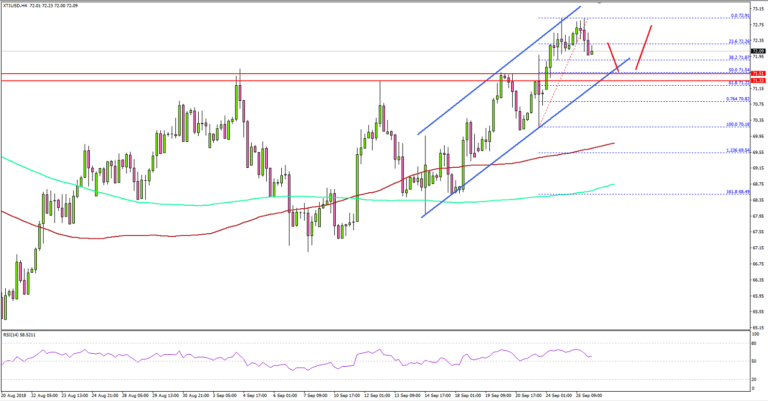
Looking at the 4-hours chart of XTI/USD, the price remained in an uptrend and settled above the $71.00 support and the 100 (red) simple moving average (4-hours). The price traded as high as $72.91 recently and it is currently correcting lower.
It broke the 23.6% Fib retracement level of the last wave from the $70.18 low to $72.91 high. The current price action suggests that there could be more gains above the $72.00 level.
On the downside, there is a major support formed near $71.40-50. There is also a key ascending channel in place with support at $71.40 on the 4-hours chart of XTI/USD.
The channel support is close to the 50% Fib retracement level of the last wave from the $70.18 low to $72.91 high. Therefore, as long as the price is above the $71.40 support, there could be more gains towards $73.00 in the short term.
If there is a break below $71.40, the price may perhaps test the next major support at $71.00.
Economic Releases to Watch Today
- German Consumer Price Index for Sep 2018 (YoY) (Preliminary) – Forecast +2%, versus +2% previous.
- German Consumer Price Index for Sep 2018 (MoM) (Preliminary) – Forecast +0.1%, versus +0.1% previous.
- US Gross Domestic Product Q2 2018 – Forecast 4.2% versus previous 4.2%.
- US Durable Goods Orders for August 2018 – Forecast +2.0% versus -1.7% previous.
NZDUSD Remains Weak And Vulnerable To The Downside
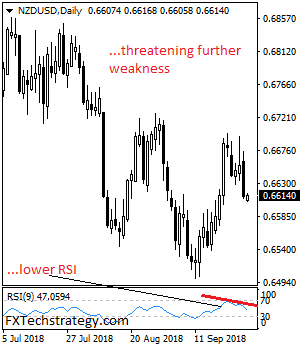
NZDUSD remains weak and vulnerable to the downside as it retains its broader bear pressure. This leaves more weakness likely in the days ahead. Support lies at the 0.6600 level. Further down, the 0.6550 level comes in as the next downside target. Its daily RSI is bearish and pointing lower suggesting further weakness. Conversely, resistance resides at the 0.6650 level where a break will aim at the 0.6700 level. A break of here will have to occur to create scope for a run at the 0.6750 level. Further out, resistance stands at the 0.6800 level. All in all, NZDUSD faces further downside pressure.