Sample Category Title
Gold Price Drops Sharply Due To A Strong Dollar
Gold price dropped to a four-week low of $1180. This happened as the US dollar strengthened following the Fed’s monetary policy statement on Wednesday. In the statement, the committee said that a strong US economy continued to support further rate increases. This led to a belief that another hike will happen in December. Three more hikes will follow in 2019. A strong dollar often leads to a drop in gold mainly because gold is mostly listed in dollars and that most traders view it as a safe haven.
Japanese Yen fell to a YTD low of 113.61 despite the positive reviews from the meeting between Donald Trump and Shinzo Abe. The meeting resolved to restart the free trade agreement between the two countries. The drop in price was partly because of the disappointing industrial production data for the month of August. The data showed that industrial production rose to 0.7%, which was lower than the expected 1.5%. It was however better than July’s contraction of 0.2%. This was offset by the positive retail sales numbers that rose by 2.7%, which was lower than the expected 2.2%. It was also offset by the inflation numbers for Tokyo. The Tokyo CPI rose by 1.3% which was higher than the 1.1% traders were expecting. The unemployment rate fell to 2.4%, which was lower than the expected 2.5%.
The sterling traded lower against the USD in the Asian session. It reached an intraday low of 1.3075. This decline was mostly attributed to the hawkish statement from the Fed. Today, traders will look to the important Q2 economic numbers from the Office of National Statistics (ONS). The numbers are expected to show that the economy expanded by 1.3%, which will be the same as that released in August. The business investment growth is expected to remain at 0.8%. Elsewhere in Europe, traders will receive important employment numbers from Germany, inflation numbers from Spain, and CPI numbers from the European Union.
EUR/USD
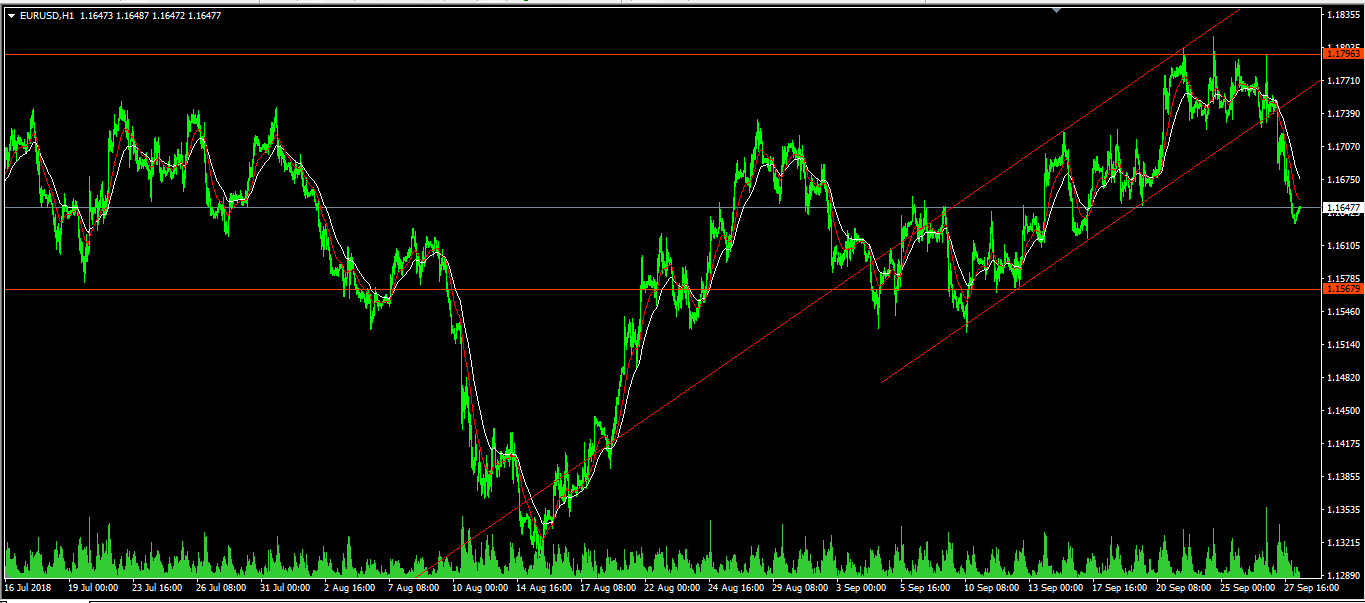
The EUR/USD continued the decline started shortly after the Fed’s interest rates decision. This decline saw it move past the important support of the diagonal channel. It also moved below the head and shoulder’s neckline of 1.1796. This happened as volume increased. This is an indication that the pair will likely continue moving lower, potentially to the next important support of 1.1570.
GBP/USD
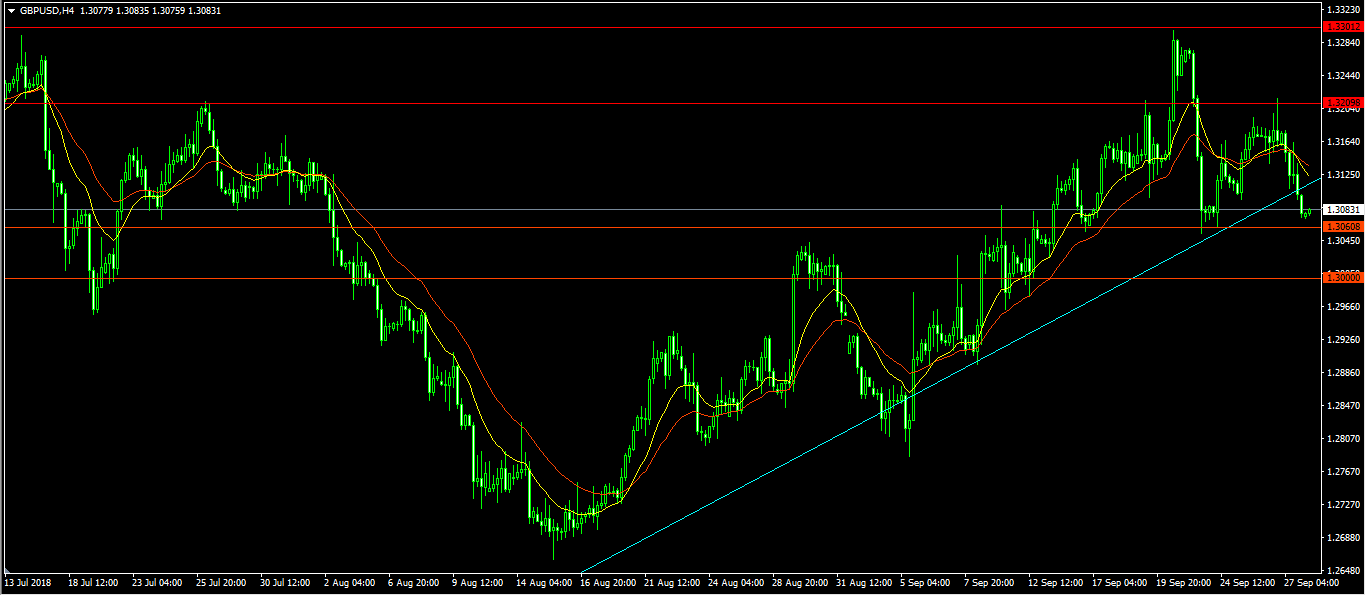
The sterling fell against the USD in the Asian session. It is now trading at 1.3080, which is close to an important support. Further declines below this support line will be an indication that the pair will likely continue to move lower. This is confirmed by the short and longer-term Exponential Moving Indicators which have just crossed each other in a bearish manner. In the near term, the pair could try to test the important support of 1.3000.
XAU/USD
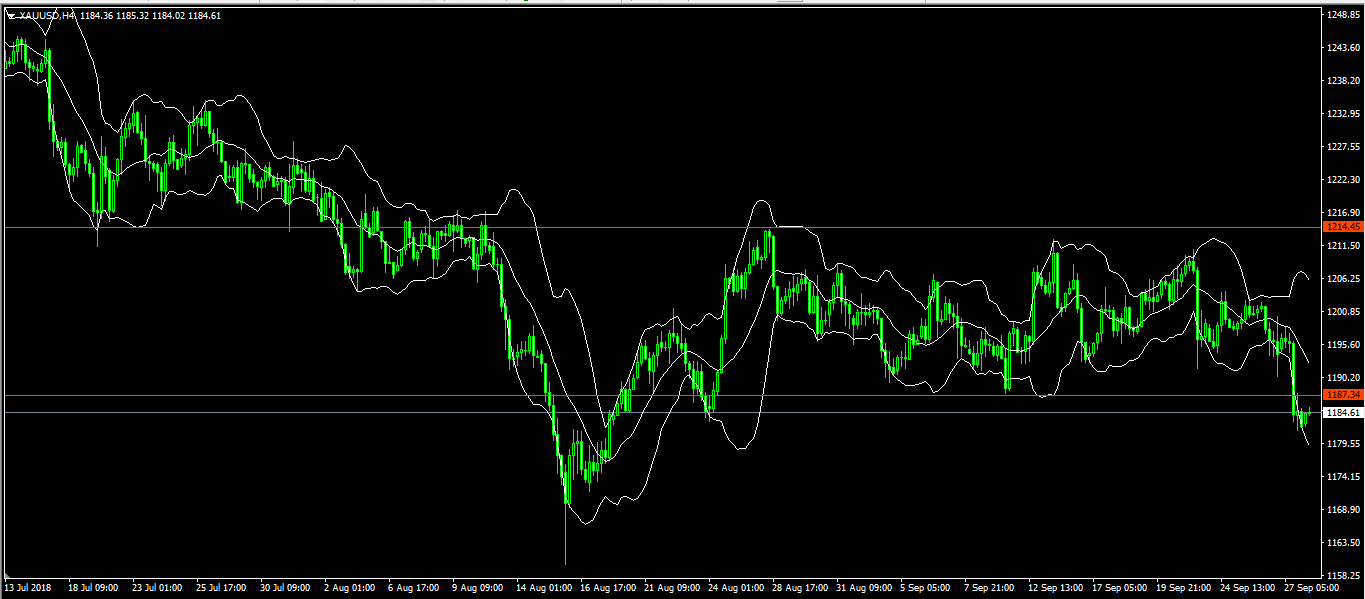
Gold reached a four-week low of 1181. This price was below the important diagonal support and resistance levels. The XAU/USD pair is trading along the lower band of the Bollinger Bands. This is a show of strength for the downward trend, which is an indication that it will continue. Further declines will likely lead to the important support of 1150.
Nikkei Elliott Wave Right Side Calling Higher
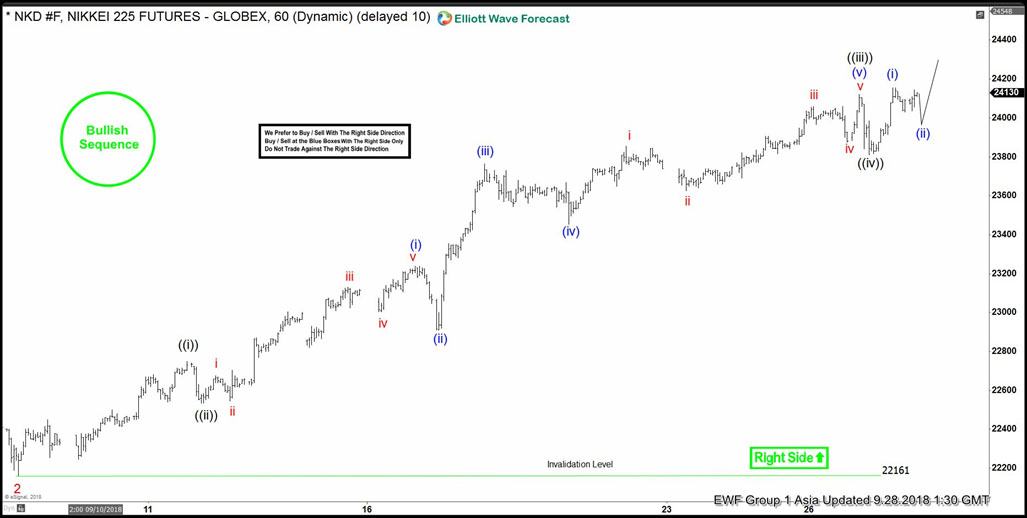
Nikkei short-term Elliott wave view suggests that the decline to 22161 on 9/06/2018 low ended Minor wave 2. Above from there, Minor wave 3 remain in progress, nesting higher in an impulse structure. With lesser degree cycles showing sub-division of 5 waves structure in each leg higher i.e Minute wave ((i)), ((iii)) & ((v)) expected to unfold in 5 waves structure. Also, it’s important to note that the right side is up & instrument is having a bullish sequence tag available in below chart. This suggests that the selling is not recommended.
Up from 22161 low, the initial rally to 22750 high ended Minute wave ((i)) in 5 waves. The decline to 22535 low ended Minute wave ((ii)) pullback. Then the rally higher from there ended Minute wave ((iii)) at 24120 high. The pullback to 23810 low ended Minute wave ((iv)). Above from there Minute wave ((v)) of 3 remain in progress, looking to extend higher towards 24401-24766 100%-161.8% Fibonacci extension area of a Minute wave ((v))=((i)) target area approximately to complete Minor wave 3. Afterwards, the index is expected to do a wave 4 pullback in 3, 7 or 11 swings before further upside is seen provided the pivot at 22161 low stays intact. We don’t like selling it & expect buyers to appear in 3, 7 or 11 swings against 22161 low.
Nikkei 1 Hour Elliott Wave Chart
Euro-Zone’s Economic Sentiment Index Dropped To A 15-Month Low Level In September
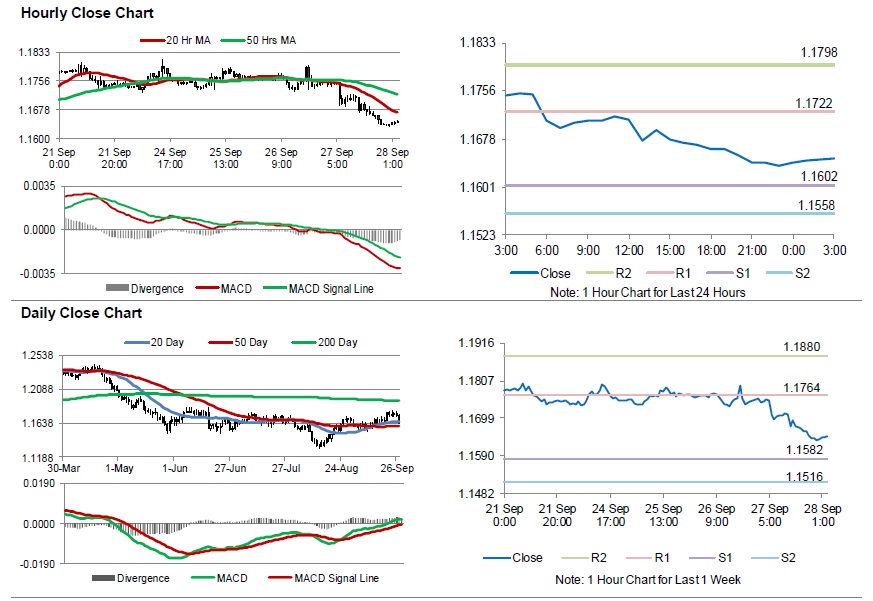
For the 24 hours to 23:00 GMT, the EUR declined 0.98% against the USD and closed at 1.1635, amid renewed worries surrounding Italy's budget proposal, following reports of delayed Italian budget meet.
Data revealed that the Euro-zone's final consumer confidence index declined to a level of -2.9 in September, at par with market expectations and confirming the preliminary print. In the prior month, the index had recorded a level of -1.9. Moreover, the region's industrial confidence index dropped to a level of 4.7 in September, more than market consensus for a drop to a level of 5.1. In the previous month, the index had recorded a revised level of 5.6. Also, the economic sentiment indicator eased to a 15-month low level of 110.9 in September, amid trade protectionism and political turmoil and following a level of 111.6 in the preceding month. Market participants had envisaged the economic sentiment indicator to fall to a level of 111.2. Meanwhile, the nation's business climate indicator remained steady at a level of 1.21 in September, compared to market anticipations for a decline to a level of 1.19.
On the data front, Germany's flash consumer price index (CPI) advanced 2.3% on a yearly basis in September, notching its highest level since 2011 and following a rise of 2.0% in the previous month. Market participants had envisaged the CPI to climb to 2.0%. Additionally, the nation's Gfk consumer confidence index unexpectedly jumped to a level of 10.6 in October, compared to a reading of 10.5 in the prior month.
In the US, data showed that US final annualised gross domestic product (GDP) advanced 4.2% on a quarterly basis in 2Q 2018, in line with market expectations and confirming the preliminary figures. In the previous quarter, the GDP had recorded a revised advance of 2.2%. Further, the nation's the flash durable goods orders rebounded 4.5% on a monthly basis in August, driven by surge in aircraft demands and more than market expectations for an advance of 2.0%. In the prior month, durable goods orders had fallen 1.7%.
On the other hand, the US advance goods trade deficit unexpectedly widened to $75.8 billion in August, higher than market anticipations for a deficit of $70.6 billion. The advance goods trade had posted a deficit of $72.2 billion in the prior month. Moreover, pending home sales dipped 2.5% on a yearly basis in August, more than market expectations for a fall of 1.0%. Pending home sales had registered a revised drop of 0.7% in the preceding month. Also, seasonally adjusted initial jobless claims climbed to a level of 214.0K in the week ended 22 September 2018, higher than market consensus for a rise to a level of 210.0K. In the prior week, initial jobless claims had registered a revised level of 202.0K.
In the Asian session, at GMT0300, the pair is trading at 1.1647, with the EUR trading 0.10% higher against the USD from yesterday's close.
The pair is expected to find support at 1.1602, and a fall through could take it to the next support level of 1.1558. The pair is expected to find its first resistance at 1.1722, and a rise through could take it to the next resistance level of 1.1798.
Moving ahead, investors would await Euro-zone's consumer price index along with Germany's unemployment rate, both for September, set to release in a few hours. Later in the day, the US personal income and personal spending, both for August followed by the Chicago purchasing managers' index and the Michigan consumer sentiment index, both for September will pique significant amount of investors' attention.
The currency pair is trading below its 20 Hr and 50 Hr moving averages.
Britain’s Gfk Consumer Confidence Index Eased In September
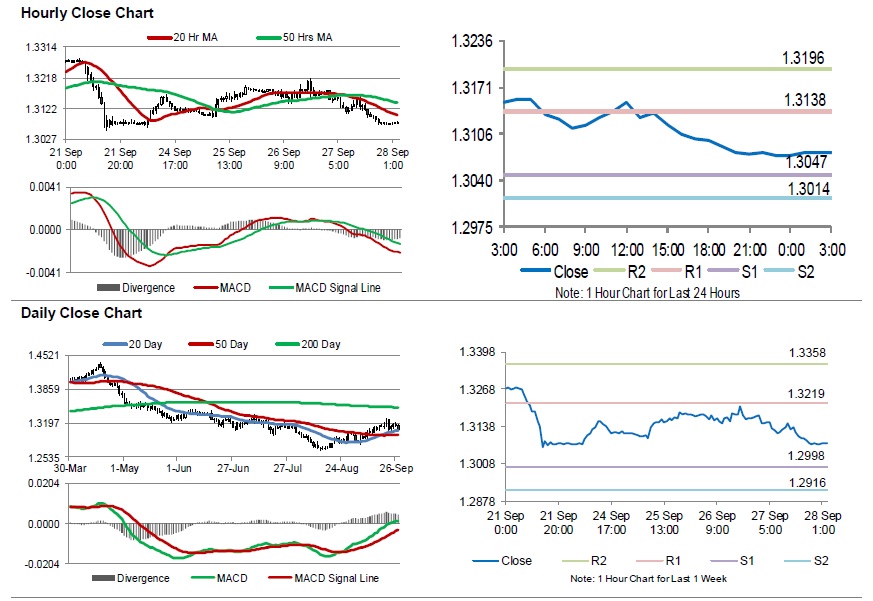
For the 24 hours to 23:00 GMT, the GBP declined 0.73% against the USD and closed at 1.3075.
In the Asian session, at GMT0300, the pair is trading at 1.3079, with the GBP trading slightly higher against the USD from yesterday's close.
Data indicated that the Gfk consumer confidence declined to a level of -9.0 in September, compared to market expectations for a fall to a level of -8.0. In the previous month, the consumer confidence had recorded a level of -7.0. On the contrary, the Lloyds business barometer jumped to a level of 29.0% in September, following a reading of 23.0% in the prior month.
The pair is expected to find support at 1.3047, and a fall through could take it to the next support level of 1.3014. The pair is expected to find its first resistance at 1.3138, and a rise through could take it to the next resistance level of 1.3196.
Trading trend in the Sterling today is expected to be determined by UK's gross domestic product for 2Q, due to be released in a few hours.
The currency pair is trading below its 20 Hr and 50 Hr moving averages.
Japan’s Unemployment Rate Surprisingly Dipped In August
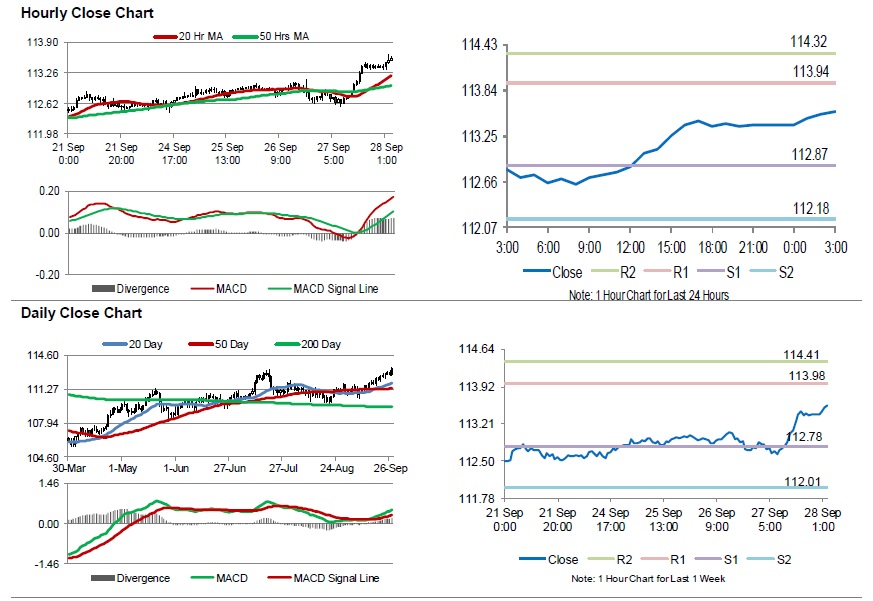
For the 24 hours to 23:00 GMT, the USD rose 0.56% against the JPY and closed at 113.40.
In the Asian session, at GMT0300, the pair is trading at 113.56, with the USD trading 0.14%
higher against the JPY from yesterday's close.
On the macro front, Japan's retail trade climbed 2.7% on an annual basis in August, compared to an advance of 1.5% in the previous month. Market participants had expected the retail trade to climb 2.0%. Moreover, the nation's flash industrial production rebounded 0.7% on a monthly basis in August, less than market anticipations for a rise of 1.4%. Industrial production had dropped 0.10% in the prior month. Additionally, unemployment rate unexpectedly slid to 2.4% in August, defying market consensus for an unchanged reading. In the preceding month, unemployment rate had recorded a reading of 2.5%.
On the contrary, Japan's large retailer's sales surprisingly fell 0.1% on a monthly basis in August, defying market expectations for an advance of 0.3%. In the previous month, large retailer's sales had recorded a drop of 1.6%.
The pair is expected to find support at 112.87, and a fall through could take it to the next support level of 112.18. The pair is expected to find its first resistance at 113.94, and a rise through could take it to the next resistance level of 114.32.
The currency pair is trading above its 20 Hr and 50 Hr moving averages.
Swiss Franc Trading A Tad Higher In The Asian Session
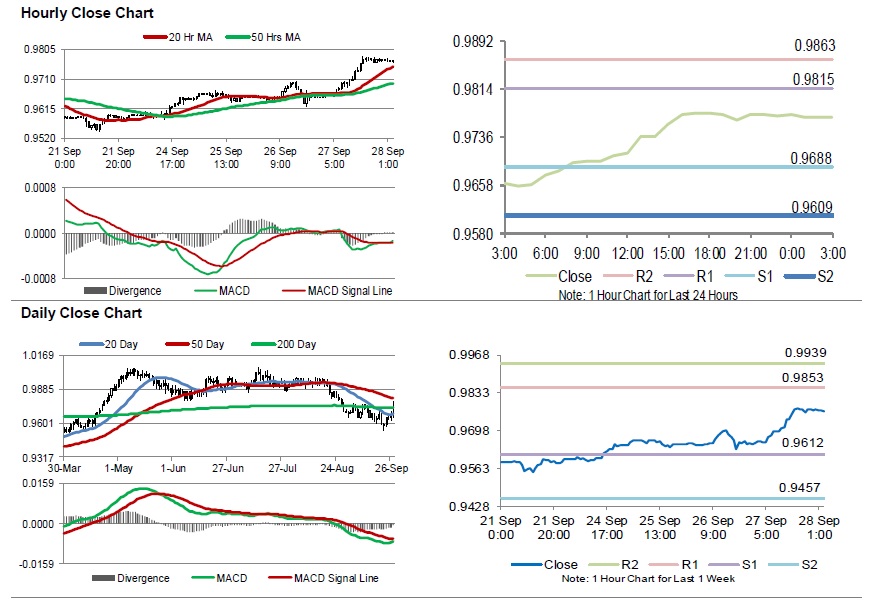
For the 24 hours to 23:00 GMT, the USD rose 1.22% against the CHF and closed at 0.9770.
In the Asian session, at GMT0300, the pair is trading at 0.9768, with the USD trading marginally lower against the CHF from yesterday’s close.
The pair is expected to find support at 0.9688, and a fall through could take it to the next support level of 0.9609. The pair is expected to find its first resistance at 0.9815, and a rise through could take it to the next resistance level of 0.9863.
Looking ahead, investors would focus on Switzerland’s KOF leading indicator for September, due to be released in a while.
The currency pair is trading above its 20 Hr and 50 Hr moving averages.
Loonie Extends Its Gains In The Asian Session
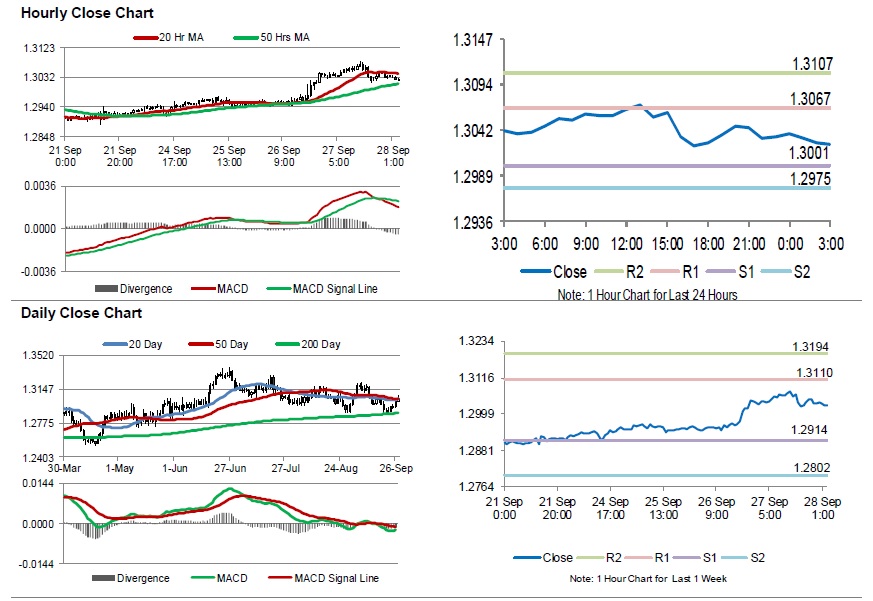
For the 24 hours to 23:00 GMT, the USD declined 0.05% against the CAD and closed at 1.3034.
In economic news, Canada’s CFIB business barometer slid to a level of 61.4 in September, compared to a reading of 61.6 in the preceding month.
In the Asian session, at GMT0300, the pair is trading at 1.3026, with the USD trading 0.06% lower against the CAD from yesterday’s close.
The pair is expected to find support at 1.3001, and a fall through could take it to the next support level of 1.2975. The pair is expected to find its first resistance at 1.3067, and a rise through could take it to the next resistance level of 1.3107.
Going forward, investors would closely monitor Canada’s gross domestic product for July, scheduled to release later in the day.
The currency pair is trading between its 20 Hr and 50 Hr moving averages.
Aussie Reverses Its Losses In The Morning Session
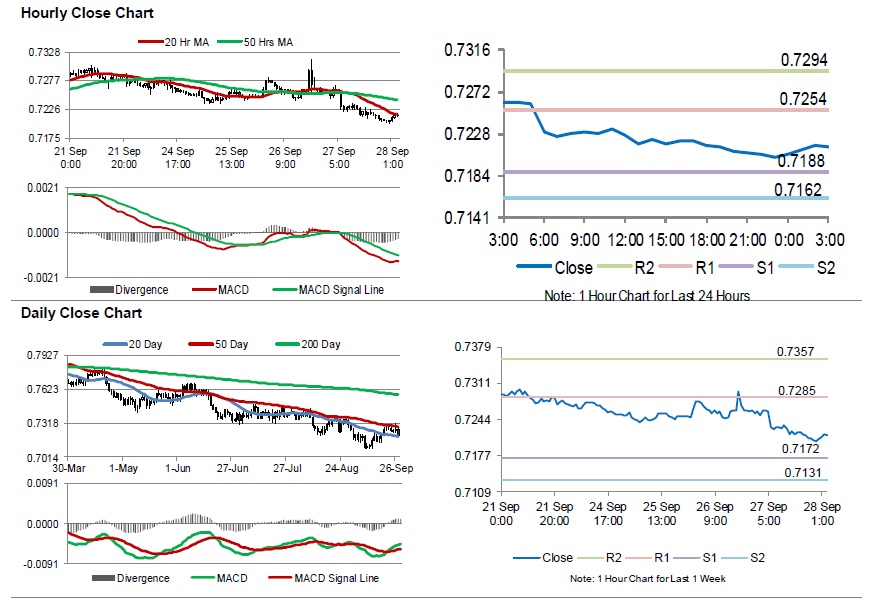
For the 24 hours to 23:00 GMT, Gold declined 1.01% against the USD and closed at USD1187.20 per ounce, amid broad strength in the greenback.
In the Asian session, at GMT0300, the pair is trading at 1188.5, with gold trading 0.11% higher against the USD from yesterday’s close.
The pair is expected to find support at 1181.87, and a fall through could take it to the next support level of 1175.23. The pair is expected to find its first resistance at 1198.87, and a rise through could take it to the next resistance level of 1209.23.
The yellow metal is trading below its 20 Hr and 50 Hr moving averages.
Gold: Yellow Metal Trading On A Stronger Footing This Morning
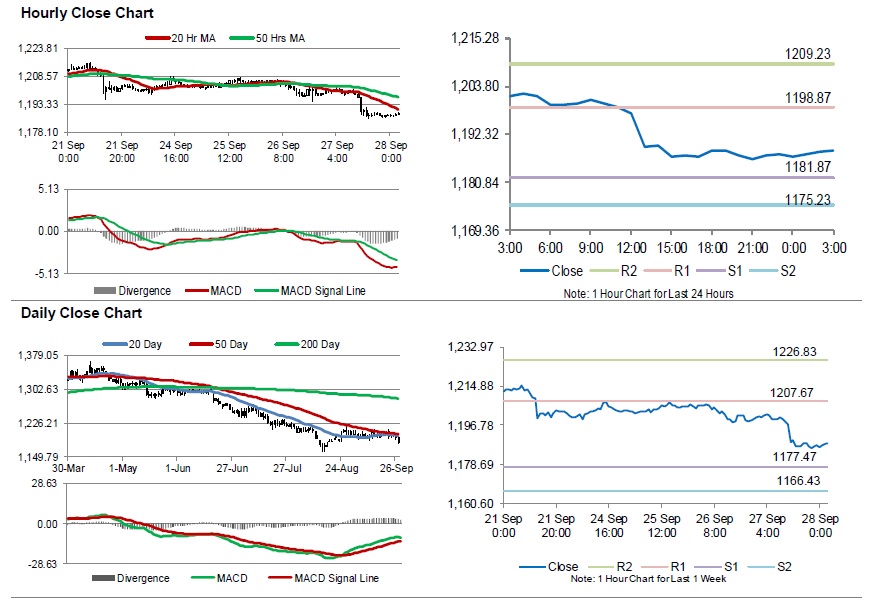
For the 24 hours to 23:00 GMT, Gold declined 1.01% against the USD and closed at USD1187.20 per ounce, amid broad strength in the greenback.
In the Asian session, at GMT0300, the pair is trading at 1188.5, with gold trading 0.11% higher against the USD from yesterday’s close.
The pair is expected to find support at 1181.87, and a fall through could take it to the next support level of 1175.23. The pair is expected to find its first resistance at 1198.87, and a rise through could take it to the next resistance level of 1209.23.
The yellow metal is trading below its 20 Hr and 50 Hr moving averages.
Silver: White Metal Trading Higher In The Asian Session
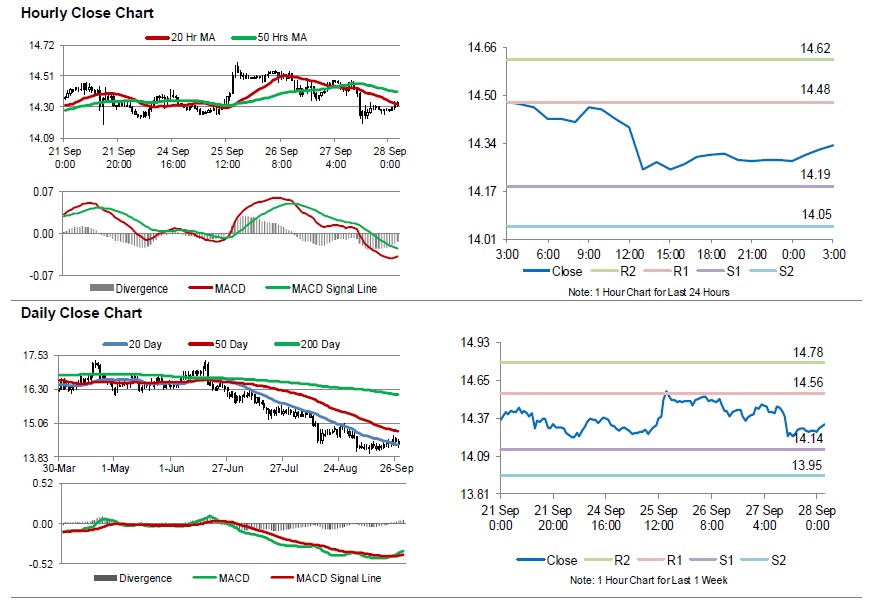
For the 24 hours to 23:00 GMT, Silver declined 0.80% against the USD and closed at USD14.28 per ounce, tracking losses in gold prices.
In the Asian session, at GMT0300, the pair is trading at 14.33, with silver trading 0.35% higher against the USD from yesterday’s close.
The pair is expected to find support at 14.19, and a fall through could take it to the next support level of 14.05. The pair is expected to find its first resistance at 14.48, and a rise through could take it to the next resistance level of 14.62.
The white metal is showing convergence with its 20 Hr moving average and trading below its 50 Hr moving average.