Sample Category Title
EUR/USD Mid-Day Outlook
Daily Pivots: (S1) 1.1712; (P) 1.1755; (R1) 1.1785; More.....
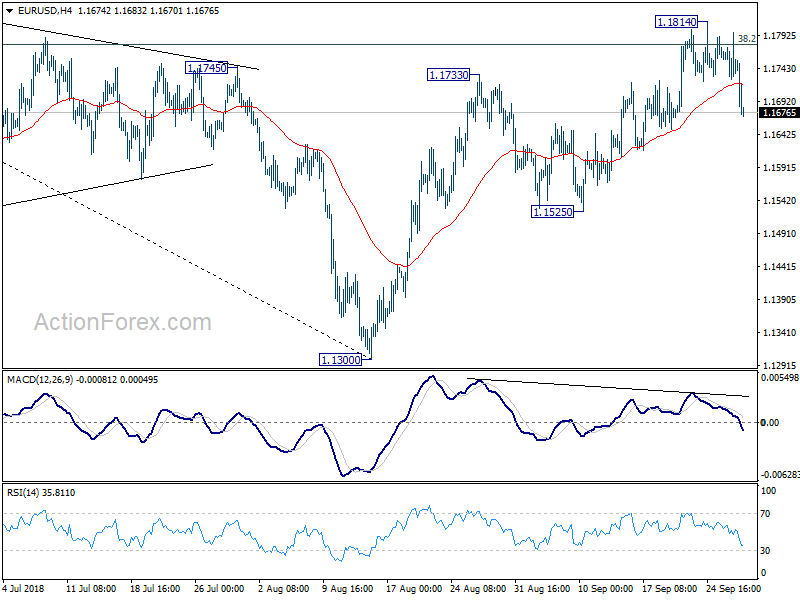
As noted before, the corrective rise from 1.1300 should have completed at 1.1814, after meeting strong resistance from 38.2% retracement of 1.2555 to 1.1300 at 1.1779. Intraday bias remains on the downside for 1.1525 support first. Break will confirm this bearish case and target a test on 1.1300 low. On the upside, again, sustained break of 1.1779 will dampen our view and extend the rise from 1.1300.
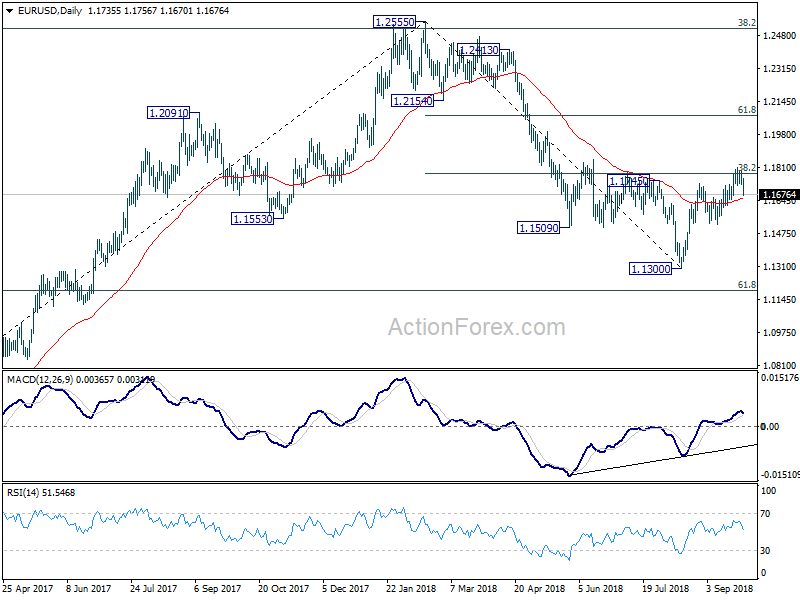
In the bigger picture, a medium term bottom should be in place at 1.1300, on bullish convergence condition in daily MACD and some consolidations would be seen. But still, note that EUR/USD was rejected by 38.2% retracement of 1.6039 (2008 high) to 1.0339 (2017 low) at 1.2516. That carries some long term bearish implications. Thus, we'd expect fall from 1.2555 high to resume after consolidation completes. Below 1.1300 should send EUR/USD through 61.8% retracement of 1.0339 to 1.2555 at 1.1186. And, in that case, EUR/USD would head to retest 1.0339 (2017 low).
USD/JPY Mid-Day Outlook
Daily Pivots: (S1) 112.54; (P) 112.83; (R1) 113.04; More...
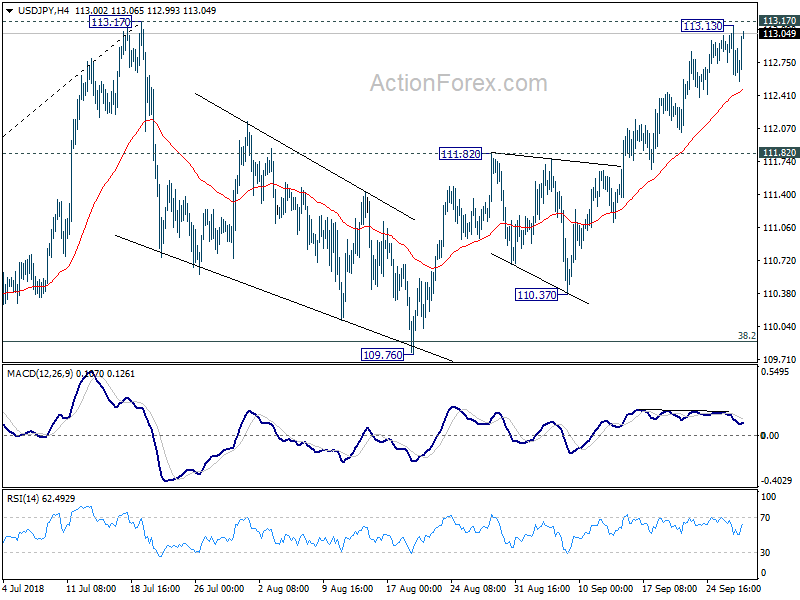
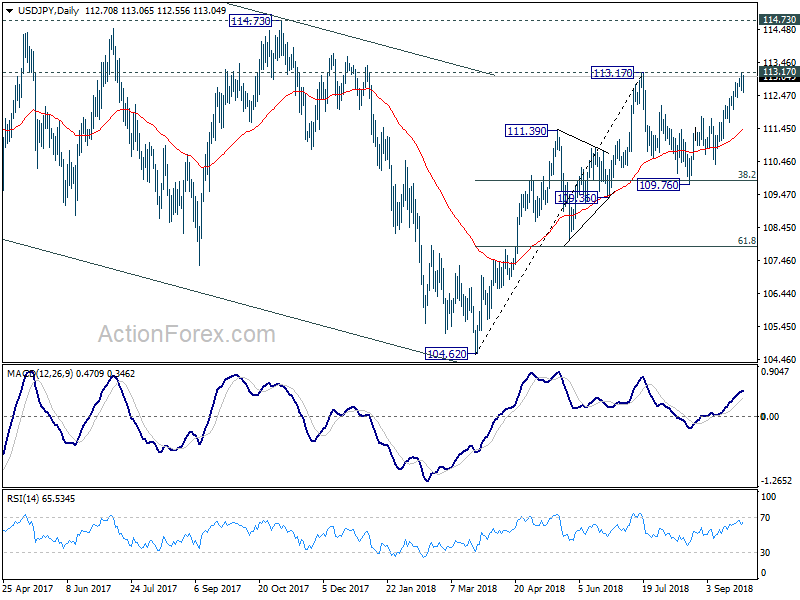
Intraday bias in USD/JPY remains neutral for the moment. Consolidation from 113.13 temporary could extend and another fall cannot be ruled out. But as long as 111.82 resistance turned support holds, further rise is expected. Decisive break of 113.17 will resume whole rally from 104.62 and target 114.73 resistance next. Nonetheless, break of 111.82 will extend the consolidation pattern from 113.17 with another decline.
In the bigger picture, corrective fall from 118.65 (2016 high) should have completed with three waves down to 104.62. Decisive break of 114.73 resistance will likely resume whole rally from 98.97 (2016 low) to 100% projection of 98.97 to 118.65 from 104.62 at 124.30, which is reasonably close to 125.85 (2015 high). This will stay as the preferred case as long as 109.36 support holds. However, decisive break of 109.36 will mix up the outlook again. And deeper fall should be seen back to 61.8% retracement of 104.62 to 113.17 at 107.88 and below.
GBP/USD Mid-Day Outlook
Daily Pivots: (S1) 1.3131; (P) 1.3174; (R1) 1.3211; More...
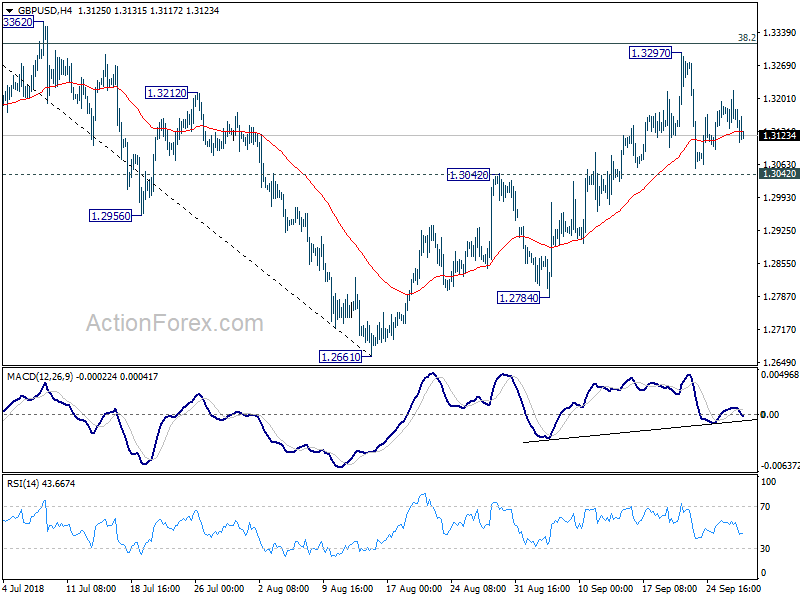
GBP/USD weakens mildly today but stays well above 1.3042 resistance turned support. Intraday bias remains neutral at this point. But outlook is unchanged that corrective rise from 1.2661 could have completed at 1.3297, ahead of 1.3316 key fibonacci level. Hence, risk will stay on the downside as long as 1.3297 resistance holds. On the downside, break of 1.3042 resistance turned support will bring deeper fall to 1.2784. Break there will argue that larger down trend from 1.4376 is resuming for a new low below 1.2661.
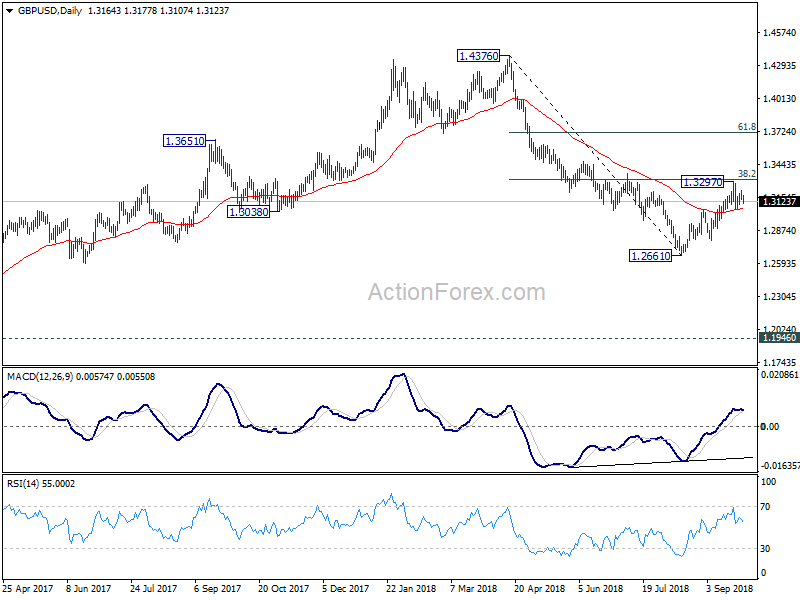
In the bigger picture, whole medium term rebound from 1.1946 (2016 low) should have completed at 1.4376 already, after rejection from 55 month EMA (now at 1.4062). The structure and momentum of the fall from 1.4376 argues that it's resuming long term down trend. And this will be the preferred case as long as 38.2% retracement of 1.4376 to 1.2661 at 1.3316 holds. However, firm break of 1.3316 would bring stronger rebound to 61.8% retracement at 1.3721. And, the eventual depth of the fall from 1.4376, and the chance of hitting 1.1946 low, will depend on the strength of the interim corrective rebound from 1.2661.
USD/CHF Mid-Day Outlook
Daily Pivots: (S1) 0.9620; (P) 0.9661; (R1) 0.9699; More...
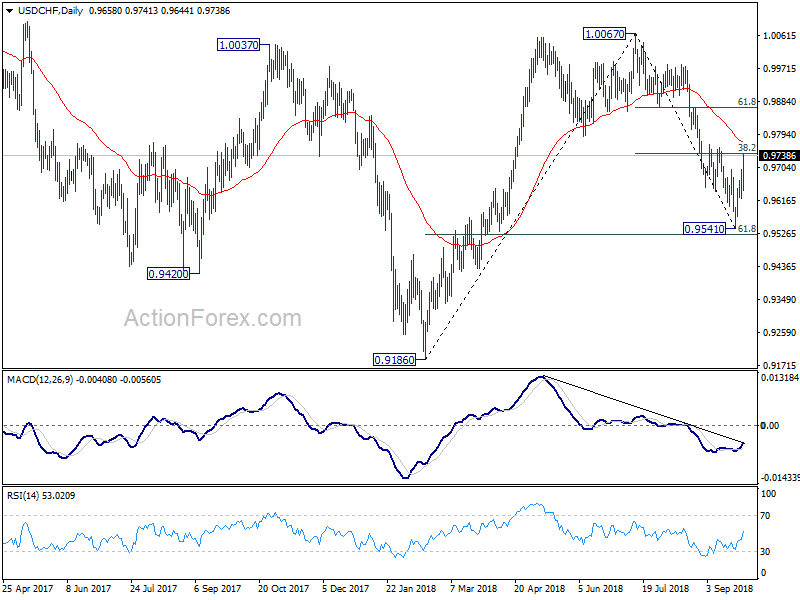
USD/CHF's rally from 0.9541 resumed after very brief retreat and hits as high as 0.9741 so far. Intraday bias is back on the upside for 0.9757 resistance first. Break will target 0.9866 key resistance level, 61.8% retracement of 1.0067 to 0.9541 at 0.9866. On the downside, break of 0.9622 minor support is needed to indicate completion of the rebound. Otherwise, near term outlook will stay cautiously bullish even in case of retreat.
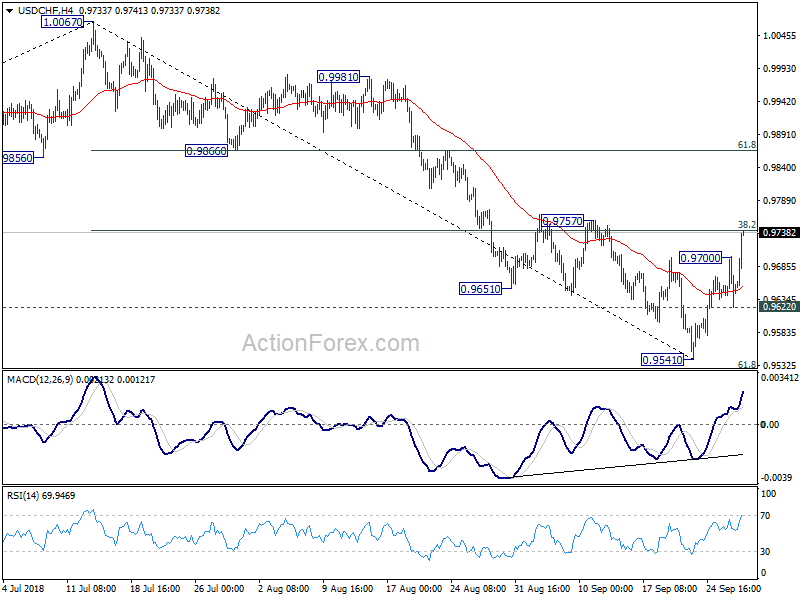
In the bigger picture, rise from 0.9186 low has completed at 1.0067, after failing to sustain above 1.0037 resistance. Fall from 1.0067 could extend to 61.8% retracement of 0.9816 to 1.0067 at 0.9523 and possibly below. But for now, we don't expect a break of 0.9186 low. On the upside, firm break of 0.9866 support turned resistance will suggest that fall from 1.0067 has completed and rise from 0.9186 is resuming.
Dollar Extends Post FOMC Broad Based Rally, Euro Lower on Italy Budget Jitter
Dollar strengthens further and broadly, in early US session as post FOMC rally extends. As we aruged in prior report, there were hawkish elements in Fed's projections and overall announcement should be Dollar positive. Today's rally showed that this view is shared by other participants. In particular, EUR/USD's break of 1.1723 minor support carries bearish implication and could now target 1.1525 support. USD/CHF also resumed recent rebound from 0.9541 by taking out 0.9700 after brief retreat. AUD/USD has taken out 0.7228 support already and should be heading to 0.7143 support. USD/CAD also surges through 1.3063 resistance, further affirm the case of bullish reversal.
Yen is following as the second strongest. For now, EUR/JPY and GBP/JPY are seen as in consolidation only, rather than bearish near term reversal. Swiss Franc is extending this week's deep decline and is trading as the weakest one. Euro follows as the second weakest, taking over Australian Dollar's place, on Italy budget jitters. Aussie is now the third weakest one for today.
In other markets, European stocks reversed earlier decline and are trading higher for now. FTSE is up 0.44%, DAX up 0.29%, CAC up 0.19%. Earlier in Asia, major indices all closed in red. Nikkei was down -0.99%, Hong Hong HSI down -0.36%, China Shanghai SSE down -0.36%, Singapore Strait Times also down -0.09%. Gold picks up downside momentum in early US session. Break of 1187.58 now could pave the way back to retest 1160.36 low.
US jobless claims rose 12k to 214k, headline durables jumped 4.5% but ex-transport missed
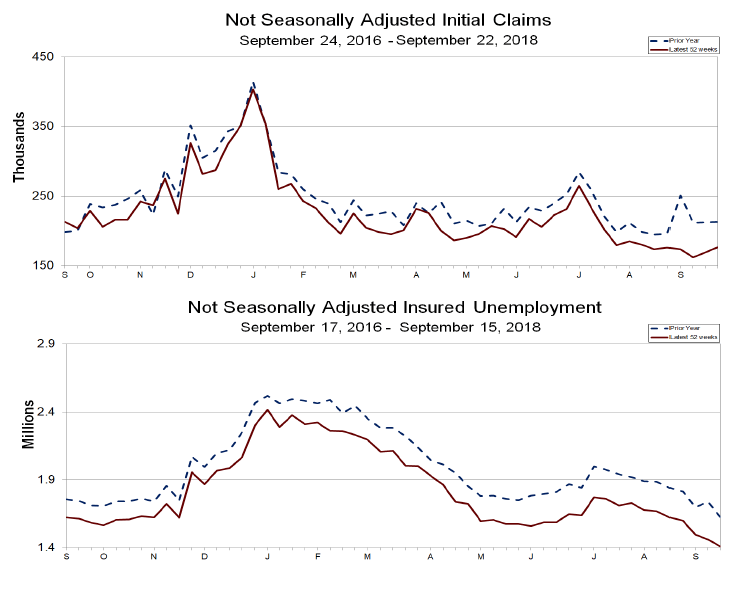
A batch of mixed data is released from the US today. Initial jobless rose 12k to 214k in the week ended September 22, above expectation of 208k but stayed low. Four-week moving average of initial claims rose 250 to 206.25k. Continuing claims rose 16k to 1.611m in the week ended September 15. Four-week moving average of continuing claims dropped -12.25k to 1.6915m, lowest since November 10, 1973.
Headline durable goods order jumped sharply by 4.5% in August, above expectation of 1.5%. But ex-transport orders rose only 0.1%, missed expectation of 0.3%. Wholesale inventories rose 0.8% mom in August, above expectation of 0.3% mom. Trade deficit widened to USD -75.8B in August.
Q2 GDP was finalized at 4.2% annualized, unrevised. GDP price index was revised up to 3.3%, from 3.0%. .
Euro pressured as Italy budget back in spotlight
Italy is occupying a lot of headlines today on the topic of 2019 budget. There are a lot of numbers flying around, without confirmation on how true are day. But one thing for sure is that the coalition partners of the League and Five-Star movements are pushing a higher budget deficit in terms of GDP for 2019, possibly at 2.4%. That's for funding for fulfilling their election promises.
On the other hand, Economy Minister Giovanni Tria, who belongs to neither party of the coalition, insists on capping 2019 budget deficit, possibly at 2.0% of GDP. It's believed the the Treasury already forecasts that deficit above 1.9% of GDP would risk debt containment.
The cabinet will have a meeting on the budget issue today. Out of that, we'd likely know whether EU would like the final compromised deficit number. Or, whether Tria will stay, quit voluntarily or be forced out.
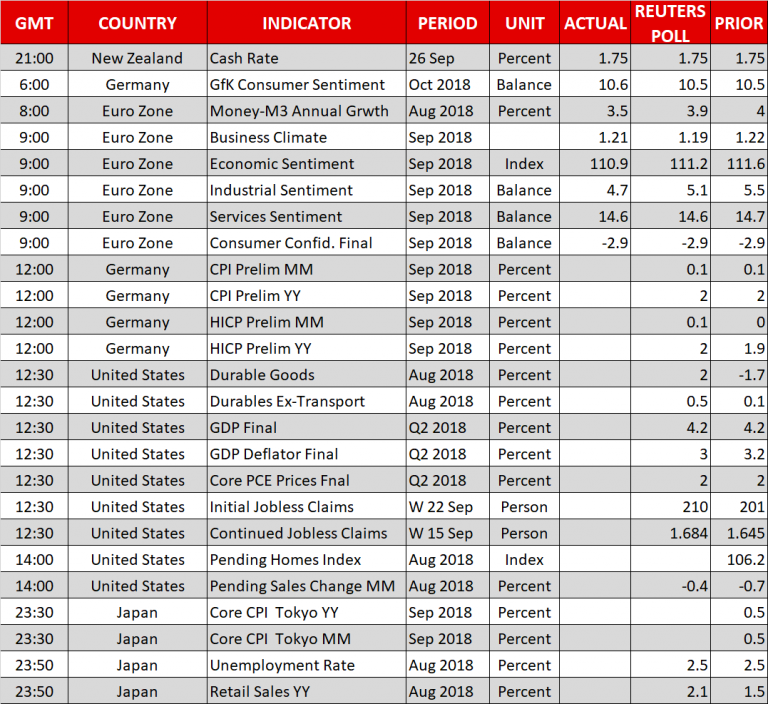
Released from Eurozone, business climate was unchanged at 1.21 in September below expectation of 1.39. Industrial confidence dropped to 4.7, below expectation of 5.2. Services confidence rose to 14.6 but missed expectation of 15.3. economic confidence dropped to 110.9 and missed expectation of 111.5. Consumer confidence was finalized at -2.9. M3 rose 3.5% yoy in August. From Germany, CPI accelerated to 2.3% yoy in September, above expectation of 2.0%. Gfk consumer confidence rose 0.1 to 10.6 in October.
EU Barnier: Continues to work for an orderly Brexit
EU's chief Brexit negotiator Michel Barnier said today "the EU continues to work for an orderly Brexit and an ambitious future partnership with the UK that should include a close economic relationship."
Separately, UK opposition Labour party leader Jeremy Corbyn visits Brussels today and warned that "crashing out of Europe with no deal risks being a national disaster." Corbyn also urged EU to "do all they can to avoid a "no-deal" outcome, which would be so damaging to jobs and living standards in both the UK and EU countries."
European Commission spokesman Margaritis Schina said today that "keep calm and keep negotiating," but he also noted "we are ready for all scenarios."
NZD/USD range bound after non-eventful RBNZ rate decision
NZD/USD trades steadily in range after RBNZ kept OCR unchanged at 1.75% as widely expected and delivered no surprise to the markets. Governor Adrian Orr reiterated in the statement that "we expect to keep the OCR at this level through 2019 and into 2020." He also kept the options open and indicated the next move could be "up or down". Economic projections are "little changed" from the August MPS. Even though Q2 GDP was stronger than anticipated, Orr noted "downside risks to the growth outlook remain". He concluded the statement by repeating "we will keep the OCR at an expansionary level for a considerable period to contribute to maximising sustainable employment, and maintaining low and stable inflation."
BoJ Kuroda: Allowing JGB yield to move strengthens effect of monetary easing
BoJ Governor Haruhiko Kuroda said today the measures taken in July, allowing 10 year JGB yield to move between -0.1% and 0.1%, "would strengthen the effect of monetary easing as a whole". It's because, it "would allow us to continue powerful monetary easing." And he's optimistic that "the steps will help accelerate inflation to 2 percent at the earliest date possible, while ensuring financial market stability."
Meanwhile, Kuroda also warned that "we need to be vigilant of the potential impact of recent protectionist moves, though the economy is likely to sustain a moderate expansion".
WTO lowered 2018 trade growth projections significantly
The World Trade Organization warned today that "escalating trade tensions and tighter credit market conditions in important markets will slow trade growth for the rest of this year and in 2019". WTO now projects growth in global merchandise trade volume of 3.9% in 2018 and 3.7% in 2019. The 2018 figure is notably lower than April's projection of 4.4%. Though, it still falls within April's range of 3.1-5.5%. The new range is lowered to 3.4-4.4%.
It noted that some of the downside risks identified in April have materialized. These include "most notably a rise in actual and proposed trade measures targeting a variety of exports from large economies". While the direct economic effects are "modest" but the uncertainty they generate may already be having an impact through reduced investment spending. In addition, it noted "monetary policy tightening in developed economies has also contributed to volatility in exchange rates and may continue to do so in the coming months."
WTO Director General Roberto Azevêdo also warned "while trade growth remains strong, this downgrade reflects the heightened tensions that we are seeing between major trading partners".
USD/CHF Mid-Day Outlook
Daily Pivots: (S1) 0.9620; (P) 0.9661; (R1) 0.9699; More...
USD/CHF's rally from 0.9541 resumed after very brief retreat and hits as high as 0.9741 so far. Intraday bias is back on the upside for 0.9757 resistance first. Break will target 0.9866 key resistance level, 61.8% retracement of 1.0067 to 0.9541 at 0.9866. On the downside, break of 0.9622 minor support is needed to indicate completion of the rebound. Otherwise, near term outlook will stay cautiously bullish even in case of retreat.
In the bigger picture, rise from 0.9186 low has completed at 1.0067, after failing to sustain above 1.0037 resistance. Fall from 1.0067 could extend to 61.8% retracement of 0.9816 to 1.0067 at 0.9523 and possibly below. But for now, we don't expect a break of 0.9186 low. On the upside, firm break of 0.9866 support turned resistance will suggest that fall from 1.0067 has completed and rise from 0.9186 is resuming.
Economic Indicators Update
| GMT | Ccy | Events | Actual | Forecast | Previous | Revised |
|---|---|---|---|---|---|---|
| 21:00 | NZD | RBNZ Official Cash Rate | 1.75% | 1.75% | 1.75% | |
| 06:00 | EUR | German GfK Consumer Confidence Oct | 10.6 | 10.6 | 10.5 | |
| 08:00 | EUR | Eurozone M3 Money Supply Y/Y Aug | 3.50% | 3.80% | 4.00% | |
| 08:00 | EUR | ECB Economic Bulletin | ||||
| 09:00 | EUR | Eurozone Business Climate Indicator Sep | 1.21 | 1.39 | 1.22 | 1.21 |
| 09:00 | EUR | Eurozone Economic Confidence Sep | 110.9 | 111.5 | 111.6 | |
| 09:00 | EUR | Eurozone Industrial Confidence Sep | 4.7 | 5.2 | 5.5 | 5.6 |
| 09:00 | EUR | Eurozone Services Confidence Sep | 14.6 | 15.3 | 14.7 | 14.4 |
| 09:00 | EUR | Eurozone Consumer Confidence Sep F | -2.9 | -2.5 | -2.9 | -1.9 |
| 12:00 | EUR | German CPI M/M Sep P | 0.40% | 0.20% | 0.10% | |
| 12:00 | EUR | German CPI Y/Y Sep P | 2.30% | 2.00% | 2.00% | |
| 12:30 | USD | Advance Goods Trade Balance (USD) Aug | -75.83B | -70.6B | -72.0B | |
| 12:30 | USD | Wholesale Inventories M/M Aug P | 0.80% | 0.30% | 0.60% | |
| 12:30 | USD | GDP Annualized Q2 T | 4.20% | 4.20% | 4.20% | |
| 12:30 | USD | GDP Price Index Q2 T | 3.30% | 3.00% | 3.00% | |
| 12:30 | USD | Durable Goods Orders Aug P | 4.50% | 1.50% | -1.70% | -1.20% |
| 12:30 | USD | Durables Ex Transportation Aug P | 0.10% | 0.30% | 0.10% | 0.20% |
| 12:30 | USD | Initial Jobless Claims (SEP 22) | 214K | 208K | 201K | 202K |
| 14:00 | USD | Pending Home Sales M/M Aug | -0.20% | -0.70% | ||
| 14:30 | USD | Natural Gas Storage | 64B | 86B |
US jobless claims rose 12k to 214k, headline durables jumped 4.5% but ex-transport missed
A batch of mixed data is released from the US today. Initial jobless rose 12k to 214k in the week ended September 22, above expectation of 208k but stayed low. Four-week moving average of initial claims rose 250 to 206.25k. Continuing claims rose 16k to 1.611m in the week ended September 15. Four-week moving average of continuing claims dropped -12.25k to 1.6915m, lowest since November 10, 1973.
Headline durable goods order jumped sharply by 4.5% in August, above expectation of 1.5%. But ex-transport orders rose only 0.1%, missed expectation of 0.3%. Wholesale inventories rose 0.8% mom in August, above expectation of 0.3% mom. Q2 GDP was finalized at 4.2% annualized, unrevised. Trade deficit widened to USD -75.8B in August. GDP price index was revised up to 3.3%, from 3.0%.
Canadian Dollar Dips, U.S GDP Looms
The Canadian dollar has posted gains on Thursday, continuing the upward movement which marked the Wednesday session. Currently, USD/CAD is trading at 1.3060, up 0.31% on the day. In economic news, the U.S releases Final GDP, with an estimate of 4.2%. In the U.S, there a host of key indicators. Core durable goods orders and durable goods orders are expected to improve in August, with forecasts of 0.4% and 1.9% percent, respectively. Final GDP is expected to post a strong gain of 4.2% and unemployment claims are forecast to climb to 209 thousand. There are no data releases in Canada. On Friday, Canada releases monthly GDP and inflation indicators. The U.S releases Personal Spending and UoM Consumer Sentiment.
As widely expected, the Federal Reserve pressed that rate trigger for the third time this year, raising the benchmark rate by a quarter-point, to a range of 2 percent to 2.25 percent. The Fed intends to continue gradually raising rates, with another rate hike expected in December and three hikes in 2019. What was of more interest to investors was the rate statement, in which the Fed removed the word ‘accommodative’ in the statement, which means that the Fed now considers monetary policy to be neutral. Fed Chair Jerome Powell, in a bid to keep markets calm, stated in a follow-up press conference that removing accommodative language in the statement did not reflect a change in policy. Still, the markets were upbeat after the Fed meeting and the U.S dollar has responded with gains against the Canadian dollar on Thursday.
Into US session: Dollar extends post FOMC rally, Euro just mixed despite Italy jitters
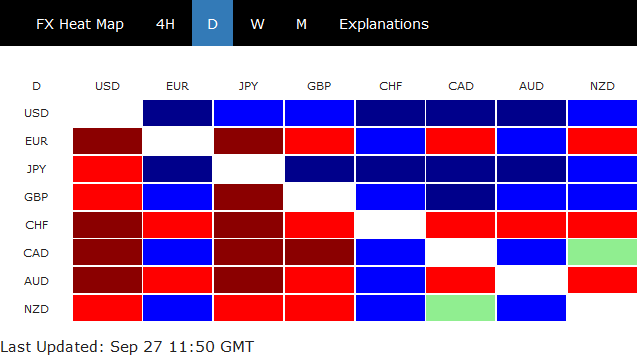
Entering into US session, Dollar is trading as the strongest one today as post FOMC rally continues. As noted in our report, there were hawkish elements in Fed's projections and overall announcement should be Dollar positive. Yen follows as the second strongest one for now, and then Sterling. Swiss Franc is suffering another day of selling and remains overwhelmingly weak for the week. Australian Dollar is the second weakest.
There are a lot of headlines flying around regarding Italy's 2019 budget, be it 2% of GDP or 2.4% or something else. Or whether Economy Minister Tria will resign or not. Euro, is just mixed, today, and it's up against Swiss Franc, Australian Dollar at the time of writing.
European stocks opened lower earlier today but quickly pared losses. FTSE is up 0.29%. DAX is down just -0.05% and CAC down -0.03% at the time of writing. German 10 year bund yield also dipped blow 0.5 handle earlier today but it's now by at 0.511, down just -0.016. Earlier in Asia, major indices all closed in red. Nikkei was down -0.99%, Hong Hong HSI down -0.36%, China Shanghai SSE down -0.36%, Singapore Strait Times also down -0.09%.
DAX Dips As Italy Delays Budget, Investors Eye German CPI
The DAX index has posted slight losses in the Thursday session. Currently, the index is at 12,359, down 0.23% on the day. Today’s key release is Germany Preliminary CPI, which is expected to post a small gain of 0.1%. Later in the day, ECB President Mario Draghi will speak at a conference in Frankfurt. On Friday, Germany releases unemployment change and the eurozone publishes CPI Flash Estimate.
In its monthly economic bulletin, the ECB said that it expected global growth to slow in the near term and warned about the effects of the escalating global trade war. The report highlighted “further tariff increases and uncertainties about future trading relations” as factors which could dampen global growth. Still, with the eurozone economy performing fairly well, the ECB is on track to halve its monthly asset purchases to EUR 15 billion, and wind up the stimulus program in December. Earlier in the week, the ECB released a study which indicated that if the U.S-China trade spat continued, the U.S would be the big loser, as a result of a decrease in trade and weaker investor and consumer confidence.
European stock markets are under pressure on Thursday, after the Italian government announced a delay of the country’s budget. Investors have long been nervous about the populist government’s financial plans, as senior officials have previously declared that Italy could breach EU budget restraint rules, which could put Italy on a collision course with Brussels. Political uncertainty in Italy remains high, as there are fears that the coalition government could collapse when the budget bill comes up for a vote.
Euro Eyes Italian Budget Meeting, German CPI & Central Bank Speeches Awaited
Here are the latest developments in global markets:
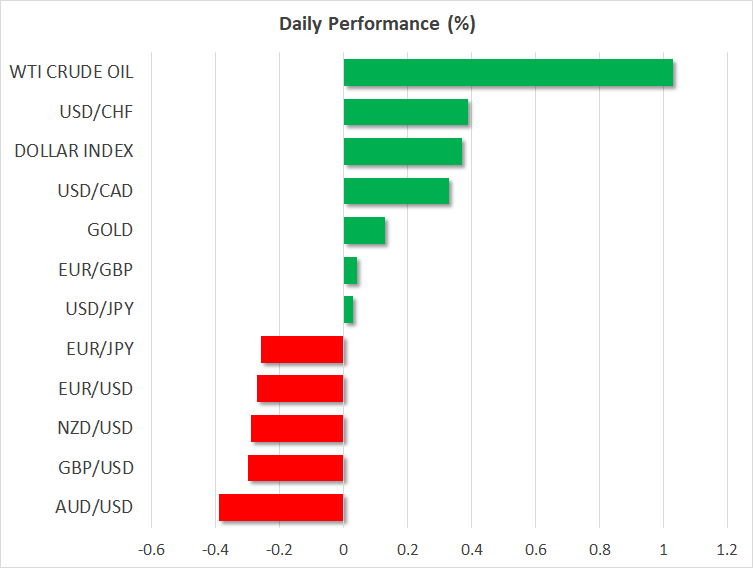
FOREX: The dollar flattened around 112.72 versus the yen early in the European session, while relative to six major currencies the greenback was in a better position, gaining 0.36% on the back of a weaker euro and pound. Euro/dollar was struggling to recoup earlier losses triggered by news that the Italian budget meeting may be postponed. Following the worrying news, however, the Prime Minister’s office confirmed that discussions will be held today (see below). As for data releases out of the Eurozone, the economic sentiment index came in worse than expected, while final readings on consumer confidence appeared in line with initial forecasts, showing that consumers’ pessimism deteriorated to 1 ½-year lows in September. The August mark, though, was revised up to -1.9. Euro/dollar was down on the day at 1.1713 (-0.22%). Pound/dollar was on the back foot as well, changing hands at 1.3128 (-0.33%) as anxiety about Brexit and the Fed’s optimism on the US economy continued to pressure buying interest in the market. In antipodean currencies, aussie/dollar and kiwi/dollar were in bearish mode, fluctuating at 0.7230 (-0.36%) and at 0.6635 (-0.30%) correspondingly. Note that the Reserve Bank of New Zealand kept interest rates steady on Wednesday as expected and maintained cautious economic outlook, reiterating that the next move in rates could be up or down. In contrast, on the same day, the Fed raised borrowing costs and signaled further monetary tightening in the coming years as anticipated. Surprisingly, though, it dropped the description that monetary policy is accommodative in the rate statement. Dollar/loonie was enjoying gains around two-week highs (+0.30%).
STOCKS: The majority of European equities were trading lower on Thursday at 1120 GMT as investors got stressed about the Italian 2019 budget, pushing the Italian FTSE MIB down by 1.20%. The pan-European STOXX 600 and the blue-chip Euro STOXX 50 declined by 0.14% and 0.08% respectively. The German DAX 30 dropped by 0.15% led by losses in utilities and industrials. The French CAC 40 retreated by 0.05% and the Spanish IBEX 35 fell by 0.54%. The British FTSE 100, however, managed to hold in the positive territory, trading higher by 0.22% after Deutsche Bank said that British shares would outperform European ones if the UK leaves the Union without an agreement on the divorce terms. In Asia, stocks closed weaker, with Japanese shares losing the most. In the US futures, tracking the S&P 500, Nasdaq 100 and Dow Jones were mixed.
COMMODITIES: Crude oil prices managed to fully recover yesterday’s downside on prospects that prices could go even higher in the wake of US sanctions against Iranian oil exports due in November. In the meantime, sources with knowledge of the matter reported that Saudi Arabia will increase output in the next few months to replace supply shortages in Iran, though it fears that next year it might have to cut output if the US pumps more oil. WTI crude and Brent rallied to $72.27/barrel (+0.98%) and $81.99/barrel respectively (+0.79%). In precious metals, gold was last seen at 1,196.68 (+0.22%).
Day Ahead: US durable goods & Q2 GDP final figures awaited; German CPI & Japan unemployment rate pending
Looking ahead to the rest of the day, the US, Germany and Japan are scheduled to report economic figures, while there are plenty of public appearances for traders to have in mind.
German preliminary inflation figures for the month of September will be available for review at 1200 GMT. Expectations are for the nation’s EU-harmonized inflation rate to rise by 2.0% in yearly terms, the same pace as before, while on a monthly basis the figure is forecast to remain steady as well at 0.1%.
Out of the US, weekly jobless claims – initial and continued – due at 1230 GMT will be gathering attention. The number of initial benefits claimants for the week ending September 22 is anticipated to be 210k, little changed from the preceding week’s 201k. The world’s largest economy will also see the release of August durable goods. Headline orders are expected to rise by 1.9% m/m from -1.7% m/m in the preceding month, whilst the core durable orders (excluding transportations equipment) is forecast to inch up by 0.5% m/m from 0.1% m/m before. In addition, the final GDP growth estimate due at 1230 GMT is predicted to remain unchanged at 4.2% q/q in the second quarter. Also, the core PCE prices will come into view at the same time, while at 1400 GMT the focus will shift to pending home sales. The US dollar is still trading higher versus major currencies and stronger-than-expected data prints could help the greenback to extend gains later in the day.
Overnight at 2350 GMT, Japan’s unemployment rate for August will get published. The unemployment rate is predicted to remain the same at 2.5%, while the preliminary figures on industrial production are anticipated to rebound by 1.5% m/m from a decline of 0.2% previously. Retail sales for the month are forecast to tick higher by 2.1% y/y from 1.5% the prior month. The BoJ’s summary of opinions from its latest policy gathering is due to be released as well. A bit earlier, the Tokyo CPIs for September will also come out.
Meanwhile in the Eurozone, the focus will stay on Italy where the 2019 budget meeting is scheduled at 1800 GMT according to the Prime Minister’s office, while pre-meeting talks are also said to take place at 1400 GMT. News of delays in the budget meeting and echoes of resignation for the Italian Finance Minister announced earlier hint that discussions could be surrounded by conflicts.
Numerous speeches are on the agenda today with the BoE policymaker Haldane speaking at 1145 GMT, ECB President Mario Draghi at 1330 GMT and Bank of England Governor Mark Carney at 1400 GMT. ECB chief economist Praet will be making remarks too at 1700 GMT. In the US, Dallas Fed President Robert Kaplan will be talking at 1800 GMT, while later at 2030 GMT remarks on the US economy by the Fed Chair Jerome Powell will attract greater attention. At 2145 GMT, comments by the BoC Governor Steven Poloz could be of interest too.
Today, a two-day meeting is starting between the Turkish President Tayyip Erdogan, German Chancellor Angela Merkel and President Frank-Walter Steinmeier in Germany with scope to improve relations between the two countries.