Sample Category Title
Gold Slides on Fed Rate Hike, Strong GDP
Gold has posted sharp losses in the Thursday session, continuing the downward trend seen on Wednesday. In North American trade, the spot price for one ounce of gold is $1184.02, down 0.88% on the day. On the release front, Final GDP in Q2 matched the estimate, with a gain of 4.2%. Core durable goods orders jumped 4.5%, crushing the estimate of 1.9%. However, durable goods orders came in at 0.1%, missing the forecast of 0.4%. On Friday, the U.S will publish Personal Spending and UoM Consumer Sentiment.
There were no surprises from the Federal Reserve, which hiked rates for the third time this year, raising the benchmark rate by a quarter-point, to a range of 2 percent to 2.25 percent. The Fed intends to continue gradually raising rates, with another rate hike expected in December and three hikes in 2019. What was of more interest to investors was the rate statement, in which the Fed removed the word ‘accommodative’ in the statement, which means that the Fed now considers monetary policy to be neutral. Fed Chair Jerome Powell, in a bid to keep markets calm, stated in a follow-up press conference that removing accommodative language in the statement did not reflect a change in policy. Still, the markets were upbeat after the Fed meeting and the U.S dollar has responded with broad gains on Thursday.
Although the markets had priced in a rate hike from the Fed, the move nonetheless boosted the U.S dollar and sent gold prices sharply lower. The Fed indicated that it plans another hike in December and three more in 2019, which is bullish news for the U.S dollar. Gold has responded with sharp losses and earlier on Thursday dropped to $1181, its lowest level since mid-August. A strong Final GDP report for Q2 has also boosted risk appetite and dampened sentiment for gold. If key consumer data on Friday is strong, the dollar rally could continue.
Dollar Punches above 113 Yen, Japanese Inflation Report Next
USD/JPY has posted gains in the Thursday session, erasing the losses from Wednesday. In North American trade, the pair is trading at 113.39, up 0.58% on the day. In the U.S, Final GDP in Q2 matched the estimate, with a gain of 4.2%. Core durable goods orders jumped 4.5%, crushing the estimate of 1.9%. However, durable goods orders came in at 0.1%, missing the forecast of 0.4%. Unemployment claims climbed to 214 thousand, above the estimate of 208 thousand. Japan will release key consumer numbers. Tokyo Core CPI is expected to post a second straight gain of 0.9%, while retail sales is forecast at 2.2%. As well, the BoJ publishes its summary of opinions. On Friday, the U.S will publish Personal Spending and UoM Consumer Sentiment.
There were no surprises from the Federal Reserve, which hiked rates for the third time this year, raising the benchmark rate by a quarter-point, to a range of 2 percent to 2.25 percent. The Fed intends to continue gradually raising rates, with another rate hike expected in December and three hikes in 2019. What was of more interest to investors was the rate statement, in which the Fed removed the word ‘accommodative’ in the statement, which means that the Fed now considers monetary policy to be neutral. Fed Chair Jerome Powell, in a bid to keep markets calm, stated in a follow-up press conference that removing accommodative language in the statement did not reflect a change in policy. Still, the markets were upbeat after the Fed meeting and the U.S dollar has responded with gains against the Japanese yen on Thursday.
The escalating trade war between U.S and its major trading partners has left the automobile sector particularly vulnerable, as that industry is highly dependent on open, tariff-free borders. On Wednesday, Japan and the U.S agreed to start trade talks, which will keep Japan’s auto sector protected from U.S tariffs, at least for the time being. President Trump has vowed to redress the $69 billion trade surplus that Japan has with the U.S., although Japan has balked at signing a free trade deal with the U.S, as it prefers a multilateral trade agreement.
Brexit Monitor Get Ready for the End-Game
Main takeaways
- As the Brexit end-game has started, this report gives an update to the Brexit negotiations, the possible outcomes, what the obstacles are and what we expect of the economy and GBP.
- In our view, the most likely outcome is a 'decent Brexit', which is soft in the sense that the UK stays close to the EU but hard in the sense that the UK is leaving the single market. The Irish border remains the most difficult issue.
- The likelihood of a 'no-deal' Brexit has increased. While there are most likely enough hard Brexiteers to trigger a leadership contest, it is more difficult for them to win it.
- The deal is likely to include a legally binding withdrawal agreement and a political declaration on what the future relationship beyond the transition period should look like.
- The real test for Prime Minister Theresa May is when the withdrawal deal is put forward for a vote in the House of Commons, as there are enough hardliners to vote it down, unless PM Theresa May persuades Labour MPs to vote in favour. We expect Theresa May to be able to get some Labour support, as her deal is better than the alternative (no deal) and the rationale would be that Labour could try to soften Brexit at a later point.
- The likelihood of a general election or a second referendum before 29 March is low. A soft Brexit keeping the UK in the single market also seems unlikely.
- While growth is still slower than before the referendum, it is still above trend and the unemployment rate is on a falling trend.
- The Bank of England seems to have launched a 'once-a-year hiking cycle' and we do not expect the next hike to arrive before May 2019, depending on the outcome of the Brexit negotiations.
- Brexit remains the key driver for the GBP and uncertainty related to the outcome is likely to keep the GBP volatile and undervalued in the coming months. We expect EUR/GBP to break substantially lower when markets can start to price out a 'no-deal' Brexit risk premium. We forecast 0.84 in 6M and 0.83 in 12M.
- In case of a 'no-deal' Brexit, we expect EUR/GBP to spike higher and a test of 1.00 should not be ruled out.
US Core PCE Inflation to Hold at Target as Spending Slows
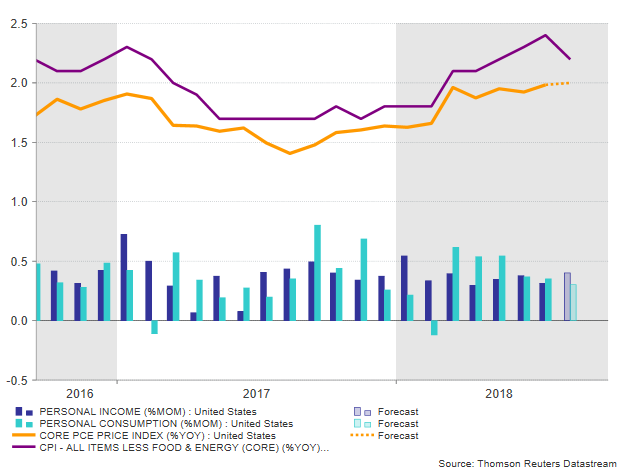
On Friday, the updated core Personal Consumers Expenditure (PCE) price index, the Federal Reserve’s favorite inflation measure, will dominate investors’ attention as economic evidence out of the US and Trump’s restrictive trade policy point to stronger inflation in the coming months. Forecasts, however, support that in August price growth in the US mainland flattened. As usual, personal income and personal consumption readings accompanying the inflation report will gather interest as well given their positive contribution to inflation, but no big changes are foreseen on this front.
According to analysts, the core PCE which excludes the volatile and seasonal components such as food and energy, is expected to arrive at 2.0% year-on-year (y/y) in August, maintaining July’s pace of inflation and thus remaining at the highest level reached since May 2012. On a monthly basis the gauge is said to ease to 0.1% from 0.2% in the preceding month.
Taking into account the Consumer Price Index (CPI) which also gets a lot of press but does not affect monetary decisions, a weakness in inflation cannot be ruled out as the core CPI inflation eased to 2.2% in September after topping at 2.4% in August, the fastest expansion since October 2008. The pullback in CPI was triggered by a sharp decline in apparel prices (-1.6%) and that might weigh on September’s core PCE index too. Decreases in medical costs in August could add pressure to the PCE inflation as well, as the sector constitutes the biggest component in the index.
Yet latest stats out of the labor market suggest that inflation might rather evolve positively in the coming months, a view backed by the FOMC policymakers as well. The government’s Nonfarm Payroll report conducted in August showed that the unemployment rate stuck for the second month at the 18-year low of 3.9%, while average hourly earnings ticked surprisingly higher to 2.9% y/y, marking the largest increase in pay in nine years. Consequently, with consumers and businesses enjoying a tax gift from the US President and new import tariffs on various products (imposed in June and September) increasing costs for US factories, inflation might not take long to pick up steam or at least hold above the Fed’s 2% price goal. A heat up in inflation would then comfortably allow FOMC policymakers to deliver further rate hikes, something the committee already plans as the famous dot plot published on Wednesday at the end of the FOMC policy meeting mirrored another rate hike this year, three more in 2019 and one rate rise in 2020. Recall that FOMC members project inflation to average 2.1% y/y in 2018, while in 2019 they see a pullback to 2.0% before rebounding to 2.1% in the following two years. It is also worth noting that September’s Nonfarm payrolls due next week are expected to say that the unemployment rate inched down to 3.8% and average hourly earnings gained momentum towards 3.0%.
About personal income, analysts believe that the monthly measure bounced from 0.3% to 0.4%, though, they speculate that consumers did not spend more but probably saved more, pushing the monthly personal spending down by 0.1 percentage points to 0.3%.
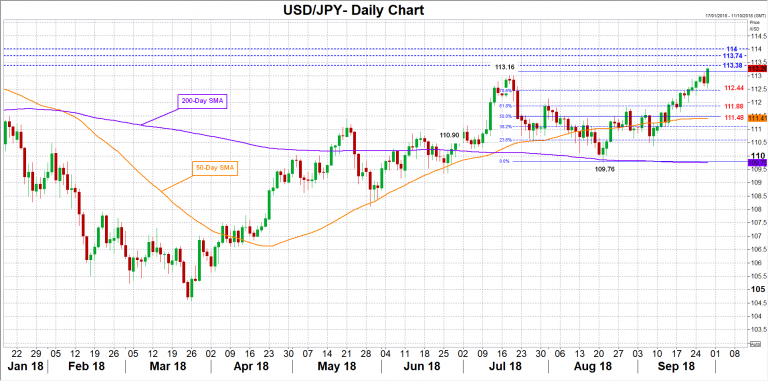
In FX markets, USDJPY managed to pierce the 113 key level on Thursday but softly so. Should the PCE price index and /or personal income and personal consumption readings surprise to the upside on Friday, the market could post further gains. In this case, traders could look for immediate resistance between 113.38 and 113.74, taken from the highs recorded in December 2017 and January 2018. Even higher, bullish actions could meet a wall at 114.00, while the 114.72 top created on November 2017 may come under the radar too.
Alternatively, discouraging figures may lead the pair down to 112.44, the 78.6% Fibonacci of the downleg from 113.16 to 109.76, before attention shifts to the 61.8% Fibonacci of 111.88, which provided some resistance recently. Moving lower, a break below the 50% Fibonacci of 111.48 would put the rally off 109.76 into doubt.
Gold finally breaks out, to the downside, 1160 next
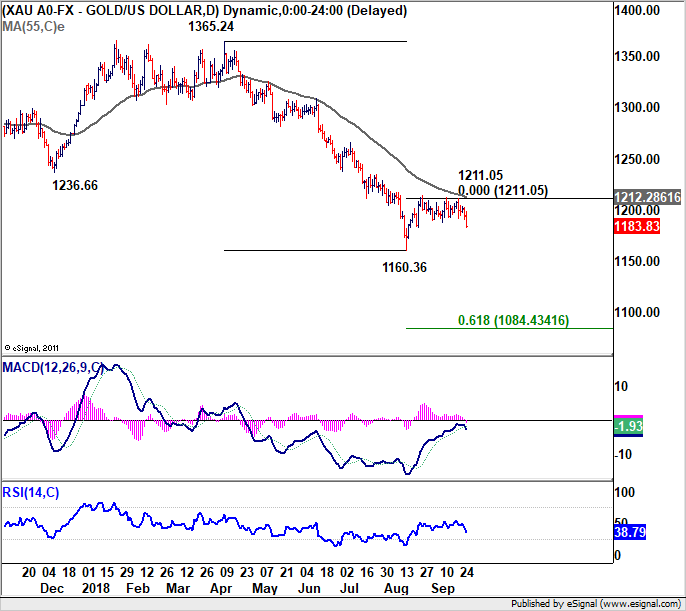
Gold finally breaks out from recent range, to the downside, through 1187.58 support. The development indicates that corrective rebound from 1160.36 has completed. We mark the end point of the correction at 1211.05. Deeper fall should be seen back to 1160.36 low next.
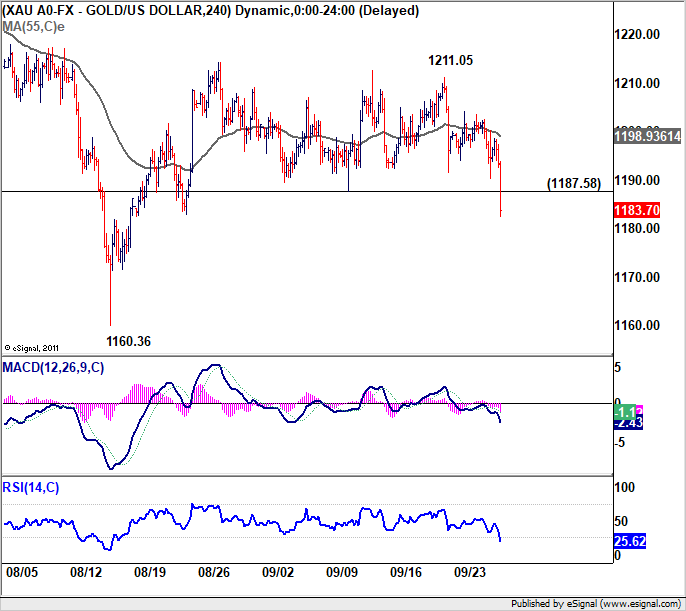
In the bigger picture, Gold is held comfortably below falling 55 day EMA. That suggests fall from 1365.24 is still in progress. Break of 1160.36 low will confirm decline resumption. In that case, next downside target will be 61.8% projection of 1365.24 to 1160.36 from 1211.05 at 1084.43.
Turkish Lira Maintains Bullish Near-Term Tone and Eyes Key Support at 5.6875
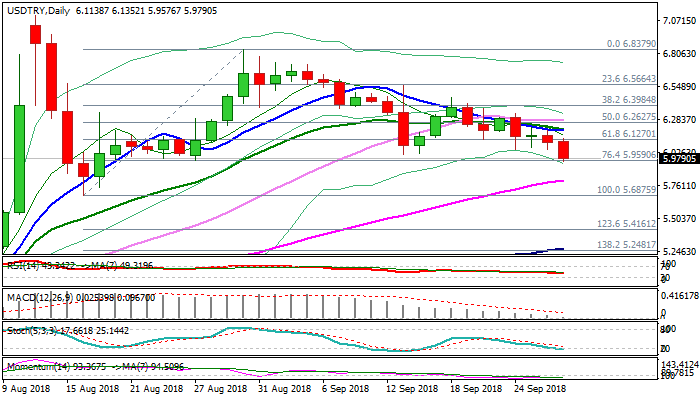
Turkish lira extends gains vs the US dollar and hit the highest levels in six weeks on Thursday. Recent action of Turkish central bank which rose interest rates by unexpected 625 basis points, started to give stronger results. Investors need some time to regain trust after the CBRT initially failed in previous rate decisions to properly tackle rising inflation, which along with crisis in emerging markets, resulted in lira’s fall to the record low August.
Fresh strength of lira after rate hike shows positive signals and could give stronger results this time.
Today’s penetration of daily cloud (6.1207/5.8097) which marked strong support and test of 5.9590 support (Fibo 76.4% of 5.6875/6.8379) was positive signal.
Fresh lira’s bulls eye rising 55SMA (5.8058) the last obstacle on the way to key support at 5.6876 (16 Aug low), break of which would generate strong bullish signal on completion of failure swing pattern on daily chart.
Bearishly aligned daily techs maintain negative outlook for USDTRY pair.
Res: 6.1270; 6.1976; 6.2234; 6.2868
Sup: 5.9576; 5.8058; 5.7493; 5.6875
Raft of Japanese Data Unlikely a Game-Changer for BoJ, Risk Flows to Drive Yen
A raft of economic data out of Japan will hit the markets on Thursday at 2330 GMT. Forecasts point to numbers that would reaffirm the BoJ’s reluctance to consider an exit from its massive stimulus program for the time being and as such, are unlikely to have much impact on the yen. Instead, the far bigger driver for the currency is likely to be any change in investors’ risk appetite amid growing trade tensions.
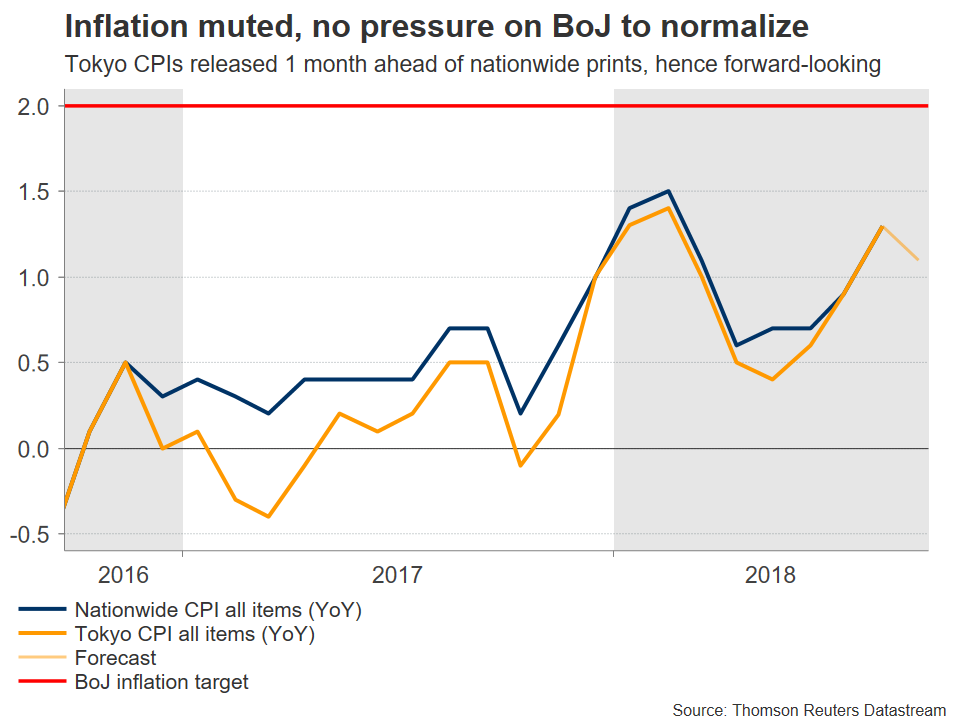
It’s going to be a busy end to the week in Japan. The Tokyo CPI readings for September are expected to confirm inflation in the Japanese capital remains tepid. The headline CPI rate is projected to cool to an annual pace of 1.1%, from 1.2% previously, while the core figure that excludes fresh food is anticipated to hold steady at 0.9%. The Tokyo CPIs are considered forward-looking gauges of the nationwide prints and hence, are crucial for Bank of Japan (BoJ) decision-making. Employment data, which will be released at the same time, are forecast to confirm that the labor market remains robust. The unemployment rate is expected to have remained unchanged at 2.5% in August, while the jobs-to-applicants ratio is also seen flat at 1.63, a four-decade high.
Twenty minutes later, at 2350 GMT on Thursday, Japan’s industrial production and retail sales data for August will hit the markets. Industrial production is projected to have rebounded to 1.5% in monthly terms, after falling by 0.2% previously, while retail sales are projected to have accelerated to 2.2% on an annual basis, from 1.5% in the month prior. Alongside these, the BoJ will release the Summary of Opinions from its latest meeting, where it kept its ultra-loose policy framework intact, providing no signals it will alter it anytime soon. Investors will probably scrutinize the Summary for any hints on whether policymakers may eventually consider dialing back stimulus, particularly in light of recent concerns by some officials regarding the growing adverse effects of their massive money-printing program.
As for the yen, Japanese data usually have only a negligible impact on the currency. To explain why, it’s fruitful to consider the example of another central bank, for instance the Fed. When US data show improvement, markets bet for a faster pace of rate hikes by the Fed, pushing the dollar higher (and vice versa). Contrast this with the BoJ, which isn’t expected to adjust its policy at all in the foreseeable future. Hence, investors don’t rush to either buy or sell the yen on data releases that probably won’t have enough of an impact to make the BoJ alter its policy. In other words, while a dramatic improvement in Japanese data could see gains in the yen on BoJ-normalization speculation, anything short of that tends to be overlooked as simply confirming the “no policy change in sight” narrative.
Instead, the yen responds much more to changes in global risk sentiment, given its safe-haven status. When trade tensions between the US and the rest of the world heat up for example, the currency typically attracts inflows. While investors seem to have largely brushed aside such concerns in recent days, any further escalation in the trade skirmish moving forward could still trigger some rebounds in the yen. That said, if price action in recent months is any guide, any such bounces may remain relatively short-lived, providing only temporary relief to the Japanese currency.
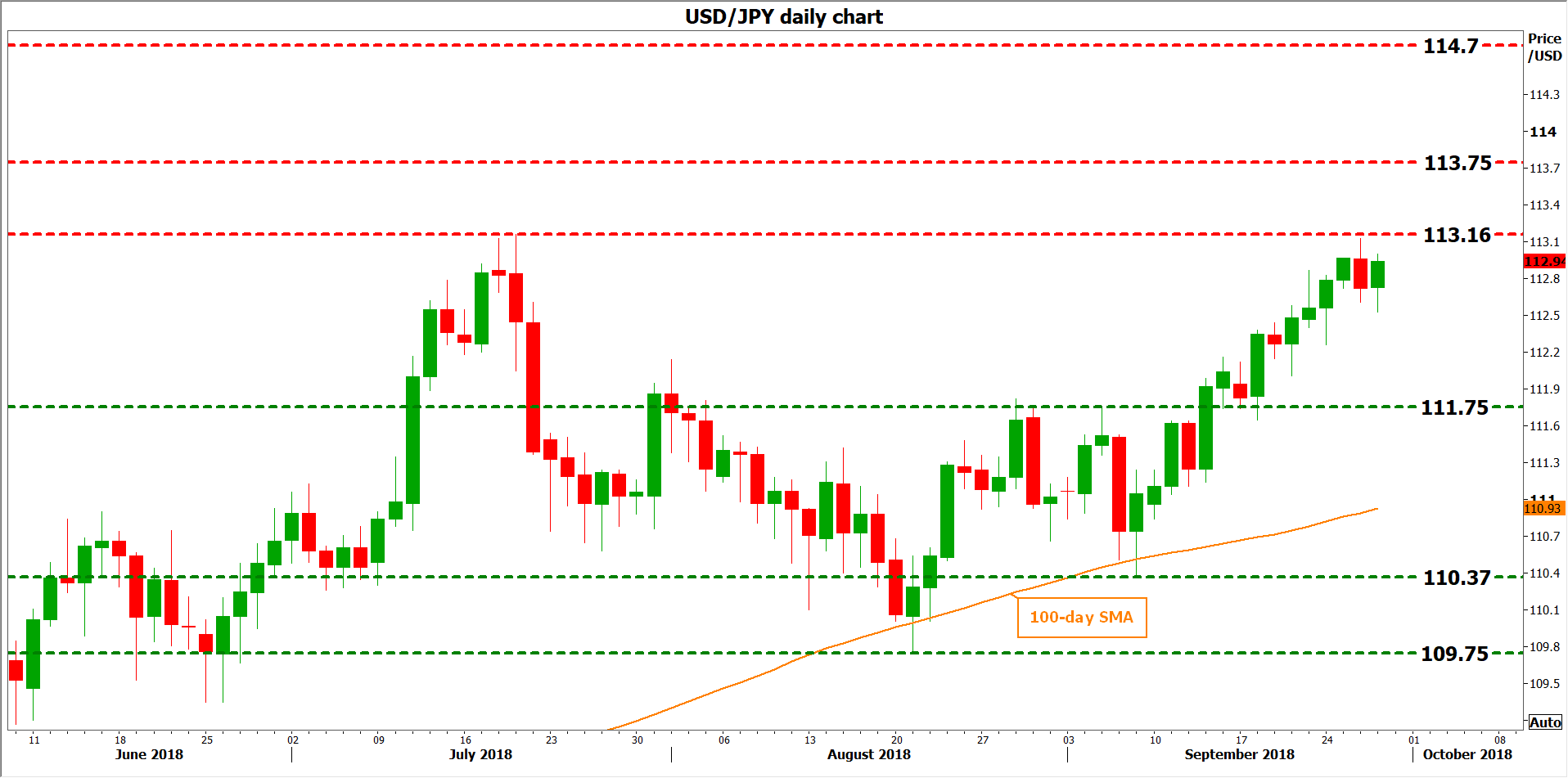
Technically, advances in dollar/yen could encounter immediate resistance around the 9-month peak of 113.16, with a break above that zone possibly paving the way for a test of 113.75, a high last seen on December 12. Higher still, bullish extensions could stall near the November 6 top of 114.70.
Conversely, a pullback in the pair may find preliminary support at 111.75, the area that halted the rally on September 5. A downside violation could shift the attention to the September 7 trough of 110.37, before the August 21 low at 109.75 comes into view.
Gold: Downside Pressure Increases after Hawkish Fed and Upbeat US data
Spot Gold holds in red for the second consecutive day and broke below psychological $1200 support on Thursday.
As expected, US interest rate change sensitive gold reacted negatively after Fed announced the third rate hike this year on Wednesday and signaled further policy tightening, which inflated the greenback.
Upbeat US data today added to bullish dollar’s outlook and pushed yellow metal’s price further down.
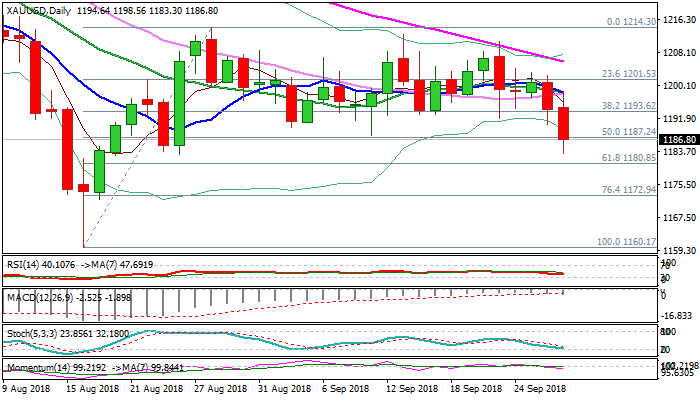
Fresh weakness today dipped below 50% of $1160/$1214 recovery leg, suggesting that corrective phase might be over.
Falling thick daily cloud limited recent upside attempts and continues to weigh on near-term action.
Daily Ichimoku studies turned to bearish setup and along with rising bearish momentum, maintain downside pressure.
Fresh bears eye pivotal support at $1180 (Fibo 61.8% of $1160/$1214), clear break of which is needed to confirm lower top at $1214 and turn focus towards key support at $1160 (16 Aug low) the lowest since early Jan 2017.
Cluster of converged daily SMA’s (10/20/30) marks solid resistance at $1198, along with broken $1200 level, which are expected to cap stronger upticks and maintain bearish bias.
Res: 1192; 1198; 1200; 1206
Sup: 1183; 1180; 1172; 1160
Sunset Market Commentary
Markets
The German Bund opened stronger this morning both catching up with US Treasury gains and reacting to Italian political news. The US story originated from yesterday’s FOMC meeting and the buy-the-rumor, sell-the-fact reaction in the US Note future. Local newspaper Corriere dela Serra delivered the Italian spin by suggesting that the rumored 1.9% of GDP deficit agreement for next year was at stake. Lega supposedly joined 5SM last-minute call for more fiscal leeway (2.4% of GDP). Political parties face a midnight deadline. BTP’s underperformed mainly at the start of trading, but failed to really recover intraday. The German Bund topped off after German regional inflation data rolled out. They all suggested a faster rise than anticipated CPI on a country level. This was eventually confirmed (0.4% M/M, 2.2% Y/Y vs 0.1% M/M, 1.9% Y/Y). The echo of ECB Draghi’s words earlier this week resonated through investors’ minds. “We see a vigorous pick-up in core inflation”. The German 10-yr yield gradually returned above the 0.50% mark. Other eco data – EMU EC confidence, M3 money supply and US durable goods orders – disappointed, but couldn’t turn the tide. German yields changes (compared to yesterday official close) range between +0.2 bps (5-yr) and -2.7 bps (30-yr). US yields add 1.4 bps to 1.7 bps across the curve. 10-yr yield spread changes vs Germany are nearly unchanged with Italy underperforming (+5 bps).
Yesterday, the dollar reacted in a guarded way to the Fed policy decision/policy guidance. The Fed confirmed the positive economic assessment from August. The interest rate dots were also little changed. The market still takes a softer view than the Fed dots and yesterday’s Fed communication was not able to narrow this gap, resulting in yet another indecisive reaction of the dollar. This morning, renewed uncertainty on the outcome of the Italian budget negotiations, hammered EUR/USD to the 1.17 area. German September CPI’s printed much higher than expected but didn’t help the euro. In the afternoon, USD strength resurfaced despite mixed US eco data (sharp widening in trade deficit, strong inventory data, mixed durable orders) and as risk sentiment improved. EUR/USD trades currently in the 1.1680 area. USD/JPY also reversed early session softness and is again testing the 113 area. Some euro softness is in play, but it also looks that the dollar maintains the benefit of the doubt post-Fed.
Trading in EUR/GBP and cable was mainly driven by the euro and the USD side of the story rather by GBP-related news. EUR/GBP dropped below the 0.89 mark, amongst others, due to uncertainty on the Italian budget. The overall decline EUR/USD spilled over to EUR/GBP. At the same time, cable (1.3130 area) ceded ground as the dollar gained across the board. As usual, there were again plenty of Brexit related headlines, but we doubt they were an important factor in today’s GBP-price action. Regarding monetary policy, we mention a hawkish tone in a speech of BoE Chief Economist Haldane as he indicated that more UK interest rate hikes are needed.
News Headlines
After rumors this morning that today’s cabinet meeting on the Italian budget could be postponed, PM Conte’s office confirms the cabinet will meet tonight at 8pm. In the meantime, Italy’s Deputy PM Salvini repeated that Italy should have a deficit above 2% of GDP so campaign promises can create jobs and spur growth.
ECB president Draghi’s words on a ‘vigorous’ pick-up in underlying inflation aren’t cold yet and German inflation unexpectedly accelerated to a four-month high. Consumer prices rose 2.2% (YoY) in September, beating the 1.9% market expectation. The monthly inflation number prints 0.4%, while only 0.1% was expected.
The US merchandise trade deficit unexpectedly grew to $75.8bn in August, from a $72.0 billion deficit in the month before, while inventories at wholesalers and retailers increased. The trade gap in goods was, however, estimated to decline to $70.6bn. Imports rose 0.7% in Augustus, while exports fell 1.6%.
USDJPY Outlook: Bulls Return above 113 as Strong US GDP Adds to Dollar’s Bullish Outlook
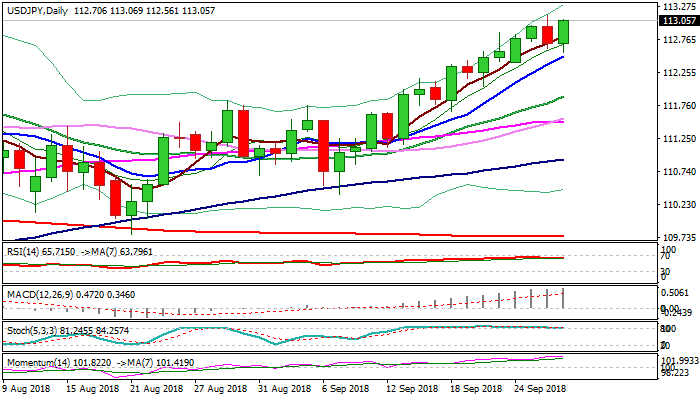
Bounce from daily low at 112.56, posted in early Europe, accelerated after upbeat US data and probes again above 113.00, for renewed attack at key 113.17/30 barriers (19 July high / Fibo 61.8% of 118.66/104.63 descend, reinforced by weekly 200SMA). Data released today showed that US economic growth in Q2 accelerated to the fastest pace in almost four years ( annualized Q2 4.2% vs 4.2% f/c) and durable goods orders surged 4.5% in Aug, heavily beating forecast at 1.9% and downward-revised July's figure at -1.2%. US weekly jobless claims unexpectedly rose by 12K (202K previous week/208K f/c) but did little to offset positive impact from upbeat GDP and durables. The pair is on track for eventual break through 113.17/30 pivots after shallow dips were contained above rising 10SMA and fresh strength neutralized risk of further easing. Further improvement of bullish dollar's sentiment on today's strong numbers and after hawkish Fed on Wednesday, could result in stronger advance, as firm break above 113.17/30 pivots is expected to generate strong bullish signal. High of 12 Dec 2017 at 113.74 marks next significant barrier, with bulls capable on travelling towards next targets at 114.49/73 (July / Nov 2017 highs). Bullish daily techs remain supportive, however, overbought slow stochastic warns that bulls may show hesitation before clearly breaking above key resistance zone. Rising 10SMA remains key near-term support (112.50) which is expected to contain dips and keep bulls in play.
Res: 113.17; 113.30; 113.74; 114.00
Sup: 112.81; 112.50; 112.04; 111.88