Sample Category Title
SNB Unlikely to Signal Normalization, May “Jawbone” Franc
The Swiss National Bank (SNB) is widely expected to keep its ultra-loose policy unchanged when it announces its rate decision on Thursday at 0730 GMT. Investors will look for hints on whether a 2019 rate increase is a realistic scenario. While Swiss economic data are painting a rosier picture, it’s probably too early for such a signal, particularly with the franc already strengthening. In this respect, there is a clear downside risk for the currency, as policymakers may express discomfort with its recent appreciation.
Switzerland’s economy has been recovering at a steady and healthy pace in recent quarters. Economic growth picked up speed in Q2, clocking in at an annual rate of 3.4%, an eight-year high. The unemployment rate continues to hover near a ten-year low and crucially, even inflation is showing signs of life again. The nation’s CPI rate currently rests at 1.2% in yearly terms, rising slowly yet consistently. To be fair though, most of this progress comes from higher energy prices, as core inflation – that excludes volatile items like food and energy – is much lower, at 0.5%.
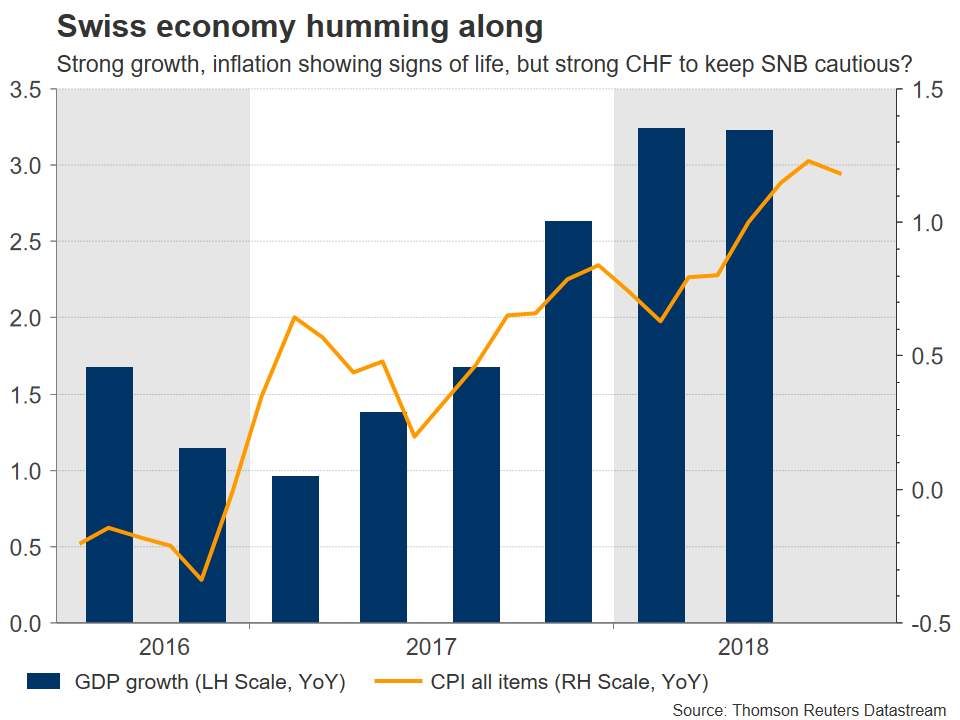
Seen in isolation, these figures point to an overall strengthening outlook, and hardly justify the SNB holding interest rates at the lowest level worldwide. Yet, there is one factor that doesn’t fit in with this rosy picture; the exchange rate. As a reminder, the SNB pays very close attention to how strong the Swiss franc is. In general, an appreciating currency tends to hold down inflation by lowering the prices of imports, and since the franc typically benefits in times of global turmoil given its safe-haven status, the SNB has regularly intervened in the FX market to weaken the currency.
Seeing things through this scope, the franc’s substantial advance since May will likely be a worrisome development for policymakers. The safe-haven currency saw a surge of inflows amid intensifying concerns around international trade, Italy’s political situation, and emerging market fragility. Its surge threatens to derail, or at least delay, the SNB’s inflation-lifting efforts. Hence, a solid argument can be made that policymakers may opt to push back against this appreciation and “jawbone” the franc lower, perhaps by expressing increased concerns around its current levels and threatening to intervene if it continues to gain.
Beyond the franc, the other major area of focus will be any hints the SNB is gearing up to follow in the ECB’s footsteps, by indicating that a rate increase could come as early as 2019 amid an improving economy. That said, it still appears too early for such a signal, as suggesting as much could trigger a sharp rally in the Swiss franc that – as mentioned above – could hamper the upward trend in inflation. The SNB is unlikely to want to take such a risk with core inflation so low still, implying the path of least resistance may be sticking to the same language on policy, for now at least.
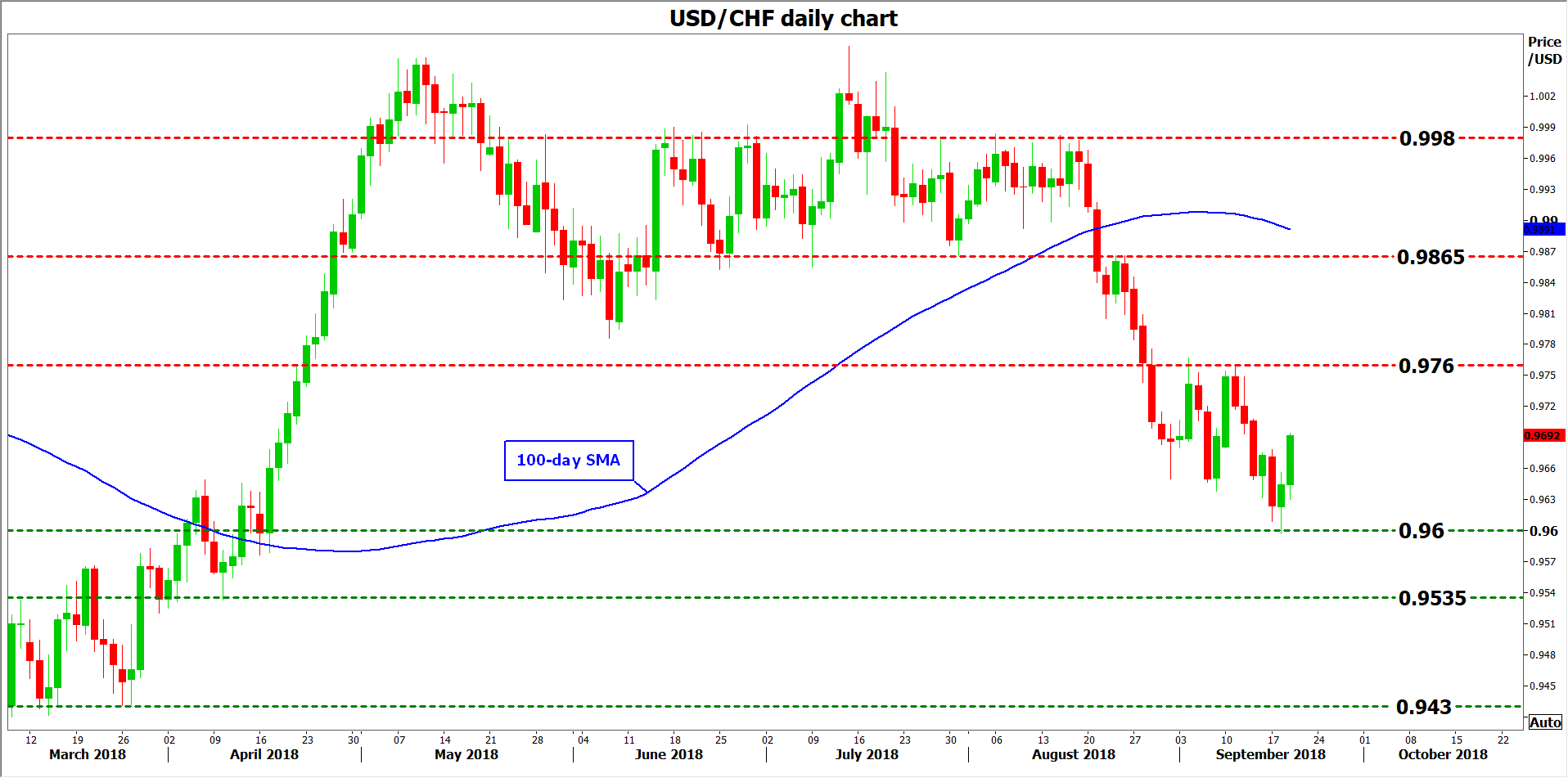
In case the Bank indeed shows no signs it is considering normalization, or if officials strike a more worried tone around the franc’s appreciation, the currency could tumble. Looking at dollar/franc, resistance to advances may come near 0.9760, the high of September 11, before the 0.9865 hurdle comes into view – this being the peak of August 23. Even higher, the August 17 top of 0.9980 would increasingly come into view.
On the contrary, any hints from the SNB that a rate hike is possible in 2019 could trigger another round of gains in the franc. In such case, dollar/franc could edge lower for a test of 0.9600, the low of September 18. A downside break could shift the attention to the April 10 trough of 0.9535, ahead of the March 26 low, at 0.9430.
Looking past the SNB, the franc will also remain sensitive to any developments in trade tensions, emerging markets, and the situation in Italy. Should these risks grow further, that would likely drive more flows into the haven currency, and vice-versa.
Gold bounded in range, more upside still in favor through 1214
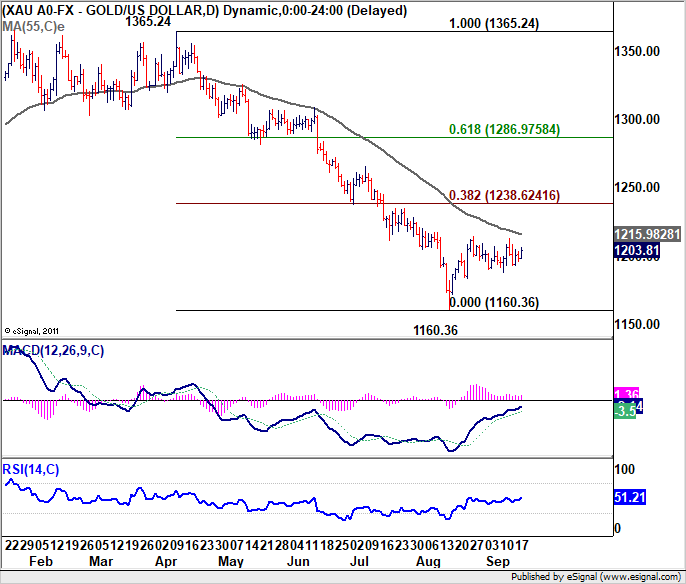
Gold continues to gyrate in range of 1187.58/1214.30. More sideway trading could still be seen. But as long as 1187.58 minor support holds, rebound form 1160.36 is in favor to extend higher. Break of 1214.30 will 38.2% retracement of 1365.24 to 1160.36 at 1238.62.
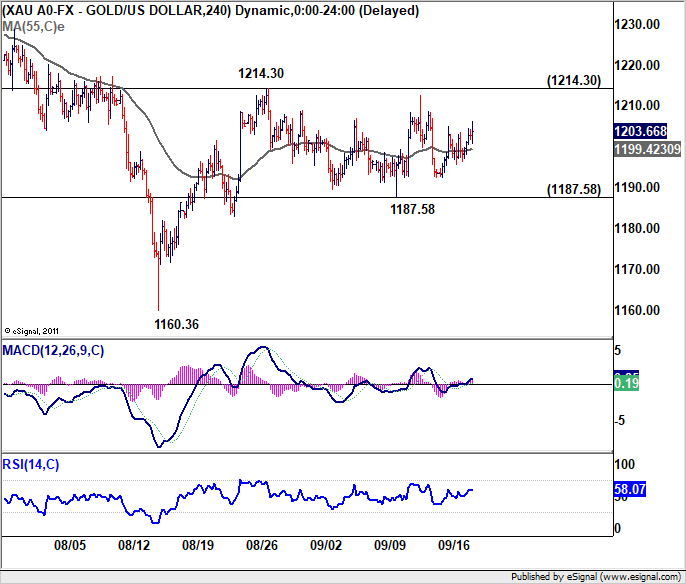
For now, such rebound from 1160.36 is seen as a corrective move. Hence, we'd expect strong resistance from 1238.62 to limit upside. On the downside, break of 1187.58 will suggest that the rebound is completed and bring retest of 1160.36 low.
GBPAUD Tumbles Below 5-Month High; Neutral in Medium Term
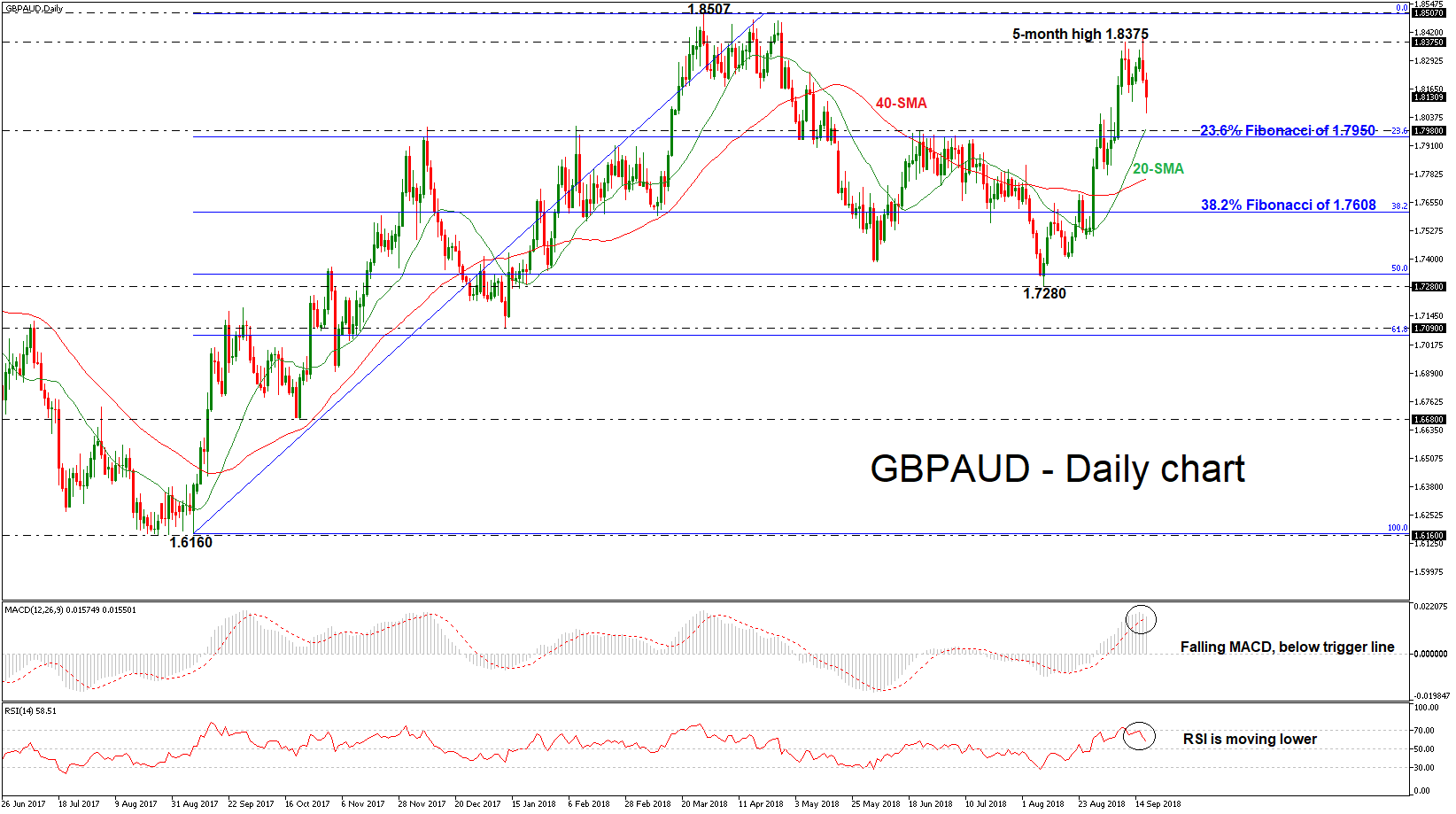
GBPAUD has come under renewed selling pressure after it created a fresh almost 5-month low, falling back below the 1.8375 resistance level, but remaining above the 20- and 40-simple moving averages (SMAs) in the daily chart. Despite the latest pullback though, the pair has not posted a fresh lower low, which makes one hesitant to trust further sharp declines for now.
Looking at momentum oscillators in the short-term, however, they suggest further downside pressure may be on the cards. The RSI dropped below the threshold of 70, detecting negative momentum, and is also pointing downwards. The MACD, already negative, is ready for a bearish crossover with its trigger line.
In case of further declines in the index, immediate support may be found near the 23.6% Fibonacci retracement level of the upleg from 1.6160 to 1.8507, near 1.7950. A downside break of that zone would open the way for the 40-day SMA near 1.7763 at the time of writing. If sellers manage to push below that hurdle too, the price could challenge the 38.2% Fibonacci of 1.7608, increasing the probability for further bearish extensions.
On the flip side, if the bulls retake control, price advances may stall initially near the latest highs at 1.8375. A potential upside violation of this level would send prices until the next resistance of 1.8807, taken from the highs on March 28.
To conclude, GBPAUD has been in a neutral mode over the last eight months and a break above the 1.8507 barrier would endorse the scenario for a bullish extension. Otherwise, a dip below 1.7090 would tilt the risk to the downside.
Sunset Market Commentary
Markets
Global core bond weakness initially persisted this morning. Both the Bund and the US Note future reached in an intraday low as UK CPI inflation unexpectedly rose to its fastest pace in 6 months. The move in the Bund coincided with a test by the German 10-yr yield of the upper bound of the 0.3%-0.5% trading range. The test was rejected in absence of eco/event news. European stock markets couldn’t build on this morning’s Asian euphoria, Brent crude slides back towards $78.5/barrel and BTP’s suffered a small setback as 5SM Di Maio is reportedly looking for a bigger deficit (2.5% of GDP) than eyed by FM Tria and Lega Salvini. Core bonds found a better bid at the start of US trading, but the move lacks momentum. US eco data printed mixed with stronger-than-expected housing starts, but disappointing building permits in August. Changes on both the German and US yield curves are limited between -1 bp and +1 bps. 10-yr yield spread changes vs Germany widen slightly with Italy (+5 bps) underperforming.
USD trading showed a similar, inconclusive trading pattern as was the case earlier this week. Markets of risky assets reacted rather muted to the most recent escalation in the US-China trade war. In this respect there was no need to run to the safe haven dollar. US housing data were mixed to slightly better than expected, but are no focus for USD trading. US/German interest rate differentials are trading near a multi-year peak, but the spread also hardly didn’t move today. EUR/USD came again close to the 1.1720 area but a break/test of the 1.1733 resistance again didn’t occur. The pair returned to the 1.1675 area. Contrary to previous days, sentiment on Italy turned more neutral and was no support for EUR/USD anymore. USD/JPY again hovered in a very tight sideways range in the 1112.20/45 area. There is still not one decisive narrative to give USD trading any clear directional bias.
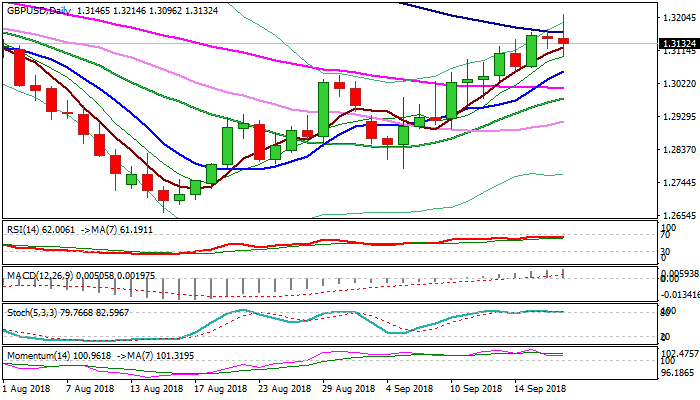
The focus for sterling trading was on the EU summit in Salzburg. Investors were looking out for signs of progress on a Brexit separation deal. In the meantime, the UK August CPI printed higher than expected at 2.7% Y/Y (from 2.5%), the highest level in six months. EUR/GBP spiked lower from the 0.89 area to the 0.8860/65 area. However, sterling soon reversed part of the initial gain as markets realized that this inflation uptick won’t change the BoE’s rate hike intentions in the pre-Brexit era. Later, sterling reversed all of the CPI-inspired gains on press headlines that PM May would reject the improved EU offer to address the issue of the Irish border. For now, there is no concrete news on any new developments at the EU summit. EUR/GBP hovers in the 0.8885 area. Cable eased back in the 1.3130 area after trading temporary north of 1.32 this morning.
News Headlines
UK inflation increased unexpectedly in August. On a monthly basis, CPI increased with 0.7% (0.5% expected) in August against a 0.0% break-even in July. Core inflation (YoY) grew 2.1% last month (1.8% expected) in comparison with 1.9% in July, indicating the price inflation is this time not due to a rise in energy or food prices alone.
UK Prime Minister May is said to reject the EU’s improved stance on the Irish border issue, according to The Times. EU’s negotiator Barnier had signaled he was ready to raise EU’s effort to address UK’s concerns on Northern Ireland. May will defend her ‘Chequers’ stance at the EU-summit in Salzburg, which starts tonight.
Italy’s Deputy Prime Minister Luigi Di Maio, leader of the Five Star Movement, is looking for an extra €28 billion for the 2019 budget, including €10 billion to fund the so-called ‘basic income’. His plans ought to raise Italy’s deficit-to-GDP ratio to 2.5%, which is higher than the previous 1.6% estimation of Finance Minister Tria.
EU Tusk: Chequers plan indicated positive evolution, calls for Nov summit on Brexit
Just ahead of the EU leaders summit in Salzburg, Austria, European Council President Donald Tusk said he would call for an extra summit in November for Brexit. He said in a news confidence "the Brexit negotiations are entering their decisive phase. Various scenarios are still possible today but I'd like to stress that some of Prime Minister May's proposals from Chequers indicated positive evolution in the UK's approach."
He added that "today there is perhaps more hope but there is surely less and less time", and "every day that is left we must use for talks. I'd like to finalize them still this autumn." However, he also noted that the part in UK Prime Minister Theresa May's Chequers plan
"will need to reworked and further negotiated".
Yesterday, Tusk laid down three key Brexit issues to focus on at the Salzburg meeting, including:
- First, we should reach a common view on the nature and overall shape of the joint political declaration about our future partnership with the UK.
- Second, we will discuss how to organise the final phase of the Brexit talks, including the possibility of calling another European Council in November.
- Third, we should reconfirm the need for a legally operational backstop on Ireland, so as to be sure that there will be no hard border in the future.
USD/CHF Mid-Day Outlook
Daily Pivots: (S1) 0.9611; (P) 0.9634; (R1) 0.9669; More.....
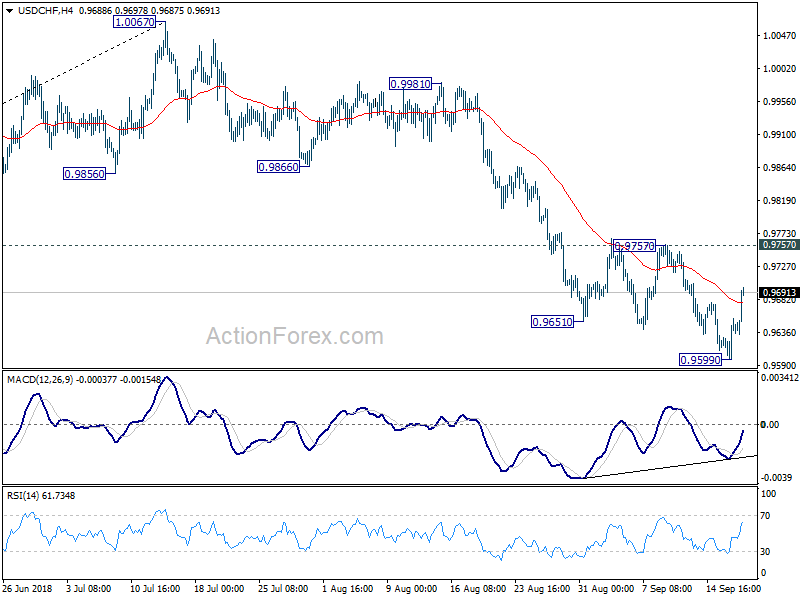
USD/CHF's rebound from 0.9599 extends higher today but it's kept below 0.9757 resistance. Intraday bias says neutral first. Considering bullish convergence condition in 4 hour MACD, even in case of another fall, downside will likely be contained by 0.9523 to bring rebound. On the upside, break of 0.9757 will suggests that fall from 1.0067 has formed a short term bottom. In such case, further rise would be seen back to 55 day EMA (now at 0.9809).
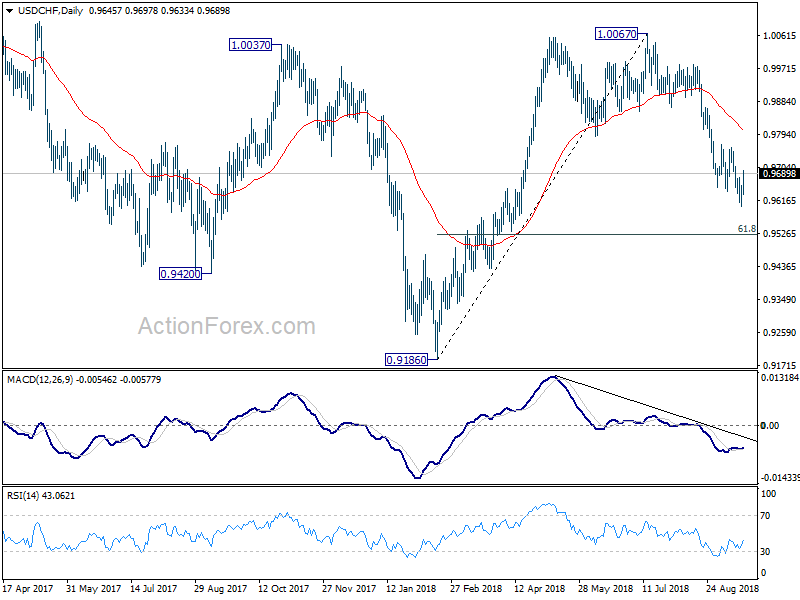
In the bigger picture, rise from 0.9186 low has completed at 1.0067, after failing to sustain above 1.0037 resistance. Fall from 1.0067 could extend to 61.8% retracement of 0.9816 to 1.0067 at 0.9523 and below. But for now, we don't expect a break of 0.9186 low. On the upside, firm break of 0.9866 support turned resistance will suggests that fall from 1.0067 has completed and rise from 0.9186 is resuming.
USD/JPY Mid-Day Outlook
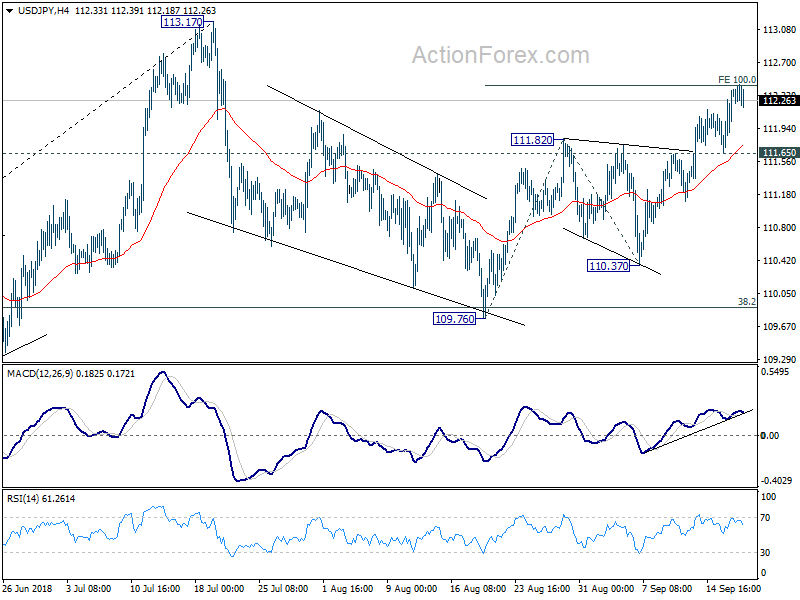
Daily Pivots: (S1) 111.88; (P) 112.15; (R1) 112.63; More...
USD/JPY lost some upside momentum after hitting 100% projection of 109.76 to 111.82 from 110.37 at 112.43. But with 111.65 minor support intact, further rally is expected. Sustained break of 112.43 will pave the way to retest 113.17 high. Nonetheless, break of 111.65 will dampen the immediate bullish outlook and turn bias back to the downside instead.
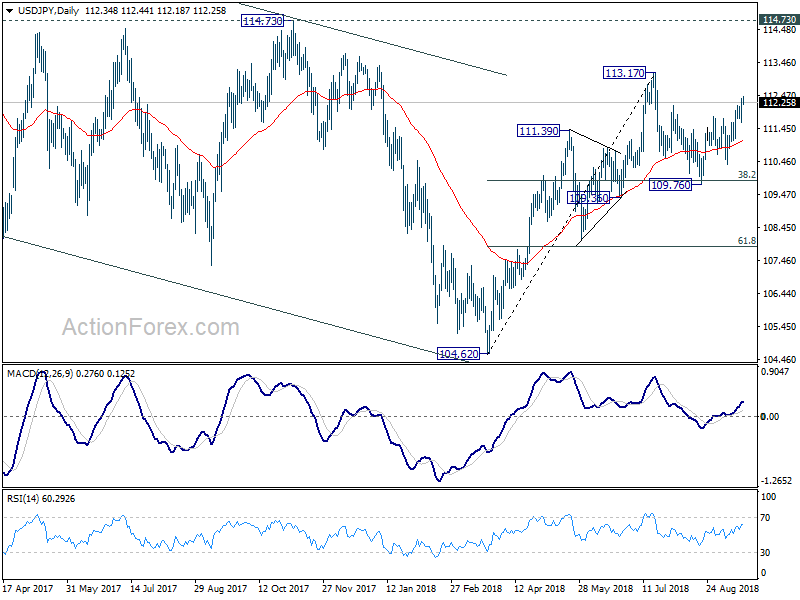
In the bigger picture, corrective fall from 118.65 (2016 high) should have completed with three waves down to 104.62. Decisive break of 114.73 resistance will likely resume whole rally from 98.97 (2016 low) to 100% projection of 98.97 to 118.65 from 104.62 at 124.30, which is reasonably close to 125.85 (2015 high). This will stay as the preferred case as long as 109.36 support holds. However, decisive break of 109.36 will mix up the outlook again. And deeper fall should be seen back to 61.8% retracement of 104.62 to 113.17 at 107.88 and below.
EUR/USD Mid-Day Outlook
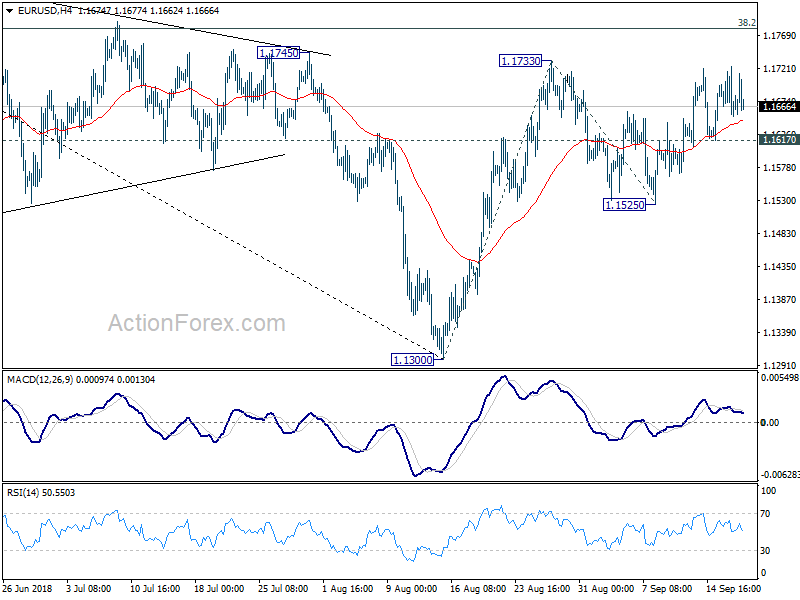
Daily Pivots: (S1) 1.1638; (P) 1.1681; (R1) 1.1711; More.....
Intraday bias in EUR/USD remains neutral for the momentum and outlook is unchanged. Even in case of another rise, upside should be limited by 38.2% retracement of 1.2555 to 1.1300 at 1.1779 to bring near term reversal. On the downside, break of 1.1617 minor support will turn bias back to the downside. Further break of 1.1525 support will indicate completion of this corrective rebound from 1.1300. However, firm break of 1.1779 will extend the rise to 100% projection of 1.1300 to 1.1733 from 1.1525 at 1.1958.
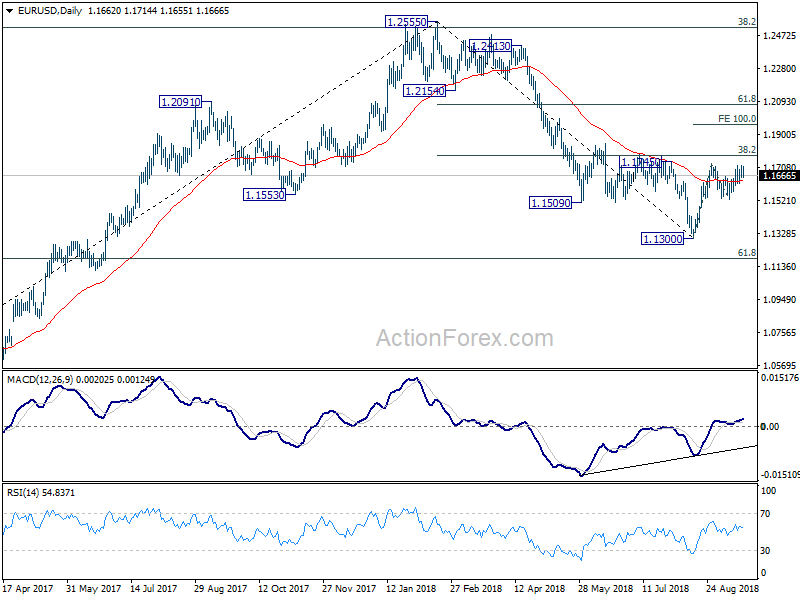
In the bigger picture, a medium term bottom should be in place at 1.1300, on bullish convergence condition in daily MACD and some consolidations would be seen. But still, note that EUR/USD was rejected by 38.2% retracement of 1.6039 (2008 high) to 1.0339 (2017 low) at 1.2516. That carries some long term bearish implications. Thus, we'd expect fall from 1.2555 high to resume after consolidation completes. Below 1.1300 should send EUR/USD through 61.8% retracement of 1.0339 to 1.2555 at 1.1186. And, in that case, EUR/USD would head to retest 1.0339 (2017 low).
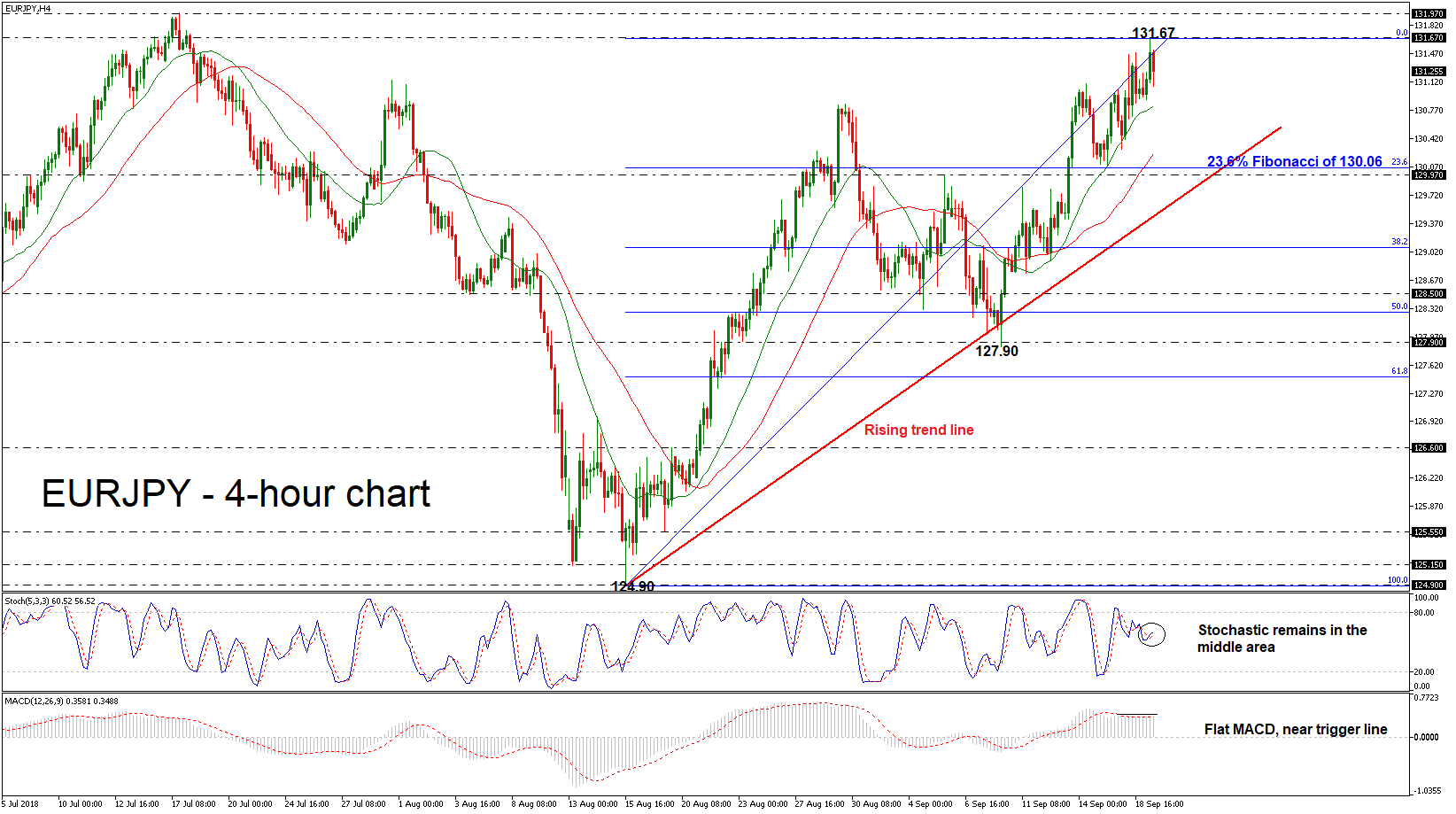
EURJPY Slips Below 2-Month High; Remains Bullish in Near Term
EURJPY created a higher high earlier today, posting a fresh two-month peak of 131.67. Currently, the price is moving above the 20- and 40-simple moving averages (SMAs) in the 4-hour chart, indicating a possible upside extension.
However, the technical indicators have lost their strong positive momentum as they are flattening. The stochastic oscillator is moving sideways in the middle area, while the MACD oscillator stands near the trigger line and above the zero line.
A move to the upside may meet resistance around the intraday high of 131.67. In case of further bullish extensions, the price could re-challenge the 131.97 level, taken from the high on July 17. A significant step above these levels could drive the pair until the next immediate resistance level of 132.50, identified by the high on April 30.
Alternatively, the 20- and 40-SMAs, which are hovering around 130.80 and 130.20, could provide immediate support levels. If there is a slip below the SMAs there is an expectation to hit the 129.97 support barrier, which holds slightly below the 23.6% Fibonacci retracement level of the upleg from 124.90 to 131.67.
Overall, the market is expected to hold bullish in the short-term after the rebound on the 124.90 support hurdle on August 15.
GBPUSD Outlook: News Hit Pound Bulls and Offset Positive Impact from Upbeat UK CPI Data
Cable dipped 0.7% and hit session low at 1.3096, following report in The Times that UK PM May could reject EU offer on Irish border. The news soured sentiment, bringing pound under increased pressure, after the currency advanced to new two-month high at 1.3214 on UK inflation report. Data released this morning showed unexpected CPI rise in August (annualized 2.7% vs 2.4% f/c / m/m 0.7% vs 0.5% f/c) which gives further evidence to the BoE for another rate hike at the end of the year. The downside became vulnerable as near-term techs softened on the recent fall which also surged through thick hourly cloud. The notion is supported by daily slow stochastic attempting to reverse from overbought territory and bearish divergence on 14-d momentum. Focus turns on today's close which would generate negative signal on repeated close below cracked 100SMA / Fibo 61.8% of 1.3472/1.2661 bear-leg. Also, break below daily cloud top (1.3066) which marks strong support, would further weaken the structure and increased risk of reversal.
Res: 1.3163; 1.3214; 1.3280; 1.3301
Sup: 1.3113; 1.3096; 1.3066; 1.3055