

Sample Category Title
Limited loss in Yuan and Chinese stocks as trade war escalation shrugged
The financial markets reactions to new round of US tariffs on China are so far rather muted. Nikkei is actually rising over 1% at the time of writing. Hong Kong HSI is down -0.72%, Singapore Strait Times is down -0.55%. China's Shanghai SSE dipped to 2644.30 but recovered. It's now trading down -0.12% only at 2648.5, still kept above 2638 key support level (2016 low).
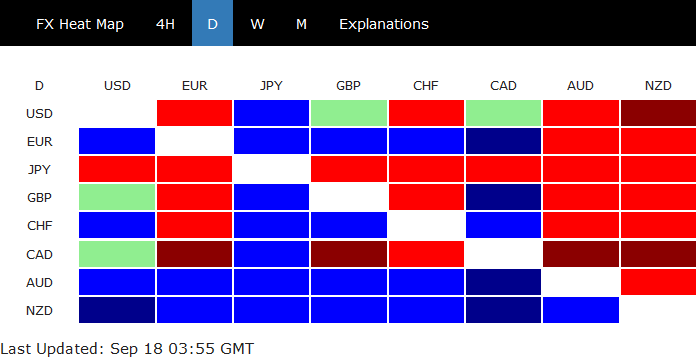
In the currency markets, Dollar turns soft again after a brief lift from the trade war news. It's trading as the weakest one together with Yen for now. Australian Dollar and New Zealand Dollar are the strongest ones.
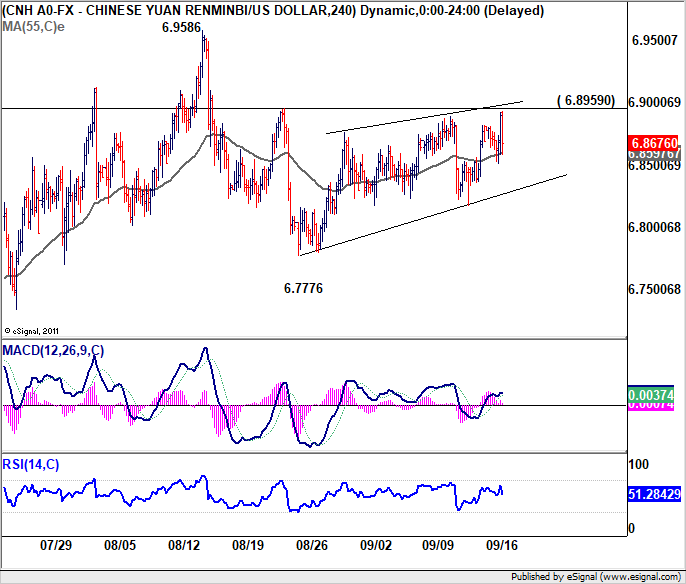
USD/CNH (offshore Yuan) edged higher to 6.8930 earlier today but there is no follow through buying to push it through 6.8959 minor resistance yet.
Market Morning Briefing: Euro Is Again Trading At Resistance Near 1.17
STOCKS
Dow (26062.12, -0.35%) dipped yesterday. The index is likely to trade in the 26000-26500 region for the near term. O major movement is seen since the last few sessions and the index seems to have come to a halt. While below 26500 resistance, Dow could spend some time in a sideways consolidation; a break above 26500 is necessary to trigger an upmove in the medium term.
Dax (12096.41, -0.23%) dipped back instead of moving higher towards 12300. If the index does not rise above 12150 just now, it could fall again to re-test 11800-11900 levels in the near term. Else, the index could start moving towards 12300 in the next 2-3 sessions.
Nikkei (23344.14, +1.08%) is up about 1% today continuing its rise above 23000. While the rise sustains, a test of 23600-24000 is possible in the medium term. Near term looks bullish.
Shanghai (2652.86, +0.049%) is trading just at the important support levels near 2650. It would be important to see if the index breaks below or bounces back from here as that would decide the medium term direction for Shanghai. The tariff announcements on $200bln of Chinese goods rolled out yesterday could be negative for the index and could probably trigger a further fall in the index from current levels. We would watch for a couple of sessions to see how the index moves. Charts suggest a bounce from here back towards 2700+ in the longer run.
Nifty (11377.75, -1.19%) continued to dip yesterday as Dollar-Rupee rallied in the intra-day session with a sharp gap up opening. While there could be some chances of correction in the Dollar-Rupee, fresh weakness in the Chinese Yuan could put pressure on the currency thereby keeping the Indian stocks under pressure too. A re-test of support at 11200 is possible this week.
COMMODITIES
Near term looks bearish just now for Crude prices. Brent (77.51) and WTI (68.36) are down slightly today.
Brent seems to be holding well below the resistance at 80 on the daily candles. If 80 hold in the near term, the price could re-enter into the 70-78 channel as seen on the 3-day candles. Immediate support is seen near 76.70.
WTI on the other hand, is also likely to come down towards 67-66 levels this week.
Gold (1202, -0.32%) saw a slight rise but continues to trade below the resistance at 1220. Immediate range is seen between 1190 and 1220. Only on a sustained break above 1220, we may turn bullish for the medium term.
Copper (2.6385) tested support at 2.60 yesterday. Narrow range trade in the 2.60-2.70 is possible this week. A break on either side is necessary to get clarity on further direction.
FOREX
Watch Resistance @ 1.17 on Euro-Dollar and near 1.316 on GBPUSD. If breached, it could be bullish for both pairs. USDINR could stay below 72.80 today as well.
Dollar Index (94.48): Resistance near 95.0-95.2 looks strong and could push Dollar Index below support near 94.5 in the next 1-2 sessions. However, the imposition of 10% import tariff on $200 bn worth of Chinese goods by US could again strengthen the Dollar and levels near 96 could open up again.
Euro (1.1696) is again trading at resistance near 1.17. Trendline support is now near 1.1625. A break above 1.17 or below 1.1625 could happen in the next couple of sessions - the bullish alternative is looking slightly more likely.
Dollar Yen (111.96) had dipped after testing levels near 112.12 yesterday but is now again rising back towards 112.1. The chances of a rise towards 112.5 (resistance on weekly candles) still remain, while it stays above 111.5. Our Sep '18 monthly forecast report on Japanese Yen (released yesterday) discusses the next long term move in the narrowing contraction since 2016.
Euro Yen (130.92): Crucial resistance near 130.75-131.0 looks like it could be breached in the near term as chances of a rise in Euro and Dollar Yen beyond 1.17 and 112.17 remain strong.
Pound (1.3153) has now decisively broken above the 1.31 resistance on daily candles. It now faces the 21 and 89 weeks MA near 1.316 - a breach of this level could make it bullish towards 1.34 by Oct.
Aussie (0.7186) has immediate support on daily candles near 0.714, which if broken could again take it down towards 0.708-0.707 – long term support level on weekly line chart. A decisive break above 0.72 would be bullish and could gradually take place by next week.
Dollar Rupee (72.515) Another test of 72.30-20 likely today - a rise past 72.80 is not preferred in today's session either. Upside near 72.80-91 could again be tested later in the week.
INTEREST RATES
German 10 year yield (0.46%) has risen above 0.45% as well - as mentioned yesterday, if it approaches 0.5% in the next few sessions, a near term rise towards 0.58% is possible.
Looking at the spread (-2.52%) between German 10 year yield and US 10 Year yield, it has trendline resistance near -2.50% which could push it down towards -2.60%.
The US 10 Year yield (2.98%) rose to a high near 3.02% but has again come off from there. Although we have been saying that 3% barrier should stay strong, there is a slight chance of a rise to 3.10% if the German 10 Year yield rises to 2.5% and the German-US spread falls to -2.6%.
On the trade war front: US has imposed 10% tariffs on $200 bn worth of Chinese goods (effective from next Monday) -this could bring down expectations of a Dec '18 rate hike by the Fed. If that happens, the 3% barrier might remain strong on the US 10 year yield.
Previous month economic data points like the US CPI and US Retail Sales have not been very positive in the last few days - if the trend continues for future data releases in the month, that could also be bearish for yields.
RBA minutes reiterated no strong case for near term rate move
The minutes of September 4 RBA meeting provided practically no surprise at all. most importantly, RBA reiterated that "the next move in the cash rate would more likely be an increase than a decrease." However, "there was no strong case for a near-term adjustment in monetary policy."
RBA also noted that a few global central banks including the Fed were expected to continuing rate hikes. This had been reflected in the markets, "most notably a broad-based appreciation of the US dollar" that "raised risks" for some, especially for "fragile emerging" markets. However, "the modest depreciation of the Australian dollar was helpful for domestic economic growth."
The central bank also noted that there were "still significant tensions around global trade policy" that represented a "material risk" to the global outlook.
Also from Australia, house price index dropped -0.7% qoq in Q2, matched expectations.
(RBA) Minutes of the Monetary Policy Meeting of the Reserve Bank Board
Perth – 4 September 2018
Members Present
Philip Lowe (Governor and Chair), Guy Debelle (Deputy Governor), Mark Barnaba AM, Wendy Craik AM, Philip Gaetjens, Ian Harper, Allan Moss AO, Carol Schwartz AM, Catherine Tanna
Others Present
Luci Ellis (Assistant Governor, Economic), Christopher Kent (Assistant Governor, Financial Markets), Alexandra Heath (Head, Economic Analysis Department)
Anthony Dickman (Secretary)
International Economic Conditions
Members commenced their discussion of the global economy by noting that GDP growth in most of Australia's major trading partners had remained above trend. Monetary policy settings had continued to be accommodative in most economies, although a few central banks had become less accommodative as spare capacity was absorbed and inflationary pressures had become more apparent.
Growth in global industrial production had been robust, particularly in the United States, euro area and smaller east Asian economies (that is, excluding Japan and China). Growth in global merchandise trade had eased to around its decade average. Growth in euro area exports, particularly to China, had declined since mid 2017, while export growth had remained strong in smaller east Asian economies. More generally, members observed that there were still significant tensions around global trade policy and that this represented a material risk to the outlook. The United States and China had increased bilateral tariffs further in late August, consistent with earlier announcements. On the other hand, the US and Mexican governments were close to finalising a new trade agreement.
In the advanced economies, spare capacity had continued to be absorbed. In the United States, the strong growth recorded in the June quarter seemed likely to have continued into the September quarter, supported by fiscal stimulus. Survey measures had pointed to further robust growth in investment. In the euro area, GDP growth had eased in most countries over the first half of 2018, but had remained above trend growth. The Japanese economy had expanded in the June quarter, following the small weather-related contraction in GDP in the March quarter. Consumption growth had picked up and continued to be supported by relatively strong growth in labour income. Tight labour market conditions had also been encouraging Japanese firms to invest in labour-saving technology. GDP growth had remained above trend in smaller east Asian economies; although business investment growth had slowed in a few economies, consumption growth in the region overall had remained strong.
Labour markets had continued to tighten in most advanced economies. In the United States, Canada and Sweden, wages growth had been increasing gradually and this had led to a gradual increase in core inflation. In the United Kingdom, the depreciation of the pound had also contributed significantly to inflationary pressures. However, core inflation had remained subdued in the euro area and Japan despite above-trend growth. In contrast, in India inflation had remained above the Reserve Bank of India's medium-term target; in response, monetary policy had been tightened in both June and July.
In China, growth in economic activity had slowed in a number of sectors. Growth in retail sales had been declining and infrastructure investment had been particularly weak. Domestic production of consumer-oriented goods, including white goods and textiles, had declined over time, with members noting that some production had been moved from China to other economies. In contrast, production of steel and glass, which are used extensively in construction, had increased.
The Chinese authorities had responded to the slowing in growth with targeted fiscal stimulus, including the announcement of new rail infrastructure projects and directives to hasten progress on some current infrastructure projects. Growth in total social financing had also increased in recent months, consistent with the authorities' encouragement of bank lending to certain sectors. Demand for housing had remained strong; property sales had increased and there had been a broad-based pick-up in growth in housing prices. The authorities in some cities had responded by strengthening regulatory measures.
The strength in Chinese crude steel production had supported imports of high-quality iron ore and coking coal. In turn, this had supported benchmark steel and iron ore prices, which had remained in a relatively tight range since the end of March, although the premiums for higher-quality iron ore had increased. Members discussed the variation in iron ore prices, reflecting different iron content and different physical characteristics including impurity levels. They noted that proposed replacement mines in Western Australia were expected to contribute to a higher average quality of iron ore product, which would also support prices received for Australian iron ore.
Movements in commodity prices had been mixed since the previous meeting. Benchmark iron ore prices had declined a little after the Chinese authorities announced a new round of environmental restrictions. Coking coal prices had increased over the prior month, but had declined from high levels since the start of the year. Thermal coal prices had remained at a high level, supported by strong demand from Asian economies.
Domestic Economic Conditions
Members began their discussion of the domestic economy by noting that conditions in Western Australia had improved after the decline resulting from the resource investment cycle. Survey-based reports of business conditions in Western Australia, which had previously been well below those reported for the rest of the country, had increased to be above historical averages, although still below the rest of Australia. Average hourly earnings in Western Australia were still around 10 per cent higher than average hourly earnings in the rest of the country, although the differential had narrowed in recent years. Population growth in Western Australia remained well below the national average, after earlier very rapid growth. Members noted that there continued to be net migration from Western Australia to other parts of the country. Conditions in Western Australian housing markets had been weak: dwelling investment and building approvals were stabilising at low levels, while housing prices and rents had continued to fall.
Members observed that the national accounts for the June quarter would be released the day after the meeting. Growth was expected to be above estimates of potential growth in year-ended terms. Members observed that data released since the previously published forecasts suggested there could be upward revisions to the recent history of GDP growth, which would boost measured year-ended growth.
Growth in household consumption was expected to have recovered in the June quarter; retail sales volumes pointed to a solid increase in consumption of goods. Retail sales data for July had been relatively weak, although online sales had continued to grow rapidly.
Dwelling investment was expected to have increased in the June quarter. Work done on both detached and higher-density dwellings had picked up, driven by increases in New South Wales (despite reports of capacity constraints) and Victoria; residential construction work done on new dwellings had continued to drift slightly lower in Western Australia and Queensland. Although residential building approvals had declined from their peak of a few years earlier, the pipeline of work to be done had remained around historically high levels in Sydney and Melbourne. Some sources of demand for new housing had eased somewhat. Notably, information from liaison with developers had indicated that off-the-plan sales of new apartments in the major east-coast cities had declined over the preceding year as a result of weaker demand from domestic investors and foreign buyers.
Established housing market conditions overall had continued to ease. Housing prices had been falling gradually in Sydney and Melbourne, and in recent months price declines had become more widespread across different suburbs and price segments. Although housing prices in Perth had also declined over recent months, prices in other capital cities had been little changed. Rent inflation had remained low.
Private business investment looked to have declined a little in the June quarter, based on partial indicators. Non-mining investment intentions for 2018/19 reported in the ABS Capital Expenditure survey had been revised higher, although firms still expected capital expenditure to be lower than in 2017/18. Mining investment was still expected to trough in late 2018 or early 2019, as the remaining large liquefied natural gas projects are completed. Business conditions more generally had remained well above average, according to a range of surveys, despite easing slightly since earlier in 2018.
Export volumes had increased strongly in the June quarter, led by rural exports. Drought conditions in some parts of Australia were expected to result in lower overall rural production and exports in the period following the June quarter, although members noted that a record crop was expected in Western Australia. The increased probability of an El Niño event suggested that the prospects for rain in drought-affected areas had fallen in the near term, which was likely to increase the magnitude of any fall in output from the farm sector.
Conditions in the Australian labour market had continued to improve. Consistent with above-trend growth in the economy, the unemployment rate had edged slightly lower over 2018, to be 5.3 per cent, which was the lowest rate since late 2012. Members observed that there had been a notable decline in youth unemployment rates in recent months. The level of employment had been little changed in July; growth in full-time employment had been offset by a decline in part-time employment. Leading indicators had suggested that employment growth would be slightly above average in the period ahead. In particular, job vacancies had increased to be at a record high as a share of the labour force. Members noted that labour market conditions had continued to vary across the country. Employment growth had been strong in New South Wales and Victoria and the unemployment rates in these states were around 5 per cent. The share of the population in employment had continued to be highest in Western Australia, despite the unemployment rate in that state increasing to around 6 per cent.
Wages growth had picked up slightly in the June quarter, with a quarterly increase of 0.6 per cent in the wage price index. In year-ended terms, wages growth had edged higher since late 2016 and this pick-up had been quite broadly based across industries, with the notable exception of the retail sector. Information from liaison had continued to point to a modest increase in private sector wages growth in coming quarters. Members noted that the effects of the recent increase in the minimum wage would boost wage outcomes in the September quarter.
Financial Markets
Members began their discussion of developments in financial markets by observing that broadly accommodative financial conditions had continued to underpin economic growth globally, and that the low volatility in financial markets in advanced economies contrasted with ongoing financial fragility in a number of emerging market economies.
In the United States, the Federal Open Market Committee (FOMC) was expected to increase the federal funds rate by another 25 basis points in September as the Federal Reserve continued gradually to withdraw monetary stimulus. Although financial conditions in the United States had tightened a little over the prior year, they remained expansionary overall. Market pricing continued to suggest a slower expected pace of policy rate increases than the median projection of FOMC officials. Members noted that in recent years, actual policy changes had been more closely aligned with the FOMC's median projections than with market expectations.
The Bank of England had increased its policy rate in August but was not expected to increase it again for at least another year, while the Bank of Canada had increased its policy rate in July and further increases were expected before the end of 2018. In Japan and the euro area, monetary policy was expected to remain highly stimulatory for some time. In both Australia and New Zealand, where official interest rates had not declined to the same extent as in other advanced economies, adjustments to the stance of monetary policy were also seen by markets as likely to be some way off.
Members noted that over the prior month, bond yields had declined slightly in most major markets and in Australia, and had remained at generally low levels for both sovereign and corporate issuers. However, Japanese bond yields had increased slightly in response to the announcement by the Bank of Japan of a wider trading range for 10-year government bond yields. In Italy, ongoing concerns about the future stance of fiscal policy following the change in government in May had resulted in wider spreads of Italian debt over German Bunds. However, the extent of the widening in spreads had been smaller than had occurred during the European debt crisis earlier in the decade, and spillovers to other markets had been relatively muted. Members noted that the budget plans of the coalition government in Italy, due to be tabled before parliament in late September, would be likely to be an important focus of financial market participants.
Strength in earnings had continued to underpin corporate debt and equity markets in the advanced economies, notably the United States, where the boost to economic activity, sales and profits from the recent tax cuts had contributed to generally positive earnings results. Share buybacks in the United States also had been boosted by recent tax reforms, which encouraged the repatriation of offshore earnings by multinational enterprises. Australian equity prices had been little changed over the preceding month, but accumulation indices (which take account of dividend payments) had continued to increase and the profit reporting period had been relatively positive. Members noted that the sharp decline in Chinese equity prices since the start of the year had occurred in an environment of weaker-than-expected indicators of growth and implementation of measures to contain financial risks, as well as rising trade tensions with the United States.
In foreign exchange markets, the US dollar had been little changed against the other major currencies over the preceding month, having appreciated by around 5 per cent on a trade-weighted basis since the start of the year. Along with other currencies, the Australian dollar had depreciated against the US dollar, and on a trade-weighted basis, but remained within the relatively narrow range of the preceding few years.
Members discussed developments in emerging markets, where capital outflows had continued over the previous month and exchange rates had depreciated, particularly in a few countries that had significant economic, financial and institutional vulnerabilities. In some markets, the authorities had responded to exchange rate depreciation by intervening directly in the foreign exchange market and/or by raising policy rates. In Turkey, rising political tensions with the United States, high inflation and the lack of credible policy responses had contributed to another sharp depreciation of the lira over the preceding month, which was around 40 per cent lower against the US dollar over the year. In Argentina, the peso had also depreciated sharply. The Argentine authorities had been in discussions with the International Monetary Fund to revise the terms of the current financial assistance package, with the potential to bring forward the disbursement of funds to support the exchange rate and shore up the government's financing needs.
Turning to financial market developments in Australia, members noted that interest rates on bank bills and other money market instruments had remained at a higher level compared with the average level of 2017, and that this had placed some upward pressure on banks' funding costs. Higher money market rates had led to a modest increase in overall funding costs, taking account of all sources of funding, including retail deposits, on which rates had remained low and been drifting down of late. Nonetheless, funding costs remained low relative to history, consistent with the low level of the cash rate.
By the time of the September meeting, lenders accounting for around 40 per cent of outstanding housing credit (including one major bank) had announced increases in mortgage lending rates in response to the increase in funding costs. Once they take effect, these increases would imply a small rise in the average outstanding variable housing loan rate, unwinding about half of the decline observed in the average housing loan rate over the preceding year. Members noted that there was evidence that banks had continued to compete strongly for new borrowers for housing, including by increasing discounts on published lending rates. For owner-occupiers, housing credit had been growing relatively strongly at around 7½ per cent annualised over the preceding six months, whereas growth in lending to investors had slowed noticeably.
Financial market pricing implied that the cash rate was expected to remain unchanged for a considerable period.
Considerations for Monetary Policy
In considering the stance of monetary policy, members noted that the global economic expansion had continued at a solid pace. Although growth in the Chinese economy had slowed a little, the authorities had eased fiscal and monetary policy in a targeted way to support near-term growth, while continuing to pay close attention to risks in the financial sector. Global commodity prices had generally remained elevated, which had supported Australia's terms of trade in the first half of 2018, but ongoing uncertainty about trade policy had led to volatility in the prices of some commodities. More generally, the direction of international trade policy in the United States continued to be a source of uncertainty for the outlook for the world economy.
Most advanced economies were growing at above-trend rates and were experiencing increasingly tight labour market conditions as well as rising wage pressures. Although core inflation had remained subdued in the euro area and Japan, it had picked up to around central bank targets in the United States and a number of smaller advanced economies. Against this backdrop, a few central banks, including the Federal Reserve, were expected to continue gradually reducing the degree of monetary policy accommodation. This had been reflected in financial market pricing, most notably a broad-based appreciation of the US dollar. This appreciation had raised risks for some economies, particularly the more fragile emerging market economies, but the modest depreciation of the Australian dollar was helpful for domestic economic growth.
Recent data had suggested that domestic growth had been above potential over the year to the June quarter, supported by strong public demand, resource exports, non-mining business investment and steady consumption growth. Business conditions remained positive and recent data on labour market outcomes had been positive. The unemployment rate had declined to 5.3 per cent in July, which was its lowest rate since the peak of the mining investment boom in 2012.
Forward-looking indicators of labour demand, including vacancy rates and survey measures of employment intentions, continued to point to above-average growth in employment in the near term. The unemployment rate was expected to decline gradually towards 5 per cent. Wages growth was expected to increase gradually as spare capacity in the labour market is absorbed. More generally, recent data had not changed members' assessment that GDP growth was likely to remain above potential throughout the forecast period and inflation was likely to increase over time. However, members recognised that there continued to be risks associated with uncertainties from abroad and low wages growth.
National housing prices had fallen moderately. In Sydney and Melbourne, price declines had followed significant growth over preceding years. Housing credit growth overall had declined, mainly because investor demand had slowed noticeably. Lending standards were tighter than they had been a few years previously, partly reflecting APRA's earlier supervisory measures to help contain the build-up of risk in household balance sheets. Some further tightening of lending standards by banks was possible, although competition for borrowers of high credit quality remained strong.
Based on the forecasts and associated risks, members assessed that the current stance of monetary policy would continue to support economic growth and allow for further progress to be made in reducing the unemployment rate and returning inflation towards the midpoint of the target. In these circumstances, members continued to agree that the next move in the cash rate would more likely be an increase than a decrease. However, since progress on unemployment and inflation was likely to be gradual, they also agreed there was no strong case for a near-term adjustment in monetary policy. Rather, members assessed that it would be appropriate to hold the cash rate steady and for the Bank to be a source of stability and confidence while this progress unfolds. Taking account of the available information, the Board judged that holding the stance of monetary policy unchanged at this meeting would be consistent with sustainable growth in the economy and achieving the inflation target over time.
The Decision
The Board decided to leave the cash rate unchanged at 1.5 per cent.
Canada Trudeau on NAFTA: Might be days or weeks away … it might not be
Canadian Foreign Minister Chrystia Freeland said yesterday that she will go to Washington again for more NAFTA talks this week. But the data is not fixed yet. She told reporters "we agreed we would continue to talk in Washington later this week ... there are some conversations it's better to have face-to-face and I think it's absolutely the right thing for us to meet this week." But no details were given.
Prime Minister Justin Trudeau indicated again that he's prepared if NAFTA talks breaks down. He said "We're not there yet ... we might be days or weeks away now, it might not be." And he insisted in protecting "supply management" which is one of the deadlock in the negotiations. The so-called supply management system of import tariffs and production limits that ensure high prices for dairy, egg and poultry product in Canada.
Responses on tariffs: Trump did not heed American warnings
Here are some responses from the industry on Trump's tariffs on China:
The U.S. Chamber of Commerce president and CEO Thomas Donohue said in a statement, "today's decision makes clear that the administration did not heed the numerous warnings from American consumers and businesses about rising costs and lost jobs on Main Street, in factories, and on farms and ranches across the country. "
Dean Garfield, president of the Information Technology Industry Council said in a statement, "President Trump's decision to impose an additional $200 billion is reckless and will create lasting harm to communities across the country."
Hun Quach, the Retail Industry Leaders Association's s vice president for international trade said in a statement, "we are extremely discouraged by the Administration's announcement to levy tariffs on millions of products American consumers buy every day." "We are disappointed to see that warnings from importers and exporters representing every sector of the U.S. economy have not been heeded with no time for mitigation."
Jay Timmons, National Association of Manufacturers (NAM) President and CEO, said in a statement "more U.S. tariffs and Chinese retaliation risk undoing that progress and moving our economy in the wrong direction." "Now is the time for talks—not just tariffs".
Trump’s full statement on tariffs on USD 200B of Chinese goods
Here is Trump's own statement:
Today, following seven weeks of public notice, hearings, and extensive opportunities for comment, I directed the United States Trade Representative (USTR) to proceed with placing additional tariffs on roughly $200 billion of imports from China. The tariffs will take effect on September 24, 2018, and be set at a level of 10 percent until the end of the year. On January 1, the tariffs will rise to 25 percent. Further, if China takes retaliatory action against our farmers or other industries, we will immediately pursue phase three, which is tariffs on approximately $267 billion of additional imports.
We are taking this action today as a result of the Section 301 process that the USTR has been leading for more than 12 months. After a thorough study, the USTR concluded that China is engaged in numerous unfair policies and practices relating to United States technology and intellectual property – such as forcing United States companies to transfer technology to Chinese counterparts. These practices plainly constitute a grave threat to the long-term health and prosperity of the United States economy.
For months, we have urged China to change these unfair practices, and give fair and reciprocal treatment to American companies. We have been very clear about the type of changes that need to be made, and we have given China every opportunity to treat us more fairly. But, so far, China has been unwilling to change its practices. To counter China's unfair practices, on June 15, I announced that the United States would impose tariffs of 25 percent on $50 billion worth of Chinese imports. China, however, still refuses to change its practices – and indeed recently imposed new tariffs in an effort to hurt the United States economy.
As President, it is my duty to protect the interests of working men and women, farmers, ranchers, businesses, and our country itself. My Administration will not remain idle when those interests are under attack.
China has had many opportunities to fully address our concerns. Once again, I urge China's leaders to take swift action to end their country's unfair trade practices. Hopefully, this trade situation will be resolved, in the end, by myself and President Xi of China, for whom I have great respect and affection.
Seeing The Forest For The Trees
Seeing the forest for the trees
With trade war dominating the landscape, even more so after this morning’s US tariff headline, it’s easy to focus on markets from a one-dimensional perspective. But cross-asset trading is multidimensional and observing the more granular details can offer much-needed clarity in these difficultt times.
US Markets
Certainly, Trade war worries are taking their toll on global equities with even the Teflon US markets showing some fraying at the edges. But today’s compass suggests trade-related global equity weakness is due to tech, as opposed to emerging markets or China. Apple, for example, does a booming bilateral business with China and with investors veering to the notion that recent weakness in U.S. tech is a result of administration earlier tariffs then a 200 billion wallop is being perceived particularly damning even for the remarkably resilient US heavyweights in the tech sector.
Ultimately equity markets remain in wait an see as big unknown remains Chinas response which will set the tone for risk sentiment. After all, much of this tariff headline was well telegraphed.
We know China can’t go tit for tat as they don’t have enough US goods to tax. So, if there is a more heavy-handed approach such as flat-out import restriction or overtly weakening the Yuan, it could certainly bring the big market bears out of hibernation.
With the US implementing a graduated tariff hike, starting with 10 % on 200 billion and moving to 25 % at the start of 2019. The ball is clearly in China’s court. While the US tariffs salvo is hardly middling, it’s not a bad as it could have been, so unless China hits with draconian measures, markets should remain supported after this morning knee-jerk reactions. Ultimately the graduated tariff hike allows more room to negotiate before the thumping 25 % levy gets triggered, so perhaps China may temper their response accordingly.
Smartwatches and Bluetooth devices were removed from the tariff list, suggesting the President is “watching” the market while taking the US heavyweight giants and US consumer under consideration.
Oil Prices
Iran sanctions will continue to provide near-term support, while discussions around global demand in the wake of this morning tariffs and speculation of further OPEC supply increases should temper upside ambitions.
Oil futures posted a minor loss on Monday. After finding some support from potential global supply losses among various OPEC countries (Iran and Venezuela). But prices eventually gave way and are tracking the CRB index lower pressured on the prospects that US tariff will negatively impact global demand.
Also, Washington continues to suggest that Saudi Arabia, Russia and the United States can raise output fast enough to offset falling supplies from Iran.
The September 23 OPEC+ meeting in Algiers is taking on a bit of life of a life of its own as what was initially thought to be a be a fundamental review of production data by OPEC’s steering committee has now turned into 20+ nation affair. Suggesting everyone wants a seat at the table most likely to discuss the supply disruption from Iranian sanctions, which is leading to speculation that further production increases will be presented at the meeting.
Gold Markets
Another case of rinse and repeat A modestly weaker dollar and aggressive short-covering pushed gold above the $1200 teeter-totter level, this despite a more hawkish lean from Fed-speak last week. Besides, haven buyers continued showing some bravado felling more confident buying gold when the dollar is fading which is provided with a subtle tailwind for prices overnight as investors brace for possible more massive tariffs than what’s currently priced into the markets. But price action remains entirely dollar driven. So, what the dollar giveth the dollar taketh as USD haven demand is back in vogue post-trade announcement.
Further risk response will be dependant on China response.
Currency Markets
I am challenged not dollar bullish from a pragmatic US interest rate storyline. But of course, price action needs to be respected especially with the EUR veering towards 1.1700 again. The strong US economy suggests USD yields have further room to run. And when former doves like Fed Governor Lael Brainard, who I dare say, is starting to roost with the Hawks, it’s giving clear signals that this sitting Fed is more hawkish than the markets 2019 rates lean.
The Chinese Yaun
The primary trade war currency hedge is back in play with USDCNH moving above 6.89 as the market awaits Chinas response. But seller should emerge given how quick the market response has been to take USDCNH higher and the uncertainty over Pboc’s next move.
Euro
With Trade ware dominating headlines early Monday morning it’s easy to overlook some basics shift in EU zone fear index with European Bank Index and CDS curve suggesting Italy’s risk premium is getting priced out the equation. Even Turkey, despite another currency wobble yesterday, is stabilising somewhat on the recent astonishing CBT rate hike. The diminishing fear factors could push Bund yields higher and provide support for the Euro.
Australian Dollar
The Australian Dollar has weakened on the 20 pips on the tariff news in consort with USDCNH moving higher as the Aussie will remain a G-10 proxy for China risk, so it’s susceptible to more headline wobbles in coming days especially China response which could be extremely crucial for risk sentiment. But so far, the Aussie reaction is pretty much following the tariff playbook.
We do have the RBA, but I suspect its unlikely to alter today’s negative Aussie lean.
Japanese Yen
Risk has wobbled on the Trade headline triggering some modest haven moves to the Yen. But volumes are light, as frankly market at his stage are not panicking as the bulk of this tariff headline was already factored.
Canadian Dollar
The Lonnie is sagging, but this is possibly more about positioning as the markets found themselves short around the 1.3000, and with the CAD $ Perma -bears failing to yield that level, the tariff headlines have triggered more short covering. But moves toward towards 1.3100 will likely be faded as NAFTA discussion are still going on.
Malaysian Ringgit
The recent support for EM central banks (Russian, Turkey and India) is buffeting the EM complex.
The 200 billion in tariffs, while negative for regional sentiment, is not as impactful for the Ringgit as the currency remains relatively insulated due to domestic oil exports and improved term s of trade. But higher US interest rates do pose some significant concerns, especially if a more hawkish fed vs a more dovish BNM does come to fruition.
USTR announced 10% tarrifs on Chinese imports, to increase to 25% on Jan 1 2019
US Trade Representative finally announced the tariffs on USD 200B of Chinese imports, effective September 24, 2018. The initial tariff rate is 10%. Staring January 1, 2019, the tariff rate will be increased to 25%. The list of products covers 5745 lines of the original 6031 lines proposed back in July 10. 297 lines were fully or partially removed from the list. Products include consumer electronics, certain chemical inputs for manufactured goods, textiles and agriculture; certain health and safety products such as bicycle helmets, and child safety furniture such as car seats and playpens.
The tariffs were part of the follow-up actions on Section 301 investigations. China's unfair trade practices were repeated in the statement. These include, forced technology transfer, depriving UA companies to set market based terms in negotiations, unfairly facilitating systematic investment in acquisition of US technology companies, and cyber intrusions to US commercial computer networks for valuable business information.
Trump warned in a statement that new round of tariffs on around USD 267B of additional imports will be pursued if China retaliates. He added that "we have been very clear about the type of changes that need to be made, and we have given China every opportunity to treat us more fairly." "But, so far, China has been unwilling to change its practices."
Eco Data 9/18/18
[php_everywhere instance="1"]