Sample Category Title
EURJPY: Sets Up To Resume Uptrend On Price Reversal
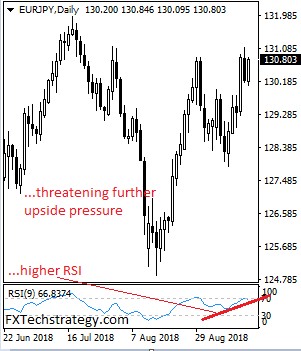
EURJPY: With the pair seeing taking back its Friday losses during Monday trading session, a resumption of its short term uptrend is now likely. Support comes in at the 130.50 level where a break if seen will aim at the 130.00 level. A cut through here will turn focus to the 129.50 level and possibly lower towards the 129.00 level. On the upside, resistance resides at the 131.00 level. Further out, we envisage a possible move towards the 131.50 level. Further out, resistance resides at the 132.00 level with a turn above here aiming at the 132.50 level. On the whole, EURJPY continues to face further upside pressure with trend resumption on the cards.
EUR/USD Mid-Day Outlook
Daily Pivots: (S1) 1.1588; (P) 1.1656; (R1) 1.1690; More.....
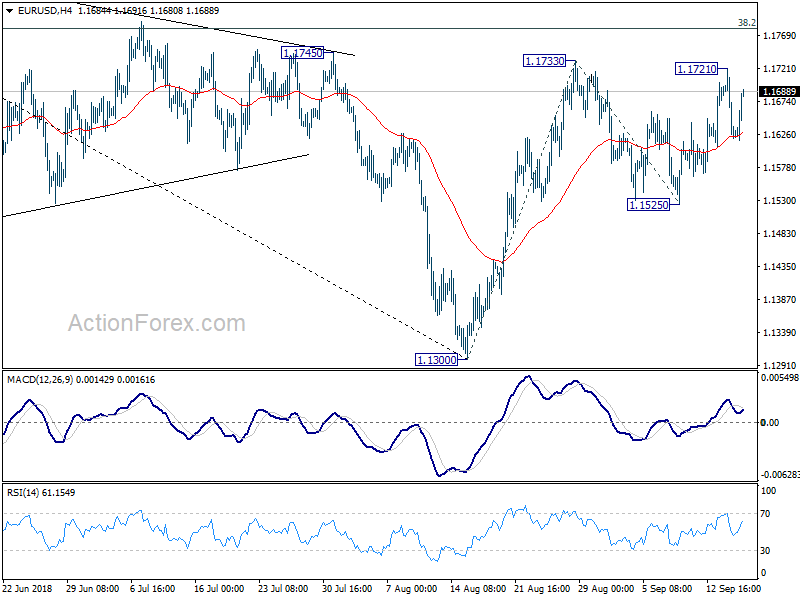
EUR/USD is staying below 1.1721 and intraday bias remains neutral. Rebound from 1.1300 could extend through 1.1733 resistance. But we'd expect strong resistance from 38.2% retracement of 1.2555 to 1.1300 at 1.1779 to limit upside, at least on first attempt, to bring near term reversal. On the downside, break of 1.1525 support will indicate completion of this corrective rebound. Retest of 1.1300 low should then be seen. However, firm break of 1.1779 will extend the rise to 100% projection of 1.1300 to 1.1733 from 1.1525 at 1.1958.
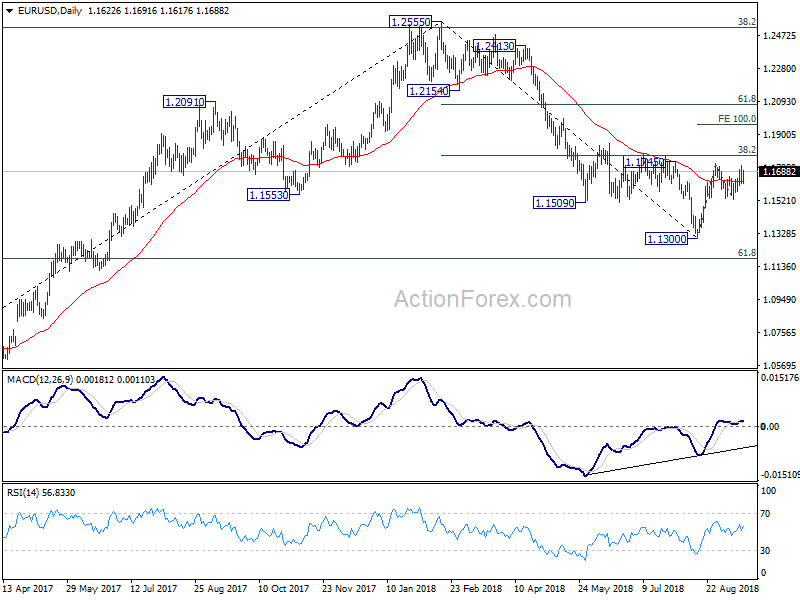
In the bigger picture, a medium term bottom should be in place at 1.1300, on bullish convergence condition in daily MACD and some consolidations would be seen. But still, note that EUR/USD was rejected by 38.2% retracement of 1.6039 (2008 high) to 1.0339 (2017 low) at 1.2516. That carries some long term bearish implications. Thus, we'd expect fall from 1.2555 high to resume after consolidation completes. Below 1.1300 should send EUR/USD through 61.8% retracement of 1.0339 to 1.2555 at 1.1186. And, in that case, EUR/USD would head to retest 1.0339 (2017 low).
GBP/USD Mid-Day Outlook
Daily Pivots: (S1) 1.3037; (P) 1.3088; (R1) 1.3120; More...
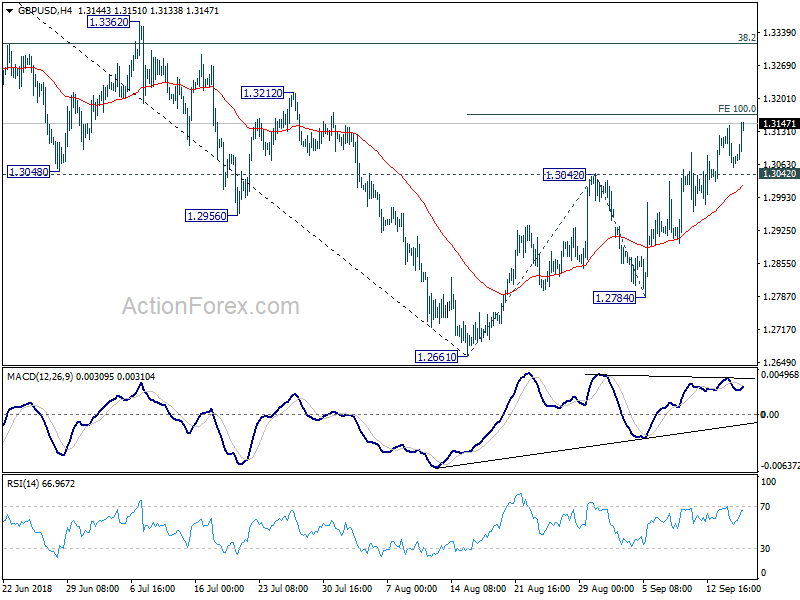
GBP/USD's rally resumes after brief consolidation and reaches and edges higher to 1.3151. Intraday bias is back on the upside for 00% projection of 1.2661 to 1.3042 from 1.2784 at 1.3165 and above. However, as rise from 1.2661 is seen as a corrective move, upside should be limited by 1.3316 key fibonacci level to bring near term reversal. On the downside, break of 1.3042 resistance turn support will argue that rebound from 1.2661 might be completed. In such case, intraday bias will be turned back to the downside for 1.2784 support to confirm.
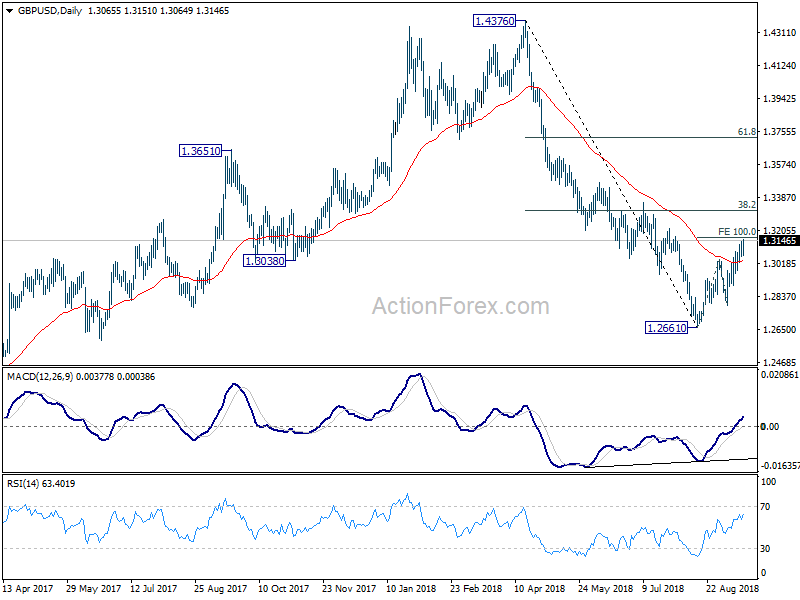
In the bigger picture, whole medium term rebound from 1.1946 (2016 low) should have completed at 1.4376 already, after rejection from 55 month EMA (now at 1.4062). The structure and momentum of the fall from 1.4376 argues that it's resuming long term down trend. And this will be the preferred case as long as 38.2% retracement of 1.4376 to 1.2661 at 1.3316 holds. However, firm break of 1.3316 would bring stronger rebound to 61.8% retracement at 1.3721. And, the eventual depth of the fall from 1.4376, and the chance of hitting 1.1946 low, will depend on the strength of the interim corrective rebound from 1.2661.
USD/JPY Mid-Day Outlook
Daily Pivots: (S1) 111.82; (P) 112.00; (R1) 112.24; More...
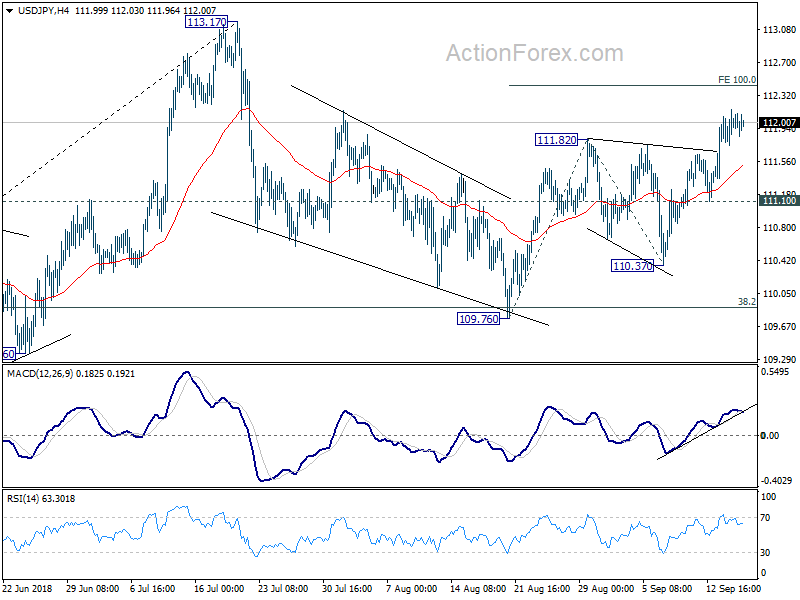
At this point, further rise is expected in USD/JPY. Current rebound from 109.76 should target 100% projection of 109.76 to 111.82 from 110.37 at 112.43 first. Break will target a test on 113.17 high. On the downside, break of 111.10 minor support is needed to signal completion of the rebound. Otherwise, near term outlook is cautiously bullish in case of retreat.
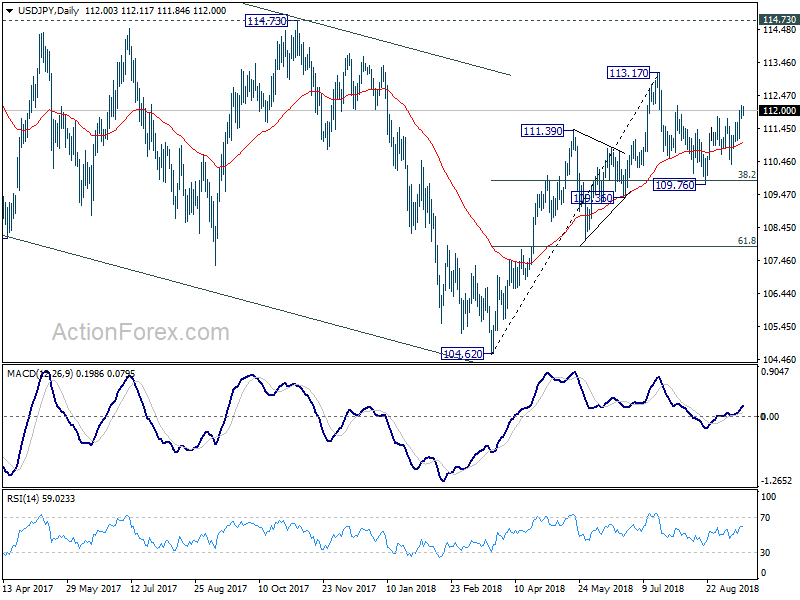
In the bigger picture, corrective fall from 118.65 (2016 high) should have completed with three waves down to 104.62. Decisive break of 114.73 resistance will likely resume whole rally from 98.97 (2016 low) to 100% projection of 98.97 to 118.65 from 104.62 at 124.30, which is reasonably close to 125.85 (2015 high). This will stay as the preferred case as long as 109.36 support holds. However, decisive break of 109.36 will mix up the outlook again. And deeper fall should be seen back to 61.8% retracement of 104.62 to 113.17 at 107.88 and below.
USD/CHF Mid-Day Outlook
Daily Pivots: (S1) 0.9647; (P) 0.9662; (R1) 0.9689; More.....
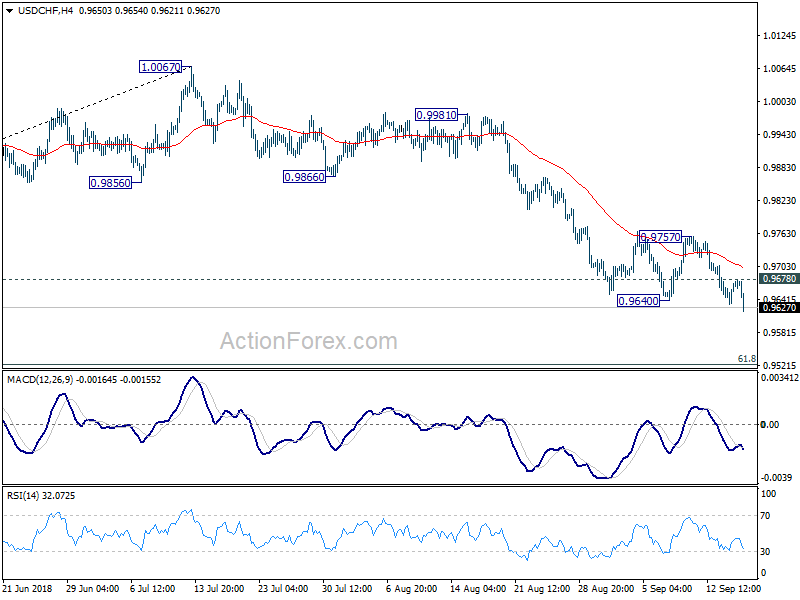
USD/CHF's decline resumes after brief consolidation and hits as low as 0.9621 so far. Intraday bias is back on the downside. Current fall from 1.0067 should target 0.9523 fibonacci level next. On the upside, break of 0.9678 minor resistance will turn intraday bias neutral again. But near term outlook will stay bearish as long as 0.9757 resistance holds.
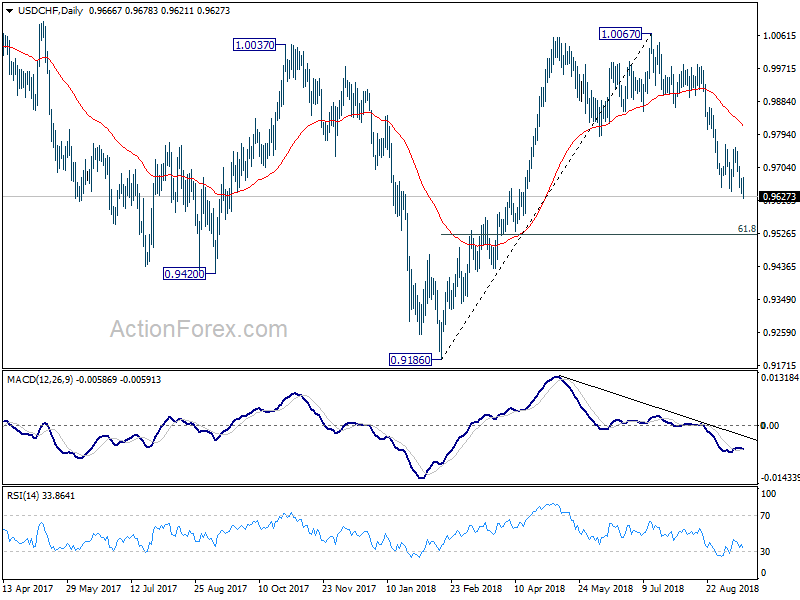
In the bigger picture, rise from 0.9186 low has completed at 1.0067, after failing to sustain above 1.0037 resistance. Fall from 1.0067 could extend to 61.8% retracement of 0.9816 to 1.0067 at 0.9523 and below. But for now, we don't expect a break of 0.9186 low. On the upside, firm break of 0.9866 support turned resistance will suggests that fall from 1.0067 has completed and rise from 0.9186 is resuming.
Dollar and Yen Back Under Pressure as Tariffs Rumor Hasn’t Turned into Reality Yet
Dollar and Yen are back under selling pressure today. In particular, USD/CHF and GBP/JPY take the lead in resuming recent moves. GBP/USD is following closely with eye on 1.3142 minor resistance. Both currencies received no special lift from news that Trump is going to impose new tariffs on China. Trump tweeted that "tariffs have put the U.S. in a very strong bargaining position". But there was no hint on when the tariffs will be formally announced. Traders could turn a bit cautious and won't commit until it's formalized. Secondly, the rumored 10% tariffs are much lower than the original figure of 25%. And the impact would possibly be a notch down.
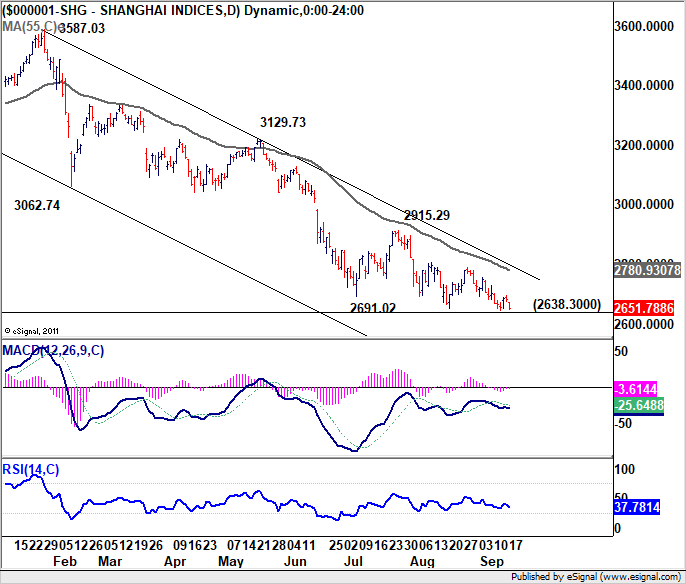
In other markets, global equities are generally down but losses are so far limited too. At the time of writing, FTSE is down -0.22%, DAX id won -0.46%, CAC is down -0.16%. Earlier today, Hong Kong HSI closed down -1.3% and Singapore Strait Times lost -0.63%. Nikkei was on holiday. China's Shanghai SSE dropped -1.11% to 2651.79, lowest in nearly four years. Key support level at 2638.30 looks more vulnerable than ever. However, it's unsure whether downside momentum will pick up again when this key support is broken. Gold continues to gyrate in tight range below 1200.
Technically, focus is first on 1.3142 temporary in GBP/USD. Then 1.1733 in EUR/USD and 131.10 in EUR/JPY will be watched to see in Euro can catch up with Swiss Franc and Sterling. Or, EUR/GBP will break 0.8875 temporary low and leave the Euro behind.
Released in US session, US Empire State manufacturing index dropped to 19 in September, down from 25.6, missed expectation of 23.2. Canada International securities transactions rose to CAD 12.65B in July.
IMF: Disruptive Brexit could lead to a significantly worse outcome
In an IMF report on UK, the organization expect growth to remain "moderate in the near term", averaging around 1.5% in 2018 and 2019. However, it wanted that " A more disruptive departure from the EU could lead to a significantly worse outcome, especially if it were to occur without an implementation period. ". On the other hand, "an agreement featuring fewer impediments to trade than currently expected could buoy business and consumer confidence, leading to faster growth.".
IMF Managing Director Christine Lagarde also said, "compared with today's smooth single market, all the likely Brexit scenarios will have costs for the economy and to a lesser extent as well for the EU." And she warned that "The larger the impediments to trade in the new relationship, the costlier it will be. This should be fairly obvious, but it seems that sometimes it is not."
In addition to Brexit, UK also faces a range of other economic challenges. These include "persistently lackluster productivity growth, large public debt, and the wide current account deficit." Nonetheless, UK's "sound macroeconomic framework, regulatory environment, and deep capital and flexible labor markets will be advantages in implementing reforms to address them."
UK Chancellor of Exchequer Philip Hammond urged the government to listen to the "clear warnings" of the IMF of no-deal Brexit. Though, he also noted that no-deal outcome is unlikely even though it's not impossible.
UK PM May believes parliament will vote for her Brexit deal with EU
UK Prime Minister Theresa May expressed her confidence that the parliament will vote for any Brexit deals that she strikes with the EU. She added that "parliament will vote for a deal because people will see the importance of a deal that maintains a good trading relationship with the EU … but gives us the freedom to take the benefits and opportunities of Brexit."
Also regarding the possibility of being rejected by the Parliament, she said "do we really think … we've been through this negotiation we get to the point where we've agreed a deal that if parliaments was to say no go back and get a better one, do you really think the European Union is going to give a better deal at that point." And, "the alternative to that will be having no deal."
Separately, Austrian Chancellor Sebastian Kurz said EU should "do everything possible to avoid a hard Brexit". French President Emmanuel Macron said "it's indispensable that we reach an agreement and that European Union rules be fully maintained."
BCC downgraded UK growth forecasts, economy to grow at a snail's pace
The British Chambers of Commerce downgraded UK growth forecasts, citing "weaker outlook for trade and investment" as main reasons. Key points in the new forecasts:
- 2018 GDP growth at 1.1%, down from 1.3%. 2019 GDP growth at 1.3%, down from 1.4%. 2020 GDP growth at 1.6%, unchanged.
- 2018 exports growth at 1.7% only, down from 2.8% in prior forecast.
- 2018 total investment growth at 1.4%, down from 1.8%. 2019 at 1.4% and 2020 at 1.5%.
- BoE expected to hike in Q1 2019 and Q2 2020. Bank rate to hit 1.25% by the end of the forecast period.
Adam Marshall, Director General of the BCC said that the UK economy as a whole is set to grow at a "snail's pace". Brexit uncertainty "continues to weigh heavily on many firms" as "most of the practical questions" remained unanswered. And, the "lack of precision" of future relationship with the EU "is lowering expectations for both business investment and export growth." He also warned that "the drag effect on investment and trade would intensify in the event of a 'messy' and disorderly Brexit".
Bundesbank: Germany just went through temporary period of weakness
Bundesbank's monthly economic report noted that the economic growth in Germany remains fundamentally intact. Slowdown during the summer was mainly due to car makers. And, "as soon as the conversion problems in the automotive industry have been solved, the pace of macroeconomic expansion should pick up again significantly"
It also said "continued positive mood of businesses, which according to the Ifo Institute's surveys has recently also improved in industry, points to a temporary period of weakness."
Both Bundesbank and the Economy Ministry expect manufacturing to shift to a higher gear in the common months.
ECB Coeure wants more clarity on pace of rate hike when conditions warrant
ECB Executive Board member Benoit Coeure urged the central to give more details in the forward guidance, regarding the pace of rate hike when it starts. He said, "should economic conditions warrant, there might be a case for the Governing Council to go beyond the timing to lift-off (rates) in further clarifying the pace at which it expects to remove policy accommodation."
And, "a further clarification of our reaction function might help market participants and the broader public to better anticipate the likely future path of short-term interest rates."
Currently, ECB's plan is to half the monthly asset purchase to EUR 15B starting October, and stop it after December. Interest rates would stay at present levels through the summer of 2019.
ECB Makuch: Unguided missile Trump is the biggest threat to Eurozone economy
ECB Governing Council member Jozef Makuch said risks to the Eurozone are broadly balanced and the central bank's stance was correct. He added policy makers were "not underestimating the risks" but "analyzing them". And, "based on what we know now, the development is stable, risks are balanced, with some downside risks to GDP growth." He also noted there is no reason to "spread gloomy mood or panic".
Makuch also pointed out that Trump is like an "unguided missile" and the unpredictably of his policies is the biggest risks of the Eurozone economy. He noted that the erratic nature of Trump as "he says something and in the end something else happens". Meanwhile, he played down risks from emerging markets and said the governing council sees no signs of spillover.
Meanwhile, Makuch is considering stepping down early as head of Slovakia's central bank. He's term supposedly end in 2021. He noted that the elections in spring 2020 would be highly divisive. That could lead to the post being vacant for an extended period. To him, Finance Minister Peter Kazimir would be a "good governor" to replace him. He hailed that Kazimir "Ecofin deals with all important monetary issues", so the lack of experience in central banking is not a problem.
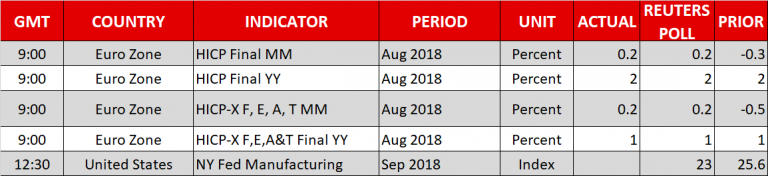
Eurozone CPI finalized at 2.0%, Core CPI at 1.0%
Eurozone CPI was finalized at 2.0% in August, down from 2.1% in July. That was still notably higher than 1.5% back in August 2017. Core CPI was finalized at 1.0% yoy. EU CPI was finalized at 2.1%, down from July's 2.2%.
Highest contribution to Eurozone CPI was from energy (0.87%), followed by services (0.59%), food, alcohol & tobacco (0.48%) and non-energy industrial goods (0.09%).
USD/CHF Mid-Day Outlook
Daily Pivots: (S1) 0.9647; (P) 0.9662; (R1) 0.9689; More.....
USD/CHF's decline resumes after brief consolidation and hits as low as 0.9621 so far. Intraday bias is back on the downside. Current fall from 1.0067 should target 0.9523 fibonacci level next. On the upside, break of 0.9678 minor resistance will turn intraday bias neutral again. But near term outlook will stay bearish as long as 0.9757 resistance holds.
In the bigger picture, rise from 0.9186 low has completed at 1.0067, after failing to sustain above 1.0037 resistance. Fall from 1.0067 could extend to 61.8% retracement of 0.9816 to 1.0067 at 0.9523 and below. But for now, we don't expect a break of 0.9186 low. On the upside, firm break of 0.9866 support turned resistance will suggests that fall from 1.0067 has completed and rise from 0.9186 is resuming.
Economic Indicators Update
| GMT | Ccy | Events | Actual | Forecast | Previous | Revised |
|---|---|---|---|---|---|---|
| 23:01 | GBP | Rightmove House Prices M/M Sep | 0.70% | -2.30% | ||
| 09:00 | EUR | Eurozone CPI M/M Aug | 0.20% | -0.30% | -0.30% | |
| 09:00 | EUR | Eurozone CPI Y/Y Aug F | 2.00% | 2.10% | 2.10% | |
| 09:00 | EUR | Eurozone CPI Core Y/Y Aug F | 1.00% | 1.00% | 1.00% | |
| 12:30 | CAD | International Securities Transactions (CAD) Jul | 12.65B | 4.35B | 11.55B | 10.30B |
| 12:30 | USD | Empire State Manufacturing Index Sep | 19 | 23.2 | 25.6 |
Gold Still Consolidating; Unable to Break Narrow Range
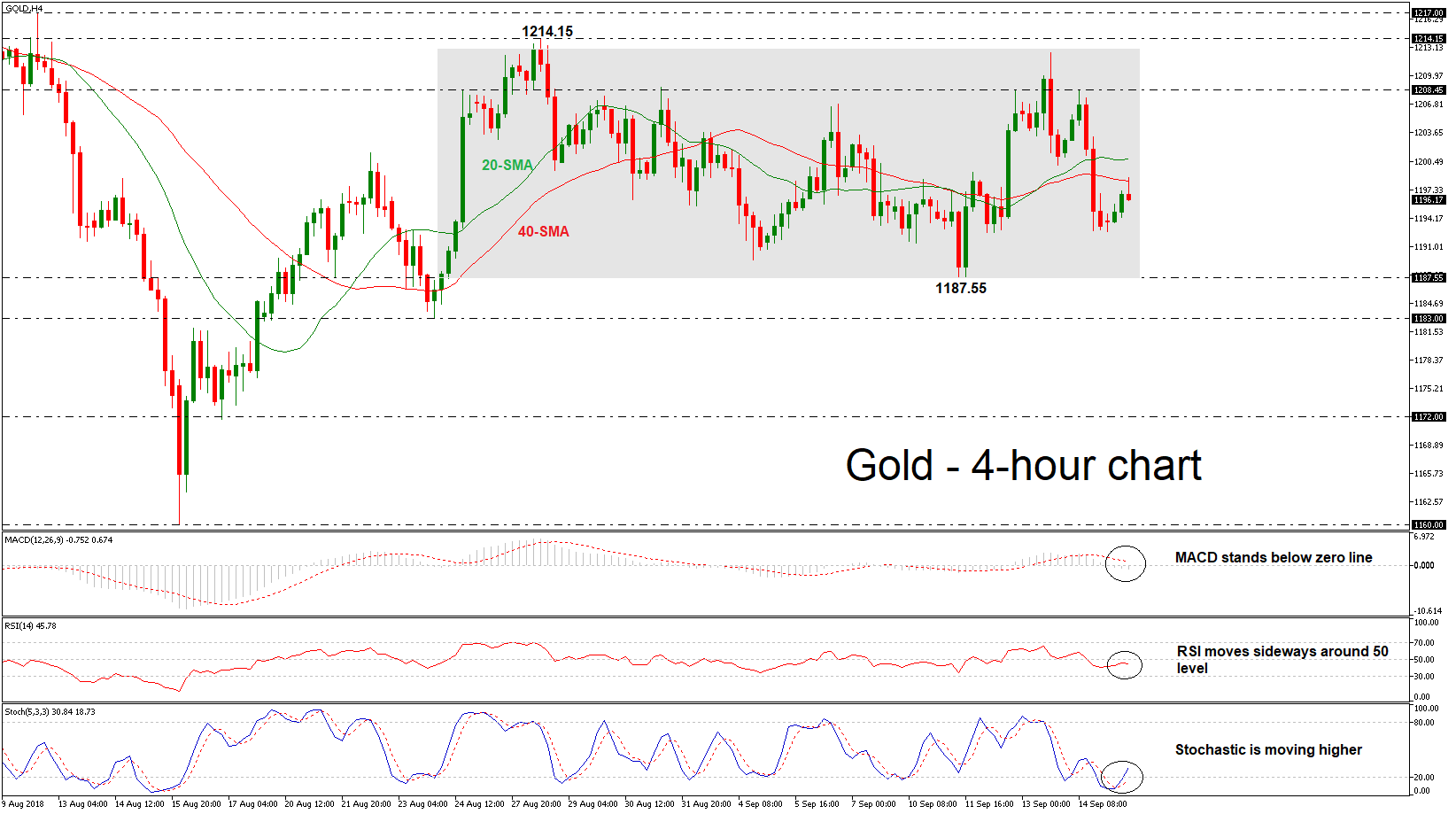
Gold still trades below the 20- and 40-period simple moving averages (SMAs) on the 4-hour chart, however, it was moving higher during the last couple of candles. The market appears to be largely in a neutral mode after the fall below the 1214.15 hurdle. Notice that the RSI is mostly moving sideways below the 50 level, while the %K line of the stochastic oscillator posted a bullish crossover with the %D line in the oversold zone, indicating more advances. Though, the MACD remains below both its trigger and zero lines.
If price action jumps above the SMAs, there is scope to test the 1208.45 resistance level, taken from the latest high. Clearing this key level could see additional gains towards the 1214.15 – 1217 resistance zone, identified by the peaks on August 28.
On the flipside, if the precious metal dips below the 1187.55 key level, then the focus would shift towards the 1183 support hurdle, identified by the low on August 24. If this level is breached too, it would increase downside pressure and may bring about a continuation of the bearish tendency. From there, the metal would be on the path towards the 1172 low.
To conclude, despite the neutral short-term bias, in the bigger picture the price has been developing in bearish mode since the pullback on the 1365 resistance barrier.
Canadian Dollar Subdued at 1.30
The Canadian dollar is trading sideways in the Monday session. Currently, USD/CAD is trading at 1.3000, down 0.07% on the day. On the release front, it’s a quiet start to the week. Canada releases foreign security purchases and the U.S publishes the Empire State Manufacturing Index, which is expected to slip to 23.2 points. On Tuesday, Canada releases Manufacturing Sales.
With only a handful of key fundamental events early in the week, investors will be keeping a close eye on the US-China trade spat. The two economic giants have already exchanged tariffs on the other’s products, and President Trump has threatened to sharply up the ante and impose tariffs of some $200 billion on China. Trump may be bluffing, but his rhetoric could torpedo trade talks with China. The timing of any new tariffs remains uncertain, as well as the level of the tariffs – will they be 10% or a far more punitive 25%? Investors remain on alert, and the specter of another tariff announcement from the U.S and the likely retaliatory response from China could boost the U.S. dollar this week. If the U.S does go ahead with further tariffs, it could put a chill on more than the equity markets. According to a report from UBS, a tariff of 10% on Chinese products could slow U.S growth in the fourth quarter and result in the Federal Reserve skipping a December rate hike.
Canadian and U.S negotiators continue to insist that the sides will hammer out a new NAFTA agreement, but investors have their doubts. There are have been no three-way talks since August, and a senior Mexican negotiator said that Mexico would like to conclude a three-way agreement but was prepared to advance bilaterally with the United States. Ottawa cannot afford to be left out of NAFTA, and has made concessions to open up its dairy sector to US producers. However, President Trump could squeeze further concessions out of Canada before agreeing to a deal. If the deadlock continues, the uncertainty could weigh on the Canadian dollar.
Euro, Pound Resume Bullish Mood as Trade Risks Intensify
Here are the latest developments in global markets:
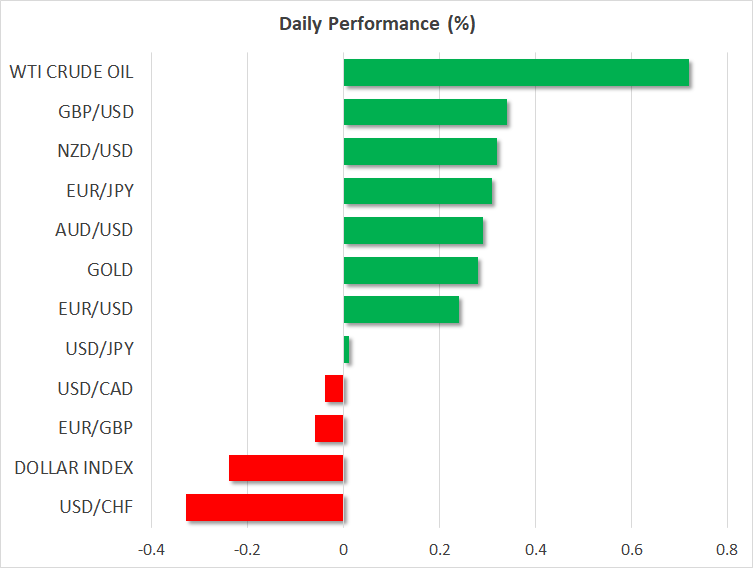
- FOREX: During the early European session, the US dollar was slightly weaker against the yen near 112.00 (-0.04%), with investors trading cautiously as the US President Donald Trump is said to announce new levies on China later today. The Eurozone Harmonized Consumer Price Index (HCPI) for the month of August released earlier today, confirmed the preliminary estimates. The yearly headline inflation remained the same as in the previous month at 2.0%, while the monthly gauge increased by 0.2% from -0.3% previously. Euro/dollar was moving higher by 0.21% at 1.1655 after the HCPI announcement. Pound/dollar was struggling to cross above 1.31, last seen at 1.3095 (+0.18%). In Brexit-related news, the London mayor Sadiq Khan called for another referendum on Britain’s European Union membership. Turning to the antipodean currencies, aussie/dollar traded higher by 0.34% on the day, though it held near 2 ½ -year lows as trade concerns continued to linger in the background, while kiwi/dollar was also up by 0.32% at 0.6568. Dollar/loonie was fluctuating around 1.3022, near its opening level.
- STOCKS: Most of the European stocks were in the red at 1045 GMT as investors resumed risk-off sentiment in speculation of additional US import tariffs on Chinese goods. The pan-European STOXX 600 fell by 0.13%, while the blue-chip Euro STOXX declined by 0.26%. The export-oriented German DAX 30 dropped by 0.46%, the French CAC 40 fell by 0.29%, whilst the Italian FTSE MIB rose by 0.51%. The British FTSE 100 decreased by 0.38%, while the Spanish IBEX 35 went up by 0.37% led by consumer non-cyclicals. In the US, indices tracking futures such as Nasdaq 100, S&P 500 and Dow Jones were poised to open lower but only modestly so.
- COMMODITIES: Oil prices edged higher on Monday despite the US Energy Secretary saying in Moscow on Friday that the US, Saudi Arabia, and Russia could raise global output in the next 18 months to mitigate supply shortfalls in Iran and other regions. Note that the NAFTA talks with Canada also made no progress so far. West Texas Intermediate (WTI) crude oil climbed by 0.68% to $69.46 per barrel and Brent advanced by 0.64% to $78.59 per barrel. In precious metals, gold is developing in a narrow range around $1195, adding 0.34% to its performance today.
Day ahead: Trade fears to weigh on sentiment; RBA meeting minutes awaited
In the remainder of the day, investors will be eagerly waiting for further updates regarding the US-Sino trade war as worries about tensions tightening even more between the nations resurfaced on Sunday. Particularly the Wall Street Journal reported on Sunday that Washington will activate import tariffs on Chinese goods as soon as today, though the size of the tariffs might be around 10% compared to 25% considered earlier. China is ready to take countermeasures in case Washington proceeds with its protectionist plans, with the Chinese foreign ministry also claiming today that talks between the countries on September 20 “should take place in on an equal footing”. The latter could be a signal that China will not hesitate to cancel talks if the US refuses to back down from additional frictions.
Brexit will be another topic in focus following negative comments by the IMF chief Christine Langarde today. The IMF chairwoman argued that the Institute is finalizing its forecasts for a reduction of UK economic growth in case of a no-deal Brexit while expecting many adverse effects as a result of the divorce. Moreover, she stressed that fiscal stimulus will not be helpful after the exit from the EU. Meanwhile, the Times newspaper stated that the EU Brexit negotiator is working on plans aiming to use technology to limit checks in the Irish border.
In terms of data releases, the New York Empire State Manufacturing Index published by the New York Federal Reserve Bank will be the main highlight in the calendar later in the day. Forecasts hint that manufacturing business conditions in the state have slowed down in September, with the index projected to drop by 2.4 points to 23.20.
Early on Tuesday at 0130 GMT, the Reserve Bank of Australia will publish minutes from its latest policy meeting on September 4 to give a detailed explanation about its decision to keep interest rates unchanged at a record low of 1.5% for the 24th consecutive month. Investors will be carefully reading the records of the meeting to identify any changes in the language that could indicate adjustments in policymakers’ appetite for further rate hikes in the future. Although the central bank reiterated that growth in the Australian economy will average a bit above 3.0% in 2018 and 2019, it maintained a cautious stance against US trade policy, characterizing it as a risk to the global growth outlook. Subdued household income remained a concern as well.
As for public appearances, at 1200 GMT, ECB Executive Board Member Yves Mersch will step up to the rostrum for the unveiling of the new €100 and €200 banknote at the ECB headquarters in Frankfurt.
Into US session: Trade war risks ignored, Europeans strong, Dollar and Yen Weak
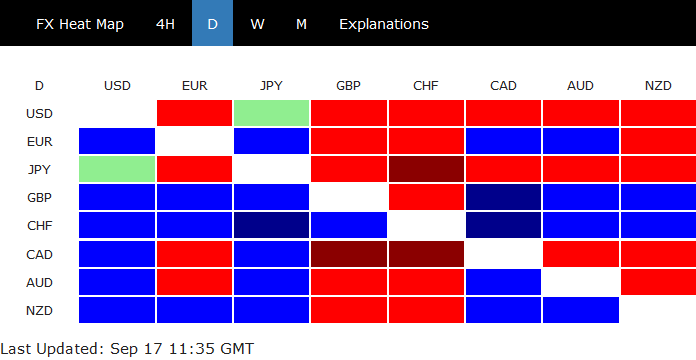
Entering into US session, Dollar and Yen are trading as the weakest ones. Europeans are the strongest ones. Reactions to the possibility of new tariffs on China are relatively muted so far. Asian stocks were down but losses were limited. Forex markets looked like they shrugged off the news. There are two possible explanations. Firstly, traders may be waiting for the news to be confirmed before acting. Secondly, the rumored 10% tariffs are much less severe than the original proposed 25%. Now, focus is immediately back on last week's low of Dollar and Yen against Europeans. In particular, the closest levels are 0.9633 in USD/CHF, 1.3142 in GBP/USD and 147.00 in GBP/JPY.
Major European indices are trading slightly softer at the time of writing. FTSE is down -0.13%, DAX down -0.32%, CAC down -0.05%. Earlier today, Hong Kong HSI closed down -1.3% and Singapore Strait Times lost -0.63%. Nikkei was on holiday.
In particular, China's Shanghai SSE dropped -1.11% to 2651.79, lowest in nearly four years. Key support level at 2638.30 looks more vulnerable than ever. However, it's unsure whether downside momentum will pick up again when this key support is broken.