

Sample Category Title
European Indices Trade Mainly Lower As The US Prepares Further Tariffs On China
Notes/Observations
- European Indices reverse earlier losses to trade mainly higher after weakness in Asia
- President Trump could announce further $200B in tariffs on China as early as today
- Cable rises on optimism ahead of EU Summit later this week
Asia:
- Pres Trump reportedly told advisers to proceed with $200B tariffs on China; tariff level likely to be around 10%, below the 25% previously announced at time of initial announcement
- China official reportedly considering declining offer of talks noting they won't negotiate with a gun to their head
Europe:
- British Chambers of Commerce (BCC) cuts 2018 UK GDP growth forecast to 1.1% vs 1.3% prior; Cuts 2019 GDP 1.4% to 1.3%
- Italy government is considering tax breaks for small Italian investors who buy domestic government bonds and keep them to maturity
- EU Brexit negotiator Barnier said to eye an Irish border plan to unlock Brexit talks; British rather than EU officials could take charge of checking NI-bound goods
- Riksbank minutes reveal members moving towards rate hike soon
Economic Data:
- (EU) EURO ZONE AUG FINAL CPI Y/Y: 2.0% V 2.0%E; CPI CORE Y/Y: 1.0% V 1.0%E
- (NO) Norway Aug Trade Balance (NOK): 31.8B v 24.5B prior
- (CZ) Czech Aug PPI Industrial M/M: +0.1% v -0.1%e; Y/Y: 3.3% v 3.1%e
- (AT) Austria Aug CPI M/M: 0.0% v -0.2% prior; Y/Y: 2.2% v 2.1% prior
- (TR) Turkey Jun Unemployment Rate: 10.2% v 9.7% prior
- (TR) Turkey July Industrial Production M/M: 3.5% v -1.0%e; Y/Y: 5.6% v 1.2%e
- (CZ) Czech July Export Price Index Y/Y: 1.8% v 0.5% prior; Import Price Index Y/Y: 2.5% v 0.7% prior
- (IT) Italy July Total Trade Balance: €5.7B v €5.2B prior; Trade Balance EU: €2.7B v €1.6B prior
Fixed Income Issuance:
- (NO) Norway sells NOK6.0B vs. NOK6.0B indicated in 6-month bills; Avg Yield: 0.89% v 0.72% prior; Bid-to-cover: 2.24x v 3.17x prior
SPEAKERS/FIXED INCOME/FX/COMMODITIES/ERRATUM
Equities
- Indices [Stoxx50 +0.1% at 3,348, FTSE -0.2% at 7,291, DAX -0.2% at 12,100, CAC-40 flat at 5,351; IBEX-35 +0.6% at 9,417, FTSE MIB +0.7% at 21,019, SMI -0.3% at 8,936, S&P 500 Futures -0.1%]
- Market Focal Points/Key Themes: European indices open broadly down, but reverse to trade slightly higher as the session wore on; risk sentiment off over trade concerns; US President Trump could announce additional $200B tariffs on Chinese goods as early as today; press reports of potential agreement on Irish border help assuage Brexit concerns; financial sector better performer, while technology leads to the downside; Ralley signs debt facility, supporting Casino shares; Chile closed for holiday; earnings expected in the upcoming US session include FedEx and Oracle, additionally master trust data; attention on upcoming interest rate decisions this week, including BOJ, RBA and SNB
Equities
- Consumer discretionary: Boohoo.com BOO.UK +0.9% (New CEO), Hennes & Mauritz HMB.SE +11.4% (quarterly sales, potential credit deal), Melia Hotels MEL.ES +0.1% (analyst action)
- Consumer staples: Dairy Crest DCG.UK +1.6% (trading update)
- Financials: Credit Suisse CSGN.CH -0.1% (Swiss regulator observation), Scor SCR.FR +1.2% (new offer)
- Healthcare: Argenx ARGX.BE +4.9% (study results), Realm Therapeutics RLM.UK -12.0% (potential sale of company), UCB UCB.BE -0.1% (analyst action)
- Industrials: Kongsberg Gruppen KOG.NO +1.5% (awarded order)
- Materials: Petra Diamonds PDL.UK +4.4% (results)
Speakers
- (UK) UK PM May: Thank Parliament will vote to support a possible Brexit deal
- (CN) China Foreign Ministry: If the US implements new tariffs, then China will take necessary response; Talks should take place on an equal footing
- (FR) France Pres Macron: It is indispensable to find accord for Brexit - Speaking alongside Austria's Kurz
- (UK) Chancellor of the Exchequer Hammond (Fin Min): UK is fundamentally strong ahead of Brexit; No deal is unlikely but not impossible
Currencies
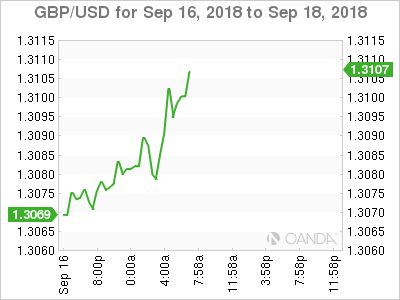
- GBPUSD rises above 1.31 once again on optimism ahead of the EU summit on Thursday up over 0.2%
- Emerging market currency's trade under pressure once again on tariffs threats, with the USDTRY over 1.5% higher the USDINR over 0.8% higher as Government plans over the weekend to curb the fall fail to lift the rupee.
Fixed Income
- Bund Futures trades at 159.14 down 10 ticks as December Bund stays under pressure. Resistance moves to 161.82 then 163. A downside break of 159.85 sees 158.69 initially.
- Gilt futures trades at 121.53 down 2 ticks following the move in Treasuries. Continued support at 122.50, with a continued move higher targeting 123.93 then 124.00.
- Monday 's liquidity report showed Friday's excess liquidity fell from €1.904T to €1.886T. Use of the marginal lending facility rose from €40M to €74M.
- Corporate issuance saw high grade issuers raise $33.4B in the primary market last week
Looking Ahead
- 06:00 (IL) Israel Q2 Current Account: No est v $1.9B prior
- 06:00 (IL) Israel Aug Trade Balance: No est v -$2.3B prior
- 07:25 (BR) Brazil Central Bank Weekly Economists Survey
- 07:30 (BR) Brazil July Economic Activity (monthly GDP) M/M: No est v 3.3% prior; Y/Y: No est v 1.8% prior
- 08:05 (UK) Baltic Dry Bulk Index
- 08:30 (US) Sept Empire Manufacturing: No est v 25.6 prior
- 08:30 (CA) Canada July Int'l Securities Transactions (CAD): No est v 11.6B prior
- 09:00 (CA) Canada Aug Existing Home Sales M/M: No est v 1.9% prior
- 16:00 (US) Weekly Crop Progress Report
Markets Flat On Tariff Announcement Expectations
- Investors await new Chinese tariffs;
- Positive Brexit comments offer hope for deal;
- IMF pessimistic on UK outlook particularly in no deal scenario.
It's been a mixed start to the week in financial markets as investors await a possible announcement of new tariffs on China which could come as early as today.
The ongoing conflict between the US and China continues to be a primary driver of market sentiment, with investors concerned about the prospect of a full blown trade war as neither side shows a willingness to blink. It was reported last week that the US invited Chinese officials for further talks, something they were open to but reports over the weekend suggest this wouldn't go ahead if Donald Trump follows through on threats of tariffs on another $200 billion of goods.
With China threatening to cosy up with Russia and the EU if Trump continues with this hostile trade approach, it will be interesting to see how the White House responds as lawmaker opposition may grow. Trump clearly thought this would be a straightforward monetary fight and may have been caught off guard by the willingness to use alternative tactics to fight back. Investors in the US are continuing to take this in their stride for now but that may not last.
The UK will be hoping to use the more hostile and fractured geopolitical environment to its advantage as Brexit negotiations continue. The deadline is fast approaching and we appear to be hearing a more open tone from EU officials who clearly view the risk of no deal Brexit as being very real and damaging and are therefore keen to avoid it. While the EU will still be fully committed to ensuring the UK doesn't cherry pick post-Brexit and the single market integrity is protected, officials will be keen to minimalize divisions.
It's this that I believe will ensure a damaging no deal Brexit is avoided rather than the worry of economic implications for the EU, which of course there also would be. The IMF warned of just that this morning, claiming that even under a broad Brexit agreement the economy will only grow at around 1.5% over the next two year, with a disruptive Brexit being significantly worse.
These pessimistic forecasts for the UK, both in the deal and no deal Brexit scenarios, won't come as a surprise to anyone and will likely be heavily disputed by those Brexiteers who have constantly attempted to downplay the analysis of supposed experts. While the forecasts are gloomy, the expectations for a deal appear to be improving along with the more conciliatory comments in the media which is providing support to sterling.
The pound has run into some resistance around 1.3150 but continues to trade above 1.30 this morning after the IMF forecasts. I think this reflects a slightly more optimistic investor and assuming negotiations don't suddenly turn sour, it could be a sign that the pound sell-off has run out of steam.
Forex Analysis: EURAUD
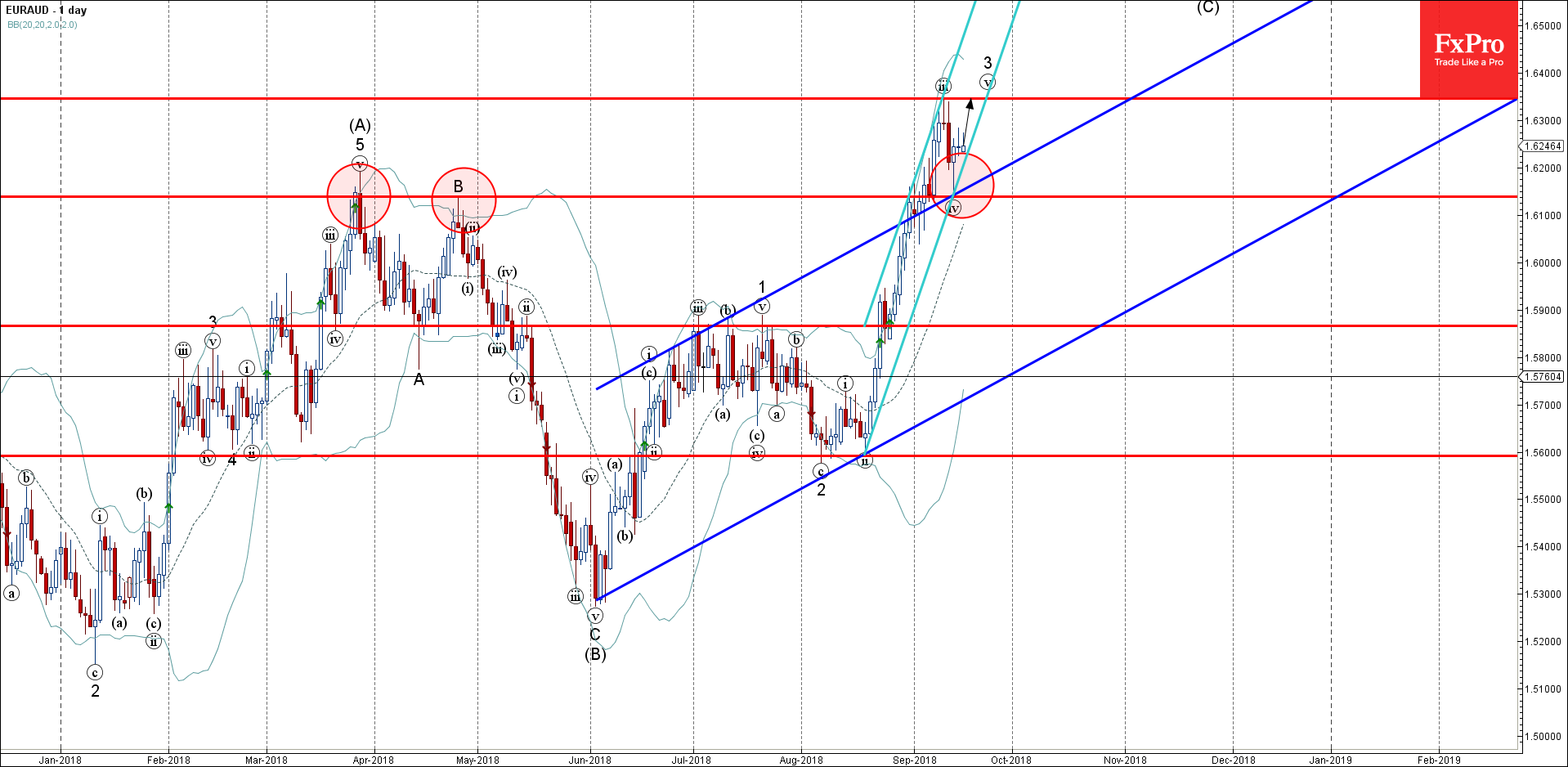
EURAUD reversed from support zone
Further gains are likely
EURAUD recently reversed up with the daily Japanese candlesticks reversal pattern Hammer from the support area lying between the strong support level 1.6140 (former major resistance from March and April) and the upper trendline of the daily up channel from August.
The upward reversal from this support area started the active short-term impulse wave (v) – which belongs to the impulse wave 3 from August.
EURAUD is expected to rise further and retest the next resistance 1.6345 (top of the previous impulse wave (i)).
USDJPY Bullish Pattern Still Working
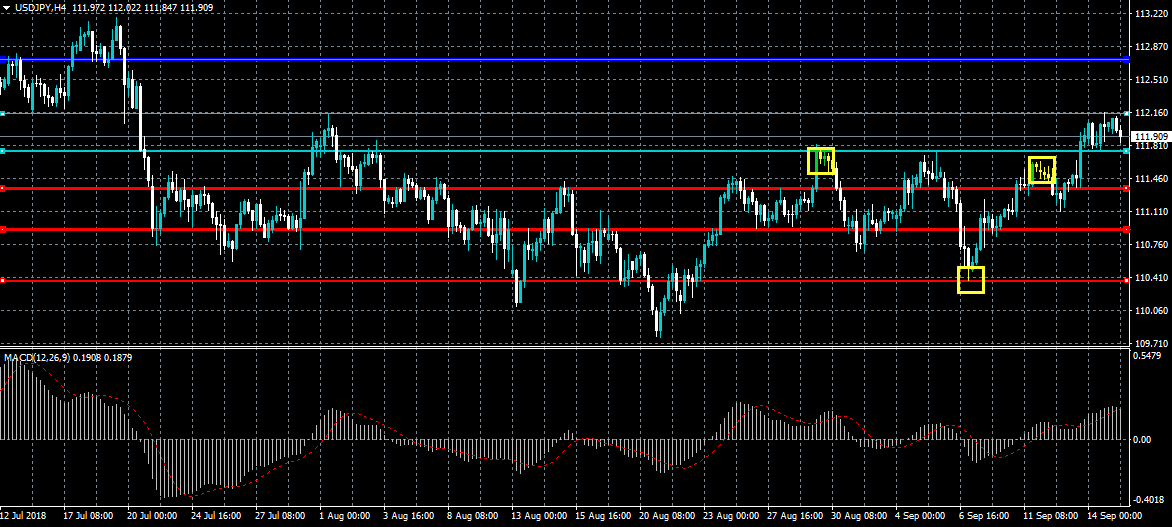
The US dollar has moved below the 112.00 level against the Japanese yen on concerns that US President Donald Trump will announce new trade tariffs on Chinese imports later today. Despite the move below the 112.00 support level, the USDJPY pair remains intraday bullish while trading above the 111.75 level. The bullish inverted head and shoulders pattern across the four-hour time frame suggests that price could reach the 113.00 level.
The USDJPY pair remains bullish while trading above the 111.75 level, key resistance is found at the 112.16 and 112.80 levels.
If the USDJPY pair moves below the 111.75 level, key support is found at the 111.37 and 110.90 levels.
EURUSD Bulls Testing Former Key Resistance Area
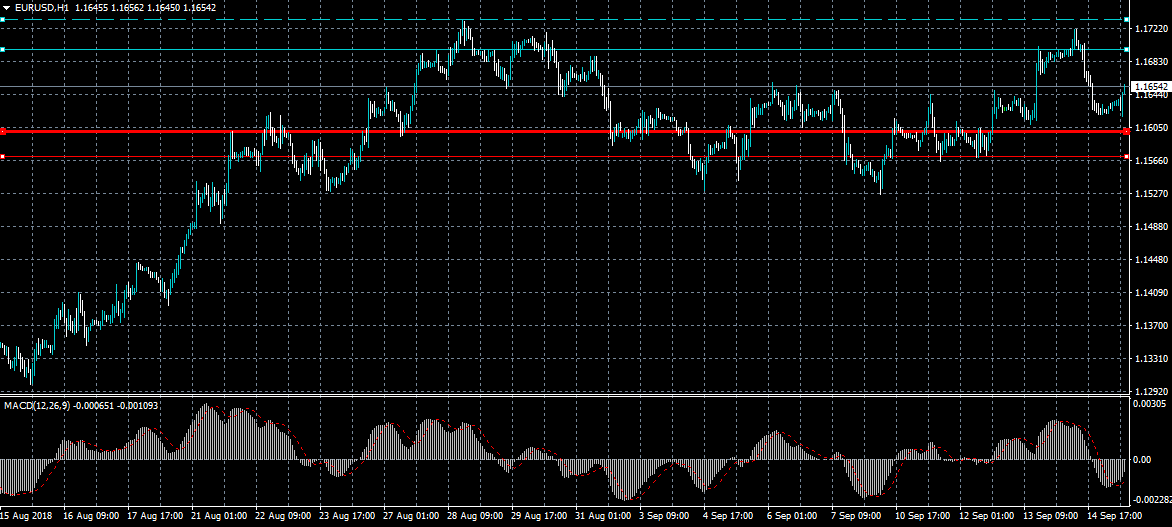
The euro currency has moved away from the worst trading levels of the week so far against the US dollar, as the greenback gives back earlier gains. The EURUSD pair has moved back towards the 1.1650 level, which was a key resistance area buyers struggled to break before last Thursday’s strong move higher. Short-term momentum is currently with buyers as the MACD indicator across the one-hour timeframe continue to trend higher.
The EURUSD pair retains a bullish intraday bias while trading above the 1.1600 level, key resistance is found at the 1.1700 and 1.1730 levels.
If the EURUSD pair moves below the 1.1600 level, sellers will likely to test towards the 1.1577 and 1.1528 support levels.
No Tariffs, Now Tariffs, What Gives?
Monday September 17: Five things the markets are talking about
The possibility of a new round on tariffs on Chinese goods is not helping equity markets this Monday morning. The ‘big' dollar is holding onto Friday's gains as investors try and acclimatize themselves to the ever-fluid trade situation that President Trump seems to be creating himself.
Deflection or negotiation, whatever the reason, markets continue to wait for the counter punch before throwing all in. China is not expected to be a willing dance partner in proposed trade talks later this month if the Trump administration goes ahead with the additional tariffs expected later today.
Note: Tariff level likely to be around +10%, and below the +25% previously announced.
Last week, the outlook for global trade looked improved, however, true to form, inconsistency seems consistent with this Trump administration.
This week, on the central bank front, the Bank of Japan (BoJ) dominates proceedings (Sept 18). However, recent domestic data remains mixed – Q2 GDP was revised upward while monthly core-machine orders rebounded from June's decline and PPI edged downward – and certainlgly disappointing news to Governor Kuroda's inflation fight.
On tap: AUD monetary policy minutes (Sept 17), BoJ rate announcement (Sept 18), U.K CPI and NZD GDP (Sept 19), SNB monetary policy decision & U.K retail sales, CAD retail sales (Sept 21)
1. Stocks see mostly red
The Nikkei 225 was closed for a bank holiday.
Down-under, Aussie stocks were the best performer in the region, as other Asia-Pacific indexes struggled with Sino-U.S trade worries. The ASX 200 rose +0.3% as energy and financial stocks logged solid gains and telecom rallied +1.5%. The negatives were elder care providers due to a planned government probe into the sector. In S. Korea, the Kospi closed down -0.66% on global trade worries.
Stocks in Hong Kong finished lower while China's main Shanghai Composite index fell to its lowest close in four-years overnight on fears that Washington is expected to unveil new tariffs on imported Chinese goods this week.
In Hong Kong, the Hang Seng index ended -1.3% lower, while the China Enterprises index closed down -1.1%. In China, the Shanghai Composite index dropped -1.1%, while the blue-chip CSI300 index also declined -1.1%.
In Europe, regional bourses reverse earlier losses to trade mostly unchanged after weakness in Asia.
U.S stocks are set to open in the ‘red' (-0.1%)
Indices: Stoxx50 +0.1% at 3,348, FTSE -0.2% at 7,291, DAX -0.2% at 12,100, CAC-40 flat at 5,351; IBEX-35 +0.6% at 9,417, FTSE MIB +0.7% at 21,019, SMI -0.3% at 8,936, S&P 500 Futures -0.1%
2. Oil higher as U.S Iran sanctions raise supply concerns, gold higher
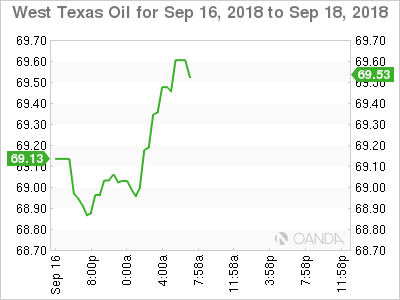
Oil prices remain better bid as the market focuses on the potential impact of U.S sanctions on Iran despite promises by Washington that the Saudis, Russia and the U.S could together raise output fast enough to offset falling supplies.
Brent crude oil is up +45c a barrel at +$78.54, while U.S light crude (WTI) is up +43c at +$69.44.
Note: Washington aims to cut Iran oil exports to force Tehran to re-negotiate a nuclear deal. Iran exports have declined by -580k bpd in the past 90-days.
On Friday, U.S Energy Secretary Rick Perry said that he did not expect any price spikes and that the world's top three oil producers could raise global output in the next 18-months.
Also capping oil prices, U.S drillers added two oilrigs in the week to Sep. 1, bringing the total count up to 749 according to Baker Hughes energy services.
Note: A Joint Technical Committee of OPEC and non-OPEC producers are due to meet today to coordinate production.
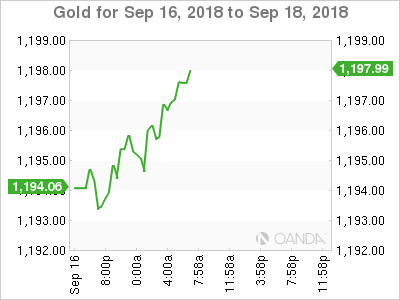
Ahead of the U.S open, gold prices have inched a tad higher as speculators look for short-term gains, amid increasing Sino-U.S trade tensions and prospects of further Fed interest rate hikes. Spot gold is up +0.2% at +$1,195.83 an ounce, after falling -0.6% on Friday when it marked its third straight weekly decline. U.S gold futures are down -0.1% at +$1,199.80.
3. Sweden's Riksbank ready to hike despite low inflation
This morning minutes from Sweden's Riksbank suggests that the board has become more tolerant of downside surprises to inflation and that it is now ready to hike rates before core-inflation has returned all the way to target.
Board members indicated that inflation expectations are “firmly anchored at the target, indicating that this is sufficient to start a very gradual tightening of the currently very expansionary monetary policy.” The bond market is pricing in a +25 bps hike in early Q1, 2019. The SEK is rallying, with EUR/SEK down -0.4% at €10.4774.
Elsewhere, the yield on U.S 10's has fallen -1 bps to +2.99%. In Germany, the 10-year Bund yield is unchanged at +0.45%, while in the U.K, the 10-year Gilt yield has rallied less than -1 bps to +1.53%. The spread of Italy's 10-year BTP's over Bunds has narrowed -8 bps.
4. Sterling rallies on Irish border hopes
GBP (£1.3095) trades atop of the psychological £1.31 handle on optimism of progress on the Irish border question ahead of this week's E.U summit.
E.U chief negotiator Michel Barnier is supposedly working on a plan to minimise physical checks at the Irish border by tracking goods using barcodes on shipping containers.
Note: The first of three Brexit summits will be held on Thursday, and E.U leaders hope a deal can be struck within the next two months.
EUR/USD (€1.1636) little changed. The ‘big' dollar is expected to remain contained this week due to the absence of Tier 1 U.S data releases, while EUR gains may be capped on ongoing Italian concerns.
Emerging market currency's trade under pressure once again on tariffs threats, with the USD/TRY over +1.6% ($6.2554) higher, while the USD/INR is +0.8% higher as the Reserve Bank of India (RBI) plans over the weekend to curb INR's fall fail to lift the rupee.
5. Annual inflation down to +2.0% in the euro area
Data this morning from Eurostat showed that the euro area (19 members) annual inflation rate was +2.0% in August, down from +2.1% in July. A year earlier, the rate was +1.5%.
For the European Union (28 members) annual inflation was +2.1% in August, down from +2.2% in July. A year earlier, the rate was +1.7%.
Digging deeper, the lowest annual rates were registered in Denmark (+0.8%), Ireland and Greece (both +0.9%). The highest annual rates were recorded in Romania (+4.7%), Bulgaria (+3.7%), Estonia (+3.5%) and Hungary (+3.4%).
DAX Slips On Fears Of More US Tariffs On China
The DAX index has started the week in red territory. Currently, the index is at 12,069, down 0.45% on the day. On the release front, Eurozone Final CPI ticked lower to 2.0%, matching the estimate. Final Core CPI also matched the estimate, at 0.1%.
Is the US-China trade war about to get uglier? The world’s two largest economies have already exchanged tariffs, and President Trump has threatened to sharply up the ante and impose tariffs of some $200 billion on China. Trump may be bluffing, but his rhetoric could torpedo trade talks with China. The timing of any new tariffs remains uncertain, as well as the level of the tariffs – will they be 10% or a far more punitive 25%? Investors remain on alert, and the specter of another tariff announcement from the U.S and the likely retaliatory response from China could boost the dollar this week against the euro. If the U.S does go ahead with further tariffs, it could put a chill on more than the equity markets. According to a report from UBS, a tariff of 10% on Chinese products could slow U.S growth in the fourth quarter and result in the Federal Reserve skipping a December rate hike.
The U.S ended the week with mixed numbers. Retail sales in August dropped to 0.1%, down from 0.5% a month earlier. This missed the estimate of 0.4%. Core retail sales followed a similar trend, falling from 0.6% to o.3%. It missed the forecast of 0.5%. These key consumer spending numbers come on the heels of CPI, which came in at just 0.2% and missed the estimate of 0.3%. There was better news from UoM Consumer Sentiment in September, which jumped to 100.8, above the estimate of 96.7 points, This marked the first time that the indicator cracked the 100-level since March.
EUR/USD – Euro Edges Higher As Eurozone CPI Matches Estimate
EUR/USD has posted slight gains in the Monday session. Currently, the pair is trading at 1.1648, up 0.20% on the day. On the release front, it’s a quiet start to the week. Eurozone Final CPI ticked lower to 2.0%, matching the estimate. In the U.S, the Empire State Manufacturing Index is expected to drop to 23.2 points.
With only a handful of key fundamental events early in the week, investors will be keeping a close eye on the US-China trade spat. The two economic giants have already exchanged tariffs on the other’s products, and President Trump has threatened to sharply up the ante and impose tariffs of some $200 billion on China. Trump may be bluffing, but his rhetoric could torpedo trade talks with China. The timing of any new tariffs remains uncertain, as well as the level of the tariffs – will they be 10% or a far more punitive 25%? Investors remain on alert, and the specter of another tariff announcement from the U.S and the likely retaliatory response from China could boost the dollar this week against the euro.
The U.S ended the week with mixed numbers. Retail sales in August dropped to 0.1%, down from 0.5% a month earlier. This missed the estimate of 0.4%. Core retail sales followed a similar trend, falling from 0.6% to o.3%. It missed the forecast of 0.5%. These key consumer spending numbers come on the heels of CPI, which came in at just 0.2% and missed the estimate of 0.3%. There was better news from UoM Consumer Sentiment in September, which jumped to 100.8, above the estimate of 96.7 points, This marked the first time that the indicator cracked the 100-level since March.
Weekly Wave Analysis EUR/USD, GBP/USD, USD/JPY
EUR/USD
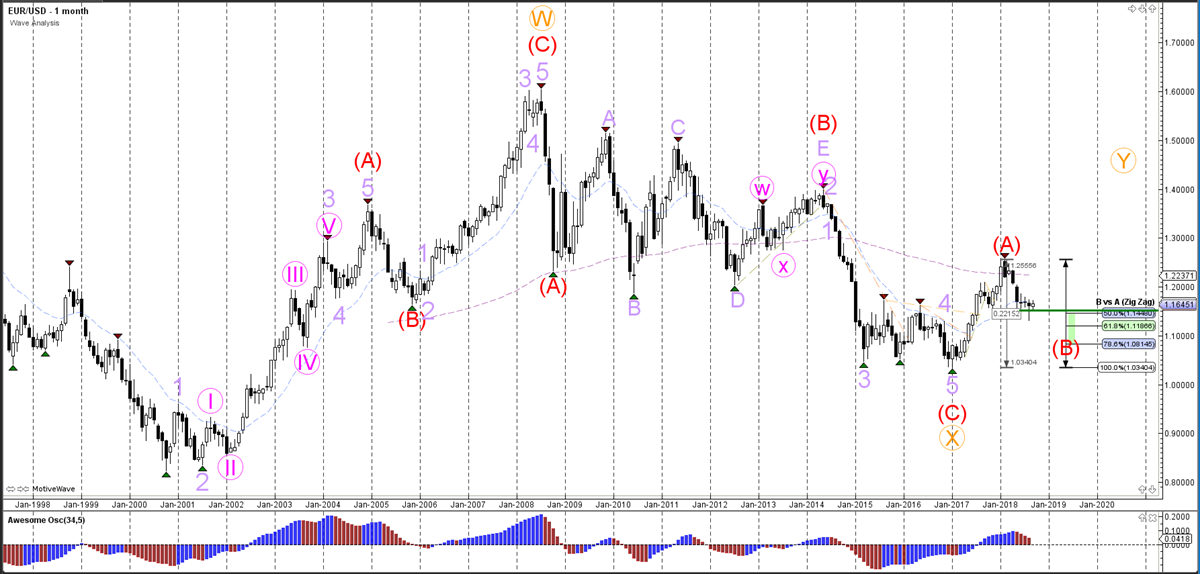
The EUR/USD bounced at the previous top, which could indicate that price will make a deeper pullback within wave B (purple) towards the Fibonacci retracement levels. A break above the previous top could indicate a bullish wave C (purple).
Daily chart:
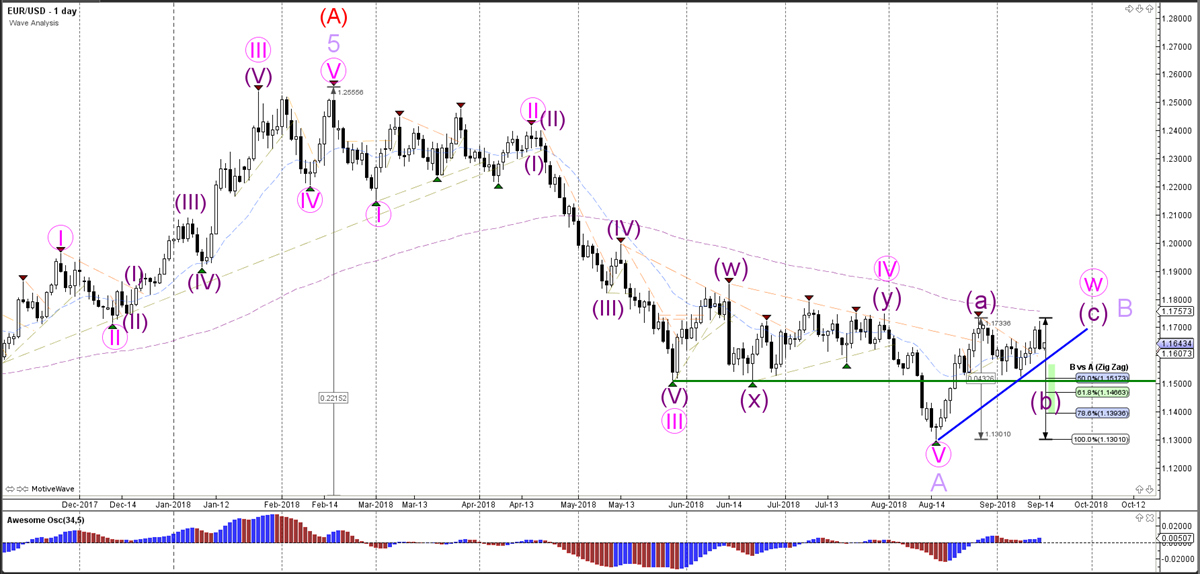
The EUR/USD is probably building a bearish ABC (purple) correction within wave B (red).
Weekly chart:
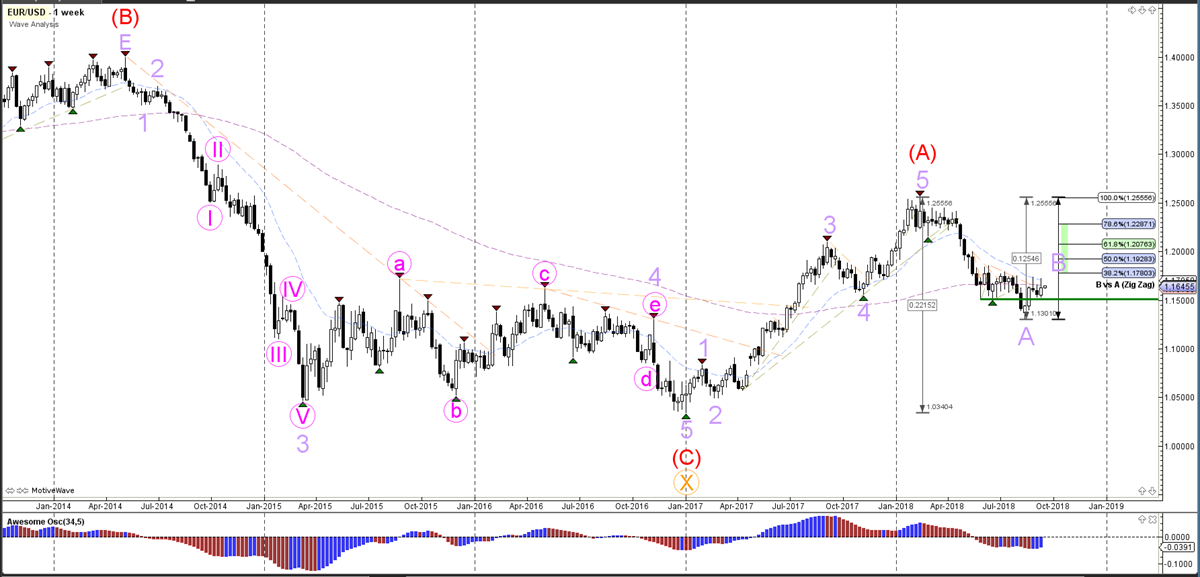
The EUR/USD has completed wave A (red) and price is most likely retracing to the Fibonacci levels of wave B (red).
Monthly chart
GBP/USD
The GBP/USD bullish breakout above the resistance trend line (dotted orange) and is expanding the wave 4 (pink) correction.
Daily chart:
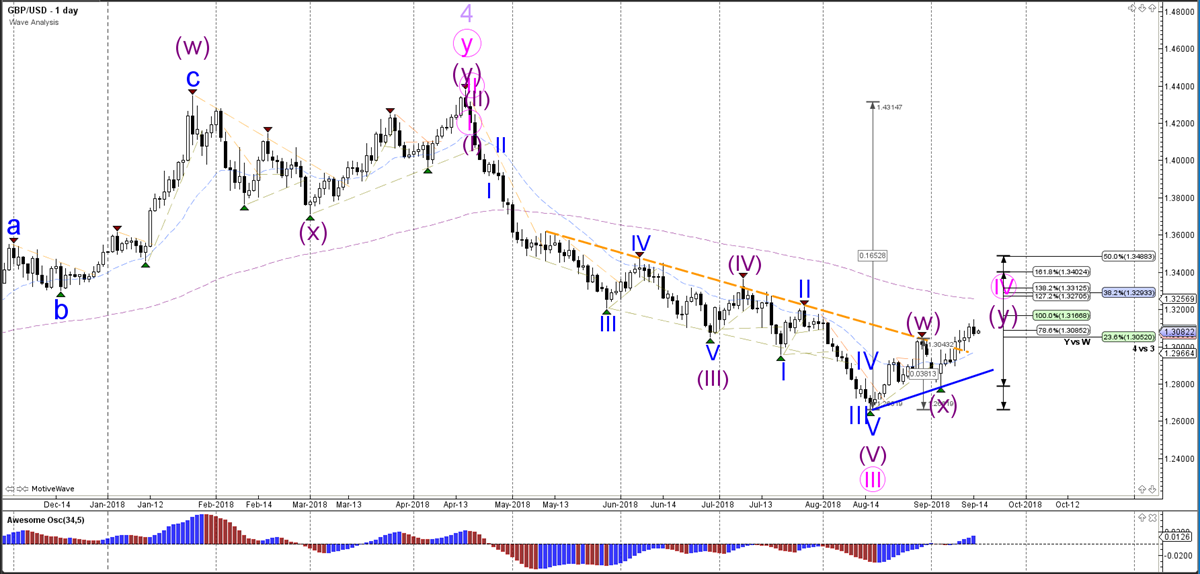
The GBP/USD has probably started the bearish wave 5 after price has completed a wave 4 (light purple) correction.
Weekly chart:
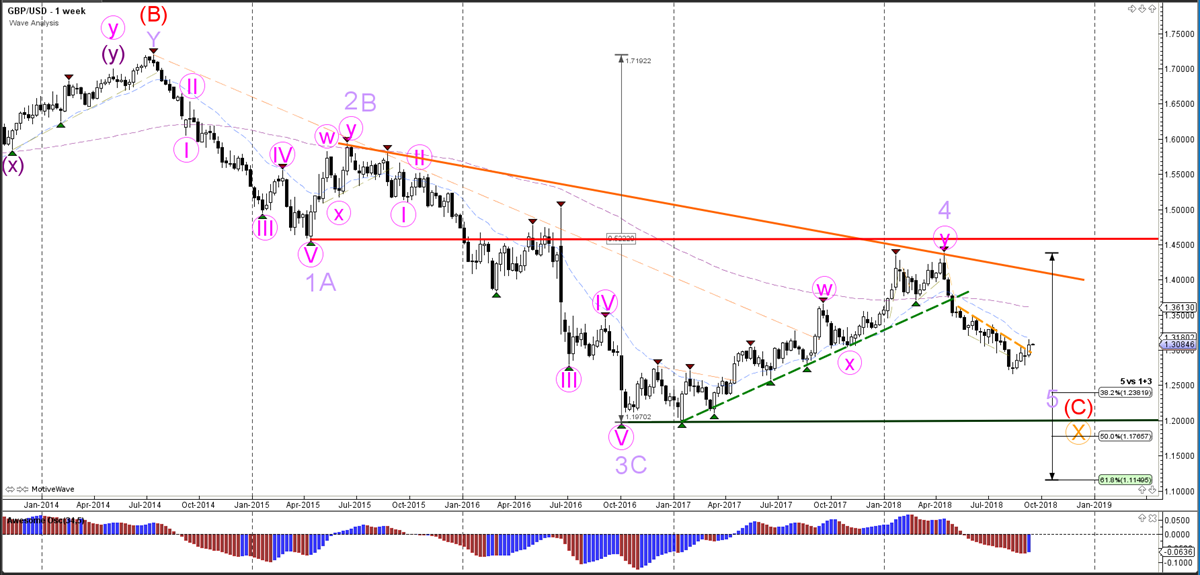
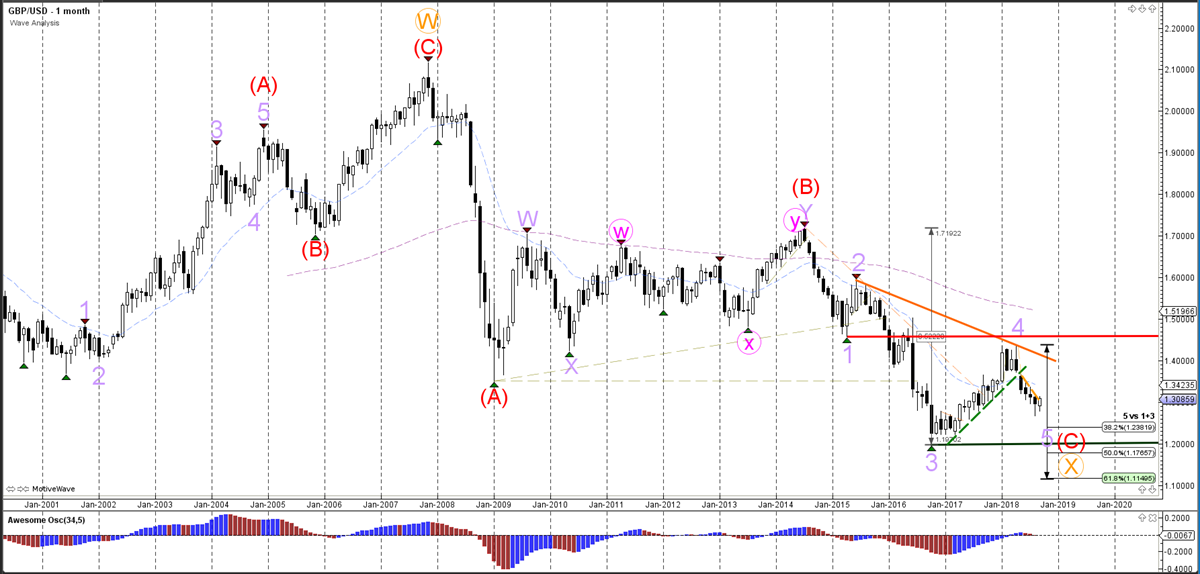
The GBP/USD bearish breakout is probably indicating the start of wave 5 (purple), whereas a bullish break above resistance (red) indicates that a different wave pattern is valid.
Monthly chart:
USD/JPY
The USD/JPY is making an ABC (purple) correction within wave X (pink) and is testing key Fibonacci resistance levels.
Daily chart:
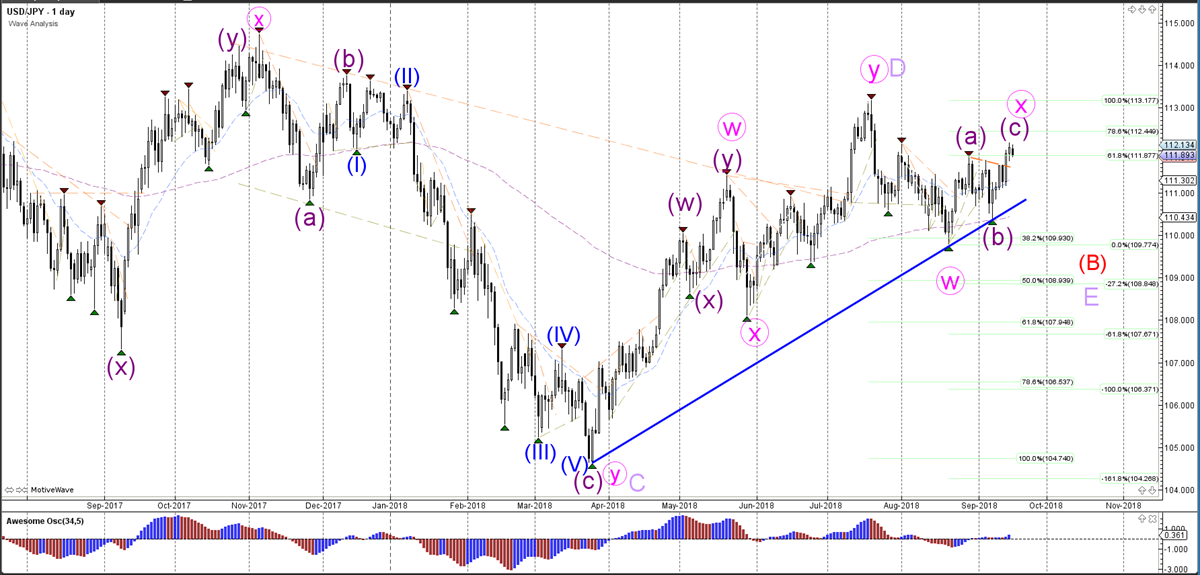
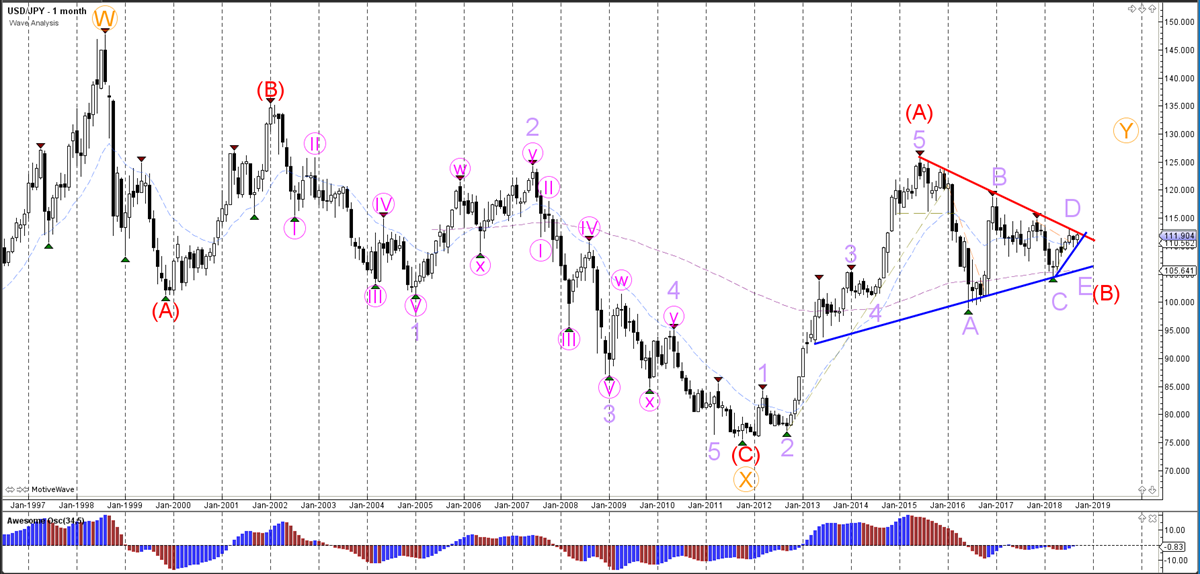
The USD/JPY could be building an ABCDE triangle (light purple) within wave B (red).
Weekly chart:
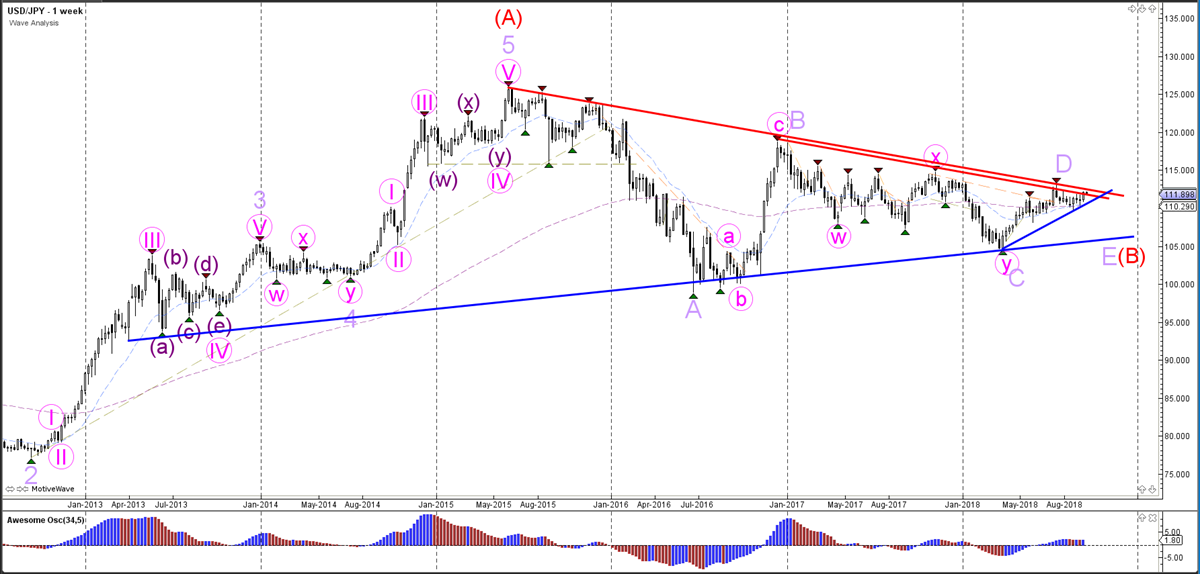
The USD/JPY is in the wave E (light purple) of the triangle pattern.
Monthly chart:
Bundesbank: Germany just went through temporary period of weakness
Bundesbank's monthly economic report noted that the economic growth in Germany remains fundamentally intact. Slowdown during the summer was mainly due to car makers. And, "as soon as the conversion problems in the automotive industry have been solved, the pace of macroeconomic expansion should pick up again significantly"
It also said "continued positive mood of businesses, which according to the Ifo Institute's surveys has recently also improved in industry, points to a temporary period of weakness."
Both Bundesbank and the Economy Ministry expect manufacturing to shift to a higher gear in the common months.