

Sample Category Title
GBPUSD Outlook: Bulls Consolidate After Failure At Cloud Top, Positive Outlook Above 1.3000 Support Zone
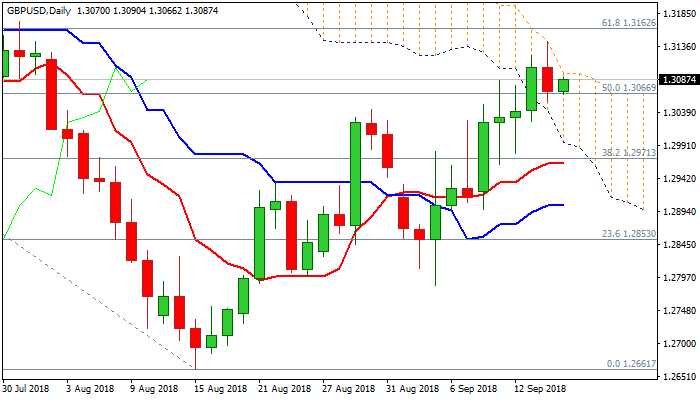
Cable trades within thickening daily cloud on Monday, after Friday's action was capped by cloud top (1.3143). Subsequent pullback and Friday's close in red, so far did not harm larger bulls, as Monday's action holds in green for now and was contained by rising 5SMA (1.3066). Strong bullish momentum and daily MA's in positive configuration are supportive, but positive impact could be partially offset by south-heading slow stochastic which emerged from overbought territory, after forming bearish divergence. Bullish outlook to remain intact while the price holds above key supports at 1.3009 (55SMA) and 1.2995 (daily cloud base). Bulls need close above daily cloud (cloud top lays at 1.3097) to open next pivotal barrier at 1.3162 (Fibo 61.8% of 1.3472/1.2661 descend), break of which to confirm bullish continuation. Brexit story remains key driver of the pound, with hopes of solution in the short-term, keeping sterling inflated. From the other side, UK PM May sticks to her Brexit plan, saying that alternative would be no deal, scenario which could be harmful for sterling. Meeting of EU leaders on Wed-Thu will be closely watched for fresh signals, along with UK inflation data, due on Wednesday.
Res: 1.3097, 1.3143, 1.3162, 1.3213
Sup: 1.3066, 1.3026, 1.3009, 1.2995
EURUSD Outlook: Euro Stands At The Back Foot After Friday’s Sell-Off, US/China Trade Tensions Seen As Key Driver
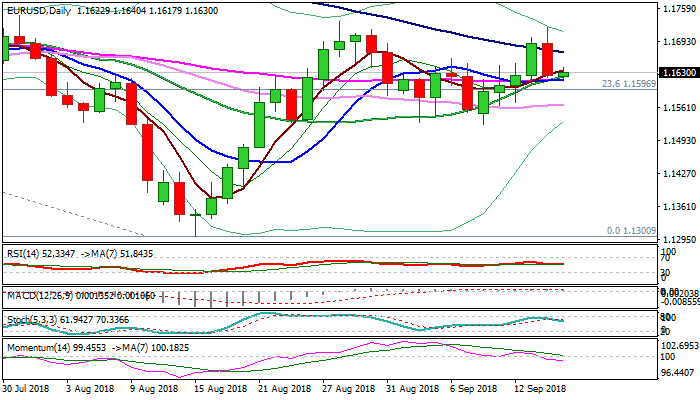
The Euro holds within narrow range in early Monday's trading, consolidating last Friday's strong losses, as the single currency was sold on rising US-China trade tensions that inflated dollar.
Friday's action created bearish engulfing and generated negative signal, which is reinforced by close below 38.2% retracement of last week's 1.1526/1.1721 rally.
Converged 10/20/55SMA contained dip, offering initial support at 1.1614, ahead of pivotal support at 1.1600 (Fibo 61.8%), loss of which would confirm reversal and possibly lead towards full retracement of 1.1526/1.1721 upleg.
Bearish momentum is building and supporting near-term action, along with south-heading slow stochastic, after false break above falling 100SMA (currently at 1.1672.
Thick hourly cloud stands above (spanned between 1.1639 and 1.1673), marking strong barrier which should limit upside attempts.
US / China trade issue is expected to be the key driver these days, as tensions rose after US announced additional tariffs over the weekend and China threatened of cancelling trade talks in such scenario.
Res: 1.1640, 1.1673, 1.1701, 1.1721
Sup: 1.1614, 1.1600, 1.1572, 1.1526
Rand To Remain Volatile This Week, Indian Rupee Declines Towards All-Time Lows
Optimism that moves from both the Central Bank of the Republic of Turkey and Central Bank of Russia to raise respective interest rates late last week should provide investors with inspiration to invest in emerging markets is wearing thin at the beginning of the week. A number of emerging market currencies have dipped lower against the Greenback early today, as a number of different external uncertainties around the global economy contribute to investor reluctance towards purchasing emerging market currencies at their current levels.
Due to the unpredictable nature of external uncertainties around matters like trade tensions, it is difficult to buy into the headlines that we have approached a turning point for the emerging markets. External uncertainties remain intense and until there are consistent indications that these are being removed from the atmosphere, it is more likely than not that investors will prefer to adopt a guarded approach towards the currencies that belong to emerging market assets.
The Indian Rupee is a prime example of a currency that is repeatedly facing pressure from uncertain external headwinds. The Rupee is also the most notable headline mover at the beginning of the week, weakening over 1% at time of writing to edge close to its recent historic lows against the Dollar. The pressure on the Rupee has come in spite of authorities taking several measures to prevent the currency from further weakness, but the unpredictable nature of various external headwinds that are weakening investor sentiment towards the emerging markets generally is preventing the Rupee from a period of recovery.
There is no disputing that one of the main contributors to the uncertain external environment is mixed messages when it comes to the status of trade talks between the United States and China. Conflicting reports remained a theme over the weekend when indications circulated that on one hand President Trump has provided the green light for additional Chinese tariffs being met, with other reports that Beijing was considering rejecting the offer from Washington to resume trade talks.
This ultimately suggests to investors that we are no closer to an “exit” door when it comes to prolonged trade uncertainty. As such, it wouldn’t be a major surprise if investors remain “risk off” as trading for the week gets underway.
One emerging market currency that is in line for volatility throughout the upcoming week is the South African Rand. Not only will the Rand remain sensitive to the various external uncertainties that are providing headwinds to emerging market assets, but there is some quiet speculation that the monetary policy meeting later this week could result in a change of interest rate policy in South Africa.
The South African Reserve Bank (SARB) is truly situated in a very unenvious position. The Rand is a leading contender for being sensitive to external headwinds away from South Africa, but the news that the economy has entered its first recession since 2009 provides an indicator that the SARB should consider lowering interest rates. The problem is that if the SARB does lower interest rates later this week, that it will increase inflationary risks for South Africa.
The British Pound is another currency that will be exposed to volatility throughout the upcoming week. UK Prime Minister Theresa May is set for another round of key Brexit discussions throughout the week and the Pound has shown on various occasions in the past couple of weeks that it remains highly sensitive to Brexit headlines. If concerns mount that the United Kingdom is heading towards a hard Brexit, we shouldn’t be surprised if the GBPUSD once again falls below 1.30 this week.
GBPUSD Still Bullish Above 1.2985 Level
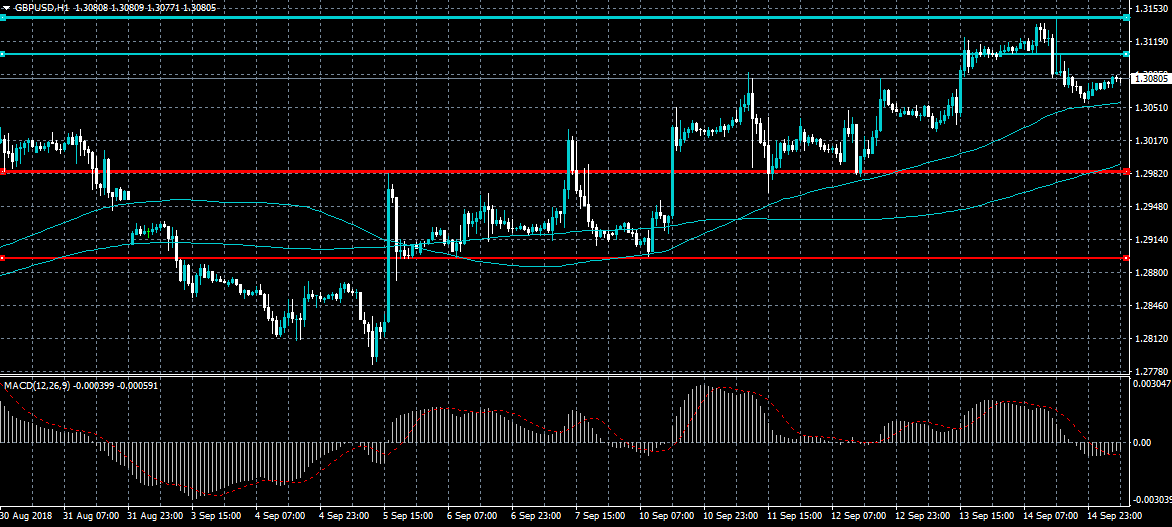
The British pound is starting to weaken pressure against the US dollar after buyers failed to maintain price above the 1.3100 level. Brexit headlines and the US dollar continue to drive the GBPUSD pair, with eurozone negotiators latest bearish comments about the Chequers Brexit deal pushing sterling lower. Buyers need to move the pair above the 1.3100 level once again, while sellers need to move price below the 1.2985 level.
The GBPUSD pair is bullish while trading above the 1.2985 level, key resistance is found at the 1.3100 and 1.3145 levels.
If the GBPUSD pair moves below the 1.2985 level, key support is found at the 1.2930 and 1.2856 levels.
EURUSD Staring The Week Under Pressure
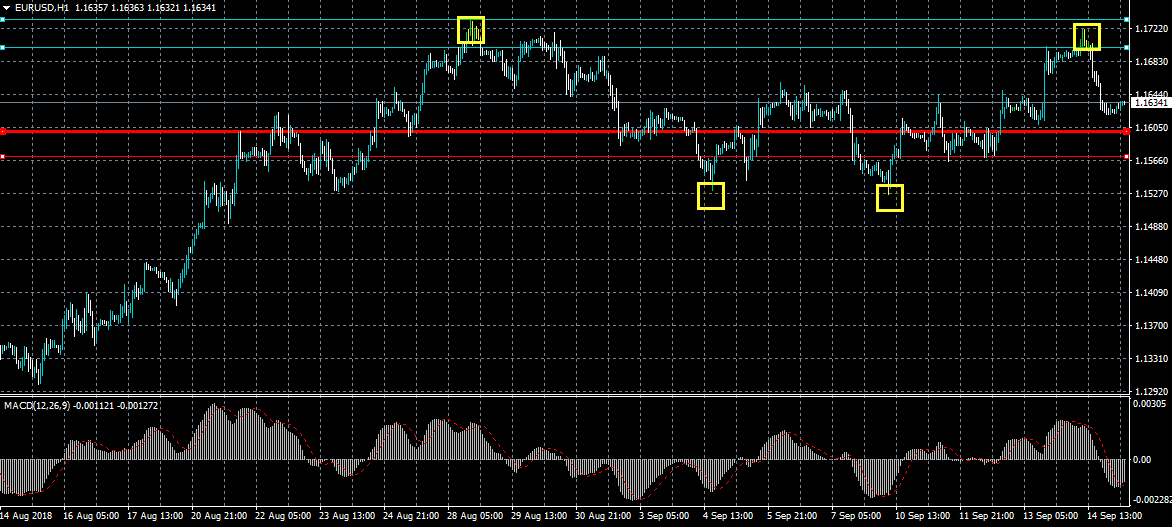
The euro has started the new trading week under pressure against the greenback, following the heavy decline in the pair last Friday. The EURUSD pair remains short-term bullish while trading above the 1.1600 level with the inverted head and shoulders pattern still valid, despite the heavy technical rejection from the 1.1720 region. Sellers will attempt to break the 1.1577 support level, while buyers to attempt to break the neckline of the bullish pattern.
The EURUSD pair remains bullish while trading above the 1.1600 level, key resistance is located at the 1.1730 and 1.1790 levels.
If the EURUSD pair moves below the 1.1600 level, sellers are likely to test towards the 1.1577 and 1.1528 support levels.
Markets Brace For A Tough Week As Trade War Intensifies
Asian stocks fell today after the Wall Street Journal reported that Trump was preparing to announce tariffs on Chinese goods worth more than $200 billion. The news came despite last week’s hopes that the US and China would restart talks aimed at ironing out key issues ahead of US midterm elections. The markets also took a hit following Typhoon Mangkhut which swept through Hong Kong and Macau causing millions of people to be evacuated.
The euro fell against the dollar as prepare for EU inflation data, which will be released at 9:00 AM (GMT). Traders expect that the data will show that the headline CPI grew at an annualized rate of 2.0% in August, which will be unchanged from the growth in July. On a month-on-month basis, traders expect the headline CPI to have risen by 0.2% after the minus 0.3% fall in July. The core CPI, which excludes the prices of food and energy products is expected to remain unchanged at 1.0%. Traders will also receive the German Buba Monthly Report and listen to ECB’s Peter Praet.
The US dollar started the week by gaining against its peer currencies. This happened as the US battled the effects of Hurricane Florence. The most affected states were North and South Carolina, which suffered extreme floods. Experts expect the floods to last for days. However, the destruction of the hurricane was not as much as expected after it was lowered to Category One. Studies show that hurricanes tend to slow down businesses and destroy wealth. The local economy then starts to grow as people and businesses begin the reconstruction process.
EUR/USD
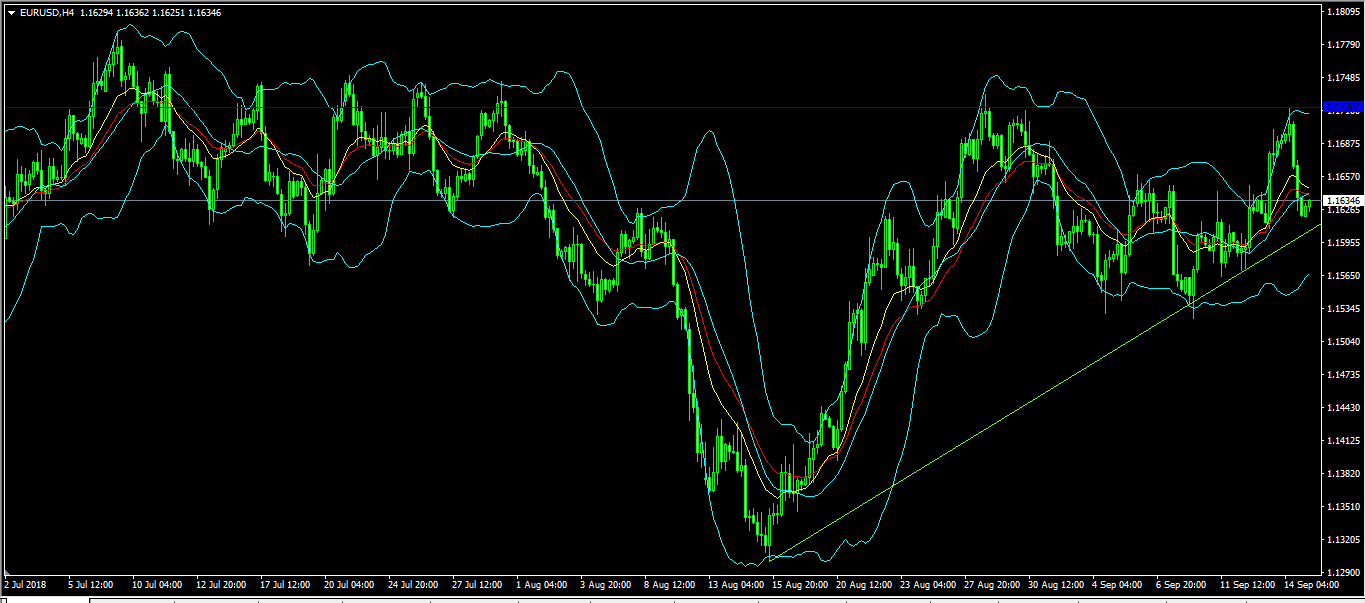
On Friday, the EUR/USD pair reached a high of 1.1720. This was an important resistance level for the pair as shown below. Today, the pair fell in the Asian session. It reached an intraday low of 1.1618, which is slightly above the important support shown below. It is now trading at 1.1634, which is along the middle Bollinger Band and along the 14 and 21-day EMA. The pair could continue to fall ahead of the EU CPI data. If it does, it will test the 1.1565 support as shown below.
USD/CHF
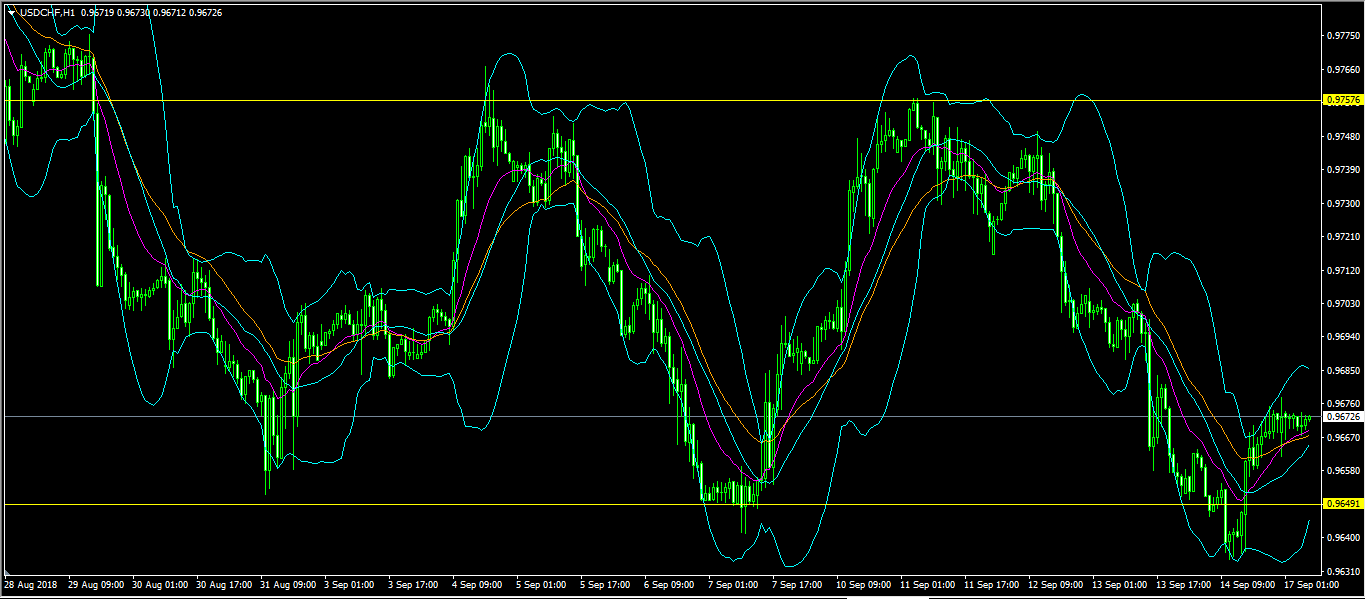
On Friday, the USD/CHF pair fell below the important support of 0.9650. Today, the dollar strength led the pair to move past the 0.9650 level. The price is along the 28 and 14-day EMA. It is between the middle and upper Bollinger Band as shown below. This pair could continue the previous support and resistance pattern and if it does, it will move to the 0.9757 resistance level. However, there is also a likelihood that it will continue the downward momentum.
XAU/USD
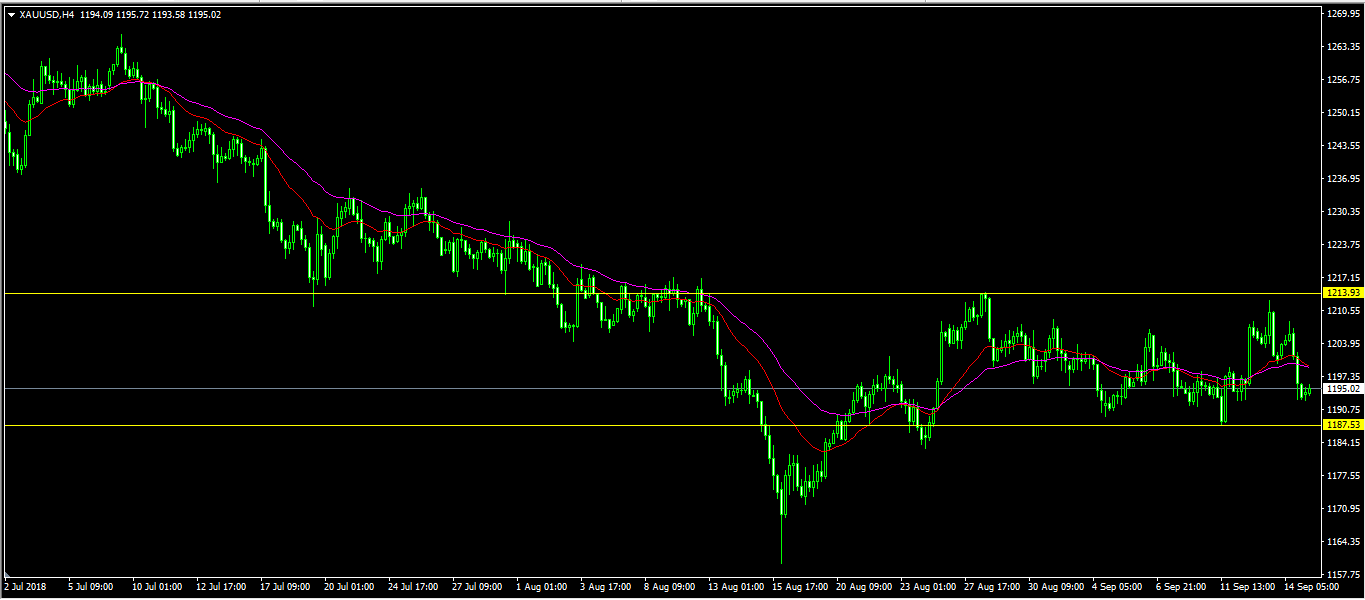
On Friday, the XAU/USD pair dropped sharply from a high of 1208 to a low of 1192. In the Asian session today, the pair attempted to move up but remained at these lows. In recent weeks, the pair has traded within the narrow channel of 1187 and 1213. If the pair crosses the support of 1187, there is a likelihood that it will continue to fall, potentially to the 1150 support.
XAUUSD Intraday Analysis
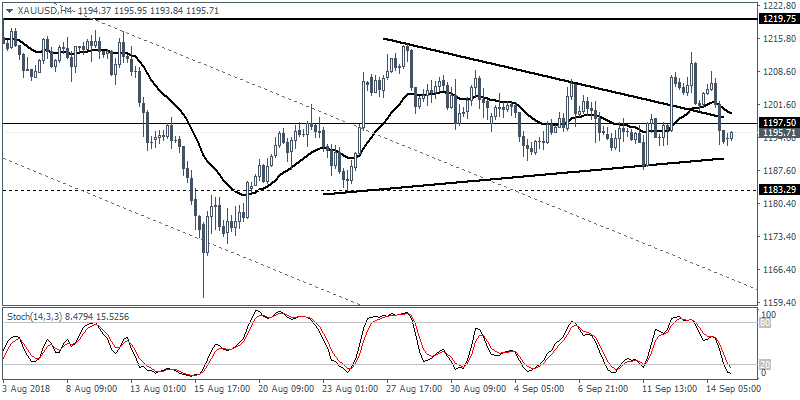
XAUUSD (1195.71): Gold prices extended the declines for the second day closing bearish on Friday. The fake-out to the upside was met with quick selling as the precious metal closed back below the 1197.50 level. We expect to see the weakness lingering in gold prices remaining subdued below 1197.50 region. The downside support at 1183.30 could once again come into focus.
GBPUSD Intraday Analysis
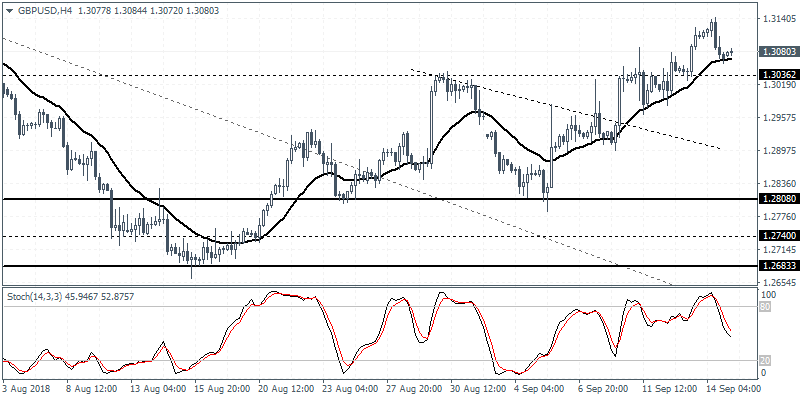
GBPUSD (1.3080): The GBPUSD currency pair gave up the gains sharply on Friday. However, as expected, a retest of the recently breached double top pattern signals further upside. If price manages to rebound near 1.3036 to form support, we could expect to see further gains pushing the cable toward 1.3205 resistance from July 26th highs. To the downside, a break down below 1.3036 could indicate price action settling back into the range. The lower support remains at 1.2808.
EURUSD Intraday Analysis
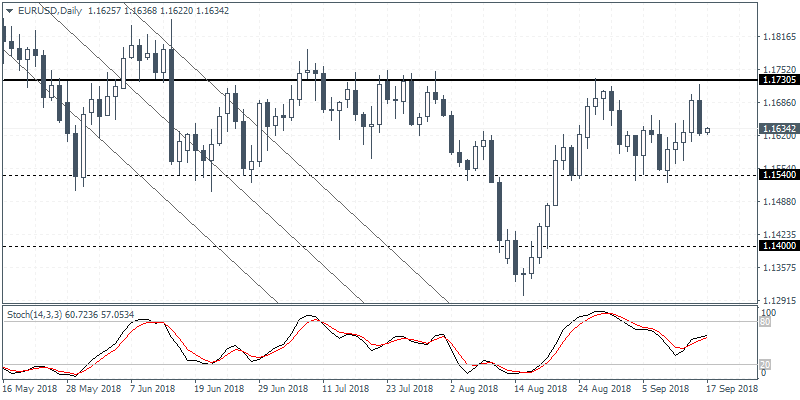
EURUSD (1.1634): EURUSD closed on a bearish note on Friday practically giving up the gains notched from Thursday. By Friday's close price action was seen closing slightly below the rising trend line. A continued decline could see price action eventually falling back to the support level of 1.1540. A breakout from the increasing trend line could potentially suggest further declines if the common currency fails the support at 1.1540.
USD Reverses Losses – Markets Look To A New Week
The U.S. dollar managed to post gains on Friday reversing the losses from earlier in the week. On the economic front, the U.S. retail sales advanced 0.1% on a month over month basis. This missed estimates of a 0.4% increase. Core retail sales also slowed, rising just 0.3% on the month. Core retail sales also came in below estimates of 0.5%.
Other data sets over the day included the import prices which declined 0.6%. Industrial production was the bright spot which advanced 0.4% on the month.
Looking ahead, the week starts off with the Eurozone's final inflation figures. Headline CPI is expected to rise 2.0% while core CPI is forecast to increase by 1.0%.
Data from the U.S. include the Empire State manufacturing index which is expected to ease to 23.2.