

Sample Category Title
Emerging Markets Rebound Seems Over, Dollar Gains On Renewed Trade Worries
Asian markets have turned to a decline with a renewed force. After the rebound of last week, the index MSCI Asia ex Japan loses 1.2% and is only 1.5% above the 14-month lows. Futures for S&P500 have returned to 2900 area, lost 0.4% from Friday’s intraday highs. The pressure on the markets increased after reports that the U.S. intended to announce the introduction of tariffs for the U.S. goods up to 200 billion as early as on Monday. China threatens to abandon the negotiations announced last week, in case of new tariffs.
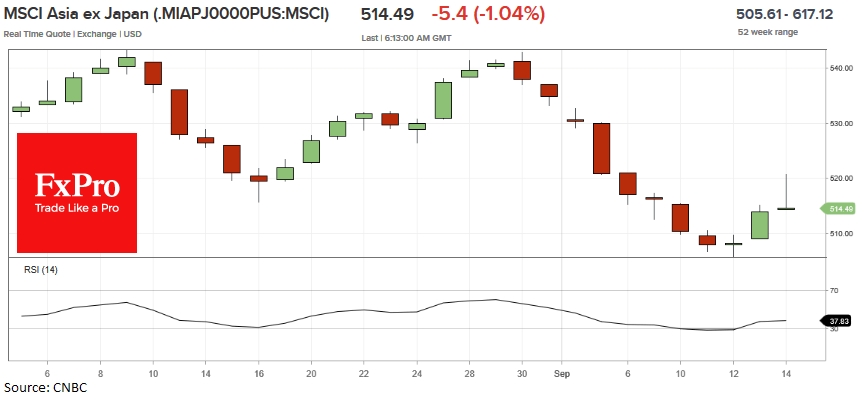
We have previously warned that the current recovery of markets is nothing more than a correction rebound after a strong oversold. Both China and the United States are difficult negotiators, and earlier this year there have already been a number of negotiations, which have not resulted in any breakthrough. 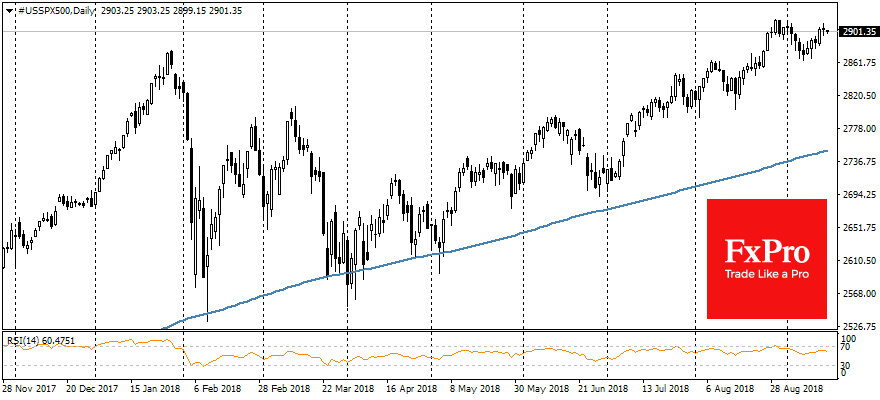
In addition to the renewed concern about a foreign trade, the strengthening of the American currency reinforces pressure on the emerging markets. The dollar rose on Friday after the start of active trading session in America. The dollar manages to hold its positions on the start of a new week on demand for it as a protective asset. The dollar index adds 0.6% to Friday’s lows and is near 94.90, one step away from the important resistance at 95.0. EURUSD once again were unable to sustain in the area above 1.1700, and trades at 1.1630 now 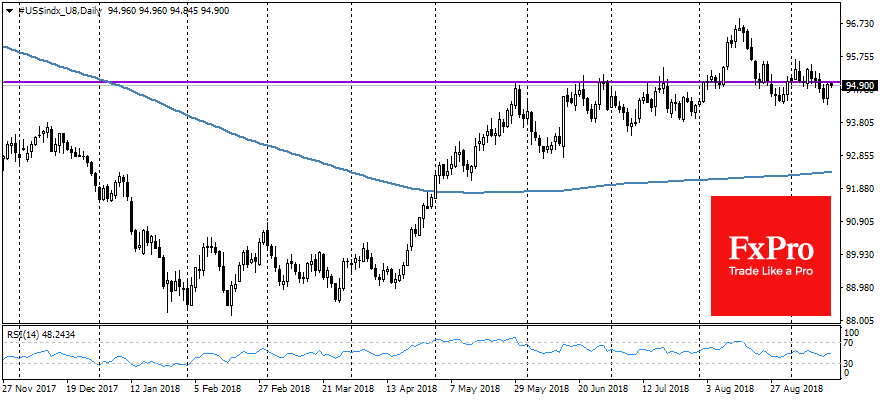
The dollar is adding in spite of the weak data on retail sales, which added 0.1% in August against expected 0.4%. In addition, it is worth paying attention to the sharp (by 0.6%) drop in import prices, which has become another confirmation (after a weak CPI and PPI) of not as serious inflationary pressure as analysts have feared. Despite this, the markets are still ignoring the weak inflation rates, bowing to the fact that a sharp increase in wages in the nearest future will cause a rise in prices.
Currencies: Dollar To Maintain Benefit Of The Doubt As Trade Tensions Resurface?
Rates: US and German 10-yr yields at/approaching 1st resistance
The US 5-yr yield pierced through the upper bound of sideways trading range in place since June on Friday, while the US 10-yr and 30-yr yields tested similar resistance. Today's eco calendar features no strong triggers to force a break. German Bunds could underperform in technical trading. The German 10-yr yield is gradually moving towards 0.5% resistance.
Currencies: dollar to maintain benefit of the doubt as trade tensions resurface?
On Friday, EUR/USD couldn't maintain a constructive momentum. The 1.1730/51 resistance remains firmly in place. Today, trade tensions might again become the dominant driver for FX trading as markets expect the US president to raise tariffs on China again. In the recent past, this environment often supported the dollar
The Sunrise Headlines
- US equity markets ended mixed on Friday with only marginal gains/losses (+/-0.05%). Asian markets lose ground with China suffering hard from new US tariff threats. Japanese markets are closed
- US President Trump has instructed to proceed with additional tariffs on Chinese products. Talks between the countries, aimed to ease trade tensions, are now at risk as China indicated not to participate in case of new tariffs.
- At a G20 meeting in Argentina on Friday, the trade and investment ministers said in a joined statement that there is an “urgent need” to improve the World Trade Organization to counteract growing trade tensions around the world.
- The EU is discussing a new option for the Irish border. Instead of putting EU inspectors at the border, they would consider to allow British officials in charge of checking goods that are headed for Northern Ireland.
- Greek Finance Minister Tsakalotos said that his country is planning to further loosen capital controls soon, in a move to complete the second pillar of regulations, concerning cash withdrawals and the opening of bank accounts.
- The central bank of China has lent $38.5bn to financial institutions through its one-year medium-term lending facility (MLF), at unchanged rates. The move was surprising, as no MLF loans were due to mature this morning.
- Today's US eco calendar is very thin, with only the Empire Manufacturing gauge for September in the US. For the EMU ,we receive the final inflation numbers of August and ECB's Coeuré and Praet speak. Belgium taps the bond market
Currencies: Dollar To Maintain Benefit Of The Doubt As Trade Tensions Resurface?
Trade tensions to support the dollar again?
On Friday, the dollar started the session on a soft footing as global risk sentiment remained positive. The euro maybe still felt some support after rather upbeat comments from ECB's Draghi on Thursday. EUR/USD filled bids in the 1.1720 area but a test of the 1.1733 resistance didn't occur. US August retail sales disappointed. The dollar tried a shy down-move upon the release, but the topside in EUR/USD proved tough. USD bulls soon came again in control. Later, market optimism eased on headlines that Trump might impose additional import tariffs on China soon. EUR/USD finished at 1.1625. USD/JPY closed the week at 112.04. This morning, Japanese markets are closed. Asian equities are mostly trading in negative territory as fear on an escalation in the China-US trade war is returning to the forefront. EUR/USD hovers in the 1.1630 area. USD/JPY is holding near 112. Today, the eco calendar is thin. In the US, the Empire manufacturing index is expected to ease slightly from 25.6 to 23, but this still indicates healthy growth. Global FX trading will probably again be dominated by the headlines on trade policy. Rumours suggest that the US president could announce additional tariffs as soon as today. Of late, the reaction of markets to further steps in the US-China trade war was often modest. Even so, a further escalation will probably still trigger a standard risk-off reaction. EM-currencies and the yuan might come under pressure. The impact on EUR/USD might be more modest, but the dollar might still maintain the benefit of the doubt. From a technical point of view, EUR/USD neared the 1.1733/51 resistance, but no real test occurred, keeping EUR/USD in the established consolidation band. For now, we don't see a trigger for a break. A decline below the 1.1530 area would indicate that the dollar is gaining some momentum.
On Friday, EUR/GBP mostly hovered in a tight range in in the low 0.89 area. Sterling gained a few ticks at the end of the day, with EUR/GBP closing at 0.8895. Poltical comments over the weekend suggest that the UK and the EU are stepping up effords to reach a deal. Key question remains whether PM May can convince enough pro-Brexit members of her party. For now, sterling is gaining some momentum, but we don't expect the move to go very far as long as there is no clear indication that PM May will receive enough political backing
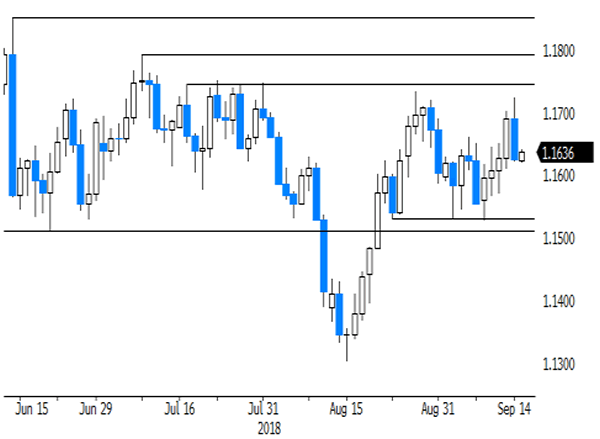
EUR/USD: 1.1733/51 resistance looks solid, for now
EUR/USD Bearish Reversal Aims At 1.1450 Target
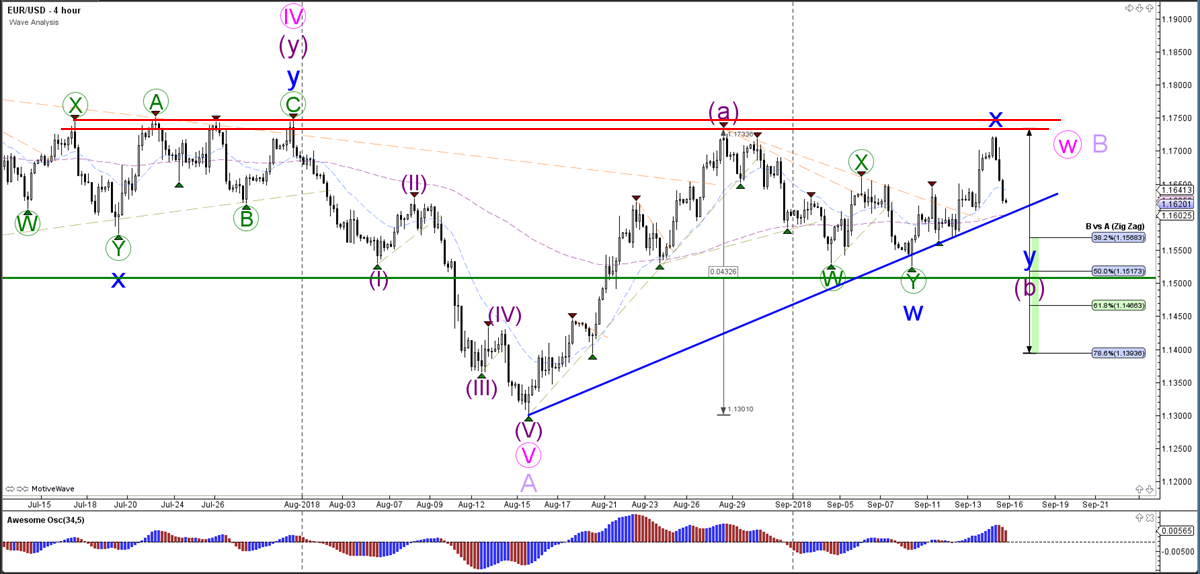
The EUR/USD approached the previous top and resistance zone (red lines) but failed to break above it. The bearish bounce indicates that the price is probably building an expanded WXY (blue) pattern within wave B (purple). The price could fall back to the Fibonacci retracement levels of wave B (purple), which is a new bounce or breakout zone.
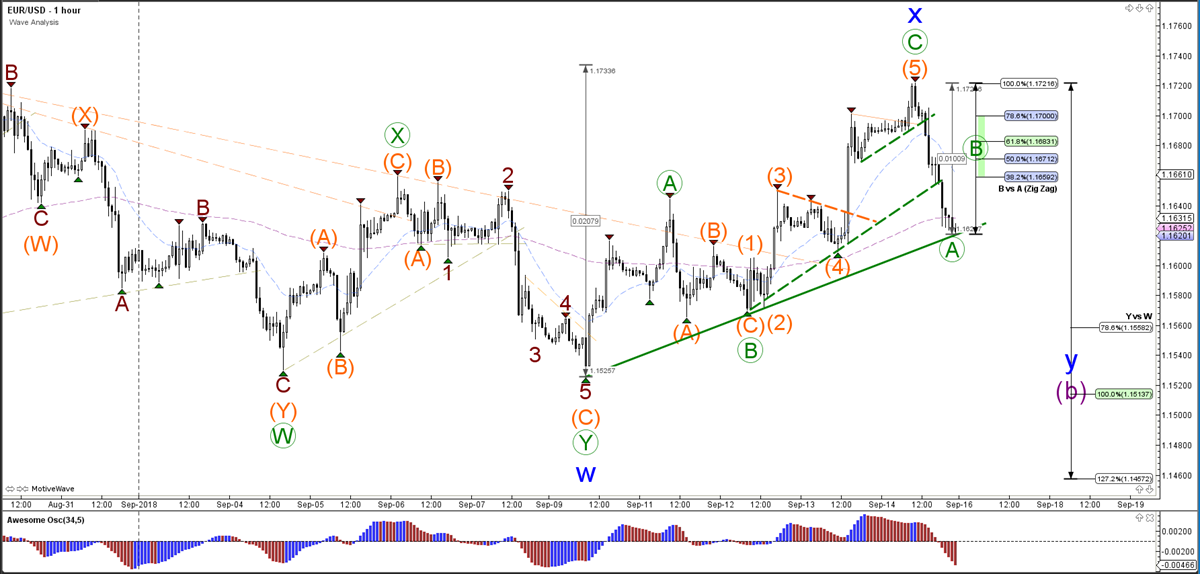
The EUR/USD completed 5 bullish waves (orange) within wave C (green) pattern. The bearish momentum is probably a wave A (green) of a larger ABC zigzag in wave Y (blue). A pullback could find resistance at the Fibonacci retracement levels of wave B vs A.
Asian Equity Markets Trade Generally Lower
General Trend:
- Hong Kong gaming names decline amid impact of Typhoon Mangkhut
- Nikkei 225 closed for holiday
- Trump to announce tariffs on $200B in Chinese imports to go into effect within weeks; announcement could be within days (Press)
- China PBoC conducts second medium-term lending facility (MLF) operation this month
Headlines/Economic Data
Australia/New Zealand
- ASX 200 opened -0.2%
- (AU) Australia ACCC: Says it has put telecom companies on notice regarding false & misleading ads, may bring court proceedings against executives of telecom companies
- (NZ) New Zealand Aug Performance of Services Index: 53.2 v 55.1 prior
China/Hong Kong
- Shanghai Composite opened -0.4% , Hang Seng -0.9%
- (CN) On Sunday Typhoon Mangkhut started to affect southern China and Hong Kong; China’s National Observatory issued its highest alert level – Press
- (CN) China Aug New Home Prices M/M: 1.5% v 1.2% prior; Y/Y: 7.0% v 5.8% prior (highest since Aug 2017)
- (CN) CHINA PBOC CONDUCTS CNY265B IN 1-YEAR MEDIUM-TERM LENDING FACILITY (MLF) V CNY176.5B PRIOR AT 3.30% V 3.30% PRIOR (2ND MLF OPERATION THIS MONTH); Skips open market operation (OMO)
- (HK) Hong Kong Monetary Authority (HKMA) said it can better deal with crisis than in 1997 and 2008 – HK Press
Japan
- Nikkei 225 closed for holiday
Korea
- Kospi opened -0.2%
- (KR) The schedule is being released regarding the Sept 18-20th North and South Korea summit: The first inter-Korean meeting due to be held after lunch on Tuesday
- (KR) Bank of Korea (BoK) sells KRW310B in 6-month monetary stabilization bonds; yield 1.720%
- (KR) South Korea sells KRW600B in 20-year bonds, avg yield 2.260%
Other
- (ID) Indonesia Aug Trade Balance: -$1.0B v -$607Me
- (SG) Singapore Aug Non-Oil Domestic Exports M/M: +0.4% v -2.4%e; Y/Y: 5.0% v 5.3%e
Europe
- (UK) UK Sept Rightmove House Prices M/M: +0.7% v -2.3%; Y/Y: 1.2% v 1.1% prior
- (UK) British Chambers of Commerce (BCC) cuts 2018 UK GDP growth forecast to 1.1% vs 1.3% prior
Levels as of 01:30ET
- Nikkei 225, closed for holiday; ASX 200 +0.2%, Hang Seng -1.8%; Shanghai Composite -1.2%; Kospi -0.9%
- Equity Futures: S&P500 -0.2%; Nasdaq100 -0.2%, Dax -0.3%; FTSE100 -0.2%
- EUR 1.1638-1.1621 ; JPY 112.14-111.93 ; AUD 0.7161-0.7141 ;NZD 0.6559-0.6538
- Dec Gold -0.1% at $1,199/oz; Oct Crude Oil -0.1% at $68.72/brl; Dec Copper +0.3% at $2.621/lb
Trade War Concerns Set To Accelerate This Week
Market movers today
In Sweden , the highlight of the day will be the minutes from the 6 September Riksbank meeting, which will be scrutinised for clues about the next policy step. We will look for an indication of a first policy hike in either December or February.
Trump may announce either today or tomorrow that he is implementing tariffs on an additional USD200bn worth of imported goods from China. According to CNN , the tariff rate is going to be 10% and not 25% as feared previously.
In the euro area , the final HICP figures from August are due. We do not expect any revision to the preliminary release, which saw headline inflation falling back to 2.05% and core inflation disappointing on the downside at 0.96%.
Selected market news
The week kicks off with a negative tone in the financial markets as trade concerns weigh on investors' risk appetite and Asian stocks trade lower this morning led by markets in Hong Kong and China, while Japanese markets are closed for a holiday.
US-Chinese trade concerns have resurfaced as the Trump administration plans to implement new tariffs on USD200bn worth of Chinese products this week. China may reject new trade talks if more tariffs are imposed, according to a report posted yesterday in the Wall Street Journal . The report quoted one senior Chinese official as saying that the country would not negotiate 'with a gun pointed to its head'. The Trump administration seems to believe that the trade war is hurting China more than the US, giving the US the upper hand in the negotiations. China has promised to retaliate to any US measures against China one-to-one, and China seems to be preparing itself for a long-lasting trade war by (among other things) easing economic policy. A deal between the US and China seems unlikely before the US mid-term elections in November.
Boris Johnson, the former UK foreign minister, launched yet another attack on Theresa May in his weekly column in the Telegraph on Sunday, saying that 'we are heading for a car crash Brexit under Theresa May's Chequers plan'. Brexit will be in focus this week when EU leaders meet in Austria on Wednesday-Thursday. Moreover, the UK Conservative Party remains divided on Brexit, as the hardliners still think PM Theresa May's Chequers plan is too soft. This could potentially trigger a leadership challenge by Boris Johnson.
The Bank of Russia (CBR) surprised markets by hiking its key rate by 25bp to 7.50% on Friday. While an unchanged rate would already mean continuation of CBR's hawkish monetary stance, the central bank governor, Elvira Nabiullina, went even further and did not rule out the possibility of more rate hikes, but sees no cuts until 2020. We do not exclude further monetary tightening by the CBR in 2018, seeing the RUB as weaker due to a possible sell-off on new sanctions
Euro-Zone’s Trade Surplus Narrowed To A Four-Year Low Level In July
For the 24 hours to 23:00 GMT, the EUR declined 0.55% against the USD and closed at 1.1629 on Friday,
On the data front, the Euro-zone's seasonally adjusted trade surplus narrowed to a level of €12.8 billion in July, marking its lowest level in 4 years and more than market consensus for a surplus of 16.2 billion. In the previous month, the nation had posted a revised surplus of €16.5 billion.
The US dollar gained ground against a basket of currencies, following upbeat economic data.
In the US, data showed that industrial production climbed 0.4% on a monthly basis in August, rising for the third consecutive month and compared to a revised similar rise in the prior month. Market participants had anticipated industrial production to rise by 0.3%. Moreover, the nation's Reuters/Michigan flash consumer sentiment index advanced to a six-month high level of 100.8 in September, compared to a reading of 96.2 in the previous month. Markets had envisaged the index to rise to a level of 96.6. Business inventories sharply rose 0.6% on a monthly basis in July, at par with market expectations. In the previous month, business inventories had advanced 0.1%. Meanwhile, manufacturing production rose 0.2% on a monthly basis in August, undershooting market expectations for a rise of 0.3%. In the previous month, manufacturing production had recorded a gain of 0.3%. Additionally, advance retail sales rose 0.1% on a monthly basis in August, reflecting its slowest progress in six months and less than market expectations for a rise of 0.4%. Advance retail sales had increased by a revised 0.7% in the preceding month.
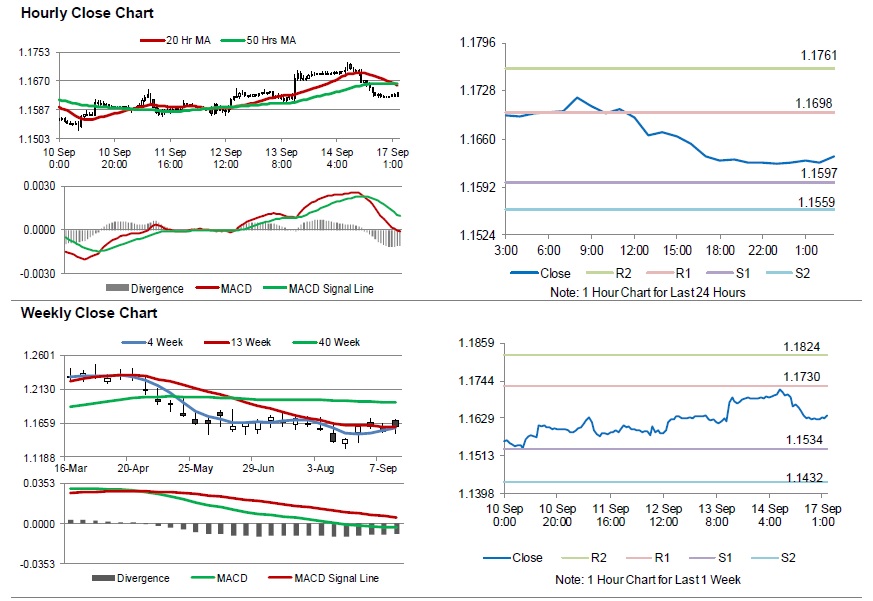
In the Asian session, at GMT0300, the pair is trading at 1.1636, with the EUR trading 0.09% higher against the USD from Friday's close.
The pair is expected to find support at 1.1597, and a fall through could take it to the next support level of 1.1559. The pair is expected to find its first resistance at 1.1698, and a rise through could take it to the next resistance level of 1.1761.
Moving ahead, traders will closely monitor the Euro-zone's consumer price index for August, set to release in a few hours. Later in the day, the US Empire manufacturing index for September, will keep investors on their toes.
The currency pair is trading below its 20 Hr and 50 Hr moving averages.
‘No-Deal’ Brexit May Adversely Affect Property Markets For A Longer Period: Mark Carney
For the 24 hours to 23:00 GMT, the GBP declined 0.34% against the USD and closed at 1.3064 on Friday.
On Friday, Bank of England Governor, Mark Carney assured that the bank is prepared to face all potential outcomes of Brexit and the policy response will not be automatic. However, Carney warned that the impact of a no-deal Brexit could be as dangerous as the 2008 financial crisis and could worsen property markets and increase unemployment. Meanwhile, he forecasted a rebound of £16 billion in favour of the UK economy, provided Britain follows Theresa May’s Chequers Brexit proposal.
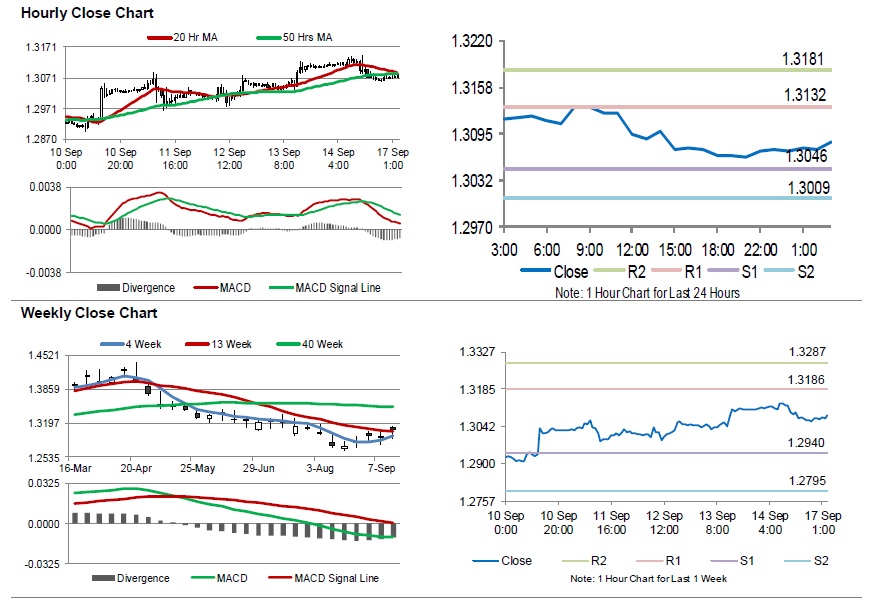
In the Asian session, at GMT0300, the pair is trading at 1.3084, with the GBP trading 0.15% higher against the USD from Friday’s close.
Overnight data showed that the Rightmove house price index rebounded 0.70% on a monthly basis in September. In the previous month, the index had registered a drop of 2.3%.
The pair is expected to find support at 1.3046, and a fall through could take it to the next support level of 1.3009. The pair is expected to find its first resistance at 1.3132, and a rise through could take it to the next resistance level of 1.3181.
With no macroeconomic releases in UK today, investors would look forward to global macroeconomic releases for further directions.
The currency pair is showing convergence with its 20 Hr and 50 Hr moving averages.
Japanese Yen Extends Its Gains This Morning
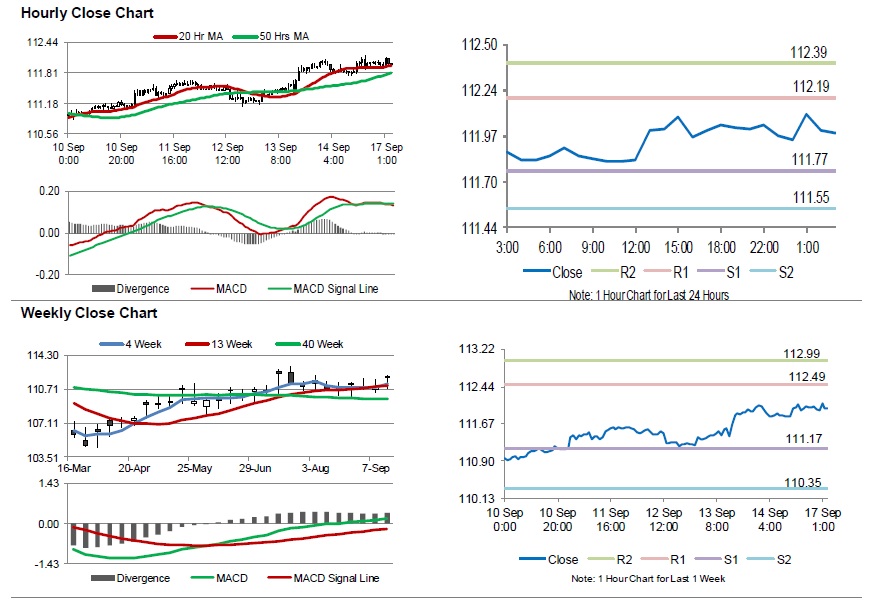
For the 24 hours to 23:00 GMT, the USD declined 0.01% against the JPY and closed at 112.01 on Friday.
In the Asian session, at GMT0300, the pair is trading at 111.99, with the USD trading marginally lower against the JPY from Friday’s close.
The pair is expected to find support at 111.77, and a fall through could take it to the next support level of 111.55. The pair is expected to find its first resistance at 112.19, and a rise through could take it to the next resistance level of 112.39.
The currency pair is showing convergence with its 20 Hr moving average and trading above its 50 Hr moving average.
Swiss Franc Trading A Tad Higher In The Morning Session
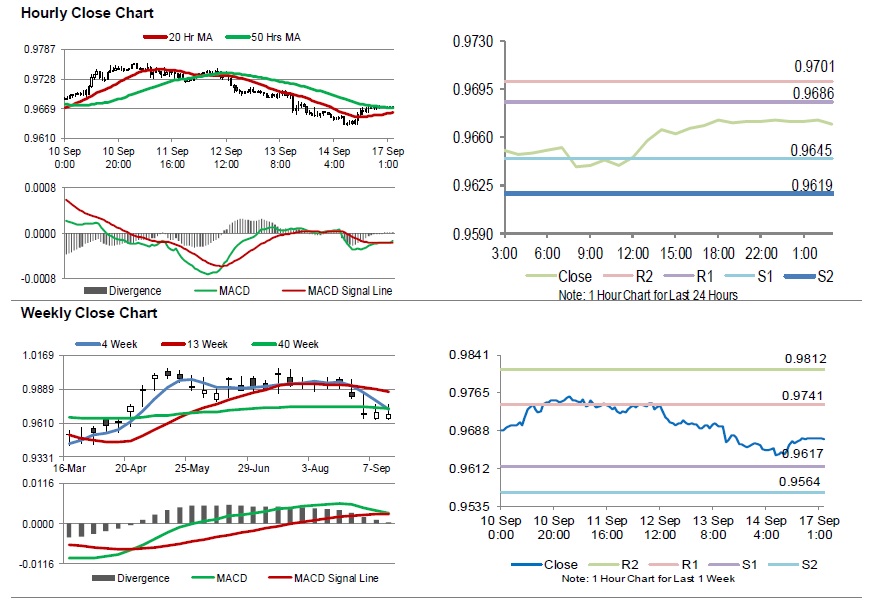
For the 24 hours to 23:00 GMT, the USD rose 0.12% against the CHF and closed at 0.9672 on Friday.
In the Asian session, at GMT0300, the pair is trading at 0.9670, with the USD trading slightly lower against the CHF from Friday’s close.
The pair is expected to find support at 0.9645, and a fall through could take it to the next support level of 0.9619. The pair is expected to find its first resistance at 0.9686, and a rise through could take it to the next resistance level of 0.9701.
Trading trend in the Swiss Franc today is expected to be determined by Switzerland’s total sight deposits, due to be released in a while.
The currency pair is showing convergence with its 20 Hr moving average and trading above its 50 Hr moving average.
ECB Makuch: Unguided missile Trump is the biggest threat to Eurozone economy
ECB Governing Council member Jozef Makuch said risks to the Eurozone are broadly balanced and the central bank's stance was correct. He added policy makers were "not underestimating the risks" but "analyzing them". And, "based on what we know now, the development is stable, risks are balanced, with some downside risks to GDP growth." He also noted there is no reason to "spread gloomy mood or panic".
Makuch also pointed out that Trump is like an "unguided missile" and the unpredictably of his policies is the biggest risks of the Eurozone economy. He noted that the erratic nature of Trump as "he says something and in the end something else happens". Meanwhile, he played down risks from emerging markets and said the governing council sees no signs of spillover.
Meanwhile, Makuch is considering stepping down early as head of Slovakia's central bank. He's term supposedly end in 2021. He noted that the elections in spring 2020 would be highly divisive. That could lead to the post being vacant for an extended period. To him, Finance Minister Peter Kazimir would be a "good governor" to replace him. He hailed that Kazimir "Ecofin deals with all important monetary issues", so the lack of experience in central banking is not a problem.