

Sample Category Title
Digesting Swedish Elections
Market movers today
Scandi markets will be digesting the financial implications of the outcome of the Swedish general election. Exit polls at the time of writing suggest that country's Red-Green block has 40.6% of votes, the Sweden Democrats 17.6% and the centre-right opposition Alliance 40.3%, meaning the absence of a clear leading candidate could trigger a political crisis during the formation of the government.
In the absence of major economic data releases, the key market focus will be on President Trump's possible announcement of US tariffs on an additional USD200bn of Chinese goods.
Focus will also remain on emerging markets, where sentiment will be influenced by the possible new US tariffs on Chinese goods mentioned above.
Danish CPI for August is due today at 08:00 CEST. We expect -0.2% m/m and 1.2% y/y, against 0.7% m/m and 1.1% y/y in July.
Today also brings figures from Statistics Denmark for foreign trade, which has surprised on the downside thus far in 2018. The key question is whether exports will pick up after a disappointing H1 18.
Selected market news
The Swedish election turned out to be a very close run between the ruling Social Democratic government and the right wing opposition. Hence, it is uncertain who will be the next prime minister in Sweden as the right wing opposition has a majority with the Swedish Democrats. However, both sides in the Swedish parliament have refused to work with the Swedish Democrats, so we have to wait and see for the final outcome of the election. The EUR/SEK has traded steadily during the Asian session.
More Chinese imports could face large US tariffs as the public hearing period in the US ended last Wednesday. In May, when the latest round of tariffs was approved, the announcement came a week after the end of the public hearing period, which could mean an announcement this Wednesday, if not earlier. The announcement and possible retaliation measures from China would likely weigh on global risk sentiment.
Emerging markets will be looking out for completion of the negotiations between the IMF and Argentinian delegation, which could help stabilise investor confidence toward the country. On Thursday, the Turkish central bank rates decision will be keenly anticipated, and on Friday the Russian central bank will decide on the monetary policy rate.
July inflation in Denmark came in much higher than expected, mainly due to package holidays. We expect that to reverse, but the timing is uncertain, creating some downside risk to our forecast for August. We expect a marked decline in annual inflation in the coming months as the temporary effects wear off. We then expect inflation to increase again in 2019 and converge on the Euro area.
AUD/USD Daily Outlook
Daily Pivots: (S1) 0.7068; (P) 0.7136; (R1) 0.7175; More...
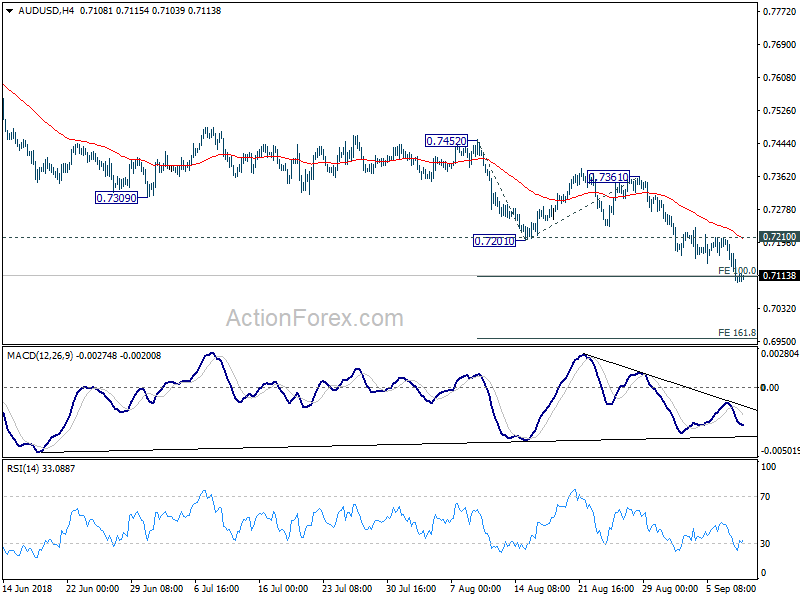
Intraday bias in AUD/USD remains on the downside at this point. Current down trend should target 161.8% projection of 0.7452 to 0.7201 from 0.7361 at 0.6955. Break will target key support level at 0.6826. On the upside, break of 0.7210 resistance is needed to indicate short term bottoming. Otherwise, outlook will stay bearish in case of recovery.
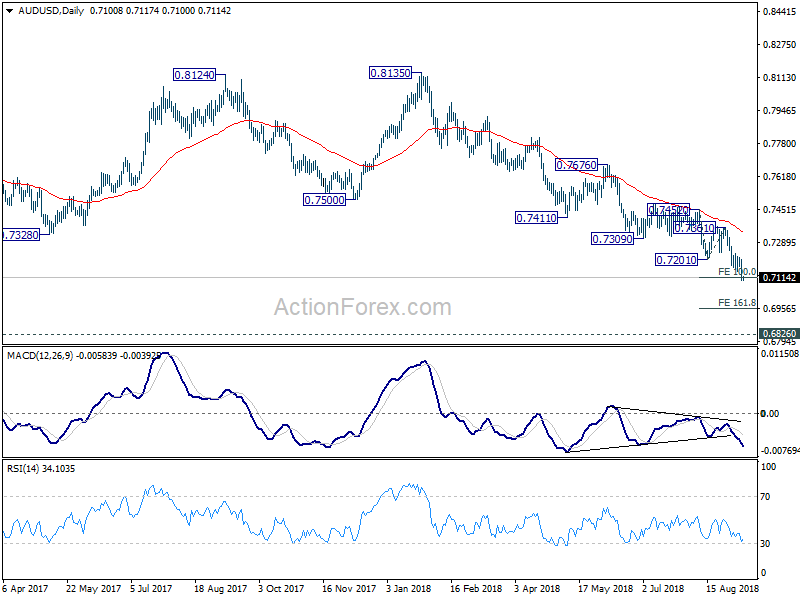
In the bigger picture, rebound from 0.6826 (2016 low) is seen as a corrective move that should be completed at 0.8135. Fall from there would extend to have a test on 0.6826. There is prospect of resuming long term down trend from 1.1079 (2011 high). Current downside momentum as seen in daily and weekly MACD support this bearish case. Firm break of 0.6826 will target 0.6008 key support next (2008 low). On the upside, break of 0.7361 resistance is needed to be the first sign of medium term bottoming. Otherwise, outlook will remain bearish even in case of strong rebound.
EUR/USD Breaks Support And Aims For Fibs At 1.15
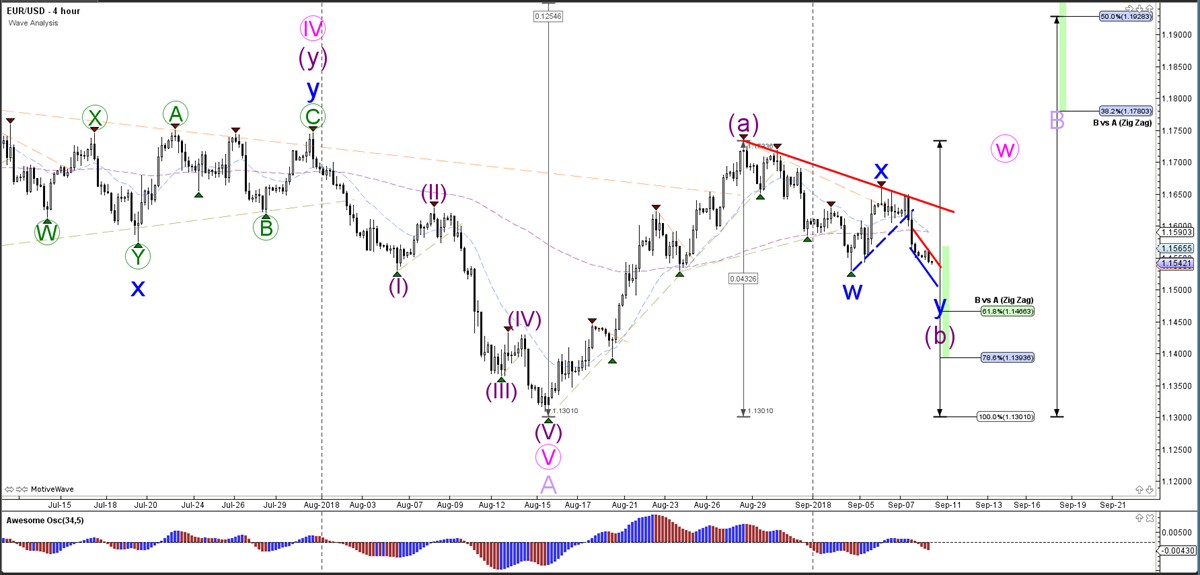
The EUR/USD failed to break above the resistance trend line (red) and instead broke below the support trend line (dotted blue). This indicates the potential for a deeper wave B (purple), which will probably test the 61.8% Fibonacci retracement level of wave B vs A and the support zone around the round level of 1.15.
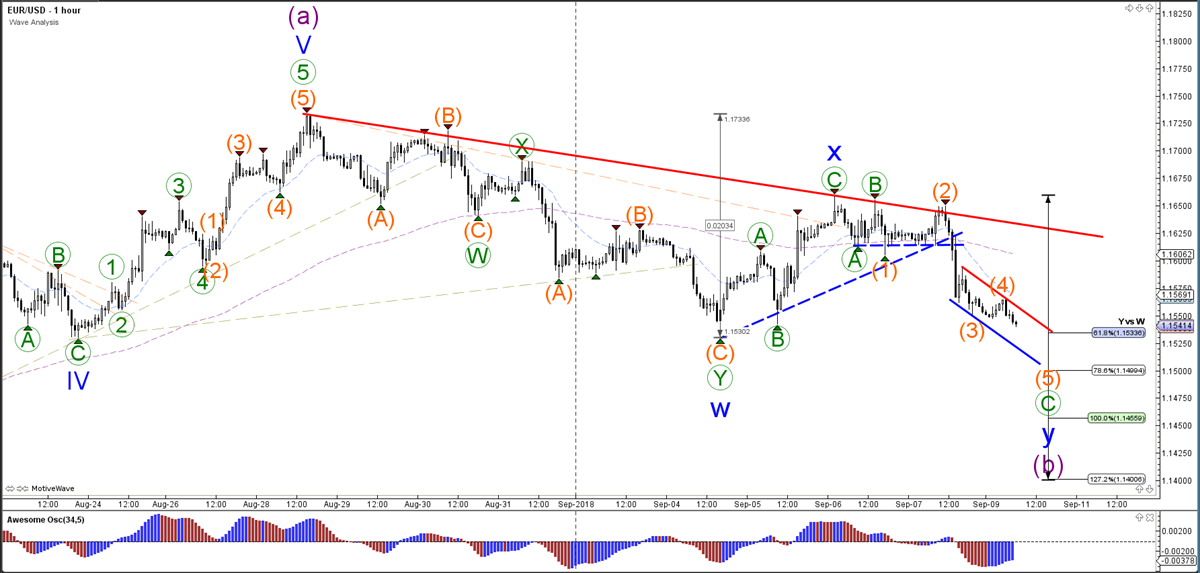
The EUR/USD could be building a bearish wave 5 (orange) within a wave C (green). The price is expected to move lower and challenge the Fibonacci levels of wave Y (blue), which in turn could become potential bouncing spots if the zone acts as support.
USD/CAD Daily Outlook
Daily Pivots: (S1) 1.3121; (P) 1.3156; (R1) 1.3201; More...
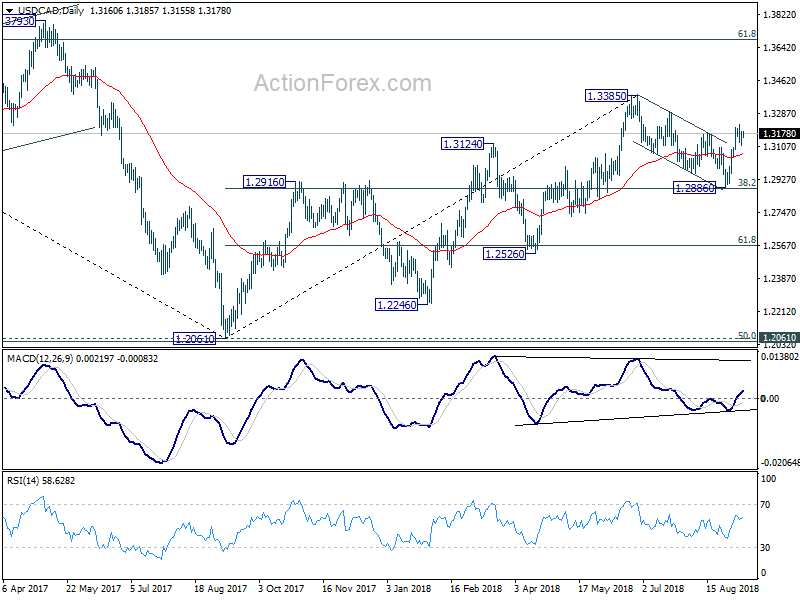
Intraday bias in USD/CAD remains neutral for consolidation from 1.3225 temporary top. We're holding on tot he view that corrective fall from 1.3385 has completed at 1.2886 already. Above 1.3225 will bring retest of 1.3385 first. On the downside, in case of another retreat, downside should be contained well above 1.2886 to bring rally resumption.
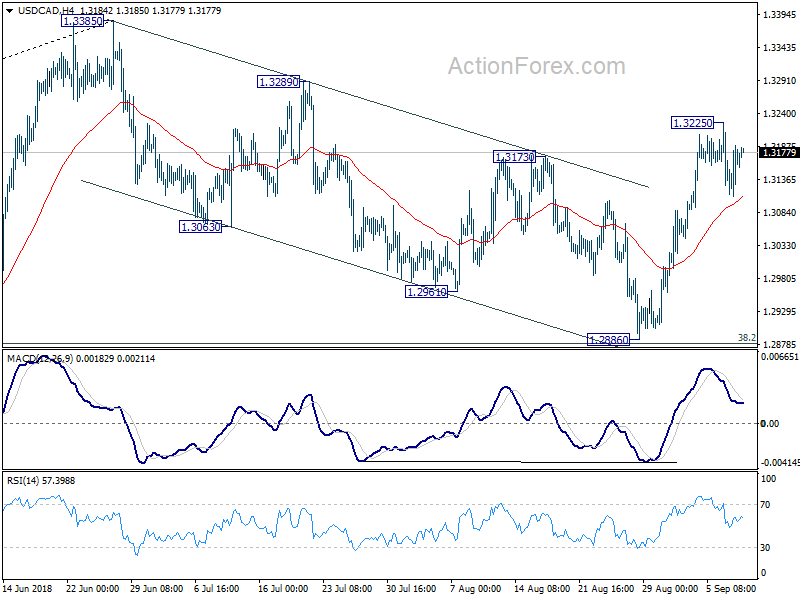
In the bigger picture, strong rebound ahead of 38.2% retracement of 1.2061 to 1.3385 at 1.2879 key fibonacci level retains medium term bullishness. That is, rise from 2017 low at 1.2061 is still in progress. Break of 1.3384 should target 61.8% retracement of 1.4689 (2015 high) to 1.2061 (2017 low) at 1.3685. On the downside, as long as 1.2886 support holds, outlook will now remain bullish.
USD/JPY Prepares For Bearish Breakout Of Triangle Pattern
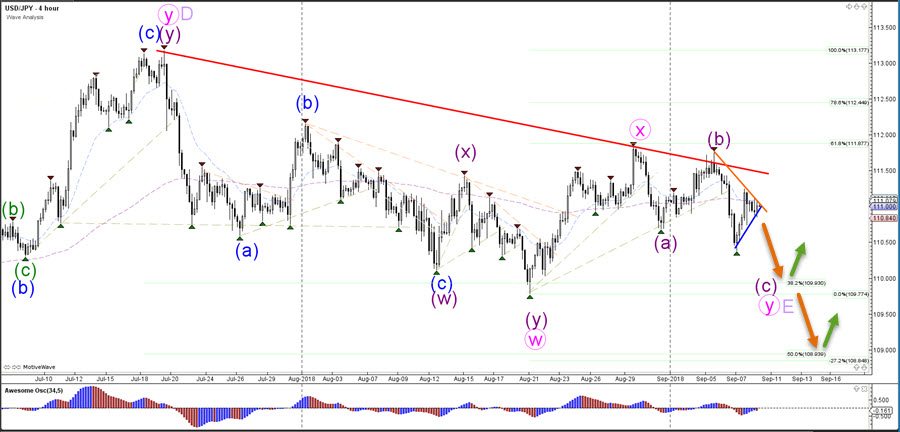
The USD/JPYmade a strong bullish bounce but a new bearish breakout could see price fall towards the Fibonacci targets to complete the wave E (purple) of the triangle chart pattern on the daily chart.
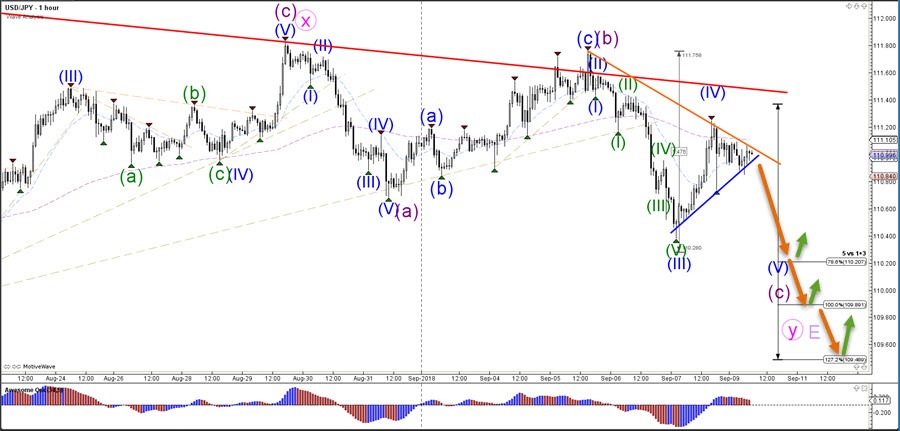
The USD/JPY is still probably buildingan ABC (purple) zigzag pattern within wave Y (pink). The confirmation of this wave pattern occurs when price is able to break below the support trend line (blue). A break above the resistance trend lines (orange/red) indicates a change of wave patterns.
The USD/JPY is probably in a wave 4 (blue) retracement, unless price breaks above the resistance trend line (orange).A break below support (blue) could indicate a bearish breakout towards the Fib targets. The S&R lines of the triangle pattern seem to be critical for the next direction.
EUR/USD Daily Outlook
Daily Pivots: (S1) 1.1519; (P) 1.1584; (R1) 1.1619; More.....
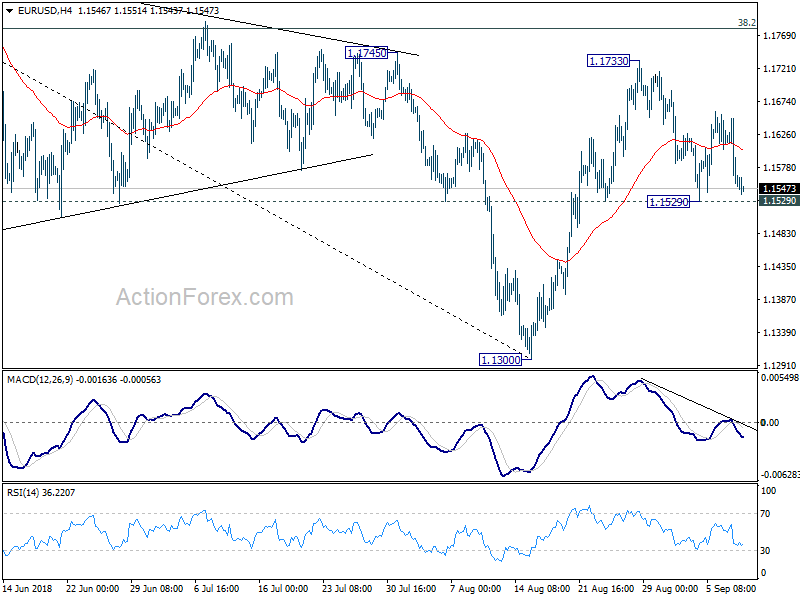
Intraday bias in EUR/USD remains neutral at this point, with focus on 1.1529 support. Break there will indicate completion of the rebound and turn bias to the downside for retesting 1.1300 low. On the upside, in case of another rise, strong resistance should be seen at 38.2% retracement of 1.2555 to 1.1300 at 1.1779 to limit upside, at least on first attempt. Overall, price actions from 1.1300 are forming a corrective pattern, that could extend for a while before completion.
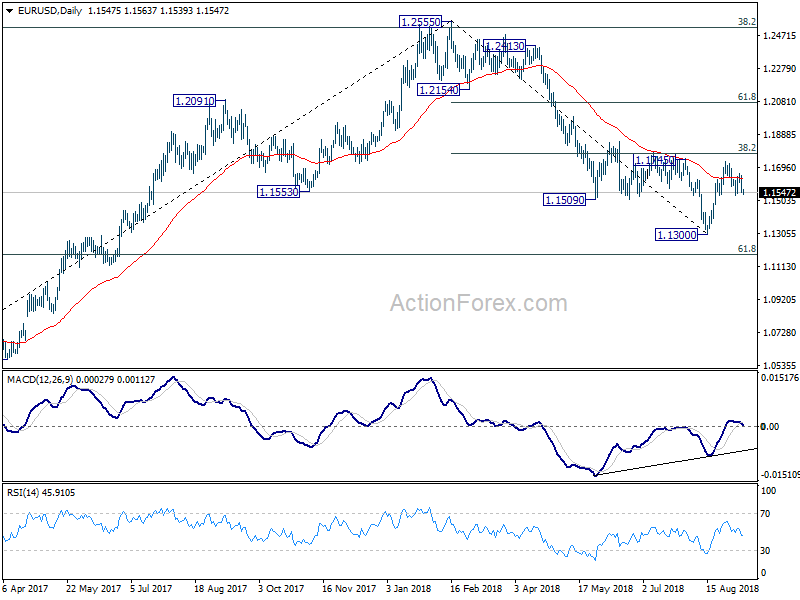
In the bigger picture, a medium term bottom should be in place at 1.1300, on bullish convergence condition in daily MACD and some consolidations would be seen. But still, note that EUR/USD was rejected by 38.2% retracement of 1.6039 (2008 high) to 1.0339 (2017 low) at 1.2516. That carries some long term bearish implications. Thus, we'd expect fall from 1.2555 high to resume after consolidation completes. Below 1.1300 should send EUR/USD through 61.8% retracement of 1.0339 to 1.2555 at 1.1186. And, in that case, EUR/USD would head to retest 1.0339 (2017 low).
GBP/USD Daily Outlook
Daily Pivots: (S1) 1.2874; (P) 1.2951; (R1) 1.2995; More...
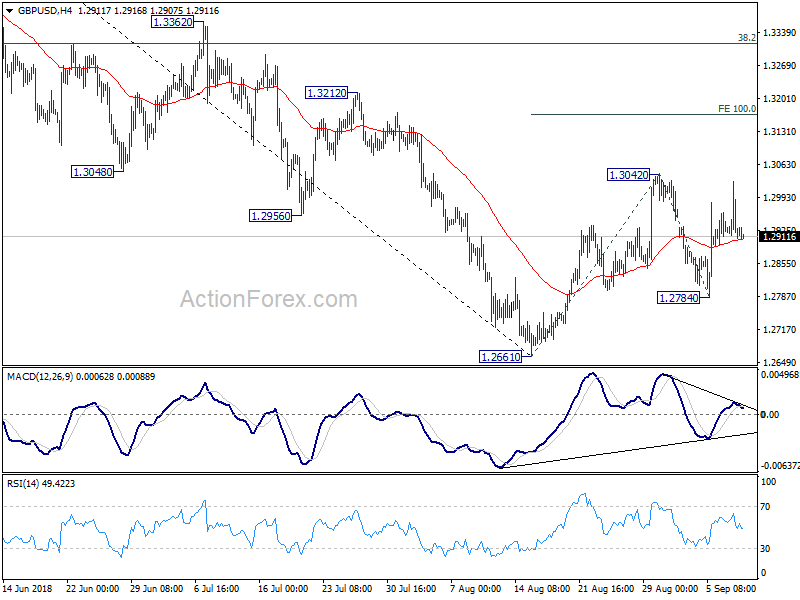
Intraday bias in GBP/USD remains neutral at this point, after failing to take out 1.3042. For now, further rise is mildly in favor as long as 1.2784 minor support holds. Break of 1.3042 will resume the rebound from 1.2661 and target 100% projection of 1.2661 to 1.3042 from 1.2784 at 1.3165. However, as such rebound is seen as a correction, upside should be limited by 1.3316 key fibonacci level to complete the corrective rise and bring near term reversal. On the downside, break of 1.2784 will bring retest of 1.2661 low.
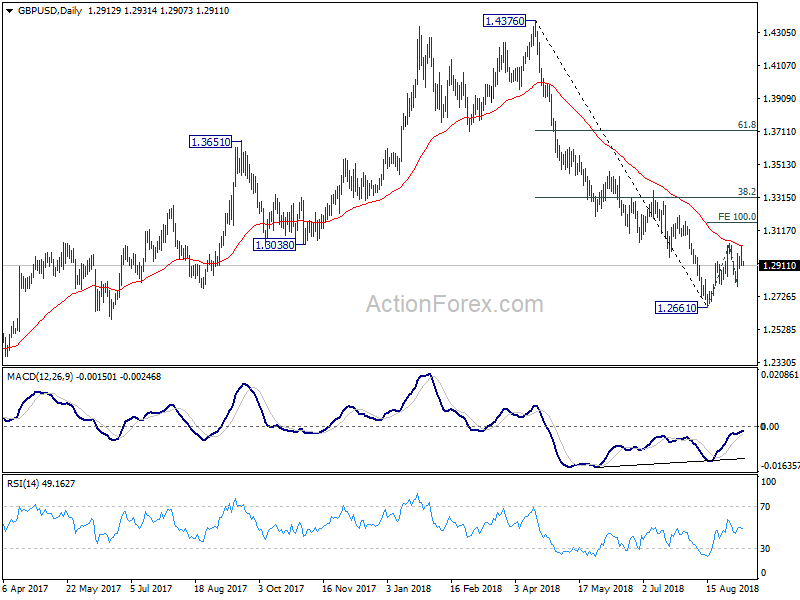
In the bigger picture, whole medium term rebound from 1.1946 (2016 low) should have completed at 1.4376 already, after rejection from 55 month EMA (now at 1.4099). The structure and momentum of the fall from 1.4376 argues that it's resuming long term down trend. And this will be the preferred case as long as 38.2% retracement of 1.4376 to 1.2661 at 1.3316 holds. However, firm break of 1.3316 would bring stronger rebound to 61.8% retracement at 1.3721. And, the eventual depth of the fall from 1.4376, and the chance of hitting 1.1946 low, will depend on the strength of the interim corrective rebound from 1.2661.
USD/CHF Daily Outlook
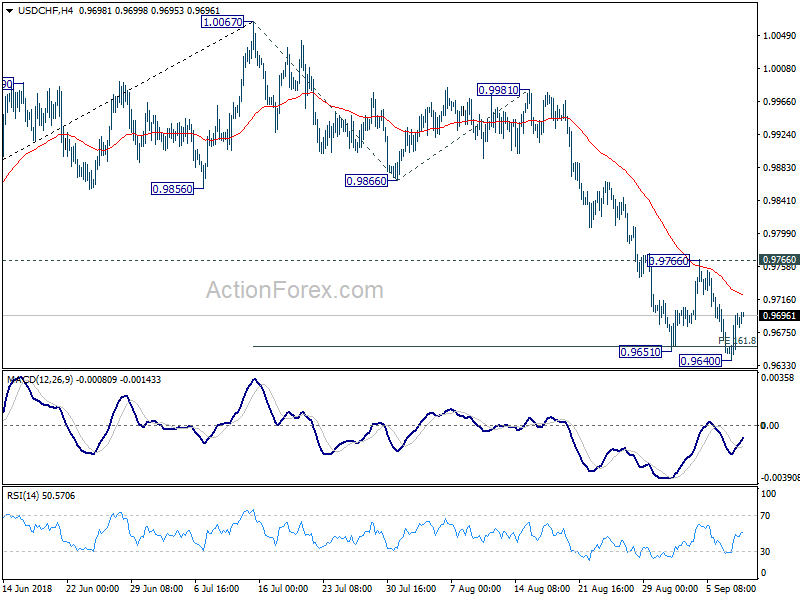
Daily Pivots: (S1) 0.9655; (P) 0.9678; (R1) 0.9714; More.....
Intraday bias in USD/CHF remains neutral at this point, after recovering from 0.9640. As long as 0.9766 resistance holds, outlook remains bearish for deeper decline. Break of 0.9640 will extend the decline from 1.0067 to 200% projection of 1.0067 to 0.9866 from 0.9981 at 0.8579 next. Though, break of 0.9766 will indicate near term reversal and target 0.9866 support turned resistance.
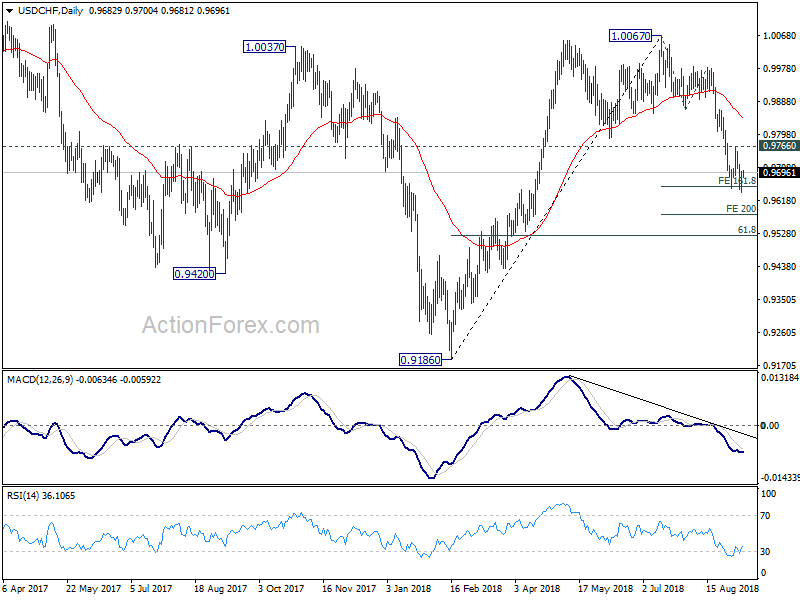
In the bigger picture, current development suggests that rise from 0.9186 low has completed at 1.0067, after failing to sustain above 1.0037 resistance. Fall from 1.0067 could extend to 61.8% retracement of 0.9816 to 1.0067 at 0.9523 and below. But for now, we don't expect a break of 0.9186 low. On the upside, firm break of 0.9866 support turned resistance will suggests that fall from 1.0067 has completed and rise from 0.9186 is resuming.
USD/JPY Daily Outlook
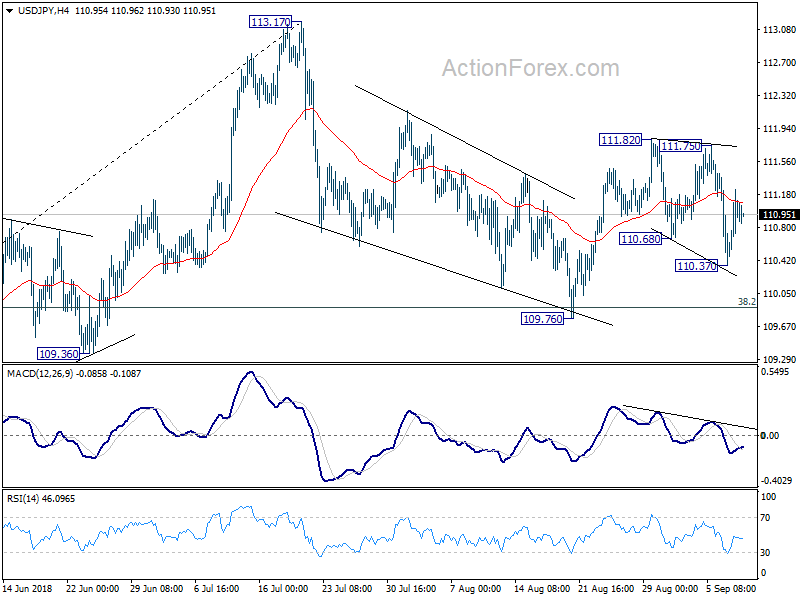
Daily Pivots: (S1) 110.56; (P) 110.90; (R1) 111.43; More...
Intraday bias in USD/JPY remains neutral at this point. On the upside, break of 111.73 minor resistance will resume the rebound from 109.76 to retest 113.17 high. Break there will resume larger rise from 104.62. On the downside, below 110.37 will bring deeper fall. But still, we'd expect strong support from 38.2% retracement of 104.62 to 113.17 at 109.90 to contain downside and bring rebound.
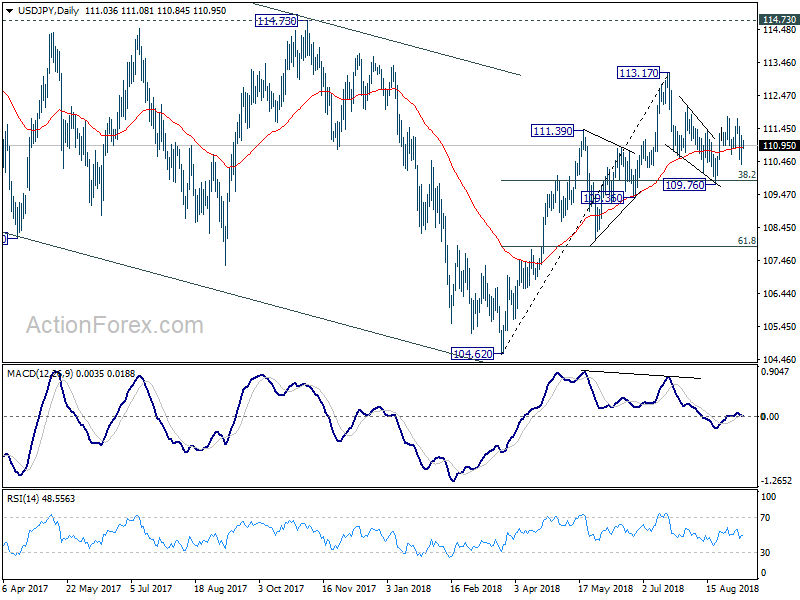
In the bigger picture, corrective fall from 118.65 (2016 high) should have completed with three waves down to 104.62. Decisive break of 114.73 resistance will likely resume whole rally from 98.97 (2016 low) to 100% projection of 98.97 to 118.65 from 104.62 at 124.30, which is reasonably close to 125.85 (2015 high). This will stay as the preferred case as long as 109.36 support holds. However, decisive break of 109.36 will mix up the outlook again. And deeper fall should be seen back to 61.8% retracement of 104.62 to 113.17 at 107.88 and below.
Yen Mildly Higher as Asian Markets Weighed Down by Trade Tension, ECB to Highlight the Week ahead
Yen opened the week mildly higher as Asian markets are generally soft on risk aversion, after Trump warned of tariffs on additional USD 267B in Chinese imports on Friday. However, Nikkei is rather immured from trade threats for today, despite Japan being named the next target. But after all, with the exception of selloff in New Zealand Dollar, the forex markets are generally in range. The fact that Australian Dollar follows Yen as the second strongest says it all. Traders are waiting for the markets to come back to life in European session, when some important UK data are scheduled to release.
At the time of writing, Nikkei is trading up 0.13% and is set to end the day with slight gain. On the other hand, China Shanghai SSE is down -0.73%, Hong Kong HSI is down -1.09% and Singapore Strait Times is down -0.58%. In particular, SSE, now at 2683, is very close to August low at 2683 and key support level at 2638 (2016 low). Break of these levels will certainly spill over to other Asian markets. Gold is trading at 1193 as recent consolidation extends. But 1182.90 near term support neve is safe and more upside is still expected through 1214.30 at a later stage.
Technically, EUR/USD will is facing 1.1529 near term support again. Break there will indicate completion of recent rebound from 1.1300 and deeper decline would be seen back to retest this low. However, how the forex markets would reaction elsewhere is uncertain. EUR/USD's fall could be triggered by another selloff in EUR/GBP, which is reversing recent rally. Or, it could be triggered by selloff in EUR/CHF which is extending the decline from 1.2004 and took our 1.1200 already. Meanwhile, GBP/USD and GBP/JPY are staying in tight range last week. Today's UK data may finally prompt a breakout.
Boston Fed Rosengren: There's an argument to normalize policy, and probably be mildly restrictive
Boston Fed President Eric Rosengren reiterated on Saturday that it's time to bring interest rate back to "normal" level. He told reporters after an economic conference that "here is upward pressure on inflation, and given that we are already at 2 percent, labor markets are already tight ... that is going to be a situation where we start persistently having inflation above what our target is." And he noted, "there is an argument to normalize policy and probably be mildly restrictive."
Rosengren also added that recent job and growth data were increasingly "inconsistent" with the estimates of a low neutral rate. And, "it would not surprise me at all if the committee estimates (on neutral rate) ... go up over time." And, if those estimates rise, "you would expect the path to move as well."
US Agriculture Secretary Perdue: Class 7 has to go for a NAFTA deal
As White House economic advisor Larry Kudlow repeated many times, "milk" is the key word in NAFTA renegotiation. This was echoed by US Agriculture Secretary Sonny Perdue in a TV interview aired on Sunday. Perdue said "our farmers don't have access to the Canadian markets the way that they have access to us. Class 7 has to go. It can't be renamed something or called something else."
Class 7 is a new milk class created by Canada to price milk ingredients such as protein concentrates, skim milk and whole milk powder. Perdue added the class "allowed them to export milk solids on the world market and below prices that cut into our opportunity for our dairy people to have access to that world market."
Canadian Foreign Minister Chrystia Freeland insisted over the weekend that to reach a deal, "it's going to take flexibility on all sides." She didn't respond to Kudlow's comments by pointed out that he is "not at the negotiating table".
Italian EM Tria: Makes no sense to borrow more on higher yields
Italian Economy Minister Giovanni Tria pledged on Sunday that the coalition will respect EU fiscal rules. And, more progressive budget plans would only be introduced gradually. The programs include both a new welfare tool advocated by the Five Star Movement and tax cuts promoted by the League. But he emphasized that "almost all reforms will start to be implemented gradually." And, "we are looking into Italy's big state balance sheet to find financial resources to be shifted toward these measures."
Also, he acknowledge the need to bring down the 130% debt to output ratio, which is the second highest in Eurozone. And such reduction "may bring about a strengthening and consolidation of Italy's presence on financial markets, which will free up resources and attract investments."He added "it makes no sense to seek two or three billion euros of extra deficit if we then have to pay three or four billion more due to higher yields". Further, "as the government puts words into actions, the (bond yield) spread will return to more normal levels."
Italian 10 year yield dipped notably from August high at 3.281 after the coalition government pledged not to break the bank. But, currently above 3%, it's still notably higher than 1.75-2.00% range before the coalition took office.
Japan PM Abe: Trade fights no benefit anyone, will proceed with sale tax hike
Facing trade threats from the US, Japanese Prime Minister Shinzo Abe kept his cool today and note that trade fights do not benefit any country. Japan is clearly the next trade target of Trump, who pull out of the Trans Pacific Partnership as the first "achievement" after taking office. Japan has been clear in insisting on promoting multilateral frameworks despite requests from the US on bilateral trade deals. Trump warned on Friday that "if we don't make a deal with Japan, Japan knows it's a big problem."
Additionally, Abe would proceed with the planned sales tax hike in October 2019 and carry out fiscal reforms. He said that "we will carry out fiscal consolidation and want to raise the sales tax as planned" to 10 percent, in a kick off news conference for his LDP leadership campaign. Abe added that he's learned a lesson from the 2014 sales tax hike and pledge with measures to ease consumptions.
Released from Japan today, Q2 GDP was finalized at 0.7% qoq, revised up from 0.5% qoq. GDP deflator rose 0.1% yoy, unrevised. Current account surplus narrowed to JPY 1.48T in July.
China bought more from others, but export growth to US steady
Trade data released on Saturday from China showed that with Trump's trade threats, it's quickly moving to other regions like EU and Australia for imports. At the same time, exports growth to the US maintained similar pace. It's still early to tell. But t Trump's trade policy failed for another month.
China increased imports from other regions in August like EU (10.6% yoy) and AU (34.0% yoy). Import from US slowed drastically to 2.7% yoy. On the other hand, exports to the US still grew steadily at 13.2% yoy comparing to EU (8.3% yoy) and AU (23.3% yoy). In the end, trade surplus with the US grew 18.4% yoy. And, trade surplus with EU just rose 4.0% yoy. Trade deficit with AU has indeed jumped 45.7% yoy. More details found in this quick note.
Also from China, CPI accelerated 0.1% to 2.2% yoy in August PPI slowed by 0.5% to 4.1% yoy.
ECB and BoE to highlight the week ahead
ECB and BoE meeting will catch most attention today. In particular, ECB is expected to reiterate that the monthly asset purchase will be tapered from EUR 30B to EUR 15B starting November. It's on track to stop asset purchases after December. But interest rates will stay at present level through the summer of 2019. The more interesting part could be the new economic projections. More in ECB to Affirm QE Reduction from October and Downgrade Inflation Forecasts. BoE, will very likely be a non-event.
In addition, there are some data to look into, including UK GDP, productions and employment, US inflation and retail sales, German ZEW, Australia employment. There will also be a bunch of Chinese data featured. Here are some highlights for the week:
- Monday: Eurozone Sentix investor confidence; UK GDP, productions, construction output
- Tuesday: Japan tertiary industry index, machine tool orders; UK employment; German ZEW economic sentiment; Eurozone employment change; Canada housing starts
- Wednesday: Japan BSI manufacturing; Australia Westpac consumer sentiment; Eurozone industrial production; US PPI; Fed's Beige Book report
- Thursday: Japan machine orders, Japan PPI; Australia employment; German CPI final; Swiss CPI; BoE rate decision; ECB rate decision; US CPI, jobless claims
- Friday: New Zealand Business NZ manufacturing index; China fixed asset investment, industrial production, retail sales, unemployment rate; Eurozone trade balance; US retail sales, import prices, industrial production, business inventories and U of Michigan sentiment
USD/JPY Daily Outlook
Daily Pivots: (S1) 110.56; (P) 110.90; (R1) 111.43; More...
Intraday bias in USD/JPY remains neutral at this point. On the upside, break of 111.73 minor resistance will resume the rebound from 109.76 to retest 113.17 high. Break there will resume larger rise from 104.62. On the downside, below 110.37 will bring deeper fall. But still, we'd expect strong support from 38.2% retracement of 104.62 to 113.17 at 109.90 to contain downside and bring rebound.
In the bigger picture, corrective fall from 118.65 (2016 high) should have completed with three waves down to 104.62. Decisive break of 114.73 resistance will likely resume whole rally from 98.97 (2016 low) to 100% projection of 98.97 to 118.65 from 104.62 at 124.30, which is reasonably close to 125.85 (2015 high). This will stay as the preferred case as long as 109.36 support holds. However, decisive break of 109.36 will mix up the outlook again. And deeper fall should be seen back to 61.8% retracement of 104.62 to 113.17 at 107.88 and below.
Economic Indicators Update
| GMT | Ccy | Events | Actual | Forecast | Previous | Revised |
|---|---|---|---|---|---|---|
| 22:45 | NZD | Manufacturing Activity Q2 | 1.80% | 0.60% | 0.70% | |
| 23:50 | JPY | GDP Q/Q Q2 F | 0.70% | 0.70% | 0.50% | |
| 23:50 | JPY | GDP Deflator Y/Y Q2 F | 0.10% | 0.10% | 0.10% | |
| 23:50 | JPY | Current Account (JPY) Jul | 1.48T | 1.56T | 1.76T | |
| 1:30 | CNY | CPI Y/Y Aug | 2.20% | 2.10% | 2.10% | |
| 1:30 | CNY | PPI Y/Y Aug | 4.10% | 4.10% | 4.60% | |
| 8:30 | EUR | Eurozone Sentix Investor Confidence Sep | 13.8 | 14.7 | ||
| 8:30 | GBP | Visible Trade Balance (GBP) Jul | -11.7B | -11.4B | ||
| 8:30 | GBP | Industrial Production M/M Jul | 0.40% | 0.40% | ||
| 8:30 | GBP | Industrial Production Y/Y Jul | 1.00% | 1.10% | ||
| 8:30 | GBP | Manufacturing Production M/M Jul | 0.30% | 0.40% | ||
| 8:30 | GBP | Manufacturing Production Y/Y Jul | 1.50% | |||
| 8:30 | GBP | Construction Output M/M Jul | -0.40% | 1.40% | ||
| 8:30 | GBP | GDP M/M Jul | 0.20% | 0.10% | ||
| 8:30 | GBP | Monthly GDP 3M/3M Change Jul | 0.60% | 0.40% | ||
| 8:30 | GBP | Index of Services 3M/3M Jul | 0.50% | 0.50% |