Sample Category Title
Boston Fed Rosengren: There’s an argument to normalize policy, and probably be mildly restrictive
Boston Fed President Eric Rosengren reiterated on Saturday that it's time to bring interest rate back to "normal" level. He told reporters after an economic conference that "here is upward pressure on inflation, and given that we are already at 2 percent, labor markets are already tight ... that is going to be a situation where we start persistently having inflation above what our target is." And he noted, "there is an argument to normalize policy and probably be mildly restrictive."
Rosengren also added that recent job and growth data were increasingly "inconsistent" with the estimates of a low neutral rate. And, "it would not surprise me at all if the committee estimates (on neutral rate) ... go up over time." And, if those estimates rise, "you would expect the path to move as well."
US Agriculture Secretary Perdue: Class 7 has to go for a NAFTA deal
As White House economic advisor Larry Kudlow repeated many times, "milk" is the key word in NAFTA renegotiation. This was echoed by US Agriculture Secretary Sonny Perdue in a TV interview aired on Sunday. Perdue said "our farmers don't have access to the Canadian markets the way that they have access to us. Class 7 has to go. It can't be renamed something or called something else."
Class 7 is a new milk class created by Canada to price milk ingredients such as protein concentrates, skim milk and whole milk powder. Perdue added the class "allowed them to export milk solids on the world market and below prices that cut into our opportunity for our dairy people to have access to that world market."
Canadian Foreign Minister Chrystia Freeland insisted over the weekend that to reach a deal, "it's going to take flexibility on all sides." She didn't respond to Kudlow's comments by pointed out that he is "not at the negotiating table".
ECB to Affirm QE Reduction from October and Downgrade Inflation Forecasts
While it has been widely anticipated that this week’s ECB meeting would be non-eventful, it is closely watched. We expect the central bank to reaffirm that the monthly asset purchases would be halved in size (from 30B euro to 15B euro) from October to December. There is chance that the reinvestment plan thereafter would be revealed. The policy rates would certainly stay unchanged, with the central bank reiterating that they would stay at exceptionally low level for an extended period of time.
Since the June meeting, economic growth, inflation and the job market have developed in line with expectations. However, wage growth and inflation have remained soft. As such, we expect the staff to slightly downgrade the inflation projections. While President Mario Draghi could talk about geopolitical uncertainties in Turkey and Italy, as well as escalation of global trade tensions, the happenings so far are not material enough to affect ECB’s policy stance.
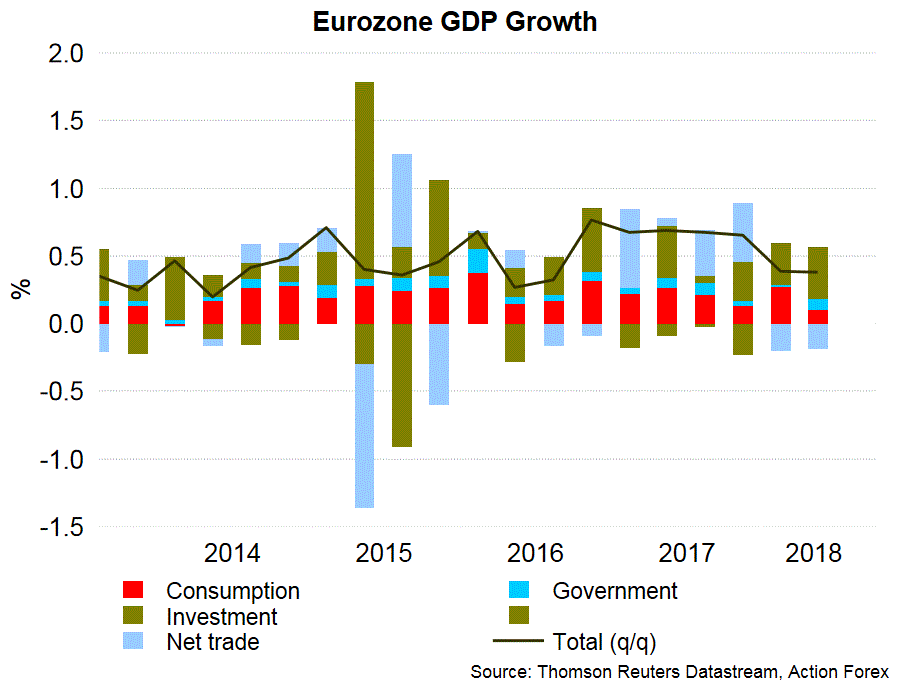
Second estimated of 2Q18 GDP was confirmed at +2.1% y/y, slightly lower than consensus of, and first quarter’s, +2.2%. On inflation, headline CPI (HICP) eased to +2% y/y in August, easing from consensus of, and July’s, +2.1%. Core inflation slowed to +1% y/y, down from +1.1% as the market anticipated. On the job market, the unemployment rate stayed unchanged at 8.2% in July. Labour cost jumped to+2% y/y in 1Q18.
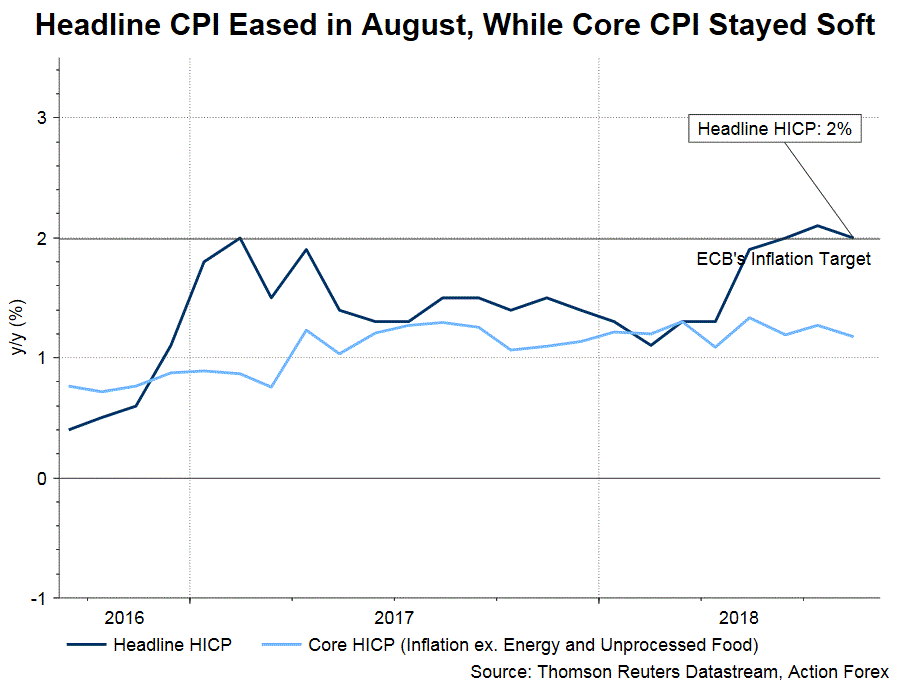
Despite being the strongest growth since 4Q12, this would not be sufficient to transmit to inflation, as the boost on domestic consumption is limited. Headline inflation was mainly driven by energy and food prices, and underlying inflation remained soft. Growth in wage is yet to meaningfully pass to the general price level. These could lead the economic staff to revise marginally lower their inflation forecasts for 2018 and 2019.
In June, ECB announced a dovish tapering plan: Reducing the size of its asset purchase program from 30B euro to 15B euro in the three months through December 2018. While the purchase program would end afterwards, the principal payments from maturing securities purchased under the program would be reinvested “for an extended period of time after the end of the net asset purchases, and in any case for as long as necessary to maintain favourable liquidity conditions and an ample degree of monetary accommodation”. ECB would reaffirm this plan at the upcoming meeting. It is also possible for the central bank reveal more details about the reinvestment plan.
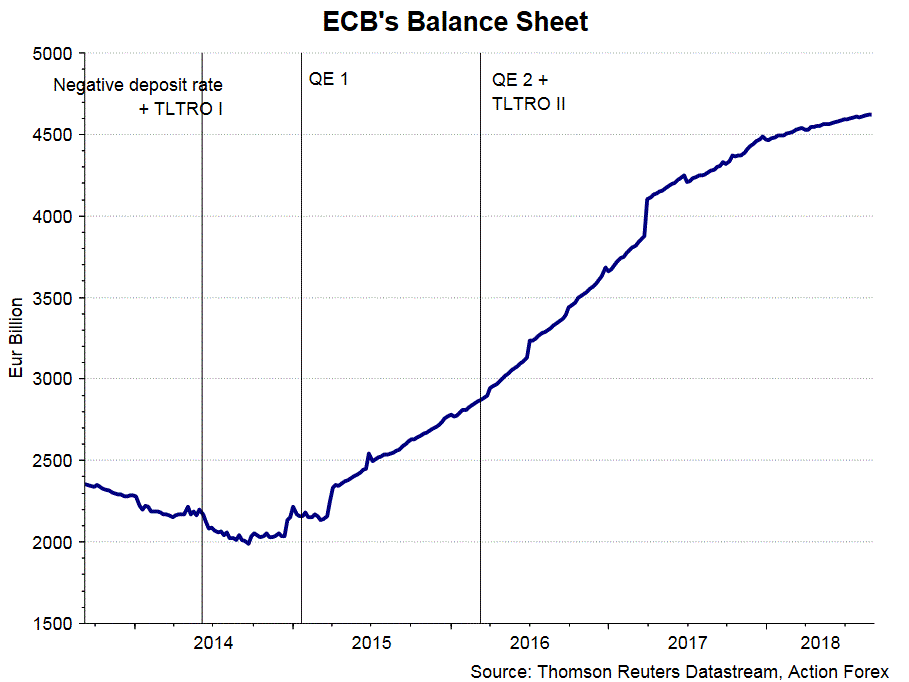
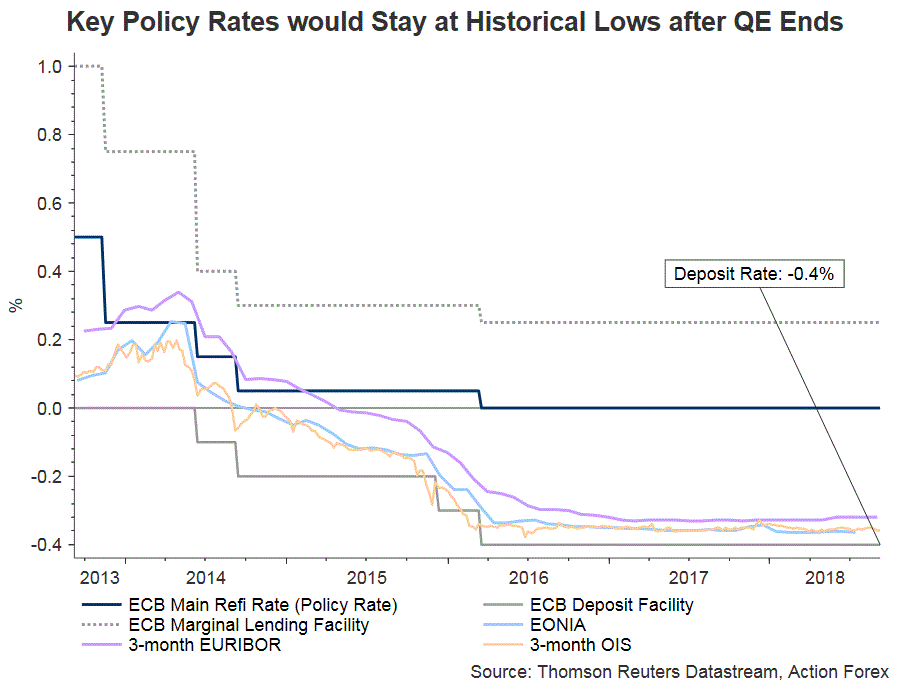
ECB’s policy rates have stayed unchanged since 2016 as will be maintained for some time after the end of the asset purchase program. We expect ECB would reiterate the forward guidance that the interest rates would “remain at their present levels at least through the summer of 2019, and in any case for as long as necessary to ensure the continued sustained convergence of inflation to levels that are below, but close to, 2% over the medium term”.
Italian EM Tria: Makes no sense to borrow more on higher yields
Italian Economy Minister Giovanni Tria pledged on Sunday that the coalition will respect EU fiscal rules. And, more progressive budget plans would only be introduced gradually. The programs include both a new welfare tool advocated by the Five Star Movement and tax cuts promoted by the League. But he emphasized that "almost all reforms will start to be implemented gradually." And, "we are looking into Italy's big state balance sheet to find financial resources to be shifted toward these measures."
Also, he acknowledge the need to bring down the 130% debt to output ratio, which is the second highest in Eurozone. And such reduction "may bring about a strengthening and consolidation of Italy's presence on financial markets, which will free up resources and attract investments."He added "it makes no sense to seek two or three billion euros of extra deficit if we then have to pay three or four billion more due to higher yields". Further, "as the government puts words into actions, the (bond yield) spread will return to more normal levels."
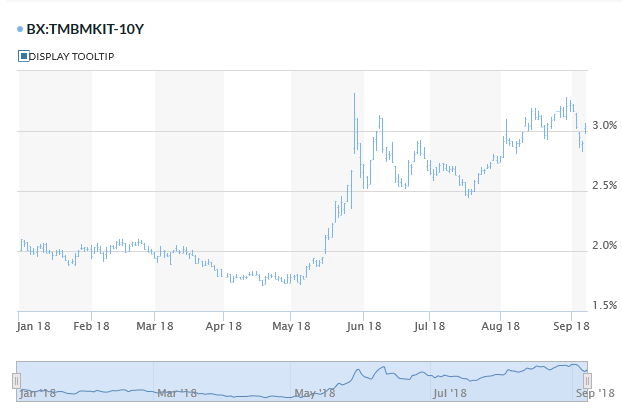
Italian 10 year yield dipped notably from August high at 3.281 after the coalition government pledged not to break the bank. But, currently above 3%, it's still notably higher than 1.75-2.00% range before the coalition took office.
EUR/USD Approaching Crucial Support Near 1.1515
Key Highlights
The Euro formed a short-term top at 1.1733 and declined against the US Dollar.
There was a break below a connecting bullish trend line with support at 1.1630 on the 4-hour chart of EUR/USD.
The US NFP in August 2018 increased 201K, more than the 191K forecast.
Today, the UK GDP for July 2018 will be released, which is forecasted to rise 0.3% (MoM).
EURUSD Technical Analysis
After trading above the 1.1700 level, the Euro failed to hold gains against the US Dollar. The EUR/USD pair formed a short-term top at 1.1733 and declined below the 1.1650 support area
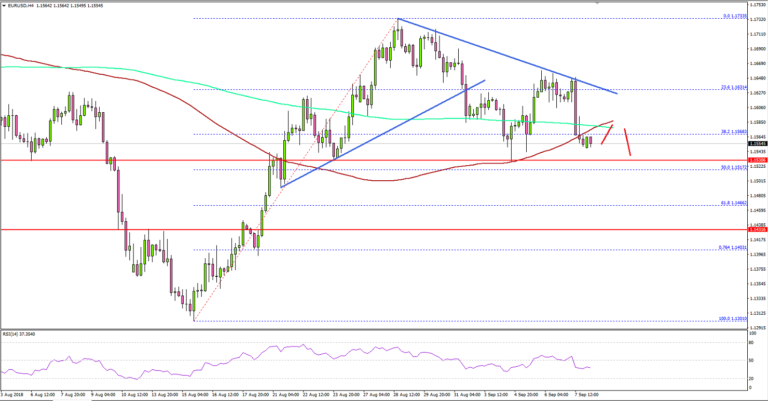
Looking at the 4-hours chart, the pair started a downward move and broke the 23.6% Fib retracement level of the last wave from the 1.1301 low to 1.1733 high. The pair also settled below the 1.1620 pivot area, opening the doors for more losses.
Moreover, there was a break below a connecting bullish trend line with support at 1.1630. At the outset, the pair seems to struggling to remain above the 100 simple moving average (red, 4-hours) and 1.1560.
Therefore, there is a risk of more losses towards the next major support at 1.1515 and the 50% Fib retracement level of the last wave from the 1.1301 low to 1.1733 high. If there are more declines, the pair could decline back towards the 1.1430 support area.
On the upside, there is a bearish trend line formed with resistance at 1.1610. To recover, EUR/USD must break the trend line and the 1.1620 pivot area.
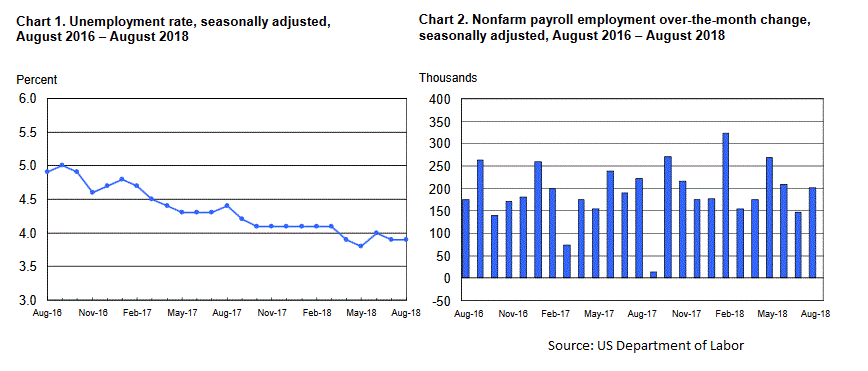
This past Friday, the US nonfarm payrolls report for August 2018 was released by the US Department of Labor. The market was looking for a rise of 191K compared with the last 157K.
The actual result was better than the forecast as total nonfarm payroll employment increased by 201K, but the last reading was revised down to 147K. Looking at the unemployment rate, there was no change from 3.9%.
The report added that:
The number of long-term unemployed (those jobless for 27 weeks or more) was little changed in August at 1.3 million and accounted for 21.5 percent of the unemployed. Over the year, the number of long-term unemployed has declined by 403,000.
Overall, the US Dollar buyers remain in control and major pairs like EUR/USD and GBP/USD could continue to face sellers in the near term.
Economic Releases to Watch Today
- UK GDP for July 2018 (MoM) – Forecast +0.3% versus +0.1% previous.
- UK Industrial Production for July 2018 (MoM) – Forecast +0.4%, versus +0.4% previous.
- UK Manufacturing Production for July 2018 (MoM) – Forecast +0.3%, versus +0.4% previous.
- UK Trade Balance non-EU for June 2018 – Forecast £-3.791B, versus £-2.940B previous.
Market Morning Briefing: Pound Is Trading Just Below Resistance Near 1.295
STOCKS
Stock indices are all mixed. While Dow is likely to remain stable, Dax and Shanghai has some more room on the downside. Nifty and Nikkei looks bullish after bouncing from support levels recently.
Dow (25916.54, -0.31%) has been trading in the narrow and sideways range without any major movement for the last 3-4 sessions and could possibly continue this for some more time. Support near 25750 may hold this week, eventually pushing the index to higher levels near 26250.
Dax (11959.63, +0.037%) has scope of testing 11600 on the downside although we could see some interim upward corrections from 11900 or 11800 levels. Near term looks bearish.
Nikkei (22314.48, +0.033%) has tested support at 22200 and while that holds, the index is likely to bounce back towards 22800-23000 in the near term. This 22200-23000 range needs to break in the longer run to indicate further directional movement. A rise in Nikkei could lead to some Yen weakness this week.
Shanghai (2677.03, -0.94%) has also been trading quietly in the narrow 2650-2750 region. Weekly candles indicate bearishness towards 2650-2600 for the near term while the trend resistance holds.
11400 is a decent near term support for Nifty and while that holds, Nifty (11589.10, +0.45%) could continue to move up towards 11700 or higher. Only a fall below 11400, if seen would bring in some weakness in Nifty over the longer run.
COMMODITIES
Brent (77.36) and WTI (68.23) have risen higher contrary to our expectation of a fall. While WTI trades above 67, could possibly head higher towards 72 in the medium term. The support on the WTI 3-day and weekly charts indicate medium term bullishness for WTI Crude. Brent has also risen a bit but resistance near 78 is still a concern of whether the support on the WTI charts will be able to support a rise in Brent as well. While below 78, we may consider another leg of fall in the next couple of sessions. A break above 78, if seen and sustains would confirm medium term bullishness.
Resistance near 1210 looks strong just now on the Gold (1199.80) 3-day candle chart and while that holds, there are some chances of a fall in prices in this week and the next. 1190-1180 can be re-tested with a possible bounce thereafter. Only a sustained break above 1210 would negate bearishness and bring in some upside hope.
Similar resistance to Shanghai and Gold is seen in Copper (2.6365) 3-day candle chart too and while the trend resistance holds, copper looks bearish for the medium term towards 2.55-2.50. Or it is also likely that copper trades sideways in the 2.55-2.75 region in the near term. But also note crucial long term weekly support could prevent further fall below 2.55/50 and rather keep prices stable before a sharp bounce is seen.
FOREX
With Euro looking like it could break below 1.155 in this week and Dollar Yuan already having breached above 6.85, we could be staring at some Dollar strength in this week.
Euro (1.1548) broke below support near 1.16 on Friday and is currently testing the crucial 21 days MA support near 1.155. A break below 1.155 (currently preferred) could be bearish, leading to a downmove towards support near 1.14 by next week. Look out for the ECB meet this week.
Dollar Index (95.43): Resistance near 95.5 is holding for the Dollar Index currently. A breach above 95.5 could happen in this week, which would then make it bullish towards 96.0-96.5 in the next week.
Dollar Yen (110.97) has been broadly trading in the 110-112 zone for the past 6-7 weeks. It is currently respecting immediate Support near 110.8-110.5 and has resistance near 111.25. Preference is tilted towards the support holding and a rise towards 112.0-112.5 taking place in the next 1-2 weeks.
Euro Yen (128.15) should stay below resistance near 130 - infact it looks bearish in the near term towards 127-126. In this week, with our preference being bearish on Euro-Dollar and slightly bullish on Dollar-Yen, we might see Euro Yen ranged around 129-128.
Pound (1.2917) is trading just below resistance near 1.295 on daily candles and looks like it could stay below this resistance level in this week. It might have some support near 1.28, which would have to break for lower levels to be tested in the coming weeks.
Dollar Yuan (6.859) has broken above 6.85 and now, might just become bullish towards 6.88-89 in the near term.
Dollar Rupee (71.735): With Euro's weakening towards 1.155 on Friday, Dollar Rupee in the offshore NDF market was trading near 72.10 on Friday night. So, there are chances of a gap up opening near 72 today. Resistance near 72.10 could push it down towards 71.60 (1st support). Below 71.60, there is crucial support in the 71.40-20 zone.
INTEREST RATES
India 10 year bond yield (8.0305%) has come off from important resistance near 8.11% in the last couple of sessions. It could come down further towards 8% in the next couple of sessions.
Following news points are currently important in context of US Yields:
On Friday, US non farm payroll data beat expectations and the average hourly earnings also came out strong. This has led to a rise in US Yields.
Earlier in the week, US manufacturing data had also reflected improvement - another reason for yields to be bullish.
Meanwhile the US-China trade conflict continues to intensify with Trump reportedly saying that tariffs might be imposed on all Chinese imports to USA (ie on $467 bn worth of goods) - if that happens, risk aversion would prevent any significant rise in yields. This is one of the major reason why we believe that the May high of 3.125% for the US 10 year yield might have been the year's top.
US 10 Year Yield (2.94%) has breached the 2.9% resistance level and could rise some more towards the 3% barrier before coming off from there once again. A break above 3% is not preferred.
German 10 year yield (0.39%) has immediate resistance @ 0.40% . Looking at the German 5 Year yield (-0.17%), which has breached above the resistance near -0.20% and the German 30 Year yield (1.06%) which has enough to room to go up towards 1.10%-1.15%, there is a slight chance that the German 10 Year yield could go above 0.4% in the near term - moreover horizontal support near 0.3% on medium term chart has been holding very well.
Japan PM Abe: Trade fights no benefit anyone, will proceed with sale tax hike
Facing trade threats from the US, Japanese Prime Minister Shinzo Abe kept his cool today and note that trade fights do not benefit any country. Japan is clearly the next trade target of Trump, who pull out of the Trans Pacific Partnership as the first "achievement" after taking office. Japan has been clear in insisting on promoting multilateral frameworks despite requests from the US on bilateral trade deals. Trump warned on Friday that "if we don't make a deal with Japan, Japan knows it's a big problem."
Additionally, Abe would proceed with the planned sales tax hike in October 2019 and carry out fiscal reforms. He said that "we will carry out fiscal consolidation and want to raise the sales tax as planned" to 10 percent, in a kick off news conference for his LDP leadership campaign. Abe added that he's learned a lesson from the 2014 sales tax hike and pledge with measures to ease consumptions.
Released from Japan today, Q2 GDP was finalized at 0.7% qoq, revised up from 0.5% qoq. GDP deflator rose 0.1% yoy, unrevised. Current account surplus narrowed to JPY 1.48T in July.
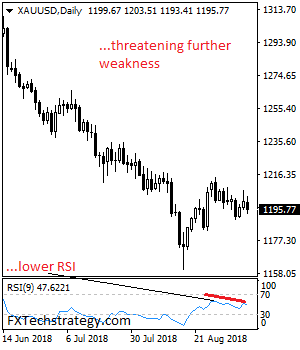
GOLD – Remains Vulnerable With Price Extension Risk
GOLD - The commodity remains weak and vulnerable leaving risk lower. On the downside, support comes in at the 1,190.00 level where a break will turn attention to the 1,180.00 level. Further down, a cut through here will open the door for a move lower towards the 1,170.00 level. Below here if seen could trigger further downside pressure targeting the 1,160.00 level. Conversely, resistance resides at the 1,200.00 level where a break will aim at the 1,210.00 level. A turn above there will expose the 1,220.00 level. Further out, resistance stands at the 1,230.00 level. All in all, GOLD looks to weaken further on price extension.
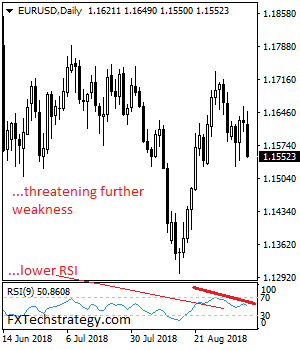
EURUSD – Eyes Further Weakness Towards The 1.1529/00 Zone
EURUSD - The pair looks to follow through lower following its past week losses. On the upside, resistance comes in at 1.1600 level with a break through there opening the door for more upside towards the 1.1650 level. Further up, resistance lies at the 1.1700 level where a break will expose the 1.1750 level. Conversely, support lies at the 1.1500 level where a violation will aim at the 1.1450 level. A break of here will aim at the 1.1400 level. Below here will open the door for more weakness towards the 1.1350. All in all, EURUSD faces further downside pressure as we look for more bear pressure.
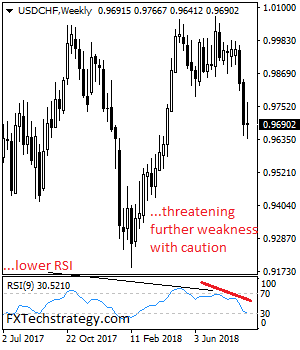
USDCHF – Sees Price Hesitation With Caution Of Recovery
USDCHF - The pair looks to hesitate further but correct higher in the new week. On the downside, support lies at the 0.9650 level. A turn below here will open the door for more weakness towards the 0.9600 level and then the 0.9550 level. On the upside, resistance resides at the 0.9700 level where a break will clear the way for more strength to occur towards the 0.9750 level. Further out, resistance comes in at the 0.9800 level. Above here if seen will turn attention to 0.9850. All in all, USDCHF faces further price consolidation but recovery risk.