Sample Category Title
EUR/USD: Displays Possibilities of a Bullish Presence, but Must Breakout of Downward Trend
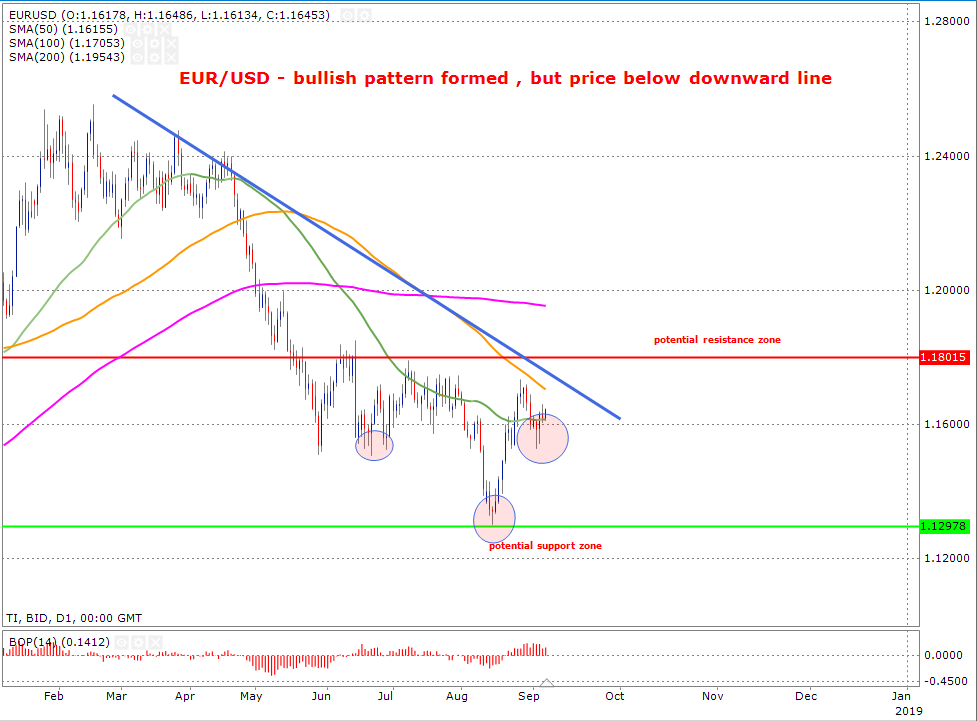
The chart below shows the pair EUR/USD to have formed a bullish pattern which is clearly indicated below in the form of a reverse head and shoulder pattern. The projection of this pattern gives reason to believe that it could maybe drive the price up in a strong bullish momentum to $1.20.
On the other hand, prior to reaching this hegemonic position, the pair EUR/USD will come across several challenges which it will have to break through first. The two main obstacles it will face would be to reach resistance zone (colored in red) which is priced at $1.18015. Moreover, the second would be to trade above all moving averages which would reinforce the belief of a bullish momentum holding dominance over the pair. The potentials of the EUR/USD price declining towards the support zone (colored in green) which is priced at $1.12978 is apparent as the price is trading below the downward trend line. However, due to the pattern displayed below the bulls do hold power at present.
The Balance of Power chart below emphasizes the strength of the bulls which are present in the market for the pair. This is because it is evident that the chart below shows gradual growth towards the upside.
Major support: 1.12978
Major resistance: 1.18015
Is The Upcoming US-NFP Data Spineless?
More rotten economic data came out of Europe. The German industrial production number was just terrible, this has made investors even more disappointed. The number fell below the expectations (0.2%) and printed the reading of -1.1%. Even the export number for the country wasn’t great either, it also missed the expectations and dropped by 0.9% MoM basis. Thanks to the global trade war which has impacted these numbers and central banks are still immune to this.
Sentiment over in Europe is really negative due to the strong possibility of new tariffs kicking in on China today and investors are worried about the reaction from Beijing. For investors, they are looking at the numbers and thinking how much of this has something to do with the ECB winding down it’s balance sheet and how much of this is down to Trump ranching up the tensions in the global trade war arena.
Back in the US, it is only about one data which matters the most- the US NFP. One thing which is on every trader’s mind is if this is going to impact the Fed’s rate decision. Highly unlikely, we do not think that today’s number has actually has that kind of power. The Fed is pretty much determined that another rate hike is on the table and they have the economic data fully supporting their thesis.
Having said this, it doesn’t mean that today’s US NFP number is spineless. There are lot of important details which are embedded in this number and this could help investors to understand the economic picture more closely. But let’s have a look at the ADP number first, it tells you that the tone isn’t positive because the ADP numbers missed the expectations. The number printed reading of 163K while the forecast was for 217K. We didn’t see any kind of trade war between effect in the ISM manufacturing number because the employment component of this number was fairly robust.
So, where does this all leave us today? The wage story will take the centre stage today. Tightening labour market should produce some meaningful impact here and this has been missing. We have witness an increase in the wage growth but the acceleration rate of this wage growth doesn’t add up with the rest of the components of the labour market. The US businesses are reluctant to add extra dollar to the wage growth and this should not be the case given if the rest of the component of the wage growth story are accurate.
Nonetheless, the headline number is expected to come in at 198K and the unemployment rate could fall further to 3.8%. A fall in the unemployment number would prompt Trump’s twitter account to show some flashy messages and claim the victory.
Canadian Dollar Trading Sideways ahead of Key Job Data
The Canadian dollar has inched higher in the Friday session. Currently, USD/CAD is trading at 1.3124, down 0.14% on the day. On the release front, the focus will be on employment indicators on both sides of the border. In Canada, employment change is expected to post a small gain of 5.1 thousand and Ivey PMI is forecast to dip to 61.5 points. Over in the U.S, nonfarm payrolls are expected to rise to 193 thousand, and Average Hourly Earnings is forecast to tick lower to 0.2%. Traders should be prepared for some movement from USD/CAD during the North American session.
There were no surprises on Wednesday as the Bank of Canada stayed on the sidelines and maintained the benchmark rate at 1.50%. The Bank raised rates by a quarter-point in July and has hiked rates four times since last summer. The Bank stated in its rate announcement that policymakers would be “monitoring closely the course of the NAFTA negotiations and other trade policy developments, and their impact on the inflation outlook”. With the Canadian economy performing well and the Fed likely raising rates later this month, there is pressure on the BoC to again raise rates in 2018. However, concerns over NAFTA and global trade tensions have won the day for now, as the BoC took a pass on a rate hike.
The global trade war has spooked investors and weighed on risk currencies such as the Canadian dollar. The U.S-China trade spat has been in the headlines for months, with the U.S slapping tariffs on China and the latter responding in kind. Will President Trump ratchet up the trade war between the world’s two largest economies? Trump has threatened to impose tariffs on $200 billion worth of Chinese tariffs, and the time period for public consultations ended on Thursday, which means that Trump is free to announce another round of tariffs at any time. The U.S dollar has benefited from the global trade war, and further tariffs against China could spell more headwinds for the wobbly Canadian dollar.
Into US session: Sterling surges as the strongest, CAD and USD follow ahead of job data
Entering into US session, Sterling just shoots up sharply in the last hour and is now trading as the strongest one for the day. There is no apparent trigger or Brexit headline flowing through. Some pointed to a transcript of EU chief negotiator Michel Barnier at the UK House of Commons, where he mentioned that EU is "open to discussing other backstops" regarding the Irish order, as a trigger. But we'd say, if that document is the cause of the rally, then it's more likely that Barnier said "no-deal scenario is not our scenario; it is not my scenario."
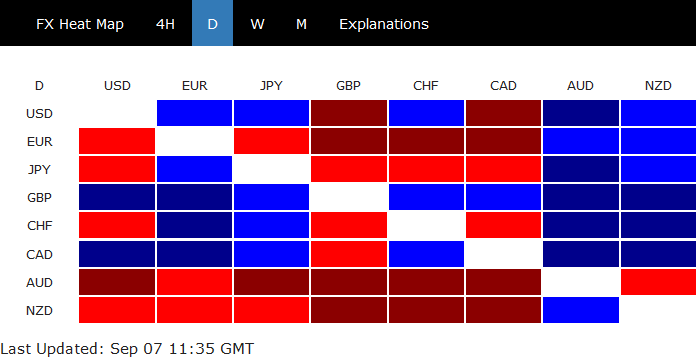
But anyway, GBP/USD is now set to take on 1.3042 resistance with today's strong rally. Meanwhile, EUR/GBP's break of 0.8937 support and the near term channel is an indication of bearish reversal.
Canadian Dollar is following as the second strongest, as it was boosted after BoC Senior Deputy Governor Carolyn Wilkins yesterday suggested that BoC is still on course for further rate hikes despite uncertainty of NAFTA negotiations.
Dollar is the third strongest for the day. Markets await US and Canada employment data.
For now, Australian Dollar and New Zealand Dollar are the weakest ones, joined by Euro thanks to EUR/GBP selloff.
In other markets, major European indices are in red today, with FTSE down -0.9% at the time of writing, DAX down -0.21% and CAC down -0.18%. Asian markets ended mixed, with Nikkei down -0.8% and Singapore Strait Times down -0.42%. But China Shanghai SSE reversed earlier losses and ended up 0.40%. Hong Kong HSI just lost -0.01%. That's a reason why Yen pared back some of the earlier gains.
NFP Preview: EUR/USD Is Bullish Above 1.1655
The EUR/USD has reached a significant resistance. There is a trend linealong with D H4/ W H3 confluence that holds the pair from proceedingfurther. However, a bounce above 1.1655 aims for 1.1683 and 1.1700.Ultimately the pair might reach 1.1750. However, as long as the pair iskept below 1.1655, we could see a bearish move towards 1.1608 and1.1569. The direction will hugely depend on today’s NFP and allaccompanying data.
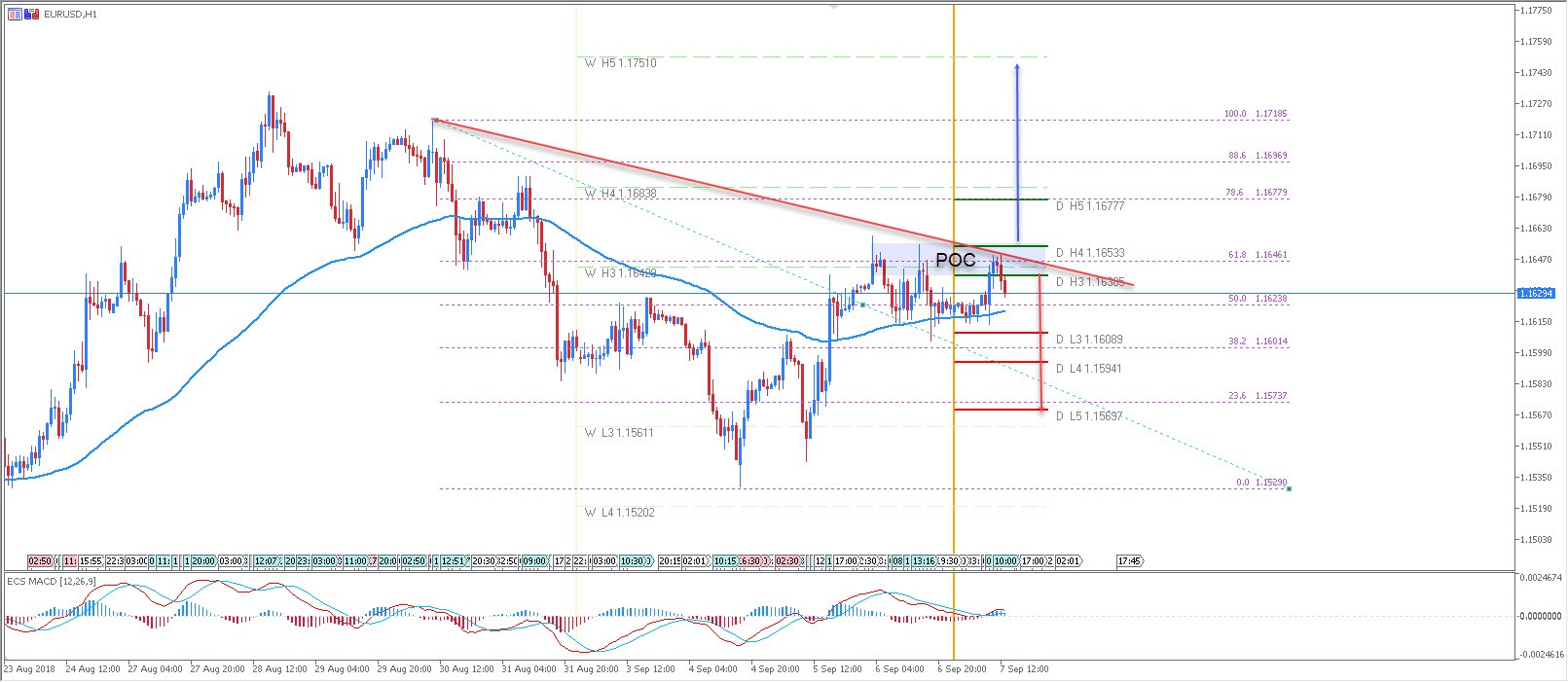
W L3 - Weekly Camarilla Pivot (Weekly Interim Support)
W H3 - Weekly Camarilla Pivot (Weekly Interim Resistance)
W H4 - Weekly Camarilla Pivot (Strong Weekly Resistance)
D H4 - Monthly Camarilla Pivot (Very Strong Daily Resistance)
D L3 – Monthly Camarilla Pivot (Daily Support)
D L4 – Monthly H4 Camarilla (Very Strong Daily Support)
POC - Point Of Confluence (The zone where we expect the price to react - aka the entryzone)
Fundamentals: Gold And Oil Ahead Of US NFP Data
Oil sees stability while U.S. crude inventories take a fall
Gold benefits from dollar declining against the Yen
Gold:
Gold continues to see better days while the dollar takes abuse against the Yen on potential future U.S. trade disputes with Japan. The topic of U.S. introducing new trade tariffs arose from a report that claimed Trump could possibly begin to rectify trade issues with the state. The consequences of this plan that Trump wishes to carry out had led to further decreases in the dollar. Moreover, the greenback has recently seen lows while European currencies and gold have begun to increase.
Gold has seen an increase and the stronger Yen has a part to play in this. This is because as the Yen grows while the dollar shows weakness it promotes the holders of JPY to profit from gold. Therefore, the precious metal has benefited from this.
On the other hand, the fate of the markets are reliant upon the employment data which is due to be released today. Depending upon the results, the dollar could see highs if the report favours the fed and rate hikes continue as planned. However, as of now it is nothing but a waiting game where the markets could go either way once the data is released. Nevertheless, at present it seems gold may continue to rise as it has been horribly over sold while the dollar has been overbought.
Oil:
Oil stabilises in price as data release on Thursday for U.S. crude inventories take a major fall. The figures which had appeared from the data release were at their lowest since 2015. Moreover, the reasons behind such negative results could possibly be due to a lower consumption levels in the driving season which is usually when gasoline is at its highest demand.
The current weakness that the emerging markets face as well as heavy lethal tariffs on Chinese goods also have a part to play in U.S. crude inventories entering on a major decline. International Brent crude futures have been priced at around $76.42 per barrel which was 8 cents decrease from the previous session. In addition, the reason behind this weigh upon the fact that demand is not as high as expected for the high driving season.
Additionally, another vital factor towards why consumer spending and demand on oil has dropped could be because of the recent events which have shortened supply and have led to price increases. Lastly, emerging market currency crisis has also taken its toll on the oil industry as weaker currencies mean weaker spending ability. This leads to reduced usage of fuel.
Bear Market Blues
Friday September 7: Five things the markets are talking about
Trade talks, tariffs threats, EM contagion fears and central bank decisions are dominating asset price moves this month.
Add geopolitical risks and U.S impeachment possibilities, market volatility is expected to remain elevated for the foreseeable future.
Global equities traded mixed overnight as investors await the latest word on trade wars and today’s payroll reports from the U.S and Canada.
The ‘big’ dollar has eased a tad ahead of U.S jobs data (08:30 am EDT), while Treasuries are steady. EM equities snapped a week of declines while their currencies rallied.
There are no major economic calendar events scheduled for this weekend. On Sunday, there is the Swedish general election and the market will be interested in the growth of the right wing.
Note: The ‘hard’ right party is expected to get around +20% of the vote. While that would make it one of the largest single parties, others are in coalitions and centre right and centre left expected to achieve +40% each.
On tap: Investors turn to the U.S payrolls report for August which is expected to show a robust rise of +191K and an unemployment rate of +3.8%.
1. Stocks mixed
U.S. equity futures are little changed ahead of NFP, following a mostly negative session in Asia, where stocks closed out the worst week in six-months.
In Japan, the Nikkei continued its slide into a six consecutive session dropping to a three-week low as investors sold chip equipment makers and on concerns that President Trump could be contemplating taking on Japan over trade. The benchmark share average dropped -0.8%. For the week, the Nikkei plummeted -2.4%, its biggest weekly fall in six-months. The broader Topix declined -0.5%.
Down-under, Aussie stocks fell again overnight, for a seventh consecutive session; on the back of the possibility the Sino-U.S trade war could escalate any time. The S&P/ASX 200 index fell -0.3% at the close. For the week, the index shed -2.8%. In S. Korea, tumbled -0.26% overnight and is down -1.8% on week.
In Hong Kong, stocks ended flat overnight as investors fear new U.S tariffs. The Hang Seng index ended down -0.01%, while the China Enterprises Index closed -0.18% lower.
In China, shares edge higher in cautious trade as tariff comment deadline expired. At the close, the Shanghai Composite index was up +0.4%. The index was down -0.8% for the week, while the blue-chip CSI300 index ended +0.45% higher, but was down -1.7% for the week.
In Europe, regional bourses trade mixed in a quiet session ahead of N. American jobs data.
U.S stocks are set to open in the ‘red’ (-0.1%).
Indices: Stoxx600 -0.1% at 373.2, FTSE -0.2% 7304, DAX -0.1% at 11947, CAC-40 +0.1% at 5249, IBEX-35 -0.2% at 9194, FTSE MIB +0.0% at 20530, SMI +0.2% at 8836, S&P 500 Futures -0.1%
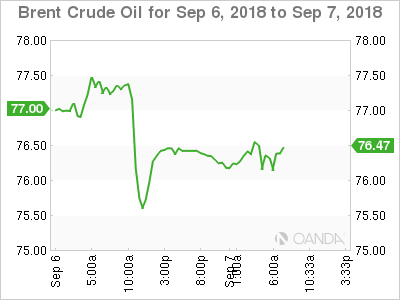
2. Oil steady as U.S crude inventories fall, but trade tensions weigh, gold higher
Oil prices are little changed despite a fall in U.S crude inventories to the lowest levels in three-years, although Sino-U.S trade tensions and economic weakness from emerging markets remain a concern.
Brent crude futures are up +8c at +$76.58 a barrel, while U.S West Texas Intermediate (WTI) crude is at +$67.93 per barrel, up +16c from Thursday’s close.
According to the EIA’s report yesterday, U.S commercial crude oil inventories fell by -4.3M barrels to +401.49M barrels in the week to Aug. 31, the lowest since February 2015.
Despite that, crude prices have been limited by a rise in refined product stocks and a relatively weak U.S driving season. Also not helping is the ongoing EM weakness. Investors can expect potential new U.S import tariffs on Chinese goods to continue to weigh on oil market sentiment.
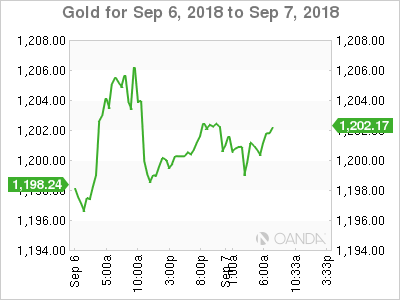
Ahead of the U.S open, gold has extended its gains overnight as the U.S dollar fell against the yen on news that President Trump would next take up trade issues with Japan, while investors feared another round of Sino-U.S tariffs at any moment.
Spot gold is up +0.1% at +$1,200.88, after printing a one week high Thursday at +$1,206.98. U.S gold futures have rallied +0.2% to +$1,206.40 an ounce.
3. Italian yields fall
Italy’s borrowing costs have fallen to a one-month low this morning and the best week for prices in three-months, thanks to easing concern over fiscal spending worries from the new anti-establishment government.
Short-dated Italian BTP yields have fallen more than -50 bps this week after reassuring comments from Rome that the sitting government would respect E.U rules on fiscal discipline.
Note: Italy’s 10-year BTP yield has fallen more than -7 bps to +2.83%, its lowest in four-weeks – it has fallen -40 bps this week.
Elsewhere, the yield on 10-year Treasuries has climbed +1 bps to +2.88%. In Germany, the 10-year Bund yield has advanced +1 bps to +0.36%, while in the U.K, the 10-year Gilt yield has increased +1 bps to +1.416%.
4. Dollar waits for NFP
Today’s U.S August jobs data is expected to show more job creations (+191K), which could bode well for the U.S dollar, especially against EM currencies and riskier developed market currencies like the AUD (a proxy for China).
Note: USD is a tad softer against G7 currency pairs ahead of NFP – trade could quickly move back to the front burner if the U.S decides to implement the +$200B in additional tariffs on China now that the public comment period related to the US proposed tariffs has expired overnight.
With a ‘no’ sign of U.S slowdown, will permit President Trump to proceed with his trade tactics, and keep the Fed on its steady rate-hiking path.
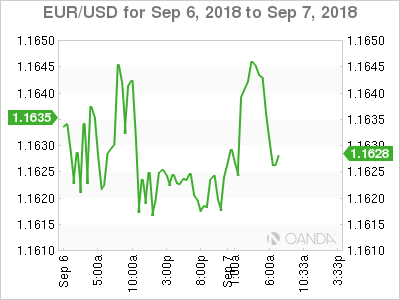
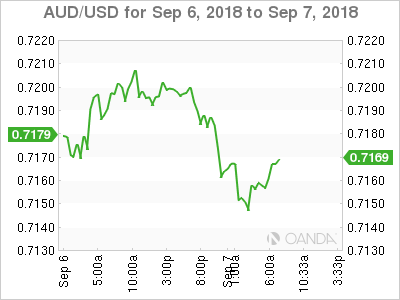
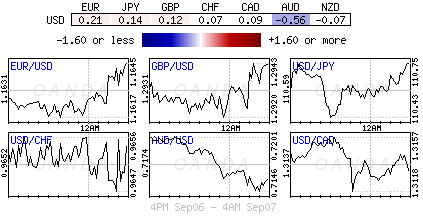
EUR/USD up +0.2% at €1.1644, but AUD/USD is down -0.7% at A$0.7155, having dropped to a 20-month low at A$0.7137. The EUR has got a lift from lower Italian BTP yields (see above).
5. Eurozone economic growth falls further behind U.S
Data this morning showed that the eurozone’s economy slowed slightly in Q2, as imports jumped despite weak household spending.
The E.U statistics agency said Q2 GDP was +0.4% larger than Q1, and +2.1% up on the same period a year earlier. That was the equivalent of an annualized rate of +1.5%, just below the +1.6% rate of expansion recorded in Q1.
Note: The loss of momentum stands in contrast with the U.S (+4.2%), where growth has surged in the same time period due to a package of tax cuts and government spending increases.
DAX Slide Continues After Weak German Industrial Report
The DAX index is trading sideways in the Friday session. Currently, the index is at 11,930, down 0.21% on the day. On the release front, German data disappointed. Industrial Production declined 1.1%, well short of the estimate of +0.2%. As well, Germany’s trade surplus narrowed to EUR 15.8 billion, shy of the forecast of 19.1 billion. In the eurozone, Revised GDP posted a 0.4% gain for a second straight month, matching the forecast. In the U.S, nonfarm payrolls are expected to rise to 193 thousand.
It’s been a dismal week for the DAX, which is down 3.5 percent. Investors have responded negatively to weak German data and gloomy prospect of worsening trade tensions between the U.S and its trading partners, notably China. German manufacturing data has been unexpectedly soft. Industrial Production came in at -1.1%, its weakest reading in five months. Earlier in the week, factory orders declined and Final Manufacturing PMI softened. New orders for German manufactured goods are down in the eurozone as well as elsewhere, which could negatively affect the German economy.
The U.S-China trade spat has been in the headlines for months, with the U.S slapping tariffs on China and the latter responding in kind. Will President Trump ratchet up the trade war between the world’s two largest economies? Trump has threatened to impose tariffs on $200 billion worth of Chinese tariffs, and the time period for public consultations ended on Thursday, which means that Trump is free to announce another round of tariffs at any time. The dollar has benefited from the global trade war, and further tariffs against China could boost the greenback against its major rivals, including the euro.
EUR/USD – Euro Gains Ground, Investors Eye US Nonfarm Payrolls
EUR/USD is slightly higher in the Friday session. Currently, the pair is trading at 1.1646, up 0.20% on the day. On the release front, German data disappointed. Industrial Production declined 1.1%, well short of the estimate of +0.2%. As well, Germany’s trade surplus narrowed to EUR 15.8 billion, shy of the forecast of 19.1 billion. In the eurozone, Revised GDP posted a 0.4% gain for a second straight month, matching the forecast. In the U.S, the focus is on employment indicators. Nonfarm payrolls are expected to rise to 193 thousand, and Average Hourly Earnings is forecast to tick lower to 0.2%.
German manufacturing data has been dismal this week. The latest casualty was Industrial Production, which posted a second straight decline. The reading of -1.1% was the weakest reading in five months. Earlier in the week, factory orders declined and Final Manufacturing PMI softened. New orders for German manufactured goods are down in the eurozone as well as elsewhere, which could negatively affect the German economy.
The U.S-China trade spat has been in the headlines for months, with the U.S slapping tariffs on China and the latter responding in kind. Will President Trump ratchet up the trade war between the world’s two largest economies? Trump has threatened to impose tariffs on $200 billion worth of Chinese tariffs, and the time period for public consultations ended on Thursday, which means that Trump is free to announce another round of tariffs at any time. The dollar has benefited from the global trade war, and further tariffs against China could boost the greenback against its major rivals, including the euro.
USDJPY MACD Continues To Trend Lower
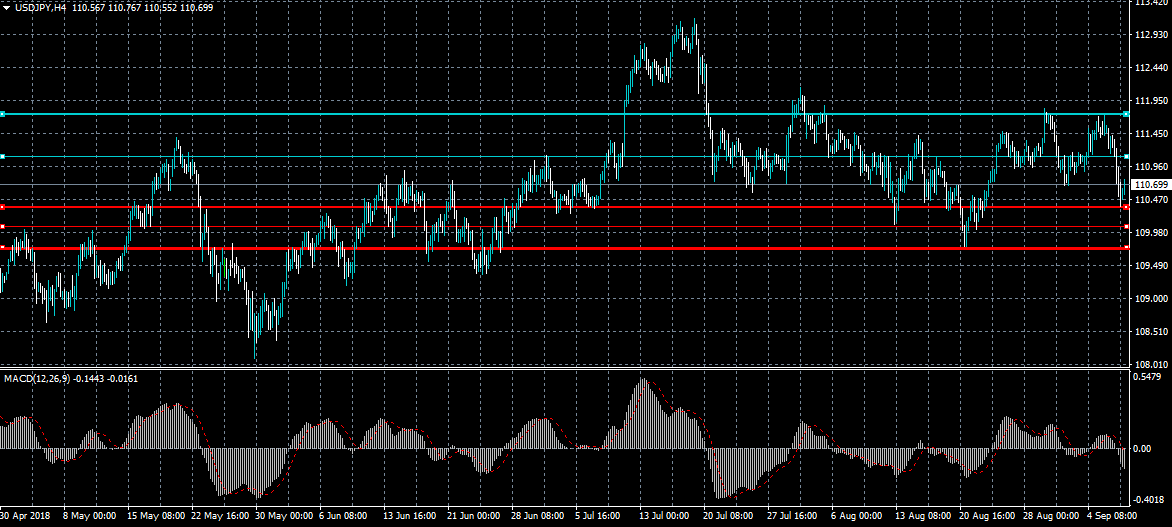
The US dollar remains under pressure against the Japanese yen currency, as traders await the release of Non-farm payrolls job report from the United States economy. The USDJPY pair has so far found support from the 110.40 level, with price managing a shallowing bounce higher. The MACD indicator across the four-hour time frame continues to trend level as the pair trades towards the worst levels of September.
The USDJPY pair is intraday bearish while trading below the 110.90 level, key support is now found at the 110.40 and 110.00 levels.
If the USDJPY pair moves above the 110.90 level, buyers will likely challenge towards the 111.10 and 111.70 levels.