Sample Category Title
USD/CHF Mid-Day Outlook
Daily Pivots: (S1) 0.9626; (P) 0.9676; (R1) 0.9701; More.....
USD/CHF breached 0.9651 to 0.9640 and quickly recovered. Intraday bias is turned neutral first. As long as 0.9766 resistance holds, near term outlook remains bearish for further decline. Firm break of 0.9640 will target 200% projection of 1.0067 to 0.9866 from 0.9981 at 0.8579 next.
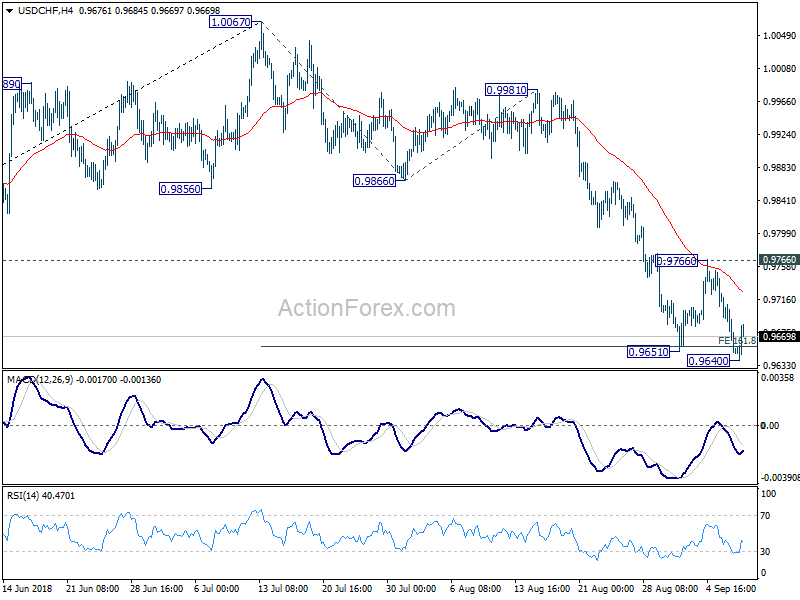
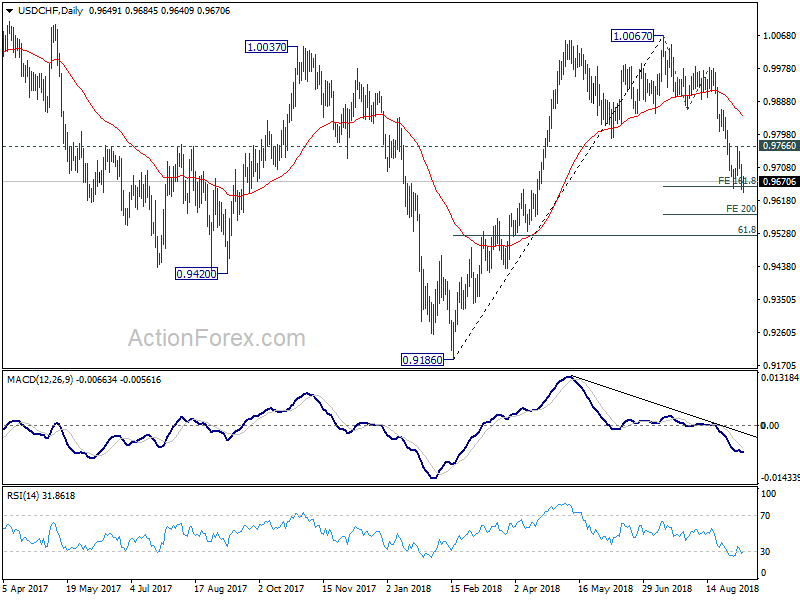
In the bigger picture, current development suggests that rise from 0.9186 low has completed at 1.0067, after failing to sustain above 1.0037 resistance. Fall from 1.0067 could extend to 61.8% retracement of 0.9816 to 1.0067 at 0.9523 and below. But for now, we don't expect a break of 0.9186 low. On the upside, firm break of 0.9866 support turned resistance will suggests that fall from 1.0067 has completed and rise from 0.9186 is resuming.
Canada Sheds Plenty of Part-time Jobs in August
August saw a loss of 51.6k net jobs from the Canadian economy. The unemployment rate rose 0.2 percentage points to 6.0%.
More than 40.4k full-time positions were added in the month, but these were swamped by a -92.0k drop in part-time employment, more than reversing July's gains. By type, the losses were spread across both types of employment: the public sector shed 38.0k net positions, and the private sector 30.7k. Self-employment rose 17.2k.
By sector, the losses showed up in professional services (-22.1k, largely in Ontario), wholesale and retail trade (-19.6k), and construction (-16.4k).
Regionally, net losses were almost entirely concentrated in Ontario, which shed 80.1k jobs, sending its unemployment rate up to 5.7% (from 5.4%). Alberta turned in a solid performance, adding 16.2k net positions and drawing a similar number people back to the labour force for an unchanged unemployment rate of 6.7%. The other provinces saw little change in net employment.
Despite the decline in employment, aggregate hours worked eked out a small gain, rising 0.2% month-on-month (1.6% year-on year). Wages were again a soft spot: average hourly earnings for permanent employees decelerated to 2.6% year-on-year (from 3.0% in July).
Looking through the monthly noise, the trend (6 month moving average) pace of job gains dipped to about 10k, as year-on-year job gains decelerated to 0.9%. Of note, these gains have been by and large in full-time employment (+2.2%) as part-time work was down 4.3% y/y following today's marked decline.
Key Implications
What a mess. This was yet another month of jobs numbers with odd details. Beneath a concerning headline report lay solid gains in full-time employment. Even more, it was by and large one province, Ontario, driving the moves. With hours worked up modestly, this isn't all that bad of a report, with the notable exception of wages.
This is now the third month in a row with softening wage growth. Wages growth in August was more or less in line with the historic average – not cause for concern necessarily, but also not cause for celebration.
For the Bank of Canada, this report will likely be put into the broader context of slowing trend job gains consistent with an economy operating near capacity. Given this week's messaging, we continue to see October as the likely timing for the next monetary policy interest rate hike. To the extent that wage growth remains soft (and the softness is confirmed in the Bank's preferred measures), a slower pace of hikes thereafter remains likely.
U.S. Labor Market Continues its Impressive Run as Wage Growth Perks Up in August
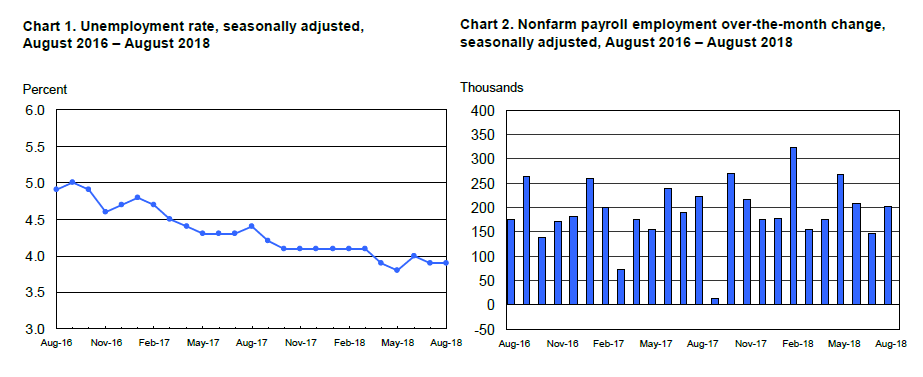
U.S. non-farm payrolls rose 201k in August, slightly better than market expectations. The previous two months were revised down 50k, but the hiring trend over the past six months is still healthy at 192k.
The unemployment rate remained at 3.9%, roughly where it has been since April. While headline unemployment has been steady, a broader measure of unemployment, the U-6, which includes marginally attached workers and people who work part-time for economic reasons, continued to fall. It ticked down to 7.4% in August, a notable improvement from 8.6% a year ago.
Services sector hiring was back in action in August, +178k new positions. Strength continued in business services (+53k), and health care and social assistance (+33k). Wholesale trade (+22k) and transportation and warehousing (+20k) rounded out the leading services sectors. Goods sector hiring slowed slightly to +26k new jobs. Gains were led by construction (+23k) where hiring is up a solid 4% year-on-year. Manufacturing employment was essentially unchanged in August, and is up 2% on the year.
There was a bright spark in the closely watched average hourly earnings measure, which rose 0.4% in August, beating expectations. Growth in wages on a year-on-year basis accelerated to 2.9%.
Key Implications
The U.S. job market continued to enjoy considerable momentum in August. The unemployment rate remained near its cycle low. Broader measures of unemployment have made more notable progress over the past year, showing how a strong job market is lifting prospects for a broader pool of workers. Going forward, it will become increasingly difficult to find workers to fill positions, and we would expect to see a natural slowing in monthly job gains.
The U.S. economy is barreling full steam ahead, and the Fed is expected to raise rates a quarter point on September 26th. Looking ahead, we will be watching to see if hotter wages in August was a one-month blip, or the start of a long-awaited pick up in wage growth that could raise inflation pressures higher than we currently expect.
EURGBP Turns Neutral in Near-Term after Break Below Uptrend Line
EURGBP pulled back in recent days, after touching a one-year high of 0.9098 on August 28. Earlier on Friday, it broke below an upside support line drawn from the lows of June 15, and if this week’s candle indeed closes below that uptrend line, then the near-term bias of the pair will have turned back to neutral, from positive previously.
Short-term momentum oscillators support the notion that the picture is turning bearish. The RSI fell below its neutral 50 line and is also pointing downwards, detecting downside momentum. Meanwhile, the MACD – although still in positive territory – lies below its red trigger line and looks to be moving lower as well.
In case of further declines, an initial line of support may be found near 0.8900, the trough of August 15. Even lower, declines may stall around 0.8855 – this being the low of August 2 – with the zone around it also encapsulating the 100-day moving average at 0.8849. If the bears pierce below it, the 0.8800 hurdle would increasingly come into scope. A clear break below the latter territory as well would turn the near-term outlook to negative.
On the flipside, a rebound in the pair could encounter preliminary resistance around the 0.8937 area, defined by the low on August 31. An upside break could open the way for 0.9030, the zone that capped the advance on September 3. If the bulls clear that hurdle, the attention would turn to the one-year high of 0.9098. A decisive move above this barrier too would mark a higher high on the daily chart, turning the bias back to positive.
Overall, if this week’s candle closes below the aforementioned uptrend line, the pair’s near-term outlook would turn neutral. For the bias to turn negative, it would require a break below 0.8800, and to shift back to positive a move above 0.9098.
Earnings the Standout of Another Strong US Jobs Report
The dollar has caught a bid after the release of yet another strong jobs report for the US, which included some good news on wages as well as employment.
Earnings growth has long eluded the US recovery and has remained in the mid-2% range for much of the last year. This has led to speculation that the labour market may not be as tight as we thought, especially when you consider how strong job creation still is, but today’s data finally offered some good news on that front. Earnings grew by 2.9% in August, the highest increase since 2009 and potentially a sign that a tight labour market is starting to be seen in people’s pay.
Of course this could be a one-off jump in the data, as we’ve seen in the past, but it does offer further support to the view that the US economy is very strong. Combined with another NFP reading above 200,000 and unemployment being below at 3.9% and things are looking very positive. The one potential downside for Trump may be that the Federal Reserve may be looking at this and wondering what impact a sustained improvement could have on their tightening policy, something the US President has been openly critical of in recent months.
The report was enough to pull cable away from 1.30, where it had been threatening to break above, while the euro was also softer against the dollar having struggled around 1.1650. US Treasury yields are also creeping higher again after the report with the 10-year back above 2.9% and potentially eyeing another run at 3%, which has proven challenging due to its role as a safe haven during uncertain and concerning times.
USD/JPY Mid-Day Outlook
Daily Pivots: (S1) 110.32; (P) 110.93; (R1) 111.34; More...
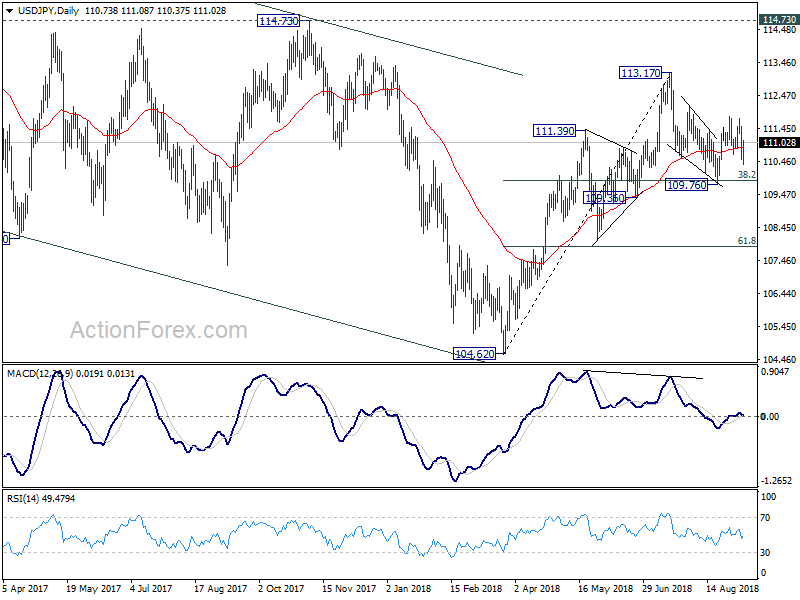
USD/JPY's strong rebound surges that corrective fall from 111.89 has completed with three waves down to 110.37. Intraday bias is back on the upside for 111.82 first. Break will resume the rebound from 109.76 and target 113.17. For now, we're holding on to the view that correction from 113.17 has completed at 109.76. Hence, even in case of another decline, we'd continue to expect strong support from 38.2% retracement of 104.62 to 113.17 at 109.90 to contain downside and bring rebound.
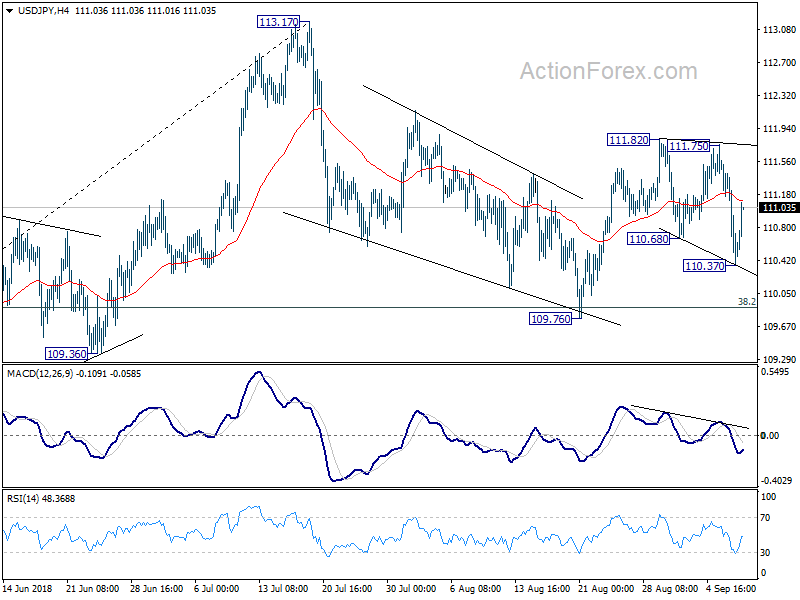
In the bigger picture, corrective fall from 118.65 (2016 high) should have completed with three waves down to 104.62. Decisive break of 114.73 resistance will likely resume whole rally from 98.97 (2016 low) to 100% projection of 98.97 to 118.65 from 104.62 at 124.30, which is reasonably close to 125.85 (2015 high). This will stay as the preferred case as long as 109.36 support holds. However, decisive break of 109.36 will mix up the outlook again. And deeper fall should be seen back to 61.8% retracement of 104.62 to 113.17 at 107.88 and below.
Dollar Rises on Solid NFP and Wage Growth, Sterling Even Stronger on EU Barnier
Sterling surged sharply today as once against lifted by Brexit. The direct trigger isn't clear but it's believed to be comments by EU Barnier. Dollar is following as the second strongest with help from another set of solid non-farm payroll data. In particular, wage growth beat an already high expectation. Despite a terribly week job report, Canadian Dollar is still trading as the third strongest one. BoC Senior Deputy Governor Carolyn Wilkins assured the market yesterday that it's on track for more rate hike despite NAFTA uncertainties
Australian Dollar and New Zealand Dollar are trading as the weakest ones for today. Worries over escalation of US-China trade war are weighing on these two currencies. The public hearing on US 25% tariffs on USD 200B in Chinese goods has completed. Trump is ready to fire another shot any time. And, without a doubt, China's retaliation of USD 60B in US imports will follow. Euro is following as the third weakest for now, partly due to heavy selling in EUR/GBP.
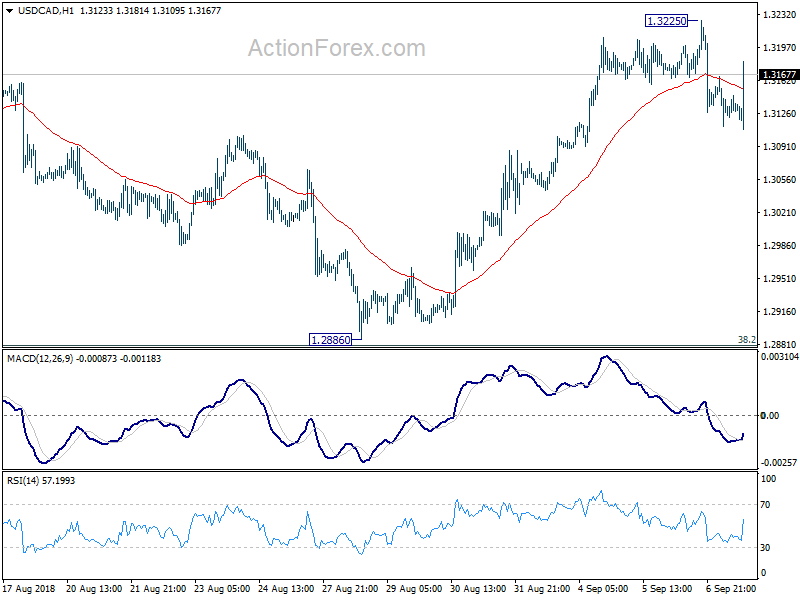
Technically, EUR/GBP's break of 0.8937 support now indicates near term reversal. That is, rise from 0.8620 might have completed earlier than expected. Near term outlook is turned bearish for deeper fall. GBP/USD is having its sight on 1.3042 resistance for resuming the corrective rebound form 1.2661. On the other hand, EUR/USD is having its sight on 1.1529 for completing equivalent corrective rebound from 1.1300. USD/CHF looks like having defended 0.9651 support and could recover further towards 0.9766 minor resistance. USD/JPY and USD/CAD could be heading back to 111.82 and 1.3225 resistance respectively.
Dollar surges as NFP added 201k, wage grew 0.4%, Canadian pressured after terrible job data
Dollar surges in after another set of strong non-farm payroll report. The headline number showed 201k growth in August, comparing to expectation of 194k. Prior month's figure was revised down from 157k to 147k though. Unemployment rate was unchanged at 3.9%. The bigger surprise, and Dollar driving one, is average hourly earnings which showed 0.4% mom growth, above expectation of 0.3% mom.
Canadian job data is very disappointing. The employment market contracted by -51.6k in August, nearly undoing all the 54.1k growth in July. That's also was below expectation of 5.1k growth. Unemployment rate also rose to 6.0%, up from 5.8% and higher than expectation of 5.9%.
EU Barnier on Brexit: no-deal scenario is not our scenario; it is not my scenario
Sterling surges broadly today in mid European session. There is no apparent trigger or Brexit headline flowing through. Some pointed to a transcript of EU chief negotiator Michel Barnier at the UK House of Commons, where he mentioned that EU is "open to discussing other backstops" regarding the Irish order, as a trigger. But we'd say, if that document is the cause of the rally, then it's more likely that Barnier said "no-deal scenario is not our scenario; it is not my scenario."
China FX reserve dropped $8.2B in Aug, no large scale direction intervention yet
China's foreign currency holding dropped slightly by USD 8.2B to USD 3.110T in August, down from USD 3.118T. But that's still lower than market expectation of USD 3.115T. Nonetheless the data showed that China's capital control measures worked reasonable well so far and thus, there was no imminent need to large scale direct intervention.
Back in August, China restarted a reserve requirement on foreign exchange forward trading. Also, a counter-cyclical factor in daily pricing of Yuan was reinstated. USD/CNH (off-shore Yuan) surged sharply since March low at 6.2359 to as high as 6.9586 as trade tension with US escalated.
On the data front
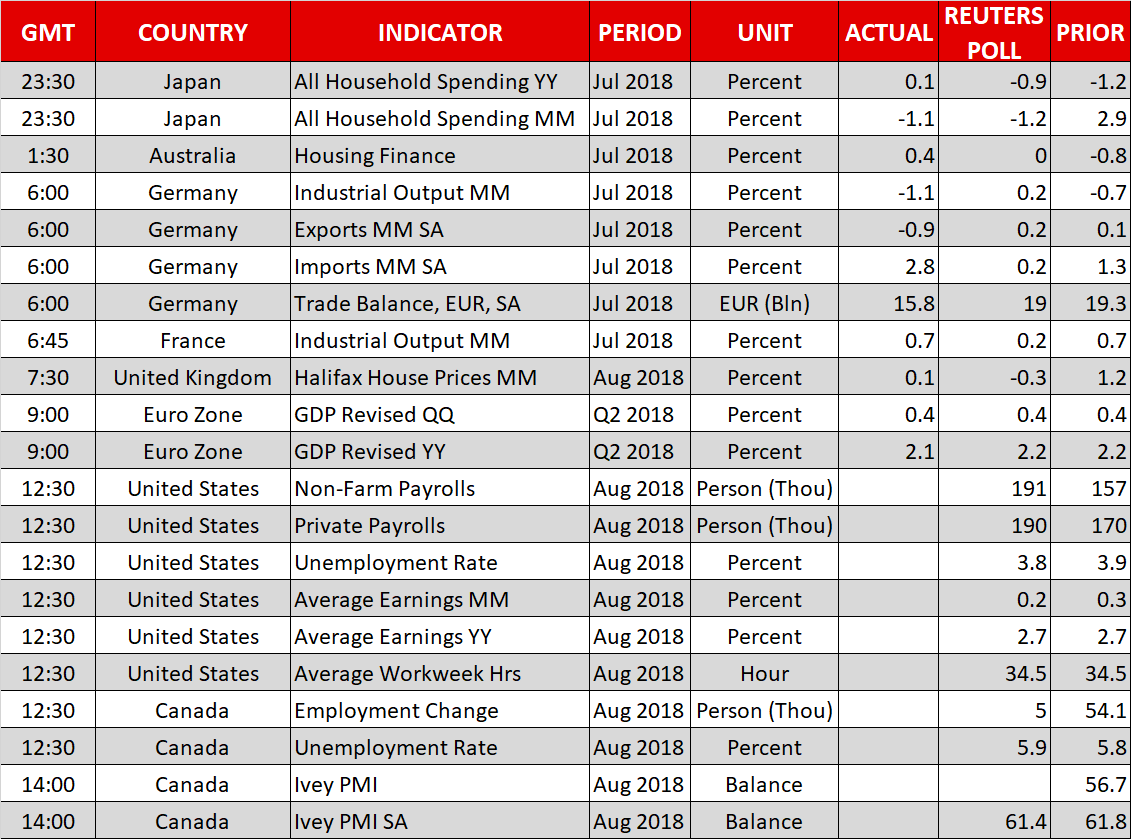
Eurozone GDP was finalized at 0.4% qoq in Q2. Germany trade surplus narrowed to EUR 15.8B in July, industrial production dropped -1.1% mom in July. Swiss foreign current reserves dropped to CHF 731B in August, unemployment was unchanged at 2.6%. Australia AiG performance on construction dropped to 51.8 in August, down from 52.0. Home loans rose 0.4% mom in July versus expectation of -0.1% mom. Japan household spending rose 0.1% yoy in July versus expectation of -0.8% yoy. Labor cash earnings rose 1.5% yoy versus expectation of 2.4% yoy.
USD/JPY Mid-Day Outlook
Daily Pivots: (S1) 110.32; (P) 110.93; (R1) 111.34; More...
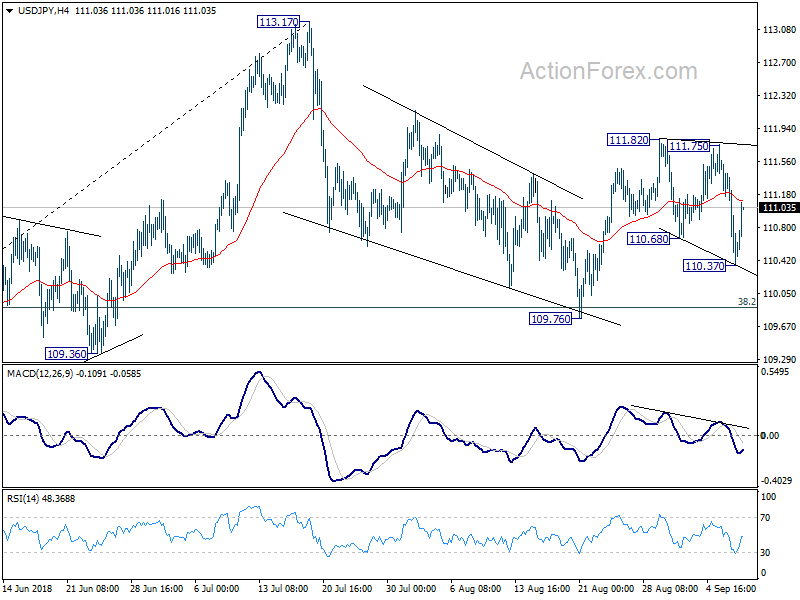
USD/JPY's strong rebound surges that corrective fall from 111.89 has completed with three waves down to 110.37. Intraday bias is back on the upside for 111.82 first. Break will resume the rebound from 109.76 and target 113.17. For now, we're holding on to the view that correction from 113.17 has completed at 109.76. Hence, even in case of another decline, we'd continue to expect strong support from 38.2% retracement of 104.62 to 113.17 at 109.90 to contain downside and bring rebound.
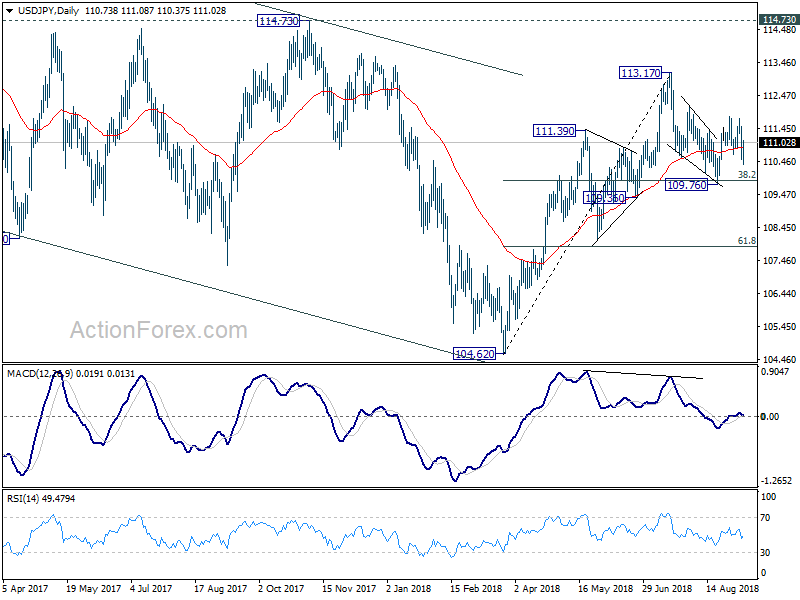
In the bigger picture, corrective fall from 118.65 (2016 high) should have completed with three waves down to 104.62. Decisive break of 114.73 resistance will likely resume whole rally from 98.97 (2016 low) to 100% projection of 98.97 to 118.65 from 104.62 at 124.30, which is reasonably close to 125.85 (2015 high). This will stay as the preferred case as long as 109.36 support holds. However, decisive break of 109.36 will mix up the outlook again. And deeper fall should be seen back to 61.8% retracement of 104.62 to 113.17 at 107.88 and below.
Economic Indicators Update
| GMT | Ccy | Events | Actual | Forecast | Previous | Revised |
|---|---|---|---|---|---|---|
| 22:30 | AUD | AiG Performance of Construction Index Aug | 51.8 | 52 | ||
| 23:30 | JPY | Overall Household Spending Y/Y Jul | 0.10% | -0.80% | -1.20% | |
| 00:00 | JPY | Labor Cash Earnings Y/Y Jul | 1.50% | 2.40% | 3.60% | 3.30% |
| 01:30 | AUD | Home Loans M/M Jul | 0.40% | -0.10% | -1.10% | -0.80% |
| 05:00 | JPY | Leading Index CI (JUL P) | 103.50% | 103.50% | 104.70% | |
| 05:45 | CHF | Unemployment Rate Aug | 2.60% | 2.60% | 2.60% | |
| 06:00 | EUR | German Trade Balance (EUR) Jul | 15.8B | 19.1B | 19.3B | |
| 06:00 | EUR | German Industrial Production M/M Jul | -1.10% | 0.20% | -0.90% | |
| 07:00 | CHF | Foreign Currency Reserves (CHF) Aug | 731B | 750B | ||
| 07:30 | GBP | Halifax House Prices M/M Aug | 0.10% | 0.50% | 1.40% | |
| 09:00 | EUR | Eurozone GDP Q/Q Q2 F | 0.40% | 0.40% | 0.40% | |
| 12:30 | CAD | Net Change in Employment Aug | -51.6K | 5.1K | 54.1K | |
| 12:30 | CAD | Unemployment Rate Aug | 6.00% | 5.90% | 5.80% | |
| 12:30 | USD | Change in Non-farm Payrolls Aug | 201K | 194K | 157K | 147K |
| 12:30 | USD | Unemployment Rate Aug | 3.90% | 3.90% | 3.90% | |
| 12:30 | USD | Average Hourly Earnings M/M Aug | 0.40% | 0.30% | 0.30% | |
| 14:00 | CAD | Ivey PMI Aug | 62.3 | 61.8 |
Dollar surges as NFP added 201k, wage grew 0.4%, Canadian pressured after terrible job data
Dollar surges in after another set of strong non-farm payroll report. The headline number showed 201k growth in August, comparing to expectation of 194k. Prior month's figure was revised down from 157k to 147k though. Unemployment rate was unchanged at 3.9%. The bigger surprise, and Dollar driving one, is average hourly earnings which showed 0.4% mom growth, above expectation of 0.3% mom.
Canadian job data is very disappointing. The employment market contracted by -51.6k in August, nearly undoing all the 54.1k growth in July. That's also was below expectation of 5.1k growth. Unemployment rate also rose to 6.0%, up from 5.8% and higher than expectation of 5.9%.
Reaction in USD/CAD is immediate.
Sterling above $1.30 on Barnier Comments as Trade Jitters Weigh on Aussie; US Jobs Data Awaited
Here are the latest developments in global markets:
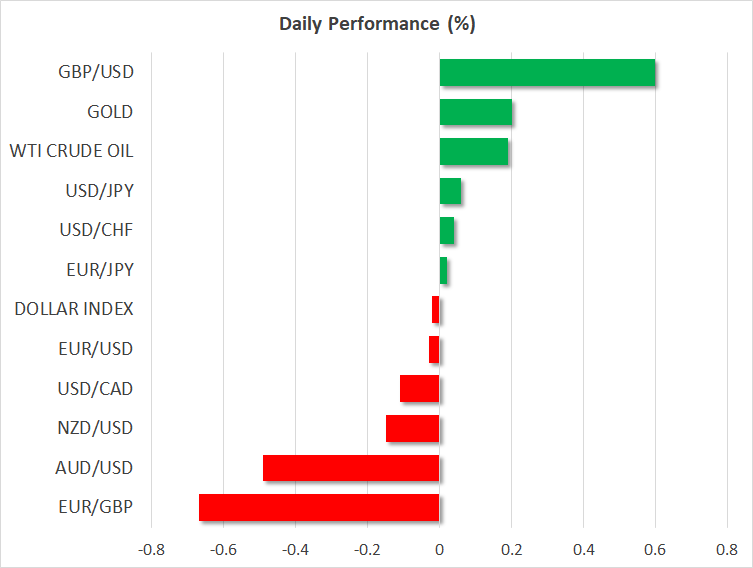
- FOREX: The US currency was trading marginally lower versus a basket of currencies ahead of the highly anticipated employment report for August due at 1230 GMT. Dollar/yen was roughly flat after losing 0.7% on Thursday, as angst over the prospect of deteriorating global trade conditions boosted the safe-haven perceived yen. The euro was down on the margin versus the dollar, reacting little to a downward revision in the eurozone’s pace of growth in Q2 to 2.1% from 2.2%. Earlier in the day, the common currency fell in the immediate aftermath of German data which showed exports and industrial output unexpectedly contracting in July, though it reversed higher soon thereafter. Pound/dollar jumped above 1.30, as a UK parliament transcript revealed that the EU’s chief Brexit negotiator Michel Barnier said that the bloc is willing to discuss the impasse relating to the Irish border; “we should be able to de-dramatize the Brexit backstop” were some of his words. Euro/pound lost ground as a result too. Elsewhere, the Aussie slipped to a fresh two-and-a-half year low of 0.7136 as growing worries over an escalation in the Sino-US trade dispute once again acted as a drag on the commodity-linked currency.
- STOCKS: Major European benchmarks were broadly lower at 1118 GMT, though barring a few exceptions the losses were relatively contained. Fears over global trade were again the major culprit behind the bearish equity market sentiment, with anxiety over EM-health (or lack of health) also contributing to that “cause”. The pan-European Stoxx 600 was down by 0.2%, trading not far above a five-month low of 372.20 tracked earlier on Friday. Meanwhile, the blue-chip Euro Stoxx 50 was lower by 0.4%. The German DAX and French CAC 40 fell by 0.3% and 0.15% respectively, while the UK’s FTSE 100 underperformed, trading lower by 0.9%. The latter was also dragged lower by the rise in sterling due to its export-heavy nature. Futures tracking the Dow, S&P 500 and Nasdaq 100 were pointing to a slightly lower open later today.
- COMMODITIES: WTI and Brent crude both edged higher by 0.2%, trading at $67.90 and $76.65 a barrel respectively. The expectation for a fresh round of tariffs, which may also dent demand for oil, has been weighing on oil prices throughout the week. In precious metals, dollar-denominated gold was 0.2% higher and not far above the $1,200 per ounce mark, possibly benefitting on the back of a slightly weaker greenback; the metal yet again failing to attract safe-haven flows on trade uncertainty is of note.
Day ahead: US payrolls report takes center stage as markets await trade news
The main event in Friday’s session will be the US employment report for August at 1230 GMT, with the corresponding data out of Canada also on tap. Beyond economic releases, investors will remain mindful of trade developments, as the US gears up to launch a fresh salvo of tariffs on $200bn Chinese products.
Kicking off with the US data, nonfarm payrolls (NFP) are projected to have risen by 191k in August, more than July’s 157k and overall a strong print consistent with further tightening in the labor market. Meanwhile, the unemployment rate is forecast to have ticked back down to a near two-decade low of 3.8%, from 3.9% previously. Last but not least, average hourly earnings are anticipated to have grown by 0.2% in monthly terms, which would keep the yearly rate steady at 2.7%. Absent a major surprise in the NFP print or the unemployment rate, investors may focus mainly on earnings, as wage growth is considered a precursor to inflationary pressures and hence plays a major role in guiding Fed decisions.
While market-implied pricing derived from Fed funds futures suggests a Fed rate hike in September is a done deal, investors appear less certain on whether a second one will materialize before year-end, assigning a 63% probability to the prospect. A strong report today that pushes those odds higher could help the dollar recoup its latest losses. On the contrary, any softness in the data that drags that probability lower towards a “coin toss”, may weigh on the greenback.
Turning to Canada’s jobs figures, forecasts suggest the labor market cooled in August, with the unemployment rate expected to tick up to 5.9%, from 5.8% in the prior month. The uptick appears owed to expectations for nearly-flat jobs growth, with the net change in employment projected to clock in at 5.0k, much lower than the 54.1k in July. The US and Canadian reports are released simultaneously, so the reaction in dollar/loonie will likely be influenced by both. Besides these data, US-Canada trade negotiations continue in Washington today, and the loonie will likely remain sensitive to any updates.
On the trade front, the Trump administration has signaled it plans to slap tariffs on $200bn Chinese products, with a potential announcement coming as early as today. China has warned it will retaliate in kind and thus, a further deterioration in risk sentiment is not to be ruled out. In such a case, funds may rotate out of riskier assets like stocks, and into safe-havens such as the Japanese yen and Swiss franc.
In energy markets, the Baker Hughes survey tracking active US oil rigs is due at 1700 GMT.
As for the speakers, regional Fed presidents Rosengren (non-voting FOMC member in 2018), Mester (voter), and Kaplan (non-voter) will be making public appearances at 1230 GMT, 1300 GMT and 1720 GMT respectively. Then, RBNZ Governor Adrian Orr will speak at 2130 GMT.
In politics, French President Macron will meet his German counterpart, Chancellor Merkel, to discuss Brexit among other issues.
Over the weekend, Sweden will hold its general election, with krona pairs likely to open with gaps on Monday.
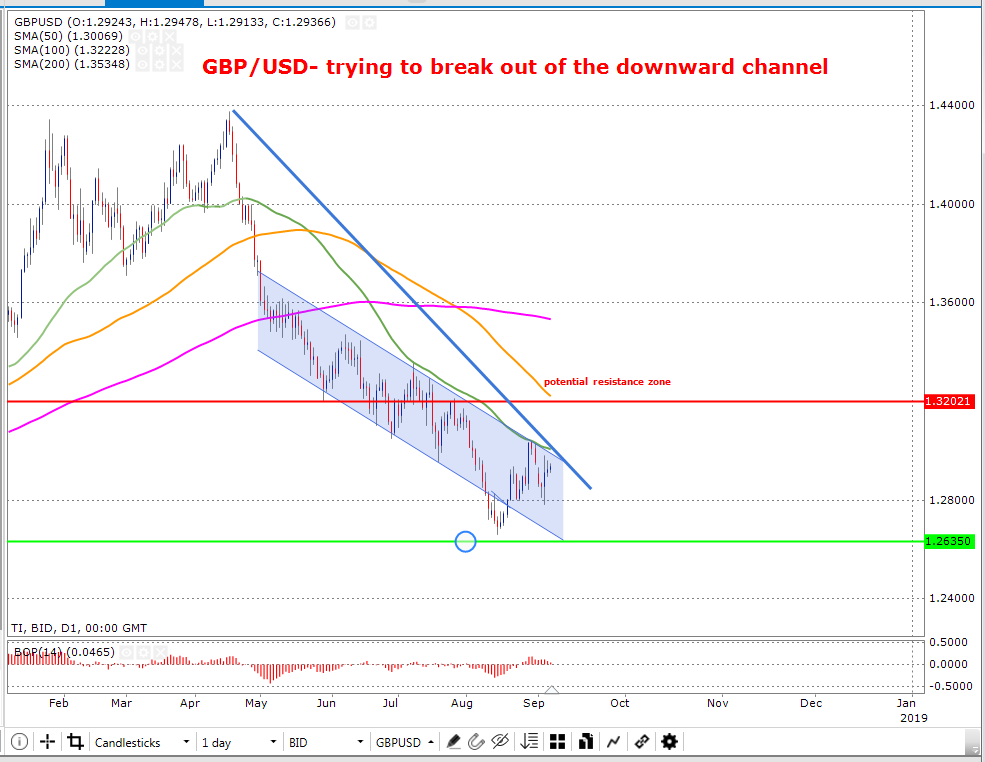
GBP/USD Attempting to Pierce Upwards through the Downward Channel
The chart below on a daily time-frame displays evidence that the pair GBP/USD is attempting to break out of the downward channel which is indicated in light blue. Additionally, the price for the pair is still trading below all moving averages where it is fairly close to the support zone (colored in green) which is priced at $1.263.
Furthermore, the price is trading near to the downward trend line (colored in blue) where the 50-day moving average (colored in green) is gradually pivoting to the upside which can maybe be seen as a bullish point. At this point, the possibilities of the price breaking out of the upward trend line to drive towards the resistance zone (colored in red) which is priced at $1.320 are present. However, the price must trade above the 50-day at the least to be considered to move up to resistance.
The Balance of Power chart below shows the bulls losing control and routing into bear territory. If this continues the price trading towards the support zone may happen.
Major support: 1.26350
Major resistance: 1.32021