Sample Category Title
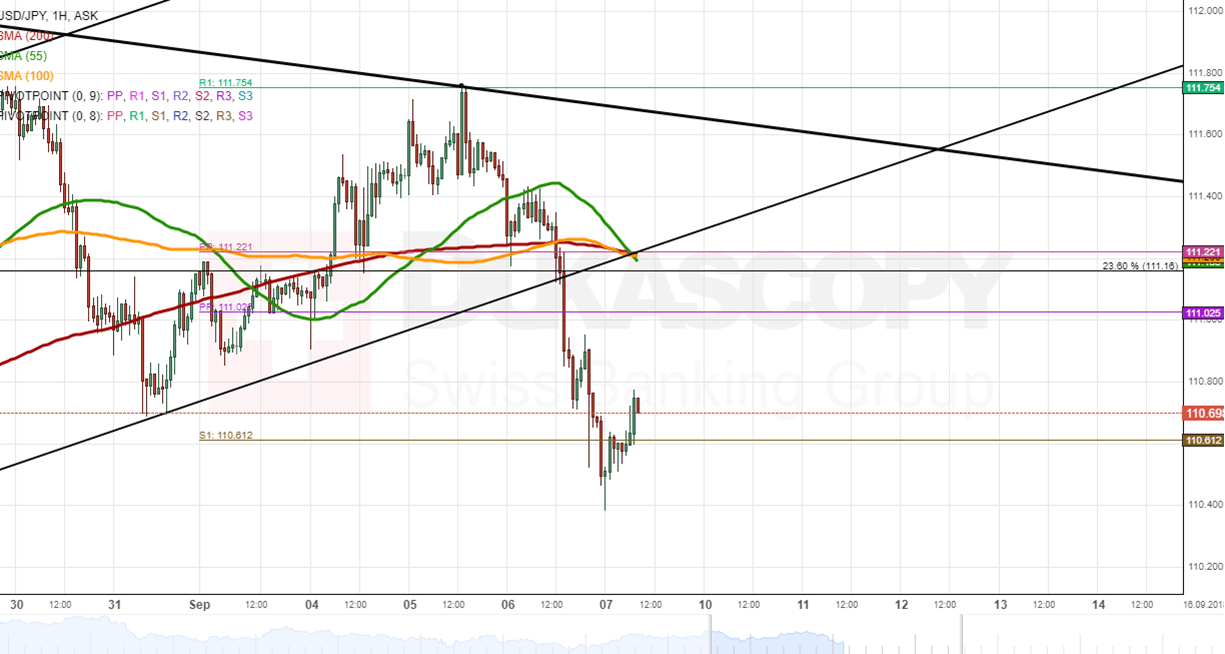
USD/JPY Analysis: Meets Weekly S1 At 1.10 Mark
The US Dollar depreciated 0.42% against the Japanese Yen since Thursday's session. The rate was located at the 110.70 mark, trying to recover itself during Friday's morning hours.
In regards to the near future, most likely the rate will surge to the monthly pivot point at the 111.02 level during the trading day. Meanwhile, the weekly S1 at the 110.61 should provide significant support for the currency rate.
Besides, if the rate will meet the monthly PP at the 111.02 level, most likely the rate will go downwards due to the strong resistance of the SMAs and 23.60% Fibo at the 111.15 level.
GBP/USD Analysis: Will Surge To 1.2970
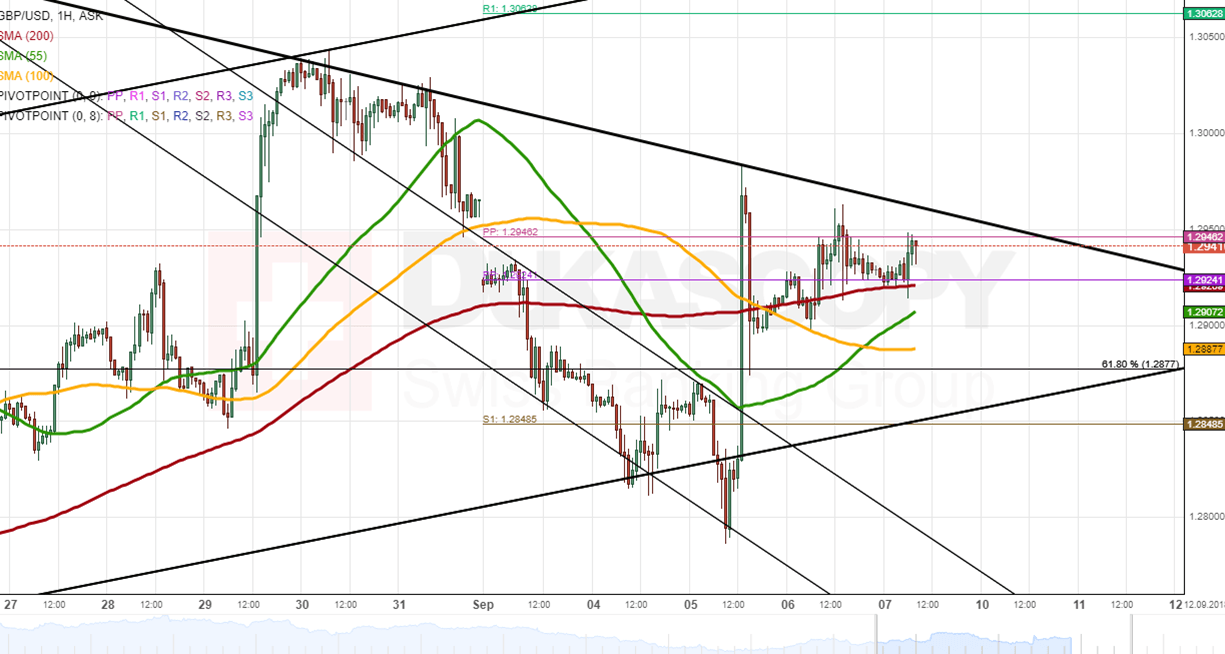
The British Pound was located between the weekly PP at the 1.2946 mark and the monthly PP at the 1.2924 mark during Friday's morning hours.
In regards the near future, most likely the rate will surge upwards due to a strong support level of the monthly PP at the 1.2924 level and the 200-hour SMA at the 1.2920 level. The rate will pass the weekly PP at the 1.2946 mark to move closer to the upper boundary of the large descending channel, which might be broken during today's session.
On the other hand, the British pound may use a strong resistance of the large channel to bounce back into the pattern at the 1.2970 level.
EUR/USD Analysis: Passes Weekly PP At 1.16
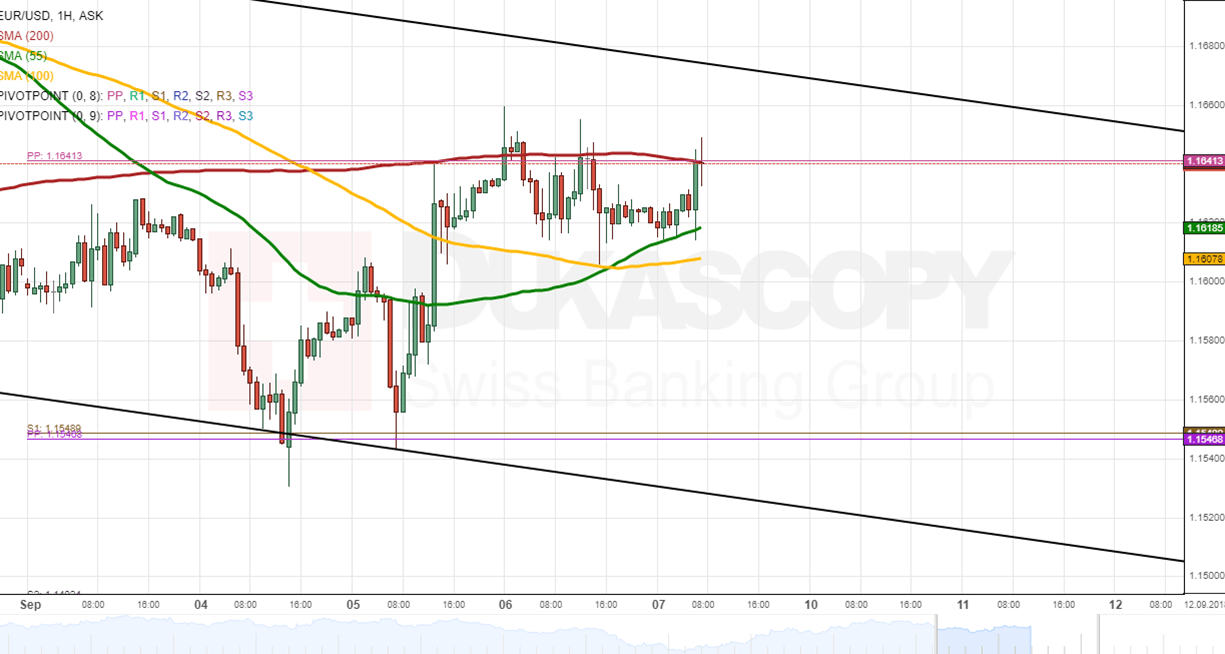
The European Single Currency appreciated 0.13% since Thursday's trading session. The currency rate was piercing the weekly pivot point at the 1.16 level during Friday morning hours.
The EUR/USD should move upwards to the upper boundary of the medium channel due to the strong support of the 55-hour and 100-hour SMAs, which most likely will support the rate during today's trading session.
In another scenario, the European Single Currency might be stopped by the 200-hour SMA and the additional resistance of the weekly PP at the 1.1640 level and move downwards to the 1.16 level.
US Jobs Data Eyed As Trump Turns Attention To Japan
- Is strong jobs growth and moderate wages a good balance for Trump?
- Japan becomes the latest trade target as negotiations with Canada continue.
US futures are trading a little lower ahead of the open on Friday, as we await the latest jobs report from the world's largest economy and President Donald Trump hints at a fresh trade conflict with Japan.
The US jobs report will naturally attract plenty of attention today, with the economy now strong and the Federal Reserve raising interest rates at a steady and consistent pace. The only thing that's lacked from what would otherwise be a booming economy is better wage growth and that is expected to continue to elude the data for August, with earnings seen growing only 2.7% again, a level it's struggled to break sustainably above since the start of last year.
I don't think that's going to cause Trump too many sleepless night though, in fact he may see it as being helpful in stopping the central bank raising rates at an even faster pace and undermining his growth plans. He's already openly criticized the Fed for its tightening policy – which in itself was highly controversial, albeit unsurprising – and the jobs report gives himself plenty of other things to brag about, most notably job growth and multi-decade low levels of unemployment. From his perspective, this may be a perfect balance.
The data also allows him to pursue his aggressive trade agenda with the rest of the world as not only is the economy performing at a level that provides him some slack, he's claiming to be fighting for well-paid and skilled labour that has moved to cheaper regions that don't play fair. It really is a win win situation for him.
The latest target for Trump appears to be Japan after he acknowledged that relations may sour with them when he tells them how much they need to pay. Months of discussions with the US' NAFTA partners, the European Union and China have yet to deliver any results, although they may be close with Mexico and Canada having agreed new terms with the former. Should Trump manage to get this over the line prior to the mid-term, it may be enough to convince voters that his globally unpopular approach to renegotiations is working and the Republicans could reap the benefits.
Of course, while NAFTA talks are progressing well, relations with China are not and with the consultation period having now passed, Trump may announce an additional $200 billion of tariffs at any time. With China promising to return with tariffs of their own, one trade conflict may soon end but the trade war appears to have plenty of time to run and will likely weigh on investor sentiment in the meantime.
Forex Technical Analysis: EUR/USD, USD/JPY, GBP/USD
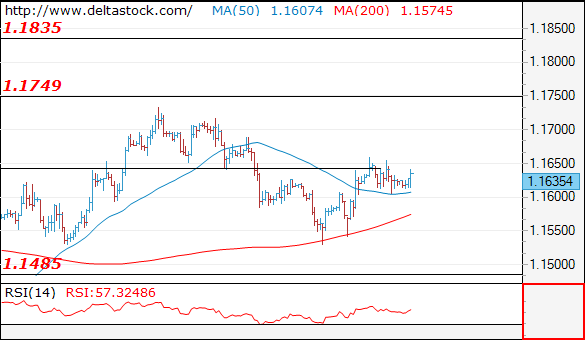
EUR/USD
Current level - 1.1635
The intraday bias is positive above 1.1600, for a rise towards 1.1730 peak.
| Resistance | Support | ||
| intraday | intraweek | intraday | intraweek |
| 1.1650 | 1.1730 | 1.1600 | 1.1300 |
| 1.1730 | 1.1840 | 1.1530 | 1.1100 |
USD/JPY
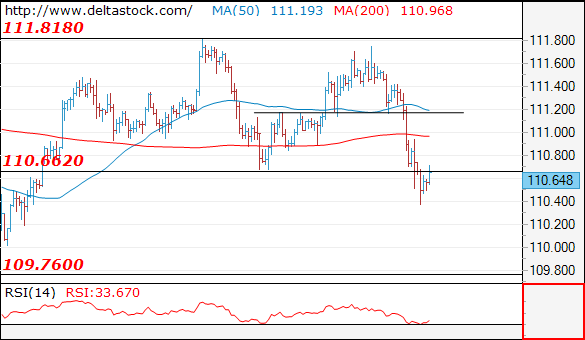
Current level - 110.64
The reversal below 111.20 led to a fast slide all the way down to 110.40 and the bias is still negative below 111.20 hurdle. My intraday outlook is rather neutral.
| Resistance | Support | ||
| intraday | intraweek | intraday | intraweek |
| 111.20 | 114.50 | 110.40 | 109.30 |
| 111.80 | 114.50 | 109.70 | 109.30 |
GBP/USD
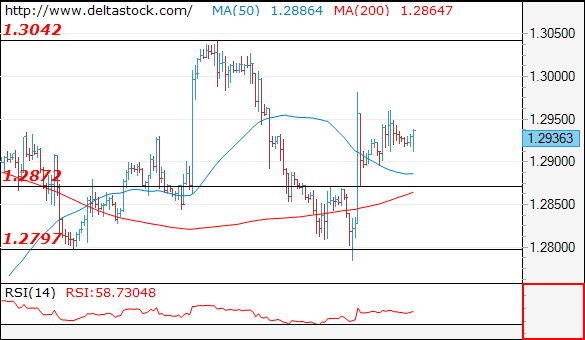
Current level - 1.2936
The recent dip to 1.2780 set the finale of the whole slide since 1.3040 peak and the outlook is bullish above 1.2870, for a test of 1.3050 area.
| Resistance | Support | ||
| intraday | intraweek | intraday | intraweek |
| 1.2980 | 1.3050 | 1.2870 | 1.2570 |
| 1.3050 | 1.3210 | 1.2780 | 1.2570 |
AUDUSD Outlook: Aussie Maintains Bearish Tone And Looks For Weekly Close Below Key 0.7160 Support Zone
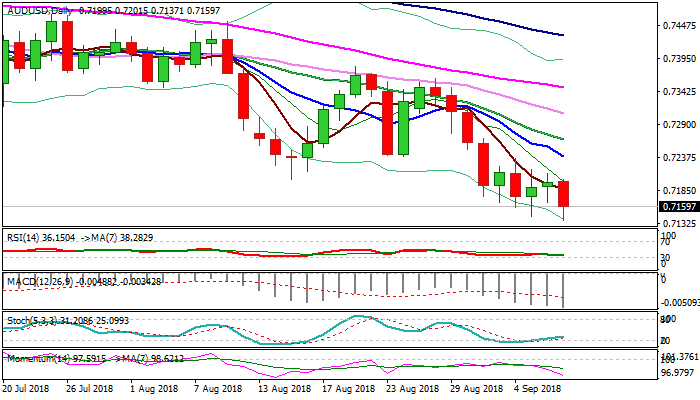
The Australian dollar fell on Friday and erased gains of past two-day recovery attempts, posting new marginally lower low at 0.7137.
Overall structure remains bearish and weighed by turmoil in emerging markets and uncertain outlook for China, due to persisting fears of escalation of trade conflict between two world largest economies.
Bears look for weekly close below key 0.7160 support zone to signal continuation of larger downtrend towards psychological 0.70 support and 0.6906 (06 Sep 2015 low) in extension.
Initial resistance lays at 0.7200 zone (former low of 15 Aug) which capped the action in past two days, with falling 10SMA (0.7238) expected to cap upticks.
US jobs data are expected to provide further signals.
Res: 0.7200, 0.7238, 0.7265, 0.7306
Sup: 0.7137, 0.7100, 0.7000, 0.6906
USDJPY Outlook: Fresh Bears Probe Below Daily Cloud Base After Report Of US-Japan Trade Conflict
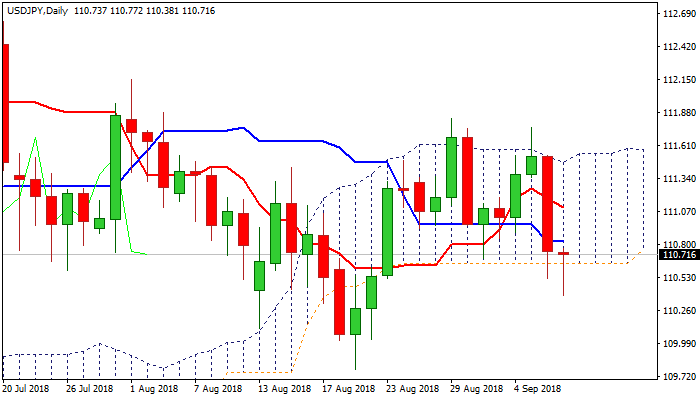
The pair holds in red on Friday and probed below daily cloud base (110.64), following strong fall on Thursday (down 0.69% for the day in the biggest one-day fall since 20 July).
The pair plunged on report suggesting that Japan would be the next country with which the US will open talks about trade issues.
Strong fall turned near-term focus lower after fresh bears weakened near-term structure and cracked strong supports at 110.64 (cloud base) and 110.51 (rising 100SMA), with Thursday’s long bearish daily candle weighing on near-term action.
Weekly close below thick daily cloud is needed to confirm bearish scenario and neutralize concerns about false break lower, which is so far in play and supported by strengthening momentum.
Firm break below cloud base would open way for renewed test of cluster of supports at 110.00/109.78 (psychological support/200SMA/21 Aug low) which contained 20/21 Aug attacks, with break here to generate strong bearish signal. Conversely, close within thick daily cloud would sideline immediate bears and kept the pair in congestion, formed within daily cloud. Us jobs data are in focus for fresh signals, with markets also awaiting further news about US/Japan trade issue.
Res: 110.77, 110.93, 111.13, 111.52
Sup: 110.64, 110.51, 110.38, 110.00
Investors Brace For US-China Tariff Showdown, US Payrolls In Focus
It has been an incredibly rough and rocky trading week for financial markets as turmoil in the EM space and global trade tensions weighed heavily on investor risk appetite.
There is a strong sense of tension in the air today ahead of a possible announcement from Washington that they will impose tariffs on an additional $200 billion worth of Chinese goods. With Beijing already indicating that they would retaliate if additional tariffs are confirmed, investors are being reminded that the prolonged trade tensions are simply refusing to go away. Overnight reports of President Trump targeting Japan as the next victim of a trade war have not helped matters with Asian stocks sinking lower amid the caution. This also provides another reminder to investors that it is not just the United States and China that stand at the heart of the global trade tensions.
Away from trade developments and emerging market turmoil, attention will be directed towards the U.S. jobs report coming out later today which will offer fresh insight into the health of the U.S. employment sector. The projection is that the report will show that the United States added 191,000 jobs to its economy last month. While every element of the U.S. jobs report remains highly significant, there will be a special focus on wage growth. While a disappointing number could translate to short-term Dollar weakness, downside losses are likely to be limited.
With inflation already beyond the Federal Reserve’s golden 2% target and the U.S. economy near full employment, expectations remain baked in that US interest rates will be raised next month. A strong employment report from the United States should also encourage expectations to increase that the Federal Reserve will also attempt to raise US interest rates two times before the end of the year.
Focusing on the technical picture, the Dollar Index has extended losses against a basket of major currencies this morning amid profit-taking ahead of the U.S. jobs report this afternoon. While intraday bears have the potential to send prices towards 94.70, employment figures will heavily influence where the Dollar concludes this week.
Gold struggled for direction this morning as investors remained on the fence ahead of the looming tariff deadline on Chinese goods and U.S. jobs report.
While the uncertainty created from trade tensions and emerging market chaos supported Gold earlier in the week, the metal remains pressured from a broadly strong Dollar across global markets. There is no real indication as it stands that investors are prepared to take profits on Dollar positions that have been building for nearly six months and potential sellers will be offered a fresh opportunity to attack Gold if the Dollar receivesfurther support over the coming sessions.
Sustained weakness below the $1,200 psychological level suggests bears will be encouraged to target $1,180 in the short to medium term.
Yen Advances As Risk Appetite Falters, US Jobs Report Coming Up
Here are the latest developments in global markets:
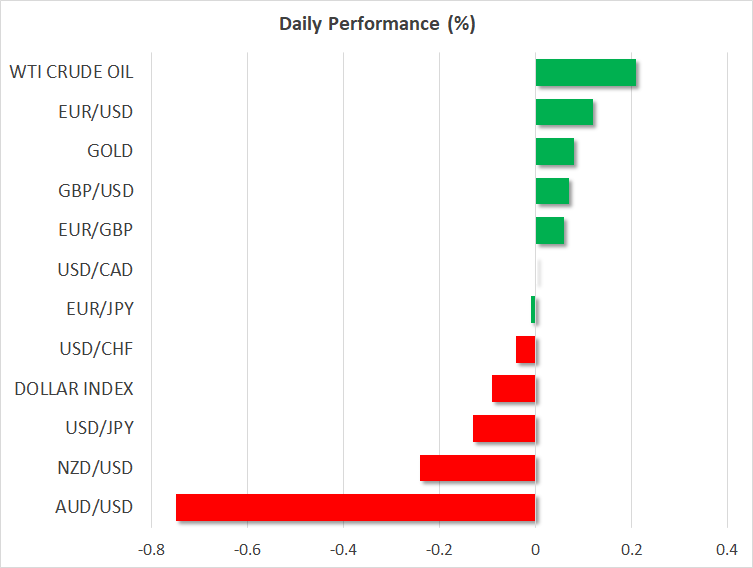
FOREX: The US dollar is marginally lower against a basket of six major currencies on Friday (-0.08%), ahead of the release of the all-important US payrolls report at 1230 GMT, where focus may once again fall primarily on the earnings figures. Safe-haven currencies like the yen and the Swiss franc rallied amid trade jitters, while the risk-sensitive aussie faltered, touching a fresh low last seen in early-2016 against the dollar.
STOCKS: US markets closed lower for the most part on Thursday, dragged down by tech-weakness amid jitters for regulation in the sector, and mounting concerns over fresh tariffs being imposed soon. The tech-heavy Nasdaq Composite (-0.91%) underperformed as tech leaders like Facebook (-2.78%), Twitter (-5.87%), and Google-parent Alphabet (-1.26%) extended their recent losses. Meanwhile, the S&P 500 fell by 0.37%, though the Dow Jones that is less exposed to tech managed to eke out a 0.08% gain. Asia was also mostly in the red on Friday, with Japan's Nkkei 225 and Topix dropping by 0.80% and 0.48% respectively. In Hong Kong, the Hang Seng was down by a mere 0.10%. Europe was a different story though, with all the major benchmarks set for a modestly higher open today, futures suggest.
COMMODITIES: Oil prices edged lower on Thursday amid the broader risk-off market environment, even despite a larger-than-anticipated drawdown in the weekly EIA crude inventory data. Investors may have focused on a different part of that report, which showed gasoline inventories rising sharply, confounding expectations for strong US fuel consumption by drivers over the summer. In the near-term, oil will remain mindful of updates in the Sino-American trade standoff, with any escalation likely weighing on the liquid via speculation for slower demand growth. In precious metals, gold is up on Friday albeit by less than 0.1%, trading within breathing distance of the $1,200 handle and remaining in the relatively narrow range it established over the past three weeks, between $1,182 and $1,214.
Major movers: Yen advances as risk appetite falters; BoC's Wilkins lifts loonie
Risk sentiment remained sour on Thursday, with safe-haven currencies such as the yen and the Swiss franc attracting inflows amid mounting concerns for further escalation in America's trade standoff with its major partners. The public consultation period over US tariffs on an additional $200bn Chinese goods ended yesterday, and although the US has not moved forward with imposing those tariffs yet, investors likely took a defensive stance in anticipation for such action. Meanwhile, a WSJ report suggested that Japan is likely the next target on Trump's trade radar, generating concerns that tensions may ratchet up even further before long.
Dollar/yen fell alongside US stock indices, breaking back below the 111.00 zone, while dollar/franc also dropped sharply to touch a fresh five-month low. As for risk-sensitive currencies, aussie/dollar is down by 0.75% on Friday, recording a new two-and-a-half year low.
The dollar remained sluggish though, ending Thursday's session lower against a basket of six major currencies – unable to capitalize on trade worries like it did in recent months. On the US data front, developments were mixed but perhaps positive on the margin. The ADP employment report for August missed estimates, likely generating some angst that the NFP print may also disappoint today. That said, the ISM non-manufacturing print rose by much more than expected, and coming on top of a similarly encouraging manufacturing index, it pointed to a robust US economy in Q3.
In Canada, the loonie was on the back foot for most of Thursday's session amid poor risk appetite and declining oil prices, but got a helping hand from BoC deputy Governor Carolyn Wilkins to end the day higher. She said policymakers debated dropping a reference of maintaining a “gradual approach” to rate increases at the latest BoC meeting, hinting at the prospect of faster hikes in the future amid an economy operating at full capacity. The loonie extended its gains a few hours later, this time on trade news after US President Trump said he believes Canada will be part of NAFTA. The negotiations continue today and the loonie will likely remain ultra-sensitive to any updates, with Canada's employment data also being in focus later in the session (see below).
Day ahead: US employment data in focus; fresh trade-war twists to be expected?
The lion's share of attention out of Friday's releases is expected to fall on the US jobs report for August. In the meantime, trade issues continue to remain in focus.
On the trade front, the public comment period for proposed US tariffs on an additional $200 billion in Chinese imports has expired and the levies could be implemented soon, likely leading to intensifying tensions between the world's two largest economies. Moreover, a fresh twist in the trade war saga may emerge soon given that the Wall Street Journal reported that President Trump may now turn his attention on trade issues with Japan. Another theme that can affect broad market sentiment and which remains in the background is emerging market angst.
At 0730 GMT, the Halifax index gauging house prices in the UK during August will be made public. However, any Brexit headlines will again be eyed as those are the ones having the capacity to spur sharp movements in sterling pairs.
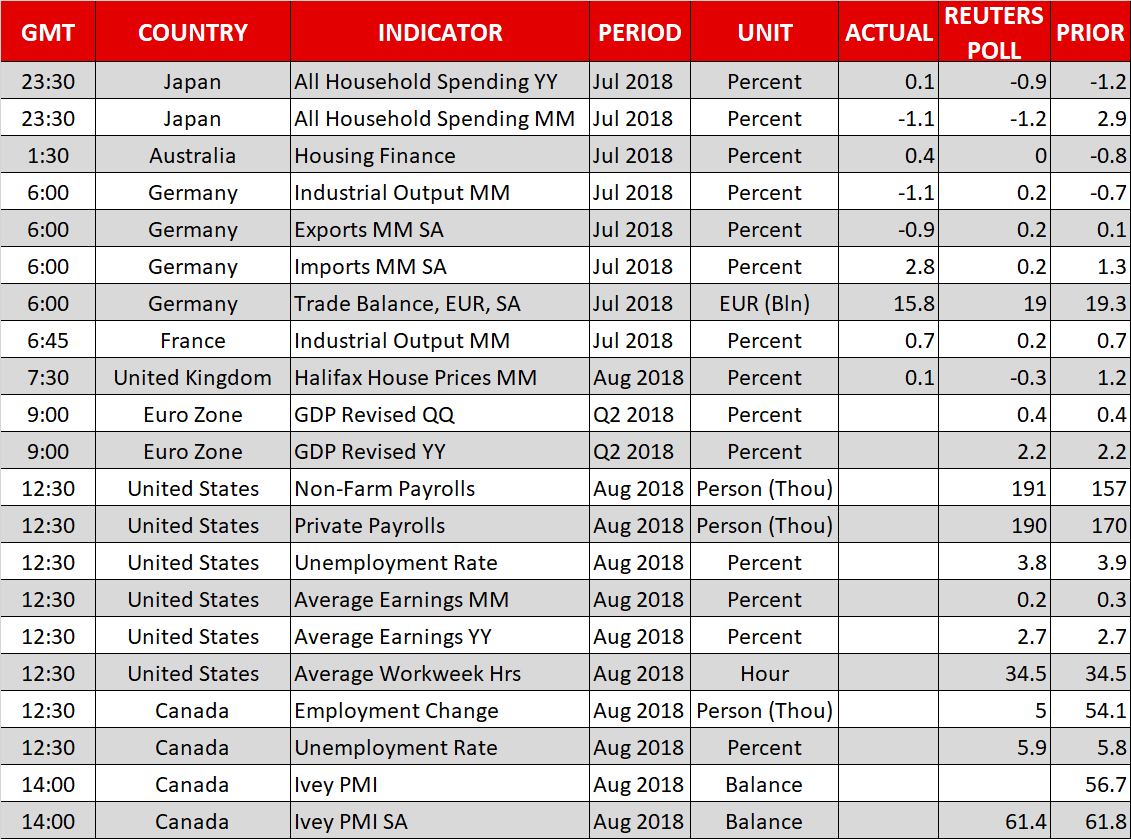
Revised eurozone GDP figures for Q2 hitting the markets at 0900 GMT are expected to confirm quarterly growth running at 0.4% q/q and 2.2% y/y – this compares to Q1's annual pace of growth of 2.5%.
The highly anticipated US employment report is due at 1230 GMT. The economy is projected to have added 191k positions in August, above July's 157k. Additionally, the unemployment rate is forecast to tick down to 3.8% from July's 3.9%, matching a low last experienced in April 2000 (this level was also revisited in May of the current year). Wage growth, which is seen as having the capacity to stoke inflationary pressures, will again be coming to the fore. In this respect, average earnings are predicted to have grown by 0.2% m/m, below July's 0.3%. This would still leave the annual pace of growth on earnings at 2.7%.
The Federal Reserve is widely anticipated to hike rates when it meets in late September, with markets pondering whether it will deliver a second 25bps increase during the remainder of the year. Fed funds futures project a 63% chance for a second rise. Strong jobs data later today, especially on the wage front, are likely to boost those odds and consequently lift the dollar. The opposite holds true as well.
Canadian employment numbers for August are also due at 1230 GMT. A considerable easing in the number of jobs added is expected; 5.0k vs 54.1k in July. Furthermore, the unemployment rate is forecast to rise to 5.9% from 5.8% in July. This would still leave it close to multi-decade low levels, pointing to a relatively tight labor market. Similar to the US, the data will likely shape investors' near-term outlook on interest rates. The probability for an October hike by the Bank of Canada currently rests at around 58% according to Canadian OIS. Lastly, the country will also be on the receiving end of Ivey PMI data for the same month at 1400 GMT, with the loonie possibly proving most sensitive to NAFTA-related developments.
Technical Analysis: EURUSD attempts conclusive move above 50-period MA; bullish signal by stochastics in very short-term
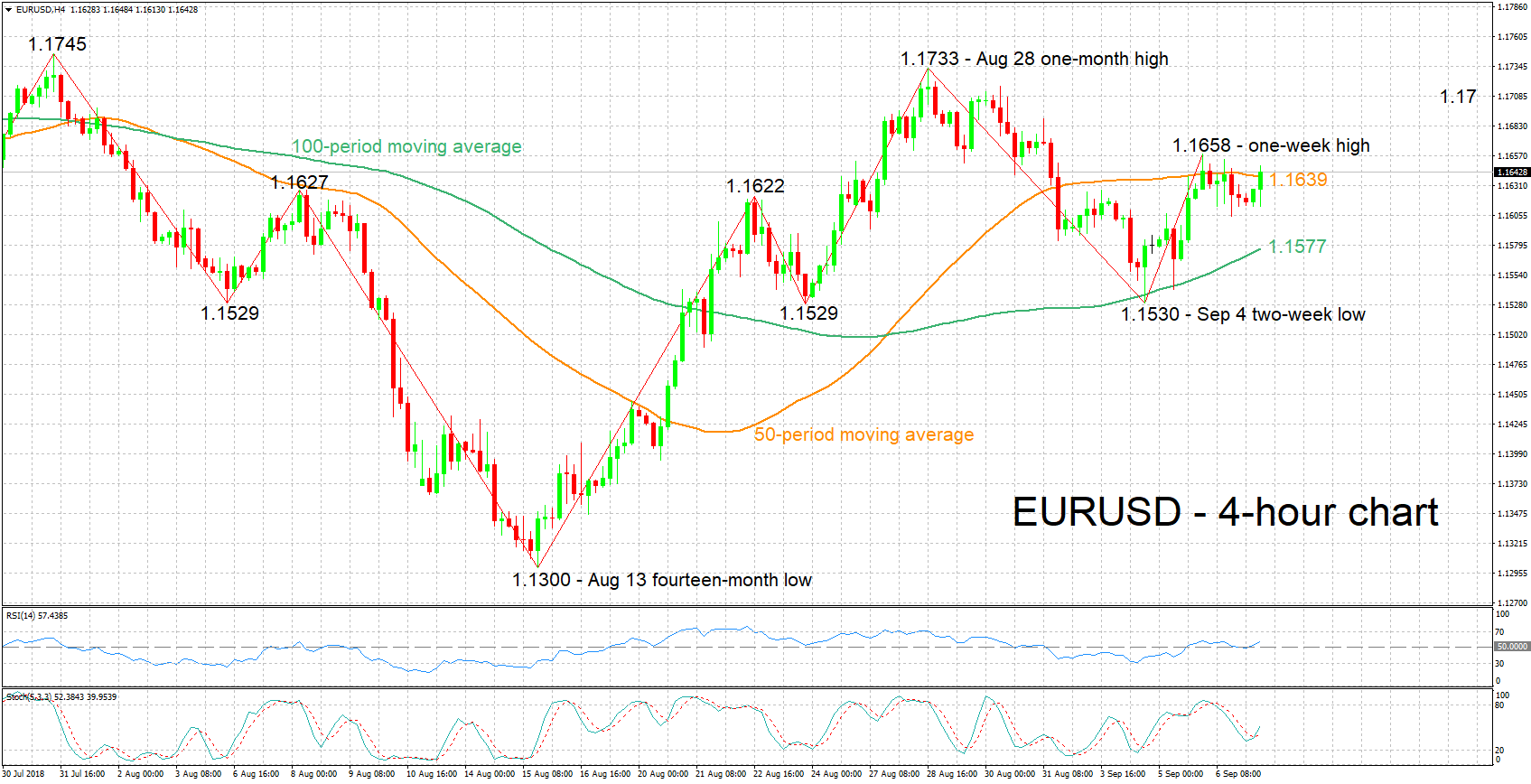
EURUSD is currently trading marginally above the 50-period moving average line. The RSI seems to be attempting a move higher which could be an early sign of short-term momentum turning positive. Turning to the stochastics, the %K line has moved above the slow %D one. This is a bullish signal in the very short-term; a decisive move up by both lines would confirm the strength of the signal.
Strong US jobs data are likely to weigh on the pair, pushing it down. Support to declines may come around the current level of the 100-period MA at 1.1577; the 1.16 round figure is also part of the area around this point. Further down, the two-week low of 1.1530 from earlier in the week would be eyed for additional support.
Conversely, disappointing figures could boost the pair. Immediate resistance may take place around yesterday's one-week high of 1.1658. Further above and given a move above the 1.17 handle, the one-month high of 1.1733 from late August would come into scope.
Regional Fed presidents Eric Rosengren (non-voting FOMC member in 2018), Loretta Mester (voter) and Robert Kaplan (non-voter) will be making public appearances at 1230 GMT, 1300 GMT and 1720 GMT respectively. Elsewhere, RBNZ Governor Adrian Orr will be giving a speech at 2130 GMT.
Meanwhile, a meeting between French President Emmanuel Macron and German Chancellor Angela Merkel touching on Brexit, immigration and the eurozone might be of interest.
In energy markets, the Baker Hughes weekly report on active oil rigs in the US is due at 1700 GMT.
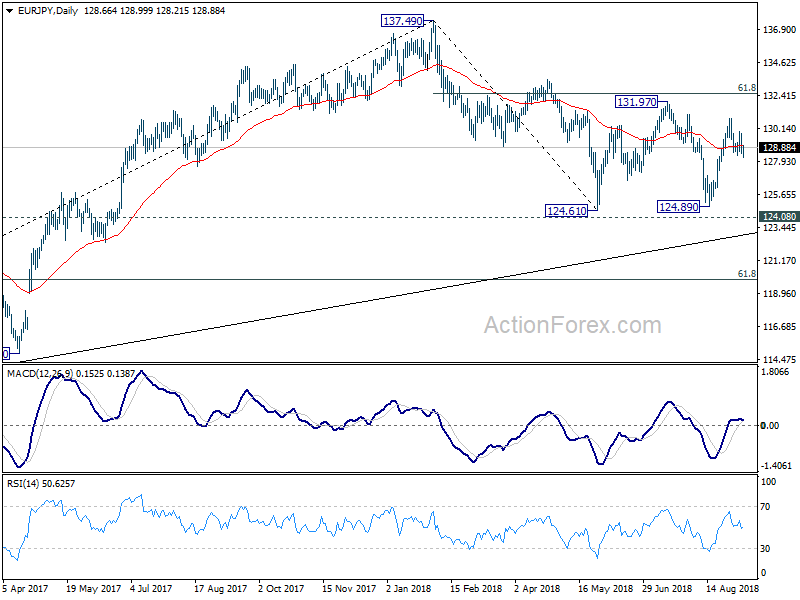
EUR/JPY Daily Outlook
Daily Pivots: (S1) 128.20; (P) 129.02; (R1) 129.54; More....
Despite breaching 128.31, EUR/JPY quickly recovered again. Intraday bias remains neutral. On the upside, break of 130.86 will extend the rise from 124.89 and target 131.97/132.56 key resistance zone. On the downside however, break of 128.31 will extend the fall from 130.86 to 61.8% retracement of 124.89 to 130.86 at 127.17 and below.
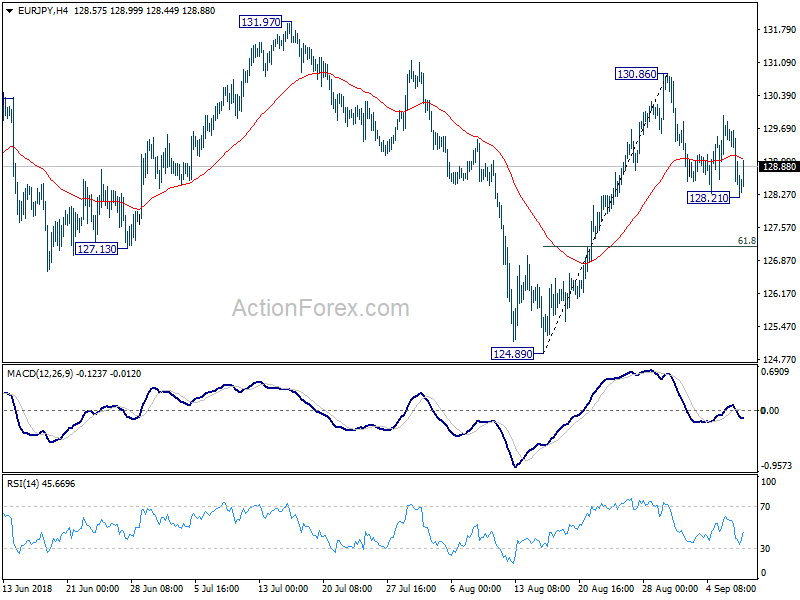
In the bigger picture, EUR/JPY once again rebounded ahead of 124.08 key resistance turned support. It's also held well above long term trend line from 109.03 (2016 low). The development argues that such rise from 109.03 might not be over yet. Decisive break of 61.8% retracement of 137.49 to 124.61 at 132.56 will pave the way to retest 137.49 high. But, firm break of 124.08 will argue that whole rise from 109.03 (2016 low) has completed at 137.49. Deeper decline would be seen to 61.8% retracement of 109.03 to 137.49 at 119.90 next.