Sample Category Title
GBPUSD Bearish Pattern Still Valid
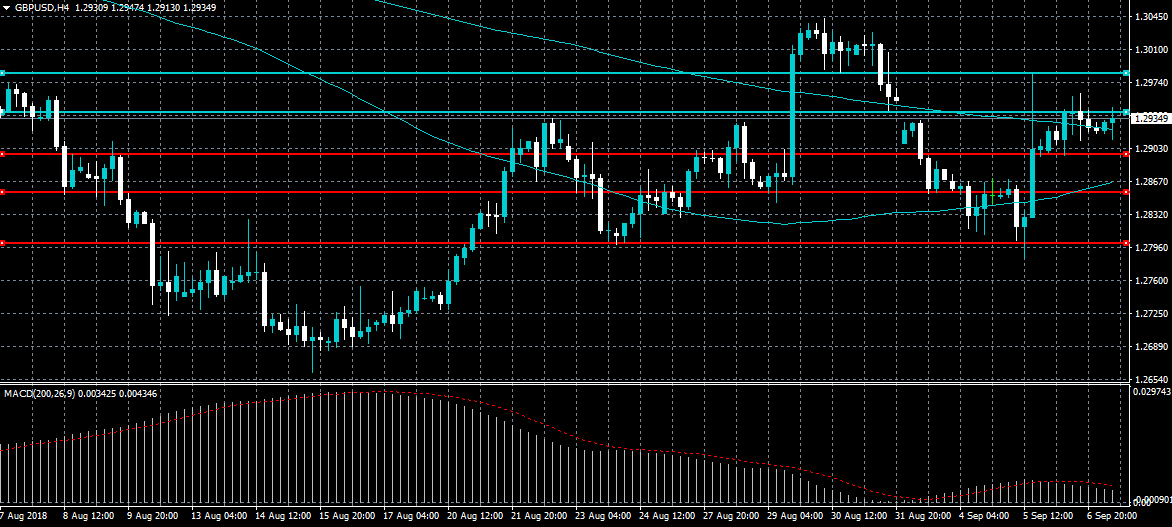
The British pound is starting to consolidate around key resistance against the greenback, ahead of the release of the United States Non-farm payrolls job report. The bearish head and shoulders pattern remains valid at current levels, with a move above the 1.3000 level needed to negate the bearish pattern. Sellers will attempt to break the 1.2863 level, while buyers will try to attack the 1.2985 level.
The GBPUSD pair is only bearish while trading below the 1.2863 level, key support is now found at the 1.2800 and 1.2875 levels.
If the GBPUSD pair moves above the 1.2985 level, buyers are likely to target the 1.3000 and 1.3040 resistance levels.
Non Farm Payrolls Friday Welcomes Back Risk-Off Mode!
Non Farm Payrolls Friday welcomes back risk-off mode!
It's payroll Friday. The weakness due to a session of unique corporate events from July has reversed, setting the stage for a solid non-farm payroll employment increase of 220k in August. ADP reported a 163k rise in private employment, slightly below the 200k expected. Broad employment indicators during August remained firm, with minor slowing in service-sector employment growth. The market expected a strong non-farm payroll employment increase of 191k in August. The marginal seasional effect could prove a drag on average hourly earnings but this is still likely to print an increase of 0.18% m/m or 2.69% annually. Finally, in the light of sustained employment growth markets expect the unemployment rate to fall to 3.8% with a potential risk of 3.7% read. Yet a spillover into USD should be limited given the broader macro environments. Trump is doing his best to derail optimism over the US. Apparently attempting to open a new front in the global trade war, Trump reportedly told The Wall Street Journal that he was “still bothered by the terms of U.S trade with Japan.” This comes on top of escalated tensions between the US and China as Trump threatens new tariffs on the Asian powerhouse. China was quick to warn of retaliatory actions should Trump move forward. USDJPY, the regional risk barometer, fell to 110.62 suggesting risk-off sentiments. Interestingly, the resilient US equity markets have had a difficult week as the tech sector saw sustained selling. While the direction for USD remains complex, we are more confident that selling pressure on high beta EM currencies such as TRY, RUBV and ZAR will remain high.
German economy likely to grow moderately in 2H2018 as foreign demand expected to decline
The German economy did well in the month of August. It managed to overcome the weakness from the first half amid improved manufacturing and service activity while inflation remained below the 2% threshold thanks to more stable currency exchanges across the months of July and August. But the trend is likely to change in the coming months as foreign demand is expected to decline rapidly.
Indeed, with German industry remaining strongly dependent on its automotive sector - accounting for more than 20% of total German industry revenue - and manufacturing orders remaining in negative territories for the second consecutive term (despite stronger domestic orders) owing to looming US tariffs on the EU automotive industry, the German economy is likely to grow only moderately in the second half of 2018.
Additionally, recent current account balance data tends toward a weaker trade surplus for the country, pushing manufacturing confidence downward starting from September.
The recent EUR/USD bounce is not expected to be sustained. The pair will be heading downward, approaching the 1.1570 range as the market is waiting for the US announcement of further duties against China.
China FX reserve dropped $8.2B in Aug, no large scale direction intervention yet
China's foreign currency holding dropped slightly by USD 8.2B to USD 3.110T in August, down from USD 3.118T. But that's still lower than market expectation of USD 3.115T. Nonetheless the data showed that China's capital control measures worked reasonable well so far and thus, there was no imminent need to large scale direct intervention.
Back in August, China restarted a reserve requirement on foreign exchange forward trading. Also, a counter-cyclical factor in daily pricing of Yuan was reinstated.
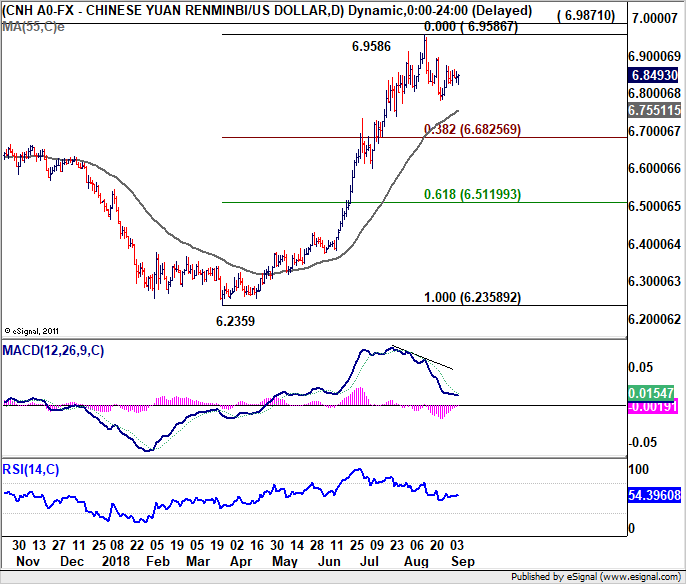
USD/CNH (off-shore Yuan) surged sharply since March low at 6.2359 to as high as 6.9586 as trade tension with US escalated.
Italian Budget Anxiety Continues To Recede, Focus On US Jobs Report
Notes/Observations
- Focus on US jobs report
- SNB FX Reserves dip due to the stronger CHF currency (Franc)
- China FX Reserves fall for 1st time in 3 months to 3.110T
Asia:
- Japan northern island of Hokkaido continues work to restore power after the recent earthquake -Japan July household spending rises for the first time since Jan
Europe:
- UK Brexit Min Raab said to have threatened Barnier that the EU would be forced to order the Irish government to reinstate the border in Northern Ireland in the event of a ‘no deal’ Brexit (Raab's warning over Irish border left EU's Barnier furious)
Americas:
- Canada Foreign Min Freeland: both sides are showing goodwill in NAFTA talks; we've had another productive meeting
- Bank of Canada (BOC) Wilkins: higher rates would be necessary to achieve inflation target. Not going to preempt Oct rate discussions
- Fed's Evans (non-voter, dove): Fed should raise interest rates to neutral and likely a little beyond. Higher inflation than expected would require more tightening
- Fed's Rosengren (moderate, non-voter): there should be more attention to forming policy buffers to mitigate future shocks
- Public comment period related to the US proposed tariffs on $200B in China goods has expired
- President Trump reportedly hinted in press interview that trade fight with Japan may be next on agenda
Economic Data:
- (NL) Netherlands July Manufacturing Production M/M: -0.9 v -0.2% prior; Y/Y: 2.0% v 3.3% prior; Industrial Sales Y/Y: 8.4% v 6.7% prior
- (CH) Swiss Aug Unemployment Rate: 2.4% v 2.4%e; Unemployment Rate (Seasonally Adj): 2.6% v 2.6%e
- (DE) Germany July Current Account Balance: €15.3B v €20.0Be; Trade Balance: €16.5B v €19.5Be; Exports M/M: -0.9% v +0.3%e; Imports M/M: 2.8% v 0.1%e
- (DE) Germany July Industrial Production M/M: -1.1% v +0.2%e; Y/Y: 1.1% v 2.6%e
- (DE) Germany Q2 Labor Costs Q/Q: 0.2% v 0.9% prior; Y/Y: 2.0% v 2.4% prior
- (FI) Finland July Preliminary Trade Balance: -€0.5B v €0B prior
- (DK) Denmark July Industrial Production M/M: 1.4% v 0.5% prior - (NO) Norway July Industrial Production M/M: -2.4% v +4.7% prior; Y/Y: -0.8% v _2.9% prior
- (NO) Norway July Manufacturing Production M/M: 0.9% v 1.0%e; Y/Y: 1.5% v 0.6% prior
- (RO) Romania Q2 Preliminary GDP (2nd reading) Q/Q: 1.4% v 1.4%e; Y/Y: 4.1% v 4.1%e
- (ZA) South Africa Aug Gross Reserves: $49.8B v $50.6Be; Net Reserves: $42.4B v $42.4Be
- (AU) Australia Aug Foreign Reserves: A$71.0B v A$69.1B prior
- (FR) France July Industrial Production M/M: 0.7% v 0.2%e; Y/Y: 1.8% v 1.0%e
- (FR) France July Manufacturing Production M/M: 0.5% v 0.2%e; Y/Y: 1.9% v 1.5%e
- (FR) France July Trade Balance: -€3.5B v -€5.7Be
- (FR) France July Current Account Balance: +€0.5B v -€2.3B prior
- (FR) France July YTD Budget Balance: -€82.8B v -€58.9B prior
- (ES) Spain July Industrial Output NSA Y/Y: +2.8% v -2.1% prior; Industrial Output SA Y/Y: 0.5% v 1.3%e; Industrial Production M/M: -0.3% v +0.4%e
- (ES) Spain Q2 INE House Price Index Q/Q: 2.6% v 1.4% prior; Y/Y: 6.8% v 6.2% prior
- (CH) Swiss Aug Foreign Currency Reserves (CHF): 730.9B v 749.9B prior - (HU) Hungary July Preliminary Trade Balance: €0.4B v €1.0B prior
- (AT) Austria Aug Wholesale Price Index M/M: 0.4% v 0.0% prior, Y/Y: 5.4% v 5.9% prior
- (CN) China Aug Foreign Reserves: $3.110T v $$3.115Te
- (UK) Aug Halifax House Prices M/M: 0.1% v 0.1%e; 3M/Y: 3.7% v 3.7%e
- (SE) Sweden Aug Budget Balance (SEK): 24.9B v 15.7B prior
- (TW) Taiwan Aug Trade Balance: $4.5B v $3.8Be; Exports Y/Y: 1.9% v 5.1%e; Imports Y/Y: 7.9% v 15.6%e
- (IT) Italy July Retail Sales M/M: -0.1% v -0.1% prior; Y/Y: -0.6% v +1.4% prior
- (CZ) Czech Aug International Reserves: $144.7B v $144.9B prior
- (RU) Russia Narrow Money Supply w/e Aug 31st: 10.29T v 10.36T prior
- (UK) Aug BoE/TNS Inflation Quarterly Survey Next 12-month: 3.0% v 2.9% prior
- (EU) Euro Zone Q2 Final GDP Q/Q: 0.4% v 0.4%e; Y/Y: 2.1% v 2.2%e
- (EU) Euro Zone Q2 Gross Fixed Capital Q/Q: 1.2% v 1.0%e; Govt Expenditures Q/Q: 0.4% v 0.4%e; Household Consumption Q/Q: 0.2% v 0.3%e
- (IS) Iceland Q2 GDP Q/Q: 1.9% v 1.1% prior; Y/Y: 7.2% v 6.6% prior
- (SG) Singapore Aug Foreign Reserves: $289.5B v $289.2B prior
- (HU) Hungary Aug YTD Budget Balance (HUF): -1.646T v -1.491T prior
Fixed Income Issuance:
- (IN) India sold total INR120B vs. INR120B indicated in 2023, 2028, 2035 and 2045 bonds
SPEAKERS/FIXED INCOME/FX/COMMODITIES/ERRATUM
Equities
- Market Focal Points/Key Themes: Indices [Stoxx600 -0.1% at 373.2, FTSE -0.2% 7304, DAX -0.1% at 11947, CAC-40 +0.1% at 5249, IBEX-35 -0.2% at 9194, FTSE MIB +0.0% at 20530, SMI +0.2% at 8836, S&P 500 Futures -0.1%]
- Market Focal Points/Key Themes: European Indices trade mixed in quiet trade consolidating after recent declines ahead of US Non Farm Payrolls later today. On a light day for coprorate headlines, IAG trades lower after a data breach in which 380K customers were affected. Enquest trades lower on earnings, while Plus500 is lower after Playtech sold its stake in the company. Green King is a notable gainer after strong comparable sales figures; Iliad trades higher on rumours of the company going private. Looking ahead notable earners include Genesco and Shiloh Industries.
Movers
- Consumer Discretionary IAG [IAG.UK] -2.1% (Data breach), GreenKing [GNK.UK] +8.1% (Earnings)
- Materials Enquest [ENQ.UK] -10% (Earnings, rights issue)
- Financials Ashmore [ASHM.UK] +2.4% (Earnings), Plus500 [PLUS.UK] -4.5% (Playtech sells stake)
- Telecom Illiad [ILD.FR] +5.5% (Speculation company could be taken private)
- Healthcare BTG [BTG.UK] -1.6% (Acquisition), Zealand Pharma [ZEAL.DK] +11% (Sell royalty streams and milestones)
Speakers
- Eurogroup chief Centeno: Italy committed to following EU principles
- EU's Moscovici: In Italy's interest to keep its debt under control
- Italy Fin Min Tria said to aim for budget deficit to GDP ratio below 1.6% vs. coalition target 2.5-3.0% area. Budget package would be around €30B and that the Govt was united on not breaching EU covenants
- Italy Dep PM De Maio: Bond spreads and rating agencies should not set Italy economic policy
- Sweden Central Bank (Riksbank) offers deposit facility to central counterparties to help manage liquidity buffers
- Germany could tighten foreign takeover rules even further.
- Indonesia Central Bank Gov Warjiyo: Gov efforts to reduce the deficit will help the IDR currency (Rupiah). Reiterated to keep stabilizing the economy and currency
Currencies
- USD was slightly softer ahead of the US jobs report. Dealers noted that trade could quickly move back to the front burner if the US decide to implement the $200B in additional tariffs on China now that the public comment period related to the US proposed tariffs had expired
- EUR/USD higher by 0.2% to trade just under 1.1650 ahead of the US jobs report. Dealers noted that Italian government bond yields continued to decline as Italian budget anxiety continues to recede.
Fixed Income
- Bund Futures trades at 160.26 down 10 ticks with the focus on US jobs data. Resistance moves to 161.82 then 163. A downside break of 159.85 sees 158.69 initially.
- Gilt futures trades at 122.29 down 22 ticks following the move in Treasuries. Continued support at 122.50, with a continued move higher targeting 123.93 then 124.00.
- Friday 's liquidity report showed Thursday's excess liquidity fell from €1.920T to €1.916T. Use of the marginal lending facility fell from €41M to €40M.
- Corporate issuance saw 3 issuers raise $22B in the primary market. For the week ended Sept 5th Lipper fund flows reported IG funds show outflows of $7.2B.
Looking Ahead
- 05:30 (ZA) South Africa to sell ZAR600M in I/ L 2025, 2033 and 2050 bonds
- 06:00 (UK) DMO to sell €5.5B in 1-month, 3-month and 6-month bills (£2.0B, £2.0B and £1.5B respectively)
- 06:30 (IS) Iceland to sell Oct 2022 RIKB Bonds
- 06:30 (ES) ECB’s De Guindos (Spain) with SSM chief Nouy at Eurofi Financial forum in Vienna
- 07:00 (CL) Chile Aug CPI M/M: 0.2%e v 0.4% prior; Y/Y: 2.7%e v 2.7% prior
- 07:00 (CL) Chile Aug CPI CPI Ex Food and Energy M/M: 0.1%e v 0.3% prior; Y/Y: No est v 1.9% prior
- 07:30 (CL) Chile Aug Trade Balance: $0.1Be v 0.4B prior; Total Exports: No est v 6.2B prior; Total Imports: No est v 5.8B prior; Copper Exports: No est v $3.0B prior
- 07:30 (CL) Chile Aug International Reserves: No est v $37.6B prior
- 07:30 (IN) India Weekly Forex Reserves w/e Aug 31st: No est v $401.3Bprior
- 08:00 (PL) Poland Aug Official Reserves: No est v $112.2B prior
- 06:45 (US) Daily Libor Fixing
- 08:00 (IN) India announces upcoming bill issuance (held on Wed)
- 08:05 (UK) Baltic Dry Bulk Index
- 08:30 (US) Aug Change in Nonfarm Payrolls: +195Ke v +157K prior; Change in Private Payrolls: +194Ke v +170K prior; Change in Manufacturing Payrolls: +24Ke v +37K prior
- 08:30 (US) Aug Unemployment Rate: 3.8%e v 3.9% prior; Underemployment Rate: No est v 7.5% prior; Labor Force Participation Rate: No est v 62.9% prior
- 08:30 (US) Aug Average Hourly Earnings M/M: 0.2%e v 0.3% prior; Y/Y: 2.7%e v 2.7% prior; Average Weekly Hours: 34.5e v 34.5 prior
- 08:30 (CA) Canada Aug Net Change in Employment: +5.0Ke v +54.1K prior; Unemployment Rate: 5.9%e v 5.8% prior; Full Time Employment Change: +35.0Ke v -28K prior; Part Time Employment Change: -30Ke v +82K prior; Participation Rate: 65.5%e v 65.4% prior; Hourly Earnings Y/Y: 3.0%e v 3.0% prior
- 08:30 (US) Fed’s Rosengren (moderate, non-voter)
- 09:00 (MX) Mexico Aug CPI M/M: 0.5%e v 0.5% prior; Y/Y: 4.9%e v 4.8% prior; CPI Core M/M: 0.3%e v 0.3% prior
- 09:00 (RU) Russia Aug Official Reserve Assets: $455.0Be v $ 458.0B prior
- 09:00 (US) Fed’s Mester (hawk, voter)
- 10:00 (CA) Canada Aug Ivey Purchasing Managers Index (Seasonally Adj): No est v 61.8 prior; PMI (unadj): No est v 56.7 prior
- 10:30 (TR) Turkey Aug Cash Budget Balance (TUR): No est v 0.8B prior
- 11:00 (EU) Potential Sovereign ratings after European close (Moody’s on Italy)
- 12:45 (US) Fed's Kaplan (dove, non-voter) speaks at Energy Conference in Dallas
- 13:00 (US) Weekly Baker Hughes US Rig Count:
weekend
- Sept 9th (SE) Swedish General Election
GBPJPY Holds In Narrow Range, Indicators Signal Bullish Bias
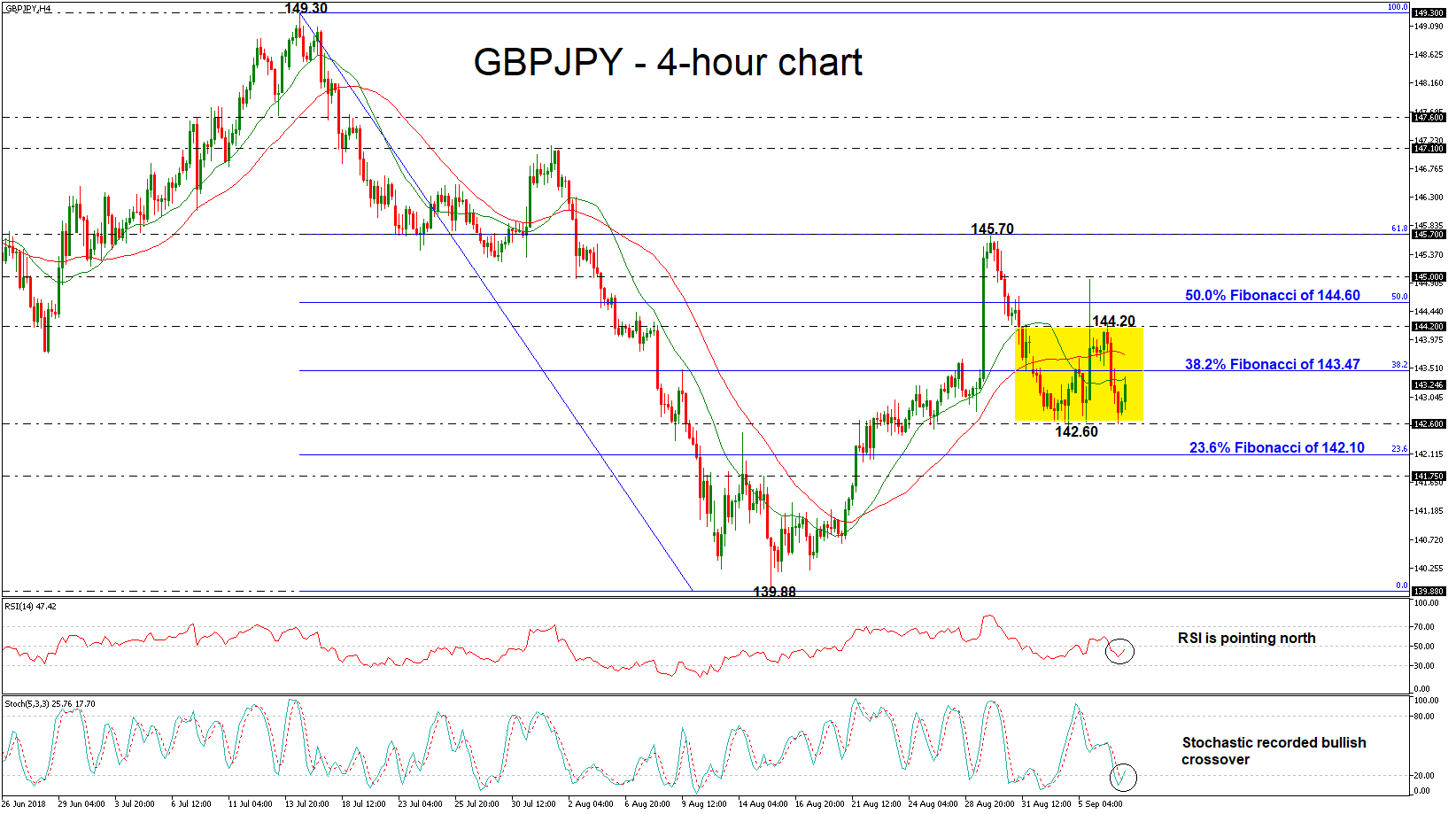
GBPJPY has been moving in a narrow range with an upper boundary the 144.20 resistance level and lower boundary the 142.60 support level, over the last week. Currently, the price is moving higher with the RSI confirming this movement as it is approaching the bullish area. Furthermore, the %K line of the stochastic oscillator created a bullish cross with the %D line in the oversold zone, which is a strong buying signal for traders.
Immediate resistance is being provided by the 38.2% Fibonacci retracement level of the downleg from 149.30 to 139.88, near 143.47. A successful leg above this region would open the way for the next resistance at the latest highs of 144.20. Also, a higher jump would ease the downside pressure and drive the pair until the 50.0% Fibonacci of 144.60.
Should the market post losses, support could be met at the lower boundary of 142.60, which the market failed to penetrate several times in the past. If the bears take charge and drop below it, the 23.6% Fibonacci is one of the major support levels at 142.10 before the 141.75 barrier.
Overall, GBPJPY remains below the 20- and 40-simple moving averages (SMAs) in the 4-hour chart and a climb above these lines could confirm the scenario for short term upside tendency.
Chinese Trade Data Eyed As Tensions With The US Look Set To Escalate, Aussie Also In Focus
Chinese trade figures for August will be made public on Saturday, with the numbers being scrutinized for any negative effects stemming from US tariffs. Meanwhile, the latest developments in the Sino-US trade spat are also putting the release high on investors' radar. Elsewhere, attention will also turn to the Aussie due to its status as a barometer of broader risk sentiment, as well as Australia's China-dependency which has rendered its currency as a liquid proxy for China “plays”.
Analysts' are forecasting China's exports and imports to have risen by 10.1% and 18.7% y/y in August respectively, below July's pace of growth of 12.2% and 27.3%. Despite the projected deceleration, if the two meet or come close to forecasts, this would still constitute a robust set of prints. Meanwhile, the nation's trade surplus (measured in USD) is expected to widen to roughly $31.8 billion from around $28.1bn in the previously tracked month.
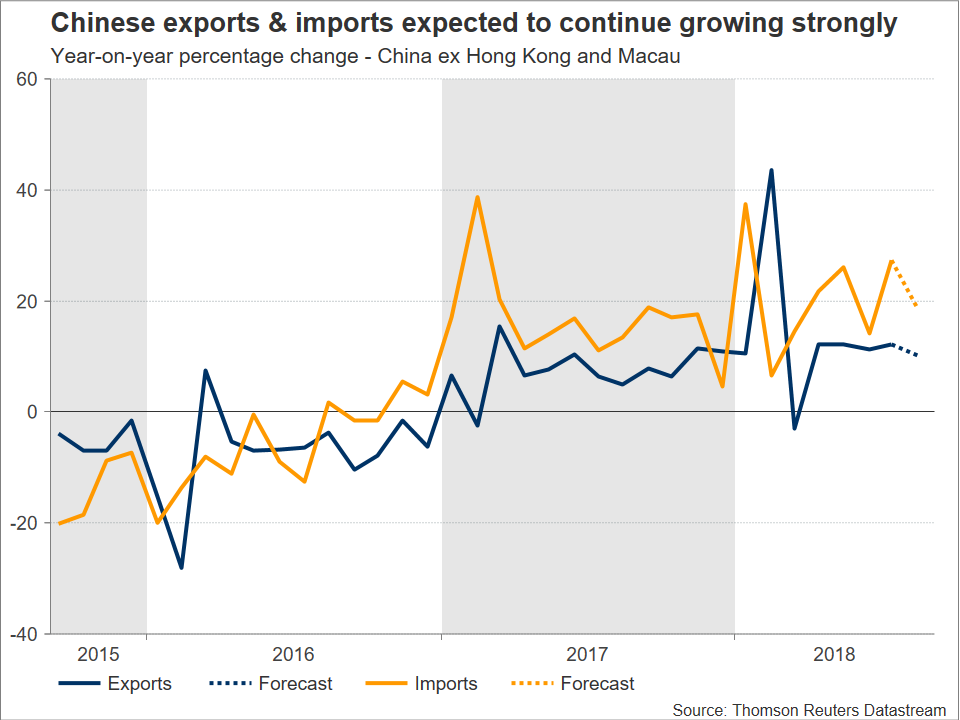
Export growth so far appears to remain largely unaffected by levies on billions of dollars of shipments to the US. Still, it is too early to conclude that this will continue holding true, especially if one factors in that the US may well ratchet up its tariff game. In this respect, the public comment period for proposed US duties on an additional $200 billion in Chinese imports has just expired. President Trump signaled willingness to push forward with these additional levies by the end of the aforementioned period. Although his administration has yet to do so, still there is angst in markets that such a move could materialize soon.
It is of note that trade data out of the US earlier in the week, showed the trade deficit on goods with China rising to a record-high $36.8bn in July, something which might lend fuel to Trump's confrontational stance with the country. Also worth mentioning, the US' relevant gap with the EU also touched an all-time high of $17.6bn; the bloc has also been on the receiving end of firing shots by the US president on trade.
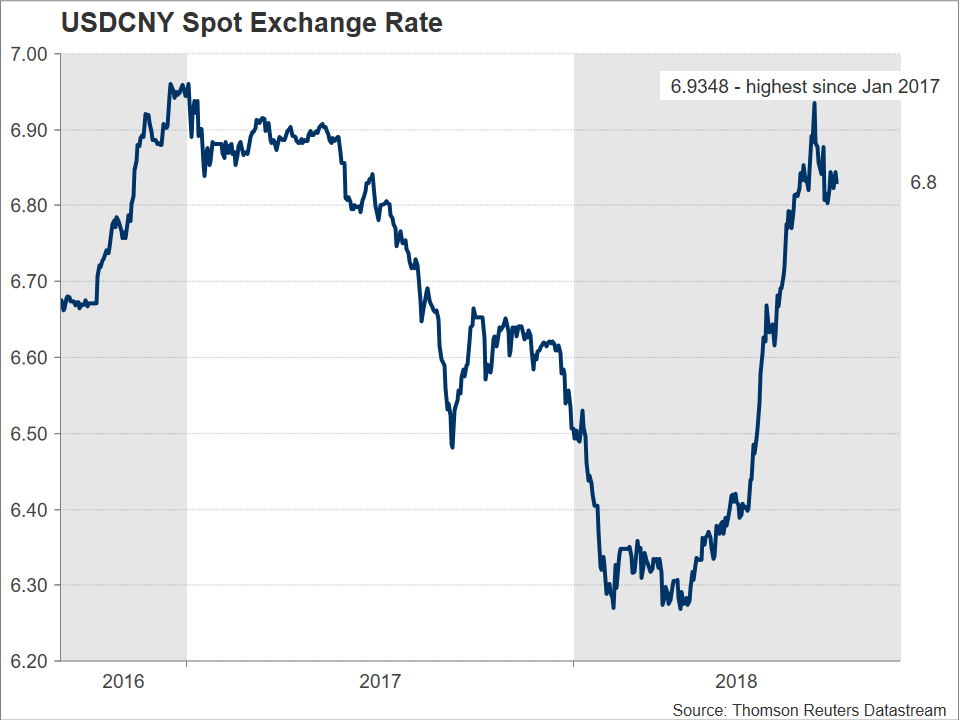
Both the onshore (depicted below) and offshore yuan have appreciated from their weakest levels since January 2017 versus the greenback hit in mid-August on the back of worries over trade and the associated negative effects on the Chinese economy. The partial recovery was aided by some efforts by the PBOC to support the currency. Still, resurfacing trade jitters are likely to weigh on the yuan.
Staying in currency-land, the Aussie will also be monitored when markets reopen for trading on Monday in the aftermath of the Chinese releases, while updates on the Sino-US trade dispute can well affect the currency as well. This is owed to Australia's heavy export dependency – a rosier outlook on global trade and growth is seen as positive for the Aussie – but also due to its close economic ties with China. As a testament to the latter, figures released on Thursday out of Australia showed the nation enjoying a record trade surplus with China year-to-date.
Encouraging Chinese data or easing trade tensions may push AUDUSD higher. Resistance to gains may take place around the 0.72 round figure. Steeper gains could shift the focus to the zone around the current level of the 50-day moving average line at 0.7345 which was relatively congested from late June to early August, given that the 0.73 handle is broken first.
Conversely, disappointing numbers or an intensifying trade row between the US and China could exert downward pressure on the pair. If the price falls below 0.7136, this being a nadir last experienced in March 2016, additional support may occur around the 0.71 round figure, with the 0.70 mark coming into scope in case of sharper losses.
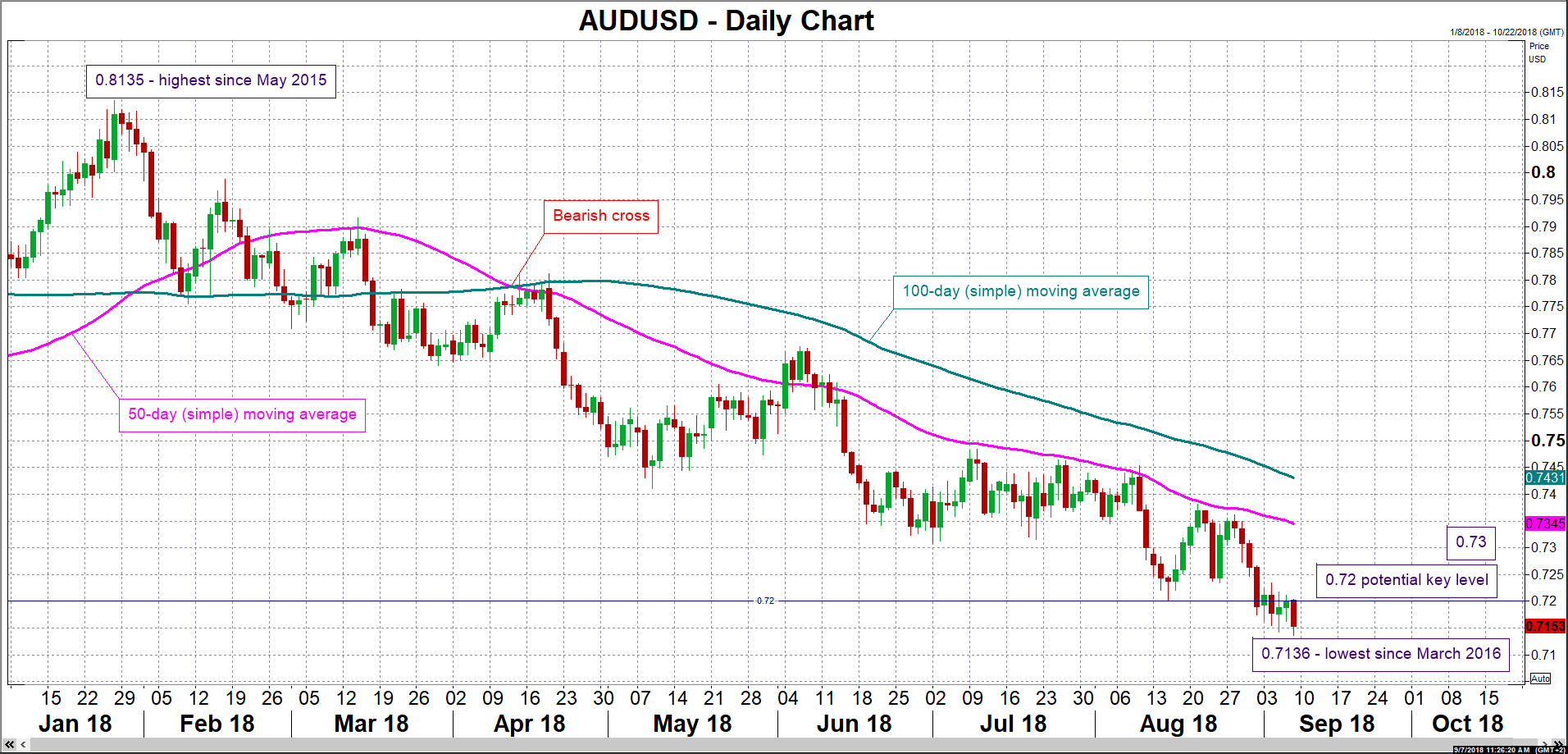
The Australian currency trading at two-and-a-half-year lows against the US dollar is attributed to a number of factors. Growing concerns over global trade and rising variable rate mortgages by some of the country's largest banks – that are seen as hurting household spending – are some of those factors.
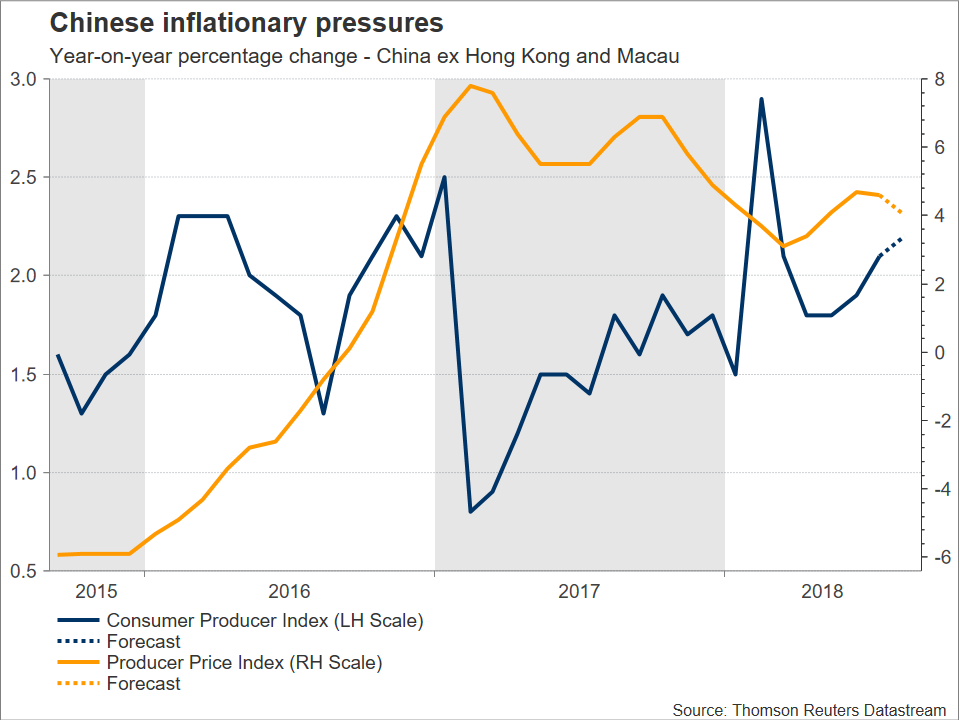
Lastly, China's producer price index (PPI) and consumer price index (CPI) for August will be hitting the markets on Monday at 0130 GMT. Factory prices, as gauged by the PPI, are anticipated to expand by 4.0% y/y, at their slowest since April. In terms of CPI inflation, it is expected to grow by 2.2%, at its fastest pace since February.
The Analytical Overview Of The Main Currency Pairs
The EUR/USD currency pair
Technical indicators of the currency pair:
Prev Open: 1.16300
Open: 1.16212
% chg. over the last day: -0.08
Day's range: 1.16137 – 1.16491
52 wk range: 1.0571 – 1.2557
The EUR/USD currency pair is consolidating. A unidirectional trend is not observed. The key range is 1.16100-1.16500. Financial market participants expect a report on the labor market in the United States. Preliminary data from ADP turned out to be rather weak. We recommend paying attention to the difference between the actual and forecasted values. Positions should be opened from the key levels.
The news feed on 2018.09.07:
GDP data in Eurozone at 12:00 (GMT+3:00);
Statistics on the US labor market at 15:30 (GMT+3:00).
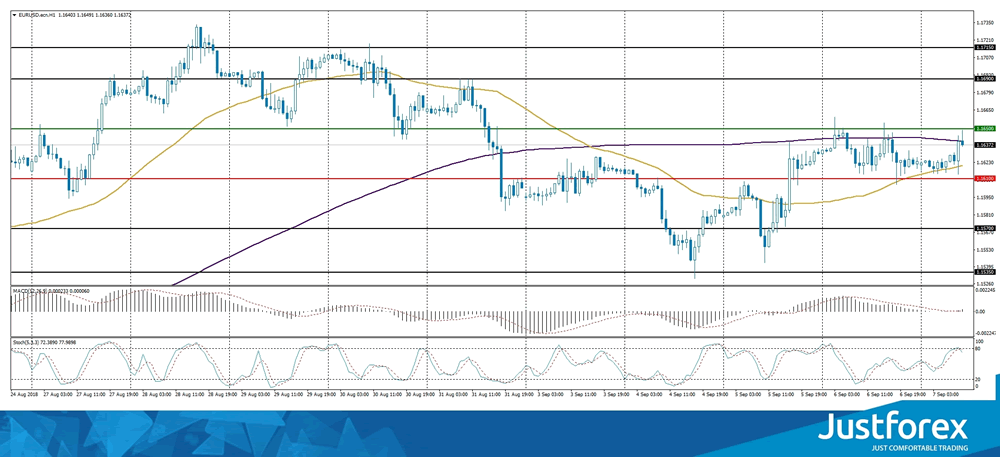
Indicators do not send accurate signals: the price has crossed 50 MA and 200 MA.
The MACD histogram is near 0 mark.
Stochastic Oscillator is located near the overbought zone, the %K line has crossed the %D line. There are no signals at the moment.
Trading recommendations
Support levels: 1.16100, 1.15700, 1.15350
Resistance levels: 1.16500, 1.16900, 1.17150
If the price fixes below the local support of 1.16100, we recommend looking for entry points to the market to open short positions. The movement is tending to 1.15500-1.15250.
Alternative option. If the price fixes above 1.16500, the EUR/USD quotes are expected to rise. The movement is tending to 1.17000-1.17250.
The GBP/USD currency pair
Technical indicators of the currency pair:
Prev Open: 1.29018
Open: 1.29254
% chg. over the last day: +0.16
Day's range: 1.29135 – 1.29479
52 wk range: 1.2361 – 1.4345
The GBP/USD currency pair continues to consolidate. Statistics on the US labor market is in the focus of attention. At the moment, the local support and resistance levels are 1.29100 and 1.29500, respectively. We recommend opening positions from these marks. Investors expect new information regarding Brexit negotiations.
The publication of important economic reports from the UK is not planned.
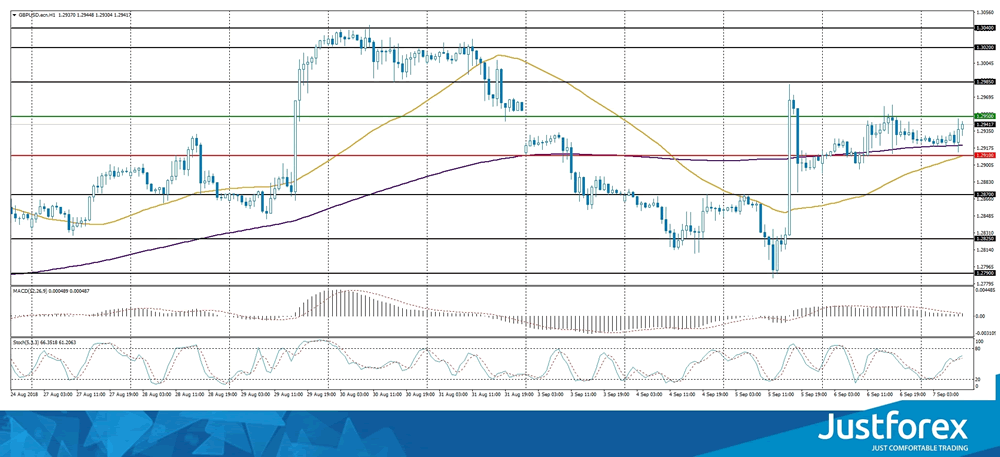
Indicators point to the power of buyers: the price has fixed above 50 MA and 200 MA.
The MACD histogram is in the positive zone and continues to rise, which signals the bullish sentiment.
Stochastic Oscillator is located in the neutral zone, the %K line is above the %D line, which also signals to buy GBP/USD.
Trading recommendations
Support levels: 1.29100, 1.28700, 1.28250
Resistance levels: 1.29500, 1.29850, 1.30200
If the price fixes above 1.29500, further growth of the GBP/USD quotes is expected. The movement is tending to 1.30000-1.30200.
Alternative option. If the price fixes below the local support of 1.29100, we recommend considering sales of GBP/USD. The movement is tending to 1.28500-1.28250.
The USD/CAD currency pair
Technical indicators of the currency pair:
Prev Open: 1.31760
Open: 1.31369
% chg. over the last day: -0.15
Day's range: 1.31130 – 1.31660
52 wk range: 1.2059 – 1.3795
Yesterday, the USD/CAD quotes moved away from local highs. At the moment, the trading instrument is consolidating. Local support and resistance levels are 1.31150 and 1.31600, respectively. Investors expect statistics on the labor market in the US and Canada. Today, trading activity and volatility can significantly increase on the USD/CAD currency pair. We recommend opening positions from the key levels.
The news feed on the economy of Canada:
A report on the labor market at 15:30 (GMT+3:00);
The index of economic activity from Ivey at 17:00 (GMT+3:00).
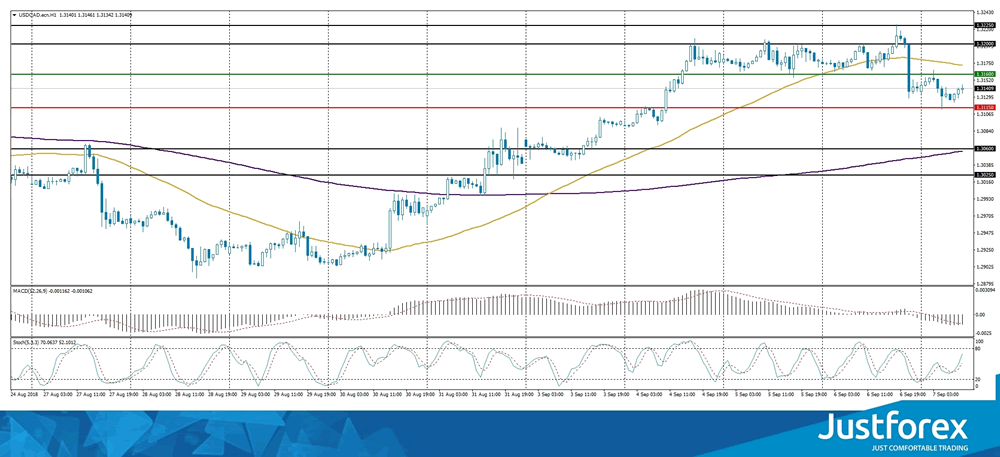
Indicators do not send accurate signals: the price has fixed between 50 MA and 200 MA.
The MACD histogram is in the negative zone and below the signal line, which indicates the bearish sentiment.
Stochastic Oscillator is located in the neutral zone, the %K line is above the %D line, which signals to buy USD/CAD.
Trading recommendations
Support levels: 1.31150, 1.30600, 1.30250
Resistance levels: 1.31600, 1.32000, 1.32500
If the price fixes below the local support of 1.31150, it is necessary to look for entry points to the market to open short positions. The movement is tending to 1.30600-1.30250.
Alternative option. If the price fixes above 1.31600, the USD/CAD quotes are expected to rise. The target level for profit-taking is 1.32000-1.32500.
The USD/JPY currency pair
Technical indicators of the currency pair:
Prev Open: 111.528
Open: 110.740
% chg. over the last day: -0.93
Day's range: 110.380 – 110.772
52 wk range: 104.56 – 114.74
The bearish sentiment prevails on the USD/JPY currency pair. During yesterday's trading, the drop in quotes exceeded 100 points. Investors are still concerned about the trade conflict between the US and China, which supports the demand for safe assets. At the moment, the USD/JPY currency pair is consolidating in the range of 110.500-110.750. The positions should be opened from these marks. We recommend paying attention to the news feed on the US economy.
The publication of important statistics from Japan is not planned.
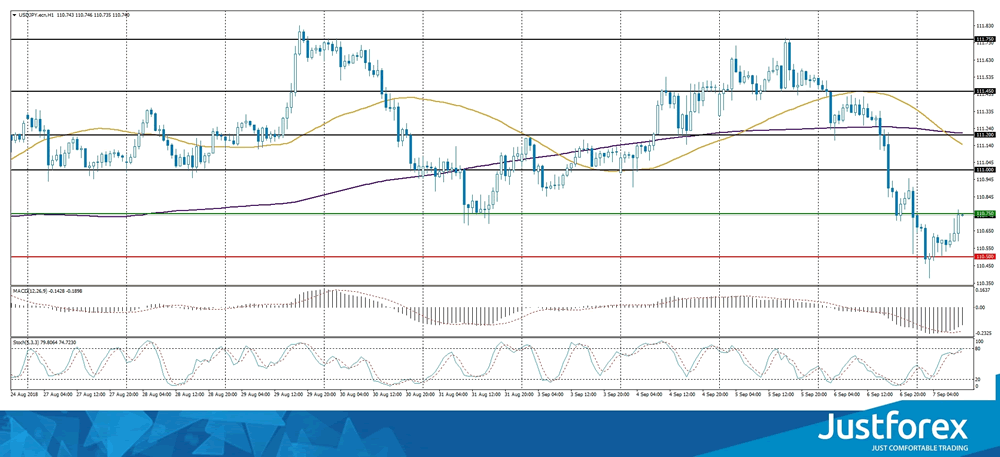
The price has fixed below 50 MA and 200 MA, which indicates the power of sellers.
The MACD histogram is in the negative zone, but above the signal line, which gives a weak signal to sell USD/JPY.
Stochastic Oscillator is located in the neutral zone, the %K line is above the %D line, which indicates the USD/JPY quotes growth.
Trading recommendations
Support levels: 110.500, 110.000
Resistance levels: 110.750, 111.000, 111.200
If the price fixes below the support level of 110.500, the USD/JPY quotes are expected to fall further. The movement is tending to 110.000-109.750.
Alternative option. If the price fixes above the level of 110.750, it is necessary to consider purchases of USD/JPY. The movement is tending to 111.000-111.250.
A Report On The US Labor Market Is In The Focus Of Attention
Yesterday, trading on currency majors was quite active. At the same time, a unidirectional trend was not observed. The dollar index (#DX) closed the trading session with a slight decrease (-0.14%). Financial market participants are still concerned about the trade conflict between the US and China, which supports the demand for safe assets. At the moment, the main currency pairs are consolidating. We expect important economic reports.
Today, at 15:30 (GMT+3:00), the US will publish labor statistics for August. The preliminary report from ADP was rather weak. At the same time, the index of economic activity in the non-manufacturing sector of the country increased from 55.7 to 58.5. Experts expect a fairly optimistic report on the labor market. We recommend paying attention to the difference between the actual and forecasted values. It should be noted that this statistics may affect the Fed views on the further monetary policy tightening. At the moment, more than 95% of financial market participants expect that the central bank of the United States will increase the range of the key interest rate by 25 basis points to 2.00%-2.25% at the meeting on September 26.
The "black gold" prices are moderately rising. At the moment, futures for the WTI crude oil have approached a mark of $68.00 per barrel.
Market Indicators
Yesterday, the major US stock indices showed mixed dynamics: #SPY (-0.30%), #DIA (+0.14%), #QQQ (-0.89%).
At the moment, the 10-year US government bonds yield is at the level of 2.88-2.89%.
The news feed on 07.09.2018:
A report on the US labor market at 15:30 (GMT+3:00);
Statistics on the labor market in Canada at 15:30 (GMT+3:00);
The index of economic activity in Canada from Ivey at 17:00 (GMT+3:00).
WTI Oil Outlook: Oil Price In Tight Consolidation After Strong Fall In Crude Stocks Reduced Bearish Pressure
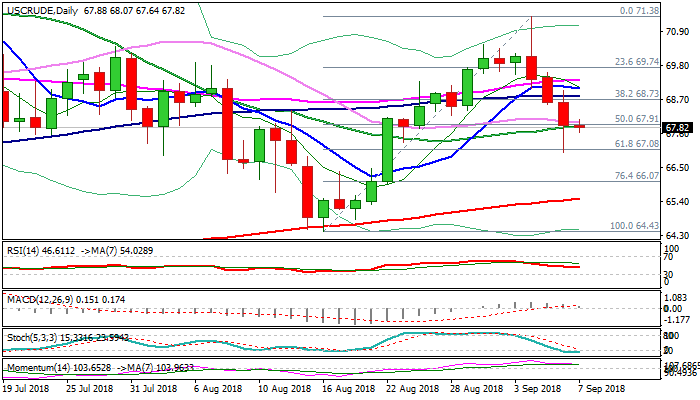
WTI oil is consolidating on Friday after three days of strong losses when the price fell from $71.38 (04 Sep spike high / strong upside rejection) to $66.99 (two-week low). Turbulent situation in emerging markets and rising fears of escalation of global trade conflict, were the factors that keep oil price under pressure, with negative impact being partially offset by unexpected rise in US crude stocks (EIA report showed weekly crude inventories fell by 4.30 million barrels, falling well below forecast for 1.29 million barrels draw). However, overall near-term structure remains negative, as daily techs are in bearish mode and fears that escalation of trade conflict could hurt global oil demand, keeping bearish bias in play. Pivotal supports at $67.08/$66.99 (Fibo 61.8% of $64.43/$71.38 / Thursday's spike low) remain in focus, with break here to generate bearish signal for extension of bear-leg of $71.38 towards next supports at $66.07 (Fibo 76.4%) and $65.50 (200SMA). At the upside, a cluster of MA barriers between $68.81 and $69.31 marks upper pivotal points, break of which would neutralize downside threats.
Res: 68.81, 69.07, 69.31, 70.00
Sup: 67.64, 67.08, 66.99, 66.07
XAU/USD Analysis: Will Pass The 200-Hour SMA
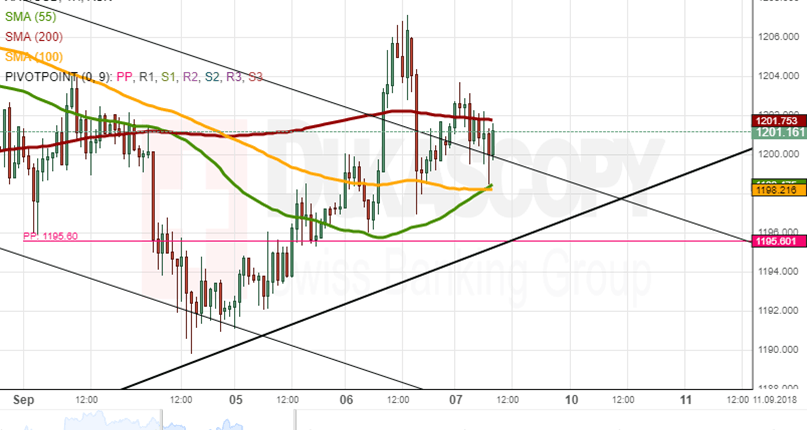
The gold price appreciated 0.21% since Thursday's trading session. The XAU/USD was located between the SMAs at the 1,201 mark on Friday morning.
In regards to the near future, the yellow metal will surge upwards due to a psychological barrier of the 1,200 mark and support of the 55-hour simple moving average and the 100-hour simple moving average, which should push the rate to the 1,206.00 level during today's trading session.
Note, that the 200-hour simple moving average at the 1,202.00 level might stop the rate and push gold back to the monthly PP at the 1,195.60 mark.