Sample Category Title
US Kudlow: Talks continue to go on with China
White House Economic Adviser Larry Kudlow said the US is "still talking with China on a number of issues" and the talks will "continue to go on .
Kudlow reiterated that the US wants "lower barriers across the board". That is, "zero tariffs, zero non-tariff barriers, zero subsidies, stop the IP theft, stop the technology transfer, allow Americans to own their own companies."
But he expressed the frustration that "those have been our asks for many months and so far those asks have not been satisfied."
US: Wages Picking Up as Labor Market Tightens
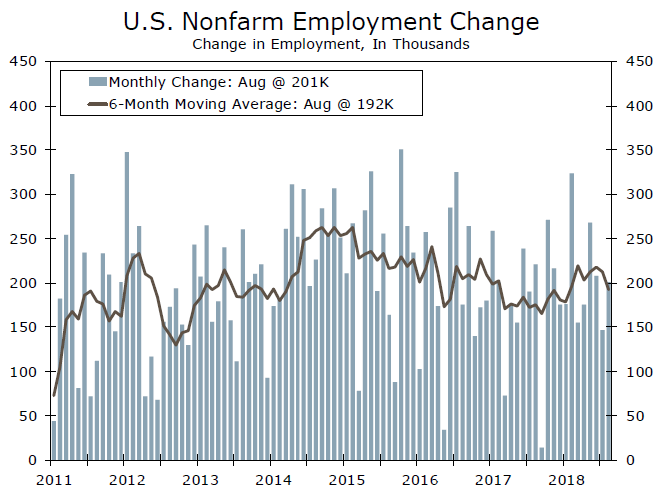
Employers added 201,000 jobs in August. That marked an improvement versus July, but the overall trend in hiring is slowing as employers are increasingly having trouble finding workers. Wages are rising as a result.
Slower Job Growth but Wages Pick Up
Hiring in the United States bounced back in August, with employers adding 201,000 jobs. Gains were somewhat mixed. Job growth was solid in professional & business services, education & health and transportation, but manufacturing employment slipped by 3,000 jobs, breaking a 12-month run of gains.
Revisions were negative, with the number of new jobs added the previous two months revised down 50,000. Despite August's pickup in hiring compared to July, the overall trend in job growth has been slowing. Over the past three months, job gains have averaged 185,000, compared to 218,000 in the first half of the year.
Difficulty finding workers rather than a lack of demand is contributing to the slowdown, in our view. The share of small businesses reporting they have at least one job hard to fill rose to the highest level in the survey's 45-year history in August, while JOLTS data from the BLS show the job opening rate similarly hovering near record highs.
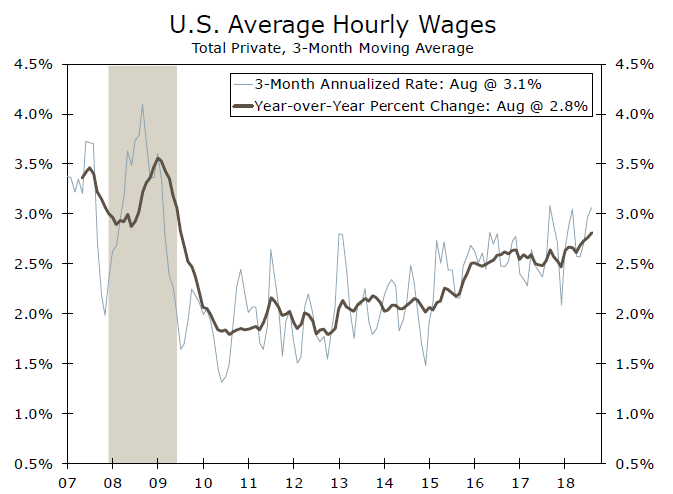
Wage growth is picking up as a result of employers increasingly having trouble finding workers. Average hourly earnings rose 0.4% in August and are up 2.9% over the past year. Although that remains weaker than the pace registered in previous cycles, the pace is picking up and wage growth is now running at the strongest pace of this expansion.
The extent that rising wages lead to higher inflation, however, remains the ultimate test for the Fed. While some FOMC members remain "puzzled" that wages have not picked up more, core inflation measured by the Fed's PCE deflator is back to 2.0% and likely to remain there as businesses increasingly report a willingness to pass on rising input costs.
Further Labor Market and Fed Tightening to Come
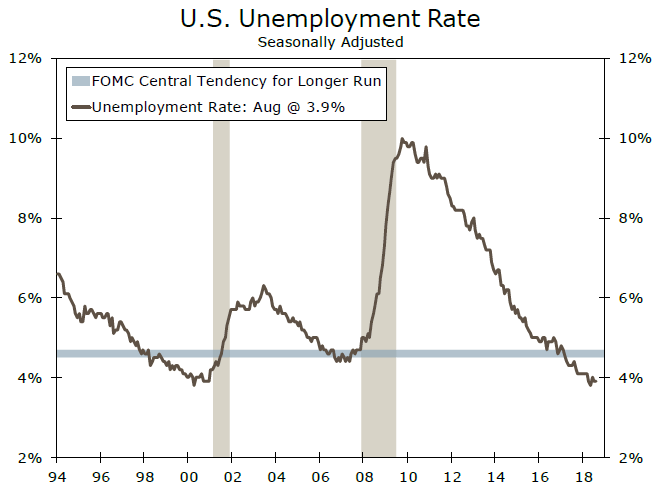
The unemployment rate was unchanged in August at 3.9%, but down 0.5 percentage points over the past year. We expect to see downward pressure on the unemployment rate continue in the months ahead. Employment growth is running around a 1.6% pace compared to labor force growth of only 0.7% over the past year. Labor force growth is set to remain subdued with the wave of Baby Boomers reaching retirement age, while participation among prime-age workers (25-54) has been more or less flat since the start of the year after having risen steadily the prior two years.
Although Fed officials, including Chair Powell, have recognized the uncertainty surrounding the "natural rate" of unemployment in real time, there is little doubt the labor market is tightening. Strong hiring and strengthening wage gains should keep the Fed on track to raise rates not only at its meeting later this month, but also again in December.
U.S. August Employment Bounces Back
Highlights:
- August payroll employment bounced back to 201k following downwardly revised gains in July of 147k (157k previously) and in June of 208k (248k). Market expectations had been for a 193k increase.
- The increase in employment was skewed towards private sector service-producing jobs which increased 178k up from the 117k gain in July.
- The separate, and more volatile, household survey indicated employment plummeting 423k following the 389k jump in July. With labour force also slumping 469k, the unemployment rate remained unchanged at 3.9%.
- The annual increase in wages jumped more than expected to 2.9% in August from 2.7% in July.
Our Take:
Today’s employment for August indicated a solid rebound in hiring to 201k after the smaller-than-expected 147k gain in July. Thus despite indications of the economy operating beyond capacity, and thus a shrinking pool of available workers to draw from, hiring remains surprisingly robust. Though the unemployment rate remained unchanged at 3.9%, it remains significantly below the Fed’s long-run expected range for unemployment of between 4.3% and 4.6%. The drop in the broader measure of unemployment, the so-called U-6 rate, to 7.4% from 7.5% provides some evidence that solid U.S. growth is drawing more individuals back into the labour force. The strength in labour markets contributed to the wage measure rising significantly to 2.9% in August from 2.7% in July. The upward trend in wage growth has generally tracked the downward trend in the unemployment rate through all of the growth phase of the current business cycle. The pace of increase in wage growth does not as yet jeopardize the Fed’s 2% inflation target. However, the risk grows as this measure continues to trend higher and is thus expected to keep the Fed tightening policy. Our forecast assumes that the current fed funds range of 1.75% to 2.00% will rise a further 50 basis points by the end of this year and a further 100 basis points through 2019. The next hike is expected later this month at the September 25-26 policy-setting FOMC meeting.
Canadian Labour Market Improvement Took a Breather in August
Highlights:
- Employment fell 52k in August to retrace most of a 54k increase in July. Sectors of strength in July (like education hiring) were generally not areas of weakness in August.
- The unemployment rate ticked up to 6.0% from the 5.8% in July that matched a more-than 4-decade low.
- Wage growth for permanent workers slowed to 2.6% from 3.0% in July.
Our Take:
There was not a lot to like in the Canadian August labour market report. One month also does not make a trend, though, particularly in the notoriously volatile LFS data. Employment dropped 52k to retrace most of a 54k July surge. Job growth has still averaged 14k per month over the last 12 months, though, with full-time job growth running almost twice as strong over that period at an average 27k per month. The unemployment rate ticked up to 6.0%. That is still only slightly above the 5.8% in July that matched a more-than 4-decade low and is still down from 0.2% from a year ago. Wage growth was perhaps the most surprising measure in today’s report, with year-over-year growth in average hourly earnings slowing to 2.6% from 3.0% in July and almost 4% in May. Even with the deterioration in jobs and the unemployment rate in August, labour markets look tight enough that wages should be growing more quickly. Wage growth has also increasingly been concentrated in B.C. and Ontario. That makes sense given labour markets have generally been stronger than average in those regions — but both have also had significant boosts to the minimum wage over the last year.
There is mounting evidence that the pace of improvement in labour markets is slowing, even looking through volatility. That is less concerning, though, with unemployment already probably pretty close to its ‘full-employment’ level. More wage growth would provide the last missing element that labour markets have indeed moved to capacity. There likely won’t be a lot for the Bank of Canada to like in today’s data — but the numbers are volatile enough that one month also shouldn’t make a big difference in their near-term assessment of the strength of the economy. Today’s data shouldn’t have much of an impact on the odds of another 25 basis point hike to the overnight rate in October.
Sunset Market Commentary
Markets
It was a typical quiet pre-payrolls European trading session on main FI and FX markets. A modest rebound in EM FX didn’t stroke with weakness on European stock markets from a risk point of view. The German Dax extends losses following this week’s break below 12100 support. Key support kicks in around 11725. Trading dynamics changed after the release of the August labour market report. Net job growth beat forecast by 11k (201k vs 190k expected), but June/July figures faced a combined 50k downward revision. Data nevertheless confirm ongoing strength on the US labour market. The unemployment rate stabilized at 3.9% (vs 3.8% consensus) with a drop in the participation rate. Average hourly earnings delivered the biggest surprise, accelerating by 0.4% M/M and 2.9% Y/Y, an expansion high and further evidence of building price pressure in the US economy. The market implied probability of two more Fed rate hikes this year increased from 63% to 68%. Markets reacted accordingly with both US yields and the dollar turning north. The US yield curve trades 3.2 bps (30-yr) to 5.4 bps (5-yr) higher at the time of writing. The US 2-yr yield tests the 2.68% cycle high. German yields add 1.4 bps (2-yr) to 2.7 bps (10-yr). The dollar’s gains are less impressive, in line with the lacklustre performance earlier this week given circumstances (risk aversion and strong US eco data). EUR/USD dropped back below the 1.16 handle (1.1573 currently), but the short term technical picture doesn’t change. USD/JPY returns above 111 following this morning’s safe haven yen gains as the WSJ suggested that Japan would be the next victim in Trump’s trade wars. Event risk remains tonight and this weekend with US President Trump possibly pulling the trigger on imposing another $200bn of tariffs on Chinese goods.
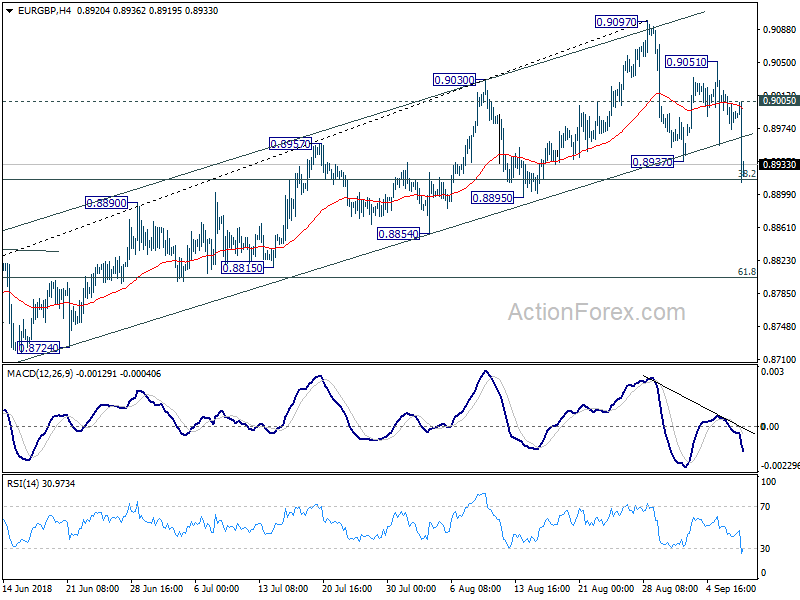
EUR/GBP initially held a tight range close to the 0.90 pivot. Halifax house prices were as expected (3.7%). Around noon, markets were spooked by Bloomberg headlines of quotes EU ‘s Barnier made in a meeting with UK policy makers early this week. Markets apparently considered it good news as the negotiator said the EU is prepared to simplify checks at the border between the Irish Republic and the UK. We doubt that the headlines should be considered as an indication that the EU and the UK are coming close to a comprehensive Brexit deal. Even so, sterling succeeded some nice gains upon the publication of the quotes. EUR/GBP dropped from the 0.90 area to the 0.8930 area. In our view, this is more an indication that the market is still positioned sterling short.
News Headlines
An official transcript of the divorce talks between Barnier and UK lawmakers on Monday was released, showing that the chief EU negotiator said lots of the UK’s blueprint for post-Brexit relations are useful and that he’s open to new ideas to fix the Irish border problem. The pound gained around 1% on the news.
Canada unexpectedly lost 52k jobs last month, following two strong months of gains (+54k in July). The 92k decline in part-time jobs outweighed the 40k increase of full-time positions, pushing unemployment up to 6.0% from 5.8% in July. Wage growth disappointed expectations (3.0%), with only 2.6% wage growth in August.
US labour market remains very strong, indicated by the latest data. Nonfarm payrolls rose 201k (190k expected). More importantly, US wages rose at their quickest pace in nine years (0.4% m/m, 2.9% y/y), suggesting a rise in inflationary pressure. This increases the probability that the Fed will raise interest rates two more times this year.
North Korea’s Kim Jong Un has put together a timeline for denuclearization. A full denuclearization would be reached by the end of US President Donald Trump’s first term (early ’21). However, no indication of concrete steps were given. North Korea insists the US takes simultaneous steps to reduce sanctions pressure.
EUR/GBP Mid-Day Outlook
Daily Pivots: (S1) 0.8972; (P) 0.8997; (R1) 0.9018; More...
EUR/GBP's sharp fall, break of channel support and 0.8937 suggests short term topping at 0.9097. More importantly, considering the choppy corrective structure, whole rise from 0.8620 might be finished too. Intraday bias is now on the downside with focus on 38.2% retracement of 0.8620 to 0.9097 at 0.8915. Firm break there will affirm our bearish view and target 61.8% retracement at 0.8802 and below. On the upside, though, above 0.9005 minor resistance will turn focus back to 0.9097 high instead.
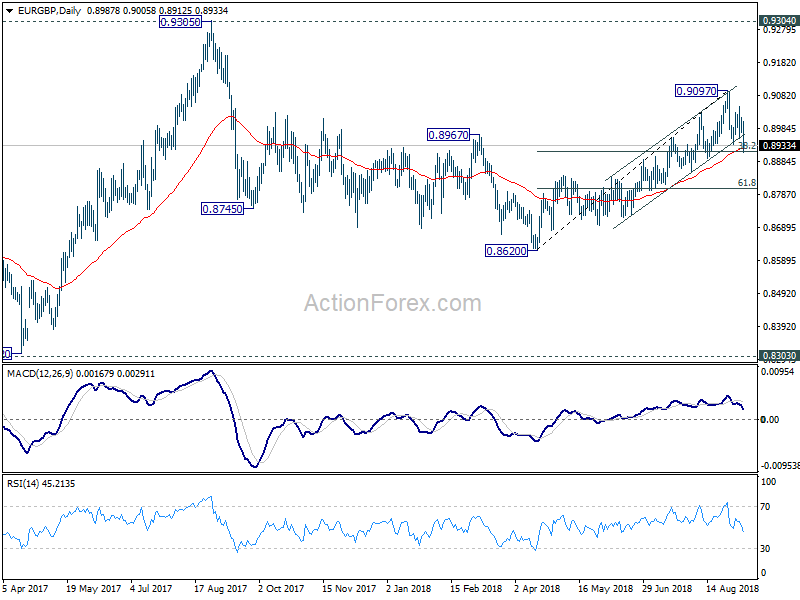
In the bigger picture, EUR/GBP is staying in long term range pattern from 0.9304 (2016 high). The corrective structure of the fall from 0.9305 to 0.8620 is raising the chance that rise from 0.8312 to 0.9305 is an impulsive move. But we're not too confident on it yet. In any case, we'd stay cautious on strong resistance from 0.9304/5 to limit upside in case of further rally. Meanwhile, if there is another medium term decline, strong support will likely be seen from 0.8303 to contain downside.
USDCAD Outlook: Strong US and Weak Canadian Jobs Data Boost USDCAD Pair
The dollar surged across the board after US Non-farm payrolls beat forecast in Aug, with 201K new jobs created vs forecasted 191K and downward-revised previous month’s release to 147K.
Unemployment rate remained unchanged at 3.9% despite forecast for fall to multi-year low at 3.8%.
Strong boost to the greenback was provided by increase in average hourly earnings which rose by 0.4% m/m in Aug vs 0.3% increase forecast, while annualized figure at 2.9% in Aug vs 2.7% forecast showed the fastest pace since 2009. The USDCAD pair jumped to session high at 1.3182, gaining 0.5% in post-data rally.
At the same time, downbeat Canadian data added to fresh pressure on the loonie.
Canada’s unemployment rate rose to 6.0% in Aug, from 5.8% in July and also beating forecast at 5.9%.
More disappointing were result of Canada’s employment change as number of people employed fell by 51.6K, strongly disappointing forecast for 5.1K increase and previous month’s increase by 54.1K.
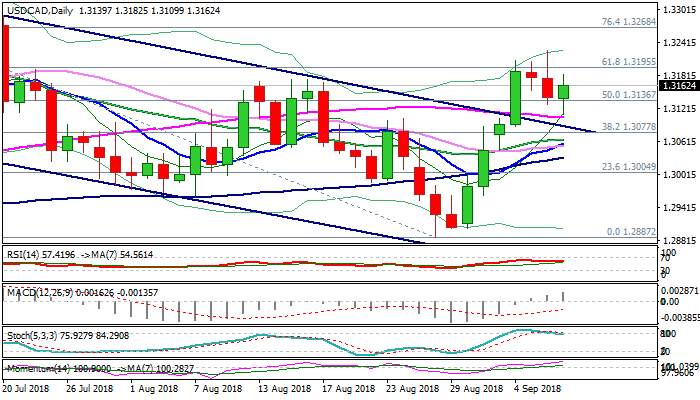
The USDCAD’s near-term structure firmed after today’s bounce, as downticks were contained by 55SMA and post-data rally looks for renewed attempt through cracked pivot at 1.3195 (Fibo 61.8% of 1.3386/1.2887 descend, close above which would be bullish signal for continuation of recovery leg from 1.2887 (28 Aug low).
Firming momentum and daily MA’s in bullish configuration support the notion, as the pair is on track for the second straight bullish weekly close.
Only return and close below 55SMA (1.3104) and broken bear-channel upper boundary (1.3087) would weaken the structure and put bulls on hold.
Res: 1.3182; 1.3207; 1.3226; 1.3268
Sup: 1.3136; 1.3104; 1.3087; 1.3065
USD/CAD Mid-Day Outlook
Daily Pivots: (S1) 1.3104; (P) 1.3166; (R1) 1.3203; More...
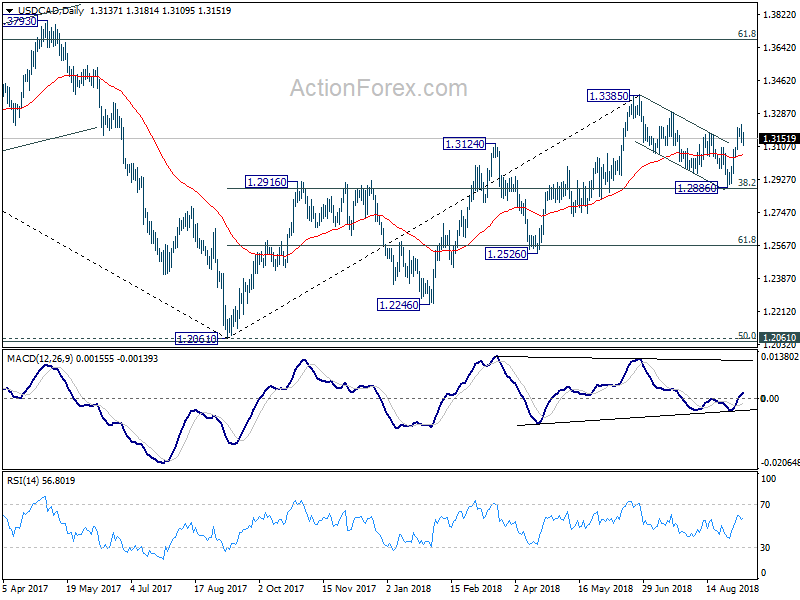
USD/CAD recovers ahead of 4 hour 55 EMA but it's kept well below 1.3225 temporary top. Intraday bias stays neutral for consolidation. At this point, we're holding on to the view that correction from 1.3385 has completed at 1.2886. Downside of retreat should be contained well above 1.2886 to bring another rally. On the upside, break of 1.3225 will target a test on 1.3385 high.
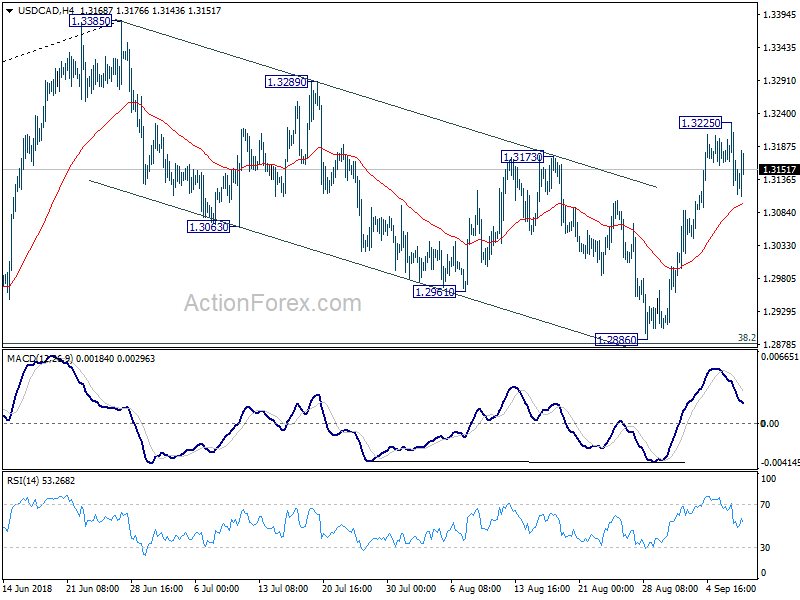
In the bigger picture, strong rebound ahead of 38.2% retracement of 1.2061 to 1.3385 at 1.2879 key fibonacci level retains medium term bullishness. That is, rise from 2017 low at 1.2061 is still in progress. Break of 1.3384 should target 61.8% retracement of 1.4689 (2015 high) to 1.2061 (2017 low) at 1.3685. On the downside, as long as 1.2886 support holds, outlook will now remain bullish.
EUR/USD Mid-Day Outlook
Daily Pivots: (S1) 1.1600; (P) 1.1630; (R1) 1.1653; More.....
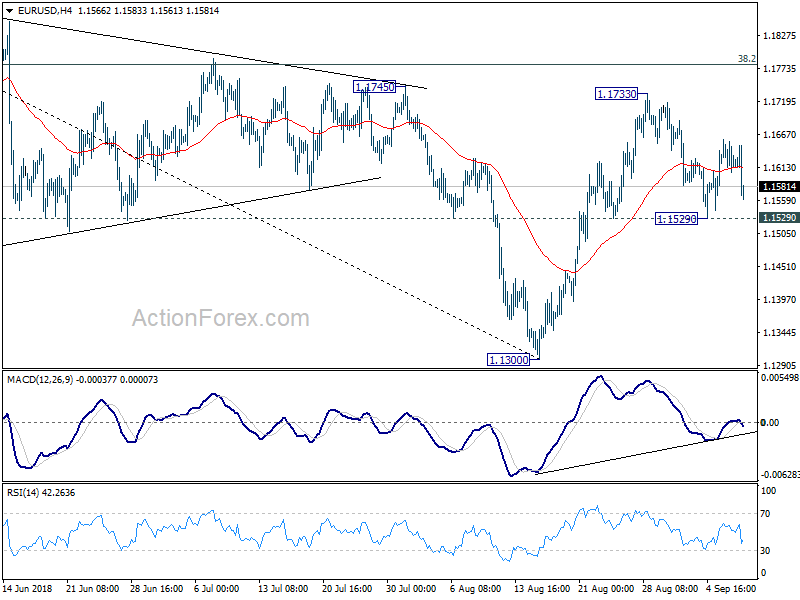
Intraday bias in EUR/USD is turned neutral with the current sharp fall. Outlook is unchanged though. in case of another rise, we'd expect strong resistance from 38.2% retracement of 1.2555 to 1.1300 at 1.1779 to limit upside, at least on first attempt, to bring near term reversal. On the downside, firm break of 1.1529 will indicate completion of the corrective rebound from 1.1300. In such case, intraday bias will be turned back to the downside for retesting 1.1300 low.
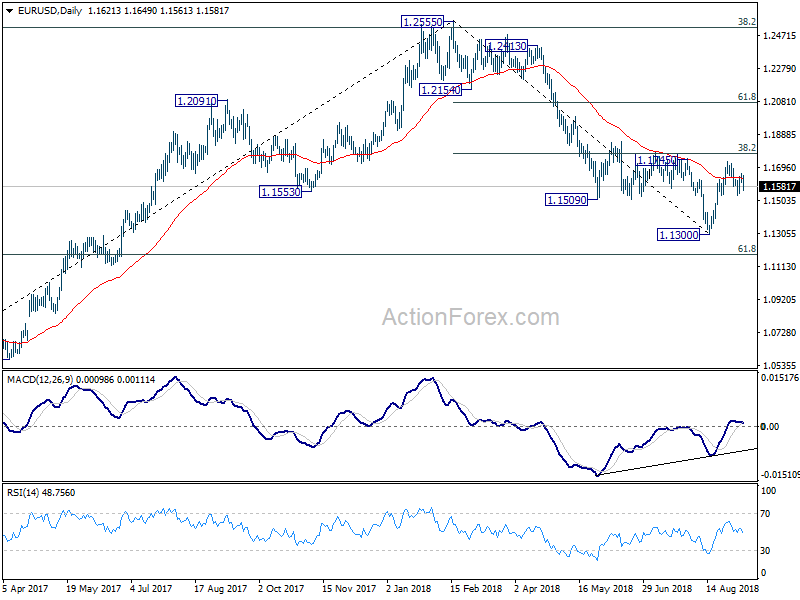
In the bigger picture, a medium term bottom should be in place at 1.1300, on bullish convergence condition in daily MACD and some consolidations would be seen. But still, note that EUR/USD was rejected by 38.2% retracement of 1.6039 (2008 high) to 1.0339 (2017 low) at 1.2516. That carries some long term bearish implications. Thus, we'd expect fall from 1.2555 high to resume after consolidation completes. Below 1.1300 should send EUR/USD through 61.8% retracement of 1.0339 to 1.2555 at 1.1186. And, in that case, EUR/USD would head to retest 1.0339 (2017 low).
GBP/USD Mid-Day Outlook
Daily Pivots: (S1) 1.2894; (P) 1.2928; (R1) 1.2960; More...
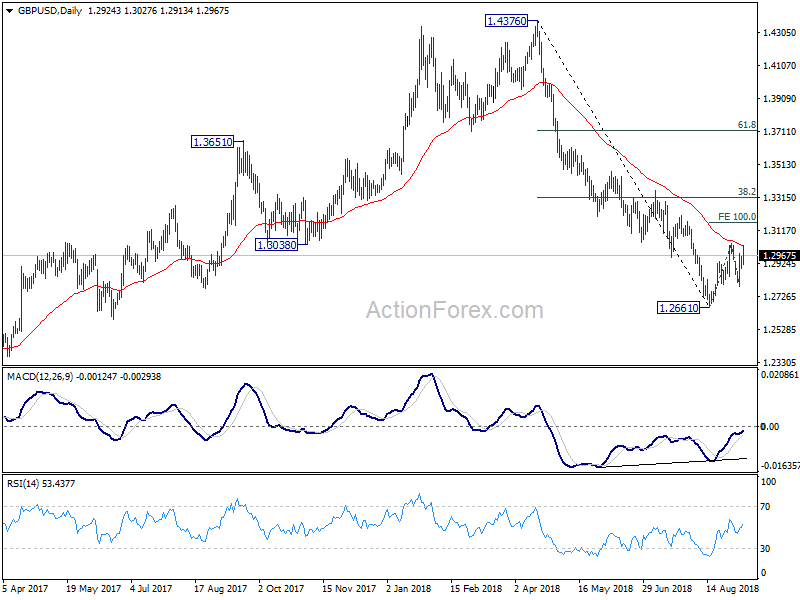
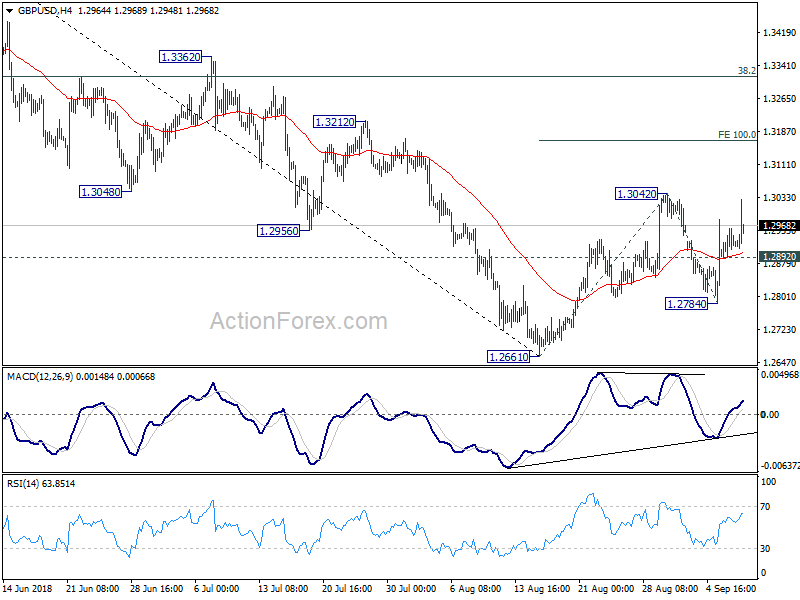
GBP/USD rises to as high as 1.3027 so far today and intraday bias remains on the upside. Break of 1.3042 resistance will resume corrective rebound from 1.2661. Next target is 100% projection of 1.2661 to 1.3042 from 1.2784 at 1.3165. But upside should be limited by 1.3316 key fibonacci level to complete the corrective rise and bring near term reversal. On the downside, below 1.2892 minor support will turn intraday bias neutral first. Break of 1.2784 support will bring retest of 1.2661 low.
In the bigger picture, whole medium term rebound from 1.1946 (2016 low) should have completed at 1.4376 already, after rejection from 55 month EMA (now at 1.4099). The structure and momentum of the fall from 1.4376 argues that it's resuming long term down trend. And this will be the preferred case as long as 38.2% retracement of 1.4376 to 1.2661 at 1.3316 holds. However, firm break of 1.3316 would bring stronger rebound to 61.8% retracement at 1.3721. And, the eventual depth of the fall from 1.4376, and the chance of hitting 1.1946 low, will depend on the strength of the interim corrective rebound from 1.2661.