

Sample Category Title
Market Morning Briefing: Euro Yen Has Moved Up Towards 130
STOCKS
Dax looks strongly bearish for the near to medium term. Dow, Shanghai and Nifty may have little room on the downside before a bounce while Nikkei is trading above support levels and could start moving up next week.
Dow (25974.99, +0.087%) has been almost stable and could test 25500 on the downside before bouncing back again. Overall the trend on the daily candle chart may hold for some more time.
Break below the immediate support at 12200 on Dax (12040.46, -1.39%) came in as a surprise as we had expected a bounce back towards 12400+. On the contrary Dax looks strongly bearish now and while below 12200, the index is vulnerable to a fall towards 11800-11600 in the medium term. View is strongly bearish.
A test of 22200 is on the cards for Nikkei (22528.46, -0.23%) which could be seen by this week. The index could then start rising back towards 23000 from Monday onwards. Overall broad range of 22200-23000 is likely to hold in the near to medium term.
Shanghai (2706.90, +0.095%) is holding well below immediate resistance and is trading just near 2700. A break on the downside could take it lower towards 2650 in the next 3-4 sessions followed by a possible rise back towards 2750.
Nifty (11476.95, -0.38/%) could have some chances of holding above 11400 and bouncing back to resume its uptrend in the near term. Only a break below 11400 would open up chances of further fall towards 11200 before a fresh bounce is seen. The next 2-sessions this week is likely to remain bearish for Nifty.
COMMODITIES
Slight dip in the Crude prices and gain in precious metals and Copper is seen in current trade.
Worries over the Tropical Storm Gordon’s minor impact along Gulf of Mexico and Central Gulf coast could have aided a fall in Crude prices yesterday. Also there are talks of a possible period deadline ending today for the US tariffs on another $200 bln of Chinese Goods. We will have to be careful of another round of pressure building up on the EM currencies in the near term. Taking into consideration the overall global factors, upside seems limited for Crude prices in the near term.
Brent (77.09) and Nymex WTI (68.56) have dipped. As expected the resistance n Brent is holding and could push the prices to lower levels in the near term towards 76-75 while WTI could also be dragged down towards 66. Near term looks bearish.
Gold (1204.90) has risen back above 1200 and as mentioned yesterday the broad 1230-1190 range is likely to exist. Gold could re-attempt a rise towards 1215-1220 by mid-next week.
Copper (2.6280) could test 2.65 before again coming off from there. Broadly the 2.70-2.58 region is likely to hold in the medium term.
FOREX
A rise in Euro towards 1.17 could help in Dollar Rupee's correction (possibly towards 71.20). However, crucial support near 95 on Dollar Index could yet again lead to Dollar strength.
After bouncing from support @ 1.1550, Euro (1.1645), as expected, has moved up further on both Germany and UK bending a little on Brexit, which makes a deal a little more possible. If it breaks above 1.165, there could be some resistance at 1.1700 as well. We expect the 1.165-1.170 resistance to hold and slowly push the Euro down again towards 1.1550 and lower. BUT, a surprise break above 1.1700 (if seen) would be significant. It would establish the 1.13 low (mid-Aug) as a medium-term bottom, and open up chances of 1.18-19.
Dollar Index (94.99) , as per our expectation, is testing support near 95 on daily candles. It could either rise back from here itself or from lower support near 94.5 on weekly candles.
Dollar Yen (111.32) is respecting resistance on daily candles near 111.50. However, while above 111, it could still rise towards resistance on weekly candles near 112.5 in the next 1-2 weeks. A break below 111 could lead to a test of support near 110.50-70 on 3 day candles.
Euro Yen (129.64) : As expected, Euro Yen has moved up towards 130. Preference is for a dip from 130. However, if Euro rises further towards 1.17 and Dollar Yen towards 111.50-112.00, then a test of resistance on daily candles near 130.5-131.0 could also take place. A week close below 129.44 (21 weeks MA) would be important for sustained bearishness.
Pound (1.2921): Crucial resistance near 1.305-1.310 is expected to hold in the near term. Some bullishness from current levels towards 1.305 now looks possible, given the progress around Brexit.
Dollar Rupee (71.755): Chances of topping out for a while from anywhere between 71.80 and 72.35. A rise in Euro to 1.1700 may help Dollar-Rupee to dip towards 71.20. Thereafter, depending on whether 1.17 holds or breaks, Dollar-Rupee could see a fresh rise from 71.20, or break below 71.20.
INTEREST RATES
The Indian 10 year GOI (8.05%) moved up to resistance near 8.12% yesterday and has dipped from there. We expect the dip to continue in the next 1-2 sessions.
Following news points are currently important in context of US Yields:
Improvement in US manufacturing data released on Tuesday (bullish for yields).)
USA and Canada's inability to reach a trade deal (bearish for yields)
impending possibility of $200 bn worth of tariifs by USA on China
Note that the May high of 3.125% for the US 10 year yield might have been the year's top.
US 10 Year Yield (2.90%) is still near the crucial 2.9% resistance level. As mentioned yesterday, a breach above 2.9% could lead to another test of the psychological barrier of 3%. A break above 3% is not preferred. Infact, the preference still remains tilted for a downmove towards 2.82%-2.75%.
BoJ Kataoka criticizes move to allow wider JGB yield band
BoJ board member Goushi Kataoka criticized the central bank's recent move to allow 10 year JGB yield to fluctuate in a larger range of -0.1% to 0.1%. He said in a speech that "there's no need to allow long-term interest rates to move in a wider range at a time when the BOJ is cutting its inflation forecasts." He added that "allowing long-term rates to rise at a time inflation and inflation expectations aren't heightening much could delay achievement of the BOJ's price target." Also, Kataoka warned "global trade frictions are intensifying and there's no room for complacency".
Kataoka is a known dove who dissented the decision to keep policy unchanged in every meeting since joining the board in 2017. Instead, he persistently pushed for more aggressive easing, targeting to keep JGB yields at 0% beyond 10 year maturity.
BOC Affirmed the Case of October Rate Hike, Downplayed Strong Growth and Inflation
BOC left the policy rate unchanged at 1.5% in August. Comments from Governor Stephen Poloz also signaled that a rate hike in October is highly likely. Yet, the market interpreted the message sent in the meeting was more cautious than previously. While acknowledging strong growth in the second quarter, the members affirmed that the economy is “closely in line” with projections. While noting accelerated inflation in July, the members blamed the idiosyncratic factors as causing volatility. While admitting that the economy has been “operating near capacity for some time:, it warned of the ongoing moderate wage growth. While guiding the next policy action as a rate hike, the central bank emphasized the uncertainty of NAFTA negotiations on inflation outlook.
The first topic BOC discussed after the policy decision was inflation. The members acknowledged that headline CPI rose to +3% y/y in July. Yet, they attributed that strong result to “a jump in the airfare component”. This is in line with what we mentioned in the preview. BOC expects inflation to return towards +2% in early 2019, as effects of temporary factors (e.g. gasoline prices) fade. While downplaying the jump in headline CPI, BOC reiterated that its core CPI measures remained “firmly around +2%. The members noted that the Canada’s economy has been “operating near capacity for some time”. This is compared with the July statement that the economy is “operating close to capacity”.
The members acknowledged that 2Q18 GDP growth came in stronger than expected. Yet, they judged that the developments remained “in line with the Bank’s July projection for growth to average near potential”. The central bank acknowledged that “the rotation of demand towards business investment and exports is proceeding” and that the housing market is “beginning to stabilize as households adjust to higher interest rates and changes in housing policies”. However, they expect growth to moderate temporarily in 3Q18, driven by “further fluctuations in energy production and exports”.
On the monetary policy outlook, BOC affirmed that the next move should be a rate hike and the path of normalization would remain “gradual” and data-dependent.
Policymakers have discussed the possible impacts of Canada’s trade relations with the US. They warned of the uncertainty about trade policies that would “weigh on businesses”. They pledged to closely monitor the progress of “NAFTA negotiations and other trade policy developments, and their impact on the inflation outlook”.
AUDUSD – Backs Off Lower Prices, Sets Up For More Strength
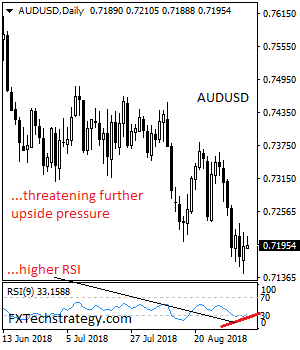
AUDUSD - The pair backed off lower prices to close higher on Wednesday. Support resides at the 0.7150 level where a breach will aim at the 0.7100 level. Below that level will set the stage for a run at the 0.7050 level with a cut through here targeting further downside pressure towards the 0.7000 level. On the upside, resistance lies at the 0.7250 level. A cut through here will turn attention to the 0.7300 level and then the 0.7350 level where a violation will set the stage for a retarget of the 0.7400 level. On the whole, AUDUSD faces further upside threats.
EUR/GBP Could Trade Further Higher Toward 0.9080
Key Highlights
- The Euro found fresh bids near the 0.8940 level and recovered against the British Pound.
- There was a break above a major bearish trend line with resistance at 0.9010 on the 4-hour chart of EUR/GBP.
- The Euro Zone Services PMI in August 2018 remained stable at 54.4.
- Today, the US ADP Employment Change for August 2018 will be released, which is forecasted to post an increase of 190K.
EURGBP Technical Analysis
The Euro declined sharply from the 0.9080-90 resistance during the last week of August 2018 against the British Pound. The EUR/GBP pair found support near 0.8940 and later recovered nicely.
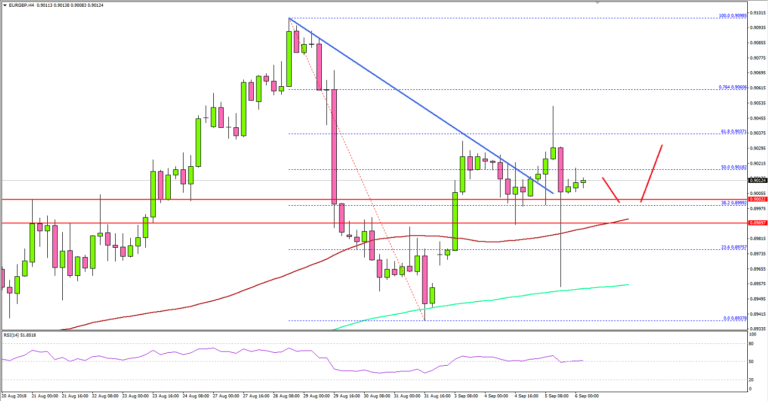
Looking at the 4-hours chart, the pair started found a strong buying interest near the 0.8940 level and the 200 simple moving average (green, 4-hours). The pair bounced back and broke the 0.9000 resistance zone.
During the rise, the pair also cleared a major bearish trend line with resistance at 0.9010. Moreover, the pair settled above the 100 simple moving average (red, 4-hours) plus the 50% Fib retracement level of the last slide from the 0.9098 high to 0.8937 low.
On the upside, the next major resistance is near the 0.9060 level, which is the 76.4% Fib retracement level of the last slide. Above 0.9060, the pair could rise towards the 0.9080 level.
On the other hand, if the pair corrects lower, it may well find support near the previous resistance at 0.9000 and the 100 SMA at 0.8990.
Recently, the Euro Zone Services PMI for August 2018 was released by the Markit Economics. The market was looking for no change in the PMI from the last reading of 54.4.
The actual result was similar to the forecast as the Euro Zone Service PMI came in at 54.4. However, the Final Eurozone Composite Output Index rose from 54.4 to 54.5 in August 2018.
Overall, the EUR/GBP pair remains supported on dips near 0.9000 and 0.8990. Looking at EUR/USD, the pair recently tested the 1.1520 support and it is currently consolidating in a range.
Economic Releases to Watch Today
- German Factory Order for July 2018 (MoM) – Forecast +1.8%, versus -4.0% previous.
- US Initial Jobless Claims – Forecast 214K, versus 213K previous.
- US ADP Employment Change August 2018 – Forecast 190K, versus 219K previous.
- US Factory Orders July 2018 (MoM) – Forecast -0.6%, versus +0.7% previous.
- US ISM Non-Manufacturing Index for August 2018 – Forecast 56.8, versus 55.7 previous
- Us Services PMI for August 2018 – Forecast 55.2, versus 55.2 previous.
Lather Rinse Repeat
Lather Rinse Repeat
The markets are going through what feels like an endless loop of lather, rinse and repeat when it comes to the US dollar.
But while there was lots of noise on Wednesday traders are lacking a definitive direction on numerous fronts.
US Markets
US equity markets fell led by a by tech giants. Indeed, when CEO’s are forced to testify before Congress amid a move for tighter regulation of the tech industry, nothing good would ever come of that. Investors did their best version of a cut an run while battening down the hatches as NAFTA negotiations and Section 301 China tariff negotiation timelines expire.
Oil markets
The API reports US crude stockpiles dropped 1.17 m barrels last week versus an expected range of estimates of 1.25 to 2.5-million-barrel draw. But the devil may be in the details, where Cushing stockpiles are up .6 million barrels.
Prices have been trading softer in the wake of the Tropical Storm Gordon ramp, which ripped through the Gulf but skirted virtually every oil and gas facility.
Also, we’re going through little more than a technical correction with the S&P Oil, and Gas E&P Index is turning lower while Nat Gas and Heating oil look suspiciously susceptible to further losses. Throw in some profit taking ahead of tomorrows US-China Tariff deadline and the more definitive Department of Energy Petroleum report. And the market is trading with a softer bias today.
Brent Crude New normal??
Is $ 70-80 Brent the new normal? Well if unnamed sources connected to Saudi oil are to be believed, it is!!. Neither an original story or a new idea but comes on the back of prompt Brent Trading in a $70-80 range for the past five months, and for those of you that know me, when it comes to the markets, I’m, a staunch believer that there is no such thing as coincidence. So if OPEC is tightly monitoring supplies to keep markets in the current sweet spot, it’s showing up on the charts.
Gold Markets
Price action has been encouraging despite the expected wave of technical seller above $1200 that was joined by a hodgepodge of Macro traders who are steady seller on rallies given the robust run of US economic data, which suggest the Feds remain on course for 2 interest rates hike this year and should be supportive of the USD.
But ultimately in the absence of a sizeable directional move on the USD, I would expect $1190-$1210 to hold near-term.
Currency Markets
Emerging Markets
Malaysian Ringgit
BNM has predictably left its policy rate unchanged at 3.25% yesterday with a neutral policy statement accompanying the decision. With so many political changes and internal policy adjustments, there was no need to add another level of complexity to the confusing landscape.
We could expect BNM to remain on the sidelines for the foreseeable future and well into 2019 as the lack of inflation and subpar GDP provide policy maker with no cause to move rates higher. However, given the economic headwinds due to the reduction in infrastructure spending, and more austerity measure aimed to reduce the burgeoning budget deficit, the next shift for the BNM may be a rate cut towards the end of 2019. As such I’m revising my year-end target for the Ringgit considerably higher to USDMYR 4.20 on tepid growth outlook while traders start to position for a dovish BNM in 2019
Argentine Peso
The Argentine Peso produced a large-scale rally in late NY following central bank intervention and talk the IMF’s ” White Knight” galloping in for the rescue.
Turkish Lira
Indeed, the weaker links in the EM chain were encouraged by this news. But the Turkish Lira did spend the day above water for a change as EEMEA Traders pare bearish bets as the market pivots to the next Central Bank of Turkey policy meeting, September 13, where the traders in my circle are expecting anywhere between a 200-400 basis point rate hike to follow.
Indonesian Rupiah
Over in Asia, where the currency sharks are circling the psychological USDIDR 15,000 level Indonesia’s Central Bank intervened to stem the one-sided speculation, but the IDR currency Bears still smell blood given the massive current account deficit. However, there are some signs that other are clawing for buying opportunities. You know the old contrarian mantra “Buy when there’s blood in the streets, even if the blood is your own.”
None the less, the pragmatist in me says to wait for the tariff noise to abate before re-engaging the risky stuff, easier trades to be had in G-10. but even there it’s slim pickings
G-10 Markets
Also, besides awaiting, NAFTA’s fate, EURUSD remains the “no-trade zone”, and USDJPY is confined to the range and capped at 111.70 for the time being, its back to the Aussie dollar again
Australian Dollar
I’m surprised by the resilience of the Aussie give the commodity carnage that is expected to continue the weakness in EM weakness, which is driving the buy all dollar bus and the tepid Chinese PMIs that counterbalanced the better than expected GDP yesterday. I think flat out AUDUSD is a problematic trade at currency levels given extended shorts, and while all the above suggests a break of .7150 is in the offing, even more so as the more hawkish interpenetration of the RBA rate decision comments is certainly not helping the Aussie at this point either.
The Canadian Dollar
The Canadian dollar held relatively stable after a slight wobble on an initial less hawkish interpretation of the Bank of Canada policy statement, but the real story remains NAFTA as traders remain on the headline and twitter alerts as reading between the lines on comments from Freeland and Trump, they suggest an end of week deadline to settle this mess. Never so much may be hinging on the negotiating skills of so few.
Dollar Loses Momentum Ahead Of Private Payrolls
The US dollar is lower against major pairs on Wednesday. Advances in the US-Canada and Brexit negotiations eased fears of further tensions. American and Canadian negotiators restarted the NAFTA renegotiation talks today. Both parties remain optimistic on a positive outcome, but at the same time no ground is likely to be given away for free. The optimism surrounding a friendly divorce between the UK and the EU has gone through different stages since last week lead EU negotiator Michel Barnier said that a new model could be used. The rejection of the UK’s proposal is now putting the deal the EU negotiated with Canada as the top alternative.
Employment data in the United States will being to roll out with tomorrow’s release of the ADP non-farm payrolls report. The report by payment processor Automatic Data Processing (ADP) will be released at 8:15 am on Thursday, September 6. Job creation has been solid and another big gain is expected in the 180,000 to 200,000 range. After the ISM manufacturing PMI surprised to the upside on Tuesday the release of the non-manufacturing PMI at 10:00 am will be tracked by investors. Oil prices are lower on Wednesday as the market has digested the supply disruptions due to Tropical Storm Gordon with only 9 to 10 percent of total production potentially under threat. The release of the weekly crude stocks at 11:00 am will give more insight on how energy demand is faring.
- ADP Private payrolls expected to add 195,000 positions
- ISM non manufacturing PMI forecasted to improve to 56.8
- US Weekly crude inventories could again show a drawdown go 2 million barrels
Euro Rises on German Brexit Comments
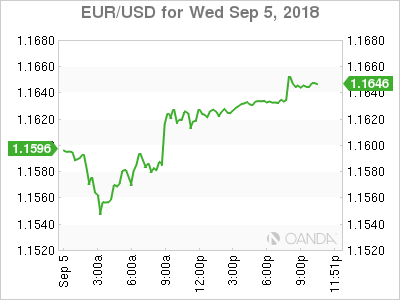
The EUR/USD gained 0.37 percent in the last 24 hours. The single currency is trading at 1.1625 after reports emerged that the UK and Germany had made progress on a Brexit deal. While details were scarce the marked sensed goodwill of German leaders that could translate into an easier trade negotiation with the EU. Trade tensions have been a major factor behind the appreciation of the US dollar. Risk aversion has risen as trade disputes could limit global growth and forcing investors to seek refuge. The US dollar has proven to be a safe haven to the detriment of major and emerging markets.
While Brexit news have been encouraging the fact remains that so far its only talk and with less than 8 months to go in negotiations a lot of work is still to be done. US-China conversations are yet to happen after a tariff war was declared and the NAFTA agreement is yet to agreed between the US and Canada using the US-Mexico deal as a template.
Oil Prices Caught Between Lagging and Leading Indicators
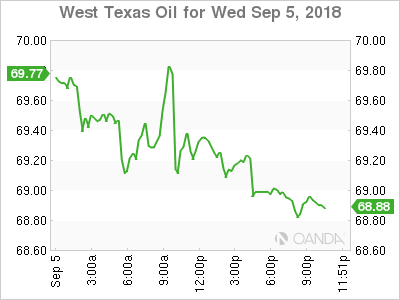
West Texas Intermediate fell 1.46 percent on Wednesday as Tropical Storm Gordon did not make it to a Hurricane and has moved away from energy operations in the Gulf of Mexico. Platforms in the area are now in the process of starting up again. Supply disruptions have boosted oil prices even though the market expects more production from OPEC members as the oil production cut agreed between the Organization of the Petroleum Exporting Countries (OPEC) and other major producers is due to end in 2018. The US sanctions on Iranian exports are starting to have a negative impact on supplies and even the threat of a weather related disruption was enough the get crude bid.
The eyes of energy traders will be on the weekly releases from the American Petroleum Institute and the Energy Information Administration (EIA) expecting drawdowns in crude inventories. Trade concerns have put pressure on energy prices as a new round of US tariffs on Chinese goods could be triggered this week after the comment period ends. Global demand for energy would fall as growth declines putting crude prices lower as the US dollar appreciates in that scenario. The lagging inventory data from last week could end up being supportive of higher oil prices, but as trade tensions rise oil prices would be put under downward pressure as global growth declines.
Eco Data 9/6/18
[php_everywhere instance="1"]
Mid-US update: Sterling stays up after fake Brexit news volatility
Sterling had a wild wide today. It's firstly lifted by a Bloomberg report that Germany and UK dropped key Brexit demand, paving the way for a deal. But then, the Pound was knocked down after a German government spokesman said that the stance was not changed. After all the volatility, the Pound is trading as the second strongest one for the day so far, next to Kiwi and better than Euro. Euro is clearly supported by sharply narrowed Italian-German yield spread. Italian politician's promise for not blowing up the public account was well taken by investors.
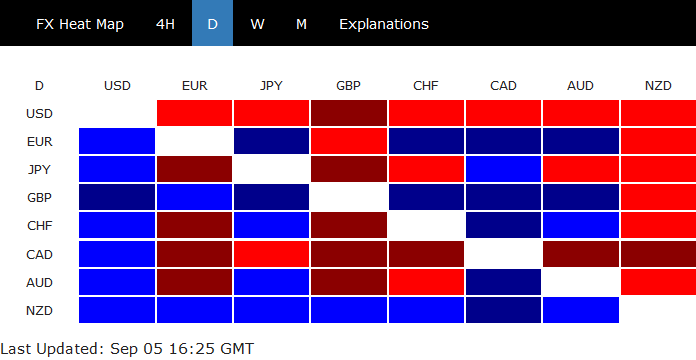
On the other hand, Dollar is trading as the weakest one for today after yesterday's rally attempt failed. Canadian Dollar followed as the second weakest. BoC's standing pat was widely expected. The statement showed much confidence in policymakers and BoC is still on track for an October hike. But the Loonie is troubled by the deadlock in trade negotiation with the US. Yen got little support from risk aversion and is trading as third weakest. Rebound in German yield is a factor contributing to Yen's sluggishness.
In other markets, US stocks are rather steady. DOW is up 0.04% at the time of writing, S&P 500 down -0.37% and NASDAQ down -1.06%. That's nothing comparing to -1.0% fall in FTSE, -1.39% in DAX and -1.54% in CAC.
Pound Gains Ground as Services PMI Beat Expectations
GBP/USD has gained ground in the Wednesday session. In the North American session, the pair is trading at 1.2905, up 0.38% on the day. On the release front, Services PMI in August improved to 54.3, above the estimate of 53.9 points. In the U.S, the sole event was Trade Balance. The trade deficit continued to widen in July, with a reading of -$50.1 billion. This marked the highest deficit in 5 months. On Thursday, the U.S releases ADP nonfarm payrolls, unemployment claims and the ISM Non-Manufacturing PMI
The pound is in positive territory on Wednesday, after a rocky start to the week. Investors reacted negatively as the manufacturing and construction PMIs both fell short of expectations. These snapshots of the health of the UK economy indicated that the lack of direction over Brexit has had a negative impact on the manufacturing and construction sectors. The pound posted gains earlier in the Wednesday session, following a report that German officials might be will to sign an agreement with the UK even if not all issues were completely resolved. This buoyed investor confidence, but shows that the pound’s movement is very dependent on the extent of progress in the negotiations between the EU and the UK.