

Sample Category Title
Sterling knocked down as German government spokesman cleared Bloomberg fake news on Brexit
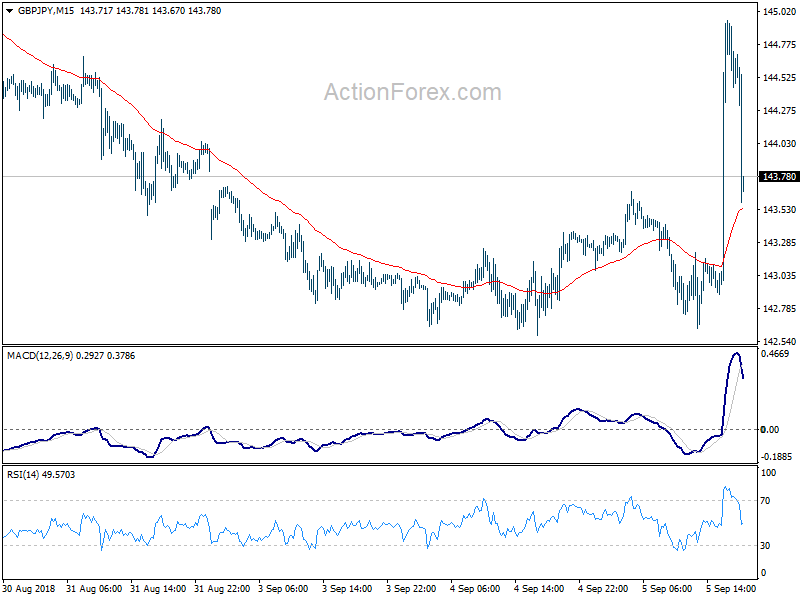
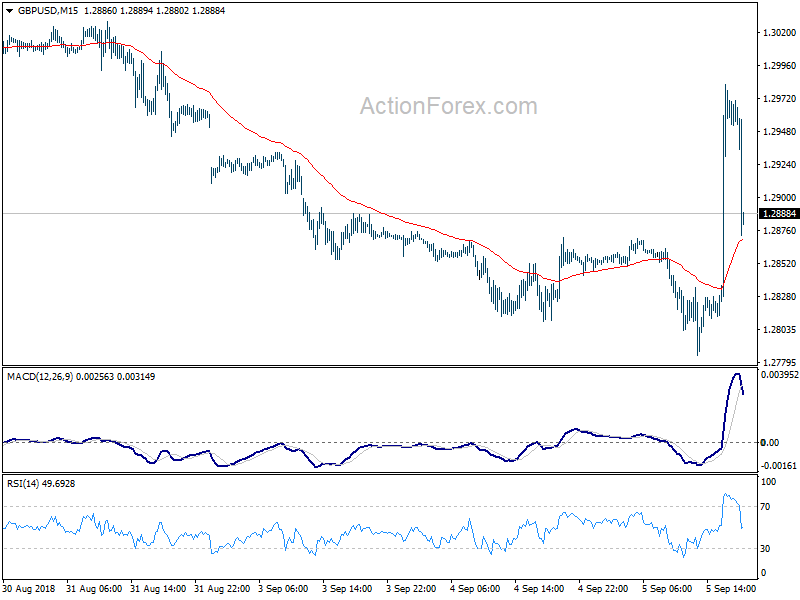
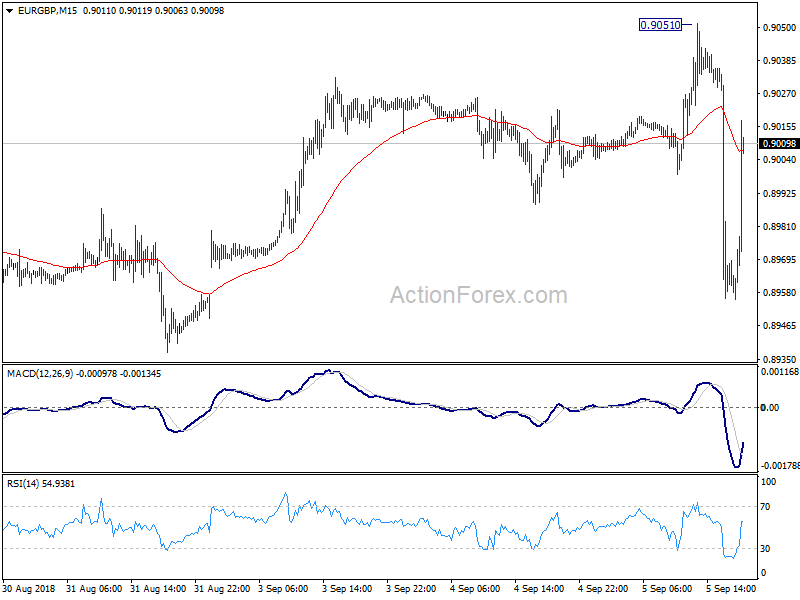
Ok. So Bloomberg reported fake news? Sterling is hammered down as a German government spokesman cleared the air and said the position on Brexit is unchanged. Also, the spokesman said Germany has full trust in EU chief negotiator Michel Barnier.
Here is a quick glance on GBP/USD, EUR/GBP and GBP/JPY.
Japanese Yen Drops to 1-Week Low as Emerging Markets Crisis Boosts US Dollar
The Japanese yen has edged lower in the Wednesday session. In North American trade, the pair is trading at 111.60, up 0.14% on the day. In economic news, the U.S trade deficit continued to widen in July, with a reading of $50.1 billion. This marked the highest deficit in 5 months. On Thursday, the U.S releases ADP nonfarm payrolls, unemployment claims and the ISM Non-Manufacturing PMI. Japan will release Household Spending and Average Cash Earnings.
The U.S manufacturing sector is in excellent shape, according to a key indicator. In August, the ISM Manufacturing PMI survey climbed to 61.3, up from 58.1 a month earlier. This marked the indicator’s highest level since February 2011. The survey found that strong business conditions had created a stronger demand for manufactured goods. However, many manufacturers are concerned with tariffs and how long they will last, which has led to uncertainty in the pricing of goods. The strong manufacturing data supports the case for higher interest rates in the United States. The odds of further rate hikes in 2018 have risen this week – according to the CME Group, the likelihood of a rate hike in September is 99% and an increase in December stands at 66%.
Emerging markets continue to struggle, as nations such as Argentina and Indonesia are experiencing major declines in their currencies against the U.S dollar. This has triggered heavy losses in emerging equity markets, and fears that this could hamper global growth are weighing on European and North American markets as well. If the sell-off in the emerging markets continue to spiral downwards, the U.S dollar could gain more ground.
No Surprise as BoC Holds Rates Steady
Highlights:
- The overnight rate was held steady at 1.50% today following an increase in July.
- The bank dismissed the recent increase in headline inflation and expects CPI will move closer to 2% early next year when the impact of higher energy prices has faded.
- Wage growth was described as moderate—the bank has often cited that as evidence of some lingering labour market slack—though policymakers think the economy has been close to full capacity for some time now.
- The bank reiterated that higher interest rates will be warranted and rate increases will be gradual and data dependent.
Our Take:
Economic data over the summer were strong enough to warrant some speculation that we’d see a repeat of last year’s back-to-back July-September rate hikes. But markets only ever flirted with the idea, and the combination of an even-keel tone from Governor Poloz and an on-consensus Q2 GDP report had us expecting little from today’s meeting. The bank delivered on that with no rate change and a policy statement that was in keeping with Poloz’s comments at Jackson Hole. The bank gave themselves a well-deserved pat on the back noting the economy is “evolving closely in line” with their July forecasts. Headline inflation has been stronger than expected, hitting the top of the BoC’s target band in July, but that was once again attributed to transitory factors (largely airline fares). The bank is taking comfort in core inflation readings that have been steady at 2%, consistent with an economy that has been operating near capacity “for some time.” Overall they sounded pleased with recent economic developments. The long-awaited rotation toward exports and business investment is proceeding, even as trade uncertainty hangs over the outlook. Higher rates and regulatory changes have weighed on housing and consumption, but housing markets are stabilizing and household indebtedness is moving in the right direction.
In a statement with few surprises, the one change in language that stood out was in the final sentence: the bank is “monitoring closely the course of Nafta negotiations and other trade developments.” Governor Poloz has been adamant that monetary policy would not be headline dependent but rather influenced by actual trade actions and the impact of uncertainty. We doubt today’s statement marks a shift in that thinking. But we’ll certainly be watching Senior Deputy Governor Wilkins’s comments tomorrow for any hints that growing trade tensions are weighing more heavily on the policy outlook. We think the BoC’s next Business Outlook Survey will be more important in their October deliberations than Nafta headlines. And barring an unexpected deterioration in business sentiment—or dissolution of Nafta—we think an October rate increase remains on track.
Fed Bullard: Yield curve and TIPS suggest monetary policy already neutral or somewhat restrictive
St. Louis Fed President James Bullard gave remarks titled "How to Extend the U.S. Expansion: A Suggestion" today. There he argued that empirical Phillips curve relationships have largely broken down in the last two decades. That is, the relationship between inflation and unemployment "began to disappear". He suggested Fed to consider financial market information in its monetary policy setting. The yield curve is taken as a good predictor of future real economic activity. The Treasury Inflation-Protected Securities (TIPS) provides indications on inflation expectations.
Bullard said:
- The yield curve information suggests that financial markets do not see excessive real growth or excessive inflationary pressure over the forecast horizon.
- The TIPS-based inflation compensation data suggest that markets do not expect the FOMC to achieve the 2 percent inflation target on average on a PCE basis over the next decade.
Combined, theses two market indicators argued that "current monetary policy stance is already neutral or possibly somewhat restrictive."
Full release and presentation.
BoC: A Gold, With a Hike Likely Just Around the Corner
The Bank of Canada held its key monetary policy interest rate at 1.50%, meeting market and economists' expectations. The statement accompanying the announcement struck a slightly hawkish note, indicating that the next rate hike will be coming soon.
The economy has been shaping up in line with the Bank's July projections, and although a slowing of growth is expected in the third quarter, the Bank attributes this to fluctuations in energy and exports (remember that their July outlook saw Q3 growth at a modest 1.5%). Importantly, the Bank sees the rotation of demand towards business investment and exports as proceeding. The statement glossed over the softer Q2 investment data, characterizing the data as "… growing solidly for several quarters."
Beyond our borders, the U.S. economy is seen as "particularly robust", although trade tensions remain a risk. The statement had little to say on NAFTA other than a reminder that Bank of Canada staff are closely monitoring the situation. Emerging market developments are seen as having limited spillovers.
At the core of the bank's mandate is inflation, and it remains an unchanged story for the Bank. The recent rise to 3% is viewed as temporary, and a return to the 2% target is seen by early 2019. The statement once again characterized their core measures as pointing to an economy that continues to operate near capacity. Wage growth is considered "moderate".
On balance, this is a fairly positive statement. The Bank again ended by noting that higher interest rates will be needed, but that a gradual approach will be taken – the same language introduced in May's statement that presaged a July hike.
Key Implications
No surprise here. Between the tone of recent communications from the Governor and an economic backdrop that is right in line with their expectations, a hold today was to be expected.
To be sure, a hike today could have been justified given core inflation right on the Bank's target and a still solid economic backdrop. So, why go with a 'hawkish hold'? Waiting until the October 24th decision for the next hike has a number of benefits:
- More communication opportunities, including a new Monetary Policy Report and forecast;
- The chance to gauge (via the Business Outlook Survey) whether Q2's soft investment performance is just a blip or a signal of something deeper; and
- Opportunity to incorporate any developments in the NAFTA renegotiation process.
That latter point is probably the key one. Barring a major shock, an October hike looks like a pretty safe bet, but after that the picture becomes murky. The Bank has been marking down its growth outlook to account for trade uncertainty – any resolution on the NAFTA front is thus likely to mean a stronger outlook, and by extension, a faster pace of hikes, all else equal.
BoC Keeps Rates on Hold at 1.5%, CAD Falls
No surprise, the Bank of Canada (BoC) has kept its overnight rate steady at +1.5%. The bank warned that heightened trade tensions represent a key risk to the global outlook.
In the accompanying communiqué, the central bank reiterated its view that higher interest rates will be warranted to keep inflation on track. It said it would continue to take a ‘gradual’ approach to lifting rates, guided by incoming data, as it gauges the economy’s reaction to higher rates.
The future of Nafta is being closely monitored, along with other trade policy developments, and their impact on the domestic inflation outlook.
U.S and Canadian negotiators are due to resume Nafta talks in Washington this morning after missing last Friday’s U.S imposed deadline. These talks again are expected to be contentious and Canada’s PM Trudeau has stated that a ‘no deal’ would be better than a ‘bad’ deal.
The CAD is trading just shy of the key C$1.3200 level at C$1.3180, up +0.04%. The short-term direction will be dictated by the USD’s fate, at least until Friday’s North American jobs reports.
Market consensus had expected the BoC to remain on hold, citing uncertainty over Nafta and a desire to avoid back-to-back rate hikes would keep the bank on the sidelines until October. Next Rate Announcement Due Oct. 24 2018.
Next up for Canada is Friday’s employment report (08:30 am EDT)
US 500 Index Near-Term Momentum Turns South; Still Bullish in the Medium-Term
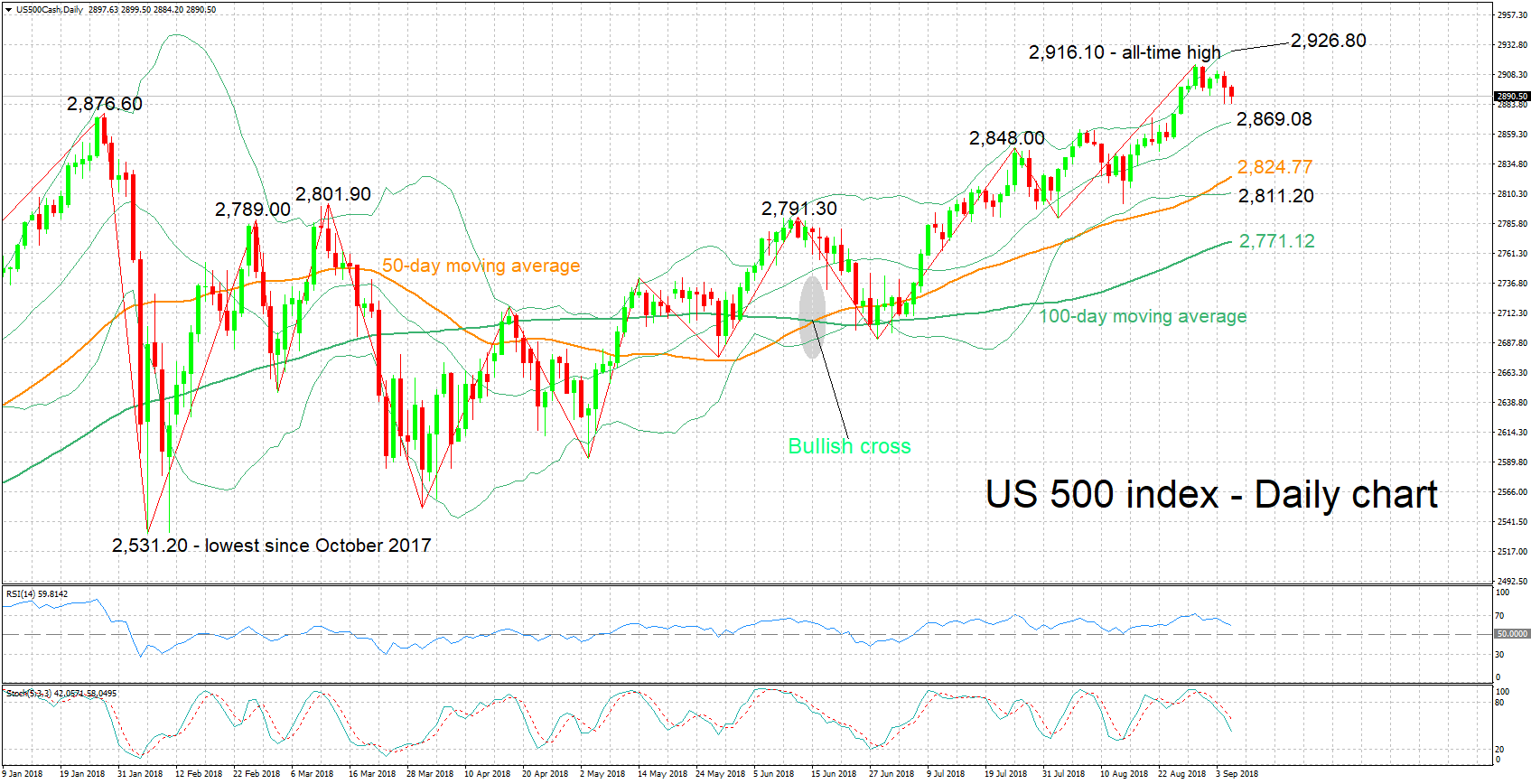
The US 500 index has declined after touching an all-time high of 2,916.50 on August 29. Still, the benchmark continues to trade relatively close to its record peak.
The RSI has reversed lower after entering overbought territory last week and continues to head down, supporting the view that near-term momentum has turned negative. The stochastics are also projecting a bearish picture in the very short-term: the %K and %D lines are negatively aligned and are moving lower.
A move back to the upside may meet resistance around the record high of 2,916.50 from the previous week. The zone around this includes the 2,900 round figure, as well as the upper Bollinger band at 2,926.80. Further above and into uncharted territory, the region around the 3,000 mark may act as a barrier to price gains, with a violation possibly fueling bullish sentiment and thus a sharp move up.
On the downside, support could come around the middle Bollinger line – a 20-day moving average line – at 2,869.08. Notice that the area around this encapsulates a couple of top from previous months. Steeper losses would turn the attention to the current level of the 50-day MA at 2,824.77, with the lower Bollinger band lying not far below at 2,811.20.
The medium-term outlook is undoubtedly bullish: the index is in an uptrend recording higher highs and higher lows and price action is taking place above both the 50- and 100-day MA lines.
Overall, the short-term bias appears to have turned negative, while the medium-term picture remains positive.
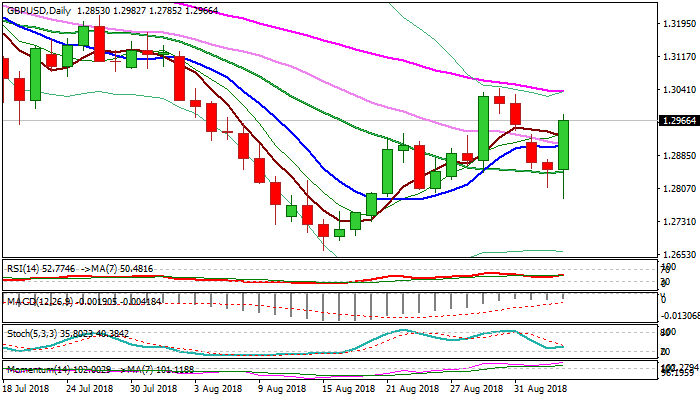
GBPUSD Outlook: Sterling Surges on Bews about UK/Germany Brexit Deal
Sterling surged across the board on Wednesday after report that British and German governments have abandoned key Brexit demands, in attempts to open way for Britain to easier reach the deal with the European Union.
Surprise decision strongly boosted pound which rose 1.1% since the news were released and hit session high at 1.2983 (the highest since 31 Aug/Fibo 76.4% of 1.3043/1.2785 bear-leg).
Fresh bullish acceleration shifted near-term focus towards psychological 1.30 barrier, neutralizing downside risk after four-day 1.3043/1.2785 fall.
Daily techs improved as rally surged through a cluster of MA’s (1.2909/29 zone), while momentum continued to trend higher, deeply in positive territory.
Daily close above 1.2960 is required to fill Monday’s gap and keep near-term focus at the upside for renewed attempt through cracked psychological 1.30 barrier and retest of falling 55SMA at 1.3035 and last Thursday’s high and recovery rejection at 1.3043.
Res: 1.2983; 1.3000; 1.3035; 1.3043
Sup: 1.2930; 1.2910; 1.2847; 1.2807
Sunset Market Commentary
Markets
Global core bonds traded mixed today with the US Note future near opening levels and the German Bund losing ground. The Bund’s underperformance is mainly related to positive brexitnews. Germany is supposedly ready to accept a less detailed agreement on the UK’s future economic ties with Europe. Difficult decisions can be postponed until the UK is in the post-Brexit transition phase, leaving time to focus solely on the Irish backstop plan for the time being. UK Gilts and German Bunds sold off on the news. Earlier in the session, core bonds for a second straight session couldn’t profit from weakness on stock markets and in EM FX. The eco calendar didn’t affect trading. German yields increase by 2.5 bps (2-yr) to 3.8 bps (10-yr). US yields add 0.4 bps (5-yr) to 1.3 bps (30-yr). 10-yr yield spread changes vs Germany narrow up to 4 bps with Italy again significantly outperforming (-15 bps) as Lega Salvini stressed once more to align with EU budget rules. The significant move in the BTP markets suggests a serious rebalancing/short squeeze. The positive Italian vibe also helps explaining the Bund’s underperformance.
The dollar initially showed no clear trend. Asian and European equity markets came under pressure despite a decent close in the US yesterday. EM remained in stormy waters. Safe haven flows supported the dollar during the morning session. EUR/USD dropped below 1.1550, but, as was the case yesterday, couldn’t maintain initial gains. EUR/USD returned to the high 1.15 area. Eco data were second tier and had no impact on USD trading. Global risk sentiment improved slightly during the afternoon session. This change was not due to high profile news from EM or from the US trade policy, but inspired by press headlines that the UK and Germany would accept a less detailed text for the Brexit agreement, raising the chances on a deal. The brexit-driven improvement in global sentiment both propelled EUR/USD (currently 1.1625) and, to a lesser extent, USD/JPY (111.70 area). Even without taking into account this afternoon’s ‘brexit-spike’ of EUR/USD, we are disappointed on the overall performance of the US currency. The dollar could have gained more on the EM/trade story or on recent strong US eco data.
Sterling continued trading with a slightly negative bias this morniong. Eco data were not to blame. The UK services services PMI unexpectedly increased (54.3 from 53.5). Markit indicated that this week’s combined PMI reports point to 0.4% Q/Q growth in the Q3 (unchanged from Q2). Sterling ignored the data. The UK currency even remained in the defensive as tensions between the UK and Russia on the Salisbury Novichok murder intensified. Later in the afternoon, fortunes finally changed in favour of the UK currency on Bloomberg headlines that Germany and the UK agreed to accept a vague text for the Brexit deal. Sterling jumped higher upon the headlines. EUR/GBP trades currently in the 0.8960 area. Cable jumped to the 1.2980 area. The report isn’t confirmed yet by Germany or the UK.
News Headlines
UK’s services sector grew faster than expected in August, with Markit/CIPS Services PMI climbing to 54.3 against 53.5 in July (53.9 was expected). The composite PMI expanded as well, from 53.6 to 54.2. According to Markit, UK GDP could sustain a 0.4% growth (QoQ) in Q3, which is rather positive despite looming brexit uncertainty.
EU Trade Commissioner Malmstrom will host US Trade Representative Lighthizer on Monday for a first meeting since EC President Juncker and US President Trump agreed last month to freeze new tariff threats and start up new trade negotiations. Malmstrom already said the two partners still have “profound disagreements”.
The German and British government have dropped key brexit demands, easing the path for the UK to strike a deal with the EU on a divorce. Germany is willing to accept a less detailed agreement on future trade ties, while the UK is willing to postpone some (major) decisions until after brexit day. Sterling gained ground on the news.
Canada’s Trade Deficit Narrowed Further in July
Highlights:
- The July trade deficit unexpectedly shrank to $0.1 billion from $0.7 billion in June. The July shortfall was the smallest since a small surplus was posted in December 2016. Markets expected a $1 billion deficit in July.
- Exports rose 0.8% in nominal terms but fell 0.8% in volume terms. Import volumes declined 1.6% in volume terms but despite an increase in equipment imports that is a good sign for Q3 Canadian business investment spending.
- Non-energy export volumes inched lower on a month-over-month basis in July but were still up 4% from a year ago.
Our Take:
A 0.8% rise in July exports was entirely explained by a big rise in energy prices but the 0.8% decline in export volumes still retraced less than half of a big jump in June. Statistics Canada reported that exports to the U.S. of steel products targeted by new 25% U.S. import tariffs beginning in June bounced back 16% in July after falling 36% the earlier month. New retaliatory Canadian import tariffs starting in July also seem to have had a significant impact on trade in targeted products. Canadian imports from the U.S. of steel products targeted fell 40% after jumping 33% in June. Looking through the volatility, the Canada-U.S. trade balance in products directly targeted in the most recent trade spat appears to be little changed in July from May (before U.S. tariffs were first implemented in June.)
On balance, the Canadian trade data has looked somewhat better in recent months. Non-energy export volumes slipped lower in July but were up 4% from a year ago. The monthly data is volatile, so a few months of encouraging data doesn’t yet make a trend — and risks around Canada’s trade relationship with the U.S. remain. It could also be, though, that Canadian exports are finally starting to get at least a modest lift from stronger global trade flows and an improved U.S. industrial sector.