Sample Category Title
(BOC) Bank of Canada maintains overnight rate target at 1 ½ per cent
The Bank of Canada today maintained its target for the overnight rate at 1 ½ per cent. The Bank Rate is correspondingly 1 ¾ per cent and the deposit rate is 1 ¼ per cent.
CPI inflation moved up to 3 per cent in July. This was higher than expected, in large part because of a jump in the airfare component of the consumer price index. The Bank expects CPI inflation to move back towards 2 per cent in early 2019, as the effects of past increases in gasoline prices dissipate. The Bank's core measures of inflation remain firmly around 2 per cent, consistent with an economy that has been operating near capacity for some time. Wage growth remains moderate.
Recent data on the global economy have been consistent with the Bank's July Monetary Policy Report (MPR) projections. The US economy is particularly robust, with strong consumer spending and business investment. Elevated trade tensions remain a key risk to the global outlook and are pulling some commodity prices lower. Meanwhile, financial stresses have intensified in certain emerging market economies, but with limited spillovers to other countries.
The Canadian economy is evolving closely in line with the Bank's July projection for growth to average near potential. Following growth of 1.4 per cent in the first quarter, GDP rebounded by 2.9 per cent in the second quarter, as the Bank had forecast. GDP growth is expected to slow temporarily in the third quarter, mainly because of further fluctuations in energy production and exports.
While uncertainty about trade policies continues to weigh on businesses, the rotation of demand towards business investment and exports is proceeding. Despite choppiness in the data, both business investment and exports have been growing solidly for several quarters. Meanwhile, activity in the housing market is beginning to stabilize as households adjust to higher interest rates and changes in housing policies. Continuing gains in employment and labour income are helping to support consumption. As past interest rate increases work their way through the economy, credit growth has moderated and the household debt-to-income ratio is beginning to edge down.
Recent data reinforce Governing Council's assessment that higher interest rates will be warranted to achieve the inflation target. We will continue to take a gradual approach, guided by incoming data. In particular, the Bank continues to gauge the economy's reaction to higher interest rates. The Bank is also monitoring closely the course of NAFTA negotiations and other trade policy developments, and their impact on the inflation outlook.
Information note
The next scheduled date for announcing the overnight rate target is October 24, 2018. The next full update of the Bank's outlook for the economy and inflation, including risks to the projection, will be published in the MPR at the same time.
BoC kept overnight rate target unchanged at 1.50%, full statement
BoC kept overnight rate target unchanged at 1.50%. Tightening bias is maintained as "higher interest rates will be warranted to achieve the inflation target".
Overall economy evolved "closely in line" with BoC's July projections. Q3 GDP is expected to "slow temporarily" due to "further fluctuations in energy production and exports." The surge in July CPI to 3% was "higher than expected" but "in large part because of a jump in the airfare component". BoC maintained that CPI will move back to 2% in early 2019.
BoC also talked down trade threats as "demand towards business investment and exports is proceeding".
Overall, BoC sounds rather confident on the economy and it's on course for another rate hike in October.
Full statement below.
Bank of Canada maintains overnight rate target at 1 ½ per cent
The Bank of Canada today maintained its target for the overnight rate at 1 ½ per cent. The Bank Rate is correspondingly 1 ¾ per cent and the deposit rate is 1 ¼ per cent.
CPI inflation moved up to 3 per cent in July. This was higher than expected, in large part because of a jump in the airfare component of the consumer price index. The Bank expects CPI inflation to move back towards 2 per cent in early 2019, as the effects of past increases in gasoline prices dissipate. The Bank’s core measures of inflation remain firmly around 2 per cent, consistent with an economy that has been operating near capacity for some time. Wage growth remains moderate.
Recent data on the global economy have been consistent with the Bank’s July Monetary Policy Report (MPR) projections. The US economy is particularly robust, with strong consumer spending and business investment. Elevated trade tensions remain a key risk to the global outlook and are pulling some commodity prices lower. Meanwhile, financial stresses have intensified in certain emerging market economies, but with limited spillovers to other countries.
The Canadian economy is evolving closely in line with the Bank’s July projection for growth to average near potential. Following growth of 1.4 per cent in the first quarter, GDP rebounded by 2.9 per cent in the second quarter, as the Bank had forecast. GDP growth is expected to slow temporarily in the third quarter, mainly because of further fluctuations in energy production and exports.
While uncertainty about trade policies continues to weigh on businesses, the rotation of demand towards business investment and exports is proceeding. Despite choppiness in the data, both business investment and exports have been growing solidly for several quarters. Meanwhile, activity in the housing market is beginning to stabilize as households adjust to higher interest rates and changes in housing policies. Continuing gains in employment and labour income are helping to support consumption. As past interest rate increases work their way through the economy, credit growth has moderated and the household debt-to-income ratio is beginning to edge down.
Recent data reinforce Governing Council’s assessment that higher interest rates will be warranted to achieve the inflation target. We will continue to take a gradual approach, guided by incoming data. In particular, the Bank continues to gauge the economy’s reaction to higher interest rates. The Bank is also monitoring closely the course of NAFTA negotiations and other trade policy developments, and their impact on the inflation outlook.
Information note
The next scheduled date for announcing the overnight rate target is October 24, 2018. The next full update of the Bank’s outlook for the economy and inflation, including risks to the projection, will be published in the MPR at the same time.
Japan 225 Index Creates Downside Rally; Could Weaken Further in Short Term
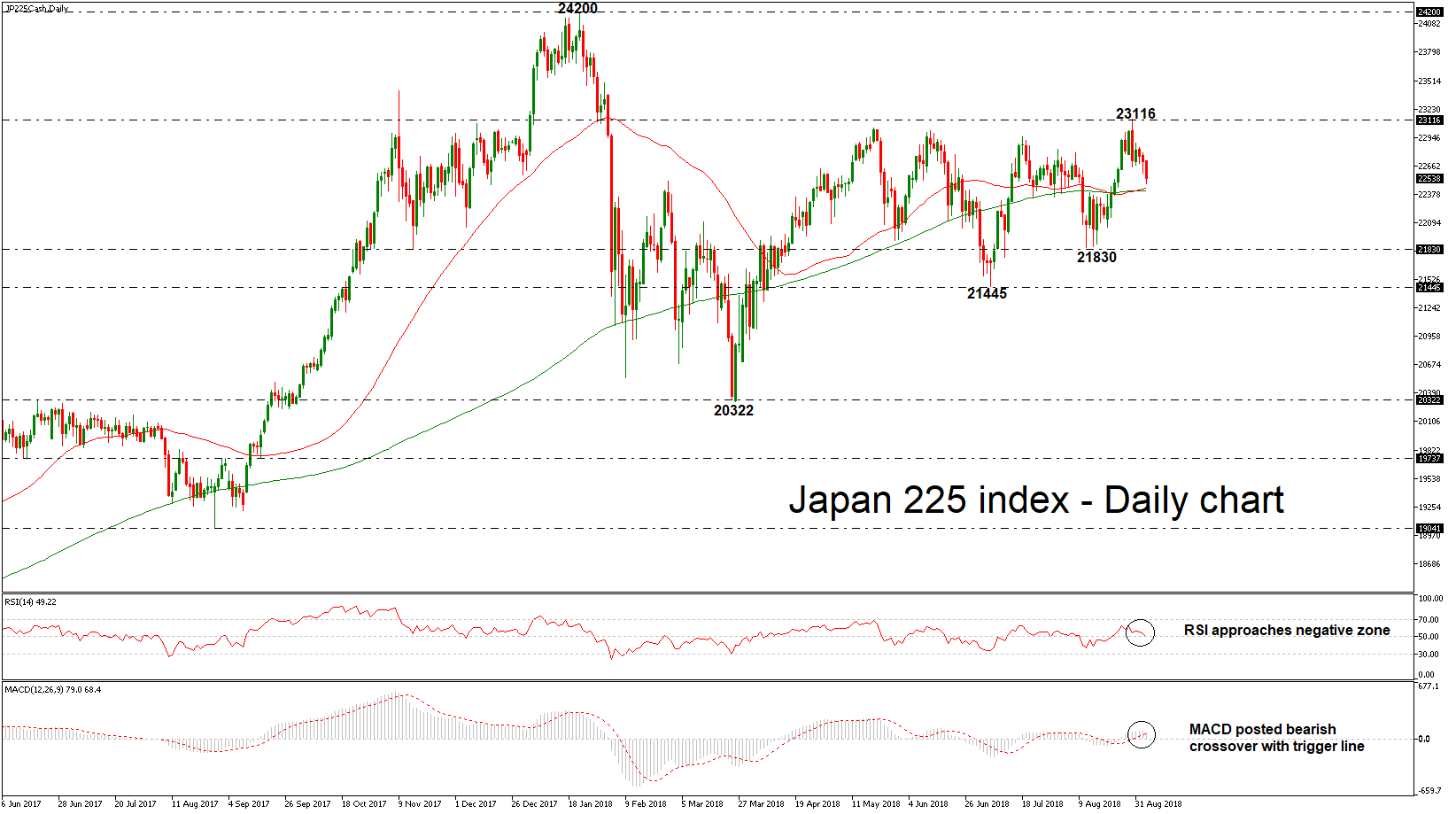
Japan 225 index has recorded a stunning downward rally following the touch on the 23116 resistance level in the prior week and is moving towards the moving averages in the daily chart. The technical indicators, continue to send bearish signals, suggesting that the softness in the market is not over yet. The RSI indicator is in progress to drop below the threshold of 50, while the MACD oscillator posted a bearish crossover with its trigger line.
Should prices decline further and fall below the 20- and 40-day simple moving averages (SMAs), near 22440 at the time of writing, it could push the index until the next immediate support of 21830. Then a leg below that level, the price could meet the 21445 barrier, taken from the low on July 5.
However, if the market manages to pick up speed, the 23116 resistance level could offer nearby resistance. This is a significant area which has been rejected several times in the past. A close above this key level would raise the chances for further increases until the 24200 resistance barrier, identified by the top on January 23.
Having a look at the weekly chart, the index seems to be in a bullish mode over the last two years that found support hurdle on 14821.
GBP/JPY Mid-Day Outlook
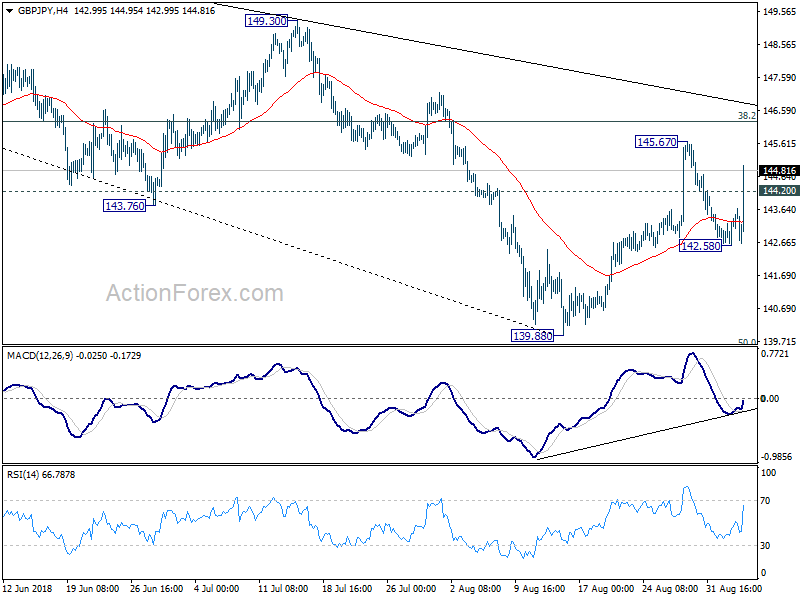
Daily Pivots: (S1) 142.79; (P) 143.09; (R1) 143.59; More...
GBP/JPY's strong rebound and break of 144.20 minor resistance suggests that pull back from 145.67 has completed at 142.58 already. Intraday bias is turned back to the upside for 145.67 first. Break will resume the rebound from 139.88 to 38.2% retracement of 156.59 to 139.88 at 146.26. Decisive break there will be a strong signal that fall from 156.59 has completed at 139.88, ahead of 139.29/47 key support zone. Further rally should then be seen to 149.30 resistance for confirmation. On the downside, though, break of 142.58 will turn focus back to 139.88 low instead.
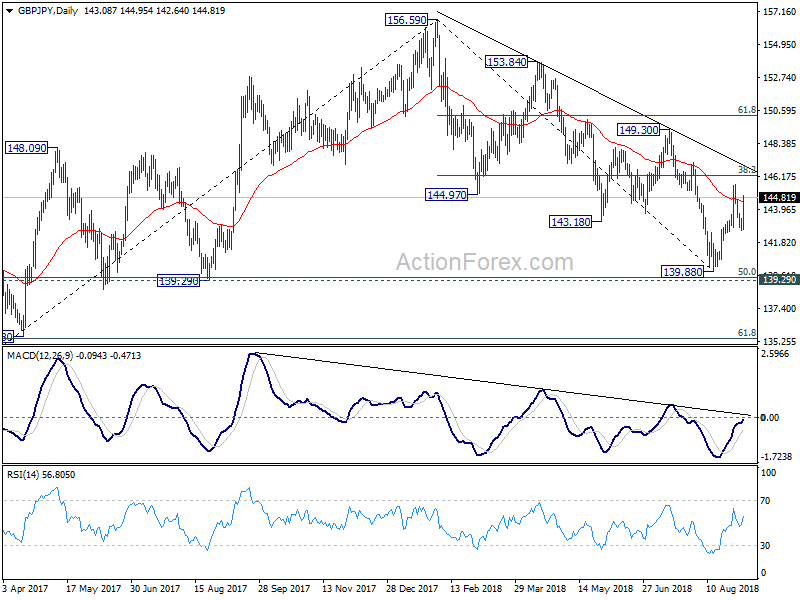
In the bigger picture, at this point decline from 156.59 is still seen as a corrective move. Focus remains on 139.29 cluster support (50% retracement of 122.36 to 156.59 at 139.47). Strong rebound from there will re-affirm the bullish case that rise from 122.36 is still to extend through 156.59 high. However, sustained break of 139.29/47 should confirm medium term reversal. GBP/JPY would then target a retest on 122.26 (2016 low).
USDCHF: Eyes Further Bullish Recovery Higher Towards 0.9787/99 Area
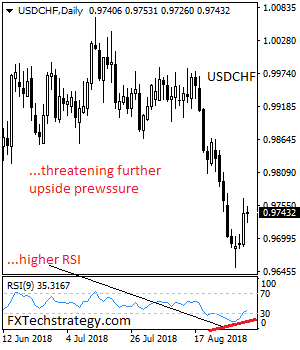
USDCHF: The pair looks to recover higher having rallied on Tuesday. On the downside, support lies at the 0.9700 level. A turn below here will open the door for more weakness towards the 0.9650 level and then the 0.9600 level. On the upside, resistance resides at the 0.9750 level where a break will clear the way for more strength to occur towards the 0.9800 level. Further out, resistance comes in at the 0.9850 level. Above here if seen will turn attention to 0.9950. Its daily RSI is bullish and pointing higher suggesting further upside. All in all, USDCHF faces further corrective upside pressure.
EURUSD Outlook: Slightly Bid on Solid Data But Lacks Firmer Direction Signal
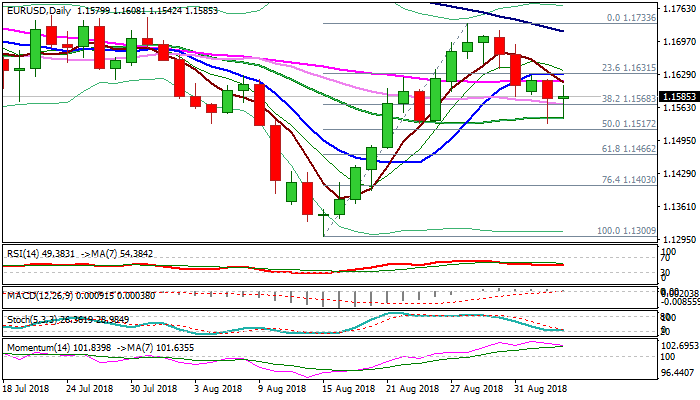
The Euro holds slight bid tone at the beginning of the US session, pressuring again 1.1600 barrier, after EU Composite PMI came forecast in August (54.5 vs 54.4 f/c, but positive impact was partially offset by weaker than expected retail sales (Aug -0.2% m/m vs -0.1% f/c and 0.3% previous month. However, repeated rejection at 20SMA, which proves to be solid support (1.1540), could be seen as initial signal of near-term bears losing traction and possible basing attempt.
Mixed signals from daily techs lack clearer direction signal, with near-term action holding between 20 and 55SMA and break of either pivot to point to fresh direction.
Res: 1.1615; 1.1629; 1.1660; 1.1690
Sup: 1.1540; 1.1517; 1.1479; 1.1466
EUR/USD Mid-Day Outlook
Daily Pivots: (S1) 1.1532; (P) 1.1580; (R1) 1.1632; More.....
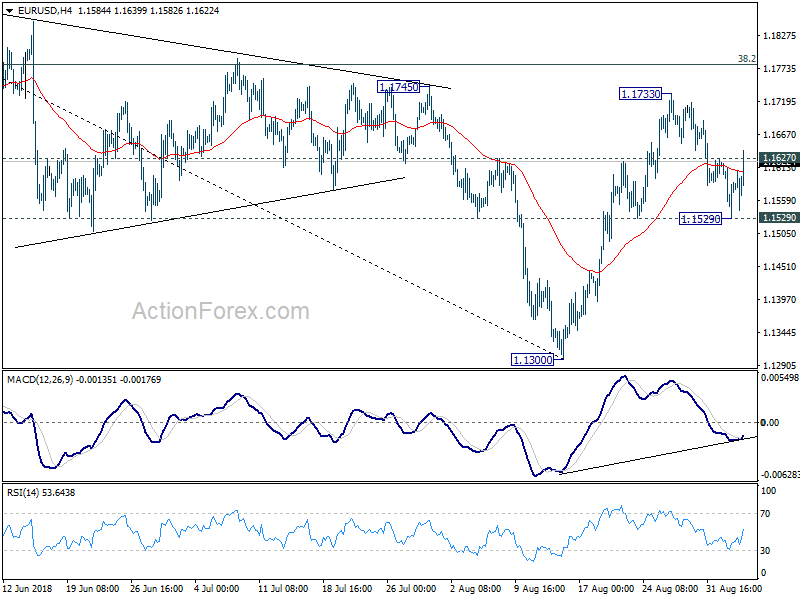
EUR/USD's rebound and breach of 1.1627 minor resistance suggests that pull back from 1.1733 has completed at 1.1529 already. Intraday bias is turned back to the upside for 1.1733 and possibly above. For now, we'd still expect strong resistance from 38.2% retracement of 1.2555 to 1.1300 at 1.1779 to limit upside, at least on first attempt, to bring near term reversal. On the downside, firm break of 1.1529 will indicate completion of the corrective rebound from 1.1300 and turn bias to the downside for retesting 1.1300 low.
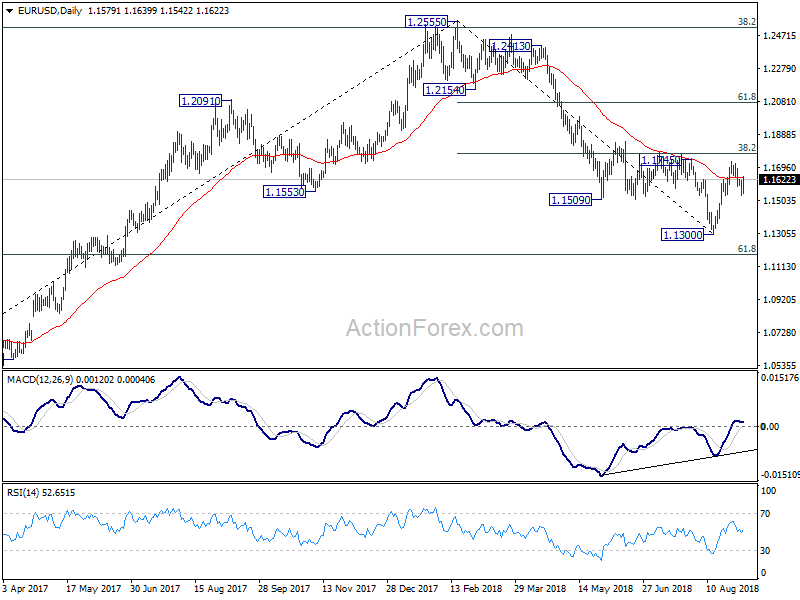
In the bigger picture, a medium term bottom should be in place at 1.1300, on bullish convergence condition in daily MACD and some consolidations would be seen. But still, note that EUR/USD was rejected by 38.2% retracement of 1.6039 (2008 high) to 1.0339 (2017 low) at 1.2516. That carries some long term bearish implications. Thus, we'd expect fall from 1.2555 high to resume after consolidation completes. Below 1.1300 should send EUR/USD through 61.8% retracement of 1.0339 to 1.2555 at 1.1186. And, in that case, EUR/USD would head to retest 1.0339 (2017 low).
GBP/USD Mid-Day Outlook
Daily Pivots: (S1) 1.2814; (P) 1.2851; (R1) 1.2890; More...
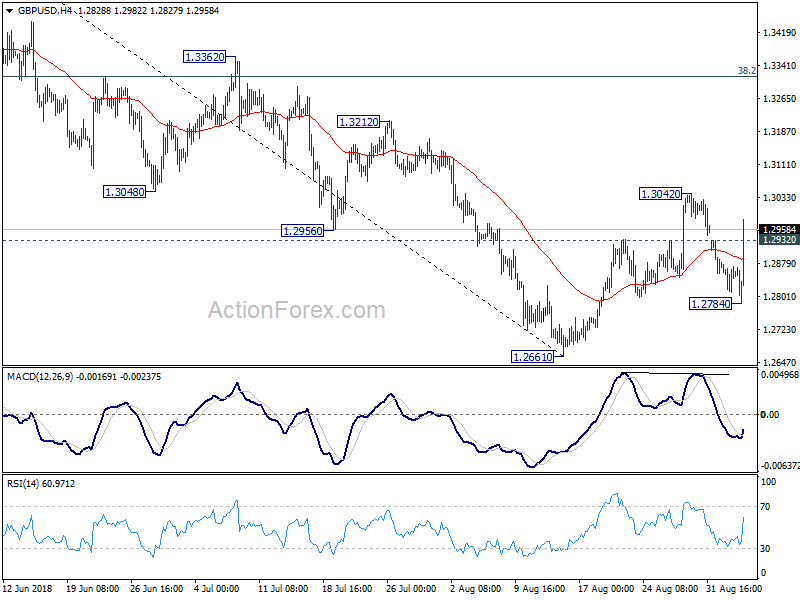
GBP/USD's strong rebound and break of 1.2932 suggests that fall from 1.3042 has completed at 1.2784. And the corrective rise from 1.2661 is still in progress. Intraday bias is back on the upside for 1.3042 resistance. Break will resume the rebound from 1.2661 and target 1.3212 resistance. We'd expect strong resistance from 1.3316 fibonacci level to limit upside to complete the rebound. On the downside, break of 1.2784 will bring deeper fall to retest 1.2661.
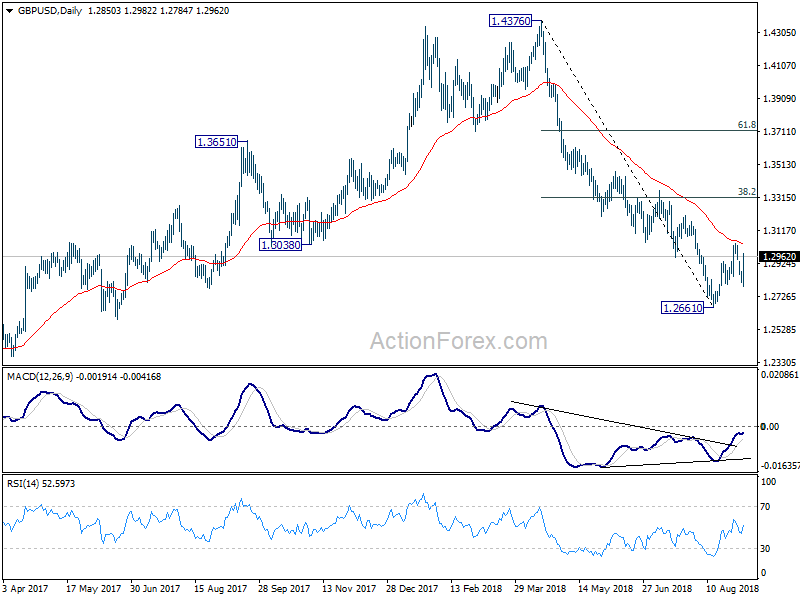
In the bigger picture, whole medium term rebound from 1.1946 (2016 low) should have completed at 1.4376 already, after rejection from 55 month EMA (now at 1.4099). The structure and momentum of the fall from 1.4376 argues that it's resuming long term down trend. And this will be the preferred case as long as 38.2% retracement of 1.4376 to 1.2661 at 1.3316 holds. However, firm break of 1.3316 would bring stronger rebound to 61.8% retracement at 1.3721. And, the eventual depth of the fall from 1.4376, and the chance of hitting 1.1946 low, will depend on the strength of the interim corrective rebound from 1.2661.
USD/JPY Mid-Day Outlook
Daily Pivots: (S1) 111.08; (P) 111.30; (R1) 111.71; More...
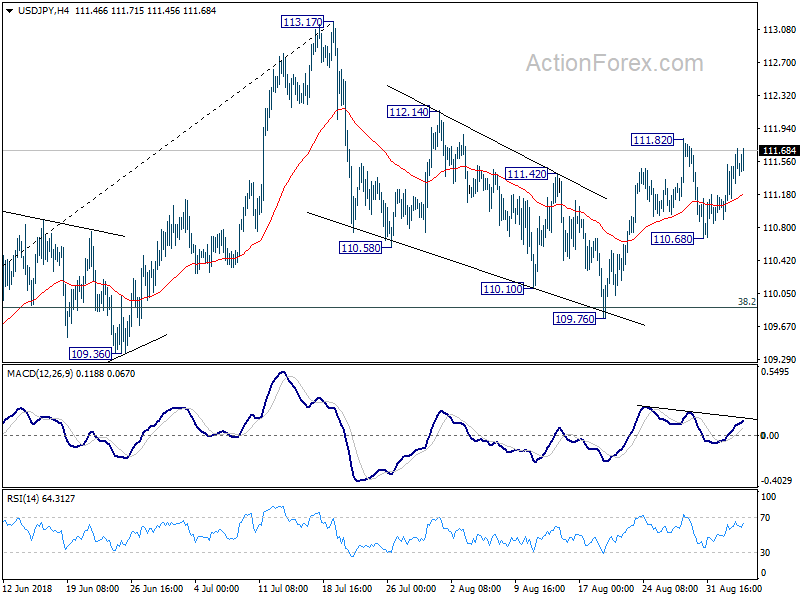
Intraday bias in USD/JPY remains neutral as it's still bounded in range of 110.68/111.82. On the upside, break of 111.82 will reaffirm the case that correction from 113.17 has completed at 109.76. And in that case, further rise should be seen back to retest 113.17 high. On the downside, below 110.68 will bring another fall. But still, downside should be contained by 38.2% retracement of 104.62 to 113.17 at 109.90 to bring rebound.
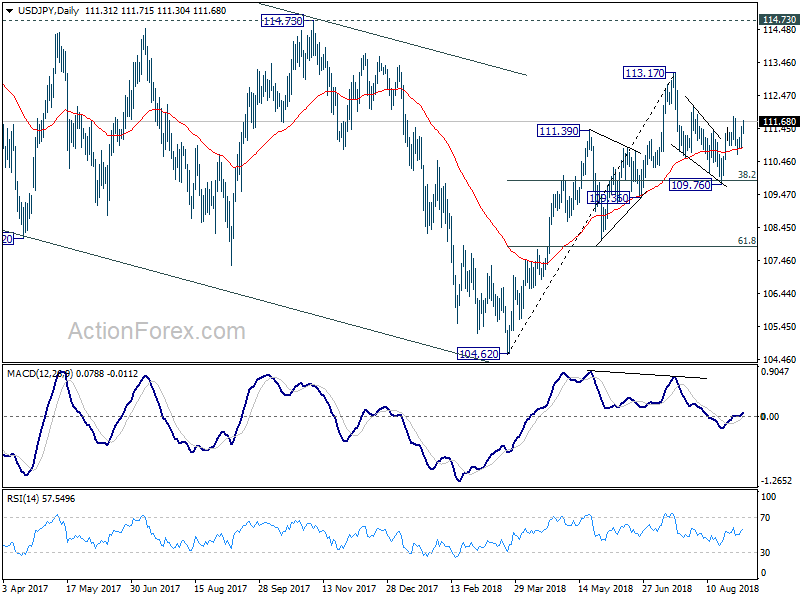
In the bigger picture, corrective fall from 118.65 (2016 high) should have completed with three waves down to 104.62. Decisive break of 114.73 resistance will likely resume whole rally from 98.97 (2016 low) to 100% projection of 98.97 to 118.65 from 104.62 at 124.30, which is reasonably close to 125.85 (2015 high). This will stay as the preferred case as long as 109.36 support holds. However, decisive break of 109.36 will mix up the outlook again. And deeper fall should be seen back to 61.8% retracement of 104.62 to 113.17 at 107.88 and below.
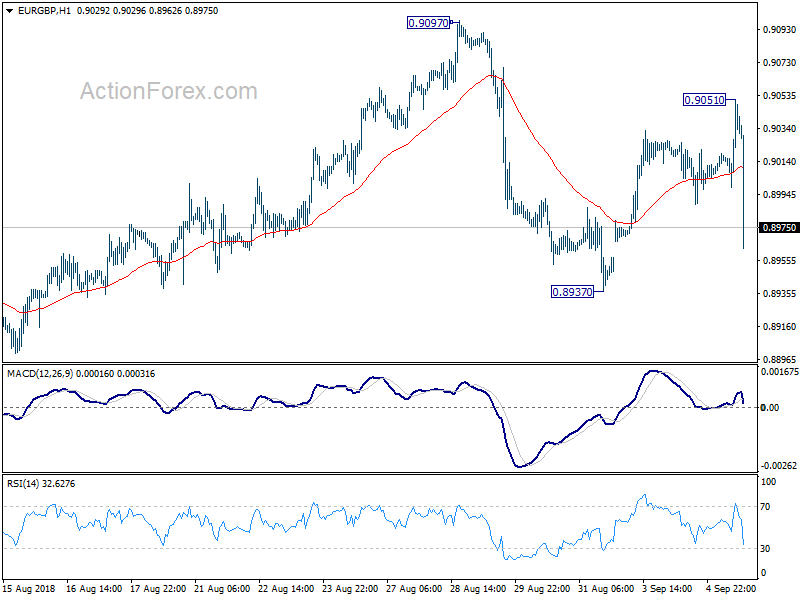
Sterling rebounds strongly as Germany and UK dropped key Brexit demand
Sterling rebounds strongly as Bloomberg reports that both Germany and UK have dropped key Brexit demands, citing unnamed source. Additionally, there are signs of progress on the key sticky issue of Irish border.
In short, Germany is said to accept a less detailed agreement regarding the future relationship. Meanwhile, UK is also prepared to accept a more vague statement of intent on the relationship too.
Most importantly, EU's chief Brexit negotiator Michel Barnier has openly said he strong opposed to the Chequer's plan. That's the trigger for Sterling's selloff this week. But Bloomberg's source said that such opposition isn't necessarily an obstacle for the agreement.
That could finally ease the path to a Brexit deal to be concluded in October, or may be later in November.