

Sample Category Title
Australia’s Trade Surplus Narrowed In July
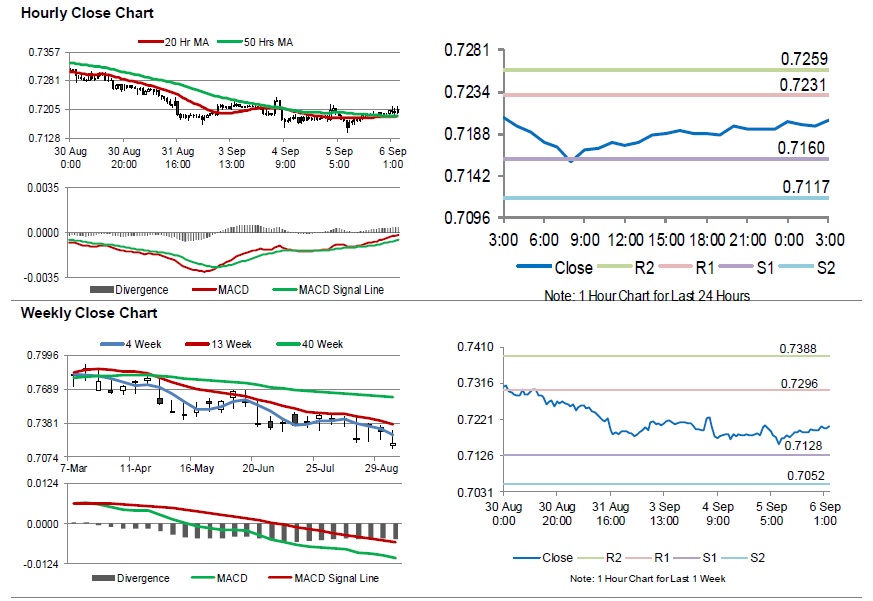
For the 24 hours to 23:00 GMT, the AUD rose 0.17% against the USD and closed at 0.7193. LME Copper prices rose 0.5% or $27.0/MT to $5850.0/MT. Aluminium prices rose 0.3% or $6.0/MT to $2046.0/MT.
In the Asian session, at GMT0300, the pair is trading at 0.7203, with the AUD trading 0.14% higher against the USD from yesterday's close.
Overnight data showed that Australia's seasonally adjusted trade surplus narrowed to a level of A$1551.0 million in July, driven by rise in imports and following a revised surplus of A$1937.0 million in the prior month. Market participants had anticipated the nation to record a trade surplus of A$1450.0 million.
The pair is expected to find support at 0.7160, and a fall through could take it to the next support level of 0.7117. The pair is expected to find its first resistance at 0.7231, and a rise through could take it to the next resistance level of 0.7259.
Trading trend in the Aussie is expected to be determined by Australia's AiG performance of construction index for August and home loans for July, set to release overnight.
The currency pair is trading above its 20 Hr and 50 Hr moving averages.
Gold: Yellow Metal Trading On A Stronger Footing In The Asian Session
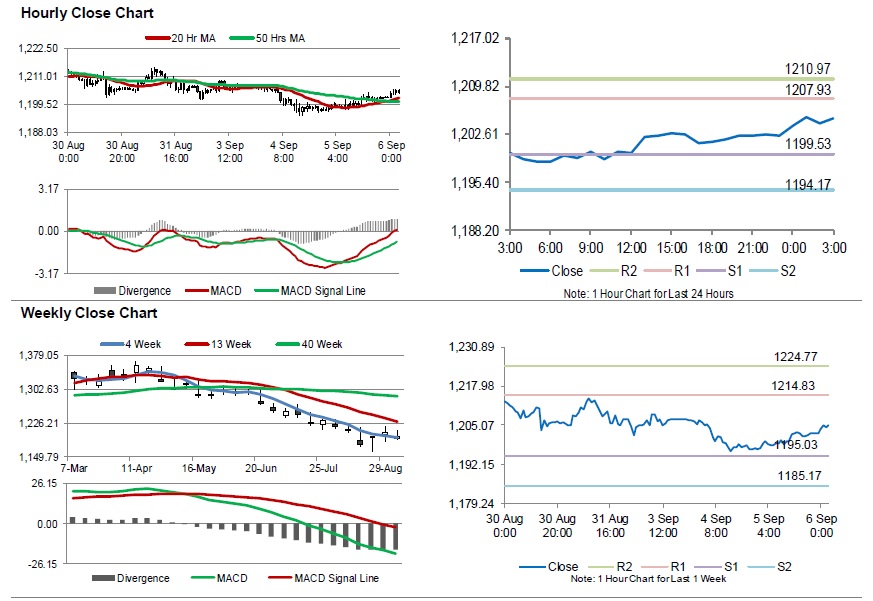
For the 24 hours to 23:00 GMT, Gold rose 0.43% against the USD and closed at USD1202.60 per ounce, as weakness in the US dollar boosted demand for the safe haven asset.
In the Asian session, at GMT0300, the pair is trading at 1204.90, with gold trading 0.19% higher against the USD from yesterday’s close.
The pair is expected to find support at 1199.53, and a fall through could take it to the next support level of 1194.17. The pair is expected to find its first resistance at 1207.93, and a rise through could take it to the next resistance level of 1210.97.
The yellow metal is trading above its 20 Hr and 50 Hr moving averages.
Silver: White Metal Trading Higher In The Morning Session
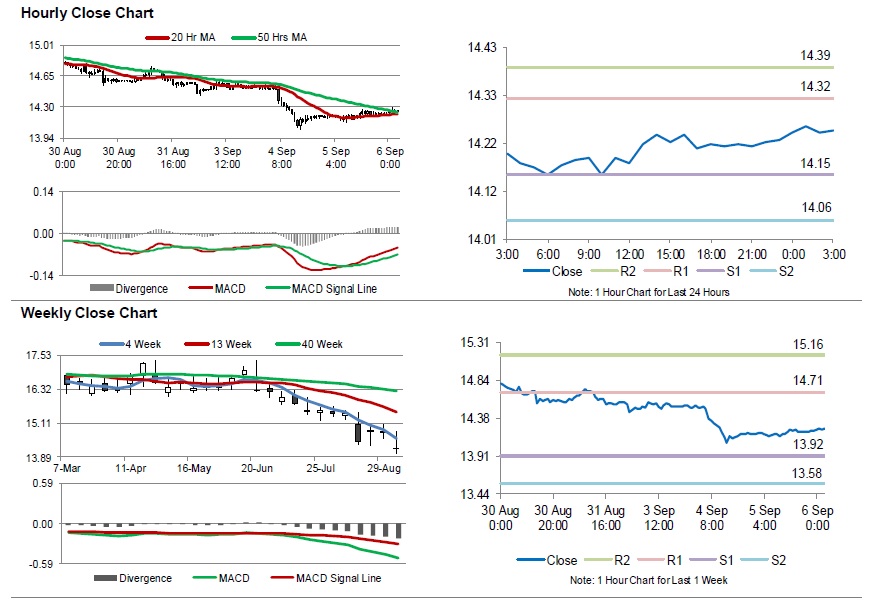
For the 24 hours to 23:00 GMT, Silver rose 0.32% against the USD and closed at USD14.23 per ounce, tracking gains in gold prices.
In the Asian session, at GMT0300, the pair is trading at 14.25, with silver trading 0.14% higher against the USD from yesterday’s close.
The pair is expected to find support at 14.15, and a fall through could take it to the next support level of 14.06. The pair is expected to find its first resistance at 14.32, and a rise through could take it to the next resistance level of 14.39.
The white metal is showing convergence with its 20 Hr and 50 Hr moving averages.
USD/JPY Daily Outlook
Daily Pivots: (S1) 111.35; (P) 111.56; (R1) 111.74; More...
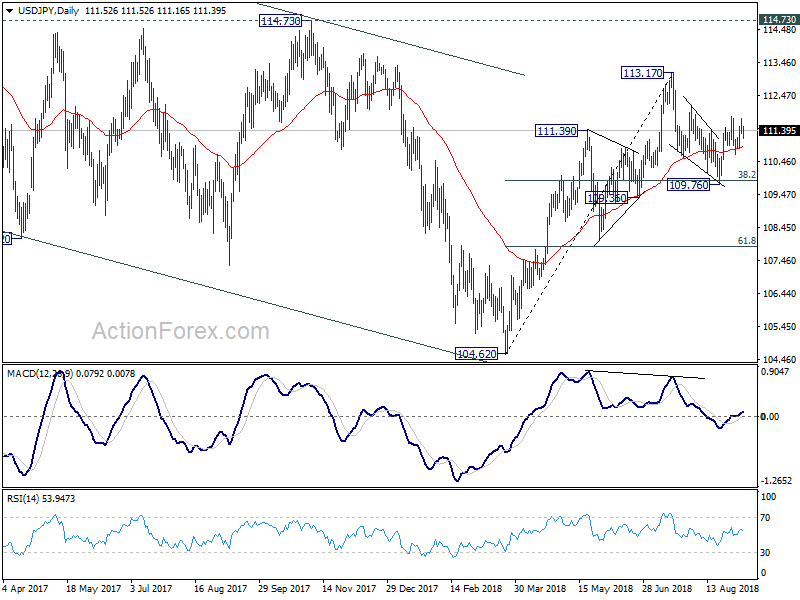
Intraday bias in USD/JPY stays neutral and range trading continues inside 110.68/111.82. On the upside, break of 111.82 will reaffirm the case that correction from 113.17 has completed at 109.76. And in that case, further rise should be seen back to retest 113.17 high. On the downside, below 110.68 will bring another fall. But still, downside should be contained by 38.2% retracement of 104.62 to 113.17 at 109.90 to bring rebound.
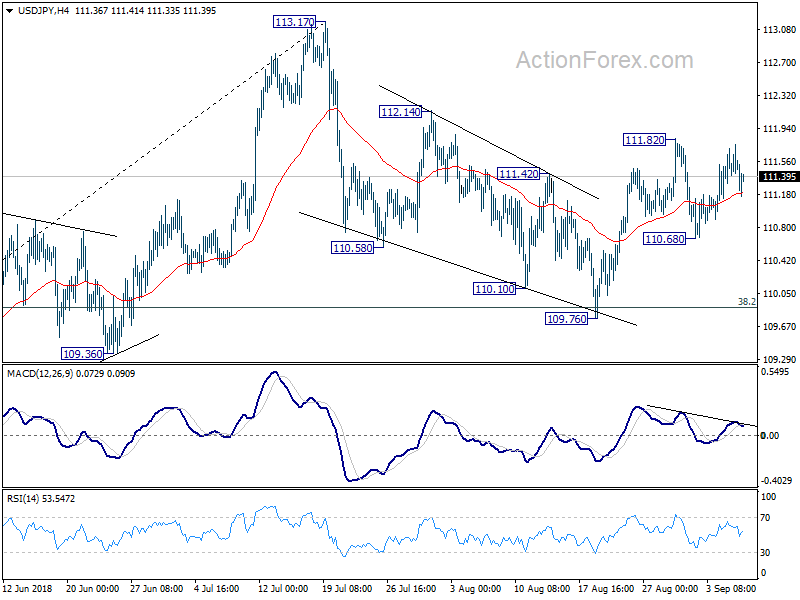
In the bigger picture, corrective fall from 118.65 (2016 high) should have completed with three waves down to 104.62. Decisive break of 114.73 resistance will likely resume whole rally from 98.97 (2016 low) to 100% projection of 98.97 to 118.65 from 104.62 at 124.30, which is reasonably close to 125.85 (2015 high). This will stay as the preferred case as long as 109.36 support holds. However, decisive break of 109.36 will mix up the outlook again. And deeper fall should be seen back to 61.8% retracement of 104.62 to 113.17 at 107.88 and below.
Crude Oil: Oil Trading On A Weaker Footing In The Asian Session
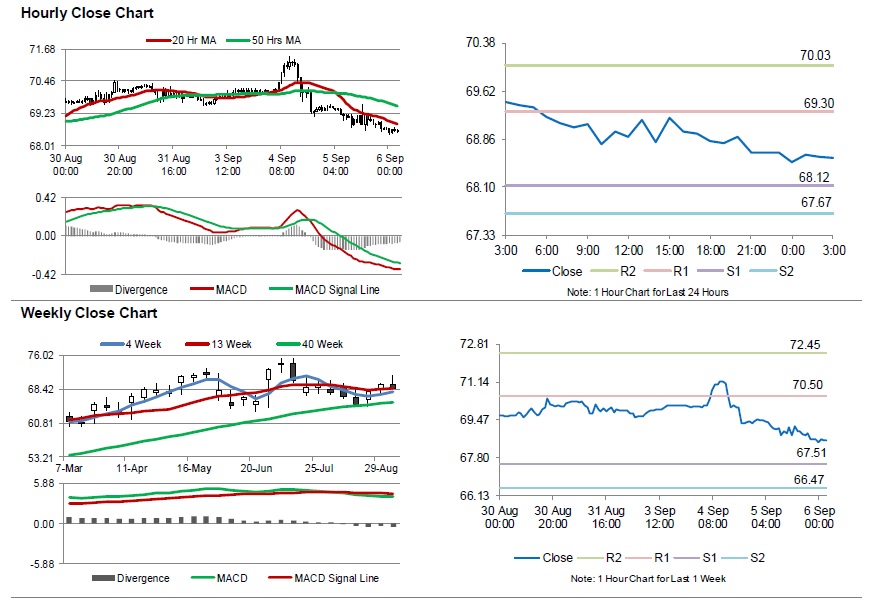
For the 24 hours to 23:00 GMT, Crude Oil declined 1.00% against the USD and closed at USD68.64 per barrel, amid worries that escalating global trade tensions would reduce demand for the commodity.
Separately, the American Petroleum Institute (API) reported that US crude oil inventories declined by 1.17 million barrels to 406.8 million barrels in the week ended 31 August.
In the Asian session, at GMT0300, the pair is trading at 68.56, with oil trading 0.12% lower against the USD from yesterday’s close.
The pair is expected to find support at 68.12, and a fall through could take it to the next support level of 67.67. The pair is expected to find its first resistance at 69.29, and a rise through could take it to the next resistance level of 70.03.
Crude oil is trading below its 20 Hr and 50 Hr moving averages.
USD/CHF Daily Outlook
Daily Pivots: (S1) 0.9699; (P) 0.9727; (R1) 0.9745; More.....
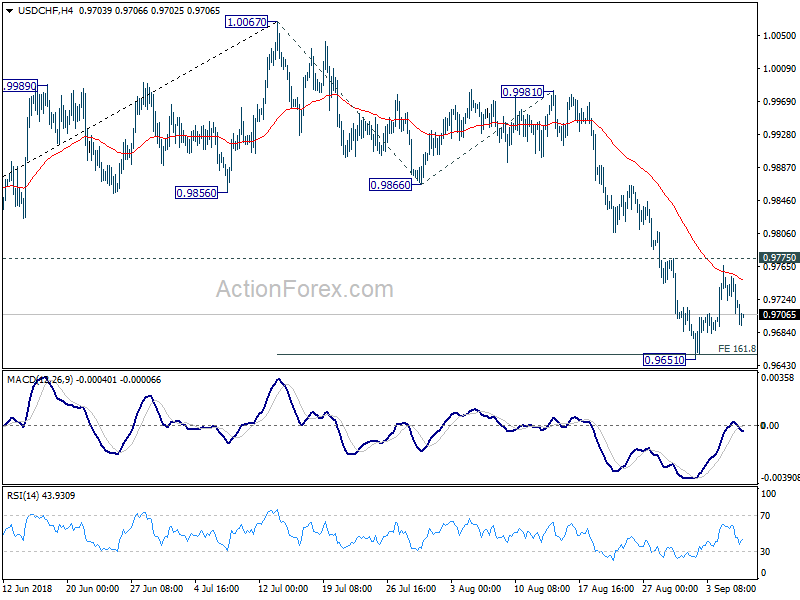
Intraday bias in USD/CHF remains neutral as this point as it's bounded in range of 0.9651/9975. With 0.9775 intact, another decline is mildly in favor. On the downside, break of 0.9651 will target 200% projection of 1.0067 to 0.9866 from 0.9981 at 0.8579 next. However, firm break of 0.9775 will be an early sign of near term reversal. That is, fall from 1.0067 could have completed. In this case, further rally would be seen back to 0.9866 support turned resistance for confirmation.
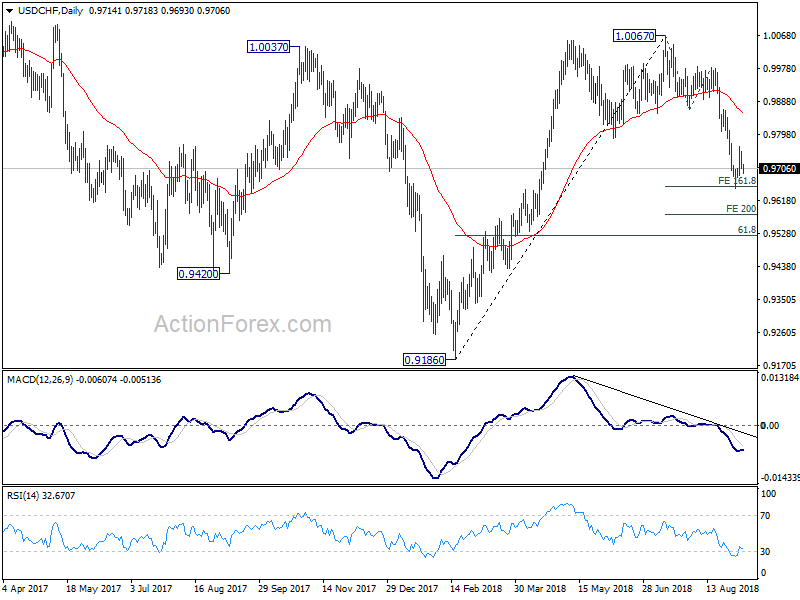
In the bigger picture, current development suggests that rise from 0.9186 low has completed at 1.0067, after failing to sustain above 1.0037 resistance. Fall from 1.0067 could extend to 61.8% retracement of 0.9816 to 1.0067 at 0.9523 and below. But for now, we don't expect a break of 0.9186 low. On the upside, firm break of 0.9866 support turned resistance will suggests that fall from 1.0067 has completed and rise from 0.9186 is resuming.
EUR/USD Daily Outlook
Daily Pivots: (S1) 1.1569; (P) 1.1603; (R1) 1.1664; More.....
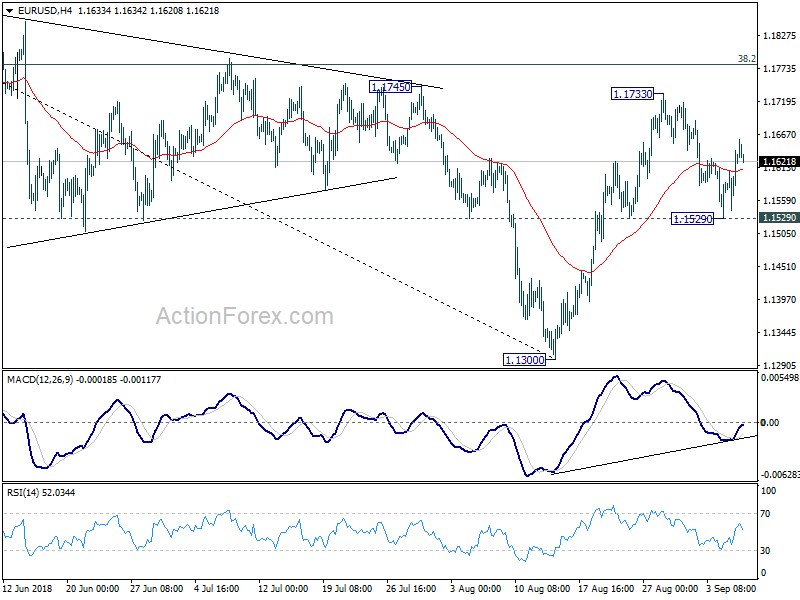
Intraday bias in EUR/USD remains mildly on the upside for 1.1733 and possibly above. But still, we'd still expect strong resistance from 38.2% retracement of 1.2555 to 1.1300 at 1.1779 to limit upside, at least on first attempt, to bring near term reversal. On the downside, firm break of 1.1529 will indicate completion of the corrective rebound from 1.1300 and turn bias to the downside for retesting 1.1300 low.
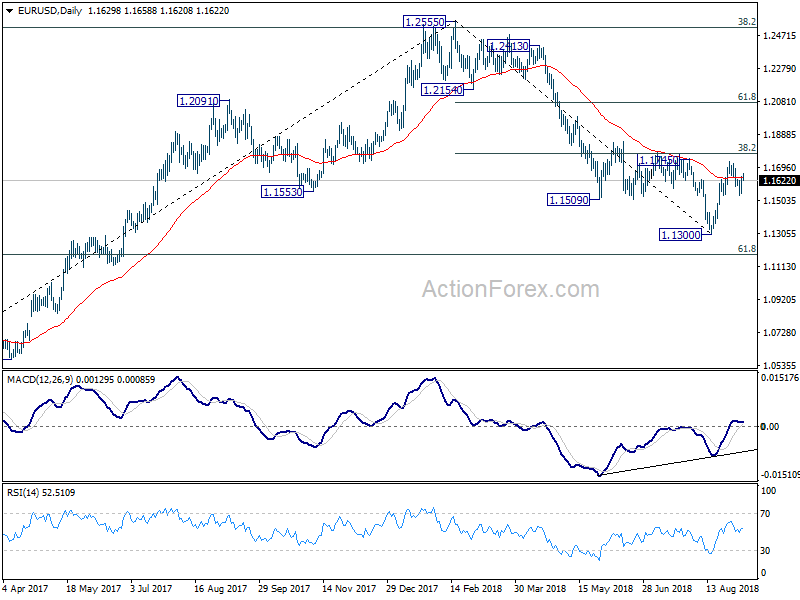
In the bigger picture, a medium term bottom should be in place at 1.1300, on bullish convergence condition in daily MACD and some consolidations would be seen. But still, note that EUR/USD was rejected by 38.2% retracement of 1.6039 (2008 high) to 1.0339 (2017 low) at 1.2516. That carries some long term bearish implications. Thus, we'd expect fall from 1.2555 high to resume after consolidation completes. Below 1.1300 should send EUR/USD through 61.8% retracement of 1.0339 to 1.2555 at 1.1186. And, in that case, EUR/USD would head to retest 1.0339 (2017 low).
GBP/USD Daily Outlook
Daily Pivots: (S1) 1.2799; (P) 1.2891; (R1) 1.2997; More...
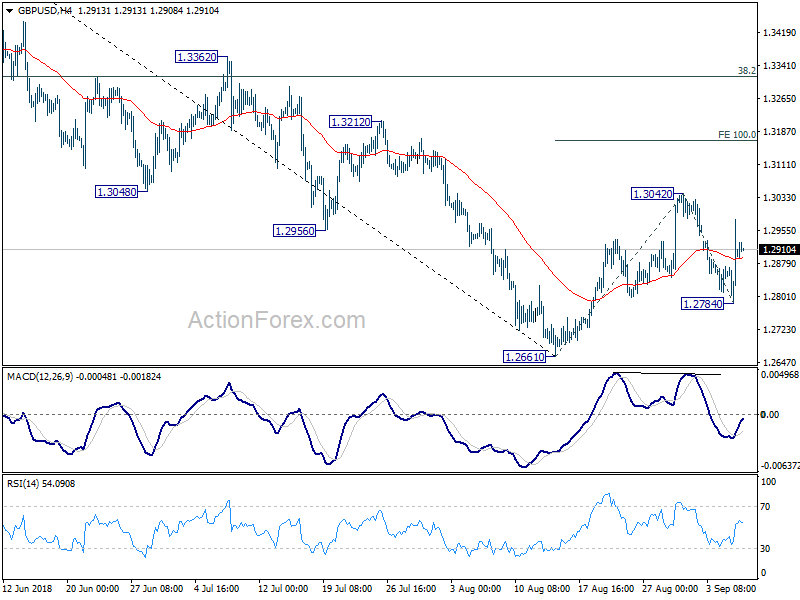
Intraday bias in GBP/USD remains mildly on the upside at this point. Current development suggests that corrective rebound from 1.2661 hasn't completed yet. Break of 1.3042 will target 100% projection of 1.2661 to 1.3042 from 1.2784 at 1.3165. But upside should be limited by 1.3316 key fibonacci level to complete the corrective rise and bring near term reversal. On the downside, below 1.2784 support will bring retest of 1.2661 low.
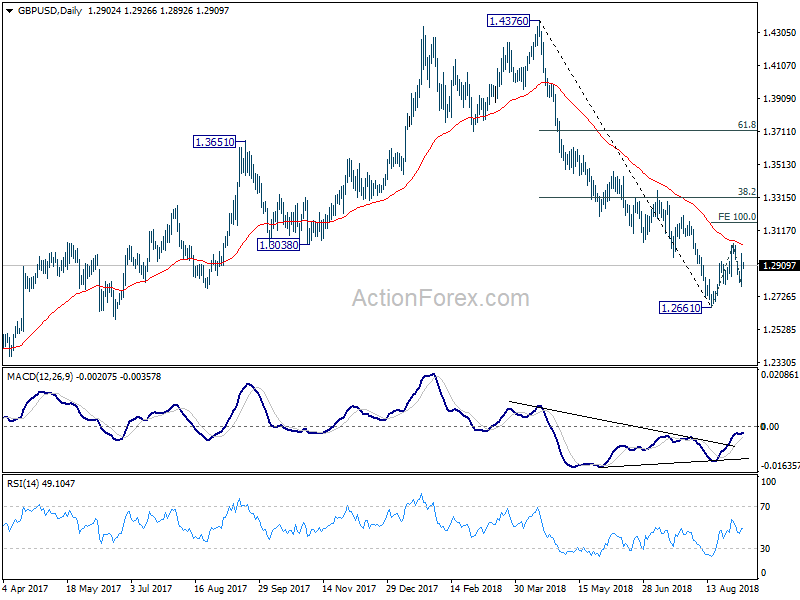
In the bigger picture, whole medium term rebound from 1.1946 (2016 low) should have completed at 1.4376 already, after rejection from 55 month EMA (now at 1.4099). The structure and momentum of the fall from 1.4376 argues that it's resuming long term down trend. And this will be the preferred case as long as 38.2% retracement of 1.4376 to 1.2661 at 1.3316 holds. However, firm break of 1.3316 would bring stronger rebound to 61.8% retracement at 1.3721. And, the eventual depth of the fall from 1.4376, and the chance of hitting 1.1946 low, will depend on the strength of the interim corrective rebound from 1.2661.
Yen and Swiss Franc Higher after Sharp Sterling Volatility, Dollar Looks to ISM Services
After sharp volatility overnight, the forex markets relatively calm in Asian session. Australian Dollar is trading as the weakest one so far with larger than expected trade surplus providing no support. Dollar follows as the second weakest as it turned soft after the rally attempt failed. Canadian Dollar and New Zealand Dollar are also weak. On the other hand, Swiss Franc and Japanese Yen are back in control with the help of risk aversion. Yesterday's selloff in European stocks were rather serious with key levels taken out. Sentiments stabilized in US and Asia, but sentiments are rather vulnerable.
One development to note was the sharp volatility in Sterling. It was firstly shot up by a Bloomberg report saying that Germany and UK made concessions on Brexit negotiation. But then the Pound was knocked down after German government spokesman cleared the air and said the position on Brexit is unchanged. Also, the spokesman said Germany has full trust in EU chief negotiator Michel Barnier. Bloomberg, and Reuters too, have been frequently used by unnamed sources to distribute false information. The motive of yesterday's news was uncertain and maybe someone wanted to undermine Barnier's position. But we have to be very careful on theses types of market moving news. Anyway, it shows once again that Sterling is very sensitive to Brexit headlines.
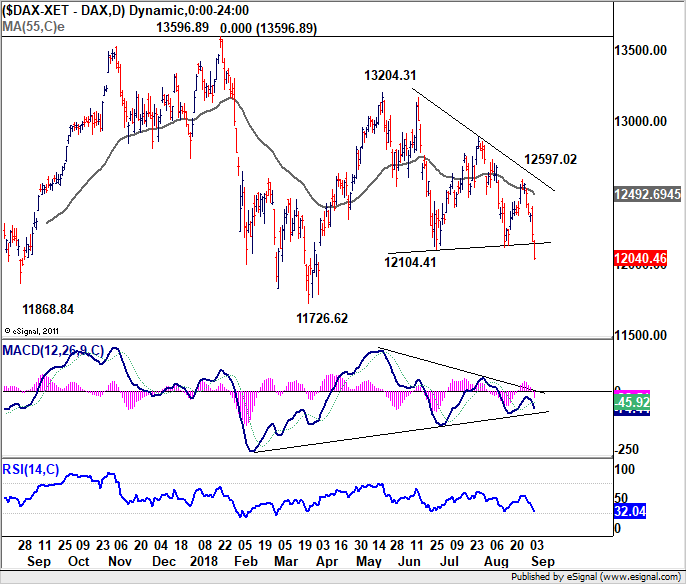
Technically, we'd like to point out the development in European indices first. FTSE lost -1% , DAX down -1.39% and CAC down -1.54% yesterday. CAC has broken 5281.78 support and the key one, 5242.64 is in sight. DAX was even worse with 12104.41 support taken out rather firmly. DAX also broke out from a triangle pattern. Further decline would likely be seen back to 11726.62 next. It's a factor that could weigh down Euro and lift Swiss Franc.
In the currency markets, yesterday's rebound in EUR/USD and GBP/USD suggests that Dollar's correction is not finished yet. The two pairs could revisit 1.1733 and 1.3042 respectively. USD/CHF was also rejected by 0.9975 resistance and it's heading back to 0.9651 support. Dollar will look into ISM services today and non-farm payrolls tomorrow for rescue.
US-Canada trade talk resumed, making good progress
Canadian Foreign Affairs Minister Chrystia Freeland returned to the table with US Trade Representative Robert Lighthizer yesterday. She said the talks were constructive and they're "making good progress". She added that "we continue to get a deeper and deeper understanding of the concerns on both sides." But Freeland declined to comment on how close the two sides were. The negotiation is still work in progress as Freeland's team have sent the US "a number of issues to work on and they will report back to us in the morning (Thursday), and we will then continue our negotiations."
Trump continued his bluff as he told reporters that if the talk doesn't work out, "that's going to be fine for the country, for our country." However, "It won't be fine for Canada". He also reiterated that the US has a "very strong position" in the negotiation. At the same time, Canada and other countries "have been taking advantage of the United States for many years."
Canadian Prime Minister Justin Trudeau reiterated his firm stance on the Chapter 19 dispute resolution mechanism, that was seen as a "red line" Trump. Trudeau emphasized that "We need to keep the Chapter 19 dispute resolution because that ensures that the rules are actually followed. And we know we have a president who doesn't always follow the rules as they're laid out."
BoC stood pat, affirmed October hike
Yesterday, BOC left the policy rate unchanged at 1.5%. Comments from Governor Stephen Poloz also signaled that a rate hike in October is highly likely. Yet, the market interpreted the message sent in the meeting was more cautious than previously. While acknowledging strong growth in the second quarter, the members affirmed that the economy is "closely in line" with projections. While noting accelerated inflation in July, the members blamed the idiosyncratic factors as causing volatility. While admitting that the economy has been "operating near capacity for some time:, it warned of the ongoing moderate wage growth. While guiding the next policy action as a rate hike, the central bank emphasized the uncertainty of NAFTA negotiations on inflation outlook. More in BOC Affirmed the Case of October Rate Hike, Downplayed Strong Growth and Inflation.
Also on BoC:
Fed Bullard: Yield curve and TIPS suggest monetary policy already neutral or somewhat restrictive
St. Louis Fed President James Bullard gave remarks titled "How to Extend the U.S. Expansion: A Suggestion" today. There he argued that empirical Phillips curve relationships have largely broken down in the last two decades. That is, the relationship between inflation and unemployment "began to disappear". He suggested Fed to consider financial market information in its monetary policy setting. The yield curve is taken as a good predictor of future real economic activity. The Treasury Inflation-Protected Securities (TIPS) provides indications on inflation expectations.
Bullard said:
- The yield curve information suggests that financial markets do not see excessive real growth or excessive inflationary pressure over the forecast horizon.
- The TIPS-based inflation compensation data suggest that markets do not expect the FOMC to achieve the 2 percent inflation target on average on a PCE basis over the next decade.
Combined, theses two market indicators argued that "current monetary policy stance is already neutral or possibly somewhat restrictive."
BoJ Kataoka criticizes move to allow wider JGB yield band
BoJ board member Goushi Kataoka criticized the central bank's recent move to allow 10 year JGB yield to fluctuate in a larger range of -0.1% to 0.1%. He said in a speech that "there's no need to allow long-term interest rates to move in a wider range at a time when the BOJ is cutting its inflation forecasts." He added that "allowing long-term rates to rise at a time inflation and inflation expectations aren't heightening much could delay achievement of the BoJ's price target." Also, Kataoka warned "global trade frictions are intensifying and there's no room for complacency".
Kataoka is a known dove who dissented the decision to keep policy unchanged in every meeting since joining the board in 2017. Instead, he persistently pushed for more aggressive easing, targeting to keep JGB yields at 0% beyond 10 year maturity.
On the data front
Australia trade surplus narrowed to AUD 1.55B in July, slightly above expectation of AUD 1.46B. Swiss GDP and Germany factory orders will be released in European session.
US data is the major focus today. ADP employment, jobless claims, ISM services and factory orders will be featured. Canada will also release building permits later in the day.
GBP/USD Daily Outlook
Daily Pivots: (S1) 1.2799; (P) 1.2891; (R1) 1.2997; More...
Intraday bias in GBP/USD remains mildly on the upside at this point. Current development suggests that corrective rebound from 1.2661 hasn't completed yet. Break of 1.3042 will target 100% projection of 1.2661 to 1.3042 from 1.2784 at 1.3165. But upside should be limited by 1.3316 key fibonacci level to complete the corrective rise and bring near term reversal. On the downside, below 1.2784 support will bring retest of 1.2661 low.
In the bigger picture, whole medium term rebound from 1.1946 (2016 low) should have completed at 1.4376 already, after rejection from 55 month EMA (now at 1.4099). The structure and momentum of the fall from 1.4376 argues that it's resuming long term down trend. And this will be the preferred case as long as 38.2% retracement of 1.4376 to 1.2661 at 1.3316 holds. However, firm break of 1.3316 would bring stronger rebound to 61.8% retracement at 1.3721. And, the eventual depth of the fall from 1.4376, and the chance of hitting 1.1946 low, will depend on the strength of the interim corrective rebound from 1.2661.
Economic Indicators Update
| GMT | Ccy | Events | Actual | Forecast | Previous | Revised |
|---|---|---|---|---|---|---|
| 1:30 | AUD | Trade Balance (AUD) Jul | 1.55B | 1.46B | 1.87B | 1.94B |
| 5:45 | CHF | GDP Q/Q Q2 | 0.50% | 0.60% | ||
| 6:00 | EUR | German Factory Orders M/M Jul | 1.60% | -4.00% | ||
| 11:30 | USD | Challenger Job Cuts Y/Y Aug | -4.20% | |||
| 12:15 | USD | ADP Employment Change Aug | 188K | 219K | ||
| 12:30 | CAD | Building Permits M/M Jul | 0.70% | -2.30% | ||
| 12:30 | USD | Initial Jobless Claims (SEP 1) | 214K | 213K | ||
| 12:30 | USD | Nonfarm Productivity Q2 F | 2.90% | 2.90% | ||
| 12:30 | USD | Unit Labor Costs Q2 F | -0.90% | -0.90% | ||
| 13:45 | USD | Services PMI Aug F | 55.2 | 55.2 | ||
| 14:00 | USD | ISM Non-Manufacturing/Services Composite Aug | 56.9 | 55.7 | ||
| 14:00 | USD | Factory Orders Jul | -0.10% | 0.70% | ||
| 14:30 | USD | Natural Gas Storage | 70B | |||
| 14:30 | USD | Crude Oil Inventories | -2.6M |
US-Canada trade talk resumed, making good progress
Canadian Foreign Affairs Minister Chrystia Freeland returned to the table with US Trade Representative Robert Lighthizer yesterday. She said the talks were constructive and they're "making good progress". She added that "we continue to get a deeper and deeper understanding of the concerns on both sides." But Freeland declined to comment on how close the two sides were. The negotiation is still work in progress as Freeland's team have sent the US "a number of issues to work on and they will report back to us in the morning (Thursday), and we will then continue our negotiations."
Trump continued his bluff as he told reporters that if the talk doesn't work out, "that's going to be fine for the country, for our country." However, "It won't be fine for Canada". He also reiterated that the US has a "very strong position" in the negotiation. At the same time, Canada and other countries "have been taking advantage of the United States for many years."
Canadian Prime Minister Justin Trudeau reiterated his firm stance on the Chapter 19 dispute resolution mechanism, that was seen as a "red line" Trump. Trudeau emphasized that "We need to keep the Chapter 19 dispute resolution because that ensures that the rules are actually followed. And we know we have a president who doesn't always follow the rules as they're laid out."