

Sample Category Title
USD/CHF Mid-Day Outlook
Daily Pivots: (S1) 0.9696; (P) 0.9732; (R1) 0.9778; More.....
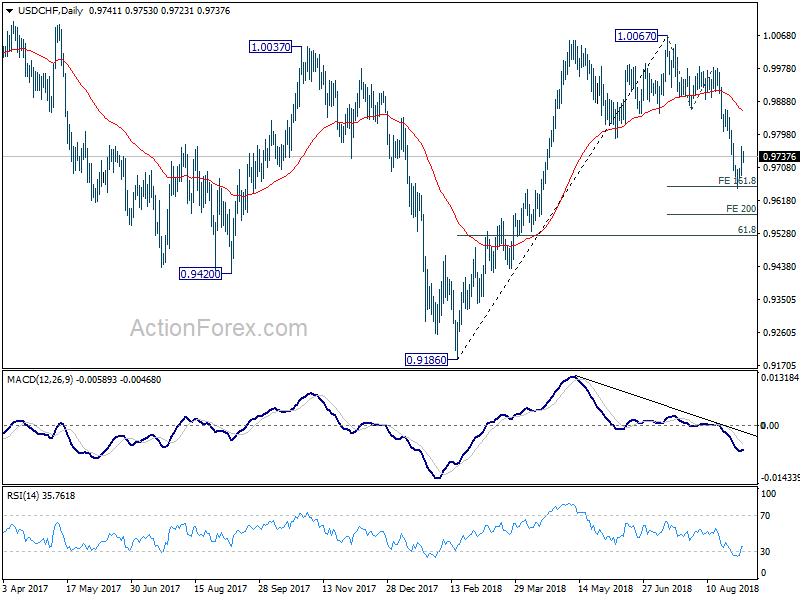
USD/CHF is still staying in range below 0.9775 minor resistance and intraday bias remains neutral. With 0.9775 intact, another decline is mildly in favor. On the downside, break of 0.9651 will target 200% projection of 1.0067 to 0.9866 from 0.9981 at 0.8579 next. However, Firm break of 0.9775 will be an early sign of near term reversal. That is, fall from 1.0067 could have completed. In this case, further rally would be seen back to 0.9866 support turned resistance for confirmation.
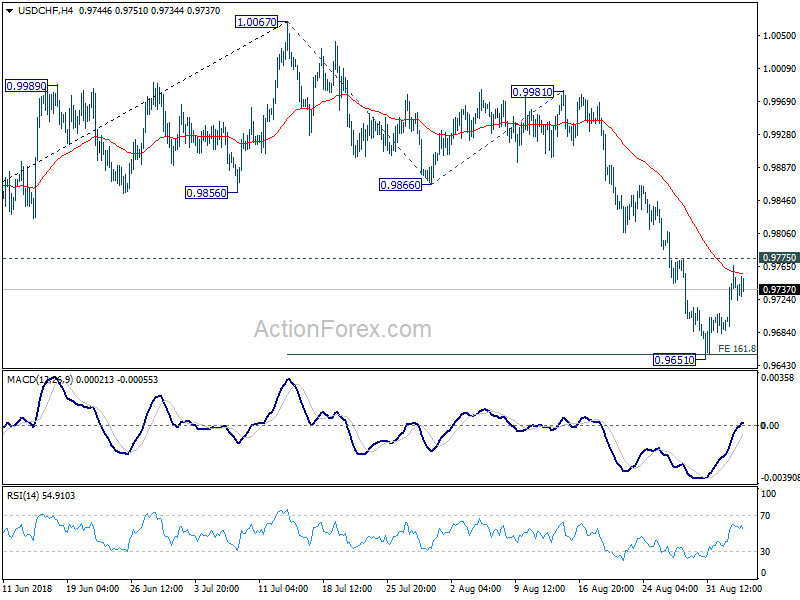
In the bigger picture, current development suggests that rise from 0.9186 low has completed at 1.0067, after failing to sustain above 1.0037 resistance. Fall from 1.0067 could extend to 61.8% retracement of 0.9816 to 1.0067 at 0.9523 and below. But for now, we don't expect a break of 0.9186 low. On the upside, firm break of 0.9866 support turned resistance will suggests that fall from 1.0067 has completed and rise from 0.9186 is resuming.
Budget Discipline Narrows Italian-German Yield Spread, Yen and Swiss Franc Lower
Risk aversion is the general theme in European and Asian markets today while US futures point to lower open. But that's not quite reflected in the currency markets. New Zealand Dollar is trading as the strongest one so far. Canadian Dollar also recovered some ground as markets await BoC rate decision. The central bank will most likely stand pat today and save the anticipated H2 rate hike for October. US-Canada trade talk will also restart but expectation is rather low. Dollar follows as the third strongest one.
Sterling is so far the worst performing one as this week's selloff, on Brexit, extends. Stronger than expected PMI services couldn't save the pound. Yen and Swiss Franc follow as the next weakest despite risk aversion. Easing worries over Italy is seen by us as a major factor. Italian 10 year bond yield drops sharply by -0.1351 so far today 2.896. Also, German 10 year bund yield is up 0.009 to 0.368. Now, spread at 300 is rather far away again. And recovery in German yield helps support Euro against Yen and the Franc.
Quick update: Sterling rebounds strongly as Bloomberg reports that both Germany and UK have dropped key Brexit demands, citing unnamed source. Additionally, there are signs of progress on the key sticky issue of Irish border. Also, even though there are oppositions to the Chequers plan, Bloomberg's source said that such opposition isn't necessarily an obstacle for the agreement.
Quick update 2: BoC kept overnight cash rate target unchanged at 1.50% as widely expected. Full statement here.
Quick update 3: Sterling is hammered down as a German government spokesman cleared the air and said the position on Brexit is unchanged. Also, the spokesman said Germany has full trust in EU chief negotiator Michel Barnier.
In the stock markets, at the time of writing, FTSE is down -0.37%, DAX down -0.68% and CAC down -0.98%. Earlier today, Hong Kong HSI closed down -2.61%, China Shanghai SSE down -1.68%, Nikkei down -0.51% while Singapore Strait Times fell -1.69%. WTI crude oil once again failed to stay above 70 handle and is now back below 69. Gold is now defending 1190 as near term consolidation extends.
Technically, while Yen weakens today, the recoveries in both EUR/JPY and GBP/JPY are rather weak and corrective looking. From that, we'd expect Yen buying to resume not soon after. 1.1529 support in EUR/USD and 0.9775 resistance in USD/CHF will remain the levels to watch for confirming whether Dollar has the momentum to complete recent correction.
Released in the US session, Canada trade deficit narrowed to CAD -0.1B in July, smaller than expectation of CAD -0.8B. Labor productivity rose 0.7% qoq in Q2 versus expectation of 0.2% qoq. US trade deficit widened to USD -50.1B in July, worse than expectation of USD -47.6B.
Italian yield tumbles after Salvini pledged not to blow up public account
Italian 10 year bond yield drops sharply today as, Deputy Prime Minister Matteo Salvini reiterated the pledge not to blow up public accounts/ Salvini, leader of the far right League, said in a newspaper interview that "clearly we will not do everything in one shot, not even Italians expect that from us... If we want to run the country for a long period we cannot blow up its public accounts." Additionally, another Deputy Prime Minister and Five-Star Movement leader, Luigi Di Maio also said "the budget law will be courageous and will keep accounts in order."
Eurozone PMI composite finalized at 54.4, expansion looking increasingly uneven
Eurozone PMI services was finalized at 54.4 in August, unrevised, up from July's 54.2. PMI composite was revised up to 54.5, up from July's 54.3. Among the countries, Ireland PMI composite hit 7-month high of 58.4. German PMI composite hit 6-month high at 55.6. However, Italy PMI composite hit 22-month low at 51.7. Chris Williamson, Chief Business Economist at IHS Markit said that "recent run of robust growth of business activity, new orders and employment extending into August." However, "expansion is looking increasingly uneven". The survey data suggested that Eurozone GDP will at least match 0.4% as in Q2. But "downturn in optimism raises questions over whether this pace of growth can be sustained into the fourth quarter."
Also from Eurozone, retail sales dropped -0.2% mom in July, below expectation of -0.1% mom.
UK PMI services rose to 54.3, but risk tilted to the downside
UK PMI services rose to 54.3 in August, up from 53.5, and beat expectation of 53.9. Markit noted in the released that there were stronger rises in business activity and new work. At the same time, input cost inflation accelerated, led by fuel prices and wage pressures. However, optimism towards the year-ahead business outlook was at lowest level since March.
Chris Williamson, Chief Business Economist at IHS Markit said that the survey data pointed to 0.4% growth in Q3. And, that's "a relatively robust and resilient rate of expansion that will no doubt draw some sighs of relief at the Bank of England after the rate hike earlier in the month." However, "business expectations for the year ahead meanwhile sank markedly lower... reflecting increased anxiety over Brexit negotiations." And, "given the increasingly unbalanced nature of growth and the darkening business mood, risks to the immediate outlook seem tilted to the downside."
Australia GDP grew 0.9% qoq, 3.4% yoy, Aussie lifted briefly
Australian Dollar was lifted notably by better than expected GDP data in Asian session. Q2 GDP rose 0.9% qoq, 3.4% yoy, comparing to expectation of 0.8% qoq, 2.8% yoy. That's marked the 27th year without recession, and it's the strongest in almost six years. Chief Economist for the ABS, Bruce Hockman, said: "Growth in domestic demand accounts for over half the growth in GDP, and reflected strength in household expenditure."
Looking at the details, domestic demand rose 0.6% qoq, government expenditure rose 1.0% qoq, new dwelling investments rose 3.6% qoq. However, employee compensation grew only 0.7% qoq "due to a rises in the number of wage and salary earners and wage rates."
The lift to Aussie is relatively brief however. While the GDP figure was strong, it's not enough to trigger even a rethink of interest path of RBA. Policymakers are looking for sign of pick up of wage growth.
Also released, Australia AiG performance of services index dropped -1.4 to 52.2 in August. New Zealand ANZ commodity price dropped -1.1% in August. China PMI services dropped to 51.5 in August, down from 52.8.
USD/CHF Mid-Day Outlook
Daily Pivots: (S1) 0.9696; (P) 0.9732; (R1) 0.9778; More.....
USD/CHF is still staying in range below 0.9775 minor resistance and intraday bias remains neutral. With 0.9775 intact, another decline is mildly in favor. On the downside, break of 0.9651 will target 200% projection of 1.0067 to 0.9866 from 0.9981 at 0.8579 next. However, Firm break of 0.9775 will be an early sign of near term reversal. That is, fall from 1.0067 could have completed. In this case, further rally would be seen back to 0.9866 support turned resistance for confirmation.
In the bigger picture, current development suggests that rise from 0.9186 low has completed at 1.0067, after failing to sustain above 1.0037 resistance. Fall from 1.0067 could extend to 61.8% retracement of 0.9816 to 1.0067 at 0.9523 and below. But for now, we don't expect a break of 0.9186 low. On the upside, firm break of 0.9866 support turned resistance will suggests that fall from 1.0067 has completed and rise from 0.9186 is resuming.
Economic Indicators Update
| GMT | Ccy | Events | Actual | Forecast | Previous | Revised |
|---|---|---|---|---|---|---|
| 22:30 | AUD | AiG Performance of Service Index Aug | 52.2 | 53.6 | ||
| 01:00 | NZD | ANZ Commodity Price Aug | -1.10% | -3.20% | -3.30% | |
| 01:30 | AUD | GDP Q/Q Q2 | 0.90% | 0.80% | 1.00% | 1.10% |
| 01:30 | AUD | GDP Y/Y Q2 | 3.40% | 2.80% | 3.10% | |
| 01:45 | CNY | China PMI Services Aug | 51.5 | 52.7 | 52.8 | |
| 07:45 | EUR | Italy Services PMI Aug | 52.6 | 53.2 | 54 | |
| 07:50 | EUR | France Services PMI Aug F | 55.4 | 55.7 | 55.7 | |
| 07:55 | EUR | Germany Services PMI Aug F | 55 | 55.2 | 55.2 | |
| 08:00 | EUR | Eurozone Services PMI Aug F | 54.4 | 54.4 | 54.4 | |
| 08:30 | GBP | Services PMI Aug | 54.3 | 53.9 | 53.5 | |
| 09:00 | EUR | Eurozone Retail Sales M/M Jul | -0.20% | -0.10% | 0.30% | |
| 12:30 | CAD | Trade Balance (CAD) Jul | -0.1B | -0.8B | -0.6B | -0.7B |
| 12:30 | CAD | Labor Productivity Q/Q Q2 | 0.70% | 0.20% | -0.30% | -0.30% |
| 12:30 | USD | Trade Balance (USD) Jul | -50.1B | -47.6B | -46.3B | -45.7B |
| 14:00 | CAD | BoC Rate Decision | 1.50% | 1.50% | 1.50% |
Pound Holds Bearish Move Despite Upbeat Services PMI; Loonie Rebounds ahead of BoC Rate Decision
Here are the latest developments in global markets:
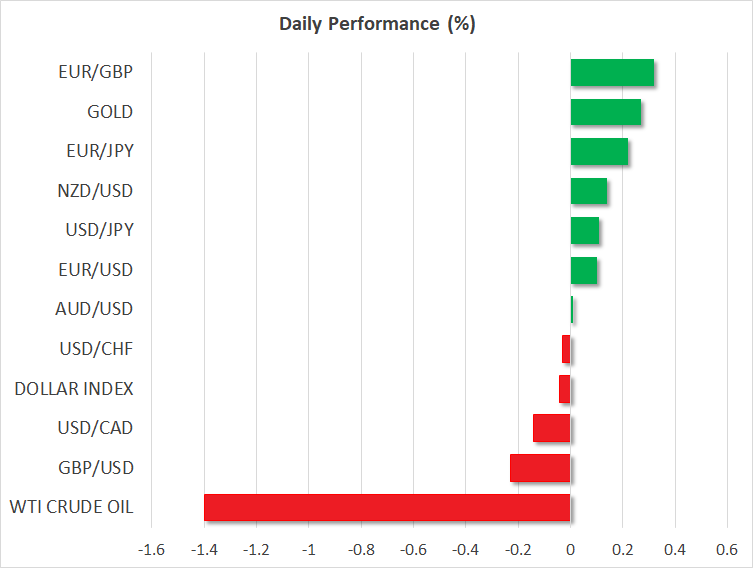
FOREX: The US dollar was moving sideways versus a basket of six major currencies on Wednesday as worries remain that the US President Donald Trump may soon restart a trade war with Beijing by imposing tariffs on more Chinese imports as early as tomorrow. Dollar/yen edged up by 0.12% but remained below its intraday high of 111.71. Turning to the euro area, the final German Markit services PMIfor the month of August was revised down to 55.0 compared to the 55.2 in the preliminary estimate, while the Eurozone Markit composite PMI finalized at 54.4 as expected in the same month. Meanwhile, retail sales in the euro area increased by 1.1% y/y in July from 1.2% previously, matching expectations. After the data, euro/dollar was trading lower by 0.11 %. Pound/dollar fell by 0.30% despite better-than-expected Markit/CIPS UK services PMI data; the index improved by 0.8 points to 54.3, compared to the expected 53.9. The antipodean currencies were mixed today, with aussie/dollar being flat and kiwi/dollar up by 0.11%. Dollar/loonie inched down to 1.3176 (-0.08%) after piercing slightly above the 1.3200 level on Tuesday. The BoC rate decision could bring further volatility to the loonie later today.
STOCKS: Investors were in a cautious mood in the European stock markets, driving equity indices lower on Wednesday except for the Italian FTSE MIB, which managed to surge by 1.0% at 1100 GMT; the upside move followed news by Italy’s deputy PM that the budget will be “courageous”. The pan-European STOXX 600 dived by 0.68% to its lowest since July and the blue-chip Euro STOXX 50 was down by 0.82%, hitting a 5-month trough. The German DAX 30 dropped by 0.61%, the UK’s FTSE 100 moved down by 0.33% and the Spanish IBEX 35 eased by 0.07%. The French CAC 40 was the worst performer, losing 0.95%. Futures tracking US stock indices were all in the red, pointing to a negative open.
COMMODITIES: Oil prices edged sharply lower today as a tropical storm hitting the US Gulf coast weakened. West Texas Intermediate (WTI) crude lost all the gains that it posted yesterday and dropped by 1.35% to $68.93/barrel. Brent oil retreated by 1.06% to $77.34 following the bounce off the highest level since May. In related news, Saudi Arabia said that it wants crude prices to stay between $70 and $80 per barrel, while OPEC’s General Secretary Mohammad Barkindo expressed the view that world oil demand will hit 100 million barrels per day “much sooner” than previously expected. Gold rose by 0.32% to $1,194.8/ounce.
Day ahead: Trade data out of the US and Canada eyed; BoC rate decision in the forefront
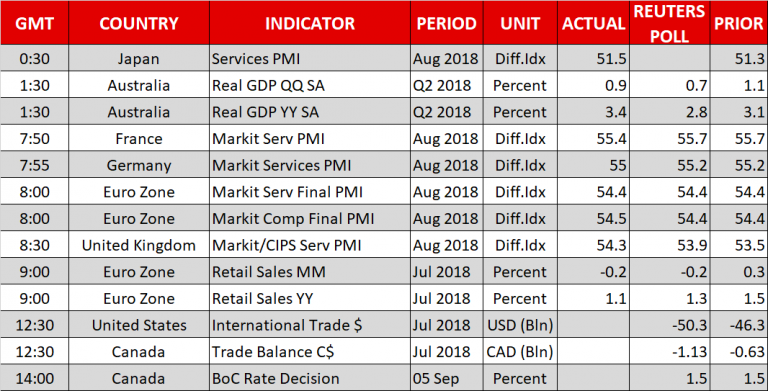
The US and Canada will see the release of trade data later on Wednesday as unresolved NAFTA negotiations between the countries resume today in Washington, a few days after the US president suggested to leave Canada out of the pact if the deal is not “fair” for the US. The talks will also come at a time when Bank of Canada (BoC) policymakers gather to decide on interest rates, with investors waiting eagerly to hear whether the BoC will keep its data-dependent approach under a riskier trade environment.
At 1230 GMT, the Bureau of Economic Analysis is expected to say that despite narrowing for the past three months, the US international trade deficit widened to $50.3 billion in July from $46.3bn in the previous month, reaching the highest since February. Investors, however, will likely be more interested to see whether the trade deficit was skewed on the Chinese or Canadian side as Washington continues to attack China and Canada.
At the same time in Canada, though, trade terms are also anticipated to deteriorate in July, with the deficit projected to come wider at C$1.13bn after reaching 1-year lows at C$0.63bn in June. Still, traders could wait for the BoC rate announcement later at 1400 GMT before taking a position on the loonie. Forecasts are for policymakers to hold borrowing costs unchanged at 1.50% with the probability for such an outcome currently standing at 82% according to overnight index swaps. Given that the NAFTA disagreements have fired up again, the central bank would prefer to sit on the sidelines for now despite inflation hitting 3.0% in July, the upper limit of its 1-3.0% price target.
Yet it could message that the next rate hike could come as soon as next month while flagging that the rate path will remain dependent on economic data to ensure that higher rates are manageable by high-indebted households. Note that household debt to disposable income ratio fell to the lowest in two years in the first quarter after new mortgage restrictions took effect in January. Should the rate statement sound more optimistic than analysts think, the loonie could recoup previous losses. On the other hand, if the BoC casts doubts on rate increases in coming months, the currency could lose ground. No press conference will follow by Governor Stephen Poloz after the completion of the meeting.
Elsewhere, Australian trade stats will come under review on Thursday at 0130 GMT, while Switzerland will publish GDP growth readings for the second quarter at 0545 GMT. In Sweden, the Riksbank is projected to hold rates steady at 0730 GMT and give a guideline on future rate hikes tomorrow.
Brexit will remain under the spotlight. Yesterday the Bank of England Chief, Mark Carney, said during his testimony in Parliament that he will extend his term beyond June 2019 to assist the British economy after its exit from the EU. Recall that the Treasury Committee has asked Carney to stay in his post until 2020.
Trade developments could make headlines during the day ahead of a crucial tariff deadline on Thursday; the US is scheduled to impose tariffs on $200 billion Chinese imports, while China could retaliate by unleashing tariffs on $60 billion US products.
In equities, executives from Facebook and Twitter, as well as Google’s top lawyer will be testifying before Congress on Wednesday on Russia meddling in the 2016 US presidential election.
In energy markets, weekly API data on US crude stocks are due at 2030 GMT.
In terms of public appearances, the dove Federal Reserve Bank of Minneapolis President, Neel Kashkari (FOMC member) will be speaking in Bozeman, Montana at 0800 GMT, while at 2230 GMT, the Atlanta Fed president, Raphael Bostic (FOMC member) will be commenting on monetary policy before a fireside chat of the Chicago Council on Global Affairs.
Canadian Dollar Under Pressure Over NATA Concerns, BoC Statement Next
The Canadian dollar has posted slight losses in the Wednesday session, after dropping sharply on Tuesday. Currently, USD/CAD is trading at 1.3178 down 0.08% on the day. On the release front, Canada releases Trade Balance and the Bank of Canada is expected to maintain the benchmark rate at 1.50%. In the U.S., the sole event is Trade Balance. On Thursday, the U.S releases ADP nonfarm payrolls, unemployment claims and the ISM Non-Manufacturing PMI.
It’s been a tough week for the Canadian dollar, which managed to lose ground on Labor Day, even though U.S and Canadian markets were closed. The currency has dropped 1.0% this week, as concerns over NAFTA are weighing heavily on the Canadian dollar. Canada and the U.S have already exchanged tariffs on each other’s products, and Canadian and U.S negotiators are scrambling to reach an agreement after a Friday deadline was missed. The U.S and Mexico reached an agreement in August, leaving Canada out in the cold. In order to reach a new trade agreement with the U.S, Canada will likely have to make some concessions, such as reducing hefty tariffs which protect the Canadian dairy industry. Prime Minister Justin Trudeau has said that no deal is better than a bad deal, but it’s clear that Canada can ill-afford to remain the odd man out, with some 75% of Canadian exports destined for the U.S.
The Bank of Canada releases its monthly rate statement later on Wednesday, with policymakers expected to hold rates at 1.50%, after the Bank raised rates by a quarter-point in July. The Bank has hinted that it will raise rates before the end of year, but is unlikely to make a move on Wednesday, given the uncertainty over the NAFTA negotiations with the U.S. Still, with the Federal Reserve likely to raise rates later in September and possibly in December, the BoC will have to make a move – otherwise, there is a risk that business investment in Canada will decline. As well, the Canadian dollar would likely lose ground as the increase in interest rates in the U.S would make the greenback more attractive to investors.
Global Trade Tensions Fuel “Risk-off” Sentiment, EM Currencies Burn
Risk aversion remains at the forefront of the current market sentiment. Prolonged trade tensions around the global economy and the new risk that investors are attacking those markets belonging to currencies with high account deficits is playing a leading role behind the dent in market sentiment.
A negative vibe continues to linger in the vicinity ahead of looming U.S. tariffs on $200 billion worth of Chinese goods, while uncertainty over NAFTA talks have left global sentiment extremely cautious. The lack of appetite for risk can be observed across stock markets today, with a wide number of Asian shares closing in red territory and European stocks following a similar trend.
The popular topic among investors remains the brutal selloff across emerging market currencies. It has certainly been a terrible trading week thus far for most major EM currencies as investors begin to compare the ongoing pressure in EM currencies to the 1997 Asian financial crisis. Trade war tensions and broad-based Dollar strength continue to play an active role in the weak sentiment for emerging markets, but the indications that investors have used the past events in Turkey to attack markets belonging to those with high current account deficits should not be ignored. The Indonesian Rupiah fell to another 20-year low against the USD earlier today while the Indian Rupee has fallen to yet another record low. The South African Rand has also been blasted into weakness following news yesterday that the economy has entered a recession. The most recent moves in the Rand are beginning to catch up to pre-crisis moves in the Lira, with the economic challenges that South Africa faces being quite similar to those in Turkey.
Heavy declines in the Turkish Lira and Argentina Peso have overall spread like a virus to other economies in the developing world with the Indonesian Rupiah, Rand and Russian Ruble just a few of the many succumbing to the negative trading environment. With the financial turmoil in Turkey and Argentina eroding sentiment and trade disputes promoting risk aversion, the near-term outlook for EM currencies remains pointed to the downside.
In the United Kingdom, Sterling bulls failed to make an appearance despite activity in Britain’s service sector picking up momentum in August. Although UK Services PMI rose 54.3 in August, up from 53.5 July, the fairly bland reaction continues to highlight how investors may be redirecting their attention elsewhere – namely uncertainty over Brexit talks. Taking a look at the technical picture, the GBPUSD remains bearish on the daily charts as long as bears can maintain control below 1.2900.
Across the Atlantic, the US Dollar is likely to remain king of the hill in the currency markets as trade tensions stimulate safe-haven demand for the Greenback. For as long as the Dollar continues to benefit from risk aversion the outlook remains bullish. Regarding the technical perspective, the Dollar Index is firmly bullish on the daily charts. Prices could challenge 95.80 in the near term once a daily close above 95.50 is achieved.
Gold prices floated slightly higher today amid the risk-off sentiment, but gains are seen as being capped by King Dollar.
The yellow metal has failed on repeated occasions to find any solid support from global trade concerns and this continues to be displayed in price action. Technical traders will closely observe how prices behave above the $1,190 level. An intraday breakdown below this level can open up the gates for a potential return to the 2018 low last seen nearly a month ago.
Into US session: Canadian Dollar recovers ahead of BoC, FX decoupled from risk markets
Entering into US session, Sterling is trading as the weakest one today, followed by Japan Japanese Yen. On other hand, New Zealand Dollar and Canadian Dollar are generally higher. The forex markets seem to have decoupled from risk sentiments today. But we'd reckon recoupling soon. BoC rate decision will be a focus in US session and it's widely expected to save bullet for October. US-Canada trade negotiation will resume in Washington today and that will also catch some attention.
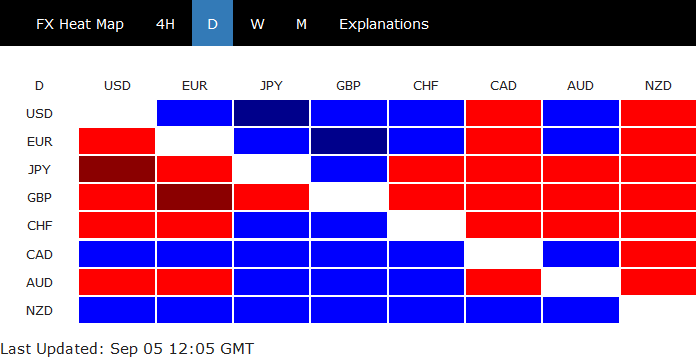
In other markets, major European indices are in red today, with FTSE down -0.33%, DAX down -0.58%, CAC down -0.85%. Earlier today, Hong Kong HSI closed down -2.61%, China Shanghai SSE down -1.68%, Nikkei down -0.51% while Singapore Strait Times fell -1.69%. WTI crude oil once again failed to stay above 70 handle and is now back below 69. Gold is now defending 1190 as near term consolidation extends.
DAX at 5-Month Low on Trump Tariffs, Soft PMIs
The DAX index has posted losses in the Wednesday session. Currently, the index is at 12,149, down 0.50% on the day. On the release front, Eurozone and German Services PMI reports rose slightly in August. The eurozone release improved to 55.4, matching the forecast. German Services PMI climbed to 55.0, but missed the forecast of 55.2 points. Eurozone retail sales declined 0.2%, missing the estimate of 0.1%. This marked the first decline since January. On Thursday, Germany releases factory orders.
With global trade tensions grabbing the headlines, German equity markets took a beating on Tuesday. The DAX fell 1.4% and has slipped to its lowest level since early April. The most important dispute is between the U.S and China. So far, the two economic giants have imposed $50 billion in tariffs on each other, and President Trump has threatened further tariffs worth some $200 billion, which could be imposed as early as this week. The U.S could elect to impose the tariffs in smaller bites, such as a $50 billion tariff. Trade trouble brews elsewhere as well. Talks are continuing between the U.S and Canada, after Friday’s deadline passed with no agreement in place. The EU has engaged in a tit-for-tat tariff exchange with the United States. The dollar has climbed significantly since trade tensions began in April, at the expense of the equity markets and other major currencies. If trade tensions continue to worsen, equity markets could continue to move lower.
EM Rout Continues, BoC Meeting In Focus
EM not out the wood yet: will it spread?
Emerging market currencies and world equities suffered another sell-off yesterday as investors remained worried that the crisis in Turkey and Argentina could spread to other vulnerable emerging market economies. The atmosphere is still very gloomy this morning as European equities slid further, following in Asian equities' footsteps. The EuroSTOXX 50 fell 0.85%, the DAX gave up 0.65%, while the SMI slid 0.45%. In the FX market, the deterioration in risk sentiment gives leg to the US dollar rally, which started last Friday, while safe haven currencies hold ground as investors take shelter.
Most investors believed the uncertainty that prevailed during the summer months would disappear when traders would come back from vacations. Unfortunately, it looks like it is here to last. We have the feeling it is now legitimate to wonder whether this is just a temporary situation or could potentially develop into a crisis. The market's wait-and-see mind-set over the last few months has demonstrated that investors couldn't find any reason to push stocks higher and that we could be ahead of difficult times. After all, a crisis usually start at the fringe before moving to the core.
Don't expect too much from today's BoC meeting
NAFTA trade talks between the US and Canada are resuming today – and this certainly not expected to be a quick resolution period. Indeed, negotiations already started last Tuesday and finally came up with no clear agreement on any single topics discussed, including agriculture, where US trade representative Robert Lighthizer office gave a statement on Friday complaining that Canada was not making any concessions on this subject. A situation that is not going to facilitate Bank of Canada business, whose monetary policy path will be put aside in current situation.
Although recent negotiations on the agriculture matter did not come up with a solution straight away with its US counterpart, recent negotiations on the matter have proven to be successful in the past. This is the case for instance with the EU, where Canadian authorities signed one year ago a new trade agreement with the UE named Comprehensive Economic and Trade Agreement which simplifies exports of goods and services from the EU or Canada and which eliminated 98% of tariffs between both countries, including on dairy products. Additional topics such as maintaining original NAFTA dispute settlement mechanism incl. countervailing or anti-dumping duties, steel aluminum tariffs and a cultural exemption clause (protecting Canada's cultural sectors such as media) will be discussed in the coming weeks.
Accordingly, as negotiations are on progress, the BoC is expected to remain cautious at today's MPC meeting, hoping that NAFTA negotiations will be concluded in a successful manner and maintaining its Overnight Lending Rate stable at 1.50% after rising it during last meeting on 11. July 2018 by 25 bps.
Continued weakness is expected for the loonie. Trading along 1.32, USD/CAD is heading along 1.3210 in the short-term.
BoC Can Wait, But Could Still Hike Rates Today
Wednesday September 5: Five things the markets are talking about
A new month, but the same mantra – trade concerns continue to simmer and erode risk appetite as emerging markets slide.
Yesterday it was EM currencies, today its global equities that are under stress, pressured by EM contagion fears. The ‘big’ dollar continues to find support for a fifth consecutive session while commodities fall, led by oil. The U.S 10-year note yield hovers atop of +2.89%.
On the trade front, Canada resumes Nafta talks in Washington today and is determined not to back down on key issues despite threats from President Trump to retaliate against the Canadian economy.
Also in focus is the Bank of Canada (BoC) monetary policy meeting (10:00 am EDT). Market consensus expects the BoC to leave its key rate unchanged (odds are at +18% for a rate hike). Nevertheless, there are arguments for a rate increase this morning because raising the key rate would reinforce Governor Poloz data-dependent stance at a time when the Canadian economy is operating at full capacity and growth has been strong.
1. Asian stocks stumble on hump day
Soured sentiment has left several Asian stock markets with their biggest declines in a fortnight, at least since the bout of EM worries that were fuelled by the TRY’s plunge.
In Japan, equities held up better than most, perhaps helped by the overnight yen softness (¥111.47). Nevertheless, investors remain worried that Sino-U.S tariff war could escalate weighed on sentiment. The Nikkei share average dropped -0.51% for a fourth consecutive session while the broader Topix fell -0.77%.
Down-under, Aussie shares extended their losses for a fifth consecutive session overnight, closing down -1%, brushing aside a robust economic growth report (Q2 GDP +0.9% vs. +0.7%) as materials stocks slid on weaker commodity prices. In S. Korea, the Kospi plunged -1.03% as trade war fears intensify.
In Hong Kong, stocks posted their biggest loss in 11-weeks on growth and trade war fears. Overnight, investors’ dumped property, energy and tech stocks amid worries about China’s economy and the Sino-U.S trade war. The Hang Seng index fell -2.6%, while the China Enterprises Index lost -2.3%.
In China, anaemic growth prospects have again pressured regional indexes. The Hang Seng index fell -2.6%, while the China Enterprises Index lost -2.3%.
In Europe, indices trade lower across the board. Leading the way is the French CAC, which is underperforming on a lower revised PMI reading and weakness in oil giant Total.
U.S stocks are set to open deep in the ‘red’ (-0.3%).
Indices: Stoxx600 -0.7% at 377.0, FTSE -0.4% 7426, DAX -0.7% at 12118, CAC-40 -1.2% at 5279, IBEX-35 -0.7% at 9315, FTSE MIB -0.1% at 20580, SMI -0.8% at 8880, S&P 500 Futures -0.3%
2. Oil falls as U.S storm threat ease, gold prices rally
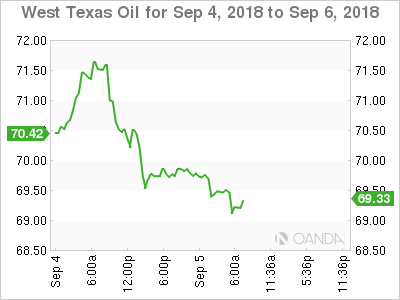
U.S crude oil prices are under pressure as a tropical storm Gordon has hit the U.S Gulf coast much weaker than expected, offsetting support from forecasts of lower U.S inventories and sanctions against Iran.
Crude prices rallied yesterday as oil companies shut a number of offshore platforms in anticipation of damage from the tropical storm – the market had anticipated the storm would strengthen to a hurricane.
Brent crude fell -47c to +$77.70 a barrel – yesterday, intraday prices climbed to +$79.72, their highest in three-months – while U.S light crude (WTI) is down -72c at +$69.15.
Investors will take their cue from today’s inventory report – API releases its supply report at 04:30 EDT, a day later than usual because of the Labor Day holiday on Monday.
Crude prices could gain support if this week’s U.S inventory reports show a drop in crude stocks, as expected. The market is expecting a drawdown of around -2M barrels million barrels last week.
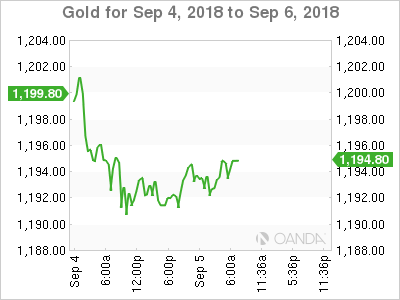
Ahead of the U.S open, gold prices are a tad higher on technical buying amid worries over inflation in EM. Nevertheless, gains remain capped as the ‘big’ dollar rallies on heightened concerns about international trade conflicts. Spot gold is up +0.2% at +$1,193.24, while U.S gold futures are mostly steady at +$1,198.40 an ounce.
3. Italian yields extend their fall on E.U budget remarks
Italian bond yields are under pressure after the Italian government moved to reassure investors that E.U fiscal rules would be respected. Nevertheless, further budget talks may affect BTP yields further.
Italy’s 10-year yield spread over Germany (+257 bps) is at its narrowest point since Aug. 10, but it still remains elevated at some +50 bps above recent lows in July, and +150 bps wider than pre-election levels.
Note: The market remains concerned that increased government spending will see Italy breach E.U fiscal rules and back up Italian yields even further.
Elsewhere, the yield on U.S 10-year notes declined less than -1 bps to +2.89%, while the yield on U.S 2’s fell less than -1 bps to +2.65%. In Germany, the 10-year Bund yield increased less than +1 bps to +0.36%, the highest in a week
4. EM contagion fears support U.S dollar
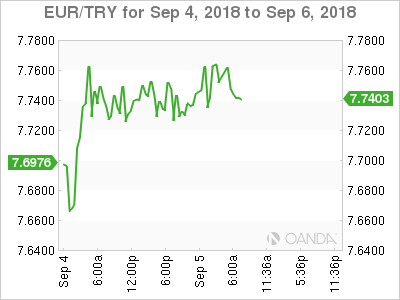
September is carrying on August’s trend – safe-haven flows continue to support the U.S dollar for a fifth consecutive session as the ‘public comment period’ related to the U.S’s proposed tariffs on +$200B of China goods is due to end tomorrow.
EUR/USD (€1.1569) is softer, trading below the psychological €1.1600 handle despite ‘bullish’ comments from Italian government officials that they will respect E.U budget laws.
GBP/USD (£1.2802) continues to probe its multi week lows on Brexit concerns. The BoE is likely to remain on hold until after the March 2019 Brexit deal. Better Services PMI data (see below) helped to support pound into the U.S session.
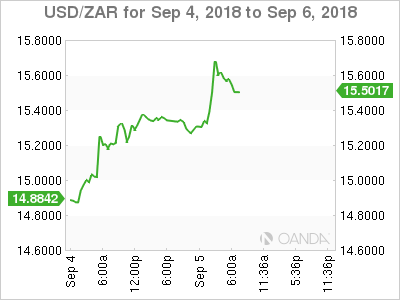
Emerging market currencies continue to weaken with South Africa’s ZAR hitting a new two-year low around the $15.70 level earlier this morning.
Note: In South Africa, the country officially entered a recession after yesterday’s GDP data. Q2 GDP annualized q/q: -0.7% vs. +0.6%E; y/y: +0.4% vs. +1.0%E – moves into recession for first time since 2009.
5. U.K services PMI does not budge sterling
Data this morning showed that Britain’s large services sector picked up more strongly than expected last month, bucking a slowdown for manufacturers and construction firms, but Brexit worries are dampening investment plans and confidence for the next 12-months.
The IHS Markit/CIPS Purchasing Managers’ Index (PMI) increased to 54.3 in August from 53.5 in July, beating market expectations.
“Adding in manufacturing and construction sector data published on Monday, the PMI pointed to a repeat of the overall economy’s +0.4% quarterly growth rate recorded in the three-months to June,” IHS Markit said.
Note: The U.K economy has slowed since the June 2016 Brexit vote, its growth rate slipping from top spot amongst the G7 group to elbowing with Japan and Italy for last spot in the growth rankings.
EUR/USD – Euro Ticks Lower As German Services PMI Misses Forecast
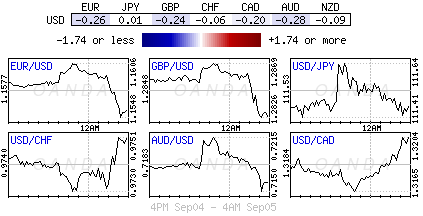
EUR/USD has recorded small losses in the Wednesday session. Currently, the pair is trading at 1.1577, down 0.04% on the day. On the release front, Eurozone and German Services PMI reports rose slightly in August. The eurozone release improved to 55.4, matching the forecast. German Services PMI climbed to 55.0, but missed the forecast of 55.2 points. In the U.S. the sole event is Trade Balance. On Thursday, Germany releases factory orders, while the U.S publishes key employment and services reports.
PMI reports are important snapshots of the strength of the economy and are closely monitored by investors. Although this week’s services and manufacturing PMI reports continue to point to expansion, the mood remains one of concern, given that the indicators have been falling short of estimates, and in some cases pointing to a downward trend. Services PMI releases in the eurozone and Germany improved in August. Eurozone Services PMI edged up from 54.2 to 54.4, while the German release climbed from 54.1 to 55.0 points. Although there are respectable numbers which point to expansion, there is some concern, as the German release missed the forecast for a second straight month.
On the manufacturing front, PMI numbers are also raising concerns. This was particularly evident in Eurozone Final Manufacturing PMI, which lost ground for an eighth straight month. The reading of 54.6, which matched the estimate, marked the lowest level since November 2016. In Germany, Final Manufacturing PMI fell from 56.9 to 55.9. Although this is a respectable reading, it is significantly lower than the readings we saw early in 2018, when the indicator was above the 60-level. German manufacturers remain generally optimistic, but have growing concerns over tariffs which the U.S has slapped on China and the EU.