Sample Category Title
Politics Remains A Hot Topic
Market movers today
The US market is closed due to Labour Day.
As we wrote in Strategy: Global macro themes in H2 18, (geo)politics will remain a hot topic here after the summer holiday.
Italy is in focus after Fitch put the country on negative outlook, and in light of the still wobbly Emerging Market sentiment it will be interesting to see whether a further rise in Turkish inflation today will draw any comments from the central bank and the pressure on the Turkish Lira.
In the UK, the House of Commons returns to session this week after a long holiday. Brexit will probably start to dominate the media coverage again ahead of the end-game in Q4. We believe the GBP will remain weak and volatile until we get more clarification on Brexit.
Global trade war concerns will be in focus later this week, as the hearing period of US tariffs on USD200bn of Chinese goods concludes on Wednesday. Last week, President Trump also reminded us all that there is only a cease fire between the US and EU, as no final deal on trade has been reached.
In terms of economic data releases, we get the August US jobs report on Friday.
Today 's Scandi figures include August manufacturing PMIs for both Sweden and Norway. In Sweden in particular, this week is very interesting with the Riksbank rate decision on Thursday and the general election on Sunday.
The geopolitical stand-off between Russia and the US in Syria is escalating. The Syrian war could hit the wires over the next few days, affecting markets through risk sentiment and the oil price.
Selected market news
On Friday, Fitch affirmed Italy's BBB rating but put the country on negative outlook (from stable) as a consequence of the political uncertainty. This was probably more or less in line with market expectations but may be seen as positive this morning, as it means the risk of any rating downgrades before end-September is low. The full Fitch report can be seen here. Despite Fitch's decision to delay a downgrade, the Italian-German 10Y bond spread is still trading significantly out of line with European peers. The next key date is the release of t he M inistry of Finance's p ublic debt and deficit projections on 27 September.
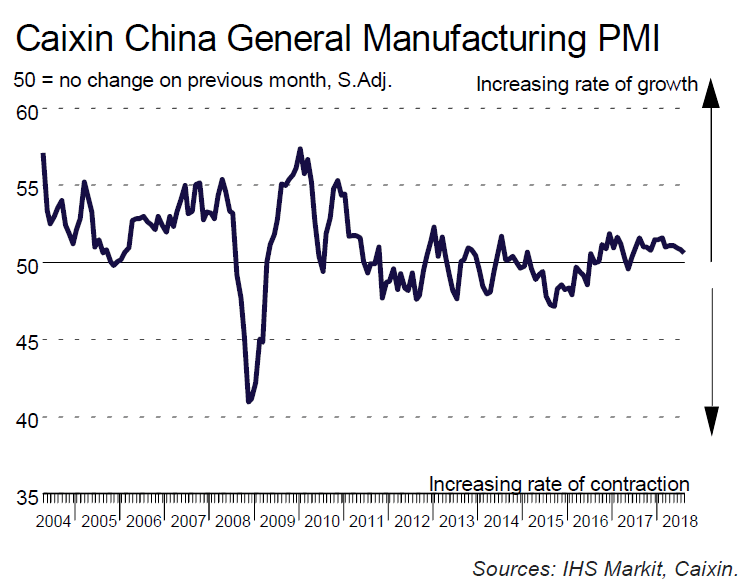
The Chinese Caixin PMI manufacturing fell to 50.6 in August, the weakest since June 2017 with the new orders sub-index at the lowest level since May 2017. Exports have been below 50 for five consecutive months. While it is not surprising the economy is slowing, it is probably slowing at a faster pace than the Chinese government likes now that also trade uncertainties are weighing on the economy. This is also the reason why it has stepped in with easier monetary and fiscal policy. We expect a soft landing.
Sterling Lower as EU Barnier Rubbished UK Brexit Plan, Yen Jumps on Risk Aversion and JGB Yields
Sterling opens the weak broadly lower and stays soft after EU chief Brexit negotiator Michel Barnier said he "strongly opposed" to UK's impractical plan. The Pound has been sensitive to any Brexit headlines and will continue to be so. New Zealand Dollar is the second weakest one. But Canadian Dollar is not too far away after trade talk with the US failed. Yen is trading as the strongest one on risk aversion. Economic data released in Asia Pacific were generally not too supportive. Euro and Australian Dollar are generally higher, next to Yen, and these two are paring last week's steep losses.
In other markets, Nikkei closed down -0.69% at 22707.38. It's now getting farther away from 23050 key near term resistance. China Shanghai SSE is down -0.38% at the time of writing. Hong Kong HSI is down -0.83% and Singapore Strait Times is down -0.37%. 10 year JGB yield is rising for another day, up 0.011 to 0.12%. This is another Yen supportive factor too. WTI crude oil breached 70 to 70.5 last week but it's now back at 69.65. Gold is hovering around 1200 as consolidation continues.
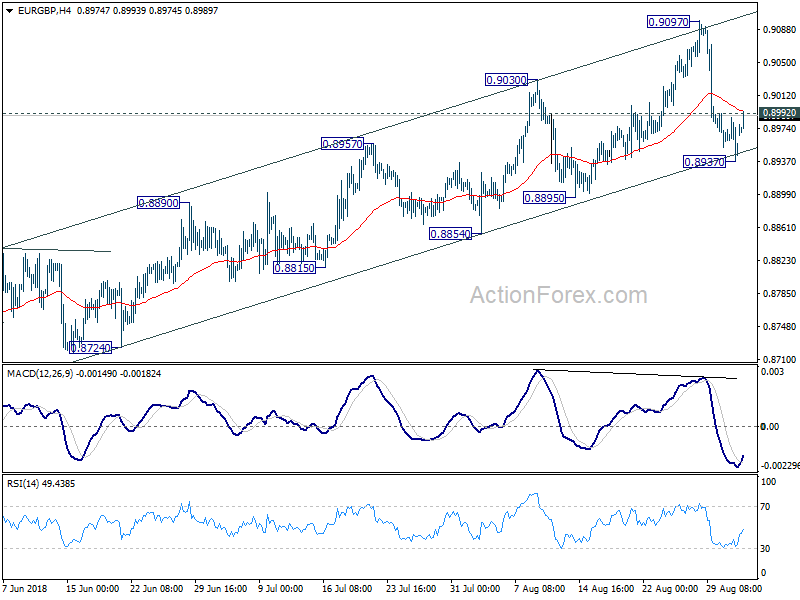
Technically, one development to note is EUR/GBP's rebound after drawing support from channel support. With 0.8992 minor resistance breached, the cross is possibly heading back to 0.9097 resistance And with the near term rising channel supported, outlook stays bullish for further rally. USD/CAD will be facing near term channel resistance at 1.3098 soon. Decisive break there will suggests that recent correction from 1.3385 has completed and could pave the way to retest this high.
Sterling weakens broadly as EU Barnier blasted Theresa May's Chequers plan
Sterling opened the week broadly lower after EU chief Brexit negotiator Michel Barnier blasted UK Prime Minister Theresa May's . And, Barnier "strongly opposed" May's proposals. On the customs proposals, Barnier said its "not practical". He added, "it is impossible to tell exactly where a product ends up, on the UK market or in the internal market." And, "the British proposal would be an invitation to fraud if implemented."
He also criticized that the "common rulebook" idea as outdated with modern world of trade. He said "the interest of Europeans is to preserve the integrity of the common market. That is our special strength and the reason why we are respected throughout the world, even in the United States." He added "we have a coherent market for goods, services, capital and people – our own ecosystem that has grown over decades. You cannot play with it by picking pieces." Therefore, the EU must prevent unfair competition if the United Kingdom has weaker legal requirements than we do. Otherwise we would discriminate and weaken our own companies."
On the other hand, a UK government spokeswoman defended that the proposal is "precise, pragmatic and that will work for the UK and the EU." And, "this proposal achieves a new balance of rights and obligations that fulfils our joint ambition to establish a deep and special partnership once the UK has left the EU while preserving the constitutional integrity of the UK. There is no other proposal that does that.
Trump slammed Canada and NAFTA, but the messages were for the Congress
The trade negotiation between US and Canada ended last week without any conclusion. Trump has already notified the Congress of his intent to sign a bilateral trade agreement with Mexico, which is called the United States- Mexico Trade Agreement. US-Canada trade negotiations will resume this Wednesday.
Over the weekend, he slammed Canada and NAFTA with his tweets. He said "there is no political necessity to keep Canada in the new NAFTA deal. If we don't make a fair deal for the U.S. after decades of abuse, Canada will be out." And, "Congress should not interfere w/these negotiations or I will simply terminate NAFTA entirely & we will be far better off." Trump added "we were far better off before NAFTA — should never have been signed. Even the Vat Tax was not accounted for. We make new deal or go back to pre-NAFTA!"
While Canada was the topic of the tweets, the messages were clearly to the Congress. For now, it's uncertain how Trump could get the US-Mexico trade deal through the Congress, without the involvement of Canada. Last Friday, chief executive of the U.S. Chamber of Commerce, Thomas Donohue also said in a statement that "anything other than a trilateral agreement won't win Congressional approval and would lose business support."
Democrat House minority leader Nancy Pelosi also said "actually fixing NAFTA requires reaching a trade agreement with both Mexico and Canada," "without a final agreement with Canada, the administration's work is woefully incomplete."
Japan PMI manufacturing finalized at 52.5, potential escalations in trade conflict weigh on sentiment
Japan PMI manufacturing was finalized at 52.5 in August, unrevised, up from July's 52.3. Markit noted in the released that "production rises amid faster new order growth", "export orders fall for second time in three months", and "geopolitical risks weigh on business sentiment".
Joe Hayes, Economist at IHS Markit, noted that the "goods-producing sector continued to record growth at the midway point in Q3". That extended the current stretch of expansion to two years - the "longest since the global financial crisis". But he also pointed out that "upturn in demand was domestic-led," with "export sales falling over the month." And, "potential escalations in trade conflict also contributed to a softening of business confidence."
However, the so called softening business confidence was not quite reflected in other data. Japan capital spending has increased 12.8% in Q2, nearly double of expectation of 6.6% and almost four times of prior quarter's 3.4%.
Mixed Australia data: Retail sales missed, manufacturing PMI rose
Australian Dollar weakened in early Asian session after mixed economic data. But Aussie quickly recovered, partly helped by oversold conditions. On the negative side, retails sales rose 0.0% mom in July, below expectation of 0.3% mom. There were falls in three of the six industries, including household goods retailing (-1.2%), clothing, footwear and personal accessory retailing (-2.0%) and department stores (-1.9%). The declines were offset by other retailing (1.7%), food (0.3%) and cafes, restaurants and takeaway food services (0.6%)". Also, ANZ job advertisements dropped -0.6% mom in August. That could point to easing momentum in job growth.
On the positive side, AiG Performance of Manufacturing Index rose 4.7 pts to 56.7 in August, indicating faster growth across the manufacturing sector. In particular, exports sub-index has jumped 8.5 points to 58.4 points. However, drought conditions in New South Wales and Queensland are now having an adverse impact on input costs and sales for some manufacturers. Company operating profits rose 2.0% qoq in Q2. TD securities inflation rose 0.1% mom in August.
New Zealand Terms of Trade rose only 0.6% qoq, missed expectations
New Zealand Dollar weakens broadly today and stays generally weak as Terms of Trade Index rose only 0.6% qoq in Q2, versus expectation of 1.1% qoq. Prior quarter's figure was also revised down from 1.9% qoq to -2.0% qoq. Looking at the details, export prices for goods rose 2.4%, while import prices for goods rose 1.7%. Seasonally adjusted goods export volumes rose 1.1%, and goods import volumes rose 0.9%. Seasonally adjusted goods export values rose 3.0%, and goods import values rose 1.7%.
China Caixin PMI manufacturing dropped to 50.6, Economy facing obvious downward pressure
China Caixin PMI manufacturing dropped -0.2 to 50.6 in August, missed expectation of 50.7. In the release, it's noted that "output expands at faster pace... but new order growth weakens and employment continues to decline". Also, confidence towards the 12-month business outlook remains lacklustre". Also it's the third straight month of decline and the lowest level since June 2017.
Dr. Zhengsheng Zhong, Director of Macroeconomic Analysis at CEBM Group noted that "the manufacturing sector continued to weaken amid soft demand, even though the supply side was still stable". Also, "worsening employment situation is likely to have an impact on consumption growth." He warned that "China's economy is now facing relatively obvious downward pressure."
Looking ahead
Swiss will release retail sales and PMI manufacturing today. Eurozone will release PMI manufacturing revision. But the biggest mover could be UK PMi manufacturing. Meanwhile, US and Canada are on bank holiday.
EUR/GBP Daily Outlook
Daily Pivots: (S1) 0.8932; (P) 0.8960; (R1) 0.8985; More...
EUR/GBP's breach of 0.8992 minor resistance suggests that pull back from 0.9097 has completed at 0.8937, after drawing support from near term rising channel. Intraday bias is turned back to the upside for retesting 0.9097 first. Break will extend the larger rally from 0.8620 towards 0.9305 high. Over all, outlook will remain bullish as long as 0.8895 support holds. However, sustained break of channel support, followed by break of 0.8895, will argue that whole rise from 0.8620 has completed. And consider that it's not clearly impulsive in structure, break of 0.8895 will also suggest reversal and turn outlook bearish.
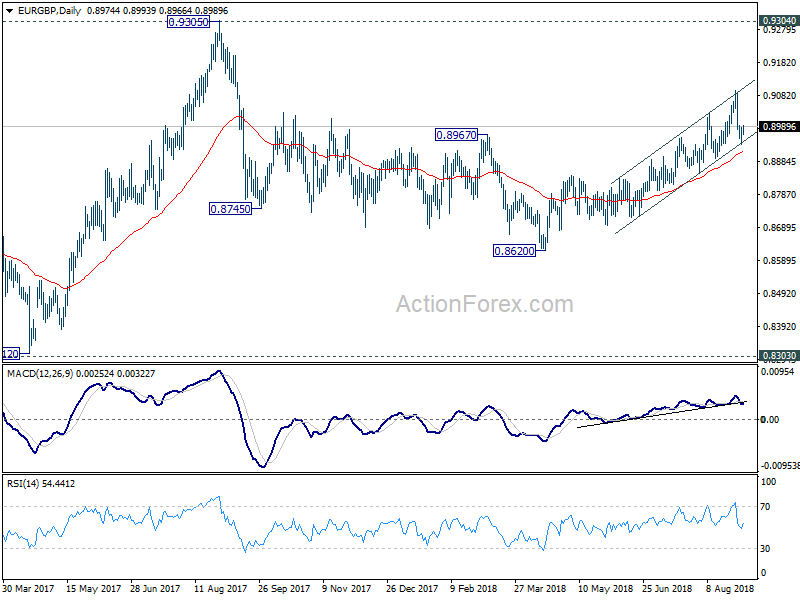
In the bigger picture, EUR/GBP is staying in long term range pattern from 0.9304 (2016 high). The corrective structure of the fall from 0.9305 to 0.8620 is raising the chance that rise from 0.8312 to 0.9305 is an impulsive move. But we're not too confident on it yet. In any case, we'd stay cautious on strong resistance from 0.9304/5 to limit upside in case of further rally. Meanwhile, if there is another medium term decline, strong support will likely be seen from 0.8303 to contain downside.
Economic Indicators Update
| GMT | Ccy | Events | Actual | Forecast | Previous | Revised |
|---|---|---|---|---|---|---|
| 22:30 | AUD | AiG Performance of Manufacturing Index Aug | 56.7 | 52 | ||
| 22:45 | NZD | Terms of Trade Index Q/Q Q2 | 0.60% | 1.10% | -1.90% | -2.00% |
| 23:50 | JPY | Capital Spending Q2 | 12.80% | 6.60% | 3.40% | |
| 0:30 | JPY | PMI Manufacturing Aug F | 52.5 | 52.5 | 52.5 | |
| 1:00 | AUD | TD Securities Inflation M/M Aug | 0.10% | 0.10% | ||
| 1:30 | AUD | ANZ Job Advertisements M/M Aug | -0.60% | 1.50% | 1.40% | |
| 1:30 | AUD | Company Operating Profit Q/Q Q2 | 2.00% | 1.40% | 5.90% | |
| 1:30 | AUD | Retail Sales M/M Jul | 0.00% | 0.30% | 0.40% | |
| 1:45 | CNY | PMI Manufacturing Aug | 50.6 | 50.7 | 50.8 | |
| 7:15 | CHF | Retail Sales Real Y/Y Jul | 1.20% | 0.30% | ||
| 7:30 | CHF | PMI Manufacturing Aug | 61 | 61.9 | ||
| 7:45 | EUR | Italy Manufacturing PMI Aug | 51.2 | 51.5 | ||
| 7:50 | EUR | France Manufacturing PMI Aug F | 53.7 | 53.7 | ||
| 7:55 | EUR | Germany Manufacturing PMI Aug F | 56.1 | 56.1 | ||
| 8:00 | EUR | Eurozone Manufacturing PMI Aug F | 54.6 | 54.6 | ||
| 8:30 | GBP | PMI Manufacturing Aug | 53.9 | 54 |
Euro-Zone’s Inflation Slowed In August, While Jobless Rate Declined In July
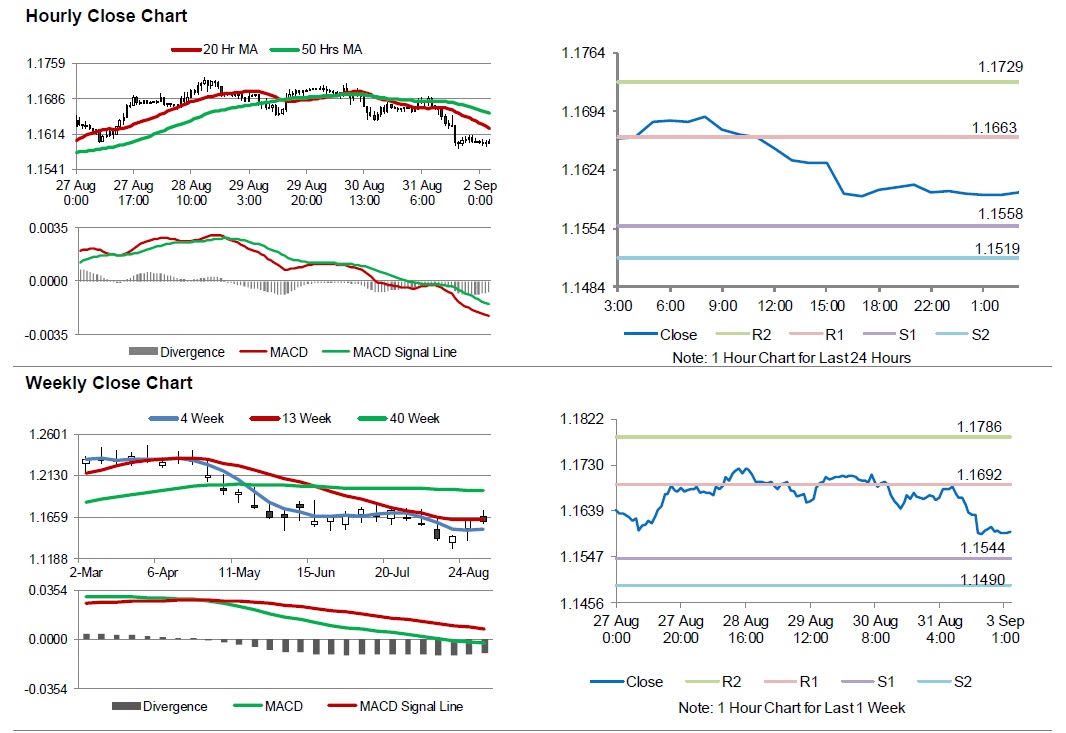
For the 24 hours to 23:00 GMT, the EUR declined 0.48% against the USD and closed at 1.1607 on Friday.
On the macro front, Euro-zone's flash consumer price index (CPI) climbed 2.0% on an annual basis in August, less than market expectations for a rise of 2.1%. In the prior month, the CPI had advanced 2.1%. Meanwhile, the nation's unemployment rate fell to 8.2% in July, in line with market expectations and registering its lowest level since November 2008. In the prior month, unemployment had recorded a rate of 8.3%.
Separately, in Germany, retail sales rose 0.8% on a yearly basis in July, less than market expectations for an advance of 1.3%. In the previous month, retail sales had risen 3.0%.
In the US, data showed that the final Reuters/Michigan consumer sentiment index dropped to 96.2 in August, compared to market expectations for a fall to a level of 95.5. The preliminary figures had indicated a fall to 95.3. In the prior month, the Reuters/Michigan consumer sentiment index had recorded a reading of 97.9. Moreover, the Chicago Fed purchasing managers' index (PMI) declined to 63.6 in August, less than market expectations for a drop to a level of 63.0. The Chicago Fed PMI had recorded a reading of 65.5 in the prior month.
In the Asian session, at GMT0300, the pair is trading at 1.1597, with the EUR trading 0.09% lower against the USD from Friday's close.
The pair is expected to find support at 1.1558, and a fall through could take it to the next support level of 1.1519. The pair is expected to find its first resistance at 1.1663, and a rise through could take it to the next resistance level of 1.1729.
Moving ahead, investors would closely monitor the final Markit manufacturing PMI data for August, set to release across the euro bloc, in a few hours.
The currency pair is trading below its 20 Hr and 50 Hr moving averages.
Britain’s August Nationwide House Prices Dropped At The Fastest Pace Since July 2012
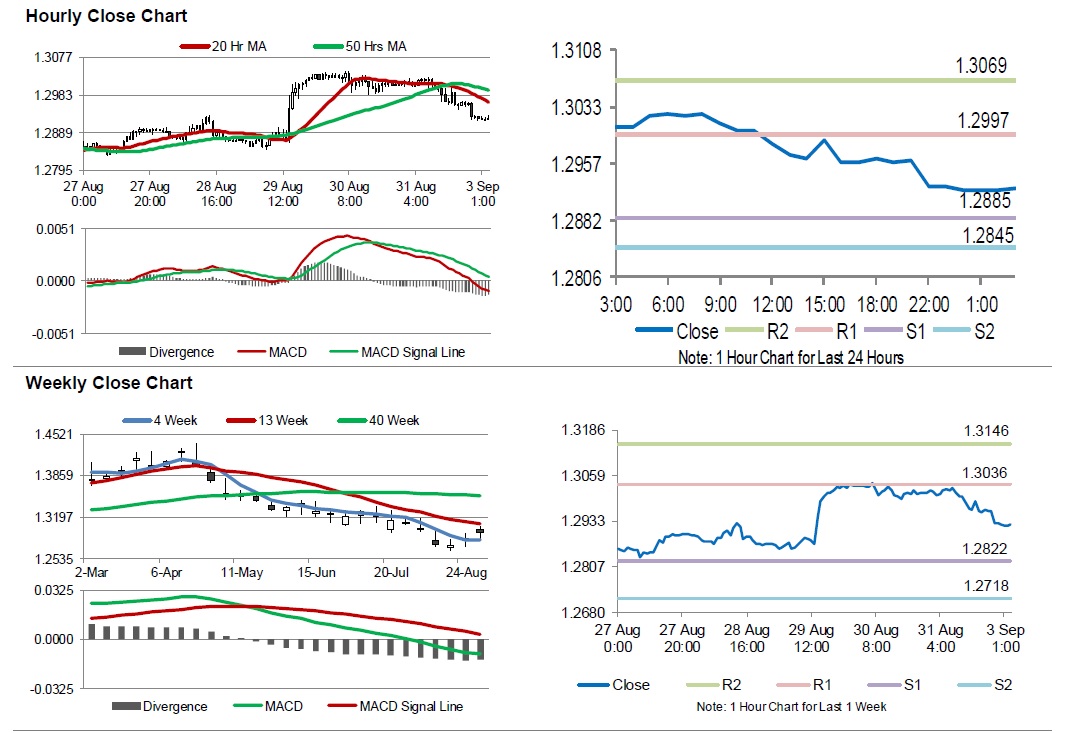
For the 24 hours to 23:00 GMT, the GBP declined 0.38% against the USD and closed at 1.2961 on Friday.
Data showed that the Nationwide house prices unexpectedly dropped 0.5% on a monthly basis in August, marking its first drop in three months and defying market consensus for an advance of 0.1%. In the previous month, house prices had climbed 0.6%.
In the Asian session, at GMT0300, the pair is trading at 1.2925, with the GBP trading 0.28% lower against the USD from Friday's close.
The pair is expected to find support at 1.2885, and a fall through could take it to the next support level of 1.2845. The pair is expected to find its first resistance at 1.2997, and a rise through could take it to the next resistance level of 1.3069.
Trading trend in the Pound today is expected to be determined by the Markit manufacturing PMI data for August, set to release in a few hours.
The currency pair is trading below its 20 Hr and 50 Hr moving averages.
Japanese Yen Reverses Its Losses In The Morning Session
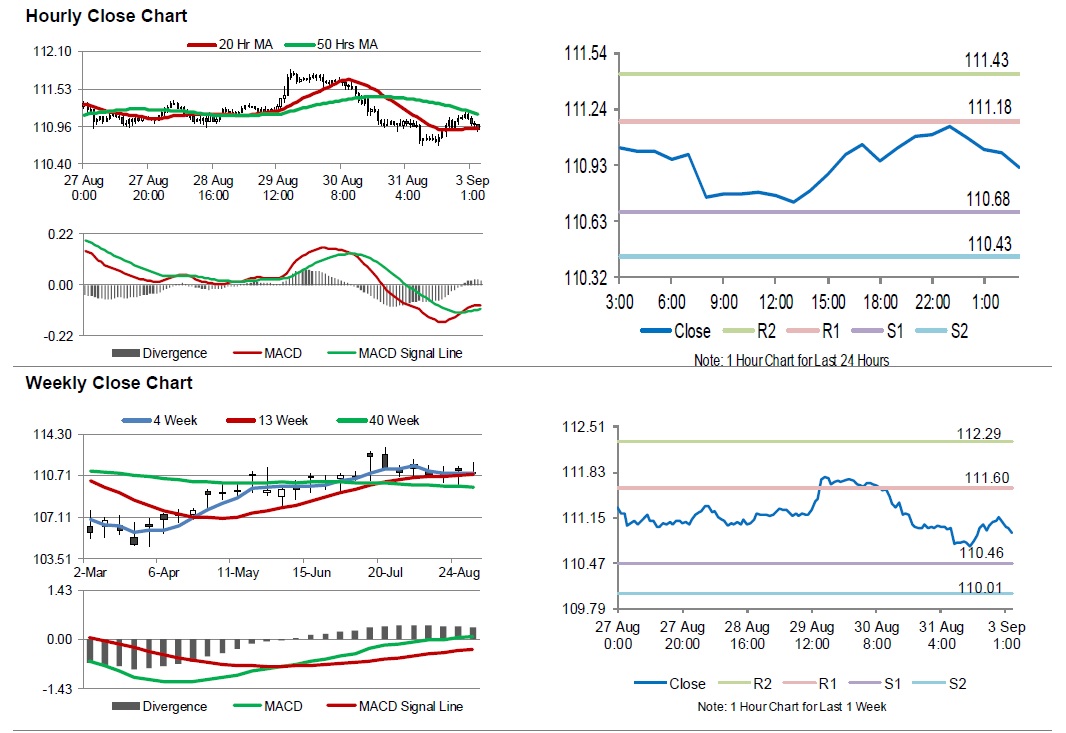
For the 24 hours to 23:00 GMT, the USD rose 0.05% against the JPY and closed at 111.09 on Friday.
In economic news, construction orders fell 9.3% on a yearly basis in July, compared to a drop of 6.5% in the previous month. Additionally, housing starts declined 0.7% on an annual basis in July, compared to a drop of 7.1% in the previous month. Market expectation was for housing starts to record a fall of 4.1%.
In the Asian session, at GMT0300, the pair is trading at 110.92, with the USD trading 0.15% lower against the JPY from Friday’s close.
Overnight data showed that Japan’s final Nikkei manufacturing PMI rose to 52.5 in August, compared to a reading of 52.3 in the previous month. The preliminary figures had also recorded an advance to a level of 52.5.
The pair is expected to find support at 110.68, and a fall through could take it to the next support level of 110.43. The pair is expected to find its first resistance at 111.18, and a rise through could take it to the next resistance level of 111.43.
The currency pair is showing convergence with its 20 Hr moving average and trading below its 50 Hr moving average.
Swiss Franc Trading Lower This Morning
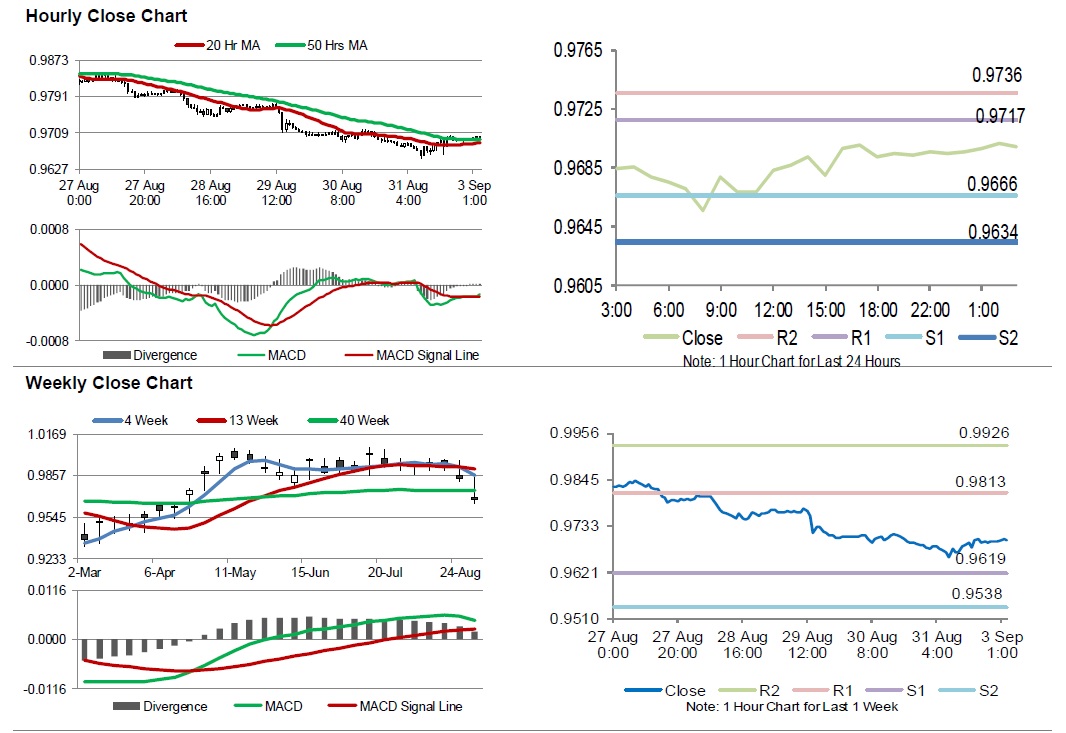
For the 24 hours to 23:00 GMT, the USD rose 0.05% against the CHF and closed at 0.9693 on Friday.
In the Asian session, at GMT0300, the pair is trading at 0.9699, with the USD trading 0.06% higher against the CHF from Friday’s close.
The pair is expected to find support at 0.9666, and a fall through could take it to the next support level of 0.9634. The pair is expected to find its first resistance at 0.9717, and a rise through could take it to the next resistance level of 0.9736.
Ahead in the day, market participants would keep a close watch on Switzerland’s retail sales for July and manufacturing PMI for August, slated to release in a while.
The currency pair is showing convergence with its 20 Hr and 50 Hr moving averages.
Loonie Trading On A Weaker Footing This Morning
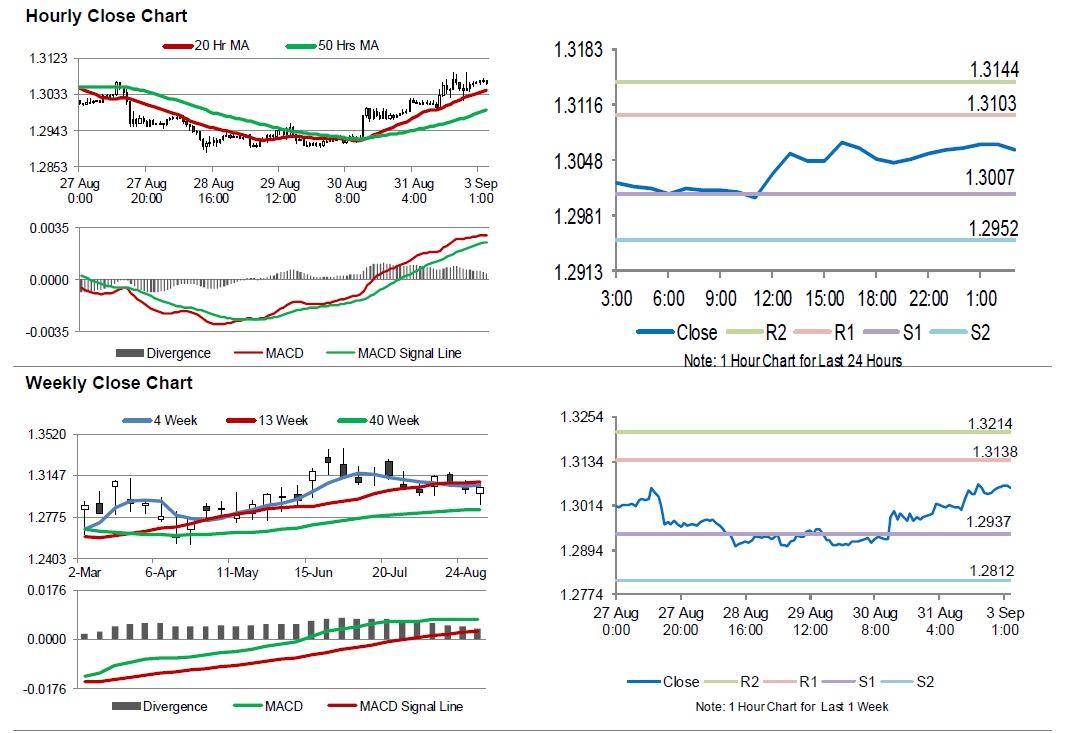
For the 24 hours to 23:00 GMT, the USD rose 0.52% against the CAD and closed at 1.3050 on Friday.
In the Asian session, at GMT0300, the pair is trading at 1.3062, with the USD trading 0.09% higher against the CAD from Friday’s close.
The pair is expected to find support at 1.3007, and a fall through could take it to the next support level of 1.2952. The pair is expected to find its first resistance at 1.3103, and a rise through could take it to the next resistance level of 1.3144.
In the absence of any macroeconomic releases in Canada today, investor sentiment would be governed by global macroeconomic factors.
The currency pair is trading above its 20 Hr and 50 Hr moving averages.
Aussie Trading Lower, Ahead Of RBA’s Rate Decision
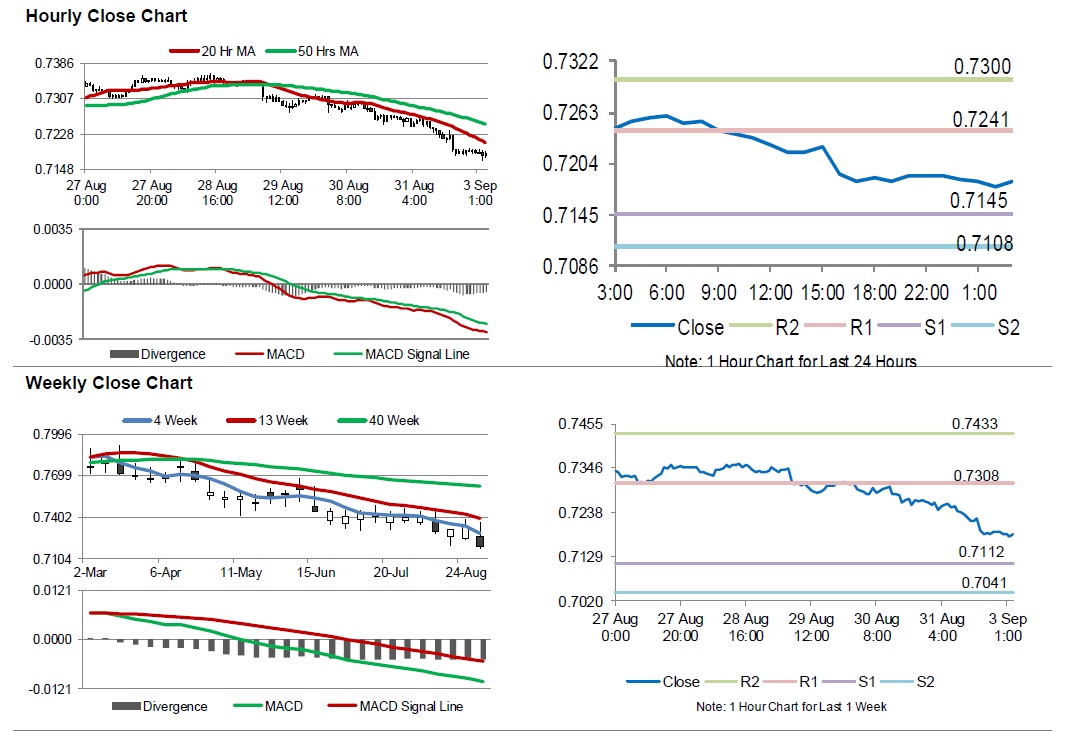
For the 24 hours to 23:00 GMT, the AUD declined 1.01% against the USD and closed at 0.7190 on Friday.
LME Copper prices declined 0.8% or $47.5/MT to $6019.0/MT. Aluminium prices fell 0.7% or $15.0/MT to $2112.0/MT.
In the Asian session, at GMT0300, the pair is trading at 0.7183, with the AUD trading 0.10% lower against the USD from Friday's close.
Overnight data showed that Australia's AIG performance of manufacturing index rose to 56.7 in August, compared to a reading of 52.0 in the previous month. Earlier in the session, Australia's monthly retail sales recorded a flat reading in July, recording its weakest reading since December 2017 and defying market expectations for a rise of 0.3%. In the prior month, retail sales had recorded an increase of 0.4%.
Elsewhere in China, the Caixin manufacturing PMI dropped to 50.6 in August, hitting its lowest level in 14-months and compared to a reading of 50.8 in the previous month.
The pair is expected to find support at 0.7145, and a fall through could take it to the next support level of 0.7108. The pair is expected to find its first resistance at 0.7241, and a rise through could take it to the next resistance level of 0.7300.
Looking ahead, market participants would keep a close watch on Australia's current account balance for 2Q slated to release overnight. Additionally, the Reserve Bank of Australia's (RBA) interest rate decision due to release early morning tomorrow will keep investors on their toes.
The currency pair is trading below its 20 Hr and 50 Hr moving averages.
China Caixin PMI manufacturing dropped to 50.6, third straight monthly drop, lowest since June 2017
China Caixin PMI manufacturing dropped -0.2 to 50.6 in August, missed expectation of 50.7. In the release, it's noted that "output expands at faster pace... but new order growth weakens and employment continues to decline". Also, confidence towards the 12-month business outlook remains lacklustre".
Commenting on the China General Manufacturing PMI™ data, Dr. Zhengsheng Zhong, Director of Macroeconomic Analysis at CEBM Group said:
"The Caixin China General Manufacturing PMI slipped to 50.6 in August from July, marking the third straight monthly drop and its lowest level since June 2017.
"The subindexes for new orders and output both remained in expansionary territory, with the former falling and the latter climbing up. This showed cooling demand and strong supply existed at the same time across the manufacturing sector.
"The employment subindex, remaining in contractionary territory, dipped to its lowest level since July 2017. The subindex for new export orders inched up despite remaining in contractionary territory, implying a still-grim export situation.
"Output charges and input costs both expanded at faster rates in August, indicating upward pressure on prices of industrial products. The subindex for future output, which reflects manufacturers' outlook of production over the next 12 months, remained in positive territory and continued to edge up.
"Stocks of finished items contracted at a steeper rate, while stocks of purchased items expanded further. The subindex for suppliers' delivery times rose, even though it failed to make it into positive territory, which implied a slightly improved capital turnover among goods producers.
"Generally speaking, the manufacturing sector continued to weaken amid soft demand, even though the supply side was still stable. Prices of industrial products were underpinned by a proactive fiscal policy, and environmental protection policies that had limited some factory production. I don't think that stable supply can be sustained amid weak demand. In addition, the worsening employment situation is likely to have an impact on consumption growth. China's economy is now facing relatively obvious downward pressure."
Gold: Yellow Metal Trading A Tad Lower In The Asian Session
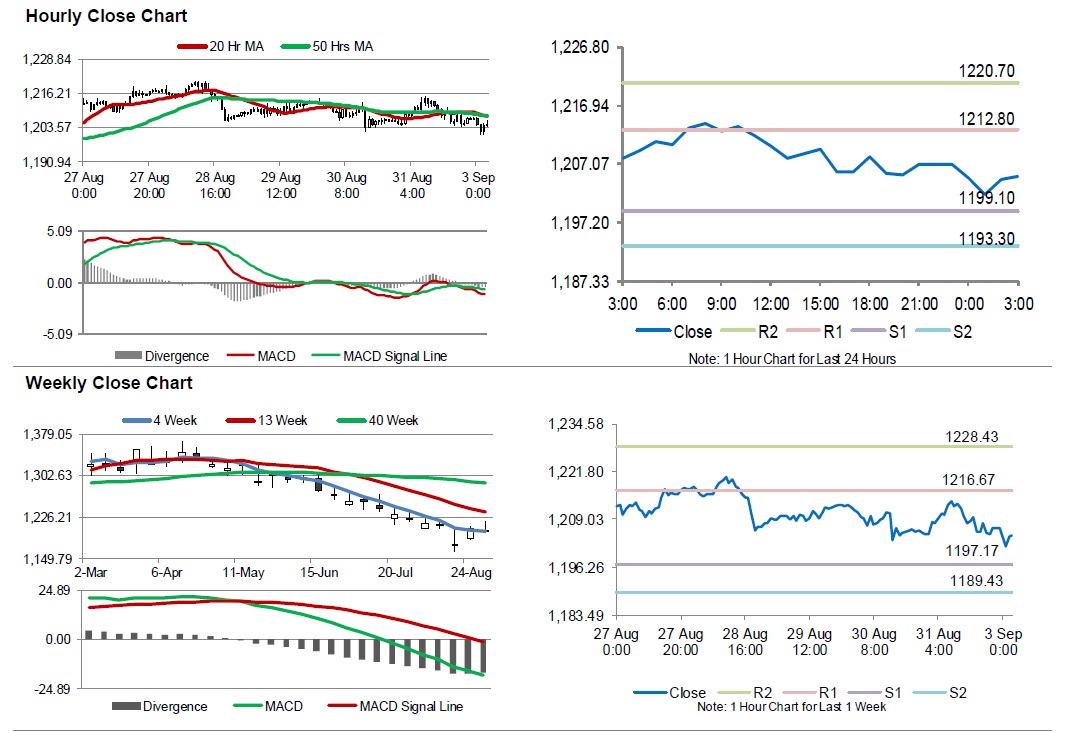
For the 24 hours to 23:00 GMT, Gold marginally declined against the USD and closed at USD1205.40 per ounce on Friday.
In the Asian session, at GMT0300, the pair is trading at 1204.90, with gold trading slightly lower against the USD from Friday’s close.
The pair is expected to find support at 1199.10, and a fall through could take it to the next support level of 1193.30. The pair is expected to find its first resistance at 1212.80, and a rise through could take it to the next resistance level of 1220.70.
The yellow metal is trading below its 20 Hr and 50 Hr moving averages.