Sample Category Title
Silver: White Metal Trading On A Negative Footing This Morning
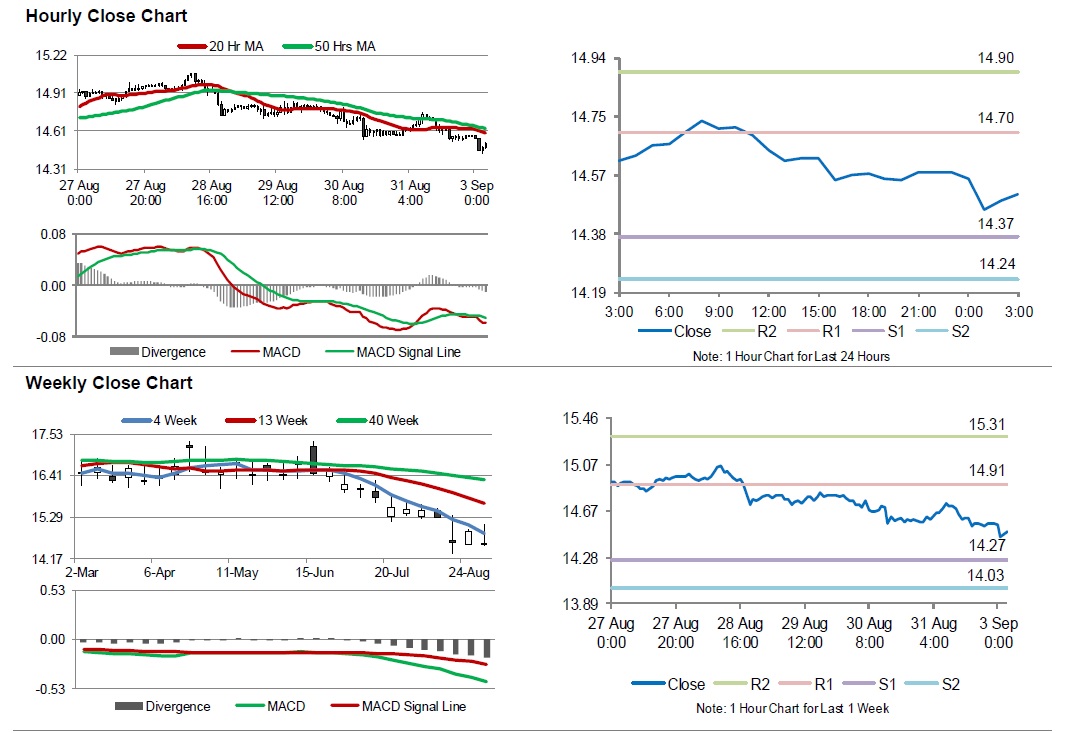
For the 24 hours to 23:00 GMT, Silver declined 0.27% against the USD and closed at USD14.55 per ounce on Friday.
In the Asian session, at GMT0300, the pair is trading at 14.505, with silver trading 0.31% lower against the USD from Friday’s close.
The pair is expected to find support at 14.37, and a fall through could take it to the next support level of 14.24. The pair is expected to find its first resistance at 14.70, and a rise through could take it to the next resistance level of 14.90.
The white metal is trading below its 20 Hr and 50 Hr moving averages.
Crude Oil: Oil Trading Extends Its Losses In The Asian Session
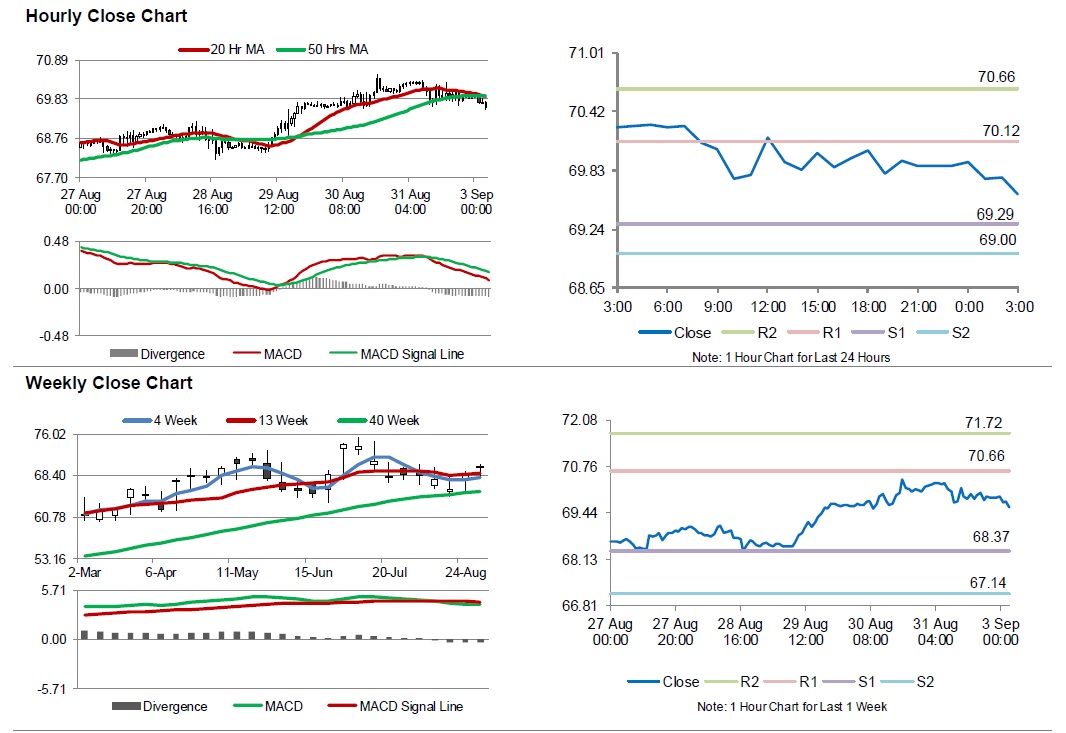
For the 24 hours to 23:00 GMT, Crude Oil declined 0.21% against the USD and closed at USD69.93 per barrel on Friday, after Baker Hughes reported that the number of active oil rigs rose by 2 to 862.0 in the week ended 31 August 2018.
In the Asian session, at GMT0300, the pair is trading at 69.59, with oil trading 0.49% lower against the USD from Friday’s close, amid increasing supplies from the OPEC and the US.
The pair is expected to find support at 69.29, and a fall through could take it to the next support level of 69.00. The pair is expected to find its first resistance at 70.12, and a rise through could take it to the next resistance level of 70.66.
Crude oil is trading below its 20 Hr and 50 Hr moving averages.
Japan PMI manufacturing finalized at 52.5, potential escalations in trade conflict weigh on sentiment
Japan PMI manufacturing was finalized at 52.5 in August, unrevised, up from July's 52.3. Markit noted in the released that "production rises amid faster new order growth", "export orders fall for second time in three months", and "geopolitical risks weigh on business sentiment".
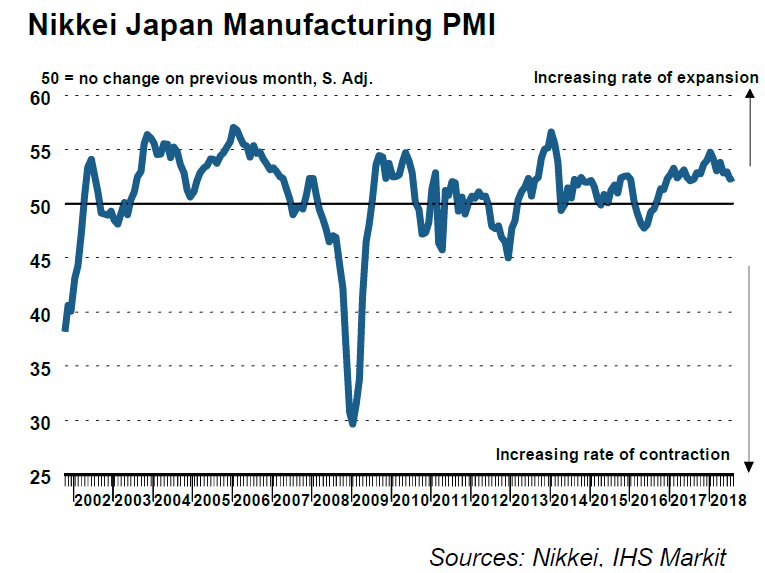
Commenting on the Japanese Manufacturing PMI survey data, Joe Hayes, Economist at IHS Markit, which compiles the survey, said:
"Japan's goods-producing sector continued to record growth at the midway point in Q3, extending the current stretch of expansion to two years - the longest since the global financial crisis. Survey data signalled a moderate improvement in the health of the sector, supported by an accelerated influx of new orders.
"That said, survey data indicated the upturn in demand was domestic-led, with export sales falling over the month. Potential escalations in trade conflict also contributed to a softening of business confidence.
"Overall sector growth remained relatively weak compared to Q1 and Q2 averages. Sub-index data continues to point to delayed input delivery times. Meanwhile, the non-replacement of retiring staff contributed to a further slowing of job creation. With this in mind, production line capabilities could be restrained over the coming months if these trends continue, irrespective of demand pressures."
USD/JPY Bearish ABC Zigzag Pattern Expected At 111.25
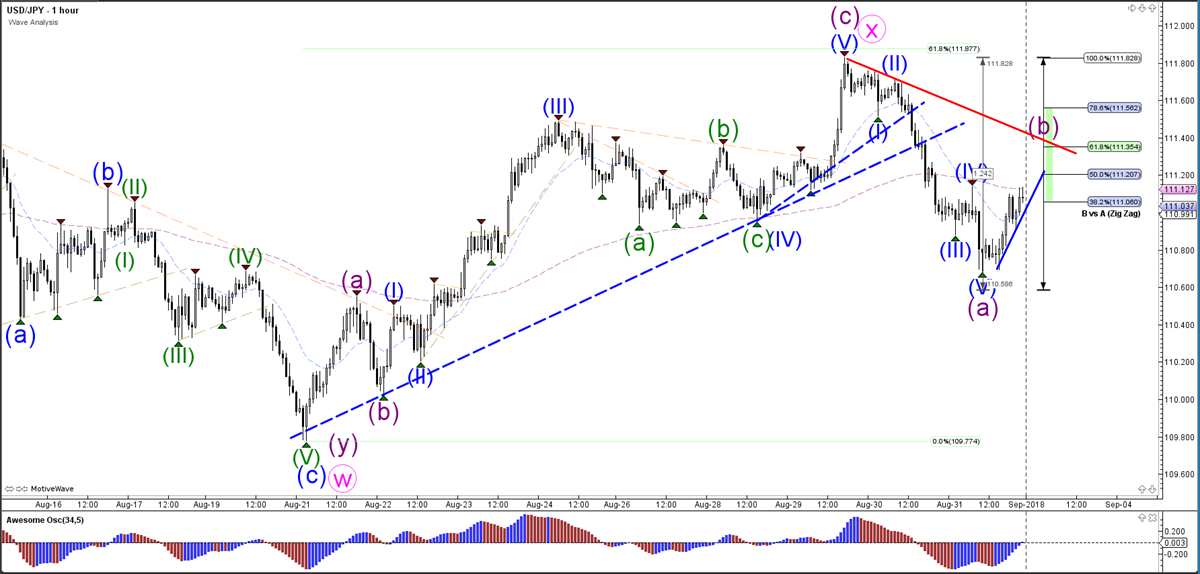
The USD/JPY bullish bounce could indicate that a bearish wave A (purple) has been completed and that the price is ready to retrace within a wave B (purple). A bearish ABC (purple) could take the price down to the Fibonacci targets to complete a wave Y (pink), a wave E (purple), and of a wave B (red).
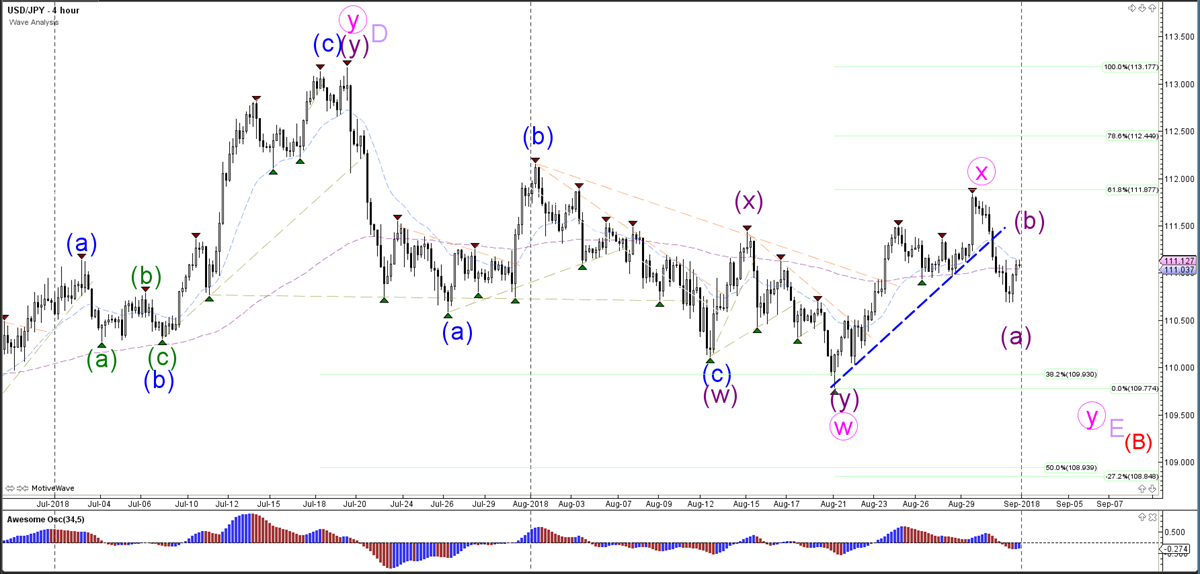
The USD/JPY has completed 5 bearish waves, which seems to be part of a wave A (purple). The price could now be building an ABC corrective pattern within wave B (purple). A bearish bounce at the Fibonacci retracement levels of wave B vs A could confirm a next bearish swing unless the price manages to break above the resistance trend line (red).
EUR/USD Prepares ABC Pattern And Aims For 1.15 Target
The EUR/USD made a bearish bounce at the resistance trend line (red) and has fallen towards the support trend line (blue). The bearish price action seems to confirm the end of the bullish swing, which is probably a wave A (purple) unless price manages to break above the resistance trend line (red) and previous top.
The EUR/USD will probably continue lower and test the Fibonacci levels of wave B (purple) if price manages to break the support trend line (blue). Price could then fall towards the 1.15 round level and the Fibonacci retracement levels and build a bullish bounce as part of a larger ABC (purple) pattern.

According to the wave patterns, it seems likely that the EUR/USD has finished a wave A (purple) and that price is completing a bearish ABC (green) pattern within wave Y (blue) of the larger wave B (purple).

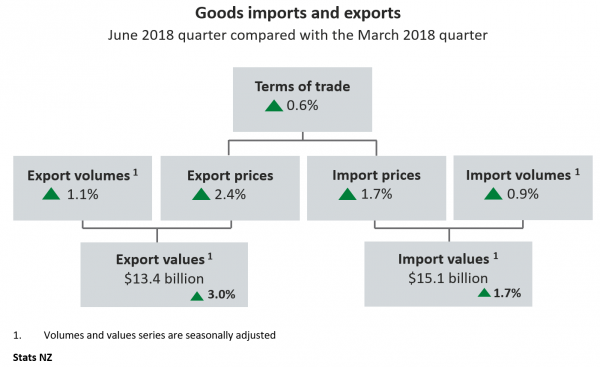
New Zealand Terms of Trade rose only 0.6% qoq, missed expectations
New Zealand Dollar weakens broadly today and stays generally weak as Terms of Trade Index rose only 0.6% qoq in Q2, versus expectation of 1.1% qoq. Prior quarter's figure was also revised down from 1.9% qoq to -2.0% qoq. Looking at the details, export prices for goods rose 2.4%, while import prices for goods rose 1.7%. Seasonally adjusted goods export volumes rose 1.1%, and goods import volumes rose 0.9%. Seasonally adjusted goods export values rose 3.0%, and goods import values rose 1.7%.
Mixed Australia data: Retail sales missed, manufacturing PMI rose
Australian Dollar weakened in early Asian session after mixed economic data. But Aussie quickly recovered, partly helped by oversold conditions. On the negative side, retails sales rose 0.0% mom in July, below expectation of 0.3% mom. There were falls in three of the six industries, including household goods retailing (-1.2%), clothing, footwear and personal accessory retailing (-2.0%) and department stores (-1.9%). The declines were offset by other retailing (1.7%), food (0.3%) and cafes, restaurants and takeaway food services (0.6%)". Also, ANZ job advertisements dropped -0.6% mom in August. That could point to easing momentum in job growth.
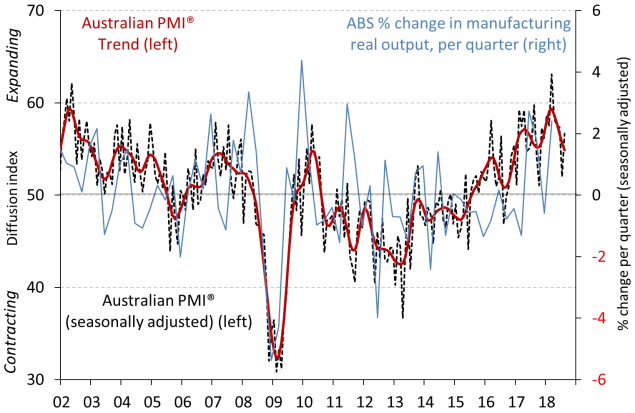
On the positive side, AiG Performance of Manufacturing Index rose 4.7 pts to 56.7 in August, indicating faster growth across the manufacturing sector. In particular, exports sub-index has jumped 8.5 points to 58.4 points. However, drought conditions in New South Wales and Queensland are now having an adverse impact on input costs and sales for some manufacturers. Company operating profits rose 2.0% qoq in Q2. TD securities inflation rose 0.1% mom in August.
Trump slammed Canada and NAFTA, but the messages were for the Congress
The trade negotiation between US and Canada ended last week without any conclusion. Trump has already notified the Congress of his intent to sign a bilateral trade agreement with Mexico, which is called the United States- Mexico Trade Agreement. US-Canada trade negotiations will resume this Wednesday.
Over the weekend, he slammed Canada and NAFTA with his tweets. He said "there is no political necessity to keep Canada in the new NAFTA deal. If we don't make a fair deal for the U.S. after decades of abuse, Canada will be out." And, "Congress should not interfere w/these negotiations or I will simply terminate NAFTA entirely & we will be far better off." Trump added "we were far better off before NAFTA — should never have been signed. Even the Vat Tax was not accounted for. We make new deal or go back to pre-NAFTA!"
While Canada was the topic of the tweets, the messages were clearly to the Congress. For now, it's uncertain how Trump could get the US-Mexico trade deal through the Congress, without the involvement of Canada. Last Friday, chief executive of the U.S. Chamber of Commerce, Thomas Donohue also said in a statement that "anything other than a trilateral agreement won't win Congressional approval and would lose business support."
Democrat House minority leader Nancy Pelosi also said "actually fixing NAFTA requires reaching a trade agreement with both Mexico and Canada," "without a final agreement with Canada, the administration's work is woefully incomplete."
Sterling weakens broadly as EU Barnier blasted Theresa May’s Chequers plan
Sterling opened the week broadly lower after EU chief Brexit negotiator Michel Barnier blasted UK Prime Minister Theresa May's Chequers plan. And, Barnier "strongly opposed" May's proposals. On the customs proposals, Barnier said its "not practical". He added, "it is impossible to tell exactly where a product ends up, on the UK market or in the internal market." And, "the British proposal would be an invitation to fraud if implemented."
He also criticized that the "common rulebook" idea as outdated with modern world of trade. He said "the interest of Europeans is to preserve the integrity of the common market. That is our special strength and the reason why we are respected throughout the world, even in the United States." He added "we have a coherent market for goods, services, capital and people – our own ecosystem that has grown over decades. You cannot play with it by picking pieces." Therefore, the EU must prevent unfair competition if the United Kingdom has weaker legal requirements than we do. Otherwise we would discriminate and weaken our own companies."
On the other hand, a UK government spokeswoman defended that the proposal is " precise, pragmatic and that will work for the UK and the EU." And, "this proposal achieves a new balance of rights and obligations that fulfils our joint ambition to establish a deep and special partnership once the UK has left the EU while preserving the constitutional integrity of the UK. There is no other proposal that does that.
CFTC Commitments of Traders – Euro at Risk as Concerns over Italy Rekindle
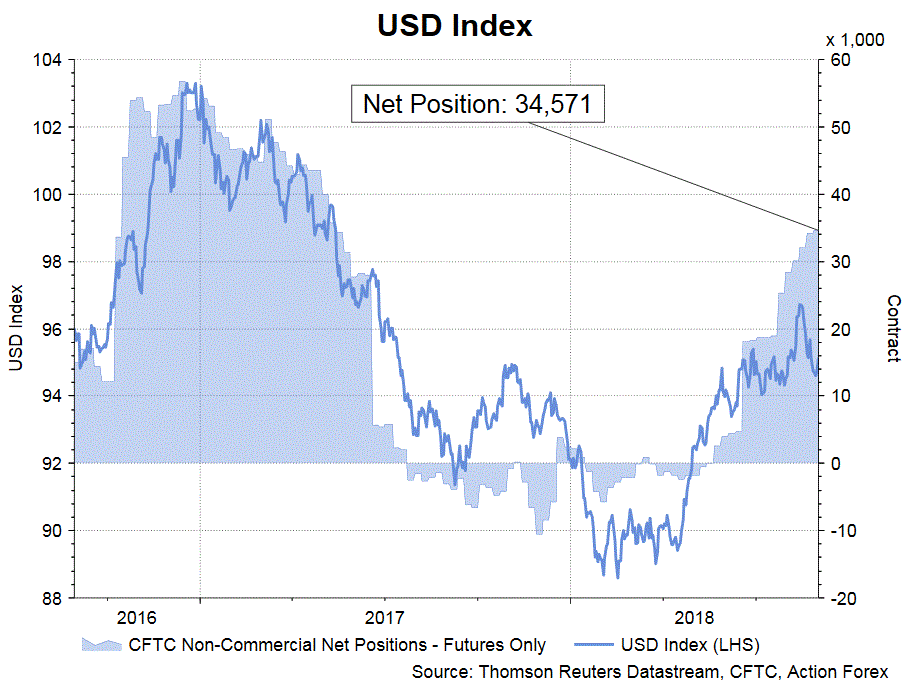
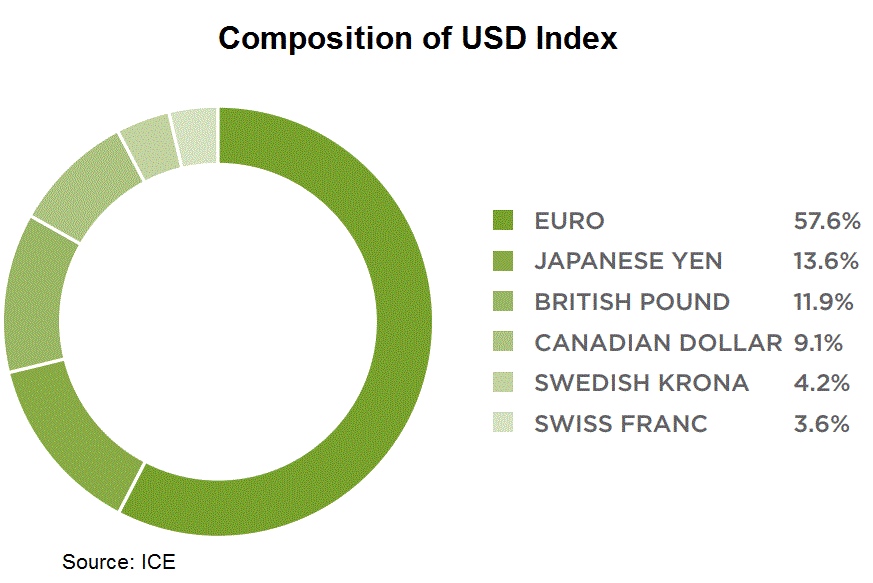
As suggested in the CFTC Commitments of Traders report in the week ended August 28, NET LENGTH of USD index added +449 contracts for 34 571 contracts for the week. Both speculative long and short positions dropped, suggesting the market was decisive about its outlook. during the reporting week, the DXY index slipped -0.57% while USD plunged -1.69% against the euro.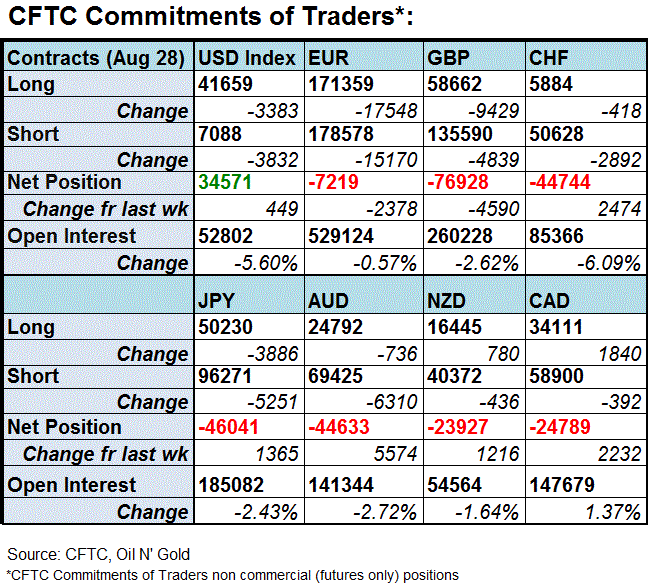
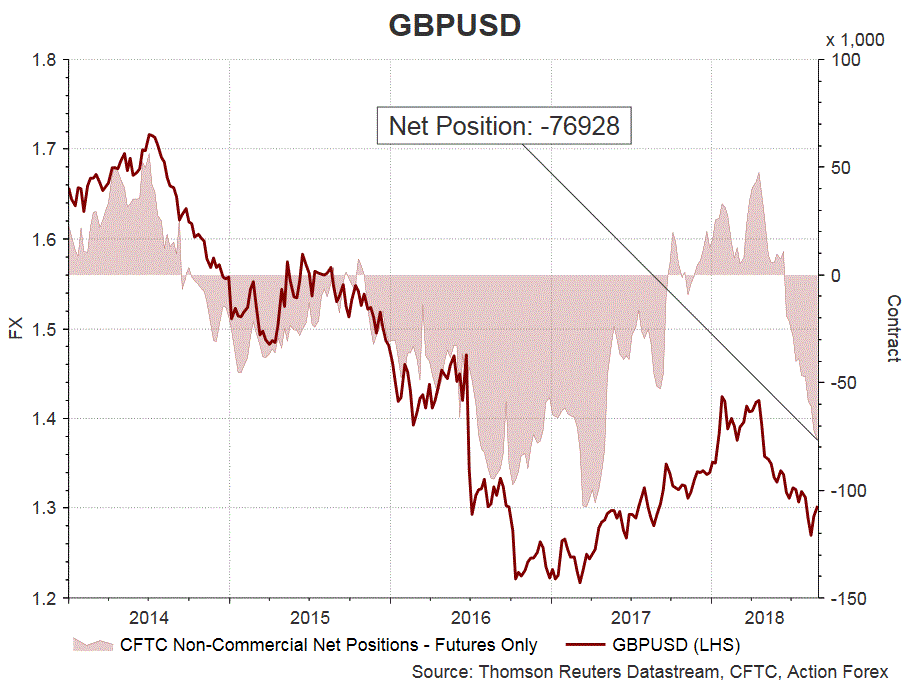
 NET SHORT of EUR futures jumped +2 378 contracts to 7 219 contracts. The market remained concerned about the Eurozone's inflation outlook as well as political uncertainty. Besides Turkish currency crisis which might affect some of Eurozone's peripheral economies, concerns over Italy have rekindled. A media report suggested that Italian government might ask support from the ECB for debt financing. Meanwhile, NET SHORT for GBP futures deepened to 76 928 contracts, up +4 590 from the prior week. GBPUSD slipped -0.25% for the week as the outlook for sterling remains clouded by Brexit uncertainty.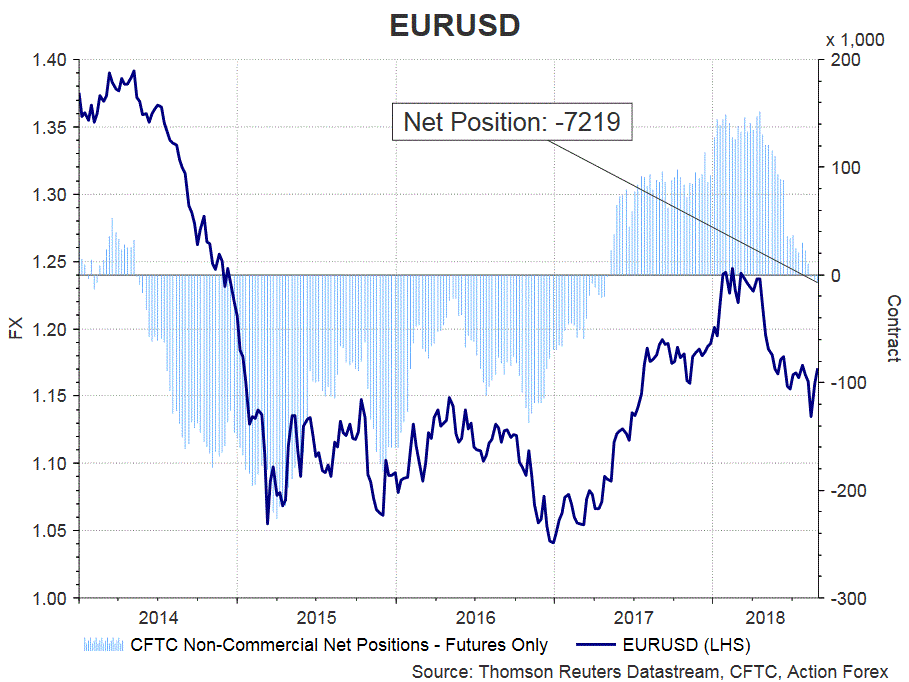
On safe-haven currencies, Net SHORT for CHF futures dropped -2 474 contracts to 44 744 while that for JPY futures fell -1 365 contracts to 46 041 during the week. USDCHF declined -1.26% during the reporting week. The strength in Swiss franc was largely driven by Turkish currency crisis which has lifted demand for safe haven assets.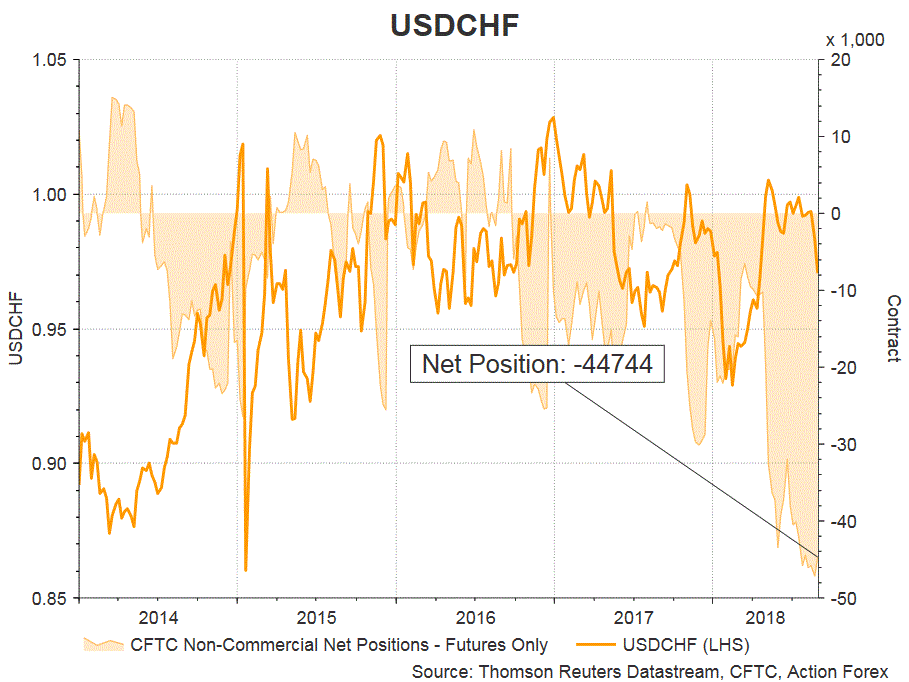
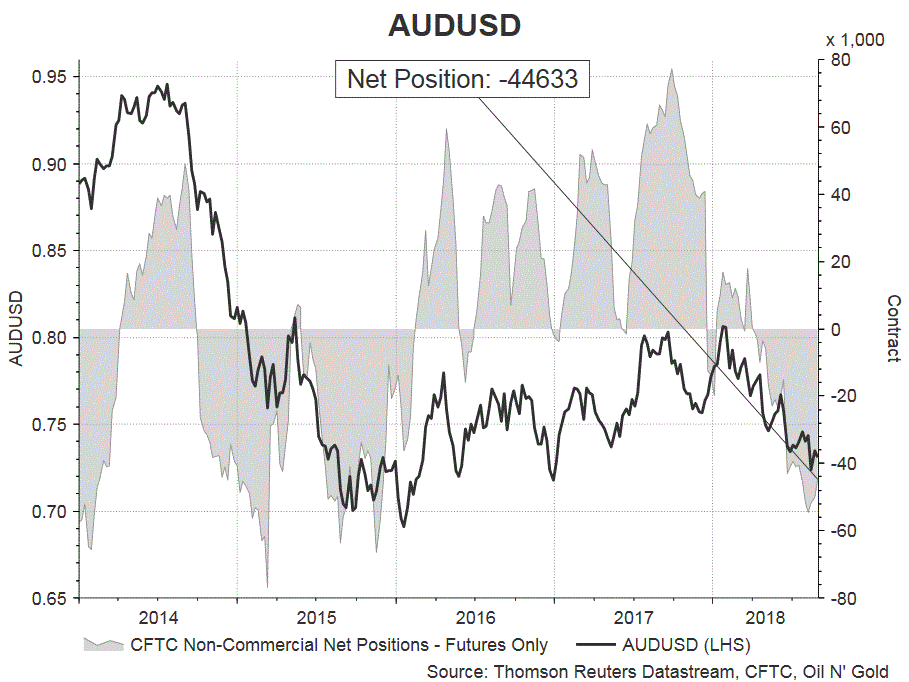
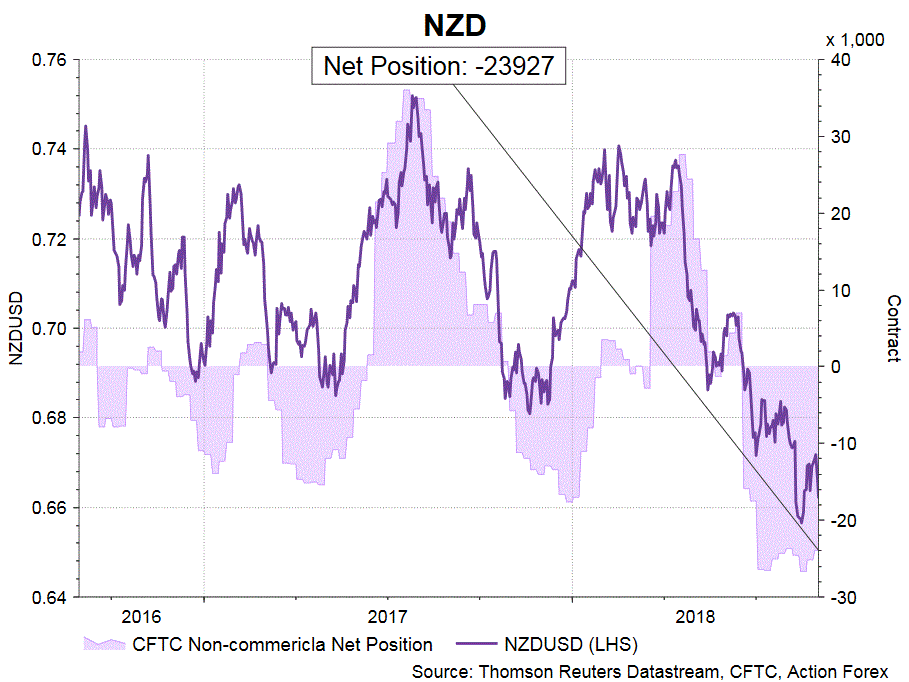
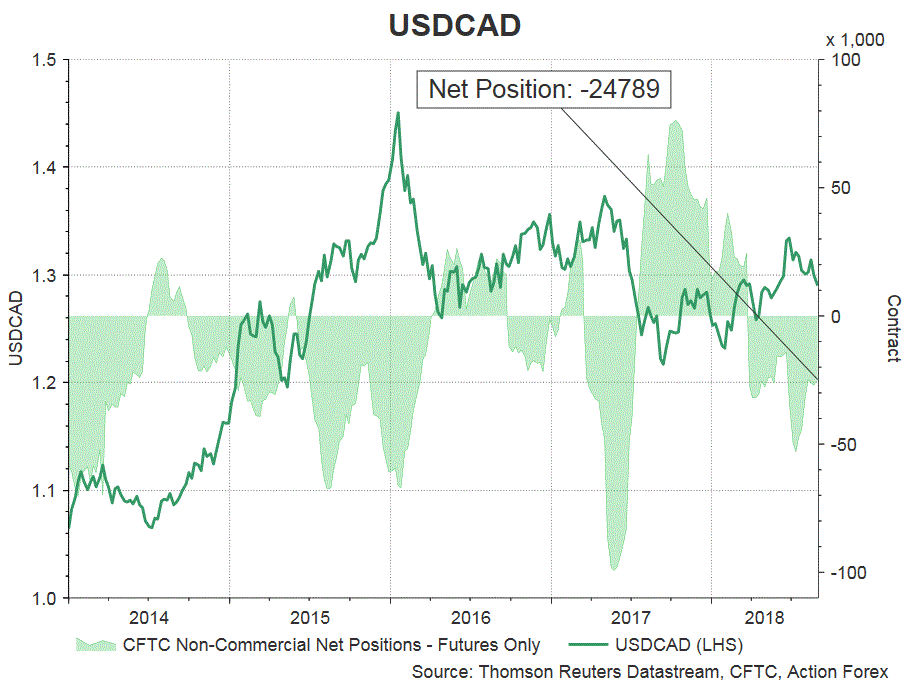
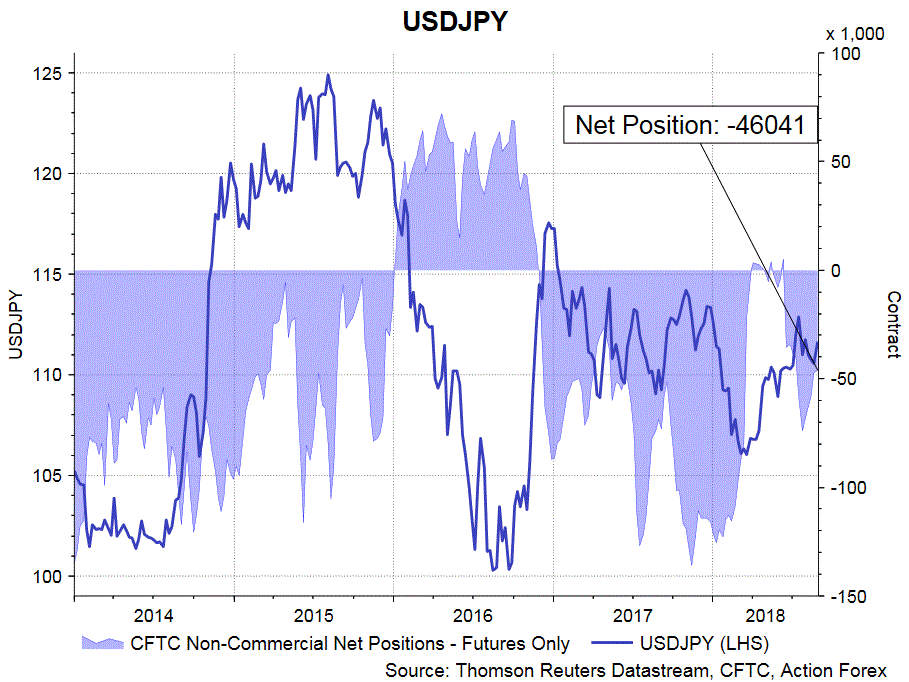 All commodity currencies stayed in NET SHORT positions. NET SHORT for AUD futures declined -5 574 contracts to 44 633, while that for NZD futures fell -1 216 contracts to 23 927. NET SHORT for CAD futures decreased -2 232 contracts to 24 789.