

Sample Category Title
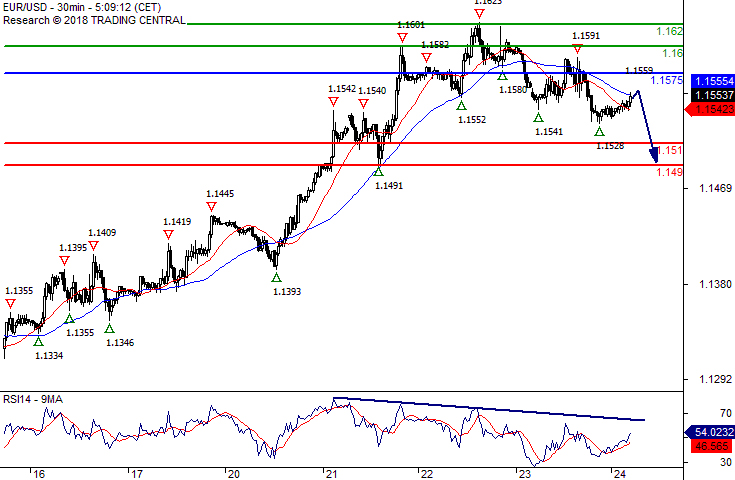
EUR/USD Under Pressure
Pivot (invalidation): 1.1575
Our preference Short positions below 1.1575 with targets at 1.1510 & 1.1490 in extension.
Alternative scenario Above 1.1575 look for further upside with 1.1600 & 1.1620 as targets.
Comment The RSI lacks upward momentum.
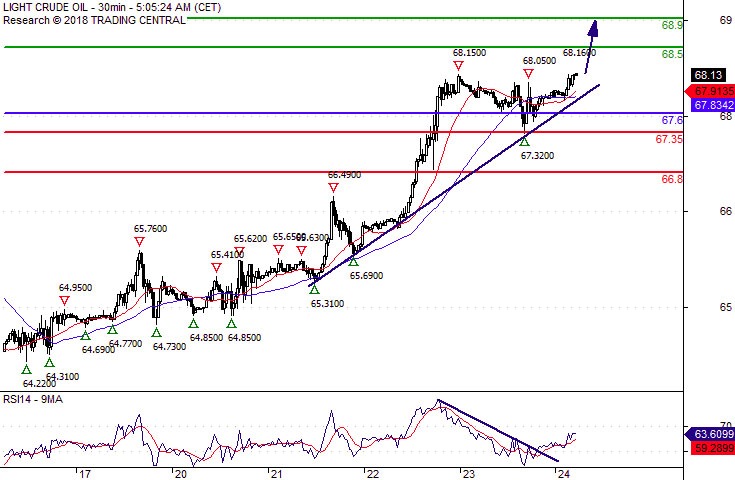
Crude Oil Further Advance
Pivot (invalidation): 67.60
Our preference Long positions above 67.60 with targets at 68.50 & 68.90 in extension.
Alternative scenario Below 67.60 look for further downside with 67.35 & 66.80 as targets.
Comment The RSI shows upside momentum.
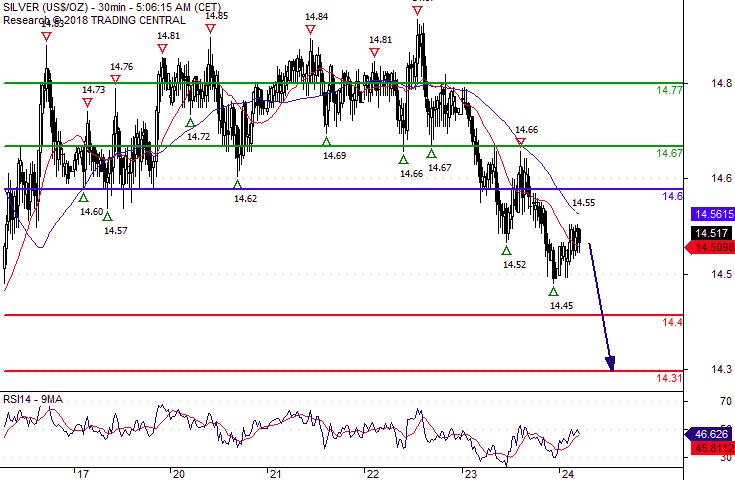
Silver Spot Key Resistance At 14.6000
Pivot (invalidation): 14.6000
Our preference Short positions below 14.6000 with targets at 14.4000 & 14.3100 in extension.
Alternative scenario Above 14.6000 look for further upside with 14.6700 & 14.7700 as targets.
Comment The RSI is mixed with a bearish bias.
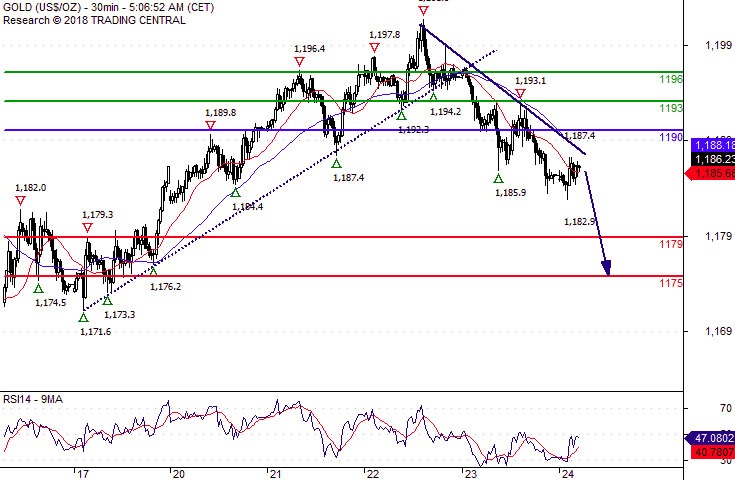
Gold Spot The Downside Prevails
Pivot (invalidation): 1190.00
Our preference Short positions below 1190.00 with targets at 1179.00 & 1175.00 in extension.
Alternative scenario Above 1190.00 look for further upside with 1193.00 & 1196.00 as targets.
Comment The RSI is mixed to bearish.
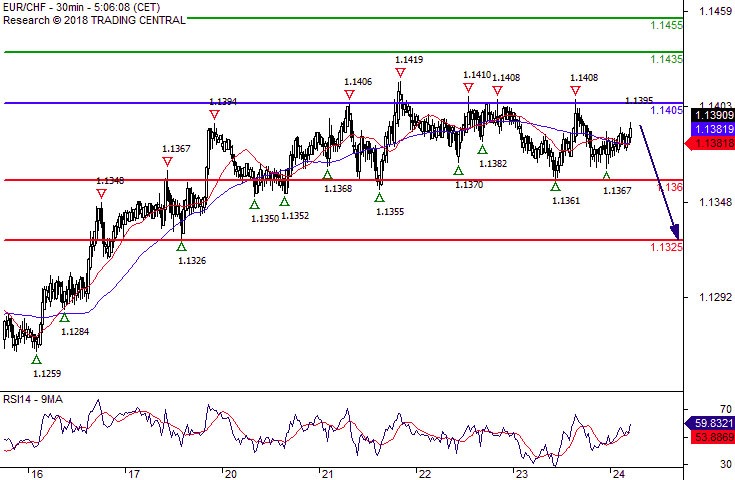
EUR/CHF Expect 1.1360
Pivot (invalidation): 1.1405
Our preference Short positions below 1.1405 with targets at 1.1360 & 1.1325 in extension.
Alternative scenario Above 1.1405 look for further upside with 1.1435 & 1.1455 as targets.
Comment The RSI is mixed with a bearish bias.
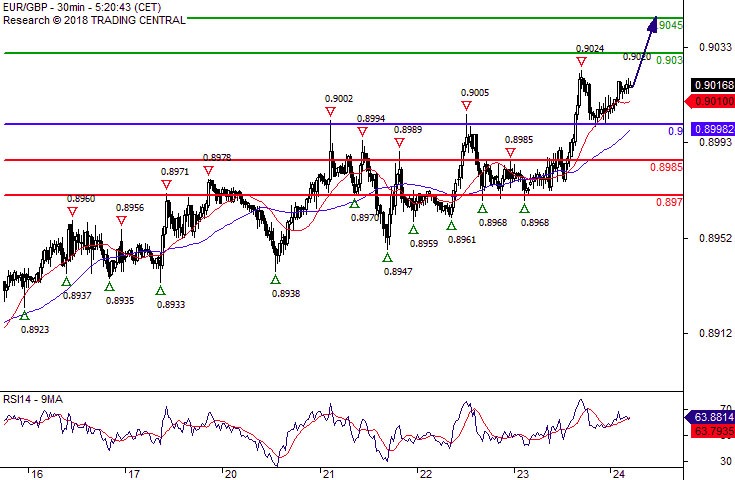
EUR/GBP The Upside Prevails
Pivot (invalidation): 0.9000
Our preference Long positions above 0.9000 with targets at 0.9030 & 0.9045 in extension.
Alternative scenario Below 0.9000 look for further downside with 0.8985 & 0.8970 as targets.
Comment The RSI advocates for further advance.
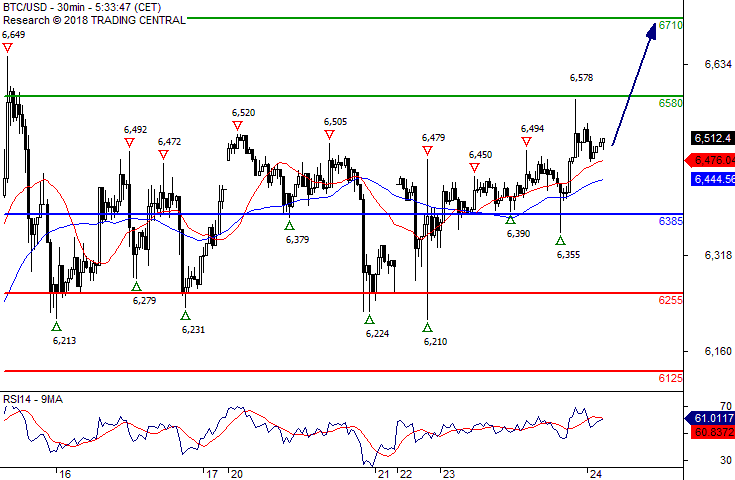
Bitcoin/Dollar Further Advance
Pivot (invalidation): 6385
Our preference Long positions above 6385 with targets at 6580 & 6710 in extension.
Alternative scenario Below 6385 look for further downside with 6255 & 6125 as targets.
Comment The RSI is mixed to bullish.
EURGBP Increased From 0.8982 To 0.9009
Markets
The dollar staged a comeback yesterday, putting EM currencies (mainly BRL which suffers election fever) back under modest selling pressure. US Treasuries underperformed German Bunds. The US yield curve bear flattened with yields up to 2.5 bps higher at the front end of the curve, while German yield changes ranged between -0.4 bps and +0.5 bps. Investors adapted positions going into tonight's speech by Fed Chair Powell after FOMC Minutes send a friendly reminder about the Fed's rate hike intentions. US economic growth accelerated this year with the Atlanta Fed currently forecasting a continuation in Q3 (4.3% Q/Qa). Price pressures are building and the labour market is tight, prompting the Fed to probably hike rates both in September and December this year. EUR/USD fell from 1.16 to 1.1550 during Asian trading, before recovering some ground. EMU manufacturing and services PMI's for August printed at good levels (54.6 & 54.4), but were slightly below/close to expectations. EUR/USD eventually set an intraday low around 1.1530 after Italian 5SM Di Maio threatened to stop paying EU funds if migrants aren't redistributed. USD/JPY rose all day, closing at 111.29, compared to a 110.56 opening even if stock markets failed to cling to this week's positive momentum, finishing with minor losses both in EMU and in the US. Sterling lost more ground as Brexit-minister Raab presented a first set of guides for businesses advising them on how to prepare for a no-deal Brexit. EUR/GBP increased from 0.8982 to 0.9009. GBP/USD fell from 1.2911 to 1.2811.
Asian bourses trade mixed overnight with Japan outperforming (+0.6%) on the back of a weaker yen. The US Note future is a tad weaker while the dollar can't cling on to all of yesterday's gains. US durables goods orders will be published today, but are dwarfed by Powell's speech. We expect him to give a bullish assessment in the US economy, preparing markets for more rate hikes to come. That could force new tests of EUR/USD 1.1510 and DXY 95.50, but we wonder whether he'll be that hawkish to trigger fresh, clean breaks. US Treasuries are nevertheless expected to underperform German Bunds. Risk sentiment (US stock markets look prone for profit taking after this week's run to a new all-time high), stress on EM FX (BRL, ZAR) and Monday's Summer Bank holiday in the UK complicate the picture and argue in favour of safe haven core bonds. Sterling will remain in the defensive as the brexit impasse is prolonged. EUR/GBP is about to test key 0.9031/0.9045 resistance. A sustained break higher paves the way for a return to the 2017 high (0.9307).
News Headlines
Luigi Di Maio, Italy's Deputy Prime Minister, caused some disturbance yesterday. His anti-establishment 5-Star Movement party would vote to suspend funding to the EU next year unless other members of the bloc agree to take in migrants being held on a coastguard ship in Sicily.
After two days of discussions on their trade disputes, the US and China failed to achieve a major breakthrough. Both countries came with statements that the nations had constructively discussed their economic relationship. In the meantime, another round of tariffs on $16 billion worth of each other's goods were activated.
Malcolm Turnbull stepped down as Australia's Prime Minister, after he lost support within his own Liberal party for being too left centered. His resignation paved the way for a new vote between Treasurer Scott Morrison and Finance Minister Peter Dutton. Scot Morrison came out as victor, being Australia's 6th PM in 10 years.
Adrian Orr, Governor of New Zealand's central bank, has opened the central banker's symposium yesterday in Jackson Hole, Wyomimng (US) by stating his central bank hasn't ruled out cutting interest rates if needed to achieve its inflation target. The inflation is currently at 1.5% and below the target midpoint of the 1-3% range.
China Says To Continue Talks With The US
General Trend:
- Asian equity markets trade mostly higher amid focus on trade and Jackson Hole
- Australia’s Westpac declines, noted the impact of higher funding costs on net interest margin
- Kiwi (NZD) declines, RBNZ Gov Orr did not rule out a cut in interest rates; Currency later pares decline
- China PBoC conducts its second MLF operation this month
- In early Asia, the US yield curve trades at the flattest level since 2007
- Fed Chair Powell expected to make Jackson Hole speech at 10 AM EDT
Headlines/Economic Data
Australia/New Zealand
- ASX 200 opened +0.2%
- ASX 200 Consumer Discretionary index +1.4%, Utilities +1.3%, REIT +0.5%, Financials flat; Telecom -2.3%
- (AU) Australia Treasurer Morrison to replace Turnbull as PM - Australia Media
- (AU) Moody's: Australia leadership change has no implications for Aaa sovereign rating (Outlook Stable)
- (NZ) RBNZ Gov Orr: Reiterates evenly balanced on rate outlook; We don't rule out a cut in interest rates.
*(NZ) NEW ZEALAND JUL TRADE BALANCE (NZ$): -143M V -400ME
China/Hong Kong
- Shanghai Composite opened -0.3%, Hang Seng -0.8%
- Hang Seng Materials index -1.7%, Info Tech -1.7%, Consumer Goods -0.9%, Financials -0.9%, Industrial Goods -0.7%, Property/Construction index -0.4%; Energy +1.3%
- (CN) China Commerce Min (MOFCOM) China and the US had 'constructive' and 'candid' exchange over trade issues; both countries to keep communication on trade
- (CN) White House official: US-China trade talks in Washington DC have concluded; talks included structural issues in China
- (CN) CHINA PBOC CONDUCTS CNY149B 1-YEAR MEDIUM-TERM LENDING FACILITY (MLF) V CNY383B PRIOR AT 3.30% V 3.30% PRIOR (2nd MLF operation this month)
- (CN) China PBoC Open Market Operation (OMO) Skips OMO v skipped prior
- (CN) China PBoC set yuan reference rate: 6.8710 v 6.8367 prior
- (CN) China Bond Connect has implemented delivery vs payment settlement system for transactions through China's primary bond clearinghouse - financial press
Japan
- Nikkei 225 opened +0.3%
- TOPIX Info & Communications index +1.3%, Retail Trade +0.8%; Iron & Steel -1.5%
- Toyota Motor: Said to plan to maintain supplied steel prices for H2 2018 (Japanese Press)
- (JP) JAPAN JUL NATIONAL CPI Y/Y: 0.9% V 1.0%E; CPI EX FRESH FOOD (CORE): 0.8% V 0.9%E
- (JP) Japan Jul PPI Services Y/Y: 1.1% v 1.2%e
- (JP) Japan Finance Ministry (MOF): Confirms to hold China-Japan dialogue on Aug 31st in Beijing
- (JP) Government bodies in Japan said to seek ~¥102T budget for FY2019 - Japanese Press
- (JP) BoJ Gov Kuroda to speak in Osaka on Tuesday Sept 25th
Korea
- Kospi opened -0.3%
- (KR) US Secretary of State Pompeo said to plan to visit North Korea on Aug 27th - US financial press
- Samsung Electronics: Apple said to place order with the company for additional iPhone X panels (Press)
Other
- (ID) Indonesia Finance Min: Currently the government is reviewing 900 items for the possible imposition of an import tax
- (MY) Malaysia July CPI Y/Y: 0.9% v 0.9%e (5th straight month below target)
- (SG) Singapore July Industrial Production M/M: -1.7% v -1.0%e; Y/Y: 6.0% v 6.0%e
North America
- US equity markets ended lower: Dow -0.3%, S&P500 -0.2%, Nasdaq -0.1%, Russell 2000 -0.3%
- S&P500 Materials -0.7%
- (US) SEMI: July North America Billings $2.36B, -4.9% m/m and +4.1% y/y
- (US) Fed Kaplan says comfortable with 4 rate hikes in 2018
- (US) Weekly Fed Balance Sheet Total Assets for the week ending Aug 22: $4.28T, -$27.1B w/w, -$234.5B y/y; Reserve Bank Credit: $4.19T, -$27.2B w/w, -$234.7B y/y
Levels as of 01:30ET
- Nikkei 225, +0.8%, ASX 200 +0.3%, Hang Seng -0.4%; Shanghai Composite +0.1%; Kospi +0.4%
- Equity Futures: S&P500 +0.2%; Nasdaq100 +0.3%, Dax +0.2%; FTSE100 +0.2%
- EUR 1.1564-1.1534 ; JPY 111.50-111.23 ; AUD 0.7291-0.7236 ;NZD 0.6653-0.6620
- Aug Gold +0.1% at $1,195/oz; Sept Crude Oil +0.8% at $68.36/brl; Sept Copper +1% at $2.670/lb
Oil Prices Continue To Rise With Brent Moving Above USD75/bbl
Market movers today
The Jackson Hole symposium started last night under the headline ‘Changing Market Structure and Implication s for Monetary Policy'. Fed Governor Jerome Powell will speak today on ‘Monetary Policy in a Changing Economy' at 16.00 CEST. We do not expect any change to the recent message from the Fed minutes and his semi-annual testimony in July. The Fed is on a continued track of gradual rate hikes as long as the recovery continues. The market will watch for any comments on the yield curve and risks from the US-China trade war in his speech.
On the data front, US durable goods orders will give more input on US investment spending, which will be interesting in order to gauge potential impact of the trade war. So far, the impact has been limited and 80% of US companies in a survey recently said the trade war would not affect their investment plans.
In the Scandies, it is time for Norwegian unemployment (LFS) and Swedish PPI (see page 2).
Selected market news
The trade negotiations between the US and China this week have not managed to deliver any progress. Markets are a bit on the limp side in terms of the out look as indications from the Chinese side indicate that talks have been constructive and that communication will continue, but that no new round of talks will take place before the US mid-term elections in November.
The US and Mexico on the other hand are still negotiating a new NAFTA deal and are set to continue talks into next week. A deal between the two could further bring Canada back to the negotiation table.
The Kansas City Fed's George and Dallas Fed's Kaplan spoke on monetary policy matters overnight. Both back another three to four rate hikes and also noted that political considerations do not play a role when the Fed sets monetary policy; i.e. they are not influenced by recent comments from US President Trump.
Oil prices continue to rise with Brent moving above USD75/bbl. While a lower USD has been a contributing factor to the strong rise seen this week, concerns about tighter supply have been at the centre of the market's attention. Earlier this week, the decline in US inventories made the headlines and yesterday focus turned to a strike among oil workers in the North Sea.
US manufacturing PMI dropped to 54.5 in August from 55.3 in July and thus to the lowest level since November last year. The data tends to confirm a peak in the US manufacturing cycle.