

Sample Category Title
Canadian Trudeau: We work on a good NAFTA deal, not just any deal
The bilateral NAFTA talks between the US and Mexico continued to drag on. Mexican Economy Minister Ildefonso Guajardo said in Washington yesterday that "we're on a path that can take us into the weekend and next week." And, "we are well advanced (but) not there yet." Guajardo also said "we need to get an engagement with Canada and the only way that can happen is if we continue through the weekend and into next week."
Separately, Canadian Prime Minister Justin Trudeau said in British Columbia the "we are encouraged by the optimism expressed by the U.S. and Mexico". But he emphasized that "we will only sign a good deal for Canadians." And, "we're working to achieve a good deal, not just any deal."
Foreign Minister Chrystia Freeland added, "in order to get to the ultimate goal that we all share of modernizing and updating Nafta, obviously it's important to resolve the bilateral issues." And, "our plan is then ultimately to move on to the trilateral issues."
RBNZ Orr: New Zealand fundamentals strong but biggest challenge is to get inflation to rise
RBNZ Governor Adrian Orr said in a Bloomberg interview at Jackson Hole that the economy is well supported with a "very supportive exchange rate" and "strong terms of trade". The fundamentals for New Zealand are strong with "stable monetary policy", "low inflation", "very good fiscal account", "accommodative exchange rate" and it's a "very positive story". But the country has come a period of strong population growth which is easing, therefore, the focus is shifted from "consumption" to "earning.
The "biggest challenge" is to "get inflation to rise" as it's below mid-point of 1-3% target for a couple of years. To do that, Orr reiterated that RBNZ will hold interest rate low for a long period of time and it's "in no rush to raise interest rate". And, Orr also emphasized that "we don't rule out a cut" if necessary.
According to Orr, trade war will have to be very real and vicious before having an impact on New Zealand significantly. And, trade income will have to fall quite considerably before affecting the country's term of trade.
Market Morning Briefing: Weakness In Yen And Aussie Is Being Reflected In Weakness In Chinese Yuan As Well
STOCKS
Global equities are mixed. Dow and Shanghai looks weak while Dax, Nikkei and Nifty have scope of rising in the near term.
Dow (25656.98, -0.30%) continued to dip yesterday also and seems to have come back to the 25750-25250 region trade. While below 25750, Dow could again come off to test 25250-25300 on the downside by early next week before another rise is seen.
Dax (12365.58, -0.16%) is stable. Trading in the middle of the 12200-12700 region, there is equal chances of moving on either direction. Looking at the longer term charts, Dax looks bullish towards 12600-12700 in the near term.
Nikkei (22488.68, +0.35%) is moving up in small movements on the daily candles. It is headed towards resistance near 22850 on the upside and while that holds, a dip again to current levels is possible in the medium term. Movement seems to be contracting within the 22850-22500 region.
Shanghai (2720.63, -0.15%) could be limited to 2750 on the upside just now. 3-day charts looks weak for Shanghai in the near term. A break above 2750 if seen and sustained would bring in some upmove towards 2800 or beyond. For now a fall back towards 2650 looks likely. Overall some sideways ranged-trade is possible within 2800-2650 region.
Nifty (11582.75, +0.10%) may move up to levels above 11600 again today. While the index trades above 11500, there is scope of eventual rise towards 11800. Near term looks bullish on a sustained rise above 11600.
COMMODITIES
Nymex WTI (68.21) has resistance at immediate levels and needs to break on the upside to continue rising towards 70. Note above 68.50, resistance is visible near 70.
Brent (75.05) could have resistance at 76 and then at 78 on the upside. Both are decent resistances and may hold in the near term. If 76 holds, we could see a dip back to 74-72 in the medium term.
Gold (1192.70) has some scope of re-testing 1180-1175 in the near term while below 1200. Some stable trade could be seen below 1200 for some more sessions.
Copper (2.65) faced rejection from the immediate resistance on the daily candles and while that holds, Copper could come off towards 2.55-2.50 region in the near term. View looks bearish just now.
FOREX
Crucial juncture in most currencies. There is a faint chance that the current Dollar strength could see a correction/ reversal next month. This current faint chance will suddenly become bigger if certain Support/ Resistances hold. For instance Support at 1.14 on Euro and Resistance at 6.8935 on USDCNY.
Dollar Index (95.59) is trading in the 95.5-96.0 resistance zone - a breach of the 13 days MA near 95.98 could take it higher towards 97 (in the coming week) and then, even higher towards 97.5 (maybe in the next to next week). The 97 to 98 zone is a crucial resistance zone, which could lead to a reversal in the medium term.
Euro (1.1553) is trading close to the mentioned Support range of 1.1550-25. A further dip below 1.1500 (if seen), might get us down to 1.1400 which might be a decent medium-term Support.
Dollar Yen (111.40): Has been unable to sustain below 110 and has risen above resistance on daily candles (110.75-111.00). As such, there may now be chances of seeing a rise to 112-113, as we have been suggesting.
Euro Yen (128.70): As mentioned yesterday, Euro Yen’s rise above the 21 days MA indicates that it could stay bullish towards 130 (resistance on daily line chart) – with a test of 130 happening some time in the next week.
Pound (1.2813) : In line with yesterday’s prediction, Pound has indeed moved down from resistance on 3 day candles near 1.294 to 1.28. A fall towards 1.27-1.26 is now likely next week.
Dollar Yuan (6.8861): Weakness in Yen and Aussie is being reflected in weakness in Chinese Yuan (6.8876) as well. Watch Resistance at 6.8935-50 over today-Monday. If that holds, there could be some chances of USDCNY topping out for some time.
Dollar Rupee (70.1175) : Strength in Dollar and Brent (if it continues today) would be crucial to take up USDINR to levels near 70.30/40. Else a dip back to 70 or lower is preferred in the near term.
INTEREST RATES
After the US FOMC Minutes revealed that the Fed is wary of some downside risks to growth from global trade tensions, ECB also in its minutes (released yesterday) expressed the same worries. This acknowledgement by major Central Banks and possible turmoil in the US Presidency could all add to the ‘risk off’ sentiment amongst investors.
Crucial levels to watch out are:
US 10 Year Yield (2.83%) : A break below 2.81%-2.80% would lead to a further decline towards 2.75%-2.74%
US 30 year (2.98%): A break below support near 2.98%-2.97% would be quite bearish.
German 10 year yield (0.34%): Could rise towards resistance near 0.4% on medium term chart (current preference is for 0.4% to not be breached – probably a gradual downtrend towards 0.18% could happen)
German-US 10Yr Spread (-2.49%) could rise towards -2.45% - this is a crucial resistance level for the spread, which if breached, could make the spread bullish in the medium term – current preference is for the resistance to not be breached.
The Japanese 30Yr (0.83%) : Crucial Resistance near 0.85% - should hold for now.
Low-level US-China trade talks ended with no result
The low-level trade talks between delegation led by US Treasury Under Secretary David Malpass and Chinese Commerce Vice Minister Wang Shouwen ended without any progress.
White House spokesperson Lindsay Walters said in an email statement that "we concluded two days of discussions with counterparts from China and exchanged views on how to achieve fairness, balance, and reciprocity in the economic relationship."
The Chinese Ministry of Commerce said in a brief statement that both sides conducted "constructive and frank exchanges" and "will maintain contact for the next step."
A fresh round of tariffs on USD 16B of goods of both sides kicked in yesterday and trade war between US and China continued.
Australian Dollar in relief rally as Scott Morrison will become next Prime Minister
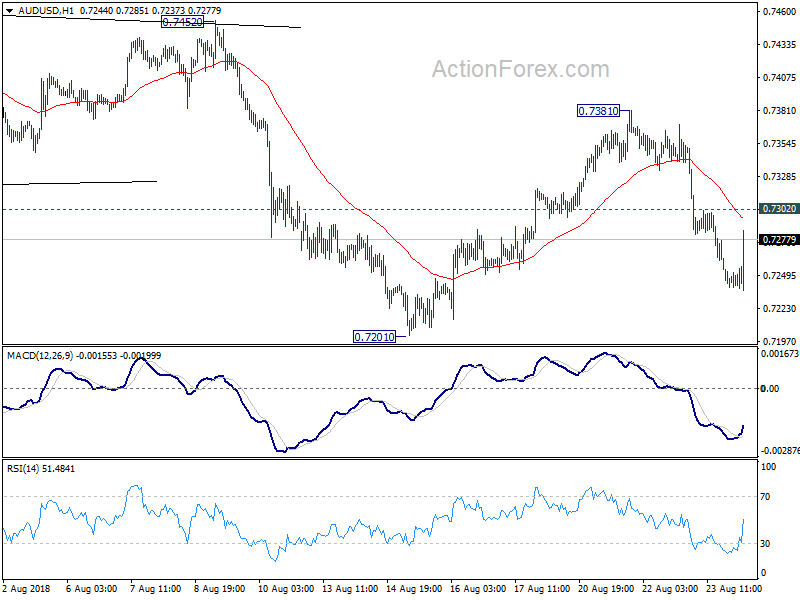
Australian Dollar is given a pop as its reported that Treasurer Scott Morrison has won enough vote to replace Malcolm Turnbull as Prime Minister. Chanllenger, former Home Affairs Minister Peter Dutton failed. And the Australian Dollar seems to like the result.
USD/JPY Likely To Recover Further Towards 111.50/80
Key Highlights
- The US Dollar found support near the 109.80 support against the Japanese Yen.
- There was a break below a major bullish trend line with support at 111.10 on the daily chart of USD/JPY.
- The US Initial Jobless Claims for the week ending August 18, 2018 declined from 212K to 210K.
- Today, the US Durable Goods Orders for July 2018 will be released, which is forecasted to decline by 0.5%.
USDJPY Technical Analysis
The US Dollar remained under a lot of pressure below the 111.80 and 111.50 support levels against the Japanese Yen. The USD/JPY pair even traded below the 110.00 level before buyers appeared near 109.80.
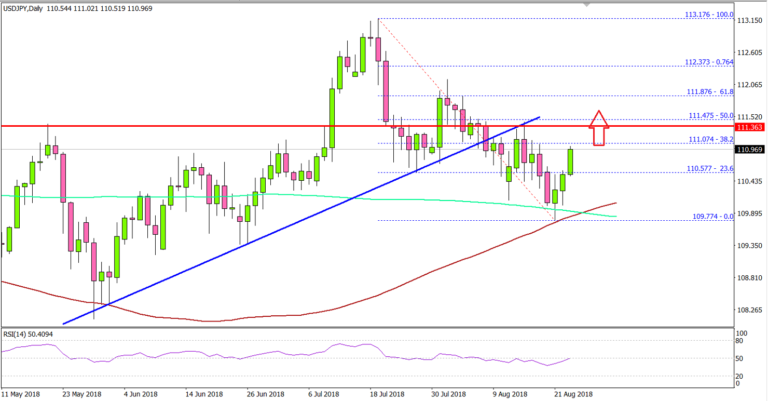
Looking at the daily chart, the pair settled below the 111.50 pivot level and broke a major bullish trend line with support at 111.10. However, the 100-day simple moving average (red) and the 200-day simple moving average (green) near the 110.00 level acted as a strong support.
It jumped back above the 110.50 level and the 23.6% Fib retracement level of the last drop from the 113.17 high to 109.77 low. On the upside, there are many resistances formed near the 111.40 and 111.50 levels.
Moreover, the 50% Fib retracement level of the last drop from the 113.17 high to 109.77 low is also near the 111.50 level to prevent gains. Above this, the pair is likely to recover towards 112.00.
On the other hand, if there is a downside correction, the pair is likely to find support near the 110.20 and 110.00 levels.
Recently in the US, the Initial Jobless Claims figure for the week ending August 18, 2018 was released. The market was looking for a rise from the last reading of 212K to 215K.
However, the actual result was positive as there was a decline from the last reading of 212K to 210K. The report stated:
The 4-week moving average was 213,750, a decrease of 1,750 from the previous week’s unrevised average of 215,500.
Overall, the US Dollar may continue to recover versus the Japanese Yen in the short term, while EUR/USD and GBP/USD are likely to extend gains.
Economic Releases to Watch Today
- US Durable Goods Orders for July 2018 – Forecast -0.5% versus +0.8% previous.
- German Gross Domestic Product for Q2 2018 (YoY) – Forecast 2.3%, versus 2.3% previous.
- German Gross Domestic Product for Q2 2018 (QoQ) – Forecast 0.5%, versus 0.5% previous.
USD/CAD Canadian Dollar Falls After US Tariffs On China Kick In
The Canadian dollar fell on Thursday as the US dollar rebounded after US tariffs on Chinese goods came into effect and the Trump administration threaten action against South Africa. There were signs that China and the US will meet, but for the time being the duties are in effect.
NAFTA negotiations seem to be finally moving with some momentum, but the choice of the US to deal with Mexico first still leaves a lot of question marks regarding how it will affect the Canadian economy. Earlier today Foreign Affairs Minister Chrystia Freeland said she was encouraged by optimism and ready to rejoin the talks.
Mexican Economy Minster has made statements that he will only reach a deal if Canada is present. There were some reports that a deal was imminent, but Guajardo came out saying they will continue to work into next week.
The USD/CAD gained 0.63 percent on Thursday. The currency pair is trading at 1.3079 as the US tariffs on Chinese goods came into effect triggering risk aversion.
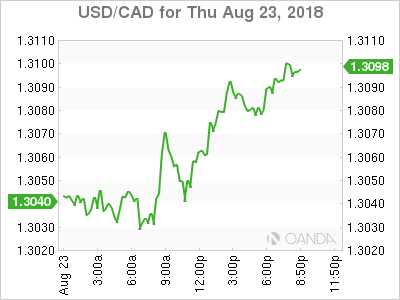
The loonie is now in the red on a weekly basis after the resurgence of the US dollar as trade concerns have once again cemented the position of the greenback as a reserve currency.
U.S. Federal Reserve Chair Jerome Powell will host a talk titled Monetary Policy in a Changing Economy as part of the Jackson Hole Symposium in Wyoming. The Fed has been under siege by the Trump administration who has openly criticized its monetary policy decisions.
The Fed has lifted interest rates twice in 2018 and two more rate hikes are forecasted. Fed members have issued comments defending the independence of the central bank and that the statements from the Trump administration do not influence in their decisions.
Bank of Canada (BoC) Governor Poloz will speak on Saturday at the same summit. The market is already pricing in a rate hike in October as solid economic indicators and the need to close the gap with US interest rates.
The speech given by Poloz will be a source of direction for the currency although the market will tend to react with with a bigger price movement if he makes a dovish assessment of current conditions.
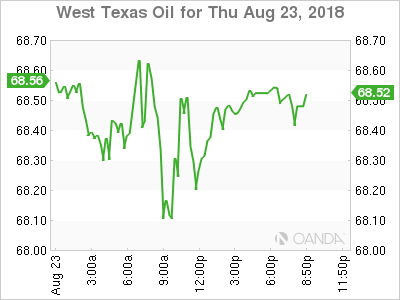
West Texas Intermediate prices are stable around the $68.53 level on Thursday. The release of the crude inventories data by the Energy Information Administration (EIA) pushed prices from $66.81 to around current levels and the strength of the dollar has capped the price recovery of oil.
Saudi authorities are trying to set the record straight on the Saudi Aramco IPO by saying it will happen when conditions are optimum but definitely not cancelled as some of the early reports were claiming.
Eco Data 8/24/18
[php_everywhere instance="1"]
Elliott Wave Analysis: USD Index Trading Bearish
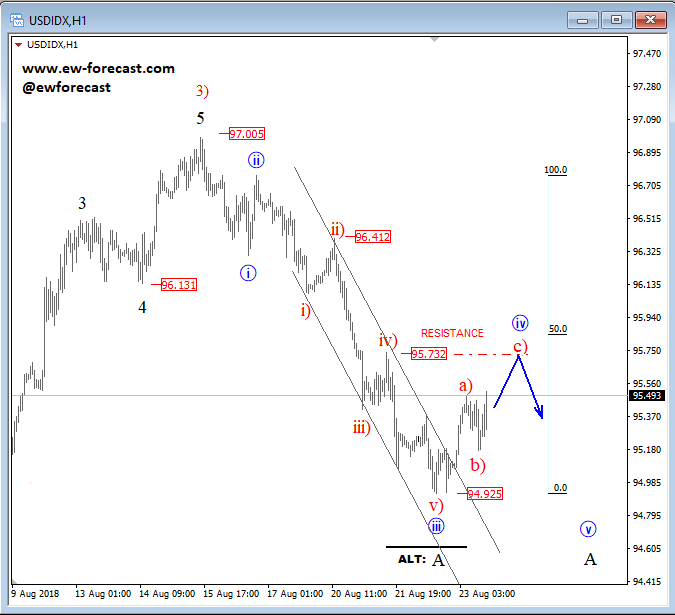
USD Index made a nice-looking, three-wave drop from the 97.00 level which also looks to be part of a bearish impulse. We see a completed blue leg iii at 94.92 level from where a new sharp intra-day recovery began to unfold. This rise can be part of a minimum three-wave correction of wave four, which can look for resistance and a bearish reversal near the 95.73 level. That said a breach below the 94.23 level will confirm more weakness into sub-wave v of A, while a break above the 96.00 level will suggest a temporary low in place, as wave A.
USD index, 1h
Japanese Yen Dips, Inflation Reports Next
The U.S dollar has posted broad gains in Thursday trade, and USD/JPY has also moved higher. In the North American session, the pair is trading at 111.14, up 0.53% on the day. In the U.S, employment claims edged lower to 210 thousand, beating the estimate of 215 thousand. New Home Sales fell to 627 thousand, well short of the estimate of 641 thousand. This was the second housing report in as many days to miss expectations. Later in the day, Japan releases two inflation reports. National Core CPI and the Services Producer Price Index are expected to post gains of 0.9% and 1.2%, respectively. On Friday, Federal Reserve Chair Jerome Powell speaks at the Jackson Hole gathering of central bankers. As well, the U.S releases durable goods reports.
Despite an ultra-accommodative monetary policy, Japanese inflation remains stubbornly low. The BoJ’s target of just below 2 percent remains elusive, so there is no pressure on policymakers to even contemplate a rate hike in the near future. Still, inflation has moved upwards, and the Services Producer Price Index has strengthened in three straight releases, reaching 1.2% in June. The indicator is expected to post another gain of 1.2% in July. If Thursday’s inflation reports are stronger than expected, the yen could recover some of the losses recorded earlier in the day.
The Federal Reserve released the minutes of its July meeting, at which policymakers maintained the benchmark rate. The minutes noted that the U.S economy remains strong and hinted that the Fed would raise rates in September. However, policymakers added that there plan to continue with gradual rate increases could have to be halted if the global trade war worsened, as the trade war represented a major downside risk to the U.S economy. Fed Chair Jerome Powell will address the Jackson Hole Symposium on Friday, and investors will be listening carefully. Powell is expected to refer to trade tensions, as well as the fact that inflation and wage growth have lagged, despite a booming U.S economy. The minutes have cemented a rate hike in September, with market odds currently at 96%. The likelihood of a December rate hike stands at 57%.