

Sample Category Title
USD/CHF Mid-Day Outlook
Daily Pivots: (S1) 0.9806; (P) 0.9832; (R1) 0.9857; More....
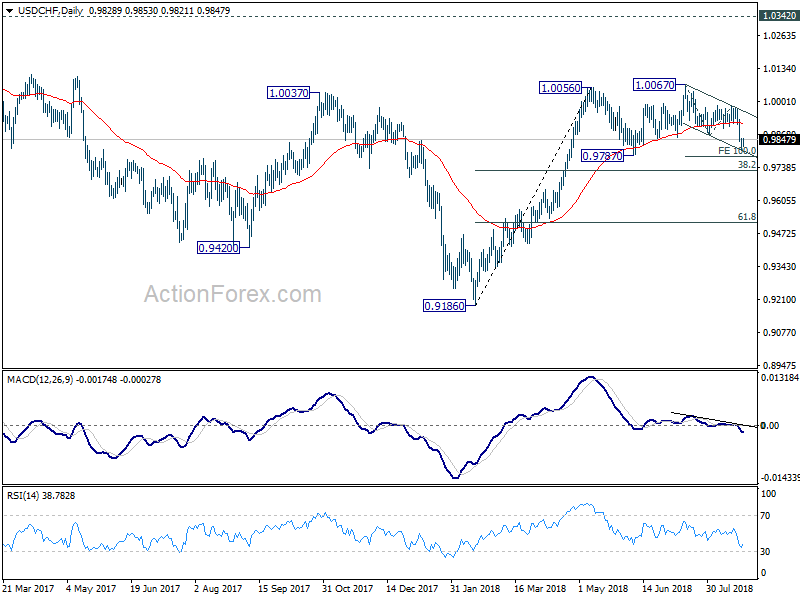
Intraday bias in USD/CHF remains neutral for consolidation above 0.9807 temporary low. For now deeper fall could be seen as long as 0.9889 minor resistance holds. Below 0.9807 will target 100% projection of 1.0067 to 0.9866 from 0.9981 at 0.9780 and possibly below. But fall from 1.0067 is seen as the third leg of the consolidation pattern from 1.0056. Hence, we'd expect strong support from 38.2% retracement of 0.9186 to 1.0056 at 0.9724 to bring rebound. On the upside, above 0.9889 will turn bias to the upside for 0.9981 resistance first. Break will bring retest of 1.0067 high.
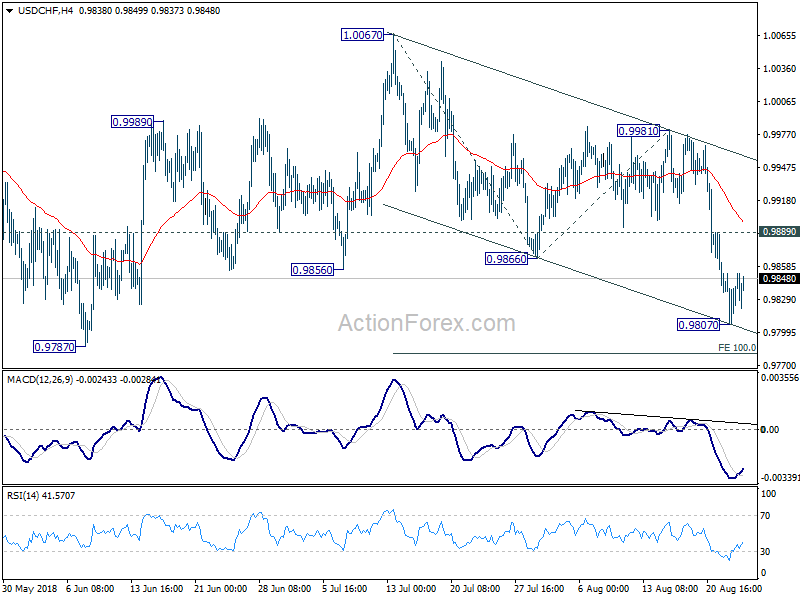
In the bigger picture, current development suggests that the consolidation pattern from 1.0056 is extending. As long as 38.2% retracement of 0.9186 to 1.0056 at 0.9724 holds, we'd expect rise from 0.9186 to resume at a later stage to retest 1.0342 key resistance (2016 high). However, sustained break of 0.9724 fibonacci level will bring deeper fall, as another declining leg in the long term range pattern.
USD/JPY Mid-Day Outlook
Daily Pivots: (S1) 110.15; (P) 110.39; (R1) 110.79; More...
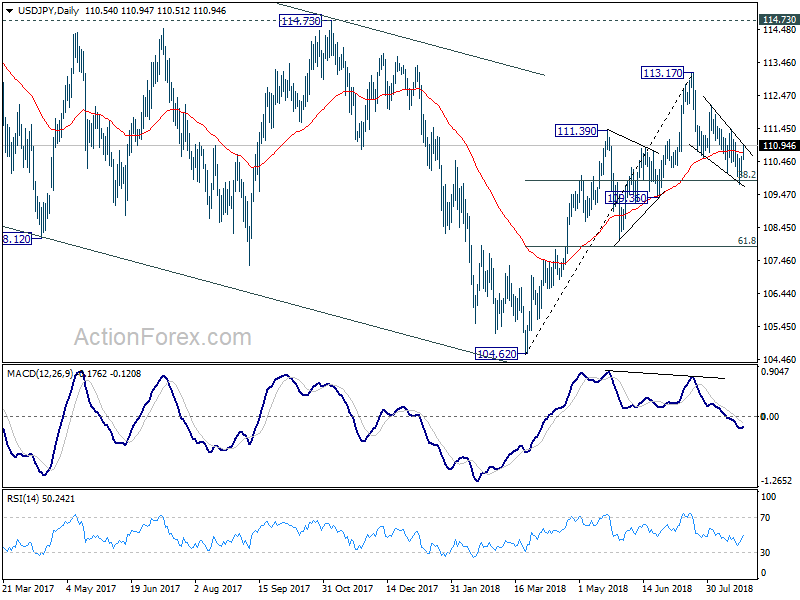
At this point, USD/JPY is staying below 114.42 resistance and intraday bias remains neutral first. No change in the view that price actions from 113.17 are a corrective pattern. We'd continue to expect strong support around 38.2% retracement of 104.62 to 113.17 at 109.90 to bring rebound. On the upside, above 111.42 will turn bias back to the the upside for retesting 113.17 first. However, sustained break of 109.90 will put 109.36 key support level in focus. Break of 109.36 will carry larger bearish implications.
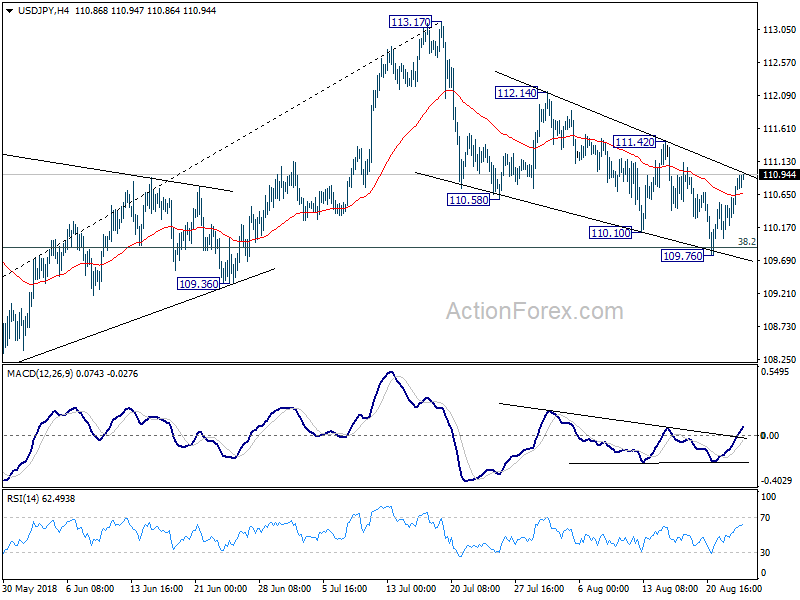
In the bigger picture, corrective fall from 118.65 (2016 high) should have completed with three waves down to 104.62. Decisive break of 114.73 resistance will likely resume whole rally from 98.97 (2016 low) to 100% projection of 98.97 to 118.65 from 104.62 at 124.30, which is reasonably close to 125.85 (2015 high). This will stay as the preferred case as long as 109.36 support holds. However, decisive break of 109.36 will mix up the outlook again. And deeper fall should be seen back to 61.8% retracement of 104.62 to 113.17 at 107.88 and below.
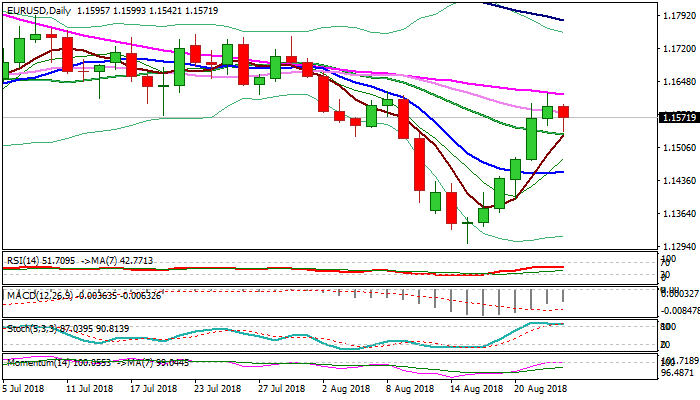
EURUSD Outlook: Bullish Bias Remains in Play While 20SMA Holds the Downside
The Euro is slightly firmer at the beginning of the US session, as weaker than expected EU/German Manufacturing data showed mild impact and so far not reacting on better than expected US weekly jobless claims figures.
Near-term action remains strongly underpinned by rising thick daily cloud, while momentum on daily chart is strengthening and increasing expectations for renewed attack at 55SMA pivot (1.1621), after today’s downside attempts were contained by broken weekly cloud base (1.1525) which marks solid support, reinforced by 20SMA.
Bullish near-term bias is expected to remain in play while the latter supports hold. Conversely, sustained break here would signal deeper correction of 1.1300/1.1623 rally.
Res: 1.1599; 1.1621; 1.1640; 1.1687
Sup: 1.1542; 1.1525; 1.1500; 1.1454
Canadian Dollar Dips as Greenback Recovers
The Canadian dollar has posted losses in the Thursday session, erasing the losses seen on Wednesday. In North American trade, USD/CAD is trading at 1.3066, up 0.54% on the day. In economic news, U.S employment claims edged lower to 210 thousand, beating the estimate of 215 thousand. The sole Canadian indicator, Corporate Profits, posted a gain of 1.0%. On Friday, Federal Reserve Chair Jerome Powell speaks at the Jackson Hole gathering of central bankers. As well, the U.S releases durable goods reports.
The Federal Reserve released the minutes of its July meeting, at which policymakers maintained the benchmark rate. The minutes noted that the U.S economy remains strong and hinted that the Fed would raise rates in September. However, policymakers added that there plan to continue with gradual rate increases could have to be halted if the global trade war worsened, as the trade war represented a major downside risk to the U.S economy. Fed Chair Jerome Powell will address the Jackson Hole Symposium on Friday, and investors will be listening carefully. Powell is expected to refer to trade tensions, as well as the fact that inflation and wage growth have lagged, despite a booming U.S economy. The minutes have cemented a rate hike in September, with market odds currently at 96%. The likelihood of a December rate hike stands at 57%.
Canadian retail sales declined 0.2% in June, missing the estimate of -0.1%. The soft reading did not spook investors, who chose to view the release as a pause in strong consumer growth – in May, consumer spending jumped 2.0%. The economy is performing well and inflation is higher, so the pieces appear in place for a quarter-point rate hike by the Bank of Canada in September. With the U.S expected to raise rates at least once more this year, there is pressure on the BoC to raise rates or watch the Canadian dollar lose ground to its U.S counterpart.
AUD/USD Mid-Day Outlook
Daily Pivots: (S1) 0.7335; (P) 0.7352; (R1) 0.7371; More...
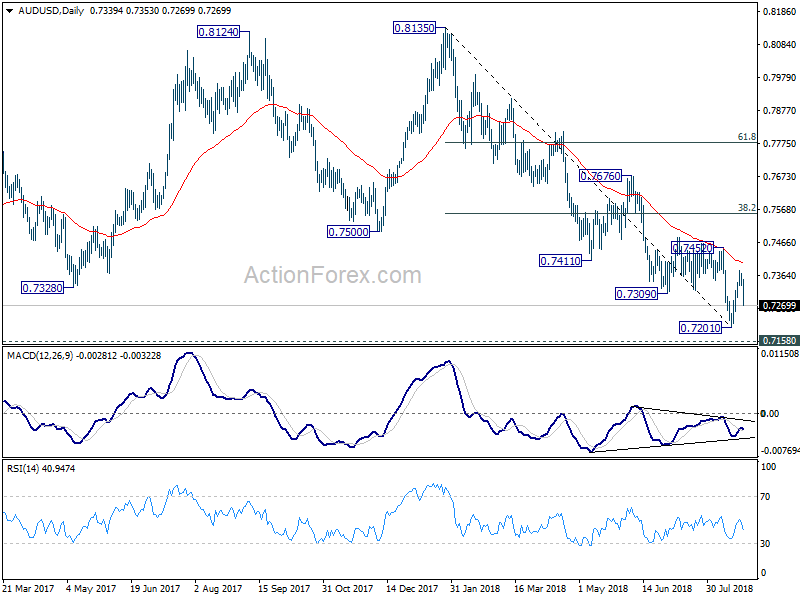
AUD/USD's decline from 0.7381 is still in progress and intraday bias stays on the downside for 0.7201 low. Firm break there will resume larger down trend fro 0.8135. In that case, 0.7158 medium term support will be the next target. On the upside, above 0.7302 minor resistance will turn intraday bias neutral first. And, even in case that correction from 0.7201 extends with another rise, we'd expect upside to be limited by 0.7425 resistance to bring larger down trend resumption eventually.
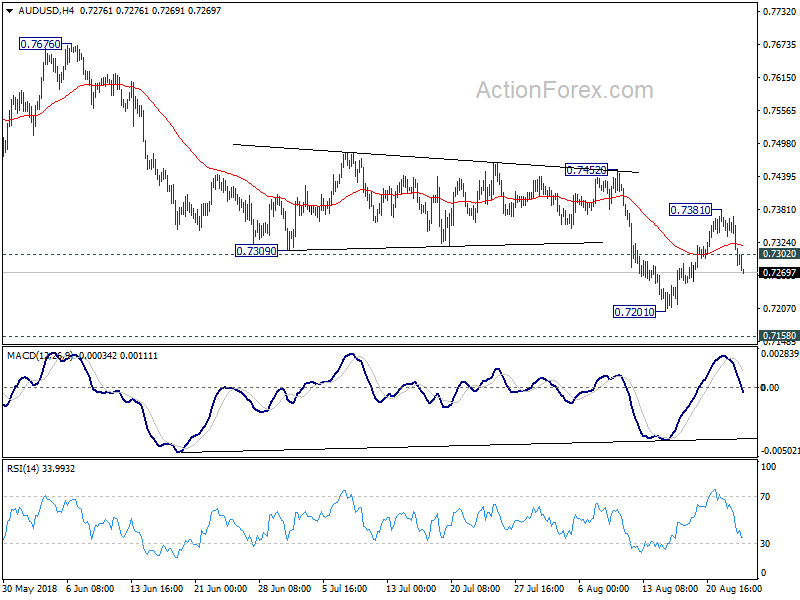
In the bigger picture, rebound from 0.6826 (2016 low) is seen as a corrective move that should be completed at 0.8135. Fall from there would extend to have a test on 0.6826. There is prospect of resuming long term down trend from 1.1079 (2011 high). But we'll look at downside momentum to assess at a later stage. On the upside, break of 0.7452 resistance, however, will indicate medium term bottoming, on bullish convergence condition in daily MACD. In that case, a correction should be seen first, with stronger rebound would be seen to 38.2% retracement of 0.8135 to 0.7201 at 0.7558. The down trend from 0.8135 will resume after the correction completes.
Dollar Rebound in Progress But Momentum Weak, Aussie Selloff Extends
Dollar is still trading as the strongest for today even though the rebound looks a bit unconvincing. In particular, the greenback is effectively just range bound against against European majors. And in fact, it's taking turn to be the strongest with Swiss Franc. Meanwhile, Australian Dollar remains the weakest one, followed by New Zealand Dollar. The Aussie is weighed down by its own political turmoil. There is a high chance Prime Minister Malcolm Turnbull would be ousted as soon as tomorrow. And it's uncertain who of Treasurer Scott Morrison, former Home Affairs Minister Peter Dutton, or Foreign Affairs Minister Julie Bishop would get enough vote for party leadership and the top job.
Released from US, initial jobless claims dropped -2k to 210k in the week ended August 18, below expectation of 215k. Four-week moving average of initial claims dropped -1.75k to 213.75k. Continuing claims dropped -2k to 1.727m in the week ended August 11. Four-week moving average of continuing claims dropped -5k to 1.7355m. The markets paid little attention to the data. Focuses are on the rising impeachment threat for Trump. And Trump himself even threatened the Americans that if he's impeached, "the market would crash" and "everybody would be very poor".
In other markets, European indices are trading nearly flat today, "flipping" between gains and losses in very tight range. China's Shanghai SSE rose 0.37% to close at 2724.62 as new rounds of tariffs from US and China takes effect. Hong Kong HSI dropped -0.49%. Nikkei rose 0.22% and Singapore Strait Times rose 1.56%. Gold breached 1187.40 minor support earlier today but refuses to give in so far.
Technically, weakness of Australian Dollar will remain a main theme in the US session. EUR/AUD just took out 1.5888 resistance to resume the rally from June's low at 1.5271. It's heading to 1.6 handle and will very likely challenge 1.6189 resistance in near term. Meanwhile, 1.1493 minor support and EUR/USD and 1.2811 minor support in GBP/USD will be watched to confirm if Dollar is really completing this week's pull back.
China's retaliation tariffs start shortly after US tariffs took effect
A new round of US tariffs on Chinese imports has just started today. The US began collecting 25% tariffs on 279 lines of Chinese goods, totalling USD 16B in values. They add to the tariffs on USD 34B of Chinese imports which are already in effect. Shortly after US tariffs on USD 16B in Chinese goods came into effect, China's equivalent retaliation tariffs also start.
In a brief statement, the Chinese Ministry of Commerce said "China resolutely opposes this, and will continue to take necessary countermeasures." And, "at the same time, to safeguard free trade and multilateral systems, and defend its own lawful interests, China will file suit regarding these tariff measures under the WTO dispute resolution mechanism."
ECB accounts: Risks broadly balanced notwithstanding protectionism and market volatility
In the accounts of July monetary policy meeting, ECB noted that "members considered that the risks surrounding the euro area growth outlook could still be assessed as broadly balanced". Though, there are uncertainties related to global factors "notably the threat of protectionism.". Also, "risk of persistent heightened financial market volatility also continued to warrant monitoring."
On inflation, there was "broad agreement" on chief economist Peter Praet's assessment. Annual HICP inflation rose to 2.0% in June. And, "on the basis of current futures prices for oil, annual rates of headline inflation were likely to hover around the current level for the remainder of the year". Muted underlying inflation "had been increasing from earlier lows". Also, there was "increasing support" for domestic cost pressures from "ongoing strengthening in wage growth". Beside, "members broadly shared the view that uncertainties surrounding the inflation outlook had been receding."
Regarding communications, "members widely expressed satisfaction that the communication of the June monetary policy decisions had been well understood by financial markets." And, the "enhanced forward guidance on the future path of policy rates had been effective in aligning market views". That is, ECB interest rates would remain at current levels "at least through the summer of 2019". It "struck an appropriate balance" between precision and flexibility and "was remarked that the Governing Council's expectation was probabilistic in nature."
Full ECB meeting accounts here.
Bundesbank Weidmann: Get the normalization ball rolling without undue delay
Bundesbank President Jens Weidmann warned today that ECB must not delay monetary policy normalization. He said, it's " time to begin exiting the very expansionary monetary policy and the non-standard measures, especially considering their possible side effects." And, such normalization process would "take place only gradually over the next few years." That "exactly why it has been so important to actually get the ball rolling without undue delay."
Weidmann added that ECB's projection of 1.7% headline inflation for 2020 is "broadly consistent" with the mandate. And, domestic prices are " likely to intensify as aggregate capacity utilization increases." Therefore, "they will thus counteract waning impetus from other components of the inflation rate, such as energy prices."
Eurozone PMIs, manufacturing looking the most susceptible to a trade-led slowdown in coming months
Eurozone PMI manufacturing dropped to 54.6 in August, down from 55.1 and missed expectation of 55.1. PMI services rose to 54.4, up from 54.2 and matched expectations. PMI composite rose to 54.4, up merely 0.1 from 54.3.
Chris Williamson, Chief Business Economist at IHS Markit said that the survey data indicated steady growth in August, and raised hopes that Q3 GDP could match Q2's 0.4%. However, "warning lights are flashing" as "risks seem tilted to the downside". He noted "escalating political worries, rising prices and a recent slowdown in order book growth have all contributed to the gloomiest outlook for almost two year". And, "with manufacturing looking the most susceptible to a trade-led slowdown in coming months, hopes are pinned on a robust service sector helping to drive economic growth as we move into the autumn, yet even here optimism is down to its lowest for nearly two years."
Also released, Germany PMI manufacturing dropped to 56.1 in August, down from 56.9 and missed expectation of 56.6. PMI services rose to 55.2, up from 54.1 and beat expectation of 54.4. PMI composite rose to 55.7, up from 55.0, hit a 6-month high.
France PMI manufacturing rose to 53.7 in August, up from 53.3 and beat expectation of 53.5. PMI services rose to 55.7, up from 54.9 and beat expectation of 55.1. PMI composite rose to 55.1, up from 54.4 and hit a 4-month high.
UK published documents on no-deal Brexit preparations
UK government published a collection of documents on "How to prepare if the UK leaves the EU with no deal". Topics covered include applying for EU-funded programs, civil nuclear and nuclear research, farming, Importing and exporting, labelling products and making them safe, money and tax, regulating medicines and medical equipment, state aid, studying in the UK or EU, workplace rights.
Brexit minister Dominic Raab said he wanted to make sure Britain "goes from strength to strength, even in the unlikely event that we do not reach a negotiated deal with the European Union." Nonetheless, Raab remained "confidence that a good deal is within out sights".
Japan PMI manufacturing: Weaker international sales weighed on business confidence
Japan PMI manufacturing rose 0.2 to 52.5 in August, slightly above expectation of 52.4. Markit noted in the release that "input and output price inflation at multi-year highs." While overall demand improves, "export orders fail to rise for a third straight month".
Joe Hayes, Economist at IHS Markit, said that the growth cycle in Japan's manufacturing sector extended to two years, "the longest uninterrupted stretch of expansion since the global financial crisis". But declining export orders suggested the expansion was "underpinned by strength in the domestic market."
Meanwhile, "weaker international sales weighed on business confidence, with panellists citing potential trade conflicts as a key risk to their outlook over the coming year."
AUD/USD Mid-Day Outlook
Daily Pivots: (S1) 0.7335; (P) 0.7352; (R1) 0.7371; More...
AUD/USD's decline from 0.7381 is still in progress and intraday bias stays on the downside for 0.7201 low. Firm break there will resume larger down trend fro 0.8135. In that case, 0.7158 medium term support will be the next target. On the upside, above 0.7302 minor resistance will turn intraday bias neutral first. And, even in case that correction from 0.7201 extends with another rise, we'd expect upside to be limited by 0.7425 resistance to bring larger down trend resumption eventually.
In the bigger picture, rebound from 0.6826 (2016 low) is seen as a corrective move that should be completed at 0.8135. Fall from there would extend to have a test on 0.6826. There is prospect of resuming long term down trend from 1.1079 (2011 high). But we'll look at downside momentum to assess at a later stage. On the upside, break of 0.7452 resistance, however, will indicate medium term bottoming, on bullish convergence condition in daily MACD. In that case, a correction should be seen first, with stronger rebound would be seen to 38.2% retracement of 0.8135 to 0.7201 at 0.7558. The down trend from 0.8135 will resume after the correction completes.
Economic Indicators Update
| GMT | Ccy | Events | Actual | Forecast | Previous | Revised |
|---|---|---|---|---|---|---|
| 00:30 | JPY | PMI Manufacturing Aug P | 52.5 | 52.4 | 52.3 | |
| 07:15 | EUR | France Manufacturing PMI Aug P | 53.7 | 53.5 | 53.3 | |
| 07:15 | EUR | France Services PMI Aug P | 55.7 | 55.1 | 54.9 | |
| 07:30 | EUR | Germany Manufacturing PMI Aug P | 56.1 | 56.6 | 56.9 | |
| 07:30 | EUR | Germany Services PMI Aug P | 55.2 | 54.4 | 54.1 | |
| 08:00 | EUR | Eurozone Manufacturing PMI Aug P | 54.6 | 55.1 | 55.1 | |
| 08:00 | EUR | Eurozone Services PMI Aug P | 54.4 | 54.4 | 54.2 | |
| 10:00 | GBP | CBI Realized Sales Aug | 29 | 13 | 20 | |
| 11:30 | EUR | ECB Monetary Policy Meeting Accounts | ||||
| 12:30 | USD | Initial Jobless Claims (AUG 18) | 210K | 215K | 212K | |
| 13:00 | USD | House Price Index M/M Jun | 0.30% | 0.20% | ||
| 13:45 | USD | Manufacturing PMI Aug P | 55.1 | 55.3 | ||
| 13:45 | USD | Services PMI Aug P | 55.9 | 56 | ||
| 14:00 | USD | New Home Sales Jul | 651K | 631K | ||
| 14:00 | EUR | Eurozone Consumer Confidence Aug A | -1 | -1 | ||
| 14:30 | USD | Natural Gas Storage | 47B | 33B |
Brent Futures Ease Slightly; Bullish in Medium-Term
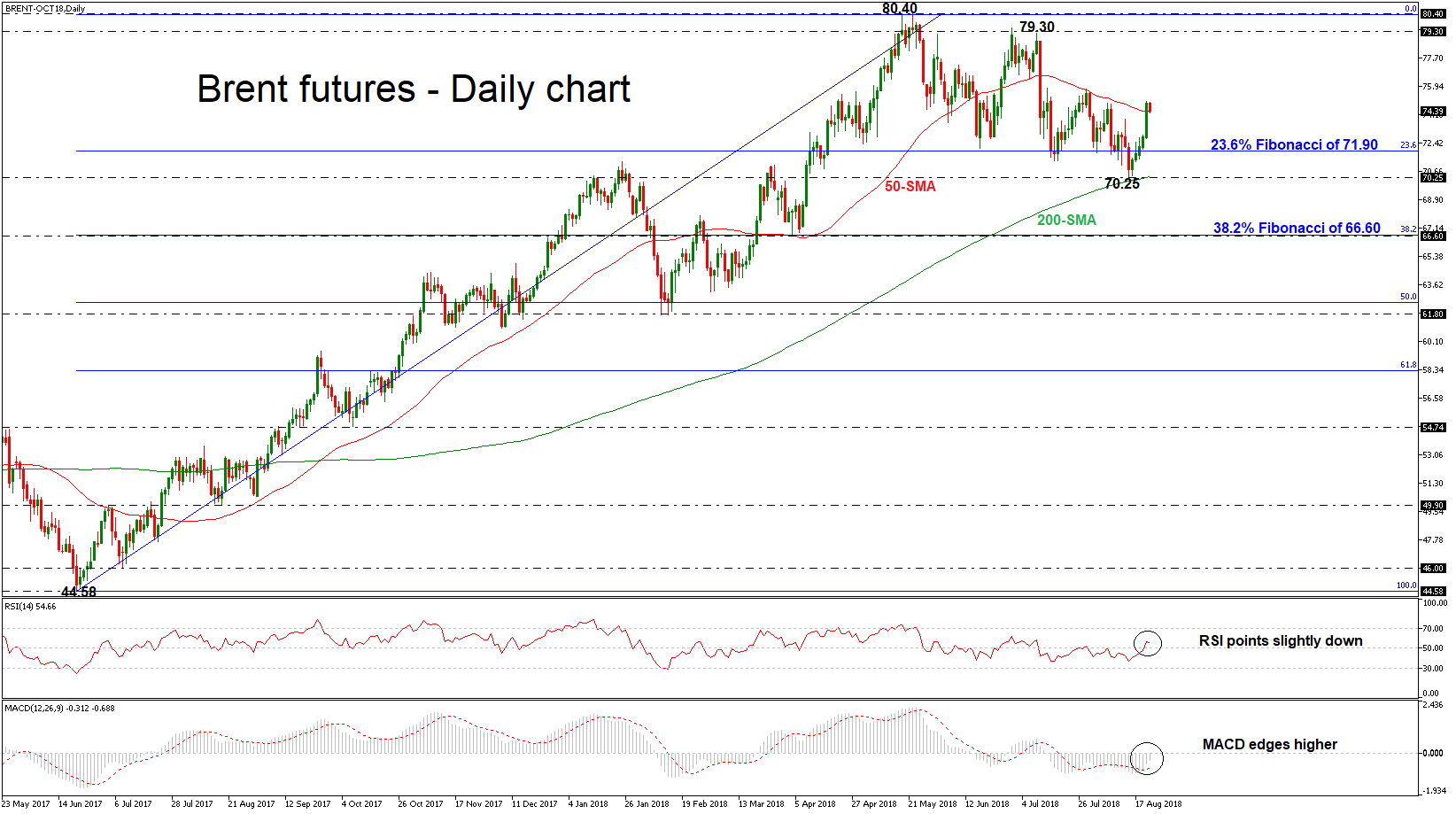
Brent futures have surged over the previous five consecutive days following the rebound on the 70.25 level, which coincides with the 200-day simple moving average (SMA). Also, the price still holds above the 50-SMA and the technical indicators are moving in the positive territory. The MACD is advancing above the trigger line, however, the RSI is sloping slightly to the downside above the 50 level.
If price action remains above the 50-day SMA, there is scope to test the 79.30 resistance level, taken from the high on July 10. Clearing this key level would see additional gains towards the 80.40 barrier, where it topped on May 22.
On the other side, if the price fails to stand above the 50-SMA, then the focus would shift to the downside towards the 23.6% Fibonacci retracement level of upleg from 44.58 to 80.40, around 71.90. A drop below this level would open the way for the latest low of 70.25. If this level is breached, it would increase downside pressure and bring a reversal again of the medium-term uptrend. From here, oil would be on the path towards the 38.2% Fibonacci, which overlaps with the 66.60 support level.
Overall, Brent has been bullish since bottoming at 44.58 in June 2017. Despite that, the latest month posted a bearish correction.
Into US session: Dollar firm but lost momentum, Trump threatens American of market crash
Entering into US session, Dollar remains the strongest one for today, together with Swiss Franc. However, recovery in the greenback seems to be losing some momentum. For now, EUR/USD and GBP/USD are holding well above 1.1493 and 1.2811 minor support respectively. Thus, there is no indication of completion in Dollar's pull back yet.
Dollar's upside momentum is apparently limited as Trump threatens the Americans that if he's impeached, "the market would crash" and "everybody would be very poor". So, Trumps is telling the world that Americans would choose to keep a criminal as President so as to save their pockets?
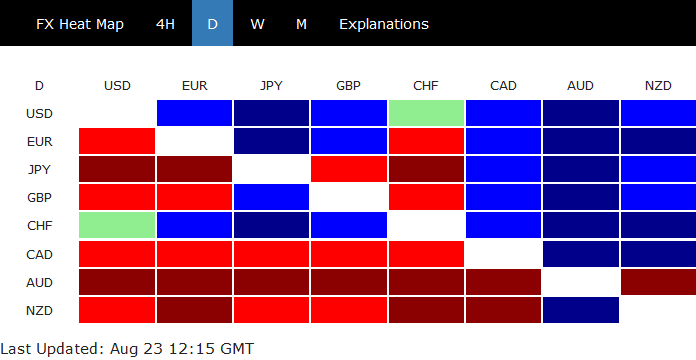
It was a pretty eventful session in Eurozone with PMIs, ECB accounts and comments from Bundesbank head Jens Weidmann. Euro is doing ell enough to trade as the third strongest one. Sterling also shrugs off the collection of documents on preparation for no-deal Brexit, published by the government.
On the other hand, Australian Dollar remains the weakest one for today on its down domestic political turmoil. The country could be having a new Prime Minister, the seventh in a decade, within days. And it's uncertain whether Malcolm Turnbull will stay. Or it will be Treasurer Scott Morrison, former Home Affairs Minister Peter Dutton, or Foreign Affairs Minister Julie Bishop.
The European stock markets are pretty quiet too, with FTSE, DAX and CAC trading nearly flat in very tight range. China's Shanghai SSE rose 0.37% to close at 2724.62 as new rounds of tariffs from US and China takes effect. Hong Kong HSI dropped -0.49%. Nikkei rose 0.22% and Singapore Strait Times rose 1.56%.
ECB accounts: Risks broadly balanced notwithstanding protectionism and market volatility
In the accounts of July monetary policy meeting, ECB noted that "members considered that the risks surrounding the euro area growth outlook could still be assessed as broadly balanced". Though, there are uncertainties related to global factors "notably the threat of protectionism.". Also, "risk of persistent heightened financial market volatility also continued to warrant monitoring."
On inflation, there was "broad agreement" on chief economist Peter Praet's assessment. Annual HICP inflation rose to 2.0% in June. And, "on the basis of current futures prices for oil, annual rates of headline inflation were likely to hover around the current level for the remainder of the year". Muted underlying inflation "had been increasing from earlier lows". Also, there was "increasing support" for domestic cost pressures from "ongoing strengthening in wage growth". Beside, "members broadly shared the view that uncertainties surrounding the inflation outlook had been receding."
Regarding communications, "members widely expressed satisfaction that the communication of the June monetary policy decisions had been well understood by financial markets." And, the "enhanced forward guidance on the future path of policy rates had been effective in aligning market views". That is, ECB interest rates would remain at current levels "at least through the summer of 2019". It "struck an appropriate balance" between precision and flexibility and "was remarked that the Governing Council's expectation was probabilistic in nature."
(ECB) Account of the monetary policy meeting 25-26 July
Of the Governing Council of the European Central Bank, held in Frankfurt am Main on Wednesday and Thursday, 25-26 July 2018
1. Review of financial, economic and monetary developments and policy options
Financial market developments
Mr Cœuré reviewed the latest financial market developments since the Governing Council's previous monetary policy meeting on 13-14 June 2018.
The slope of the US Treasury and German government bond yield curves, measured as the difference between the ten-year and two-year yields, had continued their flattening trend of recent months. In particular, between April and July 2018 estimates of the term premium in the United States had fallen deeper into negative territory despite factors which should have led, in principle, to a decompression of the premium, such as the gradual balance sheet wind-down by the Federal Reserve System and expectations of an increase in the supply of US Treasury securities based on a projected rise in the US fiscal deficit.
The most recent decline in term premia, both in the United States and in the euro area, might partly be attributed to the growing uncertainty over the global economic outlook owing, among other factors, to escalating trade disputes. This may have affected confidence among investors and contributed to an increase in demand for US Treasuries and German government bonds, widening the negative term premia that also reflected the stock effect of large-scale asset purchases.
Moreover, following the June Governing Council meeting, market participants' expectations of a first rate increase by the ECB had been pushed further into the future, as suggested by market pricing and the latest analyst surveys. This partly reflected the Governing Council's enhanced forward guidance on the future path of policy rates, which had also contributed to reducing interest rate uncertainty.
In foreign exchange markets, the euro had traded in a very narrow range against the US dollar. However, in nominal effective terms, the euro had appreciated, in particular against the currencies of a number of developing and emerging market economies. Part of the depreciation of these economies' currencies was likely related to the growing uncertainty over the impact of trade tensions.
Trade tensions were also seen by market participants to have had a negative impact on stock market valuations, most notably in China. Since its peak in late January 2018, the China Securities Index 300 had declined by nearly 20%, while other stock market indices in the region had also fallen but to a lesser extent. These equity market sell-offs no longer affected only sectors that would be most hit by tariffs. Rather, they had become more broad-based, possibly reflecting increasing concerns among investors over the impact of protectionist measures on the global growth outlook.
Credit spreads in emerging market economies had increased measurably, by around 80 basis points, since the start of 2018. However, they remained well below the levels observed in 2015 and early 2016.
The global environment and economic and monetary developments in the euro area
Mr Praet reviewed the global environment and recent economic and monetary developments in the euro area.
Regarding the external environment, the global economic expansion had continued, while trade had weakened further. At the same time, inflation dynamics had gained some momentum. Annual consumer price inflation in the OECD area had edged up to 2.6% in May, with inflation excluding food and energy also increasing marginally. Brent crude oil prices had decreased by 2.2% (in US dollar terms) since the June monetary policy meeting. Over the same period, non-oil commodity prices had decreased by 7.4%, food prices by 6.7% and metal prices by 9.7% (all in US dollar terms).
Looking at the euro area, the incoming data confirmed that the moderation in the first quarter of 2018 had reflected a pull-back from the very high growth levels of previous quarters, mostly on account of weaker export demand with some contribution from temporary and supply-side factors. The breakdown of first-quarter growth into its components showed that domestic demand and changes in inventories had contributed positively to the outturn, whereas the contribution of net exports had been negative.
High frequency indicators released since the June meeting had confirmed the ongoing broad-based expansion. The flash composite output Purchasing Managers' Index for July had decreased only slightly to 54.3, from 54.9 in June. Moreover, consumer confidence and confidence in the construction sector had remained at elevated levels, well above their historical averages. Favourable financing conditions, a robust labour market, and steady income and profit growth had continued to support private consumption and investment.
The June 2018 Eurosystem staff projections for euro area real GDP growth were broadly aligned with, or slightly below, available forecasts from other international institutions.
Turning to price developments, according to Eurostat's flash estimate, euro area annual HICP inflation had stood at 2.0% in June, up from 1.9% in May. The increase reflected higher inflation rates for the energy and food components, which had more than offset a decline in HICP inflation excluding energy and food. Meanwhile, measures of underlying inflation remained muted overall but had been increasing from earlier lows.
Annual growth in compensation per employee had increased to 2.0% in the first quarter of 2018, up from 1.8% in the fourth quarter of 2017. In the first quarter of 2018, the impetus for this upward trend had come from stronger negotiated wage growth, rather than wage drift, as had previously been the case. This shift to negotiated wage growth as the main driver bolstered confidence that the pick-up in wage growth would be sustained.
Both market and survey-based inflation expectations were largely unchanged since the June meeting. Compared with other forecasts, the June Eurosystem staff projections for euro area HICP inflation were at the upper end of the range for 2018 and in the middle of the range for 2019 and 2020.
Financial conditions had remained broadly stable, in spite of some exchange rate appreciation in nominal effective terms and lower equity markets. The Governing Council's June decisions had reduced interest rate uncertainty. In the weeks following the June meeting, EONIA forward rates had continued to decline, accompanied by a further flattening of the forward curve. Meanwhile, mounting global trade tensions weighed on euro area equity markets, while there were only modest changes in sovereign and corporate debt markets. The overall cost of financing for euro area firms had remained very favourable.
Turning to money and credit developments, the annual growth rate of the broad monetary aggregate M3 had risen to 4.4% in June from 4.0% in May. From a counterpart perspective, domestic sources of money creation had remained the main driver of M3 growth. The annual growth rate of loans to the private sector had continued its recovery, increasing to 3.5% in June, up from 3.3% in May. This acceleration had been mainly driven by loans to non-financial corporations (NFCs), which had stood at 4.1% in June.
At the euro area level, the composite cost of borrowing for NFCs had fallen to a new historical low in May, while the borrowing costs of loans for house purchase had remained stable at 1.8%. Moreover, according to the July 2018 euro area bank lending survey, credit standards had continued to ease for NFCs and households in the second quarter of 2018. The main factors contributing to the net easing had been competition and risk perceptions reflecting solid economic growth in the euro area.
Finally, with regard to fiscal policy, the euro area fiscal stance, measured as the change in the cyclically adjusted primary balance, was projected to stay mildly expansionary in 2018.
Monetary policy considerations and policy options
Summing up, Mr Praet noted that, since the June monetary policy decisions, financial conditions had remained broadly stable and borrowing conditions for households and firms had continued to be very favourable. The Governing Council's enhanced forward guidance on policy rates had struck a good balance between being sufficiently precise and maintaining adequate flexibility. Overall, the information received since the previous meeting had been broadly in line with the June assessment.
The most recent economic indicators and survey results had stabilised and confirmed the scenario of solid and broad-based growth momentum in line with the June Eurosystem staff projections.
Risks to the growth outlook could still be assessed as broadly balanced. Uncertainties related to global factors remained prominent. In addition, the risk of persistent heightened financial market volatility continued to warrant monitoring.
The strength of the euro area economy supported confidence that the convergence of inflation to levels below, but close to, 2% over the medium term would continue in the period ahead. This confidence was further bolstered by rising wages and increasing price pressures at the early stages of the pricing chain.
At the same time, underlying price pressures were building up only gradually, which argued in favour of patience, prudence and persistence with regard to the conduct of monetary policy in the period ahead.
On the basis of this assessment, Mr Praet proposed keeping monetary policy unchanged and reconfirming all elements of the Governing Council's forward guidance.
It was important for communication to emphasise that the incoming data confirmed that the euro area economy was proceeding along a solid and broad-based growth path and underlined that risks surrounding the euro area growth outlook could still be assessed as broadly balanced, but uncertainties related to global factors remained prominent.
It was furthermore important to highlight that the underlying strength of the euro area economy continued to provide confidence that the convergence of inflation to levels below, but close to, 2% over the medium term would proceed in the period ahead, as well as to stress that a significant monetary policy stimulus remained necessary for the sustained convergence of inflation.
Likewise important was for the Governing Council to reiterate that an ample degree of monetary accommodation would continue to be provided by the net asset purchases until the end of 2018, by the sizeable stock of acquired assets and the associated reinvestments, and by the enhanced forward guidance.
2. Governing Council's discussion and monetary policy decisions
Economic and monetary analyses
With regard to the economic analysis, members shared the assessment of the outlook and risks for economic activity in the euro area provided by Mr Praet in his introduction. The moderation in euro area real GDP growth in the first quarter of 2018 had reflected a pull-back from the very high levels of growth in 2017, relating mainly to weaker impetus from previously very strong external trade, as well as some temporary and supply-side factors. Moreover, the most recent economic indicators and survey results had stabilised and continued to point to ongoing solid and broad-based economic growth, in line with the June Eurosystem staff macroeconomic projections for the euro area. Overall, the risks to this growth outlook could still be assessed as broadly balanced, despite uncertainties related to global factors – notably the threat of protectionism – remaining prominent.
Regarding the external environment, members concurred with the view that the global economic expansion was expected to continue, although trade momentum had weakened. They furthermore agreed that uncertainties related to global factors remained prominent, in particular with regard to the threat of protectionism and the risk of an escalation of trade tensions. It was remarked that these tensions could generate a more general decline in confidence throughout the global economy, beyond any direct effects from the imposition of tariffs. Concerns were also expressed about the implications for emerging market economies and the recent depreciation of their currencies, with developments in these economies discussed prominently in the IMF's latest outlook for the global economy.
Turning to euro area activity, members concurred with the view that the easing in quarterly real GDP growth in the first quarter of 2018, to 0.4%, had by and large reflected a pull-back from the very high levels of growth recorded in 2017, with activity still exceeding the rate of growth of potential output. While the most recent data entailed the prospect of real GDP growth in the second quarter of 2018 being somewhat lower than embedded in the June Eurosystem staff projections, the expectation was still that this would be largely temporary and that the outlook over the medium term continued to be consistent with solid and broad-based economic growth.
Looking at the main demand components, support for the medium-term growth outlook continued to come from strong consumption fundamentals, notably ongoing employment growth. Reference was also made to the probable boost provided by expansionary fiscal measures in some countries. Business investment was expected to continue to benefit from favourable financing conditions, rising corporate profitability and solid demand. By contrast, the momentum in export demand had eased after performing exceptionally well during 2017, explaining the pull-back observed in overall economic growth. In this context, the point was made that the weaker momentum in export growth and the associated losses in market shares might, in part, also reflect the past appreciation of the euro in conjunction with other determinants of export demand, such as global growth. Furthermore, a remark was made that supply factors might also be contributing to a "structural" levelling-off of economic growth, with a number of surveys pointing to labour market tightness becoming progressively more widespread across sectors and countries.
Overall, members considered that the risks surrounding the euro area growth outlook could still be assessed as broadly balanced, notwithstanding the uncertainties related to global factors, notably the threat of protectionism. The risk of persistent heightened financial market volatility also continued to warrant monitoring.
With regard to price developments, there was broad agreement with the assessment presented by Mr Praet in his introduction. Euro area annual HICP inflation had increased to 2.0% in June 2018, from 1.9% in May, reflecting mainly higher energy and food price inflation. Looking ahead, on the basis of current futures prices for oil, annual rates of headline inflation were likely to hover around the current level for the remainder of the year. Moreover, while measures of underlying inflation remained generally muted, they had been increasing from earlier lows. According to the June Eurosystem staff projections, underlying inflation was expected to pick up towards the end of the year and to increase gradually thereafter. Patience was hence required, given the uncertainties in the baseline inflation outlook. With respect to domestic cost pressures, increasing support for the inflation outlook was seen to come from the ongoing strengthening in wage growth, although it remained to be seen to what extent wage inflation would translate into price inflation over time.
As regards developments in inflation expectations, comfort was drawn from the findings of the most recent ECB Survey of Professional Forecasters (SPF), which confirmed that probability distributions were moving towards higher headline inflation outcomes. At the same time, it was remarked that both survey-based and market-based measures indicated there was only a low probability of inflation exceeding 2% over the medium term.
Members broadly shared the view that uncertainties surrounding the inflation outlook had been receding. Developments since the previous monetary policy meeting had confirmed confidence in the continued convergence of inflation to levels below, but close to, 2% over the medium term, although expectations in the SPF for HICP inflation excluding energy and food in 2020 remained below those in the June Eurosystem staff projections. It was argued that uncertainties in the outlook for economic growth would not necessarily translate into corresponding risks to the inflation outlook. This held true, in particular, if such risks related to trade protectionism, in which case the impact on inflation was seen as being ambiguous.
Turning to the monetary analysis, members agreed with the assessment presented by Mr Praet in his introduction. The annual growth rate of broad money had risen in June, partly reversing the deceleration that had been observed between September 2017 and March 2018. While the somewhat weaker momentum in M3 dynamics over previous months had reflected the reduction in the monthly net asset purchases since the beginning of the year, this had been offset by an increase in the contribution of credit to the private sector and other counterparts. Overall, M3 growth continued to be supported by the impact of the ECB's monetary policy measures and by the low opportunity cost of holding the most liquid deposits.
It was noted that the recovery of credit to the private sector had continued in June, mainly driven by loans to NFCs. The origination of new loans for house purchase had also strengthened further, although, in net terms, housing loan growth had remained moderate owing to repayments of mortgages granted in the pre-crisis boom. The expansion of credit continued to be supported by very favourable borrowing costs for firms and households across the euro area, reflecting also the ongoing pass-through of the monetary policy measures put in place since June 2014. According to the July bank lending survey, loan developments had also benefited from some additional easing of credit standards across loan categories, in particular for households.
Monetary policy stance and policy considerations
With regard to the monetary policy stance, members widely shared the assessment provided by Mr Praet in his introduction. While uncertainties, notably related to the global trade environment, remained prominent, the information available since the previous monetary policy meeting was seen to indicate that the euro area economy was proceeding along a solid and broad-based growth path. The strength of the economy was assessed to confirm the Governing Council's confidence that the convergence of inflation to levels below, but close to, 2% over the medium term would continue in the period ahead and be maintained even after a gradual winding-down of net asset purchases. Nevertheless, significant monetary policy stimulus was considered to be still needed to support the further build-up of domestic price pressures and headline inflation over the medium term.
Members widely expressed satisfaction that the communication of the June monetary policy decisions had been well understood by financial markets. Since the June meeting, financial conditions had remained broadly stable and borrowing conditions for households and firms had continued to be very favourable. The Governing Council's enhanced forward guidance on the future path of policy rates had been effective in aligning market views about the future evolution of policy rates with the Governing Council's expectation that the key ECB interest rates would remain at their current levels "at least through the summer of 2019". This formulation was considered to have struck an appropriate balance between being sufficiently precise to provide effective forward guidance and maintaining a suitable degree of flexibility. In this regard, it was remarked that the Governing Council's expectation was probabilistic in nature.
There was broad agreement among members that an ample degree of monetary policy accommodation was still necessary to support the further build-up of domestic price pressures and headline inflation over the medium term. Overall, the uncertainties around the inflation outlook still called for caution and it was widely felt that monetary policy had to remain patient, prudent and persistent. It was considered essential to retain sufficient flexibility and optionality for monetary policy in the period ahead, and the importance of data dependency in determining the Governing Council's monetary policy stance was stressed.
Against this background, members unanimously agreed to maintain the current monetary policy stance and to reconfirm all elements of the Governing Council's forward guidance. This involved reiterating that the Governing Council expected policy rates to remain at their present levels at least through the summer of 2019 and, in any case, for as long as necessary to ensure the continued sustained convergence of inflation to levels below, but close to, 2% over the medium term. It also meant reconfirming that the Governing Council would continue to make net purchases under its asset purchase programme (APP) at the present monthly pace of €30 billion until the end of September 2018 and that it anticipated that, after September 2018, subject to incoming data confirming its medium-term inflation outlook, the Governing Council would reduce the monthly pace of the net asset purchases to €15 billion until the end of December 2018 and then end net purchases. Finally, this included reconfirming the Governing Council's intention to reinvest the principal payments from maturing securities purchased under the APP for an extended period of time after the end of the net asset purchases and, in any case, for as long as necessary to maintain favourable liquidity conditions and an ample degree of monetary accommodation.
On communication, members widely concurred with all the elements proposed by Mr Praet in his introduction. It needed to be emphasised that the incoming data confirmed that the euro area economy was proceeding along a solid and broad-based growth path in line with the June Eurosystem staff projections. It was likewise seen as important to stress that risks surrounding the euro area growth outlook could still be assessed as broadly balanced, although it also had to be acknowledged that uncertainties related to global factors remained prominent. Moreover, it should be highlighted that the underlying strength of the euro area economy supported confidence that the convergence of inflation to levels below, but close to, 2% over the medium term would continue in the period ahead and would be maintained after a gradual winding-down of APP net asset purchases.
There was also broad agreement among the members to highlight that a significant monetary policy stimulus remained necessary for the sustained convergence of inflation to continue, and to emphasise that monetary policy had to remain patient, prudent and persistent. Accordingly, it was felt that the Governing Council needed to reiterate that an ample degree of monetary accommodation would continue to be provided by the anticipated net asset purchases until the end of the year, by the sizeable stock of acquired assets and the associated reinvestments, and by the Governing Council's enhanced forward guidance. Moreover, in the light of still prevailing uncertainties that could put the sustained convergence at risk, it was considered prudent to restate the Governing Council's readiness to adjust all of its instruments, as appropriate, to ensure that inflation continued to move towards the Governing Council's inflation aim in a sustained manner.
Monetary policy decisions and communication
Taking into account the foregoing discussion among the members, on a proposal from the President, the Governing Council decided that the interest rate on the main refinancing operations and the interest rates on the marginal lending facility and the deposit facility would remain unchanged at 0.00%, 0.25% and -0.40% respectively.
The Governing Council expected the key ECB interest rates to remain at their present levels at least through the summer of 2019 and, in any case, for as long as necessary to ensure the continued sustained convergence of inflation to levels below, but close to, 2% over the medium term.
Regarding non-standard monetary policy measures, the Governing Council would continue to make net purchases under the APP at the current monthly pace of €30 billion until the end of September 2018. The Governing Council anticipated that, after September 2018, subject to incoming data confirming its medium-term inflation outlook, the monthly pace of the net asset purchases would be reduced to €15 billion until the end of December 2018 and that net purchases would then end. The Governing Council intended to reinvest the principal payments from maturing securities purchased under the APP for an extended period of time after the end of the net asset purchases and, in any case, for as long as necessary to maintain favourable liquidity conditions and an ample degree of monetary accommodation.
The members of the Governing Council subsequently finalised the introductory statement, which the President and the Vice-President would, as usual, deliver at the press conference following the end of the current Governing Council meeting.
Introductory statement
http://www.ecb.europa.eu/press/pressconf/2018/html/ecb.is180726.en.html
Press release
http://www.ecb.europa.eu/press/pr/date/2018/html/ecb.mp180726.en.html
Meeting of the ECB's Governing Council, 25-26 July 2018
Members
- Mr Draghi, President
- Mr de Guindos, Vice-President
- Mr Cœuré
- Mr Costa
- Ms Georghadji
- Mr Hansson*
- Mr Hernández de Cos
- Mr Knot
- Mr Lane*
- Ms Lautenschläger
- Mr Makúch
- Mr Mersch
- Mr Nowotny
- Mr Praet
- Mr Rehn
- Mr Reinesch
- Mr Smets
- Mr Stournaras*
- Mr Vasiliauskas
- Mr Vella
- Mr Villeroy de Galhau
- Mr Visco*
- Mr Weidmann
* Members not holding a voting right in July 2018 under Article 10.2 of the ESCB Statute.
Other attendees
- Mr Teixeira, Secretary, Director General Secretariat
- Mr Smets, Secretary for monetary policy, Director General Economics
- Mr Winkler, Deputy Secretary for monetary policy, Senior Adviser, DG Economics
Accompanying persons
- Mr Antunes
- Mr Arce
- Mr Aucremanne
- Mr Bradeško
- Ms Buch
- Mr Demarco
- Ms Everett
- Mr Gaiotti
- Ms Goulard
- Ms Koren
- Mr Kuodis
- Mr Mooslechner
- Mr Ódor
- Mr Pattipeilohy
- Ms Razmusa
- Mr Rutkaste
- Mr Schoder
- Mr Stavrou
- Mr Tavlas
- Mr Välimäki
Other ECB staff
- Ms Graeff, Director General Communications
- Mr Straub, Counsellor to the President
- Mr Bindseil, Director General Market Operations
- Mr Rostagno, Director General Monetary Policy, DG Economics
Release of the next monetary policy account foreseen on Thursday, 11 October 2018.