Sample Category Title
The American Currency Has Been Growing
The US dollar strengthened against the basket of major currencies. The US dollar index (#DX) closed yesterday in the positive zone (+0.53%). The trade conflict between the US and China is again in the spotlight. Yesterday another US sanctions on Chinese goods in the amount of $16 billion came into force, as it was planned. At the same time, on August 22-23, negotiations on the current trade situation were held between the countries. According to the Ministry of Commerce of PRC, China considers the talks that took place to be fruitful and constructive.
The single currency weakened against the US dollar. Yesterday, the index of economic activity in the manufacturing sector of Germany was published, which counted to 56.1 and was worse than the forecasted value of 56.5. Also, the minutes of the ECB meeting on monetary policy were published, according to which the growth of the Eurozone economy remains at the same level.
The "black gold" prices are rising. At the moment, futures for WTI crude oil are testing a mark of $68.30 per barrel.
Market Indicators
Yesterday, the bearish sentiment was observed in the US stock market: #SPY (-0.13%), #DIA (-0.27%), #QQQ (-0.14%).
At the moment, the yield of 10-year US government bonds is at the level of 2.81% -2.82%.
The news feed on 2018.08.24:
Data on GDP of Germany at 09:00 (GMT+3:00);
Basic orders for durable goods in the US at 15:30 (GMT+3:00).
We also recommend paying attention to the speech by the Fed's head, Powell.
USDCAD Hovers Around 23.6% Fibonacci Within Narrow Range In Near Term
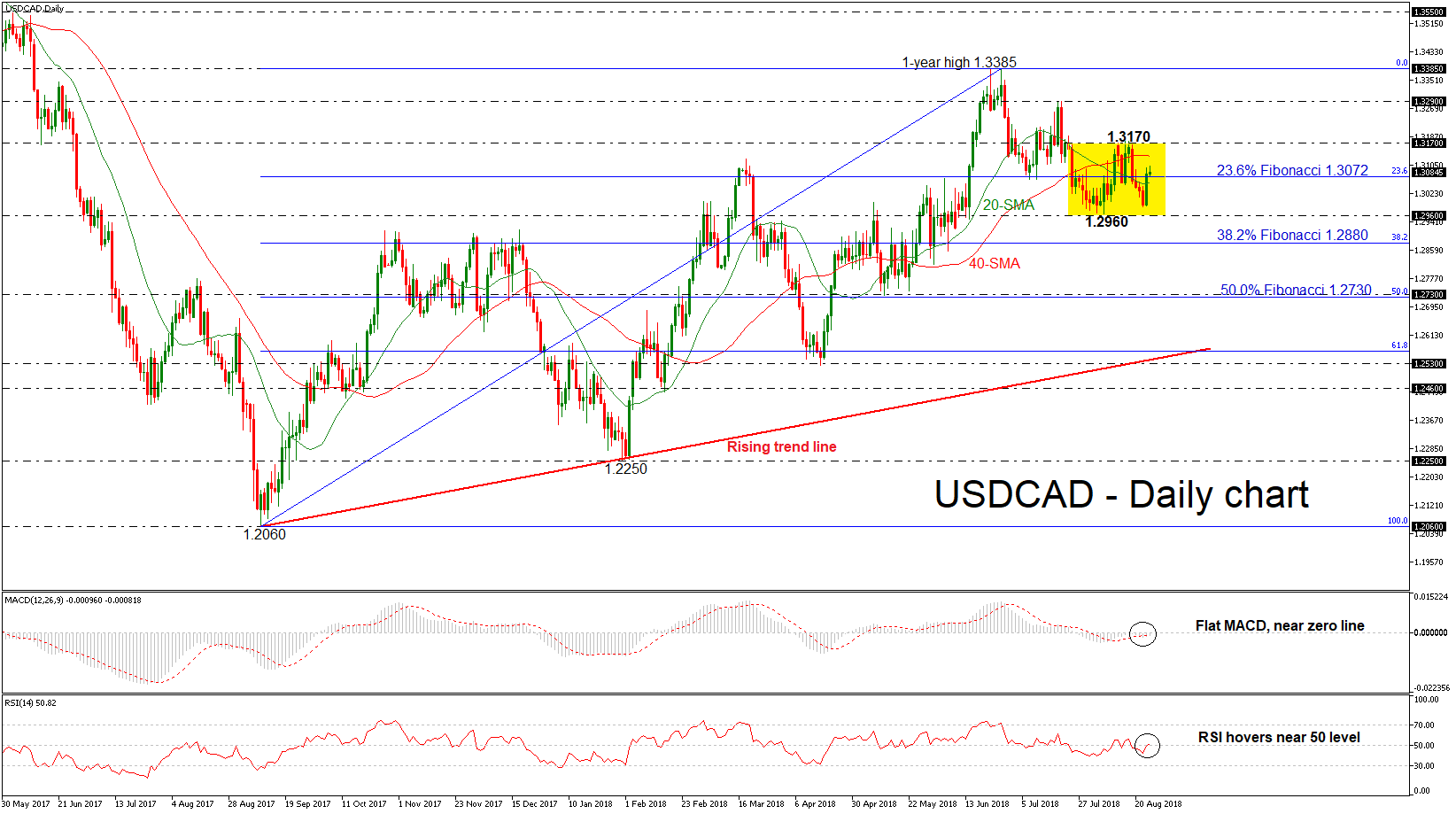
USDCAD is back above the 23.6% Fibonacci retracement level of the upleg from 1.2060 to 1.3385, around 1.3072 but the bias over the last month remains neutral. The pair has been developing within a narrow range with upper boundary the 1.3170 resistance level and lower boundary the 1.2960 support barrier.
In the short-term timeframe, the technical indicators are confirming the neutral bias as both are holding near their mid-levels. The MACD oscillator still stands above the trigger line but near the zero line with weak momentum, while the Relative Strength Index (RSI) is flattening around the threshold of 50. Moreover, the price holds within the 20- and 40-day simple moving averages (SMAs), failing to define a clear trend.
Should the price continue to move slightly higher, immediate resistance could be found around the 1.3170 resistance level, taken from the latest highs on August. An aggressive bullish rally above this area could open the way towards the 1.3290 hurdle and then until the one-year high of 1.3885.
In case of bearish extensions and a drop below the 23.6% Fibonacci (1.3072), the price could challenge the 1.2960 support level. Failure to hold above this level could open the door for the 38.2% Fibonacci region near 1.2880 before attention turns to the 50.0% Fibonacci of 1.2730.
Taking a look at the bigger picture, dollar/loonie has been trading within an ascending price structure since September 2017 and in the weekly timeframe, the price rebounded on the 20-SMA and is now moving higher.
Dollar Posts Modest Losses Ahead Of Powell Speech, Possibility Of No-Deal Brexit Hurts Pound
Here are the latest developments in global markets:
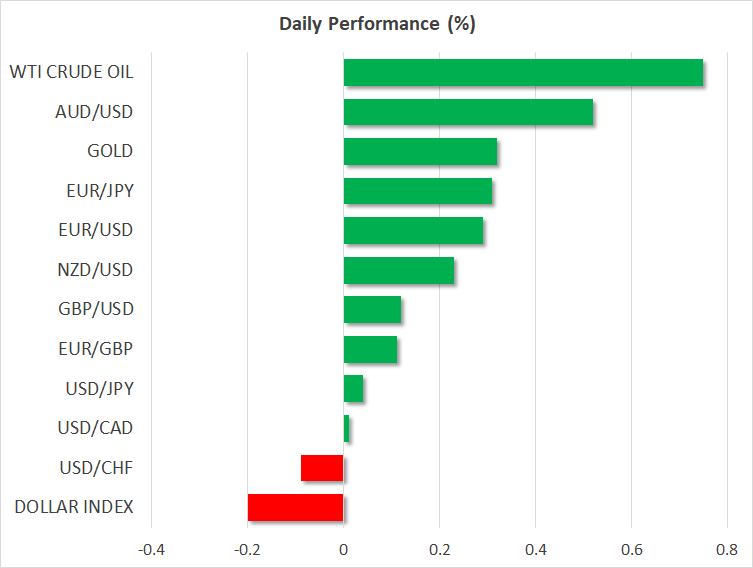
FOREX: The dollar was 0.2% down against six major currencies on Friday. Fed chief Powell’s speech at the Jackson Hole summit later today may act as the short-term driver determining positioning on the greenback.
STOCKS: The Dow Jones, S&P 500 and Nasdaq Composite finished Thursday’s trading in the red, specifically losing 0.3%, 0.2% and 0.1% respectively. Trade angst could had contributed to the fall, though it could also be argued that there was no clear catalyst spurring the losses which either way were modest in nature. In Asian markets, the Japanese Nikkei 225 and Topix indices added 0.85% and 0.65% correspondingly. Hong Kong’s Hang Seng was 0.3% down. At 0656 GMT, futures markets were pointing to a mixed open for major European benchmarks. Contracts on the Dow, S&P and Nasdaq 100 were trading slightly higher.
COMMODITIES: WTI was 0.7% up at $68.32 per barrel and is looking set to record its first weekly gain after seven straight weekly declines, as a drop in US crude stocks, a strike in North Sea fields and upcoming US sanctions on Iran are suggesting tighter supplies of the precious liquid. Brent crude was 0.6% higher at $75.17/barrel. In precious metals, dollar-denominated gold was 0.35% up, at $1,189.12/ounce, again moving in opposite direction to the US currency.
Major movers: Dollar broadly weaker as Aussie recovers somewhat; euro at 10-month high versus sterling
The dollar’s index, which gauges the greenback versus a basket of currencies, edged down after rising on Thursday to put an end to a six-day losing streak, its longest since February. The Jackson Hole summit of central bankers and Powell’s speech at the event, especially in the aftermath of President Trump’s Fed criticism will be closely watched.
The US-China trade negotiations appear to have produced no breakthrough, with the two nations also proceeding with a new round of tariffs on one another yesterday, a move that was clearly telegraphed before. Despite this, China said the talks were constructive and honest; the yuan is on the rise against the US currency today, paring some of yesterday’s losses.
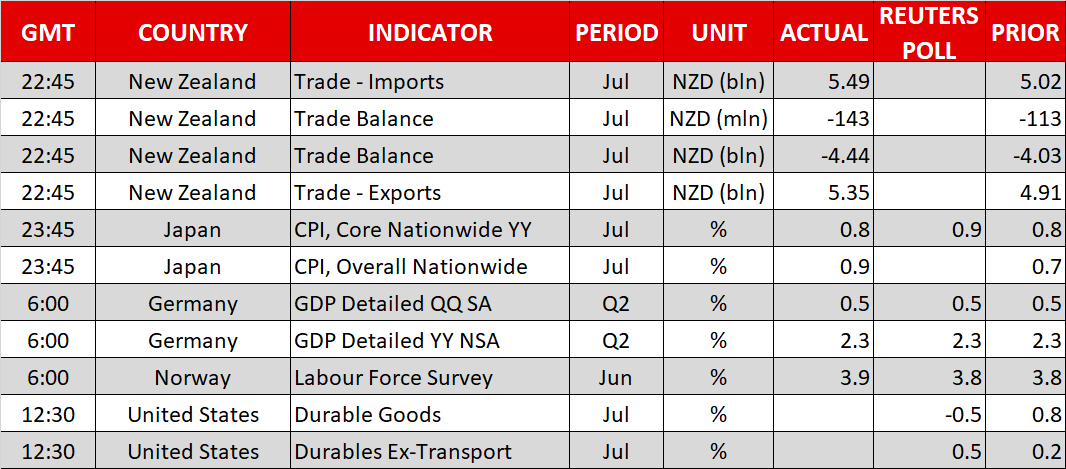
Dollar/yen was slightly higher, adding to hefty advances from the three previous days and trading not far below a near three-week high of 111.48 touched earlier in the day. Japanese inflation figures released during the Asian session showed core CPI growth remaining steady at 0.8% y/y in July, undershooting expectations for a rise to 0.9%; the Bank of Japan’s target for inflation stands at 2%.
Euro/dollar was up by 0.3%, recovering on a significant portion of yesterday’s losses, while pound/dollar, despite also trading higher, was for the most part consolidating Thursday’s decline. The British currency is coming under pressure as the government is stepping up its plans for a no-deal Brexit and warning of the consequences of such an outcome. Euro/pound was adding to gains from previous days, trading close to a 10-month peak of 0.9027 reached earlier on Friday.
The Aussie, a stark underperformer on Thursday, losing 1.4% versus the USD, was the lead gainer out of major currencies on Friday, trading up by around 0.5%, after Treasurer Scott Morrison replaced Malcolm Turnbull as prime minister. Still, aussie/dollar continues to trade below the 0.73 handle which was violated on the way down yesterday. Kiwi/dollar was also higher; New Zealand data released earlier showed a narrower monthly trade deficit in July than analysts projected.
Day ahead: Powell speaks at the Jackson Hole Economic Policy Symposium; trade still in focus
On Friday, all eyes will turn to the Jackson Hole summit hosting some of the world’s most influential central bankers. Specifically, a speech by Fed chief Jerome Powell at 1400 GMT will attract the most interest as investors will be looking for insights on how confident the Fed is regarding its rate hike outlook at a time of growing trade uncertainties and criticism by President Trump.
On trade, deliberations between the US and China so far do not appear to have produced any “tangible” outcome, though updates on the issue, as well as the prospect of US tariffs targeting $200 billion of Chinese products, will definitely be closely watched.
In terms of data releases, of most importance will be US durable goods orders giving an indication on business spending in Q3 due at 1230 GMT. Analysts forecast that orders for long-lasting manufactured goods including transportation have declined by 0.5% m/m in July after rising by 0.8% in June, while the core measure of durable goods that excludes transportation items is expected to grow by 0.5% m/m, faster than June’s 0.2%. Excluding defense items, the gauge is projected to slow down from 1.3% m/m to 0.8%.
In energy markets, Baker Hughes data on active US oil rigs are due at 1700 GMT.
Technical Analysis: USDJPY bullish but looking overbought above 111
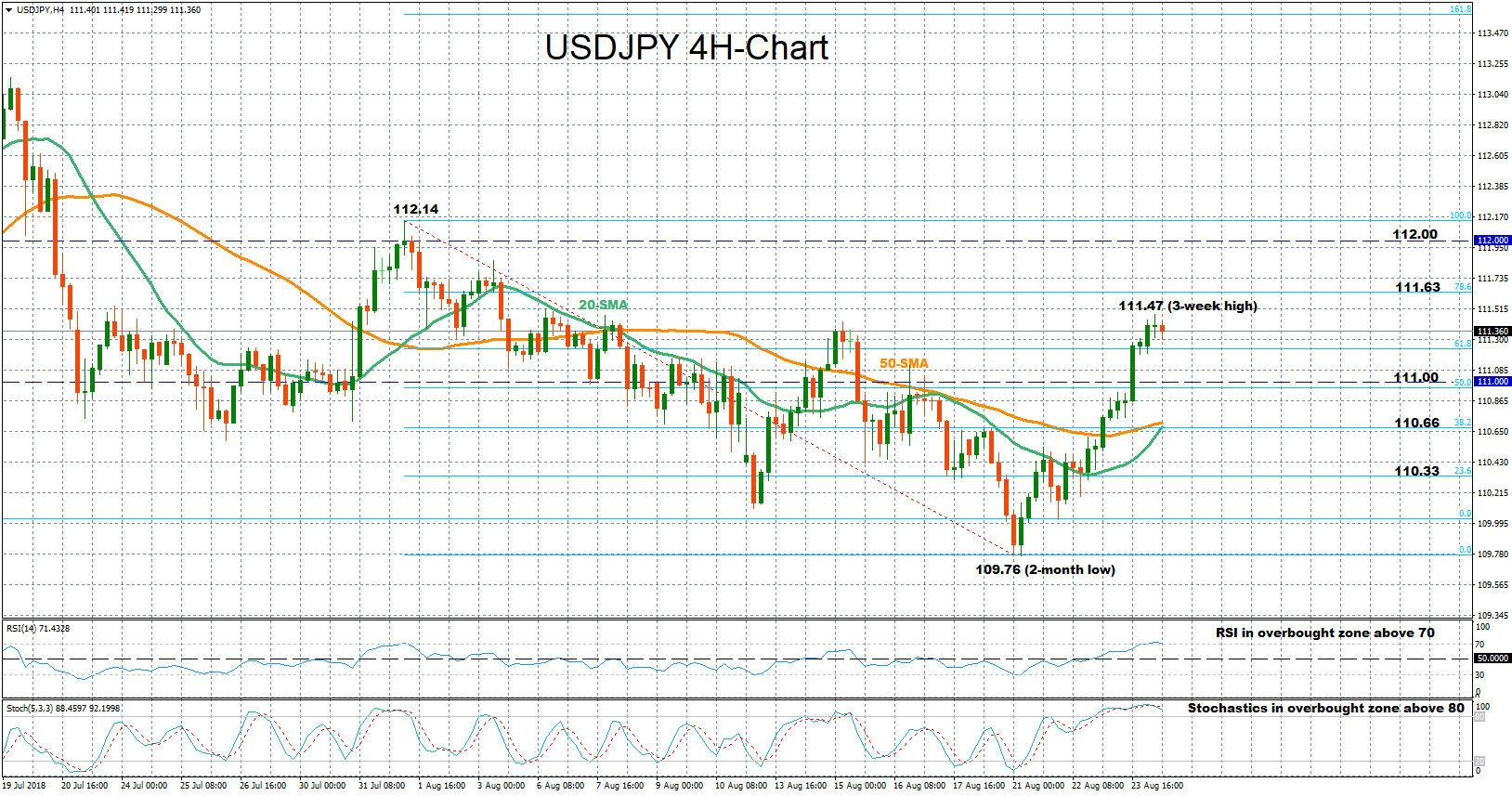
USDJPY successfully broke the 111 round level on Thursday, stretching towards a three-week high of 111.47 on Friday. The RSI, though, signals that the rally could be overdone, and downside corrections may emerge in the short-term as the indicator is currently moving in overbought levels above 70. Additionally, the bearish cross in the stochastics with the %K line moving below the slow %D one –both lines are above 80 – is a negative signal in the very short-term.
Should the pair extend downwards, the price could meet support around the 111 figure, which is slightly above the 50% Fibonacci of the downleg from 112.14 to 109.76, given of course that the 61.8% Fibonacci mark at around 111.30 is violated first. Even lower, bears could face a wall around the 38.2% Fibonacci of 110.66 where the 20- and the 50-period moving averages are currently roughly located, perhaps giving some additional importance to the area, before the eyes turn to the 23.6% Fibonacci of 110.33.
On the flip side, if bullish actions dominate, the price could overcome Thursday’s top of 111.47, with scope to test the 78.6% Fibonacci of 111.63. Any step higher could then strengthen positive momentum towards the 112.00 handle, with the August 1 peak lying not far above at 112.14.
EURUSD Only Bullish Above 1.1553 Level
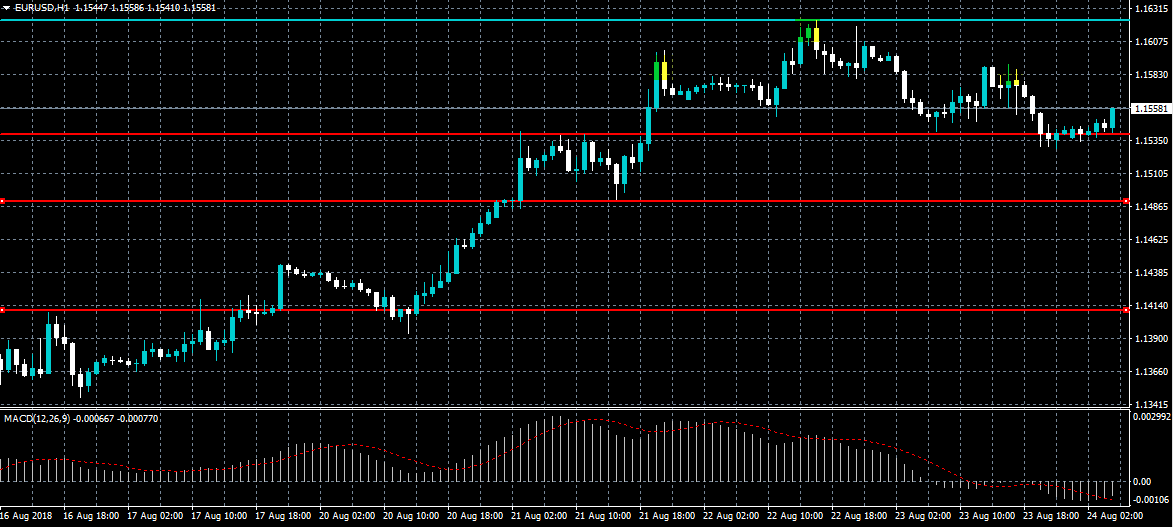
The euro continues to trade to the downside against the US dollar after yesterday’s ECB monetary policy meeting failed to boost the single currency higher. The EURUSD pair is now trading marginally above critical intraday support, at the 1.1553 level. In the short-term, a bearish head and shoulders pattern is starting to form, with the neckline around the 1.1500 support level.
The EURUSD pair is only bullish while trading above the 1.1553 level, key resistance is found at the 1.1600 and 1.1650 levels.
If the EURUSD pair holds price below the 1.1553 level, sellers are likely to test towards 1.1507 and 1.1410 support levels.
USDJPY Supported By Rising Macd
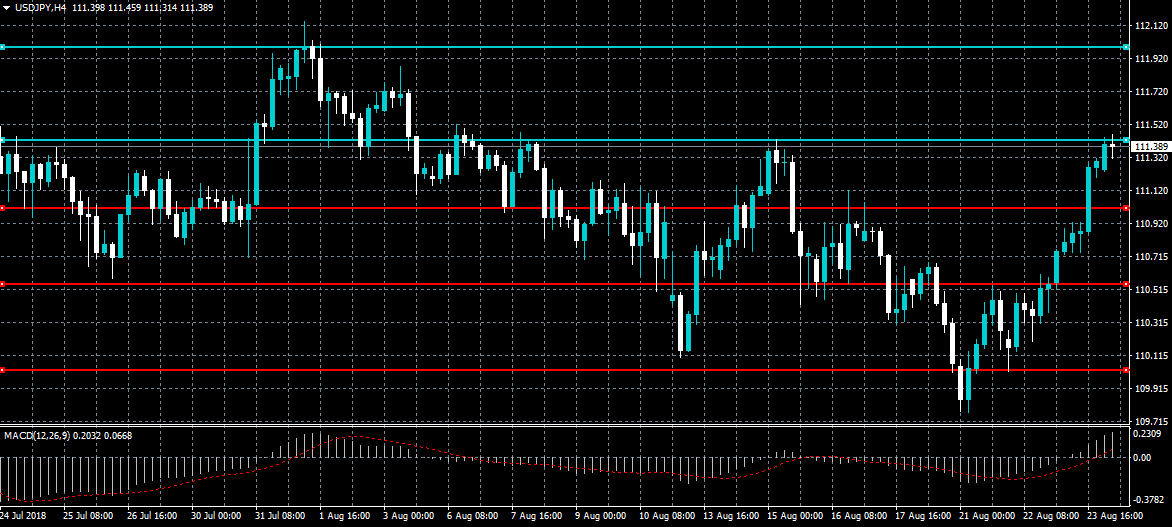
The US dollar has moved to its highest trading level in two weeks against the Japanese yen, as the greenback starts to recover some of its early-week losses. The USDJPY pair retains a strong intraday bullish bias while trading above the 111.10 level and is also supported by the MACD indicator, which is steadily rising across the four-hour time frame.
The USDJPY pair is intraday bullish while trading above the 111.10 level, key resistance is now found at the 111.39 and 112.05 levels.
If the USDJPY pair trades below the 111.10 level, sellers will likely test towards the 110.55 and 110.10 support levels.
German GDP, US Durable Goods Orders In The Spotlight
Economic data is back in the spotlight on Friday, with high-profile reports from Germany and the United States set to make headlines. In monetary policy, the Kansas City Fed’s annual Jackson Hole Symposium will continue Friday with Jerome Powell set to deliver a speech.
Germany kicks off the economic calendar at 06:00 GMT with revised second-quarter GDP. Europe’s largest economy is forecast to have grown 0.5% in the second quarter, unchanged from the revised estimate. In annualized terms, that translates into 2.3% growth.
At 08:30 GMT, the British Bankers Association (BBA) will report on mortgage approvals for the month of July. Approvals are projected to rise 40,600 month-on-month.
Shifting gears to North America, the US Department of Labor will report on durable goods orders at 12:30 GMT. According to analysts, orders for manufactured goods meant to last three years or more are projected to fall 0.5% in July after rising 0.8% the month before. Excluding the volatile transportation category, durable goods orders are projected to grow 0.5% following a 0.2% increase during the previous month.
Federal Reserve Chairman Jerome Powell will deliver a speech at the Jackson Hole Symposium at 14:00 GMT. The Fed is widely expected to raise interest rates at next month’s meeting, according to the most recent FOMC meeting minutes.
The September rate verdict will be accompanied by a revised summary of economic projections covering GDP, unemployment and inflation.
EUR/USD
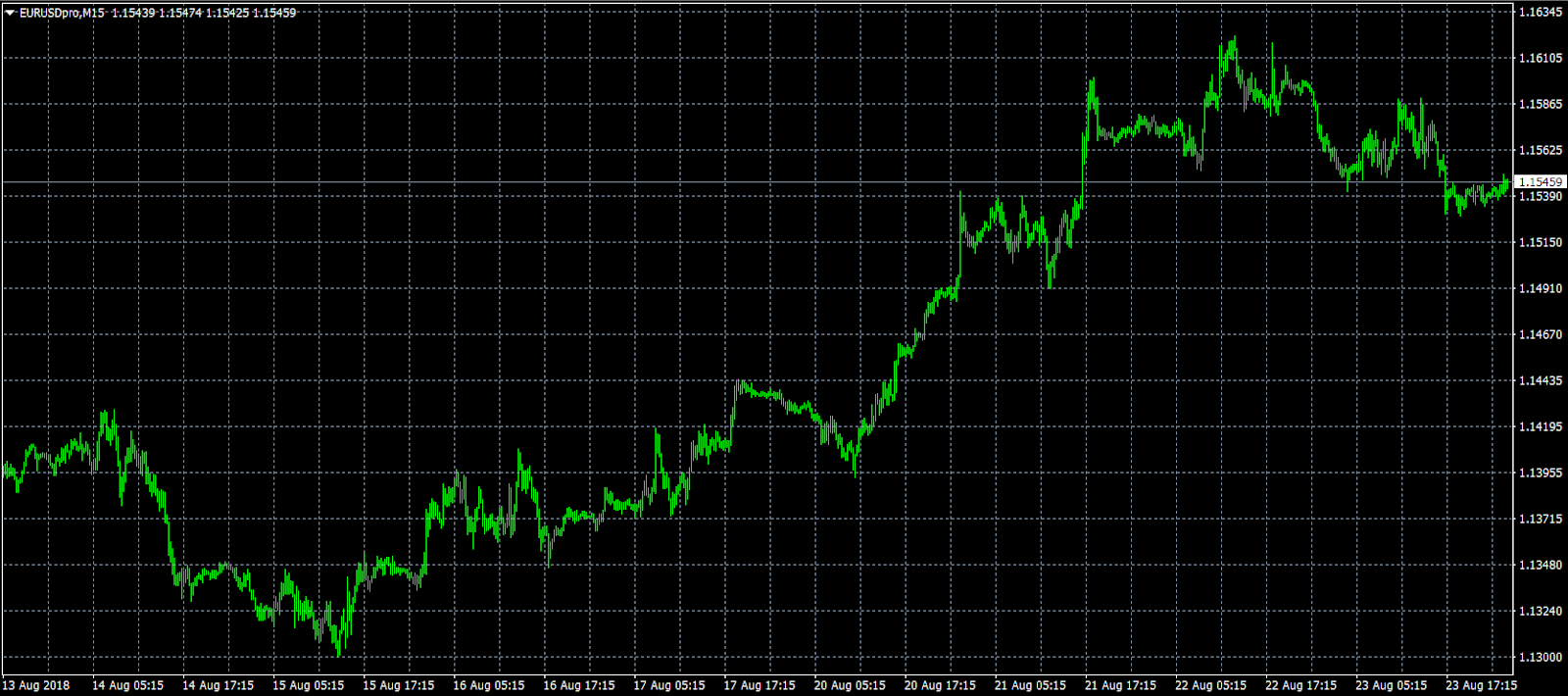
Europe’s common currency was back on the defensive Thursday after prices reached their highest level in two weeks. The EUR/USD exchange rate now sits at 1.1545, down sharply from Wednesday’s high above 1.1620. From a technical point of view, the pair faces strong resistance at 1.1665. On the opposite side of the ledger, the pair is testing immediate support at 1.1540. A break below this level exposes further losses below 1.1500.
GBP/USD
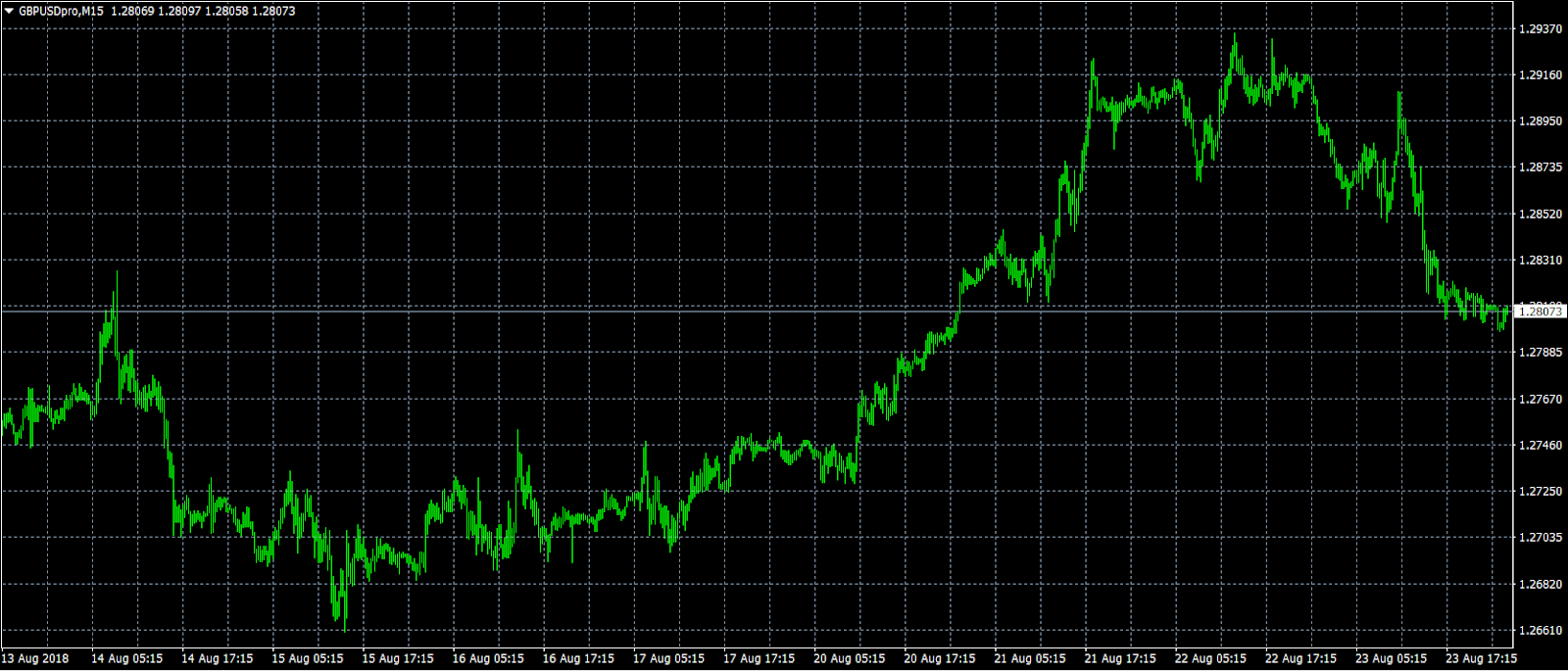
Like the euro, the British pound backed off its recent swing high against the dollar on Thursday. Cable now sits just above 1.2800 after peaking at 1.2929 during the previous session. The technical levels show immediate support at 1.2800 after the pair fell below the 1.2835 region. Below 1.2800, the next zone of support is located at 1.2765. On the opposite side of the ledger, immediate resistance is located at 1.2900.
USD/JPY
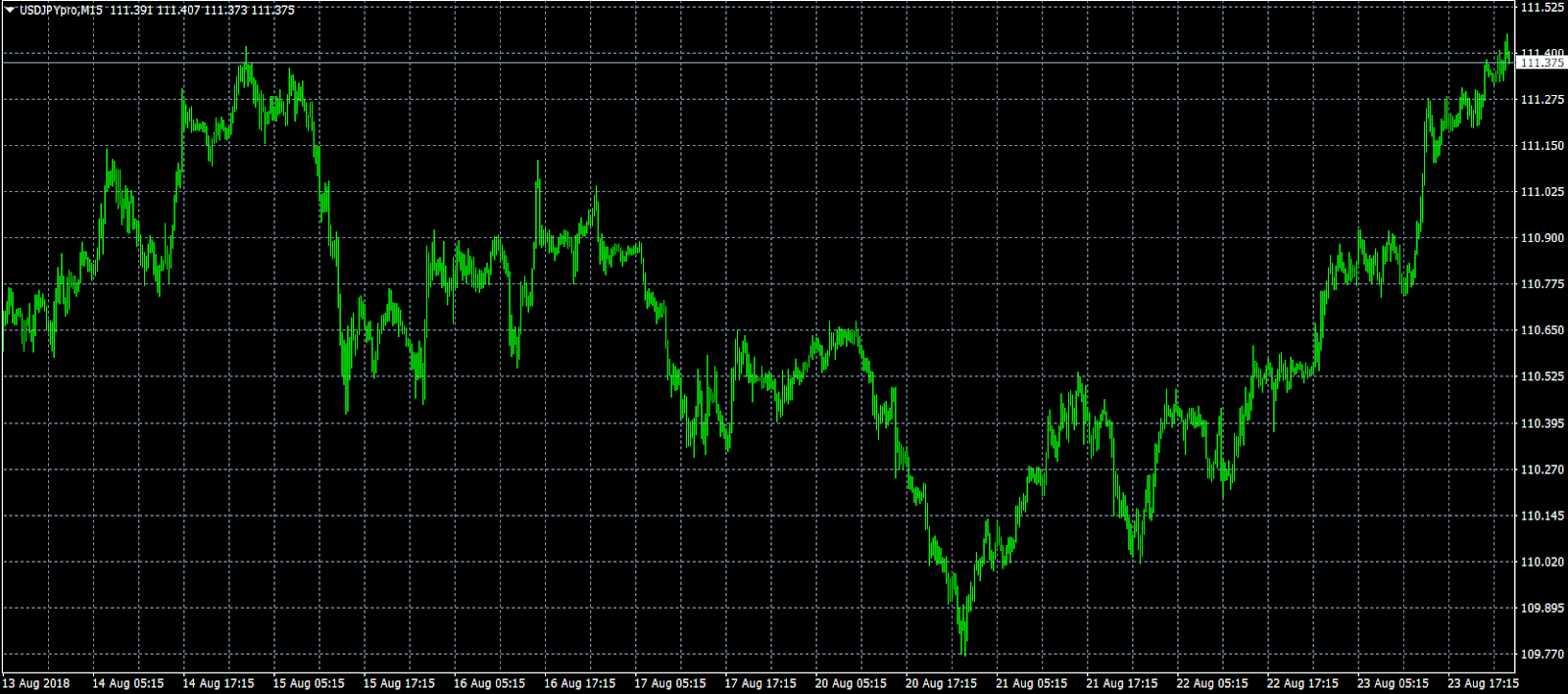
The dollar-yen exchange rate strengthened on Thursday, as the greenback regained its footing after a difficult week. USD/JPY now sits at 111.41, the highest in nearly three weeks. In terms of technical levels, the pair is now targeting the 111.81 region, which is the closing high from 3 August. On the opposite side of the ledger, immediate support is located near 111.00.
GBP/JPY Daily Outlook
Daily Pivots: (S1) 142.37; (P) 142.69; (R1) 142.97; More...
With 141.32 minor support intact, rebound from 139.88 short term bottom is in favor to continue. GBP/JPY be targeting 55 day EMA (now at 144.78). However, on the downside, below 141.32 minor support will likely extend larger down trend and turn focus back to 139.29/47 key support zone instead.
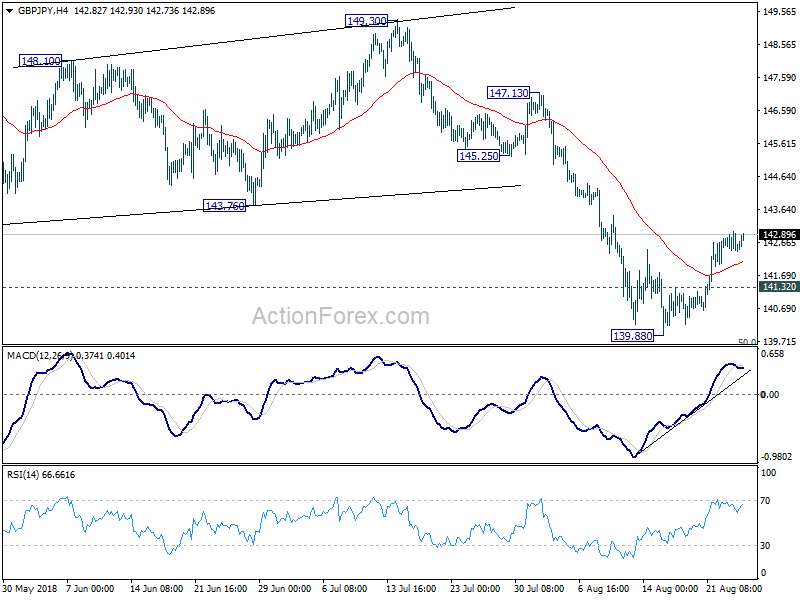
In the bigger picture, at this point decline from 156.59 is still seen as a corrective move. But the current downside accelerate makes this view shaky. Focus will be on 139.29 cluster support (50% retracement of 122.36 to 156.59 at 139.47). Strong rebound from there will re-affirm the bullish case that rise from 122.36 is still to extend through 156.59 high. However, sustained break of 139.29/47 should confirm medium term reversal. GBP/JPY would then target a retest on 122.26 (2016 low).

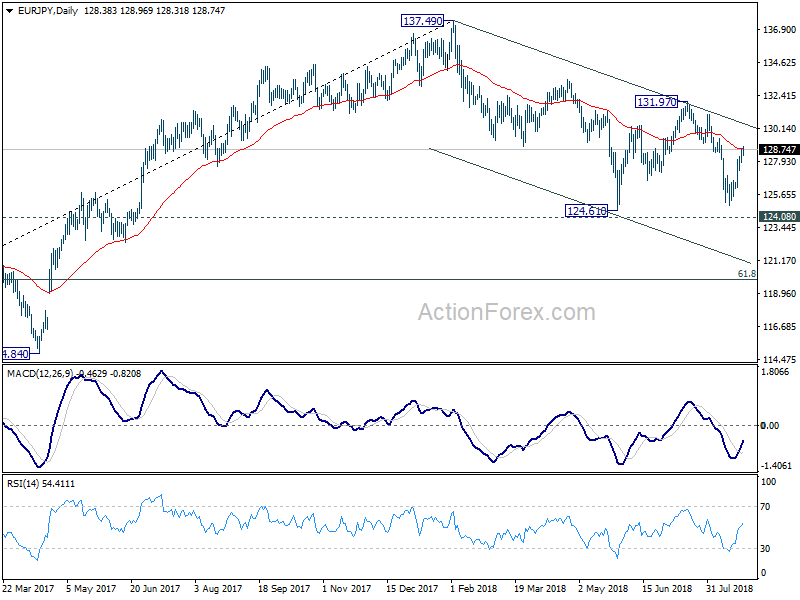
EUR/JPY Daily Outlook
Daily Pivots: (S1) 128.00; (P) 128.39; (R1) 128.85; More....
EUR/JPY's rebound from 146.89 extends higher to 128.69 so far and met 55 day EMA already. Intraday bias stays on the upside and further rally could be seen towards 131.97 resistance. On the downside, break of 127.33 minor support will suggest that the rebound has completed and bring retest of 124.61/89 support zone.
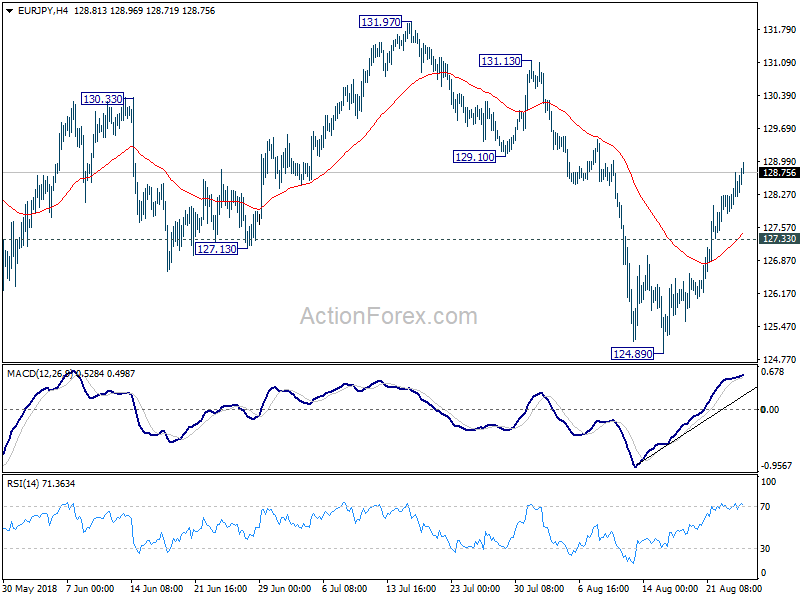
In the bigger picture, focus is back on 124.08 key resistance turned support. Decisive break there will argue that whole rise from 109.03 (2016 low) has completed at 137.49. Deeper decline would be seen to 61.8% retracement of 109.03 to 137.49 at 119.90 next. Sustained break there will pave the way to 109.03 and below. Meanwhile, rebound from 124.08 will keep medium term bullishness intact for another high above 137.49.
XAUUSD Intraday Analysis
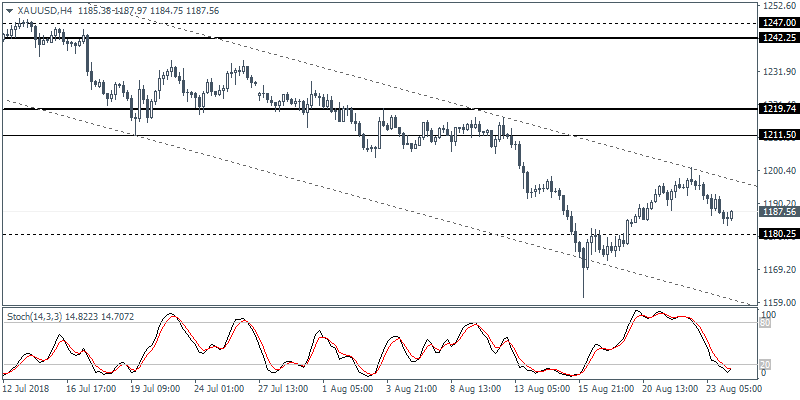
XAUUSD (1187.56): Gold prices turned bearish following the doji candlestick the day before. Although the 4-hour chart currently is signaling a possible bullish reversal, we expect to see gold prices test the 1180.25 level of support. Establishing support here could potentially keep the upside bias intact. The 4-hour falling price is also likely at the risk of price breaking out to the upside. But for this to occur, gold prices will need to form a reversal around 1180.25. To the upside, the resistance level at 1211.50 remains the target.
USDJPY Intraday Analysis
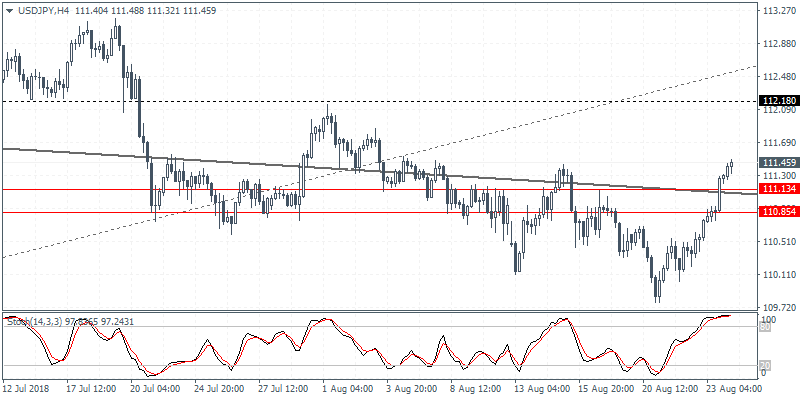
USDJPY (111.45): The USDJPY extended the gains strongly on Thursday and the bullish momentum is expected to continue to push the currency pair higher in the near-term. The main resistance to the upside is seen at 112.18 on the daily chart. On the 4-hour chart, the USDJPY managed to close back above the support/resistance level of 111.13 - 110.85. Any near-term declines are likely to stall back at this level and it would confirm the upside bias in the currency pair.