

Sample Category Title
USD/JPY Daily Outlook
Daily Pivots: (S1) 143.01; (P) 145.44; (R1) 146.86; More...
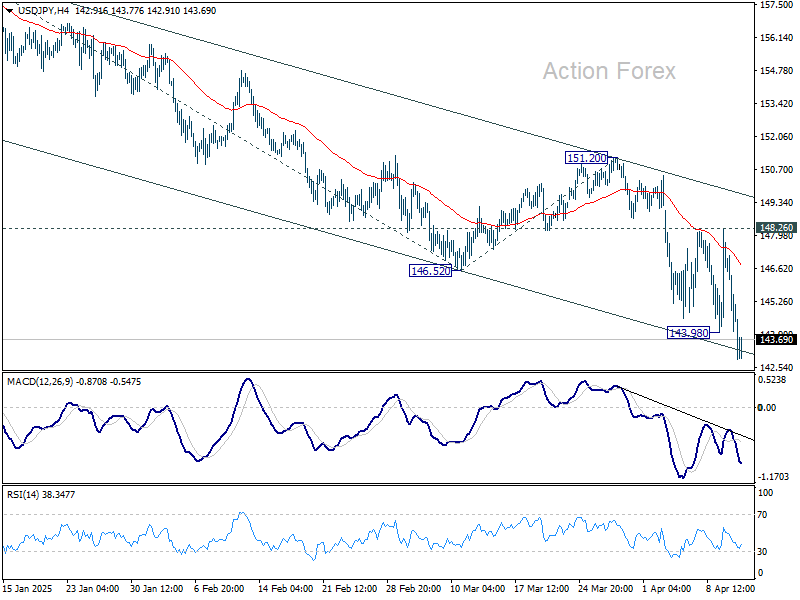
Intraday bias in USD/JPY is back on the downside with break of 143.98 temporary low. Current fall from 158.86 should target 139.57 support next. On the upside, break of 148.26 is needed to indicate short term bottoming. Otherwise, outlook will stay bearish in case of recovery.
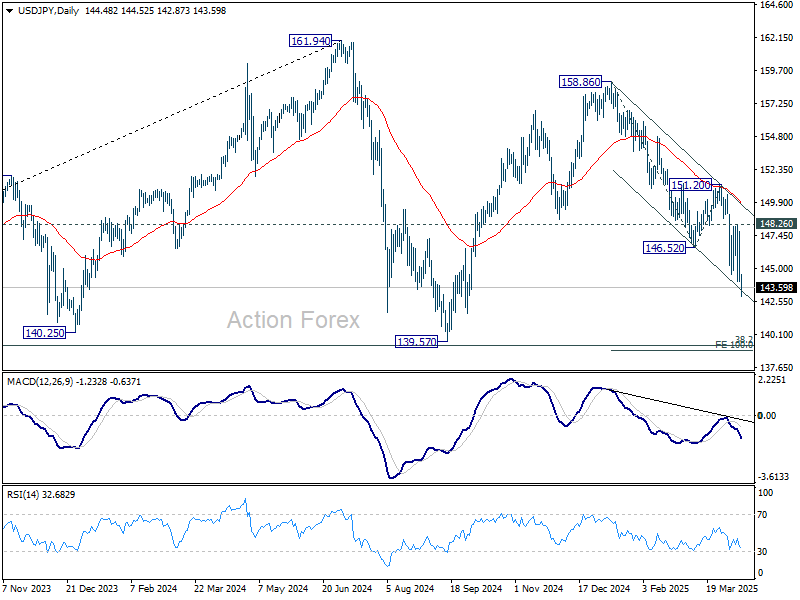
In the bigger picture, price actions from 161.94 are seen as a corrective pattern to rise from 102.58 (2021 low), with fall from 158.86 as the third leg. Strong support should be seen from 38.2% retracement of 102.58 to 161.94 at 139.26 to bring rebound. However, sustained break of 139.26 would open up deeper medium term decline to 61.8% retracement at 125.25.
Gold Touches All-Time High. Overbought or Poised for More Upside?
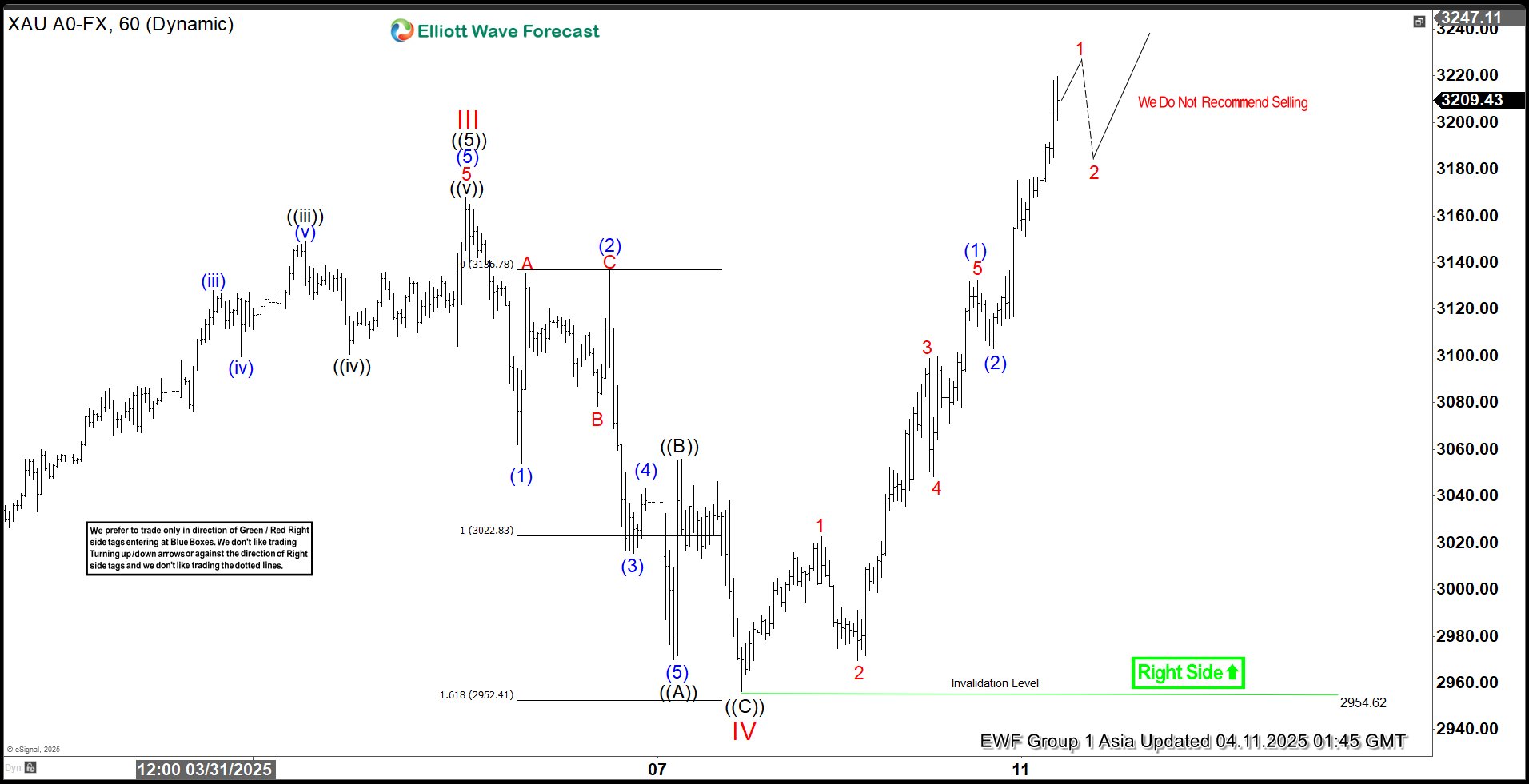
Gold ($XAUUSD) has soared to a new all-time high, marking the launch of its next bullish phase. This powerful uptrend began on September 26, 2022, and is unfolding as a five-wave Elliott Wave pattern, a technical framework traders use to predict market movements. The first wave (I) climbed to 2081.82, showing strong momentum. Then, a corrective wave (II) pulled back to 1810.58, setting the stage for more gains. The third wave (III) was the most explosive, rocketing to 3167.74, driven by global demand for the safe-haven metal. Wave IV followed, forming a zigzag pattern—a typical correction where prices dip before resuming the trend. This correction found its low at 2954.62 after a structured decline.
Now, gold is advancing in wave V, the final leg of this impulse. The first sub-wave, wave (1), hit 3132.59, with smaller waves within it showing steady progress. A brief wave (2) dip ended at 3103.17, and now wave (3) is pushing prices higher. As long as the key support at 2954.6 holds, pullbacks should attract buyers, particularly in 3, 7, or 11 swings—technical levels where dips often reverse. This suggests more upside ahead for gold, appealing to both traders and investors watching this historic rally.
XAUUSD (Gold) 60 Minute Elliott Wave Chart
XAUUSD (Gold) Video
https://www.youtube.com/watch?v=C3JZX3hcvV8
USD/CHF Daily Outlook
Daily Pivots: (S1) 0.8120; (P) 0.8350; (R1) 0.8467; More…
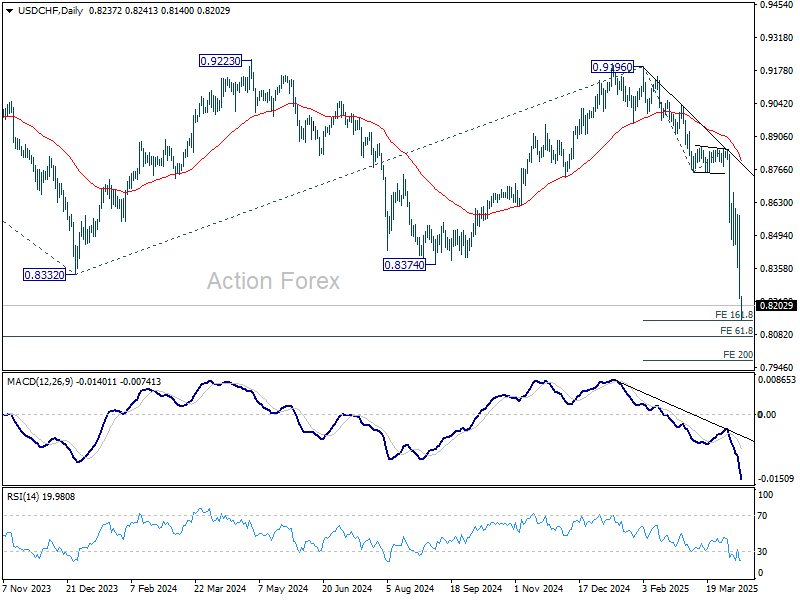
Intraday bias in USD/CHF remains on the downside as current selloff accelerates again. Break of 161.8% projection of 0.9196 to 0.8757 from 0.8854 at 0.8144 will target 200% projection at 0.7976 next. On the upside, above 0.8358 support turned resistance will turn intraday bias neutral and bring consolidations first, before staging another decline.
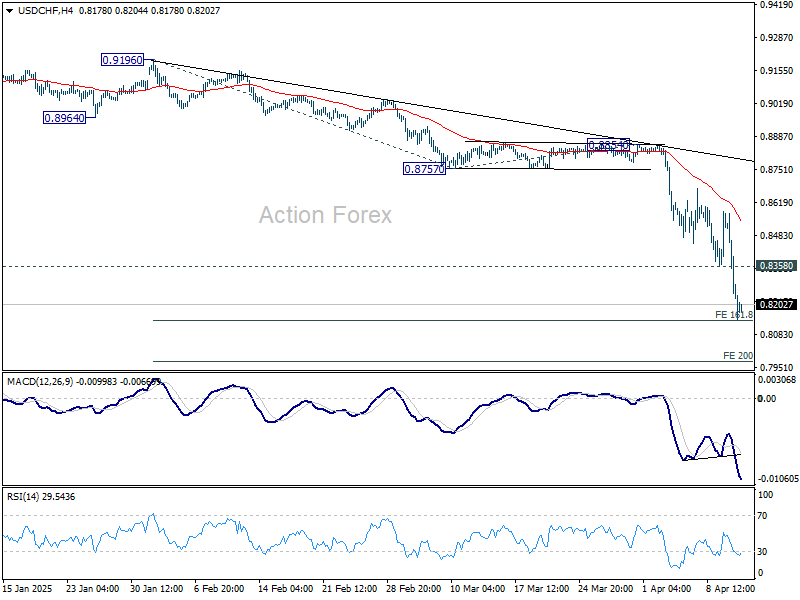
In the bigger picture, the break of 0.8332 (2023 low) confirms resumption of long term down trend from 1.0342 (2017 high). Next target is 61.8% projection of 1.0146 (2022 high) to 0.8332 from 0.9196 at 0.8075. Firm break there will target 100% projection at 0.7382.
Safe Havens Surge, Treasury Rout Deepens, US Assets Hit by Relentless Selloff
The brief moment of optimism following the US tariff truce has quickly faded, as financial markets buckle again under renewed pressure. US stocks closed sharply lower overnight, wiping out a large portion of Wednesday’s historic rebound. The risk-off tone spilled into Asia, though unevenly—Japan saw steep losses, Singapore posted moderate declines, while Hong Kong and China held relatively steady. Overall, the ongoing huge volatility suggests that global markets are far from stabilizing.
The trade war narrative has shifted into a far more dangerous phase. The US confirmed that tariffs on Chinese imports were immediately raised to 125% after China responded with an 84% rate of its own. That brings total US duties on Chinese goods to a staggering 145%. At these levels, the tariff figures themselves become much less relevant. The policy is signaling a structural decoupling of the world’s two largest economies.
Yet, the most alarming development is unfolding in the US Treasury market as 10-year yield surged past 4.45% mark again in Asian trading. This sharp reversal from the temporary calm after the US paused some reciprocal tariffs for 90 days is stoking fears of deeper structural issues in bond markets. This trouble in Treasuries has drawn comparisons to the 2020 “dash-for-cash” and the 2022 UK gilt crisis.
In the currency markets, the flight to safety is clear, just not into Dollar. Swiss Franc surged to its highest level against the greenback since 2015, while Euro and Yen also strengthened markedly. Altogether, markets appear to be undergoing a synchronized flush-out of US assets, with investors dumping stocks, Dollar, and even Treasuries.
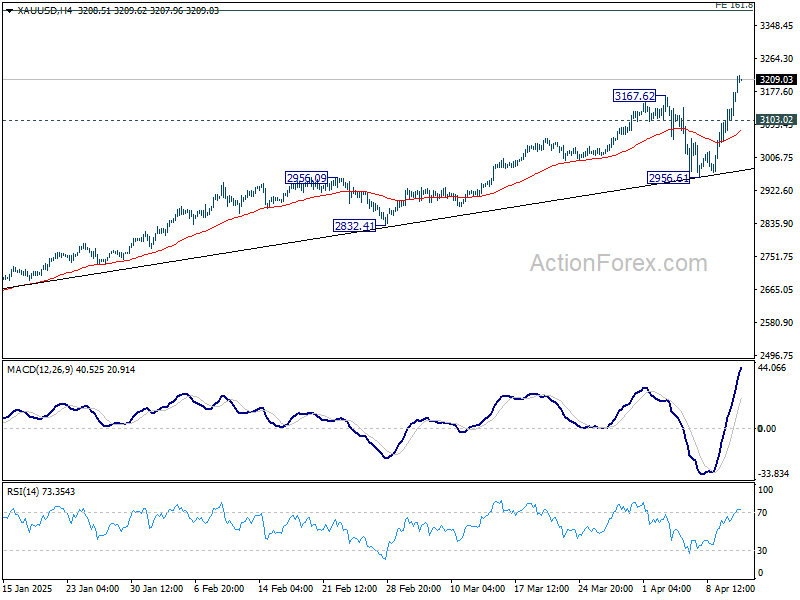
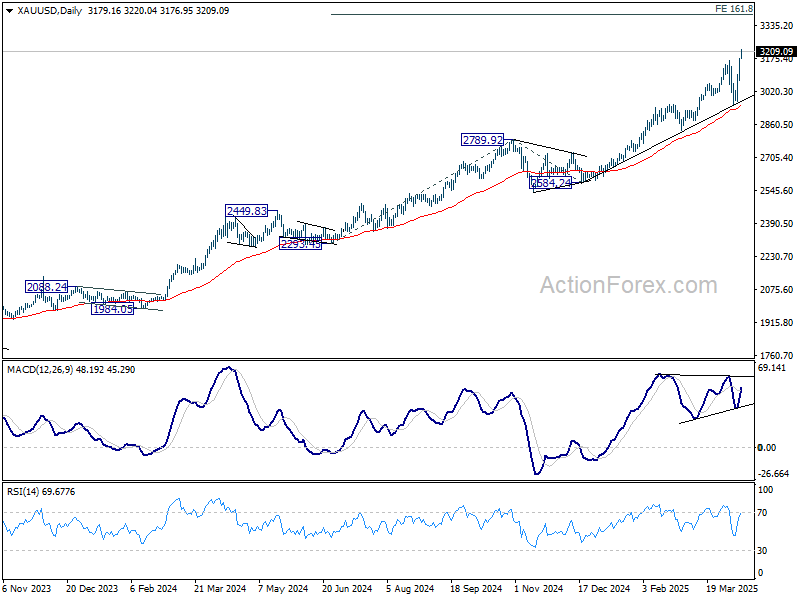
Technically, Gold defied gravity again and surged to new record high above 3200 market. For now, further rise is expected as long as 3103.02 support holds, or in short 3100 mark. Next target is 161.8% projection of 2293.45 to 2789.92 from 2584.24 at 3387.52.
In Asia, at the time of writing, Nikkei is down -4.36%. Hong Kong HSI is up 0.76%. China Shanghai SSE is up 0.32%. Singapore Strait Times is down 1.94%. Japan 10-year JGB yield is up 0.024 at 4.46. Overnight, DOW fell -2.50%. S&P 500 fell -3.46%. NASDAQ fell -4.31%. 10-year yield fell -0.006 to 4.394.
Fed’s Goolsbee: No playbook for tariff shock, rate path uncertain but likely lower
Speaking overnight, Chicago Fed President Austan Goolsbee said that nothing is "off the table", including rate hikes, cuts, or holds. The sheer scale of recent trade developments creates a stagflationary shock, and there is "not a generic playbook" for how a central bank should respond to.
Also, Goolsbee noted a key challenge: the data being released now may not yet fully reflect the evolving reality on the ground. That’s why he believes Fed must closely monitor both hard data and soft indicators, especially as lag effects complicate interpretation.
Despite the tariff-related uncertainty, Goolsbee still sees rates trending lower over the next one to two years. Nevertheless, he stressed that should long-run inflation expectations begin to drift, “any central bank almost has to address that… regardless of what the other conditions are.”
Fed’s Collins: Tariff-driven price pressures may delay further policy normalization
Boston Fed President Susan Collins said in a speech overnight that keep interest rate at current level is "appropriate for the time being" due to the "highly uncertain environment."
Collins acknowledged that "renewed price pressures" from tariffs could "delay further normalization of policy".
"Confidence is needed that the tariffs are not destabilizing inflation expectations," she emphasized.
She added that any "preemptive action" to support growth would require a “compelling” signal that economic activity is deteriorating more than expected.
Although she expects inflation to gradually return to the 2% target, she acknowledged that core inflation may rise “well above” 3% in the near term due to higher import costs. In her view, the Fed must remain vigilant to ensure these pressures do not become entrenched.
NZ BNZ manufacturing falls to 53.2, new orders signal trouble ahead
New Zealand’s BusinessNZ Performance of Manufacturing Index slipped slightly from 54.1 to 53.2 in March, but remained firmly in expansion territory. Production climbed to 54.2, the highest level since December 2021. Employment also posted a robust 54.7, marking its strongest result since mid-2021. However, a decline in new orders, which dipped below the 50-neutral mark to 49.6, raises concerns about the durability of this rebound.
BusinessNZ’s Catherine Beard acknowledged the resilience in activity and employment, but highlighted persistent challenges. Despite improving sentiment, nearly 58% of surveyed manufacturers cited negative conditions, pointing to weak demand, fewer new orders, and uncertainty across both domestic and export channels.
BNZ Senior Economist Doug Steel noted that the PMI data supports the case for manufacturing GDP growth in early 2025. Still, he cautioned that risks to the outlook are clearly tilted to the downside, "given recent extreme volatility on global markets following rapidly evolving US-driven trade policy changes."
USD/CHF Daily Outlook
Daily Pivots: (S1) 0.8120; (P) 0.8350; (R1) 0.8467; More…
Intraday bias in USD/CHF remains on the downside as current selloff accelerates again. Break of 161.8% projection of 0.9196 to 0.8757 from 0.8854 at 0.8144 will target 200% projection at 0.7976 next. On the upside, above 0.8358 support turned resistance will turn intraday bias neutral and bring consolidations first, before staging another decline.
In the bigger picture, the break of 0.8332 (2023 low) confirms resumption of long term down trend from 1.0342 (2017 high). Next target is 61.8% projection of 1.0146 (2022 high) to 0.8332 from 0.9196 at 0.8075. Firm break there will target 100% projection at 0.7382.
NZ BNZ manufacturing falls to 53.2, new orders signal trouble ahead
New Zealand’s BusinessNZ Performance of Manufacturing Index slipped slightly from 54.1 to 53.2 in March, but remained firmly in expansion territory. Production climbed to 54.2, the highest level since December 2021. Employment also posted a robust 54.7, marking its strongest result since mid-2021. However, a decline in new orders, which dipped below the 50-neutral mark to 49.6, raises concerns about the durability of this rebound.
BusinessNZ’s Catherine Beard acknowledged the resilience in activity and employment, but highlighted persistent challenges. Despite improving sentiment, nearly 58% of surveyed manufacturers cited negative conditions, pointing to weak demand, fewer new orders, and uncertainty across both domestic and export channels.
BNZ Senior Economist Doug Steel noted that the PMI data supports the case for manufacturing GDP growth in early 2025. Still, he cautioned that risks to the outlook are clearly tilted to the downside, "given recent extreme volatility on global markets following rapidly evolving US-driven trade policy changes."
USD/JPY Slips Further—Market Eyes Key Support Levels Ahead
Key Highlights
- USD/JPY started a fresh decline below the 146.50 level.
- A connecting bearish trend line is forming with resistance at 148.20 on the 4-hour chart.
- GBP/USD is again rising and might aim for gains above 1.3000.
- Gold prices could rally further and to a new record high above $3,150 level.
USD/JPY Technical Analysis
The US Dollar faced a strong rejection near 148.25 against the Japanese Yen. USD/JPY started a fresh decline below the 147.20 and 146.50 levels.
Looking at the 4-hour chart, the pair traded below the 50% Fib retracement level of the upward move from the 143.99 swing low to the 148.28 high. The pair is now below the 100 simple moving average (red, 4-hour) and the 200 simple moving average (green, 4-hour).
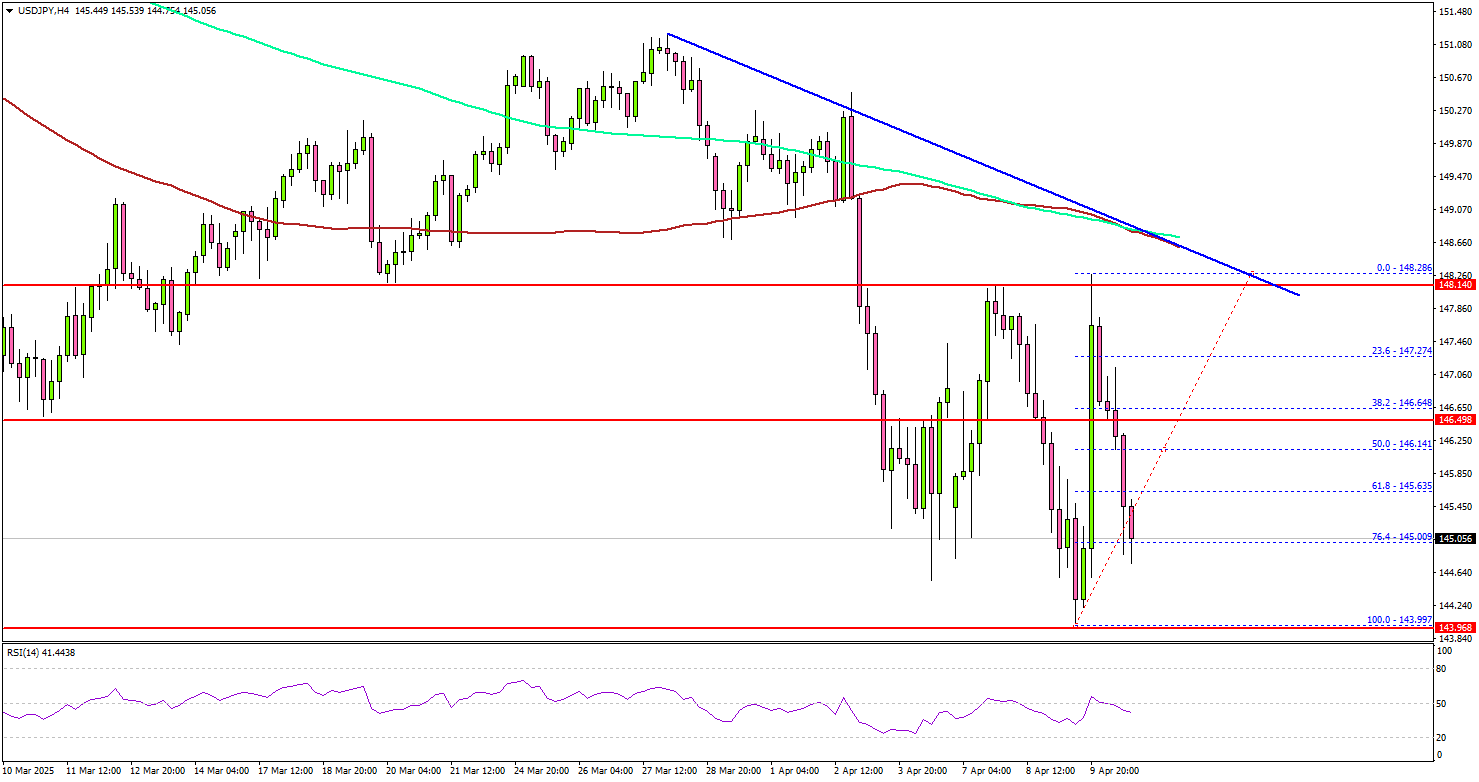
There is also a connecting bearish trend line forming with resistance at 148.20 on the same chart. If there is a fresh increase, the pair could face resistance near the 146.00 level.
The next major resistance is near the 146.50 level. The main resistance is now forming near the 148.20 zone. A close above the 148.20 level could set the tone for another increase. In the stated case, the pair could even clear the 149.50 resistance.
On the downside, immediate support sits near the 144.00 level. The next key support sits near the 143.65 level. Any more losses could send the pair toward the 142.50 level.
Looking at Gold, the price started a fresh increase, and the bulls might soon aim for a move toward the $3,200 level.
Upcoming Economic Events:
- US Producer Price Index for March 2025 (MoM) – Forecast +0.2%, versus 0% previous.
- US Producer Price Index for March 2025 (YoY) – Forecast +3.3%, versus +3.2% previous.
- Michigan Consumer Sentiment Index for April 2025 (Prelim) – Forecast 54.5, versus 57.0 previous.
Fed’s Goolsbee: No playbook for tariff shock, rate path uncertain but likely lower
Speaking overnight, Chicago Fed President Austan Goolsbee said that nothing is "off the table", including rate hikes, cuts, or holds. The sheer scale of recent trade developments creates a stagflationary shock, and there is "not a generic playbook" for how a central bank should respond to.
Also, Goolsbee noted a key challenge: the data being released now may not yet fully reflect the evolving reality on the ground. That’s why he believes Fed must closely monitor both hard data and soft indicators, especially as lag effects complicate interpretation.
Despite the tariff-related uncertainty, Goolsbee still sees rates trending lower over the next one to two years. Nevertheless, he stressed that should long-run inflation expectations begin to drift, “any central bank almost has to address that… regardless of what the other conditions are.”
Fed’s Collins: Tariff-driven price pressures may delay further policy normalization
Boston Fed President Susan Collins said in a speech overnight that keep interest rate at current level is "appropriate for the time being" due to the "highly uncertain environment."
Collins acknowledged that "renewed price pressures" from tariffs could "delay further normalization of policy".
"Confidence is needed that the tariffs are not destabilizing inflation expectations," she emphasized.
She added that any "preemptive action" to support growth would require a “compelling” signal that economic activity is deteriorating more than expected.
Although she expects inflation to gradually return to the 2% target, she acknowledged that core inflation may rise “well above” 3% in the near term due to higher import costs. In her view, the Fed must remain vigilant to ensure these pressures do not become entrenched.
Cliff Notes: A Late Change of Heart
Key insights from the week that was.
Starting in Australia, April’s Westpac-MI Consumer Sentiment Survey – which was in the field last week – provided a first-look into households’ reaction to President Trump’s tariff turmoil. Sentiment was only slightly lower over the first half the week, before moving sharply lower after the ‘Liberation Day’ announcements, leaving the headline index down 6% at 90.1. There were significant declines across the sub-indexes tracking ‘family finances vs. a year ago’ (–8.5%), but also the year-ahead outlook for family finances (–6.2%) and the economy (–5.7%). Attitudes toward consumption, which were already precariously placed owing to the elevated cost-of-living, fell victim to this emerging uncertainty, with the ‘time to buy a major household item’ sub-index falling –7.3% to be 34% below its long-run average. Although households were more uncertain about the prospect of interest rate relief, markets have since come to our view and have fully priced in a 25bp rate cut from the RBA in May.
The subsequent rapid deterioration in trade relations between the US and China and 90-day reprieve for other nations makes for a completely different picture, however (see below for further detail). The current tariff structure, should it persist, is not expected to have a significant impact on the Australian economy, principally thanks to China’s ability to stimulate to offset the shock. Though, there is a risk that the extreme volatility of recent weeks may see consumer and business confidence remain on the backfoot for an extended period. Still, if the market volatility recedes, domestic factors are likely to once again become the focus, specifically the health of the labour market, ongoing moderation in inflation, and the prospective recovery in consumer spending.
In the US and globally, the Trump administration’s trade agenda whiplashed markets this week. Following last week’s reciprocal tariff announcement, global bourses opened sharply lower for fear of where US and global growth could end up. Then, after holding to the announced tariffs resolutely, and doubling down on China, President Trump suddenly announced a 90-day reprieve for all non-retaliating countries. Imports from these economies will now only receive a 10% tariff on entry to the US, at least for the time being. The tariffs on Mexico and Canada will remain in place, however; while, at the same time, President Trump doubled down again on China, increasing their reciprocal tariff rate from 104% to 125%. Note this rate is reportedly in addition to the initial 20% tariff, so Chinese imports now face a combined tariff rate of 145% on entry to the US. Negotiations are set to get underway between the US and numerous nations next week. It is not clear what cost President Trump will demand for US tariff relief, but Treasury Secretary Bessent has alluded to a request for other nations to also tariff China. If they do so, then the current bilateral conflict risks becoming a much broader threat to global growth, to the detriment of China but also every other country involved.
The minutes of the FOMC's March meeting highlight why President Trump may have had this change of heart. Evident in the discussions amongst members is that inflation remains the key consideration for monetary policy decisions. “Several participants noted that their contacts were already reporting increases in costs, possibly in anticipation of rising tariffs, or that their contacts had indicated willingness to pass on to consumers higher input costs that would arise from potential tariff increases." A couple of members also raised concerns over the ability of the FOMC to assess the persistence of inflation in real time. There was also a specific reference to "many firms… paus[ing] their capital spending plans", an adverse development for both growth and inflation. These views do not mean the FOMC are myopic in their focus. But simply that, as highlighted by Chair Powell last Friday, inflation is expected to remain further from target than employment, and policy needs to be set accordingly. The “Committee may face difficult tradeoffs if inflation prove[s] to be more persistent while the outlook for growth and employment weaken[s]”.
Coming back to our region, the Reserve Bank of New Zealand cut rates by 25bps to 3.5% at its April meeting, in line with market expectations. The statement noted that the "adaption of global supply chains to increased trade barriers will take longer to work through. It was noted [also] that monetary policy cannot offset the long-term negative effects of higher barriers to international trade". Looking ahead, we anticipate a further 25bp cut in May and risks are likely to remain skewed to the downside for some time thereafter, requiring careful assessment of the incoming data.
Gold Wave Analysis
Gold: ⬆️ Buy
- Gold broke key resistance level 3150.00
- Likely to rise to resistance level 3200.00
Gold today broke above the key resistance level 3150.00 (which stopped the previous impulse wave I at the start of April, as can be seen below).
The breakout of the resistance level 3150.00 accelerated the active intermediate impulse wave (3) from last November.
Given the overriding daily uptrend, Gold can be expected to rise to the next resistance level 3200.00, which is the forecast price for the completion of the active impulse wave (3).
