Sample Category Title
Markets Mostly Calm As US Fires First Trade Shot, US Jobs Data Eyed
Here are the latest developments in global markets:
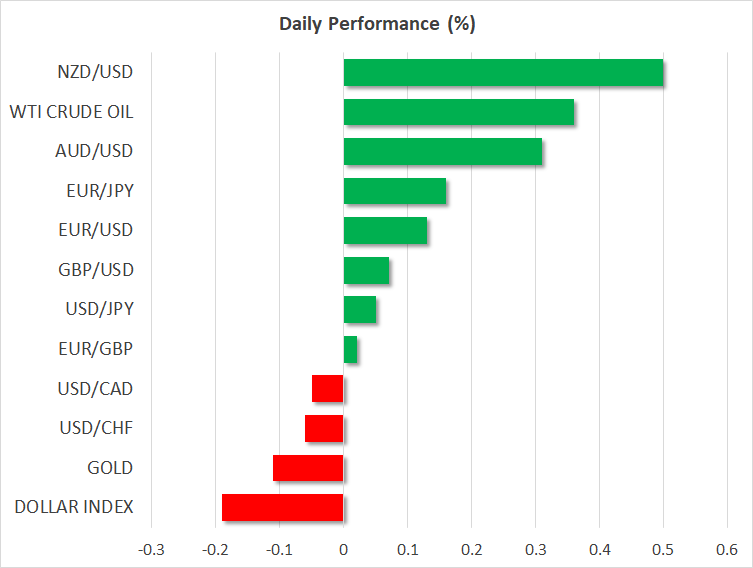
FOREX: The US dollar index is down by almost 0.2% on Friday, ahead of the release of the US employment report for June later today. Meanwhile, the safe-haven Japanese yen is on the back foot, with investors appearing largely unfazed by a possible escalation in the US-China trade saga (see below).
STOCKS: US equity markets closed higher on Thursday, undeterred by the looming threat of the US and China exchanging tariffs on Friday. The Nasdaq Composite led the way, rising 1.12%, with the advance fueled by technology stocks – which have shown remarkable resilience in the face of tariff-worries this year. The S&P 500 and the Dow Jones gained 0.86% and 0.75% respectively. Futures tracking the Dow, S&P, and Nasdaq 100, are currently in positive territory, though only marginally so. The positive sentiment was also evident in Asia, with Japan’s Nikkei 225 and Topix climbing by 1.12% and 0.92% correspondingly, while Hong Kong’s Hang Seng index rose by 0.61%. Europe looks set to follow suit, with futures tracking all the major indices signaling a higher open today.
COMMODITIES: Oil prices are a little higher on Friday, with WTI and Brent rising by 0.36% and 0.13% respectively. Both benchmarks recovered some of the notable losses they posted yesterday. The decline was triggered by reports Saudi Arabia increased its production in June, as well as a surprising build in the weekly EIA inventory data, instead of the anticipated drawdown. In precious metals, gold is lower by 0.1% on Friday, giving back the modest gains it posted in the previous session. The next major market mover for gold will probably be today’s US employment report. Given that the yellow metal is denominated in dollars, it’s likely to move in inverse fashion to the US currency today. Hence, a strong jobs report could weigh on gold, whereas a softer one may boost it.
Major movers: US fires first trade shot, Chinese retaliation eyed; dollar yawns after Fed minutes
The US officially fired the opening salvo in its trade standoff with China earlier this morning, as the announced 25% tariffs on $34bn Chinese goods went into effect. The market reaction was non-existent, given that the move was signaled well in advance. Instead, investors will look towards China’s countermove; the Asian nation has long said it will reply with proportional measures.
The main question is whether the US will then strike back again – as it has warned it will should China respond –, thereby provoking another move from China, and taking the “trade war” narrative to a whole new level. Should such moves unleash another wave of risk aversion in markets, haven currencies such as the yen could benefit over the near-term, to the detriment of risk-sensitive assets, like stocks and the aussie.
Overnight, the minutes from the latest FOMC meeting delivered no surprises, at least for dollar-traders, as the currency barely reacted to the release. While policymakers noted the strength of the US economy and reaffirmed their gradual hiking trajectory, they also sounded a note of caution, highlighting that trade uncertainty could weigh on business investment, and that downside risks have intensified. While their assessment fell short of suggesting suck risks could delay rate increases, that remains a clear possibility should tensions escalate further and manifest themselves into the real economy. Today, all eyes will be on the US jobs report.
In the UK, sterling/dollar erased all its early gains associated with a hawkish tone in BoE Governor Carney’s remarks yesterday, to close the day slightly lower following Brexit headlines. Reportedly, both German Chancellor Merkel and the UK Brexit Minister Davis consider the new customs plan for Brexit presented by UK PM May as “unworkable”.
The UK cabinet will meet today to decide whether it’ll back this plan, but admittedly, these reports likely poured cold water on expectations this proposal could break the deadlock in the negotiations. Theresa May now finds herself between an EU rock and a Brexiteers’ hard place, with political uncertainty likely to continue dominating sterling moves in the absence of any tier-one UK data on the economic calendar for a while.
Day ahead: US jobs report firmly in focus; Canada also receives employment data; trade developments eyed
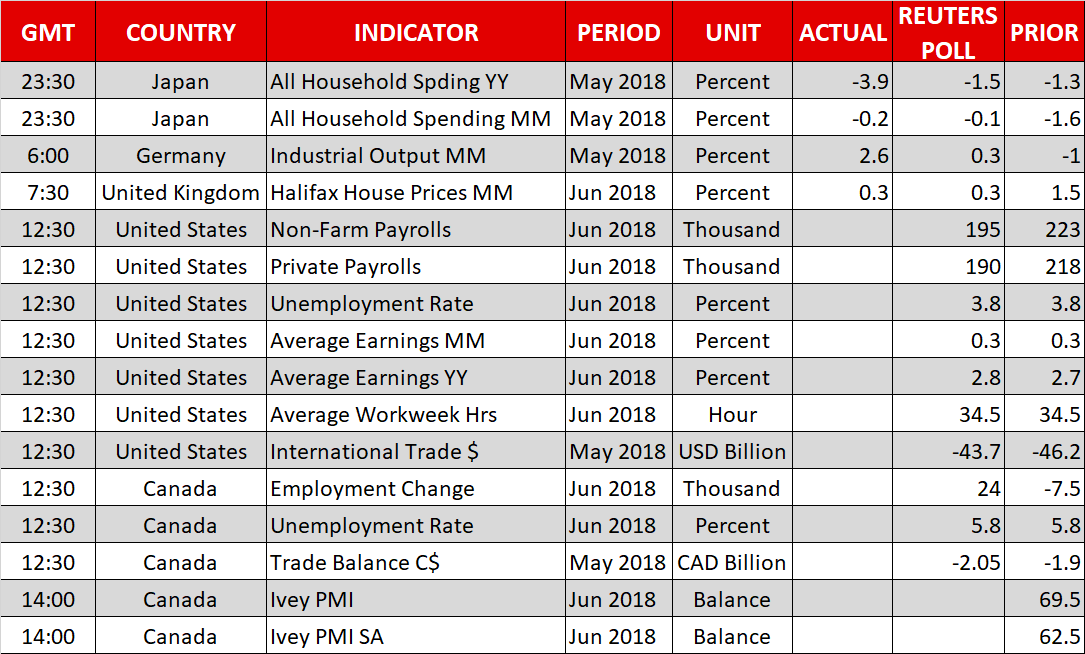
Friday will see the release of what is considered by many as the most important monthly release out of the world’s largest economy, namely the nonfarm payrolls report. Besides this, Canada will also be on the receiving end of employment data, while developments on the trade front will also be closely watched as US tariffs on Chinese goods kick in today.
At 0730 GMT, the Halifax index gauging house prices in the UK during June will be made public. An easing of growth in prices is projected by analysts.
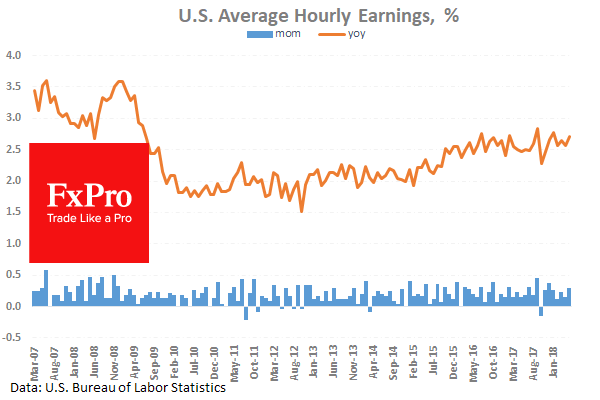
The focus will next turn to the US which will see the release of its nonfarm payrolls report for June at 1230 GMT. After the addition of 223k positions in May, the economy is anticipated to have added another 195k during June. Meanwhile, the unemployment rate is expected to remain at the 18-year low of 3.8%. Economic theory suggests that such a low rate should drive wages up as employers have to compete to attract skilled workers. This takes us to wage growth, which is again expected to attract most interest out of the jobs data: average earnings are projected to expand by 0.3% m/m (the same as in May) and by 2.8% y/y (2.7% in May).
Stronger wage growth has the capacity to stoke inflation expectations, leading market participants to price in a more aggressive Fed tightening cycle, something which is theoretically dollar-positive.
Data on international trade out of the US are also due at 1230 GMT; the deficit is forecast to narrow to $43.7 billion from $46.2bn.
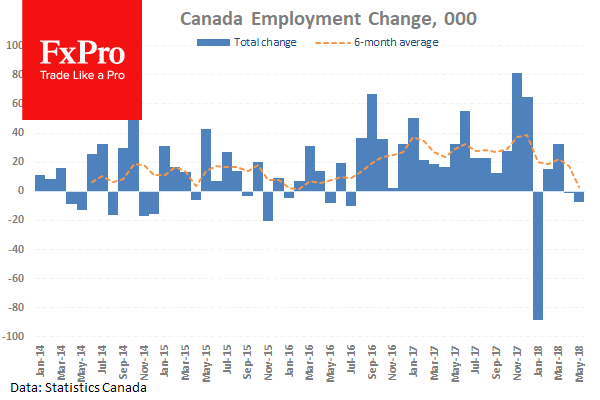
At the same time as the abovementioned figures, Canadian jobs numbers will be hitting the markets. The economy is anticipated to have added 24k positions during June, which compares to a reduction of 7.5k in May. In the meantime, June’s unemployment rate is forecast to remain unchanged at 5.8%, its lowest since the 1970s. Better-than-anticipated data releases have the capacity to more conclusively put on the table a rate hike by the Bank of Canada during next week’s meeting. Specifically, the odds for a rate increase currently stand at 67% according to Canadian overnight index swaps, and should it rise on the back of strong figures today, the loonie could come under renewed buying interest.
Other Canadian data out today include May’s trade balance (1230 GMT) and June’s Ivey PMI (1400 GMT).
With US tariffs on $34 billion of Chinese imported goods going into effect today, the attention now turns to China which has vowed to fight back. The reaction in the markets has so far been calm today. Escalating tensions, though, may trigger a flight to safety, boosting safe-haven perceived assets such as the yen, at the expense of riskier ones.
On the Brexit front, PM Theresa May will be meeting with her cabinet today to discuss key issues in negotiations such as the future trade relationship between the UK and the EU.
A lecture by Daniele Nouy, ECB’s Chair of the Supervisory Board, is on the agenda at 1000 GMT.
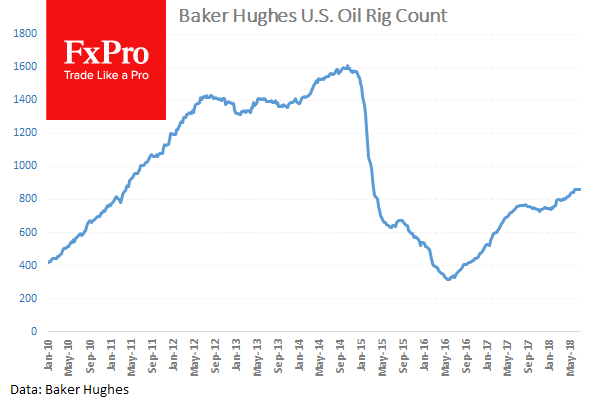
In energy markets, Baker Hughes data on the number of active oil rigs in the US are due at 1700 GMT.
Technical Analysis: EURUSD looking bullish in the short-term, records 3-week high
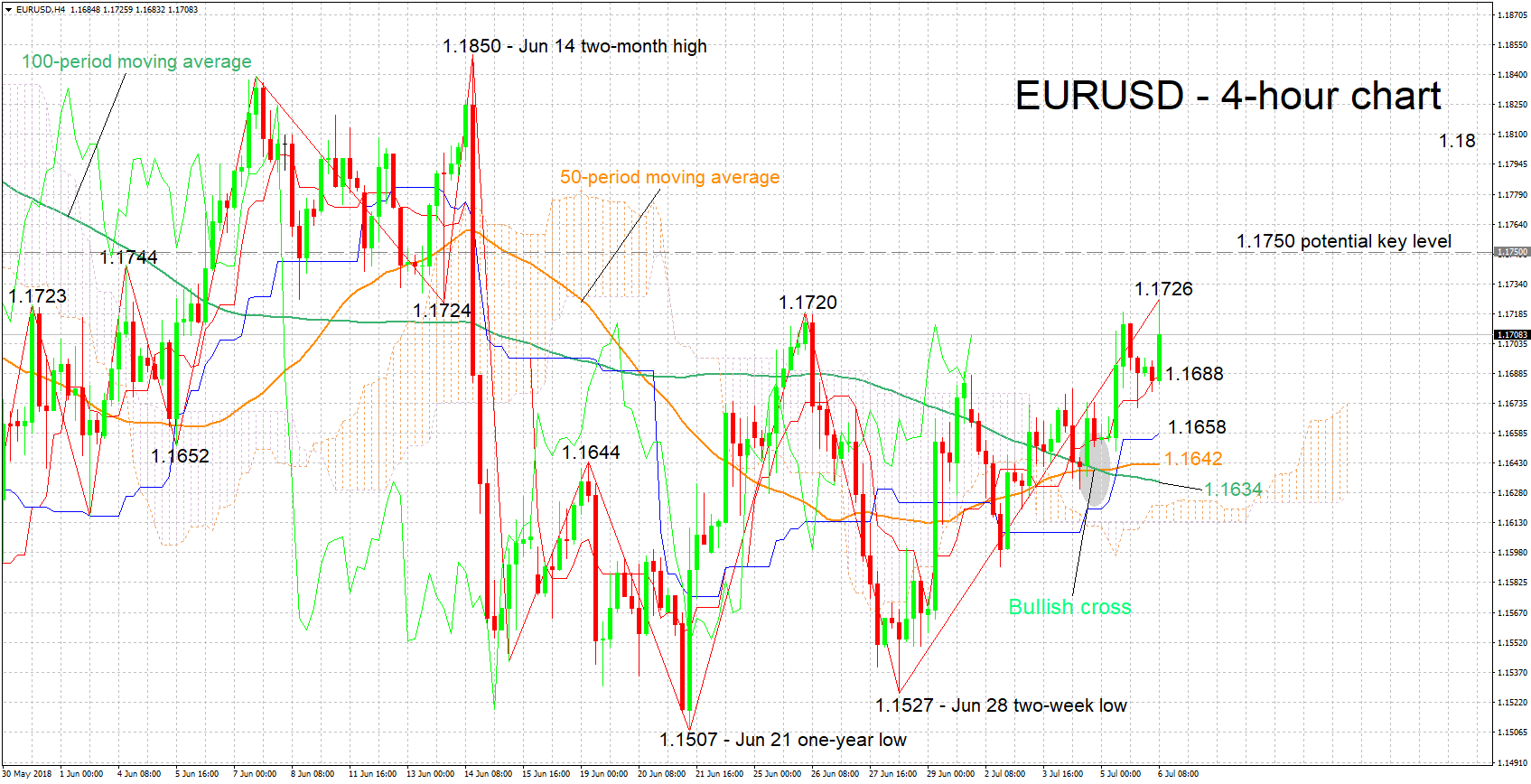
EURUSD has risen by roughly 200 pips after touching a two-week low of 1.1527 on June 28. Earlier on Friday, it hit a three-week high of 1.1726. The positively-aligned Tenkan- and Kijun-sen lines are projecting a bullish bias in the short-term.
A stronger-than-expected US NFP report, especially on the wage growth front, is likely to weaken the pair. Support could come around the current level of the Tenkan-sen at 1.1688, including the 1.17 round figure. Further below, the focus would turn to the Kijun-sen at 1.1658.
Conversely, weaker-than-anticipated data could push EURUSD higher. Resistance may come around the 1.1750 handle, an area which was somewhat congested in the past. The 1.18 handle would increasingly come into focus in case of stronger bullish movement.
Trade developments can also move the pair.
XAUUSD Intraday Analysis
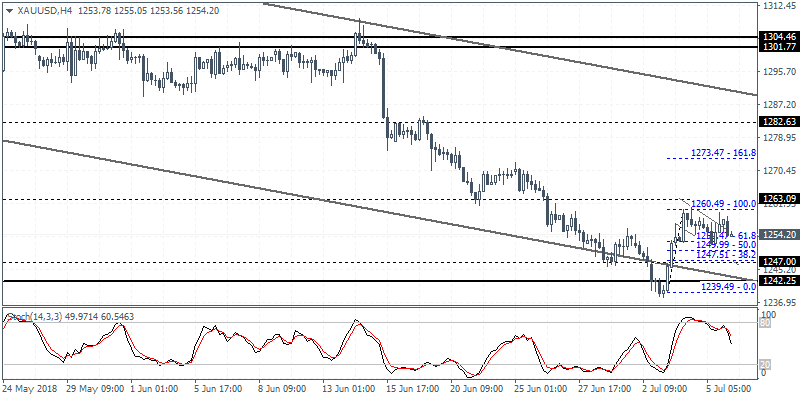
XAUUSD (1254.20): Gold prices maintain their subdued price action with the precious metal seen giving up some of the gains earlier today. There is scope for a bullish flag pattern to be validated. This could potentially keep price action to trend higher. The support at 1252.4 remains a key level. As long as this minor support holds, gold prices are likely to target the resistance at 1263 with further gains on a breakout seen pushing the precious metal to 1273.47 which marks the measured move of the bullish flag pattern.
USDJPY Intraday Analysis
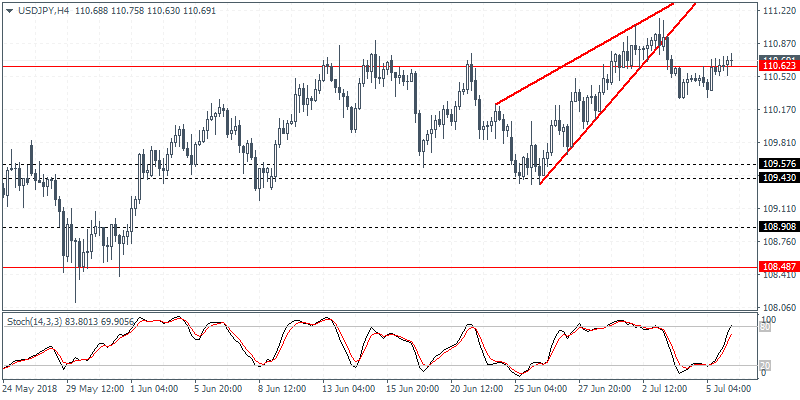
USDJPY (110.69): USDJPY was seen hugging the resistance level near 110.62 by Thursday's close. Price action remains trading flat around this level as we expect to see the currency pair potentially pushing lower. The support at 109.57 - 109.43 is most likely to be tested to the downside. Alternately, a breakout above 110.62 could keep the currency pair maintaining its bullish gains to the upside. A higher close above 111.12 could trigger further gains toward 111.37 marking the highs from mid-May.
EURUSD Intraday Analysis
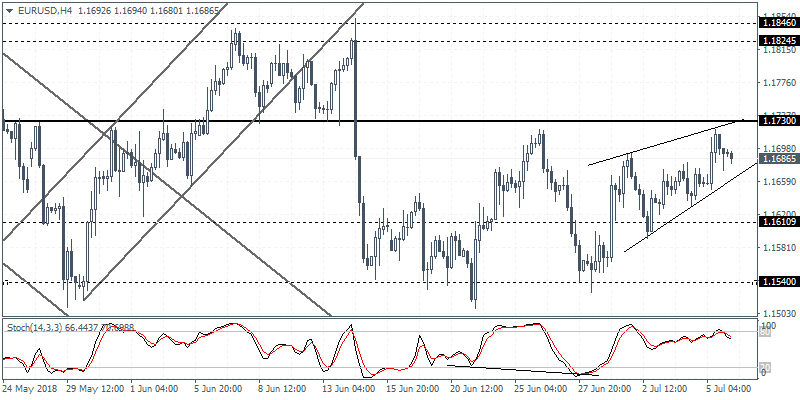
EURUSD (1.1686): The EURUSD currency pair's gains were capped near the minor rising trend line. The common currency rose to a fresh monthly high before easing back. The consolidation over the week has resulted in a rising wedge pattern. A breakout from this pattern on the 4-hour chart could signal the EURUSD likely to fall back to the 1.1610 level of support. To the upside, price action will need to breakout above 1.1730 in order to signal further gains to the upside.
Focus Turns To June Payrolls Report
It was a busy day for the currency markets yesterday. The German factory orders report showed that output increased 2.6% on the month beating estimates of a 1.1% increase. Previous month's revisions showed a revised print from a 2.5% decline to just 1.6%.
In the NY trading session, the ADP payrolls report showed that the economy added 177k jobs in June. This was below the median estimates of 190k. Data for May was revised higher to show 189k jobs.
The services sector measured by ISM showed an increase to 59.1 on the index. This beat estimates by a strong margin and activity was seen rising from May's 58.6.
Later in the evening, the FOMC meeting minutes were released. The minutes showed that officials were concerns about letting inflation run too hot. Members print from a 2.5% decline to just 1.6%.were seen widely agreeing that further rate hikes were needed. The markets did not react much to the release of the Fed minutes.
Looking ahead, the U.S. and Canada jobs report will be coming out today. Canada's employment change is expected to show 20.4k jobs being added. This marks a bullish print which could potentially trigger the BoC to likely hike rates once again. The Canadian unemployment rate is expected to remain steady at 5.8%.
In the U.S. the payrolls report is expected to show that the economy added 195k jobs on the month, marking a slower pace compared to the 223k jobs added the month before. The U.S. unemployment rate is expected to hold at 3.8% and the wage growth is forecast to rise 0.3% on the month.
EURUSD Bulls Need To Break The 1.1719 Level
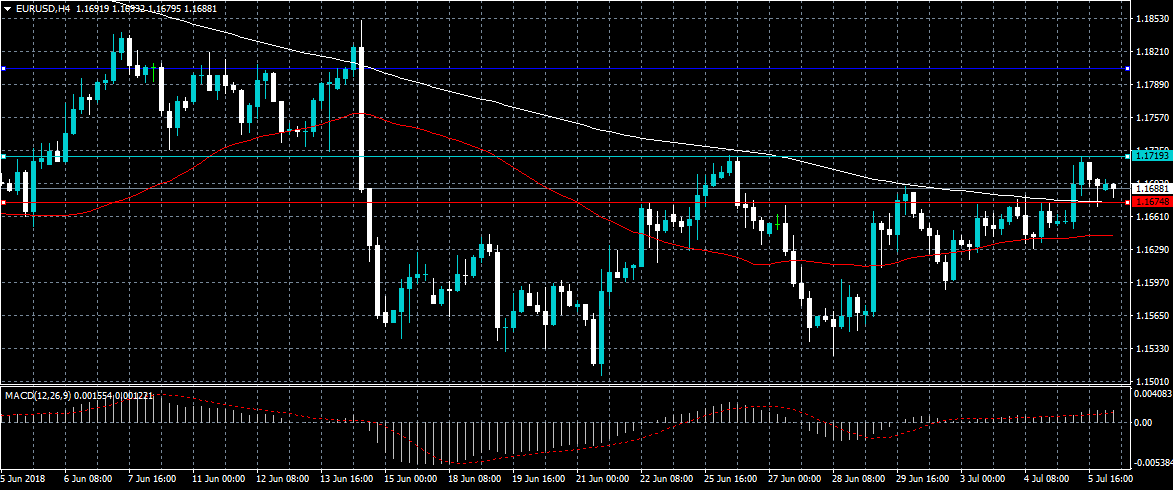
The euro currency has fallen back towards key breakout support against the greenback after buyers failed to keep the price above the 1.1700 level. EURUSD bulls now need to move above the 1.1719 resistance level to keep the recent short-term bullish momentum alive the pair. The next strong directional move in the EURUSD will likely come after the release of today’s key US monthly jobs report.
The EURUSD pair is only intraday bullish while trading above the 1.1719 level, key resistance is found at the 1.1750 and 1.1780 levels.
If the EURUSD pair moves below the 1.1674 level, further declines towards the 1.1648 and 1.1600 support levels may follow.
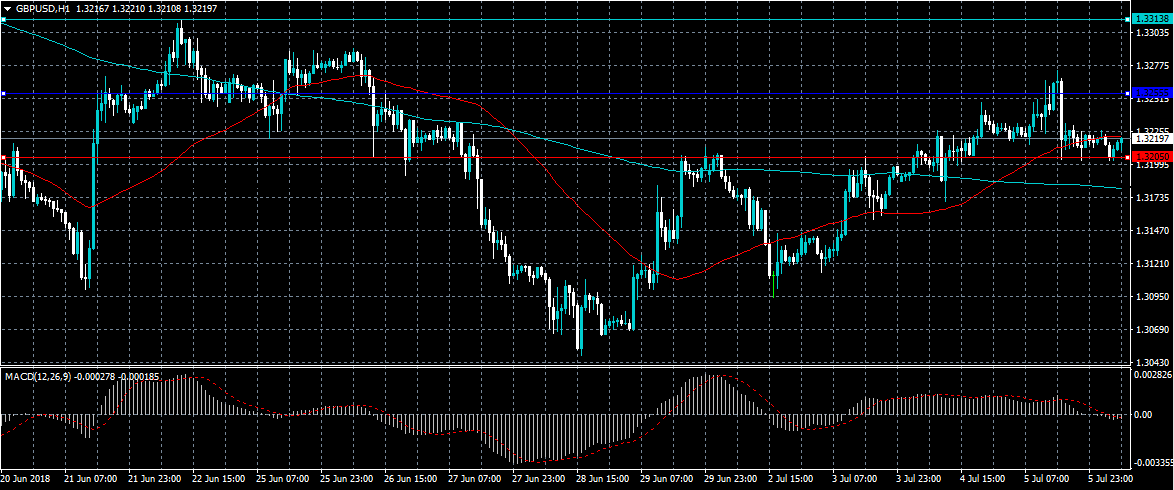
GBPUSD Bulls Need To Hold The 1.3255 Level
The British pound is starting to give back gains against the US dollar, as price falls back towards the key 1.3205 support level. The GBPUSD pair started to slip from the 1.3273 level, as the US dollar index firmed following the release of the FOMC Meeting Minutes. Bulls now need to reclaim the 1.3255 level for further advancement, while sellers will look to hold price below the key 1.3205 support level.
The GBPUSD pair remains bullish while trading above the 1.3205 level, key resistance is now found at the 1.3273 and 1.3313 levels.
If the GBPUSD pair trades below the 1.3205 level, key technical support is found at the 1.3170 and 1.3142 levels.
Dollar Strengthens After Hawkish Fed Minutes Report
After falling for the best part of yesterday, the dollar strengthened against its major peers after the Fed released minutes from its June meeting. The minutes revealed how Fed officials remain upbeat about the US economy but cautious about the impacts of a trade war.
Today, the focus among traders will shift from yesterday’s Fed minutes to employment numbers for the month of June. Economists expect jobs numbers to continue showing improvements with a steady increase in the number of people employed. They expect the number of people employed in June to grow to 200,000 and unemployment to remain at 3.8%. The most closely watched numbers in the report will be on wages and participation rate. Average hourly earnings are expected to grow by 0.3% with the participation rate expected to remain at 62.7%.
Trade will also be in the spotlight. At midday today, the US tariffs on Chinese goods will kick-off. This will officially be the start of a trade war that experts believe will be prolonged and difficult for consumers. Chinese officials have promised to retaliate against these tariffs which target $34 billion of Chinese imports.
Canadian employment numbers will be in focus too. The numbers will come at the same time as those from the United States. Traders expect the Canadian economy to have added 24,000 jobs in June after disappointing job losses in May. The unemployment rate is expected to remain steady at 5.8% as is the participation rate of 65.3%. Later on, the Ivey PMI will be released and is expected to show improvements. The PMI will rise to 63.2 from May’s 62.5.
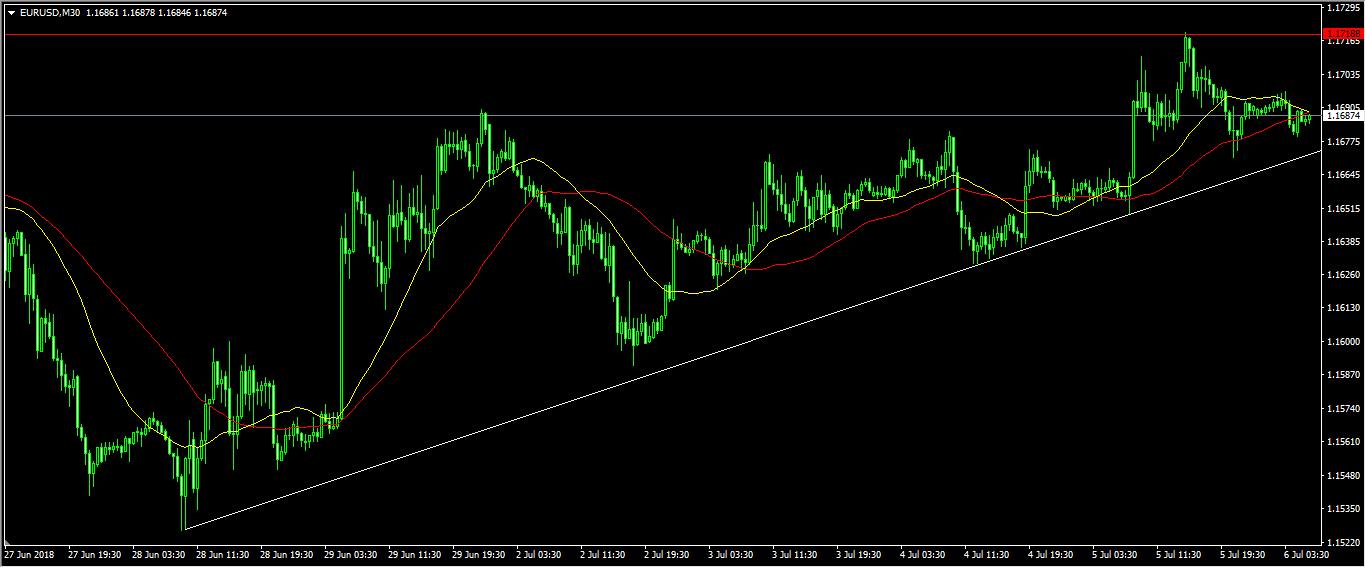
EUR/USD
The EUR/USD pair lost its upward momentum after the hawkish statement from the Fed. The pair dropped a few pips from yesterday’s top of 1.1720. It is now trading at 1.1687. Today, the pair will likely see some major movements as the tariffs kick in and as the US releases employment numbers. Further downward movements will see the pair test the important support of 1.1670 as shown below. If the jobs numbers disappoint, the pair will likely move past yesterday’s high of 1.1720.
USD/CAD
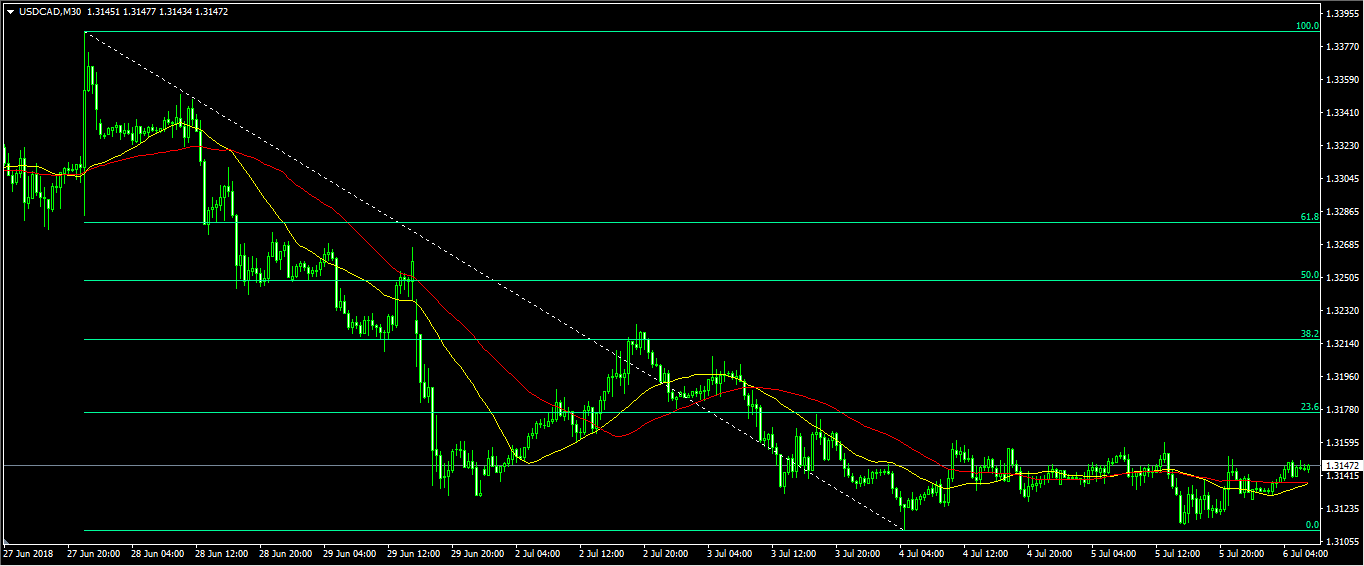
On Thursday last week, the USD/CAD pair declined from the weekly high of 1.3385 and reached a low of 1.3110. This week, the pair has traded in a sideways direction. This could change today as jobs numbers from the US is countered with the jobs numbers from Canada. In the likely event that a reversal happens today, traders should look at the 50% Fibonacci Retracement level 1.3250.
USD/JPY
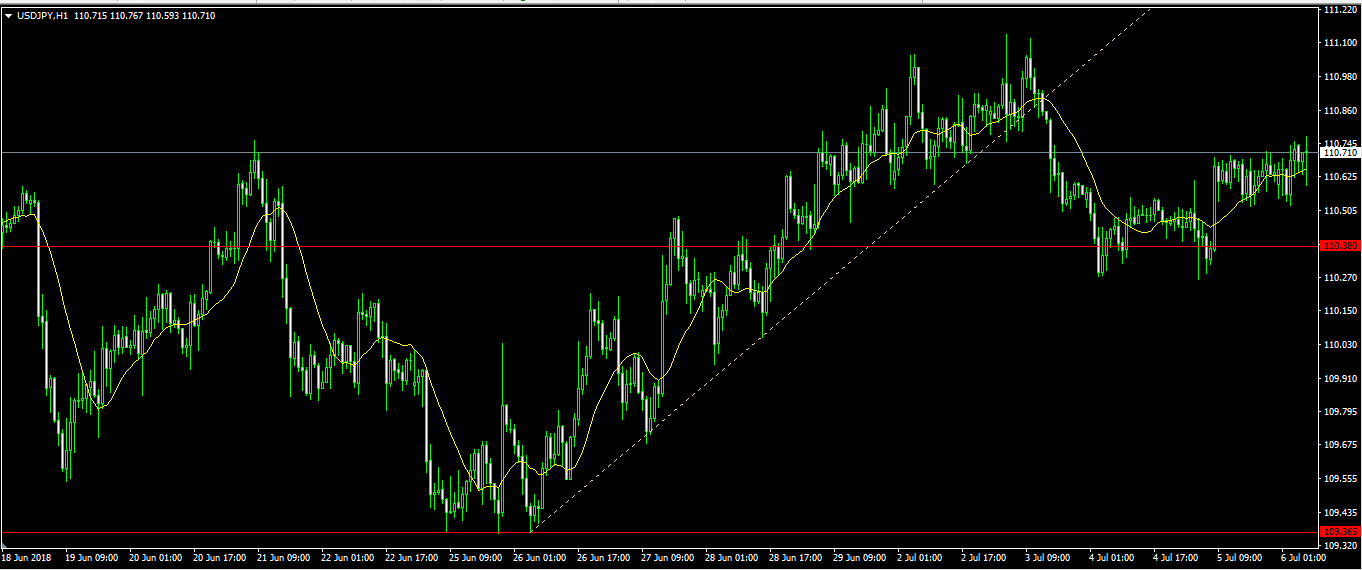
On Tuesday, the USD/JPY pair crossed the major support level of 110.89. Since then, the pair has moved lower and is currently trading at 110.63. This price is the 38.2% Fibonacci Retracement of the pair. Today’s jobs numbers from the US will likely cause major movements in the pair. A bearish report could see the price test the important support of 110.27. A better-than-expected jobs report will see the pair test yesterday’s high of 111.13.
FOMC Minutes Confirm They Expect To Reach Neutral Policy By 2019
The FOMC minutes highlighted some increased risks to the US economy particularly concerning trade relationships but the view still holds that the Fed should and will stick to its path of rate hikes with another two hikes being the consensus for 2018. The path of rates hikes will continue into 2019 with the Fed achieving a neutral policy in that year. Despite the hawkish policy the FOMC minutes tempered the tone with concerns and risks, making the USD less attractive and causing little movement in FX pairs. Stocks sold off initially in response to the minutes but recovered and are drifting higher despite today being the start date for US and Chinese tariffs. The market is positioning ahead of the Nonfarm Payroll data release later today that is expected to show a growth of employment by 200K.
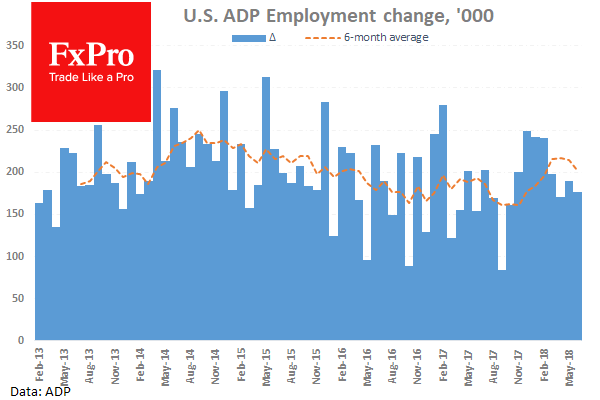
US ADP Employment Change (Jun) was 177K against an expected 190K from 178K previously which was revised up to 189K. This data has fallen under 200 last month showing that the US economy is continuing to add jobs but at a slower pace than recently. The data was expected to beat the previous reading which had formed a low for 2018 so far at 178K, but this was not the case as a soft reading fell by 1K to record a new low. EURUSD moved up from 1.16061 to 1.16195 after this data release.
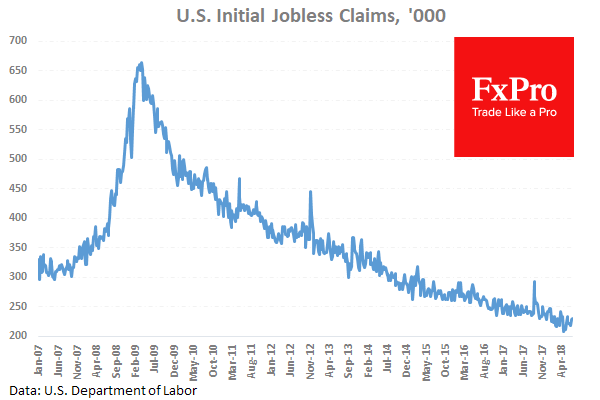
US Initial Jobless Claims (Jun 30) were 231K against an expected 225K from 227K previously which was revised up to 228K. Continuing Jobless Claims (Jun 23) were 1.739M against an expected 1.720M from a prior 1.705M which was revised up to 1.707M. This data was expected to show a rise in continuing claims with a small drop in the number of initial claims expected but the latter was actually higher than expected and beat the previous reading, showing an increase in joblessness. GBPUSD fell from 1.32741 to 1.32559 after the release.
US Markit Services PMI (Jun) was 56.5 against an expected 56.5 against a previous number of 56.5. This data came in to match last month’s reading. Markit PMI Composite (June) was 56.2 against an expected 56.0 from 56.0 previously, continuing its recent gains after a pickup in this metric over the last few months. USDJPY moved up from 110.585 to 110.651 after this data hit the market.
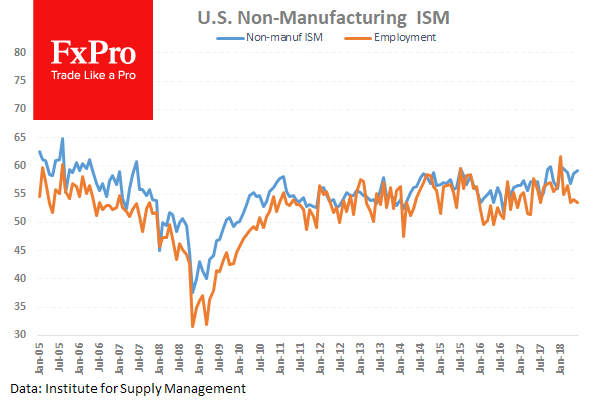
US ISM Non – Manufacturing PMI (June) was 59.1 against an expected 58.3 from 58.6 previously. This data outperformed last month with a strong gain after falling from a high of 59.9 in February. This shows a pickup in the sector that turned the lower expectation for this reading on its head. EURUSD fell from 1.17051 to 1.16908 after this data release.
EURUSD is up 0.09% overnight, trading around 1.17004.
USDJPY is up 0.14% in the early session, trading at around 110.744
GBPUSD is up 0.07% this morning trading around 1.32298
Gold is down -0.16% in early morning trading at around $1,255.57
WTI is down – 0.10% this morning, trading around $71.74
Markets Wait For Nonfarm Payrolls Data
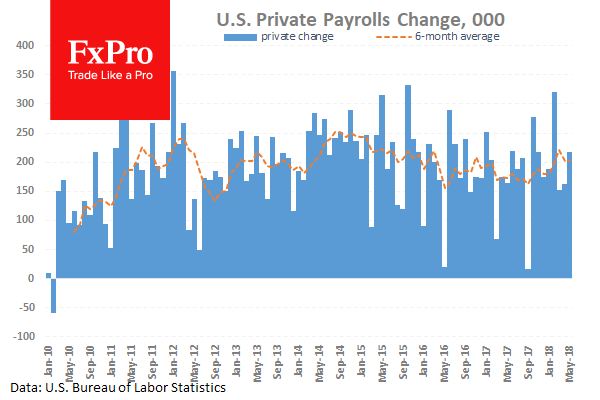
At 12:30 GMT, US Non-Farm Payrolls (Jun) is expected at 195K from a prior 223K. This measures the change in the number of employed people in June. The Unemployment Rate (May) is expected at 3.8% with a prior of 3.8%. Labour Force Participation Rate (Jun) is expected to be 62.7% against a prior reading of 62.7%.
Average Hourly Earnings (Jun) is expected to be 0.3% (MoM) and 2.7% (YoY) against 0.3% (MoM) and 2.6% (YoY) previously. Average Weekly Hours (Jun) is expected to be 34.5 against a previous 34.5. This data can have a large impact on markets as the tight labour market has yet to show its impact with an increase in earnings. This would lead to an increase in inflation which markets have reacted negatively to recently. USD crosses and assets can experience extreme volatility around these data releases.
At 12:30 GMT, Canadian Unemployment Rate (Jun) is expected to be 5.8% against a previous 5.8%. Participation Rate (Jun) is expected to be 65.3% against 65.3% prior. Net Change in Employment (Jun) is expected to be 24.0K against a prior -7.5K. Unemployment had fallen to the lowest levels in ten years and is settled around 5.8. CAD pairs can see an increase in price movement from this data.
Canadian International Merchandise Trade (May) is expected to be $-2.05B against $-1.90B previously. This fell to match the low of November 2016 in May at $-4.10B but rebounded last month, and it is expected to come in weaker today.
At 14:00 GMT, Canadian Ivey Purchasing Managers Index s.a. (Jun) is expected to be 63.2 against a previous 62.5. Ivey Purchasing Managers Index (Jun) was 69.5 previously. The data dropped from the April reading last month which was the highest since 2011 at 71.5 and slipped under expectations. This data is showing robust growth, despite the fall as it is now at recent levels, continuing one of the longest positive runs with over 20 months above 50.0. CAD crosses can be moved by this data release.
At 17:00 GMT, Baker Hughes US Oil Rig Counts is due to be released with a headline number from last week of 858 from 859 previously. Oil prices fell last yesterday after a build in inventories following 3 weeks of bigger than expected draws. WTI Oil can become volatile around this data release and will be in traders’ minds when trading resumes on Monday.