Sample Category Title
WTI Bullish Pennant In A Strong Uptrend
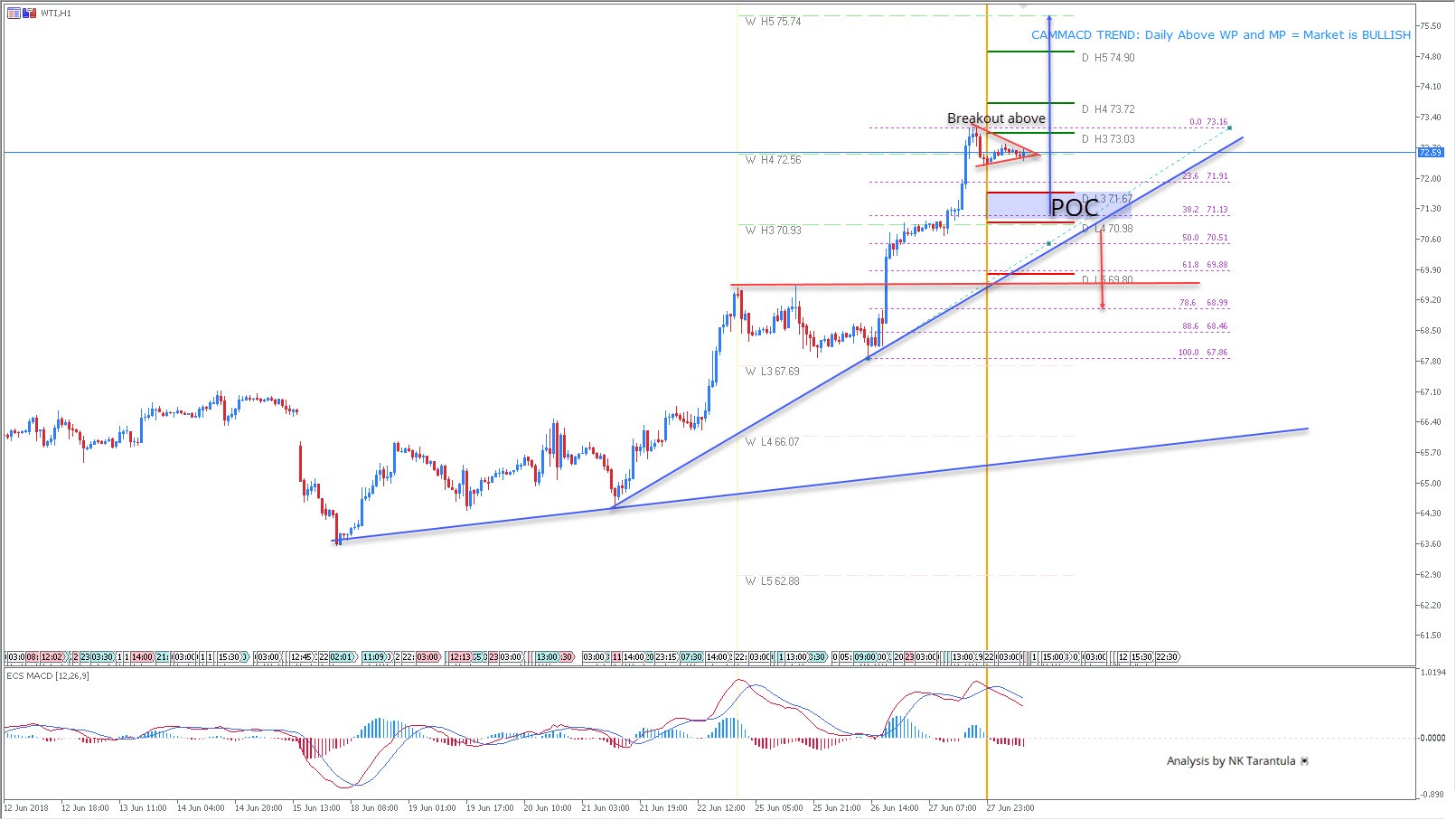
The WTI has made a strong bounce above W H3 and W H4 levels, indicating a bullish pressure that shows no signs of waning. Just above W H4 resistance at D H3, the price has formed a small bullish pennant. Break above 73.16 and we should see a continuation move. If the price retraces to POC zone 71.10-71.70 we might see another push to the upside targeting 73.16. Above 73.16 targets are 73.72, 74.90 and 75.74.
Only the break below the D L4/Trend line at 70.98 should provide bears with more momentum targeting 69.00
W L3 - Weekly Camarilla Pivot (Weekly Interim Support)
W H3 - Weekly Camarilla Pivot (Weekly Interim Resistance)
W H4 - Weekly Camarilla Pivot (Strong Weekly Resistance)
D H4 - Daily Camarilla Pivot (Very Strong Daily Resistance)
D L3 – Daily Camarilla Pivot (Daily Support)
D L4 – Daily H4 Camarilla (Very Strong Daily Support)
POC - Point Of Confluence (The zone where we expect price to react aka entry zone)
US Markets Blow The Biggest Intraday Gain Since February
Risk aversion on trade tensions carried into the European session yesterday morning was replaced with a relief rally in the US pre-market as President Trump appeared to go easy on China and its ability to invest in the US. The President signalled that the CFIUS would regulate investments into the US which the markets took to be a softening of his position. US Stock markets rallied to the day’s highs posting the biggest daily gains since February with the US 30 up from 24284.00 to 24570.00, while in FX USDJPY gained from 109.969 to 110.486. But Chief Economic Advisor Kudlow reignited the fear of a hard-line approach when he said that “Trump is not retreating on China”. This wiped out all of the gains as the markets reacted to the headline, with the US 30 closing at 24117.59 down -0.7% and GBPUSD falling to the 113.000 level as the dollar strengthened throughout the day.
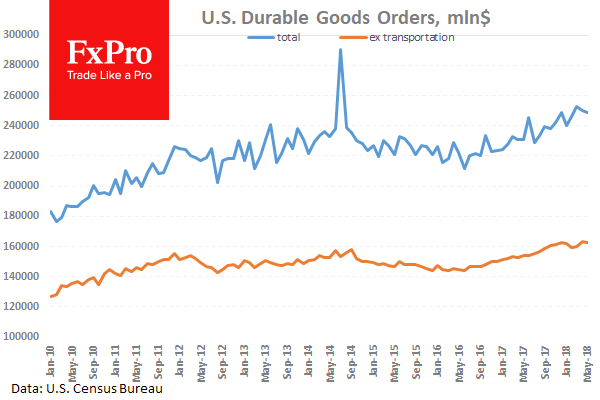
US Durable Goods Orders ex Transportation (May) were -0.3% against an expected 0.5% from 0.9% previously which was revised up to 1.9%. Durable Goods Orders (May) were -0.6% against an expected -1.0% against -1.6% previously which was revised up from -1.7% and with the release of the data was against revised up to -1.0%. This data fell under 0% last month and stayed below this mark but came in higher than the previous reading. The ex-transports data missed its forecast and came in lower than the previous reading. This shows a slowing in quantity of orders placed. USDJPY went higher from 110.162 to 110.486 after this data release.
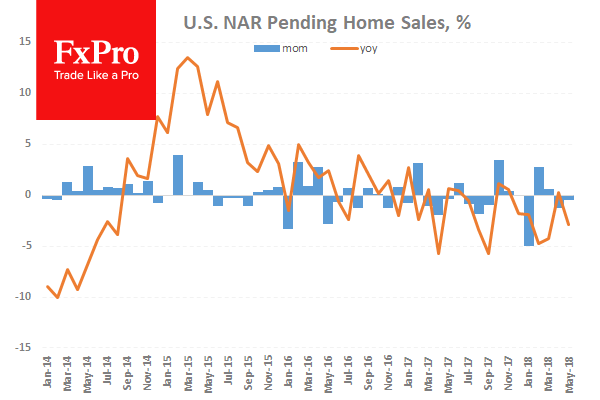
Pending Home Sales (MoM) (May) were -0.5% against an expected 0.5% from a prior reading of -1.3%. This data points missed expectations but came in higher than the previous reading. The data is expected to turn back above zero today but remains under that mark. This is in-line with the pattern from last year and if this is followed, next month should see a stronger performance. EURUSD fell from 116.112 to 115.749 following this data release.
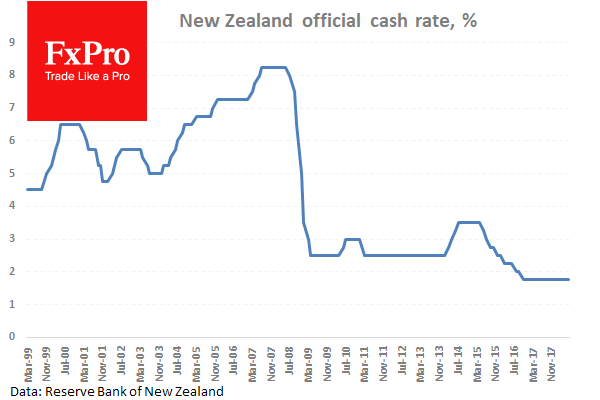
New Zealand Interest Rate Decision was released with the RBNZ keeping rates unchanged at 1.75%. The Rate Statement was also released at this time. In the statement the Bank said that they are well positioned to respond to any eventuality with the next rate move either up or down. They commented that the outlook has been tempered slightly by trade tensions. NZDUSD moved higher from 0.67779 to 0.68078 after the announcement.
EURUSD is unchanged overnight, trading around 1.15552.
USDJPY is up 0.03% in the early session, trading at around 110.290
GBPUSD is down -0.17% this morning trading around 1.30890
Gold is down -0.04% in early morning trading at around $1,252.50
WTI is up 0.07% this morning, trading around $71.79
US GDP Data Expected To Remain In Line With Previous Data
At 08:00 GMT, The ECB will release its Economic Bulletin revealing the data used by the governing council while making the latest interest rate decision. It also provides a detailed analysis of the current and future economic conditions in the bloc. EUR pairs can move in reaction to this event.
At 09:00 GMT, The Eurozone Business Climate data will be released with an expectation for 1.40 against a previous reading of 1.45. EUR pairs could be impacted as a result.
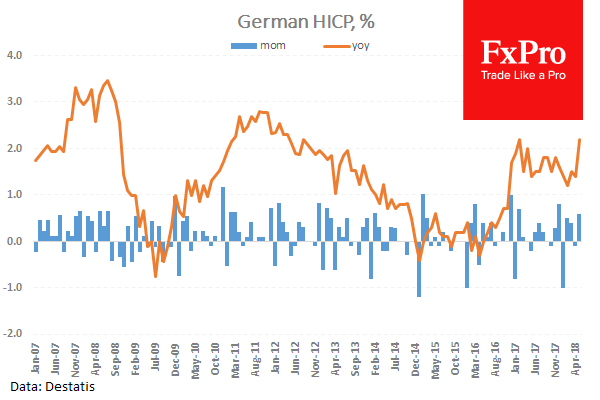
At 12:00 GMT, German Harmonised Index of Consumer Prices (YoY) (Jun) is expected to come in at 2.1% against a prior reading of 2.2%. This data is expected to slip under the previous reading on a yearly basis after it performed well with its rise from the May reading of 1.4%. EUR crosses can be moved by this data
At 13:30 GMT, US Gross Domestic Product Annualized (Q1) data will be out, with the headline number expected to be 2.2% from a previous 2.2%. Gross Domestic Product Price Index (Q1) data is expected to be 1.9% from a previous 1.9%. Also at this time Core Personal Consumption Expenditures (QoQ) (Q1) are expected to be 2.3% from a prior 2.3% reading from Q4. Personal Consumption Expenditure Prices (QoQ) (Q1) are expected to be 2.6% from a previous 2.6%. 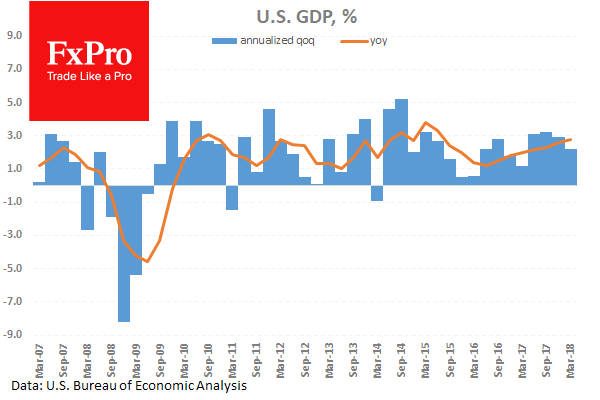
Initial Jobless Claims (Jun 22) are expected to come in at 220K from 218K previously. Continuing Jobless Claims (Jun 15) are expected to be 1.725M from a prior 1.723M. USD crosses can see moves as traders take Dollar positions in reaction to the numbers released. 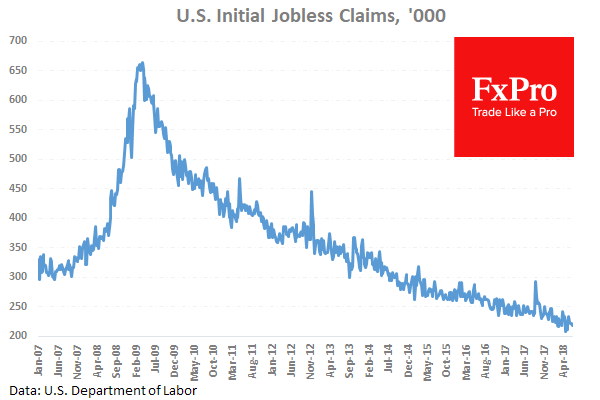
At 13:30 GMT, MPC Member Haldane is due to speak about productivity growth at the Academy of Social Sciences Annual Lecture, in London. Comments may result in moves in GBP crosses.
At 14:45 GMT, US Fed’s Bullard is due to speak at a scheduled event. USD pairs can be impacted as a result of comments made during this time.
At 20:00 GMT, FOMC Member Bostic is due to speak about affordable housing and jobs at the Centre for Working Families, in Atlanta. Comments made can result in moves in USD pairs.
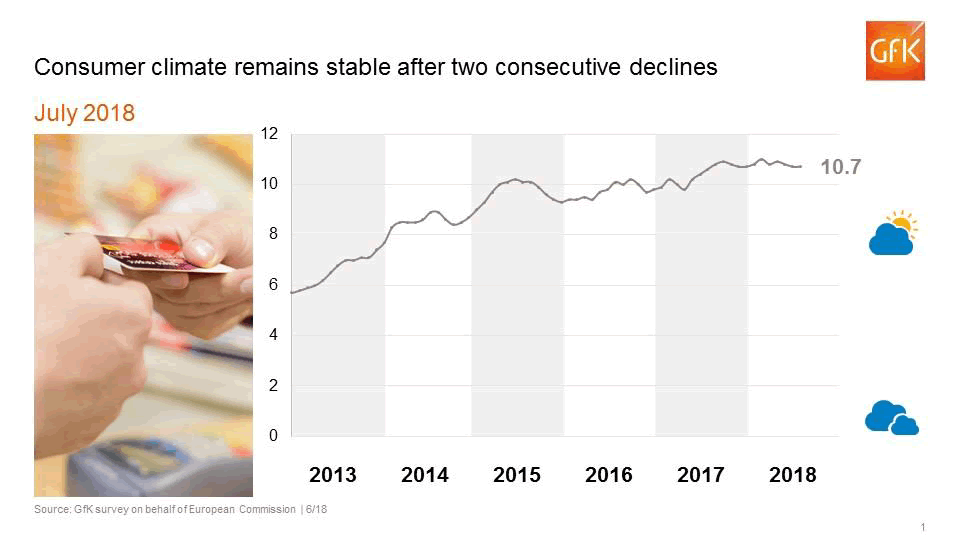
German Gfk consumer sentiment unchanged at 10.7. Economic expectations tumbled on protectionist Trump
German Gfk consume climate for July (in June) was unchanged at 10.7, slightly above expectation of 10.6.
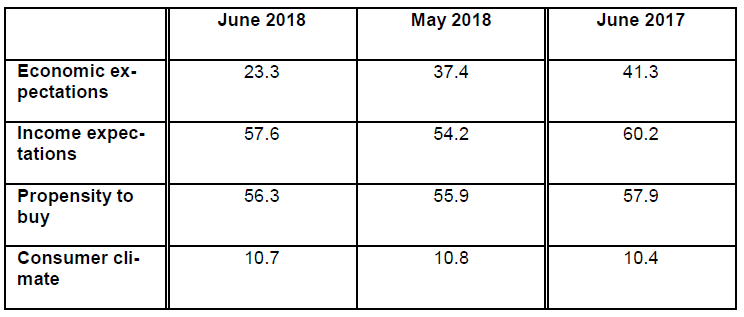
Among the components, there is notable 14.1pts drop in economic expectations from 37.4 to 23.3. GFK blamed US trade policy as the driver of the decline. It said in the statement that "the American President's protectionist trade policy, which affects both Germany and other export-oriented countries such as China, casts further gloom over the economic forecast." As a result, "economic experts are currently predicting that the economic dynamics of the global economy will decline."
As an export nation, Germany is affected "naturally". Gfk pointed to the study of German Institute for Economic Research (DIW) and the ifo Institute, which projected the German economy will "drop down a gear" this year. These two institutes lowered GDP forecasts by around half a percent to 1.9% and 1.8% respectively.
Nonetheless, income expectations improved from 54.2 to 57.6. Propensity to buy also rose from 55.9 to 56.3. The improvements offset deterioration in economic expectations.
USDJPY Surpasses 200-Day SMA Once Again, Neutral In Short-Term
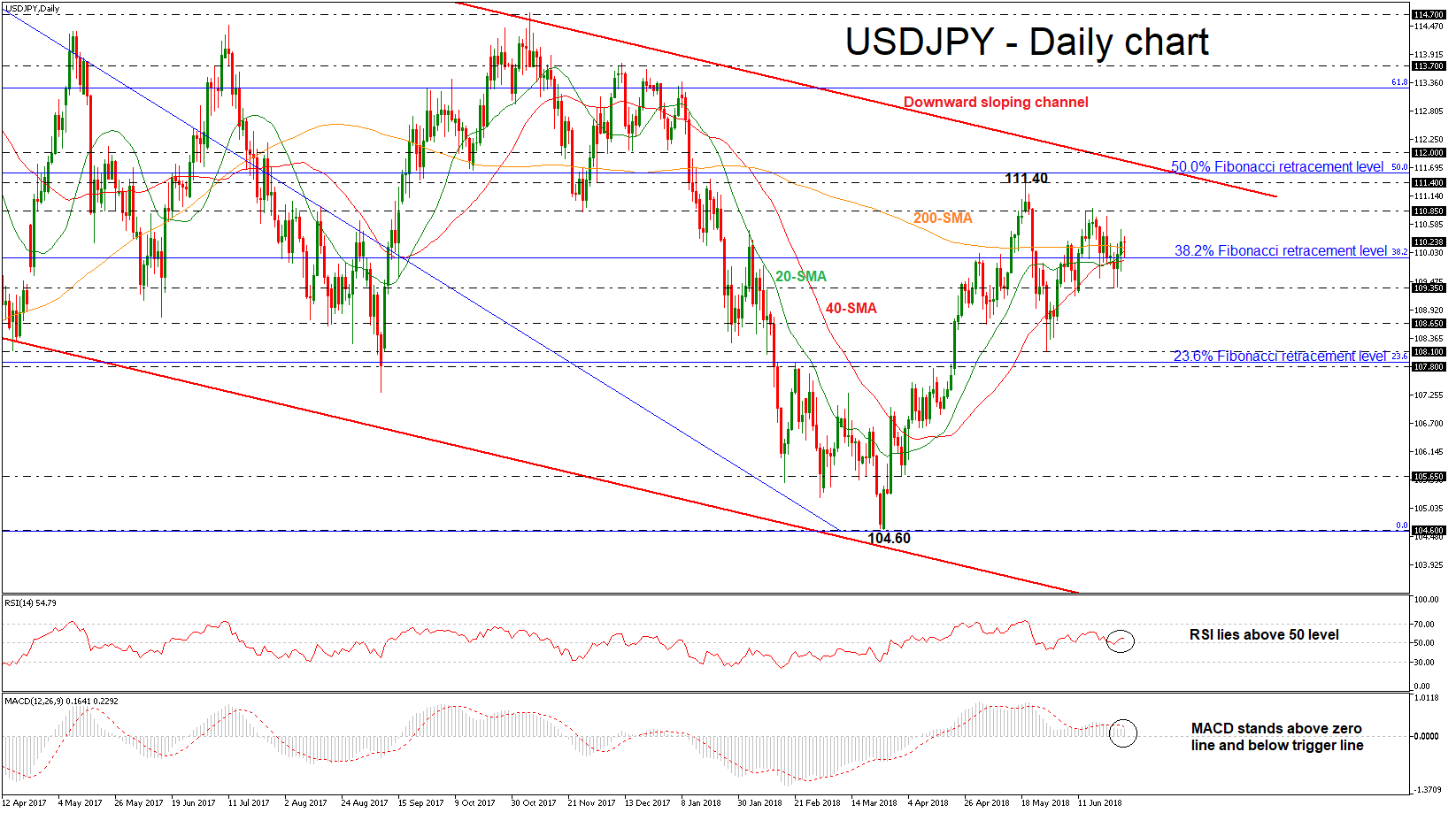
USDJPY remains in a narrow range during June with upper boundary the 110.85 resistance level and lower boundary the 109.35 support. Moreover, the 38.2% Fibonacci retracement level of the downleg from 118.60 to 104.60, around 109.95 acts as strong mid-level of the range, as the price is moving around this barrier.
The price is set to complete the third bullish day in a row after the bullish crossover of the 20- and 40-simple moving averages (SMAs) and the surpass of the 200-SMA in the daily timeframe. Technically, the RSI indicator is sloping upwards above the threshold of 50, while the MACD oscillator lies near its trigger line and is rising with weak momentum above the zero line.
Should the market edge higher and run above the 110.85 level, resistance could be met between the 111.40 resistance level and the 50.0% Fibonacci mark near 111.60. A leg above this area could send prices towards the 112.00 psychological barrier, which currently is in the path of the descending trend line of the longer-term falling sloping channel. In case of an upside violation of this level, it could shift the bearish bias to bullish.
On the flip side, if the pair bounces down and closes below the 38.2% Fibonacci, support could be met at the 109.35 hurdle. Further losses could drive the pair until the 108.65 obstacle taken from the low on May 4.
In the longer timeframe, USDJPY has been trading within a descending sloping channel since December 2016, while in the medium-term the market holds in an ascending movement after the rebound on the 104.60 support.
Dollar Races Higher, EU Summit To Prove Crucial For Merkel’s Government
Here are the latest developments in global markets:
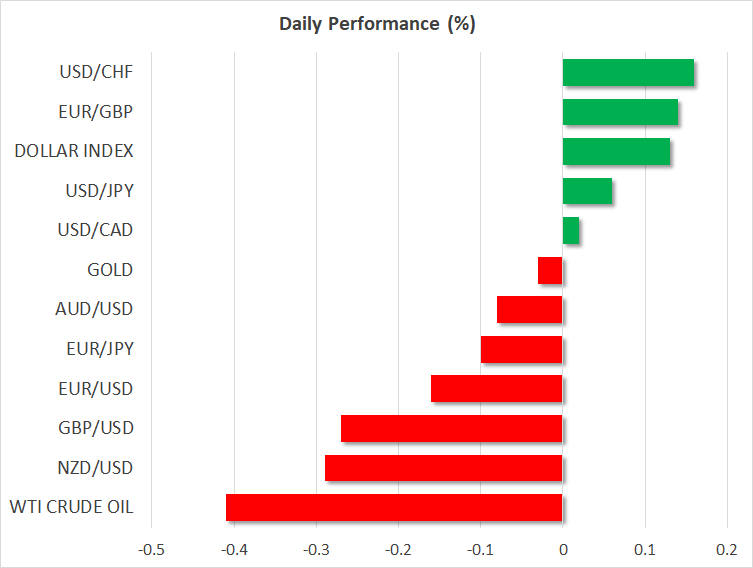
FOREX: The US dollar index is roughly 0.1% higher on Thursday, extending its gains from the previous session and trading just below an eleven-month high. Meanwhile, both the euro and sterling are on the defensive. The kiwi came under renewed selling interest after the RBNZ kept the option of a rate cut on the table.
STOCKS: US markets closed lower on Wednesday, giving back earlier gains. The drop came after White House economic advisor Kudlow said the Trump administration’s latest announcement on China was not an indication the US will soften its stance on trade, keeping investors on edge. The Nasdaq Composite was hit the hardest (-1.54%), while the S&P 500 (-0.86%) and the Dow Jones (-0.68%) also took a beating. Futures tracking the Dow, S&P, and Nasdaq 100 are currently flashing green though, pointing to a slightly higher open today. The negative sentiment rolled over into Asia as well, with Japan’s Nikkei 225 and Topix falling by 0.01% and 0.26% respectively. In Hong Kong, the Hang Seng dropped by 0.51%. Europe looks set to follow suit, as futures tracking all the major indices suggest a notably lower open today.
COMMODITIES: Oil prices are a little lower on Thursday, giving back some of the significant gains they posted in the previous session, when WTI touched a fresh three-and-a-half year high. Most of the gains came after the weekly EIA inventory data showed a much larger crude drawdown than expected. Prices surged even despite a stronger dollar, which typically weighs on the dollar-denominated liquid. In precious metals, gold is marginally lower today, extending its losses from Wednesday. The yellow metal is now trading at a fresh low for the year, at $1249/troy ounce. Given the insensitivity it has displayed towards trade frictions lately, its continued plunge appears to be primarily a function of a strengthening dollar more than anything else.
Major movers: Kudlow frightens equities, but dollar rises; kiwi drops after RBNZ
US stock markets went for a rollercoaster ride on Wednesday. They raced higher initially, after the Trump administration confirmed it will take what many have deemed as a less-confrontational route towards curbing Chinese investments in high-tech US companies. Officials said they will use a review process to assess whether foreign investments in “critical technology” pose national security risks, with Treasury Secretary Mnuchin saying the changes will not target China specifically.
However, the narrative that the US was seeking de-escalation soon got turned on its head, after White House economic advisor Larry Kudlow said the announced plan was not an indication of a softening stance towards China. Stocks quickly gave back all their gains to trade much lower in the aftermath.
The dollar, meanwhile, surged throughout the day, remaining largely unfazed by the trade narrative. The dollar index is slightly higher on Thursday as well, trading just below an eleven-month high reached earlier in June. Not even a sizeable drop in longer-term US Treasury yields was enough to halt the greenback’s advance, which may have been at least partly fueled by quarter-end demand.
The other factor potentially driving flows into the dollar was broad weakness in the euro and sterling. With little in the way of news flow, it seems the looming EU summit today is casting a shadow on the euro. German Chancellor Merkel’s coalition government could face collapse should she return home without a deal on immigration, potentially sending Europe’s largest economy to early elections.
Similarly, considering the summit will also touch on Brexit – where negotiations are still stuck on the Irish border issue – investors may have taken a defensive stance towards the pound. Some comments from BoE Governor Mark Carney yesterday that global risks are rising probably didn’t do the currency any favors either. Cable is down almost 0.3% today too, touching a fresh seven-month low.
Elsewhere, kiwi/dollar is down 0.3% today – trading at new two-year lows – after the RBNZ kept its policy unchanged overnight, but adopted an even more dovish tone. Officials said they are well positioned to manage a change in the cash rate either up or down, keeping the prospect of another rate cut on the table amid disappointing GDP growth and global trade tensions.
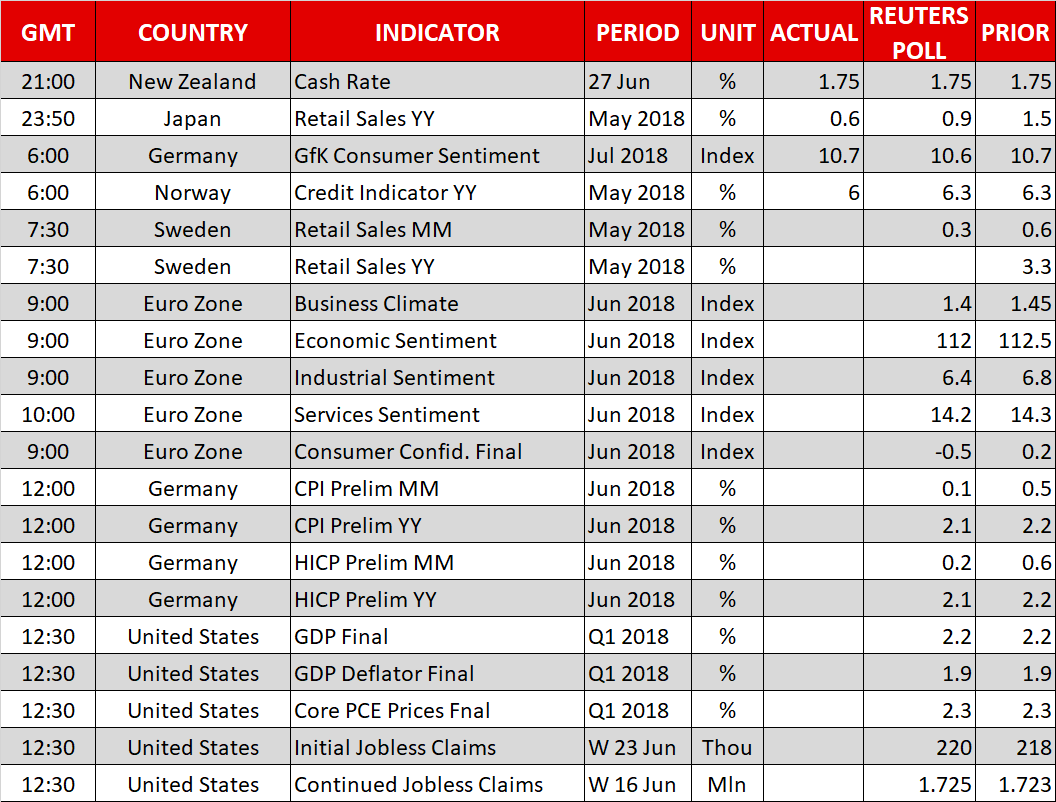
Day ahead: Eurozone business surveys, German inflation and US GDP due; EU summit gets underway; trade headlines still of interest
Thursday’s calendar features numerous business surveys out of the eurozone, inflation figures out of Germany, as well as updated GDP estimates for Q1 out of the US. Meanwhile, a European Council Summit commencing later on the day will also be of interest, as it could prove crucial for German Chancellor Angela Merkel’s coalition government. Any headlines on the state of global trade are also likely to prove market moving.
Krona pairs will be in focus at 0730 GMT, as Sweden will be seeing the release of retail sales figures for May.
At 0900 GMT, the European Commission’s Directorate General for Economic and Financial Affairs will be releasing numerous surveys gauging business morale, all of which are expected to reflect a worsening of sentiment during June relative to May. June’s final consumer confidence reading, again released by the same authority, will also be made public at the same time, with the relevant index anticipated at -0.5, its lowest since October 2017.
Germany, the eurozone’s and Europe’s largest economy, will be seeing the release of June flash inflation figures at 1200 GMT. CPI growth is projected to slow down to 0.1% m/m (from 0.5% in May) and 2.1% y/y (from 2.2% in May). The Harmonised Index of Consumer Prices (HICP), that uses a common methodology across EU countries, will also be of interest. These numbers come one day before the eurozone sees its own preliminary inflation figures hitting the markets, and are also important in the sense that they may give an indication regarding tomorrow’s release.
Final estimates for Q1 GDP growth in the US are expected to confirm growth standing at 2.2% on an annualized basis during the quarter. The numbers are due alongside the final releases on Q1’s GDP deflator and core PCE price data at 1230 GMT. Weekly jobless claims numbers are also due at the same time.
EU leaders will be gathering in Brussels for a summit to touch on issues including migration, security & defense, and economic and financial affairs. Brexit will also be discussed, though that’s likely to come to the fore during tomorrow’s talks.
There are rising concerns over the sustainability of German Chancellor Merkel’s coalition government, with political instability in the country likely to act as a drag on the euro. Specifically, the Christian Social Union (CSU) party, Merkel’s Bavarian ally, has threatened to clash with her unless the party’s demands on reducing the country’s immigration burden are satisfied. Merkel will likely attempt today to get concessions from her European counterparts that would allow her coalition to continue ruling Europe’s largest economy. EU Summit Chairman Donald Tusk and European Commission President Jean-Claude Juncker will be holding a press conference after the first working session of the meeting at 1700 GMT.
Andy Haldane, the BoE policymaker who surprised markets last week by voting in favor of rate hike, will be talking at 1330 GMT. Regional Fed Presidents James Bullard (1445 GMT – non-voting FOMC member in 2018) and Raphael Bostic (1600 GMT – voter) are also scheduled to make appearances today.
Lastly, trade developments remain in the background. On Wednesday, the US adopted a softer stance of some sorts against China, providing some relief to markets. Still, mixed signals are projected by the Trump administration and a re-escalation of tensions is not to be ruled out.
Technical Analysis: EURUSD bearish in the short-term
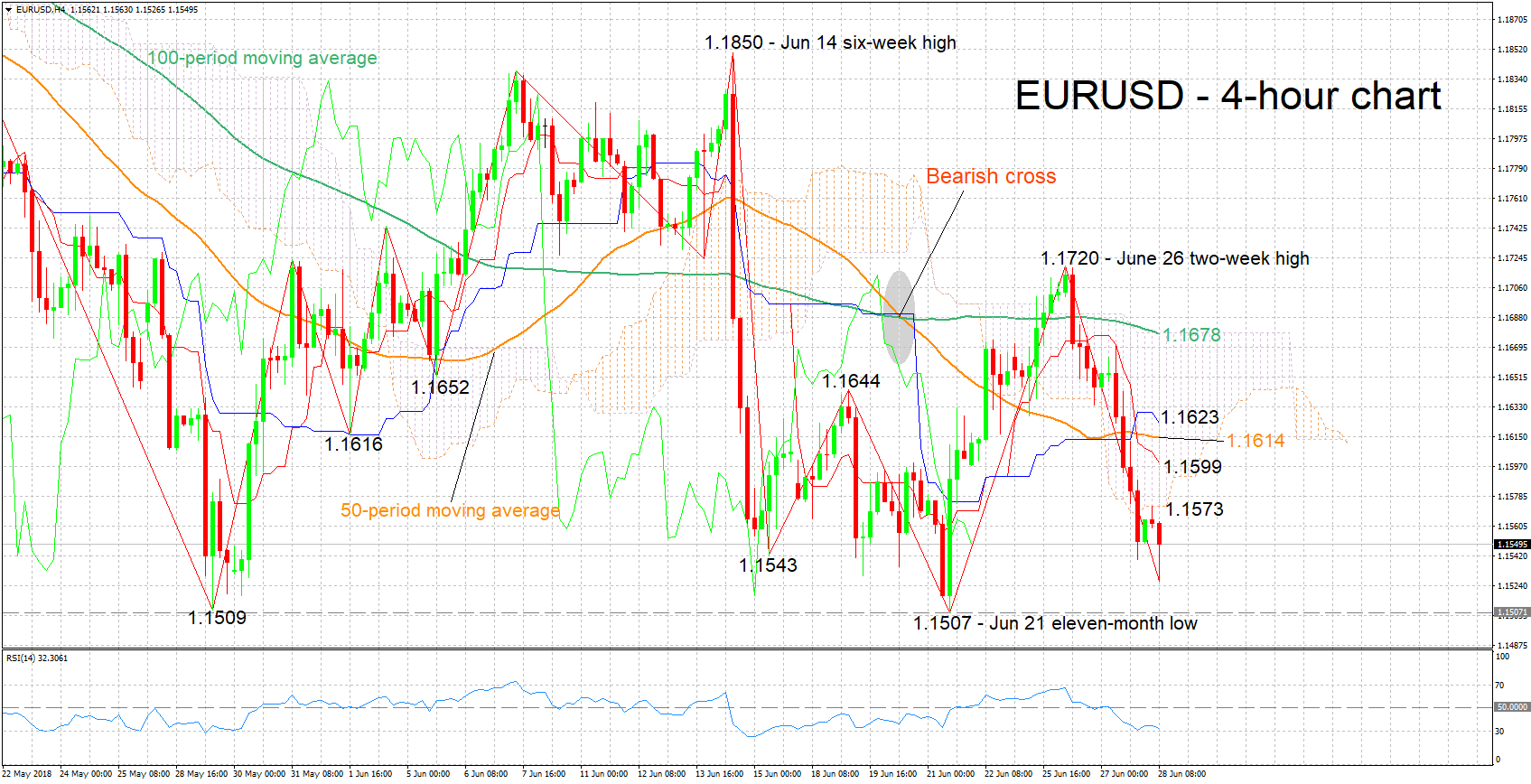
EURUSD has declined by more than 150 pips after reaching a two-week high of 1.1720 on Tuesday. Earlier on Thursday, it recorded a one-week low of 1.1527. The negatively aligned Tenkan- and Kijun-sen lines are projecting a bearish picture. The RSI is also pointing towards negative momentum. Notice though as well that the indicator is close to the 30 oversold level.
An EU Summit outcome that is seen as undermining Merkel’s government will likely exert downward pressure on the pair. Support to declines could come around last week’s 11-month low of 1.1507, including the 1.15 round figure, with steeper losses increasingly bringing into scope the 1.14 handle.
Anything seen as strengthening Merkel’s position on the other hand might allow EURUSD to advance. Resistance to advances may be met around the Ichimoku cloud bottom at 1.1573, and further above from the area around the current level of the Tenkan-sen at 1.1599; the region around the latter includes the 1.16 handle, the current level of the 50-period MA (1.1614) and the Kijun-sen (1.1623).
Eurozone and US releases due later today can also spur some positioning in EURUSD.
Relentless Rout For Emerging Market Currencies Extends
While the speed of selling has slowed down compared to the early part of the week, emerging market currencies have continued to show weakness in the early hours of Thursday morning. The Thai Baht, Malaysian Ringgit, Chinese Yuan, Indonesian Rupiah and Indian Rupee are all trading lower at time of writing. The Indian Rupee has in fact softened as much as 0.6% to meet a new intraday low, which is the weakest level on record according to Bloomberg data going back to the beginning of 1973. The weakness in the Rupee is very much correlated to the Dollar strength that is hammering emerging markets but concerns over a meeting this week in New Delhi between Indian officials and US trade representatives to calm trade tensions have also weighed on local sentiment. Speculation that the United States has told India to weaken its dependence on Iranian oil also appears to have impacted investor sentiment.
Another factor that is weighing on the emerging market sentiment is the positive turnaround in USD momentum over recent trading sessions. The USD has made an attempt to re-challenge 2018 highs after speculation circulated on Wednesday that President Trump might be adopting a softer tone on China. Reports that the United States will not impose restrictions on Chinese investment in US technology firmswere initially met with optimism that the trade war narrative between the two largest economies in the world would take a breather. White House economic advisor Larry Kudlow quickly squashed that optimism when he commented that the US administration’s latest approach towards China shouldn’t be seen as a retreat.
The comments from Kudlow are likely to ensure that there is still an atmosphere of risk aversion across trading. This means that global stocks are likely to trade cautiously with a lack of risk appetite encouraging the ongoing lack of buying momentum for emerging market currencies. Year-to-date there are only two emerging market currencies that have traded higher against the Dollar, with this being the Colombian Peso and Malaysian Ringgit. The gains in the Malaysian Ringgit this year are getting smaller by the day with the advance in the Ringgit now standing at just below 0.2%. There is a likelihood that by next week the Colombian Peso could stand on its own as the only emerging market currency to have advanced against the Dollar this year.
Concerns over emerging market weakness are naturally going to raise questions over whether central banks will intervene in the market to protect their respective currency. This could come in the form of direct intervention in the foreign exchange market or raising interest rates in an effort to attract investors back into their respective market. However, it should not be understated that what we are seeing in the FX market is a very broad-based Dollar rally. This means that the advancement in the Dollar is the main catalyst behind emerging market weakness, and the weakness in emerging market currencies is something that is being mirrored across their counterparts.
Speculation is high that Bank Indonesia might raise interest rates once again before the end of today to prevent the Rupiah from hitting further milestone lows against the Dollar. Traders have previously rejected each of the recent interest rate increases by Bank Indonesia, and I do feel that the risk remains current that a central bank interest rate increase from any emerging market central bank could only encourage a near-term impact for their currency.
For as long as buying the Dollar continues to be the trend of the FX market, there is very little emerging markets can do to prevent weakness. Any break in emerging market currency weakness ahead could also be a temporary measure.
GBP/JPY Daily Outlook
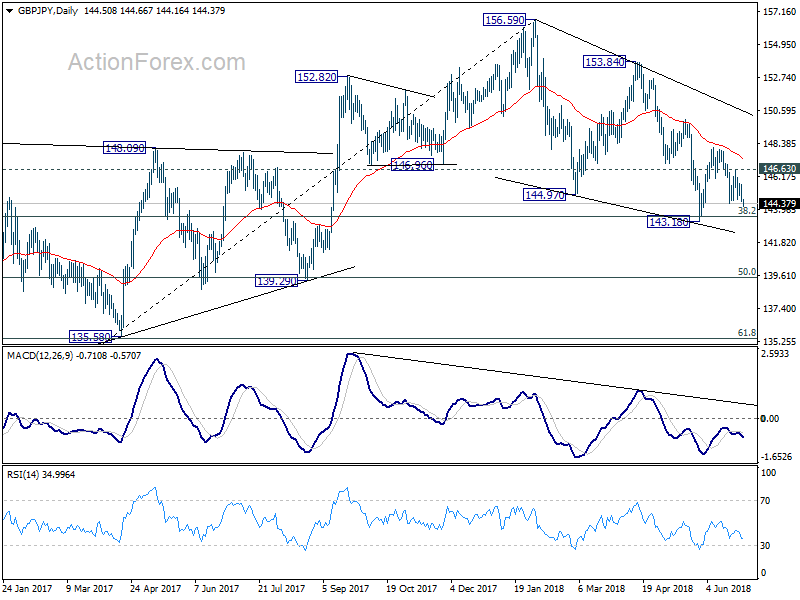
Daily Pivots: (S1) 144.18; (P) 144.96; (R1) 145.40; More...
Break of 144.37 supports indicates resumption of fall from 148.10. Intraday bias is turned to the downside for 143.18 support first. Firm break there will resume larger decline from 156.59 and target 139.25/47 cluster support level. On the upside, above 146.63 minor resistance will target 148.10 instead.
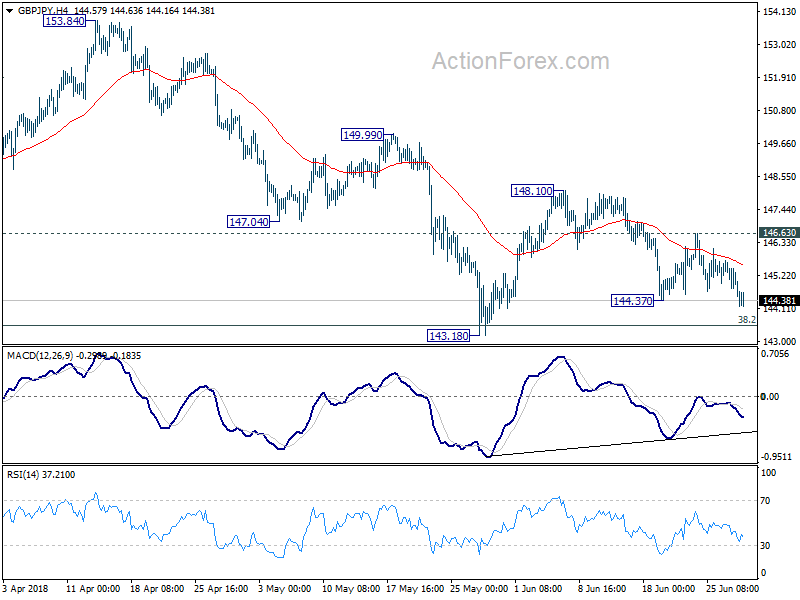
In the bigger picture, no change in the view that decline from 156.59 is a corrective move. In case of another fall, strong support should be seen above 139.29 cluster support (50% retracement of 122.36 to 156.59 at 139.47) to contain downside and bring rebound. Meanwhile, break of 153.84 should confirm that the correction is completed and target 156.59 and above to resume the medium term up trend.
XAUUSD Intraday Analysis
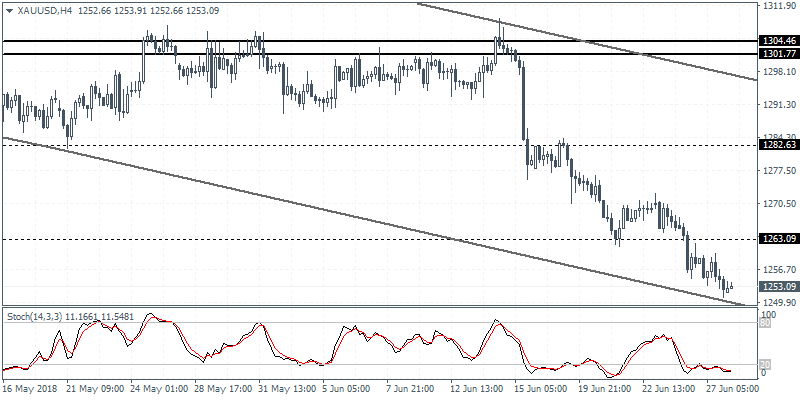
XAUUSD (1253.09): Gold prices continued to extend the declines with the bearish momentum slowly gaining pace. The price of the precious metal extended to a 6-month low. However, we anticipate a modest rebound in the near term. Price action is expected to retrace the declines back to the 1263 level which previously served as support. Establishing resistance at this level could signal a possible reversal yet again with gold prices likely to fall further in the near term
USDJPY Intraday Analysis
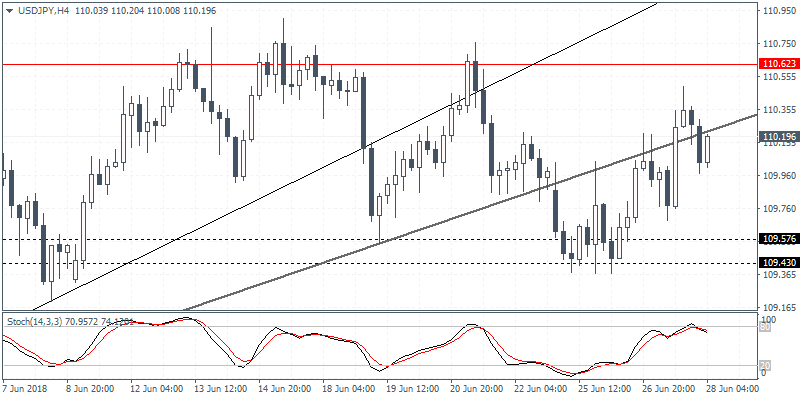
USDJPY (110.19): The USDJPY currency pair rebounded with some momentum but price action was seen failing to break past the rising trend line. A reversal at this level is expected to see price action posting declines back to the support level of 109.57 - 109.43 region. As long as the support holds, the USDJPY currency pair is expected to maintain a sideways range. However, we expect the support level to break which could potentially set the stage for USDJPY to push lower toward the 108.90 level of support in the medium term.