Sample Category Title
US Housing Starts And Building Permits Are Expected To Remain Steady
At 08:00 GMT, ECB President Mario Draghi is due to speak at the ECB Forum on Central Banking, in Portugal. EUR crosses can be impacted by any comments made.
At 08:30 GMT, ECB’s Praet is due to chair a discussion on the Macroeconomics of price and wage setting. EUR crosses can be moved by any comments made in relation to ECB policy.
At 11:00 GMT, ECB’s Praet is due to chair a panel discussion on the Macroeconomics of price and wage setting with US Fed’s Bullard and Central Bank of Ireland Governor Lane. EUR and USD crosses may be moved by any comments made in relation to Central Bank policy.
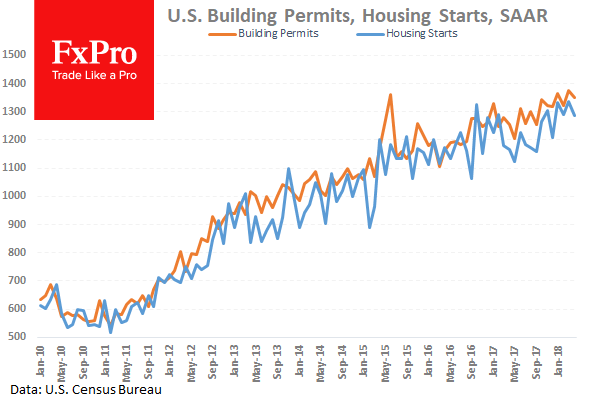
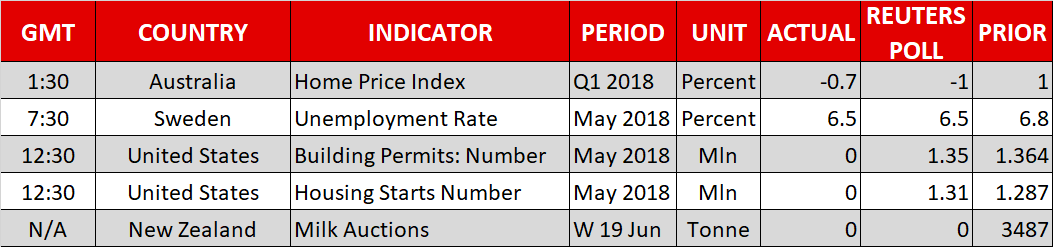
At 12:30 GMT, US Housing Starts (MoM) (May) is expected at 1.317M from a previous number of 1.287M. Building Permits (MoM) (Apr) is expected to come in at 1.350M with the prior reading of 1.352M. This data is expected to remain largely in line with the previous readings. These data points have been recovering since hitting lows in 2009 after the financial crisis of 0.46M and 0.49M respectively. The readings in February were the highest since those lows in both cases and these levels have yet to be matched or surpassed. USD crosses can see increased volatility around this data release.
Tentative – Global Dairy Trade Price Index is expected to be released with a previous reading of -1.3%. A negative reading at the beginning of this month reversed the positive reading from mid May. NZD pairs can be affected by this data release.
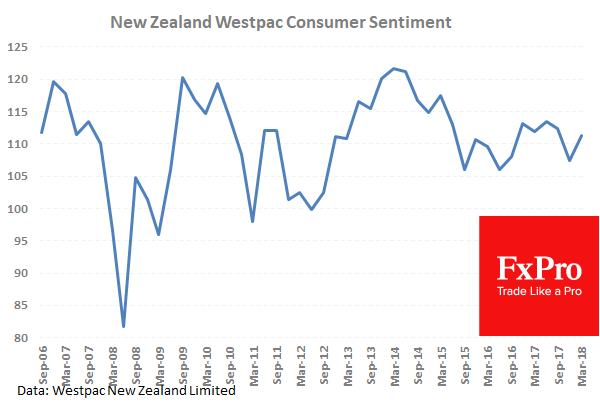
Tentative – New Zealand Westpac Consumer Survey (Q2) will be released with a prior number of 111.2 recorded. NZD crosses can be affected by this data release.
GBPUSD Moves Slightly Above 6-Month Low, Further Losses Are Expected
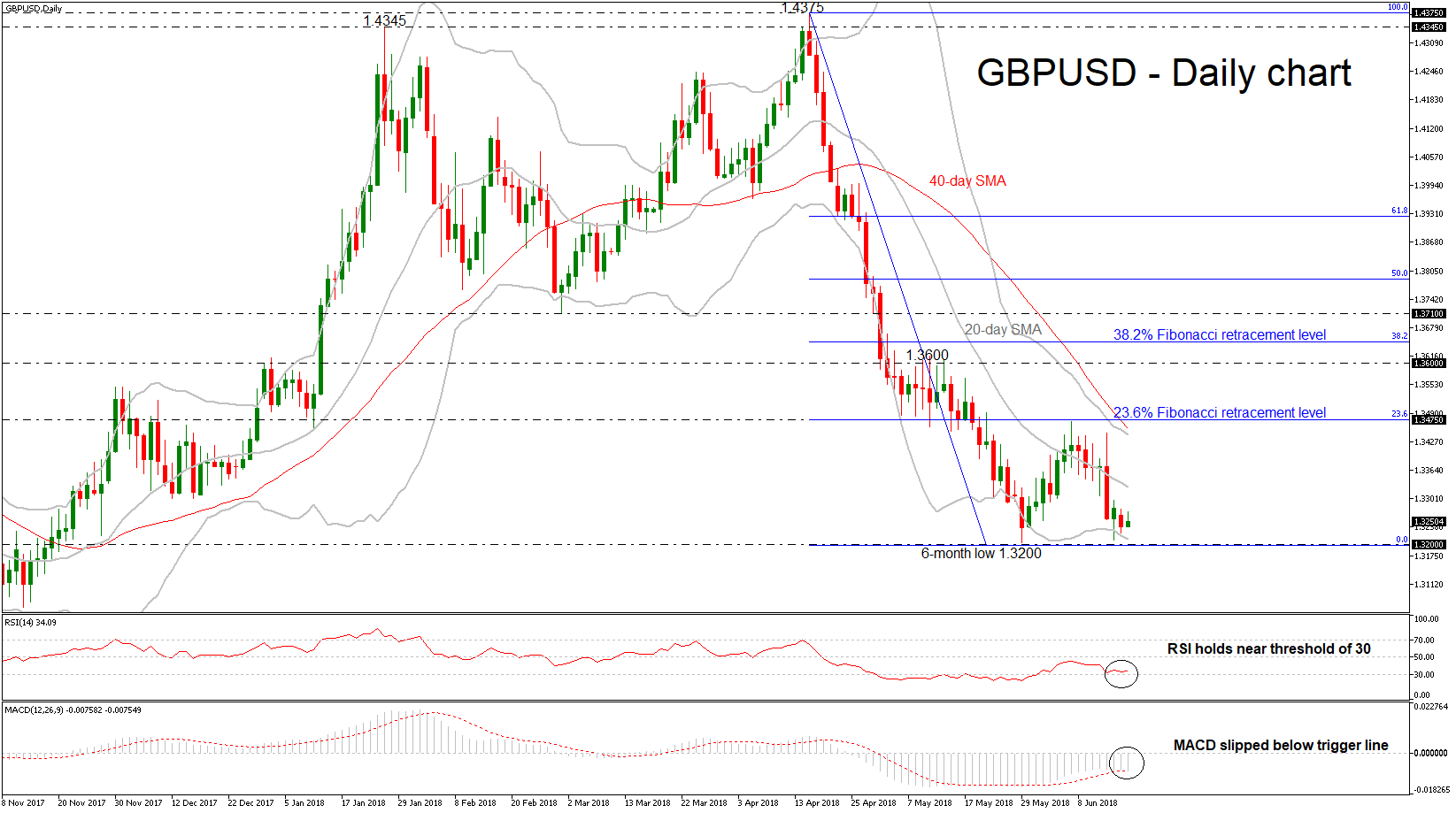
GBPUSD decreased considerably in the previous week following the bounce off the 23.6% Fibonacci retracement level of the downleg from 1.4375 to 1.3200, near the 1.3475 resistance barrier. The cable is trying to pare some of its losses but remains weak as it is still developing below the mid-level of the Bollinger Band (20-day simple moving average) in the near term.
In the daily timeframe, the RSI indicator is moving in the negative territory and is flattening near the threshold of 50. Moreover, the MACD oscillator posted a bearish crossover with its trigger line below the zero line, extending the scenario for further bearish movement.
Should prices continue to head lower and break the significant six-month low of the 1.3200 psychological level, immediate support could come at the 1.3040 support hurdle. A drop below this region as well would take the pair closer to the next support at the 1.2770 level, which holds almost 500 pips away from the current market price. Investors need to be cautious for any upside retracement until the latter level.
To the upside, there is an immediate resistance of the mid-level of the Bollinger Band around 1.3325 while above that, the next major resistance to watch is the 23.6% Fibonacci of 1.3475. However, the price needs to surpass the upper boundary of the Bollinger band and the 40-day SMA before challenging the aforementioned psychological hurdle. A successful close above this barrier, could open the way towards the 1.3600 psychological level, taken from the highs at the beginning of May.
Having a look at the bigger picture, GBPUSD started an aggressive downward trending rollercoaster after it touched the 1.4375 resistance level last April and failed to complete a strong retracement movement.
Ifo downgraded German growth forecasts notably
The Ifo said in a report today that "Storm Clouds Gather Over German Economy". It said, the upswing since last year has "lost impetus" and "international economic risks in particular have growth significantly.
German GDP growth is expected to slow from 2017's 2.2% to 1.8% in 2018 and 1.8% in 2019. That's notable downward revision from Spring forecasts of 2.2% in 2018 and 2.0% in 2019.
Inflation, though, is projected to climb from 1.8% in 2017 to 2.0% in 2018 and 2.1% in 2019. That's upward revisions from Spring forecasts of 1.7% in 2018 and 1.9% in 2019.
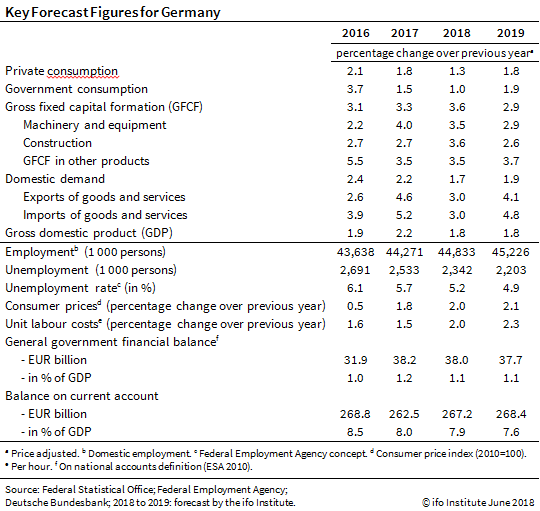
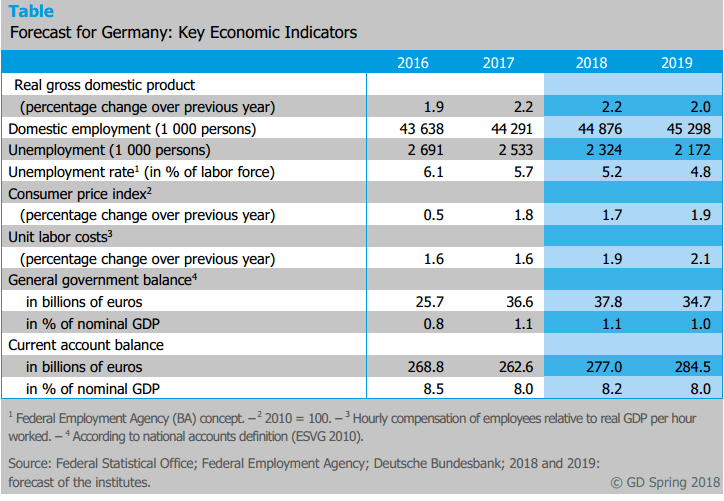
Even after the downward revision in growth projection, Ifo noted that downward risks have "increased significantly". In particular, it singled out the US as external risk. It pointed out "in June 2018 the USA introduced tariffs of 25% on steel and 10% on aluminium imports from Canada, Mexico and the European Union. Although the long-term effects of these tariffs are relatively weak, the USA is currently considering whether it should introduce a tariff on imported cars too. Overall, this would lead to considerably higher GDP losses. At the same time, the EU and China have announced retaliatory tariffs, meaning that the introduction of further trade barriers is no longer a negligible risk."
In addition, Ifo pointed to US triggered supply side driving oil price surge as another risk. It noted, "the increase in oil prices up until the beginning of this year were largely demand-side driven. Since then friction between the USA and Iran have promoted a supply-side in-crease in oil prices, which is likely to have a dampening impact on the world economy. If the pressure from the US government on the EU were to become so great that the EU revoked the nuclear agreement, oil prices would continue to rise and curb growth in world production."
Yen Bulls Return As Trade Frictions Intensify, ECB Forum Gathers Attention
Here are the latest developments in global markets:
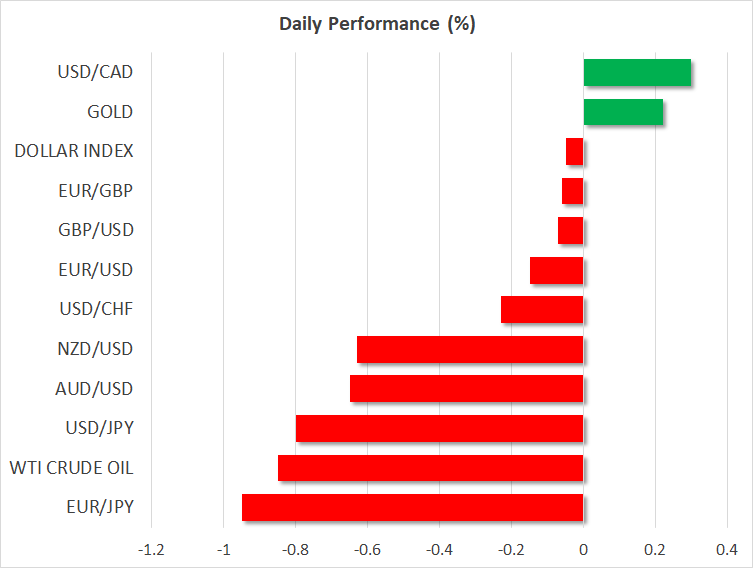
FOREX: The US dollar index – which tracks the greenback's performance against a basket of six major currencies – is lower on Tuesday, though by less than 0.1%. Meanwhile, the Japanese yen is 0.8% higher against the dollar and nearly 1.0% stronger versus the euro, as signs of further escalation in trade tensions between the world's two largest economies are diverting flows into safe-haven assets.
STOCKS: US markets closed mostly lower on Monday, amid lingering concerns over a trade war. The Dow Jones and the S&P 500 fell by 0.41% and 0.21% respectively, while the Nasdaq Composite managed to rise, albeit only marginally. Futures tracking the Dow, S&P and Nasdaq 100 are currently flashing red and suggest these indices are likely to open sharply lower today, following reports overnight the US is considering another round of tariffs on China. Asian markets felt the heat, with Japan's Nikkei 225 and Topix plunging by 1.77% and 1.55% correspondingly, while in Hong Kong, the Hang Seng dropped a whopping 3.1%. In Europe, futures tracking the major benchmarks suggest the carnage will continue, as all indices are expected to open more than 1.0% lower.
COMMODITIES: Oil prices rebounded on Monday, aided by reports that OPEC and associated producers may decide to raise their production by less than previously suggested at their upcoming meeting on Friday. However, both WTI and Brent gave back some of their gains on Tuesday, as the broader risk aversion in markets and the increasingly realistic prospect of a 'trade war' is clouding the outlook for oil demand. In precious metals, gold is 0.2% higher today, currently trading just above the $1,280/ounce mark. The risk-off environment is helping the metal post some gains, though the advance is still relatively small compared to the surge seen in other haven assets like the Japanese yen.
Major movers: Havens rally, stocks slump as risk aversion takes hold
Another wave of risk aversion hit markets on Tuesday, following reports the US may impose 10% tariffs on another $200bn in Chinese goods. The move likely caught investors by surprise, considering how recently the latest set of tariffs was announced, and that several participants probably anticipated some form of dialogue in the coming days, not immediate escalation. Trump said these tariffs will go into effect if China 'insists on going forward with the new tariffs it recently announced', adding the US will impose even further measures if the Asian nation retaliates again. China immediately responded it will 'forcefully fight back' with 'qualitative' and 'quantitative' measures.
In classic risk-off fashion, equity markets in Asia were a sea of red, while haven currencies like the Japanese yen soared overnight. Risk-sensitive currencies such as the aussie and kiwi also took a hit, both declining by 0.6% versus the greenback, with aussie/dollar tumbling to a one-year low. Even gold prices rose, albeit very modestly, once again showing a muted response to trade worries.
Clearly, the risk that the situation deteriorates further has risen meteorically, as the two sides are back into a tit-for-tat pattern. More importantly, it is becoming increasingly questionable whether the US moves are simply intended to generate leverage ahead of talks, or whether they are indeed the opening salvo in a 'trade war', as there are currently no signs of negotiations being in the pipelines. China is likely to announce fresh countermeasures of equal intensity – as it has done consistently thus far – likely keeping risk appetite suppressed for a while, and potentially diverting funds into haven assets to the detriment of riskier ones.
Elsewhere, politics are still in play in Europe. German Chancellor Merkel's position is seen as being in jeopardy amid a domestic standoff on immigration policy. Her government's interior Minister, Horst Seehofer, is leading a ‘rebellion' to turn away immigrants if they have registered elsewhere in the EU. The situation is seen as weakening Merkel's already-fragile standing, and is worth keeping a close eye on, as any signs that the pro-EU Chancellor may be replaced would likely spell bad news for the common currency.
Day ahead: US housing data due; US-China trade spat receives new chapter; ECB Forum also on the agenda
Tuesday's calendar is relatively light in terms of economic releases, with some figures on housing out of the US attracting most interest. Generating more attention than data releases though, are trade developments, as well as the ECB Forum in Sintra, Portugal.
Krona pairs will be in focus as Sweden's unemployment rate for May is made public at 0730 GMT.
May's housing starts out of the US will be released at 1230 GMT. Analysts are projecting a 1.4% monthly increase in the number of starts during May, following a 3.7% decline in April. The number of building permits for May is due at the same time.
The outcome of the bi-weekly milk auction will be known later today – though there's no specific time of release. Kiwi pairs will be generating attention as the data are made public; dairy products are New Zealand's largest goods export earner, with higher prices seen as supporting the NZD.
On the trade front, the US-China spat received a new chapter after Trump threatened to push forward with an additional 10% tariff on $200 billion worth of Chinese goods imported into the US. China indicated that it plans to retaliate to such an action, whilst accusing the US of starting a trade war. Developments will be closely watched and have implications not just for currency markets, but also equity, fixed income and commodities.
In UK politics and Brexit-related, PM Theresa May suffered a defeat in the House of Lords on Monday which opens the way for another vote in the House of Commons and a likely confrontation with pro-EU 'fellow' Conservatives over her Brexit plans.
The ECB Forum on Central Banking in Sintra, Portugal will continue through Wednesday and features speeches from influential policymakers who can move markets with their comments. ECB President Mario Draghi (0800 GMT), ECB chief economist Peter Praet (0830 GMT and 1100 GMT) and St. Louis Fed President James Bullard (1100 GMT – non-voting FOMC member in 2018) will be among those delivering remarks today at the venue. Meanwhile, ECB Member of the Supervisory Board Pentti Hakkarainen will be speaking in Frankfurt at 1015 GMT.
In energy markets, API data on US crude stocks are due at 2030 GMT.
Technical Analysis: USDJPY negative in the short-term as it hits 8-day low
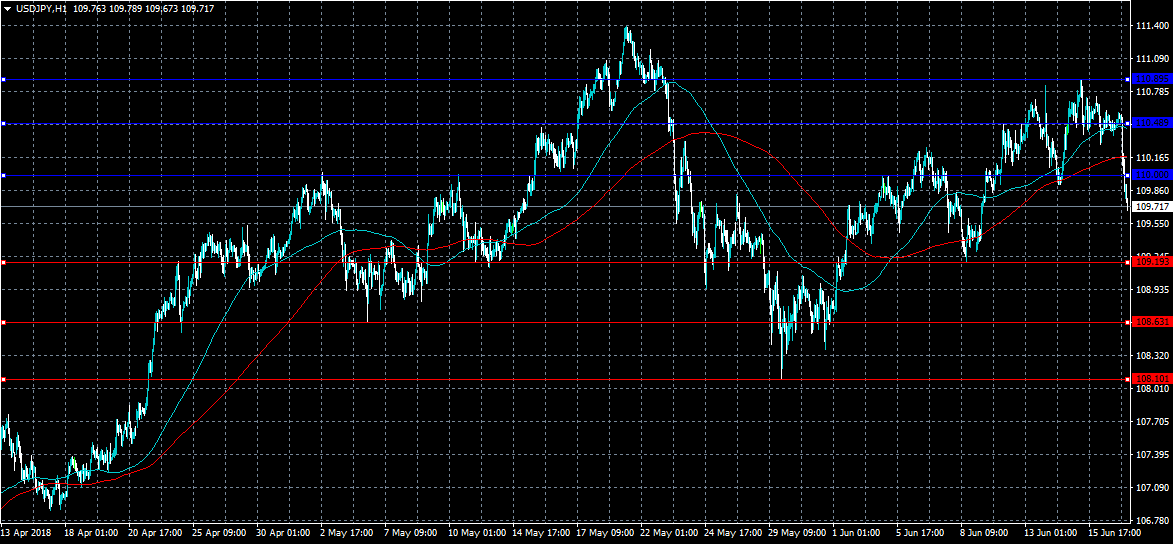
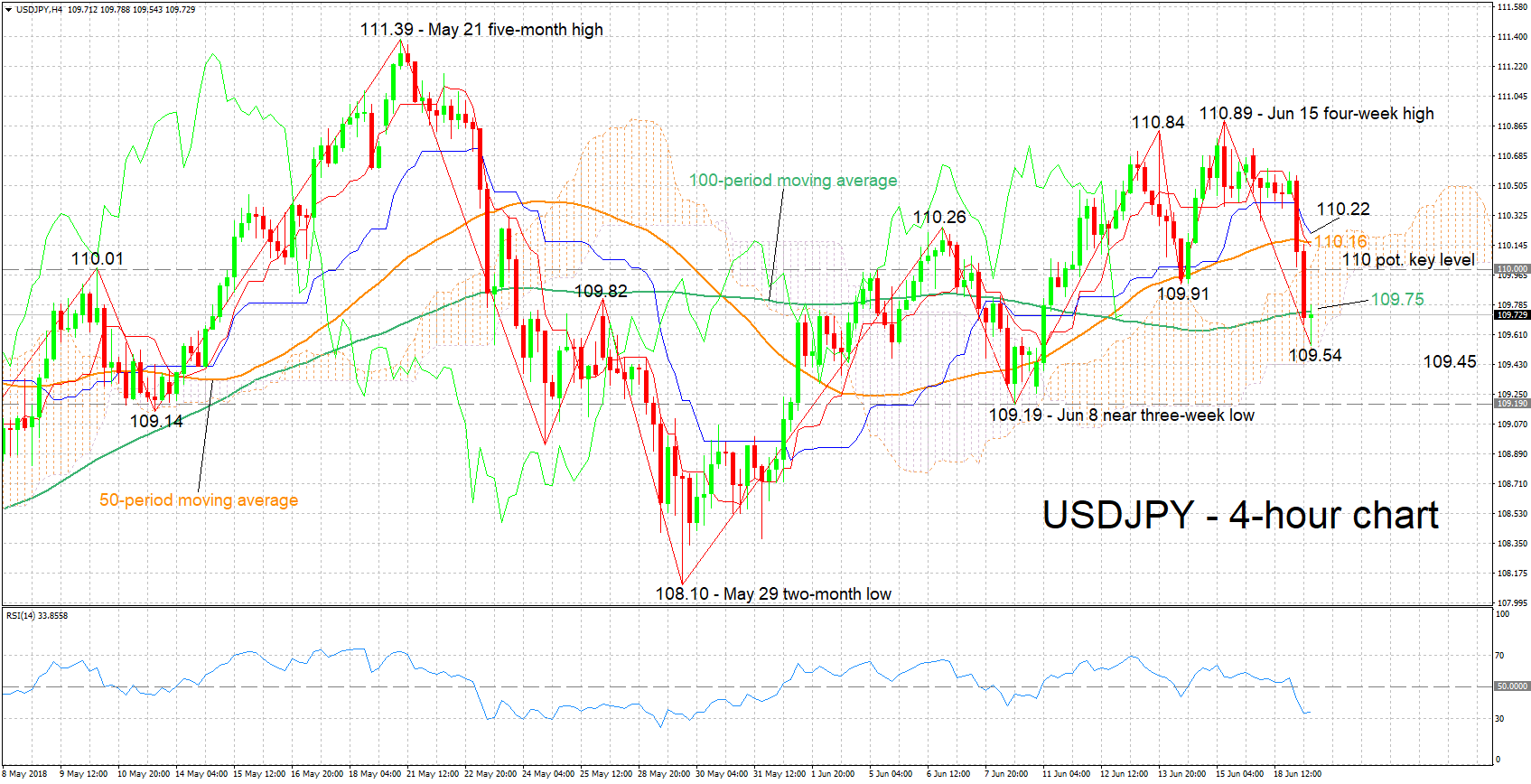
USDJPY recorded losses after touching a four-week high of 110.89 on Friday. Earlier on Tuesday, the pair posted an eight-day low of 109.54. The negatively aligned Tenkan- and Kijun-sen lines, as well as the declining RSI are pointing to a bearish short-term picture for the pair.
Further escalation of trade tensions between the US and China is likely to divert safe-haven flows into the yen, pushing USDJPY further down. Immediate support could come around the Ichimoku cloud bottom at 109.45. The region around the near three-week low of 109.19 from June 8 – including the 109 handle – would be eyed next in the event of steeper declines.
An easing of tensions is expected to boost the pair. Resistance seems to be taking place around the current level of the 100-period moving average at 109.75. The area around the 110 round figure, which also encapsulates the 50-period MA (110.16), Ichimoku cloud top (110.14), Tenkan-sen (110.14) and Kijun-sen (110.22), could act as an additional barrier further above before the attention shifts to last week's four-week high of 110.89.
US releases later in the day can also move the pair.
XAUUSD Intraday Analysis
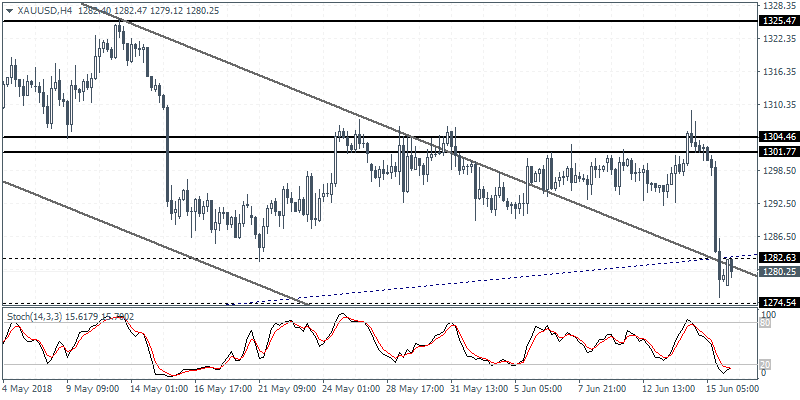
XAUUSD (1280.25): Gold prices were seen drifting below the 1282 handle and price action is showing signs of forming a temporary bottom between 1282 and 1274. The reversal off this level could once again put gold prices to trade within 1301 - 1304 level of resistance while to the downside, the declines are likely to be limited near the 1274 handle. Gold prices are likely to remain in the sideways range for the moment.
USDJPY Intraday Analysis
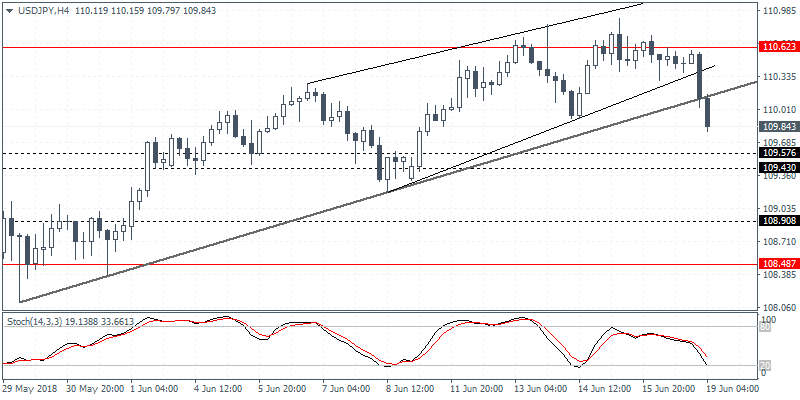
USDJPY (109.84): The USDJPY currency pair was seen posting losses with the markets going easy on risk. Following the break of the rising trend line and the rising wedge pattern, the USDJPY currency is likely to retest the lower support at 109.57 - 109.43. In the near term, any retracement will most likely test the breakout level near the trend line at 110.09. But further gains are likely to be limited at this point.
EURUSD Intraday Analysis
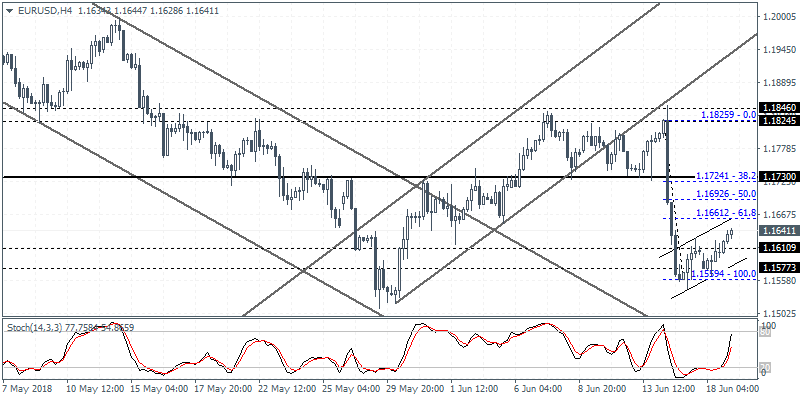
EURUSD (1.1641): The EURUSD currency pair was seen trading subdued with price action mostly limited within the range established from Friday. However, early price action in the Asian session is signaling that the currency pair might be inching higher. Still, the main resistance at 1.1730 remains a key level that needs to be breached in order for the euro to target 1.1920 - 1.1955 level. While the bias is slightly shifting to the upside, the 4-hour chart shows the EURUSD posting a bearish flag pattern near the support. A break down below 1.1577 could however signal a continuation to the downside, targeting 1.1394.
Risk Sentiment Puts The USD On The Back Foot
The U.S. dollar was seen trading mixed on Monday with a slight risk aversion putting the safe haven yen and the Swiss franc on the front foot. Economic data was relatively light on the day. The markets continue to remain cautious on escalating trade war rhetoric between the U.S. and its trading partners including China.
The economic calendar for the day is relatively quiet. The ECB president, Mario Draghi is expected to speak for the second day today at the banking conference in Portugal. This is later followed by the Eurozone current account report.
The U.S. trading session will see the release of the building permits data. Economists forecast that building permits increased 1.35 million in the month of May, slightly lower than the 1.36 million seen the month before.
The U.S. housing starts data is also expected during the day.
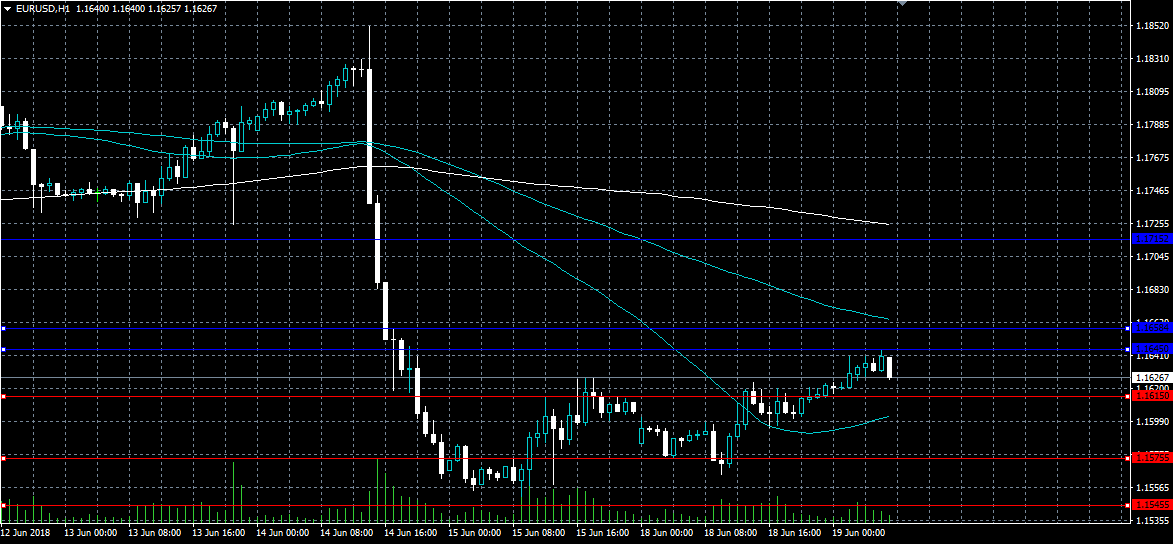
EURUSD Only Intraday Bullish Above 1.1615 Level
The euro has moved above key resistance against the US dollar, after the greenback tumbled, following trade tariff concerns between the United States and China. The EURUSD pair has so far found technical resistance from the 1.1645 level, although bullish momentum continues to build while price trades above the 1.1615 level. Traders now look to key speeches from ECB President Mario Draghi and Federal Reserve Chair Jerome Powell.
The EURUSD pair is intraday bullish while trading above the 1.1615 level, further upside towards 1.1658 and 1.1715 remains possible.
If the EURUSD pair moves below the 1.1615 level, price may decline back towards the 1.1575 and 1.1545 levels.
USDJPY Now Bearish Below 110.00
The US dollar has fallen sharply lower against the Japanese yen, after reports surfaced that US President Donald Trump has asked US trade reps to identify two-hundred billion in Chinese goods that could have trade tariffs placed on them. The risk-sensitive USDJPY pair has tumbled well below 110.00 level, and risk deeper losses as risk-off trading sentiment increases. Traders now look towards a scheduled speech from Federal Reserve Chairman Jerome Powell and the US equity market open.
The USDJPY pair is bearish while trading below the 110.00 level, key technical support is found at the 109.00 and 108.63 levels.
If the USDJPY pair moves above the 110.00 level, key intraday resistance is found at the 110.28 and 110.48 levels.